Notice: Function _load_textdomain_just_in_time was called incorrectly. Translation loading for the wordpress-seo domain was triggered too early. This is usually an indicator for some code in the plugin or theme running too early. Translations should be loaded at the init action or later. Please see Debugging in WordPress for more information. (This message was added in version 6.7.0.) in /home/bcm/src/dev/www/wp-includes/functions.php on line 6121 uk | Zikoko!
It’s that time of the year when we all start to regret all the decisions that led us to still be in Nigeria.
If, like me, you need an escape from all the pressure that comes with this season, you should clutch these tips like the best thing after hot agege bread.
Mute UK, Canada and USA on X
There’s a higher chance of hearing about your friend or family member’s travel plans on Twitter than on WhatsApp, Facebook, Instagram or in person. But how will you even know if you’ve muted all the japa buzzwords? What you don’t know won’t kill you.
Join a political party
This is the best time to pitch your tent in the compound of the APC, PDP or any other political party in the country. But don’t stop at joining, preach the gospel of your membership and everyone around you will easily mark you as a patriotic Nigerian nurturing plans to run for office. Can you run for office from the abroad? Exactly. No one will be able to pressure you.
Take an interstate trip
It’s not the UK or America, but at least, you’re catching flights, right? It’s the thought that counts. A change of scenery and environment will make it easier to accept the thought that your bestie is now a thousand miles away. After all, you’ve also relocated a dozen miles away.
Plan a vacation
Some Nigerian parents have taken a chill pill with marriage talks and jumped on the japa train. To avoid the entire mix, just plan a small vacation around that period and make yourself unavailable. With ₦200-₦500k, you might even be able to take a trip to Ghana, Togo or the Benin Republic.
Launch a business
For every “Are you considering japa?” question that comes your way, you tell them you have a business to grow in Nigeria and would only consider travelling out for vacations.
Start the japa conversation
This will give you a sense of taking a step in the japa direction. Research about the country and processes, and every time your friends in the abroad ask when you’re joining them, load them up with information that shows you’re putting in the effort. It’s giving delulu, but it’s better than unhealthy pressure.
The Nigerian experience is physical, emotional, and sometimes international. No one knows it better than our features on #TheAbroadLife, a series where we detail and explore Nigerian experiences while living abroad.
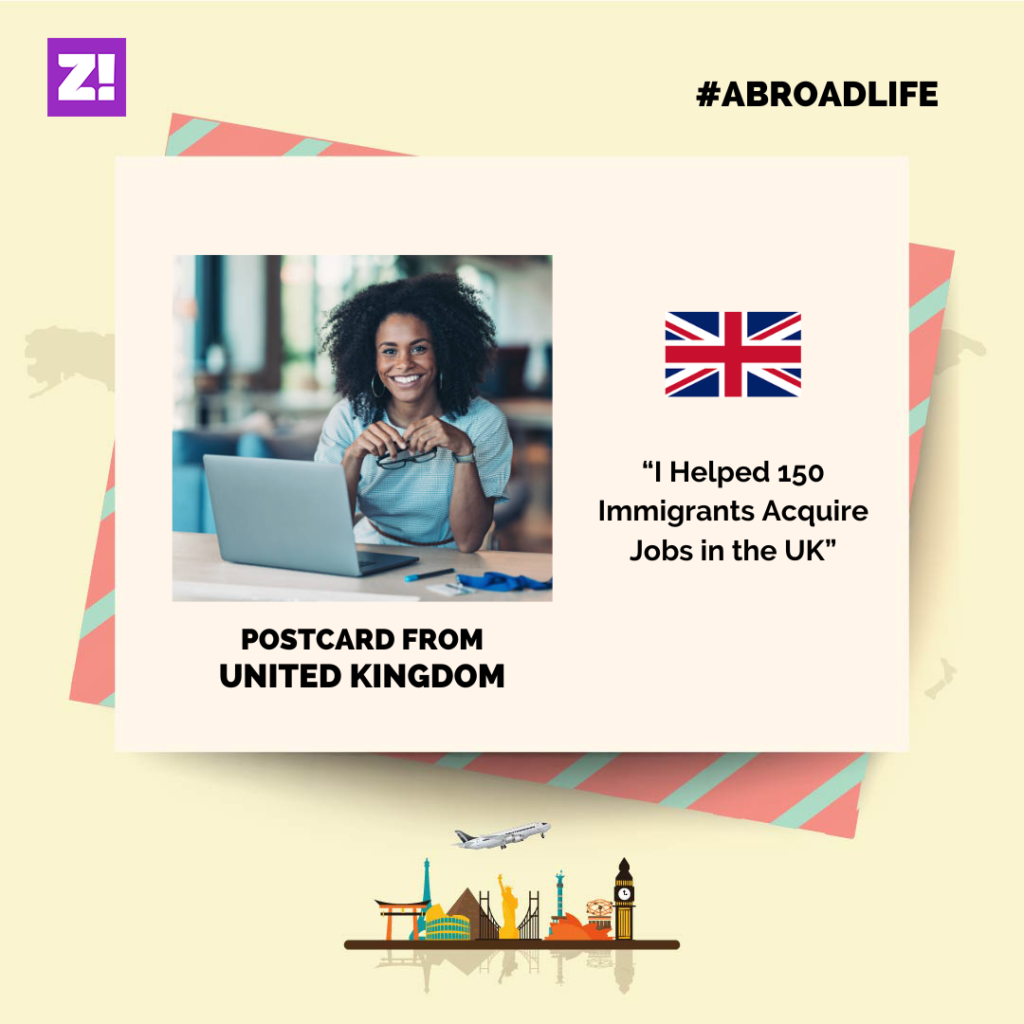
The subject of today’s Abroad Life is Rukayat, a senior financial analyst in the UK whose side hustle is to connect foreign immigrants with job opportunitiesthrough RKY Careers. She spills the tea on her journey into resigning from a senior position at a legacy bank to relocate to the UK for her Master’s Degree and eventually starting her employment franchise.
What inspired you to move to the UK?
Oh, I moved to the UK to be with my fiancé (now husband) in 2019. As I started early, I was then at a senior level at Guaranty Trust Bank (not an executive). But I also wanted to further my education and get a Master’s degree.
What was the process like?
Well, I first have to start with the anxiety. I had to work through the fact that I was leaving my senior role at the bank to start a new life in the UK. I first tried to come in as a tourist to test the waters, as I didn’t have as much information on the process then as I do now.
However, I was later denied for reasons I’m not aware of. At the time, there wasn’t a specified student visa that could enable me to stay in the UK after my studies, so the “student visa” I got only allowed me access to the UK, which expired immediately after graduation. It was in 2021 that it became effective. I got admission to study Financial Technology at the University of Stirling, shortly after the COVVID in 2020
That’s wonderful! What was your Masters’ experience like?
I had the experience of taking physical classes for six months or four months after the peak of the COVID period. The percentage of Nigerians or even other Africans among the whites was very low.
In fact, I and one other Nigerian were the only two self-paid students in my class. The remaining two Nigerian students were on a Chevening scholarship. I also had the opportunity to pay my school fees in installments for twelve months. I was able to pay through savings from my salary at the bank, plus I had the support of my husband.
At that period, I had to live in Stirling, Scotland. Stirling was what I needed at the time because it was a very quiet and humble place. However, I didn’t live with my husband in England, so I still had to pay 350 pounds for my accommodation.
I got married a few months after I came in, was pregnant throughout the time of my studies, and gave birth at the time of my dissertation, so I needed a calm environment. It was also a struggle getting part-time jobs in the beginning (from September to December) because of the influx of international students rushing into the country. However, I could live with my husband’s support, and I finally got a part-time job in January.
Fantastic! How did you then come about creating RKY careers?
Getting my first job after school in the UK also birthed RKY careers in 2022. Going into the job market at first was scary because of the issue of not accepting Blacks lower rate than other races. However, this wasn’t the case. God favoured me with job offers, and I got various calls on salary expectations. At some interviews, I got rejected. At times, this happened in my final stage.
I was applying for jobs based on my research and had no guidance. I eventually got a job as a Senior Finance Analyst. After a couple of months, I then started to help Nigerians, from close friends and family to people in my current work who also had struggles getting a job in the UK for the first time. I first named the page “Live Careers in the UK” as a career consultation and advisory page, where I could dish out advice for first-time immigrants on careers in the country.
In the process, I also started helping people create CVs as well as LinkedIn optimisation. Last year, we also started to work on training for career professionals who wish to transition.
How did you register?
I first went to the Companies’ House where I paid a bill of 13 pounds. You can register as a limited liability company or a sole entity, but mine was a sole entity. You must also be eligible for it, as not everyone’s visa allows them to own companies in the UK.
What have been the achievements and setbacks so far?
So I’d say our team has done a good job so far regarding achievements. We had over 150 success stories of people who got jobs in the UK and even Nigeria and were called for speaking events, and they are generally doing very well. We have also empowered people to live their dreams in whichever career opportunity they choose.
The challenge, I’d say, is dealing with people, as you cannot satisfy everyone with a peculiar style. You have to offer bespoke services. It is also uncommon for Africans to patronise their own people, and even if they do, they make so many demands. I think we need to do better to respect black owned companies.
Where do you see RKY careers in the next 5 years?
We intend to make more impact and help more people be an inspiration to many others. We also need to increase inclusion and diversity in the workplace, not just for Nigerians but for all Africans.
Want to know Nigeria’s political history since 1999? Sign up here.
The Nigerian experience is physical, emotional, and sometimes international. No one knows it better than our features on #TheAbroadLife, a series where we detail and explore Nigerian experiences while living abroad.
She speaks of her motivations for relocating, getting her student visa, registering her husband as her accompanying person, and navigating life with their current visa status.
What was your motivation for moving to Scotland?
I’d say that the act of “Japa,” or relocating to another country, has been my dream for as long as I can remember.
I’ve always loved the atmosphere and culture of Caucasians. Also, getting a postgraduate degree has always been on my bucket list, and that was a key priority in my mind.
The UK had the best offers for me regarding tuition fees, and my school (the University of Aberdeen) is currently ranked as one of the best schools in the UK.
Nigeria was also getting very difficult with issues of fuel scarcity, frequently interrupted power supply, etc., which spurred me to take action on my Japa plans.
When did you start the process?
I applied for admission in October 2022, shortly after my wedding in June 2022. Towards the beginning of November, I had gotten my entry, and by 2nd week of December, we had our visa.
By December 31, we had left the country for Scotland.
Wow, that was fast! Was anything done to hasten the process?
No, not really. The significant steps are to get admission from your institution and stack your proof of funds for 28 days.
Then they gave us our university’s CAS (Confirmation of Acceptance for Studies). However, every school has its own admissions process. Some schools may need you to send a deposit (maybe £2k – £4k) before they give the CAS. And it’s not something you can do without, as you’d need it for your student visa application.
However, my school didn’t request the deposit, so I didn’t pay. I did get a priority visa, though.
What’s the difference between a priority visa and a regular one?
Usually, there are peak visa periods, e.g., December, because of students going in January.
September and October are usually very busy and take longer processing times. However, if it’s not a peak season like April/May, no one would advise you to get a priority visa because it will likely take less than five working days.
Nice! How did your husband apply for his visa?
He applied as an [accompagnating person] under me.
How does that work?
When I applied for admission, I informed the school that I’d be bringing my husband in as a matter of courtesy.
However, the family issue applies when you’re applying for a visa. When filling out the form online, one of the first questions asked is if you have a spouse or children legally recognised under the law.
You fill out the form separately for each person, and since it was just my husband, I filled out only one. You must also ensure that your Proof of Funds covers living expenses for yourself and your family members and your school fees.
For a student, there are two types of proof of funds. If you go to school in London, you’d need to show up to £1,334 (or N758,777) and £1,023 (N104,419) if you go outside London. And both are for if you’re coming alone.
If you’re coming with a family member, you must show £680 (or N386,706) each. Proof of funds is also needed for the duration of your course and your family member’s monthly living expenses.
It will be higher or lower depending on where you live in the UK. For instance, if you live outside London, your proof of funds would be much cheaper than for someone living in London.
It’s not complicated at all.
Great. How has Scotland been for you in terms of advantages and challenges?
There are a lot of advantages here, especially in terms of schooling. When you go to a well-known university with the best learning environment, you tend to want to excel at your studies so that it won’t be in vain.
It has been fantastic for my husband and me in terms of everyday life. People just smile at you and greet you when you pass by. Things are not overly expensive at grocery stores. You’re just getting what you paid for. One is not worried about unstable power or fuel scarcity. It’s been great for us so far.
For challenges, what I can think of so far is the fact that we’ve not had a lot of time to save pounds as new immigrants. It’s easy for us to believe we’ve spent much money on certain things. But we’ve realised that older families, even Nigerians, have lots of money saved up in pounds. We are getting there anyway.
Is there anything else you’re yet to figure out as a new immigrant?
Well, maybe just driving. I have to learn to drive on the other side of the road. Plus, unlike Nigeria, they’re very law-abiding regarding road safety. There are also cameras at every stop, so whatever you do, they’re watching you.
Are there any rules and regulations that restrict your spouse?
There are just 3: no access to public funds, one can’t be a sportsman (I have any clue why), and you can’t practise medicine if you’re still in training except if you have a degree from a UK institution.
So in terms of public funds, they can’t access welfare or unemployment funds.
In cases of an accident or injury, there is a hospital bill called the Immigration Health Surcharge (IHS). This is a UK health charge that non–Europe Economic Area (or EEA) immigrants must pay as part of the immigrant application process. It was paid for while you paid for your visa fee.
The IHS fee fully covers hospital bills.
Based on your understanding, are there any downsides to being an accompanying person in the UK?
Honestly, my husband hasn’t had any so far. Once you’re here, you’re here. People even respect that you had to spend a lot of money to leave your country.
We’ve told people of our migration story in church, and they’re always amazed and like, “Wow, you guys must have been doing very well in your country”, and so on, for you to afford what you pay for.
Even if one is a driver, they treat the person with the same respect as a mayor. The people here are hot and friendly.
Are there any obligations for families that come over with post-grads?
Yes. Firstly, they have to pay tax. As far as they’re working, they have to be unlike students. Students are limited to 20 hours per week, so it doesn’t interfere with studies, but there’s no time limit for families.
Would you say that tax laws are lenient for families?
Well, yes. So there are two types of tax—the income tax and the council tax. Income tax is a percentage of the salary, while council tax must be paid whether you have a job.
You’d usually pay council tax for utilities such as water, waste disposal, etc.
Speaking from our experience, my husband has been lucky because he found a job in tech shortly before we relocated. But even if he didn’t, they don’t impose council tax returns immediately. We’ve been in the UK for five months, and only last month did they start giving us council tax. Some cities process these things slower or faster than others.
Would you say that jobs are readily accessible for post-grads and their families?
It depends on the location. It is easier to find jobs in places like Edinburgh than in Aberdeen. It’s just like comparing the job opportunities volume between Lagos and Abeokuta.
Everyone can get jobs; depending on location and your skill set, it may take some time.
What do you think of the current visa ban for post-graduate student families?
I’ve heard that and don’t think it’s that way. Over time, the UK has habitually closed its borders for a while and then opened them back. Their visa processing is faster than in places like the US or Canada.
The UK’s land mass is comparatively smaller, so they must be careful. But there will always be a need for international students. From what I’ve been hearing, most universities in the UK cannot run without international students because that’s where the bulk of the money comes from.
If they decide to make this ban permanent, it will affect universities because it will discourage international students from applying to their universities. And that would mean a lack of money for them.
This video from Scottish UK Parliament member Carol Monoghan proves this point. I can understand why it’s happening, though, because you can see Nigerian postgraduate students with courses of 1 year bringing 5-6 family members. It makes one raise eyebrows.
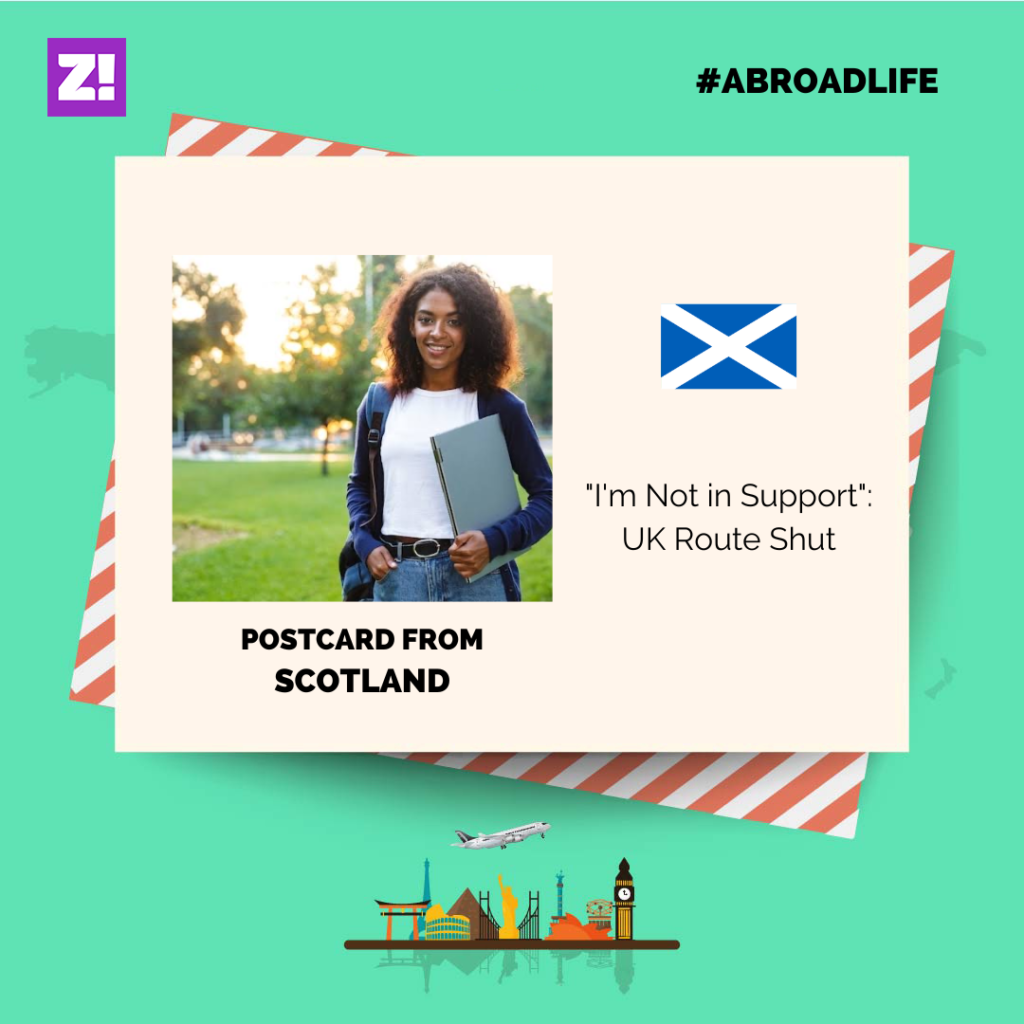
All the same, even though I understand their motivations because of the population explosion, I am not in support of this ban. I’ve been on the other side of the fence regarding making relocation plans, and I know how frustrating it can be to change those plans and re-strategize from scratch. Plus, who wouldn’t like to have their loved ones close to them? It’s not easy.
Have you heard from postgraduate aspirants back home? How do they feel?
Well, everywhere is hot in that regard. I know some of them; the whole situation has made them livid. It has forced people to re-strategize all over again. I am incredibly grateful to God that my husband and I made it out when we did; if not…
If not, indeed. Have you watched the Tiamiyu video? What are your opinions on it?
One thing we need to know about the UK is that they’re very brilliant. They know that people are taking advantage of the study route, but they wouldn’t want to say that for fear of being racist. He just said what he wasn’t supposed to say.
But do you think his actions would affect students already in the UK?
I don’t think so. I think they already know that this is what Nigerians are doing. The decision was already made before they posted the guy’s interview.
But from the Scottish MP’s video, it sounds like not all parties are still on board, and it’s still a matter of debate. Let’s watch and see.
How can your husband then upgrade their visa in the future?
So it depends, as there are several routes. I could either apply for a graduate visa after I graduate for two years, or any of us can get a sponsored job. These processes don’t take time at all.
Do you and your husband ever see yourselves relocating back to Nigeria?
Honestly, no. Maybe I can revisit Nigeria for “Detty December” or other special occasions, but I don’t want to limit myself to just the UK.
My husband and I would love to explore other countries soon.
The phrase “good things don’t last forever” seems to be the new reality for Nigerians aspiring to relocate to the United Kingdom (UK).
Once a popular travel destination for the Nigerian “japa” dream, it is slowly dropping off the ‘wannabe list’.
The UK is set to add new restrictions to curb its migrant population boom. This week, the monarchy-led country plans to disclose more details of a restriction affecting foreign postgraduates; they won’t be able to bring their families to the UK.
There are claims that this targeted Africans, and there are many reasons to believe so. But who exactly are the affected parties, and what would the impact of this restriction be for aspiring international students?
The affected parties
These include mostly students aspiring for a Master’s degree and some other postgraduate degrees. However, highly skilled PhD students with 3-5 years courses will remain unscathed by the ban.
What brought about this upcoming policy change? To understand this, we need to understand a few things that contributed to the need for the UK to have plans for travel restrictions.
In September 2022, official immigration data released by the British government revealed a surge in the number of foreign students in the UK. Students brought 135,788 family members—that’s nine times more than in 2019. Nigerian students—59,053 alone—brought over 60,923 relatives.
UK government when they saw the numbers
As a result, the UK Home Secretary, Suella Braverman, has considered clamping down on international students coming to the UK due to the massive “structural pressures” that it imposes.
The decision also follows reports that net migration into the UK has hit 1 million. This has made the Tory MPs ‘apply pressure’ on Prime Minister Rishi Sunak “to get a grip on the rocketing numbers”.
UK’s 2019 international education strategy
In case you didn’t know, the UK wasn’t always a popular destination for Nigerian students. Between 2012 and 2017, the country experienced a 27% drop in Nigerian student admissions, and they saw the need to up their game.
How we imagine the UK government plotting a way out of their predicament
Hence, the Department for Education and the Department for International Trade created the International Education Strategy in March 2019.
In this strategy, Nigeria was part of five high-priority countries (India, Indonesia, Saudi Arabia, and Vietnam) that the UK chose to achieve two main goals. This was to increase education exports by £35 billion per year and increase the number of international higher education students studying in the UK to 600,000 annually.
This plan worked on the Nigerian front, as the number of Nigerians who obtained UK student visas experienced a 39% increase (from 13,020 in 2019 to 21,305 in 2020).
But this wasn’t enough for the UK government. They needed to sweeten the deal, and in October 2020, the British Home Office introduced the student visa. It was established as an improvement to the former mode of student migration, called Tier 4. Among many new guidelines, it created a unique, golden opportunity for Nigerian students—to leave the country with their families.
But even though this served as a blessing in disguise for international students, we can all see what the UK government is about to do. Problem.
But why is the UK such a popular choice for Nigerian students?
Due to these factors, the average Nigerian student can do anything to fund their access to UK education, from scholarships to even loans from family and friends.
Is the ban valid or not?
According to opinions on Twitter, most agree that there would be a drastic reduction in not just the families who make it abroad but in foreign students themselves.
The UK government's statement suggests that they are considering a potential ban on dependents of international students, from entering the country. However, your headline highlights Nigerians, inaccurately portraying Nigeria in a negative manner. This raises valid concerns…
However, this could also mean the UK government ‘shooting themselves in the foot’.
A 2021 report by SBM Intelligence revealed that Nigerian students and their families contributed as much as £1.9 billion to the economy in the 2020/2021 session. And really, would they want to miss out on that bag?
The Nigerian experience is physical, emotional, and sometimes international. No one knows it better than our features on #TheAbroadLife, a series where we detail and explore Nigerian experiences while living abroad.
This week’s Abroad Life subject is a healthcare worker, freelancer and data analyst in his early thirties. He lives in London but works in Bournemouth at the moment. He speaks to us about his life before moving to London, how life in London has been so far, and his newfound love for politics since the buildup for the 2023 general elections started.
What motivated you to move to the UK?
I was born and raised in Nigeria. After I graduated from university, I started working at a publishing company in Lagos. But life was hard for me there. This was for several reasons. Firstly, my residence was at Ikotun, and my workplace was at Ilupeju. The distance was insane but still manageable. After some months, the company relocated to Lekki. Now imagine me having to go all the way to Lekki from Ikotun every single day. That is a distance of almost 60 km. At some point, I got sick of it.
Also, I’ve always wanted to return to school and do my Master’s. The initial
Plan was to do it somewhere in Nigeria, as I felt it was too expensive to do it abroad. But I guess at some point, I thought that the dysfunctional nature of Nigeria would always catch up with me. My best bet was to leave, so I saved up money and, with the help of my family, left Nigeria.
How was the migration process?
So initially, my first plan was to move to Canada. I started the process in 2019 with the use of an agent. I even got admission into Thompson Rivers University, but my visa was rejected. This was because they felt I would not return after school. I spent the next year in Nigeria and got more motivated to leave due to the pandemic and the overall frustration of the country’s lack of working systems.
I then asked a friend sometime around mid-2020 if it was too late for me to start my master’s application to schools in the UK, and his answer was no. He told me to start the process immediately. I went through the process myself, got the visa and then travelled in 2021.
Nice. So how would you describe London so far?
London is like Lagos, but a bit more organised. There are better transport systems. You can always use the tube or train. You get to see a lot of people like you in London. Near my house is an African Market where you can get egusi and other African foodstuffs. There are even African restaurants.
However, when you move away from cities like London or Manchester and you move to places like Bournemouth (where I am currently), it’s way calmer. There’s less traffic and the scenery is nicer. But you hardly see people like you; less African stores and the like. You can also hardly see African food here and you just have to stick to European dishes.
Even though it’s cheaper to live in Bournemouth, I still have friends in London; hence, I can never really leave London. It also reminds me of Lagos too. You can be walking and see two people speaking Yoruba.
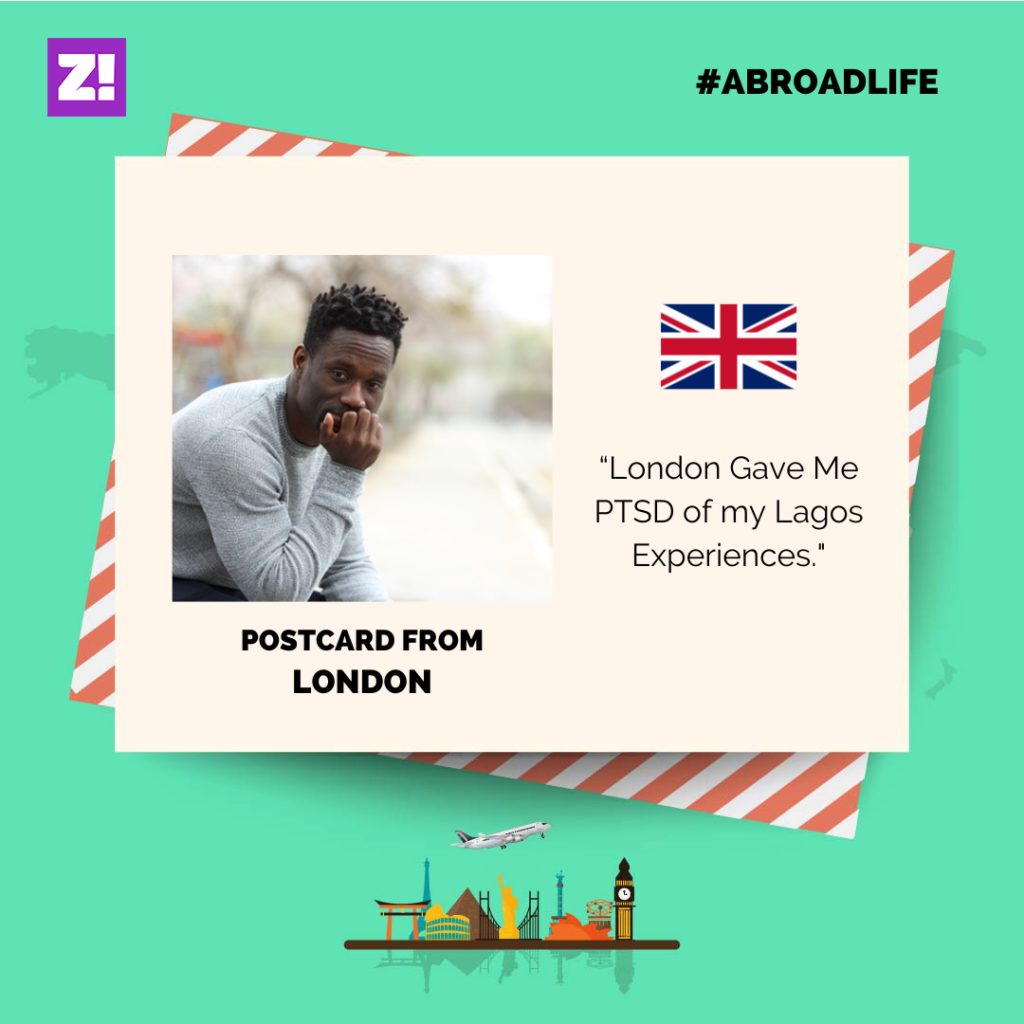
I can remember my first week in London. I needed someone to exchange currency with and the person was in Arsenal, so I had to travel there. I can remember seeing local brooms and people selling puff puff in London. It was crazy. It gave me PTSD of my Lagos experiences.
What are the challenges and advantages of living in London?
It can sometimes get lonely, especially if you don’t make friends easily. There was a time I stayed somewhere for a year and I didn’t even know who my next-door neighbour was. In Nigeria, when you move to a new place, before the next two days you know everyone on the block. I’m lucky I have my cousin here with me, as we both came at the same time. I don’t know how I’d have survived without my family. There is no way I can forget Nigeria in a hurry. I always keep up with current affairs from time to time.
However, you’re sure that nothing will halt your progress because they have systems that work. If you’re working a 12-hour shift, for instance, you can be sure that you will get paid your dues no matter what. No one is telling you that they can’t afford to pay your salary or you get half your salary like in Nigeria.
Also, if you work hard here, you’ll succeed. You can be sure of seeing the fruit of your labour. But in Nigeria, it’s not the case. It’s very risky to do business because you’re not sure of the next government policy that can strike it down. Like this naira redesign for instance, you see the way people are panicking. Things like that don’t happen here.
I’ve noticed that Nigerians here also tend to do very well. This is because we are used to battling systems and external forces that are out to destroy our efforts. When one arrives with that anger and zeal, there is always the possibility of one doing better because those bad systems are almost non-existent. This is the biggest advantage here really.
[newsletter type=”gov”]
Nigeria’s elections are less than two weeks away. Would you vote if you were in Nigeria?
I’d definitely vote if I were in Nigeria.
Did you know you’d not be able to vote from the UK? If you did, then why did you still leave?
I knew I’d not be able to vote. This wasn’t because of a lack of patriotism. I know that when I was doing my undergraduate studies back in Nigeria, I was in groups that advocated for better governance and sensitisation for citizens.
But it got to a point where I was almost going insane with everything going in Nigeria and I needed an escape. I still really love Nigeria and I still wish to come back. However, with Nigeria’s current state, I don’t see how it can benefit me at the moment. Also, I’m the only boy in my family. At some point, my parents will start expecting me to pay bills and do things that a ‘son of the house’ should do. When you’re in Nigeria, paying bills, and your financial capacity isn’t growing anywhere, things will become difficult for you.
Who are you supporting in the 2023 elections, and how do you wish to show your support from abroad?
Funny enough, I supported the All Progressives Congress (APC) in 2015 over the People’s Democratic Party (PDP) because I felt PDP was enjoying a huge monopoly and needed some real competition, having been in power for the last 16 years. However, the APC came and made things even worse.
However, with the rise of a third-force party, I’ve now become a supporter of Peter Obi, who’s under the Labour Party (LP). I believe he’s not part of the ‘inner cabal’ of Nigerian politicians and, therefore, can bring in fresh ideas for Nigeria to become a better place. I’d love for him to be elected as president so that he can change the country and I can come back home. Nigeria is a sweet country to live.
As to how I’m showing my support, I’m making sure that my friends and family are ‘Obidient’. My dad, for one, was so surprised at my newfound political awareness. This is because my dad’s image of me whenever it comes to politics is forcing me to watch the 9 o’clock news back in Nigeria. But when I pitched Obi as the right candidate in one of my calls he was shocked, and so were my family members. So I can say that yes, I show my support by heavily endorsing Obi to everyone I know back home. I also make sure to always make my support loud for Obi on social media, especially on Twitter.
The Nigerian experience is physical, emotional and sometimes international. No one knows it better than our features on #TheAbroadLife, a series where we detail and explore Nigerian experiences while living abroad.
This week’s subject on #TheAbroadLife was a Unilag student who got a fully-sponsored internship in 2022 with an investment bank in the UK. He talks about living in a minor city where he’s often the only black person around, how he’s adjusted to it and why he’s considering a permanent stay in the UK.
Where are you right now?
I’m in Nigeria right now, but that’s only because I came back to enjoy my December. But I live in Chester in the UK.
When did you decide to leave Nigeria?
I didn’t really decide to leave, but everything was set in motion in my penultimate year in Unilag, when I got a summer internship at an investment bank in the UK. It was a fully-sponsored internship and it prompted my move.
Goals. How did you get the internship?
Some global investment banks recruit interns from African countries, as well as other parts of the world. So, it was a typical job application experience. I saw the opening, applied, got invited for a test, a recorded interview followed by a live interview.
With these internships, you’re usually applying to a range of divisions within the bank. Divisions like investment banking, capital markets, human resources, technology, etc.
I started the application late in 2021, and a few months later, I was offered an internship position. It was only meant to be ten weeks long, but my visa allowed me to stay a while longer than that. They initiated the process for me to move and work in their office in Chester, UK.
That’s sweet. What was the visa application process like?
The bank uses a travel company called Fragomen to help with the immigration of their employees. They assisted me from the point of getting an offer letter and applying for a work visa to getting my biometric done and my visa approved. I just had to take my documents to TLS, a UK visa application centre in Ikeja, and they mediated everything else from there on out. The process normally takes about six to eight weeks. But due to the war heating up in Ukraine at the time, it took about ten weeks for me to get a decision.
My visa got approved and the next thing was for me to move. I left Nigeria for the UK in June 2022. The company handled all expenses including my accommodation in the UK.
What were you expecting when you left for the UK?
I had an open mind. This was my first time leaving Nigeria at all, so I only knew as much as I’d heard. One thing that struck me about the place is how different Chester is from the more cosmopolitan cities like London.
99% of the people are white. I can be sure that when I enter any gathering or location here, I’ll be the only black person. I’m often the only black person on the trains. It makes the experience lonely, but at the same time, eye-opening. The loneliness can be very face-slapping sometimes sha. One time, it got really bad that I decided to try a local dating app, and I couldn’t even find any black person on it.
Was it the same at your internship?
Not really. We had way more diversity where I worked. The company hired about 30 Africans, and around 12 of us were in Chester. So, at least I had people I could relate with much better. Of the 12 Africans, one was Nigerian and fluent in French.
The company itself has a culture of inclusion, and it showed. I met interns who were military veterans. I met someone who could speak up to seven languages. Another has a YouTube channel with over 100k subscribers. Another was a trans person. It just made me realise how much more people could be outside of the straight line of going to school and “reading book”.
Also, it made me see how narrow my worldview had been up until then. The experience really widened my psyche, and I’m grateful for it.
What’s Chester like?
It’s an old city built during the Roman empire, so it still has buildings with that ancient feel, places like the Chester Cathedral. It’s a naturally beautiful place, where you can just take a short walk outside and randomly find a spot to take Instagram-worthy pictures. Also, they have the second biggest zoo in all of UK.
The city is very community-centered. You’ll see families walk their dogs and old people holding hands. They also have a lot of space. Because of that, horse racing is very big in Chester. In fact, it’s almost a weekly festival. You know how families dress their kids up to go to church on Sundays? That’s exactly how entire families dress up to go watch the races on weekends here. It’s so nice to see. Never seen a more laid back group of people before.
Tell me more about the people
They’re extremely polite and always want to make small talk, even about things that aren’t exactly their business. They’re also very accommodating. Even though it was a predominantly-white environment, I never felt like I was treated differently. In fact, they always seemed so excited to meet someone who’s new to the place.
One time, I and a friend — also an intern — were going to a place we’d never been before, and we were talking on the bus, trying to figure out where the right stop was. This woman sitting behind us overheard and politely interfered to tell us where the right stop was. After, she started making small talk about where we were going, and just like that, she became our friend for the rest of the ride.
Have you had any culture shocks since getting to the UK?
Ah, yes. Where do I start from? The food! Oh my god. I have to carry pepper with me every time because the food is always bland. And it’s impossible to find African restaurants here. It’s impossible to find Nigerian food unless I cook, which I absolutely don’t like doing. I’ve been to London a few times since I’ve been in Chester, and I always have more food options there.
Another thing is the cold. I arrived during the summer, and the weather was 14oC. How in the world is it 14oC during summer? I carried a lot of regular shirts thinking I could make do with them since it was summer. LMAO.
The accent here is another interesting thing. It sounds like English, and it’s actually English, but you can’t tell for sure when they’re talking to you. Their accent is very similar to Scottish, so it’s different from what you’d hear in places like London. It used to be a struggle when I’m in conversations, but I’m better at understanding it now.
Another thing is how much people smoke here. Everyone has a vape pen. I love the people here, but the smoking makes me scared for them sometimes.
How long was the whole internship experience?
It was ten weeks long.
How have you been able to stay so long then?
After the internship, I applied to extend my stay to get a better feel of the city. On top of that, the company I worked with reviewed my performance and offered me a full-time position. But I had to come back to Nigeria to complete my education first.
Now that I’m done, I’m going back to Chester because what am I looking for in Nigeria?
So you’ll stay in Chester for as long as possible?
I’d prefer to move to a place with more variety, especially with the food. London would make sense. But I also like Chester, so I can definitely settle here.
Want more Abroad Life? Check in every Friday at 9 A.M. (WAT) for a new episode. Until then, read every story of the series here.
The japa trend has taken Nigeria by storm in the past couple of years, as students, families and professionals are fleeing the country for greener pastures.
According to the United Nations Department of Economic and Social Affairs, the number of international migrants from Nigeria in 2020 was about 1.7 million. With the recent announcement by the United Kingdom’s Department for Education, it looks like this figure will climb even higher in 2023.
What did the UK say?
So, via a publication on their website, Nigeria was listed among the African and Asian countries whose citizens are eligible to apply for teaching jobs in the UK come 2023.
The other eligible countries are Ghana, Hong Kong, India, Jamaica, Singapore, South Africa, Ukraine and Zimbabwe.
The programme will begin on February 1, 2023, and applicants must have a Qualified Teacher Status (QTS) awarded to them by the Teaching Regulation Agency (TRA). The interesting thing about this process is you don’t need formal teaching training. What you’d need are:
An English and Mathematics qualification the same standard as a grade 4 General Certificate of Secondary Education (GSCE). This is equivalent to a C in your West African Senior School Certificate Examination (WASSCE) or National Examination Council (NECO) Certificate.
A Bachelor’s degree
A minimum of two years teaching experience
What does this mean for Nigeria?
More brain drain
This year, we witnessed the mass exodus of our health professionals leaving the country with an average ratio of one doctor to 10,000 patients. And with this opportunity, we may soon see this calamity replicated in our already dilapidated education system. Public schools are already overwhelmed with the number of students they have to deal with, and this situation may get even worse in the coming year.
Poor quality of education
If a brain drain happens in our education sector, it’ll do more than increase the ratio of educators to students. The quality of any education system depends on the quality of its intellectual pool. Last month, the registrar of the Teachers Registration Council of Nigerianoted that over 260 teachers migrated to Canada this year. If our number of qualified teachers continues to dwindle, it’ll eventually affect the quality of students produced.
Retarded economic growth
It’s important to remember that applicants for the UK teaching jobs don’t need formal teaching qualifications. However, they must have a Bachelor’s degree, meaning they’d be skilled in other areas. If we lose most of our skilled labour to migration, our economic and technological development will remain in the trenches.
A good way for the country to manage this situation would be to increase the incentives for the academic staff across all public schools, provide more job opportunities with attractive salaries for graduates, and make the work environment and culture more conducive.
It seems like Nigerians aren’t the only ones concerned about the 2023 elections, even our colonisers have taken some interest as well. Considering that our immigration rate to the United Kingdom has increased to 64% in one year, it’s not exactly surprising.
The British High Commissioner to Nigeria, Catriona Laing, has warned all political parties and officials that Britain would be “watching very closely” to see who’ll mess up and commit electoral fraud or sponsor violence. The punishment? Visa restrictions that’ll stop them from flying to the UK.
But is this enough to stop Nigerian politicians from misbehaving? The UK can do more to pepper our politicians should they dare to tamper with the elections and we have some ideas.
Ban all UK hospitals from attending to Nigerian politicians
Medical tourists like the All Progressives Congress (APC) candidate, Bola Tinubu, and Peoples’ Democratic Party (PDP) candidate, Atiku Abubakar, and others like them should be banished to the Nigerian medical trenches if they do so much as sneeze on our votes.
Seize all their foreign assets
Nigerian politicians love showing off their wealth with assets abroad, and the UK is a favourite destination. It would be a shame if the UK government seized everything election riggers own in their jurisdiction, from apartment buildings to the smallest toothbrush.
Deport their children
Who says it’s only politicians that need to pay for rigging elections? Even their children studying at Cambridge and Nottingham need to pay for their parents’ misdeeds.
Public humiliation
The UK always threatens visa restrictions for election riggers before Nigerian elections but we never hear about the people affected. Maybe it’s time for them to start naming offenders on their blacklist so we can more loudly shame them in public. We have some rotten tomatoes that need to be thrown.
The Nigerian experience is physical, emotional, and sometimes international. No one knows it better than our features on #TheAbroadLife, a series where we detail and explore Nigerian experiences while living abroad.
The doctor on today’s #AbroadLife talks about moving to the UK in 2020 and finding happiness with reunited friends from Nigeria despite how difficult the UK can be.
When did you decide to leave Nigeria?
2017. Before then, I was like a Nigerian who dreamt of moving abroad but didn’t do anything about it. When I finished medical school in 2017 and went for my housemanship, I realised Nigeria wasn’t a place I wanted to practice medicine.
Why?
The quality of medical practice in Nigeria is bad. Let me tell you the experience that made the decision final. In the hospital’s surgery department where I worked, a consultant usually checked on the patients and instruct nurses on how to care for them. On one of these routine visits, the consultant asked a nurse to open up the dressing of a man’s injury so he’d check and advise on how the man could recover faster. The nurse’s response, right in front of the patient: “I’ve recently dressed his injury, and now we don’t have materials to dress it again if I open this one.” And the consultant moved on.
Just like that, the man couldn’t get the care he deserved, and nobody seemed to care.
What was your process for leaving like?
I first had to choose where I was going. USA and Canada were out of the picture because I just don’t see myself living and working in those places. Australia and New Zealand are too far. South Africa is still Africa. The UK is just perfect. It’s also the easiest path for Nigerian doctors looking to japa.
I decided on the UK in 2017, wrote my IELTS and PLAB exams in 2018 and started applying for jobs after. I sent over 100 job applications through NHS and vacancies on hospital websites. By 2019, I had five offers, and I took the one that offered the most money.
Why the UK?
As a child, I fantasised about living in the UK because of the castles, the beautiful scenery, men in top hats, culture, etc. That’s what the movies made it look like.
And when you got there? Expectation vs reality: UK edition
The first thing that hit me when I got off the plane was the cold. I anticipated it, but no matter how prepared you are, you can’t expect what snow cold feels like. As I settled in, I saw that my idea of the UK was flawed. . I found normal houses, normal people, even some bad roads.
As time has gone by, I’ve realised that the England we see in movies is actually Wales and Scotland. Those places are breathtakingly beautiful.
Was it easy settling?
When I first moved here, my sister lived about an hour away, so she helped me settle in.
Apart from your sister?
Here’s where it gets interesting. In the space of four months after I got here, four other people from a book club I was in, in Nigeria, also moved to the UK. We were all still on the book club group chat, presumably reading that month’s book, so we decided to meet at a restaurant to catch up and discuss the book.
None of us had read the book. But at least we saw one another, talked about what life was like in the UK and ate good food. We posted pictures and the story of our meeting on social media, and it got a lot of engagement and sweet comments, so we decided to do it again.
The next time we met was Thanksgiving, and I invited them over for a different version: Friendsgiving. We had lots of Nigerian food, alcohol, music and games.
After that, we decided to make it a thing. We saw how happy we were around one another, and it made sense to keep hanging out like that.
Before we could hang out again, COVID struck.
Ouch.
We spent the lockdown having Netflix parties and keeping up via videos and texts. When they eased the lockdown, we went on a hike. And then we went on a picnic. And then another person came from Nigeria and we went to visit him in his city. We also went camping in cabins near the lakes for a few days. With each hangout, we increased in numbers because people brought their spouses and friends.
By December 2020, I hosted our Christmas party in my apartment. There were 12 of us, and we ate, danced, drank and slept comfortably.
This is so sweet.
We haven’t stopped hanging out. In June, we’re going to Portugal because there’s going to be a long weekend of public holidays when the queen celebrates her platinum jubilee.
Nigerians who live in Nigeria take for granted the support system around them. In the UK, there’s nothing like that. You don’t have family, and the people here aren’t the friendliest. If you’re on the internet a lot, you’ll hear jokes about how people in the UK mind their business to a fault. It’s true. You can stay here for years and not know what your neighbour looks like.
When I first moved here, I couldn’t have my gas cooker or washing machine delivered to me for weeks because the delivery company wanted me to be at home at a particular time, and I had to be at work. In Nigeria, I’d easily meet a neighbour to receive the items for me. People don’t do that here. I had to buy food and use a laundromat for weeks because I didn’t have anyone to receive my package.
My friendship with these people is the blessing I need to survive in this place. In November 2021, we had Friendsgiving again, and this time, everyone took turns saying what they were grateful for. Almost everyone said they were grateful for the group.
Do you guys live in the same city?
The closest person to me lives one hour away by high-speed train. That’s far. All this hanging out we’re doing takes a lot of planning, scheduling, travelling and commitment, but we do it because it keeps us together.
What’s the plan for the future of this friendship?
We just want to keep hanging out and creating memories. Nothing big. Just people in a hard country finding time to enjoy themselves.
Hey there! My name is Sheriff and I’m the writer of Abroad Life. If you’re a Nigerian and you live or have lived abroad, I would love to talk to you about what that experience feels like and feature you on Abroad Life. All you need to do is fill out this short form, and I’ll be in contact.
The Nigerian experience is physical, emotional, and sometimes international. No one knows it better than our features on #TheAbroadLife, a series where we detail and explore Nigerian experiences while living abroad.
Today’s subject on Abroad Life moved to the UK in 2018, but immediately wanted to return to Nigeria — people told her to go back to her country and others mimicked her accent. She’s finally moved to a new town and, for the first time, is excited about living in the UK.
First things first, when did you decide to move abroad?
In 2016, people were crazy about moving to Canada. My older brother jumped on that craze and decided to move there too for school at 16, so I thought, “Me too I have to leave Nigeria.”
My plan was to go to the US for university, but a mass shooting happened in the US, and I just became paranoid. It seemed like something bad would happen to me if I went to that side of the world.
Thankfully, in 2018, a family friend finished their sixth form in the UK, and because I was just finishing secondary school, my parents decided I should go to the UK to do my sixth form too. When I moved, I was 16.
Was that your first time travelling?
Oh no. I’m a UK citizen. My parents travelled to the UK to have me and moved back to Nigeria one month later. Every year since I was a kid, we travelled to either the US, UK, Dubai or Ghana. Honestly, I don’t know why we didn’t think of the UK first when we were considering my university options. When we did decide, it seemed like the most sensible option.
How did leaving Nigeria to go stay elsewhere feel?
Exciting. My mum spent about 15 years of her childhood up in the UK, so she brought us up on UK stories and slangs. Whenever I tried to say those slangs to my Nigerian friends, it seemed like I was speaking another language. They just didn’t get it. Moving to the UK was meant to be an avenue for me to explore who I thought I was at heart.
Okay so, expectations vs reality?
So, I moved to a town called Stevenage to live with a family friend, her husband and two daughters. I thought I was going to get there and meet a nice, sexy town with a great social scene and people I could relate well with. But omo, that town wasn’t giving “abroad” at all. The roads were bad and the buildings were ugly. I wanted to run back to Lagos.
My school was a bus away in another town called Hitchin. That place wasn’t great too, but what stood out in both towns was the absolute whiteness of it. I rarely saw any black people. And the white people I encountered were people with thick accents who couldn’t even speak correct English, but occasionally told me to go back to my country.
In school, people would say stuff like, “Oh my! How can you speak and write so well?” I was also introduced as, “Lisa* from Nigeria” every single time. Like, what happened to just saying my name? Why did they have to add “from Nigeria” every single time? I didn’t enjoy my two years in sixth form at all.
That sounds awful.
The only thing that helped me survive was the family I lived with. They treated me like their own daughter, and their kids treated me like their own sister. On my mum’s birthday, I was sad I couldn’t be in Nigeria for her party, and the people I was staying with went out, got food, and started a mini party in the house just so I could feel better.
I finished sixth form in the middle of the pandemic in 2020, so I took a break before university. I just felt like.
What did you do for that year?
I got a job at a store in Stevenage. I arranged stuff on counters, cleaned and did some other administrative tasks. It was the ghetto. I worked with older white people who mistook me for a dissimilar-looking black colleague and mimicked my accent. It was a store, so there was no HR I could report to. I just moved on whenever anything like that happened.
How long did you work there?
Exactly one year. After that, I moved to Coventry for university. Again, my first thought when I moved in to my hostel at my uni in Coventry was, “Am I really abroad?” The walls were cracked and the hallways were dirty. I thought I’d hate being here too.
But when I went into the campus, things looked much better. First, I saw diversity like I hadn’t seen in Stevenage or Hitchin. There were people from so many different countries — especially Africa — that just seemed like they would make cool friends.
One thing I noticed was that people from other countries know about Nigeria and Nigerians more than Nigerians know about other people. As I settled in, I started making friends. And yeah, all my friends are black.
It’s not like I don’t speak with white people o. I just don’t have them in my close circles because there’s not a lot we can relate to.
How long is your uni course?
It’s three years. I don’t know what I’m doing when I finish here, but I know I was born to enjoy my life and have plenty money, so that’s probably what’s going to happen.
I’m also considering returning to Nigeria for NYSC, but when I get to that river, I’ll cross it. Right now, I just want to enjoy uni and enjoy my life.
Hey there! My name is Sheriff and I’m the writer of Abroad Life. If you’re a Nigerian and you live or have lived abroad, I would love to talk to you about what that experience feels like and feature you on Abroad Life. All you need to do is fill out this short form, and I’ll be in contact.
Ask your friends studying in the UK. It’s not all fun and vibes. They can relate to most, if not all of the struggle on this list.
1. The slangs
Bruh, what the heck does “ledge” and “innit” even mean? Hay God.
2. The weather
Everywhere will just be cold and wet. They should have kuku said it’s inside freezer you’re coming to study.
3. The constant homesickness
“Hard guy or gal”, until you find yourself missing your mother in the middle of the night. Tuff.
4. Everyone thinks you’re flexing
Boya you should set up a gofundme so they’ll know things are critical, because why all dis? Or you can become a Kyshi Affiliate and learn while you earn. Register here.
5. Travelling costs
The return ticket alone can give you instant heart attack. It looks like witchcraft will be the best option at this point. You better take advantage of the FREE back to school ticket by Kyshi or get a discount.
6. Phone calls
See, just make WhatsApp and Zoom your best friend, because those call charges are from hell.
7. Sending/receiving money
As if your money struggle in Nigeria isn’t enough. Now, you’re in a foreign country and it looks like e your village people have swallowed the money.
Returning to school after summer break?
You can take advantage of this amazing opportunity to win a back to school ticket to London courtesy Kyshi, in partnership with @travelstartng.
How to Participate:
Download and sign up on the Kyshi App. Transact at least £500 during the campaign period (1 September – 17 September) Check @kyshico for more details.
The Nigerian experience is physical, emotional, and sometimes international. No one knows it better than our features on #TheAbroadLife, a series where we detail and explore Nigerian experiences while living abroad.
The subject of today’s Abroad life is a 35-year-old man who has lived many lives. He talks about being rejected three times by the US embassy, the bad state of the Nigerian education system, and how freelancing paid for his japa.
When did you decide that you wanted to leave Nigeria?
I’d always passively wanted to leave Nigeria, just because I knew I could have a better life somewhere else. The desire became active when I was 16.
What happened when you were 16?
The American embassy rejected my visa application.
Now, I was privileged to have a good family in Nigeria. My parents were together, and I was close to my brothers. Growing up was pretty fun. We didn’t really have money like that, but we had each other.
I’d always been interested in technology. I studied every machine I saw and built new ones with whatever spare parts I could find, so it was only fitting that when I finished secondary school, the only thing I wanted to do was study robotics. No Nigerian university offered robotics, so I wrote the SATs and applied for scholarships in the US. My SAT scores were so good, I got tons of scholarships. None of them was fully funded, but one was offering to pay 90% of my tuition for me to study robotics, so I went with that one.
I got to the embassy for my visa interview, and I wasn’t even allowed to speak before I was rejected. In retrospect, I believe I could have presented better documentation, but I still don’t like the way I was treated. We weren’t even given seats and were made to wait for long in the sun. I was really hurt.
What happened next?
I got depressed. At that point, I didn’t know it was depression, but I didn’t want to leave home or leave my bed, or eat, or take a bath, or talk to anyone, or live. I just wanted to stay in bed all day. I’d never been rejected that badly before. My parents saw that I was heading to a dark place and decided to intervene. They got all the money they could and got me into Igbinedion University. They couldn’t afford the fees, but they wanted to make up for the fact that I couldn’t go abroad.
What was school like?
I quickly discovered that the Nigerian education system was a terrible sham. I studied electrical and electronics engineering, and my lecturers weren’t passionate about imparting knowledge — they didn’t even impart knowledge. They just poured out the content of a textbook or the same lesson notes they’d been using for years. It was obvious they were only trying to get through the day and earn a living. In my first semester, I tried to actively be a part of school by asking questions, but the lecturer would tell me not to be so inquisitive. On some other occasions, I’d correct something they did wrongly, and they’d insist they were right. I decided to focus my energy on other things.
What did you focus on?
Business. I like to tell myself that university wasn’t good for me educationally, but I learnt how to do business. My parents were always struggling to pay my fees, so I promised myself that before I graduated, I would be able to pay at least one session’s fees. I couldn’t achieve that, but I learnt a lot. In school, I started a game centre, a tech support business and a business that helped people turn photographs into pictures.
I got so disengaged from school that I would only pay attention to my studies one week before exams, and I still finished with a second-class upper division.
In my fourth year, I had an experience that changed the way I thought.
Tell me about it.
I interned at NLNG and saw young people earn so much money. It was the first time, after my rejection, that I realised that I could live in Nigeria, live a very good life and make good money. Those six months brought me some clarity.
Nice.
After school, I got an internship at a production company where I fell in love with videography. I became confused. Did I want to be a videographer, a business person or someone that was interested in robotics? I was still looking for answers when NYSC posted me to a village in Taraba.
Let me paint a picture of the village: there was no power and there was no network. If you wanted to make a call, you either had to climb a mountain or go to the neighbouring village. I had to innovate and build an antenna out of wires and a metal hanger which I connected to my phone, and that’s how I was able to make calls. But we still didn’t have power in my corper’s lodge, so I had to make money to buy a generator. I found a gig where I marked WAEC and NECO exam papers. After I got the gen, I would go from room to room collecting money from people to buy fuel every day. That’s how we survived.
That must have been tough.
My primary place of assignment was a public secondary school where they had to mass promote people even if they didn’t get good grades because the number of students was overwhelming. I taught JSS 3 Integrated Science. To make some extra money, I found a job in a neighbouring village uploading songs into people’s phones and fixing phones and laptops.
One day, I was teaching my students and mentioned an improper fraction like ⅗, and they all said it wasn’t possible. JSS 3 students didn’t understand the concept of improper fractions. I was so visibly shaken that I had to walk out of the class and have a few words with myself — was I going to help them or not?
I found a primary school nearby and asked the proprietor for some math textbooks, so he took me to the school’s library. The place was in pristine condition. There were tonnes of textbooks waiting there to be used. Nobody ever touched them. I took a few textbooks back to my school and organised after-school lessons. It was then I discovered that my JSS 3 students were at Primary 3 level of mathematics. They couldn’t do Primary 4 math.
The classes increased in size every day, and the students showed their appreciation by bringing me baskets of fruits. That was all they could offer. I wasn’t asking for money or anything. I was doing something genuinely good and enjoying it. The students enjoyed it too. It was obvious they were interested in learning. Everything was going smoothly, and then I did something I’m not proud of.
What?
I got overwhelmed. I couldn’t do my extracurricular teaching job and business at the same time, so I had to make a choice. I chose business. I was broke, and people were beginning to demand the services I offered more and more in the neighbouring village, so I told my students I couldn’t continue teaching them after school.
I got really popular in the neighbouring village. I was fixing everything. I brought so much business to the guy I was working with that he trusted me enough to leave me with his apartment, his shop and his bike and went to Lagos for a while. Even the local government chairman used to call me to his house to fix stuff. People paid ₦500 or ₦1000 to fix their stuff, so it’s not like I was making a lot of money, but I had so much business that the ₦500s and ₦1000s were enough for me to live a decent life. After NYSC finished, I left Taraba.
Where did you go?
Abuja. I set up a business there for a bit doing tech support, but I had to leave because there was too much corruption. If you wanted to get big jobs, you had to bribe someone or promise them some money from the deal. I didn’t like that, so I went to Lagos.
Was Lagos different?
Lagos was much better. You got jobs because you were good at what you did. It was when I got to Lagos that I fell in love with karate. I gave it my all. I got my black belt, became a sensei and set up my dojo.
By 2017, I had a fully functioning tech support business and a dojo where I taught karate. Life was good, so I decided to visit my friend in the US. The embassy rejected my visa again. They said I didn’t have strong enough ties to Nigeria.
Omo.
Rejection again. It was terrible. But I didn’t make a big deal out of it. I met my wife shortly after and in 2018, we got married.
Immediately after our wedding, she got pregnant. That was when I actively started looking for ways to leave Nigeria. I’d seen all the ways Nigeria could fail someone and didn’t want my child to be born here. We applied for my wife to travel to have her baby, but we were rejected again. We had our twins in Nigeria.
Congratulations!
Haha… Thanks! At this point, I’d become obsessed with the idea of leaving Nigeria. My wife knew too, so she suggested every avenue she stumbled upon, but we didn’t go with any one of them because they were scams.
By 2019, we sold all our property and got a fully furnished apartment. We didn’t want anything to hold us down when we got the opportunity to leave. It was also in 2019 that I decided to reduce the energy I put in my tech support business and put it all in my martial arts.
In 2020, Covid came and I had to shut down the dojo. You can’t do karate and jujitsu while practising social distancing. We became really broke.
Damn.
Nigeria was terrible in 2020. A disease was changing the way humans interacted, there was unrest, insecurity, poverty, and to make things worse, instead of our government to help us, they hoarded the things we needed the most. So I called my friends abroad and started complaining. I think at some point, they got the message that I was broke, and a few of them sent me money.
It was also in all of this madness that I ventured into content creation and got my first job writing for an American company that paid in dollars. I tasted foreign currency and didn’t look back. I made thousands of dollars a month writing SEO articles. At some point, I decided to train young people, put them on a monthly salary and start my own company. Whatever writing jobs I got apart from my main one, they’d do it and get some money, and then I’d keep the rest. It was amazing. But I wasn’t spending any of this money. I was keeping it all. I needed a war chest so that I would never be in a position of helplessness again.
A responsible man.
And then my wife found the perfect opportunity for us. The UK was letting people stay for two years after they completed their academic studies. We jumped on it like ants on sugar. My wife applied for a master’s, we got our visas, and we left a few days before 2020 ended. It was all funded by my online writing gig.
What’s it like in the UK?
It’s amazing. We have a nice little apartment in a city that’s not so busy. I’ve had to become a more involved father because my wife is busy with her masters and her full-time job. From time to time, I still write for money, but I’m mostly just watching the kids. It’s a lot of learning for me, but I’m happy to be doing it in a place like this, with my family happy and living together.
Hey there! My name is Sheriff and I’m the writer of Abroad Life. If you’re a Nigerian and you live or have lived abroad, I would love to talk to you about what that experience feels like and feature you on Abroad Life. All you need to do is fill out this short form, and I’ll be in contact.
Students in Nigerian universities have stories to tell, but hardly anyone to tell them to. For our new weekly series, Aluta and Chill, we are putting the spotlight on these students and their various campus experiences.
This week’s subject is Akinola Oluwafemi. He talks about his desire to study in Canada because of his discontent with the Nigerian education system and how he tried to leave twice but couldn’t because the universe happened.
When did you get into school?
2015. I chose UNILAG, because, for some reason, my parents thought federal universities were better than private universities. Also, most of my friends from secondary schools were filling in UNILAG in their application forms. There was this whole hype around the school — about its fun and freedom — and for someone who was coming from a restrictive secondary school, that was a big deal. However, I went to UNILAG because there was no choice. I couldn’t care less about any university in Nigeria, I wanted something more.
What did you want?
A university outside of Nigeria. I didn’t want to study here.
Lmao. All of us.
Yeah, but that wasn’t going to happen at the time. So, I opted for UNILAG and applied to study Electrical Engineering. Apart from my love for innovation, I’ve always wanted to have the “Engineer” tag. It sounded cool. My parents didn’t oppose my decision, and I suspect that they even loved the idea of it. Luckily, I got in. That was a silver lining.
What happened when you got in?
Man, I still believed that the Nigerian education system didn’t have a lot to offer me. I was here but I was hell-bent on studying abroad and I continued to put pressure on my parents to let me go. I used to say I was in UNILAG for tutorials, to prepare me for the Canadian experience. In my first year, I was just in school physically. I was going to classes only for attendance. My sights were set on the remaining five months I had left to spend before I japa.
What happened?
Life oh! 2016 was weird. The second semester of 100 level came and it was time to leave. I’d written the TOEFL exam and everything was ready. I applied to University of Manitoba to study Electrical Engineering and I got accepted. All I needed to do was pay the acceptance fee.
But that didn’t happen?
I got another offer from my aunt in the UK. Her children weren’t living with her, so she wanted me and my brother to come to the UK and attend one of the universities there. She’d been in the UK for a long time and claimed that she had some international student privileges that were going to be useful for me and my brother. Well, that complicated things.
You needed to make a decision
Pretty much. And my parents left me to decide. They could afford University of Manitoba, but it was still a lot of money. Also, my aunt really wanted me to come to the UK, so I was like “Okay, I’m going to forfeit the University of Manitoba admission, and I did.”
Two weeks after the payment deadline had passed, she called that there was a new development. She found out that we weren’t qualified for the aid. She would still have to pay a whole lot to get us in.
Ah. That sucks.
Now, the UK university was more expensive than University of Manitoba. She said she could take one person. We agreed that my brother should go. After a week, she called again to inform us that she couldn’t take any of us due to a lot of factors.
Whoa!
It wasn’t her fault, though. She got the wrong information. I reached out to University of Manitoba to see if I could still continue the process there. That didn’t happen. There was no extension and they had already registered the students that were coming in that year. That was the last straw. My parents were already pissed and were off the case. They were like I should continue at UNILAG, and that was it.
It be like that sometimes.
I wasn’t going to let that be the end of it. I continued to coax my parents. My dad had moved on, so there wasn’t a way there. But I got through to my mum. She enrolled me for SAT classes and the plans were set in motion that I would try a US university this time. I paid for the classes and exams.
But something else happened, didn’t it?
You bet that it did. The SAT exam day clashed with an exam I needed to write at school. It would have been easier if it was a test, but it was a whole ass exam for a compulsory course and a prerequisite for another course. I needed to pass it before I could register for the next one. Also, the professor was the most-dreaded lecturer in the faculty. Now, I needed to make another decision. If I didn’t write the exam, I would have an automatic extra year. And I wasn’t sure if I was willing to take that risk for something I wasn’t sure would come through.
I’m guessing you chose to write the UNILAG exam
Yes. My parents were pretty adamant that I wrote the UNILAG exam. They promised that I could always write the next SAT. That made sense, so I sat for the school exam. When the time came to write the next SAT, they’d already moved on and I couldn’t convince them this time. They were like maybe that was how God wanted it — you know how Nigerian parents are. So yeah, it turned out that I was going to spend all five years at UNILAG.
Oof. You were looking forward to leaving Nigerian and studying abroad and you tried twice, but it didn’t happen. What did you do to move on from that?
It took me a while to accept it. There was a process to coming to the realisation that it wasn’t just meant to be. I blamed myself for how I handled the University of Manitoba thing. For the longest time, I beat myself up for it. At first, it affected the frequency with which I went to class. For a while, I wasn’t sure what the point was. It wasn’t what I wanted. But when I realised that UNILAG was the only thing I got, man, I had to stand up and go on about my business as usual. I couldn’t lose in two places if you know what I mean.
I’m curious, do you think your privilege had something to do with it?
Yes, I guess it did. But also, University of Manitoba was just the right fit because I could get an international student loan. Everything was set, so it definitely felt like I screwed it up.
Did you ever settle into UNILAG?
Yeah, but it was a slow, agonising process. I spent my first two years trying to get out. By the time I realised that I wasn’t going anywhere, I’d missed out on so much. I hadn’t made friends or anything, so it was basically just me trying to find my place two years later than I should have. It wasn’t until 300 level that I started to blend in, became a normal UNILAG student, and started to enjoy the school.
Did this affect your grades in any way?
It did, actually. They were just there when they could have been so much better. I couldn’t complain, to be honest. If I had been invested from the start, chances are that they would be mad. The whole reason I wanted to leave this country and its education system was built around this idea I had that I couldn’t get much from the system. And I was running with that until I went for IT and had an epiphany. My IT changed my life.
Tell me about that.
I got an opportunity to run the 6-month IT at Total. And man, it was tough to get a spot there, More than 1000 students across Nigeria applied for it. There were a series of tests we had to write at each of the four stages. The toughest part was the waiting period. I didn’t even wait for them — I had started my IT at a radio station. When they eventually notified me that I had gotten it, I couldn’t believe it. For the first time in some time, I was truly happy.
I know what you mean.
I started there and everything just felt like a dream. They didn’t pay a lot of money to student interns, but there were a couple of benefits. I stumbled on the payment logbook and I saw these outrageous numbers. People were actually earning so much in a country I was desperate to leave. This did a lot to change the way I saw this country.
Lmao
I was somewhat cool with my supervisor and I told him my japa story. He’d been abroad and he was like living there is overrated. He advised that I learn how to play my cards right and I would see that there’s a lot to do and experience here.
Facts. How was the Total experience?
I was in the Information System and Technology department and everything I had to worry about was making sure the communication systems worked perfectly. It was surreal, to be honest. I was seeing and using all these stuff I had read about in the textbooks. I’ll admit that I geeked out. I thought I was having all the fun I could until it was time to go offshore.
Was that fun?
The best! I was in the Gulf of Guinea for about 6 weeks, surrounded by the ocean, working for one of the biggest oil companies in the world. What could beat that?
You didn’t want it to end, did you?
Nah, but it had to. I tried to extend my internship and they were okay with it. But UNILAG had to sign off on it and it was going to be a long process. So, I had to let it go and go back to school. I left with all this energy and motivation. In fact, I’m looking to go back there.
So how’s your final year going?
Not bad. The major thing to do now is to write my project and leave. However, ASUU strike and the Coronavirus have put everything on a pause, so I’m still here. It will end soon, though. I’m sure of that.
I know you said your outlook about the country has changed since your IT, but are you still looking to move out?
Yes, I wouldn’t rule it out. I still need to experience something new in another country. The difference now is if I leave, I’m sure that I’m coming back. There’s a lot to do here.
Are you currently studying in Nigeria or elsewhere and have a story to share about your life in school? Please take a minute to fill this form and we will reach out to you ASAP.
Can’t get enough Aluta and Chill?Check back every Thursday at 9 AM for a new episode. Find other stories in the series here.
What’s up, Zikoko Fam? It would mean the world to us if you spared a few minutes to fill this Reader Survey. It’s so we can bring you the content you really want!
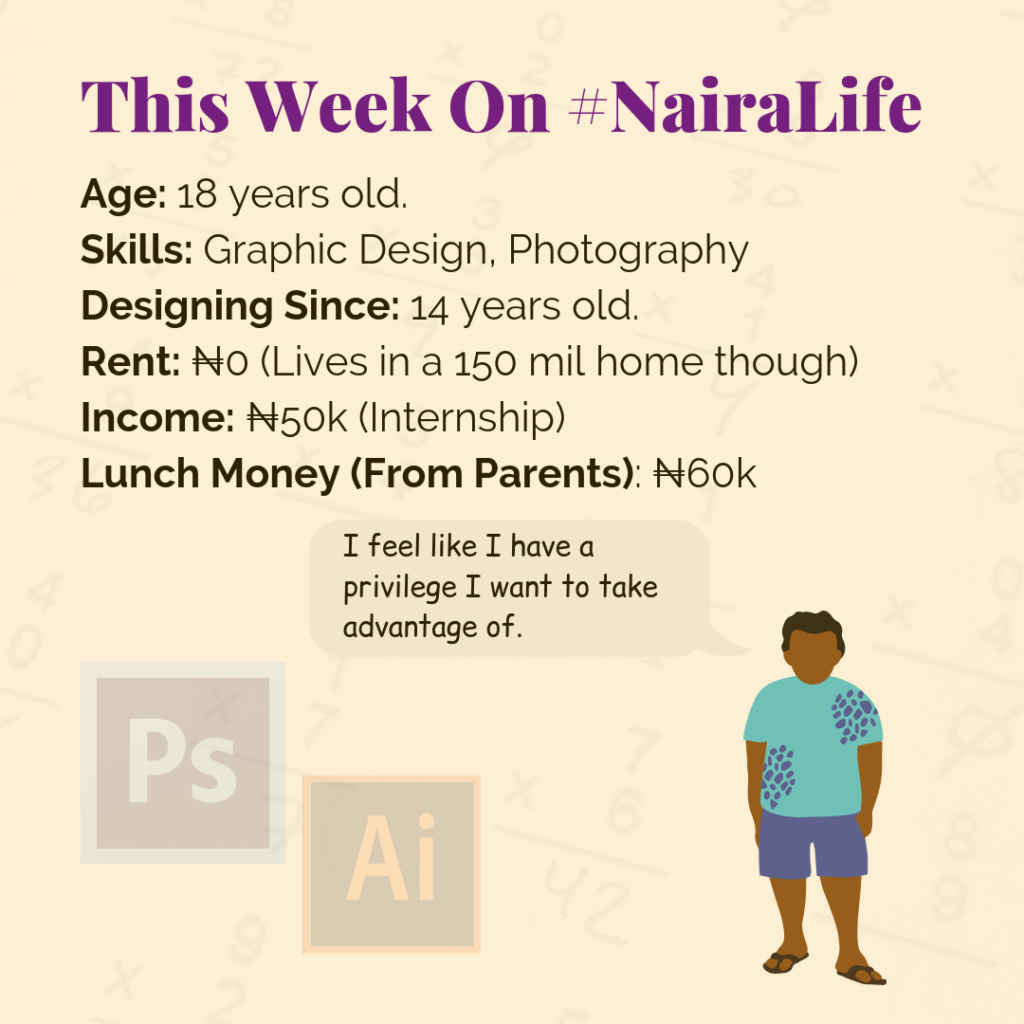
Every week, Zikoko asks anonymous people to give us a window into their relationship with the Naira. Some will be struggle-ish, others will be bougie–but all the time, it’ll be revealing.
The subject of this week’s story just hit 18. He’s also at his first 9-5 ever, as an intern. When he’s not in Nigeria as an intern or on holiday, he’s a student in the UK.
When was the first time that you wanted money and your parents were like, what for?
I think it was that time I wanted money for a website I was working on – I’d already spent £350. I spoke to a company that was supposed to do it, and they quoted $5000.
Then my parents asked, “How do you intend to get the money back? Have you thought about it? What sources of revenue will bring it back?” I couldn’t figure this out.
It made me start asking myself what the point of making something people could use, but still not have a way to sustain it.
Especially since it was something that would have running costs after.
Did you get the money eventually?
No. That was the end of the website. It’s interesting, school always encourages you to feel like you can do anything you want – and it’s true. But there’s a balance of opportunity cost. You can do this, but are you going to have the time? Are you going to be able to look at it properly? And most importantly, are you going to get it back?
That’s when I started tracking how much I made from commissions, how much I spent on equipment, and on financing the projects I was working on.
How old were you when you asked for the money?
16. I’d had other expenses before. Like there was this app that I needed to pay 100 dollars to keep on the app store. And they paid for that.
What are the things you do that fetch you money?
Graphic design and photography. I started designing when I was 14 – self-taught. Then album covers for friends in 2015. I charged like ₦5000 for each –
– Mad thing, but you just mentioned the naira for the first time.
Hahaha.
Okay, back to the things that fetch you money.
I didn’t earn a lot, because Nigerians didn’t see the value in it at the time. The question is, was I not finding the people who were willing to pay? Was I not good enough at the time? Or were people not just ready to give money to a 16-year-old?
Anyway, by the end of 2017, I was charging £100 per logo and £30 for posters.
What are some interesting things you’ve heard about money from your friends?
A couple of things. I’ve heard someone say she has to marry a rich husband. I think that was half a joke though. Hopefully. Then there are the ones that say, “It doesn’t really matter for now, my parents can cover stuff. Why am I bothered?”
Why now though?
I feel like I have a privilege I want to take advantage of. I don’t need to pay rent and I still get financial support from my parents, big time. At this point, I’m still making massive loss in a sense, because my expenses are way more than I’m making on my own.
I still have that advantage for the next two or three years. The way I see it, I’m making a time investment now, buying equipment now that I can, and setting things up properly. By the time I’m no longer under my parents’ care, the investments I’m making now, would make it easier for me.
If you come out of uni and you don’t have a job or means of income, it puts you at a disadvantage, because now you’re thinking about taking your life into your own hands. I feel like that’s what puts a lot of people into system jobs – it’s not really what you want to do, but it’s what’s available to you.
I want to avoid that period where I’m like, what the hell do I do?
That makes sense.
Truth is, there are friends in my circle that will probably get big ass grants from their parents as soon as they finish school. I might get that too, but the way my parents are, it’s not going to be something I’ll get easily. Also, there’s that part where I just want to make something of myself. My grandparents weren’t rich – in fact, they were on the verge of being poor. But my parents managed to make something of themselves. So I’m like, why do I have to wait for my parents when I can just improve on what they’ve already started?
That’s an interesting way to look at it.
I also think generational wealth can be a massive ego dump on kids. It can make kids feel like they’re better than other people. It’s one thing to be better off than other people, it’s another thing to think you’re better. It can be dangerous when you start to feel like the latter.
Okay, let’s talk about your monthly income.
I only just started getting a set monthly income – I’m currently in my first 9-5 as an intern.
People tend to have fixed expenses. But for me, my allowance from my parents is mostly meant to be lunch money. So, food is 60k. Then I spend 10k per week on cabs. I use cabs when my folks’ car is unavailable – that sounds bougie AF. Then I have a bunch of subscriptions: about 24k in total.
Do you feel like you should be earning more money?
Yes! I undercharge big time. One thing you can’t change is perception. If I was 25, doing the things I’m doing now, I’ll probably be able to charge a thousand pounds for a logo. When you’re working with a 25-year-old, you know they have bills to pay, and you won’t want to do them a disservice. Also, I don’t have that much work experience, so people don’t trust me very much even after seeing my portfolio. It’s like people aren’t sure if it’s a fluke or a valid representation of skillset.
If I was producing this type of work at 25, I’d be earning way more.
How much do you imagine you’d earn if you were 25 today?
That’s a good question. I’ve never thought about that. Assuming I stop working 9-5, and some things I’m trying to put it in place is set up the way I want them to be, I’ll be able to make about £3000 a month. I dunno if I’ll be working in Nigeria, but if I work here, probably a mill a month. Now that I’ve said this, I would probably have to check back when I’m 25 to see if I was just chatting kid shit or not.
How much do you think it would cost to fund age 25?
Like, if I had to pay for everything myself? Per month…? Wait. How much is rent?
Let’s start with where you live, how much do you think it costs?
I have no fucking clue. How much is rent? Wow, there’s so much you have to think about when you’re old. Filling your car up with petrol. Electricity bills. Food. Faaji. I don’t know how much that costs! I can’t even start to think about it.
You see, this is one of my fears because the money I’m making now doesn’t mean much. Someone actually working might spend it on petrol in a month.
By the “money I’m making,” are you talking about the 165k?
Okay… This is so confusing because I know that the average earning for an entry-level person in Nigeria is between ₦50k and ₦200k per month. This has me fucked up because I feel like rent for a house where I live will be more than that. Unless I’m delusional. How much does a bank teller earn?
About 50 to ₦80k.
Yeah! That’s actually what I’m actually referring to. I’m so confused as to how someone would earn ₦30k from a full-time job and not be dead.
That’s minimum wage, and I know a couple of people who earn less.
How does a person even survive? Where would you live in Lagos? You can barely live on a bank teller’s wage in Lagos. How would you do this on a minimum wage…? That’s quite scary! How do you hack this?
What do you think?
You can squat…?
That’s the thing – growing up the way I did, you don’t get a full insight into the way Nigeria really is. It’s almost unfair to us, because without understanding exactly what’s going on around you, how do you even begin to help? A lot of people my age say that Lagos is actually a great place.
In your circle
But there are people living in a manner that seems impossible on paper. When we don’t see that, you start to ask, who’s done us the injustice; is it our parents? Probably. Because when you don’t see that, how are you supposed to even appreciate what you have? How do you even begin to think of how to help the country as a whole or the people on the other end of that shit?
Going to work every day made me realise that low-income earners are packed into some areas, and no one cares about them. I saw people bathing outside, not because they chose it, but because the communal shower space is open, visible from the street. It’s like slum living.
It is slum living.
Everyone has privileges, but when did you first realise yours?
Between the time I was 8 and 10, and probably from a couple of places. My parents had people working in the house, and I think from that point, I noticed some differences. We’d travel, but the domestic workers didn’t. I wouldn’t say that’s when it became apparent. At that time, it was just like, that’s life.
But then, the true realisation came in this period of my life. It was last year I started to realise that one of the reasons Nigeria is the way it is, is because a lot of the things we use are imported ideas. Remnants of colonisation. If you ask me, the reason Nigeria looked and felt better just after white people left is that the information was just passed down.
After that – and this is theory – more and more people started migrating to cities. When people come from less developed places, they pick up what’s left of what was taught. Enforcement isn’t as strict, and people start to get away with more and more, the level of how well stuff works just degrades. And more people come in and pick up the remnants and bad habits.
Another thing as well is, we’re not very innovative. We haven’t thought for ourselves how to make stuff work for us. And the only way these people can learn how stuff should even begin to work properly is from exposure. And you can only really gain exposure by going to places where things work the way they’re supposed to.
My new point of realisation was that, not only are people not financially empowered, they are also – for lack of a better word – not mentally empowered. Because there really isn’t much thinking going on.
How are you supposed to think about what you can’t conceive? What does a person working in the market think about on a day to day basis? It’s hard to think about much when you’re in hardship, because all you can think about is, “Where is my next meal coming from? How much have I made today?”
Coming to the point where I realised that thinking about innovation is not evenly spread among Nigerians is the point where I realised my privilege properly.
Okay, okay. Let’s talk about other stuff. What’s something you really want but you can’t afford?
A car. I actually really want a car. I’m currently borrowing my mum’s car, but I want to borrow as little as possible. I want everything to be clear, like “this is my own person as an adult.”
You’re in a hurry to adult.
That’s what my parents say. There’s the thing about ‘waiting to be matured’ that people say. I don’t get it. It’s not as if we’re getting stupider as a species. Why do I have to be babied? I don’t believe you can truly accept responsibility until you’re given responsibility. Raising kids without giving them responsibilities is kind of dumbing them down.
What are old people’s assumptions about 18-year-olds and money that piss you off?
Because I spend a lot, people assume that I’m not saving for the future or something. I’m not stashing money now so I can get things that’ll help me stash money later. Another fucking assumption is that I dunno how much it means to be an adult. Because… apart from rent and shit… Wait.
Hahahaha.
Okay in retrospect, it’s actually true. I dunno. But a lot of people feel all the money I get goes to enjoyment.
Let’s talk about enjoyment. What’s a good day out?
Probably spending 10 to 15k on one meal. Fuckkk. That’s my guilty pleasure. Not much else. I don’t actually spend much on wayward enjoyment.
Financial happiness. On a scale of 1-10.
Right now? I’m very fucking happy. I think I’ve finally reached a point I wanted to get to. At this point, I can say that if my allowance was taken out, I won’t be affected. I’ll still be able to run as my own person.
The constant struggle to be your own person.
Pretty much.
What’s something you wanted me to ask that I didn’t ask?
The only thing missing is how much my parents spend on me, which I honestly dunno. Like, kids are just one big ass investment. But it’s probably pushing £50k a year.
How much of a chunk do you think that takes out of their finances?
I wouldn’t even know to be honest. Oh wait, I just checked the listing of the house when they bought it.
How much did it cost them?
₦150 million.
This story was edited for clarity.
Check back every Monday at 9 am (WAT) for a peek into the Naira Life of everyday people. But, if you want to get the next story before everyone else, with extra sauce and ‘deleted scenes’, subscribe below. It only takes a minute.
Picture this, after a long day at work or school, you get home really tired and open your fridge to get small chow. To your dismay, someone wrote hateful words all over your food.
This happened to 19 year old biomedical student at Warwick Univeristy, Faramade Ifaturoti, on April 5 when she found racist slur written on her bananas.
Faramade tweeted her disgust, sharing a picture of the bananas which had “Monkey”and “Nigga” boldly written on them. A picture of Donald Trump was also found on her fridge.
She was shocked to have been directly targeted and promptly tweeted at the University accomodation’s Twitter account.
She said “Just entered the kitchen and look at what one of my flatmates has done. I am extremely disgusted @WarwickAccomm. I’m actually fuming! Like what?In 2016? People still behave like this?!”.
The school’s Twitter account responded and has vowed to look into the racist attack.
A racist incident has been widely reported on social media – the University is investigating as a matter of urgency.
— University of Warwick (@uniofwarwick) April 5, 2016
— Warwick Anti-Racism Society (@uwarsoc) April 5, 2016
Some even think she shouldn’t have tweeted the pictures.
The solidarity of Warwick University students for Faramade is admirable. However, the University management should ensure a crackdown on racism to preserve its integrity.
A Nigerian couple in the UK were sentenced to 12 years in prison on December 7, for subjecting Mr Sunday Inuk to 25 years of servitude. He was just 13 when the Edets took him without permission from his parents in 1989, with false dreams of getting work and an education upon getting to the UK.
Sunday Inuk served the family without pay for 25 years, eating and wearing only what he was given, cooking, cleaning, gardening and sleeping in the hallway all through.
We have compiled a list of 15 things he could’ve achieved in 25 years.
A day ago, it was reported that a number of Nigerians (48, 50 or 500 depending on who you asked) were deported from the UK, due to immigration related offences.
These are the various reactions.
When the person that promised to file UK visa for you is part of those that were deported.
In case you have been under a rock (or climbing a mountain), please be informed that Diezani Alison Maduekwe, the first female minister of petroleum and first female president of OPEC, has been arrested in London on charges of corruption and theft and sturves.
Reactions below:
1. When you get arrested in the UK for corruption
2. When you consider what would have happened if you’d been arrested in Nigeria
3. When you see one piece of Hyde Park you coulda, shoulda, woulda bought…
4. When you remember your Birkin collection
5. When you remember they don’t carry Birkins in jail
6. When people say you stole £13 billion
7. When people ask you if you’re richer than Goodluck Jonathan
8. When people say that women are more corrupt than men and should not be allowed near power
9. When you hear Buhari will be the next Minister of Petroleum
10. When you decide to tell the whole world how you did it