Notice: Function _load_textdomain_just_in_time was called incorrectly. Translation loading for the wordpress-seo domain was triggered too early. This is usually an indicator for some code in the plugin or theme running too early. Translations should be loaded at the init action or later. Please see Debugging in WordPress for more information. (This message was added in version 6.7.0.) in /home/bcm/src/dev/www/wp-includes/functions.php on line 6121
Talk True | Zikoko!
  • Talk True: Does Eating Beans Actually Make You Tall?

    Talk True is a Zikoko limited series for medical myth-busting. With each episode, we’ll talk to medical professionals about commonly misunderstood health issues to get the actual facts.


    If you grew up in a Nigerian home, you know it’s a given that Saturdays are reserved for beans or beans-derived meals. And if you didn’t like beans, you were likely encouraged to eat it or prepare to be short. Beans have been so associated with height that almost every tall person can relate to being presented with the “Do you like beans?” question at least once in their lifetime.

    But how did our parents and grannies start championing the “beans for height” theory in the first place? Is it a claim based on facts, or yet another ploy to force us to eat the food at home? Ayooluwa Okunjolu, a nutritionist, provides answers.

    Why’s the “beans for height” theory even a thing?

    “Beans are a great source of plant-based protein, and protein is an essential nutrient for growth and development — which we assumed means “height” — but few people actually know that beans isn’t all protein. It’s a great protein source, but that’s not all it is,” Ayooluwa says.

    While beans contain 21-25% protein by weight — much higher than other plant-based protein sources — it contains about 65-72% complex carbohydrates by weight as well. Meaning it’s technically more carbs than protein. So, using beans alone as the primary source of protein in your diet won’t exactly provide all the growth and development your body needs. 

    Nigerian mothers right now

    So, does eating beans actually make you tall?

    “If it were true, I’d definitely be six feet tall, because my mum made sure I ate a lot of beans growing up,” Ayooluwa notes. 

    It just doesn’t work that way

    He explains further.

    Growth and development are more of a cellular thing: organ development, tissue building and repair, cognitive development, etc.

    Protein-rich food like beans supports growth and development, but it’s just one piece of the puzzle when it comes to increase in height. Genetic factors account for approximately 60-80% of a person’s height, while environmental factors — like diet, exercise and lifestyle — contribute only 20-40%.

    Your diet can impact whether you reach your maximum height potential, but it can’t alter the genetic potential for height. So, I’m sorry, but if your parents aren’t tall, it’s unlikely you’ll be tall regardless of the amount of beans you eat.”

    Eating beans doesn’t equal to height, dear

    Should you stop eating beans, then?

    Definitely not. Beans contribute to healthy iron and Vitamin B intake, which prevents anaemia that could result in delayed growth in children. Some sources also say it’s great for brain power. As Ayooluwa explains, improper nutrition will also lead to an individual not reaching their full height potential.

    “Beans are a very important part of our diet. It’s really nutritious, and when taken together with other healthy foods in a balanced diet, the body grows as it should.”

    What kind of food can make you tall?

    A balanced approach to nutrients is key. If your genetic blueprint doesn’t have “six feet” levels of height, there’s almost nothing food can do. But nutrition can help, and Ayooluwa explains that it’s an all-hands-on-deck approach. 

    “There’s no special food that’ll make you taller, but balancing all the nutrients is essential for growth and development. Nutrients like carbs, healthy fats, protein, vitamins and minerals are all equally important.”

    Is there still hope for short people?

    Not exactly. There’s hardly any physical change (read as height) that can happen once you’ve crossed puberty. This is because your bones stop growing and essentially fuse together.

    “We stop growing around age 20, so eating healthy shouldn’t be for the purpose of getting taller at that age. Growth starts from infancy. Once there’s malnourishment and stunted development from an early age, it’s difficult to change in adulthood. So, doing the right thing from the beginning is essential. It doesn’t mean adults shouldn’t eat healthily, though. Remember, there’s still cellular growth and development going on — tissue repair and muscle building, for instance.”

    The takeaway

    Beans are a great source of protein, but it’s not the only factor involved in height. Ensuring a well-balanced diet from childhood will help you reach your full growth potential. But height is largely genetics. So, if it didn’t dey, it didn’t dey.


    NEXT READ: Talk True: Does Cranberry Juice Cure UTIs?

  • Talk True: Does Cranberry Juice Cure UTIs?

    Talk True is a Zikoko limited series for medical myth-busting. With each episode, we’ll talk to medical professionals about commonly misunderstood health issues to get the actual facts.


    The odds of you waking up and developing a sudden craving for cranberry juice are pretty minimal. With its characteristic tart taste, cranberry juice doesn’t rank high on popular refreshment choices, but it’s a hit in the online feminine wellness space.

    Here’s why

    A quick vaginal health/wellness search on Instagram will reveal many vendors touting the belief that cranberry juice will make Urinary Tract Infections (UTIs) go away forever. Is this claim based on facts, or is it a myth? Dr Mary Alo provides answers.

    First off, what’s a urinary tract infection?

    As the name implies, it’s a bacterial infection of any part of the urinary system, which includes the kidneys, ureters, bladder and urethra. In women, it’s typically characterised by a burning sensation while peeing, cloudy or bright red urine, frequent passing of small amounts of urine, fever and pelvic pain. 

    Image: Sora Shimazaki on Pexels

    While men can also have urinary tract infections, women are at a greater risk because they have a shorter urethra than men, making it easier for bacteria to travel to the bladder. Other gender-specific risk factors include using contraceptive diaphragms, pregnancy, frequent sexual activity with new partners and menopause. 

    It’s important to note that while sex can cause bacteria to move further into the urinary system, UTIs aren’t contagious/sexually transmitted infections.


    You know what’ll be contagious, though? The amount of fun you’ll have at HERtitude — Zikoko’s women-only party for the hottest babes. Get tickets here.


    How does cranberry juice come in?

    Some sources also claim that regular intake of cranberry juice improves the vagina’s “taste” — even though no scientific evidence supports the claim. But Mary explains the flaw in this logic.

    “UTIs are infections majorly caused by a bacterial organism called Escherichia coli (E. Coli), and as such, are best treated with antibiotics. The rationale for using cranberry juice is that it can, in a way, help to preserve the flora. Infections are more likely to occur when the normal flora of the urinary tract is disturbed. E. Coli works by attaching itself to the host’s tissue, and current hypothesis suggests that cranberry juice works to prevent the adherence of E. Coli to the urothelium of the urinary tract. Without this attachment, the bacteria can’t infect the mucosal surface, thus preventing an infection from occurring.

    But this is prevention. It isn’t enough rationale to use it as a form of treatment as UTIs can only be treated with antibiotics.”

    Should you ditch it, then?

    Not exactly. 

    “It makes more sense to use cranberry juice in a proportionate amount as a preventive measure, though I wouldn’t recommend that’s all you use to prevent urinary tract infections. 

    You can use it in addition to concrete preventive measures like drinking more water, urinating before and after sexual intercourse to limit the spread of bacteria, wiping the vaginal area from front to back after using the toilet and not abusing antibiotics.”

    Better treatment options for UTIs

    Mary emphasises that urinary tract infections can only be treated with antibiotics.

    “Once your healthcare provider confirms that the symptoms point to a urinary tract infection, the next thing to do is prescribe the appropriate antibiotic regimen for treatment. Don’t let people who are more profit-oriented tell you otherwise. Cranberry juice is just one of many ways to prevent UTIs — especially in recurrent infections — and it works in tandem with other preventive measures.”

    The takeaway

    Cranberry juice has benefits for feminine wellness and vaginal health, but it can’t cure urinary tract infections. At best, it’s a preventive measure, but not in isolation if preventing UTIs is the primary goal.


    YOU SHOULD ALSO READ: Talk True: Is Period Syncing a Real Thing?

    Don’t leave without getting your ticket to HERtitude 2023!
  • Talk True: Are Toilet Infections Actually a Thing?

    Talk True is a limited Zikoko medical myth-busting series. With each episode, we’ll talk to medical professionals about commonly misunderstood health issues to get actual facts.


    If you paid close attention the first time you heard the term “toilet infection”, there’s a high possibility it was in a danfo. It probably involved someone standing in one corner of the bus selling pills they swore were the solution to all your life’s problems. 

    Sigh

    If it wasn’t a danfo, it was one of those loud voices that repeatedly thundered from hidden speakers in the market urging you to buy “Dr Iguedo’s Goko Cleanser” to clear the million toilet infections in your system. If you asked the danfo entrepreneur or the cleanser marketers about what the symptoms of toilet infections are, their responses would range from “itching in the vaginal area” to “watery smelly discharge” and even “infertility”.

    But are toilet infections really a thing? What state must your toilet be in to “infect” you? Itohan, a general medicine practitioner, speaks on this. 

    What’s a toilet infection?

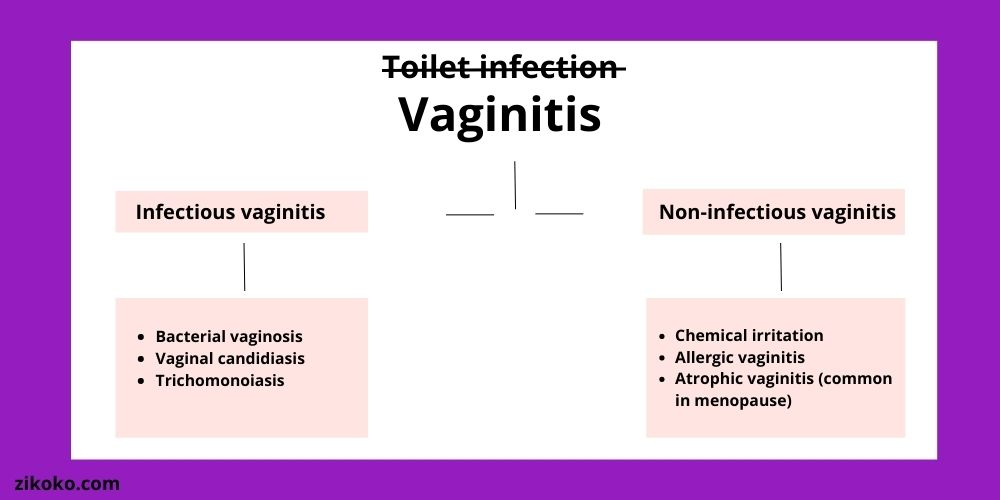
    “Toilet infection is a layman — and often misleading — term for vaginitis,” Itohan says. 

    Google-trained doctors be like…

    Vaginitis (or vaginal infection) is an inflammation of the vagina that may result in itching, unusual discharge and pain. It is usually caused by either one/or a combination of a bacterial or fungal infection, a change in the normal balance of vaginal bacteria, a sexually transmitted infection (like Trichomoniasis) or even menopause. And it’s actually a common medical condition.

    “About one-third of women — especially those in the reproductive age — will have vaginitis at one point or another.”

    But is it gotten from toilets?

    The list of probable causes above doesn’t mention toilets, but I ask Itohan to be sure.

    “No. It’s definitely not. A dirty toilet doesn’t lead to a vaginal infection. To know what might be causing inflammation, it’s important to look at the symptoms and more likely causes.

    When due to a fungal infection, vaginal inflammation is caused by an overgrowth of yeast (a fungus called Candida). This type of vaginitis is called a yeast infection or vaginal candidiasis and is characterised by intense itching around the vulva, a burning sensation after sex or urination, thick white cottage-cheese-like discharge and general soreness.

    Another type of vaginitis is bacterial vaginosis, and it’s typically a result of an imbalance in the normal vaginal bacteria due to factors like douching or unprotected sex with a new partner. The difference here is, this type usually comes with an abnormal offensive odour. Some people don’t even experience itching or any symptoms with bacterial vaginosis.”

    While Itohan insists dirty-toilets-causing-infections are a myth, she admits irritants can upset the vaginal environment and cause vaginitis.

    “We call this type non-infectious vaginitis, and it’s often caused by an irritation or allergic reaction. Some people will start to itch when they come in contact with chemicals from perfumed soaps, detergents or tissues. This is why your doctor will always advise you to clean the vulva with water and mild soap. Vulva, not vagina, please. That’s another recipe for bacterial imbalance.”

    And definitely don’t do this:

    Generalising can be dangerous

    As someone who’s seen several cases of vaginitis, Itohan understands the dangers of blanketing every symptom as a “toilet infection”.

    “Most people attribute every itch or discomfort they feel to yeast or some toilet infection and just use boric acid to relieve the itching. But you need to know the actual cause if you want long-term relief. 

    Imagine treating vaginitis caused by trichomoniasis, a sexually transmitted infection, with boric acid (which treats yeast infections). You’d get temporary relief but left untreated, trichomoniasis can last years and cause complications like premature delivery in pregnant women and poses an increased risk for cervical cancer.”


    ALSO READ: After Surviving Cervical Cancer, I Just Want Peace


    Should you be worried?

    Even though vaginitis may be concerning, it’s not something to be too worried about.

    “Whatever the cause of vaginitis is, it’s usually treatable. It’s nothing to be ashamed of. Don’t be scared to visit your doctor. It’s ten times better than relying on what Aunty A from Instagram said she used to treat hers.”

    Know your body, babes

    The first step to properly detecting and managing vaginitis is knowing your body well enough to observe when something’s off.

    “Every woman has some form of vaginal discharge and smell. The discharge tends to change in consistency and quantity throughout the menstrual cycle. When you’re in tune with your vaginal health, you’d know when there’s a different odour.

    For example, yeast infections are probably the most common type of vaginitis (after bacterial vaginosis), and it tends to reoccur in most ladies. A babe who’s had it before and is self-aware knows to watch out for factors that increase the risk, such as using antibiotics and birth control pills which may disrupt normal vagina flora, hormonal changes due to the menstrual cycle or pregnancy, or any condition that causes a weakened immune system. Again, most types of vaginitis are highly treatable.”

    On treatment

    Itohan emphasises that treatment is relatively simple and accessible, but the right diagnosis is key.

    “Once a diagnosis is made by your doctor or healthcare provider, treatment will typically involve over-the-counter pills, creams or suppositories. A yeast infection requires antifungal medications, while antibiotics are the go-to for bacterial vaginosis. See why proper diagnosis is important?”

    Preventing vaginitis is also very possible, and mainly requires some lifestyle changes.

    “Avoid douching like a plague. Please don’t steam your vagina to make it ‘tight’. It may destroy naturally occurring bacteria in the vagina and lead to an infection. Avoid scented tampons or soaps. Change out of wet clothing as soon as you can. Clean your sex toys after every use. Use water-based lubricants, and of course, use protection with new sexual partners.”

    If you have recurring vaginitis, please visit a doctor or healthcare provider.


    NEXT READ: Why Women’s Nipples Hurt, According to Marion