Notice: Function _load_textdomain_just_in_time was called incorrectly. Translation loading for the wordpress-seo domain was triggered too early. This is usually an indicator for some code in the plugin or theme running too early. Translations should be loaded at the init action or later. Please see Debugging in WordPress for more information. (This message was added in version 6.7.0.) in /home/bcm/src/dev/www/wp-includes/functions.php on line 6121
Ruger | Zikoko!
  • Ruger’s Third Wave Will Have Him Ru the World

    Ruger has been talented from the jump. The self-titled afro-dancehall artist didn’t break into the mainstream until his 2021 single, Bounce, took off few months after his debut. But he only had to put out song covers on IG for nine months before he was discovered in 2019. Since then, he’s gone on to make hits, creating a unique spot for himself among peers. 

    As we prepare for his forthcoming debut album, RU THE WORLD, let’s dive into his musical journey.

    When Michael Adebayo Olayinka began his journey to becoming a recording and performing artist, he was sure he’d make hits. But he didn’t know he’d have to be Ruger — a highly fatal firearm used at close range — first. The Nigerian artist FKA Mikky Drey got his current name because of his habit of making gun fingers in the studio. By 2019, afrobeats had another bad boy on its hands, with a name-change, pink-dyed hair and an eyepatch reminiscent of Baba Fryo.

    After waiting three years for a university admission, Ruger got serious with his music while learning to repair phones at the popular Computer Village in Lagos. In November 2019, former Mavin artist, D’Prince, saw his content on IG and has since put him under his wings, talent management and music label. 

    Throughout the 2020 lockdown, Ruger recorded across music studios and hotel rooms and underwent some artist development. And in January 2021, Jonzing World released One Shirt on which Ruger led the first verse and chorus. This afropop song about humble beginnings and disappointments was his official musical introduction, a showcase of the youngster’s head for captivating lyricism and vocals. D’Prince put down gems and Rema delivered a beautiful verse, but Ruger carried the song on his back. He didn’t even need anybody else on the song.

    A proper introduction came with a self-titled single, Ruger. Ru Boy, as he’s fondly called by fans, glided over the African percussion fused with 808 drum kicks, likening his arrival in the industry to the deadly coronavirus. The track opened his EP, titled PANDEMIC, a month later. On this EP, Ruger swam in and out of different sounds from the second track to the sixth, including uptempo afropop (Monalisa, Yekpa) and dancehall (Bow and Bounce). He sang exclusively to women, showing off his patois, pun strength, good-boy-gone-bad charisma and hypersexuality.

    PANDEMIC came out to mild reception and didn’t cut deep into the mainstream until Bounce took on a life of its own and turned into one of the biggest songs of 2021. It went on to debut no. 39 on TurnTable’s Top 50 Chart and number two on the Apple Music Top Afrobeats Songs, giving Ruger his first global recognition, after which he linked with Jamaican artist, Projexx, on the mid-tempo dancehall Sidepiece remix.

    Ruger closed 2021 out with the release of The Second Wave (four-track EP) in November, around the time COVID-19 made a comeback. On Champion, Ruger accepts his newfound stardom, expressing this through an afropop flavour similar to his early One Shirt jam. Useless has a dancehall-galala vibe that’ll get even Daddy Showkey up from his seat, throwing the popular “konto” dance.

    He put the TikTok-friendly closing tracks, Snapchat and Dior, with the smash hit Girlfriend, WeWe and Warning — on which he mentioned his influences, like Lucky Dube, 2Baba and the late Sound Sultan — on a deluxe album in June 2022. This move gave Dior its time in the sun as it became a hit. At this point, Ruger had morphed into a full-blown bad boy, accepting his wayward playboy role. Girlfriend had everyone tilting their waists anytime it came on, and with it, he owned the IG, Snapchat and TikTok streets for a while.

    Then came the back-and-forths with BNXN which birthed Asiwaju, a track on which he claimed superiority over his peers. However, the public accused him of making a campaign song for the agbado government. The hit song was rich in replay value with dramatic lyricism and all the nuance that make certified Naija jams.

    Red Flag was his last drop of 2022 — a problematic song that saw him relishing in toxic masculinity, with lines like “you saw the red flags, baby, but you ignored the red flags / baby, you con dey vex, see, I can’t change / baby, you better rest or end this now” — maintaining the honesty of a villain who’s come to terms with himself. But on his first offering of 2023, Ruger took a U-turn from his Red Flag confessions to become a preacher of sweet love on DJ Neptune’s Bienvenue, without losing his sensual one-liners. You know you’re a hitmaker in the Naija music scene when popular DJs feature you on their songs. That’s how far Ruger has come since 2019.

    On May 12, 2023, he began the journey to his debut album by releasing two singles: the amapiano-inspired, booty appreciation song, Bun Bun with Jugglerz; and Jonzing Boy, an allegiance record to the label that pays him. Jonzing Boy later appeared on a two-song pack, Kristy, that came out in July. 

    It’s clear that fun, hedonism and dancehall-galala aren’t leaving Ruger anywhere anytime soon, not even with his successful tours across Africa, Europe, and currently, the U.S. Since his nationwide six-concert deal with Eko Hotel & Suites and opening performance at Burna Boy’s 02 Arena concert, both in 2021, Ruger has been booked and busy on the road.

    And he has managed to turn every performance to a debauchery show, grinding and dry humping willing fans, dressed in his iconic singlet, belt and ripped jeans. Just two days after his U.S tour, he announced his debut album, titled RU THE WORLD, drops on September 1st. 

    Ruger shared that his most stressful session on the album was with Legendury Beatz, as he was under pressure to deliver a great record like the other heavy hittas — Wizkid, Wale, Bad Bunny and Seyi Shay — who have worked with the production team. 

    We’ll also get some relationship confessions, like Dear Ex, an unreleased song he described as an apology to three babes he’d led on. In the announcement video he posted on his socials on August 28, he shared a preview of a drill jam we first heard on his Boston show.

    We believe Ru To World will be multi-genre as he continues his penmanship flex as a wild, sweet-tongued singer exploring his youth. While he builds a solid CV as a stage performer, Ruger would finally have a full-length project to present on tour. The 23-year-old looks to be slowly bringing dancehall music back to the mainstream, following in the footsteps of Yung L, Patoranking, Timaya and General Pype.

    [ad][/ad]

  • Streaming Farms: How Our Fave Artists and Labels Might Be Scamming Us

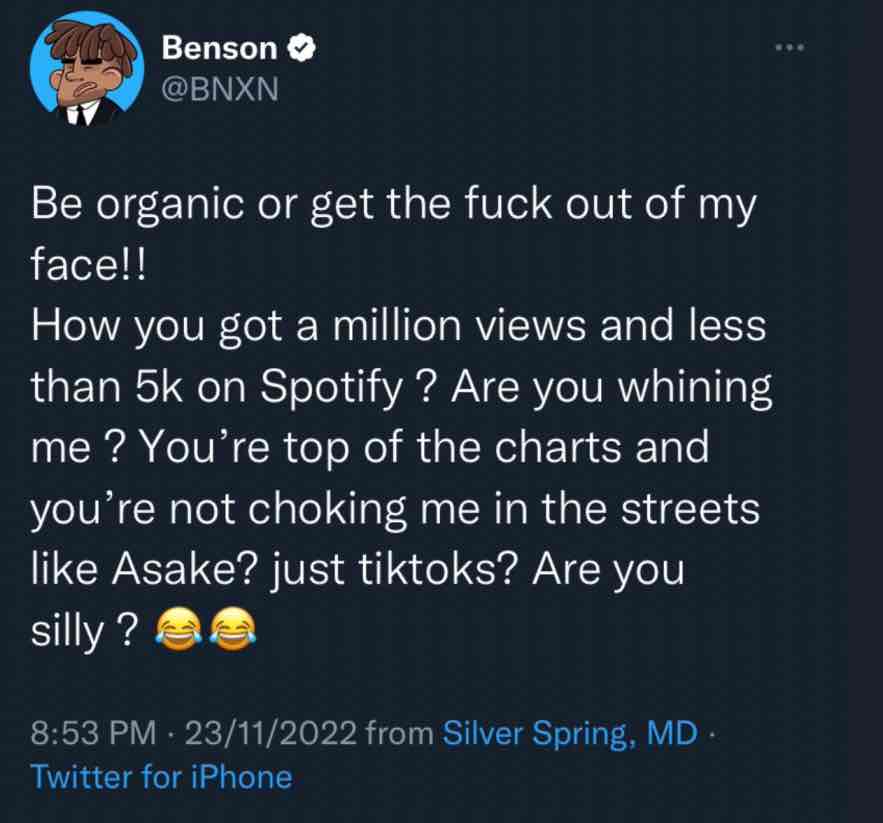
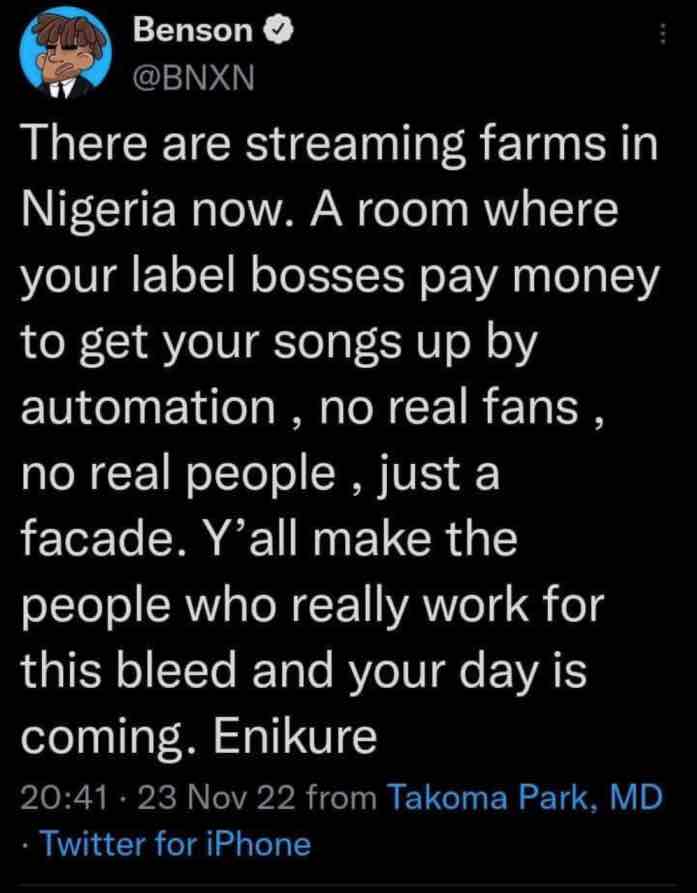
    Watching Ruger and BNXN fight on Twitter is nothing new. As a matter of fact, it happens almost every time one of them has a new song coming, forcing the internet to believe they’re probably in the same group chat. Like clockwork, BNXN dropped Traboski just hours after their back and forth. But outside of their recent fight being chaotic as hell, it also revealed something Nigerians can’t stop talking about — streaming farms. 

    Ruger’s tweet accusing artists of paying influencers for TikTok popularity
    BNXN’s tweets accusing Ruger and his label of using streaming farms to top the charts

    Streaming Farm 101 

    Nigerians are already used to the word farming — Buhari asked us to “go to the farm and earn respect” in 2018, and Tinubu threatened to send 50 million youths to the farm during his campaign — but most people aren’t used to streaming farms. 

    While the concept sounds like a new area of tech that could finally make our tech bro aspirations a reality, streaming farms are companies designed to add fake streams to a song using bots or multiple phones at a time. Yes, I know, it sounds crazy, but when you remember how easy it is to buy likes or followers on social media, it makes total sense that buying streams is a possibility. 

    These streaming farms take advantage of apps like Spotify, Apple Music, Audiomack and Deezer, also known as Digital Service Providers (DSPs), making a shitload of money for themselves and their clients. However, before it starts to look like a “Nigerians are always doing 419” scenario, it’s important to note that streaming farms are not unique to Nigeria. They’re actually global and used by both established and upcoming artists. 

    RECOMMENDED: Marketing 101: How to Blow As a Young Nigerian Music Artist

    How streaming farms works

    These streaming farms are known to create bots — software applications passing off as human internet users. Because of their ability to mirror human subscribers, these bots are programmed to carry out human activities, like streaming music, but on a large scale. 

    So while Americans (no data for Nigeria, unfortunately) can listen to music for an average of a little over two hours a day, bots can do 24 hours straight because they don’t have to sleep or look for ewa agoyin in the morning. These bots can stream music as many as 1000 times in just one minute.

    Alternatively, some streaming farms just use a lot of phones to play a song over and over again. Wild AF! But it’s true. 

    Why do artists and labels use streaming farms? 

    How many times this year have you seen your faves post a screenshot of their song topping the charts on either Spotify or Apple Music? Whether we like it or not, streaming is here to stay, and it’s an important part of an artist’s career. 

    The amount of streams you get as an artist doesn’t just give you bragging rights. It also helps you make money since DSPs are known to pay artists based on streams. But bragging rights and money aside, streaming numbers do something else; they pique people’s curiosity. 

    Several times, I’ve seen a song top the charts or amass a truckload of streams even though I’ve never heard it anywhere, and none of my friends have either. The fact that this song is such a “hit”, and I’m completely oblivious to its existence, makes me feel left out. How are millions of people on this wave, and I’m dulling? And before you know it, I’m streaming the song. 

    The truth is, I’m not the only one who streams songs out of curiosity and FOMO, a lot of people do it too. This introduces them to a new artist or song, even though the initial hype surrounding the artist is fake. Streaming farms maintain the hype or position of top artists as hitmakers while it helps smaller artists break out. 

    In a normal world, the number of streams on musical platforms would be an accurate and true determination of a song’s or artist’s popularity, but we don’t live in a normal world, do we? 

    Are streaming farms legal? 

    Before you consider starting your own streaming farm or employing one, know it’s all at your own risk, dear. While Nigeria doesn’t have an explicit law proving streaming farms are fraudulent entities, using them still counts as  a direct violation of the terms and services of streaming platforms. 

    What streaming farms do to the music industry

    Ruger and BNXN’s Twitter fight might’ve exposed streaming farms on a large scale, but the truth is, most people have known about it for a long time. 

    For independent and upcoming artists, streaming farms make an already hard industry ten times more difficult to break into. Forget competing with other talents, you now have to compete with their social media following and the multiple bots they have streaming their songs. 

    Streaming farms also mess up how we consume or receive music. Not only does it trick listeners into listening to a song, but it also makes it hard to know if the artists or songs are actually hot. Do the streets and clubs really love you? Or have we been manipulated into thinking we do? 

    ALSO READ: Why Asa’s “IDG” with Wizkid Is Missing — and Why She’s Suing Joeboy

  • Marketing 101: How to Blow As a Young Nigerian Music Artist

    Are we the only ones noticing that BNXN and Ruger only fight when one of them wants to drop music? 

    With new music dropping left and centre these days, Nigerian artists are doing the most to grab our attention these days. 

    If you think fighting is extra, wait until you read some other ways Nigerian artists trick us into listening to their music. 

    Claim to be the best in the game so fans can argue 

    Wizkid has done it, Davido does it once in a while and Burna Boy does it every three to five business days. Claiming to be the best, knowing fully well that your career is built on autotune, is a sure way of attracting all the stan groups to come and defend their faves. By trying to insult and drag you, they’ll end up giving you the visibility you need. 

    Look for other artists to fight with because violence is sweet 

    If there are two things Nigerians like, it’s amebo. To capture our attention, you must combine both of them stylishly, and the only way to do that is to cause drama by fake fighting on the TL. From Victony and Omah Lay’s pretend fight to Buju and Ruger’s monthly fights, everyone is doing it. Get on board!

    Pray and fast that a messy tweet from your past shows up so you can be temporarily cancelled

    Cancelling has become one of the quickest ways to blow. The moment the internet decides to drag you like Tiger gen based on something you said or did, everyone starts trying to catch up with the gist. Before you know it, you’ve become a hashtag, and people start streaming your music either out of curiosity or spite. It doesn’t make sense, but I guess it is what it is. 

    Ask Korty if she has free time to gist with you 

    Korty recently said she’s the goat of YouTube, and if that whole African Giant thing worked for Burna Boy and got him a Grammy, then yes, sis, talk your shit! As the goat of YouTube and Gen Z content creation, Korty should also be on your “How to Blow” list. Make a video with her, pretend to be into some weird shit like cooking based on astrology, and watch the internet eat you up like plantain. 

    Visit the nearest MFM for anointing and night vigil

    It doesn’t matter if your song is about how all power belongs to someone’s bum bum, you still need the support of the Holy Spirit for your song to blow. Remember, what God cannot do doesn’t exist. Find the nearest Bible-believing church and start kabashing ASAP!

    RECOMMENDED: 10 Things to Take to Shiloh Instead of Your Partner’s Picture

    Backflip and summersault until you come up with a viral dance move 

    Having a good song is important, but having viral TikTok dance is important-er. Argue with the Gen Zs who are running the world right now. 

    Post a chat screenshot of how you got a feature 

    Do you think getting people like Wizkid or Olamide on your song is easy? You have to tension everyone with screenshots of these icons telling you that you’re the next big thing. You need us to know you’re not on our level. 

    Post screenshots of your Apple Music and Spotify rankings

    How else will people listen to your music if you don’t show them that other people are also listening to it? Quick maths, bro. 

    Post image or video of yourself in the studio 

    As an artist, you must remind everyone that the grind didn’t start today. Before dropping your album, a dimly lit studio picture or video filled with smoke everywhere is compulsory for the TL. The best caption that goes with this post? “Something is cooking *insert flame emoji*”

    ALSO READ: Halfway Into 2022 and These Are the Best Nigerian Albums We’ve Heard