Notice: Function _load_textdomain_just_in_time was called incorrectly. Translation loading for the wordpress-seo domain was triggered too early. This is usually an indicator for some code in the plugin or theme running too early. Translations should be loaded at the init action or later. Please see Debugging in WordPress for more information. (This message was added in version 6.7.0.) in /home/bcm/src/dev/www/wp-includes/functions.php on line 6121
Rabiu Kwankwaso | Zikoko!
  • What We Learnt from the Latest Presidential Town Hall

    On December 4, 2022, Arise TV hosted a town hall with leading 2023 presidential candidates in attendance. Only the regular absentee, Bola Ahmed Tinubu of the All Progressives’ Congress (APC), was missing from the party. Those present were Atiku Abubakar of the People’s Democratic Party, (PDP), Peter Obi of the Labour Party (LP) and Rabiu Kwankwaso of the New Nigeria People’s Party (NNPP).

    What were the highlights?

    Despite the fact they’re all contesting on different mantras and platforms, the candidates seemed to agree on certain policy issues. All three believe in education being a driver of growth. They also shared, to varying degrees, sentiments that the constitution needs to be revised and an emphasis on health insurance for all.

    But they had their differences too. Obi believes strongly that an investment in human capital development is vital to pulling Nigeria out of poverty. He spoke on reviving the bank of agriculture in Kaduna to enable farmers get easier access to loans.

    Kwankwaso believes strongly in education but also in greatly expanding Nigeria’s security forces. He also said he would make strides in other sectors like in infrastructure and construction. He claimed that as Kano governor, he built three major cities in four years with ₦‎40 billion without borrowing.

    Atiku believes the private sector is the driver of prosperity and plans to incentivise it. He is also particular about agriculture being a mainstay of the economy and spoke on plans to expand the sector to employ more people. The PDP candidate also spoke on his achievements as vice president, how he was in charge of local government administration in his first nine months in office and how he plans to sustain programmes the PDP launched.

    Any touchy subjects?

    On the issue of medical tourism, Kwankwaso seemed the boldest on the matter when he said he’s in good health and that his doctor has certified he has at least 30 years of life left in him.

    The former Kano State governor said he’d keep using Nigerian health facilities if he becomes president. “We’ll introduce some policies that’ll improve healthcare service delivery through the NHIS. We’ll make healthcare accessible to every Nigerian.”

    Atiku appeared evasive on the matter by saying he would declare his health status if the need arises. On medical tourism he said, “The Nigerian health facilities that cater for my health may not be available. You know that we have limitations. We have been talking about those limitations.”

    Obi also didn’t fully commit to ending medical tourism when he said, “It’s actually required that those aspiring to lead should be able to make their medical records available to the public. And two, I have served as a governor. While serving as governor, I resuscitated some facilities and used them. I’m still using them till today. 

    “I believe if there’s any issue of referral from them, I mean if there’s a situation our healthcare can’t handle, I’ll not say everybody must be restricted here. As for my position, I use the facilities here and I believe in them. And I can tell you they’re very competent. All we need is to believe in them. I’ve shown you how we can use insurance to prove everyone can be cared for.”

    What else?

    All three candidates made pledges to Nigerians. Atiku doubled down on his mantra of unifying the country as president, Obi pledged to form a government of national unity, while Kwankwaso pledged to provide quality education and train as many Nigerians as possible. 

    But as every Nigerian knows from experience, talk is cheap. The one good thing we can take from this town hall is we can hold whoever becomes president accountable based on the promises they’ve made to us.

  • This Nigerian Voter Wants Online Voting Just Like BBN

    The Nigerian Voter is a series that seeks to understand the motivations that drive the voting decisions of Nigerians — why they vote, how they choose their candidates, why some have never voted, and their wildest stories around elections.

    The subject of today’s The Nigerian Voter is Abubakar, a 28-year-old project manager and a member of the New Nigeria People’s Party (NNPP). He told us about his voting experiences and why he sees Kwankwaso as his favourite candidate.

    How many times you have voted? 

    I voted for Goodluck Jonathan of the Peoples Democratic Party (PDP) in 2015, and Atiku Abubakar, also of the PDP, in 2019. 

    Why?

    I’ve never really liked the APC due to their corruption and bias. They’re a result of all the bad leaders Nigeria has produced over the years, and I’ll definitely not want to be part of that kind of political party.

    Where did you vote and what were your experiences like?

    Both times I’ve voted in Kaduna, it’s been nothing but hell. All sorts of corruption go on, from vote buying to actual physical harassment. In 2019, an APC agent tried to give me ₦‎20k to vote for Buhari but I didn’t accept it. I’m casting my vote in Lagos this time so I’m looking forward to a better experience.

    What’s your favourite thing about Nigeria’s electoral system?

    It’s the speed at which the results are processed these days. I’m not a man of patience or suspense, so I’m more for getting things done ‘sharp sharp’

    What’s your least favourite? 

    I dislike the manual processes we’re still using for elections in Nigeria. We should have evolved to even online voting by now. If fans can vote online for that reality TV show, Big Brother Naija, why can’t we do that in our own electoral system?

    If you had your way, what would you change about the system?

    I’d automate the entire process and make use of encrypted software. I’d also ensure credible and accountable Nigerians are put in charge of the ballot collation. These Nigerians will be educated and, most importantly, have an accurate moral compass.

    What would you say every voter should consider before choosing a candidate?

    Every voter should choose competence over cheap talk. If there’s one thing I know about politicians, it’s that they talk more than they do. I’d also choose track record because it speaks for itself. You don’t need to convince people all over the country to vote for you when they already know you, your achievements, and what you bring to the table.

    Who are you voting for?

    Rabiu Kwankwaso for president in 2023! I believe he has the integrity, will, and energy to take Nigeria further. APC and PDP have produced elected leaders in the past but we’re still complaining about the most basic things electricity, insurgency, education, etc. It’s absurd that in 2022, I don’t feel safe enough to use the road to travel to my hometown in Kaduna. 

    And your candidate can fix these things?

    I believe especially in Kwankwaso because of his track record in Kano State, with infrastructure, free feeding for primary school students, and the establishment of the Kano State University of Science and Technology. Also, his experience as a former Minister of Defence will help us with the terrorism issue. Remember, a track record always counts.

    What problems would you like Kwankwaso to solve as president? 

    I’d love for him to tackle terrorism and figure out the economy. Kaduna has suffered insurgency issues which have changed the lives of many people I used to know. We also need to reach a stage in our economy where Nigeria can stand on its own and not borrow every time. I want Nigeria to be a better and safer place for my future children, and I believe Kwankwaso can achieve these dreams.

    Are you mobilising people to vote? 

    During the PVC registration, I got seven of my friends to register for their PVC or apply for renewal. I had to change my voting location too, and I made sure to spread the word at my workplace as well as my mosque. This is the make-or-break election, and Nigerians must be prepared. 

  • Here’s What Rabiu Kwankwaso Wants to Do as Nigeria’s President

    Quick Facts

    For day three, The Candidates hosted Rabiu Kwankwaso of the New Nigeria Peoples Party (NNPP), and his running mate, Isaac Idahosa.

    One of the important goals of the NNPP is to build an expansive security outfit for Nigeria. The party’s manifesto titled, “My Pledges To You”, has promised to recruit 750 thousand people into the armed forces and increase the police force to one million people.

    At the two-hour session on Saturday, both of them were interviewed by Kadaria Ahmed. 

    Here are the interesting bits of what they said, as promised.

    What key areas did they focus on?

    Kwankwaso started off by reeling out his achievements. He’s a two-term governor of Kano state, a former senator, and former Minister of Defense. He spoke about his record in education which saw him provide scholarships for thousands of Kano students. 

    He also mentioned that his government provided free education for doctors. In one instance, he said his administration awarded 300 doctors a scholarship, noting that only 45 of them were male, highlighting his commitment to giving women more opportunities.

    He said he was proud of having been in government for many years without a scandal to his name which he said others couldn’t boast of and claimed that he ran his government without accumulating debts or borrowing any money.

    What interesting things did he say?

    Kwankwaso spoke on his role in Nigerian politics, having aspired to the presidency under the People’s Democratic Party (PDP) and the All Progressives Congress (APC). “I was a founding father of the APC”, he said. He added, “When we started PDP, we wanted to bring many people on board”. 

    On the NNPP’s ideology, his response was vague. He said,  “We want to see how to make Nigeria a better place for everybody”. He highlighted two issues he says are troubling the economy. How to make money into the treasury, and how to spend it.

    On restructuring, he said that while he believes in it, he also believes that the reason people are clamouring for it is due to “system failures”. He hopes to address these once elected. If people still want things like state police after he assumes office, he says he’ll listen.

    Kwankwaso said the number of police officers in Nigeria is too small and he wants to expand it to one million. The host, Kadaria responded that doing that would cost the government trillions of naira and asked how he planned to fund it. 

    His response was that he would plug the gaps in Nigeria’s oil earnings and noted that Nigeria’s oil quota has dropped from 2.2 million barrels per day (bpd), to around one million. He plans to fix that and use the money to fund security.

    He added that he also wants to ensure free education, mopping out the 20 million out-of-school children from the streets. 

    Any controversy?

    Kwankwaso was careful to stay off any controversial issues. For example, he didn’t touch on the farmer-herder clashes. He was asked about the right to self-determination and whether he would free Nnamdi Kanu. Kwankwaso said he won’t speak on it as the matter is in court.

    He also wasn’t clear on whether he would remove the petrol subsidy. Kwankwaso has said in the past that he will “review” it.

    Kwankwaso was pressed on allegations by current Kano governor, Abdullahi Ganduje that his scholarship scheme was fraudulent. He was also quizzed about leaving heavy debts for his successor. Kwankwaso denied those claims, saying he paid scholarships in advance and asked anyone with proof otherwise to come see him.

    Kwankwaso was asked to comment on statements he made about Igbo people that were found belittling. He appeared to laugh them off as though he was misquoted. 

    An important question of whether he was a spoiler in the 2023 race was raised. His response was that INEC already announced plans of a runoff (a second election when the first one provides no clear winner) which showed his party was a force. 

    His words: “Give us till January next year then you will see the real party in the game. The so-called three big parties are losing ground and there’s absolutely nothing they can do to stop this trend.”

    What were reactions like?

    His supporters in the audience said Kwankwaso gave a good showing. One of them, Abubakar told me, “I hope you’re now convinced about Kwankwaso”. 

    Pundits on the show had varied reactions. Professor Ladi Adamu said the strength of Kwankwaso’s candidacy was that he had no certificate issues — ouch — and that his choice of running mate was well balanced. 

    Emeka Madunagu, a journalist, praised Kwankwaso’s experience in politics. He however, called his manifesto vague and unclear on issues like the exchange rate regime. 

    For Gbolahan Olojede, a public affairs analyst, he liked that Kwankwaso’s manifesto had special focus on the environment, something he said other manifestos didn’t dwell much on. He however faulted Kwankwaso’s plan on education subsidy. He said, “Subsidy should be targeted at the right people. Free education will overburden the government. Let those who can afford to, pay for their education.”

    This brings us to the end of day three of ‘The Candidates’. If you’d like to learn more about ‘The Candidates’, Citizen will be providing exclusive coverage for the duration of the town halls.

    Follow us on Twitter, Instagram, and Tiktok for more information. You can also follow @TheDariaMedia on Twitter and Facebook and @dariamediang on Instagram.

  • Five Big Moments from the Presidential Town Hall

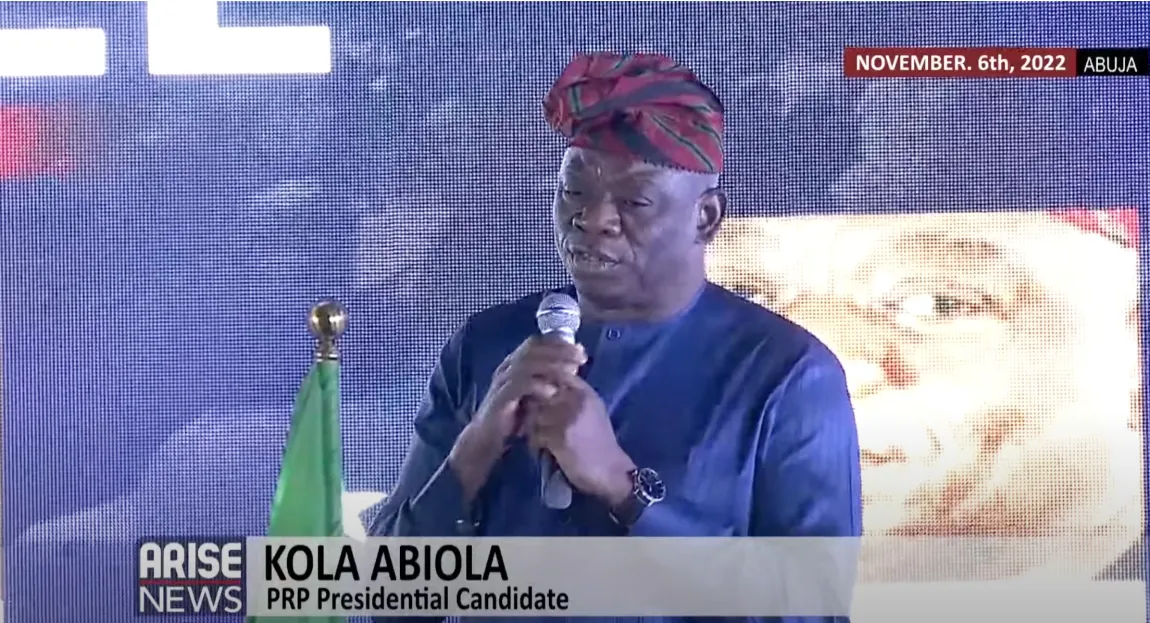
    On November 6, 2022, Nigerians were given another opportunity to scrutinise the presidential candidates. This time, at a town hall hosted by Arise TV in Abuja. 

    It’s no news that your usual suspect (read: BAT) and Atiku Abubakar did not show up but four major parties were represented in varying capacities — Rabiu Kwankwaso, the presidential candidate of the New Nigeria Peoples Party (NNPP). Peter Obi, the presidential candidate of the Labour Party (LP). Kola Abiola, the presidential candidate of the Peoples’ Redemption Party (PRP), and Ifeanyi Okowa, vice presidential candidate of the Peoples Democratic Party (PDP).

    If you are looking at the trends on Twitter and wondering what you missed, we’ve got you covered. 

    The BAT ghosts again

    In a country where almost nothing is predictable, like what value the naira will trade against the dollar tomorrow, or what country Buhari will zoom to next, you can be sure of one incontestable truth — Bola Tinubu, aka BAT, will not turn up for a presidential debate.

    And so like clockwork, the BAT was absent. It would have been bearable — even if not tenable — if the BAT was far away from the debate venue, like at his favourite London abode, or in his bullion home of Bourdillon.

    However, the BAT was in Abuja — the same city where the town hall was held. And while his mates were busy talking to Nigerians about their plans for the country, the BAT had more pressing matters to deal with — like the latest owambe in town.

    Later, his campaign team released a statement explaining why he couldn’t attend. We could explain the silliness of it, but it’s better to just show you.

    BAT doesn’t send you and he wants you to know it. His campaign team has already announced he will be your president whether you like it or not. Over to you, Nigerians.

    The rock is no longer playing with you

    Depending on who you ask, Obi’s (aka The Rock) performance was either meh, or excellent. 

    But that’s by the way. While Obi touched on different matters ranging from the economy to security, the most interesting soundbite came off the cuff. At different points during the town hall meeting, Obi was posed questions from Dino Melaye, spokesperson of the PDP. 

    But it appeared Dino the skitmaker eventually took his antics too far, prompting Obi to say “enough”.

    Obi often projects a calm mien, so to see him so visibly annoyed suggests that Dino rattled him. His supporters say he handled it well. We’ll leave you to draw your own conclusions.

    Okowa got a rough reception

    The early videos that came out at the start of the town hall meeting showed Okowa getting some tough love. The crowd present was pissed that his principal, Atiku Abubakar, failed to turn up for what was billed as a “presidential debate”. 

    https://twitter.com/KnightSirdam/status/1589331486779805696

    Okowa would later explain that it had been relayed to Arise TV ahead of schedule that the PDP would be sending a representative in Atiku’s stead. He said they didn’t object to it. Well, despite the initial gra gra, the show went on.

    Okowa didn’t seem shy to take on issues, sharing ideas on how to deal with stuff like insecurity. Besides defending the PDP’s legacy in government, he took a swipe at Kwankwaso, a former member of the PDP, and Obi who until May was a member of the PDP and the former running mate of Atiku in 2019.

    And he didn’t stop there. He fired more shots at Obi for prioritising saving when the economy was dire.

    It would have been smooth sailing for Okowa except that around the same time he was throwing punches offline, another story on him was doing the rounds online. Talk about timing.

    Kwankwaso won a lot of fans

    If anyone came out ahead, it was probably Kwankwaso. Most commentaries from across political divides seemed to suggest he handled himself well. 

    And despite Okowa carpeting him for being a former PDP member, he kind of held his own.

    Kwankwaso threw his own shots. 

    While speaking in support of Okowa over the absence of his principal, he disclosed that it was at least better to have someone turn up instead of one other candidate that didn’t send anyone at all. Ouch.

    But it was not all rosy. He claimed that he left no debt when he left his office. Maybe he didn’t think the fact-checkers would go and verify. But they did, and came back with their final verdict.

    Kola Abiola was a mixed bag

    To be fair, we loved his outfit. The blue senator and that red fila probably made him the best dressed of the four candidates.

    Still, he was the least popular of the mix.

    Abiola spoke eloquently. Unlike other candidates, he noted  that Nigeria already had adequate security infrastructure but it just failed in addressing gaps in manpower training. He also spoke on the economy, making the case for a market-driven one.

    Yet, not everyone was pleased with his performance.

    And like Kwankwaso, he also got a spanking from the fact-checkers.

    ALSO READ: Peter Obi Wants Your Shishi, and Other 2023 Campaign Lessons

  • One of These 18 Candidates Is Nigeria’s Next President

    With five months left before Nigerians elect a new president, the Independent National Electoral Commission (INEC) has released the final list of candidates for the 2023 presidential election.

    More than 90 million Nigerians are registered to vote

    What you should know

    1. All 18 political parties in Nigeria have candidates on the ballot.
    2. There’s only one female candidate and no female running mate.
    3. The youngest presidential candidate is 38 years old. 
    4. The oldest presidential candidate is 75 years old.

    Who are the 2023 presidential candidates?

    …and who are their running mates?

    Christopher Imumolen, 38 — Accord (A)

    Education: Bachelor of Engineering

    Vice Presidential Candidate: Bello Bala Maru, 59.

    Princess Chichi Ojei, 44 — Allied Peoples Movement (APM)

    Education: American International School, Lagos

    Vice Presidential Candidate: Ibrahim Mohammed, 47

    Sunday Adenuga, 48 — Boot Party (BP)

    Education: FSLC, SSCE, Master of Science

    Vice Presidential Candidate: Mustapha Usman Turaki, 36

    Dumebi Kachikwu, 48 — African Democratic Congress (ADC)

    Education: FSLC, WAEC

    Vice Presidential Candidate: Ahmed Buhari, 40

    Nnadi Charles Osita, 49 – Action Peoples Party (APP)

    Education: FSLC, SSCE

    Vice Presidential Candidate: Hamisu Isah, 45

    Adewole Adebayo, 50 — Social Democratic Party (SDP)

    Education: FSLC, SSCE, LLB

    Vice Presidential Candidate: Buhari Yusuf, 50

    Omoyele Sowore, 51 — African Action Congress (AAC)

    Education: FSLC, WAEC, MSc

    Vice Presidential Candidate: Magashi Haruna Garba, 45

    Osakwe Felix Johnson, 57 — National Rescue Movement (NRM)

    Education: FSLC, NABTEB, B.A, MSc

    Vice Presidential Candidate: Kyabo Yahaya Muhammad, 72

    Malik Addo-Ibrahim, 58 — Young Progressives Party (YPP)

    Education: BSc in Economics

    Vice Presidential Candidate: Enyinna Michael Kasarachi, 44

    Kola Abiola, 60 — Peoples Redemption Party (PRP)

    Education: FSLC, WAEC, BSc, MBA, MSc

    Vice Presidential Candidate: Zego Haro Haruna, 49

    Peter Obi, 61 — Labour Party (LP)

    Education: FSLC, WASC/GCE

    Vice Presidential Candidate: Yusuf Datti Baba-Ahmed, 53

    Hamza Al-Mustapha, 62 — Action Alliance (AA)

    Education: First School Leaving Certificate (FSLC), WAEC

    Vice Presidential Candidate: Johnson Emmanuel Chukwuma, 45

    Dan Nwanyanwu, 62 — Zenith Labour Party (ZLP)

    Education: WASC, LLB

    Vice Presidential Candidate: Abubakar Jibrin Ibrahim, 55

    Rabiu Kwankwaso, 66 — New Nigerian Peoples Party (NNPP)

    Education: FSLC, OND, HND, Post-graduate diploma, MSc, PhD

    Vice Presidential Candidate: Isaac Idahosa, 57

    Peter Umeadi, 67 — All Progressives Grand Alliance (APGA)

    Education: Bachelor of Law (LLB)

    Vice Presidential Candidate: Mohammed Abdullahi Koli, 65

    Yabagi Sani, 68 — Action Democratic Party (ADP)

    Education: FSLC, Secondary School Certificate, BSc

    Vice Presidential Candidate: Udo Okey Okoro, 50

    Bola Tinubu, 70 — All Progressives Congress (APC)

    Education: BSc Business and Administration

    Vice Presidential Candidate: Kashim Shettima, 55

    Atiku Abubakar, 75 — Peoples Democratic Party (PDP)

    Education: GCE, MSc

    Vice Presidential Candidate: Ifeanyi Okowa, 63

    May the best man or woman win.

    ALSO READ: The Most Dramatic Moments of the 2023 Election Campaign… So Far

  • Who Are the Candidates for the 2023 Presidential Election?

    Everybody and their grandmother wanted to get on the ballot to be elected Nigeria’s next president in the 2023 presidential election. But now that the dust has settled on primary elections conducted by political parties, that list has significantly reduced to only a handful of candidates. 

    The pre-season competition is over, and here are the candidates that will appear on the ballot for Nigerians to vote for in 2023.

    Christopher Imumolen — Accord (A)

    Christopher Imumolen is the presidential candidate of Accord. He won the party’s ticket unopposed and is 39 years old.

    Hamza Al-Mustapha — Action Alliance (AA)

    Hamza Al-Mustapha, a former security aide to the late General Sani Abacha, is the presidential candidate of Action Alliance (AA). He was the candidate of the Peoples Party of Nigeria (PPN) in the 2019 presidential election but scored less than 5,000 votes. He’s 61 years old.

    Omoyele Sowore — African Action Congress (AAC)

    Who Are the Candidates for the 2023 Presidential Election?

    Omoyele Sowore was elected the African Action Congress (AAC) presidential candidate at the party’s national convention on June 9th 2022. Sowore was also the party’s candidate for the 2019 presidential election but only recorded less than 34,000 votes. He’s 51 years old.

    Dumebi Kachikwu — African Democratic Congress (ADC)

    Who Are the Candidates for the 2023 Presidential Election?

    Dumebi Kachikwu beat 11 other aspirants to snatch the presidential ticket of the African Democratic Congress (ADC). He’s the founder of Roots Television and the brother of a former Minister of State for Petroleum Resources, Ibe Kachikwu. He’s 48 years old.

    Yabaji Sani — Action Democratic Party (ADP)

    Yabaji Sani is the national chairman of the Action Democratic Party (ADP) and will also represent the party on the ballot for the 2023 presidential election. He was the party’s presidential candidate in 2019 and scored nearly 55,000 votes. He’s 64 years old.

    Bola Tinubu — All Progressives Congress (APC)

    Who Are the Candidates for the 2023 Presidential Election?

    Bola Tinubu beat a dozen other aspirants to the highly-coveted presidential ticket of the All Progressives Congress (APC). He’s a former senator and Lagos State governor. He’s 70 years old.

    ALSO READ: Lessons We Learnt from APC Presidential Primaries

    Peter Umeadi — All Progressives Grand Alliance (APGA)

    Peter Umeadi is a former Chief Judge of Anambra State who’ll represent the All Progressives Grand Alliance (APGA) on the ballot for the 2023 presidential election. He won the ticket unopposed. 

    Yusuf Dantalle — Allied Peoples Movement (APM)

    Yusuf Dantalle is the flagbearer of the Allied Peoples Movement (APM) for the 2023 presidential election. He’s also the party’s national chairman and was elected unopposed. He was a losing candidate in the 2019 Kogi State governorship election. He’s 50 years old.

    Sunday Adenuga — Boot Party (BP)

    Sunday Adenuga will fly the flag of the Boot Party (BP) at the 2023 presidential election.

    Peter Obi — Labour Party (LP)

    Who Are the Candidates for the 2023 Presidential Election?

    Peter Obi, a former Anambra State governor, is the flagbearer for Labour Party (LP) for 2023. He was a vice presidential candidate of the Peoples Democratic Party (PDP) in the 2019 presidential election. He’s 60 years old.

    Okwudili Mwa-Anyajike — National Rescue Movement (NRM)

    Okwudili Mwa-Anyajike beat eight others to the presidential ticket of the National Rescue Movement (NRM).

    Rabiu Kwankwaso — New Nigerian Peoples Party (NNPP)

    Who Are the Candidates for the 2023 Presidential Election?

    Like Obi, Rabiu Kwankwaso also left the PDP in pursuit of his presidential ambition. He eventually won the ticket of the New Nigerian Peoples Party (NNPP). A former Kano State governor, he also served as a minister and senator in the past. While he failed to get on the presidential ballot in 2015 and 2019, he’s trying again in 2022. He’s 65 years old. 

    Atiku Abubakar — Peoples Democratic Party (PDP)

    Who Are the Candidates for the 2023 Presidential Election?

    Atiku Abubakar is one of the favourites to win the 2023 presidential election after winning the PDP ticket. The former vice president was also the party’s candidate in the 2019 presidential election but finished second. The 2023 election is his third time on the presidential ballot and sixth attempt overall since he first contested in 1993. He’s 75 years old.

    ALSO READ: Lessons We Learnt from PDP’s National Convention

    Kola Abiola — Peoples Redemption Party (PRP)

    Who Are the Candidates for the 2023 Presidential Election?

    Kola Abiola beat three other aspirants to become the flagbearer of the Peoples Redemption Party (PRP). He’s the son of the late MKO Abiola (who was adjudged to have won the 1993 presidential election that was annulled by the military government of Ibrahim Babangida). He’s 59 years old.

    Adewole Adebayo — Social Democratic Party (SDP)

    Adewole Adebayo is the presidential candidate of the Social Democratic Party (SDP). The 54-year-old is a lawyer and founder of KAFTAN Television.

    Malik Addo-Ibrahim — Young Progressives Party (YPP)

    Who Are the Candidates for the 2023 Presidential Election?

    The presidential candidate of the Young Progressives Party (YPP), Malik Addo-Ibrahim, is a civil rights activist and founder of the Reset Nigeria Initiative. He’s the son of the Ohinoyi of Ebira Land in Kogi State.

    Dan Nwanyanwu — Zenith Labour Party (ZLP)

    Who Are the Candidates for the 2023 Presidential Election?

    Dan Nwanyanwu is another national chairman that’ll be representing his party as a candidate for the 2023 presidential election. He’s promised to unite Nigerians in three months if elected president.

    ALSO READ: Time Is Running Out for You to Register for Your PVC