Notice: Function _load_textdomain_just_in_time was called incorrectly. Translation loading for the wordpress-seo domain was triggered too early. This is usually an indicator for some code in the plugin or theme running too early. Translations should be loaded at the init action or later. Please see Debugging in WordPress for more information. (This message was added in version 6.7.0.) in /home/bcm/src/dev/www/wp-includes/functions.php on line 6121
Police officers | Zikoko!
  • Police Pension Bill: New Hope for “Oga Police”

    For a while now, retirees of the Nigerian Police Force have appealed to the National Assembly to pass the Police Pension Bill, which would exclude them from the Contributory Pension Scheme (CPS). Without trying to stoke false optimism, it looks like they’ve finally gotten the answers to their prayers. 

    What is the latest on the Police Pension Bill? 

    On Tuesday, May 6, the Senate passed the Bill to establish a Police Pension Board. This Bill excludes members of the Nigerian Police Force from the CPS and returns them to the Defined Benefit Scheme (DBS).

    The “Defined Benefit” pension scheme means the government is solely responsible for paying pensions to retirees. Under this scheme, retirees are entitled to a specific amount based on their years of service, retirement age, and terminal salary, as opposed to the Contributory Pension Scheme introduced in 2004, where the employer and employee contribute monthly pension and retirement benefits. Initially, as part of pension reforms under the Pension Reform Act of 2004, the government transitioned police officers to the Contributory Pension Scheme, which also includes all public servants.

    Why did police officers want this Bill in the first place? 

    Before now, the Nigeria Police Pension Office (NPPO) oversaw the payment of pensions and gratuities to retired police officers. And they functioned under the National Pension Commission (PenCom), the pension administrator for retirees under the Contributory Pension Scheme (CPS). 

    However, over the years, the NPPO has been plagued with cases of corruption and mismanagement. In 2013, a High Court in Abuja sentenced Yakubu Yusuf, a Director of the Police Pension Office, to six years imprisonment or the option of a fine of ₦750,000 for spending ₦23.3 billion meant for pensioners for personal use. 

    In 2020, six public officials were re-arraigned by the Economic and Financial Crimes Commission (EFCC) in a High Court in Abuja over their involvement in a ₦64.6 billion police pension scam.

    And beyond the corruption in the NPPO, police officers say the CPS system has faults that have impoverished the lives of police retirees, as the retirement benefits are meagre compared to what would have been received under the DBS. The level of trust in the system is low.

    For instance, an Assistant Superintendent of Police (ASP) and a Deputy Superintendent of Police (DSP) take home #25,000 and ₦29,000, respectively, as a monthly pension. In contrast, officers in the same rank under the Defined Benefits System would receive between ₦106,000 and ₦120,000 as their monthly pension. DBS covers pensioners who existed before the Pension Reform Act of 2004 was enacted. 
    If you no tell us, how we go know? Tell us here.

    Reactions to the Bill

    So far, PENCOM, the Pension Fund Operators Association of Nigeria, and other stakeholders oppose the new Bill, claiming it’ll cost the federal government about ₦ 2 trillion in pension liabilities to cater for 300,000 police officers. 

    On the other hand, Alkali Baba, the representative of the Deputy General of Police, Sanusi Lemu, says that the new Bill would boost the morale of police officers treated unfairly under the CPS. 

    There is a strong shared sense of optimism among police officers about this bill, believing that it has the potential to redefine policing in a positive manner and enhance the lives of both active officers and retirees. We hope this legislation will enable police officers to live and work with greater ease and an improved quality of life, particularly for retirees.

  • How Much Trouble Is Seun Kuti In?

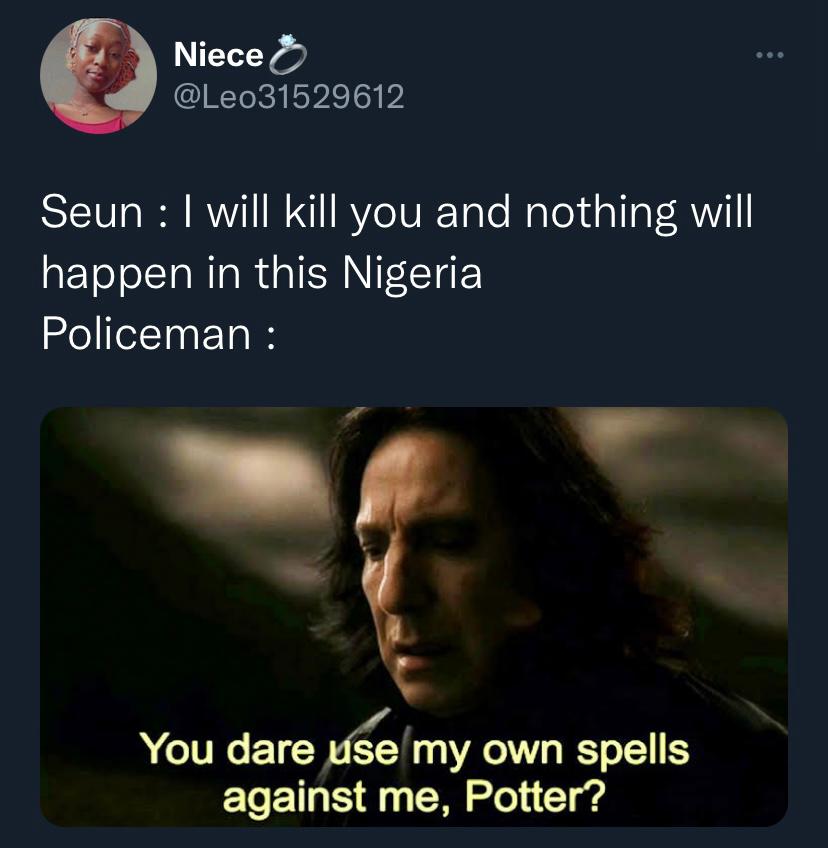
    Nigerians being assaulted by police officers is nothing new; it’s as normal as spending four hours in Lagos traffic on a Friday evening.  So, on May 13, 2023, when the video of Seun Kuti, son of the Afrobeat legend Fela Anikulapo Kuti,  surfaced online of him assaulting an officer on Lagos’ Third Mainland Bridge, it definitely caught the attention of many and spawned many questions. 

    What exactly happened?

    While the exact reason behind what started the issue in the first place is still unknown, the video showed Seun yelling repeatedly, manhandling, and eventually slapping the officer’s face. 

    In his defence, Seun claims he was “assaulted” first, and the officer tried to kill him and his family members, although the video shows otherwise. He says that he has enough evidence to back this up and had the initial intention of placing charges against the officer for assault. 

    However, the Inspector General of Police, IGP Usman Alkali Baba, in a statement the next day on May 14, 2023, ordered the arrest of Seun Kuti and a full investigation into the causes of the assault shown in the video

    We’ve seen this before

    This isn’t the first time we’ve seen celebrities assault police officers. In 2014, when flagged down for violating a traffic law, Tiwa Savage decided she wanted all the smoke and proceeded to insult the police officers who stopped her. She didn’t stop there; she also removed and flung away the cap of one of the officers.  

    In 2018, Small Doctor was also arrested and prosecuted for threatening to open fire on an officer. And more recently, in 2022, Ice Prince was arrested for allegedly abducting, assaulting, and threatening to throw the police officer who stopped him for driving a car without a plate number at 3 a.m. into a river.

    There are penalties for these kinds of offenses, as Nigeria is a country with laws. 

    What does the Law say?

    According to Section 356(2) of the Criminal Code Act, assaulting, resisting, or willfully obstructing a police officer while acting in the execution of his duty, or any person acting in aid of a police officer, is considered a felony and can earn you three years in prison. 

    Section 98 of the Police Act 2020-98 also states that “A person who assaults, obstructs, or resists a police officer in the discharge of his duty, or aids or incites any other person to assault, obstruct or resist a police officer or other person aiding or assisting the police officer in the discharge of his duty, commits an offence and is liable on conviction to a fine of ₦500,000 or imprisonment for a term of six months or both.”

    Reactions so far

    It is unusual for Nigerians to sympathise with members of the police force, and we’ve seen no lost love in this case. 

    Popular Nigerian singer Peter Okoye pleaded with the Nigerian police to temper justice with mercy. 

    Today, Seun Kuti was arrested and is currently being detained at the State Criminal Investigation Department in Lagos. Many Nigerians anticipate what penalty or punishment follows.

    No one knows for sure how this case will turn out, but given the history of police assaults by celebrities, we hope it doesn’t get swept under the rug.