Notice: Function _load_textdomain_just_in_time was called incorrectly. Translation loading for the wordpress-seo domain was triggered too early. This is usually an indicator for some code in the plugin or theme running too early. Translations should be loaded at the init action or later. Please see Debugging in WordPress for more information. (This message was added in version 6.7.0.) in /home/bcm/src/dev/www/wp-includes/functions.php on line 6121 police officer | Zikoko!
The Nigerian police force (NPF) has become an integral part of every Nigerian’s life. You see them everyday — in the heat of car traffic, in their patrol cars and at checkpoints. While these uniformed officers represent the law and coordinate arrests of defaulters, not much is known about their administrative structure.
The NPF consists of departments that work together to discharge their duties. This structure is according to sections 214(2)(a) and 215(2) of the constitution which defines how police force authority is layered in ranks and the extent of their power. In these provisions, the NPF has been divided into three different structures:
Command Authority Structure
Administration Structure
Organisation structure
While these three structures are all interconnected, this article primarily focuses on the “Administrative Structure” of the NPF and their duties.
The NPF’s Administrative Structure is made up of 7 Departments (A – G). Each department has a core focus to maintain, and while it might be different, they are all charged with the central duty of upholding Justice and keeping the country safe from all threats.
A Department (Administration)
Here we have the top officials of the rank and file saddled with the core responsibility of supervision and coordination of the police in the discharge of their duties. Officers in this department handle everything from formulating policies, reforms, and procedures to carrying out disciplinary actions against juniors and senior officers in the force. This department also handles convening senior officer’s conferences and preparing annual reports and budgets.
B Department (Operations)
We have the officers in charge of directly handling the security and safety of the lives and properties of the citizens throughout the country. They plan and organise security measures for the larger communities to prevent crime, oversee inter-agency operations, and handle all policy formation on traffic control, terrorism, insurrection, natural disasters, and many other issues that affect the general population.
C Department (Logistics and Supply)
These officers handle the procurement and distribution of clothing and accoutrements such as vehicles, buildings, arms and ammunition, spare parts, and printing equipment. They maintain and distribute all necessary equipment related to the NPF.
D Department (Investigation and Intelligence)
These officers handle all criminal investigations, liaison with Interpol, Forensic investigations, prosecution, and maintenance of all records on policing and enforcing the laws.
E department (Training and Command)
This department is in charge of recruiting and training fresh cadets and other officers in the NPF. They maintain and supervise all police colleges and create policies to standardise the development of staff and equipment of the NPF in line with international standards.
F Department (Research)
This department is charged with researching and developing new and existing policies to ensure the standards of the NPF are up to date. They also handle information and ethics management.
G Department (ICT)
This department handles all the computer-related affairs of the NPF. They see to matters of cyber security and maintain all the sensitive registries and systems of the NPF such as the Biometric Central Motor Registry (BCMR), Automatic Fingerprint Identification System, and Tracking and Intercepting Device Unit.
These are all different systems and registries that are employed across departments within the NPF. They are experts in the ICT field and are essential to the discharge of the NPF Mandate.
These departments are the machines that make the police department work and show that beyond the roadside patrols and highway checks, the Nigerian police force does much more.
The Nigeria Police Force (NPF) is really concerned that its officers don’t have a monopoly on violence.
The police have recently recorded three cases of assault against its officers within five days, in Lagos alone. After decades of brutalising Nigerians, some of them are starting to fight back:
Bro Muyiwa are you seeing this sir???? And what step have Nigeria police Hqt taken on this assault on Nigeria police sir….🤔🤔🤔 pic.twitter.com/qWaKO6W9mj
The trend of Nigerians assaulting police officers is frightening enough that even the Inspector-General of Police (IGP), Usman Baba, addressed it in a statement.
While Nigerians fighting back against police officers is a manifestation of the culture of distrust they have with the public, it’s not the best conflict-resolution strategy for civilians. Because this could happen:
More than the risk of dying, assaulting a police officer is likely to get a civilian in trouble regardless of the officer’s provocative conduct. It’s a felony that could land a convicted person in prison for three years.
“I should have just said, ‘Do you know who I am?’ 20 times”
What can you do instead?
Defuse
Remember to never cut the red wire
Distrust for the police force means Nigerians expect officers to move mad at any point during a regular encounter. Interactions between Nigerian police officers and civilians these days can get confrontational and violent in the blink of an eye.
Especially if you don’t have anything for the boys
It’s in your best interest as a civilian to get through this encounter without resorting to blows or anything that lands you in prison. The most important thing you can do is remain calm. The police officer should be committed to this kind of attitude too, but that’s not always the case. When they don’t reciprocate your calmness, what’s the best way to handle it?
Don’t resist arrest
Police officers have a certain level of “reasonable force” they can apply to a situation in which a suspect is resisting arrest. If you react violently to provocation, it can give them justification to keep assaulting you.
It’s important to remain calm and not lash out so they can’t build an unfair case against you. They know the kind of trouble you can get into and are happy to exploit it. Comply with instructions even in the face of provocation. You can raise alarm for the awareness of people in the area, but don’t resist arrest.
When a police officer assaults you, the best immediate course of action is to gather as much evidence of the assault.
Remember crucial details for documentation, do a video recording of the incident with your phone, if possible, or if it happened in public, urge others to record it.
It’s also important to record the officer’s name and identification number if possible.
That’s how this guy lost his job
Visit a doctor
No, not this one
If you sustain injuries in the course of the assault, it’s advisable to visit a doctor for treatment and get a report that’ll serve as medical evidence for your case against the offending police officer.
Find a lawyer
There are cases when you can deal with a violent police encounter without needing legal counsel, but it’s advisable to get one just in case things get complicated.
Complain
When you’ve gathered all the evidence you need to build your case, file a complaint with the police force’s Complaint Response Unit (CRU). The force created the unit in 2015 to process complaints from members of the public and provide feedback on actions taken on such complaints.
You can contact them through one of these options:
You can also forward your complaints to the public relations officers of state commands on social media or their mobile phone numbers.
As long as your life isn’t in immediate danger, beating a police officer is a very bad idea. Take the high road, please.
This is Zikoko Citizen’s Game of Votes weekly dispatch that helps you dig into all the good, bad, and extremely bizarre stuff happening in Nigeria and why they’re important to you.
Subscribe now to get the newsletter in your email inbox at 8 am every Friday instead of three days later. Don’t be LASTMA.
Finally, some good news for Nigerians: Buhari’s special Christmas gift is to end terrorism completely by the end of the year.
President Buhari’s ascent to the number one seat in the country rested on his promise to end insecurity in Nigeria. Voters believed him easily because he’s a retired military general and that should mean he can crush terrorism with just his side eye if he stares really hard.
But the president must have only been squinting at terrorists as insecurity escalated over the past seven years. He definitely tightened the noose on Boko Haram, but a different kind of terrorism with no religious buzz rose in other regions of the country. Those terrorists have attacked Nigerians in their homes, on the road, on train tracks and even at the airport.
The president is sick of that now and has ordered the country’s security agencies to do their jobs and secure the country. The Minister of Interior, Rauf Aregbesola, who’s known more for announcing public holidays than his spectacular failure to manage internal security, announced the government’s new resolve at a joint security press conference this week.
The minister said the day is coming when Nigerians can sleep with their two eyes closed again because their security is guaranteed. And by December 2022, peace is scheduled to be restored to every inch of Nigeria. Buhari has ordered it and so shall it be.
The government’s latest promise would be the kind of news to toast cheap bottles of wine to, except we’ve been here before many times under Buhari. We’ll believe it when we see it.
What Else Happened This Week?
Unpaid Police Officers Are Losing Their Wives to Okada Riders
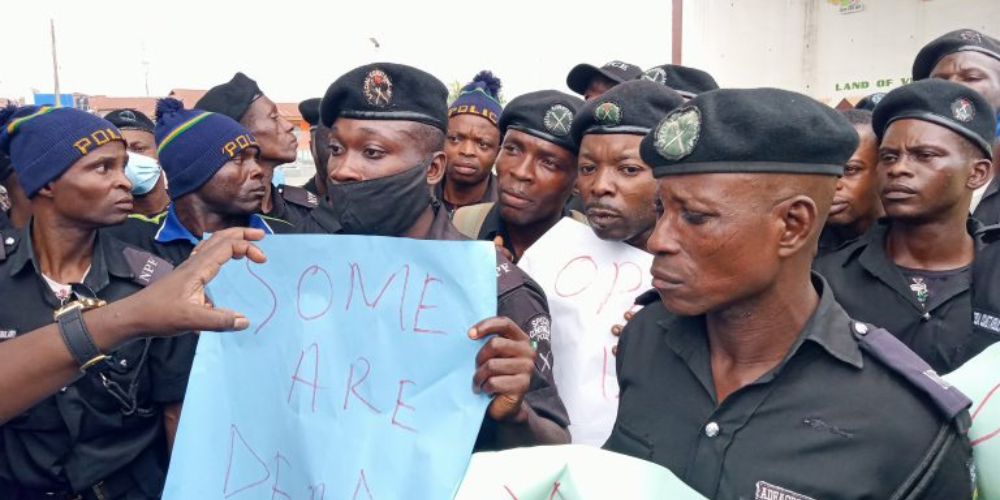
Even by Nigerian standards, police officers taking to the streets to protest against unpaid wages is a terrifying nightmare. Yet, that’s what police special constabularies in Osogbo, Osun State did on September 7th, 2022.
For context, these officers are part of the Community Policing Constabulary Scheme. They assist the main police force with grassroots tasks like intelligence gathering and reporting cases. So, they’re like the errand boys of the Nigeria Police Force (NPF).
The constables complained that the government failed to pay their salaries for 18 months, and you can imagine what that means with the state of this economy. Inflation is skyrocketing and the cost of living isn’t anybody’s mate right now. But even worse than that, the protesters were unhappy that the sapa choking them was making them lose their wives to okada riders. It was enough of a significant problem that one of them wrote, “Okada riders are sleeping with our wives” on a placard at the protest.
The NPF didn’t roll out tanks, water canons and tear gas against the protesters like they do to civilians. But the Osun State Commissioner of Police, Adewale Olokode, did have strong words for them. He called them an embarrassment and expected them to communicate their grievances more privately according to protocol.
Every worker deserves his fair wages, and it’s abundantly clear why the government should never neglect to pay the allowances of police officers. A failure to do so is the kind of thing that leads them to extort innocent Nigerians, and extortion is just the gateway drug for crooked cops to get worse. The government should pay them so they can get their wives back.
What are the names of the two top politicians who recently turned skit makers? (Hint: One is a former minister and the other is a former senator.)
Click here to tweet your answer to @ZikokoCitizen on Twitter.
Ehen, one more thing…
We may not be in the days of Noah, but deadly floods have wrecked thousands of lives in 33 states and the Federal Capital Territory (FCT) since the beginning of the year. Buhari says he’s on top of things, but who believes anything that guy says these days?
With the 2023 elections drawing closer, I wonder what it was like to live in a time without democracy. In this article, a police officer who lived through the first military coup in 1966 shares the moments that led up to joining the force at 18 and the moment that reminded him there was more to life after 35 years of service.
The life of an Igbo police officer in the ‘90s, as told to Ortega
Life before the first military coup in 1966
I was a restless child born in 1937. I grew up as the only son of my father, and his brothers expected me to take up his role as our village’s chief priest. But my father wanted something more for me. He wanted me to go to school and live outside the cage tradition had built for our lineage as its custodians.
My father was convinced living together would make it easier for my uncles to persuade me. So he kept me away for as long as he could. When I was five years old, I had to live with different people in my village and depend on them to put me through school. They called me Nwali, son of the soil. It meant I belonged to everyone in my village but to no one at the same time. The villagers were in charge of taking care of me while my father kept my uncles at bay. Their generosity got me a secondary school education. But that was as far as I could go with the resources they had.
“They called me Nwali, son of the soil”
Everyone expected me to become a teacher, but I found the role quite stuffy and boring. I spent the two years after secondary school working odd jobs instead. I tapped palm trees and helped families build houses — I did anything I could get my hands on. I saw my father once in a while, but he expected me to figure things out on my own.
At 17, I decided to leave my village in Delta for Benin. My cousin promised to teach me to drive and offered me work as one of his cab boys. The first three months were okay, but I couldn’t bear the long hours of driving just to have my cousin take most of the profit I made. I couldn’t tell him that because I had to be grateful to him for trying to help.
After another three months of yelling for passengers under the hot sun, I decided to take a break and go back to Delta. That’s when I found a bit of luck in my life.
On my way to the park, I met a friend who was coming in from Delta. We exchanged pleasantries and I explained why I was heading home. His response to my complaints of driving taxis for hours under the sun was an odd demand for me to follow him on an errand in Benin. He offered to cover the two pence it would cost to get a bus back to my village, so I decided to go with him. There was nothing to lose.
The errand turned out to be recruitment at the police college for new constables in 1955. Of course, I was surprised my friend wasn’t just upfront about it, but I was more interested in how to get in as well. So while he queued up, I rode a bicycle back home to get my documents. Hundreds of people were in the queue when I got back. Every young man wanted a chance to wear fancy uniforms and work with white men. I just needed money.
“I refused to learn Yoruba. I felt it was easier to handle thieves that pleaded for mercy if I didn’t hear anything after e jo”
When it finally got to my turn, the constable took one look at my file and asked me to leave. Apparently, 18 was too young to serve. But then, luck was on my side. One of the senior officers asked him to consider me because I looked strong. And that’s how I got into the ranks.
There were only four police colleges in Nigeria at the time. Benin was just a point of recruitment, so I was moved to the one in Kaduna for a while before I was relocated with other southern officers to Lagos in 1956. I can’t remember how much I earned, but we were paid in pounds until 1973 when naira notes were introduced. What I loved about my job was the respect it gave me. No matter the rank, there was some kind of honour you felt putting on a police uniform in the ‘60s. There was also a lot more investment in the force. I attended the Police Colleges in Paris and Britain for short courses, and in a year, I rose to the rank of cadet.
I worked in Lagos until 1959. A senior officer decided it was best to experience other parts of the west. And in 1959, the country was still at a point when a mid-western Igbo (Igbos from the Bendel region) man transferred to Lagos or Abeokuta wasn’t odd. Nobody cared where I was from or that I refused to learn Yoruba. I felt it was easier to handle thieves who pleaded for mercy if I didn’t hear anything after “E jo”. I didn’t believe Yoruba people were open to learning my dialect. But it didn’t matter. No one bothered too deeply.
Abeokuta was a lot calmer than Lagos. I was stationed there to monitor the railway stations. We derailed passengers coming in from the north and monitored the day-to-day running. But after two years, I got bored. I liked the rush of Lagos more, where things like welcoming renowned leaders happened. For instance, in 1956, I got to see the Israeli prime minister, David Ben-Gurion.
“It wasn’t until the first military coup in 1966 things changed. The attack happened the day I got married in the village.”
Working at the police station in Lagos let me meet people from different works of life. And that made my work interesting. Like the time I met a gambler who was brought in from Obalende back in 1956. He was charged as a thief, but he didn’t seem like one to me. I was in charge of the evidence desk, so I could probe a bit more when criminals came in.
When we spoke, he mentioned that he ran away from home and was trying to win bets to make more money. But the men who arrested him didn’t believe it. He confessed to stealing clothes the morning of his arrest, but that was it. For some reason, he seemed genuine, and I believed his story. I spoke to my colleagues and we got him off on a two-week sentence rather than a year for petty theft. Those were the moments that made me feel like my job mattered; even the bible says blessed are the peacemakers.
The year everything changed
It wasn’t until the first military coup in January 1966 that things slowly began to change. The attack happened the day I got married in the village. For the most part, civilians were safe. But because the attack was by southern soldiers, Chukwuma Kaduna Nzeogwu and Emmanuel Ifeajuna, it looked like the Igbos were trying to disrupt peace. I knew better than to share my thoughts with colleagues; people were upset.
I was moved to Lagos to serve later that year. They began to look at me as a police officer who was Igbo rather than just a police officer.
As a corporal and the only breadwinner of my home, I knew better than to get involved in the messiness of politics. My main priority was keeping my family safe while my wife was expecting our first child.
The second attempt at taking over the government took away the last shred of peace. It was in August 1966, and officers called it the revenge coup. Unlike the first coup, which was handled mainly by southern officers, this operation seemed like retaliation from northerners because it was led by Lt. Colonel Murtala Muhammed.
Unlike the first, this takeover was successful, and for the first time, we lived under military rule. It was a very difficult time depending on your tribe. For me, it suddenly meant something to be an Igbo man serving with the Lagos police force. Some superior officers checked our badges and their countenance changed when they found out I was from the south. But I wasn’t going to buckle under the sudden pressure.
“When we lost the war in 1970, Nigeria went into a long period of discrimination”
Back home, people were being slaughtered. Trains were loaded with dead bodies in the east, and when Lieutenant Colonel Ojukwu decided to push back in 1967, so did the ruling officers. It was a bloodbath, and I still don’t know how Lagos maintained some sense of sanity. Still, by 1968, I had to send my family back to Delta state from Lagos.
I’d become a sergeant by the end of 1966, and it was business as usual at the force, which meant always being away from home. But I’d had my second daughter and wasn’t comfortable with working all the time when things were so unsafe. I also couldn’t get any of my wife’s sisters to travel from Delta to Lagos because of their safety.
It was better to take my wife and kids to Delta dressed in my police uniform, which was the only thing keeping me from being harassed or outrightly killed. It was a hard decision, but keeping them away was for the best. Our village didn’t experience the attacks going on in the eastern towns.
Between 1967 and 1970, Nigeria was at war with itself. But I didn’t have the time to process what it meant at 30 years old. I had to focus on my task of training police officers, assisting to keep some level of sanity in Lagos.
When we lost the war in 1970, Nigeria went into a long period of discrimination. Rising to the top of the force suddenly became difficult. I should’ve officially been promoted to sergeant, but the results for the exams I took weren’t released until after a year. Most people had theirs a few weeks after the exams. That’s when I knew a lot was about to change for me.
By 1975, I’d made a life for myself in the Ikeja barracks. My marriage was what you’d call successful because my wife and I had five children at that point. What hadn’t been so successful was my ability to support my family on my salary. I was earning less than ₦20k as a sergeant, and a family of seven wasn’t exactly cheap. But I wasn’t the only one experiencing the economic challenge.
“When my friend, a fellow officer, died from high blood pressure, I realised there was more to life than chasing ranks”
Leaving behind the police force
With the political instability, getting goods was hard and prices went up. I could get Omo for less than ₦5 before the coup, but after, we were spending almost ₦20 per sachet. Rice was also a luxury because importing was difficult. My wife eventually had to open a store to sell drinks so she didn’t have to depend on my salary for foodstuff. But I didn’t care about the money. I wouldn’t have enjoyed any other job as much.
As the years went by, I began to feel like my work as an officer didn’t matter. My family joined me in Lagos again in 1971. The Civil War was over, and I missed seeing my family. I’d had my second child in 1968, and we only saw a few times a year because of the state of things. So I brought them to join me at my flat in Ikeja barracks.
I spent years leading up to the final coup in 1975 as a sergeant. I was in the office with a few personnel who talked about setting a village close to mine on fire. I’m sure they didn’t have a clue where I was from. But that’s how ruined we were as a country after 1965. At least, the failed 1966 coup was just a power struggle, but the rest were about personal dislikes amongst ourselves.
As long as the ruling party preferred a certain ethnic group over mine, even as an Assistant Commissioner of Police (ACP) in 1983, I dealt with unwarranted questioning and didn’t get the recognition I deserved. But I was convinced I needed to rise the ranks to be a commissioner because it would make a difference.
Then one of my friends, a fellow officer, died from high blood pressure, and I realised there was a lot more to life than chasing ranks. I was earning around ₦80k as an ACP in 1986. I decided to start putting money aside to build a home for my family in Delta. As the only son, my father left over 500 hectares of land to me. That was enough for a farm and properties to rent out over time.
“I don’t regret my time on the police force”
Major General Babangida was still in power and the force was dominated by western and northern men. I could count the officers in my rank who were from the south on one hand. But I didn’t have the time to feel bitter. I put in my notice for retirement in 1989 and was approved for pension within six months. I left in 1990 at 53 without looking back.
It’s been 32 years since and my monthly pension hasn’t changed. Less than ₦80k per month is all I’ve gotten since 1990 while my retired colleagues from the army receive a minimum of ₦150k per month. I was one step away from the highest rank in the force, but I can’t get decent money for 35 years of work. That’s the biggest pain for me. It shows policemen aren’t as valued as we were in 1955.
But I don’t regret my time there. I’d do it all over again if I could because being on the police force gave me some of my greatest memories. Being an officer was a time I got to see the real side of human nature because of the amount of history I saw unfold. And now that I spend most of my time alone, it’s nice to remember what life was like when I was a young man.
Now that we know what life was like for a Nigerian police officer in the ‘60s, imagine what would’ve happened if Abacha Never Died.
Social media undoubtedly has a huge influence in our lives, whether we like it or not. Twitter, Facebook, Instagram and the rest are our daily bread. When we wake up in the morning, we instantly reach for our phones just to find out what happened while we were out cold.
Just like there are two sides to everything, social media has its good and bad parts. It’s a tool we can use however we want to.
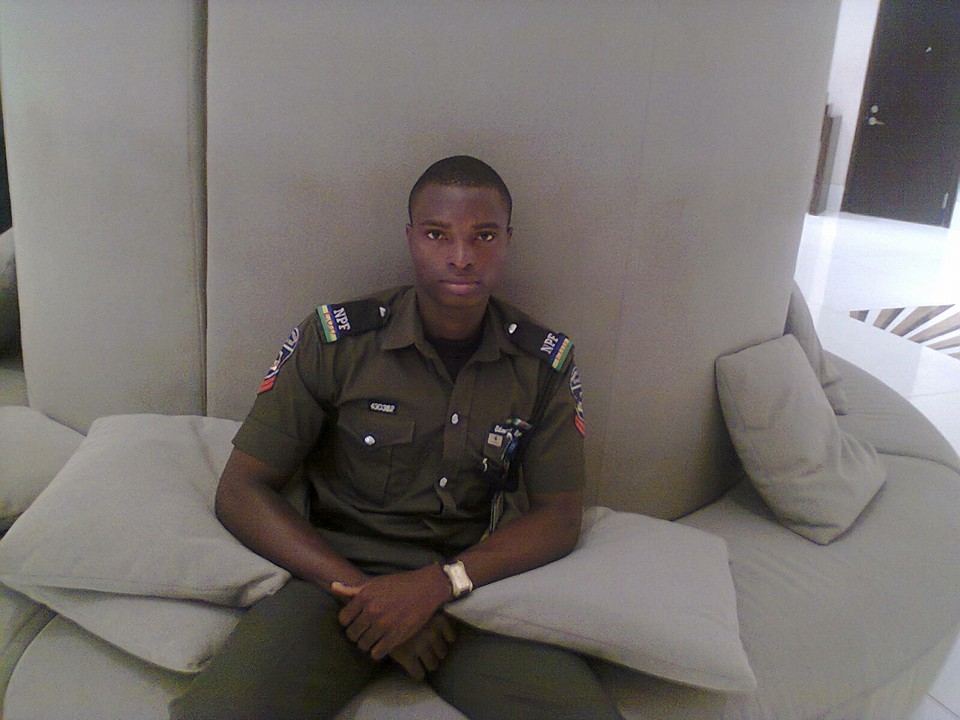
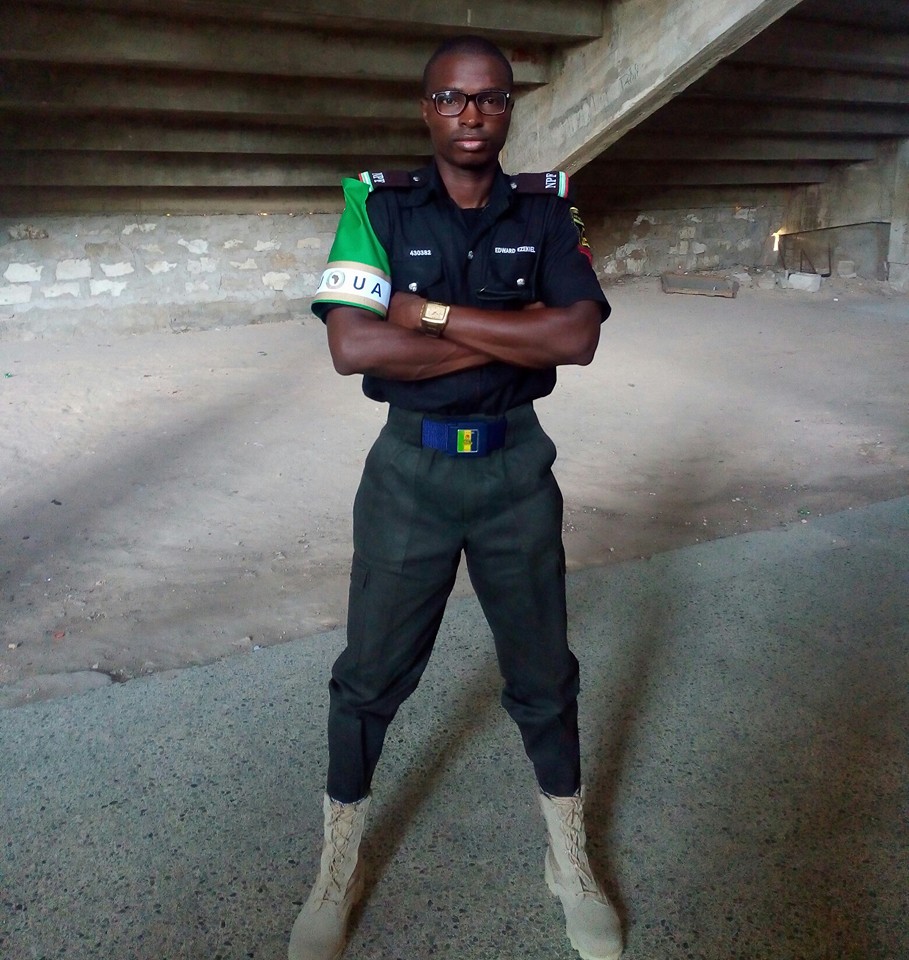
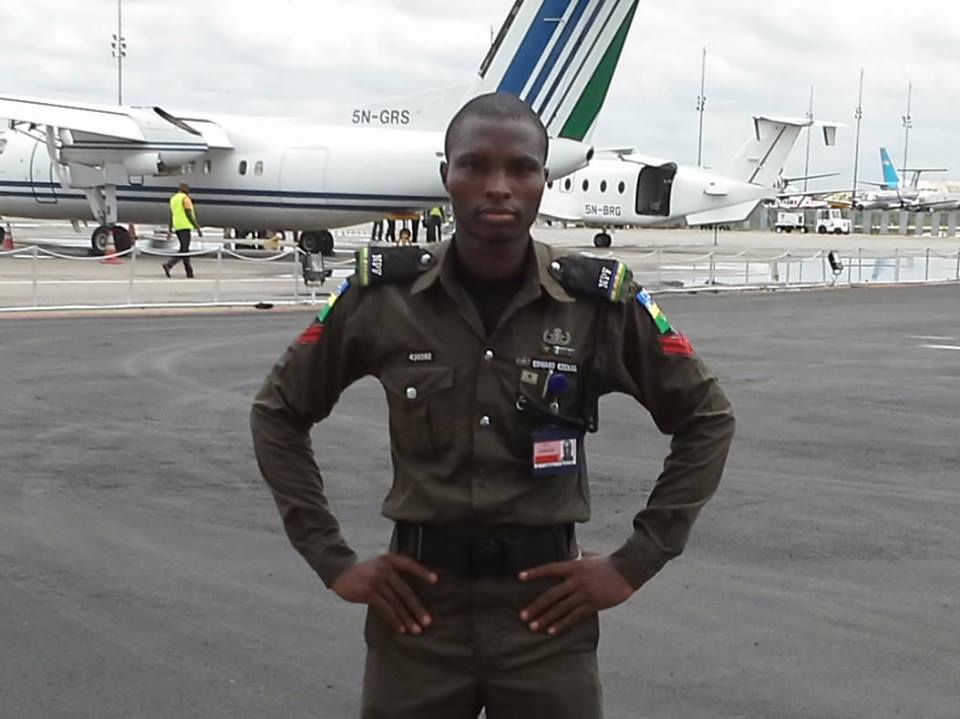
Remember Edward Onoriode, the police officer who defuses bombs for a living?
He’s one of the reasons why we haven’t lost our faith in the Nigerian police. Well, he’s here to inspire us again with words of wisdom. This time, it’s about how using social media positively helped him get a job.
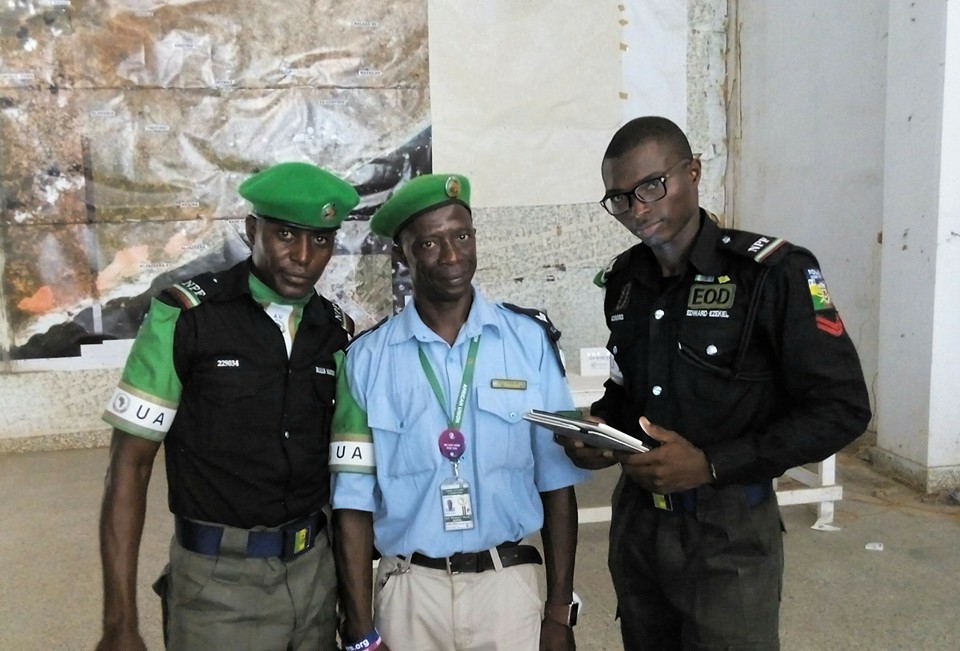
Edward is currently a peace ambassador to Africa under AUPOL (Africa Union Police) and he got this job all thanks to social media – Facebook to be exact.
Read his story:
What type of friends do you keep online?
Millions of people are on Facebook but are not making the best out of it. What has most of you people gained being on Facebook everyday? What type of friends do most of you keep on Facebook? Are you on Facebook to read gossips alone, make jokes alone, criticise politicians alone, ridicule religious people alone, scam people or defraud innocent people? Are you on Facebook looking for that important connection that will skyrocket you to the next level in life, do business online, post pictures alone, writes stories, talk about sex and relationship alone…etc…? What type of friends do you keep online? Or are you the type that is always on Facebook hunting for the opposite sex or same sex just to satisfy your sexual urge? Are your Facebook friends the type that will bring out the best in you? Are they the type that will make you become something out of nothing? Remember, there are so many opportunities being online mostly on Facebook. Are you taking advantage of those wide range opportunities? Or you are just on Facebook for Facebook sake?
Many years ago, I kept my identity very secret. Only a very few Facebook friends knew am a police officer because I wasn’t too proud to tell the world am a policeman. I felt I’ll be stereotyped if I come out open. I never knew I was only deceiving myself and fooling myself all those while. I was ashamed to be identified as a Policeman until I met Mr Remi Adeoye on Facebook who is so proud of his job and display it without minding whose ox is being gored. He changed my psyche and perception about the job I do for a living. He made me to understand I should be proud of what I do for a living. He made me to realize I can change the face and thinking of most police officers if I come out open. He made me to realize with my boldness to issues, I can change the perception most people have towards the police. He made me to realize my achievement in life is because of the job I do for a living despite being a rank and file in the police something many senior police officers haven’t achieved and are dreaming to achieve. All his advise were well noted by me and I thought about them for a while and that’s why I came out open. Today, am so proud to be called a Police officer and an EOD personnel.
Me and Mr Remi Adeoye haven’t really met in person. We are just friends online. He love some of my articles and I love almost all of his articles. We bonded like father and son. He chat with me like we are age mate. He advise me like am his biological son. He talk to me like a colleague, brother, friend and son that have knew each other for ages. He mentor me both on marital issues, social issues, economical issues, financial management, religious matters and how to be professional in my job and duty. He’s one Facebook friend I’ll forever be grateful to have and I want to take that relationship beyond Facebook. In fact, he’s my Facebook man with a golden heart of the year and beyond.
Last year, we were chatting as usual and he told me he’d like to recommend me as a peace ambassador to Africa under AUPOL (Africa Union Police). I thought he was joking. He requested for my particulars and I reluctantly gave it to him not really hoping anything good will come out of it due to the Nigerian factor.
Two months after I gave Mr Remi Adeoye my particulars, i was on duty one faithful morning when I received a call from Abuja that I should report at Abuja the following day by 7am for screening and interview at the Directorate of peacekeeping mission camp. I was mute for minutes and all I could say afterward was “YES SIR!”
I was confused when I dropped the call. “How can I be in Abuja the following day by 7am without preparing for such unprecedented journey?” I thought to myself.
Abuja from Lagos is not Ibadan from Lagos nor Sango from Lagos. I quickly sent some messages to Mr Remi Adeoye confirming the call I just received and he confirmed it and told me to report at Abuja at the said time because some inspectors are actually coming from Egypt, Uganda, and Kenya to screen prospective volunteers.
Immediately, I placed a call to my wife and told her to leave her shop and head home to help me get some few belongings that am going to Abuja that night.
That day, I took a night bus to Abuja hoping that I’ll arrive at Abuja hopefully before 6am and prepare for the screening that is slated for 7am. Unfortunately for me, the bus I boarded was involved in a minor motor accident and I ended up arriving Abuja at 12:30pm. It was really emotional. I don’t have Mr Remi Adeoye number and the only means I can reach him is via Facebook. I quickly sent him some messages telling him all that happened on my way to Abuja. Luckily for me, Mr Remi Adeoye is very penchant and always online on Facebook. He replied me immediately and told me what to do. When I got to the screening camp, my name has already been strucked out because I wasn’t around when the inspectors called my name. I quickly sent another message to Mr Remi Adeoye again, he replied me and told me he’ll call the inspector on phone to admit me which he did. I was admitted and I was the last person to be screened that day. Sadly, I didn’t perform well due to pressure, stress, so many thoughts on my head and emotions.
The following day was for interview/exercise. That day, the inspectors said they want only one EOD officer to represent EOD personnel for interview/exercise. Luckily for me, my colleagues told me to step up and represent them. I was glad, and I did my best even though I never prepared for such exercise and performance and I did very well in the exercise. That singular performance was how I was selected among over 500 officers across the nation that applied for AUPOL job.
You see! One Facebook friend who I met online was able to pilot me and caterpult me to what I am today and who I’ll become tomorrow.
Many people has criticised me by being too regular on Facebook. Some said; “what have you gained being a Facebook regular and celebrity?” “What have you gained being online daily?” ” You are jobless that’s why you are always on Facebook writing rubbish….” That’s what many people often told me and I never mind, I kept focus and do what gives me joy in a diplomatic way even though many people don’t agree with me. Today, that jobless boy is a AU staff and a peace ambassador. That jobless boy don’t only earn naira monthly but he’s also being paid in dollars monthly now. That jobless boy is now touring many Africa countries on a UN jet eating continental dishes. That jobless boy don’t pay for his internet services anymore but access the internet for free. That jobless boy is given a free accommodation, free healthcare services, free meal, free flight around east Africa countries and will be given a certificate as a peace ambassador when he complete his mandate with AU after 12 months or 24 months maximum.
I ask again, what type of friends do you keep online? Have they been able to add value to your life? Or are they the types that are just good for gossips, hate speech and propagandas? Pls, make good use of being online!!! Not everybody you throw insults at due to differences in political issues, religion, relationship arguments… etc… as you don’t know who may be your helper in life.
I want to use this opportunity to say a very big thank you to Mr Remi Adeoye for granting me this opportunity to be part of those chosen to represent EOD, The Nigerian Police and Nigeria on international assignment and I promise I’ll do my best not to disappoint you, myself, my family, EOD, the Nigerian Police, Nigeria and Africa at large.
Thank you very much Mr Remi Adeoye!!!
We often think that humanity is a lost cause, but then something happens and you’re given a reason to believe that there’s still hope.
In Nigeria, the saying “The Police is your friend” is actually ironic.
Nobody believes it. Coming across a good, selfless police officer is the same as seeing a blue moon. But something happened recently that impressed us and we’re sure it’ll impress you too.
Remember Edward Ezekiel Onoriode, the police officer who defuses bombs for a living?
Edward has given us another reason to love police officers.
He discovered a purse, at Ikeja Shopping Mall, containing valuables and really expensive items such as: cash in local and foreign currencies, recharge cards worth N2000, nine ATM cards, international passport, international and local drivers licenses, a national ID card, voters card and a gold necklace.
Edward had the opportunity to keep everything for himself, or return the purse with some articles missing and he would’t be held accountable if he said that he found it that way. But he got in contact with and returned the purse to the owner.
The lady who couldn’t believe her luck offered Edward monetary compensation, which he promptly turned down, because he believes “It’s good to do the right thing, not because of any reward that comes with it, but because its the right thing to do.”
Could any police officer get better than that?
Read the full story below.
<!–
//
(function(d, s, id) { var js, fjs = d.getElementsByTagName(s)[0]; if (d.getElementById(id)) return; js = d.createElement(s); js.id = id; js.src = “//connect.facebook.net/en_US/sdk.js#xfbml=1&version=v2.3”; fjs.parentNode.insertBefore(js, fjs);}(document, ‘script’, ‘facebook-jssdk’));
// ]]>
I was at Ikeja shopping mall two days ago on duty where I recovered a missing purse at the parking lot. The purse…
I was at Ikeja shopping mall two days ago on duty where I recovered a missing purse at the parking lot. The purse contained; some cash both local and foreign currencies, recharge cards worth about N2000, nine ATM cards, complementary cards, valuable documents, international passport, international and local drivers license, national ID card, voters card and a gold necklace.
I took the missing purse to the security office where all lost but found items are being kept for the owners to claim should in case the owners lodge a formal complaint that their items at the mall went missing for possibly claim after identification.
At the security office where we went through all the items inside the purse for record purpose, one of the security men told me point blank that if he’s the one that recovered the missing purse, he’d remove the money, gold necklace and recharge card before bringing the purse to the office for record purpose. I wasn’t disappointed with his misguided speech because that’s the normal character of most Nigerians when they recover a missing item.
Somehow, I decide to trace the owner of the purse via her complimentary card and put a call across to her. Open receiving the call, she screamed at the background jubilating that her missing purse has been recovered. She drove straight to the mall, tracing me through my mobile number I used in calling her.
When we met, she didn’t mind we were in public, she gave me a warm hug and thanked me and prayed for me. I took her to the office where the purse was kept. She checked her purse and discovered that nothing was missing. She was astonished. She asked me again if I was the one that saw the item and I said yes.
She told me that she was already in the bank filling forms to block her ATM cards. She said in those ATM cards, she have over N200m in there and the necklace in the purse is valued at N1.8m. She also said, I just removed a heavy burden from her neck because life would have been miserable for her missing her international passport, international and local drivers licence including other documents. She kept thanking me and almost knelling down. She was awed and she told me that she least expected a Police officer to recover a missing item containing cash and still return that missing item intact without removing a dime out of it mostly in this harsh economy. She kept staring at me like am a God.
To cut the long story short, she gave me some cash which I rejected. I told her am doing my job and taking money from her for recovering her missing purse is wrong on my part. I also made her to understand that we can become friends and maybe in the future she can appreciate my nice gesture to her but I won’t take anything from her for doing my job at the moment.
She became speechless and asked me which church am i attending? I smiled and told her “am irreligious. In fact, am a freethinker” that’s the exact words I told her.
She stood their for minutes without knowing the next word to say.
Anyway, we are now friends and she just introduced me to her husband this morning on phone. Her husband was so excited and has invited me and my family to join them on a dinner in any of my off days.
Is good to do the right thing not because of any reward that comes with it but because its the right thing to do.
NOTE: IF ANY OF YOU ARE IN DOUBT OF THIS STORY, THE ADDRESS WHERE THIS INCIDENCE TOOK PLACE IS IKEJA SHOPPING MALL ALAUSA LAGOS. GO THERE AND INVESTIGATE RIGHT FROM THE ENTRANCE GATE AND THE SECURITY STAND.
Good morning.
As Edward says,
Your being in uniform is to protect the lives of civilians while the civilians are to pay you via tax to the government that employed you.
You don’t disrespect those that pay you so, respect the civilians and they’d respect you in return.
Edward and his family has made two friends for life.
We hope that Edward will serve as a poster boy for police officers everywhere.