Notice: Function _load_textdomain_just_in_time was called incorrectly. Translation loading for the wordpress-seo domain was triggered too early. This is usually an indicator for some code in the plugin or theme running too early. Translations should be loaded at the init action or later. Please see Debugging in WordPress for more information. (This message was added in version 6.7.0.) in /home/bcm/src/dev/www/wp-includes/functions.php on line 6121
Peter Obi | Zikoko! Peter Obi | Zikoko!
  • Wait First: Is Peter Obi Using Nnamdi Kanu’s Lawyer?

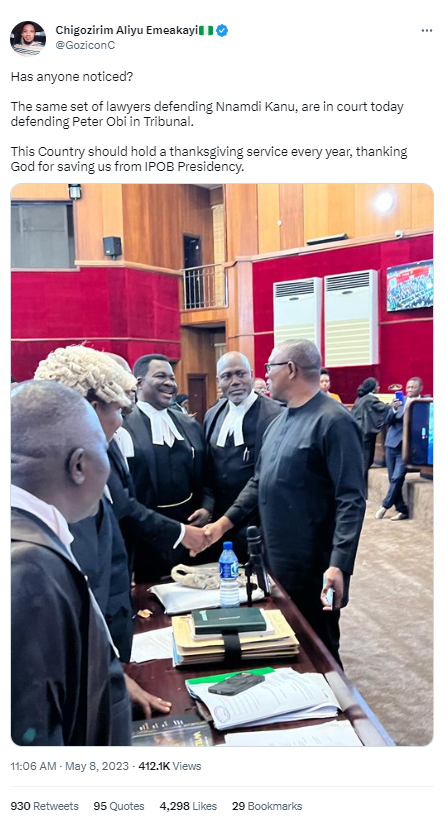
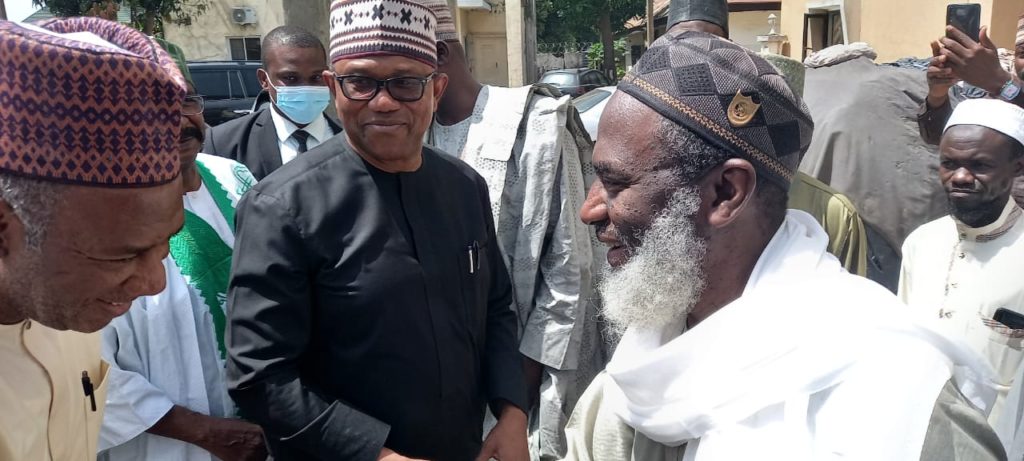
    On May 8, 2023, a Twitter user with the handle @GoziconC claimed that the lawyers defending Nnamdi Kanu, the leader of the secessionist group the Indigenous People of Biafra (IPOB) now in custody, are the same as those of Labour Party presidential candidate, Peter Obi, at the ongoing presidential tribunal proceedings. 

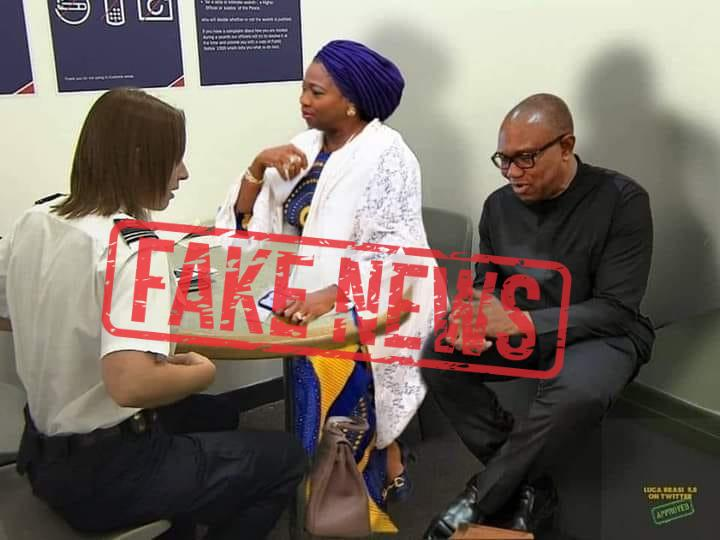
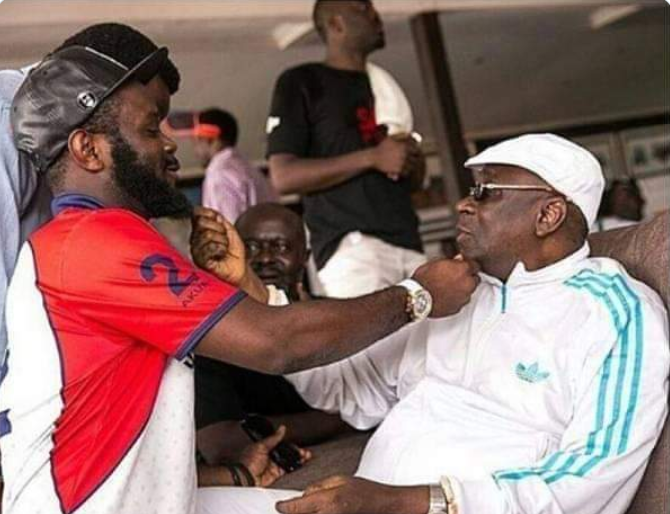
    The user followed up his claim with a photo of Obi in conversation with some lawyers in court. As of the time of writing, the tweet has been viewed over 412k times. 

    A self-acclaimed leader of the IPOB, Simon Ekpa, also tweeted on May 9, 2023, that Mike Ozekhome (SAN), who is Nnamdi Kanu’s counsel and appears in the photo above, is part of Obi’s legal team.

    On Wait First, we divide claims into three categories. A valid claim is a fresh banana. A false claim is burnt dodo. And a misleading claim is cold zobo.

    So, how valid is this claim?

    ALSO READ: Who’s This Simon Ekpa Guy Running IPOB?

    Verification

    Fact-checkers at the Centre for Democracy and Development (CDD-West Africa) examined this claim. Here’s what they found:

    In January 2022, following his apprehension by the Nigerian government, Nnamdi Kanu appointed Mike Ozekhome as his lead counsel in his case against the FG. Ifeanyi Ejiofor, one of Kanu’s lawyers, also confirmed this.

    Is Mike Ozekhome representing Peter Obi at the Election Tribunal? 

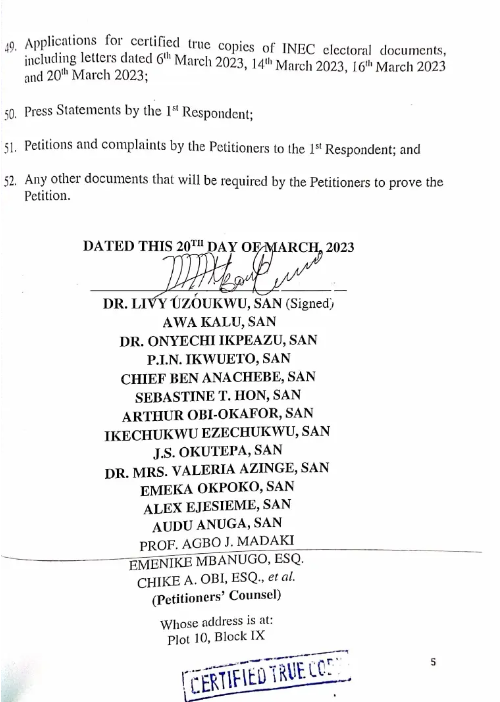
    “The election petition prepared by Obi’s legal team includes a list of the legal practitioners representing the petitioner. Mike Ozekhome’s name does not appear on the list.

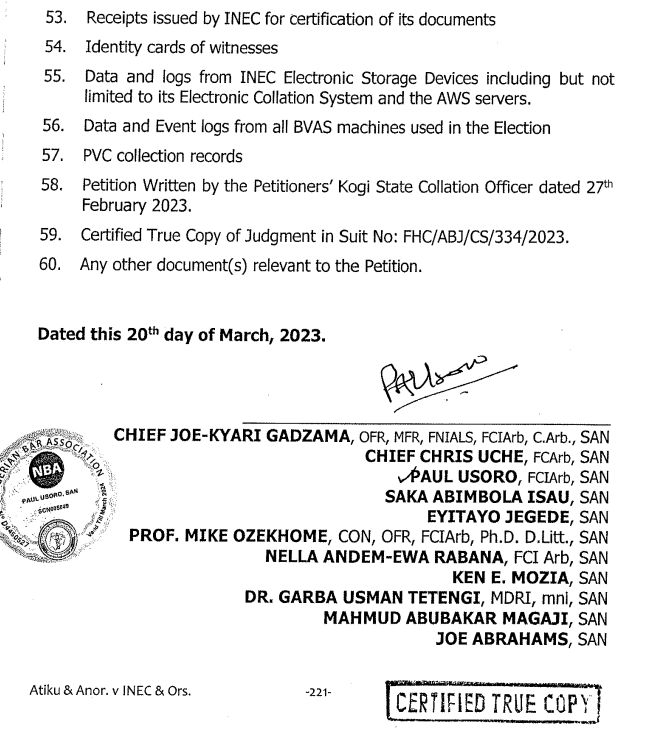
    “We, however, found Ozekhome to be among the legal team of Atiku Abubakar, the presidential candidate of the Peoples Democratic Party (PDP), which was inaugurated in March 2023. The team included his name in the petition that was submitted.

    “Further investigation revealed that Ozekhome and Atiku have had a clientele relationship since 2017. He is also currently representing the latter in the alleged money laundering case filed by Festus Keyamo. 

    “Another senior lawyer in the attached image to the tweet is Yusuf Ali, a member of Bola Tinubu and the All Progressives Congress (APC)’s legal team. We found that the lead counsel to Peter Obi and the Labour Party (LP), Onyechi Ikpeazu, has never represented Nnamdi Kanu or the IPOB secessionist group.”

    Verdict

    The claim that lawyers representing Peter Obi at the presidential election tribunal also represent Nnamdi Kanu is burnt dodo. It’s false.

    Can you handle the hotness of Zikoko’s Hertitude? Click here to buy your ticket and find out.

  • What Nigerian Lawyers and Analysts Are Saying About the Election Tribunal

    Bola Ahmed Tinubu, the All Progressives Congress presidential candidate (APC), was announced the winner of the February 25, 2023, presidential elections and Nigeria’s new president-elect on March 1, 2023, by the Independent National Electoral Commission (INEC). 

    However, with 19 days left until the presidential inauguration on May 29, 2023, Tinubu still has many opps standing in the way of his dream to become Nigeria’s next president. 

    On March 21, 2023, four presidential candidates, Atiku Abubakar of the Peoples Democratic Party (PDP), Peter Obi of the Labour Party (LP), Solomon Okangbuan of Action Alliance (AA) and Chichi Ojei of Allied People’s Movement (APM) took the almighty legal steps. They filed petitions at the Presidential Elections Tribunal in Abuja, seeking to nullify INEC’s declaration of Bola Tinubu as the winner of the 2023 presidential elections.

    The petitions claim that the elections should be voided for the following reasons:

    • At the time of the elections, Tinubu wasn’t qualified to contest, which would infer that he received “wasted votes”.
    • Kasim Shettima had a double nomination, one as APC’s vice-presidential candidate and the other for a senatorial seat in the National Assembly, contrary to Section 35 of the Electoral Act.
    • Tinubu failed to get 25% of the votes in the Federal Capital Territory (FCT) and engaged in corrupt practices which are in non-compliance with the Electoral Act.

    The Presidential Election Petitions Court, led by Justice Haruna Tsamanni, began proceedings on May 7, 2023, and the Action Alliance (AA) party withdrew its petitions against Tinubu’s victory. 

    While we’ll continue to observe the tribunal, ZikokoCitizen reached out to some lawyers and political analysts to hear their thoughts on the tribunal and predict possible outcomes. Here’s what they had to say:

    “Our democracy is maturing.”

    Titilope Anifowoshe is a legal practitioner passionate about charity and good governance; she’s also the founder of the Eagles Foundation for Humanity. And she’s happy that our politics is evolving into a multidimensional one not necessarily dominated by two political parties.  

    According to Titi, “I have mixed feelings about the tribunal because some of the petitions are issues that should have been brought before the court pre-election. I hope some of the trivial and technical issues will not stall justice. But regardless, I’m confident that the Supreme Court will do the needful. Let’s not forget that Lady Justice is blindfolded and a respecter of no one but the Law. I am really optimistic that justice will be done. 

    On how likely it is for the tribunal to nullify Tinubu’s win, I can’t assertively say that this will happen because the whole situation is dicey. If you look at some of the grounds of the petition from Peter Obi and the Labour Party against Tinubu, while the 1999 constitution in Section 137 makes it clear that being charged and fined is grounds for disqualification, the Law also speaks about a 10-year gap. We should also remember the maxim that says that a man cannot be punished twice for the same offence. 

    If we also look at the grounds of the double nomination of Kasim Shettima, while it contradicts the Electoral Act, Section 35 of the Act uses the word “knowingly”, and Shettima can claim ignorance in the situation. But in the same vein, when we look at Section 60(5) of the Electoral Act, we can see that INEC violates its rules. So, considering these factors, it’s difficult to state clearly if the election will be nullified. However, we should never forget that judicial decisions must be accepted as correct, and I trust the tribunal’s decision.  

    But regardless, the tribunal and judiciary are governed by legal precedents and established rules, and justice won’t be denied. Although the Electoral Act and INEC guidelines are obviously imperfect, we’re gradually getting there. We hope the panel will reflect the yearning of the majority of Nigerians and they will be fair and honest.”

    “Electoral injustice takes away the dignity of human persons.”

    Festus Ogun, also a legal practitioner, hopes that the tribunal’s decisions reflect the people’s wishes and aspirations. 

    He said, “While it’s unprofessional to preempt or predict the outcome of the court in cases such as this, I honestly believe that a lot of our people feel cheated and violated. I also believe that electoral injustice takes away from the dignity of human persons. 

    Given this, many young Nigerians yearn for true justice at the tribunal. But unfortunately, as we’ve experienced in the past, when matters get to the court like this, lawyers and litigants tend to focus on technicalities. But I am hopeful that this time, Nigerians will pay more attention to the substance of the case.”

    “There is a political question mark on Tinubu’s mandate.”

    Demola Olarenwaju is a Public Affairs analyst, political commentator and the Special Assistant in Digital Media and Strategy to Atiku Abubakar. He thinks that regardless of the tribunal’s outcome, he doesn’t expect it to lead to an explosive situation in the country. 

    “The courts have made it clear that they don’t want to spend time on unnecessary litigation and technicalities, but instead, the case will be decided on merit. We hope this will be adhered to and the Presidential Elections Petitions Court will be concluded shortly. The petitions from the different political parties are very interesting. Peter Obi comes from the angle of legalities, which questions the legitimacy of Tinubu and Shettim as candidates in the general elections. On the other hand, Atiku Abubakar is coming from the angle of what happened on election day, which is the non-adherence of INEC to the Electoral Law. Also, in Atiku’s petition, we see the margin of lead principle, which says that where the margin of lead between the declared winner and the runner-up is less than the number of cancelled votes, then the elections should be considered inconclusive and makeup elections should be conducted. So, from all this, it’s clearly a two-pronged attack.

    On the likelihood of the court nullifying the election, given the history of Peter Obi and Atiku with electoral litigation, it could happen again in this case. Also, the advent of BVAS makes it easier to point out areas where over-voting or electoral malpractice occurred. Also, the fact that there were four major candidates in this election and Bola Tinubu could only get 30% of the votes shows that he isn’t the choice of most Nigerian voters. There’s a political question mark on his election mandate as declared by INEC that has to be resolved in court. 

    Everyone will move on if the elections are nullified, or supplementary polls are held. I don’t think it will be an explosive situation, and despite what the ruling party says, Nigeria will continue to be Nigeria, and heaven won’t fall. It’s clear that many Nigerians believe that the elections were compromised, and the tribunal should be firm in adjudicating the case. I also expect the tribunal and judiciary to open their doors to the media to show that there’s nothing to hide. 

    However, my prediction for the worst possible outcome of the presidential tribunal will be supplementary elections between Atiku and Tinubu or Atiku and Peter Obi if Tinubu is disqualified. But in any way it plays out, Atiku Abubakar will be involved in the second round of elections”. 

    Also read: Five Popular Election Tribunal Judgements in Nigeria.

    Rest assured, Zikoko Citizen will continue to keep a close watch as the drama unfolds and keep you updated on the post-election drama!

  • Wait First: Did Poverty Increase During Peter Obi’s Tenure as Anambra Governor?

    On April 19, 2023, a Twitter user with the handle @cbngov_akin1 claimed that the poverty rate increased while Peter Obi was governor of Anambra state. The tweet has garnered over 91,000 views as of the time of filing this report.

    On Wait First, we divide claims into three categories. A valid claim is fresh banana. A misleading claim is cold zobo, while an outrightly false claim is burnt dodo.

    So, how valid is this claim?

    Some background

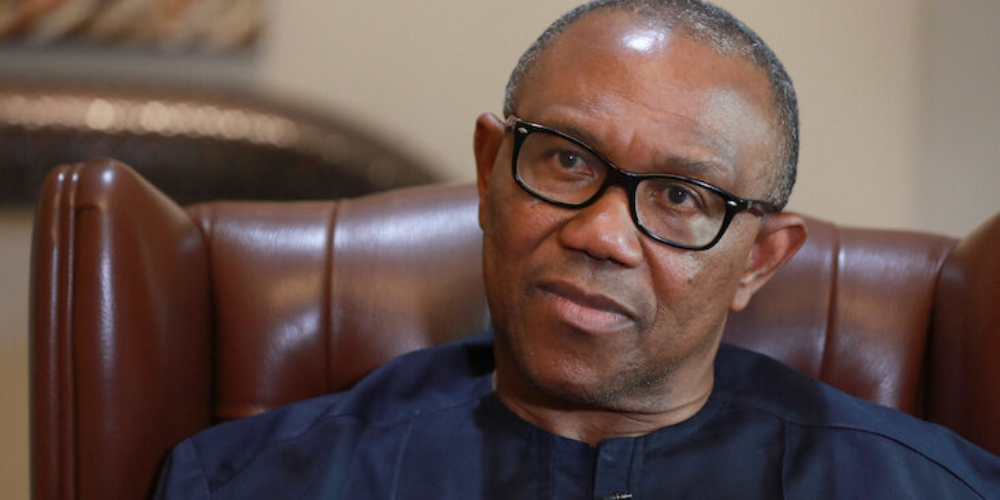
    [Peter Obi / Africa Report]

    Peter Obi, the Labour Party’s (LP) presidential candidate, had a staggered time in office as governor of Anambra state. In 2003, he contested for governor under the All Progressives Grand Alliance (APGA). Chris Ngige was declared the winner, but in a lengthy court battle, the victory was overturned at the Supreme Court. Obi was reinstated as the election winner and assumed office in March 2006. 

    Obi was impeached in November 2006 and reclaimed his mandate following another court ruling. He returned to office in February 2007. He was removed again after the 2007 election but was reinstated by the Supreme Court. Obi won reelection and served as a two-term governor from March 2006 to March 2014.

    Obi’s performance as governor has come under intense scrutiny since he declared his intention to run for president, particularly as his campaign promises hinged on combatting poverty. The Independent National Electoral Commission (INEC) announced him third in the presidential election with 6,101,533 votes. 

    Poverty is more than just a number. It’s a complex issue that affects many aspects of a person’s life. OECD data shows that poverty rates are measured by income levels falling below the poverty line. But poverty is not a one-dimensional problem that can be summed up with a single indicator. The National Bureau of Statistics (NBS) is the go-to agency in Nigeria for collecting, analysing, and disseminating crucial statistical information that helps understand the socioeconomic realities of the country’s citizens.

    Verification

    Our partners FactCheck Elections, looked into this claim. Here’s what they found.

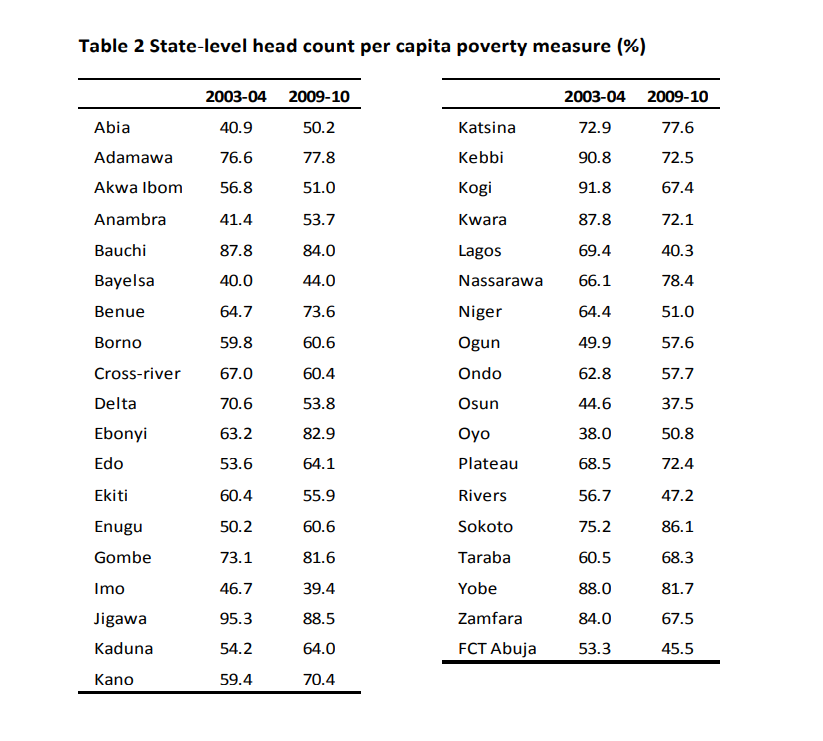
    “Findings by FactCheckElections revealed the (NBS) National Poverty Rates For Nigeria: 2003-04 (Revised) and 2009-10 (Abridged Report). The report showed that Anambra had 41.4% state-level headcount per capita poverty measure in 2003-04 and 53.7% in 2009-10. 

    “The National Poverty Rates For Nigeria: 2003-04 (Revised) And 2009-10 (Abridged Report) capture poverty rates across Nigeria with the Absolute Poverty Approach (using a per capita approach of assigning 3000 calories requirement for an adult).

    [Source: NBS]

    “FactcheckElection can find no official data report on the poverty rate between 2011 – 2018. Aside from forecasts and predictions, there’s no absolute poverty study in those years. According to a reply tweet by Dr Yemi Kale (former statistician general of Nigeria), ‘NBS has not conducted any absolute poverty study since 2009’.

    “However,  there is a 2019 Poverty & Inequality in Nigeria report published by the NBS. The report showed Anambra had a poverty rate of 14.78%.”

    Verdict

    So what’s the status of the claim? Based on data from the (NBS), Anambra’s state-level headcount per capita poverty increased from 41.4% in 2003-04 to 53.7% in 2009-10. Peter Obi was governor between 2006 and 2014. So the claim is partly true, and we give it a banana rating. However, no official data shows the poverty rate when he left office in 2014.

  • Wait First: Did the FG Secure Peter Obi’s Release from Detention?

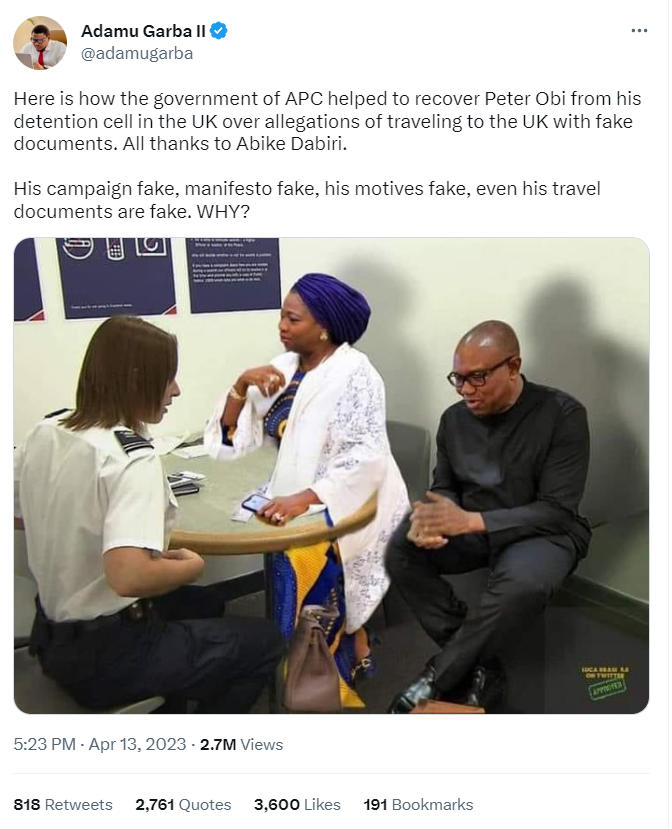
    On April 13, 2023, Adamu Garba, a member of the ruling All Progressives Congress (APC), tweeted an image of the Chair of Nigerians in Diaspora Commission (NiDCOM), Abike Dabiri-Erewa, with the Labour Party (LP) presidential candidate, Peter Obi. He claimed that the APC had helped secure Obi’s release from detention in the UK after travelling with fake documents.

    The tweet has amassed over 2.7 million views. 

    On Wait First, we divide claims into three categories. A valid claim is fresh banana. A false claim is burnt dodo, and a misleading claim is cold zobo. So what’s the status of this claim?

    According to a report by Premium Times, Obi was detained in London by UK immigration officials for alleged impersonation. A statement by the Head Obi-Datti Media, Diran Onifade, confirmed that Obi was harassed by London immigration officials and placed in detention. Onifade said this was where Obi spent the Easter holidays.

    “The LP presidential candidate arrived at the Heathrow Airport in London from Nigeria on Good Friday, April 7, 2023. He joined the queue for the necessary Airport protocols when immigration officials accosted him. They handed him a detention note and told him to step aside,” Onifade said.

    Onifade said the offence means an impersonator could commit weighty crimes that would cause people to point fingers at Obi, causing embarrassment.

    In his reaction to a report that the UK government apologised to Obi over the detention, Obi said he did not receive any letter of apology from the British government. 

    Verification 

    To verify Adamu’s claim, our partners, FactCheckElections, came across a report by LEADERSHIP . In the report, the federal government of Nigeria denied news that it intervened in Obi’s detention ordeal. 

    The spokesperson of NiDCOM, Abdur-Rahman Balogun, said the image attached to the tweet is a “stunt.”

    He added that the NiDCOM boss, Dabiri-Erewa, was not in the UK and not in a position to secure the release of any Nigerian suspected to be under UK interrogation

    “Our attention has been called to the above social media stunt, which has gone viral. Aunty Abike Dabiri-Erewa is NOT in the UK and not in a position to secure the release of any Nigerian suspected to be under UK interrogation. So, members of the public should disregard the information in its entirety,” Balogun said.

    Verdict

    Adamu’s claim is false and therefore burnt dodo. Avoid the spread of misinformation, as it has the grave potential to cause public panic and harm.

  • Nigeria’s Voting Pattern Gives Peter Obi a One-Sixth Chance of Winning

     [countdown date=”Feb 25, 2023 7:00:00″]

    The 2023 elections in three days will go down as one of Nigeria’s most important historical events.

    In the days leading up to the elections, we’ve experienced many interesting curves: 

    • For the first time, there’s a third force party serving as a threat to contenders from the two major political parties;
    • The youths are the highest proportion of registered voters at 39.5%;
    • Voters will be accredited not manually but with technology using the Bimodal Voter Accreditation System (BVAS).

    Out of anticipation, several polls have been published to predict the winner of the 2023 presidential election. 

    Using data from the voter turnout and the voting patterns of previous elections since 1999, a group of private observers; John Analoh, Ayomide Gbadegesin and Femi Labiyi, have predicted six possible outcomes for the upcoming elections.

    The winner will be decided after a run-off 

    A run-off means a winner will be decided after two rounds of voting. This would happen if neither candidate got the majority votes, i.e. 25% of votes in 24 states. And this is very likely because each presidential candidate is a powerhouse in their own right.

    Peter Obi, the Labour Party (LP) presidential candidate, is expected to have many votes from the South-East, South-South and North-Central states. But Bola Tinubu, the presidential candidate for the All Progressives Party (APC), may win critical states like Kaduna, Borno and Kano. 

    Also, the presidential candidate for the Peoples Democratic Party (PDP), Atiku Abubakar, is expected to win or come a close second in many states and even in the South-South regions. 

    So, while Bola Tinubu may get the most votes, he might be unable to pull off 25 per cent in 24 states. 

    Atiku Abubakar wins the election

    For this outcome, although Peter Obi might have the most votes in the South-East. Atiku would get many votes from states in the South-South region, especially in Delta state. 

    Also, while the North-West and Noth-East regions vote in favour of Bola Tinubu, Atiku would win in APC powerhouses like Jigawa, Katsina and Zamfara. This would ultimately propel him to victory.

    Bola Tinubu wins the election

    In this scenario, Tinubu wins comfortably in the South-West region and is voted favourably for in the North-East and North-West regions, particularly in Kano, Kebbi, and Kaduna.

    And although Peter Obi might perform well in the South-East, Atiku is also expected to pull strong figures from the South-south region.

    Atiku Abubakar win the election

    If Atiku does exceptionally well in South-south regions and APC strongholds like Jigawa, Katsina and Zamfara. In that case, he could have the majority vote in 24 states.  

    Bola Tinubu wins the elections

    It’s also probable that while Tinubu does a clean sweep in the South-west, he would also come a close second in the South-south, northeast and north-west regions. This would very easily push him to victory.

    Peter Obi wins the elections

    In this scenario, the elections will end with the third-force candidate, Peter Obi taking the coveted prize. 

    For this to happen, Rabiu Kwankwaso, presidential candidate for the New Nigeria Peoples Party (NNPP), gets good numbers in the North-West and some parts of the North-east region. And Peter Obi wins Lagos and gets the majority votes in the North-Central.  

    While we can’t say who the winner will be, the one thing that can be confirmed is that the 2023 elections will shape Nigeria’s future.

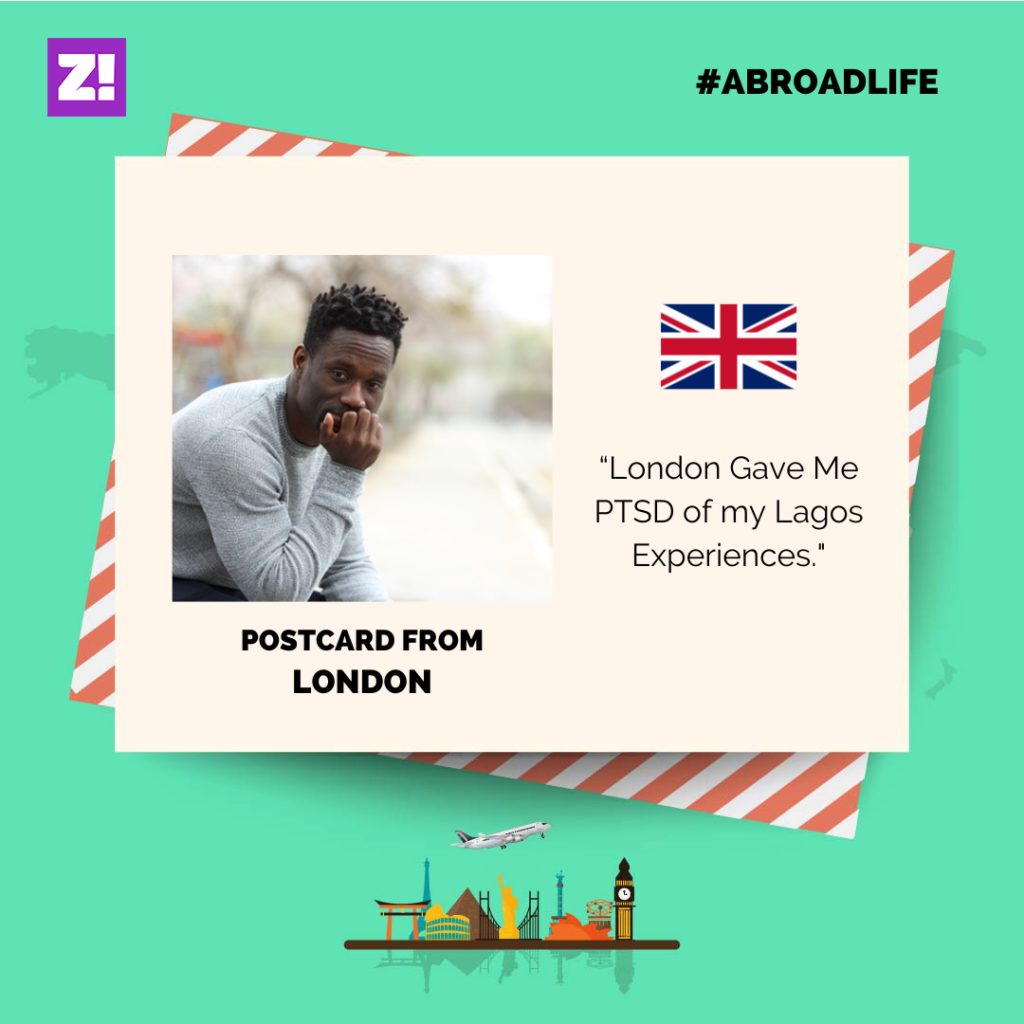
  • “London Gave Me PTSD of my Lagos Experiences” – Abroad Life  

    The Nigerian experience is physical, emotional, and sometimes international. No one knows it better than our features on #TheAbroadLife, a series where we detail and explore Nigerian experiences while living abroad.


    This week’s Abroad Life subject is a healthcare worker, freelancer and data analyst in his early thirties. He lives in London but works in Bournemouth at the moment. He speaks to us about his life before moving to London, how life in London has been so far, and his newfound love for politics since the buildup for the 2023 general elections started. 

    What motivated you to move to the UK?

    I was born and raised in Nigeria. After I graduated from university, I started working at a publishing company in Lagos. But life was hard for me there. This was for several reasons. Firstly, my residence was at Ikotun, and my workplace was at Ilupeju. The distance was insane but still manageable. After some months, the company relocated to Lekki. Now imagine me having to go all the way to Lekki from Ikotun every single day. That is a distance of almost 60 km. At some point, I got sick of it. 

    Also, I’ve always wanted to return to school and do my Master’s. The initial

    Plan was to do it somewhere in Nigeria, as I felt it was too expensive to do it abroad. But I guess at some point, I thought that the dysfunctional nature of Nigeria would always catch up with me. My best bet was to leave, so I saved up money and, with the help of my family, left Nigeria. 

    How was the migration process? 

    So initially, my first plan was to move to Canada. I started the process in 2019 with the use of an agent. I even got admission into Thompson Rivers University, but my visa was rejected. This was because they felt I would not return after school. I spent the next year in Nigeria and got more motivated to leave due to the pandemic and the overall frustration of the country’s lack of working systems. 

    I then asked a friend sometime around mid-2020 if it was too late for me to start my master’s application to schools in the UK, and his answer was no. He told me to start the process immediately. I went through the process myself, got the visa and then travelled in 2021. 

    Nice. So how would you describe London so far?

    London is like Lagos, but a bit more organised. There are better transport systems. You can always use the tube or train. You get to see a lot of people like you in London. Near my house is an African Market where you can get egusi and other African foodstuffs. There are even African restaurants. 

    However, when you move away from cities like London or Manchester and you move to places like Bournemouth (where I am currently), it’s way calmer. There’s less traffic and the scenery is nicer. But you hardly see people like you; less African stores and the like. You can also hardly see African food here and you just have to stick to European dishes. 

    Even though it’s cheaper to live in Bournemouth, I still have friends in London; hence, I can never really leave London. It also reminds me of Lagos too. You can be walking and see two people speaking Yoruba.

    I can remember my first week in London. I needed someone to exchange currency with and the person was in Arsenal, so I had to travel there. I can remember seeing local brooms and people selling puff puff in London. It was crazy. It gave me PTSD of my Lagos experiences. 

    What are the challenges and advantages of living in London?

    It can sometimes get lonely, especially if you don’t make friends easily. There was a time I stayed somewhere for a year and I didn’t even know who my next-door neighbour was. In Nigeria, when you move to a new place, before the next two days you know everyone on the block. I’m lucky I have my cousin here with me, as we both came at the same time. I don’t know how I’d have survived without my family. There is no way I can forget Nigeria in a hurry. I always keep up with current affairs from time to time.

    However, you’re sure that nothing will halt your progress because they have systems that work. If you’re working a 12-hour shift, for instance, you can be sure that you will get paid your dues no matter what. No one is telling you that they can’t afford to pay your salary or you get half your salary like in Nigeria. 

    Also, if you work hard here, you’ll succeed. You can be sure of seeing the fruit of your labour. But in Nigeria, it’s not the case. It’s very risky to do business because you’re not sure of the next government policy that can strike it down. Like this naira redesign for instance, you see the way people are panicking. Things like that don’t happen here. 

    I’ve noticed that Nigerians here also tend to do very well. This is because we are used to battling systems and external forces that are out to destroy our efforts. When one arrives with that anger and zeal, there is always the possibility of one doing better because those bad systems are almost non-existent. This is the biggest advantage here really. 

    [newsletter type=”gov”]

    Nigeria’s elections are less than two weeks away. Would you vote if you were in Nigeria?

    I’d definitely vote if I were in Nigeria. 

    Did you know you’d not be able to vote from the UK? If you did, then why did you still leave? 

    I knew I’d not be able to vote. This wasn’t because of a lack of patriotism. I know that when I was doing my undergraduate studies back in Nigeria, I was in groups that advocated for better governance and sensitisation for citizens. 

    But it got to a point where I was almost going insane with everything going in Nigeria and I needed an escape. I still really love Nigeria and I still wish to come back. However, with Nigeria’s current state, I don’t see how it can benefit me at the moment. Also, I’m the only boy in my family. At some point, my parents will start expecting me to pay bills and do things that a ‘son of the house’ should do. When you’re in Nigeria, paying bills, and your financial capacity isn’t growing anywhere, things will become difficult for you. 

    Who are you supporting in the 2023 elections, and how do you wish to show your support from abroad?

    Funny enough, I supported the All Progressives Congress (APC) in 2015 over the People’s Democratic Party (PDP) because I felt PDP was enjoying a huge monopoly and needed some real competition, having been in power for the last 16 years. However, the APC came and made things even worse. 

    However, with the rise of a third-force party, I’ve now become a supporter of Peter Obi, who’s under the Labour Party (LP). I believe he’s not part of the ‘inner cabal’ of Nigerian politicians and, therefore, can bring in fresh ideas for Nigeria to become a better place. I’d love for him to be elected as president so that he can change the country and I can come back home. Nigeria is a sweet country to live.

    As to how I’m showing my support, I’m making sure that my friends and family are ‘Obidient’. My dad, for one, was so surprised at my newfound political awareness. This is because my dad’s image of me whenever it comes to politics is forcing me to watch the 9 o’clock news back in Nigeria. But when I pitched Obi as the right candidate in one of my calls he was shocked, and so were my family members. So I can say that yes, I show my support by heavily endorsing Obi to everyone I know back home. I also make sure to always make my support loud for Obi on social media, especially on Twitter.

  • Why Stears’ Predictive Poll Thinks Peter Obi Will Win 2023 Elections

    It is 17 days to the start of the 2023 presidential elections. The pressure has only gotten werser, with various opinion polls showing which of the ‘Big 4’ of Nigeria’s presidential candidates could win Nigeria’s iron throne.

    The ‘Big 4’

    So far, all the opinion polls released have had an inconclusive winner — until the release of Nigeria’s first predictive poll by Stears Insights. And the winner? None other than Labour Party candidate Peter Obi! He was declared the winner by a whopping 27% ahead of APC’s Bola Tinubu (15%), PDP’s Atiku Abubakar (12%), and NNPP’s Rabiu Kwankwaso (2%).


    [Premium Times/Pendrops]

    But you must be wondering — what the heck is a predictive poll, and how did Stears come about their results? Let’s show you how they did it here:

    What is a predictive poll?

    Before getting into the nitty gritty of a predictive poll, it is important to note one key thing about previous opinion polls, which is the appearance of silent voters. 

    Silent voters do not reveal who they would vote for as their preferred candidates. The ANAP poll of December 2022 gives a good example of this:

    However, with Stears, they found a solution to this: create a proprietary estimation model that predicts scenarios for the most likely voting patterns for silent voters within a data set. With this, one can have a comprehensive “prediction of the future” concerning the 2023 presidential elections. Thus, the name “predictive poll”. Get it?

    Now that we understand what a predictive poll is let’s look at how Stears came to their conclusion and the various scenarios in which Obi was declared the winner.

    The methodology behind Stears predictive poll

    To make a nationally representative poll, Stears interviewed 6,220 people — making it the largest public opinion electoral poll for the 2023 elections. People from the sample data set were randomly selected by state and gender to mirror the distribution of registered voters in Nigeria. All 36 states and the FCT were polled. 

    One unique thing about the sample size and breakdown is that it enables one to make predictions at the state level, which is a unique feature of Stears’ predictive poll.

    Now that we know about the methodology let’s review the scenarios.

    The silent voter turnout scenario

    Stears’ predictive model analysed the preferences of the transparent voters and the revealed preferences of silent voters to estimate the most likely preferred candidate for each silent voter.

    The model assigns 43% of undeclared votes to Tinubu. This suggests that most silent voters are Tinubu supporters. However, Obi is still the predicted winner when the reassigned silent voters are added to the declared voter count.

    The high voter turnout scenario

    NB – Red stands for Peter Obi, Sky blue stands for Tinubu, Green stands for Atiku, and Dark Blue stands for Kwankwaso

    Stears created a high-turnout scenario and applied it to the prediction model. This includes everyone who declared an intention to vote. This is except for those who still needed to collect their PVC. Undecided voters who were unsure whether they wanted to vote are also included.


    In this case, Obi gets 41% of the vote, holding a comfortable lead over Tinubu, based on the model’s predictions. The high-turnout scenario corresponds to a turnout of roughly 80% on election day.

    The low voter turnout scenario


    NB – Red stands for Peter Obi, Sky blue stands for Tinubu, Green stands for Atiku, and Dark Blue stands for Kwankwaso

    Even though one might want to be optimistic, let’s face it. Nigeria has had a sordid history of low voter turnout for elections since 1999. Therefore, one needs to account for a scenario where the voters simply don’t show up.

    The low-voter turnout scenario only included people who:

    • Had their Permanent Voter’s Card (PVC);
    • Stated that they are sure about their chosen candidate;
    • Felt very confident in the electoral process;
    • Were sure they would vote;
    • Felt safe going out to vote.

    In a low voter turnout scenario, Tinubu edges the vote. The low-turnout scenario resulted in a turnout of roughly 28% on the day.

    Now you’ve seen how your vote counts in making your favourite presidential candidates win the elections. Make sure to rush to the polls with your PVC come February 25. Defend your rights and fight for your life!

    Stears Insights is a data & intelligence company providing subscription-based data and insight to global businesses and professionals. Stears’ mission is to become the world’s most trusted provider of African data & insight to global professionals.

    Zikoko Citizen writes the news and tracks the 2023 elections for citizens, by citizens in our weekly newsletter, Game of Votes. Make the subscription of a lifetime here.

  • Here Are Five Promises Obi Made at Chatham House

    From presidential opinion polls to a highly loyal and ‘Obidient’ fan movement, Labour Party (LP) presidential candidate, Peter Obi, has been the talk of Nigeria’s 2023 presidential race so far. 

    This is due to his promises to Nigerians in his campaign speeches on his desire to restore the country’s economy. For him, this will be from a nation that consumes to a nation that produces.

    On January 17, 2023, he reiterated these promises in the Chatham House in London, UK. 

    Most Nigerians online were especially glad that the candidate could answer questions given to him boldly and by himself. 

    This wasn’t the case for another presidential candidate, who had his Chatham House speech in December 2022.

    That candidate is Bola Tinubu of the All-Progressives Congress (APC)

    Anyways, let’s look at five bold promises that Obi made to Nigerians during the event:

    “We’ll fight and stop corruption”

    Like Marvel’s Avengers, Obi wishes to stop evil and build a “New Nigeria” where there is no corruption alongside his running mate, Yusuf Datti Baba-Ahmed. 

    Yusuf Datti Bab-Ahmed and Peter Obi

    He feels that the duo are the best fit for the job. He claimed that he never took property for himself in his tenure as Anambra State governor. He also claimed that Datti didn’t steal any money during his time as a Senator. 

    His strategy to end corruption is to ensure that it doesn’t exist in the basic units of society. This includes family units and friends. 

    According to Obi, “If you’re not involved [in corruption], your wife is not involved, your family is not involved, and the people around you are not involved, you have reduced corruption by over 50%.”

    “As long as some Nigerians are in IDP [camps], all of us are in IDP [camps].” 

    Obi promised to ensure that the whole of Nigeria is secure, not just select states. 

    He mentioned spending his Christmas holidays in Makurdi and Abuja in Internal Displaced Person camps (IDP). In these camps, he assured all displaced persons that he would not stop until all Nigerians were secure in their home states.

    “As Long As Nigerians Are in IDP [camps], All of Us Are in IDP [camps]. We can’t have some Nigerians sleeping in IDP [camps] and some in mansions.”

    Nigeria currently has the third highest number of internally displaced persons (IDP) in Africa. 2.7 million IDPs were recorded in 2020. An estimated number of 2.7 million people was recorded in 2020. This is due to rural conflicts, extremism,  armed banditry, and climate disasters. 

    “I’ll attract foreign investors like bees to honey.”

    In June 2022, the National Bureau of Statistics (NBS) declared that the total value of capital entering Nigeria had declined to $6.7 billion in 2021. This was the lowest amount in five years.

    What’s Obi’s plan to solve this?

    He said he would ensure that the country is attractive enough for foreign investments in the first place. 

    According to Obi, foreign capital has not been forthcoming in Nigeria. This is due to its “being scared” of the rule of law, and heavy corruption. 

    He plans to solve that by making sure that there is a regulated environment where there is no corruption.

    “Further borrowing will ONLY be for production.”

    For Obi, the problem is not in the country’s borrowing but in using the money borrowed mostly for consumption purposes. 

    Obi came again with his “Consumption to Production” mandate. The borrowed money will be used for production purposes only. To achieve this, he plans to implement economic policies to reduce our debt service. This is because borrowing is a major drain on government revenue.

    If he becomes Nigeria’s president, debt is one problem Obi has to solve “sharp sharp” for us. The country is currently in a ₦77 trillion debt since President Buhari first came into power in 2015. 

    “If they can declare an emergency on power, then I can declare a war”

    When asked how he would combat hindrances to national power generation, Obi used the example of South Africa. 

    The nation recently declared an emergency on power. This gave any independent vendor free licensing to generate up to 100MW of electricity. 

    Note that this is a country that currently generates 42,000 MW of power. Meanwhile, Nigeria has not generated up to 6,000 MW of electricity since 1960.

    Hence this inspired Obi to say that “if South Africa could declare an emergency on power,” then he could “declare a war on power.”

    He plans to instigate this “war” by removing legislative blockers for independent energy companies and giving them free licenses to generate certain amounts of power for the country.

    We write the news and track the 2023 elections for citizens by citizens in our weekly newsletter, Game of Votes. Make the subscription of a lifetime here.

  • Photoshop 101: A Nigerian Political Campaign Strategy

    On 6 January 2023, the All-Progressives Congress (APC) presidential candidate, Bola Ahmed Tinubu, caused quite a stir on social media timelines with a photoshopped picture of him appearing on a campaign billboard. 

    The victim of the act was Ebuka Obi-Uchendu, host of the popular reality TV show, Big Brother Naija (BBN). In the photo, both Tinubu and Ebuka seem to be sharing the same pose, clothes, and even his wedding ring.

    [Photo Credit: Mufasatundeednut on Instagram]

    Many Nigerians have criticized the photo, with former senator Dino Melaye even going as far as saying that there is nothing original about the “emi l’okan” man

    Sadly, this isn’t the first time politicians have been accused of the photoshop act. Here are some other cases:

    Atiku receiving a handshake from Trump

    During Atiku’s 2019 presidential campaign, a picture of him with a former American president, Donald Trump, was circulated. This was to clear rumours about his ban in the U.S. 

    However, Africa Fact Check revealed that President Muhammadu Buhari was the original person in the photo in April 2018.

    Peter Obi with “Tinubu’s Insignia” Cap

    Shortly before the Labour Party (LP) presidential candidate joined the party in May 2022, a post by Facebook user Taiwo Olaore was circulated. In the photo, Obi was wearing Tinubu’s insignia cap at an event. This drove the narrative that Obi was a supporter of Tinubu’s campaign or “BATified”.

    However, further checks by The Cable revealed that the cap was digitally imposed on his head, as he wore no cap in the original photo.

    The Buhari and ‘Jubril from Sudan’ Rumors

    In 2017, rumours started to circulate that Buhari was dead after three months of ill health in the United Kingdom. Pictures from a lookalike named “Jubril” was now the new president.

    However, this was thoroughly disputed by Buhari himself. He came out to assure the public that he has not been replaced by a double.

    Tinubu with Joe Biden

    Shortly before his Chatham House visit in 2022, a photo of Tinubu speaking with the current president of America, Joe Biden, was circulated.

    However, the APC campaign media director, Bayo Onanuga, cleared the air that the photo had been doctored and there the presidential candidate’s last location then was at Abuja.

  • What Are the Highlights of Obasanjo’s Obi Endorsement Letter?

    For one of Nigeria’s foremost political chieftains and former president, Olusegun Obasanjo, January 1, 2023, wasn’t just for the celebration of a new year. He also used it to finally announce his endorsement of the Labour Party (LP) presidential candidate, Peter Obi. 

    Labour Party Presidential Candidate, Peter Obi and Olusegun Obasanjo [Independent Newspapers]

    His letter of endorsement titled “My Appeal to All, Particularly Young Nigerians”, came as a surprise for many Nigerians, as there had been debates on which candidate had his ticket for the 2023 elections. 

    But in hindsight, should this have taken anyone by surprise? 

    Obasanjo has been hinting at a ‘third force’ political party since he adopted the African Democratic Party (ADC) during the 2019 election race as a result of his dislike for the major parties, the All-Progressives Congress (APC) and the People’s Democratic Party (PDP). 

    This is not to talk of his denial of All-Progressives Congress (APC) presidential candidate, Bola Tinubu in October 2022 and dumping of his former vice-president and People’s Democratic Party (PDP) candidate, Atiku Abubakar in December 2022.

    However, Atiku’s lack of support isn’t shocking, as both men have been fighting for over a decade since the end of their presidential tenure in 2007.

    Anyway, we read all the grammar in Obasanjo’s letter so that you don’t have to. Here are our key takeaways:

    No candidate is a saint

    “None of the contestants is a saint but when one compares their character, antecedents, their understanding, knowledge, discipline, and vitality that they can bring to bear and the great efforts required to stay focused on the job, particularly looking at where the country is today and with the experience on the job that I personally had, Peter Obi as a mentee has an edge”.

    For Obasanjo, Nigerians should only see Peter Obi as the better man of the three candidates, as none of them qualify for sainthood. 

    This is a statement that can’t be argued with, with Tinubu’s many allegations of drug trafficking and thuggery in Lagos,  Atiku’s long-standing record of corruption that amounts to trillions of dollars, and even accusations against Obi of a secret hive of businesses in the Pandora papers in October 2021. 

    “‘Emi l’okan’ and ‘I have paid my dues’ are the wrong mentality”

    “Let me say straight away that ‘Emi Lokan’ (My turn) and ‘l have paid my dues’ are one and the same thing and are wrong attitude and mentality for the leadership of Nigeria now.”

    Even though it was an endorsement letter for Obi, Obasanjo didn’t fail to throw some unapologetic shades at Tinubu and his archnemesis Atiku with two of their infamous statements, “Emi l’okan” and “I have paid my dues”. But why were these two claims made?

    In case you’ve been living under a rock, Tinubu made the infamous entitlement claim, Emi l’okan (It is my turn) in June 2022 when the APC was considering another presidential candidate asides from him.

    For Tinubu, this was an unthinkable act, as he has tried using political figures like Muhammadu Buhari, Nuhu Ribadu, and even Atiku to fulfill his presidential plans since 2007. And 2023 may just be his last chance.

    In Atiku’s case, he feels he has “paid his dues” to Nigeria after a long track record of trying to be Nigeria’s president since 1993. 

    He came close by being Obasanjo’s vice-president from 1999 to 2007, but even that isn’t enough. For Atiku, the iron throne of Nigeria’s presidency should belong to him by all means necessary.

    The TVCP Leadership Characteristics

    Obasanjo’s ideas of a good leader fall under an acronym called T.V.C.P, which stands for Track record of ability and performance; Vision that is authentic, honest and realistic; Character and attributes of a lady and a gentleman who are children of God and obedient to God; and Physical and mental capability with the soundness of mind.

    While he didn’t mention any names, he hinted that he has worked with all three ‘mentees’  in government at one point or another, and two out of these three have neither of these characteristics. We already know who they are.

    Atiku Abubakar and Bola Tinubu 

    Let the past go

    “Just let us agree to move forward together in mutual forgiveness, one accord, inclusive society, equality and equity. Together and without bias and discrimination, fear or favour, we can have Nigeria of one nation in diversity, in truth and in practice. Let us honour, cherish, respect and even celebrate our diversity which is the basis of our potential greatness and strength”.

    Obasanjo’s cry for unity in diversity could first be interpreted as a cliche cry for help, but not if you understand the context.

    It’s no news that ethnicity is a major factor for Nigerians when picking a presidential candidate. Despite Obi leading most of the presidential polls in 2022, a December 2022 poll by ANAP revealed that 38% of voters in the South West have refused to disclose their preferred candidate, mostly due to cases of voter intimidation.

    In this area, Obi’s chances are looking slim as he hails from the South-Eastern region. 

    This is possibly Obasanjo encouraging Nigerians to move past the tribal bias and pick who they really want as their next president in February 2023.

  • On Your Own (OYO) — Olubadan Denies Endorsing Peter Obi

    On December 13, 2022, the Labour Party’s (LP) Presidential Campaign Council (PCC) paid a visit to the Ibadan traditional council. In a viral video shared by Doyin Okupe, the Director-General of the Obi-Datti Campaign Organisation, a member of  the traditional council could be seen praying for Peter Obi. 

    Okupe captioned the tweet, “Emphatic endorsement for Peter Obi from Ibadan traditional council.”

    However, it appears the Olubadan of Ibadanland, Oba Lekan Balogun, Alli Okunmade II, isn’t on the same page with Okupe.

    How has the Oba reacted?

    A statement released by the palace on December 14, 2022,  described the endorsement as a false and self-concocted one. The palace said the prayer shouldn’t have been twisted to appear as an endorsement of the candidate. The statement further cautioned politicians to leave the palace out of their power play and stick to facts. 

    The palace said, “Let it be emphasised that Olubadan and his cabinet members don’t and can’t belong to any political party and they would never express preference for any candidate or political party in the public no matter the degree of temptation.”

    What the palace basically told Obi and other politicians is, “You’re on your own (OYO)”.

    Why’s this significant?

    Endorsement power plays aren’t new in Nigerian politics. As we’ve explained before, politicians seek endorsements from powerful figures in the hopes they can help sway voters in their favour. We only need to go back to October. Then, the Afenifere backed both the All Progressives Congress (APC) and the LP presidential candidates.

    The issue, though, is that it’s difficult to accurately measure the impact of endorsements. More significantly, publicly backing a candidate as a traditional ruler has its risks. If they win and turn out to be unpopular, the people can turn against the ruler in the grassroots for leading them astray.

    If, on the other hand, a traditional ruler backs a losing horse, the winning horse won’t forget and might be vindictive. The safe bet is to stay in the middle and avoid staining your white as the Olubadan has done.

    Endorsements may be useful for campaign PR, but politicians are better served appealing to voters directly. Because in the end, people will vote who they want — endorsement or not.

  • What’s Peter Obi Promising Nigerians in His Manifesto?

    After two months of back and forth, we’re pleased to announce the presidential candidate of the Labour Party (LP), Peter Obi, has finally released his manifesto!


    The manifesto has attracted mixed reactions from fans and haters alike since Obi announced the 72-page document on December 4, 2022.

    But, what exactly is the content of this document? 

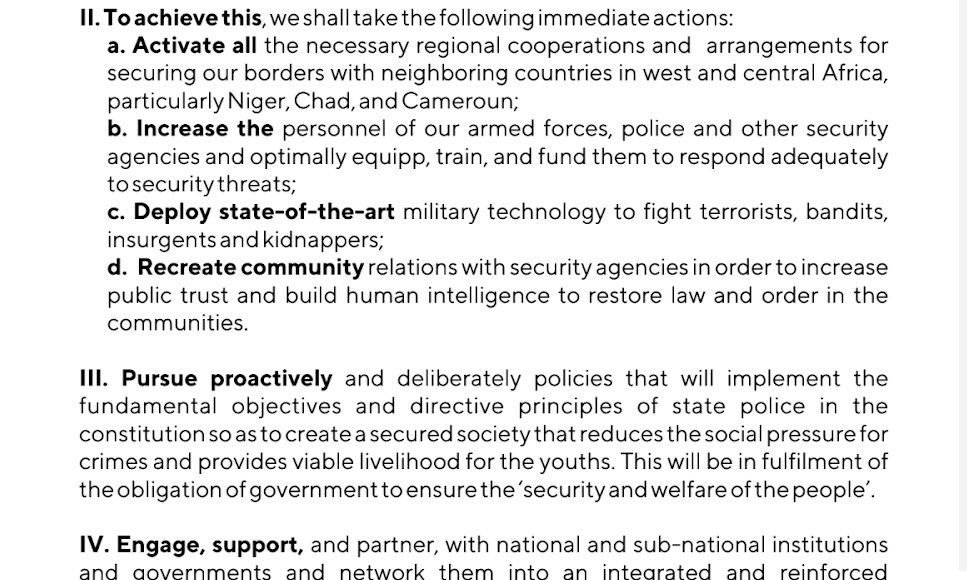
    Introduction of a state police system

    Obi plans to put in place policies that would implement the principles of a state police system in the Nigerian constitution. But these could create some problems.


    The Senate is already hostile against state policing due to fears that officers will become errand boys for governors who may also neglect to pay them well. 

    This could become an issue as Obi needs a National Assembly aligned with his interests and plans for the country to succeed. But how many Labour Party candidates are likely to win seats in the National Assembly in 2023? 

    The All Progressives’ Congress (APC) controls a majority of the current Senate with 66 members and only one of the remaining 43 members is an LP senator.

    According to the list released by the Independent National Electoral Commission (INEC), the Labour Party is contesting for only 78 seats out of the 109 seats in the Senate. It also doesn’t help that most of the vacant slots will favour Obi’s rivals more, as there are no Labour Party candidates in key states like Kebbi, Katsina, Lagos, Borno, and Ekiti. 

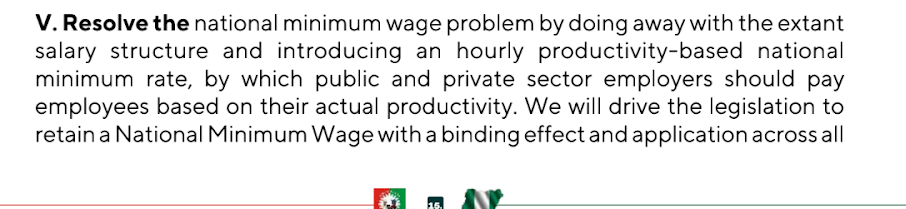
    Hourly national minimum rate

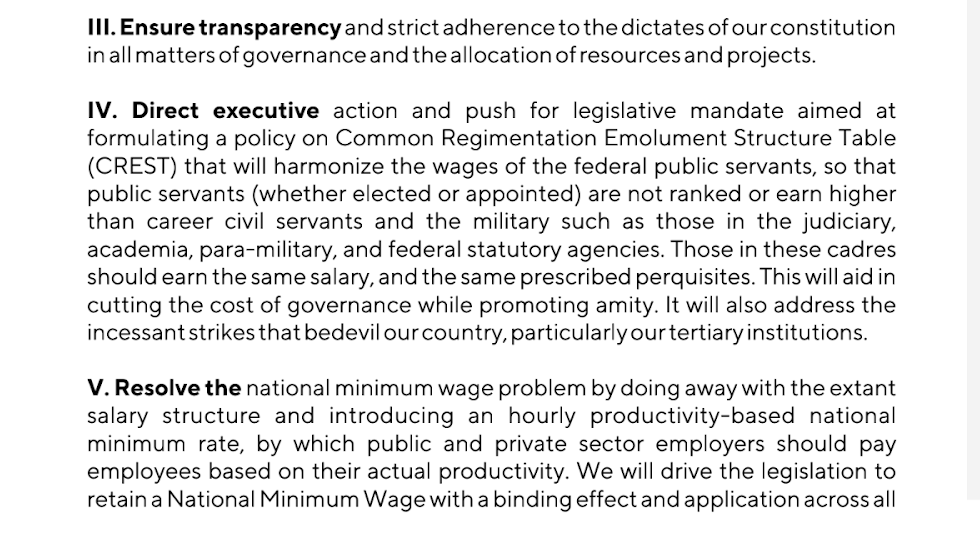
    Peter Obi’s answer to Nigeria’s low minimum wage problem is to introduce a minimum rate based on one’s productivity per hour instead of the current ₦30,000 per month.

    It’s not hard to know where the inspiration for this came from, as Western countries such as Canada, the United Kingdom, and the United States all run a minimum wage per hour system.

    The plan creates a semblance of fairness, as workers would get paid based on how much time they work. The more hours you work, the more money you get to put in the bag.


    Also, this section of the manifesto mentioned the “criminalisation of non-payment of salaries, wages, pensions, entitlements, benefits, and violation of collective bargaining agreements,” which means the law will start frowning at horrible bosses who delay payment of workers.

    This is how we imagine every worker would feel if that happened:

    Equal pay for politicians and civil servants

    Obi intends to implement a Common Regimentation Emolument Structure Table (CREST). This is a policy that’ll enable elected politicians and appointed officials to earn the same as civil servants.

    But are the National Assembly lawmakers interested in earning the same paycheck as civil servants?


    The move from consumption to production

    “Consumption to production” has become a catchphrase of the Obi campaign. We’re not surprised the idea appeared in his manifesto. How does he plan to make it happen for Nigeria? 

    • Re-skilling youths in the Science, Technology, Engineering, and Mathematics (STEM) field for the nation’s economy. This is needed given that most students in Nigeria don’t feel the need for STEM. This is due to the slow rate of curriculum updates, and poor funding, especially in rural areas.
    • Venture capital fund for young entrepreneurs 
    • Apprenticeship system for technical skills.
    • The rise of a “Green Army” whose mission is to use the $3 trillion from international climate finance to create economic growth and employment for youths.

      But how does he intend to do that? That definitely wasn’t specified.

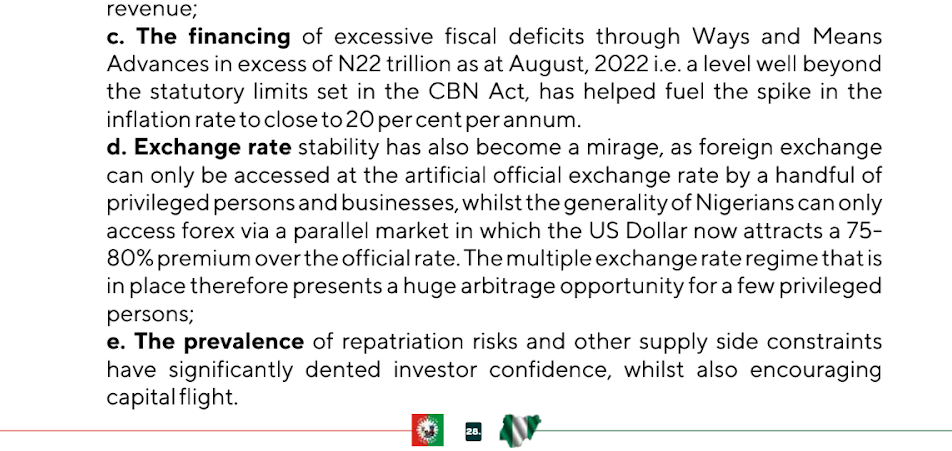
    Multiple exchange rate system

    In his manifesto, Obi expressed his feelings about Nigeria’s current exchange rate system. Here’s what he had to say:

    While these problems are true as Nigeria currently has rates from the Central Bank and black markets, we’re still waiting on Obi to give us a solution to the problem.


    The Afro-centric diplomacy 

    Obi also plans to protect the rights of Nigerians abroad through Afrocentric diplomacy. Compared to Nigeria’s current foreign policy which only seeks to promote relations among member countries, his Afrocentric policy has benefits. This would help to both protect Nigerian citizens abroad as well as promote their businesses.

    This would be done by rebuilding Nigeria’s military power, establishing leadership roles in African affairs, and even using our top position in entertainment to enhance economic strategies.


    This will definitely be a welcome change. Nigerians are suffering from physical harassment overseas even as many more are using any means necessary to japa.

  • What We Learnt from the Latest Presidential Town Hall

    On December 4, 2022, Arise TV hosted a town hall with leading 2023 presidential candidates in attendance. Only the regular absentee, Bola Ahmed Tinubu of the All Progressives’ Congress (APC), was missing from the party. Those present were Atiku Abubakar of the People’s Democratic Party, (PDP), Peter Obi of the Labour Party (LP) and Rabiu Kwankwaso of the New Nigeria People’s Party (NNPP).

    What were the highlights?

    Despite the fact they’re all contesting on different mantras and platforms, the candidates seemed to agree on certain policy issues. All three believe in education being a driver of growth. They also shared, to varying degrees, sentiments that the constitution needs to be revised and an emphasis on health insurance for all.

    But they had their differences too. Obi believes strongly that an investment in human capital development is vital to pulling Nigeria out of poverty. He spoke on reviving the bank of agriculture in Kaduna to enable farmers get easier access to loans.

    Kwankwaso believes strongly in education but also in greatly expanding Nigeria’s security forces. He also said he would make strides in other sectors like in infrastructure and construction. He claimed that as Kano governor, he built three major cities in four years with ₦‎40 billion without borrowing.

    Atiku believes the private sector is the driver of prosperity and plans to incentivise it. He is also particular about agriculture being a mainstay of the economy and spoke on plans to expand the sector to employ more people. The PDP candidate also spoke on his achievements as vice president, how he was in charge of local government administration in his first nine months in office and how he plans to sustain programmes the PDP launched.

    Any touchy subjects?

    On the issue of medical tourism, Kwankwaso seemed the boldest on the matter when he said he’s in good health and that his doctor has certified he has at least 30 years of life left in him.

    The former Kano State governor said he’d keep using Nigerian health facilities if he becomes president. “We’ll introduce some policies that’ll improve healthcare service delivery through the NHIS. We’ll make healthcare accessible to every Nigerian.”

    Atiku appeared evasive on the matter by saying he would declare his health status if the need arises. On medical tourism he said, “The Nigerian health facilities that cater for my health may not be available. You know that we have limitations. We have been talking about those limitations.”

    Obi also didn’t fully commit to ending medical tourism when he said, “It’s actually required that those aspiring to lead should be able to make their medical records available to the public. And two, I have served as a governor. While serving as governor, I resuscitated some facilities and used them. I’m still using them till today. 

    “I believe if there’s any issue of referral from them, I mean if there’s a situation our healthcare can’t handle, I’ll not say everybody must be restricted here. As for my position, I use the facilities here and I believe in them. And I can tell you they’re very competent. All we need is to believe in them. I’ve shown you how we can use insurance to prove everyone can be cared for.”

    What else?

    All three candidates made pledges to Nigerians. Atiku doubled down on his mantra of unifying the country as president, Obi pledged to form a government of national unity, while Kwankwaso pledged to provide quality education and train as many Nigerians as possible. 

    But as every Nigerian knows from experience, talk is cheap. The one good thing we can take from this town hall is we can hold whoever becomes president accountable based on the promises they’ve made to us.

  • Where’s Peter Obi’s Manifesto?

    Election season in Nigeria isn’t only about who can hold the biggest rallies or make the most eye-catching promises, it’s also about who can throw the biggest insults. 

    That’s why it’s not a surprise that the camps of the presidential candidates of the Labour Party (LP), Peter Obi, and All Progressives Congress (APC), Bola Tinubu, have been at each other’s throats lately.

    How did the argument start?

    Tinubu struck the first blow during a rally in Delta State on November 25, 2022 when he accused an unnamed candidate of always giving the wrong statistics. He also stated that mentioning the person’s name would be a disgrace to him. 

    Even though he didn’t mention anyone’s name, anyone following the campaigns closely would know which presidential candidate loves dishing out statistics:


    It’s… Peter Obi [Leadership News]

    The chief spokesperson of the LP’s Presidential Campaign Council, Dr Yunusa Tanko, then cut Tinubu down to size by saying he’s “someone who cannot even identify his own mother”. He also challenged Tinubu to show up for an open debate with Obi. He was confident the former Anambra State governor would win and humiliate Tinubu.

    It didn’t take long before the APC flung its own dirt when Tinubu’s campaign spokesperson, Festus Keyamo, told Obi not to expect his candidate to debate with him based on “ideas in his head”.


    According to Keyamo, there are some key documents Obi should reveal to Nigerians if he ever wants an intellectual faceoff with the BAT:

    • A release of Obi’s manifesto for scrutiny.
    • A comparison of his achievements as Anambra State governor versus Tinubu’s achievements as the governor of Lagos State.
    • A list of current associates he mentored in politics as the governor of Anambra.
    • Names of any political party Obi has helped to form or partner with which he still belongs to today.

    While it’s obvious Keyamo used some of his points as a cheat code for Tinubu  — given his track record of infrastucture in Lagos and godfatherism — his point on Obi’s manifesto is indeed one that has caused some concern for voters as he’s yet to release his manifesto.


    What’s the update on Obi’s manifesto?

    In October 2022, a document believed to be Peter Obi’s manifesto trended on social media. But the candidate announced later that day that the document wasn’t his manifesto but an earlier draft copy under review.

    Weeks later, he’s still not released a final version of his manifesto. His failure to release one stands out because he’s the only major candidate yet to do so. Candidates of the APC, Peoples’ Democratic Party (PDP), New Nigeria People’s Party (NNPP) and even the Social Democratic Party (SDP) have all dropped their manifestos.


    What’s taking so long?

    According to LP’s Special Adviser on Public Affairs, Katch Ononuju, the manifesto is still being “fine-tuned”, as the party is trying to be careful not to plagiarise other party manifestos. 

    He also told Nigerians not to worry about the manifesto, as it’s not a “big deal”, since what Obi would have written as a manifesto has been said in interviews anyway. 

    Are manifestoes a big deal?

    Unlike Nigeria, countries in other parts of the world don’t play with their manifestos. In Mexico and even Bhutan in South-Asia,  political parties are required by law to submit a copy of their election manifesto to the electoral commission before general elections. Citizens can only access these manifestos with the approval of the commission.

    Why should you care about manifestos?

    In all this, you must be asking — why should you care whether manifestos are released or not?

    The answer is quite simple — for accountability. If a politician makes a set of promises and it’s properly documented, it makes it easier for us to hold them by the neck when they fail to deliver. 

    So even though we know Tinubu is just looking for an excuse not to debate anyone in public, the question still remains — where’s Obi’s manifesto?

  • We Already Know Nigeria’s Next President, If You Believe Election Polls

    If we asked you to describe the 2023 presidential election campaigns, what word would you use? 

    Whichever word just ran through your mind, we know it doesn’t rhyme with “boring” or “dry”, because the campaign season has been entertaining. 

    Millions of Nigerian voters have picked their candidates for the 2023 presidential election, but we won’t know who has more supporters until February 2023. But because some people want to see the future, they’ve been organising polls to frame the picture of what will happen. These polls represent the most dominant public opinion and we looked at five of the biggest polls to see which candidate is leading.


    NOI Poll — Peter Obi

    According to a poll conducted by the NOI Polls Opinion Learning Center (NOPC) in September 2022, Labour Party (LP) presidential candidate, Peter Obi, will most likely win the election with 21% of the votes.

    Bloomberg Poll — Peter Obi

    The candidate of the People’s Democratic Party (PDP), Atiku Abubakar, and the All Progressive Congress (APC) candidate, Bola Tinubu, ended up with 13% each. Rabiu Kwankwaso of the New Nigeria People’s Party (NNPP) finished last with only 3% of voters rooting for him.

    Obi was also projected to win another poll conducted by American media company, Bloomberg. He finished the poll with a whopping 72% of decided voters rooting for him.


    Tinubu finished the poll with 16% of voters in his corner and Atiku finished in third place with 9%.

    Fitch Institute Research — Bola Tinubu 

    Obi’s flawless record as the winner of presidential polls ended when Fitch Solutions, a research company, released its own report and crowned Tinubu the most likely winner. 

    However, Tinubu’s projected victory wasn’t without a comma as Fitch also projected it would cause social unrest in Nigeria especially due to his choice of another Muslim as vice-president.

    We2Geda — Peter Obi

    When We2Geda asked 15,438 registered voters across Nigeria in September 2022 who they plan to vote for, 51% of them crowned Obi. 25% of them ended up in Atiku’s corner and Tinubu had to settle for 19% of respondents.

    Further analysis also showed Obi remained a favourite in four geopolitical zones: North-Central, South-South, South-West, and South-East, while Atiku was the poll leader in the North-East and North-West zones.

    Nextier — Peter Obi

    When Nextier polled 2,000 Nigerians in rural areas, they also crowned Obi as Nigeria’s next president. Nextier excluded the home states of the leading presidential and vice-presidential candidates in conducting the poll.

    Who’s the winner?

    After much deliberation and collation of facts, the winner of the 2023 presidential election polls is… Peter Obi!

    But how effective are opinion polls on Nigerian elections?

    Polls aren’t considered a big deal in Nigerian elections, but facts don’t lie and neither does history. In 2010, 53% of people from the NOI poll believed that Jonathan would win the 2011 election, and he did. Buhari also won the NOI poll of 2014 with 32% and later became president in 2015. He also won the NOI poll of 2018 ahead of the 2019 election and look who’s still our president.

    If the history of polls tells you anything, it’s that they can be very reliable. However, it’s still nothing but a waiting game until Nigerians elect their new president on February 25, 2023.

  • What you should know about the children of BAT, Obi and Atiku

    All eyes are set on the 2023 presidential candidates in the race to become Nigeria’s next president and move into Aso Rock Villa. We’ve already profiled the candidates and profiled the wives of the top contenders. But what do we know about their children who could also follow them to Aso Rock Villa next year?

    Bola Tinubu — All Progressives Congress (APC)

    We know Bola Ahmed Tinubu (BAT) has fathered at least six children. They are: Olajide Tinubu (late), Folashade Tinubu-Ojo, Seyi Tinubu, Zainab Tinubu, Habibat Tinubu and Olayinka Tinubu. 

    BAT with his wife and two daughters, Zainab and Habibat. [Daily Post]

    From all indications, only Folashade and Seyi are at the forefront of BAT’s campaign. Seyi, especially, has featured heavily on his father’s campaign trail, most recently in Kano where he led a one-million man march. 

    https://twitter.com/tvcnewsng/status/1594369342652964867

    Seyi describes himself as a serial entrepreneur and happens to have many powerful friends just like his dad.

    Seyi playing with the Oba of Lagos. [Twitter/@BolanleCole]

    With the way he’s moving, Seyi might get an appointment in his father’s administration if he wins. 

    Atiku Abubakar — Peoples’ Democratic Party (PDP)

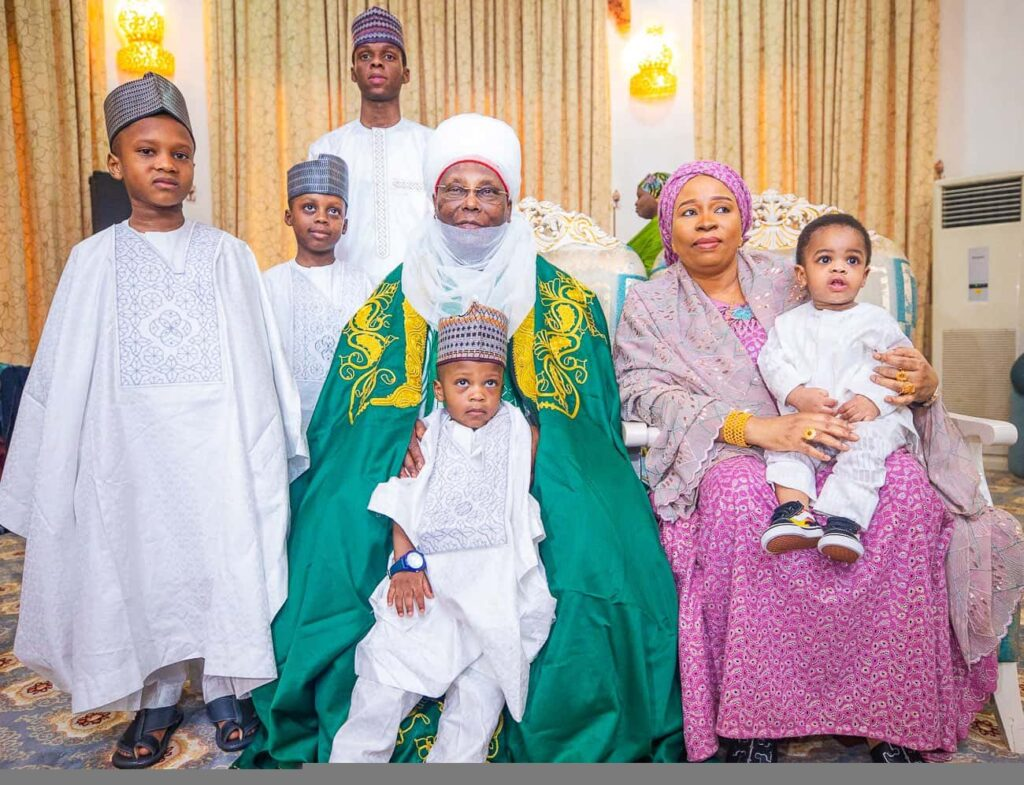
    As the husband to a total of six wives over the years, Atiku Abubakar has fathered enough children to fill two football teams. As at last count, he’s fathered at least 30 children but we certainly won’t be listing all of them here

    Atiku with one of his wives and children. [DNB]

    In the book titled “Atiku – The Story of Atiku Abubakar”, he explains that his choice of polygamy was to expand his family having been born without siblings.

    We’re not aware of any of his children actively involved in his campaign though and who can blame them? The man is on his sixth run for the presidency since he started running back in 1993. If it was you, wouldn’t you be tired?

    Peter Obi — Labour Party (LP)

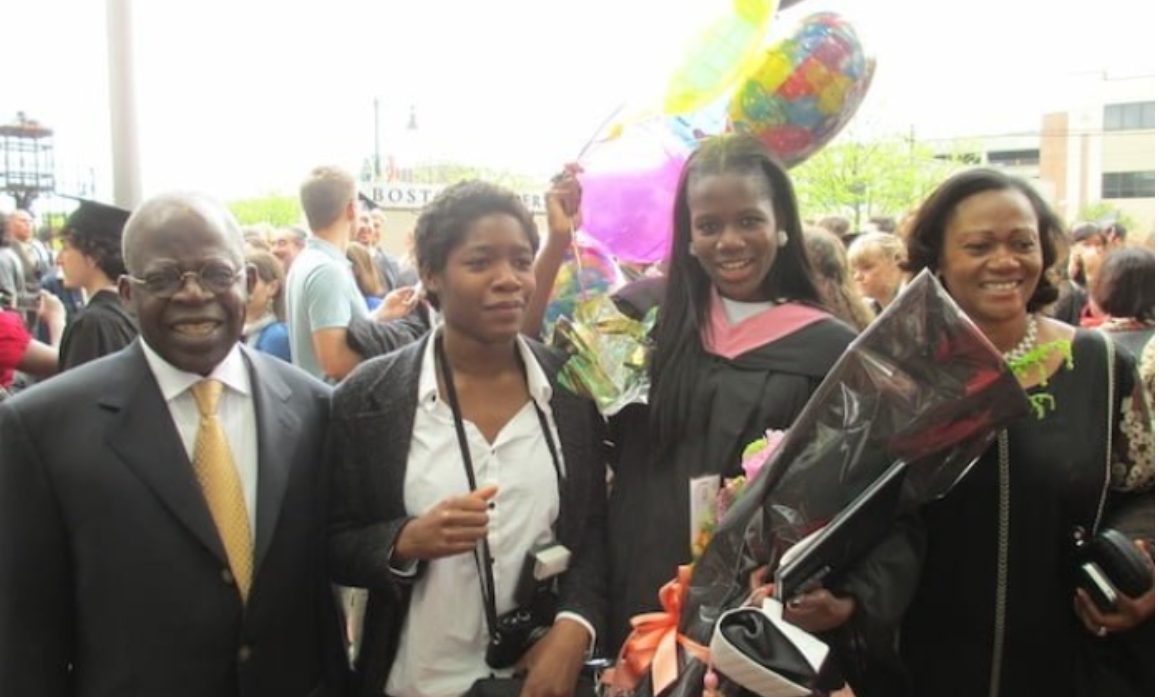
    Peter Obi of the Labour Party has two children: Gabriella Nwamaka Frances Obi and Gregory Oseloka Obi. As far as we know, Gabriella is a teacher based in Nigeria and Gregory is an actor based in the United Kingdom (UK). 

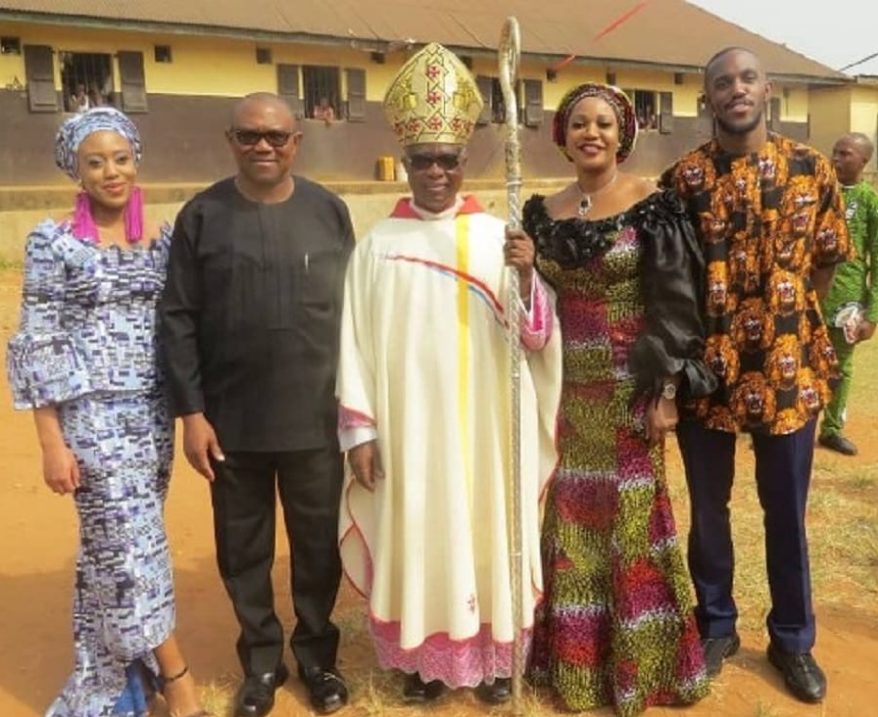
    Obi with his family and Archbishop Valerian Okeke [DNB]

    Like Atiku, we’re not aware of any of Obi’s children actively involved in his campaign. The one time he spoke of his children publicly was to say his son, who was almost 30, had no car. This caused some funny reactions online

    ALSO READ: One of These Women Is Nigeria’s Next First Lady

  • What Peter Obi’s Plans for Nigeria Could Mean For You

    Peter Gregory Obi has gone from a dismissed, little-known candidate to a household name in the race for Nigeria’s 2023 presidential election. Since May 2022 when the Labour Party (LP) candidate made the controversial switch from the People’s Democratic Party (PDP), there have been rallies, lawsuits, allegations, and even a passionate and unified ‘Obidient’ force fuelling his campaign to become Nigeria’s next president.

    [Source: BusinessDay]

    On Day 4 of “The Candidates” presidential town hall series hosted by Daria Media in partnership with Zikoko Citizen, Obi appeared alongside his running mate, Dr Yusuf Baba Datti-Ahmed, to discuss their plans for Nigeria with the host, Kadaria Ahmed.


    We highlighted some of Obi’s plans and what it means for Nigerians if he becomes president:

    “Economy is the base of our problems”

    For Peter Obi, the answer to almost all of Nigeria’s problems is transitioning from consumption to production. 

    The candidate said, “The economy is at the base of all our problems. Yes, we have security problems, but one can link it directly to the economy. When over 130 million people don’t know where their next meal will come from, one is bound to have a crisis.

    “One needs to first and foremost look at food production, and how you can feed the country. The greatest physical asset in the country is the uncultivated land in the North.”

    All of this sounds nice, but it takes close to two years for uncultivated land to be made suitable for farming. What exactly would Obi do before then? These were questions Kadaria asked but no specific answers were given.

    “My government will be a government of national unity”

    According to Obi “It’s my commitment to ensure the security of lives and property of Nigerians and ensure there’s a united Nigeria, through equity, justice and doing things following the rule of the law.”

    To drive home his point about championing unity, he sneaked in a diss directed at the presidential candidate of the All Progressives’ Congress (APC), Bola Tinubu, who recently vowed to “send Peter Obi back home” from Lagos to his native Anambra State.


    “If you check our utterances, we’ve never said things like “let’s send Peter Obi back to where he’s coming from.” I’ve lived everywhere and I’ve maintained that no one should vote for me because I come from the southeast, or vote for me because it’s my turn, but go for our track record.”

    Part of Obi’s unification plan includes “aggressively” pulling people out of poverty in the North. Despite not getting a concrete roadmap for how this would be done, it’s a welcome change to see a candidate in the town hall series highlight the poverty in the North. A United Nations (UN) report states that 70% of residents in the North-West live below the poverty line.

    “Subsidy must go”

    If Obi becomes president, fuel subsidy is going to be a thing of the past, as he doesn’t understand why a large chunk of Nigeria’s ₦‎6 trillion deficit goes into subsidy. He also believes subsidy is “organised crime” and should no longer be a part of Nigeria’s economy. 

    But what does it mean for Nigerians? For one, the cost of fuel and commodities in the market will rise since citizens would bear the full cost of fuel production. However, Obi plans to make sure refineries are up and running as soon as possible, so as to cushion the effects of pricing.

    How well can this work? Only time can tell.

    The solution to IPOB’s agitation is dialogue”

    Military intervention isn’t top of Obi’s list in tackling the separatist agitation of the Indigenous People of Biafra (IPOB). Instead, he’s more interested in sitting with them for a dialogue.

    According to Obi, “Everywhere in the country is full of agitation, which is a result of leadership failure over the years. There is nothing wrong with agitation. We’ll dialogue and discuss with everybody. The reason why IPOB is agitating is because of injustice.”

    Well, we can only wonder how far dialogue would help here as IPOB members have already established the fact they don’t even want an Igbo president. What if IPOB doesn’t listen?

    “I will declare a war on power”

    Nigerians may have the chance to experience uninterrupted power supply, as Obi believes Nigeria has the capacity to transmit 12,000MW of electricity. He promised to fix the problem of transmission infrastructure to make this a reality.

    The candidate also promised justice for middle and low-income earners for tariffs, as he plans to charge those who can afford and subsidise for those who can’t. At least, the days of seeing things like this are over:

    https://twitter.com/Iamchrisrockss/status/1593153826814840832?s=20&t=iyCXuXYBtG2LQdfCxKmiMw

    Obi also promised that any of the privatised companies that could generate 100MW of power without licensing would be supported.

    “I will pull people out of poverty”

    For Peter Obi, the days of Nigerians struggling in the trenches are over, especially for owners of small businesses. How will he do this?

    The candidate said, “People know that MSMEs are the foundation of every economy, even in the West. Big countries like China and Indonesia know this.”

    When pressed for specifics, Obi promised to create fiscal and monetary policies with government grants through the Bank of Industry (BOI). But how useful will this be for new startups? The BOI only caters to startups with three years of acceptable track performance; not to mention the strict conditions beneficiaries have to pass.

    If Peter Obi is going to address MSMEs, it should be looked at with a more critical point of view, and also with the consideration of “baby businesses”.

    ALSO READ: Here’s What Rabiu Kwankwaso Wants To Do As Nigeria’s Next President

  • What Peter Obi Said About IPOB, Others at “The Candidates”

    Day Four of “The Candidates” town hall series for 2023 presidential candidates hosted Peter Obi of the Labour Party and his running mate Datti Baba-Ahmed on November 21, 2022. The duo faced some tough questions from the host of the series, Kadaria Ahmed, and the studio audience. Here are the highlights of the evening.

    Petrol subsidy

    Kadaria asked Obi his plans on how to deal with Nigeria’s budget deficit. This led to a debate on petrol subsidy payments and Obi didn’t mince words. “I believe that subsidy must go. What we have today as subsidy is organised crime.” 

    Obi said petrol subsidy payments have taken a huge chunk of Nigeria’s budget and promised to provide an alternative. He pointed to modular refineries and Aliko Dangote’s refinery as options to explore to reduce the cost of refining oil.

    Foreign exchange rate

    Obi said to solve the exchange rate problem, Nigeria needs to look at its underlying cause. “The naira is weak because we have weak reserves driven by low exports. There aren’t enough exports bringing foreign revenue.” Obi believes that once Nigeria becomes productive, the naira would rebound.

    IPOB

    A couple of tricky questions about the Indigenous People of Biafra (IPOB) surfaced. Kadaria asked Obi about his stance on self-determination and Nigeria’s unity. 

    “Once you do things based on fairness and equity, you’ll see unity. We’ll form a government of national unity.”  

    Obi said he would listen to all agitators and dialogue with them. “There’s nothing wrong with agitation. You can’t attack people for expressing their opinion. People agitate everywhere, even in my house. You sit down and listen to them before you say yes or no.”

    Climate change

    On climate change and Nigeria’s flooding crisis, Obi believes part of the problem is rooted in the management of Rivers Niger and Benue. He said that Egypt’s Nile River, which is much larger, is properly managed. 

    “Over the years, contracts have been awarded to dredge the Niger and Benue. If they’d been doing that, we’d have water transport and (properly) channel the water. Nobody will collect contracts and go away under our government.”

    Pressed on whether he was committing to dredging the rivers, Obi said yes.

    Electricity

    Obi plans to revamp the power sector, despite the cost. “I’ve done the numbers well,” he said, “we can fund the power sector.” His strategy includes varying tariffs which would exist across various bands for low income and high income neighborhoods. Obi wants richer neighborhoods to fund the poorer ones. He says he’ll get subsidised tariffs for them. “I’ll declare war on power,” he added. 

    He said Nigerians will be able to generate up to a certain number of megawatts without license while cutting down on taxes and levies. “There’ll be regulation, but we won’t waste people’s time.”

    Fighting corruption 

    Obi said he’ll bring corruption to a minimum. “I’m not going to fight corruption by being vindictive. We’re going to make sure there are proper investigations and everything. We’ll operate by the rule of law. Where we even need to negotiate, we will. There are other countries who have done it better and I’ve learnt from them.” 

    Folks, that’s Day Four of our coverage of “The Candidates” presidential town hall series. Follow us on Twitter, Instagram, and Tiktok for more coverage of the series. You can also follow Daria Media on Twitter and Facebook and Instagram.

    ALSO READ: Here’s What Rabiu Kwankwaso Wants to Do as Nigeria’s President

  • Embarrassing Moments from 2023 Presidential Candidates so Far

    It’s the World Cup in a few days and while Nigeria won’t be taking part, there are no hard feelings as there’s enough drama at home to keep us occupied. With things getting intense ahead of the 2023 elections, we’ve seen presidential candidates buckle under pressure with twists and slips. 

    Being the troublemakers that we are, we’ve compiled the top four embarrassing moments  of the presidential campaigns so far.

    Atiku has his “emi lokan” moment

    We start with the unifier. Atiku Abubakar of the People’s Democratic Party (PDP), had his first major gaffe at an interactive session on October 14, 2022. Addressing the Arewa Joint Committee, Atiku was asked what his plans were for the North. 

    We should have known he was up to no good when he turned up in sneakers. He took the mic, and the words that came from his mouth were in stark contrast to his goal of unifying Nigerians. 

    His words: “I think what the average northerner needs is someone who is from the North, and who also understands the other parts of Nigeria, and who has been able to build bridges across the rest of the country. This is what the northerner needs. He doesn’t need a Yoruba candidate, or an Igbo candidate. This is what the northerner needs.”

    Nigerians had interesting reactions to this online.

    BAT loves bad things

    Bola Tinubu (BAT) of the All Progressives Congress (APC) is no stranger to controversies. If anything, he delights in them. At a summit in Kaduna, around the same time Atiku was pulling his “emi lokan” stunt, BAT reminded us that he’s the true king of comical errors. 

    In what was supposed to be a compliment to Nasir El-Rufai, BAT still found a way to throw a jab at him. He said: “I’m begging Nasiru El-Rufai not to run away for (an) additional degree. Your vision, creativity and resiliency in turning a rotten situation into a bad one is necessary at this critical time.”

    His spokesman called it a “slip of tongue”. But as you’ll find out soon, that would be one of several slips to come.

    Obi and his unverifiable facts

    Peter Obi (The Rock) of the Labour Party (LP) has no doubt captured a lot of supporters, building his Obidient army. And if there’s anything he is famous for, it is quoting statistics to back up his claims. However, not all rocks are solid, as Obi has shown us.

    His most prominent gaffe came in an interview on Channels TV. On July 25, 2022, he claimed that of the 150 players playing in the National Basketball Association (NBA), almost 100 are Nigerians. 

    You know how Obi always says “Go and verify”? Well, fact-checkers did and they found his claim to be untrue. Turns out that among the 109 international players registered for the league’s 2021-2022 season, only five — and not “almost 100” — are from Nigeria.

    The BAT strikes again

    BAT’s most recent gaffe places him head and shoulders above the presidential pack. At a rally on November 15, 2022, in Plateau state, the BAT lost track of his own political party when he asked God to “bless the PDAPC”. We checked, and there’s no party by that name. 

    Naturally, we have questions.

    And theories.

    And a winner.

    Are there any other moments you think we left out? Let us know in the comments.

    ALSO READ: Atiku Joins Tribal Olympics and BAT’s Lips Are Loose Again

  • Peter Obi and The Use of Underage Children in Politics

    If there was anything we learned on Monday, it is that nobody is above political breakfast. The Labour Party (LP) presidential candidate, Peter Obi got his in the form of a ₦50 million lawsuit from an activist, Wale Ojo-Lanre, on the use of a toddler, Chioma as a “poster child” in his political rally in Lagos.

    According to Lanre, he decided to be a voice for the voiceless and fight for the rights of this toddler as a “concerned Nigerian and a friend of litigation.” 


    However, Obi doesn’t have to bear the cross alone, as his comrades were also mentioned in the suit. They include the mother (Queen), the Labour Party, the Federal Government, and the Attorney-General of the Federation.

    But that’s not all, folks. Not only does Lanre want N50 million from Obi’s pockets, but he also decided to make some other demands:

    • Peter Obi and the Labour Party should delete their tweets and several other posts on their social media accounts about the underage girl-child.
    • The Federal Government and Attorney-General are to separate the mother and daughter and the girl should be placed in welfare custody.

    But was Peter Obi wrong in the eyes of the law?

    Here’s what the law says. 


    Sections 29 and 33 of the Child Rights Act of Lagos State, states that anyone who exploits a child in any form or way not already mentioned in this Part of this Act which is prejudicial to the welfare of the child commits an offense.

    The punishment is either a fine of N500,000 or imprisonment of up to five years. Even though the amount charged may sound like a hefty sum, count Obi out if you think he’s going to choose imprisonment when he wants to be president.


    The use of underage children in politics

    Sadly, this is not the first time underage kids will be used in the course of political ambitions. It is quite common during election season.


    In 2018, Umar Ganduje, a Kano State governor was accused of using schoolboys in Kano. This was in response to a viral video of him receiving a $5 million bribe. The boys were seen campaigning for Ganduje and asking viewers to vote for him. But INEC later checked it out and decided that the video was from Kenya and not Nigeria.

    In 2012, a video went viral in Sokoto showing dozens of kids and teens voting with fake voter cards. 

    Recently in November 2022, underage kids were spotted as registered voters in INEC’s online voter registration. This is a crime under the 2023 Electoral Act of Nigeria.

    Keep in mind that according to INEC, the ideal age for voters is from 18 years and above.

    Why are underage children used in elections?

    Some electoral officials claim that sometimes the children are used because their parents insist they are up to 18. 

    They also claim that they allow children to vote because any attempt to stop them could lead to violence in these usually “volatile” parts. But what violence is an underage child capable of? 

    What can INEC do?

    If an underage child is used illegally for a rally, or in the polls, it is the duty of INEC to specifically investigate such rallies and polling units and take necessary action.

    INEC, we are waiting for you to do your job.

  • Four Highlights of Chukwuma Soludo’s Rant About Peter Obi

    Chukwuma Soludo is in the news again. He has a habit of making the headlines on average, once a month. In September, he was in the news for banning miniskirts in Anambra schools.

    In October, he placed a ban on gaming and casino activities in the state that made lots of people feel uneasy. And on November 14, 2022, the former central bank governor went on a lengthy rant against the presidential candidate of the Labour Party (LP), Peter Obi.

    What happened?

    Soludo said he was ranting because of an interview he had on Channels TV. In the interview, he claimed that the investments Obi made in Anambra are now worth “next to nothing”.

    As soon as the interview went out, Obidients loaded Soludo with heavy blows. So much so that he  lamented that they subjected himself and his family to “abuse and harassment”. He said he was tired of it and came to set the record straight. We looked at the four most interesting things from his response.

    Soludo compared Obi to Hitler

    You know things are very bad when you’re being compared to the genocidal maniac, Adolf Hitler. Here are Soludo’s words: “At the outset, let me state that this exhibition of desperation, intolerance and attempt to bully everyone who expresses the slightest of dissent is reprehensible. This is Hitler in the making. 

    “When the revered Archbishop Chukwuma stated that in Enugu State, they were not obedient, he was ferociously bullied on social media. Any dissent is tagged a saboteur or, in my case, it could be that I want to contest for president after office or that I am envious of Peter Obi.”

    Soludo rubbished Obi’s achievements

    It was not enough that Soludo compared Obi to Hitler, he said that Obi’s achievements were not “all that”. He said Obi’s achievements have not stood the test of time. 

    “Of course, there is room for legitimate debate about the logic or quality of the investments. A bishop recently publicly advised that I should please try to construct the ‘Ngige type of quality roads’, stating that the ones done by his successor (that is, Peter Obi) had washed off, while Ngige’s remained. I promised and we are delivering quality roads that Anambra has not seen before. Yes, poverty more than doubled under Peter Obi and more than 50% of Ndi Anambra were in poverty under him. Go and verify!”

    Obi is just playing games, he knows he can’t win

    You could sense from Soludo’s response that he was ready to enter the mud. He said that even Obi himself knows he’s wasting his time in 2023. His words:

    “Let’s be clear: Peter Obi knows that he can’t and won’t win. He knows the game he is playing, and we know too; and he knows that we know. The game he is playing is the main reason he didn’t return to APGA. The brutal truth (and some will say, God forbid) is that there are two persons/parties seriously contesting for president: the rest is exciting drama!

    “As my brother, I wish him well and even pray for him. I told him during his courtesy call that my prayer is that himself or Prof Umeadi of APGA would win, why not? That is from my heart, but I also told him that my head and facts on the ground led me to know that its probability is next to zero.”

    Expect a part two from Soludo

    The title of Soludo’s rant is “History beckons and I will not be silent (1)”. Part one implies that there’s a part two. Our man isn’t ready to quit just yet. 

    In Soludo’s words, “In this preliminary response, there are some things I will refrain from saying here because, in the end, February/March 2023 will come and go, and life will continue.”

    Soludo just dropped this as an appetiser. Let’s see if he makes it a two-course meal. 

    How has Obi responded?

    Obi’s latest response on the matter seems to be a lot calmer. . He still thinks of Soludo as his bro and tells him that whatever his shortcomings in governance were, Soludo as a professor is now in a better place to fix them.

    Over to you, Soludo. Less talk, more work.

  • This Muslim Voter Doesn’t Believe Religion Should Be an Electoral Criteria

    The Nigerian Voter is a series that seeks to understand the motivations that drive the voting decisions of Nigerians — why they vote, how they pick their candidates, why some have never voted, and their wildest stories around elections.

    The subject of today’s The Nigerian Voter is Safiya, a Muslim lady from Kaduna State in her twenties. She moved to Lagos in 2018 in search of greener pastures. She told us about her past experience voting in the North, and her views on religion and tribalism when it comes to the voting process. 

    What made you come from Kaduna to Lagos?

    I moved here in 2018. The economy is very poor there in Kaduna and farmers are not making ends meet. Here in Lagos, I am making more money than my secondary school teacher and I can employ him, even with my mama put business.

    So that being said, I came to Lagos to get what I want, which is a better life for myself. Kaduna was just too poor and it is not safe with Boko Haram attacks here and there. Most people living in the North are just branching out to different parts of the country. 

    Have you ever voted before?

    Yes, I have. 

    In 2019, I went to Niger State to vote (since that was where I registered), but it was a terrible experience because the INEC chairmen there did not allow one to vote. 

    It’s only the people that settled them with money (bribes) that they allowed to vote. If you don’t settle them well, the vote will not count.

    Have you ever faced any form of harassment during voting?

    Yes oh, very well. 

    I can remember an INEC guy slapping me across the face because I was arguing with someone that jumped the queue. Unknown to me, the person had already bribed this guy with N20,000, which back then, was a lot of money in the North. 

    Even a pregnant woman nearly lost her baby in my presence because she was pushed down with violent force. It was a really tough time.

    Who did you vote for then and why?

    That time, I voted for Buhari, because I was scared that nobody else would win if I voted for them. I know that with these elections, if someone is running for office a second time, it’s that person that will win. 

    So since 2019 was for Buhari’s second tenure, I just voted for him anyway.

    Do you regret voting for Buhari now?

    Ah, well, sometimes I wish I had the courage to vote for someone else. 

    Atiku may not be the best person for Nigeria, but he is better than this Buhari. Anyways, I’m just hoping that 2023 will be different with the right person, insha’allah.

    Who would you vote for in 2023 and why?

    Peter Obi, because we need an educated person that can develop the country financially. People know that supporting businesses will reduce the financial pressure on them as a government, instead of simply encouraging the usual employment by people. 

    Peter Obi has these ideas. And you know Igbos, they’re quite skilled with this business thing. So I know he would create financial freedom for businesses. We would also have our own Nigerian-made stuff instead of importing. I don’t trust men like Tinubu to deliver, and Atiku should go and rest. The man has been running for president ever since I was in primary school. 

    Igbo men are always very successful in business, so I know that if I vote for Obi, he will create ways for businesses to grow. Maybe I can get a restaurant instead of this mama put.

    But would you say religion should be a big part of your criteria for a candidate?

    Look ehn, Nigeria is the way that it is now because we are all voting based on tribe or religion. In 2015, my people voted for Buhari because he is from the North, but look at how that turned out. If I was ever told that my own Northern Muslim brethren could treat us this way, making us become refugees in other parts of the country, I would never have believed it. 

    Election is not about religion or tribalism. We need to vote for the right person. It is religion and tribalism that made us vote for Buhari the first time, and look at where that turned out. I can’t vote for Tinubu because he extorts people, and he doesn’t care. 

    Look at this flooding crisis for instance that happened in Kogi State. Did Tinubu ever go to visit any of those victims? How many days passed before Atiku visited? It was only Obi that had enough sense to go to those places and sympathize with them, and help them. Why would I not vote for that kind of leader? 

    Tinubu said emi l’okan and they’re playing with the presidential seat as some sort of royal seat that is turn by turn. Is it a royal family thing, that you’re saying emi l’okan? Rubbish. This time, we need to all vote and our vote has to count!

    Who are the people you know voting for? 

    It’s still Peter Obi oh, even in the North. 

    I can’t say I know a single person that wants to vote for Atiku or Tinubu. It’s because my own people are all into a business and they’ve seen that Peter Obi is their man. They will go to the polls en-masse in 2023 and cast their vote!

  • Five Big Moments from the Presidential Town Hall

    On November 6, 2022, Nigerians were given another opportunity to scrutinise the presidential candidates. This time, at a town hall hosted by Arise TV in Abuja. 

    It’s no news that your usual suspect (read: BAT) and Atiku Abubakar did not show up but four major parties were represented in varying capacities — Rabiu Kwankwaso, the presidential candidate of the New Nigeria Peoples Party (NNPP). Peter Obi, the presidential candidate of the Labour Party (LP). Kola Abiola, the presidential candidate of the Peoples’ Redemption Party (PRP), and Ifeanyi Okowa, vice presidential candidate of the Peoples Democratic Party (PDP).

    If you are looking at the trends on Twitter and wondering what you missed, we’ve got you covered. 

    The BAT ghosts again

    In a country where almost nothing is predictable, like what value the naira will trade against the dollar tomorrow, or what country Buhari will zoom to next, you can be sure of one incontestable truth — Bola Tinubu, aka BAT, will not turn up for a presidential debate.

    And so like clockwork, the BAT was absent. It would have been bearable — even if not tenable — if the BAT was far away from the debate venue, like at his favourite London abode, or in his bullion home of Bourdillon.

    However, the BAT was in Abuja — the same city where the town hall was held. And while his mates were busy talking to Nigerians about their plans for the country, the BAT had more pressing matters to deal with — like the latest owambe in town.

    Later, his campaign team released a statement explaining why he couldn’t attend. We could explain the silliness of it, but it’s better to just show you.

    BAT doesn’t send you and he wants you to know it. His campaign team has already announced he will be your president whether you like it or not. Over to you, Nigerians.

    The rock is no longer playing with you

    Depending on who you ask, Obi’s (aka The Rock) performance was either meh, or excellent. 

    But that’s by the way. While Obi touched on different matters ranging from the economy to security, the most interesting soundbite came off the cuff. At different points during the town hall meeting, Obi was posed questions from Dino Melaye, spokesperson of the PDP. 

    But it appeared Dino the skitmaker eventually took his antics too far, prompting Obi to say “enough”.

    Obi often projects a calm mien, so to see him so visibly annoyed suggests that Dino rattled him. His supporters say he handled it well. We’ll leave you to draw your own conclusions.

    Okowa got a rough reception

    The early videos that came out at the start of the town hall meeting showed Okowa getting some tough love. The crowd present was pissed that his principal, Atiku Abubakar, failed to turn up for what was billed as a “presidential debate”. 

    https://twitter.com/KnightSirdam/status/1589331486779805696

    Okowa would later explain that it had been relayed to Arise TV ahead of schedule that the PDP would be sending a representative in Atiku’s stead. He said they didn’t object to it. Well, despite the initial gra gra, the show went on.

    Okowa didn’t seem shy to take on issues, sharing ideas on how to deal with stuff like insecurity. Besides defending the PDP’s legacy in government, he took a swipe at Kwankwaso, a former member of the PDP, and Obi who until May was a member of the PDP and the former running mate of Atiku in 2019.

    And he didn’t stop there. He fired more shots at Obi for prioritising saving when the economy was dire.

    It would have been smooth sailing for Okowa except that around the same time he was throwing punches offline, another story on him was doing the rounds online. Talk about timing.

    Kwankwaso won a lot of fans

    If anyone came out ahead, it was probably Kwankwaso. Most commentaries from across political divides seemed to suggest he handled himself well. 

    And despite Okowa carpeting him for being a former PDP member, he kind of held his own.

    Kwankwaso threw his own shots. 

    While speaking in support of Okowa over the absence of his principal, he disclosed that it was at least better to have someone turn up instead of one other candidate that didn’t send anyone at all. Ouch.

    But it was not all rosy. He claimed that he left no debt when he left his office. Maybe he didn’t think the fact-checkers would go and verify. But they did, and came back with their final verdict.

    Kola Abiola was a mixed bag

    To be fair, we loved his outfit. The blue senator and that red fila probably made him the best dressed of the four candidates.

    Still, he was the least popular of the mix.

    Abiola spoke eloquently. Unlike other candidates, he noted  that Nigeria already had adequate security infrastructure but it just failed in addressing gaps in manpower training. He also spoke on the economy, making the case for a market-driven one.

    Yet, not everyone was pleased with his performance.

    And like Kwankwaso, he also got a spanking from the fact-checkers.

    ALSO READ: Peter Obi Wants Your Shishi, and Other 2023 Campaign Lessons

  • Peter Obi Wants Your Shishi, and Other 2023 Campaign Lessons

    One thousand and one things are happening with a presidential election, especially one as chaotic as Nigeria’s 2023 race.

    Peter Obi Wants Your Shishi, and Other Campaign Lessons from Last Week

    These are the highlights of the 2023 presidential election campaigns in the past week.

    Obi won’t give shishi but he needs a lot of it

    The Peter Obi presidential campaign uncovered a deep dark secret last week that stunned everyone across Nigeria: presidential campaigns cost money. Who saw that one coming? Before you know it, someone would tell us Abacha was a thief.

    Peter Obi Wants Your Shishi, and Other Campaign Lessons from Last Week

    “He was only saving Nigeria’s money for future use”

    The national chairman of the Labour Party (LP), Julius Abure, opened the door to a dash of public ridicule when he appealed for donations to the party’s campaign for the 2023 presidential election. Crowdfunding for presidential elections isn’t an entirely new concept, but it was a bit comical coming from a campaign that has made penny-pinching a trademark.

    Nigeria’s electoral laws set a limit of ₦5 billion to run a presidential campaign. How much of that can the Peter Obi campaign raise?

    Tinubu finally wins something, but there’s a twist

    The presidential candidate of the All Progressives Congress (APC), Bola Tinubu, has survived a lot of things in his campaign — there was that pee thing, the constant questions about his health and his many gaffes.

    But his campaign has been turning a good corner in the past couple of weeks, and he crowned that last week with an endorsement by Fitch Ratings which projected victory for him in 2023.

    Peter Obi Wants Your Shishi, and Other Campaign Lessons from Last Week

    Peter Obi has won three major polls released in the past couple of months, but the Fitch report predicted a strong Tinubu victory — an outcome that validates his entitled campaign to succeed Buhari.

    But while the report may be good news for Tinubu, it’s not such a great one for Nigerians as Fitch also projected his victory will lead to social instability in Nigeria.

    Atiku’s American wonder

    Atiku has to tick three things on his checklist whenever he runs for president — prove he’s not a northern extremist, beg Obasanjo to take back the stealing allegations and take a trip to the United States.

    Last week, the former vice president packed his campaign team and flew to the U.S. to once again prove that he can waltz into the country where his critics say he’s wanted for corruption. He did a lot of standing around and taking fly jpegs in America and nobody saw him in handcuffs.

    Peter Obi Wants Your Shishi, and Other Campaign Lessons from Last Week

    Roc Boys no drip pass this one

    If the presidential election was a game of stunts, Atiku won last week hands down and should be crowned president as soon as he returns to Nigeria. But if he hopes to have a victorious campaign, there’s one more thing on his checklist he has to resolve and the name is Nyesom Wike.

    Kwankwaso has a miracle up his sleeves

    Does anyone still remember Rabiu Kwankwaso is in the presidential race? The former Kano State governor was primed as the dark horse candidate to challenge the APC and PDP in 2023. But even though he’s been dislodged from public consciousness by Obi’s rise and is now only rated fourth in a three-horse race, Kwankwaso isn’t giving up without a fight. 

    The former governor is still rallying his impressive crowd of Kwankwasiyya supporters with their famous red caps and posting photos of large rally crowds on his Twitter. 

    Peter Obi Wants Your Shishi, and Other Campaign Lessons from Last Week

    But does anyone trust it’ll translate into a win for the candidate of the New Nigeria People’s Party (NNPP)? A chieftain of his party, Buba Galadima, seems to think he’ll perform the miracle of the five loaves of bread and two fish by sweeping over “50-something million votes” in the north while nicking more votes in the southern region.

    If Galadima has seen the state of voter turnout in Nigerian elections, then he’d know he’s building castles in the air, but he’s no stranger to that.

    Imumolen is a local champion

    At 39, Christopher Imumolen of the Accord Party (AP) is the youngest presidential candidate in the race for the 2023 presidential election, and he won’t let you forget it. He’s made many claims about being the “authentic youth” option and wants young Nigerians — the most populated voting group — to elect him to make a statement

    Imumolen’s campaign got some kick last week when he commenced a tour of Nigeria’s West African neighbours to… campaign for president of Nigeria. 

    Christopher Imumolen started his tour in Togo with plans to also touch down in Benin Republic, Ghana and Liberia. Even though he refused to be drawn into a debate on why other candidates are doing diaspora outreach in exotic places in Europe and North America, Imumolen seemed to suggest his own West African tour had more substance. We can’t begrudge a man his days of local outreach.

    Sowore is pocket-watching

    Peter Obi Wants Your Shishi, and Other Campaign Lessons from Last Week

    Remember how the law says it should cost a maximum of ₦5 billion to run a Nigerian presidential campaign? Well, it’s kind of an open secret that Nigerian politicians spend more than the limit and they get away with it because authorities don’t enforce election finance laws. The candidate of the African Action Congress (AAC), Omoyele Sowore, wants that to change for 2023 to create a level playing field.

    Which is why you have laws and a referee like INEC

    You can understand why this is coming from a candidate who could only raise a grand total of ₦‎1‎57.9 million for his 2019 campaign. But Nigeria does need to get serious with enforcing laws to make sure everyone is playing by the books. Why have laws if you won’t enforce them? Is this a third-world country?

    ALSO READ: Village People Stopped These Nigerians from Becoming President

  • Why Afenifere Is Backing Both the BAT and the Rock for President

    A lot can happen in a month — you could safely lose as much as 9kg, read as many as 20 books or make 10 trips to the moon. And if you’re a Nigerian, one month is enough time for one socio-political group to endorse two different candidates for the 2023 presidential election.

    On October 30, 2022, Afenifere, a Yoruba group, endorsed the presidential candidate of the All Progressives Congress (APC), Bola Tinubu. A respected leader of the group, Pa Reuben Fasoranti, announced the endorsement in Akure, Ondo State when the candidate visited him. But this wasn’t Afenifere’s first endorsement of a 2023 presidential election candidate.

    On September 26, 2022, another Afenifere leader, Pa Ayo Adebanjo, threw his support behind the presidential candidate of the Labour Party (LP), Peter Obi.

    What do the separate endorsements mean?

    What’s clear from Afenifere’s endorsement competition is that the group is a house divided against itself. Just like political parties in Nigeria, Afenifere has factions that aren’t always in agreement.

    Even though Fasoranti stepped down as the group’s leader for Adebanjo in 2021, they’ve ended up on opposite ends of issues. In his response to Fasoranti’s endorsement of Tinubu, Adebanjo said the Obi endorsement is the real deal.

    Do these endorsements really matter?

    On one hand, politics is largely a game of numbers and interests which explains why politicians seek the support of individuals who hold influence over large groups of people. These individuals could be anyone from towering political figures to traditional rulers and religious leaders. 

    On the other hand, it’s difficult to measure the impact of these endorsements on elections in Nigeria. For example, former president, Olusegun Obasanjo, publicly endorsed Atiku Abubakar and described him as “President-to-be” for the 2019 presidential election, but we all know how that ended.

    Like the Afenifere, there are many more groups waiting to endorse candidates, whether organic or paid for. But the real question is how much do these endorsements affect real voters?

    ALSO READ: One of These 18 Candidates Is Nigeria’s Next President

  • Why Peter Obi’s Meeting With Sheikh Gumi Is Causing Commotion

    On Monday, October 17, 2022, the presidential candidate of the Labour Party (LP), Peter Obi, along with his running mate, Datti-Baba Ahmed, visited the controversial Islamic cleric, Sheikh Gumi, in Kaduna State.

    Obi and Gumi had a private meeting to discuss his plans for Nigeria. The candidate later shared photos of the visit on Twitter, setting off a wave of mixed reactions among his supporters and critics.

    Peter Obi and Sheikh Gumi

    Baba-Ahmed, Obi and Gumi [Image Source: Twitter]

    To understand the reason for the online commotion, we first need to understand why Sheikh Gumi is such a controversial figure.

    Who is Sheikh Gumi?

    Ahmad Abubakar Gumi is an Islamic cleric, scholar and former military officer born on the same day Nigeria gained independence on October 1, 1960.

    He studied at the Ahmadu Bello University before enlisting in the Nigerian Defence Academy (NDA). He served in the Nigerian Army Medical Corp (NAMC) as a medical officer before he retired as a captain and moved to Saudi Arabia to advance his Islamic education.

    Gumi is the son of Sheikh Abubakar Gumi. A former leader of the Izalatul Bidi’a wa Ikamatul Sunnah (Izala), a radical Muslim sect that has been linked with inciting religious riots in Nigeria’s northern region.

    Why is Gumi so controversial?

    In February 2010, the Saudi Arabian government arrested Gumi and detained him for more than six months over alleged ties with Farouk Abdulmutallab, a Nigerian known as the Underwear Bomber who tried to blow up a commercial plane in the United States. Gumi regained his freedom after the Nigerian government intervened on his behalf.

    Peter Obi and Sheikh Gumi

    Farouk Abdulmutallab [Image source: Guardian UK]

    Gumi is a huge supporter of Nigeria’s controversial Minister of Communications and Digital Economy, Isa Pantami, who, in 2021, was exposed for championing extremist Islamic ideas and also, supporting terrorists in his past sermons.

    Peter Obi and Sheikh Gumi

    Isa Pantami [Image source: Digital Africa]

    What Gumi is perhaps most infamous for is being an advocate for bandits terrorising the northern region. He notably negotiated the release of the Greenfield University students abducted in Kaduna in 2021, after the bandits demanded a ₦‎100 million ransom. He also went on a media campaign to pressure the Federal Government to establish a Ministry of Nomadic Affairs to address the bandits’ grievances.

    Gume also didn’t win any fans for describing kidnapping as a “lesser evil” during his campaign to whitewash the terrorists. He said: “Kidnapping children from school is a lesser evil because in the end, you can negotiate and now bandits are very careful about human lives. Before, the mission of bandits was to go into a town, ransack it and kill people.”

    So why did Obi pay Gumi a visit?

    Although Obi’s tweet about the visit gave no indication as to its exact purpose, Gumi himself has said they met to discuss the candidate’s plans for the country. He added that he received Obi the same way he receives other high-profile politicians who visit him. The candidate’s aide, Oseloka Obaze, tweeted that Gumi advised him not to let the movement he has started to end after the elections.

    How have Obi’s supporters reacted?

    The reactions to the meeting have been varied among Obi’s supporters. A supporter on Twitter said: “PO abeg Sheikh Gumi is a known ethnic bigot. No be everywhere we go stop by.” 

    In response to the tweet, another supporter said: “This is what we call ‘Building bridges’. Gumi is also a Nigerian. No court has convicted him. Let’s build bridges. Even APC dominated areas and difficult to reach areas will be reached. This is the Unifier. The bridge builder.”

    What does everyone else think?

    Critics have accused Obi’s supporters of hypocrisy for supporting his Gumi visit. They say that Obi’s supporters called Gumi unprintable names in the past but are now aligning themselves with him because he’s popular in the northern region where Obi is yet to establish a strong presence. Other critics say Obi brought himself low with the visit. 

    One thing is clear though, no matter how saintly any one candidate is perceived to be, they’re ultimately in the race to win. How they do it, and if the end justifies the means, is a question only time can answer.

  • What Nnamdi Kanu’s Freedom Means for Nigerians

    To his support base, Nnamdi Kanu is the saviour of the Igbo people from the clutches of the Nigerian government. To the Nigerian Government, he’s a terrorist and a threat to democracy. But for the rest of Nigeria, Nnamdi Kanu is simply the leader of the Indigenous People of Biafra (IPOB), a sect prominent in championing the secession of the southeast region from Nigeria to create its own independent state called Biafra.

    Image Source: Afolabi Sotunde/Reuters

    Kanu’s first arrest

    In October 2015, the Department of State Services (DSS) arrested Kanu in Lagos after arriving from the United Kingdom. The government later charged him to court on charges of terrorism and felony. In April 2017, the Federal High Court in Abuja granted him bail on “medical grounds”, but jumped bail months later after a Nigerian Army raid on his home, and he wasn’t seen in public for over a year.

    In June 2021, the Nigerian government announced that Nnamdi Kanu was miraculously back in custody in Nigeria.

    The government refused to disclose how Kanu was arrested and back in the detention of his buddies at the DSS. But he claimed he was illegally arrested in Kenya and extradited to Nigeria without due process. 

    From that point onwards, it’s been nothing but a seemingly unending court case,  accusations of inhuman treatment and counter-accusations between Kanu and the Federal Government. Imagine being forced to wear the same outfit, without any washing, for five months. 

    Kanu’s imprisonment heightened unrest in the southeast, especially with a controversial sit-at-home order implemented on Mondays across the region. The curfew has been blamed for the increase in criminal activities and violence in the region

    Image Source: Daily Post Nigeria

    A bittersweet release 

    On October 13, 2022, the Court of Appeal sitting in Abuja, the Federal Capital Territory (FCT), ruled Kanu’s arrest and extradition illegal and dropped all terrorism charges against him.

    You can only imagine how Kanu must have felt as he heard the verdict. 

    But, don’t rejoice yet. He has still not been released from DSS custody. Why?

    Well, it’s due to the Federal Government, again. This time, the Attorney-General of the Federation, Abubakar Malami, declared that Kanu was only discharged but not acquitted. He added that there were other issues predating Kanu’s rendition “on the basis of which Kanu jumped bail” which remained “valid issues for judicial determination.”

    In other words, the FG is pissed at Kanu’s jumping bail five years ago and wants to show him shege. 

    What are the people saying?

    Well, we have seen a number of mixed reactions to Kanu’s release. His supporters in the southeast region are happy, as this means no more sit-at-home orders from IPOB and getting back to their normal lives. 

    But there are still fears of IPOB lashing out if the Federal Government detains him further. After all, the current Buhari-led government is known for disobeying court orders. 

    There are also fears about Kanu’s potential influence on the 2023 elections and the fate of Peter Obi, the most prominent 2023 presidential candidate from the southeast region. Nigerians are curious to see whether he’ll be Obi’s ally or foe.

    Time will surely tell. 

  • How Peter Obi Accidentally Built an Obidient Force

    On January 15th, 2022, a former governor of Anambra State, Peter Obi, praised the Super Eagles of Nigeria on his Twitter account. He got hundreds of responses but most of them weren’t talking about his original message about the national football team. 

    How Peter Obi Accidentally Built an Obidient Force

    Many of the Nigerians in his comment section were begging him to run for president. One of the replies under that tweet was so threatening that Obi had to respond directly. The Twitter user threatened legal action against the former Anambra State governor if he failed to throw his hat into the ring for the 2023 presidential election. In response, Obi said, “Give me some time.”

    How Peter Obi Accidentally Built an Obidient Force

    10 months later, Obi dumped one party for another, dodged a tricky crisis that could have sunk his ambition and powered his status from underdog to frontrunner candidate fueled by the passion of Nigerian youths. But his story didn’t start 10 months ago.

    In the beginning…

    In 2003, four years after Nigeria returned to the loving arms of democracy, billionaire businessman, Peter Obi, contested for the seat of Anambra State governor. The Independent Electoral National Commission (INEC) declared Chris Ngige the winner of that election but Obi disagreed with the result and started a legal battle that lasted three years. 

    In 2006, the court ruled that Obi was the winner of the election. It was the first time a court decided the winner of a governorship election in Nigeria. Obi assumed office in March 2006 but in less than a year, Anambra State lawmakers impeached him (in November 2006) over alleged corruption. Obi claimed it was a witch-hunt because he refused to inflate the state’s annual budget. He went back to court again and won; the impeachment was overturned and he made a triumphant return in February 2007.

    When it was time for another governorship election in 2007, Obi wasn’t on the ballot because he believed he was entitled to four full years in office as governor. Andy Uba won the 2007 election, and Obi had to vacate the Government House in May 2007. But he ran straight to his babalawo, the Supreme Court. 

    How Peter Obi Accidentally Built an Obidient Force

    The court agreed that Obi deserved his four-year term and nullified Anambra’s 2007 governorship election to return him to office to complete his first term. This victory became the precedent for other governors who would go on to win their mandates in court and is the reason why a total of eight states now have off-cycle elections. Obi won a second term in office in 2010 and remained the governor of Anambra State till 2014.

    How Peter Obi Accidentally Built an Obidient Force

    Transmission

    In 2014, Obi did what all Nigerian politicians do in their lifetime: he switched parties. He had spent his eight years as Anambra State governor as a member of the All Progressives Grand Alliance (APGA). But just months after he left the Government House, he dumped the party for the Peoples Democratic Party (PDP) which was in control of the Federal Government at the time.

    Five years later, Obi found himself on the PDP’s presidential ticket as the running mate to former vice president, Atiku Abubakar, for the 2019 general elections. 

    How Peter Obi Accidentally Built an Obidient Force

    Even though they lost the election, Obi was one of the stand-out characters from the campaign trail. His vibrant spirit, track record as governor and obsession with statistics imported from China were some of the 2019 election campaign highlights. It was his first true introduction to the national spotlight — the moment he unwittingly sowed the seeds of the Obidient movement.

    The rise of Obidience

    How Peter Obi Accidentally Built an Obidient Force

    By the beginning of 2022, the 2023 presidential election was already shaping up as the usual two-horse race between the PDP and the All Progressives Congress (APC). And in those two parties, Bola Tinubu and Atiku Abubakar were already being primed to lead their tickets. But both men, veteran politicians from all the way back in the 90s, had an image problem that made them hard to swallow, especially for young voters. 

    As an alternative, the Nigerian youth looked across the landscape for who had more palatable appeal. Their eyes fell on Obi. That’s why hundreds of young Nigerians hounded him to run for president in response to that January tweet where he was talking about football.

    Two weeks later, Obi tweeted that he would “step into the field” if the PDP zoned the presidential ticket to the south. But when it was clear the party would renege on the gentleman zoning agreement, and Atiku remained the favourite to win the party’s ticket, Obi’s growing supporter base started prompting him to leave the party and join another one that would put him on the ballot. 

    This move would be tricky because only the APC and the PDP command political “structures” strong enough to win national elections. But as his chances of clinching the PDP ticket dwindled, Obi took the plunge and joined the Labour Party (LP).

    Obi’s move enjoyed widespread support among the demographic of young Nigerians disillusioned with the establishment, and they vowed to carry his campaign on their heads. And as the support base swelled, they needed a name. They became Obidients.

    What’s the appeal of Peter Obi?

    Every Nigerian election has a candidate billed as the “messiah” to lead Nigerians out of the wilderness to the Promised Land. Even though Obidients have stopped short of using that tag, Peter Obi represents the wealth of option Nigerians don’t usually get in presidential elections. He’s distinguished himself, with his much-talked-about humility, financial prudence, and a certain kind of sophistication that’s become a rarity in Nigerian elections.

    Since winning LP’s presidential ticket, Obi’s campaign has been fueled chiefly by supporters with a deep sense of commitment to his ministry and the hope that he represents. In response to criticism that he has no political structure to win a national election, Obidients have rolled up their sleeves and got down to work. They’ve moved what was once derided as a social media campaign to the grassroots to win more voters to the Obidient movement.

    The result of the work is starting to show in opinion polls that have boosted confidence about Peter Obi’s chances. According to three prominent polls, including one by Bloomberg, Obi is ahead of his two main rivals and is primed to win the election next year.

    One of Peter Obi’s most prominent narratives is that he’s a political “outsider” even though he’s an establishment politician who’s broken bread with the same political class Nigerian youths are desperate to retire. But the candidate has had to fight for a political career that his supporters feel makes him different.

    To end up inside Aso Rock Villa, he’ll need his Obidient force to pull off the impossible and spit in the face of an unyielding status quo.

    How Peter Obi Accidentally Built an Obidient Force

    ALSO READ: One of These 18 Candidates Is Nigeria’s Next President

  • Why We Must Not Allow Bullying to Become the Norm for Elections

    It takes a village to pull off an election. No Nigerian election is complete without the candidates pulling antics, boring campaign rallies, cringey skits and dance videos, exaggerated campaign promises, and banners like this:

    Why We Must Not Allow Bullying to Become the Norm for Elections

    But more than anything, an election needs voters. In fact, the legitimacy of an election is often defined by how many people turn out to vote. These voters are the people who fuel an election campaign after buying into the vision of their preferred candidate and spreading their gospel everywhere they go. 

    But just like with anything that happens where two or more are gathered in service of anything, there are bound to be… issues.

    The problem with Nigeria’s 2023 elections campaign

    As with any sort of competition, with elections, it’s never enough to say pounded yam is your favourite swallow. It’s equally as important to outline and, with the aid of diagrams, prove that your opponent’s semo is manufactured inside Lucifer’s latrine. The goal of putting on that pressure is to get them — and other undecided people — to ditch semo and join hands with you to crown pounded yam as the king of swallow that it is.

    Why We Must Not Allow Bullying to Become the Norm for Elections

    Your choice is elite and any other choice is a counterfeit

    Over the course of the campaigns for the 2023 presidential election, this culture of putting down the other camp has oftentimes crossed six lanes into harassment. The most recent episode involved Nollywood actress, Joke Silva, who openly declared her support for the presidential candidate of the All Progressives Congress (APC), Bola Tinubu. The wave of online harassment that followed her declaration forced her to disable comments on her Instagram page. And she’s only one of many that have been targeted for online harassment over their choice of candidate.

    More than once, the presidential candidate of the Labour Party (LP), Peter Obi, has cautioned his supporters to be of good conduct. His repeated calls for restraint were fueled by the sometimes problematic online attacks against other candidates and their supporters.

    But at the same time, other camps have also targeted Obi’s supporters and mislabeled them as terrorists using his campaign to further their supposed anti-government agenda. His supporters have also faced real-world violence while trying to boost support for him in the streets. In August 2022, thugs in Lagos State rough-handled a physically-challenged Obi supporter who proudly displayed his support on his wheelchair.

    A couple of supporters flying his flag also suffered violence after a campaign rally in Lagos State on October 1, 2022.

    https://twitter.com/ObiFlagboy/status/1576597581014003713?s=20&t=ayIuLt0wlxtUiemGiKwsPw

    The many incidents of online harassment and offline violence currently brewing aren’t new in Nigeria. And while opposing camps keep arguing over which one is more damaging to Nigeria’s democratic process, there’s a more important question to answer.

    Where’s the voter’s right to choose?

    The real beauty of democracy is the right it bestows on every eligible person to choose who they want to represent their interests in government. And while this right is protected by the nation’s relevant laws, it’s not completely divorced from the freedom of speech of others to criticise it. But this freedom also has certain limits, and to go beyond them is considered harmful.

    Why We Must Not Allow Bullying to Become the Norm for Elections

    Nigeria’s 2023 presidential election is deeply personal to the more than 90 million people registered to vote. Nigerians have been dragged through too many traumatic events over the past seven years. It’d be foolish not to carefully consider the nation’s next leadership choice as critical to its survival. But it’s still important to always know where the big red line is.

    Why We Must Not Allow Bullying to Become the Norm for Elections

    An election isn’t determined by who screams the loudest obscenities online but by the people that show up to vote at the polls. If you want to make sure your pounded yam becomes the king of swallow, the best strategy is to find like-minded people like yourself who love pounded yam or are at least open-minded enough to listen to your pitch. Raining fire and brimstone on semo lovers or, even worse, fufu lovers, isn’t likely to get them to turn their back on their favourite food.

    Why We Must Not Allow Bullying to Become the Norm for Elections

    It’s important that when the 2023 presidential election is over, there’s enough of a relationship to mend for everyone to work together for the country’s future, regardless of who wins. The 2023 election is a battle for Nigeria’s soul and it’s essential that participants don’t lose their own way in the pursuit of moulding a better country.

    ALSO READ: One of These 18 Candidates Is Nigeria’s Next President

  • Nigeria Is Living in the Days of Noah, Again

    This is Zikoko Citizen’s Game of Votes weekly dispatch that helps you dig into all the good, bad, and extremely bizarre stuff happening in Nigeria and why they’re important to you.

    Subscribe now to get the newsletter in your email inbox at 8 am every Friday instead of three days later. Don’t be LASTMA.

    Nigeria has a very short list of frequent natural disasters: Ponzi schemes, politicians and destructive annual floods.

    Over the past week, thousands of people living in Kogi State became homeless after invasive floods visited them and decided to feel at home. Many of these victims have raised alarm about their fate, but this isn’t just a story about Kogi.

    Flood in Nigeria

    Source: Twitter/@AlejiOjay

    This year, more than half a million Nigerians have suffered the same watery fate witnessed in Kogi this week. Between January and August alone, flood incidents in 33 states killed 372 people, according to statistics from the National Emergency Management Agency (NEMA). And the sad thing is there’s nothing special about what’s happening because it repeats itself every year.

    Heavy rainfalls cause much of these flood incidents but there’s a man-made aspect to it too. Every year, Cameroonian officials release excess water from Lagdo Dam. The excess water knows no boundaries and travels, without a visa, through the River Niger and Benue to wreak havoc in Nigeria. This happens every year, yet the government hardly ever prepares for it other than to raise alarm.

    Flood in Nigeria

    In fact, Kogi’s Commissioner for Environment, Victor Omofaiye, was upset that the victims ignored NEMA’s warnings to move to higher ground, even though there’s little evidence the government provided them with alternatives. The state government is now scrambling to provide relief for those affected by appealing to the Federal Government and non-governmental organisations (NGOs).

    Until that help comes, at least the affected residents can console themselves with these shamelessly-branded boats the Kogi State first lady, Rashida Yahaya Bello, donated before this week’s severe floods.

    Flood in Nigeria

    Source: Blueprint

    What Else Happened This Week?

    The Battle for Who’ll Inherit Buhari’s Mess Is Live!

    Presidential candidates have been heavily flirting with Nigerians for the past couple of months but that’s just pre-marital sex in election campaign terms. It wasn’t until September 28, 2022 that the Independent National Electoral Commission (INEC) blew the whistle for the official start of campaigns. 

    This leaves the floor open for candidates to commence the battle for the unique honour of becoming the man or woman who inherits Buhari-shaped trials and tribulations from May 29, 2023.

    The candidate of the Peoples Democratic Party (PDP), Atiku Abubakar, flagged off his campaign with the launch of a range of books that are about him. He also released a 15-minute video address promising to be Nigeria’s great unifier, never mind that he’s been struggling to unite his own party.

    The candidate of the Labour Party (LP), Peter Obi, flagged off his campaign at a solidarity rally with his supporters in Jos, Plateau State. It was an auspicious day for him too because Bloomberg News released the result of a poll that showed him as the clear favourite to win next year’s election. It’s the third major poll he’s won in weeks, but February is still a long time away.

    The candidate of the All Progressives Congress (APC), Bola Tinubu, launched his own campaign with a press statement after he flew to London and cancelled his scheduled campaign event. There has to be something about London that seduces Nigerian presidents and presidential hopefuls and we’d like to know so we can use it to keep them here.

    Flood in Nigeria

    On February 25, 2023, more than 90 million Nigerians will have the opportunity to pick the country’s next president from a pool of 17 men and one woman. The time to pay attention and choose your fighter starts now.

    Have You Seen This Video?

    Ehen, one more thing…

    Nigeria’s national grid collapsed for the seventh time in 2022 this week and sent Nigerians back into familiar darkness. At what point are we taking it to Shiloh for deliverance?

  • Why Do Nigerian Presidential Candidates Sign the Peace Accord?

    On September 29th, 2022, candidates for the 2023 presidential election gathered at a glossy ceremony in Abuja to sign a peace accord. 

    …in their Sunday best

    This ceremony is like two lovers having a blood covenant, except there’s no blood involved here and the candidates aren’t really in love with one another. So, what’s this ritual about and why do they commit to it?

    A brief backstory

    It’s easy to forget these days, but Nigerian elections used to be very violent. Post-election violence used to be as inevitable as Buhari flying to London every year.

    …as long as he’s not the one getting the debit alert

    For example, the post-election violence of 2011 resulted in the death of more than 800 people after supporters of Muhammadu Buhari, who lost the election, protested that it was rigged. The protests degenerated into ethnoreligious riots in northern states where rioters murdered hundreds of people. 

    Critics partly blamed Buhari for the escalation of the violence due to his strong position that the southern Christian winner of the election, Goodluck Jonathan, rigged it. And he didn’t learn his lesson because, in 2012, Buhari went ahead to say, “The dog and the baboon would all be soaked in blood” if the 2015 election was rigged too.

    Rhetorics like Buhari’s and the general climate of careless conduct by Nigerian politicians formed the building blocks of the National Sensitisaton Workshop on Non-Violence in 2015.

    The first peace accord

    Ahead of the 2015 general elections, the worried Goodluck Jonathan administration initiated a series of conversations with political stakeholders on peace-building. The goal was to ensure political actors embraced a more civil approach during campaigns for office.

    At the National Sensitisaton Workshop on Non-Violence on January 14th 2015, presidential candidates, including Buhari, and their political parties signed a peace accord to behave themselves on the campaign trail. The main promises in the pact were to run issue-based campaigns and not engage in ethnoreligious provocations that could lead to violence. A new ritual was born.

    They even got Kofi Annan to attend this thing

    Section 3 of the peace accord recommended the creation of a National Peace Committee (NPC) to guarantee the constant promotion of peace. Funded by the United Nations’ Development Programme (UNDP), the NPC launched soon after, on January 25th 2015, and former military head of state, General Abdulsalami Abubakar appointed as its head.

    This is what the first peace accord looked like.

    2019 presidential candidates signed a similar pact, and 2023 candidates have now done the same. But we noticed a couple of notable things from this year’s ceremony.

    Tinubu is missing in action

    Since political parties elected their candidates in June, there have been two public events where the major candidates have crossed paths — the Nigerian Bar Association (NBA) conference in August and the latest signing of the peace accord. The candidate of the All Progressives Congress (APC), Bola Tinubu, has ghosted both events and sent his vice presidential candidate, Kashim Shettima, instead.

    Nigeria is only just about to be rid of one absentee president but a frontrunner to replace him is already showing signs of following in his footsteps. At least Buhari waited to get into the office before ghosting everyone. Tinubu is already running his campaign remotely and giving fuel to the beer parlour gist that his running mate is the one actually running for president.

    Sowore isn’t a man of peace

    The 2023 election is Omoyele Sowore’s second attempt contesting for the seat at Aso Rock Villa, but he’s acquired a reputation for being a troublemaker. He didn’t disappoint at the signing of the accord. 

    Sowore already mentioned in interviews that he wouldn’t allow organisers to treat him like a second-class candidate and he almost caused a stir when he wasn’t allowed to sit in the front row with the most prominent candidates. He also got in a brief war of words with former Abacha henchman, Hamza Al-Mustapha, who’s also running for president.

    Sowore went on to sign the peace accord, but we all know what he really is.

    Is the peace accord good for Nigeria?

    Nigerian elections used to be more violent than they currently are, and politicians were more reckless. Coincidence or not, that recklessness has become more restrained since candidates and parties started signing the NPC’s peace accord in 2015.

    “I promise not to call BAT a Yoruba masquerade.”

    Signing the peace accord may not completely eliminate the recklessness and violence still gripping Nigerian elections, but the NPC’s effort to establish a reasonable level of civility can’t be said to be a complete waste of time.

    The 2023 presidential candidates will sign a second peace accord close to the elections. This second accord is more tailored towards candidates promising to accept the result of a free, fair and credible election. 

    Hopefully, Tinubu has someone to alert him so he can put it on his calendar. He can’t say it’s his turn to be president and not turn up at these things.

    ALSO READ: One of These 18 Candidates Is Nigeria’s Next President

  • One of These 18 Candidates Is Nigeria’s Next President

    With five months left before Nigerians elect a new president, the Independent National Electoral Commission (INEC) has released the final list of candidates for the 2023 presidential election.

    More than 90 million Nigerians are registered to vote

    What you should know

    1. All 18 political parties in Nigeria have candidates on the ballot.
    2. There’s only one female candidate and no female running mate.
    3. The youngest presidential candidate is 38 years old. 
    4. The oldest presidential candidate is 75 years old.

    Who are the 2023 presidential candidates?

    …and who are their running mates?

    Christopher Imumolen, 38 — Accord (A)

    Education: Bachelor of Engineering

    Vice Presidential Candidate: Bello Bala Maru, 59.

    Princess Chichi Ojei, 44 — Allied Peoples Movement (APM)

    Education: American International School, Lagos

    Vice Presidential Candidate: Ibrahim Mohammed, 47

    Sunday Adenuga, 48 — Boot Party (BP)

    Education: FSLC, SSCE, Master of Science

    Vice Presidential Candidate: Mustapha Usman Turaki, 36

    Dumebi Kachikwu, 48 — African Democratic Congress (ADC)

    Education: FSLC, WAEC

    Vice Presidential Candidate: Ahmed Buhari, 40

    Nnadi Charles Osita, 49 – Action Peoples Party (APP)

    Education: FSLC, SSCE

    Vice Presidential Candidate: Hamisu Isah, 45

    Adewole Adebayo, 50 — Social Democratic Party (SDP)

    Education: FSLC, SSCE, LLB

    Vice Presidential Candidate: Buhari Yusuf, 50

    Omoyele Sowore, 51 — African Action Congress (AAC)

    Education: FSLC, WAEC, MSc

    Vice Presidential Candidate: Magashi Haruna Garba, 45

    Osakwe Felix Johnson, 57 — National Rescue Movement (NRM)

    Education: FSLC, NABTEB, B.A, MSc

    Vice Presidential Candidate: Kyabo Yahaya Muhammad, 72

    Malik Addo-Ibrahim, 58 — Young Progressives Party (YPP)

    Education: BSc in Economics

    Vice Presidential Candidate: Enyinna Michael Kasarachi, 44

    Kola Abiola, 60 — Peoples Redemption Party (PRP)

    Education: FSLC, WAEC, BSc, MBA, MSc

    Vice Presidential Candidate: Zego Haro Haruna, 49

    Peter Obi, 61 — Labour Party (LP)

    Education: FSLC, WASC/GCE

    Vice Presidential Candidate: Yusuf Datti Baba-Ahmed, 53

    Hamza Al-Mustapha, 62 — Action Alliance (AA)

    Education: First School Leaving Certificate (FSLC), WAEC

    Vice Presidential Candidate: Johnson Emmanuel Chukwuma, 45

    Dan Nwanyanwu, 62 — Zenith Labour Party (ZLP)

    Education: WASC, LLB

    Vice Presidential Candidate: Abubakar Jibrin Ibrahim, 55

    Rabiu Kwankwaso, 66 — New Nigerian Peoples Party (NNPP)

    Education: FSLC, OND, HND, Post-graduate diploma, MSc, PhD

    Vice Presidential Candidate: Isaac Idahosa, 57

    Peter Umeadi, 67 — All Progressives Grand Alliance (APGA)

    Education: Bachelor of Law (LLB)

    Vice Presidential Candidate: Mohammed Abdullahi Koli, 65

    Yabagi Sani, 68 — Action Democratic Party (ADP)

    Education: FSLC, Secondary School Certificate, BSc

    Vice Presidential Candidate: Udo Okey Okoro, 50

    Bola Tinubu, 70 — All Progressives Congress (APC)

    Education: BSc Business and Administration

    Vice Presidential Candidate: Kashim Shettima, 55

    Atiku Abubakar, 75 — Peoples Democratic Party (PDP)

    Education: GCE, MSc

    Vice Presidential Candidate: Ifeanyi Okowa, 63

    May the best man or woman win.

    ALSO READ: The Most Dramatic Moments of the 2023 Election Campaign… So Far

  • Dear Nigerian Politicians, Don’t Make Assassinations Great Again

    This is Zikoko Citizen’s Game of Votes weekly dispatch that helps you dig into all the good, bad, and extremely bizarre stuff happening in Nigeria and why they’re important to you.

    Subscribe now to get the newsletter in your email inbox at 8 am every Friday instead of three days later. Don’t be LASTMA.

    Dear Nigerian Politicians, Don't Make Assassinations Great Again

    There was a time when political assassination, and the dread of it, was a feature of Nigerian politics and everyone was happy to be rid of those bad old days over the past decade. But the ugliness of it crept back in the past week in two significant ways: one real and one theatrically absurd.

    Dear Nigerian Politicians, Don't Make Assassinations Great Again

    On September 11, 2022, gunmen ambushed the convoy of Senator Ifeanyi Ubah (Anambra South – YPP) in Anambra State and killed two police officers and three civilians. His bulletproof vehicle was the only reason the first-time senator escaped death.

    Naturally, many prominent Nigerians condemned the attack for being barbaric. One of them was the presidential candidate of the Labour Party (LP), Peter Obi, who’s a former Anambra State governor. What Obi didn’t know at the time was that he was about to have his own brush with assassination but in the most absurd manner.

    You may remember Festus Keyamo as a social crusader, but he’s also the campaign spokesperson for the candidate of the All Progressives Congress (APC), Bola Tinubu.

    On September 12, 2022, Keyamo accused Obi of planning to fake an assassination attempt on himself to frame the APC and win some sympathy points. He didn’t provide a source for his allegation other than, “Trust me bro”, but he called the plot a part of the “US Strategy”, like that gives it any sort of authenticity.

    Dear Nigerian Politicians, Don't Make Assassinations Great Again

    Obi’s camp quickly dismissed the allegation and turned it around, tagging it as Tinubu’s camp floating the idea of assassinating the former governor. It wasn’t a surprise that fake reports circulated online later on September 12 that gunmen attacked Obi’s convoy in Abuja.

    Even for someone of Keyamo’s infamous temperament, weaponising assassination ahead of the 2023 general elections is nothing short of reckless, especially in light of the Ubah attack. 

    This isn’t the best time in Nigerian history to bring back the grim days of Bola Ige and Funsho Williams. 

    Dear Nigerian politicians, please apply some decorum.

    What Else Happened This Week?

    The Rise (and Fall) of Ransom Negotiators

    Nigeria’s kidnap-for-ransom industry has grown in leaps and bounds over the past seven years. The industry generates hundreds of millions of naira provided by families of victims. With that much money on the table, it’s only natural that we have seen the rise of a new career option for Nigerians: ransom negotiators. One of them is Tukur Mamu.

    Mamu’s main bread and butter is journalism, but he negotiated the release of some of the train passengers that terrorists kidnapped in March 2022. He has also been very loud about the government ensuring the safe and speedy return of the passengers with two dozen still in captivity six months later.

    The government heard his voice and decided to slam him with charges, accusing him of collaborating with the terrorists. The main charge is that he’s been pretending to be a referee in a game where he’s actually the 12th man for the terrorists.

    The Nigerian government doesn’t have very high regard for ransom negotiators, and Mamu’s developing court trial could set the tone for their future in the Nigerian kidnapping ecosystem.

    Have You Seen This Video?

    Question of the Week

    How long did Nigeria’s second republic last?

    Click here to tweet your answer to @ZikokoCitizen on Twitter.

    Ehen, one more thing…

    Governor Ben Ayade of Cross River State became a punctuality prefect this week when he locked out civil service workers who didn’t resume on time for work at the Government House. 

    It’d be nice to see him transfer that energy into pretending to be a state governor and pay the workers he owes.

  • The Most Dramatic Moments of the 2023 Election Campaign… So Far

    So much has happened since 2023 presidential candidates got their parties’ tickets that you may be forgiven for thinking election campaigns have started. But the Independent National Electoral Commission (INEC) won’t officially declare the floor open until September 28th, 2022.

    2023 presidential campaign drama

    This means everything that’s happened over the past few months are just dress rehearsals for the real thing to come. 

    “The game hasn’t started?”

    And if these dramatic moments are anything to go by, we’re in for a very eventful five months before the 2023 election.

    Sowore’s water campaign

    2023 presidential campaign drama

    Not a lot of election candidates in Nigeria are out-of-the-box thinkers like the presidential candidate of the African Action Congress (AAC), Omoyele Sowore. And he proved this with an election rally inside a lake in May 2022.

    2023 presidential campaign drama

    No one should be too shocked if people from the marine kingdom participate in the 2023 elections.

    Tinubu’s “emi lokan” rant

    What was supposed to be a regular toasting of party delegates is now forever remembered as the day candidate of the All Progressives Congress (APC), Bola Tinubu, walked naked into the market square (not literally, thank God). 

    https://twitter.com/DrRayoWright/status/1534877072337711104?s=20&t=DHhMEfGqUmB9jZhd6YKxVQ

    Peter Obi’s special friend

    You’d hope that public office holders can surround themselves with competent special advisers and senior special assistants. But Peter Obi wasn’t shy about letting the public know that one of his most brilliant decisions as Anambra State governor goes all the way back to advice from a mentally-challenged man.

    Shettima’s “fake” priests

    The appearance of what many critics considered to be fake priests at the unveiling of Tinubu’s controversial Muslim-Muslim ticket has also been a notable point of the pre-campaign season. 

    2023 presidential campaign drama

    We still don’t have a clear answer on if those priests are hired fakes or just Z-list clerics no one really knows, but it’s giving shady.

    2023 presidential campaign drama

    Atiku’s aeroplane campaign ad

    The questionable campaign ads haven’t started rolling out yet, but the candidate of the Peoples Democratic Party (PDP), Atiku Abubakar, stole the lead with this one about an aeroplane:

    Where did that aeroplane take off, and why does the narrator not sound like the Atiku that’s supposed to be the narrator? Also, has he seen the state of flight ticket prices these days? It’s so bad Osuofia can’t afford to go to even Abuja.

    2023 presidential campaign drama

    Tinubu’s “cassava, garri, ewa” campaign

    Tinubu is fast becoming the lead content creator for the 2023 campaign and this video proves it:

    https://twitter.com/AfricanmanWSP/status/1544441104795312128?s=20&t=1TN-RgU60yjNmCBfHqi9wQ

    ALSO READ: The 2023 Presidential Campaign Promises We Already Find Laughable

  • Who’s Responsible for All the Fake News Around the 2023 Elections?

    So many things don’t change about a typical Nigerian election: candidates, colourful election rallies, laughable campaign promises and of course, fake news.

    Who's Responsible for All the Fake News Around the 2023 Elections?

    Fake news is typically weaponised to manipulate perceptions about candidates or situations and we’re already seeing, in real time, how that’s affecting Nigeria’s 2023 presidential election.

    It’s raining fake news

    Campaigns for the 2023 elections don’t officially start until September 2022, but the pre-season campaign has been littered with an abundance of misinformation. On August 9th, 2022, Ghanaian president, Nana Akufo-Addo, raised alarm on Twitter that his name was being used for dirty business in Nigeria.

    He was responding to a story that was trending on social media, where he allegedly wrote a letter to the presidential candidate of the All Progressives Congress (APC), Bola Tinubu. In this letter, he supposedly advised Tinubu to consider his supposedly frail health and step down for Peter Obi, the presidential candidate of the Labour Party (LP).  The long and short of Akufo-Addo’s reaction was that the story was fake and the reply was:

    Who's Responsible for All the Fake News Around the 2023 Elections?

    Obi has also been the subject of endorsements from Hollywood stars — endorsements that have turned out to be fake.

    Who's Responsible for All the Fake News Around the 2023 Elections?

    Tinubu has featured in another story involving the circulation of a presidential campaign council list that he said was fake.

    There have also been fake social media accounts of prominent people like the former president, Olusegun Obasanjo, being used for misinformation.

    Who's Responsible for All the Fake News Around the 2023 Elections?

    This account is fake

    But who cares about fake news?

    Every fake story allowed to spread unchallenged pollutes the public consciousness heading into the elections. Fake news can be harmless mischief, sure, but it can also be malicious and dangerous.

    And the tension of this current fake news season is already getting to the presidential candidates themselves. 

    Tinubu has called out Obi’s supporters to stop spreading lies against him. In an indirect response, Obi accused faceless “opposition” of creating misinformation materials for his benefit so that his campaign can be blamed.

    How to deal with fake news

    Unfortunately, it’s impossible to completely eliminate fake news online, whether it’s created unintentionally or intentionally to manipulate. But it doesn’t matter what the intention of creators of fake news is, they need unsuspecting people to carry this message.

    It’s important for internet users to step into the gap and ensure they don’t help the spread of fake stories. Because, more than the creators, it’s the people who share fake news that really give such news life. This is why it’s important that everyone is cautious about the kind of stories they share online.

    So how can I help to stop the spread of fake news?

    Who's Responsible for All the Fake News Around the 2023 Elections?

    There are a few obvious things to look out for to help curb the spread of misinformation:

    Question the source

    The source of a message can be as important as the message. Before you share a story of any weight, ask yourself if you trust the source to be telling the truth.

    Corroborate

    If there’s an opportunity to double-check the information from other sources, do that for sure. Trust is fine, but verify first.

    Check your bias

    Emotionally-charged topics like elections can make us more likely to fall for fake news, especially when it’s something that fits neatly into our biases. Always check to see that your judgement isn’t clouded by your bias.

    Think twice before sharing

    Before you share that juicy story about a candidate or party, are you sure that you need to? You need to answer this question especially if you can’t find corroborating sources, or feel your bias is in the way of good judgement.

    Don’t think you’re too smart to be fooled

    Who's Responsible for All the Fake News Around the 2023 Elections?

    It can be ridiculously easy to fall for fake news, no matter how refined you think you are. This is why it’s important that you tick all the boxes on this list. Scrutinise everything carefully. Be curious and don’t stay stuck inside your bubble.

    Burst it

    You may not create fake news, but you’re needed as fuel to make it spread to more people.

    ALSO READ: What We Learnt About the 2023 Presidential Candidates at NBA Conference

  • What We Learnt About the 2023 Presidential Candidates at NBA Conference

    The Nigerian Bar Association (NBA) invited six of Nigeria’s 17 candidates that’ll contest in the 2023 presidential election to its annual conference on August 22nd, 2022. 

    The candidates used the platform to toast Nigerians and sell themselves as the best things since agege bread

    What We Learnt About 2023 Presidential Candidates at NBA Conference

    We learnt some new things about them at the conference.

    Tinubu is a busy man

    What We Learnt About 2023 Presidential Candidates at NBA Conference

    Let’s immediately get it out of the way that the candidate of the All Progressives’ Congress (APC), Bola Tinubu, didn’t attend the conference even though it took place only a few minutes from his house. 

    Maybe he was too busy drawing up his strategy for the millions of youths he plans to draft into his agbado army, or maybe he’s just a late-blooming introvert too shy to show his face in public.

    Tinubu sent his running mate, Ibrahim Shettima, to the conference instead and we have to talk about him…

    Shettima needs a stylist

    Shettima showed up to the NBA conference looking like this:

    What We Learnt About 2023 Presidential Candidates at NBA Conference

    And the only plausible explanation is that he’s a victim of “What I Ordered vs What I Got.” It’s also possible that Tinubu only told him about the conference last minute, so he only got the chance to hurriedly dress himself at the car park. Either way, we (don’t) sympathise.

    Dumebi Kachikwu isn’t a one-minute man

    The most basic lesson even a primary school student learns is to always listen to instructions. But the candidate of the African Democratic Congress (ADC), Dumebi Kachikwu, is a man that likes to assert himself.

    When the MC asked him to give his closing remarks in one minute or less, he protested that it wasn’t enough. The instruction was for him to talk about what he’d do for Nigerians as president, but he kept talking off the script so much that the MC cut him off and moved on to the next candidate.

    Atiku wants to make Nigeria… great again?

    In his address at the conference, the candidate of the People’s Democratic Party (PDP), Atiku Abubakar, advocated for a Nigeria where everyone has a sense of belonging and there’s unity and we’re all singing kumbaya around a fire.

    What We Learnt About 2023 Presidential Candidates at NBA Conference

    And, according to him, that only ever happened when the government of Olusegun Obasanjo assumed power in 1999. Conveniently, Atiku was his vice president at the time and he thinks Nigerians need to bring back that “experience” in 2023 to rescue the country. According to him, to escape the trenches, we must go back to move forward.

    Peter Obi wants to flip a switch

    In his address, the candidate of the Labour Party (LP), Peter Obi, was unforgiving in his assessment of Nigeria as a failed country. And his fix is that Nigeria must make the transition from an insecure country to a secure one, from a disunited country to a united country, from a lawless country to a country of law and order and from a corrupt country to a transparent country.

    Obi didn’t clearly outline how he’ll make this happen, so the only assumption is that there’s a switch somewhere waiting to be flipped.

    Tinubu wants to recreate the Lagos experience for Nigeria

    As Tinubu’s representative at the conference, Shettima proudly announced to everyone that the APC candidate will recreate the Lagos experience for Nigeria. But what’s the Lagos experience? The fourth-largest economy in Africa? Or the home of life-threatening annual floods and an agbero culture that’s become a trademark? Is the Lagos experience a blessing or a threat?

    Shettima also promised that a Tinubu presidency will address “ecology” and we’re not sure if that’s a synonym for “unemployment” or the name of a vegetable.

    What We Learnt About 2023 Presidential Candidates at NBA Conference

    ALSO READ: The 2023 Presidential Campaign Promises We Already Find Laughable

    Dumebi Kachikwu will make everyone patriots

    The MC gave Kachikwu a second chance to sell himself after his initial stumble and his proposal is to introduce a patriot bill that makes everyone equal. 

    To make Nigerian leaders care about real issues, he plans to force them to use the same public amenities the average Nigerians use. For instance, his patriot bill forces public officers to travel only by road except in case of emergencies.

    What We Learnt About 2023 Presidential Candidates at NBA Conference

    His theory is simple: The people who have the power to make Nigeria work would do everything possible to make it happen if it directly affects them and their families.

    Adewole Adebayo knows where the money is buried

    There’s an unending debate about whether Nigeria is a rich country or in the chokehold of sapa. But the candidate of the Social Democratic Party (SDP), Adewole Adebayo, believes Nigerian politicians are lying when they say there’s no money on ground. That means our money will grow like grass if he wins?

    Also, Adebayo’s strategy to win the election is appealing to Nigerians to change the people they usually vote for. We wonder where we’ve heard that change thing before.

    What We Learnt About 2023 Presidential Candidates at NBA Conference

    So original

    ALSO READ: What Nigeria Can Learn from Kenya About Cutting Politicians’ Salaries

  • The Dramatic Impeachment Stories of Nigerian Governors

    A minority group of federal lawmakers caused a stir on July 27th, 2022, when they threatened to impeach President Buhari for being incompetent. 

    The seriousness of the threat is, among other things, betrayed by the fact that no Nigerian president has ever been impeached. But that spotless record isn’t the same when it comes to state governors in Nigeria.

    The Nigerian impeachment process isn’t set up to be easy to pull off. Even a bribe-taker caught on tape can escape it. 

    The Dramatic Impeachment Stories of Nigerian Governors

    This is a random image

    To be impeached from office can mean a lot of things — you’re the worst of the worst, there’s a powerful political godfather who hates your guts or you don’t possess enough political clout to ensure that kind of disgrace never reaches your door. Or all of the above.

    Here are the governors who belong to the exclusive club of impeached executives in Nigeria’s democratic history:

    Joshua Dariye

    Joshua Dariye has tasted Nigerian impeachment

    Don’t let the tears fool you

    Joshua Dariye’s run as Plateau State governor, and as a politician, has been nothing short of dramatic. He won his first election as governor in 1999, and again in 2003, which is when things start to get interesting.

    President Obasanjo accused the governor of failing to manage a religious crisis that caused bloodshed in the state, declared a state of emergency and suspended Dariye in May 2004.

    While on suspension, British police officers arrested the governor in a London hotel in September 2004. They charged him with money laundering but released him on bail and he simply never returned

    He fled back to Nigeria just in time to resume office when the state of emergency expired in November 2004. But this isn’t how Dariye’s story ends. 

    Plateau State lawmakers impeached Dariye in November 2006 on suspicion of corruption. He disappeared into hiding, from where he fought his impeachment which was invalidly carried out by only six of the state’s 24 lawmakers. 

    He won the case and returned to the Government House again in April 2007, just one month to the end of his second term. But this isn’t the end of Dariye’s story.

    Immediately after he lost his immunity as governor, the Economic and Financial Crimes Commission (EFCC) started prosecuting him for stealing over ₦1 billion from the state’s treasury. Despite his criminal case, he went on to win senatorial elections in 2011 and 2015. But his luck finally ran out in 2018 and an FCT High Court sentenced him to 14 years in prison. That’s still not the end of Dariye’s story. 

    Dariye appealed his sentence, and the Supreme Court reduced it to 10 years. And because Dariye never gives up, President Buhari granted him a presidential pardon in April 2022. He’s currently awaiting release.


    ALSO READ: Why Everyone Is Angry Buhari Pardoned Two Thieves for Easter


    Diepreye Alamieyeseigha

    Diepreye Alamieyeseigha has tasted Nigerian impeachment

    Like Dariye, Diepreye Alamieyeseigha was also serving his second term as Bayelsa State governor when police officers arrested him in London for money laundering in September 2005. 

    The police found more than £1 million in cash in his London home but still granted him bail. This decision turned out to be a mistake.

    Like Dariye, Alamieyeseigha jumped bail and ran back to Nigeria, reportedly disguising himself as a woman.

    Bonjour lamasi?

    But unlike Dariye, he returned home to impeachment breakfast and was immediately arrested for corruption. He later pleaded guilty to six charges of corruption and was jailed for two years on each count. Goodluck Jonathan, his deputy governor who went on to become president, controversially granted him a presidential pardon in 2013.

    He died of cardiac arrest two years later.


    ALSO READ: How To Impeach An Incompetent President


    Ayo Fayose

    Ayo Fayose has tasted Nigerian impeachment

    “I am the drama!”

    Ayo Fayose is remarkable for being the first governor in Ekiti State to serve two terms, but he didn’t complete his first one because he was dragged out of his chair through impeachment.

    Fayose won his first election in 2003, but Ekiti lawmakers removed him from office in October 2006 over corruption allegations. They accused him of diverting state funds to do la vida loca for himself and his family. 

    His deputy, Biodun Olujimi, was also impeached, so the lawmakers swore in the House Speaker, Friday Aderemi, as acting governor instead. This caused a constitutional crisis and forced President Obasanjo to declare a state of emergency, swearing in Tunji Olurin as Ekiti’s sole administrator. 

    Fayose fled Nigeria while the impeachment process concluded and didn’t return until the heat on him died down. He contested for the governor’s seat again in 2014 and won. 

    In 2015, the Supreme Court ruled that the lawmakers didn’t impeach Fayose in a valid process. The governor briefly flirted with the idea of asking the court to let him contest a third time because of the illegal impeachment, but it never materialised.

    Peter Obi 

    Peter Obi has tasted Nigerian impeachment

    Peter Obi is the first Nigerian governor to win his mandate through the courts. INEC declared Chris Ngige the winner of the 2003 Anambra State governorship election but Obi contested it in court. 

    When he won three years later, he took office in March 2006. But lawmakers impeached him seven months later for alleged misappropriation of funds and booted him out of office. But he didn’t stay down.

    Obi ran back to the courts and won yet again for a triumphant return to office in February 2007. But when Andy Uba won the 2007 governorship election, Obi had to vacate once again in May 2007. 

    He went to the courts, again, to argue that he’s entitled to four years as governor starting from 2006 when he assumed office. 

    This is probably how he addressed the courts every time he returned there

    The Supreme Court agreed with him, again, and he returned to office in June 2007 where he remained till 2014 when his second term expired.

    Rasheed Ladoja

    Rasheed Ladoja has tasted Nigerian impeachment

    Rasheed Ladoja won the 2003 Oyo State governorship election on the back of support from the influential Lamidi Adedibu. When the two fell out later, lawmakers impeached the governor in January 2006. 

    He challenged the impeachment and won at both the Court of Appeal and Supreme Court. This allowed him to return to the governor’s seat in December 2006, but he failed to win his party’s ticket for a second term. Attempts to contest for a second term in 2011 and 2015 also met brick walls.

    Ladoja faced the customary probe from the EFCC, but he beat his ₦4.7 billion fraud case and the court acquitted him after 11 years of trial in 2019.

    Murtala Nyako

    Murtala Nyako has tasted Nigerian impeachment

    Murtala Nyako’s two terms as governor of Adamawa State governor isn’t any less dramatic than any of the other governors on this list.

    He won his first election in 2007, but the Election Petition Appeal Tribunal annulled his victory in 2008 due to electoral malpractices. 

    Nyako won the election again and returned to office two months later. But the state’s House of Assembly made impeachment moves against him. He survived the plot and even won a re-election in 2012. But he was back on the chopping block two years later.

    Dread it, run from it, impeachment arrives all the same

    The House of Assembly accused the governor of mismanagement, investigated him, found him guilty of gross misconduct and impeached him in July 2014.

    The Supreme Court later overturned the impeachment in 2016, but didn’t reinstate him to office.

    The lesson to learn here is if it’s not dramatic and/or very likely illegal, then it’s not a Nigerian impeachment.


    ALSO READ: Why You Shouldn’t Hold Your Breath for Buhari’s Impeachment


  • How to Help Your Presidential Candidate Win Elections in Nigeria

    The 2023 presidential election won’t happen for another eight months, but the ball’s already rolling. Parties have picked their presidential candidates and candidates have picked their running mates, even if some of them are placeholders. All those things are important, but the centrepiece that validates an electoral process is the voter: you. 

    How to Help Your Presidential Candidate Win Elections in Nigeria

    There are currently two types of voters: those that have a difficult time picking their preferred presidential candidate and those that already daydream about the kind of life Nigerians will have when their preferred presidential candidate wins. If you’ve already decided, how can you turn that daydream into a reality by getting your candidate elected? Well, there are some helpful tips.

    Adopt a catchy group name

    A rapidly-emerging trend of Nigerian election years is group names for supporters of presidential candidates; this year hasn’t been an exception. Buharists had their time in the sun and the Atikulated and Kwankwasiyya have been around for some time. These days, there’s a rising wave of Obidients and a colony of the BATified. 

    Sure, it scores cool points online to have a rad group name to identify with, but that’s the least of the things you have to do to get your presidential candidate into office. So what do you do?

    Donate to their campaign

    How to Help Your Presidential Candidate Win Elections in Nigeria

     Yes.

    Just like cocaine addiction, election campaigns cost money. The spending limit of a presidential campaign was recently raised from ₦1 billion to ₦5 billion. And unless your candidate is secretly a drug dealer or Ponzi scheme merchant, there’s no way they can shoulder that financial burden alone. They need all the extra ₦1k and ₦2k that you can afford to support their ministry. Keep in mind, though, that it’s against the law to donate more than ₦50 million — just in case your money grows like grass.

    Advertise your support

    More than cash donations, you can also provide material support to contribute to your favourite candidate’s success. It can be as basic as changing your social media display pictures, sharing campaign posts created by your candidate and attending their rallies and campaign events.

    ALSO READ: Who Are the Candidates for the 2023 Presidential Election?

    Propagate their message

    How to Help Your Presidential Candidate Win Elections in Nigeria

    There’s no better way to help your candidate’s ministry than to evangelise their selling points to everyone you can find: your neighbour, your seatmate inside the public bus, the people at your favourite salon and even the person that aired your WhatsApp message three years ago. Just like a movie you enjoy, your candidate can gain more appeal through the sheer power of word-of-mouth.

    Organise

    You don’t have to act alone in pushing your favourite candidate’s ministry. It’s almost impossible, even. You can always find political action groups online and offline and connect with them to push your candidate. 

    Volunteer

    How to Help Your Presidential Candidate Win Elections in Nigeria

    You can also volunteer to directly work for your candidate’s campaign in an official capacity. You can help the campaign to fundraise or engage in voter outreach, education and registration drive ahead of the election. Your candidate needs as many people as possible to reach out to every potential voter and secure their votes.

    Have your PVC to vote, duh

    How to Help Your Presidential Candidate Win Elections in Nigeria

    The highest form of devotion to your candidate’s success is to vote for them at the polls. It’s hard to do that if you don’t have your permanent voters card (PVC). It helps that you changed your social media display picture for your candidate, but voting for them at the polls is what has the biggest impact on getting them across the finish line. That’s the only way your candidate’s journey can end in praise.

    ALSO READ: Time Is Running Out for You to Register for Your PVC

  • Who Are the Candidates for the 2023 Presidential Election?

    Everybody and their grandmother wanted to get on the ballot to be elected Nigeria’s next president in the 2023 presidential election. But now that the dust has settled on primary elections conducted by political parties, that list has significantly reduced to only a handful of candidates. 

    The pre-season competition is over, and here are the candidates that will appear on the ballot for Nigerians to vote for in 2023.

    Christopher Imumolen — Accord (A)

    Christopher Imumolen is the presidential candidate of Accord. He won the party’s ticket unopposed and is 39 years old.

    Hamza Al-Mustapha — Action Alliance (AA)

    Hamza Al-Mustapha, a former security aide to the late General Sani Abacha, is the presidential candidate of Action Alliance (AA). He was the candidate of the Peoples Party of Nigeria (PPN) in the 2019 presidential election but scored less than 5,000 votes. He’s 61 years old.

    Omoyele Sowore — African Action Congress (AAC)

    Who Are the Candidates for the 2023 Presidential Election?

    Omoyele Sowore was elected the African Action Congress (AAC) presidential candidate at the party’s national convention on June 9th 2022. Sowore was also the party’s candidate for the 2019 presidential election but only recorded less than 34,000 votes. He’s 51 years old.

    Dumebi Kachikwu — African Democratic Congress (ADC)

    Who Are the Candidates for the 2023 Presidential Election?

    Dumebi Kachikwu beat 11 other aspirants to snatch the presidential ticket of the African Democratic Congress (ADC). He’s the founder of Roots Television and the brother of a former Minister of State for Petroleum Resources, Ibe Kachikwu. He’s 48 years old.

    Yabaji Sani — Action Democratic Party (ADP)

    Yabaji Sani is the national chairman of the Action Democratic Party (ADP) and will also represent the party on the ballot for the 2023 presidential election. He was the party’s presidential candidate in 2019 and scored nearly 55,000 votes. He’s 64 years old.

    Bola Tinubu — All Progressives Congress (APC)

    Who Are the Candidates for the 2023 Presidential Election?

    Bola Tinubu beat a dozen other aspirants to the highly-coveted presidential ticket of the All Progressives Congress (APC). He’s a former senator and Lagos State governor. He’s 70 years old.

    ALSO READ: Lessons We Learnt from APC Presidential Primaries

    Peter Umeadi — All Progressives Grand Alliance (APGA)

    Peter Umeadi is a former Chief Judge of Anambra State who’ll represent the All Progressives Grand Alliance (APGA) on the ballot for the 2023 presidential election. He won the ticket unopposed. 

    Yusuf Dantalle — Allied Peoples Movement (APM)

    Yusuf Dantalle is the flagbearer of the Allied Peoples Movement (APM) for the 2023 presidential election. He’s also the party’s national chairman and was elected unopposed. He was a losing candidate in the 2019 Kogi State governorship election. He’s 50 years old.

    Sunday Adenuga — Boot Party (BP)

    Sunday Adenuga will fly the flag of the Boot Party (BP) at the 2023 presidential election.

    Peter Obi — Labour Party (LP)

    Who Are the Candidates for the 2023 Presidential Election?

    Peter Obi, a former Anambra State governor, is the flagbearer for Labour Party (LP) for 2023. He was a vice presidential candidate of the Peoples Democratic Party (PDP) in the 2019 presidential election. He’s 60 years old.

    Okwudili Mwa-Anyajike — National Rescue Movement (NRM)
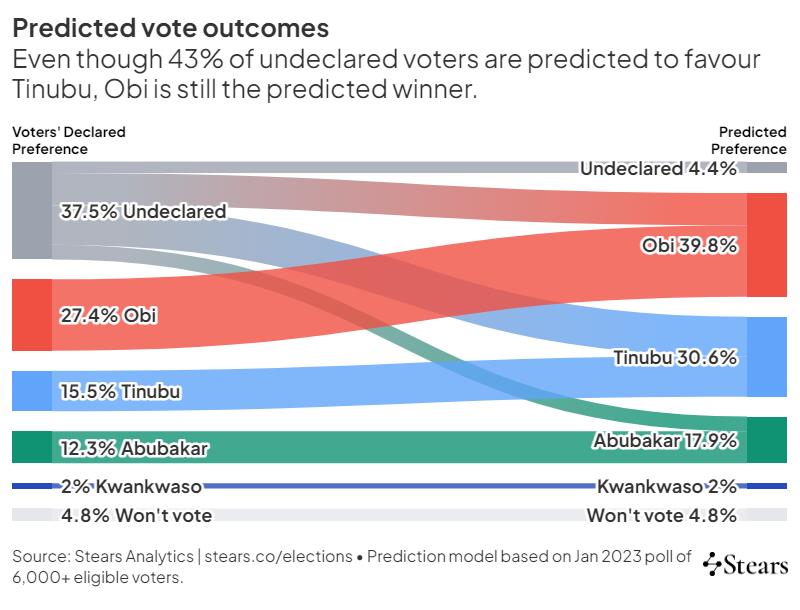
    Okwudili Mwa-Anyajike beat eight others to the presidential ticket of the National Rescue Movement (NRM).

    Rabiu Kwankwaso — New Nigerian Peoples Party (NNPP)

    Who Are the Candidates for the 2023 Presidential Election?

    Like Obi, Rabiu Kwankwaso also left the PDP in pursuit of his presidential ambition. He eventually won the ticket of the New Nigerian Peoples Party (NNPP). A former Kano State governor, he also served as a minister and senator in the past. While he failed to get on the presidential ballot in 2015 and 2019, he’s trying again in 2022. He’s 65 years old. 

    Atiku Abubakar — Peoples Democratic Party (PDP)

    Who Are the Candidates for the 2023 Presidential Election?

    Atiku Abubakar is one of the favourites to win the 2023 presidential election after winning the PDP ticket. The former vice president was also the party’s candidate in the 2019 presidential election but finished second. The 2023 election is his third time on the presidential ballot and sixth attempt overall since he first contested in 1993. He’s 75 years old.

    ALSO READ: Lessons We Learnt from PDP’s National Convention

    Kola Abiola — Peoples Redemption Party (PRP)

    Who Are the Candidates for the 2023 Presidential Election?

    Kola Abiola beat three other aspirants to become the flagbearer of the Peoples Redemption Party (PRP). He’s the son of the late MKO Abiola (who was adjudged to have won the 1993 presidential election that was annulled by the military government of Ibrahim Babangida). He’s 59 years old.

    Adewole Adebayo — Social Democratic Party (SDP)

    Adewole Adebayo is the presidential candidate of the Social Democratic Party (SDP). The 54-year-old is a lawyer and founder of KAFTAN Television.

    Malik Addo-Ibrahim — Young Progressives Party (YPP)

    Who Are the Candidates for the 2023 Presidential Election?

    The presidential candidate of the Young Progressives Party (YPP), Malik Addo-Ibrahim, is a civil rights activist and founder of the Reset Nigeria Initiative. He’s the son of the Ohinoyi of Ebira Land in Kogi State.

    Dan Nwanyanwu — Zenith Labour Party (ZLP)

    Who Are the Candidates for the 2023 Presidential Election?

    Dan Nwanyanwu is another national chairman that’ll be representing his party as a candidate for the 2023 presidential election. He’s promised to unite Nigerians in three months if elected president.

    ALSO READ: Time Is Running Out for You to Register for Your PVC

  • Game of Thrones: Who Wants to Be Nigeria’s President in 2023?

    Nigeria’s Game of Thrones for the 2023 presidential election is currently at the point where everybody and their grandmother is laying claim to the Iron Throne. We recently made a list of some of the aspirants in the race, but a few more people have declared their intention since then to replace President Buhari in 2023.

    Let’s see who’s shooting their shots at the most difficult job in the country. 

    Atiku Abubakar

    Atiku Abubakar is a 2023 presidential election candidate

    You may remember Atiku Abubakar as Nigeria’s vice president between 1999 and 2007. What you may not know is that he’s been involved in every single presidential election since 1993. To clarify: he’s been either a vice presidential candidate, presidential aspirant or candidate in Nigeria’s past seven presidential elections since the 1990s. But he’s only made it to the general election ballots for the presidential position twice: in 2007 and 2019.

    When he officially declared his intention to join the race for the 2023 presidential election on March 23rd 2022, the former vice president said he was obeying the “brave voices” of Nigerians who told him to try again. He wants Nigerians to remember him as the 11-year-old village orphan that reared cattle and rose through adversity to become successful. 

    Atiku’s big rallying cry for the 2023 election is to unify Nigerians, and we’re guessing he’s going to need more than cellotape to pull that off.

    Peter Obi

    Peter Obi is a 2023 presidential election candidate

    Politicians lie all the time about how they joined an election race because ordinary people pressured them to run, but that’s hardly the case for Peter Obi. Since he stopped being Anambra State governor in 2014, his name has always popped up as a viable potential for the presidency. 

    For the 2019 presidential election, Obi settled for being a vice presidential candidate alongside Atiku. This time around, he’ll be running head-to-head against Atiku for the ticket of the Peoples Democratic Party (PDP). 

    For his campaign, you can expect a lot of promises about saving Nigeria by saving money, and a lot of statistics about China.

    ALSO READ: Why Nigeria (Probably) Needs a 102-Year-Old President

    Aminu Tambuwal

    Aminu Tambuwal is a 2023 presidential election candidate

    Aminu Tambuwal has been a busy politician by all standards. He won his first election to enter the House of Representatives in 2003 and won two more before he left in 2015 as Speaker. From the National Assembly, he jumped right into the governorship seat for Sokoto State in 2015 and won a second term in 2019. 

    He’s also jumped parties as regularly as the national grid collapses. He started from the All Nigeria Peoples Party (ANPP) before he jumped to the Democratic People’s Party (DPP) and back to the ANPP and then almost immediately to the PDP. He stayed with the PDP for seven years before he jumped to the All Progressives Congress (APC) in 2014, and then back to the PDP again four years later. 

    This is not the first time Tambuwal is eyeing the presidency too. He finished second behind Atiku in the PDP’s primary election four years ago, and the two will do battle once again for 2023.

    Nyesom Wike

    Nyesom Wike is a 2023 presidential election candidate

    Without context, Governor Nyesom Wike of Rivers State does things like this:

    Wike has been a cornerstone of the PDP for years and his retirement plan after eight years as Rivers State governor is the presidency. When he officially announced his intention to run for the top seat, he mentioned that his strategy is to take power from the APC and save Nigeria.

    We’ll let him use his own words to describe his claim to the presidency, “When a mad man flogs you, don’t run. If you run, the mad man will pursue you. If he flogs you, take a stick and flog the mad man. If you do that, the mad man will start running. This APC requires people to say, ‘Enough is enough,’ and I’m that person that can tell them.”

    We can be sure that the 2023 presidential election will be anything but boring with this one around.

    With primary elections set to start in April 2022, more people may join the 2023 presidential race. But not to worry, we’ll keep you updated.

    ALSO READ: These People Want to Lead Nigeria But Who Are They?