Notice: Function _load_textdomain_just_in_time was called incorrectly. Translation loading for the wordpress-seo domain was triggered too early. This is usually an indicator for some code in the plugin or theme running too early. Translations should be loaded at the init action or later. Please see Debugging in WordPress for more information. (This message was added in version 6.7.0.) in /home/bcm/src/dev/www/wp-includes/functions.php on line 6121
medicine | Zikoko!
  • Federal Universities in Nigeria and Their Cut-Off Marks for Medicine

    Looking to pursue a degree in medicine at a government-owned institution? This article has a list of federal universities in Nigeria and their cut-off marks for medicine. For some universities, the cut-off mark is the derived figure after the addition and division of the UTME, post-UTME, and O’level scores.

    Now, let’s get it.
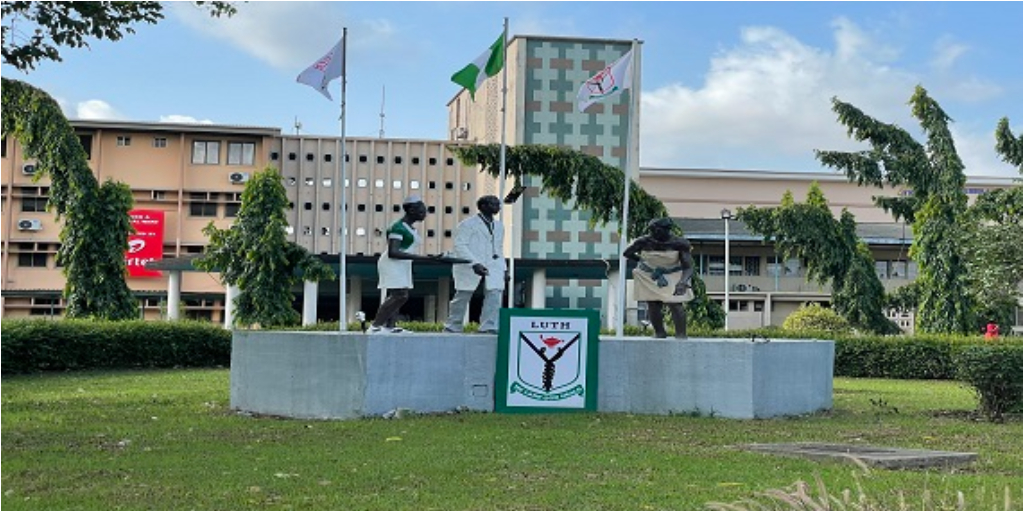
    Federal Universities in Nigeria and Their Cut-Off Marks for Medicine

    University of Lagos (UNILAG)

    Established in 1962 and situated in Akoka, Lagos, UNILAG is one of the highly sought-after federal universities in Nigeria. Medical students undergo their studies at the College of Medicine, Idi-Araba, Lagos, which also houses the university’s teaching hospital. UNILAG offers a program in medicine and surgery.

    Cut-off

    UNILAG has not announced the cut-off mark for the 2024/2025 period. The cut-off mark for the 2023/2024 session was 84.675

    University of Ibadan

    Popularly known as Nigeria’s premier university, UI was established in 1948. The main campus is located in Agbowo, Ibadan, the capital of Oyo state. Medical students undergo their program at the University College Hospital (UCH) in Agodi. UI offers an undergraduate program in medicine and surgery.

    Cut-off

    The university hasn’t released the official cut-off mark for the 2024/2025 academic session. The cut-off for the 2023/2024 intake was 79.

    Federal University, Lokoja

    Established in 2011 and commonly known as FUL, this university is situated in the city of Lokoja, the capital of Kogi State. In 2023, the university made the Times Higher Education 2023 Sub-Saharan African Ranking. FUL offers an undergraduate program in medicine and surgery.

    Cut-off

    The cut-off mark for medicine and surgery in the 2023/2024 admission exercise was 70% of UTME. The university is yet to announce the new-cut mark for the 2024/2025 admission session.

    University of Benin (UNIBEN)

    UNIBEN is a government-owned university established in 1970. It was formerly known as the Midwest Institute of Technology before a name change in 1971. UNIBEN is among the public universities that offer a degree in medicine and surgery.

    Cut-off

    Regardless of the course of study, prospective students are expected to have a UTME score of 200 for eligibility to write the school’s post-UTME. Each department then sets its individual score, but the cut-off isn’t publicly available.

    University of Ilorin

    UNILORIN ranks among one of the best government-owned institutions in Nigeria. It was established in 1975 and located in Ilorin, Kwara’s capital. The institution offers a program in medicine and surgery and has a university teaching hospital where medical students undergo training.

    Cut-off

    The institution hasn’t announced the official cut-off mark for the 2024/2025 academic admission exercise. However, for the 2023/2024, prospective students required an average score of 180 and above to be eligible to write the post-UTME exercise for their course of study.

    University of Jos (UNIJOS)

    Commonly known as UNIJOS,  this is a government-owned university established in 1971. The main campus is situated in Jos, Plateau state. The university offers an undergraduate program in medicine and surgery. Medical students undergo training at the Jos University Teaching Hospital (JUTH).

    Cut-off

    UNIJOS hasn’t made an official announcement of its cut-off mark for the 2024/2025 intake. However, the general UTME cut-off for the last admission exercise was pegged at 180. Note that prospective students seeking admission into medicine and surgery also need to meet some other requirements as determined by the university.
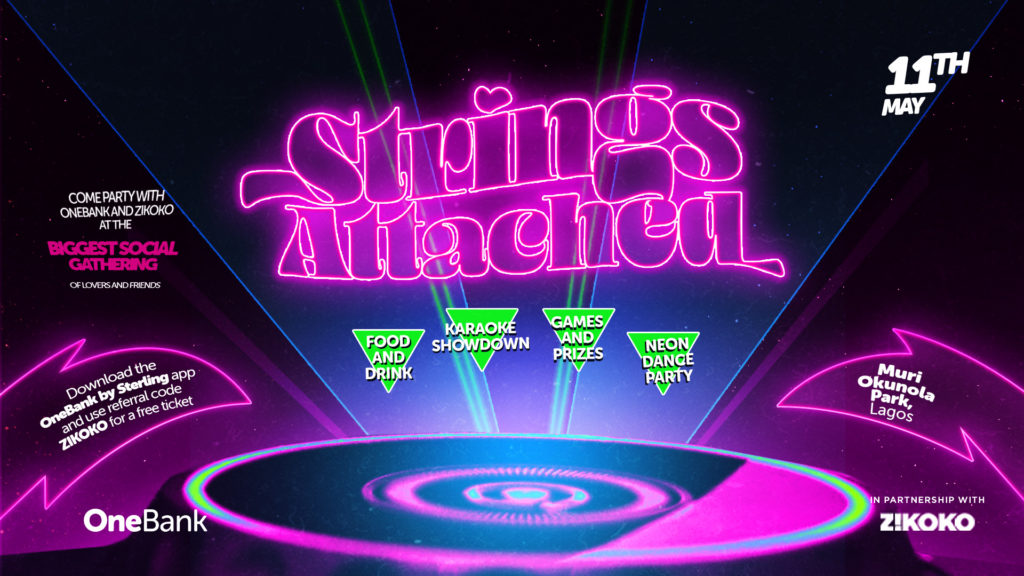
    Get a free ticket to Strings Attached and enjoy a feel-good evening of music, dancing and games at Muri Okunola Park, Lagos on May 11, 2024.

    Nnamdi Azikiwe University

    Also known as UNIZIK or NAU, this public university was established in 1991. The main campus is situated in Awka, the capital of Anambra state, while it has another campus in Nnewi. UNIZIK offers a program in medicine and surgery. Medical students undergo their training at the Nnamdi Azikiwe Teaching Hospital.

    Cut-off

    The university hasn’t announced the cut-off mark for the 2024/2025 admission round. The last cut-off the university made publicly available for medicine and surgery was at an aggregated (UTME, post-UTME, and O’levels) 310.5

    Usman Dan Fodio University

    Known as UDUSOK, the university, named after Usman dan Fodio, the founder of the Sokoto Caliphate, is one of four universities established by the Nigerian government in 1975. It’s a public research institution located in Sokoto state. It offers an undergraduate degree in medicine and surgery. Medical students undergo training at the Usman Dan Fodio University Teaching Hospital.

    Cut-off

    As of the 2022/2023 admission exercise, the cut-off mark for medicine and surgery was set at 290. The university hasn’t announced the cut-off mark for the 2024/2025 session.

    University of Uyo

    The federal government established this university in 1991. It was merged with the former University of Cross River State, earlier established in 1983. The university, which is located in Uyo, the capital of Akwa Ibom, offers a program in medicine and surgery. Medical students receive training at the University of Uyo Teaching Hospital.

    Cut-off

    The university isn’t known to set cut-off marks. Admission is based on the candidate’s performance and NUC quota. UNIUYO has an NUC admission quota of 120 students, as such candidates with the highest UTME scores are considered for merit admission.

    University of Calabar

    UNICAL was formerly a campus of the University of Nigeria, Nsukka, before it was established as a standalone university under the National Higher Education Expansion Programme of 1975. It’s one of the highly-ranked government-owned institutions in eastern Nigeria. The university offers a program in medicine and surgery and trains its medical students at the University of Calabar Teaching Hospital Anambra.

    Cut-off

    The university hasn’t announced the cut-off mark for the 2023/2024 admission session. 260 was set as UTME score cut-off for medicine and surgery during the 2021/2022 admission round.

    Bayero University

    This university is an offshoot of Ahmadu Bello University, Zaria. It formerly operated as the Abdullahi Bayero College before it was upgraded to the status of a full-fledged university by the federal government in 1977. Bayero University offers a degree in medicine and surgery. Medical students undergo training at the Aminu Kano Teaching Hospital.

    Cut-off

    The university hasn’t announced the official cut-off mark for the 2024/2025 admission exercise. However, as of 2021/2022, the UTME cut-off mark for the faculties of clinical sciences and pharmaceutical sciences was 220 and above.

    If you found this piece about federal universities in Nigeria and their cut-off marks for medicine useful, you should read this next: The Hilarious Life of A Nigerian Medical Student


  • Talk True: Does Cranberry Juice Cure UTIs?

    Talk True is a Zikoko limited series for medical myth-busting. With each episode, we’ll talk to medical professionals about commonly misunderstood health issues to get the actual facts.


    The odds of you waking up and developing a sudden craving for cranberry juice are pretty minimal. With its characteristic tart taste, cranberry juice doesn’t rank high on popular refreshment choices, but it’s a hit in the online feminine wellness space.

    Here’s why

    A quick vaginal health/wellness search on Instagram will reveal many vendors touting the belief that cranberry juice will make Urinary Tract Infections (UTIs) go away forever. Is this claim based on facts, or is it a myth? Dr Mary Alo provides answers.

    First off, what’s a urinary tract infection?

    As the name implies, it’s a bacterial infection of any part of the urinary system, which includes the kidneys, ureters, bladder and urethra. In women, it’s typically characterised by a burning sensation while peeing, cloudy or bright red urine, frequent passing of small amounts of urine, fever and pelvic pain. 

    Image: Sora Shimazaki on Pexels

    While men can also have urinary tract infections, women are at a greater risk because they have a shorter urethra than men, making it easier for bacteria to travel to the bladder. Other gender-specific risk factors include using contraceptive diaphragms, pregnancy, frequent sexual activity with new partners and menopause. 

    It’s important to note that while sex can cause bacteria to move further into the urinary system, UTIs aren’t contagious/sexually transmitted infections.


    You know what’ll be contagious, though? The amount of fun you’ll have at HERtitude — Zikoko’s women-only party for the hottest babes. Get tickets here.


    How does cranberry juice come in?

    Some sources also claim that regular intake of cranberry juice improves the vagina’s “taste” — even though no scientific evidence supports the claim. But Mary explains the flaw in this logic.

    “UTIs are infections majorly caused by a bacterial organism called Escherichia coli (E. Coli), and as such, are best treated with antibiotics. The rationale for using cranberry juice is that it can, in a way, help to preserve the flora. Infections are more likely to occur when the normal flora of the urinary tract is disturbed. E. Coli works by attaching itself to the host’s tissue, and current hypothesis suggests that cranberry juice works to prevent the adherence of E. Coli to the urothelium of the urinary tract. Without this attachment, the bacteria can’t infect the mucosal surface, thus preventing an infection from occurring.

    But this is prevention. It isn’t enough rationale to use it as a form of treatment as UTIs can only be treated with antibiotics.”

    Should you ditch it, then?

    Not exactly. 

    “It makes more sense to use cranberry juice in a proportionate amount as a preventive measure, though I wouldn’t recommend that’s all you use to prevent urinary tract infections. 

    You can use it in addition to concrete preventive measures like drinking more water, urinating before and after sexual intercourse to limit the spread of bacteria, wiping the vaginal area from front to back after using the toilet and not abusing antibiotics.”

    Better treatment options for UTIs

    Mary emphasises that urinary tract infections can only be treated with antibiotics.

    “Once your healthcare provider confirms that the symptoms point to a urinary tract infection, the next thing to do is prescribe the appropriate antibiotic regimen for treatment. Don’t let people who are more profit-oriented tell you otherwise. Cranberry juice is just one of many ways to prevent UTIs — especially in recurrent infections — and it works in tandem with other preventive measures.”

    The takeaway

    Cranberry juice has benefits for feminine wellness and vaginal health, but it can’t cure urinary tract infections. At best, it’s a preventive measure, but not in isolation if preventing UTIs is the primary goal.


    YOU SHOULD ALSO READ: Talk True: Is Period Syncing a Real Thing?

    Don’t leave without getting your ticket to HERtitude 2023!
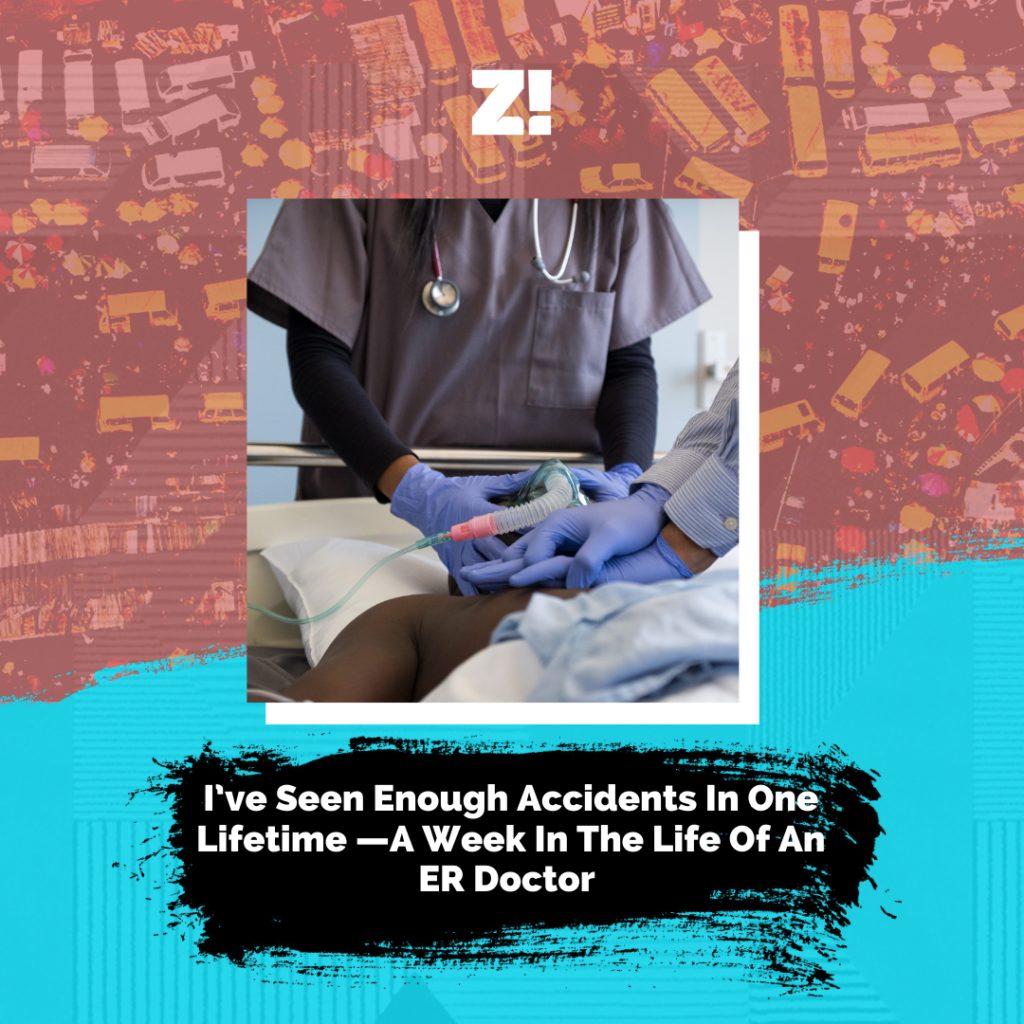
  • I’ve Seen Enough Accidents In One Lifetime —A Week In The Life Of An ER Doctor

    A Week In The Life” is a weekly Zikoko series that explores the working-class struggles of Nigerians. It captures the very spirit of what it means to hustle in Nigeria and puts you in the shoes of the subject for a week.


    The subject of today’s “A Week In The Life” is an emergency room doctor at the Lagos State Accident and Emergency Center. He talks to us about the stress that comes with his job, how witnessing road accidents has made him more cautious, and the procedure for contacting emergency services in Lagos. 

    ER doctor

    MONDAY:

    Because everyone is rushing to beat Lagos traffic, Mondays are one of the busiest days for me. And I’m not saying this because I’m also stuck in traffic.

    I start my day at 6 a.m. on most days. My routine is the same: I wake up for morning prayers, have my bath and freshen up, then I dress up. 

    Work resumes at 8 a.m. so I leave my house at 7 a.m. Because I work in an emergency centre, the first thing I do when I get to work is change into scrubs — a protective garment worn by healthcare professionals involved in patient care. 

    After that, I go to the emergency room to take over from my colleagues on the night shift. My colleagues hand over by briefing me on the history of patients on admission and treatments done so far. Somewhere between all the paperwork and catching up, my day fully starts. 

    On Monday, we get a lot of road traffic accidents and a high number of assault cases. Unsuspecting workers who leave their houses early to beat the traffic are sometimes attacked by hoodlums. Also, private cars and bus drivers who drive too fast in the early morning get into accidents. 

    My job involves resuscitating these patients and stabilising them. That is, keeping them alive long enough until they can get to a General hospital or to a specialist. 

    My first patient today stood out to me because he was a victim of assault. He was rushed in with a fractured skull and he had lost a lot of blood. I noted to the ambulance driver that I could only stabilise the bleeding, and he had to take the patient to LASUTH for specialist care. 

    After that patient, the rest of my day was a blur: stabilise this patient, repeat, stabilise that patient, repeat. Over and over again. 

    TUESDAY:

    We get a lot of emergency cases every day and our response time is of utmost importance. When a patient enters our gate, the security personnel rings an alarm system to alert every healthcare worker in the facility to start running to the ER. You leave whatever you’re doing and run. 

    It takes less than two minutes to get to a patient, then treatment commences. 

     Before any contact with the patient, we put on our PPEs, gloves, disposable aprons, face mask and shields. Then we move to what we call initial patient evaluation and resuscitation. This follows a stepwise pattern known as A — E: 

    A — airway and cervical spine  — spinal cord  —  protection

    B — breathing & ventilation

    C — circulation

    D — disability or neurological deficit observation

    E — environmental checks. You check the surroundings to eliminate any other form of injury that might have happened due to the environment. 

    Different doctors handle different parts of the protocol.

    A: There’s a doctor whose job is to ensure that the airway is not compromised and the patient can breathe well. In addition, they also protect the cervical spine which houses the spinal cord. Protecting the spine is important because the lifting of a patient for treatment, especially after an accident, can damage important nerves connected to the diaphragm. And this can affect the supply of oxygen to the brain and heart, which can lead to death.

    There’s another doctor in charge of monitoring the patient’s breathing. They ensure the patient has no injuries that can affect breathing. Then circulation where the doctor replaces body fluid of patients who are in shock due to reasons like bleeding or infection.

    Finally, we check for disability and monitor the patient’s surroundings to ensure that we don’t miss anything. While all this is ongoing, the patient’s vitals like pulse rate, heart rate and oxygen level are being measured by the nurses.  

    Once the health team is satisfied with the patient’s stability, we then refer them for specialist management. A nurse accompanies the patient in our ambulance and hands over the patient to the new team that’ll resume management. 

    The best part? We do all this for free so that patients don’t have to worry about money. In an emergency, people just need to dial 121 and our ambulance will pick them up. Then our facility handles the rest.

    WEDNESDAY:

    Today, I’m thinking of how quickly things in the ER move from 0-100. One second you’re in your call room chilling and the next you hear the alarm ringing. And you start to run. 

    It can be overwhelming and demanding because you’re always on your toes. I remember being nervous on my first day of work because of the number of patients and the pace of the job. But now? I can function in my sleep. 

    It’s been a year since I started this job and the experience has given me self confidence. Now, I don’t panic and I never freeze. 

    I’ve also changed a lot since I resumed the job. I now take extra caution when driving by wearing my seat belt before leaving my house or office. I don’t drive more than 60km/h. And if I see a car speeding, I allow them to go past me. 

    When everyone is horning on the road, I put on my double-pointer [hazard light] and stay on one side of the lane. I let everyone overtake me because I’m not rushing anywhere. 

    I also don’t cross the express. If the pedestrian bridge is 30 minutes away, I’ll trek towards it and climb. I’ll also not be caught dead on a bike.

    Why? I’ve seen enough road traffic accidents to last a lifetime. I know better. 

    We have a saying in the emergency centre: “What are you running for? Even if you go slow, you’ll still get to where you’re going.”

    THURSDAY:

    In this job, there’s no “off” switch that you can just turn off. The lines between home and work get blurred, especially for patients who have spent some time in the facility with us. I find myself constantly thinking about my patients even when I’m off work. 

    I’m happy that the Lagos state government pays the patient’s fees so we can focus on saving lives. In my experience, the delay from payment and deposit affects a patient’s chances of survival. But this way, we commence treatment quickly.

    I wish there were more centres like this around the country. I also wish the health system as a whole was something to be proud of. If things worked well and doctors had equipment, maybe jaapa would reduce. I love my job, but I know it’s a bubble so I’m still making plans to leave for greener pastures. 

    The experience has opened my eyes to many possibilities. When I get abroad, I know that I’d like to still continue as an emergency responder. The adrenaline and fulfilment from helping patients is second to none. 

    But away from daydreaming to the present. We have a lot of accident cases today. But I’m not worried —with our level of care and protocols, we’re fortunate to have a low mortality rate. For that, Glory be to God. 

    I can’t wait to close from work in the evening and crash on my bed. I’m on the night shift tomorrow, and I need all the rest I can get. Fridays are also one of the busiest days because of TGIF accidents. But until I have to think of Friday, my plan is simple: I must survive today’s madness. 


    Check back every Tuesday by 9 am for more “A Week In The Life ” goodness, and if you would like to be featured or you know anyone who fits the profile, fill this form.

    [donation]

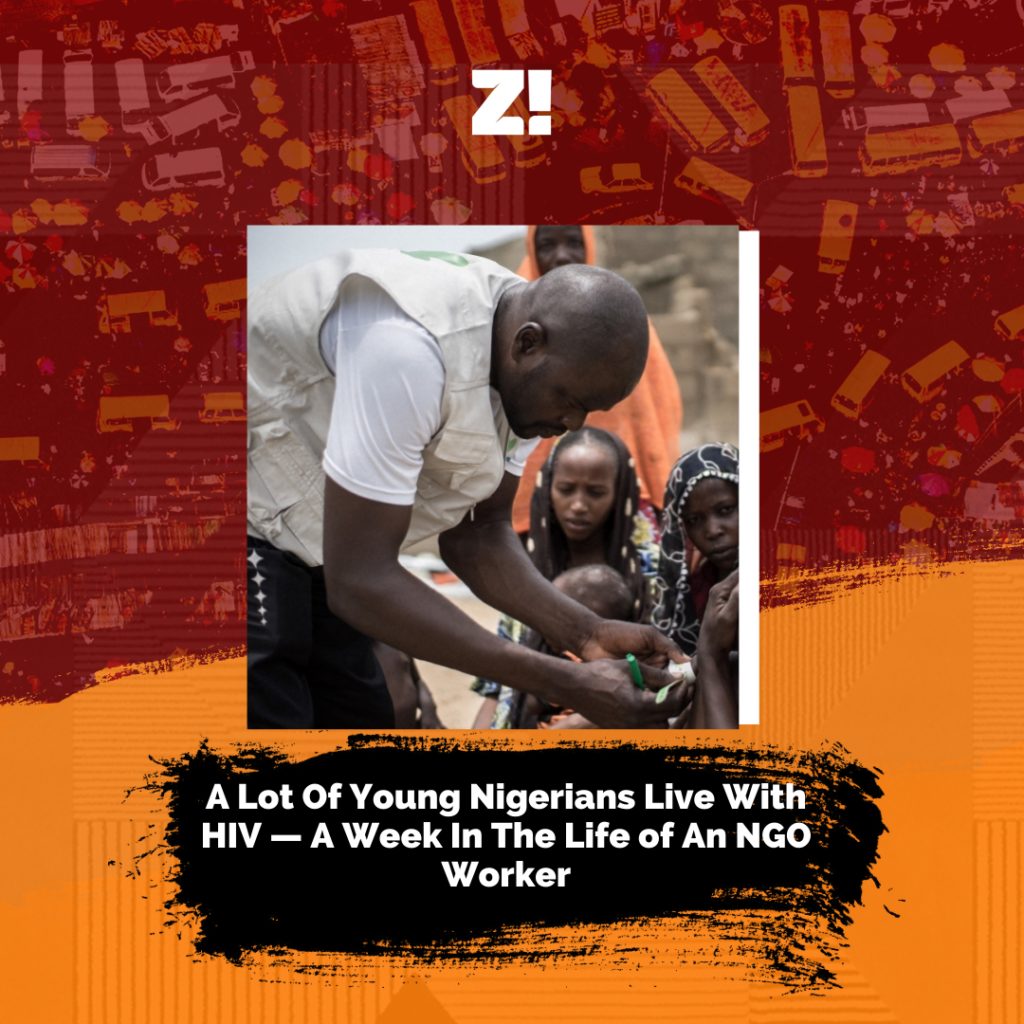
  • A Lot Of Young Nigerians Live With HIV — A Week In The Life of An NGO Worker

    A Week In The Life” is a weekly Zikoko series that explores the working-class struggles of Nigerians. It captures the very spirit of what it means to hustle in Nigeria and puts you in the shoes of the subject for a week.


    The subject of today’s “A Week In The Life” is a medical doctor working at an NGO. He talks to us about why he left clinical medicine for NGO work, lessons he has learnt on the job, and how all his experiences add up in helping him achieve his dreams.

    NGO
    Image source: Google Images

    MONDAY:

    My day starts early because I’m a nightcrawler. I wake up at 3 a.m. to read an email or watch a movie, then I return to sleep when I’m done. 

    I wake up again by 5:30 a.m. to pray, and I lie in bed after prayers doing nothing till 7:00 a.m. Then I get up to have my bath. A side effect of living outside Lagos is that I spend 45 minutes bathing, brushing, singing in the shower and still get to work by 8 a.m. The roads are free and my house is a 10-minute drive from my office. 

    I resume my day with coffee to wake me up and I start to mentally psyche myself to face the day. Mondays have one thing in common: meetings, meetings, more meetings. 

    Yay! 

    TUESDAY:

    I work as a program associate at an NGO providing access to care for people living with HIV. My organisation’s job is to monitor and manage the entire care process in line with the UNAIDS 95-95-95 goal. This states that firstly, 95% of people who are HIV positive should know that they are HIV positive. Secondly, 95% of people who receive an HIV positive diagnosis should be on medications. Thirdly, 95% of people who start treatment for HIV should be virally suppressed

    We try to achieve this goal by splitting ourselves into various teams: the tuberculosis HIV team, the prevention of mother to child transmission team, the paediatric team and the adult team. I work with the adult team and my job involves receiving patient’s data from health workers on the field and using it to guide strategy and program implementation. 

    Today, I read through the data of the number of clients in care, their viral load level and drug adherence. From these indicators, I can tell where our strategy is working and where it isn’t. One of the states I’m managing shows a number of patients with a relatively high viral load, so I make a mental note to enrol some of them in an enhanced adherence counselling program. This is to understand their specific challenges and help them work through them.

    If that doesn’t work, then we’ll have to switch them to second-line antiretroviral drugs.

    I inform my boss of this development and he suggests we travel down to the community for a few days to support the work of the field workers and to observe their process. 

    I acknowledge his advice and concern, however, the major thing on my mind is food. I need to eat before I can continue thinking. It’s important I help myself first before I try to help others. 

    WEDNESDAY:

    It’s 5:00 p.m and it’s the close of work. Days like this remind me of why I decided to leave clinical medicine. As a clinician, I’d work 48 hours non-stop shifts and still resume work on the third day by 6:30 a.m. Every free time I had was dedicated to either sleeping, catching up on sleep or dreaming about when I’d sleep. 

    I quickly realised that the 24/7 work lifestyle wasn’t for me and I ran. I was also looking for something mentally tasking with a large scale impact on the population, so the NGO job fit perfectly. The ability to work flexible hours while providing impact? Sign me up. 

    In addition, the remuneration was very attractive. Suddenly, work went from being miserable to being “fun.” 

    I’m fortunate to have this job and I don’t take it for granted. I plan to make the best use of my time and that’s why today, I’m meeting up with a few friends for dinner. After all, all work and no play…

    THURSDAY:

    It’s been a relatively chill week and nothing has broken, yet. That’s why I have some time to reminisce today. 

    A few things I’ve learned from this job: there are a lot of young people living with HIV in Nigeria. A lot. But it’s also not a death sentence because, with proper treatment and adherence, people live till old age. I’ve seen first-hand how compliant patients who receive HIV diagnosis live with suppressed and virtually undetectable viral load. This means they can carry on without the fear of infecting their sexual partner. 

    I’ve also seen how people struggle with stigma because of their HIV diagnosis. And how tedious it can be to use medicine at a fixed time every day. 

    Then, I’ve also noticed that the prevalence of HIV seems more among people from low socioeconomic backgrounds. And that’s why I’m sure that if we didn’t have NGO’s, the HIV burden in Nigeria would have been 10 times more than it currently is. 

    At the end of the day, everyone needs to understand that HIV is not a death sentence and that people live meaningful lives regardless.

    Work has also made me abstain from having multiple sexual partners. Because I understand that the easiest mode of contracting HIV is through unprotected sexual intercourse,  I have only one sexual partner. I wish younger people had more sexual education to encourage them to stay safe. 

    FRIDAY: 

    It’s currently noon and that means we’re a few hours away from the weekend — TGIF! 

    I’m aggressively trying to wrap up all my tasks for the day so I don’t take work home over the weekend. But my tasks involve a lot of “dear sir”, “dear ma”, “please find attached” and so many “best regards.” One of the hard parts of corporate culture is the formality and email culture, but I don’t mind. It’s still better than where I’m coming from. 

    I know that if I put my head down this experience will be very useful. As long as I keep polishing my Excel skills, Microsoft skills and soft skills, it’ll add up. After I’ve gained meaningful experience then I’ll go for my Masters in health policy or data science and start to focus on health system strengthening. By the time I’m done, I’ll be one big consultant focusing on Nigeria, Then I’ll forget all about this struggle. 

    Until that time comes, I’ll keep typing my “warm regards.” And working and playing hard. However, before I start dreaming, I need to first survive today in one piece. 


    Check back every Tuesday by 9 am for more “A Week In The Life ” goodness, and if you would like to be featured or you know anyone who fits the profile, fill this form.

    [donation]

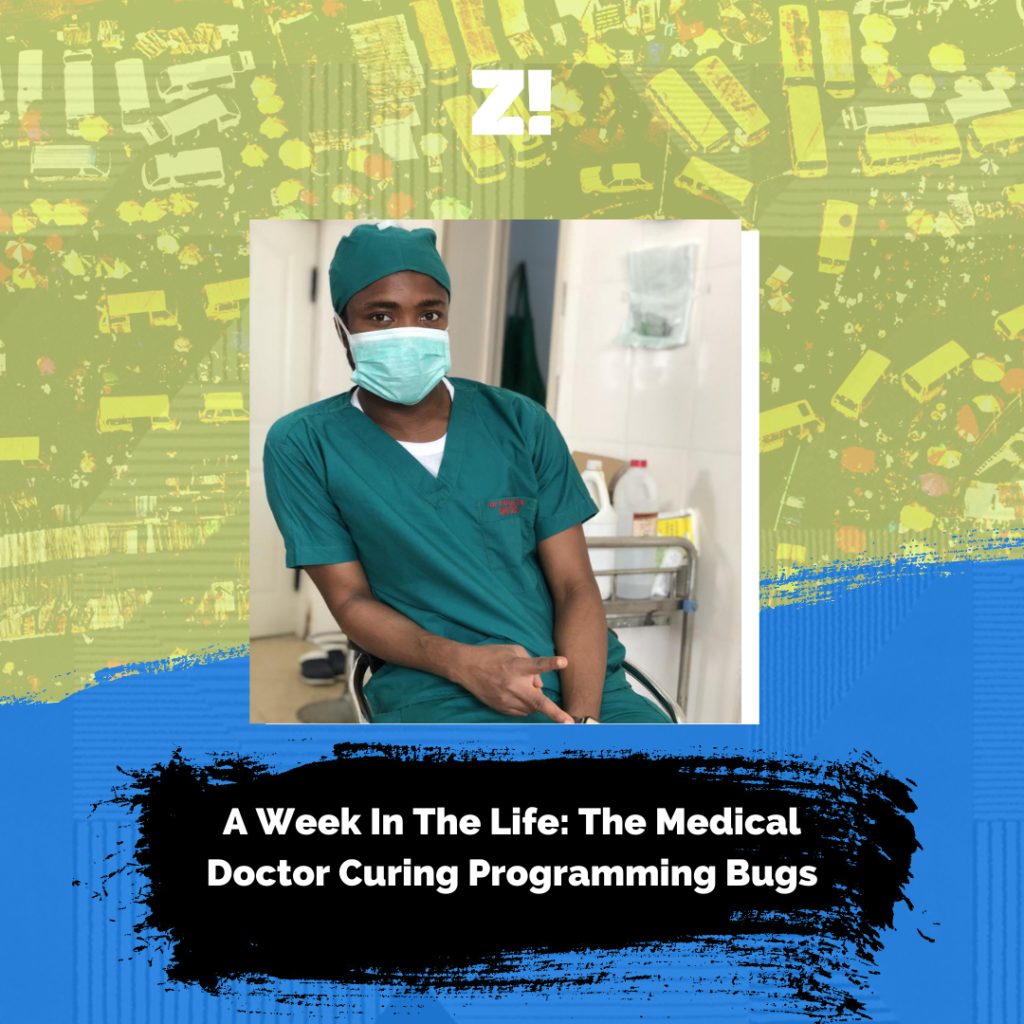
  • A Week In The Life: The Medical Doctor Curing Programming Bugs

    “A Week In The Life” is a weekly Zikoko series that explores the working-class struggles of Nigerians. It captures the very spirit of what it means to hustle in Nigeria and puts you in the shoes of the subject for a week.


    The subject of today’s “A Week In The Life” is a Medical doctor. He talks about the worst year of his medical career, how Nigeria kills dreams, and why he’s aggressively learning to code.

    MONDAY:

    I wake up by 5:30 a.m. because I have to pray and get ready for work. I like to get to work early because punctuality is a virtue. After prayers,, I scroll through messages on my phone to see if I missed anything from the night before. I reply to a few messages, then I go through the ritual of brushing, bathing and general grooming, and I’m ready for the day.

    I work as a doctor in a small private clinic. When I resume at the hospital, the doctor on the night shift hands over a patient that was on admission over the night. I introduce myself and go over the treatment plan. There is no other patient on admission, so I sit and wait for outpatients. I’m grateful for this job because I don’t see more than 5 – 10 patients in a day. It’s rare, as a doctor, to do a job that gives you free time. 

    Thankfully, I’m with my laptop, so I decide to write some code. I inform the nurse that I’ll be in the doctor’s room if she needs me, and my day really begins.

    TUESDAY:

    The residency program for doctors in this country is crap. I considered doing residency and even wrote the first qualifying exam, but thank goodness I noticed a trend that changed my orientation on time. 

    A few months ago, each unit had ten doctors, and even that wasn’t enough. But now, you have one doctor doing the work of ten people. So you realise that the person is overworked, underpaid and underappreciated. This is quite discouraging. 

    I still think that my house job year was one of the worst years of my life because it was a really long year. There were days I thought I was going to die because of the workload. I don’t consider myself a lazy person, but it was overwhelming even for me. It was just too much work. 

    I’ll never forget a weekend call that broke me. Typical weekend calls last for 48 hrs — you resume at 8 a.m. on Saturday and leave the hospital by 4 p.m. on Monday. I remember that I was in one extremely stressful unit and by 9 p.m. on Monday, we hadn’t left the hospital. I’ll never forget thinking I was going to die as we moved to the last patient. My eyes were closing as I struggled to keep up with my senior colleagues. At one point, I didn’t even realise I had started swaying until I felt a hand on my shoulder. It was an elderly matron who had noticed I was about to fall that stopped me. She got me a chair, sat me down and sent for a bottle of coke for me. For the first time since that day started, someone showed me empathy. It’s funny how people are so focused on getting help that they don’t realise that even the helper needs help. That singular act was the kindest thing anyone did for me during that house job year. 

    I think that was one of the straws that made me realise that this country is not it and any hope for a change in the healthcare sector is light-years away. 

    The thought of residency being worse than house job is scary, and that’s why a lot of doctors are investing in jaapa. I hope that journey will be more straightforward and rewarding. Today, I’m going to spend my time dreaming of a healthcare system that’s not trying to kill me.

    WEDNESDAY:

    The hardest part of being a doctor is societal expectations. People expect you to dress a certain way, act in a certain manner and then go down the traditional path of residency. 

    Anyone who diverges from this path — I have friends exploring other fields — is considered a failure. In a way, medicine has a way of indoctrinating you to believe that you can’t be anything without it.  And that doctrine is one of the hardest things to break free from. I think once many doctors realise that there’s much more outside of the profession, the better they’ll be for it. I’m hoping that when we jaapa, our passion will be reignited. I think for many people, passion died during the house job year, and they’re just winging it until they get out. 

    Learning to code started out as a result of curiosity and a lack of options. I remember reading a book that changed my perspective. The book talks about how people with two high in-demand skills can give more value, and how they own the future. These people are able to identify opportunities for innovation in one field and then bring knowledge from another completely different field to help in problem-solving. The unique advantage they have is that someone in either field would either be unable to see those unique problems or would lack the skills to solve them. 

    After reading the book, I started learning to code as part of my new year resolution. I’m trying to see if I can use technology to solve medical problems. Two months to the end of 2020, and I’m grateful for how far I’ve come. I can’t wait to say it’s been one year since I started learning to code. 

    THURSDAY:

    Today, I can’t sleep. I’m tossing and turning. I’ve been dreaming of a bug that just won’t allow my code to be great. I dreamt of the solution to the problem and that’s what woke me up. 

    For something that started out of curiosity, I’m hooked. I find myself waking up in the middle of the night to solve some problem. I’ve lost count of how many times I have found myself dancing in the middle of the night alone, with no music playing, because I successfully fixed a bug in my code. 

    My proudest moment still remains my first project. I was at work one day when a child was brought in the middle of the night. The child had seizures, was dehydrated and unconscious. Being the only doctor [with only a nurse] in the clinic, I had so many responsibilities. I had to monitor vital signs, set intravenous access [a line] and calculate the amount of fluids to give the child. Even though the calculation wasn’t hard, I couldn’t help but think of how to automate the task so that the next time I had a similar patient, I’d have one less task to perform. I wanted a way to input some values and get the amount of fluid to give. This made me build my first project — a calculator to determine the amount of fluid to give to a dehydrated child. 

    After building this, I innocently put in on Twitter because I felt like one or two people would relate. In less than six hours, I had over two thousand views. I was shocked because I don’t think I’ve ever had anything that had more than 10 views. It was a humbling experience which has prompted me to build a lot more medical applications. 

    I’m grateful for the medical community on Twitter, and I’m glad to be a part of it. I’m also grateful for my support system, most notably my girlfriend who’s always there for me. 

    I’m just here thinking about how she’s been my number one supporter on this journey. She has supported me with time, money and encouragement. In fact, my plan for today is simple: I’ll start calling her sugar mummy. 

    FRIDAY:

    Today, I made $100 from my first coding job. This may not seem like a lot until you realise that it is one third the average salary of a doctor in Lagos. It’ll take 10 full working days for a doctor to earn that amount, and I did that in six hours. More than anything, this has shown me that there’s some prospect in coding. We die here.

    I’m not going to white-wash it; coding is hard. It’s frustrating. It makes me feel clueless, stupid, dumb. It’s ridiculous that because you miss one semicolon, your project is breaking.  However, if you stick through the difficult times, it gets easier and you begin to gain some proficiency. I’m lucky because I have a good support system, and I’ve also been a recipient of kindness from helpful strangers. 

    I’m going to keep pushing it — medicine and technology. I see a future where I’m running my own tech startup. At the back of my mind, I’m hoping that it’s not within this country because Nigeria has a way of killing your dreams. And because medicine in Nigeria is a jealous lover; it’s almost impossible to combine anything with it, especially if you’re going through the path of a residency programme. Outside this country, you can have a life outside of medicine, the long hours and poor pay, and that’s all I’m hoping to have. Is that too much to ask for?


    Check back every Tuesday by 9 am for more “A Week In The Life ” goodness, and if you would like to be featured or you know anyone who fits the profile, fill this form.

    [donation]
  • She Started Out Being A Doctor, Now She’s Chasing Something Else

    Every week, Zikoko seeks to understand how people move the Naira in and out of their lives. Some stories will be struggle-ish, others will be bougie. All the time, it’ll be revealing.

    Tell me about money when you were a kid.

    I remember the first person who ever gave me a ₦500 note. A guest spent the night with my family and gifted two notes to me when he was leaving the morning after.

    Shout out to visitors that roll out cash. 

    Haha! I’ll say we were comfortable. Bills were paid on time, new stuff for school every session, we travelled abroad for summer vacation. We weren’t wealthy, but we had enough. We had the new consoles, the latest sneakers, the newest phones.

    Sweet. 

    That was before my dad retired sha. After he did, my mum kept up the good work, but it wasn’t like before. 

    What did your dad do for a living, and what did your mum do?

    My dad was a medical doctor working as an expat in another country – he did that for 20 years. He had to work across cities in the country, even in a village. My mum was a teacher, but she moved to live with my dad for about 9 years and I lived with both of them for a while before coming back to Nigeria. She came back to Nigeria and became the principal of a school.

    Now she’s a businesswoman. 

    What’s the first thing you ever did to ‘earn’ money?

    In secondary school, I would write poems and sell them for Valentine’s Day. So I would write like 5 poems, you select the one you want, pay, then my best friend would use her beautiful handwriting to write inside your card. If you want a custom poem, you pay extra. My best friend and I shared the money 50-50. I was in SS2/SS3 at the time. 

    *Love letter for 100*

    We were in a boarding school so it was extra money to buy snacks and food during breaktime. I was known for my literary work once upon a time. 

    Young bestseller. Inside Life!

    Inside Naira Life, hahaha. 

    After that, did you do anything to earn money?

    I just had to be someone’s child, hahaha. Allowances basically – all through uni. There was really no need to look for extra income then. And medicine is a jealous profession. It’s not easy to combine it with something else. 

    So naturally, House Job after actual school?

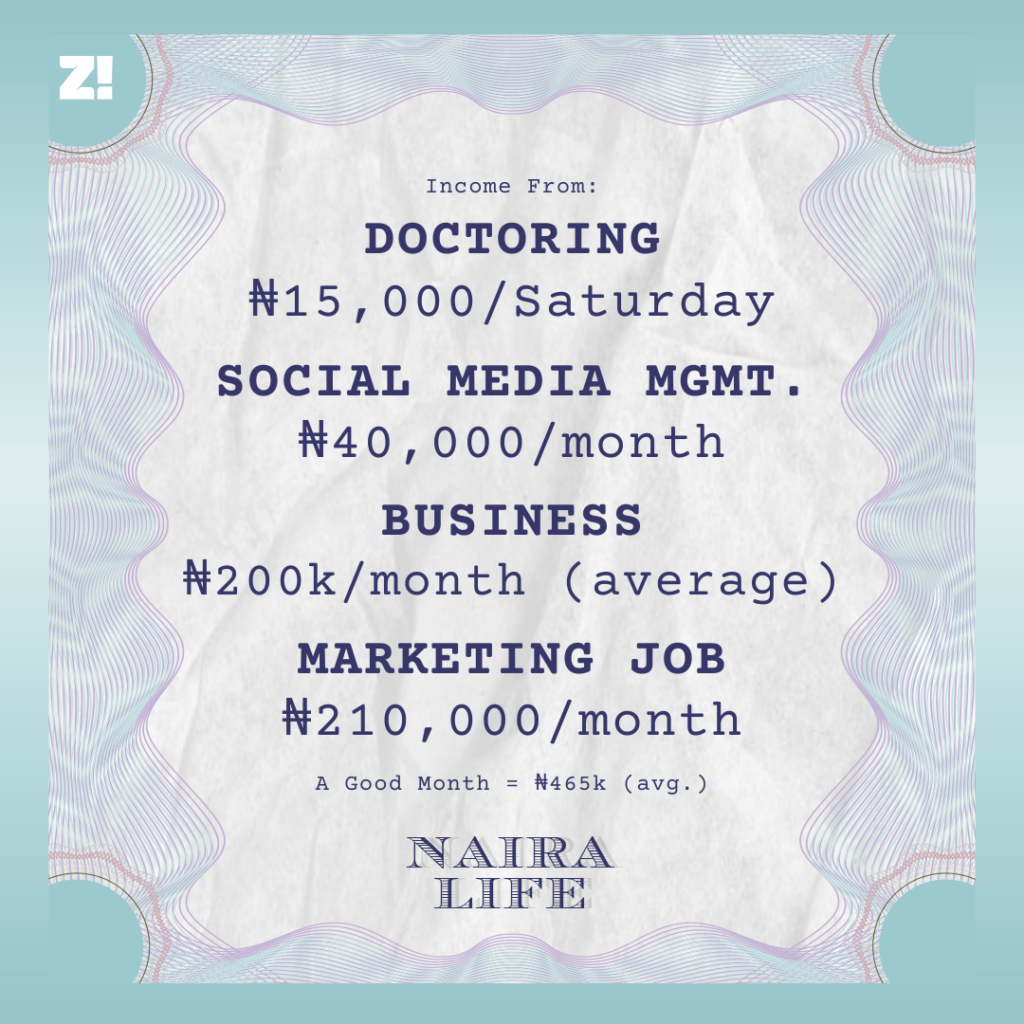
    Yeah, I moved to Lagos for that. Got a job with the Lagos State Government and we were paid about ₦157k. Now the money was different almost every month, and the payslips never really explained what was going on but ₦157k was the average. I turned 25 during this, and I did the house job from 2015 till 2016. I got a job almost immediately after – barely a week – at a private clinic in Ikoyi and I was paid ₦80k monthly. 8 am to 4 pm, 5 days a week and alternate Saturdays. 

    However, just before getting this job, I started a fabrics business with a capital of ₦30k – buying and selling. 

    Smooth. 

    I worked in the clinic for a few months before NYSC. During NYSC, I was paid ₦43k by the state and after plenty gbas-gbos, ₦75k plus allowee of ₦19,800. 

    After NYSC, I had the option of going back to Lagos State or the private clinic but I wanted something else so I was home for six months. My husband noticed how much of a struggle it was during those months.

    Wow. What did you want so badly that you were willing to wait for 6 months?

    Something around Advertising, Marketing communications or Business consultancy. During that period, my business was my major source of income and fortunately, it was doing well.

    So so sorry about that. 

    Anyway, after months of not getting any job in the field I wanted because “what is a doctor looking for in this field” and other unreplied applications, I went back to the private clinic. But when I went back, I told my boss that I wanted to do social media marketing also and I wasn’t going to work 5 days a week.

    Wait, you mentioned husband earlier. 

    I got married during NYSC. 

    Ballpark number. How much did your wedding cost?

    Hahahaha. My husband usually says ₦10 million. We had over 1500 guests. But trust me, it wasn’t our money. Our parents paid for the wedding. The money we saved up was used to get an apartment and set it up – I saved ₦300k. We had a list of things we needed for the house so when people asked what we wanted for the wedding, we sent the list. 

    How much will you say your gifts saved you, in cash?

    Over ₦500k – fridge, microwave, washing machine, gas cooker, blender, water dispenser, and other things I can’t even remember. We could have bought those things eventually but we would have bought cheaper ones. My husband is a doctor too and when we got married, he was working in a private clinic while I was a Corper. So we had to be penny-wise. 

    You fed an army.

    The parents did. We just had fun. 

    Do you ever imagine a scenario where they just handed you the cash instead?

    I tried to convince the parties involved. I was told how impossible it was for me to have a small wedding. I’m the first grandchild of my mum’s family with 6 aunts and an uncle. They consider me their baby. Everybody came from across the globe. 

    Okay okay, back to getting back to being a doctor

    And social media marketer. Surprisingly, she agreed. Anyway, I started working 3 days a week and alternate weekends. I handled social media also. I was paid ₦1.5 million/annum, and I used the other two days to run my business. 

    So, you worked there as a doctor and managed their social media? Awesome!

    Yes. And surprisingly, when I calculated my salary, it was higher than what a lot of my friends were earning as doctors. 

    That’s interesting. 

    Medicine doesn’t pay well in Nigeria and it’s really sad. I have many many friends who have relocated and are planning to relocate soon.

    In fact, the whole medical journey can be a struggle. They sold us the medical dream but didn’t show us the full picture.

    My dad once told me that if I  wanted to be rich, I shouldn’t be a doctor. Didn’t make much sense to me then but I get now. 

    Doctors are some of the smartest people but many don’t know anything outside medicine. I know many people who would like to try something else but they don’t even know what else to do. So they stick with what they know.

     Society doesn’t even make it easy. The pressure is ridiculous. 

    In all, the real ballers are the owners of big hospitals. Especially those who have registered HMOs. Then consultants who studied abroad and then come back to Nigeria and consult for big big clinics, or hospitals. Just consulting for big hospitals is enough. That’s a lot of reading and investment. 

    Ah, that’s brave. 

    Yep. In fact, I got a job in 2019 at a marketing company. I still work as a doctor but only on alternate Saturdays and I still handle their social media. And I still run my business. 

    Let me tell you a funny story. 

    I’m listening. 

    When I was going to switch, I was scared – leaving the known for unknown. I had wanted this for a long time and I was really getting boredat the clinic. Then I got my job offer and saw how much they were offering.

    How much? 

    ₦3.6 million/annum. My friend and colleague at the clinic made me drop my resignation letter that day. My husband was out of town, I sent the offer letter to him and he sent back a draft of my resignation letter

    Hahaha. 

    When I resumed, I experienced culture shock.  I was coming from a place where we waited till the last day of the month or the first day of the next month for salary to getting several credit alerts for different things in the course of the month.

    Mad o.

    A few weeks after I resumed, the MD announced that everyone was getting a raise. I remember sitting there thinking:

    Is this how you people used to do it? That was the day I knew I wasn’t going back to full-time medicine. I had seen the light.

    Well done! So, business plus clinic side gig, plus main job, what’s that looking like?  

    When my business started, I used to do a lot of running around and it was quite stressful. But these days, I pray and focus on large orders – less stress, more profit. And everyone is happy. Pre-COVID, I tried to do one batch a month. 

    Ah, and now covid has paused it? 

    For individuals, yes, but I supply fabrics to businesses too so I still got some of those during this period. 

    What’s something you want but can’t afford?

    I was dreading this question. Because I don’t think I have an answer. Probably to spoil my husband and parents the way I would love to. My reason is because I hardly ever drop lump sums for anything. I prefer to pay in installments or save up for something. I plan my money.

    Talking about planning your money, what’s your monthly expense sheet like?

    Anything that’s not here doesn’t have structure. I do agro investments, I save one of my salaries in Dollar vest on Piggyvest. I just started getting into stocks and Eurobond etc – one of my salaries, the clinic gig. I send money to my parents sometimes. 

    I have a shopping addiction – shoes and clothes. I am trying to slow down now.

    Tell me about your wildest splurge

    I think December 2019, a store was doing sales and I was just buying shoes and clothes. Bought Christmas presents for people. Dropped money for church and some other money gifts. I don’t know how much I spent but roughly ₦200k to ₦250k.

    Woah. 

    You’ve heard worse jo. 

    Hahaha. Yes I have.

    I’m not really one to splurge. If it’s above my budget, I don’t think about it. It’s not even an option. I wait for sales or a better deal. If it’s essential, I save or pay in installments. The only thing I splurge at once are agro investments. 

    What’s the most annoying miscellaneous you’ve had to pay for?

    MDCN annual fees. I hate that I have to pay for it year after year and nobody is actually checking to see if I am doing the right thing.

    I know you plan all your money, but what’s the last thing you paid for that required serious planning?

    We moved houses. From a rented flat to one that is almost free (₦12k a month with electricity and water and other perks) but we had to renovate. So we needed to plan that. However, because we had been saving our rent monthly, it made it easier so we just used the rent money for renovation and added extra. Stretched finances a bit but we are good.

    ₦12k a month? Is there still space?

    Hahaha, it’s hospital quarters o. I was doing shakara before but after doing the maths, nobody begged me. They are supposed to be taking it straight from my husband’s salary.

    Lit lit lit lit o. Do you have a sense of how much renovation cost?

    About ₦600k. We bought a few things too.

    Tell me a financial regret you have. 

    I wish I had gotten more savvy about investments earlier, probably during housejob. I started taking it seriously last January and I have seen great improvement. But also, one needs to earn more to be able to save and invest more. 

    My financial decision I don’t regret though, is starting my business.

    On a scale of 1 to 10, how will you rate your financial happiness? And why?

    7. I’m content with my life to be honest. I can’t think of anything I really need that I don’t have. I have things that I want but no hurry, everything good will come. The remaining 3 is for the potential money I can make if I take the right steps. There’s always room for improvement. 

    One last thing.

    I’m listening. 

    If your 13-year-old came to you and said, “Daddy, I have met the man/woman I want to spend the rest of my life with,” would you approve? 

    I am guessing you wouldn’t let the child make such a decision. So why do we make kids choose what career paths they want to follow at that age? 

    Some will know, but many of us are on a journey of self-discovery. And I’m still on that journey. I don’t have a 5-year plan. I have an idea of who I want to be but I take each day as it comes and enjoy the experience.

    I enjoy being a doctor, but I know there’s so much more that I can be and I’m not afraid to find out.

    Grand closing. Thank you very much for taking the time.

    This story was edited for clarity. Some details have been changed to protect the identity of the subject.

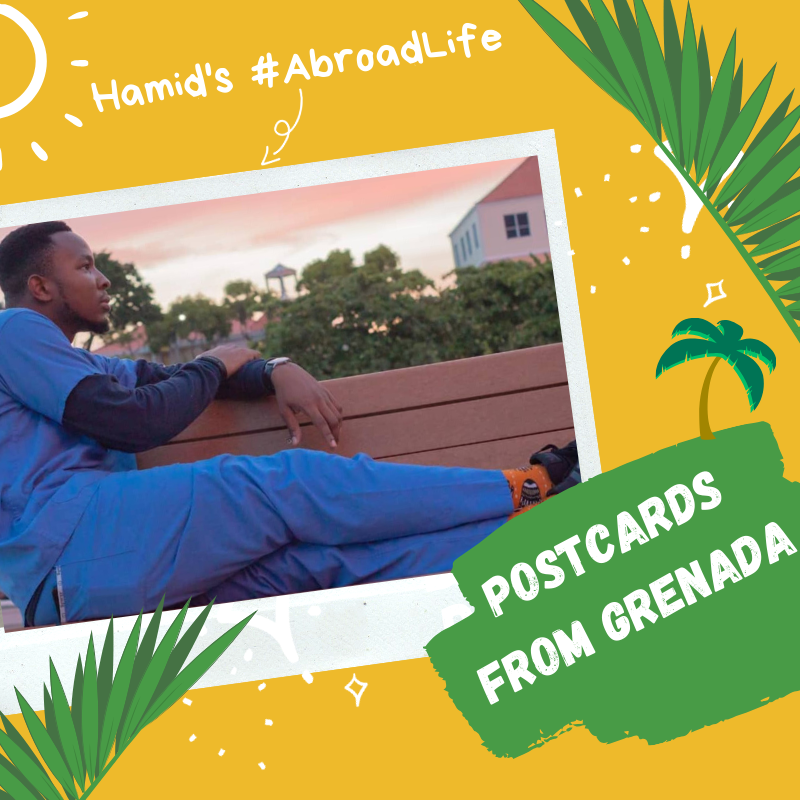
  • Gearing Up In Grenada: Hamid’s Abroad Life.

    The first time I heard about the country Grenada was during a now-forgotten Miss World pageant. I haven’t had any real reason to pay any mind to the country since, until very recently when something I was researching had me put Grenada through Google images.

    I shouldn’t have.

    The image results made me want to pack Nigeria inside Bagco Super sack and just forget it in Ghana’s backyard forever.

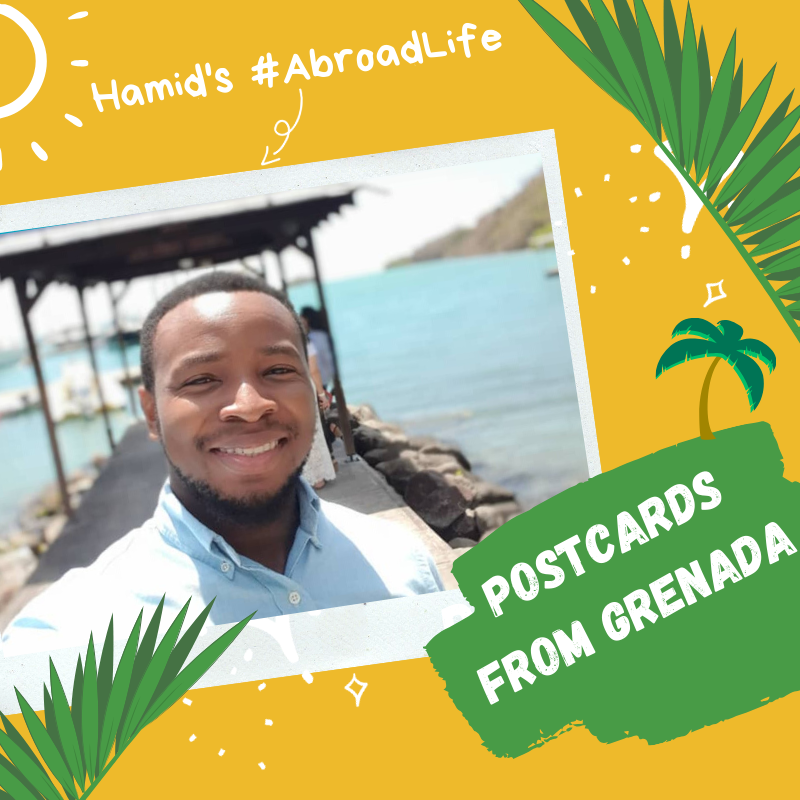
    Anyway, bitterness to the side, today’s abroad life subject – Hamid, has been living in Grenada for the past two years. We caught up with him to find how life in paradise feels like.

    How does it feel waking up every morning and knowing this view is only a few miles away from you?

    I won’t lie, this level of ifakanbale (rest of mind) is unmatched! I lived in Lagos before I went to England for my A-levels and undergrad and now Grenada, so I’ve been a bit removed from regular Nigerian craziness for a little bit. But you see this Grenada’s calmness, 10/10 would highly recommend. Down to the people, nobody has stress in this country, they take their time with everything.

            *Jealousy levels start to rise”. 

    So for those of us that didn’t watch Miss World growing up, where is Grenada?

    Grenada is an island country made up of the Island of Grenada and some smaller Islands. Off the top of my head, I can name two  – Grenada and Carriacou. It’s around the Caribbean Sea, so everything’s just soft.

    Even though ‘Sanwo-olu’s face was annoying me’ is a good enough reason to move these days, why are you currently living in Grenada?

    School. I’m currently studying medicine at St. George’s University.

    Just BTW, how long does it take to get from say Lagos to Grenada? 

    This question! So ideally, Lagos to Grenada should be about eleven hours, but there are no direct flights, so it always ends up taking so much longer.

    More than half a day on a plane for medical school? When LUTH is just here?
    (Just want everyone to know we spent a full minute laughing at this.)

    Let’s be serious here, plis dear. So when I say it takes more than 11 hours, here’s what happened when I made my first trip to Grenada. Let’s say I left Lagos on a Sunday, I didn’t get to Grenada until Wednesday.

    Say what?

    Here’s what happened.

    In an ideal world, to get from Lagos to Grenada, you can either go from Lagos to London or Lagos to America, then get a direct flight to Grenada. So I was leaving from the US, and the thing with flying is, if you don’t book on time, flights get really expensive, so I was going to take a connecting flight when I landed Atlanta, to go to New York, then Frankfurt, then Barbados before getting on a final plane to Grenada.

    *Jealousy levels reduce a little bit*

    See, if my plan went that way, wouldn’t I have been happy? After having a layover of about five hours, I got introduced to what I like to call the Carribean Connecting flight culture (Hamid™).

    What’s the Carribean Connecting Flight Culture?

    Basically, if you have a connecting flight from the Carribeans, the rule is that your flight is going to be delayed, just take it like that. The exception is that it won’t. And if that isn’t bad enough, because they mostly use small planes, if you’re travelling with two boxes, just know one isn’t leaving the airport with you, like they’ll actually ask you which bag you’ll prefer to have with you when you leave the airport. I picked the one with my clothes because the drip is forever and well, I didn’t want to stink up the place wearing the same clothes over and over. Didn’t get my other box until days after.

    Ah.

    Ah indeed. So when I got to Barbados, my flight was delayed. When the plane finally arrived, it was meant to go to two places – Grenada and Trinidad and Tobago, with Grenada being the first destination. Ask me the only country it ended up going to, just ask.

    Oh no.

    Oh no indeed. During the trip, the pilot just announced that they’d only be going to Trinidad, it was like film trick. Four hours at the Trinidadian airport and plenty KFC food vouchers after , courtesy the airline company ⁠— we finally, finally got to Grenada.

    A patient king, I stan.

    Before we go on, I’d like to go back to the studying in LUTH question. 

    Sure thing.

    I’ve had the opportunity to shadow Nigerian doctors and I have to say, they should probably practice with capes attached to their coats because they are doing truly remarkable work with so little resources. Nigerian hospitals are painfully under-funded, the doctors here are just trying to make the best out of a system that is continuously failing them. So, if you are in anyway blessed to have the opportunity to study in a country and a system that works, I will always suggest you take that route.

    I hear that. So for someone looking to get a visa to Grenada, how will they go about it?

    Um, well have your documents first of all, academic records, passport, all of that. Then write a letter to the Grenadian customs maybe a month before. You really don’t need a visa to come to Grenada. I don’t think you —

    MY PEOPLE DID YOU HEAR THAT?

    Haha. Well at the time I arrived here. Like even my passport just has stamps on it, I didn’t have to apply for a visa. There’s a form to fill when you arrive, and some fees to pay, but I think that’s about it.

    Okay. #Grenada2020 let’s see what’s up. 

    Let’s take it back 2 years when you first arrived. What were the first three things you liked about Grenada that made you go, ‘Lagos, e go be’?

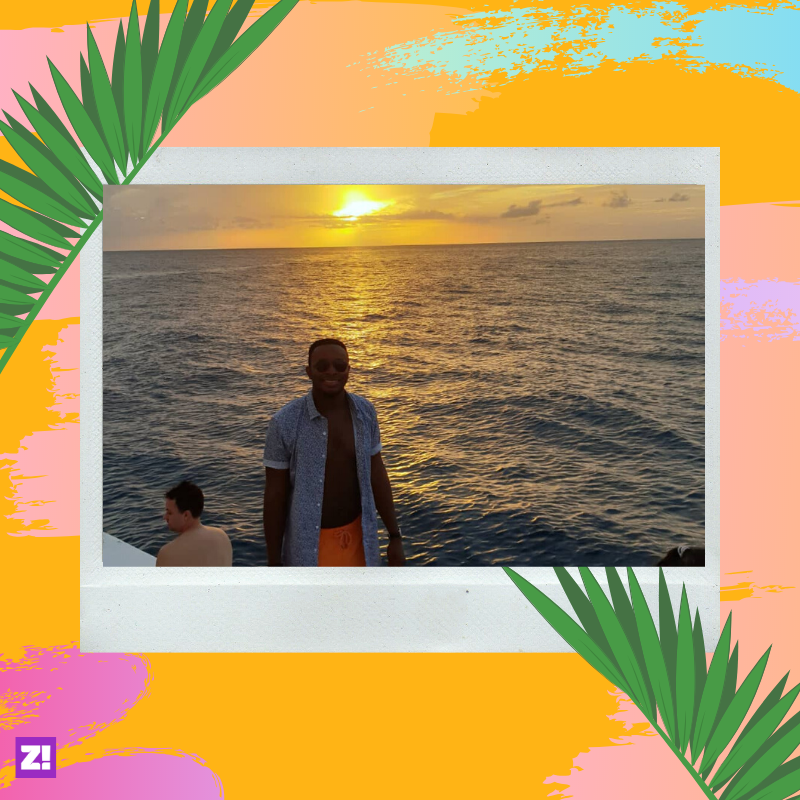
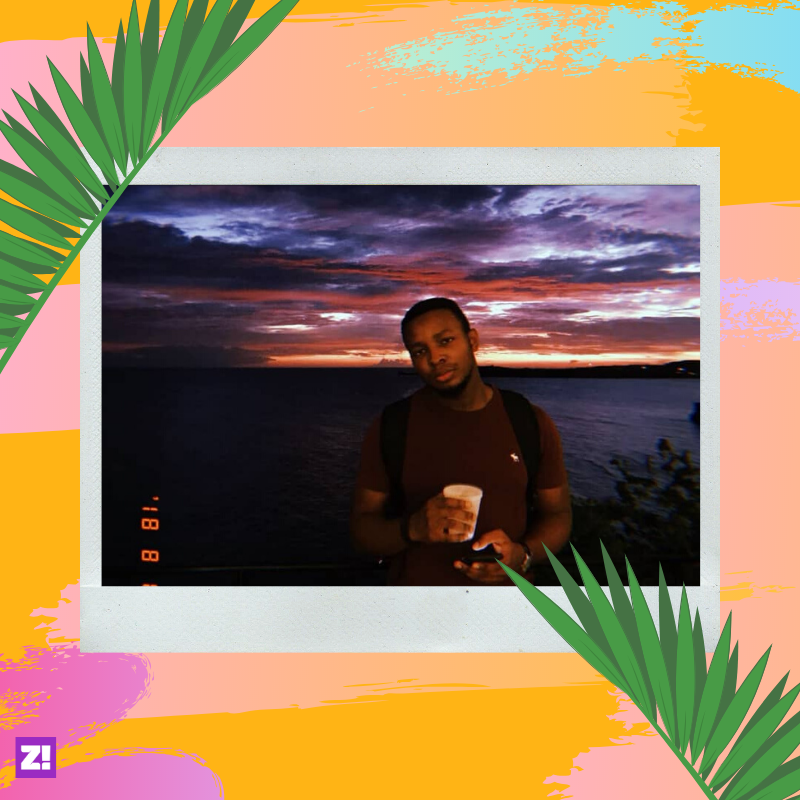
    Hmm. Definitely the sunsets. They are honestly the most beautiful, beautiful things. My phone is filled with pictures of them. Because my school is right by the coast, I get views of the most beautiful sunsets in this life. 

    One lie, you didn’t lie about these sunsets.

    Haha. After the sunsets, definitely the beaches! See, these Grenadian beaches are good for your health. Throw on your swim gear, head to the beach, any bad mood is cured.

    *Stares at summer body. Summer body stares back*

    Like this one beach – Grand Anse. It was voted one of the best beaches in the world. Then maybe after that, just being here to study medicine, that would be my third. 

    *Jealousy levels dangerously spike*

    Now that you’ve been here two years, what are the coolest spots to visit?

    Let me see. Definitely Junction. It’s a bar and grill. It turns to a club at night. They play soca music and afrobeats.

    Naija to the world!

    You say that now, but really all they’ve been doing for two years is playing ‘If’ and ‘Fall’ by Davido. They only started playing ‘Come Closer’ this year and they even cut Wizkid’s part out.

    LOL. What?

    Yes oh. Then maybe The Dodgy Duck and Umbrella, which are restaurant-type establishments. I’m not one to go to clubs, mostly because their audiences are very em… white. Can’t really be giving them Zanku to Taylor Swift you know.

    Indeed you cannot. So you’re pretty much living in Heaven while we’re here struggling with Road Safety. We can’t have that. What’s the inside gist on the worst parts of living in Grenada? 

    Let’s see. Shipping costs! Oh my God, it is so expensive to ship anything here. Say you get an iPhone for $1000, just know you’re going to spend like $500 clearing it.

    What did you say?!

    No joke. Then electronics are unreasonably expensive here. Just smuggle them in if you can. And lastly, they drive like crazy people here. Which is extra scary because the roads are very narrow and hilly so it’s just hard to reconcile with the jeje lifestyle everyone lives. Like they literally rush everywhere, just to get to their destinations and resume their quiet lives. Blows my mind. 

    *Jealousy levels return to a respectable level*

    But how’s schooling there?

    Pretty good. There’s a healthy mix of people. A lot of Canadians, Americans, some Batswana on scholarship from their government. Of course a lot of Nigerian students are here as well, so that’s always a plus. Facilitators too, which are like lecturers, but for study groups. A lot of them are Nigerian.

    How come so many people are moving to an island country for medical school?

    The thing about St. George University is, it’s a US accredited school. Of all non-US schools, it has about the highest success rate of providing a pathway for doctors looking to practice in the US and also the UK.

    Got it. And how are classes?

    Pretty intense.I am currently in Term five, which is pretty much the final lap before I take one of the biggest exams of my life  in February, which will determine if I can have my residency in the US. So I’ve been through Term 1-4 here, where we learnt the foundation of medicine and anatomy. Oh something cool happened this week actually.

    Tell me!

    I worked in orthopaedics this week, and I took patient history, which is important because our school usually brings in standardised patients, meaning people without symptoms, learning props almost. So working on real-life patients was a real thrill.

    Okay, I’m about to put you on the spot here, just helping you prep for that big exam. What do you do when a person is choking?

    Check to see if the area is safe to approach, then ask them to cough. After that, look in their mouth to see what’s obstructing the airway. If you can see it, ask them to cough, if they can’t, finger sweep, try to get it out.

    Ew.

     Be ew-ing there. Be careful you don’t push it further back in. If not, go behind them, make a fist, put it infront of them above their belly button, take the other hand behind that, then do an in and up motion to try to get them to bring up the object blocking their airway. All of this if they’re conscious. ..there’s  a whole other procedure where they’re not.

    Doctor Doctor!

    Haha. Awa niyen! 

    So what’s the plan after Grenada?

    I’m looking to go to the US for my residency. I have more family there, so it’d be nice to be closer to them. I’ll do my clinical rotations there, take the Step 2 exams, and use that to apply for residency programme in whatever specialty I’m looking towards. I’m currently considering internal medicine or neurology. We’ll see.

    I have to say, this doesn’t sound like green passport energy. Perchance sir, what is the colour of your booklet?

    It’s greener than green. Doctors just have a high demand over there, plus I have visiting history to the US and clearly I’m coming for school, so it isn’t very likely that my visa will be denied.

    From your mouth to God’s ears, all the best Doc!

    Thanks!

    Want more Abroad Life? Check in every Friday at 9 A.M. (WAT) for a new episode. Until then, read every story of the series here.

  • “I Wrote JAMB again after NYSC”

    “I cannot remember when I decided it was medicine or nothing else. I got admission to study medicine at the University of Benin twice but Uniben was not accredited so I couldn’t study it. Losing that admission twice before I finally settled for Biochemistry didn’t deter me from my goal.”

    “The stress, pains and disappointment that came with Biochemistry didn’t deter me from my goal either. When I was done and I said I wanted to go back to school, I had little or no support. Frankly, I don’t know why I kept on pushing but I’m glad I did.”

    “I wrote UTME twice after NYSC and four times in a total. Today, I don’t have just my Medicine degree but the support of my family and friends as well as some really good grades. Some days it’s hard, especially when your secondary school mates keep on sending you their Wedding IVs and your present university classmates are not even as old as your youngest sister.”

    “But then I remember this has always been what I wanted and the inner peace I get doing this. I truly believe this is my calling. All that makes up for whatever sadness or momentary depression I may find myself in from time to time.”

    • Anon. University of Medical Sciences, Ondo State.
  • “Excuse me nurse please where is the Doctor?”

    You are looking at her.

    “You want to specialize? When you haven’t found husband?”

    Who husband epp?

    “Aunty please help us call the main Doctor”

    Please explain yourself

    “Small girl like you, so you mean you are a doctor?”

    Who are you calling small girl?

    “Aunty Doctor, Aunty nurse”

    It’s just Doctor, please

    “Ehn I know you are not a nurse just help me call the male Doctor”

    The level of disrespect

    “Eh nurse wait stop talking let me talk to the main Doctor”

    I’m confused he’s a medical student

    “I’m not saying you don’t know your work o, just help me call your oga”

    Look at me I’m the oga here

    “You are a doctor? Your husband is trying o, hope you have time for him”

    Is that what we are here for?

    “You mean you are a doctor doctor? And you are a woman?”

    And so what?

    “Sister but you are too fine to be a doctor now”

    Better face your front
  • All The Reasons We Don’t Trust Doctors

    1. When you are rolling in pain and they are busy asking you questions calmly as if you are not about to die.

    2. When the doctor is smiling at you like a predator so you know your life for the next few days is ruined and stinky.

    3. When they say your problem is a “minor issue” but their bill is still a major headache!

    4. When they bring out a big axe after telling you “it’s just a small injection”.

    5. When they don’t warn you about the terrible taste of some medicines when they ask you to take them.

    6. When they introduce you to some human beings that are meant to be nurses but they behave like witches.

    7. When they say “small surgery” as if such a thing exists.

    8. When they start asking you about next of kin so now you know they are colluding to kill you.

    9. When you feel better and want to thank your God in peace but the doctor starts looking at you somehow.

  • If Your Doctor Is Close To Your Family, This Is For You

    1. When you have to go to the doctor again.

    2. When the doctor asks if you are sexually active, you’re like:

    3. When you have to undress in front of him/her.

    4. When the doctor eventually finds out the source of your issues and it’s sexual.

    5. When you have to ask for advice on sex and STD’s.

    6. When you realise they’re actually cool and treat you like the adult you are.

    7. But when next you see them at any family event, you’re still like: