Notice: Function _load_textdomain_just_in_time was called incorrectly. Translation loading for the wordpress-seo domain was triggered too early. This is usually an indicator for some code in the plugin or theme running too early. Translations should be loaded at the init action or later. Please see Debugging in WordPress for more information. (This message was added in version 6.7.0.) in /home/bcm/src/dev/www/wp-includes/functions.php on line 6121 ken saro-wiwa | Zikoko!
What significance lies within a name? A great deal, we assure you. A name imparts a sense of identity and connection, especially when it pertains to a national symbol or landmark, such as an airport or stadium. Such names not only preserve history but also ignite inspiration, serving as touchstones for future generations.
Just like everyone else, we were astonished to learn that the President has approved the renaming of 15 airports in Nigeria, including the Port Harcourt International Airport, which has now been designated as the Obafemi Jeremiah Awolowo International Airport.
We acknowledge the current state of Nigeria, which has seen a significant increase in tribal influence since the 2023 general elections. However, we assure you that our appeal to the President is not based on tribal or linguistic factors. Allow us to present three reasons why we are urging President Bola Ahmed Tinubu to rename the Port Harcourt International Airport to Ken Saro-Wiwa International Airport:
To the Niger Delta, Ken Saro-Wiwa signifies selfless hope:
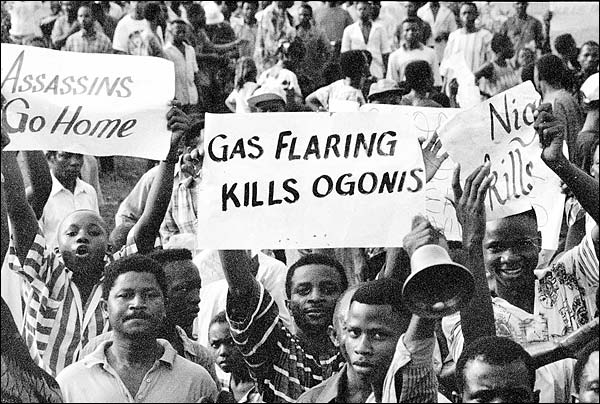
Many decades before the Global North began to throw around the terms “climate change” and “environmental conservation”, Ken mobilised Ogoniland and the peoples of the Niger Delta to speak out against the degradation of their land and livelihood—at a time when freedom of speech came at a cost and against an oil giant so powerful no one could confront.
It was a typical David vs. Goliath, but sadly, “Goliath” and General Abacha ganged up to kill David. Ken’s defiant hope is something we can all identify with in Rivers State, and it serves as a lesson to the Nigerian State in how it treats minority tribes. It is only be-fitting that his bravery be immortalised this way.
The Niger Delta is in dire need of positive role models:
Unlike the Western region of Nigeria, where Chief Obafemi Awolowo is from, and Northern Nigeria, where many stories account for role models to whom young people can aspire, positive role models are not uplifted as much here in the Niger Delta.
Years of violence have birthed many negative role models, and we believe the renaming of the Port Harcourt International Airport provides an opportunity to uplift a selfless role model for posterity to look to.
Ken-Saro Wiwa International Airport will be a reminder:
A reminder to everyone flying into the Niger Delta that more than 40 years later, the environmental degradation of Ogoniland and other oil-producing communities in the Delta has not ended.
It will be a reminder to the Federal Government to fulfil its promise to clean up the Niger Delta and restore the livelihood of community members who have been rendered poor while Nigeria feeds on the profits of crude oil sales. It will be a reminder to the world and the global community that indigenous people matter.
It is important to note that, we do not in any way, through this petition, seek to belittle the strides and contributions of Chief Obafemi Jeremiah Awolowo to Nigeria and its existence. However, we believe that the Federal Government can identify several landmarks and monuments to immortalise this great man; however, for the sake of Rivers State and the Niger Delta, we believe that Ken Saro-Wiwa will be a better fit.
Also, as a policy organisation, we want to recommend that the Federal Government develop a Guide or Convention for naming national monuments and landmarks, ensuring that the wishes and thoughts of host communities are considered before final names are announced.
A national monument/landmark title is sacred and should not be reduced to a handout for friends; careful thought and consultation must go into it. Here is an example from Texas, a US State.
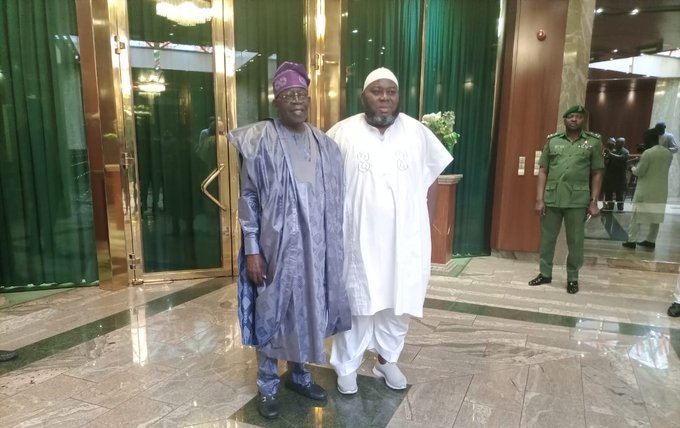
On June 16, 2023, a burly man met Nigeria’s president, Bola Tinubu, at the nation’s official residence — the Aso Villa. No one knows the nature of their clandestine conversation.
Bola Tinubu and “the mystery man” [Channels Television]
Older Nigerians may understand why his speech was so ‘inflammatory’, but the Gen Zs? Not so much. The biggest question on their lips has been: who is Asari Dokubo?
To answer this, we must time travel to when oil became Nigeria’s new gold up for grabs by foreign oil companies, causing a never-ending conflict in the oil-rich Niger Delta region and the rise of some indigenous ‘avengers’.
While they have existed under different tags, they are commonly addressed as the Niger Delta Militants.
Several militant groups in the Niger Delta have attacked oil facilities in the past [AFP]
And all this oil was coming from one region — the Niger Delta.
First test drilling for oil in Nigeria in Oloibiri, Imo State c. 1950 [Ukpuru]
Unfortunately, the vast wealth derived from petroleum didn’t trickle down to the masses in the Niger Delta, who suffer severe consequences due to oil exploration activities.
The region was severely exploited. This was since the 19th century with the discovery of palm oil and crude oil after Nigeria’s independence. Foreign oil companies like Royal Dutch Shell and Chevron set up bases in oil-rich areas, notably the Ogoniland in Rivers State. Indigenes were uprooted from their homes forcefully as government made a profit from the evacuations.
The Ogonis and other minority groups complained about the forced evacuations and very little compensation. The government looked away. So did the oil companies.
Members of Nigeria’s Ogoni community protest against Shell in New York. Photograph: Bebeto Matthews/AP
As all land belongs to the state and is held in trust by the government, the residents had little recourse under the law.
The law also prescribed that compensation for seized land would “be based on the value of the crops on the land at the time of its acquisition, not on the value of the land itself.”
For this reason, the Ogoni people became increasingly dissatisfied and soon formed one of the first Niger Delta agitation groups, the Movement for the Survival of the Ogoni People (MOSOP).
Beginning in December 1992, the Ogonis started fighting for their land and lives, and the oil companies fought back, leading to escalation on both sides.
MOSOP issued an ultimatum to the oil companies (Shell, Chevron, and the Nigerian National Petroleum Corporation (NNPC)) demanding some $10 billion in accumulated royalties, damages and compensation, and “immediate stoppage of environmental degradation”, as well as negotiations for mutual agreement on all future drilling.
What was the government’s response? Well, more agitation. They banned public gatherings and a declaration of disturbances made in oil production as an “act of treason.” But the protests seemed to work. Oil extraction decreased to a mere 10,000 barrels a day, and this got the government extremely pissed.
Several misunderstandings later, the Sani Abacha led military regime found its closure.
The Murder of the Ogoni Nine
In May 1994, nine activists from the movement who later became known as ‘The Ogoni Nine’, among them Ken Saro-Wiwa, were arrested and accused of incitement to murder following the deaths of four Ogoni elders (allegedly killed by a mob led by the Ogoni Nine).
Saro-Wiwa and his comrades denied the charges. However, they were imprisoned for over a year before being found guilty and sentenced to death by a tribunal on November 10, 1995.
Many Nigerians expected the sentence to be commuted, especially as pressure rose from the international community.
“Ogoni Nine: The Encirclement Begins” [Archiv.ing]
The activists were denied due process and, upon being found guilty, were hanged by the Nigerian state.
The Ogoni Nine [Center for Development]
“Saro-Wiwa Hanged? Ogonis Wail and Mourn” [Archiv.ing]
The hanging was met with global criticism from human rights organisations and countries. Shell was also accused of bribing the military to silence Saro-Wiwa and the other activists.
However, we must also note that MOSOP and the Ogonis were not the only people tired of the empty promises of the government and oil companies. This is where we cue in a younger Asari Dokubo and the emergence of the Ijaw Youth Council (IYC).
Asari Dokubo and the IYC
Tinubu’s guest, Asari Dokubo, grew up in the ashes of the Ogoni Nine murder, hating the Nigerian government for taking his home from him. We can trace his displeasure to 1998, when he founded the IYC —to make similar demands as the Ogoni Nine— and became its vice president.
In December 1998, it released the famous Kaiama Declaration, which demanded control of the Niger Delta’s energy resources. The declaration soon stirred the entire Ijaw population, and more than 500 communities supported it. This also helped Asari secure the position of organisation president in 2001.
During this period, however, Asari grew increasingly militant. His more radical agenda was at odds with the core leadership of the IYC. This made him to begin building a private militia organisation known as the Niger Delta People’s Volunteer Force (NDPVF).
The militancy of the Niger Delta People’s Volunteer Force (NDPVF).
The NDPVF is seen to date as one of the major catalysts for the crisis in the Delta region. The NDPVF, a militant group, was largely funded by local and regional politicians who sought great profits from the region’s oil revenue.
They quickly escalated an armed conflict with a rival group, the Niger Delta Vigilante (NDV), who also sought to control the Delta’s oil resources. Combat was concentrated primarily in Warri and, soon enough, Nigeria’s oil capital Port Harcourt and areas to the city’s southwest. Both groups engaged in oil ‘bunkering’ and other illegal forms of local resource extraction.
A change in political ideals by the NDPVF caused the group’s former sponsors to withdraw their financial support and begin funnelling funds to the rival NDV. Asari’s NDPVF declared an “all-out war” against the Nigerian state.
The Effects of the NDPVF Activities
The threats to attack oil wells and pipelines by the NDPVF caused terror for oil companies operating in the area. They started to withdraw most of their staff from the Niger Delta. This resulted in a massive drop in oil production of 30,000 barrels per day. It also significantly pushed the price of petroleum worldwide.
Due to the crisis, Nigerian President Olusegun Obasanjo called Asari and the leader of the NDV, Ateke Tom, to Abuja for peace talks. But unfortunately, these peace talks failed. After he refused to endorse the legitimacy of the Olusegun Obasanjo government, Asari was arrested and charged with treason by the Nigerian government.
On June 14, 2007, Asari was released on bail as part of President Umaru Yar’Adua’s pledge to try and bring peace to the Niger Delta region. He was also given $10 million a year from Abuja as a “federal pipeline security fee” to protect River State pipelines from banditry.
His old ‘crimes’ were overlooked as part of an extensive amnesty program across the Niger Delta region. This saw many of his followers lay down their arms as the government promised to provide jobs, protect the Niger Delta, and prioritise the people over profit.
The negative impact of oil theft on Nigeria
Now that you understand who Asari Dokubo is, you see why it’s ironic that he’s complaining about oil theft and pipeline (in)security. Here’s the reality of oil theft in Nigeria and how it affects you:
The stolen oil is sold on the black market. Since it doesn’t pass legal channels, it deprives the state of crucial income that could be used for public infrastructure, social programs, and economic development.
Oil spills and environmental pollution often accompany oil theft. Thieves use crude and unsafe methods to extract oil, damaging pipelines and infrastructure. These incidents result in widespread farmlands, water sources, and ecosystem contamination.
The proceeds from oil theft are often used to fund criminal activities, including insurgency, terrorism, and other forms of organised crime. This creates security challenges, particularly in the Niger Delta region, where most oil theft incidents occur.
Nonetheless, the impact of oil spillage and environmental degradation in the Niger Delta region remains a concern, as millions of people can’t lead normal lives and are not catered for by the Nigerian state.
On November 10th 1995, Ken Saro-Wiwa and 8 other MOSOP leaders were executed by Nigerian military personnel.
Their deaths led to a national and international outcry and resulted in Nigeria’s suspension from the Commonwealth Nations for four years.
MOSOP (Movement for the Survivial for the Ogoni People) fought against the unregulated and illegal activities of oil companies such as Shell.
The activities of these oil companies resulted in severe environmental degradation of the Niger Delta region among other things.
In 1993, Saro-Wiwa and 8 other MOSOP chiefs were arrested and tried for the murder of 4 Ogoni chiefs.
Ken Saro-Wiwa and the other 8 men continuously denied their involvement and 2 years later, while in prison, they were woken in their sleep and hanged.
The secret trial and conviction of Saro-Wiwa and his colleagues, the failure to allow an appeal and the subsequent murders of the 9 men showed the many flaws of our then military-regime.
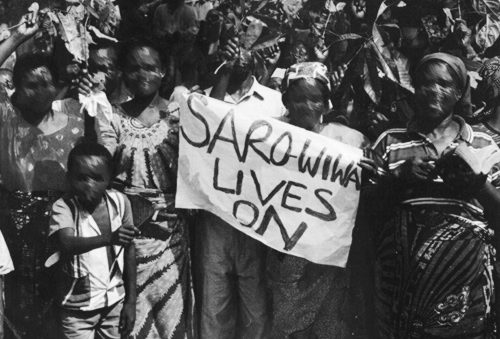
Today, 20 years later, Nigerians all over the world remember the legend of Ken Saro-Wiwa.
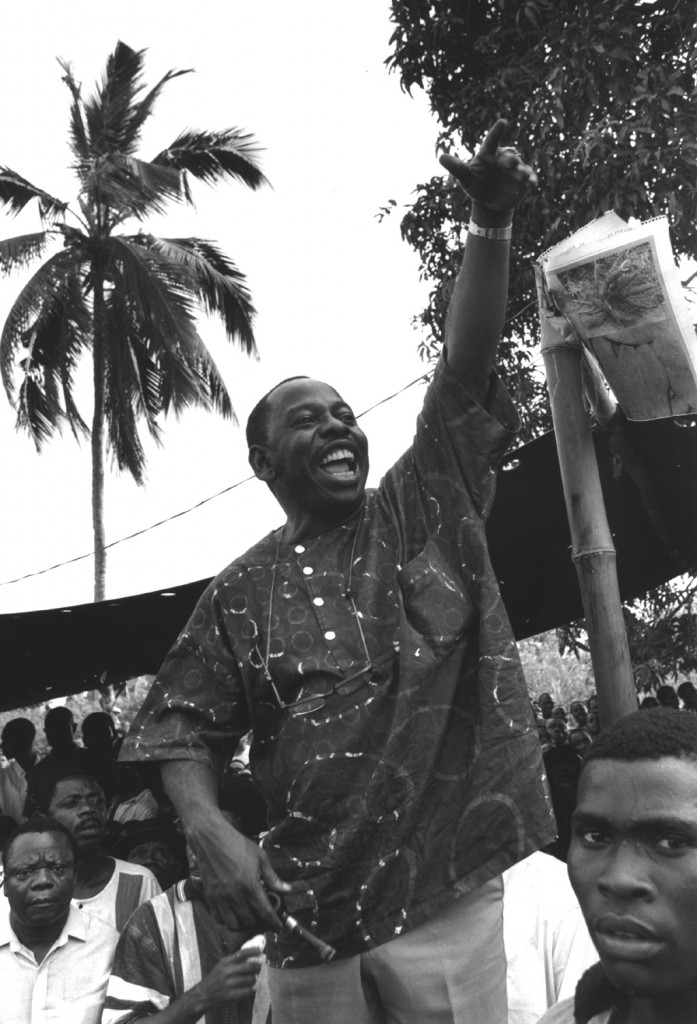
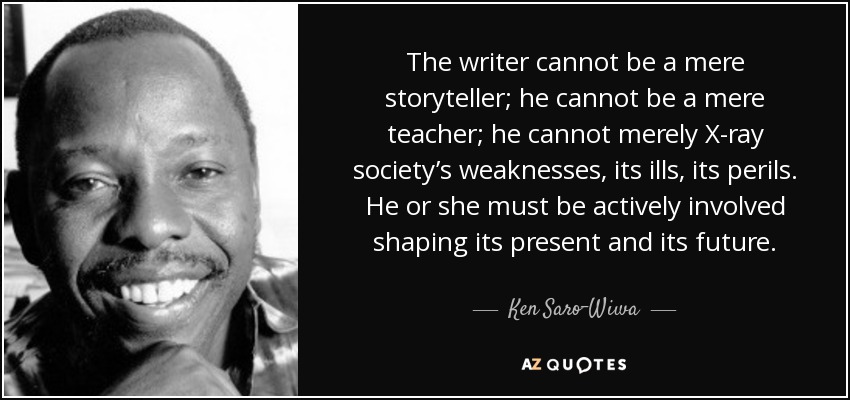
Saro-Wiwa was known as an environmental activist, Ogoni leader, poet and writer who campaigned against the pollution caused by the oil industry in the Niger Delta region. For his heroic activism he was awarded the Goldman environmental prize.
It is NOT ENOUGH to remember Ken Saro Wiwa & other 8 #OgoniLeaders today. YOU, how are you viewing matters of present SUFFERING of OTHERS?
But because of the great work and heroism of Ken Saro-Wiwa and others, these unfortunate crimes against the Niger Delta people have not gone unnoticed.
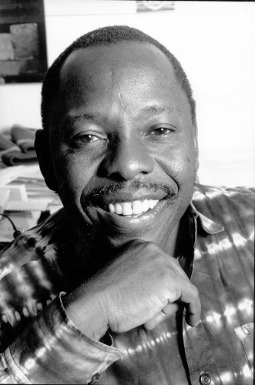
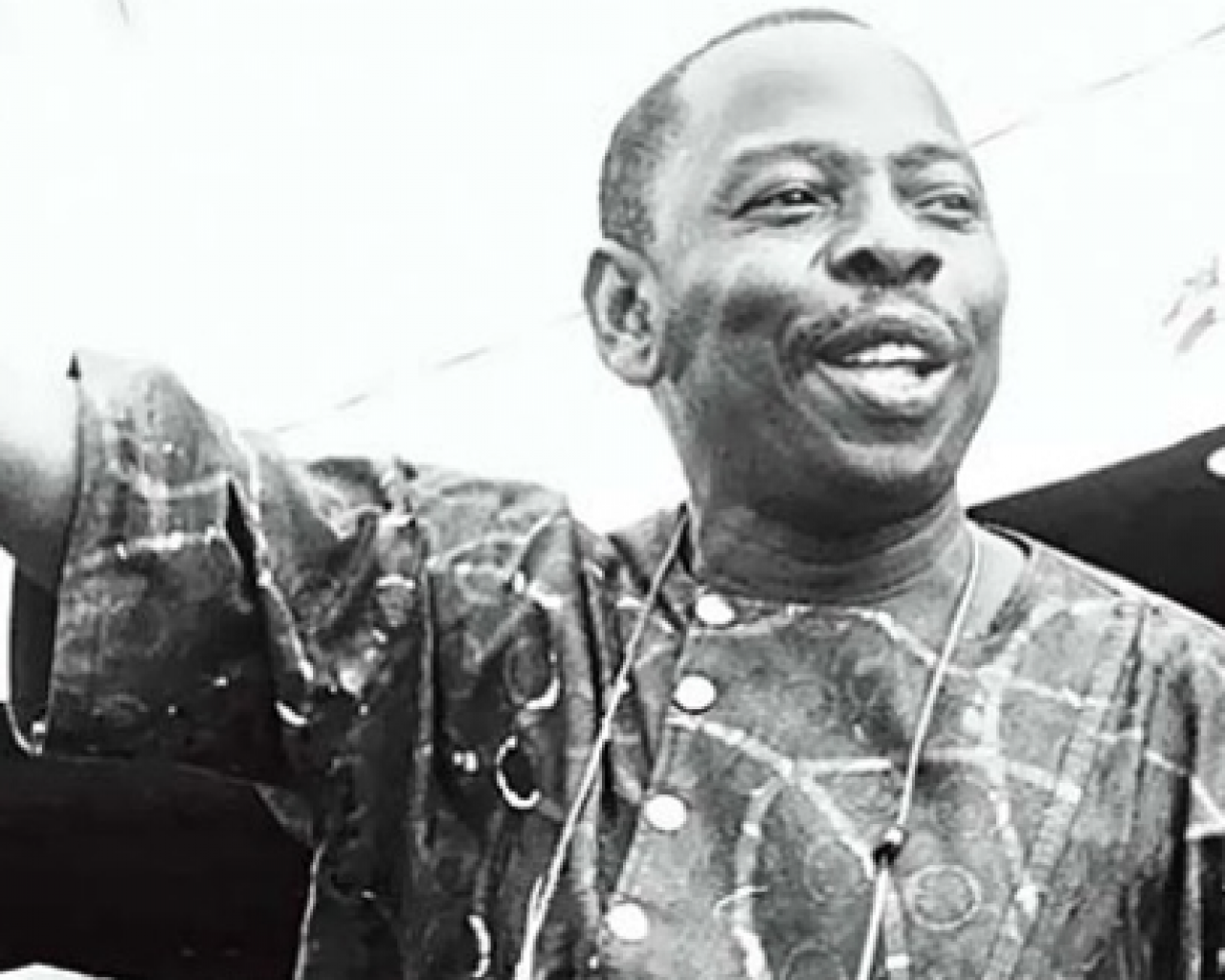
Ken Saro-Wiwa (October 10, 1941 – November 10, 1995), a true Nigerian hero.