Notice: Function _load_textdomain_just_in_time was called incorrectly. Translation loading for the wordpress-seo domain was triggered too early. This is usually an indicator for some code in the plugin or theme running too early. Translations should be loaded at the init action or later. Please see Debugging in WordPress for more information. (This message was added in version 6.7.0.) in /home/bcm/src/dev/www/wp-includes/functions.php on line 6121
june 12 | Zikoko!
  • June 12: The Day Nigeria Found Its Voice?

    It’s Democracy Day. Major operational institutions are closed. If you tune in to radio and TV stations in the country, everyone is talking about the significance of June 12. This is a day that has come to represent Nigeria’s democracy. 

    How did Democracy Day become such an important public holiday in Nigeria? 

    First, you must understand the rise and fall of the 2nd Republic as the catalyst for the demand for democratic governance in Nigeria. You also need to know the backstory of the annulled June 12, 1993 elections, and the journey of Moshood Kashimawo Olawale “MKO” Abiola, who became an emblematic figure in Nigeria’s democratic history. 

    Shehu Shagari, Buhari and the Fall of the 2nd Republic 

    To better understand the significance of the Nigerian clamour for democracy in 1993, we must rewind thirteen years to when Shehu Shagari, a civilian president, was in power. 

    His election into power led to the rise (and fall) of Nigeria’s 2nd Republic from 1979–1983.

    Shagari’s election into power resulted from a military-to-democratic government transition model initiated by then Gen. Olusegun Obasanjo in 1979. 

    The initiation resulted from Nigerians’ displeasure with the military’s involvement  in the 1966 Biafra Civil War and the dictatorship of Gen. Muritala Mohammed, his predecessor

    But with Shagari’s entry into power, Nigeria didn’t enter a season of political utopia but plunged into its existing problems. 

    Oil prices crashed, riots occurred in Northern Nigeria, ministers became more corrupt, and massive electoral malpractice and rigging occurred during the 1983 general elections.

    This led to Gen. Muhammadu Buhari overthrowing the Shagari administration in a coup during the same year. However, Buhari’s government didn’t fare any better either. 

    Buhari was particularly unpopular with citizens for his Decrees No. 2 and 4. These gave the state security power to ban strikes and popular demonstrations and censor media outlets perceived as posing a threat to the government’s interests. 

    By 1985, it became clear to the political elite in the country that Buhari had no plans of ever giving back power to Nigerians. This resulted in the Ibrahim “IBB” Babangida-led coup in August 1985. 

    IBB, the military general with a desire for democracy 

    Upon resuming power, Babangida implemented measures to reduce governmental influence over the press. His government also released a number of individuals detained during the previous regime. 

    Nevertheless, he encountered similar economic challenges as his predecessor, Buhari, including the devaluation of the naira, which led to social unrest

    To address this, he dissolved part of the Nigeria Labour Congress (NLC) and ordered the temporary closure of universities

    With the perception of being labelled as “just another military dictator” in Nigeria’s history, Babangida needed to achieve something remarkable that would leave a positive legacy in the eyes of Nigerians. You can consider it as him “doing better”.

    For him, the solution was clear—to restore democratic governance.

    To achieve this, he embarked on significant reforms. This included:

    • The creation of additional states within the Nigerian federation.
    • An establishment of dual-tier legislatures at both national and state levels
    • The appointment of civilians to govern the states
    • And the formation of two major national political parties: the Social Democratic Party (SDP) and the National Republic Convention (NRC).

    With these structures in place, the only thing Nigerians needed to do was elect a new president as the final phase of the transition. This is where this story becomes more intriguing—so grab your popcorn, and let’s dive in.

    The June 12, 1993, elections

    The June 12 elections witnessed a head-to-head battle between SDP’s business mogul, MKO Abiola, and NRC’s Alhaji Bashir Tofa. The election was scheduled for Saturday, June 12, 1993. 

    This election was critical, as it would determine Nigeria’s first democratically elected president since 1979, marking the start of the 3rd Republic. 

    At the end of the election, MKO Abiola emerged as the winner with over eight million votes, winning in 19 states. His opponent, NRC candidate Tofa, received over six million votes and won in 10 states.  

    Out of the total votes cast, which exceeded 14 million, Abiola secured nearly 60 per cent. This made him the clear winner of the election. This election is widely regarded as the most free and fair in Nigeria’s history. 

    MKO emerged as a prominent figure and continues to hold significance. Hailing from the South-West region and having Babagana Kingibe, his running mate, from the North-East made them a preferred choice for most people during the elections. Interestingly, despite both candidates being Muslims, they had wide support.

    The election was annulled, which led to MKO—considered as Africa’s most successful businessman—not becoming president.

    Who annulled the election?

    It was Babangida. After the initial results were posted on June 14, 1993, no additional election results ever appeared on the National Electoral Commission (NEC) board.

    On June 16, the government-run Radio Nigeria announced that NEC was suspending the official results announcement due to “developments and action pending in courts.” The announcement cited irregularities observed during the elections.

    The announcement triggered widespread protests and civil unrest across Nigeria, leading to the resignation of Babangida. This was followed by Ernest Shonekan’s brief interim civilian government and, ultimately, the Gen. Sani Abacha military coup of 1993. 

    Abiola was placed in detention following the annulment. Under Abacha’s leadership, the military regime in power at the time accused him of treason. They had him arrested after he declared himself the winner of the June 12 elections. 

    Abiola died the day he was set to be released from detention, on July 7, 1998. The circumstances surrounding his death remain unclear. The claims of assassination as the cause of his death are also uncertain.

    How Nigerians got to celebrate June 12 as Democracy Day 

    In 2018, former President Muhammadu Buhari changed the date of Democracy Day from May 29 to June 12. 

    The commemoration of Democracy Day on June 12 is now in its 6th year. For many Nigerians, particularly those from the South-West states, today is marked as significant for the outcome of the election.

    But for Buhari, June 12 is a way to nationally acknowledge the man who lost his life in the quest for democratic governance in Nigeria. 

    Undoubtedly, the 1993 general elections and MKO Abiola will forever be etched in Nigeria’s history as the pinnacle of its democratic revolution. 

  • Why Tinubu May Not Recreate M.K.O. Abiola’s 1993 Victory

    During elections, politicians try every strategy to win people’s hearts. From eating roadside boli to wearing school uniforms, they’d do everything with bright smiles for photo ops.

    Tinubu Abiola 1993
    Lagos state Governor, Babajide Sanwo-Olu showing his hairdressing skills

    For the 2023 general elections in Nigeria, the presidential candidate for the All Progressives Congress (APC), Bola Ahmed Tinubu, has decided not to use the all too popular method of pretending to be a commoner. Rather, perhaps to invoke the spirit of June 12, 1993, and tug the hearts of the older generation, he has made symbolic references to the campaign of arguably Nigeria’s most popular politician, M.K.O. Abiola.

    Tinubu Abiola 1993

    Some of the similarities are:

    • Tinubu’s manifesto is titled “Renewed Hope”, similar to Abiola’s “Hope ’93”.
    • Like Abiola, Tinubu is also from the South-West and running a same-faith campaign with his running mate, Baba Gana Kingibe.
    • Similar to Abiola, Tinubu also kick-started his presidential campaign in Jos. 

    Many people, including Tinubu himself, have taken this opportunity to reiterate that this is a chance to restore Abiola’s mandate. However, this isn’t the ’90s, times are different, and Nigeria has changed in many ways. So while Tinubu may posture himself and his campaign similarly to Abiola’s, here are some reasons why he might not get his desired outcome.

    The internet never forgets

    In 1993, M.K.O. Abiola had a massive influence on the media, especially as he owned the Concord newspaper, a leading publication in the country that formed public opinion. While Bola Tinubu also owns media bodies like The Nation newspaper and TVC news station, he doesn’t have as much media privilege, as he now has to deal with social media and the ever-present bone in his neck: the gen-zs. 

    Tinubu Abiola 1993

    And you can say that it’s a little too late for rebranding as many people already associate him with corruption and godfatherism. Proof of the internet staying winning is in videos of bullion vans entering his residence during an election and of him “charging” his team to snatch power at any cost.

    https://www.youtube.com/watch?v=d4kgJAsHCok

    The Muslim-Muslim ticket

    Like we said earlier, this isn’t the ’90s. While the same faith ticket may have worked for Abiola, Nigeria today is deeply divided along religious lines. Many people are uncomfortable with the lack of representation, especially since many churches and Christians have suffered attacks in previous years. Some Christian bodies and leaders have already discouraged their followers from voting for Tinubu, which can be detrimental to his campaign, especially if he has to worry about a “third force ” that has managed to achieve this religious balance. 

    Nationwide influence

    One of the peculiar things about Abiola was his political relevance on a national scale. Due to his philanthropy, he was loved widely. Sadly, we can’t say the same about Tinubu. Although he has established himself as a powerhouse in the southwest, there’s still much distrust from people from other parts of the country. Another thing to remember is that Abiola faced opponents who he could have easily defeated if the elections were repeated twice over. But as it stands, the story is very different for Tinubu as he is facing candidates equally strong in their own rights. 

    Although we don’t know yet what the outcome of the upcoming general elections will be, it’s clear that when it comes to recreating Abiola’s historic June 12, 1993 win, Tinubu may still have a long way to go.

  • 12 Things About June 12

    June 12 is one of those important dates that’s impossible to erase from Nigerian history. It’s a date that sticks out. So, why’s June 12 such a big deal in the country?

    It’s about an election

    June 12th, 1993, was the day Nigeria conducted what’s widely considered by local and international observers as its freest and fairest presidential election.

    MKO Abiola won that election

    12 Things About June 12

    MKO Abiola of the Social Democratic Party (SDP) was adjudged the winner of the June 12 election as he had won over 58% of the total votes cast before collation was paused. His only opponent in the contest was Bashir Tofa of the National Republican Convention (NRC).

    Babangida annulled the election

    12 Things About June 12

    Even though Abiola was widely considered the winner of the election, he was never officially crowned the winner. General Ibrahim Babangida’s military government cut Abiola’s victory dance short by annulling the election.

    Corruption was used to justify the annulment

    Babangida’s decision was unpopular at the time. To justify the annulment, he said more than ₦2.1 billion was spent by presidential candidates to undermine the election. He also accused officials and party agents of electoral fraud. The military government’s reasons for the annulment didn’t fly with Nigerians and the international community.

    The annulment ended the Third Republic

    The June 12 election was going to cement Nigeria’s return to a democratic system of government. State governors and lawmakers had already been elected and in office before the government annulled the presidential election. Nigeria would’ve returned fully to civil rule on August 27th, 1993, if everything went according to plan.

    Babangida stepped down months later

    After eight years in office, the June 12 incident increased pressure on Babangida to step down as promised. He handed over power to an interim government headed by Ernest Shonekan, who was tasked with completing Nigeria’s transition to democracy.

    Abiola rejected a Vice Presidential appointment

    12 Things About June 12

    Shonekan named MKO Abiola the vice president of the interim government Babangida handed over to, but he rejected this. The interim government was unpopular and ruled to be illegal by a Lagos State high court.

    June 12 paved the way for Abacha

    12 Things About June 12

    The chaos of the annulment of the June 12 election paved the way for General Sani Abacha’s military coup of November 1993. He overthrew the interim government and ruled Nigeria until his death in 1998. 

    ALSO READ: An Abacha in Agbada Is Trying to Return to Power

    Abiola died fighting for his June 12 mandate

    MKO Abiola protested heavily against the annulment. One year later, on June 11th, 1994, he declared himself president of the country. His declaration prompted the Abacha government to arrest and detain him for four years. He died of a heart attack as he was about to be released a month after Abacha’s death.

    June 12 birthed the National Democratic Coalition

    The annulment birthed the formation of the National Democratic Coalition (NADECO) which was an influential pressure group of pro-democracy activists who called on Abacha to step down for Abiola to claim his mandate. Abacha’s government blamed the group for a series of attacks that targeted the military. Many civil society groups and trade unions also protested against the Abacha government.

    There were martyrs

    12 Things About June 12

    The annulment of the June 12 election wasn’t well-received by the Nigerian public. Security forces killed protesters while trying to suppress protests against the government. The military government also assassinated prominent people like Kudirat Abiola, MKO’s wife, and Chief Alfred Rewane, a financier of NADECO, over their agitation for June 12. 

    June 12 didn’t become Democracy Day until recently

    Democracy Day used to be celebrated every May 29 since 1999, the year Nigeria eventually returned to civilian rule. President Buhari changed that in 2018 when he made June 12 Nigeria’s new Democracy Day.  He also conferred the posthumous title of Grand Commander of the Order of the Federal Republic (GCFR) on Abiola.

    ALSO READ: What If Abacha Never Died?

  • June 12 Protest: Here’s Everything That Happened

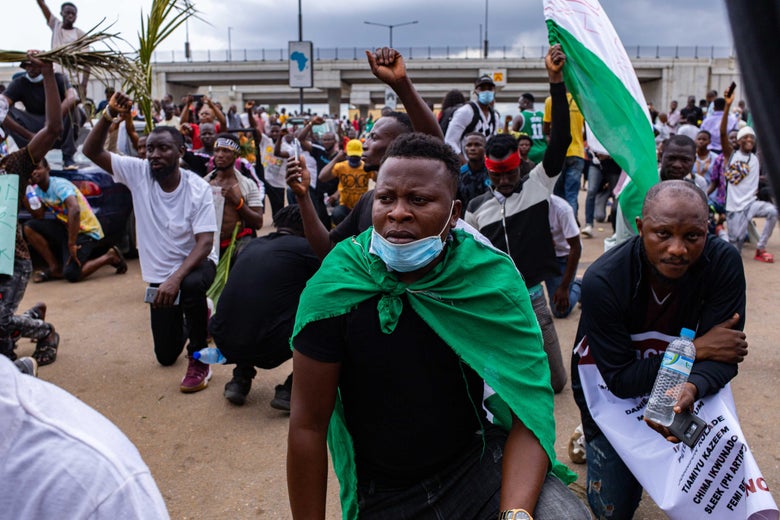
    June 12 Protest: Yesterday, after months of planning, Nigerians took to the streets to protest against bad governance, abuse of human rights, worsening insecurity, and other forms of maladministration and mishandling of democracy in the country. Coincidentally, this protest happened one week after the Nigerian government’s sudden and unconstitutional Twitter ban.

    Yesterday was also Nigeria’s Democracy day, and as usual, the president gave his Democracy day speech.

    This reporter was not impressed:

    https://twitter.com/Jayproff2/status/1403801754861506581?s=20

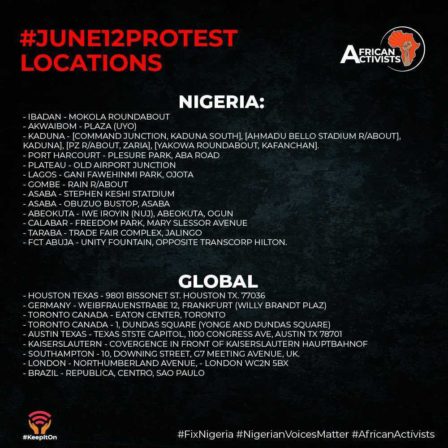
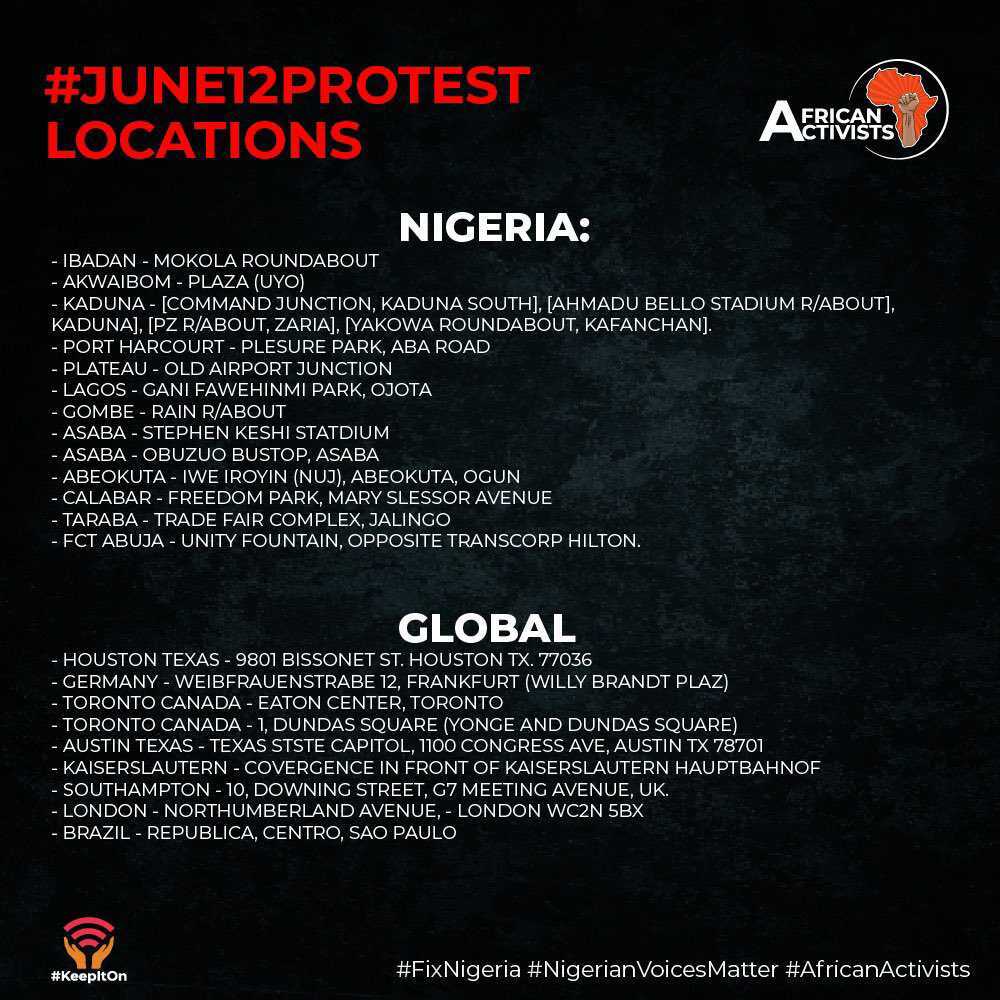
    Where did the June 12 protest happen?

    The protests happened across different states of the federation, and also outside the country.

    June 12 locations

    Here are some of the updates from the protest:

    The police arrested protesters in Ojota, Lagos:

    Peaceful protesters in Ojota, Lagos were arrested after police had used teargas as warning.

    Tear gas was also used to disperse the crowd.

    In typical Nigerian police-style, direct shots were fired at citizens:

    Oyo State Governor, Seyi Makinde joined the June 12 protest:

    Just like he went out for the EndSARS protests, Oyo State Governor, Seyi Makinde came out for the June 12 protests yesterday too and rallied with the people. He seems to have this people person thing going well for him.

    People were paid to support Buhari:

    People dressed in Buhari merch were also out on the streets in Abuja and other parts of Nigeria yesterday, supporting Buhari. A few of them owned up to being paid small amounts of money to wear the shirts and hold placards in support of the government.

    https://twitter.com/duke_cbe/status/1403765544868790272?s=20

    Outside Lagos and Abuja, more people turned up for the protests.

    June 12 Protest- Warri, Delta state:

    June 12 Protest-Jos:

    Kano:

    Benin, Edo state:

    https://twitter.com/UjuAnya/status/1403732213808746497?s=20

    Akure, Ondo state:

    London:

    New York:

    Nigerian were also ready to show help to people needing medical help, with people tweeting that they were available to help if anyone needed an ambulance or urgent first aid:

    Nigerian lawyers on Twitter also helped release people who were arrested.


  • Here’s Everything We Know About The June 12 Protest

    If you have been active on social media, you must have noticed the trending hashtag #June12Protest. In this article, we explain what the June 12 protest is, why it is happening, and what to do if you will be joining it.

    What is the June 12 Protest?

    Today, June 12, 2021, Nigerians will take to the streets to protest against bad governance, abuse of human rights, worsening insecurity, and other forms of maladministration and mishandling of democracy in the country. This is coming a week after the Nigerian government banned Twitter for “the persistent use of [Twitter] for activities that are capable of undermining Nigeria’s corporate existence.” This suspension was announced through a Twitter thread.

    This ban has been deemed unconstitutional, especially because it is a restriction of the rights of Nigerian citizens to express their right to freedom of expression. The provision for the Fundamental Human Rights for Nigerians can be found in Chapter 4 of the Nigerian Constitution. Section 39, under this chapter, details our right to freedom of expression and the press, and Section 40, our right to peaceful assembly and association.

    By coming out to protest, Nigerians are exercising this fundamental human right and demanding for better governance and protection of the Nigerian citizen, among other things.

    Where is the June 12 protest happening?

    The protests are proposed to happen nationwide across all 36 states in the country, and in a few other states outside the country.

    Here is a thread to follow for updates on other protest locations:

    Who are the leaders of this protest?

    Just like the #EndSARS protests of October 2020, there is no central leadership for this protest. It is simply Nigerians gathering together to speak against things which are affecting the quality of their lives as citizens.

    Why June 12?

    June 12 is a significant day for democracy in Nigerian. This day is believed to be the “real” Democracy day when Nigerians came out enmasse to vote for a democratic government, and free themselves from the shackles of a military regime.

    If you are going for the June 12 protests, here is a list of things you should take note of:

    8 Very Important Safety Tips Every Protester Should Know