Notice: Function _load_textdomain_just_in_time was called incorrectly. Translation loading for the wordpress-seo domain was triggered too early. This is usually an indicator for some code in the plugin or theme running too early. Translations should be loaded at the init action or later. Please see Debugging in WordPress for more information. (This message was added in version 6.7.0.) in /home/bcm/src/dev/www/wp-includes/functions.php on line 6121
ielts | Zikoko!
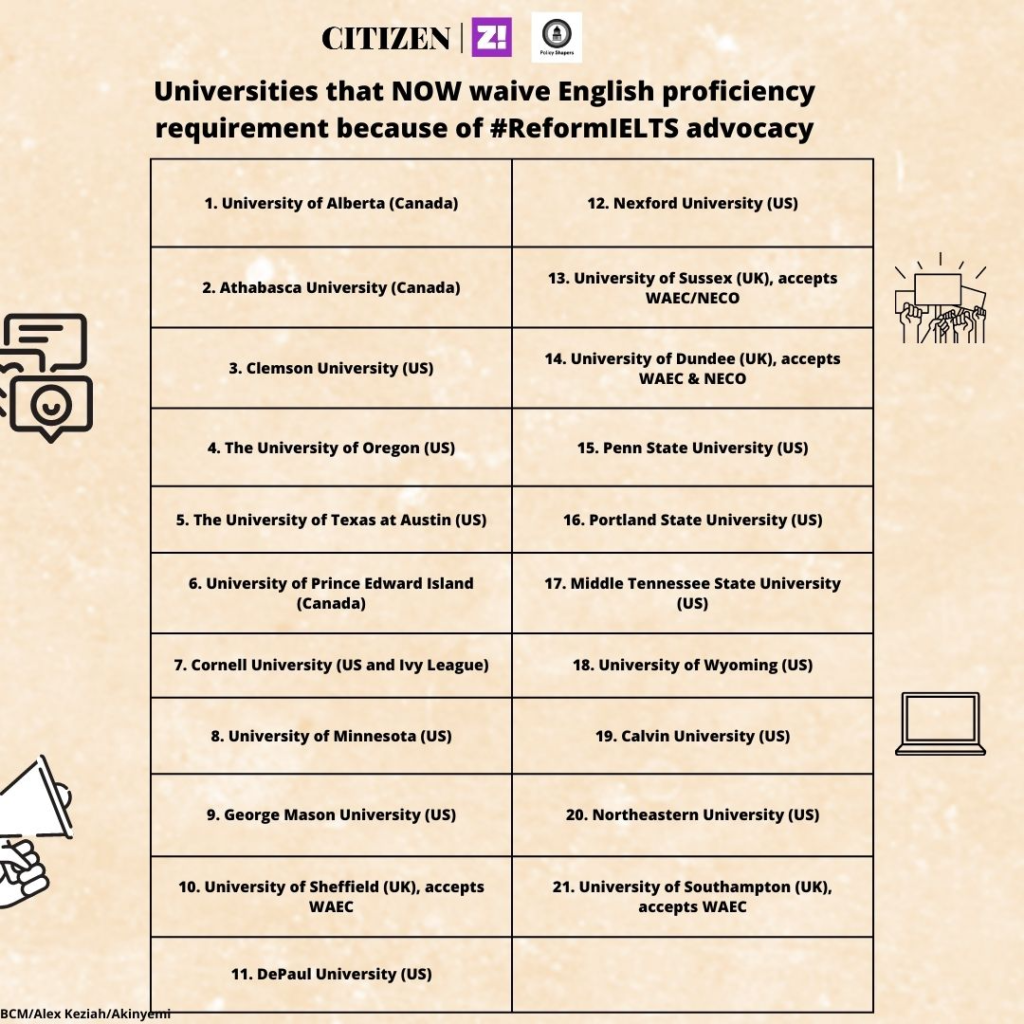
  • How #ReformIELTS Made 20 Universities Change Their Language Policies

    By Policy Shapers

    In January 2020, a Nigerian policy advocate, Ebenezar Wikina, confronted Nexford University in an email after he was asked to prove his English language proficiency before enrolling in a business program.
    Wikina’s refusal to take a language proficiency test forced Nexford to review its admission policy. This was the foundation for the #ReformIELTS campaign— a policy advocacy movement that has mobilised over 80,000 people across Africa to challenge language discrimination in the global education system. 
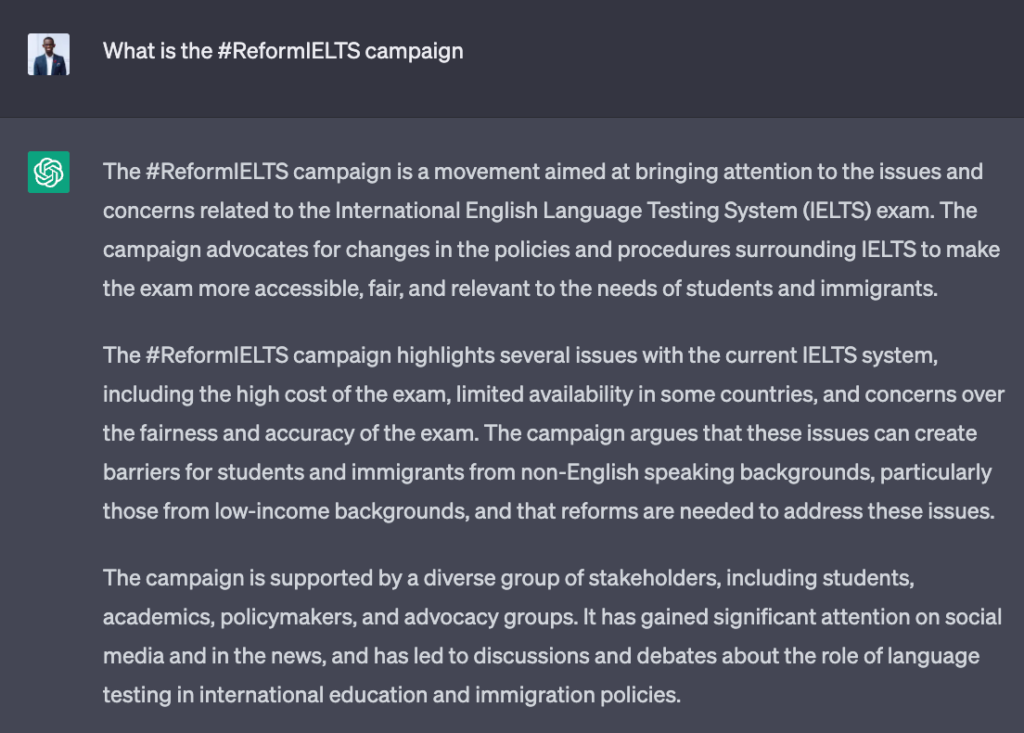
    What ChatGPT says about the #ReformIELTS campaign

    The campaign, which has featured on more than 500 media platforms globally, led to 20 universities across Canada, the United States, and the United Kingdom, removing the IELTS/TOEFL barrier for applicants from English-speaking countries in Africa. 

    While Wikina has been at the forefront of this reform, Policy Shapers, a policy reform and advocacy organisation he founded in August 2020, has been the organised fighting front. 

    Policy Shapers have engaged the UK government’s Home Office in a policy debate. For every intellectual gbas from the Home Office, Policy Shapers responded with a greater gbos.

    Is it even possible for a young person to be a policy advocate?

    But how did these young Nigerians achieve this level of bravery, and how can you do something like that?

    Let’s talk:

    Policy Advocacy 101

    Policies are the decisions and principles of organisations and establishments that determine how they act or treat people who deal with them. Those Lagos restaurants that refuse people entry because of how they are dressed are acting based on their internal policies.

    Policies can be discriminatory—like how Lagos restaurant policies are anti-baddies—bad or need to be amended to meet new needs.

    Policies may come from private establishments or the government; like fuel subsidy removal or Emefiele’s naira redesign policy.

    Every time you see a policy you don’t like and you speak against it; you are doing the work of a policy advocate— like how Wikina refused to write IELTS at Nexford.

    If you take it forward by telling your friends about the policy and they take action with you, leading to the policy being reformed or eliminated, you are doing policy advocacy.

    With 62% of Nigeria’s population under 25 years of age, organisations like Policy Shapers believe in youths as the major stakeholder in Nigeria and should be part of the policy dialogue and decisions that decide their future. 

    So, in case you’re still wondering, yes, you have a role to play in the policy decisions made in Nigeria because you will be affected whether or not you do something. The price of bread or shawarma, the cost of internet data, the price of Netflix and Prime subscriptions, or whether or not delivery companies are successful all depend on policy decisions.

    How Policy Shapers influenced policy decisions in 20 universities globally 

    Simple answer: Obasanjo’s internet.

    Policy Shapers encouraged many young people like you, to use email and social media, and a Change.org petition to ask abroad universities to stop asking us to prove we can speak English. 

    After #EndSARS protests against Police Brutality in 2020, the group felt it was safer to protest and advocate online. They used the People, Data, and Time (PDT) principle. Here’s what that means according to them:

    • People: Every policy advocacy campaign should be about people. The model we piloted through this campaign was not to directly lead every aspect of this advocacy. On the contrary, we empowered and inspired young people in Nigeria and the diaspora to take the lead in engaging institutions. One person who has been very influential in this entire process of engaging schools, and has now inspired many others to follow him, is Dr Olumuyiwa Igbalajobi, a Nigerian post-doctoral research fellow based in Canada. Dr Olumuyiwa single-handedly wrote to almost 100 schools seeking policy changes and we are so glad to have someone so passionate working with us.
    • Data: For government officials, the numbers must make sense. This is why we produced over 20 pages of evidence in collaboration with over 80 young people in our Advocacy Taskforce to back our argument for the inclusion of Nigeria and Anglo-African countries in the UK’s Majority English Speaking Country (MESC) list. These data points have helped us drive the message of our campaign and we produced it 
    • Time: Change takes time. In our fast-paced AI world, it’s easy to want change to take place immediately but it doesn’t always work like that in the policy world. We must remain patient and resolute till the end. Since the incident with Nexford University in January 2020, it has taken more than 50 months of persistence before we arrived here. When you want something,  don’t stop until you get it, right? 

    Policy Shapers is building a community of young policy enthusiasts to co-create policy ideas and advocate for a better Nigeria. Learn more about how to join here
    This piece is produced as part of the partnership between Policy Shapers and Zikoko Citizen to deliver policy analysis to young Nigerians. 

  • “Nigerians Think They Know English” — A Week in the Life of an IELTS Tutor

    “A Week in the Life is a weekly Zikoko series that explores the working-class struggles of Nigerians. It captures the very spirit of what it means to hustle in Nigeria and puts you in the shoes of the subject for a week.



    The subject of today’s “A Week in the Life” is Adeola Badmus, an Abuja-based IELTS tutor. She talks about her struggles with teaching proud adults, Nigerians who think they shouldn’t write IELTS and why she loves her job so much regardless.

    graphic design of A week in the life of an IELTS tutor

    SUNDAY

    My Sunday tutorial sessions are in the afternoon, and I don’t go to church, so I sleep in until 9:30 a.m. When I get up, I do my morning skincare routine. While my skincare mask is on, I clean my apartment. After that, I take my bath and go back to bed. 

    My session usually starts at 1 p.m., but today, I decided to chill because I knew I wouldn’t have to deal with the traffic at City Gate on weekends. It would be a smooth 20-minute trip from Lugbe to Central Business District in town. 

    My plan worked to the “T”: I stepped into my workplace at exactly 1 p.m. 

    IELTS has four parts: Listening, Reading, Writing and Speaking. Today, I taught Speaking, my favourite class. 

    People communicate with each other every day — with friends, family, colleagues — but once you start asking them questions and expecting them to give you answers, to practise for a test, everything changes. You see people changing their accents and stumbling over their words, unsure of what they’re saying and making mistakes they may not make on a normal day. People behave differently when they’re being monitored; they feel judged. My job is to make sure they perform well in such situations.

    During the class, someone expressed discomfort. She said, “I’m sorry. Can I take that again?” after answering a question. I asked why, and she said she felt like she had just messed up, from the way I was looking at her. I hadn’t even said anything. It’s funny to see adults squirm under perceived pressure, a wicked kind of fun, but it’s just interesting to watch otherwise hard guys and babes become very feel self-conscious. I spent the next few minutes making small talk with my students and trying to draw them out of their shells. I always make sure students can be comfortable with me at all times. 

    By 5 p.m., I got dinner from a cafe on the next street and headed home, where I had a private class from 6-9 p.m. waiting for me. I ran the three-hour private listening classes virtually, and today’s client is in Dubai. She struggled with names, especially “Kramer” because the letters “C vs K” confused her, but I walked her through several examples.

    After the class, I was exhausted and slept off while scrolling through Facebook.

    MONDAY

    On Mondays, I have morning and afternoon sessions: 9-12 and 1-4 p.m. 

    Teaching adults is not the same as teaching children. It’s actually more difficult. Teachers can punish difficult secondary school students who are misbehaving. Growing up, my teachers scolded or flogged me, or sent me out of the class. But all these are off the table when you’re teaching adults.

    Managing petulant adults is a skill that requires patience and diplomacy. And that’s what a lot of teachers don’t know. There’s a student who got transferred to my class today. He complained that his previous teacher was rude. While reporting to my boss, he said, “I’m in his class, but I’m not his child.”

    Many of my students are people with jobs and responsibilities. They come to classes from their place of work, and many have multiple jobs and families to support. So I have to consider that they’re stressed already, and I’m careful not to give them more than they can handle.

    The costs of japa-ing are not cheap, so some of them are upper-middle-class snobs — people wey get bread, so I also have to manage big egos. Some of my students are professionals like senior doctors and nurses who want to get a better life abroad. 

    A lady came to my class during the afternoon session and was sizing everyone up like we were all beneath her. She looked me over and asked my boss, “Do you think this one has anything to offer me?”

    I smiled gracefully. I’m in Abuja after all.

    I’ll just give her two weeks. She’ll want to be my best friend.

    That incident made me remember the Indian guy who joined my class last year. He was surprised to see a Nigerian teach IELTS so well. He said, “How come you know English this well?”

    He told me he had Nigerians working under him, and he saw us as half-baked. He had also wanted to sign up with an American prep centre because he didn’t think a Nigerian could teach him. Funny, because he wasn’t exactly the brightest student. I didn’t know how to respond to such a backhanded compliment, but I brushed it off and got on with teaching. When his results came out, he passed quite all right, but he wasn’t among the best performers in my class, so what was up with the snobbery?

    If not for confidentiality and ethics, I would have rubbed my best students’ results in his face. It’s tough dealing with snobby clients like these, but it’s the job I chose, so I do my best to handle them.

    TUESDAY

    When students get frustrated, they start complaining, “Why do Americans and British people force us to write IELTS?” They say it’s unfair for Nigerians because English is our official language. The common argument is that many indigenes of Western countries have a very poor command of the English language, many of them are illiterate. 

    And I get it, but I explain that the British Council grading system is not placing applicants against illiterates, they’re measuring us up against educated indigenes. They want to attract competitive talent, people who’ll add value to their economy. 

    WEDNESDAY

    Today, a former student sent me $500. He used to have doubts about his abilities, but he passed his test in flying colours and is now in Canada. 

    When former students send me gifts like this, I’m always emotional. It’s a gift to be able to help people’s dreams come true. My current job is the healthiest I’ve ever had, and my students really help me shine. But it wasn’t always like this.

    At my previous job in Ibadan, I endured an abusive environment and barely escaped rape. The job didn’t pay much, and during COVID, they slashed my salary. I had to take extra classes to make extra money. I was barely hanging on. I no longer looked forward to stepping out of my house in the mornings.

    But when a staff sexually assaulted me at work, and the boss said, “Not every man can be around a woman and not be tempted,” I knew I had to leave.

    A few weeks later, a friend recommended me to my current company. I sent in my IELTS results and attended an interview. They liked me so much that they relocated me to Abuja. Now, they pay a major portion of my rent, and I work with the best people. My salary has increased twice in nine months, and my employers seem to care about my growth.

    Why won’t I keep shining?

    ALSO READ: “Nigerians Like to Do Anyhow” — A Week in the Life of a Wedding Planner


    Hi, I’m Ama Udofa and I write the A Week in the Life series every Tuesday at 9 a.m. If you’d like to be featured on the series, or you know anyone interesting who fits the profile, fill out this form.

  • Want to Pass Your IELTS Without Studying? Follow These 6 Simple Tips

    It’s been japa season for so long and almost every Nigerian is trying to leave this country. We know you probably want to leave too and you’re most likely going to need to write IELTS, which is why we’ve come up with these easy tips to help you pass your IELTS on the first try.

    1. Don’t talk for 10 days.

    If you really about passing your IELTS, you’ll keep quiet for more than 10 days sef. Don’t go around doing cho cho cho up and down before you mess up the little English you’ve been managing. Keeping quiet helps keep the English in your brain safe.

    2. Spend your days thinking of how to answer your questions.

    Again, the perks of keeping quiet. When you keep quiet, you get to think of how to answer the test questions correctly without having to study. Fink about your answers and spend more time finking about thinking about your answers.

    3. Don’t look for trouble before someone swears for you and makes you fail your exam.

    The fact that we have to tell you this means you are nowhere ready to take the test. Why are you even looking for trouble a few days before writing IELTS when you know your village people are so hardworking? It makes no gaddamn sense.

    4. Tell your Babalawo to reveal test questions to you. 

    Why study when you can just call your Babalawo to project the questions and answers to you in your dream? You have to let them know a few weeks ahead of time sha, so they can get all the questions and answers ready for you immediately you need them.

    5. Get a math tutor. 

    This is one of the best things you can do when preparing to pass IELTS. Maths tutors really don’t care about their grammar and tend to make a lot of errors when speaking. Constantly communicating with them will help your brain immediately recognize wrong grammar. 

    6. Only watch Nollywood movies on Youtube. 

    We are being really specific because we really want to help your life. Spend a chunk of your time watching Nollywood movies on Youtube. For best results, combine this with reading Yoruba movie subtitles.

    Try these easy tips first before shitting on these brilliant ideas. 

  • If You Score 7/10 On This Antonym Quiz, You Don’t Need To Write IELTS

    Antonyms are words which are opposite in meaning to each other (e.g. good and bad, Nigerian politicians and accountability). This quiz is a test of two things: your understanding of antonyms and comprehension abilities.

    People who score above 7/10 definitely have superior English skills.

    Where do you stand?

    [donation]

  • 21 Things That Are Just Too Real For Nigerians Who Have Written IELTS

    Preparing for the IELTS exam should count as part of the risk factors for hypertension in Nigeria. People are actively trying to leave the country but the English test seems to be a major obstacle in their path.

    We present some of the super real moments for people who have had to take this exam:

    1) My face the first time I saw the cost of the exam:

    I can’t afford to fail.

    ielts nigeria Zikoko

    2) Me to my bladder on exam day:

    Don’t embarrass us, please. We don’t have enough time.

    begging ielts zikoko

    3) Anytime I miss a word in the listening test:

    Johnny, stop talking so fast. Slow down ffs.

    Mr Krabs Confused Zikoko

    4) After watching twelve E2 videos in one day:

    My data!

    Robert baratheon ielts zikoko

    5) How I felt on the day of the speaking test:

    boy talking into a microphone Zikoko ielts

    6) Looking at the time during the writing task:

    “Why are you running? Why are you running?”

    7) My heart on results day:

    God no go shame us.

    get out Zikoko ielts

    8) Trying to choose between MOD/B.C:

    issa rae ielts Zikoko

    9) When I mispronounce a word during speaking:

    Am I ready for abroad like this?

    10) My expression when I see some essay topics:

    11) Why are writing letters, please?

    Dear IELTS,

    I am writing this letter to tell you not to stress me.

    Yours faithfully,

    12) “Write a letter thanking your friend for the beans they gave you on your last visit”:

    tyler the creator confused ieltszikoko

    13) Arranging the night before the exam:

    Double-check my passport and writing materials for the hundredth time.

    14) The way I prayed against my village people on the exam day:

    praying ielts zikoko

    15) Greeting everyone at the exam venue:

    I don’t know if I will get extra 0.5 for respect, please.

    16) When I hear many people don’t pass well with B.C:

    17) Me to myself when I am on social media instead of studying:

    18) “Do you agree/disagree, to what extent do you agree/disagree, discuss both views”:

    19) When you see your boss at the exam venue:

    You too?

    20) “Discuss both views and give your opinion”:

    I don’t have an opinion, please. Just let me come to your country and live opinion-free.

    21) “You now have one minute to write down your points to be discussed in section two of the speaking test”: