Notice: Function _load_textdomain_just_in_time was called incorrectly. Translation loading for the wordpress-seo domain was triggered too early. This is usually an indicator for some code in the plugin or theme running too early. Translations should be loaded at the init action or later. Please see Debugging in WordPress for more information. (This message was added in version 6.7.0.) in /home/bcm/src/dev/www/wp-includes/functions.php on line 6121
editorial | Zikoko!
  • EDITORIAL: Nigeria’s Presidential Election Isn’t Over

    Two of every three voters during Nigeria’s February 25, 2023, presidential election didn’t want Bola Ahmed Tinubu of the ruling All Progressives Party (APC) to be their president. Yet, the Lagos Jagaban (boss) managed to get 36.6% (8.7 million) of the total votes (24.9 million), to become Nigeria’s president-elect.

    Nigeria 2023 Presidential Election Result. Infographics by Muhammed Akinyemi/BCM.

    It is the smallest win margin of any Nigerian President since 1999. It is also the election with the lowest voter turnout — 29% of 93.4 million registered voters — since Nigeria gained independence.

    Nigeria's voter turnout since 1999. Infographics by Muhammed Akinyemi/Zikoko Citizen.

    While this looks like a decent result from afar, when we zoom in on the massive violence, voter intimidation, harassment, and rigging allegations by opposition parties, one begins to question the legitimacy of the results. 

    Violence was so unbelievably widespread that the House of Representatives majority leader, Ado Doguwa (of the APC), was arrested for allegedly shooting at least three people to death. In North-Central Kogi state, the sitting state governor, Yahaya Bello (of the APC), destroyed five roads leading to the district of an opponent, Natasha Akpoti, claiming he did so to avoid terror attacks.

    But it does not end there.

    INEC: What we ordered vs what we got

    The presidential race saw three other contenders polling at least 1 million votes each: Rabiu Kwankwaso of the New Nigeria Peoples Party (NNPP) got 1.4 million votes, Peter Obi of the Labour Party (LP) got 6.1 million votes,  and Atiku Abubakar of the People’s Democratic Party (PDP) got  6.9 million votes. 

    Atiku was contesting for the sixth time and was no stranger to the process. However, Obi (a third-force candidate who left the PDP months before the election) and Kwankwaso (who lost a presidential primary in 1993) were on the ballot for the first time. 

    All four leading candidates and millions of Nigerians were banking on the promise of the Independent National Electoral Commission (INEC) to organise a free and fair election. 

    The introduction of the Bimodal Voter Accreditation System (BVAS) was supposed to eliminate voter fraud and assist INEC with collating accurate data directly from polling units to the INEC Result Viewing Portal (IReV). But days after the election result had been announced, the IReV portal was yet to host most of the results.

    Image

    Peter Obi’s running mate, Datti Baba-Ahmed, lamented the “widespread technological problems and manipulation of results” at a press conference in Abuja.

    While one could write Datti off as a pained loser, many Nigerians have taken to the IReV portal to collate the numbers as they are uploaded. What is on the portal and what was announced by INEC are at variance.

    Despite getting a ₦305 billion budgetary allocation, INEC did not conduct a convincingly free and fair election.

    INEC cannot blame its failure on the want of time. The BVAS, for instance, has been tested in Anambra (2021), Abuja (2022), and Osun state (2022). 

    Just days before the presidential election, INEC tested its processes again on February 4 across 436 polling units, assuring Nigerians it was ready. Why, then, did BVAS and IReV malfunction mar the electoral process on February 25, 2023? 

    The INEC Chair, Mahmood Yakubu, has questions to answer. And the answers might be in court.

    Legal steps

    Peter Obi and Atiku Abubakar have held press conferences addressing their supporters, opponents, and INEC, ending with a promise to take legal action.

    Obi is notorious for winning post-election litigation, while Abubakar has never won any election petition, although he has a string of successes in other cases, including defeating former president Olusegun Obasanjo. 

    However, one factor stands against both men: no Nigerian President has been sacked from office after INEC declared the winner. And the president-elect seems to be counting on this, as he starts his tour to celebrate with loyalists.

    The Supreme Court’s recent string of cases, which make it seem like it sways in the direction of the ruling party, is also a source of concern. The current Imo State governor, Hope Uzodinma (of APC), sits in office after coming fourth at the polls due to a Supreme court decision which sacked his opponent Emeka Ihedioha (of PDP).

    In a way that Nigerians have not had to do before, there is great attention and expectation that the Supreme court will either validate Tinubu’s victory or reach a conclusion that may lead to recounting an outright announcement of another candidate, or a redo of the voting process.

    The polls might have closed, but the presidential election process is still open.

    With the gubernatorial election days away on March 11, eyes must fall back on INEC. This is an opportunity for INEC to initiate a redemption. Nigerians (locally and abroad) and the international community are all paying attention. 

    INEC has this lifeline left to encourage voter participation. Will it take it?

  • EDITORIAL: Nigeria Is Not Giving, and Nobody Wants to Take Responsibility

    Nigeria is stressing the homeboys and gyals, and we are not having it. To ask a Nigerian for their average queuing hour in these Buhari times, you have to contextualise the queue; the one for buying PMS/petrol at N350/litre or the one to withdraw their money?

    Everyday guilt pleasures like cookies have become impossible to afford, as necessities like menstrual pads are now becoming out of reach. 

    When you ask who should be held responsible for the financial violence, you’ll get conflicting answers like Aisha Buhari’s brother, Godwin ‘Meffy’ Emefiele, bank managers, or even the everyday Nigerians who have POS businesses.

    Why is petrol so expensive and why can’t we get some? You will have to ask petrol marketers, filling station owners, or perhaps, Rexxie.

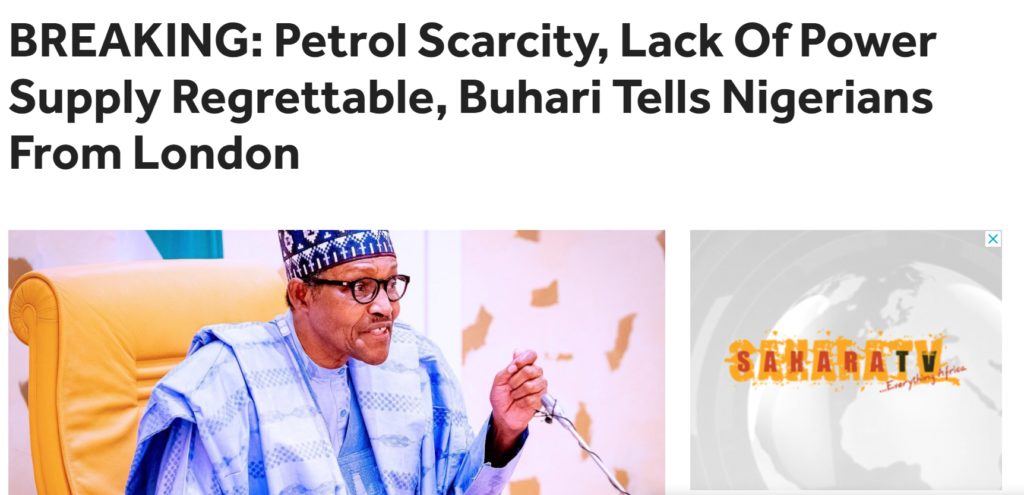
    The Nigerian presidency’s tone-deaf approach to handling this crisis shows that we are on our own. Nobody wants to be responsible for Nigeria’s woes, not even President Bubu, who doubles as our petroleum minister.

    [Sahara Reporters]

    To top it all, all this ba la blu hullabaloo is happening just weeks before Nigeria’s election.

    Election era

    Under the Muhammadu Buhari administration, we’ve been in our #EndSARS era, Supreme Court governors era, and eight-month ASUU strike era, and it’s time for our bye-bye to Bubu era.

    Despite young Nigerians making up to 39% of registered voters, the process for collecting their Permanent Voter’s Card has been so scandalous that some people can’t find theirs at INEC offices, even though the portal says it is ready. 

    Many who want to collect theirs are stuck in school and are begging the Nigerian Universities Commission and other bodies to free them for their PVC collection and eventually to vote. Now that the PVC collection era has passed, they can only hope that those who have gotten their PVCs are not forced to be in school, away from their polling units, on election day.

    Why is it difficult for schools to close for one week to allow young voters to participate in the voting process? Are they not the ones that will spend eight years in school if a bad government is elected?

    Likeeee????

    Anybody can collect 

    Nigeria’s bad governance and anyhow behaviour are like sand; they will touch everybody. What this election era is showing us is that nobody is safe and anybody can collect. 

    Politicians like Nasir El-Rufai (Kaduna State gov), Yakubu Dogara (fmr Speaker House of Reps), and Adams Oshiomole are now entering the media to tell us that some party members are plotting against their party’s flagbearer not to win the election. It’s the acting as if it’s not their party that has been clowning Nigeria for the past eight years for me.

    Not Femi Gbajabiamila (current speaker HoR), whose escort killed a newspaper vendor coming out to tell us who to vote for because Nigeria is currently a lawless state. But Mr Lawmaker’s security is shooting shot with innocent lives.

    Please rest

    As if it’s not all of us suffering in this pandemic, some people are now trying to blame gen z for not knowing ministers who have added nothing to them.

    When we live in a nation where you are deprived of basic education on your country’s history, where our principles are guided by who you know and less by what you know, it becomes difficult to blame people for being indifferent.

    The internet, however, provides a space for people to catch up and learn. It’s why you should follow Zikoko Citizen to become a baller on Nigerian politics. You should also subscribe to Zikoko Citizen’s Game of Votes, to get updates on the 2023 elections. But we can’t fix decades of problems in one week’s editorial.

    We continue to implore young Nigerians to vote in the coming elections and decide who they trust enough to lead them. But stop acting like they are the reason you can’t buy petrol in your car. 

    The government has to take responsibility for its failure, and where it can’t, the citizens step in by voting to fix it, as we will do on February 25, 2023, and March 11, 2023.


    This is a Zikoko Citizen Editorial. No part of this publication may be reproduced, distributed or transmitted in any form or by any means without proper attribution to Zikoko Citizen.