Notice: Function _load_textdomain_just_in_time was called incorrectly. Translation loading for the wordpress-seo domain was triggered too early. This is usually an indicator for some code in the plugin or theme running too early. Translations should be loaded at the init action or later. Please see Debugging in WordPress for more information. (This message was added in version 6.7.0.) in /home/bcm/src/dev/www/wp-includes/functions.php on line 6121 Dangote | Zikoko!
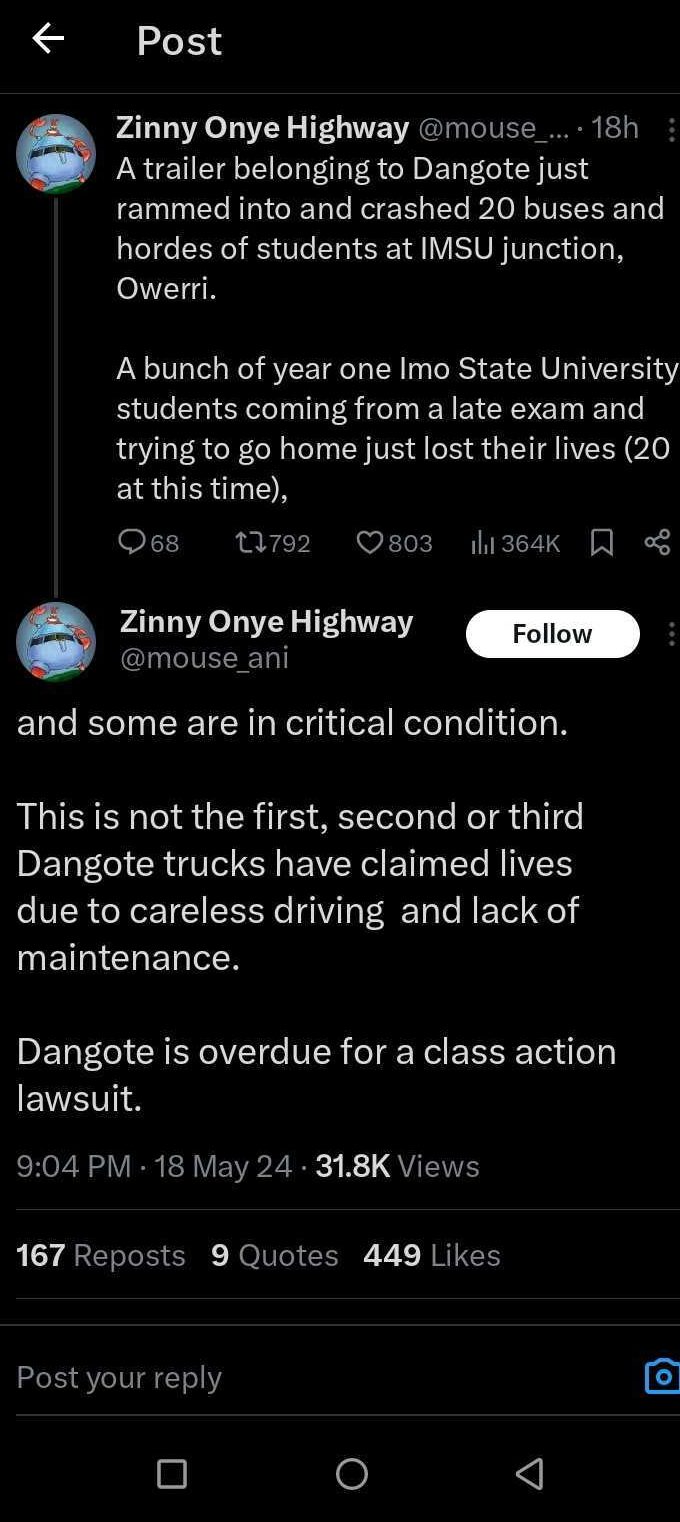
Around 8 pm, on May 18, 2024, a trailer crashed into at least three buses and groups of students heading home from late exams at Imo State University junction, Owerri. The accident was reportedly caused by a brake failure, and the driver of the truck is missing and allegedly on the run.
The trailer allegedly belongs to the Dangote Group.
Is this the first time we’re seeing something like this?
No. In January 2021, a dangote truck loaded with cements claimed about 18 victims on its path when it crashed into shops and properties in the Akungba-Akoko area of Ondo state. Eight of the victims were students of Adekunle Ajasin University at Akungba-Akoko.
The resultant tension from students led to a temporal shutdown of the university. The company paid ₦500,000 to each family that was affected by the incident.
What is the public response to the accident at IMSU?
Social media is abuzz with condolences and agitations regarding the absence of laws that guide trailer activities and drivers’ accountability on the road.
Others have said that the junction is notorious for accidents and the government should build a flyover bridge to prevent a repeat in the future.
[ad]
Meanwhile, the Governor of Imo State, Hope Uzodinma, released a press statement sharing his condolences and stating that investigations were underway, and the Ministry of Health would actively help in providing medical services.
In Nigeria, better days seem to be finally ahead of us, and citizens might have to heave a sigh of relief. For a while now, many of us have been looking forward to the completion of Dangote’s Oil Refinery, which launched in 2016. This project is expected to not only reduce the frequency of fuel scarcity plaguing the country but also create more job opportunities and provide a better financial economy.
In the latest dash of good news, on May 7, 2023, President Bubu’s special assistant on digital communications, Bashir Ahmad, announced that the oil refinery is set to begin operations on May 22, 2023.
Here are some key things to know about this anticipated refinery:
The refinery site is in the Lekki Free Zone and sits on approximately 2,653 hectares of land, about six times the size of Victoria Island, Lagos.
It was initially intended to be built in Ondo State, but the plans fell off due to state politics, and the project was moved to Lagos.
It’s set to produce 640,000 barrels per day and will reposition Nigeria as a global energy hub as it’s capable of meeting the energy demands of the whole country.
It has the longest subsea gas pipeline in the world at 1100 km and is expected to handle three billion cubic feet of gas daily.
About 12,000 MW of electricity is expected to be generated.
So what are some of the benefits Nigeria and its citizens stand to gain following its full operation?
Economic benefits
Despite being one of Africa’s largest crude oil producers, Nigeria spends billions of dollars importing petroleum products yearly due to lack of functional refineries. This has also heightened illegal oil bunkering in the Niger Delta and adversely affected the economy.
However, with the emergence of Dangote’s refinery, the need to import refined petroleum products will be eliminated, as it’s expected to produce 65 million litres of premium engine gasoline, 15 million litres of diesel, 4 million tons of jet fuel, and 3 billion standard cubic feet of gas per day. To be optimistic, this is expected to ultimately turn Nigeria into an exporter of refined petroleum products and petrochemicals.
Our Naira will weigh more in value
With Dangote’s refinery set to run in full operation, there’s a possibility of the Nigerian currency finally getting stronger in the foreign exchange market. Nigeria spends about $50 billion on petroleum product imports, but with the completion of this refinery, experts expect that import costs will reduce.
This refinery should reduce pressure on the nation’s currency and increase forex inflow significantly through sales of petroleum products. This will make Nigeria less dependent on imports and more self-sufficient, causing a positive ripple effect on other sectors of the economy.
More employment opportunities
Currently, the refinery employs about 40,000 Nigerians and foreigners, which is expected to increase upon the commencement of operations. Aliko Dangote, as disclosed on the official website, plans to increase the number of employees to 57,000 in the coming months.
Dangote’s refinery is one of Nigeria’s many steps towards self-sufficiency, and hopefully, the plausible expectations around its operations will survive the deeply rooted corruption and nepotism in the country, specifically in the oil and gas sector.