“A Week In The Life” is a weekly Zikoko series that explores the working-class struggles of Nigerians. It captures the very spirit of what it means to hustle in Nigeria and puts you in the shoes of the subject for a week.
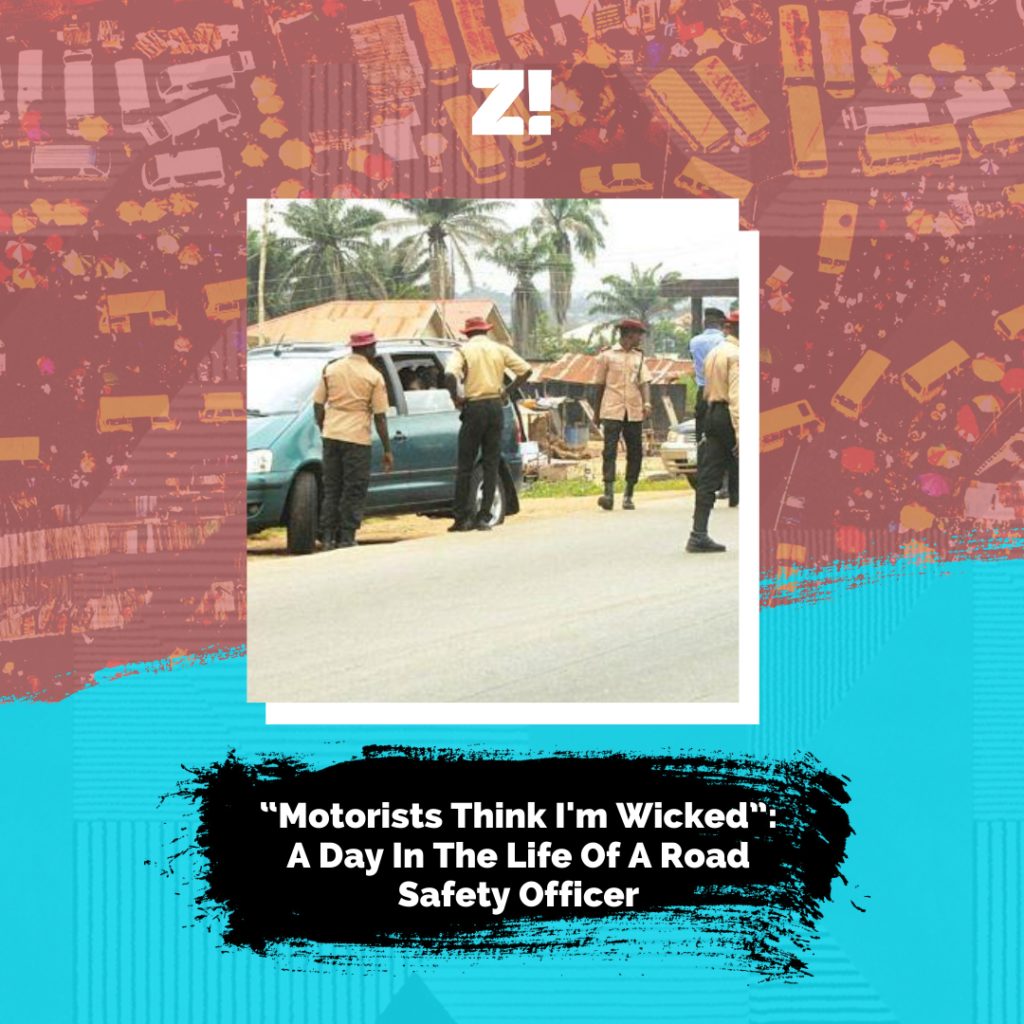
The subject for today’s “A Week In The Life” is a Federal Road Safety Officer. He talks about why refusing bribes from motorists sometimes cause him problems and why his children and corruption are reasons he can’t wait to take on a senior role at directorate level.
4:30 am – 6:00 am:
I wake up by 4:30 am every day. The first thing I usually do is prepare the kids for school. Thankfully, school is not in session so I don’t have to do that today. I have my bath and rush out. I’m rushing because morning parade starts at 6 am and I must not miss it. The parade is where we touch base and discuss our plans for the day. Missing it is a punishable offence. Without traffic, it takes about 25 minutes to get to the office. However, with traffic, the journey takes as long as two hours. It’s still early when I leave the house so there are no bikes to take me to the bus stop. This means that I have to trek which is another journey in itself. Thankfully, I don’t have to stay long at the bus stop before I find a vehicle to carry me to work. I arrive at work, change into my uniform and make it just in time for the parade.
At the parade, our supervisors address us, assign us to various duties and my day officially begins. I’m in operations and this involves supervising motorists and helping out in emergency response, so my team and I hit the road to start work.
7:00 am – 12 noon:
Every work or duty whether it’s an artisan or white-collar has their peculiarities. Something that makes the work difficult to do. In my case, it’s the psyche of the motorists. It’s a big challenge because Nigerians have normalized bad behaviour. We know the country is bad and all, but you are not meant to drive on the road without a valid driver’s license. The funny thing is that it doesn’t cost a lot to do – You get the temporary license online, and in sixty days time, you get a permanent copy. However, my country people prefer to go on the road and give someone ₦2,000 – ₦3,000 just to scale through without a license. At the end of the day, they end up giving people this money more than 12 times a year thereby spending more than they would have spent to just do the license.
When I stop a motorist and let them see the reasons why they should not depend on bribing an officer, they keep asking: Who be this one, wetin dis one dey try to prove? Are you not a Nigerian?
They see me as irrational or unreasonable because I don’t behave like every other person. In fact, they think I’m wicked, heartless, and I don’t want to help them. Sometimes it turns into a quarrel and they rally a crowd to sympathize with them. It gets tricky here because Nigerians have a thing against uniformed people. Once there’s public sentiment, most people side the motorist who is actually an offender because they don’t buy your story. Road safety officer that doesn’t want to collect money? [haha]. Then I’ll start hearing you for don leave am. You for don collect. It then becomes a dilemma because how are we going to make things right?
As I am battling the work front, there are also family members. They either call asking for my help when they break road traffic laws or they need someone to help them process a driver’s license. I keep telling them that we have to start making things right and we can do things the right way. We must not do things the wrong way. After all my talk, they still don’t get it and tomorrow, they’ll still ask me to either beg for them or introduce someone to help them.
They don’t get it. Neither does the majority of the force. The officers who get it are not enough to change the image of the force but we still try. Sigh.
1:00 pm – 4:00 pm:
I booked a man driving a Tundra for an offence this afternoon. He was driving without a seat belt and was eating. To make matters worse, his car papers were not up to date. After explaining and begging, I booked him for driving without a seat belt and also impounded his car. I explained to him that he had to update his papers for his own safety and for the safety of other road users. Eventually, he came to collect his car and his wife drove him down. He asked to see me and he introduced me to his wife. His wife, a consultant in a big teaching hospital said he was just praising my professionalism. After retrieving his car, we exchanged contacts and I promised to visit.
Moments like this make me happy because it shows that some people appreciate me. I remember another incident where I stopped a road user and after a severe warning, I let him go. The next time I ran into him was at the hospital when I went for scaling and polishing. It turned out that he was the head dentist there and he remembered me. So, I got special treatment and he ended up sorting my fees which I know was not cheap. Sometimes, I wonder that if I had collected ₦2,000 from him on the road, would he have given me the same treatment?
Corruption is a cycle that affects all of us. We live in normal houses [not barracks] like regular people. We go to the same hospital as regular people. Our children go to regular schools too. If an officer takes money from a motorist that’s a doctor, the doctor will try to make it back and may inflate their own fees. Then let’s say a policeman goes to the doctor and can’t afford the fees, the policeman goes on the road to try to make the money and your guess is as good as mine… It’s an endless cycle that hurts everyone.
4:00pm – 6:00 pm:
I get off work by 6 pm. That’s when people on night patrol take over. On some days, they come early to relieve us, so I use that opportunity to pick my kids from school. That bonding time with daddy is important to me. It’s good to let them have a change from mummy coming to pick them; time spent with family is precious. I can’t wait till I actually have more time to spend with my kids. This means that I have to keep growing in my career, I must not be stagnated. I can’t afford to miss a promotion. The only way I’ll have more time is to get in a senior role at maybe directorate level. Then, I’ll have more time for my kids and I can also make recommendations for change in the force. Because our agency is under the presidency and there are so many stratum and chains of command, it’s only at that level that your input really counts.
Until that time, all I can do is count down till 6 pm when I get off work. I’ll keep working to get there because, at my level, I can’t change a thing – I’m still what the Igbo people call boy-boy.
Editors note: FRSC images were taken randomly from the internet as the interview was done anonymously.
Glossary:
Boy-boy: Someone that runs errands for other people.
Check back every Tuesday by 9 am for more “A Week In The Life ” goodness, and if you would like to be featured or you know anyone who fits the profile, fill this form.