Notice: Function _load_textdomain_just_in_time was called incorrectly. Translation loading for the wordpress-seo domain was triggered too early. This is usually an indicator for some code in the plugin or theme running too early. Translations should be loaded at the init action or later. Please see Debugging in WordPress for more information. (This message was added in version 6.7.0.) in /home/bcm/src/dev/www/wp-includes/functions.php on line 6121 AdultingbyZikoko | Zikoko!
Adulting. Who on earth invented that concept? They have to go back to their mood board to revise the entire structure of this really exhausting lifestyle. Particularly the part where you have to pay for everything you didn’t really know had to be paid for. I mean who knew pipes don’t fix themselves. Or that you actually have to buy new trash bags when they run out. Don’t even let us get started on the price of mattress or curtains or rent! All in all, being an adult is the ghetto.
To be sure that we are not the only one in this problem, we asked five Nigerians to share their most expensive brush with being adults. Read their stories below
Tayo, 22
Growing up, I was really into sports. I still am. But I used to be so reckless and I didn’t care very much about injuries or my glasses. If I got an injury, I would just go into the hospital for treatments or get new pair of glasses if I needed one because my parents had an insurance plan. But recently as an adult, I needed to get an eye test and new glasses. When I saw the bill, I was so scared because I wasn’t even expecting it. My glasses cost a shit load because of how it is for me. so just my lenses cost about ₦75,000 and the test was ₦15,000. The cheapest I could get cost about ₦35,700. I learned for the first time all this time I was just doing anyhow.
Olamide, 20
To be honest, since I started adulting, things as cheap as deodorants seem so expensive now that I pay for them. When I was younger, my dad always got them for me, from body lotion to roll on, perfumes and body wash sometimes sanitary pad, but now that I work and pay for them myself I feel like those industries are extorting us. I’m a student in Port-Harcourt but I go to school from home, I run a tye and dye business and because it pays well, my dad felt I could start paying for some little things myself. I like it though because sooner or later I would still have to as I am almost done with school.
Ayo, 29
I moved to Lagos from Ogun state in the middle of last year. When I got here, I had rented an apartment around Ago Okota, Lagos. The house is a 2 bedroom en suite flat and it was my first experience getting an apartment in Lagos. Then came the problems, house rent is about ₦800,000 excluding other charges, all in all, it was about a million Naira. Omo that is way too far from what I pay for house rent in Ogun state which is usually around ₦300,000 a year, and even though my new job can support the rent, it is still a wild bill to be paying.
Katherine, 23
The first time I experienced adulting in this way was when I moved to a school hostel in 200 level of university and had to redecorate my room. Nobody told me curtains were so expensive or that the little hook things they use to hang them at the side are also equally pricey. Now when I had to buy a mini-fridge, the prices the vendors called almost wrecked my bank account.
Jill, 24
The one thing I didn’t know was so expensive before I started adulting was Printer Ink. At my first job that was one of my tasks (stocking office supplies) so I needed to get the costs and prepare a memo. I called someone at a printing supply store to ask and omo If I knew that was the price maybe I wouldn’t have been printing Hannah Montana pictures to use as posters for my room then.
There is also, of course, medicine, they are actually so expensive. This one time, after gathering adult energy to take myself to the clinic, it was time to buy the prescribed medications. When I got to the pharmacy and the I was told that the prescriptions were worth over ₦20,000, I told the pharmacist abeg cos him and who? Small sick oh. He legit laughed and had to reduce and substitute here and there.
Here’s some free advice, whatever you do, do not opt-in for the Nigerian adulting package. It is a scam. But I”m guessing it’s already too late for you. And if that is the case please join the line of wailers and “had I known” on the left there. Adulting is an extreme sport on its own but adulting in Nigeria is in a league of its own. But we thought long and hard about it and realized that the 6 things on this list would make the package way easier.
1. Access to a never ending back up cash reservoir.
Nothing teaches the essence of money as adulting does. 20 seconds in you understand exactly how much difference money makes when it is in the picture.
2. A very proactive guardian angel.
Preferably one with the energy level displayed in this GIF and one that we can actually talk to. This guardian angel’s most important KPI (asides making sure we don’t die) is warning us about stupid decisions we are about to make. Like calling an ex because we are bored.
2. An innate ability to cook.
Because food is important and the ability to whip up something both edible and delicious is important.
3. An eternal generator.
Because we both know NEPA a.k.a PHCN lives to disappoint but we need electricity either way.
4. An equally proactive genie.
And we’ll be needing wishes like “rent”, “transport”, “concert tickets”, “data” and “miscellaneous” covered, please.
5. Free Netflix access for one week every month.
To make up for the social life that will keep eluding us.
6. An “UPGRADE TO ADULTING OR REMAIN A CHILD” option.
And most importantly, we would like the luxury of choice please. How do you just shove a person into something like Nigerian adulting simply because they are now old? Be kind please.
What’s up, Zikoko Fam? It would mean the world to us if you spared a few minutes to fill this Reader Survey. It’s so we can bring you the content you really want!
We want to know how young people become adults. The question we ask is “What’s your coming of age story?” Every Thursday, we’ll bring you the story one young Nigerian’s journey to adulthood and how it shaped them.
The young woman we spoke to this week feels like she turned out okay, but she knows she could have been in a better place if she mentally prepared for some of the things that happened as she became an adult.
My life as a child revolved around the church. My parents were ministers in a popular Pentecostal church at the time. They made my siblings and I go to church on Sundays, Saturday evenings and often after school for weekday services. My reading revolved around religious books. I read a lot of bible stories with the same reverence that I read books like Chicken Licken, Famous Five, and Enid Blyton titles. My dad was an avid reader too, so there were books around me all the time. This made me develop a love for reading real quick. Reading was my escape.
In junior school, I read a court case and decided I would be a lawyer. A 10-year-old who knew what she wanted was everyone’s darling. I’d tell adults I wanted to be like Gani Fawehnmi, a human rights activist and a writer like Wole Soyinka, and they would smile. At every moment as a child, I knew exactly what I wanted and had all I needed to get to there. Knowing this made me confident.
My parents were bankers. Executives in two old generation banks. In spite of the money they had, my parents taught us to live so frugally. It was mostly my mum; she was strict. She made us save the little we had and invested in top companies on our behalf before we even became adults. When my dad bought us expensive gifts: new laptops, new shoes, dolls, etc., my mum complained. She shopped for our things on the busy streets of Eko market, while my dad bought most of our things when he travelled out of Nigeria. Somehow, this made me think we were poor, or at best average.
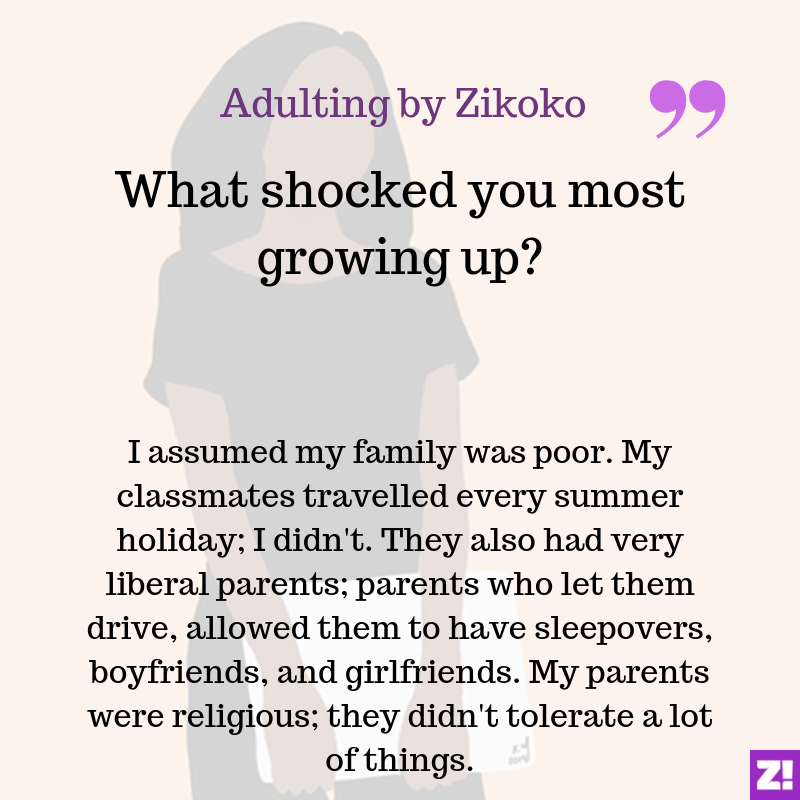
When I joined a new secondary school that was different from my old school at the start of SS1 — in that they used both British and American curriculums — this feeling became even more profound. I was astounded by just how often my classmates travelled every summer. In my first week, when my new classmates asked where I went for summer, I shrugged and said, “Just South Africa,” because I felt it didn’t count. It wasn’t Greece, or London, or Rome, or Paris.
They also had very liberal parents; parents who let them drive, allowed them to have sleepovers, boyfriends, and girlfriends. It was a very lonely period of my life because I felt left out. Worst still, the class bullies picked on me because I had acne and didn’t carry the best backpacks or wear the best shoes.
Still, when I looked at my results at the end of every term, I was proud of myself. In the old school, we were 50 in a class, and each set had at least six classes. While my older siblings were the smartest in that school, always coming top of their set and winning prizes, I was never given any special award. I always came among the first 10 in my class. That was as good as it got. My mum’s response to this was always, “Congratulations.” Nothing more. It was her response to everything, even when one of my older siblings competed for the entire state in a Math competition and came in first.
In the new school, we were 30 in a class; each set had at most 4 classes. I was often the best in government, Christian religious studies, and literature. I usually came in the first 5 in my class. This was largely because the teachers in the new school were very thorough and friendly — they never flogged students; they spent time helping each student develop in weak areas. I even excelled in subjects like Maths and Biology, subjects I had previously sucked at. One time, during a test out, I scored 14/20 and was the highest in the entire set. The best students from other classes, especially the science class came to me to explain it to them. That was the only time I felt like I truly belonged in that school.
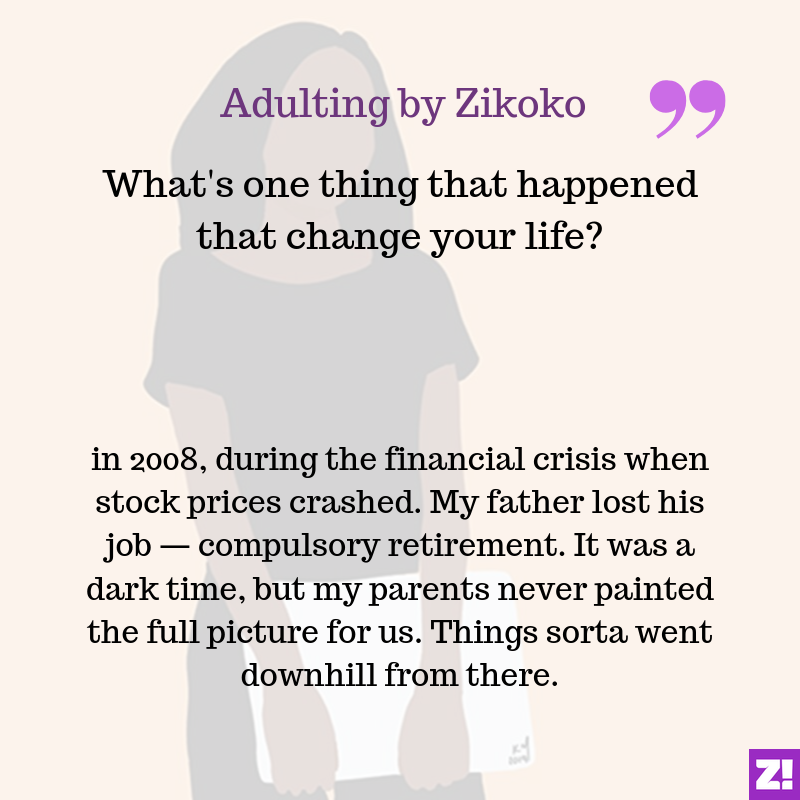
Things changed in 2008, during the financial crisis when stock prices crashed. My father lost his job — compulsory retirement — after his bank was merged with a new bank. It was a dark time, but my parents never painted the full picture for us. The only changes made were moving schools and my mum became the one to give us allowances. My older siblings were already in university at the time. The stability I had known for so long crashed. At first, I hated the new school. It was a lot cheaper than the old school, but still quite expensive than my first secondary school. Subsequently, however, I met new people and made new friends. I was still a star student, only now, in an environment that made me feel like I was truly accepted.
I assumed my dad would try to find a new job, but he didn’t. He got an offer at some point, but he rejected it on religious grounds. Before he lost his job, I was really close to my dad; we had the same interests and look exactly alike. He was my shield from my mother. But I started to loathe him after he declined the job on a religious basis. I don’t know how it happened, but the contempt slowly crept in and soon, I discovered I couldn’t stare at him when speaking to him. My siblings and I complained about him to ourselves all the time. We had a house and cars; we were comfortable, but it didn’t look good for our father to remain jobless. We couldn’t continue to lie to people when they asked what our father did for a living that he was a businessman, when all he did was watch movies and read books all day.
When I became a feminist, I loathed him even more — if he was going to be a stay at home dad, the least he could do was pull some weight around the house, but he didn’t. My mum still returned home after a hectic day at work, to prepare his meals. His demands of her, and us increased. I soon realised how fragile masculinity was. He had to assert himself somehow, so we could continue to respect him. And the ways in which he did it were terrible.
When it was time for university, I hoped to go to school in the UK, like most of my classmates. I searched online for scholarships and started speaking with people. I didn’t want to write JAMB, just because. My parents made me take it, and I ended up in a government university in Nigeria studying the course of my dreams.
It was at this point adulting started in the true sense of the word. However, if I’m being honest, I’ve always felt like an adult, even as a child; there’s one part – the unfair pressure of growing up as a girl-child in Nigeria. Then there’s this goodie-two-shoes maturity I’ve always had, that some of my classmates and friends didn’t. It’s the attitude that makes me a stickler for rules, always so scared to break rules or offend people. Sometimes, I blame my mum for this. She made us grow up fast because she didn’t want us to make mistakes she might have made. She wanted us to be independent, and with a mother like that — a mother that started a business on the side while being an executive in a bank just to support the family — it was easy.
With all the strikes and poor facilities, law became the course of my nightmares. I was on a 4.8 GPA in my first and second years. My older siblings had finished with first class, so I wasn’t about to be the exception. But in my third year, my grades dropped and I really didn’t care. I mean I did care to some extent – I became depressed but I eventually stopped caring. All my studying and burning the midnight candle wasn’t reflected in my results, so I settled for 3.8, second class upper. Sometimes, I wonder if I had put a little more effort, I’d have done better, but I’m not sure. I’ve always been laid back especially in uni:
I can’t come and go and kill myself. o
I could also fault my parents for this: we had drivers all through the time we were in primary and secondary school. We were pampered and sheltered to an extent, and suddenly, I get admission into university, and I’m expected to suffer by jumping busses and feeding myself? That’s hell. To cope, I found writing jobs that paid, which allowed me to take cabs and live in a decent place off-campus. This afforded me some comfort.
While in university, I abandoned religion. When my dad first lost his job, I thought things were falling apart, and so I found solace in religion. After a while, I realised that humans would always be stupid and find a way to say it’s religion. I didn’t make a conscious decision to stop, I just abandoned it.
If there was something I could do differently, it would be to mentally prepare myself right from a young age that mummy and daddy’s money won’t always be there. Although I’m comfortable and happy with life now, I still always have it at the back of my mind that if things go to shit, I can always call my mum and she’ll give me money or ask me to move back home. Maybe that’s not necessarily a bad thing. But that independence my mum always wanted me to have — financial independence that meant I wasn’t relying on men for money — made me rely on her for money. I feel like I’m ambitious, but I also feel like I’m too lazy and laid back.
Right now, I work a job that isn’t giving me the optimum satisfaction I want, and I’m afraid to quit because the money is good and I’m afraid I’ll never get another job again and end up like my father. Which is an irrational fear because I’m poached regularly, either to join companies or become freelance.
In the end, I’m comfortable with one thing: I am not turning out too badly. Yes, my relationship with my father might not be all that, but it’s getting better. I’m starting to see the future a bit clearly, and that’s good enough for me.