Notice: Function _load_textdomain_just_in_time was called incorrectly. Translation loading for the wordpress-seo domain was triggered too early. This is usually an indicator for some code in the plugin or theme running too early. Translations should be loaded at the init action or later. Please see Debugging in WordPress for more information. (This message was added in version 6.7.0.) in /home/bcm/src/dev/www/wp-includes/functions.php on line 6121
a week in the life | Zikoko!
  • A Week in the Life of a Fine Artist Who Refuses to Be Disrespected

    A Week in the Life is a weekly Zikoko series that explores the working-class struggles of Nigerians. It captures the very spirit of what it means to hustle in Nigeria and puts you in the shoes of the subject for a week.


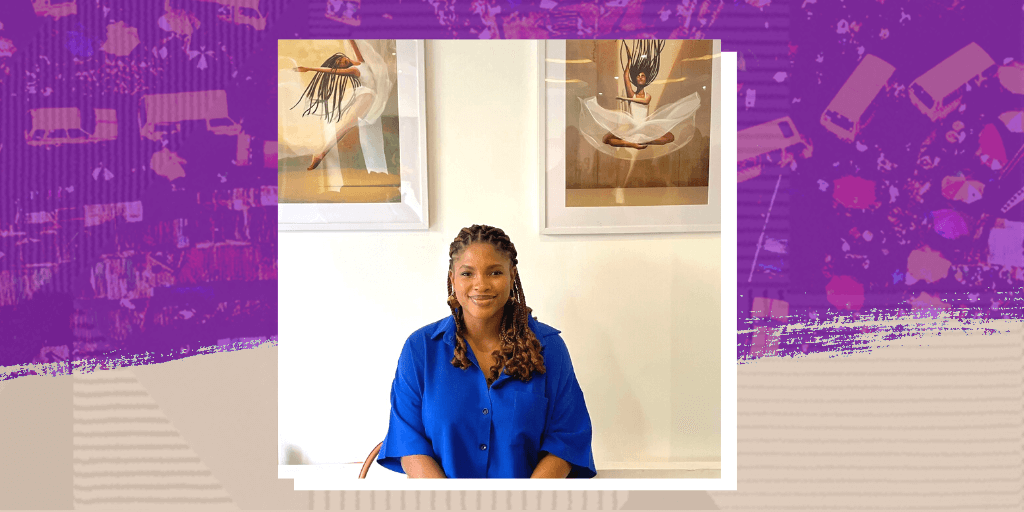
    Fine artist Renike Olusanya has always excelled in art, but several years ago, when she got her first commission of ₦25k, she didn’t realise her life was about to change. In 2022, she’s illustrated for international brands and publishing houses and sold a tonne of remarkable art. She tells Zikoko how she navigates work-life balance as a freelance fine artist, her frustrations dealing with clients and how she’s focused on building friendships. This is her life in one week.
    MONDAY

    I used to sleep around 3 a.m. — which is normal for artists because we’re all messed up — but I don’t want again. These days, I try to sleep between 12 and 1 a.m. I believe in gradual changes as it’s more realistic to go from sleeping by 3 a.m. to 1 a.m. than 10 p.m. I usually wake up around 9 a.m, but today, I woke up at 6:30 for some reason, and it was hell.

    I like to respond to my inquiries and emails on Sunday nights so I won’t be under too much pressure on Monday. I also schedule emails for different times of the day depending on the time zone of the recipient. First, I write a to-do list, eat breakfast and get to work. I just started eating breakfast two months ago because I’m trying to build lean muscle and maintain healthy habits.

    I like to eat overnight oats, which is funny because I used to hate [cooked] oatmeal until I discovered the beauty of overnight oats. I make it by soaking rolled oats in oat milk with chia seeds, Greek yoghurt, grapes & peanut butter and storing it in the fridge overnight. So in the morning, I just wake up and eat. Sometimes, I eat it with fried eggs. 

    I work from home as an artist, so it can be difficult to get into work mode. I like to act like I’m going to work. When I’m done with breakfast, I freshen up, dress up formally and head to my home art studio for the rest of the day. By midday, I’m fully in work mode, and I work until 5 p.m., only pausing to stand up every hour when prompted by my Apple Watch. While working, I love listening to podcasts like The Archetypes by Meghan Markle and No Stupid Questions by Stephen Dubner and Angela Duckworth.

    By 5 p.m., I get out of my work chair and change into gym clothes. I recently bought a treadmill I put in my studio because I neither have the strength for Lagos gyms nor a car to make daily trips. I also don’t like going out. I used to work morning till night without standing up. But that’s unhealthy, and I recently decided to become more physically active, I bought the treadmill and some dumbbells to work out in the evenings. I also do yoga until 7:45 p.m. 
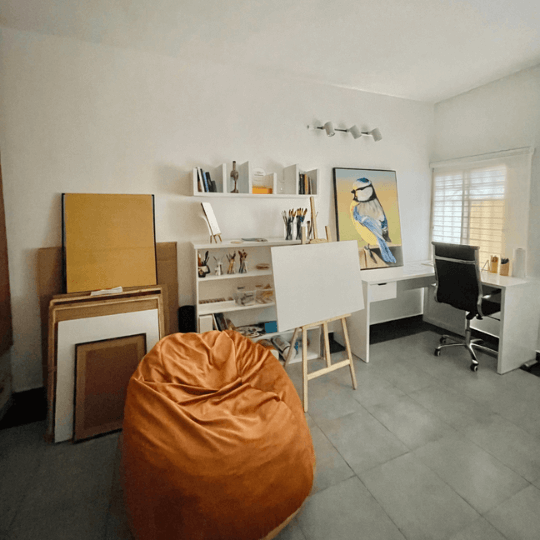
    Renike's home art Studio
    Renike’s home art Studio

    Afterwards, my Mondays can go either of two ways. I either eat dinner, read articles or a book, scroll through Twitter and TikTok and watch a movie, or I go to Obi’s House at Hard Rock Cafe — but this is once in a blue moon. Tonight, I’m staying in my house. Before I go to bed, I love those quiet moments when I just apply skincare products to my face.

    TUESDAY

    It’s funny how people only notice you when you’re out there and seem to be doing well. Sometimes, I get so caught up in trying to move forward I forget how far I’ve moved from the early days of my career. But today, I woke up thankful. And while eating my overnight oats — I can’t get enough of it — I took a few moments to meditate on my journey. 

    In 2016, when I was in Unilag, someone reached out and asked me to supply prints of my artwork to a guest house. When the money entered my account — ₦500k — I was just looking at the alert like, I’ve used talent to escape the trenches o! Which is funny because my first commission was so random. I had a mentor — a pastor who used to encourage me. He commissioned me to paint his wife and paid me ₦25k. 

    My first book cover was also a commission from a friend. She paid ₦30k for the illustration, and I was more than happy to work on it because I loved everything about her poetry collection, from vision to execution. I kept creating and putting out my work and not long after, I got a gig that paid £500. Just imagine the gap. And then, the gigs just kept coming….

    As I finished my oats and prepared for the day, I knew I was going to absolutely slay it. 

    WEDNESDAY

    As a freelance fine artist, the nature of my job lacks structure, so I have to consciously decide to stick to a routine every day of the week, and a to-do list is my greatest tool. Knowing what to do before I start each day has helped my artistic process a lot because I track my activities and progress on projects for the day.

    As a full-time fine artist, I draw what I like and sell them. Sometimes, people want me to draw things for them, and for a fee, I do. I get book cover commissions from either a self-published author or publishing house. When a house reaches out to me to design a book cover, it could be because the author saw my work somewhere and liked it. Like when I designed the cover of Nicola Yoon’s book Instructions for Dancing, one of Penguin’s creative directors reached out to me and said Nicola Yoon saw my work on Instagram — it’s always Instagram — and thought I’d be a great fit. Of course, I was interested. There’s usually a process that makes collaborating easy: a creative director reaches out, I do my work and get paid. 
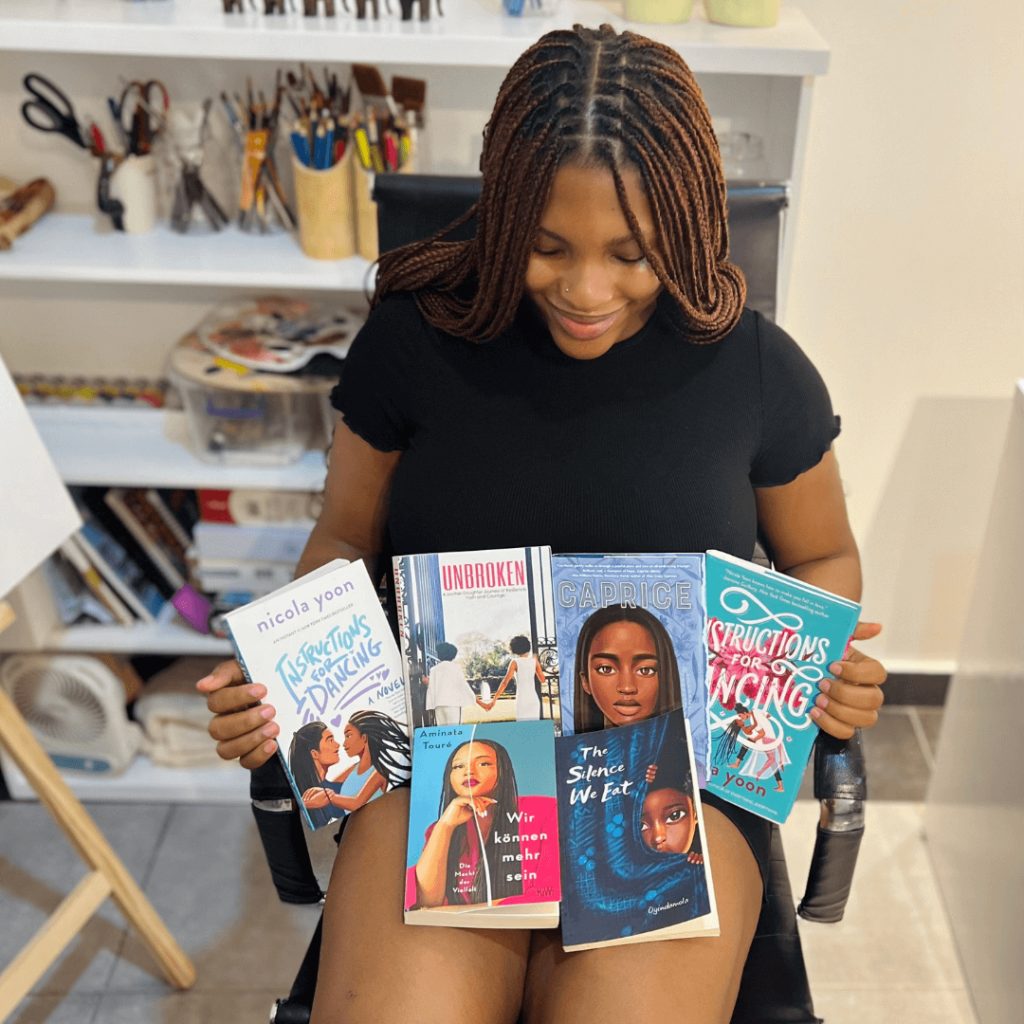
    A photo of a woman Renike posing with some books she designed covers for
    Renike posing with some books she designed covers for

    But with independent authors, there’s a lot of back-and-forths because I ask a lot of questions, and sometimes, they don’t really know what they want, so I have to guide them through. I’m the illustrator as well as the consultant. I can ask for a non-disclosure agreement to protect their work if they feel reluctant to tell me certain details of their story.

    I used to have a fixed price list, but not anymore, because I often sold myself short, especially when the projects evolved or derailed. Right now, I have a base fee and add extra depending on the complexity of the project. Painting someone’s head will be different from painting someone’s hand, for example; the same goes for half-body vs full-body portraits.

    When I do personal art, I start with an idea, roll it around in my head for a while before I start painting. Which reminds me, the last time I did something personal was in July [2022]. I worked really hard between 2020 and 2022, putting out a a lot of work and building my reputation — and that’s why I can afford my lifestyle today. I still have ideas, but it’s been hard to find space to create personal work. Funny, I never struggle with commsioned work.

    I’m thinking this as I step out of my studio at 5 p.m. today. I make a note to paint something personal soon.
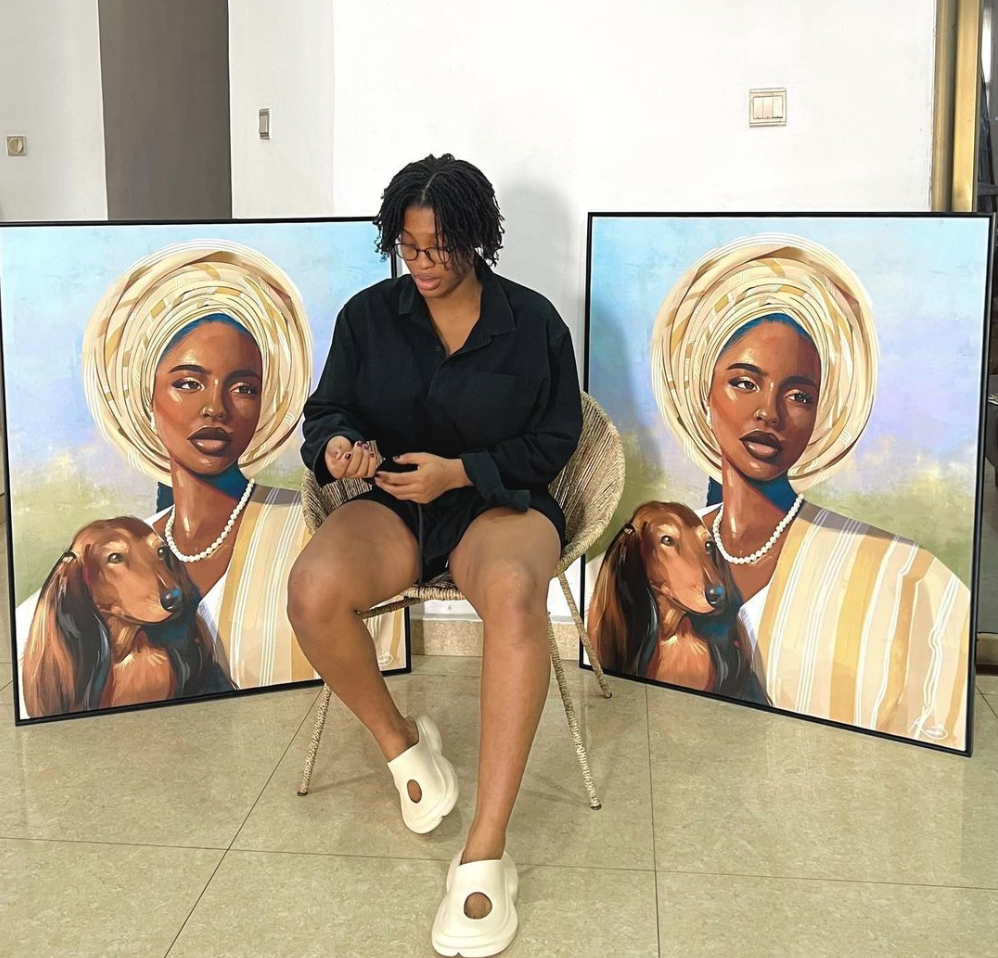
    Renike the fine artist posing with her artworks

    THURSDAY

    Today was just annoying; payment wahala here and there. The biggest headache I have these days is accepting payments. Most of my clients are outside the country so anytime I need to receive a payment, I always have to manoeuvre one issue or the other as a Nigerian living and working in Nigeria.

    I’ve put my name out there to the point that people now trust me. All you need to do is Google my name and see I’m legit. But it wasn’t always the case. When I was still coming up around 2019/2020, it used to frustrate me that some international clients would just air me after seeing I’m Nigerian. 

    There was a time one of these traditional banks that recently went digital kept restricting my account until I threatened to sue. I was getting paid, but I couldn’t get my money. It’s not like the money was plenty o — didn’t even have the money to sue — but I couldn’t take it anymore. 

    I’m also struggling with inflation, and it’s affected the kind of projects I take on. My foreign clientele typically commissions digital art and book covers while most of my Nigerian clients prefer portraits. But right now, I don’t take as many portrait commissions or get as many requests as I used to because my base price is in dollars. With the way the naira is moving nowadays, I can’t charge Nigerians in Nigeria. It’s ridiculous to convert what was, say, ₦100k at the beginning of 2022 to more than double that. 

    It’s such a struggle, and I’m tired mehn. When does one get a break?

    Renike the fine artist posing with her artwork
    Renike posing with one of her works

    FRIDAY

    A younger artist reached out to me today, complaining that they did work for someone, and the client refused to pay. I discussed with the person on how they could prevent it from happening again.

    I’ve worked with too many problematic clients than I’d like, but because I’ve had a few years of experience, I can spot them from a mile away and run for my life. They always have a crazy long list of things they want done — things that’ll normally cost an arm and a leg — but never have the budget for it. 

    No matter how big you are, you can’t escape problematic clients. These days, what I do is if there’s something they want and their budget doesn’t match it, instead of chasing them away, I try to compromise to find middle ground. For example, if you really want a full-body portrait of five people, and you only have enough to cover a full-body portrait of three, I can suggest a half-body portrait of five people instead. But the problematic ones don’t even want to make concessions; all they do is stress me out, so I just run away.

    A few years ago, there was this lady who reached out to me for a painting. I was still charging around $500 and above at the time. We moved to the consultation stage, but after hearing all the details she wanted, I was like, ehn? This thing you want — with the whole world including heaven — is how much it would cost. Omo, this woman started ranting. What really annoyed me was when she said I’d wasted her time. I had to clear her — respectfully — on the spot.

    Clients are always right o, but they should also respect people who work with or for them. She wasted my time too when she was describing heaven and earth. People need to understand that they’re paying for a service and we’re doing it in return for the payment. Our work as artists is to bring your vision to life, so you can’t disrespect us because you only want to pay a certain amount of money. I won’t accept disrespect just because I’m providing a service.

    I’ve had to evolve my process in a way that demands respect, so right from the beginning, you know you’re not dealing with an anyhow person: 

    1. I ask a lot of questions and sign contracts from the get-go, so nobody will say something, and then later, say that’s not what they said, because I have the receipts. 
    2. I don’t attend to inquiries over the phone. I prefer emails so there’s a trail of communication.
    3. When people divert from the original agreement or add something or the other, I charge extra.

    I always set boundaries from the beginning. I don’t work for people who refuse to respect these boundaries because my peace of mind is important to me. Once people realise that after two revisions, they have to pay extra fees, they sit up and tell me exactly what they want.

    But you see clients who treat me well? First of all, they offer me good money and are polite. Sometimes, they’re even ashamed to offer the money. To me, it’s big money o; to them, it’s like, “You have all this talent, and I can’t afford you, but please, take this money. And I’m like, “Yes ma’am.” 

    After I did the book cover for my friend’s poetry collection, I kept posting my work on social media, and the next people who reached out offered me £500 and were telling me they knew it was lower than what I usually charged. The way I screamed. Me that my previous job was ₦30k? Me that used to beg people to pay ₦50k, and they’d refuse? Me that didn’t even think I was good? That was my turning point.

    SATURDAY

    On weekends, I like to work out in the afternoons rather than in the evening. I also spend time watching and making TikToks of my art — and some fun dance routines too. Weekends are when I let my hair down and dance. But not at parties because, these days, if I do legwork in public, they’ll say Renike is razz. I do my legwork in my house, please. Dancing makes me feel really active and happy. 

    Weekends are also for hanging out with friends. I didn’t have a lot of friends growing up. I’m only starting to make them — especially female friends — in my adulthood. I love them so much and love hanging out with them. They make life worth living. When I’m sad, I know I have this group of people I can talk to, who won’t judge me. They listen to me, hype me up, dance with me, crack funny and dead jokes with me, etc.

    I like to read books too. Today, I finished Colleen Hoover’s Verity, and I’ve still not recovered. Tomorrow is Sunday, and I’ll sleep like my life depends on it. When another Monday comes, I’ll eat overnight oats, dress up and face the week.


    Check back for new A Week in the Life stories every first Tuesday of the month at 9 a.m. If you’d like to be featured on the series, or you know anyone interesting who fits the profile, fill out this form.

  • A Week in the Life of a Brand Designer Who No Longer Accepts “Exposure” as Payment

    “A Week in the Life is a weekly Zikoko series that explores the working-class struggles of Nigerians. It captures the very spirit of what it means to hustle in Nigeria and puts you in the shoes of the subject for a week.


    The subject of this Week in the Life is Joboson Chisa, a brand designer. He designs across a broad spectrum: brand identity, perception, sales, marketing, communications etc. He tells about his design process, how he made his first million as a brand designer, his frustrations negotiating with clients and why he’s no longer choosing “vawulence” on design Twitter.

    Graphic photo of a designer Joboson China

    MONDAY

    I always wake up at 6 a.m. thinking we should scrap Mondays. So I don’t get out of bed until 9 a.m. During those three hours, I browse Twitter and think up ideas, to start the week. Sometimes, I tweet motivational stuff, the occasional “we gonna make it #Wagmi” — as if I have energy to start the week — right from my bed. The lies we tell…

    Anyway, by nine o’clock, I finally get out of bed and open my laptop. Mondays are for stand-up meetings and admin work — sending and responding to emails, receiving and analysing feedback, etc. I get the most rejection mails from organisations about my pitches on Mondays, and I don’t eat breakfast until 12. 

    After work, I catch up on all the “vawulence” on Twitter. There’s always someone being ratioed for a bad design opinion at the start of the week. If you’re looking for hot takes on +234 design Twitter, you’ll find them on Monday. It’s like designers had too much time on their hands during the weekend and the gist spilt into the new week. 

    TUESDAY

    I know it’s just Tuesday, but please, the week has been crazy already. As a freelancer working from home, Tuesdays are usually my busiest days, when I actually open my design software and get to work. When I have deadlines, I beg MTN to have mercy on me.

    I’m very busy these days, juggling several client projects. And as if that wasn’t enough, I carried myself to take on community work. That’s the curse of being a freelance designer — taking on more projects than you should. But I’m a bad guy, so I’ll just wait until those deadlines are due then the panic monster will pressure me into slaying them. 

    After seven gruelling hours at my work desk, I have new designs. They’re so beautiful — even though I know I’m going to hate them tomorrow. But it’s been a hard day’s work, and I’m satisfied. Work hasn’t ended though, only client work. 

    Around 6 p.m., I turn my focus to a personal project. I’m trying to build 234 Brand Street, an online community of designers like myself, and even though I don’t have a clear roadmap, this thing has me doing things out of my comfort zone. I’m editing videos, learning new software, making templates for a live event — mehn, it’s been crazy motivating and crazy stressful. Who send me work?

    WEDNESDAY

    Someone reached out to me on LinkedIn, and I was so excited because that would be my first client from the platform — I’m mostly active on Twitter. This person told me they needed a designer and promised so many high sounding jargon — except payment. What would I use a “founding designer” title to do when it’s not coming with money? Is that how they say they’ll pay in “exposure” these days?

    Once I told him I wasn’t comfortable with the offer, he stopped responding. I was really disappointed because I felt like LinkedIn had better to offer.

    People like this stress me out. But I’ve made my peace that money conversations will often be weird. Just as I was rounding up work for today, someone emailed me from Behance to ask for my rates. When I asked for their budget, he asked what I wanted. He now said it was out of his budget. But didn’t he say he didn’t have a budget?

    I finished the first iteration of a brand identity I’d been working on for the past week for a US-based client and sent the files over. I expect to get their feedback by next Monday. So it wasn’t an unproductive day.

    After all the stress, I called my boys out to hang in the evening. As a remote freelancer, I try to invest as much time as I can in my social life. I felt like having cocktails, so we went for drinks until 11 p.m.

    THURSDAY

    The weekend is almost here so bored designers usually start dropping hot takes and fighting on Twitter today. I didn’t have urgent projects immediately pressing my neck, so I decided to indulge a bit by spending a little too much time on the app, calling out designers for their problematic takes. Thursdays are usually my freest days anyway.

    The thing is I’m a very outspoken person, and I feel very privileged to be in the design industry. But in +234 design Twitter, some people want to feel more important than they really are. There’s this worrying trend of people trying to position themselves as better than others rather than solving problems for people who can pay for their services. 

    The design community on Twitter used to be very different from what it is now. It was once a melting point of shared ideas and innovation, but these days, you’ll just see someone who hasn’t done any notable work, but because they got into tech from a random gig and bought fancy gadgets, nobody will hear word again. 

    One thing about me is I’ll always call out bullshit when I see it. Sometimes, I keep quiet, expecting people to know better — don’t get me wrong, I’m all for the good things design money can get one, but it’s becoming a pattern to detect those who breed on vibes, controversy and empty show off — I’ve saved some of their lit workspace pictures, though.

    After today sha, I’ll be keeping quiet. I don’t want to build a brand on “vawulence”. I just hope younger, less experienced designers won’t fall for the empty hype of people who don’t really care about them as much as they see newbies as stepping stones to their own goals. 

    FRIDAY

    I’m always excited about the weekend. It gives me a sense of accomplishment, and I also get to do fun stuff. Earlier today, I completed a major design project, handed it over and got paid. The money was up there with the highest I’ve charged this year, so I’m in high spirits.

    I’ve had a weird money journey, especially with charging clients. When I started out, I charged ₦5k for logos — and sometimes, I didn’t even get paid. But I’ve come a long way. In December [2021], a friend asked me how much I charged for designs. At the time, I was charging ₦500k – 700k for a full brand package, which included logos, social media and marketing templates, merch and many more. When they told me I was too good to be charging that amount, I didn’t believe them

    But later, I did research and saw designers charging $2k for brand identities I didn’t think were all that, so I decided to raise my rates. When a client reached out to me shortly after, I decided to ask for more money than I normally would. I pitched an idea, held my breath and asked for ₦1.7m. I didn’t know where I got the audacity from. The company accepted, and I wanted to run mad with excitement. That was my first million. Since then, I’ve not looked back.

    When I received my credit alert this evening, I knew it was time to have fun. I’m going to hit up my squad so we can decide if we’re going to a concert, bar or any fun event in Lagos. I try to go out every weekend, but this one will be special.


    Check back for new A Week in the Life stories every first Tuesday of the month at 9 a.m. If you’d like to be featured on the series, or you know anyone interesting who fits the profile, fill out this form.

  • A Week in the Life of an Apprentice Tailor

    “A Week in the Life is a weekly Zikoko series that explores the working-class struggles of Nigerians. It captures the very spirit of what it means to hustle in Nigeria and puts you in the shoes of the subject for a week.


    18-year-old Susan* is learning to sew to keep herself busy during the ASUU strike. But in Nigeria, apprentices are at the mercy of their bosses. And Susan’s typical week is full of more downs than ups. Find out why tailors lie and how she’s making the best of the ASUU strike in this week in her life.

    Graphic design with image of a sewing machine for an apprentice tailor

    MONDAY

    I like Mondays because they’re the most chilled days of my week. People have collected their dresses during the weekend, and even though sometimes, we receive clothes on Monday, it’s not plenty like that. I was looking forward to a chill day as usual, but my day started badly when I was harassed by street boys.

    My dad asked me to help him cash a cheque on my way to work. The bank isn’t far from my house, so I decided to trek. On my way, I saw some men loitering around and thought it was the regular street boys that’ll leave you be as long as you mind your business. But these ones started catcalling me. It wasn’t my first time being catcalled — that one is normal in Lagos — but these guys were very aggressive to the point of touching me. I managed to break away.

    I thought I’d be able to shake off the experience, but by the time I got to work, I was still shaken and I felt dirty. I hoped to just get through the day. 

    Things were going fine until a woman brought in curtains and my madam assigned the work to me. I started on it, but there was a part that was very tricky. 

    The thing about sewing is that it’s better to leave something alone than to redo it after making a mistake because mistakes only make the material worse. I’m still an apprentice so I decided to show my madam that part, but she was talking with the person that brought the curtain outside and I didn’t want to interrupt them. So I waited for her to be done with their conversation. 

    But when madam stepped into the shop and saw me idle, she started shouting at me — she didn’t even give me space to explain myself. I was so embarrassed.

    My day went from bad to worse. When I got home and showered, I couldn’t sleep. I was thinking about how if there was no strike and I was in school, something like this wouldn’t happen to me. It’s not like school isn’t easy but it’s just easier for me to blame it on ASUU.

    TUESDAY

    I’ve not recovered from yesterday’s incident and I didn’t even sleep well. But work continues, abi? So I went to work. 

    Tuesdays are only slightly busier at the shop sha, because that’s the time people come with their materials and take measurements and we start working. So since I didn’t have much to do today, I had a lot of time to think about my life.

    Even though I like fashion, I didn’t plan to learn the trade this soon. I’m only doing it because ASUU has been striking for more than six months now, and we don’t even know when it’ll end. 

    I like fashion, but I wish I didn’t have to learn under these conditions. The former place I used to learn was worse than this. The complete trenches. I went there to learn fashion but would find myself in my madam’s house, washing her clothes, taking her children to school, cooking for her husband, and plenty more things. I stayed there for three months before I complained to my mum,, she pulled me out of there, but she’d already paid the apprenticeship fee.

    This place I’m currently doing apprenticeship isn’t perfect, but it’s better. It’s closer to my hous,e and I don’t have to worry about the stress of entering danfo. But I’m tired, to be honest. I can’t wait for ASUU to call off strike. 

    Everybody is like, don’t waste this time. Learn something new. But learning something new doesn’t change the fact that I’m stagnant. My mates in private universities are already in 400 level and me, I’m still in my second year. If there was no strike and this was just a normal holiday, I’d be more excited about learning a trade, But right now, I’m doing it because I don’t have a choice. I just have to do it, if not, I’d be idle. Maybe that’s what makes it feel less interesting.

    WEDNESDAY

    Wednesday is when the real work starts. The official closing time is 5 p.m, and on Monday and Tuesday, we close around that time. But from Wednesday onwards, it’s 6:30 we leave because there’s always so much work. 

    It’s not like I can’t leave at 5 o, I’m just not comfortable leaving unfinished work. But no matter what, I’ll never stay beyond 6:30 because of security issues. 

    Today, I learnt how to make peplums. My mum has a lot of peplum dresses and I’ve always loved them. used to think they were difficult to make. But today, when madam tailor was showing me how to make it, it didn’t even take her more than two minutes. After cutting the material, you just need to put a stale on the peplum, sew round it, and then iron the cloth.

    Image source: Mynativefashion 

    I made my first peplum, and it came out well. I was so happy because my week started so badly.

    Every day I learn something new, and it makes my time here more bearable. By the time I got home, I had so much fun telling my parents and just knew I’d sleep well.

    THURSDAY

    Thursdays are extra busy because people want to get their dresses on Friday. Customers call non-stop to ask if their clothes are ready. It’s also when we lie the most because even if the clothes are not ready, we’ll tell the customers we’re done. We do this just so they’ll stop calling us every five minutes.

    We’re all on edge on Thursdays because of the building tension that a customer can come at any time. It’s the day I make the most mistakes because I’m still learning to manage the pressure.

    It’s also on Thursday that madam tailor shouts at her apprentices the most. I understand her concern, but sometimes, I think there are better ways to correct inexperienced apprentices sha.  It gets ugly when she starts laying her hands on people.

    Like today, I was working on a child’s dress and was almost done — it was just remaining the hand. The problem is, I’ve not really mastered how to cut the hands of dresses yet, so usually, when I get to the hands, I ask a more senior colleague to help me out. I don’t have a personal sewing machine at home, so I fear I’m not learning as fast as I should. The tailor doesn’t allow apprentices to bring their own stuff to sew at the shop. So, other apprentices who have machines usually go home to practice.

    But today, everyone else that could help me was neck-deep in work. I could have waited o, but I was trying to be useful. I said to myself that since I’ve seen people cut dress hands before, I could try it. I finished the dress and moved on to other tasks.

    Around 6:15 p.m., when I was preparing to go home, I heard “KPAIII” on my back. I was already so stressed from the hectic day, so it took me some moments to gather myself. Then the tailor showed me the dress and started shouting at me. She told me it wasn’t her fault I don’t have a machine at home and called me all sorts of names. She kept beating me with that her hand that’s very painful. Me that they don’t beat at home. 

    Shey I’d have left the unfinished dress for someone else. Me that was trying to be useful. Ah, ASUU, see what you people have caused. Please free me, let me go back to school.

    FRIDAY

    When I woke up this morning, my ears were ringing. Then I realised I still have to go to work today after the nonsense that happened yesterday. 

    I wanted to tell my parents, but no. It’s not the first time and my parents are very vocal people. What usually happens is, after my parents call the woman to complain, she’ll apologise to them, promise to do better, and then turn around to badmouth me to other staff and apprentices in the shop. It’s funny because you’d expect them to empathise with me. Shey all of us are suffering the same thing? But no, they’ll join to badmouth me. 

    There’s a kind of stigma that comes with being the one who snitches to their parents — they stop assisting me or sharing knowledge. And me, I’m at a disadvantage because I don’t have a sewing machine. When I look at all the problems that come with reporting, I wonder: at what cost? I’ll just bear it, learn my thing and go. 

    The previous place I paid ₦70k for, the money entered bush. I don’t know how much my parents paid for this one I’m currently doing, but it’s probably even more expensive. And it’s not like my parents can terminate the contract and collect a refund. That’s why I endure.

    Fridays are chaotic as hell. By the time we closed today, I’d put all the events of the week behind me but was too tired to trek home. So I took a danfo. I can’t wait for the weekend abeg. My family will be at home and now that the season has ended, we’ll watch BBN recaps and highlights.


    Check back for new A Week in the Life stories every first Tuesday of the month at 9 a.m. If you’d like to be featured on the series, or you know anyone interesting who fits the profile, fill out this form.

  • An Emotionally Turbulent Week in the Life of a Fast Food Cashier

    “A Week in the Life is a weekly Zikoko series that explores the working-class struggles of Nigerians. It captures the very spirit of what it means to hustle in Nigeria and puts you in the shoes of the subject for a week.


    Nine hours every day, Uche Uka* sells food from behind a counter at a prominent fast food restaurant, while evading stern managers. While on duty, resting is against the restaurant’s rules. But after two years of thankless service for ₦40k a month, she wants better from life

    fast food cashier social image design

    MONDAY

    Mondays are the slowest days at the fast food restaurant, maybe because many people cook during the weekend and still have food in their fridges. But I still end up tired.

    The eatery I work at opens at 7 a.m. We don’t have cleaners and support staff, I have to arrive early to clean up the store, machines, utensils and surfaces, bring the food from the kitchen to the counter and prepare for when the store opens. It’s a cashier’s duty to make sure all the food and drinks are recorded and cross-checked with the cooks. So I resume at 6 a.m.

    There are two other cashiers on my shift, and we do several jobs while the company only pays us for one. When we pleaded with management to hire cleaners, they asked us, “So, who’ll pay them?” 

    We used to open at 8 a.m., but the company decided to push it forward to cater to students and workers who stop by to pick up food on their way to school and work.

    Morning shift is supposed to last from 6 a.m. to 2:30 p.m. — eight-and-a-half hours — but that rarely happens. I often leave at around 4:30 because I’m required to settle records after my shift. Depending on the manager, they can make me stay until six. I don’t have a choice. Every single tray of food I served has to be accounted for, along with every naira. If there’s any shortage, they’ll deduct it from my ₦40k salary. 

    Every day comes with its own wahala. Sometimes, a manager can wake up on the wrong side of their bed, come to work and transfer their frustration on us. Even more often, customers bring their own problems and cause a scene. 

    Today, I left the restaurant at 4 p.m. and headed home. Even though Mondays are always slow, I’d been standing for over ten hours, so I’m tired. I’m always tired.

    TUESDAY

    Today didn’t go well at all. A pregnant woman came in and ordered takeaway basmati fried rice. A portion of the rice is two-and-half spoons and costs ​₦700​. I asked if she wanted a big-sized takeaway pack or a small one. She said, “Big.” When I handed her the food, she started complaining it was too small. 

    She accused me of not putting enough rice, even though a portion would look smaller in the larger pack. When she accused me of trying to steal her food and pocket the money, I explained to her that it’s not cashiers who set the pricing or quantities. I asked if she wanted an extra portion and she insulted my father.

    When she came in, I told her not to look at the board. She could tell me what she wanted, and I’d tell her the price. The restaurant usually updates the prices on the system, while the old price remains on the board. Maybe that’s why she called me a fraud. 

    This woman brought out a calculator and refused to pay for the pack she asked for, which costs an extra ₦150. She kept yelling and threatened to complain about me to the branch manager. Then she called the head office to complain that I’d hacked the system to cheat her and pocket her money. Me, a cashier, hacking? See me see wahala.

    I don’t understand it when people dump their frustrations on cashiers. I’m not happy at this job, but you don’t see me shouting at people.

    The manager came in and dashed her a free meal just so she could leave. Then, he turned to me and started shouting that it was my fault. Thank God I had witnesses who called him out sha. A man even told him to update the board and stop letting problematic customers harass cashiers. But even though I didn’t do anything, I still had to apologise. Because when everybody leaves, it’s me the manager will deal with. 

    The man who stood up for me tried to give me a tip for my troubles, but the manager intercepted it. Company policy is that no staff should handle cash or personal property during work hours. Usually, I have to hand over my personal belongings at the security desk and sign them in. When managers intercept tips like this, they promise to add it to our salary at the end of the month. But, for where? I know I’m never seeing that money.

    I finally got home, called my brother and told him about my day. He told me it is well and cracked jokes that made me laugh. By the time I hung up and prepared for bed, I realised I wasn’t so angry anymore.

    WEDNESDAY

    I woke up to a call that I should come in for the evening shift. These duty managers keep changing things, and I never know until the last minute. I wish they would rotate it weekly so I’ll know okay o, this week, I’m on morning shift, next week, I’m on evening shift. I’ve begged them several times to tell me my shift ahead of time, but they just do anyhow they want. We, the junior staff, don’t have a choice. If you enter any manager’s wrong side, you’ll see shege.

    I don’t like evening shift because we have to stay back to do records  even though the store closes by 10 p.m, Sometimes, I get home as late as midnight. I’ve been robbed before, and with the news of kidnapping these days, it’s very unsafe. One of my colleagues was stabbed recently. But who cares? They’ll say the insecurity also affects managers.

    The company now has a policy that workers must live a maximum of 15 minutes from the store. I wonder if they’re just mocking us because none of us can afford to live anywhere around the area.  Even my six months’ salary can’t rent a place there. When I moved to this city in 2020, I had to save for six months to get my current apartment in a villagey area about 30 minutes away. 

    But can I complain? 

    My ₦40k salary can only take me so far, but I try my best to be disciplined. My rent is ₦150k, and I make sure to save ₦20k every month for it. I get lunch at work, so I only have to bother about breakfast. Transport costs me about ₦400 daily — about ₦10k a month. I use the rest to buy provisions and toiletries. My brother lives in Lagos and supports me by paying my school fees once in a while — about ₦60–70k for my online programme at the university where I’m studying economics. 

    I ended up staying until 11 p.m. today before they said I could leave. Thank God I got home safely.

    THURSDAY

    I don’t know if everybody in this city got hungry and decided to eat fast food, but the eatery was filled to the brim, and the cashiers were so overwhelmed, one of us had to beg the manager around to help us. Jesus, the noise, fights and shouting? Two customers even got close to throwing blows because they couldn’t agree on who was next in line.

    Rush-hour days like this have become very common. We’ve been begging management to hire more people, but they said revenue isn’t enough. Every day I come to work, I stay on my feet for eight to ten hours, and my body begs for mercy. It’s against the rules to sit down. Once my shift starts, I must be on my feet until they let me go. If a manager catches you trying to rest even for one second, you don enter wahala be that.

    All I was thinking about the whole day was how I don’t have to come to work on Saturday. I work Sunday to Sunday, but I have one day off during the week. The way I’m going to sleep?

    FRIDAY

    The night  blinked by so fast my head was turning when I woke up. My first thought was how I don’t want to be stuck here. I don’t want to wake up by 5 a.m. every day, rushing to a job that’s killing my joy. But I have to pay rent, buy food and pay my school fees. 

    Even though I don’t like the job, it’s the only one I could find that I can work while schooling. Some jobs with better pay, once you tell them you’re in school, they’ll say they don’t want your wahala. So I can’t complain too much.

    I have two weeks of leave per year. My exams usually run for one week, and I have two of them each year. So I usually go on leave during exams. I’m in 200 level now and still have three years to go. 

    Exams start in two weeks, and even though it’s an online program, I have to go to campus for revision classes until exams. It’s bothering me even more because I have to go to school today. Juggling school with this cashier work is hell. After serving people on my feet for nine hours non-stop, I’ll jump into a cab and rush to school. I know I’ll be too tired to even hear what the lecturer is saying, but at least, I’ll get points for attendance, abi?

    SATURDAY

    As I am now, I’m living my life for someone else, because every day, I dress up to go and do work I don’t want to be doing. I like handling money, making sales and attending to people, but not under these conditions. It’s the reason I took this job and now, I’ve been working as a cashier for two years, but nothing has improved, but I hope that’ll change soon. 

    I want to take back control of my life. I have an idea to start supplying zobo and tiger nut drinks to restaurants, but I don’t have capital. I don’t know how lucrative it’ll be, but even if I get the same amount as my ₦40k salary in profit every month, I don’t mind. As long as I’ll have a little more control of my life and no longer have to work at the eatery. 

    From my calculations, it’ll cost about ₦700k to start because, for fast-food restaurants to even consider you as a supplier, you have to be able to deliver in large quantities consistently. I hope I can get a loan for it. The prices of things I’ll need to buy are going up every day, but God will help his child.

    I held on to this hope as I locked my door and went to work. It’s the same hope on my mind when I get back home. 

    Tomorrow is Sunday which happens to be my worst day of the week because it’s always our peak period for sales — family time out, dates, flexing, meals before and after church service, church food time with members — always a crowd.

    Nobody wants to work on Sunday morning because of all that work. But last last, someone must have to do it either by choice or force.

    Breaking free from all the stress is the only thing on my mind these days. But for now, I have to get some sleep and rest well ahead of work tomorrow.


    Check back for new A Week in the Life stories every first Tuesday of the month at 9 a.m. If you’d like to be featured on the series, or you know anyone interesting who fits the profile, fill out this form.

  • An Impatient Week in the Life of a Debt Collector at a Digital Bank

    “A Week in the Life is a weekly Zikoko series that explores the working-class struggles of Nigerians. It captures the very spirit of what it means to hustle in Nigeria and puts you in the shoes of the subject for a week.


    For nine hours every day, 26-year-old Daisy* calls 180 loan defaulters to get them to pay up their debts. But when she’s overlooked for a promotion after two years, she starts doing the bare minimum while she figures out her next career move.

    Graphic image of a customer service agent for A Week in the life of a debt collector
    Photo by MART PRODUCTION via Pixels

    MONDAY

    My typical day starts at 7 a.m., but I go back to sleep and wake up fully by eight most days. If I had to go to the office, I’d wake up at six and leave my house at seven. But thank God my company now lets people like me, who’ve been on the job for a long time, work from home. 

    I take my bath and do skin care — even though I work from home, it’s annoying that I have to use sunscreen, according to skincare experts. SMH. Then I hotspot my smartphone to my laptop and get ready to get through the day. My work is straightforward: I ask customers to pay up their gbese. I’m pretty much a call centre agent, so when a call comes to me, it’s because a customer has picked up and I’m an available agent. 

    I interact with customers until 6 p.m. when I log off. 5 p.m. is the official closing time, but everyone is used to working until six because, targets. If I need to take breaks, they have to be for less than 30 minutes each. But I can’t complain. 

    After work, I’m too tired to do anything, so I fry eggs, drink tea or order food. I don’t have time to cook a full meal because of my limited break time. I spend the rest of the night social media-ing, and catching up on texts and calls from friends, before going to bed around 11 p.m.

    TUESDAY

    At 8:50 a.m. when I sat at my desk to meditate before my first call today, I thought about how my target used to be 150 calls per day. It soon increased to 160. As the company continued to expand, they increased the loan collection targets till I was making 180 complete calls per day — a complete call means I dialled, the customer picked, and I introduced myself: “Hi, my name is Daisy. I’m calling you from [insert company name].”

    The day flies by as I take call after call and try to keep my cool because I’m not a very patient person. Word on the gossip line is the company has struggled to raise funding recently. It seems the company’s runway is depleting, and so, there’s serious pressure to recover as much money from debtors as possible. 

    My company used to outsource loan collections to an agency I worked for, but during COVID, they terminated the contract, and I got laid off. Then I applied to join the company’s in-house collections team and got in. At first, I was a high performer, hitting my targets and winning departmental awards. But after personnel changes and reviews, the workplace became toxic.

    The turning point was when I got passed on for a promotion. As one of the founding members, I’d been recommended by a team lead and even worked in the marketing team temporarily. I was enjoying my new role upstairs, and for three weeks, I thrived. Then HR came from nowhere and said they weren’t aware of the arrangement, and they’d already hired two people for the role. They sent me back to the loan collection team. I was devastated. Since then, I’ve been on autopilot. 

    They made things worse by encouraging competition to the point of toxicity. People would come to work from 7 a.m. to 6 p.m. because the more calls you make, the higher your chances of recovering money. All this just so they could meet targets and get paltry bonuses. I did it for a while and would earn an extra ₦45k here or ₦60k there. But the payment didn’t match the effort.

    That’s why they’re expanding the loan collection team from the current 65 people to 100 by the end of the year. So I expect the targets to keep increasing. Things are bad, and the economic downturn in the country means people aren’t making enough to pay back their loans. This makes the work much harder for us, and we’re scared of being laid off.

    WEDNESDAY

    Omo. Today, I lost my shit. I understand people are struggling, but please na. I already hate when they assign me late buckets — people more than one month overdue — but this guy who’d defaulted for 35 days and counting was still doing anyhow. I’m supposed to ask why they’re delaying payments, and then, figure out a way to get them to “drop something”. 

    But this guy hadn’t shown any commitment, by making a part payment or even extending his loan. So I told him, “How much can we get from you today, Mister man?! Me too, I used to borrow money na. What’s all this?”

    I get the late bucket customers because I’m one of the more experienced people on the team, but nobody pays me for the extra stress. Loan defaulters can be so annoying. They feel like we debt collectors can’t do anything because the company’s penalties are lenient. We only charge them a tiny percentage in late payment fees for a week, and then, we attempt to auto-debit their accounts. But these sneaky people leave their accounts empty. 

    What we do is flag them as credit defaulters, but most ordinary Nigerians don’t even care. Only those trying to leave the country or who need good credit scores to run businesses do. But those kinds of people rarely default on their loans. 

    When I’m introducing myself to customers, I have to prepare myself because, depending on their mood, conversations can go south very quickly. Sometimes, it’s difficult to stick to the script. 

    I’m not proud of going off on that guy today. But sometimes, when they start moving mad, I want to give it back to them hot-hot. Our calls are recorded, and my quality assurance (QA) score will surely take a hit, but we move.

    THURSDAY

    Today, there’s gossip going around that the company’s trying to review the bonus structure again, but I don’t even care. The base pay for my role is ₦110k monthly. Just as recently as three months ago, people got up to an extra ₦80k if they met three key performance indices (KPIs): QA score, output and recovery. 

    The old system was something like this: If my team calls 1m customers, we’re supposed to recover at least 70% of the debt. If I call 3k customers in a month and they were owing ₦3m, I must recover at least 70% of the money. If I hit my 70% target, and my team meets its 70%, it means I’d meet the recovery KPI.

    I also need a QA score of 90%, which is measured by following the call script, being empathetic, maintaining a certain tone of voice and requesting complete or part payments. This has been my biggest issue as I usually score between 82% and 89%. I don’t care about customers’ reasons for defaulting payment. Just pay the money you owe.

    Before my first short break at around 1:30 p.m., I called a debtor, and before I even finished introducing myself, she’d started shouting, “Ahn ahn! I already told you people I don’t have any money. Please please please, you people should let me rest. Your colleague called me yesterday and the day before yesterday. Why will you be calling somebody every day?”

    Wait o, am I not supposed to ask them for the money they promised to pay? Shey she dey whyne me ni? Is she the only person who’s ever borrowed money? What kind of nonsense is this na? When I dropped the call, I knew I was going to score zero on QA, but God no go shame me. 

    Some defaulters even lie that they’ve paid and there must be something wrong with our app. Mad people.

    All this stress and they’re still changing the rules. The most recent one was them introducing some kind of tier system for bonuses. Basically, even if you meet your 180 calls per day and score above 90% in QA, if you didn’t recover up to 70% of the top performer’s recovery in the team, your other two metrics have gone to waste. It’s things like these that cause unhealthy competition and working conditions.

    We wouldn’t go for breaks just because we were trying to meet targets. Some people didn’t even have time to eat; they’d bring food to work and take it back home. Even me that likes to talk, my mouth was paining me.

    I no longer give a fuck about the job. Imagine doing backbreaking work nine hours a day, for ₦110k a month with bonus wey no even sure. You recover millions for a company, but your money or career isn’t increasing or improving. 

    I’d hoped I’d grow in the role and, in two years, become a team lead or get into project management or digital marketing or something. But I’m stuck in the same role, and there’s not much room to grow, so I have to start looking out for myself. 

    These days, I’m just doing enough to not lose my job. I won’t do more than I’m paid for because fintech won’t kill me for my mother. All the OGs are already leaving the company. I’m just biding my time while I figure out my next move.

    FRIDAY

    I’m always grateful for Fridays because I’m a social butterfly. Work may weigh me down, but when I turn up? I turn up. As I turn on my laptop, all I’m looking forward to is close of work so I can go to SOUTH and unwind. I’m tired. All my body needs right now is their Long Island. The thought of it is the only thing that’ll get me through the day.

    While I’m having lunch and taking a break from those annoying loan defaulters, I think about trying new things and keeping at them. In the recent past, I’ve tried project management. I finished the course, but I got bored when it was time to apply my knowledge. I’ve also tried data analysis, SQL and digital marketing, and now, I’m about to complete a course in virtual assistance. Maybe my experience in customer relations and communication would help me thrive in that role.

    I often think I don’t have the grit to succeed, but maybe I’m just scared of starting over in an entry-level role. I don’t know again abeg. Too much thinking and too little time. I finish eating and get back to work.

    My weekend afternoons are for the virtual assistant course I’m taking. Evenings are for “we outside”. When next Monday comes, I’ll face it bravely.


    Check back for new A Week in the Life stories every first Tuesday of the month at 9 a.m. If you’d like to be featured on the series, or you know anyone interesting who fits the profile, fill out this form.

  • This Public Relations Writer Is Tired of Writing for Money — A Week in the Life

    “A Week in the Life is a weekly Zikoko series that explores the working-class struggles of Nigerians. It captures the very spirit of what it means to hustle in Nigeria and puts you in the shoes of the subject for a week.


    After failing to get a job with his pharmacy degree, Nicholas* switched to content writing. Now on a ₦135k monthly salary, he’s tired of doing the same things every day to put food on the table. What’s an ideal future for him? To get crypto writing gigs that’ll make him a millionaire.

    Phot of a tired man with the caption: This Public Relations Writer Is Tired of Writing for Money — A Week in the Life

    MONDAY

    Every day, I wake up between 6 and 7 a.m. to do the same things: devotion, and meditation, and then I resume work at 9 a.m. I work remotely, so I only have my bath after my team’s standup meeting around 10 a.m. Then I ask my assistant to run me through my to-do list, which typically doesn’t have much to excite me.

    I’m the head of communications at a company that creates courses for professional development to help people get into crypto. My job is straightforward: I manage all public relations going out of the company, including content writing and design. And even though the marketing team handles social media, all their content still has to go through me to ensure they match our brand tone and voice.

    After work, I close my laptop and either pick up a book or watch TV and sleep. The next day, I do the same things all over again.

    TUESDAY

    In 2015, I graduated with a pharmacy degree, did my internship in 2017 and served the following year. But when I tried to get into the job market, I realised, omo, e be like this thing no too pure. From hospitals to institutions in Ebonyi and Abuja, where did I not apply to? My dad even sent my CVs up and down. After a few months, I told myself, “It’s like I will use what I have to get what I want o.” 

    I used to write stories before I graduated, so I decided to try content writing in early 2019. I worked for someone in the United Kingdom for six months. It was hell. The man was supposed to pay me ₦80k, but I was doing everything in the company: manager work o, designer work o, even personal assistant. But he had the nerve to still delay my chicken change salary every month. 

    Before my birthday in June, I begged this man to pay me my money on time. He said, “Okay, I’ll look into it.” Oya now, birthday came and passed, and man did me “Aired DFKM” on top money I worked hard for. He paid me for June in July, and delayed my August and September salaries. By October, I couldn’t take these delays anymore, so I quit.

    I was out of a job until the COVID-19 lockdown in March 2020, doing odd freelance jobs and collecting small small money. Then the CEO of my current company reached out to me to join his startup. I’d edited his pitch deck for free a while back, so when he reached out to me, it was to offer me the job.

    I started in the company as a content writer, and after 10 months, I got promoted to head of communications. My job is pretty monotonous these days, but I prefer it to when I worked as a pharmacy intern. 

    As I take my bath after morning stand-up today, I think how different my current life isfrom when I was practising pharmacy. Before, I’d have to be at work attending to patients from 8 a.m. until 8 p.m. It was stressful as fuck, and I always returned home drained. Now, my schedule is flexible; I work from home, lead a team and delegate tasks.

    When I get back to my work table, I dive into monotonous work for the next six hours: planning webinars, editing course content and looking for ways to improve the company’s processes for external communications — same old, same old.

    WEDNESDAY

    Omo, they’re dragging my boss today. The thing about startups is we make mistakes and learn as we go. In an ideal setting, the marketing team should involve me in their projects at the planning stage, But omo, these guys just created briefs, wrote up documents, got them approved by management and brought them to me to edit at the 11th hour. I was like, WTF? But management pressured me to just do it like that and keep it moving.

    There was a backlash when the information went public, just as I’d warned. And as things heated up on the TL, I advised everyone to not respond to anything until we figured out damage control. But the CEO entered the dragging, and things got messy on Twitter, Facebook and in our Whatsapp community groups. I was so pissed because we could’ve handled the situation better, but this man no dey hear word. Omo, they ratioed his life so much I had to involve the company lawyer.

    It’s been a long day, and I just want to go to bed. But I check the time. It’s still 3 p.m. Why does time crawl when you’re not having fun?

    I just mute my Twitter app and continue working on the document I’ve been drafting for the past week. It contains the plan to help smoothen the flow of information across teams to prevent stuff like this from happening in future.

    THURSDAY

    After all the drama of yesterday, when I woke up this morning, my body kind of refused to get the memo that work continues, but sapa is always a good motivator.

    During today’s standup meeting, I ran through my plan for improving communications, and it hit me that I don’t have regrets about switching from pharmacy to content and PR sha. I sabi work; it’s just I’m not where I want to be.

    These days, my life is a blur. There’s no passion. When I wake up in the morning, there’s no ginger, nothing to look forward to. I’m tired of writing just to put food on the table and pay bills. Between 2017 and 2019, I used to write stories to submit to journals and magazines, and there was always something to look forward to. I miss the thrill of getting acceptance letters and the heartbreak of rejections, for example.

    Now, I’m just tired of the monotony of corporate daily life. I’m doing the same things every day and not earning enough.

    My company currently pays me ₦135k net, and I get an extra ₦100 – ₦120k from freelance work. I want to earn millions, so I don’t have to take on so much work in my spare time to make up for my salary. I need to have time to create content I love.

    I can’t wait for the weekend sha. I took this gig recently, writing about crypto stuff for a guy who pays me ₦8 per word. For him to be able to pay me that much, he probably earns close to a million naira monthly. He’s a middleman who gets contracts and outsources them to me, but I found someone who gets gigs from a direct source and has promised to link me up as long as I can build my portfolio and show workings. I plan to do just that, so help me God.


    *Subject’s name has been changed to protect his identity


    Check back for new A Week in the Life stories every first Tuesday of the month at 9 a.m. If you’d like to be featured on the series, or you know anyone interesting who fits the profile, fill out this form.
  • A Day in the Life: The Loan Officer Who’s Trying to Like Her Job

    A Week in the Life” is a weekly Zikoko series that explores the working-class struggles of Nigerians. It captures the very spirit of what it means to hustle in Nigeria and puts you in the shoes of the subject for a week


    Today, a woman who sells loans to Nigerian police officers walks us through the chaos of dealing with aggressive officers, why she dislikes the job and her plans for the future. 

    A Day in the Life of a loan officer
    Image credit: POLCOOP

    I have to be at work by 8 a.m., so I wake up at six. My my mum is already preparing breakfast, so I sweep the house, take my bath, eat breakfast and prepare for work. By 7:30 a.m., I leave the house. 

    I work as a loan advisory officer at a company that offers loans to police officers, and my work involves convincing the officers to take the loans. It’s a weird job. Instead of outright pushing a product like the average salesperson, my work is more advisory. I show them why they need the loan and guide them through the process.

    When I get to the office, it’s meetings, meetings and meetings. And then, I hit the road looking for policemen who need money.

    The loan company works with the Integrated Payroll and Personnel information system (IPPIS) to offer the loans. I joined the company as a customer service agent when I wanted to move up the career ladder from being a pre-school teacher. Then the company restructured and moved me to sales. I hate anything to do with sales targets because it comes with competition.

    For instance, a police officer who’d taken his first loan through me relocates to another city. When they get there, they may want to take another loan. I have to be very careful to prevent my colleagues from reaching them before me because all the company cares about is us bringing in loan requests. If I let a police officer seek loans from another advisory officer, I’ve lost. I have to be very jealous about my customers. 

    Before, when a police officer tells me they want ₦100k, for example, I’d just process their loan request. But, omo, I have targets to meet o. Nowadays, I upsell to them. I’ll ask, “Are you sure?” and try to convince them to ask for more. I like this part sha, because I’m improving, and I know it’s a valuable skill I’ll need when I decide to switch careers.

    My life is also full of fear. Travelling outside my state so often just to convince police officers to take loans stresses me, especially with the country so insecure. I’ve heard stories of robbers attacking police stations to destabilise them before going into town to rob. My daily fear is, what if I get caught up in a crossfire?

    And I’m a young lady. Have you met Nigerian policemen? Imagine meeting them every single day. The average Nigerian policeman is aggressive so I get threats and visits to the police station often. The most recent instance was after one of them applied for a loan term of six months, and for some reason, IPPIS continued deducting from his account until the eighth month. He was refunded eventually, but he refused to let it go. He’d also asked me out earlier, and I’d refused, so maybe that’s what was paining him. He came to the office, rough-handled the customer service lady and carried us to the police station where he lied that I’d disrespected him and taken his money. 

    After everything was resolved, I came to work the next day and nobody even looked at me. I don’t think I’m cut out for this kind of life, but I have to eat.

    By 3 p.m., I’ve visited five police stations and scored seven leads. The economy is hard and people need more money, but I don’t know if that’s a good thing. I’m really tired when I get back to the office. Little do I know I’m coming back to wahala. There’s this drunkard policeman who comes to disturb me every other month. Even though I’ve explained how loans work to him, he still comes to complain when money is deducted from his salary. Why are police officers so dramatic?

    The only thing that’s keeping me here is money. I’m currently still in school and I have to pay for it. ASUU strike is helping me because I don’t have to combine work and school for now. I can focus on work and learning digital skills. I look forward to a time when I no longer have to do loan officer work for Nigerian policemen every day. I’ve started learning content marketing through online courses. I practise what I learn during the weekend, and I hope to start it as a career soon.

    Omo, it’s been a long day, and I can’t stress myself thinking too much about these things. I just want to go back home and rest.

    Check back for new A Week in the Life stories every first Tuesday of the month at 9 a.m. If you’d like to be featured on the series, or you know anyone interesting who fits the profile, fill out this form.

  • “I Got Into Painting by Mistake” — A Week in the Life of a Female Painter

    “A Week in the Life is a weekly Zikoko series that explores the working-class struggles of Nigerians. It captures the very spirit of what it means to hustle in Nigeria and puts you in the shoes of the subject for a week.


    This week’s “A Week in the Life” subject is Mimi Faith, a female painter thriving in a male-dominated industry. This means dealing with gender stereotypes and misbehaviour from male clients. One thing keeps her going though: her ambition to own a home in Lagos.

    MONDAY

    If I have to work on the island, I’ll wake up around 4:30 a.m. to beat Monday morning traffic. If I’m working on the mainland, I can wake up a little later. But I never sleep past 6 a.m.

    When I wake up also depends on whether I’ve already inspected the space I’m supposed to paint. If I have, it’s ji, ma sun, because I’ll have to leave at first light. But if I’m just going for inspection, I don’t have to rush so much. I’ll sha still get my handbag ready, put in my scraper, measuring tools, pen and paper, along with all the other tools I’ll need for the inspection.

    All that doesn’t matter today because I don’t have any active jobs. So I’ll step out of my house to scout new buildings in my vicinity, or the ones under renovation. I’ll go with my brochures, colour palettes, pictures of designs and measuring tape. Depending on who I meet there — engineer, owner or site supervisor — I’ll introduce myself and find out if they already have a painter.

    Most of the time, they tell me they do, but it doesn’t stop me. I’ll show them I can do designs most painters can’t because I’m not a regular painter, I’m a decorative painter. Last last, if I don’t get to work with them on a particular project, I’ll try to build a relationship so they can keep me in mind for future jobs.

    I didn’t get any jobs today, but we move. Tomorrow, I go again.

    TUESDAY

    People are always surprised when I walk into a site, introduce myself as a painter and pitch my services. Today, an engineer shouted, “You say you’re a painter? Are you sure you can climb ladder?” I’m a woman in what people consider a male-dominated industry, so the disbelief isn’t surprising. 

    Some don’t believe me even after I show them photos of my work, including photos of me at work. Most of the people I meet on building sites give me small jobs to test if I can actually do what I said I do. Some ask me if I’m the one who actually does the painting or if I want to collect the job to outsource it to men. When I finally get the jobs, the site supervisors will keep coming to make sure I’m doing as I said.

    Thankfully, most of my jobs come from social media and referrals. Since I post about my work consistently, and I’ve done work for many social media connections, my online audience trusts my work. At 10 a.m, while I was at a site close to my house, someone reached out to me on a Facebook mutual’s recommendation. 

    Their compound wasn’t too far from where I was, so I quickly headed over there, inspected the apartment and negotiated payment. It’s a quick job that won’t take more than two days so I spent the rest of the day buying paints and prepping the building for tomorrow.

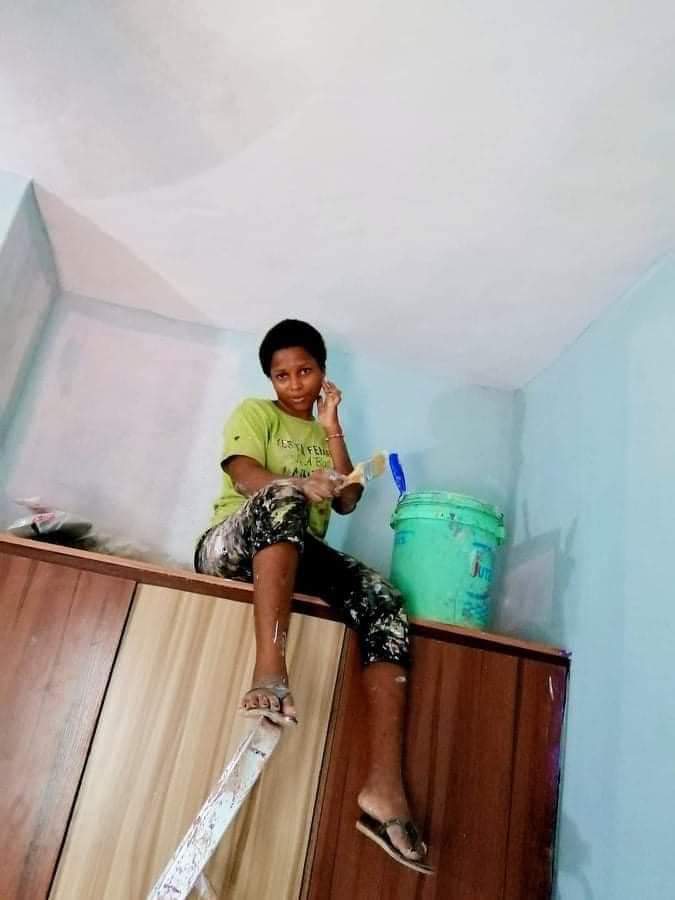
    Mimi faith, the female painter, painting the ceiling

    WEDNESDAY

    I worked on the apartment all day and lost track of time. It was only until my boyfriend called that I realised it was already past six. When I was on the bus, I realised how tired I was. All that was on my mind was the kind of deep sleep I’d get when I got home.

    My boyfriend gave me the massage of my life, and I slept off before I knew it.

    THURSDAY

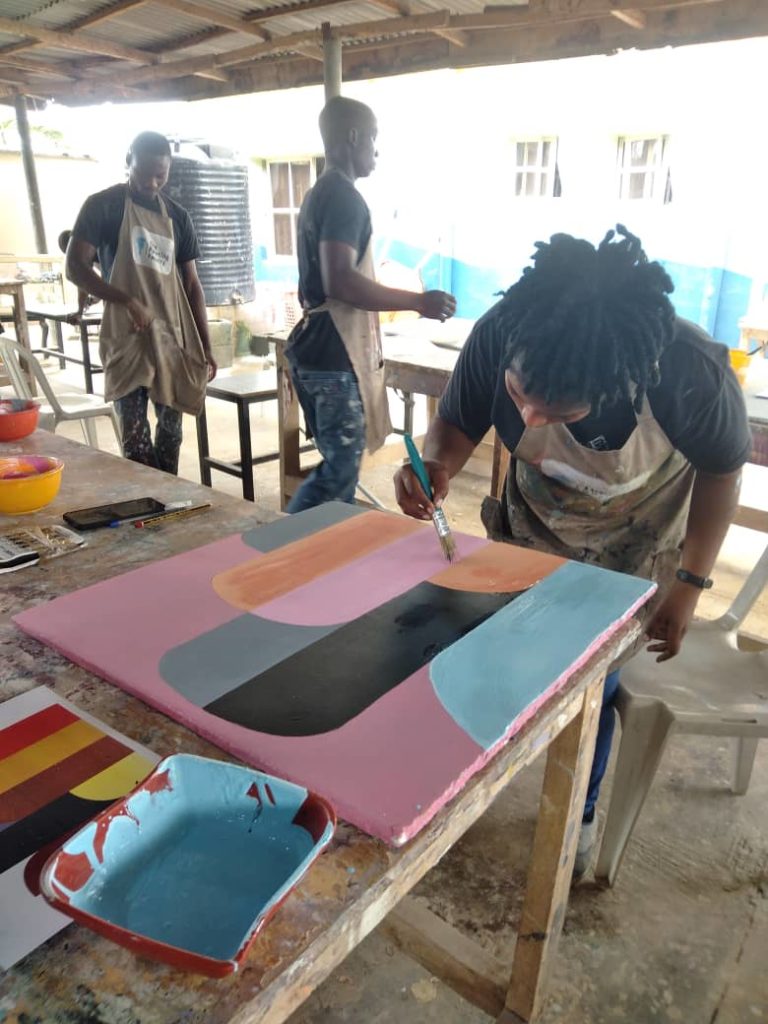
    Pinterest got me into painting. And it was even by mistake. I’ve always liked do-it-yourself (DIY) crafts. Two years ago, I was trying to decorate my house and needed to install wallpapers, so I went on Pinterest for inspiration. Before long, I started looking into wallpaper installation classes online. Soon after, I followed a guy on Instagram, who would eventually train me. 

    But the turning point was seeing the painting design he did in his corridor. I fell in love with it. That’s when I knew I wanted to become a painter. Even though wallpaper installation was easier to learn, I quickly got bored.

    Today, I went to finish up yesterday’s work and had to face the hardest thing about my job: painting ceilings. It’s not that I’m short o; it’s just everyone is taller than me. When I’m painting high points like ceilings, my neck and shoulders scream in pain. But I push through the pain because I chose this work, so how woman go do?

    By 2 p.m., I was done and the owner of the apartment was happy. Job done; smiles guaranteed. On to the next one.

    FRIDAY

    When I first started painting, I met a lot of nonsense men. I quickly realised safety was — and may always be — an issue. Most men contact me to come and inspect their space, but when I get there, they’ll be like, “I been just wan see you”. When it’s not madness.

    I’ve tried a few things to prevent situations like this. Sometimes, I ask for photos and videos of the place to be painted, so I can gauge how serious they are. But people don’t know how to take pictures or record videos well. Some are so bad I have to go and check out the place anyway.

    There was a guy who reached out to me to check out his place. We fixed an appointment, and when I got there, he started telling me things like, “I don finally see you for real life.”. What’s my business? You called me for painting and you’re now telling me to sit down and talk and go out on a date. I just carried my bag and started going back home. 

    Sometimes, men even ask for a date as a condition to hire me.

    My own is let it end in talk sha. Let nobody come close to me or touch me. So I go with a colleague if I have a bad feeling about a potential client.

    Photo of Mimi Faith, female painter, while decorative painting

    What really pains me is how people assume I get jobs automatically because I’m a woman. When in reality, people are always doubting me, especially when it comes to pricing. Very often, I hear things like, “Na because say you be woman, na hin you dey charge this much?” Some people think they’re supporting me or doing me a favour.

    Male painters don’t go through all these shalaye. They just negotiate, do the work and collect their money. When it’s my turn, people will be doing plenty permutations.

    We move sha, because for me, every job is an advert. I want someone to walk into any room I painted and ask who painted it. I focus on doing excellent work, exceeding expectations and getting referrals. My online presence is helping me very well, and some repeat clients still call for me no matter where they are in Nigeria. 

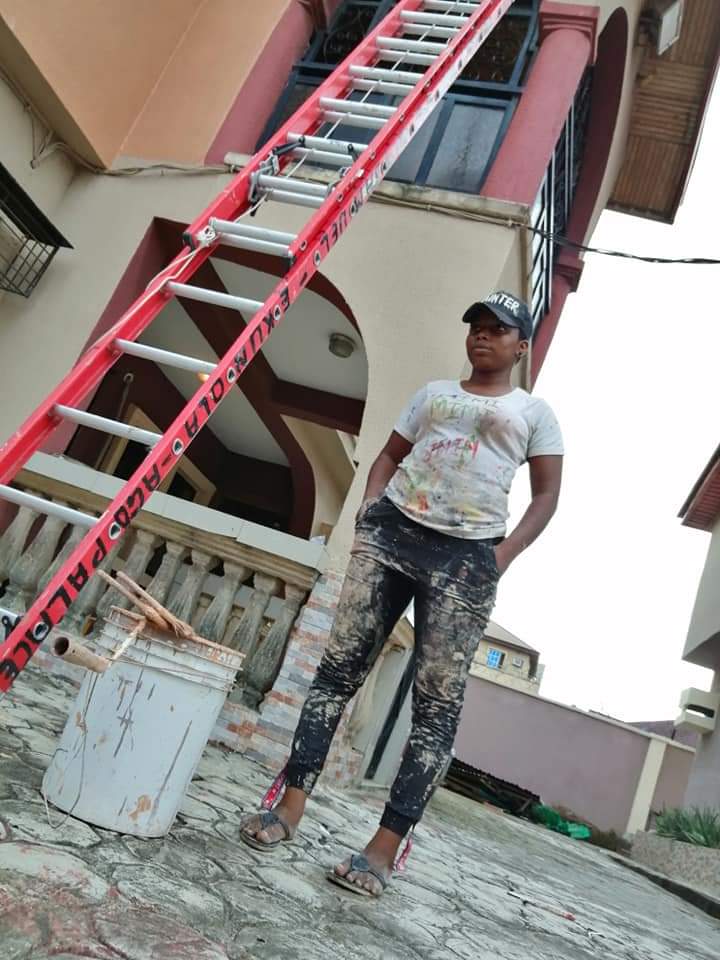
    To be honest, I’ve been fortunate. When I was starting out, a Facebook friend hired me to repaint her apartment. While I was painting, she went live on Facebook and was broadcasting to her friends. Someone noticed I was standing on an inverted bucket to reach the ceiling and offered to buy me a ladder. I thought it was a joke, said thank you and kept it moving. Omo, after I finished, the person said he was serious o, that I should find out the price and let her know. He later sent me the ₦35k for the ladder. That was one of the most touching things anyone has ever done for me.

    Photo of Mimi Faith, female painter, with her ladder and paint bucket

    SATURDAY

    Today, I locked down a contract for a building on the island from a referral, as usual. I start work next week and should be done in three to five days. It’s a big deal for me because it’s another chance to show that I sabi this work. I’ll use this weekend to rest and recharge. Next week, I’ll go there and kill it.

    Stuck in traffic heading back to the mainland, I had the chance to reflect on my work. Normally, I feel like I’m not doing enough, but today, I feel fantastic. I’m just two years into this career, and it surprises me how much I’ve grown. I want to be the best I can be, and I know I can do anything I set my mind to — except cook egusi sha. 

    I’ve worked with women who’ve achieved a lot — women like the one whose house I’m coming from. I see women rent, build and buy houses in expensive areas of Lagos, and I know I want to do the same. The one that pains me sha, is when they say my work ethic inspires them. I dey inspire you, but na you dey build house for Lekki. Please.

    By the time I get home around 8 p.m., my boyfriend has prepared dinner — rice and stew. But it’s not enough. It’s been a long week, my body is paining me and the weather is cold. I want a massage and plenty cuddling.


    If you liked this story, also read: I’m the Only Woman at My Job — A Week in the Life of An Oil and Gas Engineer at Sea


    Check back for new A Week in the Life stories every first Tuesday of the month at 9 a.m. If you’d like to be featured on the series, or you know anyone interesting who fits the profile, fill out this form.

  • “I’ve Only Ever Been Late to Work Once” — A Week in the Life of a Receptionist

    A Week in the Life” is a weekly Zikoko series that explores the working-class struggles of Nigerians. It captures the very spirit of what it means to hustle in Nigeria and puts you in the shoes of the subject for a week


    What’s it like to be a receptionist in Lagos? It involves a lot of patience. In this week’s “A Week in the Life”, Ogechukwu Agwu, a receptionist who works at an FMCG company in Lagos, tells us about dealing with snobbish callers, reporting co-workers who come late to work and why she’s grateful for her job.

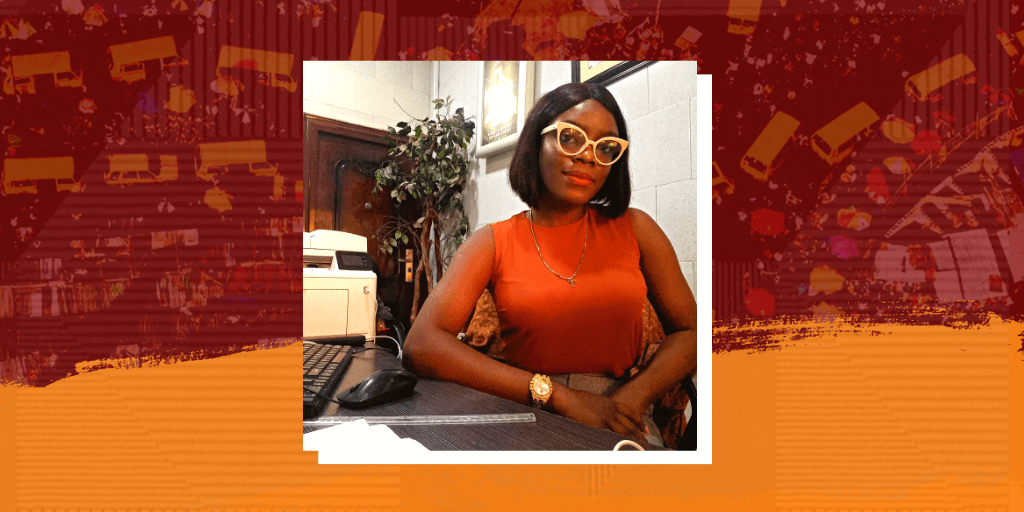
    Roseline Agwu Ogechukwu A Week in the life of a receptionist

    MONDAY


    I never use an alarm because my body just knows I need to get up and chase capitalism. Every morning, I wake up at 5 a.m., and then, I join my family’s morning devotion for 15 minutes. 

    For the next 45 minutes, I prepare lunch for my family, have my bath and dress up. By 6 a.m, I’m ready for work, but I don’t leave the house until 6:30 for security reasons and because of my eyesight, as I have myopia.

    I must be early to work because, as a receptionist at a fast moving consumer goods (FMCG) company at Abule Oshun, Lagos, I’m the face of the office and the first person anyone meets when they step into the building.

    I arrive at 7:45, and when I step into the office, I wash my hands and feet from the dust of public transport and bad roads. I also wash my face and hair, top up my moisturiser and sunscreen, and mentally prepare myself for the day. 

    On Mondays, the sales teams and company affiliates come in for several back-to-back meetings, so there are always so many people around. As I brace myself and mentally prepare to attend to many people today, a salesman opens the door, comes in and says hello. I look at my watch and see it’s ten minutes to eight. His arrival is my cue that the first day of a long week has started.

    TUESDAY

    Apart from the very many salespeople, the rest of the week follows the same pattern: take calls, meet people, take records and help them reach solutions. If a driver comes in and needs to deliver a package, I’m the person they turn to. If an order for a shipment comes through and the driver needs to pick up their products, it’s me they’ll meet. 

    This also means I have to deal with all kinds of people, both well-mannered ones and the ones with attitude. The “do you know who I am” energy around here is insane. Someone can come in and want to walk straight into the offices, and I’m like, “Hi. Good morning. Who are you here to see?” and they’re looking at me like, who is this crap?

    Such is the life of a receptionist.

    WEDNESDAY

    On a normal day, do I like meeting or talking to people? No. But I like this job. This is one of the best companies I’ve ever worked at, where what they promised in my job description is what I’m doing — not much extra work. And even the extra work sef, it’s beg they’ll be begging. So when I’m at work, I give 100% and feel fulfilled.

    Some days, I just come to work, sit down and go home. But there are days when I have to be on my feet, running around and trying to sort out issues here and there. A big part of my work is attending to the drivers moving products, and they give me serious headache. 

    Like a driver today, he came to carry 100 cartons of products, but the vehicle he came with couldn’t possibly contain everything. Man just came to sign. I looked through my window and asked him, “Wait o. Is that your vehicle?” In cases like this, the warehouse may have documented for him to carry 200 cartons first and come back for the remaining 300. But these drivers won’t inform me. So when it’s time to balance the books, my own documents won’t correlate with the warehouse people’s.

    I spent the rest of today fighting fires — calling people up to balance out documents, a driver’s diesel finished and needed money, another person needed money to replace truck tires. 

    By the time I got home, it was almost 8 p.m. I was so tired, I didn’t even do my full skincare routine. I just took my micellar water, cleaned my face, had my bath and closed my eyes to sleep. 

    THURSDAY  

    What I dislike most about work isn’t work. It’s the process of getting to work. Even though I’ve been working here for a year now, I’ve still not gotten used to the daily commute. I’m not an early morning person, so it’s always a struggle. 

    One time, I had to squat in a bus carrying pineapples and other farm produce because there was no danfo on the road. The bus didn’t have any seats, so I squatted all the way from Volks to Abule Oshun. By the time I got to the office, I was already tired.

    One of my duties as a receptionist is to check the roster for arrival times of co-workers and mark lateness. In this company, lateness starts at 8:30 a.m. Anyone who comes in by 8:31 gets ₦500 deducted from their salary per late day at the end of the month. Anyone who arrives after 9 a.m is minus ₦1k, 10 a.m is minus ₦2k, and so on. At the end of the month, I draft an Excel sheet to report defaulters. 

    When I joined the company last year, the lateness deadline used to be 9 a.m, possibly because of the COVID-19 pandemic, but human beings know how to misuse grace. People started coming by 10, 11, so my boss pushed the deadline back to 8:30 a.m. and imposed the fines. People sat up immediately. But it pained me because now, I have to rush to the office before eight o’clock every morning, especially as I’m the first point of call in the company. 

    I’ve only ever come late to work once — around to nine — and of course, they reduced my money by ₦500. I couldn’t even disguise because, as I entered the office late, I jammed HR. But no wahala sha. Never again.

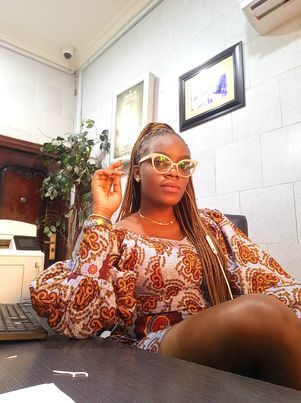
    Roseline wearing the glasses frames she sells

    FRIDAY

    It’s TGIF today, but not for me because my Saturdays are to chill. I also have time for my side business selling frames for eyeglasses

    When I left my office today at 4:30, it hit me that for once in a very long time, I’m actually enjoying my day job. Because me, I’ve seen shege. 

    In my previous job, I was both receptionist and cashier at a lab on the island, where I worked six days a week. I was also an errand girl they sent to the bank. It was a horrible place to work, and I barely had personal or family time. But I now have time to do things like chill with family and attend choir rehearsals and still run a side-hustle without stress.

    As I board the danfo, I know I’ll get home before 7 p.m despite the rush hour traffic, and cook dinner for my family.


    If you loved this receptionist’s story, you may enjoy: A Week in the Life of an NCDC Call Centre Agent


    Check back for new A Week in the Life stories every first Tuesday of the month at 9 a.m. If you’d like to be featured on the series, or you know anyone interesting who fits the profile, fill out this form.
  • The Product Designer on a Mission to Change Her Passport — A Week in the Life

    “A Week in the Life is a weekly Zikoko series that explores the working-class struggles of Nigerians. It captures the very spirit of what it means to hustle in Nigeria and puts you in the shoes of the subject for a week.


    The subject of this week’s #AWeekInTheLife is Lola Salehu, a Nigerian product designer based in Dubai. She tells us about switching from coding to design, the intentional way she sees the world and the most important thing on her bucket list — to change her passport.

    Photo of a woman sitting with the caption: The product designer on a mission to change her passport lola salehu

    MONDAY

    I live in the UAE and work for a company in the United Kingdom (UK), so I’m three hours ahead. I can decide to start working at 9 a.m. my time, or noon (9 a.m. UK time). Today, I’m choosing 12 p.m.

    But before then, I go to the gym from 7 a.m. to 9, return home and freshen up. I recently started taking hair and skin care seriously, so I spend an hour on those before settling down to a light breakfast of oatmeal.

    When I resume work, it’s a lineup of meetings until the end of the day, aligning with other team members and business stakeholders until 3 p.m. Then, meetings with my team members for the next two hours. After that, I could do some hands-on design, run feedback loops for my team or analyse data to get insights that’ll help us decide what to build next.

    When I close from work around 7 p.m., I shift to my personal projects. I’m currently working on a course for designers, and volunteering at upcoming tech communities. Then I take a walk and grab dinner, which could be a burger or jollof rice. If I’m feeling fancy, I buy shawarma. When I get home, I eat, and around 10 p.m., I go to bed.

    TUESDAY

    I lead a team of two product designers, one brand designer and one web designer. While Mondays and Wednesdays are heavy-meeting days, I do more hands-on work on Tuesdays and Thursdays.

    As a product designer, my Tuesday can involve collaborating with other teams — marketing, sales, finance, engineering and product teams, etc. I make digital products that work and people can use — phones, laptops, watches or even VR headsets. The products I design must solve problems for both individuals and businesses.

    Every company has business goals, and I’m working to achieve a goal every quarter. My job as a product designer is to make people care about how the business intends to solve the problem. It involves elements of storytelling, innovating and prototyping solutions that I think will solve whatever problem the company is looking to solve for its customers.

    To do this, I talk with the customers a lot. My job involves a lot of collecting and interpreting data to make sure we’re prioritising what they really want and deciding on what’s nice to have while considering the business objectives. At the end of the day, I need to make sure my team has met those goals.

    WEDNESDAY

    Today, I worked on testing out a user flow with customers. In product design, a user flow is the path a user takes to complete a task on a website or app. I recorded the process from start to finish and couldn’t help but notice how flexible this job is compared to my previous one.

    These days, I’m more flexible with the kind of data I collect and work with. I can watch recorded sessions to observe the behaviours of our customers and make informed product decisions on the fly. Unlike when I was in fintech and couldn’t record certain things. For example, you can’t record sessions on a fintech app in case a user might be typing in their card details.

    I loved being at the centre of payments processing in Africa, but fintech in the West is very different from how it works in Africa. Yes, there are regulations, but the government won’t just wake up one day with a policy that would reset your business, for instance.

    Lola Sales speaking

    THURSDAY

    I love teaching when I’m not working. That’s why I’m putting together a course for designers. In my spare time, I also have speaking engagements in tech and youth events where I pick a topic and teach people about it. I’m a designer, so naturally, I can’t shut up about design, which is funny because I didn’t always want to be a product designer.

    I was a software engineer for two years, and there was this designer at the company I worked. While I’d be scratching my brain over coding a feature, this guy would be designing the next one. I thought it was easy, and I was like, “Omo, I don’t want to be doing 2+2 = X logic coding for the rest of my life.”

    Only for me to switch to product design and see pepper. But I realised engineering and product design are pretty much solving the same problem in different ways. Nothing is easier than the other. While coding is logical, design is analytical and creative. I liked this way of solving problems, so I stuck with it.

    After work at 6 p.m. today, I went out for a walk and took pictures of the cityscape. When I got back home, I journaled for a bit before sleeping. I love documenting memories of even the most random things and writing or creating photo journals to relive them. 

    FRIDAY

    On Fridays, the TGIF energy starts early. I mean, it’s the weekend!

    I see the world in colours and pathways and processes. That’s why I love living in Dubai. This city started as a desert; all they had was sand. But they designed this sprawling city with so much thought and intention, and were successful at it. I apply this mentality to everything I’m doing, and I know everything will come out fine. 

    But another thing that drives me is my desire to escape the limitations of having a Nigerian passport. While we have a rich history, culture and creativity, there’s not much Nigeria has done for me — instead, it often takes from me. 

    I want to change my experience and see what the world offers. I don’t want to stay three hours extra at an airport because I’m Nigerian. I don’t want to meet people who’re wary of me because I’m Nigerian. So in five years, I see myself in a new life with a new passport and glorious new adventures. 


    If you liked this story, you might like this too: “I’m a Firefighter at My Job” — A Week in the Life of a Fintech Marketer


    Check back for new A Week in the Life stories every first Tuesday of the month at 9 a.m. If you’d like to be featured on the series, or you know anyone interesting who fits the profile, fill out this form.

  • “In Computer Village, Every Day, New Drama” — A Week in the Life of a Computer Vendor

    “A Week in the Life is a weekly Zikoko series that explores the working-class struggles of Nigerians. It captures the very spirit of what it means to hustle in Nigeria and puts you in the shoes of the subject for a week.


    The subject of this week’s “A Week in the Life” sells gadgets at Computer Village. He tells us about the chaos of the Village and how he manages to stay faithful in a market infamous for dishonesty.

    Graphic image of In Computer Village, Every Day, New Drama” — A Week in the Life of a Computer Vendor (1)

    SUNDAY

    I sell phones, laptops and accessories in the Lagos Computer Village. My week starts on Sunday night because business almost never stops — na them dey rush us. 

    From 6 p.m. until around midnight, I respond to messages from people making inquiries. When I receive payment for an order, I verify it and schedule delivery for Monday morning or whenever they need it. Doing so on Sunday nights makes my already busy Mondays more bearable.

    MONDAY

    I wake up by 5 a.m. every Monday morning to get ready for the week. By 6 a.m, I leave Ogba and head out to my shop in Computer Village, Ikeja. Depending on the traffic situation, I can get to my shop by 7:30 or around 8 a.m. Resumption time is 9 a.m. but I like to arrive early so I can get a head start. Also, the orders from the previous night need to be dispatched as early as possible. If I waited until 9 a.m. to resume, stress would kill me.

    I get most of my orders from social media and Whatsapp, from first-time customers and a network I’ve built over the years. 

    By 12 p.m., I take a two-hour break to either nap, stroll around the Village or go see my girlfriend who lives close by. I head back to the shop at 2 p.m. and keep selling until 6 or 7 p.m. when I close and head home. Sometimes, people keep coming after 6,especially those who have office jobs, and I have to attend to them.

    At 7 p.m., I turn off my data, put my phone on silent and place it in my backpack because the way home is dangerous at night. I also put any cash I have into the bag and hold it as if my life depended on it — I’ve been a victim of pick-pocketing before. 

    Due to Monday’s rush-hour traffic, it takes two or three hours to get home. I have dinner, respond to more inquiries and take more orders until sleep calls.

    TUESDAY

    Computer Village is wild gan! If you lose guard, you go collect. But even with all the warnings, some people are either too naive or don’t hear word. I saved someone from being duped today.

    If you’ve ever been to Computer Village, you know that it’s very easy to get scammed. Everyone knows about buying a phone only to find out that there’s fufu inside, right? That’s old news. The reigning one these days is taking the panel of an older model of a phone and wrapping it on a new model to dupe unsuspecting customers. They can cover the panel of an iPhone XR in an iPhone 13 casing.

    A woman came to my shop and asked to buy a London-used iPhone 13. The market price of such a phone is ₦430k. She complained that it was too much and went elsewhere. Soon after, she called me and started cussing me out. She called me a thief just because she felt my price was too high. After all, she found someone to sell it to her for almost half my fee. 

    After she’d finished ranting, I told her it was unnecessary. She could have either told me she wasn’t buying or given me the “I’ll get back to you” line and ghosted. There was no need for her to insult me. She hung up and forwarded a message to me on WhatsApp. Someone was willing to sell it to her at ₦250k. 

    I did a double-take and asked her if that vendor was in Computer Village. I told her it was impossible for someone to sell an iPhone 13 for so cheap, even if it had faults. She kept arguing, and then, she sent me a photo of the phone. I took one look and knew it was a scam. But she refused to believe me. According to her, I just wanted to chop her money.

    I’d have collected my “L” and kept it moving o, but I decided to get her to ask the vendor about the phone. I told her to tell them a fellow vendor was asking. The vendor admitted that it was an iPhone XR in an iPhone 13 case. 

    She started wondering why they didn’t tell her from the beginning. In Computer Village? Where almost everybody is hustling by hook or crook? Plis dear!

    I don’t take disrespect lightly, so after that conversation, I deleted her number along with the Whatsapp conversation. I was angry.

    WEDNESDAY

    In Computer Village, every day, new drama. Everybody thinks they’re smart — not just traders; even customers do dishonest shit. But me I sha know how to give close marking. 

    Today at the shop, these three guys came to buy laptops and behaved strangely. I know there are customers who can’t make up their minds, but these ones rubbed me off the wrong way.

    I closed the door and stood by it, making sure all three guys were inside. As they kept asking for laptops, dropping them and asking for more, me I knew it was “format”. I promptly texted my shop assistant to watch them closely and ensure she returned every laptop to the show glass as soon as they dropped it so that we won’t hear stories that touch. The guys got frustrated and left eventually. Awon oloshi.


    Editor’s pick: The Zikoko Guide to Surviving Computer Village


    THURSDAY

    The first rule of Computer Village is to never follow anybody you don’t know. Those boys and men who prowl the streets, who don’t have shops, avoid them. The best thing is to have a trusted plug or get a referral. Even if you don’t know where you’re going, you must never show it. Find a proper shop and do your business; never trust a stranger.

    People fall victim every day. Like today, I went to get a spare part from a colleague and found somebody sitting in his doorway. After some time, people at the shop noticed he wasn’t doing anything, so we asked him to leave if he didn’t have any business there. 

    The guy (let’s call him Bayo) told us he was waiting for someone. Who? He mentioned someone nobody had heard about. We suspected foul play and asked what happened. This man told us he needed to change his screen, so when he got to the Village, someone approached him and said he could fix it. But first, Bayo had to give him ₦15k to buy a new screen as he was just an engineer. When he was done, Bayo would complete the payment for workmanship.

    The man brought Bayo to the shop and told him to wait, but hours later, neither screen nor “engineer” was anywhere to be found. We just told Bayo, “Your phone don go. Sha dey go house.” 

    We taunted him sha, because that’s how we do. How you go follow person wey you no know like zombie? At least, whenever he hears gist about Computer Village, he too will have a story to tell.

    FRIDAY

    In Computer Village, everybody minds their business. If you see someone getting duped, mind your business. Most times, it’s their greed that’s getting the better of them. Unless you want to put yourself in trouble, just keep it moving.

    Sometimes, a deal goes bad and the customer returns. Maybe they were sold something that didn’t last as long as expected or developed a fault. They’re not coming back peacefully; they’re coming back with “Indaboski”. Unless I know the seller and can vouch for them, in which case I’ll step in and try to resolve the conflict, but if I don’t know them? As I see the angry customer starting go cause a scene, I’ll just do “eyes right”.

    The biggest lesson I’ve learnt is to be a straightforward person. When I started this business in 2013, I was lucky to be handheld by the kindest vendor, and his values have stayed with me.

    So even though Computer Village is infamous for deception, I choose to keep my customers happy because nothing matters to me more than peace of mind. I treat everyone as if they’re my only customer, and it has worked for me so far. I get a significant amount of referrals weekly.

    Thankfully, my customers treat me the same way.


    If you enjoyed this “A Week in the Life”, check out: A Week in the Life of a Computer Technician Selling Ewa Agoyin on the Side


    Check back for new A Week in the Life stories every first Tuesday of the month at 9 a.m. If you’d like to be featured on the series, or you know anyone interesting who fits the profile, fill out this form.

  • “I Love Transforming People Into Rich Aunties” — A Week in the Life of a Textile Designer

    A Week in the Life is a weekly Zikoko series that explores the working-class struggles and victories of Nigerians. It captures the very spirit of what it means to hustle in Nigeria and puts you in the shoes of the subject for a week.


    On today’s #AWeekInTheLife, we feature Samiat Salami, who designs textile prints which she uses to make ready-to-wear clothes and home decor. She walks us through her design process, the pains of running a global business in Nigeria and how difficult it is to find plus-size models for her robes.

    Graphic image of Samiat Salami, A Week in the Life of a textile designer

    MONDAY

    I’m not an early riser because I wake up multiple times during the night, so I usually get out of bed at 9 a.m. Because I have asthma and tend to wake up with a sore throat thanks to the air conditioner (AC), the first thing I do is have a cup of tea to help me clear my sinuses. 

    I try not to open my phone or computer first thing in the morning because if I do, anxiety will kick in, and I’ll get caught up in the slog of it all for the rest of the day. So while enjoying my beverage, I like to live in the moment for a bit; I can read a chapter of fiction on my toilet seat or mosey around the house.

    By 10 a.m., I finally switch my phone on. And the minute I do that, it’s an avalanche that never ends, back-to-back calls or emails or whatever else I need to catch up on. 

    As a textile designer, I work with many artisans, and it’s a lot of stress! I get so many calls from people going, “We’ve run out of blah blah blah”, “Did you really want it this way?” and “Because we did it this way the last time and you didn’t like it, we thought we have to ask you specifically before…” Yeah, there’s just a whole bunch of back-and-forths. 

    I also work with manufacturers who sew my designs into actual products. So I’ll need to give and receive feedback from them as well. Then, I have to work with retailers I sell my stuff to in the US, and they would usually have follow-up questions. I also do a healthy amount of customer service following up with direct online orders and on social media.

    Around 1 p.m., my team members come to my house where the living room doubles as my studio, where all the following-up comes to a head. All the “Do we like this print?” “Do we not?” “Will this print be better for robes or tableware?” “Do we need to talk about different marketing ideas?” “Do we need to shoot a campaign?” “Are we planning for this?” questions get answered from 1 – 6 or 7 p.m. We just go ham and it’s pretty intense. The day tends to be very fast-paced, but we make sure to take short breaks for lunch and to catch our breaths.

    By 6 p.m., I’m hammered and restless. So when everybody leaves, all I want to do is go for a walk around my estate. I have a restless body that’s always trying to keep up with my mind and walking helps me catch up. When I get back, I just collapse into bed.

    Samiat Salami

    TUESDAY

    My process of designing textiles begins with prints and patterns. I’m inspired a lot by the flora and fauna of Nigeria, and I do a lot of research for each collection, about the origin of a plant, how it falls, what it’s like, the colours… I often take long walks in nature, taking loads of pictures of flowers and other beautiful things I see. I curate all these photos into a mood board. Then I work with my illustrator to refine them.

    For example, for the hibiscus prints I’ve been working on for months, it was just me taking loads of different species of hibiscuses I’ve seen in nature. I took pictures in Nigeria, and in California and Florida. After photographing, I’ll study the patterns, like how they go from red to yellow, for example.

    Next, I work with my illustrator to create digital designs inspired by my mood board. Then we’ll send them to a really lovely man in Osogbo with whom I like to work, and fabrics for him to hand-draw the patterns on — he has to translate our illustrations into something that’s a lot more illustrative by hand. When he’s done creating the sample prints, we’ll go through several iterations until we get it right. 

    WEDNESDAY

    I only meet my team about three times a week, so when I’m not having anyone come around my apartment, like today, I’m running around Lagos. 

    After catching up on emails and correspondence at around 12 p.m., I head out to Surulere or Lekki where my manufacturers operate, to approve things and discuss samples and finer details of new products.

    For example, if I’m doing a fit test — putting a garment on a fit model — I’ll have to make different iterations to get it right, and that can take a whole day because it involves a lot of back-and-forths. It’s like: “cut it”, “put it on”, “twist it this way”, “put it back on”, and so on…

    I use myself a lot, which is interesting because I’m not the typical fit model. I have very small body parts, and I’m only five-two. When people think of models, they’re typically tall and slender and have no curves. But that doesn’t translate into the body of many Nigerian women. This is why so many people struggle with traditional brands.

    For me, I’m smallish, and I have thighs and boobs, and all sorts of things that aren’t straight, so I need to know how the clothes fit me so I can translate how it would fit other body types. This is why I’m size-inclusive. One of the reasons I started my brand is that I got frustrated struggling to find clothes that fit me.

    So now, I make clothes for people of different sizes: people who are larger, people who are thinner, people who are top-heavy or bottom-heavy, etc. I want everybody to feel comfortable and safe and happy in my clothes. I don’t want anyone to have to feel like they’re conforming to any standard of beauty I’m setting. This is not about me. It’s about you feeling fucking great in whatever I make for you.

    But it’s been really difficult for me to find models above a certain size, and I don’t think it’s because we don’t have women like that. Such women shy away from that industry because they’re often told that they’re not the ideal of beauty. There are cultures that find only thin people attractive, but that’s not Nigerian. I’m currently on the lookout for bigger models.

    THURSDAY

    One of the most frustrating parts of my work is that the manufacturing industry in Nigeria doesn’t have a solid structure yet. Countries like India, Indonesia, Morocco and Mexico, all have long histories of artisanship that have been vetted and worked with other countries. There are whole brands, American and British, that go to places like India to mass-manufacture. These countries already have legacy systems in place for everything. We don’t have that yet in Nigeria; we don’t have working production systems, so it’s difficult to get things done. 

    So I find myself having to build everything from the ground. It’s gruelling, but it’s me that chose this life.

    Because of this, problems come up all the time in manufacturing. For instance, I only work with 100% Nigerian cotton, like Funtua. Funtua is not the kind of thing I can just go to the market in Lagos and buy because I manufacture in such large quantities, so I buy thousands of yards at a time. I get it from Kano. And now, there are problems like insecurity and terrorism plaguing that area, so these materials are becoming increasingly difficult to get. 

    My suppliers can just increase their prices in a blink of an eye because of all the inflation and uncertainty. Imagine how much this affects my estimates and budgets. Things like this affect production and delivery to customers. I’m not really good with sloppy work, and my perfectionist self has to deal with all these variables. It’s so tiring.

    photo of Photoshot involving the textile designer

    FRIDAY

    Today, I received satisfactory feedback from a client. It’s the best thing in the world for me. I love that twinkle in their eyes when they try something on and go, “I look fabulous”. Especially the robes, as they tend to have a kind of decadent feel so every time someone puts them on, I can see their demeanour change. They take on this kind of rich aunty or uncle vibes, and I’m just like, “I’m here for it!”

    Seeing people love something I made, after all the labour, brings me unspeakable joy. It’s especially fulfilling because my designs don’t always translate properly to print. So when we finally get it right and people fuck with it, that “oh, I made a beautiful thing” feeling washes over me.

    textile designer Oya Abeo robes

    SATURDAY

    I went to Ibadan with my team today. I’ve always had this fascination with the city. As a child, one of my many ambitions was to study Yoruba and teach at the University of Ibadan (UI). Ibadan is one of those cities where the myth of it is so rich and so closely tied to what it means to be Yoruba. It has hills and red sand, a rustic feel and a certain kind of magic you can’t find in Lagos. Ife is another such city. 

    The last time I visited Ibadan, I knew I wanted to shoot a campaign there. So when we got into Ibadan today by train, we went straight to Amala Skye in Bodija to get our amala fix. Mehn, I ate the best ogunfe I’ve ever had. Then, we lodged at the International Institute of Tropical Agriculture (IITA) at Moniya. 

    I’m excited about this campaign because I’m working with an all-women team. I love when I get to work with women. The energy is always different. I like working with men too, but working with a bunch of creative women in the same room? The energy is kind of magnetic and beautiful. We’ll continue shooting in choice locations around the city for the next few days, and I can’t wait for all the beauty that’ll come out of this project.


    READ ALSO: A Week in the Life of an Instagram Thrift Vendor


    Check back every Tuesday by 9 a.m. for more “A Week in the Life” goodness, and if you would like to be featured or you know anyone who fits the profile, fill out this form.

  • The Doctor Who Ditched Clinical Practice to Sell Perfumes — A Week in the Life

    A Week in the Life is a weekly Zikoko series that explores the working-class struggles of Nigerians. It captures the very spirit of what it means to hustle in Nigeria and puts you in the shoes of the subject for a week.


    Kedei Ibiang is a medical doctor who specialises in public health, but she quit her job this year (2022) and turned her focus to selling fragrances and scented candles. For today’s A Week in the Life, she explains the process of making fragrances, why she quit her job and the beauty of being in control of her time.

    Photo of: graphic design of a doctor who left her job to sell perfumes

    MONDAY

    I’m not a morning person, so when I wake up at 7 a.m., the first thing I do is pick up my phone to check social media. I spend about 20 minutes checking my inboxes to ensure I’ve not missed any messages or inquiries from customers or prospective customers. Then, I catch up on Facebook and Instagram. There’s always one drama or the other. The recent one is about some lady influencer who scammed people for billions of naira in a Ponzi scheme. After 30 minutes of mindless scrolling, I’m out to face the business that pays me.

    I spend the rest of the day packaging orders within Abuja for the delivery guy to pick up. When he does, I follow up with him and ensure that all the orders reach their buyers. For interstate orders, I have an account with a delivery company. The dispatch rider picks up the orders and drops them off at the company’s office, and they take it up from there.

    I have terrible eating habits which means I often forget to eat. Ironic that I’m a doctor but I’m not a fan of food. If I could find a way to exist without eating, I would. But by late afternoon, I order food and go back to work until 7 p.m. I don’t have a social life, so after work, it’s Netflix until 10 or 11 p.m. when I sleep.

    TUESDAY

    When I started using perfumes around 2006, I discovered that I couldn’t use most sprays because my mum and I are asthmatic. I had respiratory allergies myself, which meant that the alcohol in perfumes choked me. The best I could use were roll-ons and body mists because of their lower alcohol content. Even then, I would run into the bathroom, spray whatever I needed to spray while pinching my nose shut, and run back into the room, slamming the bathroom door shut so I wouldn’t inhale the spray. Wild times.

    But in 2017, I decided to look for non-alcoholic alternatives that are non-toxic and hypoallergenic. My search led me to start Kay’s Perfumery the following year. I eventually Then I expanded my product line to producing and selling scented candles, diffusers and room sprays. I also formulate fragrances once in a while.

    My process starts with contacting my supplier in Dubai. Once every three or four months, I send him a list of fragrances I need, and we conclude on quantity, sizes and pricing. My orders usually cost anywhere from ₦300k to ₦600k, but the naira’s freefall has really affected my business. The quantity of oils I’d have gotten for ₦300k in 2021 now costs me an extra ₦75k to ₦100k. It’s really wild.

    When I’m ready to pay, I send the payment through a middle man who converts my naira to dirhams. Once my supplier confirms that I’ve paid, he ships my order.

    I play around with ideas in my head a lot, so when I get one that sticks, I just type it out on my phone’s notepad and expand on it. When I have enough options for the notes, I start formulating the scent. It’s sort of an elimination process: I decide on my main notes and the ones that I want to be in minute quantities, then I come up with the first sample which I test for notes and sillage — the trail created by a perfume when it’s worn on the skin. If I don’t feel comfortable with the scent, I go back to tweak it — drop some percentages, increase others, add a new note and repeat the process to come up with a second sample. I test it again: do I like it? Is it nice? Does it linger? I could repeat that process up to five times until I get something that works nicely. When I’m satisfied, I wear it out to gauge people’s reactions and the kind of compliments I get. 

    If it’s a scent I think would sit better on a guy, I gift it to a few friends or some old customers — if a longtime customer is lucky enough to be placing an order at the time I’m creating a new scent, I just throw in a small sample and ask them how they like it. I use their feedback to decide whether or not I’m adding it to my product line. 

    And when I create a scent that bangs? It really bangs. In December 2021, I formulated a signature diffuser — I called it “Christmas Wine” — that was a hit. I sold over ₦400k worth of it in eight days! The orders poured in so much that I had had to stop taking orders for two days so I wouldn’t break down from stress.

    WEDNESDAY 

    Today, while I was writing ideas down for a new candle scent, I remembered the time I made a scent that flopped. 

    Before Valentine’s Day this year [2022], I was working on three special candle fragrances: Date Night, Love Potion and Let’s Get Nutty (which had coconut and truffles in it). I spent so much time on Love Potion because I wanted it to be the flagship. I had made noise about it on social media and people were hyped! I received so many pre-orders. The mix of notes was just perfect… in theory, but when I produced it, it turned out mid as fuck. 

    I tried so hard to make it work but it just didn’t. I was running out of time so I had to abandon it and inform my customers that Love Potion wasn’t going to be available due to unforeseen reasons. Luckily for me, customers accepted other fragrances. The Let’s Get Nutty that I didn’t really put much effort into making turned out to be the star — and saviour — of the show. 

    THURSDAY

    Even though everything in this Nigeria is out to frustrate business owners, I still derive joy from this entrepreneurship thing. I carry my customers on my head, and I love it when they’re delighted, but once in a while, someone comes around and moves mad.

    When I’m not making signature scents, I sell candles wholesale and produce in bulk for other brands. The candle industry is fairly new in Nigeria. People have started appreciating scented candles, so these days, they bring me almost 70% of my monthly revenue. Vendors buy my custom scents, slap their branding on them and resell. Sometimes, I take orders to import specific scents that can’t be found here, and I sell them as well.

    In February, a lady reached out and asked me to make candles and diffusers, and import packaging materials for her. She had very niche requirements, and her order amounted to ₦1.2m. We spoke for over a week. I invested so much time and effort into this deal. I even informed my suppliers, and we finalised on shipping and delivery timeline. All that was left was payment. Then this babe ghosted me.

    This thing pained me, I can’t lie. I’d been so happy about the deal because I wanted to get some things from a supplier in China at around the same time she reached out. I was like, “Oh, perfect. I’m just going to throw my other cargo into this and ship all of them at once.” The ghosting touched my chest. 

    To add insult to injury, she now blocked me. I was shocked when I found out. All she needed to do was just let me know she wasn’t going to proceed, but she just went ahead and blocked. Just. Like. That. 

    Me that like closure, I reached out to her through my personal IG profile only to receive excuses and apologies. She told me that something came up and yada yada yada. She now promised to continue the deal later on. Abeg abeg. At that point, I no longer gave a damn.

    That experience has taught me to be more apprehensive of customers when they make certain inquiries. Sha the information I fed that babe for free, ehn? I suspect she didn’t really want to buy from me; she just wanted information. I hate when people waste my time. But we move.

    FRIDAY

    It’s not every day you see a medical doctor who sells perfumes, but abeg, at the moment, I’m not “doctoring”. I never liked clinical practice because it was very monotonous. I hated going through the same processes every day go to the hospital at 7:30 a.m., work all day till maybe 4 p.m., attend to the patients, rinse and repeat.

    When it was time to specialise, I decided to go for public health because no two projects are the same. There’s always variety. I could work with organisations that either run as private firms or provide public health services to the government. So everything from infectious diseases or sexual reproductive health or maternal and child health. 

    For a while, I was running my fragrance business on the side. I used to coordinate a gender-based violence project that wrapped up in 2021. After that, I decided to take three to four months off to focus on my perfume business and do some serious marketing. During that time, I applied to several grants and won one of them. 

    This year (2022), I decided to delve back into public health, so I joined an organisation in March. But it didn’t quite work out. I didn’t enjoy working there, and even though it paid quite well, the work culture was very different from what I was used to. The environment was beginning to tell on my mental health, so I quit after one month. Now, I’m back to focusing on Kay’s Perfumery full-time. That doesn’t mean I’m done with medicine. I still have a lot of plans for the year. 

    I have an assistant who helps with inventory, so after the dispatch driver picks up the orders for today, I catch up on the International Health and Women’s Rights course I’m taking. There’s another course on health tech that I’ve abandoned for a million years, but I intend to go back to it.

    I didn’t exactly plan my work life to turn out this way, but it couldn’t have been better if I did. I love that I own my hustle and I get to create and execute my ideas. I’m excited to see what more the future holds. Who knows? I could be expanding to skincare soon.

    I study till I’m tired. By 7 p.m. on those rare days I feel like stepping out for fresh air, I’ll just check on a friend to see if she’s free. If she is, we’ll have a chill girls’ night out till about 10 or 11 p.m.


    Check back every Tuesday by 9 a.m. for more A Week in the Life goodness, and if you would like to be featured or you know anyone who fits the profile, fill out this form.

  • A Week  in the Life of a Hostel Caretaker Enduring Occasional Tenant Madness

    A Week in the Life” is a weekly Zikoko series that explores the working-class struggles of Nigerians. It captures the very spirit of what it means to hustle in Nigeria and puts you in the shoes of the subject for a week


    The subject of today’s “A Week in the Life” is the caretaker of a hostel close to a university that houses 45 self-con rooms. He talks about the chaos of his job, managing difficult tenants and his dream to japa one day.

    A week in the life of hostel caretaker

    I usually wake up around 6:30 to 7 a.m., but sometimes it can be earlier. My family and I live in one of the rooms in the same building where I work, and I work seven days a week, so I can’t separate work from life. 

    Tenants usually wake me up for one thing or the other. Sometimes it could be that water finished overnight and a tenant is calling me first thing in the morning because they have to bathe and go to work. So I have to get up, put on the gen and pump water. Or maybe someone’s shower got blocked and I need to call a plumber as soon as possible. There are 45 self-contain rooms in this building, so problem no dey finish. But thank God this morning is problem-free so I can sleep till 8 a.m. 

    My daughter is at her grandma’s for the holiday, but immediately I rise from the bed, my secondborn — who is just a few months old — starts crying. My wife gets up and carries the baby. 

    As the hostel manager, my responsibility is to make sure the compound is neat and well-maintained. Since every tenant pays an annual service charge upfront, I also have to make sure they’re comfortable. If there’s a socket that suddenly stopped working, I call an electrician. If someone’s having trouble with their lightbulb or kitchen sink, na me dem dey call.

    I spend my days in the compound doing almost the same things 24/7, and it can get boring, but how man go do? Today, I’m happy sha. A former tenant came in the afternoon and we chatted for hours until nightfall. It’s been a long time since I last saw him, so the gist was plenty.

    TUESDAY

    My job is easy these days, but it wasn’t always like this. When I got employed in this building last year, I saw pepper. In late 2020, I got hired to care for this building. It was a new building that was taking tenants for the first time, and management made a lot of — I don’t even know if I should call them mistakes or just negligence. 

    The problem is that first of all, they built this hostel as if they were building it abroad: three columns of apartments facing each other, but they now sealed the small corridors in between with a plastic roof. And they didn’t stop there. They wanted to make the building shine-shine, so instead of leaving space for small breeze to be flowing in front of the building, they went and covered everywhere with glass blocks which ran from the ceiling to the ground floor, covering every inch of space. Without any air conditioning system.

    While the hostel building looked fancy from the outside, the way they built it wasn’t practical. The self-con rooms are small and have only one window each. But the builders put solar panels and inverter in the building, and that’s what they used to market the rooms. All 45 rooms were taken in two weeks. But small time, problem started coming.

    When tenants paid their one-year leases and service charges in December 2020, the harmattan hid the ventilation problem in the building. Also, it was dry season so there was sufficient sunlight to power the solar inverters. Everybody had fun. 

    Until the heat came in February. NEPA stopped bringing light and the inverters started running down frequently. Hot air was trapped within the building with nowhere to go. Tenants complained, but building management didn’t say anything. After some time, the tenants transferred their vex on me. I tried to explain to them that none of this was my fault, but since I was the only representative of the building management on-site, na me collect all the complaining and insult. It was the most difficult time of my life because I lived in the same building as the tenants and was suffering the same problems. I asked the manager to buy a backup generator for but she ignored me.

    Then one day, after NEPA refused to bring light for two days, the inverter went off in the middle of the night, around 2 a.m. Water also finished because there was no light to pump. Nobody could sleep. Almost all the tenants came downstairs to protest. They hurled insults at me and emptied the waste bins at my doorstep. There was nothing I could do except hope and pray that morning would come quickly. 

    When day finally broke, I called the manager and showed her what was going on in the compound. I was ready to quit at that point. Luckily, she sent money for a backup generator. I don’t know why Nigerian business owners like to wait until everything is falling apart before they act.

    In March, the heat became unbearable. The owner of the building sacked the manager and hired somebody more proactive. The new manager finally brought masons to break the huge blocks of decorative glass and installed windows in their place. Finally, we could breathe fresh air again.

    WEDNESDAY

    Human beings can be funny, but I understand that we can’t all be the same. That’s why I do my best to be patient with people. Before tenants move into the building, they sign an agreement form that contains rules and regulations. But me I don’t know if they don’t read it well. After moving in, you’ll start seeing tenants doing anyhow. and if I didn’t have patience, I’d be fighting everyone every day. 

    Like this guy that lives on the top floor. There’s a shed outside the gate with two drums dedicated to waste disposal. But this boy came downstairs and scattered his trash all over the place. I asked him why he behaved like that, and he just told me, “No vex,” and ran back upstairs. I’m not even going to let anything steal my peace of mind today. I’ll calm down and clean up the place. 

    By the time I go back into the compound, I realise I’m not even angry again.

    THURSDAY

    Even with the occasional madness, I enjoy this work. E no dey stress me at all. But I wish it paid better. I’m raising a family of four, and I’m the breadwinner. I have two daughters: a toddler and a newborn baby and I don’t know how we’re even roughing it. It can only be God.

    I usually tell my younger friends to think of settling down, but this thing is hard. The friend that visited me on Tuesday, who has more money than me, said he’s not thinking about getting married until he gets to around 35 because he wants to make money first. And I can’t even blame him because this country is somehow.

    Before this caretaker work, I was a porter at a hotel. The salary was chicken change, but I used to get so many tips that I could go months without touching my salary. And my previous oga was so impressed with my work that when my current madam wanted to start renting this building out, he recommended me to be the caretaker. 

    I no longer get any tips, but at least I’m not worrying about rent. I also have more time to spend with my family, so nothing spoil.

    My current madam lives in the US, and she normally says she likes the way I’m taking care of her building. And sometimes, like today, I wonder if she’ll just invite me and my family to japa to the abroad since she’s so impressed. But my wife thinks I’m a joker. Anyway, I’ll keep doing my best and hoping for the best. One day, I’ll see better opportunity that will change my life.


    Hi, I’m Ama Udofa and I write the A Week in the Life series every Tuesday at 9 a.m. If you’d like to be featured on the series, or you know anyone interesting who fits the profile, fill out this form.

  • “Nigerians Like to Do Anyhow” — A Week in the Life of a Wedding Planner

    A Week in the Life is a weekly Zikoko series that explores the working-class struggles of Nigerians. It captures the very spirit of what it means to hustle in Nigeria and puts you in the shoes of the subject for a week


    The subject of today’s “A Week in the Life” studied animal science in university but now plans weddings for a living in South East Nigeria. She explores the challenges of dealing with Nigerians who love to party and why she loves her job so much.

    A week in the life of wedding planner feature image design

    MONDAY

    The first thing on my mind when I wake up at 8 a.m. today is that I’ve been doing this wedding planning thing for two years.

    It feels like two lifetimes ago when I stumbled upon this line of work by chance — I studied animal science at the University of Maiduguri, so what’s my business with weddings? 

    My faith led me to event planning. I was in a Christian group back in school, where I organised and planned its events on campus. After youth service, I met a woman in Abuja who was an events decorator and started to help her out. After some time, I grew to love the business, so she took me on as an intern. My experience with planning events in uni made me confident that I’d be good at it professionally, so I also enrolled in an events agency for a training programme and got certified. 

    When I completed my training, I didn’t get any clients. People didn’t want to take a chance with an unknown, fresh-faced lady. But one day, a relative asked me to plan their big wedding — for free. The thing with family is that they always want to use people for free. I needed to get my brand out there, so I took the job. 

    In that first gig, I ran into problems. The decorator I hired was supposed to be at the venue on Thursday, but he didn’t show up until Saturday at 3 a.m. He stopped picking up my calls. I couldn’t sleep. The decorator was meant to set up a cabana for the groom and bride, amongst other elaborate things as it was a big-budget wedding — and cabanas take so much time to make. I still don’t know how I managed to pull through, but the wedding turned out successful. Since then, I’ve built my business with sheer determination. If you’re faint-hearted, you can’t succeed in this business. Nigerians like to do anyhow. 

    And as I wake up today, I’m thanking God. I take some minutes to mentally prepare for my day which will involve a lot of calls with vendors and soon-to-be-wedded couples, then I rise from bed and freshen up.

    TUESDAY

    The thing that stresses me the most about planning weddings is the unpredictability of it all. I got five proposed weddings in the first quarter of 2022 and only completed three. 

    People cancel weddings all the time for several reasons. Someone could’ve cheated or is hiding a child somewhere. There was this client who reached out to me and we started planning. Everything was going smoothly, but suddenly, there was a problem with the families. Someone didn’t pay the full settlement of the bride price. They called off the wedding.

    Anything can happen at any time, so I’m always prepared. Though I hate when this happens because I don’t receive my full pay if a wedding is called off. I also have to make refunds. And the biggest disappointment of all: since I can only book an event for one wedding at a time, I’ve lost out on other clients.

    But when a wedding goes according to plan, it’s beautiful.

    WEDNESDAY

    I have a wedding billed for this Saturday. Thankfully, this client booked me about five months back [in late 2021]. I love clients like this because they give me enough time to get the best possible venues and vendors. This couple knows what they want and it’s an absolute joy to communicate with her.

    I met this client at an event I planned we got talking. She was a guest and loved the decor and the orderliness of the show. She later reached out on Instagram and said she trusted I’d do a great job for her wedding. She’d been dreaming of her wedding forever. She had a mood board and a clear idea of how she wanted the ceremony to be. So I knew I’d enjoy working with her, and we’d become good friends.

    I’ve covered all the bases ahead of Saturday. I’ve hired the best decorators and the ambience we’re working on will blow everyone’s mind. All I need to do until Saturday is make calls, send reminders and make sure all bookings and logistics are sorted out. Photographers are one of the most important aspects of weddings. The pictures are going to like last a lifetime. So if you don’t have good photographs, you might end up regretting your big day. But my photographers are tested and trusted, so we’re good to go.

    We’ll have a bachelorette party and pre-wedding games the night before the wedding day. We’ll also do a dress rehearsal of sorts. It’s all going to be stressful, but I know I’ll have a lot of fun while at it.

    THURSDAY

    I’ve been burnt a few times by people. Now, I don’t even let people try rubbish with me. Every time I communicate with a client on phone, I record it on my notes app and send a copy to the client on Whatsapp. I also never let clients arrange logistics [feeding, accommodation] for me. I prefer to do it myself. 

    There was this client that frustrated me in 2020 ending. I live in Imo State but regularly plan weddings outside the state. This lady’s wedding was going to be in Aba, and she booked hotel accommodation for me.  When I arrived at the hotel, it was bad. I called her and she told me that she booked ₦10k rooms for me. But when I went down to the reception and asked for their price list, I found out that my room was the cheapest room at the hotel at ₦5k. I was so mad.

    Then, she refused to pay me the full price. I’d charged her ₦250k, but she paid ₦80k upfront and said she’d complete it just before the wedding. The day before the wedding, I asked her about it, and she claimed she was only owing me ₦40k because she’d booked my hotel accommodation. I was furious. Was it ₦120k that would make me travel all the way to Aba to stay in a rubbish room and plan an event that was already stressing me out?

    When she saw that being aggressive wasn’t working, she started begging me to quietly accept it so her husband wouldn’t hear. When I noticed that she didn’t want me to involve her husband, I pounced. Me? I was ready to cause wahala o. I even refused to attend the reception ceremony unless she completed my money. I had receipts to show that this woman was trying to defraud me. 

    The groom later decided to pay me in full. I laugh when I remember the bride shooting me daggers with her eyes. And nowadays, I make sure all my clients sign contracts before we even start working together. Then I ask for ​​70% upfront and collect the remaining 30% two weeks before the event.

    FRIDAY

    I used to live in Abuja, then I moved to Port Harcourt after I got married. When I got pregnant with my first child, I and my husband moved to Owerri in late 2019 — just before the COVID-19 pandemic and lockdown. That lockdown made me pause my business for months. I say I’ve done event planning for two years, but that’s because I don’t count 2020. I didn’t do much during the pandemic. So when the country opened up again, I was the happiest person in the world. 

    I’m grateful for a supportive husband. My job is chaotic, and he calms me. His mum is a caterer so he understands the business. He’s the one who got me my first, second and third paying clients, and I love how he carries my matter on his head.

    I’m also grateful for the woman I first interned with when I was starting out. That woman showed me I stood a chance. When I started branching out on my own, she gave me as much support as I needed. She always believed the sky is wide for everyone and never saw me as a competitor. She used to say that my clients are not her clients even though we played in the same market.

    As I head to tomorrow’s wedding venue to make final checks, I’m daydreaming of the future. Business is growing steadily; I currently have two coordinators and one intern, and I want to expand. I want to diversify my event coverage bandwidth and go into the events industry at full blast. So help me God.


    Check back for new A Week in the Life stories every first Tuesday of the month at 9 a.m. If you’d like to be featured on the series, or you know anyone interesting who fits the profile, fill out this form.
  • A Week in the Life of an Instagram Thrift Vendor

    A Week in the Life is a weekly Zikoko series that explores the working-class struggles of Nigerians. It captures the very spirit of what it means to hustle in Nigeria and puts you in the shoes of the subject for a week


    The subject of today’s “A Week in the Life” dropped out of school and fled home as a teenager due to parental abuse. After years on the road, she had dreams about denim and is now carving a niche for herself as a Denim Pro.

    Trigger Warning: Sexual Assault

    A Week in the life of a thrift vendor feature graphic design image. Denim Vendor

    MONDAY

    I wake up high on hope today, and the first thing I do is pick up my phone. With motivational quotes flying up and down on social media, I have a feeling this will be a good week. My day usually begins with pressing phone, and today is no different. I go over my content calendar, choose a topic, then post on my Facebook and Instagram personal and business pages. Today, I’m posting about the history and cultural importance of stonewashed jeans. After that, I take a deep breath and get ready for the week. 

    Mondays are slow for my business as I usually don’t make a lot of sales. Maybe it’s because everyone else is serious and trying to change their lives on Monday. So, after posting content online, I’ll use the rest of the day to tend to the little business that comes in. Towards evening, some customers stop by my apartment to try on denim outfits on their way back from work.

    My heart leaps for joy at the sound of each credit alert.

    By 6 p.m, I lock my doors and head to the gym, where I’ll work out till 8 p.m. When I get back home, I take my bath, eat, scroll through social media and plan tomorrow’s social media posts before I sleep.

    TUESDAY

    I wake up grateful that my love for denim changed my life. I’m so glad to be sharing this love with people and getting paid for it.

    I’ve always loved denim, but I didn’t always know I could make a living from it. I spent so much time drifting aimlessly through life as a teenager before I started having a recurring dream about denim. In these dreams, I’d see myself running around in denim shorts while holding a camera.

    I come from a poor background with an abusive mother and a father who wasn’t always around. I dropped out of school after my first year and ran away from home. My parents couldn’t afford the tuition anyway — after paying for my first year, they left me to fend for myself. I didn’t even choose the course I was studying — nursing; they did, and I hated it.

    I tried many things to help me survive. I ran errands for people. I took on writing jobs for content mills that took advantage of my desperation and paid me next to nothing. 

    I learnt early that people would not help me if they weren’t getting something in return. And most times, if I asked a man for help and I wasn’t giving anything in exchange, my body became something they had to take. 

    From 2016 to 2018, I spent so much time on the road, travelling to different places. I was a homeless, broke teenager trying to figure out life. The women I’d tried to befriend didn’t seem to connect with my reality. They either treated me badly, didn’t care or couldn’t help me. Some would offer to help but just leave me hanging.

    But men? Men were always more than willing to spend money as long as they were sure they were going to obtain sex. 

    There was a time I went to squat with someone in Edo State, a man who I’d met on Facebook. He raped me and took the small money I had. When I left his place, I got into a car headed to Bayelsa State, completely penniless. Lucky for me, I struck up a chat with a guy in the Sienna. Later in the conversation, I told him, “See this car wey I dey so? E be like say when we reach, the driver go need to come down come beat me because me I no get shi-shi to pay am.” 

    I lied to him that I’d come to Edo to look for work. As someone who’d been stranded before and had strangers help him, he offered to pay my t-fare.

    When I got to Delta, I begged a driver who was going to Port Harcourt to take me along with him. I also managed to convince this one too that I was job-hunting. In reality, I was going to squat with another man.

    I lived with him for a while. My denim dream continued: me running around playfully in stylish denim outfits while holding a camera.

    In 2018, I went to the market and saw a woman selling the kind of denim I’d dreamt about. It was a dream come true, literally. She sold two pieces to me for ₦500 each. When I got back to my host’s house, I told him about it, but he didn’t give a shit.

    The reason he’d let me stay with him was transactional, but he could’ve at least pretended to care. At this point, I was tired of it all and could no longer continue living at the mercy of men. I told him I didn’t want to keep having sex with him, and he promptly kicked me out of his house.

    I was stranded yet again. In the scorching sun, I thought I had come to the end. They say, “He that is down needs fear no fall.” I was down and out. 

    But I got lucky. While I was moping around, trying to figure out my next move, a student  with whom I’d recently become friends on Facebook texted me, “How are you?” I told him my plight. I didn’t know where to go, didn’t know who to ask for help, and I was tired of fucking men for shelter. He told me that he was in Lagos for his Industrial Training programme, but he could let me stay at his off-campus room in Uyo for a while.

    I had enough money for transport fare and nothing else and I expected to sleep hungry that night. But when I got to Uyo, he called his friend, sent ₦1,000 to buy fries for me and asked him to give me the change.

    When he came back to Uyo, I told him about my denim dreams and plans: we lived close to students, and I’d read somewhere about starting a business, niching down and building brand recognition. I was going to make sure I became known for all things denim. 

    As I go to bed tonight, I feel so blessed because it still feels like a blur. I don’t know how I was able to build all this from nothing — the sleepless nights and peppery tears, the panic attacks and rigid goals. Now I’m squatting in my own room because the clothes I sell are so many, they now own my space. Na small small sha.

    WEDNESDAY

    Today made me laugh so hard! 

    I usually travel interstate to restock thrift t-shirts and denim clothing every Wednesday. Depending on the quantity I need and how much I have, I either go to Aba, Port Harcourt (PH) or Lagos. I don’t go to Lagos often because it’s very stressful and expensive — I have to spend ₦50k upwards on transport alone. 

    Today I went to PH. I left my room before 5 a.m., arrived at the bus park by 6 a.m and boarded the first bus to PH. 

    In the bus, I posted content for Wear or Tear Wednesday, a fun weekly series where I post different denim styles and ask my audience to choose the denim outfits they’d wear and the ones they’d tear. I love how it gives me a chance to share interesting things about denim as well as entertain them. After posting, I closed my eyes and slept for the rest of the journey.

    I got to Port Harcourt at a few minutes past 9 a.m and went straight to my suppliers’ stalls. I wanted to buy t-shirts first because they are lighter to carry, then denim jeans and jackets later. A bale of t-shirts costs about ₦200-₦250k, while jeans cost anywhere from ₦300-₦500k. I didn’t have enough money to buy full bales, so I had to join the section where wholesalers open their bales and share the clothes among retailers. Those wholesalers have a rule: no one touches a bale until the owner opens it, and in cases where more than one retailer likes a piece of clothing, the wholesaler decides who gets it.

    While we waited for the owner to open his bale, I noticed that the small man beside me was fidgeting. I don’t know what entered into his head, but he dipped his hand into the bale as the owner was opening it. What happened after that was complete chaos. 

    Get this: retailers usually buy t-shirts at around ₦1k each, but prices have soared recently, and the wholesaler grudgingly agreed to sell at ₦1,800 per shirt, so he was visibly pained. 

    Have you ever seen an angry Igbo trader?.

    The wholesaler yanked him up by his collar and dangled him mid-air. The small man kept shouting, “Drop me!” It took a small crowd to get him out of the wholesaler’s grip. 

    After that episode, everybody comported themselves.

    I left PH at 4 p.m. and arrived at Uyo around 9 p.m. I was so tired I fell asleep immediately I got to my room. Even in my sleep, I was laughing at the thought of the man flailing in the air. I wondered what gave him the guts to dip his hand into the bale. You should never mess with an Igbo trader.

    THURSDAY

    I said it that this was going to be a good week! 

    A tech-bro acquaintance called me and told me he needed clothes for himself and his friends. Good thing I’d just restocked, so I took a pile of denim and t-shirts to their compound and sold nearly everything. It was the most money from sales I’ve ever made in a single day — over ₦100k.

    When I returned to my apartment, I lay down and looked at the ceiling, like, “Ehen, is this me like this? In this life? Me that didn’t have ₦100 to buy fries not so long ago?”

    The day kept getting better — customers kept stopping by to buy jeans and t-shirts.

    As I wind down for the day, I look back on my life and feel so grateful. I feel that thing that makes people cry tears of joy, but I can’t muster the tears. As I’ve reached this height like this from nothing, how many more heights can I reach? How much more can I climb?

    That climb that I’m climbing ehn, e go long o, because I still dey climb dey go.

    FRIDAY

    I don’t know when I became the poster child of the go-get-it attitude or became this person that if I tell you I’m going to do something, I’m going to do everything in my power to achieve it.

    If I trace it, this started when I decided to get into the denim business. I got ₦20k from a friend I’d mentioned starting a business to. At first, bills came from nowhere and took a chunk of the money. By the end of the week, despite how much I managed, I was left with just ₦13k for market runs. I just closed my eyes and used ₦2k to buy shawarma because why not? The money would go away anyway.

    After stress-eating, I sought help from a Facebook friend who’d done thrift business before. She was pursuing a master’s in English in Nsukka, but when she returned home to Aba, I visited her and she taught me everything she knew about Canva, basic brand identity and marketing.

    I combed the markets for weeks, searching for good quality Okrika denim products. They were too expensive, so I decided to start by selling bralettes and other small clothes. Over time, I grew my revenue, started buying and selling jeans and T-shirts and founded two thrift brands: Denim Pro and Polo Palace. I went for it and got it.

    Recently, I’ve picked up skating. I don’t remember how I learnt to skate; all I know is that one day I said I was going to learn to skate and I did it. I’m the happiest person once I have the wind in my face. 

    SATURDAY

    Today, I’m thinking about the future. Someday, I’d like to go back to school and get the best education money can buy and study a course I actually want. I know it’ll be something in the humanities, possibly psychology. I find that I’m great at either putting people at ease or making them uneasy. I also want to collect their money while at it.  If I don’t become a therapist, I’d like to do economics or marketing psychology and work in an advisory role.

    If that doesn’t work, I’ll find something else that I love doing that can bring me money. I don’t have all the answers now, but I know I really want to go to school, and that’s why I work so hard. Either way, life will figure itself out.

    As I put my skating boots in my gym bag and step out of my room, my heart is full.


    Check back every Tuesday by 9 a.m. for more “A Week in the Life” goodness, and if you would like to be featured or you know anyone who fits the profile, fill out this form.

  • A Week in the Life of a Nigerian Rockstar Who’s Living Her Dreams

    A Week in the Life is a weekly Zikoko series that explores the working-class struggles of Nigerians. It captures the very spirit of what it means to hustle in Nigeria and puts you in the shoes of the subject for a week.


    What’s it like to be a rockstar in Nigeria? Today, we explore a week in ClayRocksU’s life. Clay is a Nigerian rockstar who grew up saving her pocket money to buy music albums. She shares the joys and challenges of performing rock music in Nigeria, blending Afropop and punk rock and why she thinks dogs are the absolute best.

    A Week in the life graphc image  of a Nigerian rockstar ClayrocksU

    WEDNESDAY

    I woke up at 4 a.m. today to prepare for a video shoot for my new single with my band, The Misfits. Our shoot is billed for 8 a.m. but I’m up at 4 because I need to mentally prepare and leave early. 

    The name “Misfits” really fits my band. We’re five oddballs in a band of misfits that’s been jamming since 2015: Orange, the one who fusses over everything; Best — the complete opposite of Orange — the clown of the group; Jerry, who’s been in the band since he was 19, is the calming influence and source of optimism; and Dare, the bassist and official late-comer. If we have a session for 1 p.m, I have to tell Dare we’re starting by 8 a.m., and he’ll still come late. But to be fair, his schedule is tight, yet he’s supportive and shows up every time.

    I started Clay and The Misfits by accident. I only used to do acoustics before, but one day, I needed a band to play for me at a show. I really enjoyed the performance and decided we could create a proper rock band.

    I get to the studio at 8 a.m. Orange and Jerry come in minutes after I do. In 20 minutes’ time, we’re set for the shoot, but Dare hasn’t shown up yet. I can’t blame him today sha. Today’s traffic was awful because of the ongoing fuel scarcity and long queues.

    The shoot lasts until late afternoon. After that, we go to the studio to rehearse for our weekend shows. We rehearse a few songs including my new single, but my favourite is a rock cover of Flavour’s Ashawo. The song isn’t part of our plans for today — it just comes up while we’re freestyling. But in 15 minutes, we’ve written the guitar arrangement. We flow through it so sweetly that we decide to record it. 

    We continue rehearsing until 6 p.m when we leave the studio. I spend the next few hours in traffic. By the time I get home, I’m exhausted but happy about the video shoot and the songs we made today.

    THURSDAY

    Every Thursday, I host an hour-long show on the radio where I play rock music with my co-host. I use this opportunity to plug in my music — I released a new single last week titled Amin where I fused Afropop elements into punk rock. The end product is a song I’m really proud of. I cried while writing Amin because it was such a validating experience, words can’t explain the feeling.

    It’s a personal victory to be able to do something I love for a living. I grew up listening to rock. My dad played a lot of Bon Jovi and Bryan Adams and I grew to love the sound. As a teenager, anytime I got my hands on the remote control, I watched MTV. And I saved up my pocket money to buy rock music compilations. 

    I’ve always dreamed of being a musician. In secondary school, I was in science class and JETS club. After competitions, I’d take off my JETS club uniform and join arts students. I was also the best dancer in the school. After secondary school, I wondered why I even went to science class in the first place when I’d only always cared about music and performing arts.

    After the radio show, since I’m trying to be more active on social media, especially TikTok, Instagram and YouTube, I’ll shoot TikTok videos to promote my music and engage with my followers.

    FRIDAY

    Sometimes I wake up and wonder why I chose this life. Like today, the only thing on my mind is, “God, why?” All my friends who went to school are working, and some are married. Me, I said I wasn’t going to work for anybody, I didn’t want to do a 9-5, I wanted to chase my dreams and do my own thing. I didn’t stop there; I now said it’s rock music that I’ll do — music that isn’t very popular in Nigeria. 

    As if that’s not enough, I’m a woman, and women usually have it harder in the entertainment industry. I’ve met people who loved my music and wanted to work with me or sponsor me, but at the last minute, they went, “But you’re a woman.” 

    Some men even move to me under the pretext of liking my music, only for me to realise later that they just wanted to get into my pants. If you want to have sex with me, just talk to me direct, let me know if I’ll say yes or no; don’t go through my music.

    I spend all morning questioning God, then I move on. Weekends are the lifeblood of my job, so the Misfits and I are booked and busy. Knowing I’m performing with The Misfits at a popular cafe on the island later in the day makes me feel better. We do this every other Friday. 

    I didn’t always like performing. I used to dread getting on stage But I’ve come to accept it as part of the process. I look forward to every performance these days. When the music gets going, I transform into something so beautiful words can’t describe.

    I feel like if I ever get to that point where I no longer feel anxious or get that rush of adrenaline before I go on stage, It means that I’m becoming complacent because I’ve “arrived”, and I might stop giving my best. 

    When my band gets on stage, we perform continuously for three hours, and it feels like I could sing all night. We’re so high on joy that our drummer throws the drums on stage at the end of our performance: this is how I rockstar, and the crowd cheers like crazy!

    Rock band of Nigerian Rockstars: Clay and the Misfits

    SATURDAY

    I’m still not over yesterday’s performance. It wows me that I’ve connected with folks who really fuck with rock music. Somehow, there are people on the island who just want to listen to rock music,  so that’s how we always get shows. It’s not mainstream money, but it pays the bills. 

    Five years ago, I went on a hiatus after releasing an EP with high hopes. It went well to an extent, but I’m an independent artiste, and I didn’t have money to promote it. After that, I got burnt out. I got tired of dropping stuff that wasn’t resonating with many people as I’d like. It’s probably unfair to my core fans, but at some point, I just kept asking, “Is anybody even listening to my stuff? 

    In 2020, I wanted to make a comeback, but COVID-19 happened and the lockdown was really hard on me. But in late 2021, I pulled myself by my bootstraps and started going to the studio again. 

    I decided to focus on my music without bothering myself too much with numbers. Now, I’m sticking to what I love and promoting myself with whatever resources I can garner. The people that love me love me, and I’m choosing to focus on them. And that’s what I’m going to keep doing.

    SUNDAY

    Tonight, I’m billed for an event I’ve been looking forward to for two months, as it’s a major event. But before my performance, I’m walking dogs. Aside from music, I’m also a professional dog trainer. I love dogs because they bring me calm — but only when they’re true puppies. 

    Today’s client’s dog is not a true puppy. 

    When the owners reached out to me, I told them that I’m strictly a puppy trainer, but I realised their dog is like one year old when I got there. Training puppies is a joy because they’re cute and receptive, but a one-year-old dog is like a human teenager who has learnt all the bad habits, and now the owners want me to fix the dog in two weeks. I don’t know if they think it’s magic.

    I don’t mind training dogs so much; they’re wonderful and so willing to give. Imagine the person who’s loved you the most and given you everything, no-holds-barred? Now, multiply that love by five. They can only break your heart when they die.

    After my training session with the dog, I catch up with the band for tonight’s gig. But the organisers are moving mad: they’re refusing to pay the outstanding money we’d agreed. They had two months to plan this thing, but they’re only telling me now? But we’ve been preparing for this show for weeks! We eventually decide to perform just so that our efforts to prepare for the show would not waste.

    With Nigerian shows, you never know what quality of sound to expect, but nothing could have prepared me for how bad this one is. It’s the worst I’ve sound ever heard — so bad that I have to apologise to the crowd. They seem to understand sha because they’re cheering us anyway. Midway through our performance, our mics get cut off. It’s one of the most embarrassing moments of my life. But we move.

    I cannot wait to go home and sleep.

    Photo of a Nigerian rockstar ClayrocksU

    MONDAY

    People approach me all the time to sign recording contracts, but they’re usually filled with red flags or just shabbily done. Like after yesterday’s performance, someone reached out to me and wanted to sign me to their label. He took my number, and the next thing he was sending me a record label contract. Just. Like. That.

    As I suspected, it turned out to be a bogus contract. I’m looking for a label, but I put my all in my music and so I will only sign for a label that at least respects me.

    Anyway, I quickly brush off the disappointment as one of those things. I’ve had a busy weekend, so I’m going to focus on resting and enjoying myself. For the next two days, I’ll drink wine, order food delivery, watch a crime show and have the time of my life until my week begins.


    Check back every Tuesday by 9 a.m. for more “A Week in the Life” goodness, and if you would like to be featured or you know anyone who fits the profile, fill out this form.
  • “I Want to Die Empty” — A Week in the Life of a Workaholic Psychiatrist

    A Week in the Life is a weekly Zikoko series that explores the working-class struggles of Nigerians. It captures the very spirit of what it means to hustle in Nigeria and puts you in the shoes of the subject for a week


    The subject of today’s “A Week in the Life” is Kelvin Alaneme, a Nigerian psychiatrist in the UK. He walks us through the heartbreaking aspects of his job, navigating a long-distance relationship with his family and juggling multiple businesses because he thrives in chaos.

    A week in the life of psychiatrist rectangle

    MONDAY

    My mornings follow a strict regimen. I’m preparing for a medical exam, so the first thing on my to-do list is to study for two hours when I wake up at 4 a.m. By 6 a.m., I hop on Telegram and Discord to follow up with my cryptocurrency communities. There’s never a dull moment in this group, and this motivates me to keep sharing knowledge and resources. 

    I have to go to the hospital at 9 a.m., but first, I post content about my career, cryptocurrency and immigration tips on my Facebook and Instagram profiles. 

    I’m a specialist doctor at the NHS, so when I get to the hospital, I resume ward rounds. If there’s no consultant around, like today, I become the most senior staff member on-site. I’ll spend the rest of my afternoon reviewing patients, preparing documentation and writing tribunal reports. 

    I look forward to studying and reviewing past questions after work for my licensing exams. I live in the UK, but my wife and kids live in the US. I can’t wait to pass this exam so I can relocate with my family. Which reminds me — I need to call my family before I sleep. It’s 6 p.m. in the US now; if my wife is still at work, we’ll talk briefly, but if she’s back home, I’ll video chat with the children too.

    After the call, all I can think about today is our long-distance relationship. My wife is also a doctor. When I left Nigeria to pursue a master’s in public health in London, she had just completed her US medical licensing exam. She and the kids joined me in the UK but had to leave for her US residency programme — something she’d always wanted to do. We had to come to terms with the prospects of a long-distance relationship. 

    But it wasn’t supposed to be for long. In July 2020, she relocated to New York with the kids. When I completed my master’s later in September, I was going to flee to the US to join them, but in the days leading up to my departure, I received three middle-grade doctor job offers here with juicy salaries and great perks. 

    We started to rethink our plan. The jobs offered me career progression, which I couldn’t get in the US yet as I had not written the US medical licensing exams.  Staying in the US meant I would have to do low-wage jobs while I waited to take the licensing  exams. That meant I would only make enough to cope and would strain my wife’s income. We decided to stay apart for a little longer.

    TUESDAY

    There’s nothing as fulfilling as helping patients with mental illness get better. I’m a psychiatrist, so my job is to diagnose, treat or help people prevent mental illness.

    This is why facing a progressively deteriorating mental illness is the heartbreaking part of my job, especially when I have to have difficult discussions with the family of the patient. I have to explain to them why a patient who initially responded very well to treatment is suddenly not responding again. Or why a patient who was supposed to be admitted for a month has been receiving treatment for six months. Then I also have to tell their families and friends that this is the new normal, that their loved ones may not return as the person they once knew — or return at all. 

    Watching families come to terms with that knowledge — denial, sorrow, pain, defeat — is crushing.  I wonder: if I feel this way for telling them, I can’t imagine how it must be for them who are actually affected. But I have to help them face it. As a professional, finding the balance between objectivity and empathy is the most difficult thing in the world. But this is what I’ve signed up to do, and it is a responsibility I must bear with grace.

    WEDNESDAY

    While I have a full-time job at the hospital, I have my hands in many other places. I run Coin University, a 20,000-member strong community that teaches crypto for free. I also founded CareerEdu, a career mentorship platform which helps skilled Nigerians emigrate to the UK. I’m also a musician running a record label. 

    Sometimes, I wonder how I have time to pursue all these endeavours. I think it’s because my wife is not around. We were talking about it last week, and it struck me that if we lived together, there would be no Coin University or CareerEdu. If I were living in the US, I wouldn’t have time to be starting new businesses up and down. 

    I look at myself and shake my head because it’s just a life of stress. But I’m grateful for my wife. She is patient; she sees the big picture and gives me massive support. Because of her, I can close my eyes and just do what I do. 

    THURSDAY

    Today I’m grateful for immigration. Moving to the UK changed my life. When I first came here in 2019, I worked as a bartender and a waiter, then I taught nursing and medical students in London for nine months until I got my licence to practise as a doctor. I’ve been practising for two years in the UK, and the quality of my life has skyrocketed. I want as many doctors and nurses to move here.

    I’m also grateful for data management: I just retrieved a patient’s medical history and records at the click of a button. I practised medicine in Nigeria for five years, and many of the centres didn’t have functional equipment or the power to run them, and it always broke my heart. Getting told there’s no oxygen when you need it to save someone’s life does things to you. I’ve been in the UK for over two years, but it still blows my mind that CT scans get done in minutes and I can receive MRI results by the next day. 

    I wouldn’t trade this experience for the world.

    FRIDAY

    I can smell the weekend! On weekdays, I’m a full-time doctor; at night and weekends, I’m a serial entrepreneur chasing my passions. I’m looking forward to the weekend because I’ll have more time to pursue my other interests. After hospital work today, I’ll check in with my team of developers and designers. 

    Coming to the UK helped me get into tech — I wasn’t always interested. In 2020, I won the Voices of Tomorrow Competition for a healthcare financing solution that will help Nigerians reduce out-of-pocket expenditure. Healthcare is free in the UK, and it’d be nice to create something that’ll help Nigerians get a semblance of that. I now have contacts in Silicon Valley, which scares me as much as it excites me. 

    I love being exhausted and when I die, I want to die empty, knowing that I gave everything I could give. To me, life is an orange, and I’m squeezing out every last drop of juice.


    Check back every Tuesday by 9 a.m. for more “A Week in the Life” goodness, and if you would like to be featured or you know anyone who fits the profile, fill out this form.

  • “It’s Not Just to Mix Coke and Jack Daniels” — A Week in the Life of a Bartender

    A Week in the Life is a weekly Zikoko series that explores the working-class struggles of Nigerians. It captures the very spirit of what it means to hustle in Nigeria and puts you in the shoes of the subject for a week.


    The subject of today’s “A Week In the Life” mixes drinks for a living. He tells us about quitting his full-time bartending job to start his business, how his biochemistry degree makes him a better bartender and why Lagos restaurants sell shit cocktails.

    Life of a Bartender

    Thursday

    My week begins on weekends when Lagos fires up with parties and events, so I must prepare. Every week is different for me, depending on whether or not I have a bartending gig. When I do — like this week — I spend a few days preparing. If I don’t, I experiment with new recipes and do some consulting for restaurants and bars. 

    This week, I have a gig on Saturday at an owambe-themed party in Ikeja. It’s supposed to be big. I’ll spend today sourcing supplies, finalising my signature recipes and testing them to make sure that they taste great and that I can produce them at scale.   

    Asides from mixing drinks, I also have to make sure the distribution of drinks goes smoothly, which is the most technical aspect of my business. It involves a lot of math and data analysis, especially for large events like this. I have to be sure that the ingredients are enough for as many estimated guests and any unexpected surge in demand. The worst thing that could happen to a bartender is a shortage of drinks or ingredients; that’s why I plan and calculate so much before an event. I’ll need to hire a bar assistant for the day, make a ton of calls to my suppliers, create a budget, etc. I have to make sure everything is in place by the end of tomorrow.

    Friday

    I woke up at 9 a.m. today with a heavy heart. It seems drinks get more expensive week after week. I have to go to the wholesale market at Apongbon because I still can’t believe the price quotes I got yesterday from my drinks suppliers.  Absolut vodka was ₦5k just last week; today, it’s ₦6k — and that’s even a cheap drink. More expensive drinks like Ciroc added ₦3k overnight. Inflation is a bastard.

    I’m just thankful I no longer depend on only bartending at events for a living. It’d be crazy. Thank God for my consulting which brings in the occasional lump sum on the side. Late last year, a businessman was opening a restaurant in Lekki. He had posted on Facebook that he needed an expert to create unique signature drinks to make his restaurant stand out. Over 40 people commented, tagging my name, so he reached out to me. I designed the restaurant’s bar, set up a custom signature cocktail menu and trained the current bartender. That was my first paid consulting gig, which broadened my opportunities. These days, when consulting, I make at least double of what I earn from bartending at events, but consulting opportunities aren’t as regular. 

    By 2 p.m., I’ve bought everything I need. I won’t buy fruits until the day of the event, so they’ll still be fresh.

    The “Yoruba Demon” – one of the signature cocktails

    Saturday

    Today, I am once again thankful. This time last year, I was working full-time at a bar in Lekki which made me hate my life. My shift was meant to be 2 p.m. to 10 p.m., Wednesday to Monday, with shared accommodation in a room near the bar. This setup made sense because I lived on the mainland. Imagine going to Orile from Lekki at 10 p.m.

    One month after I started, though, they made us vacate the room. For the next few months, I squatted in the bar’s lounge, sleeping on a couch five days a week. They also made me work overtime as I was the only bartender and I was always around. 

    This bar paid me only ₦60k monthly for all my effort, and I didn’t even have time for side gigs to fetch me extra money. One day, I just vexed and told them I wasn’t doing again. I left and started my own brand.

    Nowadays, I love the flexibility of being my own boss, even though it has its downsides. For example, this business is seasonal — there are times when bartenders are in high demand, like during holidays. Then there are downtimes where you barely see any gigs. But freelancing puts me in the driving seat and has improved the quality of my life.

    Sunday

    Today was one hell of a day. The event went well above my expectations. My new signature palm wine cocktails were an instant hit. I sold out and got an outpouring of positive feedback, and so many people shouted me out on Facebook. That’s always good for business. 

    I was nervous before the party because I’m usually afraid of large events. And this started after my experience one day in 2020. 

    That day, I served drinks at the Lagos Social Hangout — an end-of-year party in Ikeja, Lagos. Guests loved the drinks so much that I made back my capital after just two hours. At around 7 p.m., when the party was in full swing and orders were pouring in, something unfortunate happened that ended the party abruptly. Seun Kuti, who lives on the street, got into a scuffle with some car owners at the event and fired gunshots. And the party scattered. The crowd dispersed and everybody scrambled.

    By that time, I’d only made about 20% profit. This was supposed to be my largest party in a long time, and I was high on hope. I’d borrowed money to set up for the event and had to watch my potential earnings vanish in seconds. 

    I’ve since moved on from the incident, but I still panic when I’m bartending at large events, which is why I’m glad I don’t have any other events until next weekend. I’ll spend the rest of the week relaxing with my family and looking back on today’s success.

    Monday

    As a first child to Igbo parents, it once seemed like an absurd decision to mix drinks for a living, but that’s the life I’m living now. 

    People like to downplay this job. They say: “Is it not just to mix Coke and Jack Daniels?” I also used to think bartending was only about combining drinks. But there’s a science to it. I realised this when I started reading books on mixology. I saw references to entropy, enthalpy, thermodynamics and other things I’d learned studying biochemistry in school. Even the simplest things like why certain drinks are served in certain types of glasses and in specific quantities have scientific reasons. It all made sense.

    I dived into the rabbit hole of mixology, exploring the science and art of it all. I even took a course. Those months I spent studying was the game-changer. To my parents, it didn’t make sense at all, because they expected me to graduate get a standard 9-5 job. But when they saw that I could make more than the average 9-5 wage from one bartending gig, it became easier to convince them.

    My chemistry background applies to my job every day and informs the decisions behind each new signature I make. It’s very technical, and that’s what many Lagos restaurants get wrong. Only very few places bother to study how to mix drinks.

    The path I have taken is somewhat unconventional — a long winding road, but I’m learning through every turn and becoming a better person with every step. My wrists hurt today. I must have made over 500 drinks last night, but I’m pleased.


    Check back every Tuesday by 9 a.m. for more “A Week in the Life” goodness, and if you would like to be featured or you know anyone who fits the profile, fill out this form.
  • A Week In The Life: 10 Of The Most-Read Stories Of 2021

    A Week In The Life” is a weekly Zikoko series that explores the working-class struggles of Nigerians. It captures the very spirit of what it means to hustle in Nigeria and puts you in the shoes of the subject for a week.


    2021 was a long year. I know it and you definitely know it. I wrote my first “A Week In The Life” story of 2021 on the 5th of January. It was about an interstate driver who had a girlfriend in almost every Nigerian state he visited. This awe-inspiring, mind-boggling, larger-than-life, yet commonplace story would set the tone for some of the episodes in the series.

    As the year comes to a close, and with over 36 stories under the “A Week In The Life” flagship, I’ve picked 10 of the most-read stories from the series. These stories were picked based on the number of page views they had, the conversations they sparked and the general audience reaction to them.

    Whether you started reading this series last year, this year, or even last week, here are some stories that our audience definitely enjoyed reading and sharing.

    Dive in:

    1) When I’m In Front Of A Camera, I Feel Like Wizkid Or Davido — A Week In The Life Of A Pornstar

    Forget everything you know because this story will challenge it. After failing to get into Nollywood, Juliet, the subject of this story decided to go into acting porn. She talks about the stigma involved in her job, not being ashamed to show her face in her videos and how powerful she feels in front of a camera.

    According to Juliet, “During video shoots, I tell my men that it’s acting we’re acting so they shouldn’t get carried away thinking it’s their girlfriend they’re fucking. I also make it clear that they must not cum in me —  they can cum on my laps, face, tummy but not inside me.”

    Read more here.

    2) Manager By Day, Sugar Baby At Night: A Week In The Life

    The subject of this story has gone from swearing not to sleep with married men to not refusing their advances.

    The result? A lot of gifts and houses. Why did she suddenly change her mind and go down the sugar baby route?

    Manager By Day, Sugar Baby At Night: A Week In The Life | Zikoko!

    Click here to read her origin story.

    3) A Week In The Life Of An Unpaid Full-Time House Wife

    What’s it like being an unpaid full housewife? It’s a lot of thankless hard work, unnecessary suffering and acceptance in the grand scheme of things.

    A Week In The Life Of An Unpaid Full-Time House Wife | Zikoko!

    The heaviness in this story still haunts me today. See why here.

    4) My Life Ended When I started NYSC” — A Week In The Life Of A Tired Youth Corps Member

    If you’ve done NYSC, this story will make you angry, sad, and confused. Why? Because the suffering is relatable and pointless. For this episode, a youth corps member without a place of primary assignment talks about the bleakness of her days, being frustrated by the NYSC scheme and the ways she sparks joy in her life.

    A Week In The Life | Zikoko!

    Continue here.

    5) Nigerians Call Strippers So Many Dirty Names — A Week In The Life Of A Stripper

    The subject of today’s “A Week In The Life” is Debbie, a stripper. She tells us about how stripping changed her life, why she wants the Nigerian police to do better, and how she plans to fund her dreams of living an expensive life. 

    Nigerians Call Strippers So Many Dirty Names — A Week In The Life Of A  Stripper | Zikoko!

    Read here.

    6) I Feel Like I’m Juggling Two Identities — A Week In The Life Of A Dominatrix

    Fair warning: This story has everything from drugs to sex to everything your Nigerian parents warned you about. However, if you want to get lost in a story, you should settle down and read this. Definitely worth your time.

    domme | Zikoko!

    Read more

    7) I Almost Lost A Knee Cap — A Week In The Life Of A Drug Dealer

    The subject of today’s “A Week In The Life” is a drug dealer. He talks to us about his process for baking edibles, how he almost lost a knee cap, and his plans to set up a cartel if his japa plans fail. 

    I Almost Lost A Knee Cap — A Week In The Life Of A Drug Dealer | Zikoko!

    Satisfy your curiosity here.

    8) For 2 Years I Didn’t Win A Single Bet — A Week In The Life Of A Gambler

    The subject of today’s “A Week In The Life” is a writer and gambler. He talks about how earning in dollars makes gambling in Naira bearable, selling his properties to offset gambling bills and the adrenaline rush betting gives him. 

    For 2 Years I Didn't Win A Single Bet — A Week In The Life Of A Gambler |  Zikoko!

    Dive in.

    9)  A Week In The Life: The Interstate Driver With Girlfriends In Many States

    To be honest, I’m even changing. I’m not bad like that. If I count my girlfriends, I have only five consistent ones. I’ve removed the inconsistent ones from my list because no time. I’m also thankful that God take libido bless me to be able to keep everyone satisfied. It’s grace. I be pure Igbo guy, I strong die.

    This long-distance driver has gone from having a girlfriend in almost every state in the country to having “just” 5. Why does he do it? What’s his motivation? and is he not scared of the risks involved?

    A Week In The Life: The Interstate Driver With Girlfriends In Many States |  Zikoko!

    Click here to find out.

    10) “Remember You Left Home To Feed Home” — A Week In The Life Of A Bus Driver

    The subject of today’s “A Week In The Life” is Jimoh Adamu, a 27-year-old bus driver. Jimoh tells us about the inspiration behind the famous quotes on his bus, how the Lagos state Keke ban set him back, and his quest for a better life.

    Remember You Left Home To Feed Home” — A Week In The Life Of A Bus Driver |  Zikoko!

    Finish up here.


    Check back every Tuesday by 9 am for more “A Week In The Life ” goodness, and if you would like to be featured or you know anyone who fits the profile, fill this form.

  • A Week In The Life: 10 Must-Read Stories Of 2021

    A Week In The Life” is a weekly Zikoko series that explores the working-class struggles of Nigerians. It captures the very spirit of what it means to hustle in Nigeria and puts you in the shoes of the subject for a week.


    2021 was a long year. I know it and you definitely know it. I wrote my first “A Week In The Life” story of 2021 on the 5th of January. It was about an interstate driver who had a girlfriend in almost every Nigerian state he visited. This awe-inspiring, mind-boggling, larger-than-life, yet commonplace story would set the tone for some of the episodes in the series.

    As the year comes to a close, and with over 36 stories under the “A Week In The Life” flagship, I’ve picked 10 of the absolute must-read stories in this series. These stories were picked based on their ability to inspire awe, make you pause and think, or simply to make you appreciate the mundane.

    Whether you started reading this series last year, this year, or even last week, here are some stories that deserve to be read twice:

    1) A Week In The Life Of An Orisa Priestess Trying To Guide People To Their Destiny

    As someone who has had struggles with faith, I found the conversation with an Orisa priestess fascinating. Not only was it eye-opening learning firsthand about Yoruba religion, but I also got to hear her talk about destiny, spiritual bodies and how Orisa priests/priestesses guide people on the right path.

    The part of the conversation that sticks is where she says the work is a passion and not a job. I’d pay good money for her to teach me how to have that approach to work.

    Satisfy your curiosity here.

    2) One Bumpy Semester Made Him Drop Out Of School, Now He’s A Cattle Seller — A Week In The Life

    This story makes me angry because it gives you a front-row seat to the failures of the Nigerian education system. It chronicles how the Nigerian approach to mistakes is always costly.

    But the most inspiring thing from this story is that despite all the challenges, the subject still has faith in better days ahead. How? why?

    Read here to find out.

    3) I Can Spot Fake Watches Just By Looking At Them — A Day In The Life Of A Watch Repairer

    When I think of quiet dignity, I think of horologists or watch repairers as they are popularly called. With almost 10 years of experience fixing watches, I enjoyed geeking out and asking the horologist about everything watch-related.

    PS: I may have enjoyed watching him work a bit too much.

    Read here.

    4) The Cupping Therapist Who Believes In Modern Medicine: A Week In The Life

    I’m sure you’re asking yourself what cupping means? and no, it’s not that type of cupping you perv.

    Cupping is a form of alternative medicine practice that involves making painless cuts on the skin to remove toxins and our subject talks about the health benefits of cupping, why she enjoys her job and how she makes alternative and modern medicine work for her. 

    While writing this story I couldn’t help but make this joke: “Sticks and stones may break my bones but cupping excites me.” I’m sorry. Read more here if you’re interested in learning about this fascinating job.

    5) I work Two Jobs But It Feels Like I’m Not Working — A Day In The Life Of A Forklift Operator

    I like this story a lot because it gives an overview of an easily overlooked job that plays a crucial part in all of our supply chain processes. For context, forklifts are used in lifting everything from beverages to food to medicines.

    How do you become a forklift operator and why does someone choose to become one?

    Read here.

    6) “We’re All One Sickness Away From Poverty” — A Week In The Life Of A Caregiver

    The subject of today’s “A Week In The Life” is a medical practitioner who has been taking care of a sick parent since last year August. He tells us about the frustrations of the healthcare system, the mind-blowing financial costs and the emotional tolls an illness exerts on a person.

    Catch up here.

    7)  I Don’t Have Any Human Friend —A Week In The Life Of A Zookeeper

    As a zookeeper, you spend more time with animals than with humans. What happens when your job becomes your life? Well, if you’re like Mr. Emeka, the subject of this story, it means you have no human friends.

    How must that feel? Start here to experience what it feels like.

    8) When I’m In Front Of A Camera, I Feel Like Wizkid Or Davido — A Week In The Life Of A Pornstar

    Forget everything you know because this story will challenge it. After failing to get into Nollywood, Juliet, the subject of this story decided to go into acting porn. She talks about the stigma involved in her job, not being ashamed to show her face in her videos and how powerful she feels in front of a camera.

    According to Juliet, “During video shoots, I tell my men that it’s acting we’re acting so they shouldn’t get carried away thinking it’s their girlfriend they’re fucking. I also make it clear that they must not cum in me —  they can cum on my laps, face, tummy but not inside me.”


    Read more here.

    9) A Week In The Life: The Alaga Iyawo Who Dislikes Parties

    The subject of today’s “A Week In The Life” is an Alaga Iyawo. These are women who host Yoruba wedding ceremonies, sing songs of praises, double as MC’s and serve a host of other functions. She talks to us about not liking parties even though her job revolves around them, the challenges she faces in day-to-day life, and what a perfect retirement looks like for her.

    If you enjoy parties then you’ll enjoy this story.

    10) I’m The Only Woman At My Job — A Week In The Life Of An Oil and Gas Engineer At Sea

    The subject of today’s “A Week In The Life” is a process engineer at an oil-producing facility. Process engineers ensure that the process of crude oil production from collection to processing for sale runs smoothly. What this means is that they spend a lot of their time solving problems or preventing problems from happening.

    Our subject tells us about being the only woman at her job, life at sea, and what it takes to extract crude oil.

    If you must read anything today let it be this story.


    Check back every Tuesday by 9 am for more “A Week In The Life ” goodness, and if you would like to be featured or you know anyone who fits the profile, fill this form.

  • I work Two Jobs But It Feels Like I’m Not Working — A Day In The Life Of A Forklift Operator

    A Week In The Life” is a weekly Zikoko series that explores the working-class struggles of Nigerians. It captures the very spirit of what it means to hustle in Nigeria and puts you in the shoes of the subject for a week.


    The subject of today’s “A Week In The Life” is a forklift operator. Forklifts are equipment used in lifting heavy loads from the factory to the warehouse and from the warehouse into trucks.

    Our subject talks to us about working two different jobs as a forklift operator, working flexible hours at both jobs, and making more money than the typical forklift operator. How does he do it? Read more to find out: 

    Unless I’m on the night shift or something as unpredictable as Lagos traffic delays me, my day typically starts at 10 a.m. The first thing I do is to lay out my plans and assess my level of preparation to achieve them. Both companies I work for — company A and B — require operators at the start of their shift, to go round their machines, assess their readiness for work and document their findings in a logbook. I equate planning my day with assessing my machine, but in this case, I am the machine, and the machine is me. Once I’m done with this, the day begins.
    As a forklift operator, I’m half part an engineer who operates an industrial machine and half part an operator who has to lift loads. I mostly do this using a machine called a forklift —  an industrial machine with a forklike mouth used for lifting heavy loads over short distances. 

    Think about it like this: in the absence of a mobile crane machine, you can use a forklift. Although, a crane is taller and safer because the load is carried at a distance from the operator, compared to forklifts which are quite close. 

    I work part-time with two companies that produce and sell drinks, and my job typically involves stacking these drinks into the warehouse after production or loading them for sale into waiting trucks. 

    People say knowing how to drive a car means you can drive a forklift. They aren’t entirely wrong but they are also not right. Knowing how to drive a car makes things easier, but you still need to learn the rules of the forklift from scratch because it has functions a car doesn’t have. The tyres have a turning pattern that ensures that the front tyre can be reversed to face the back, and vice versa — this means that you can navigate through extremely tight spaces.

    In addition, the forklift has three levers — which a car doesn’t have — and that’s why we’re called operators, instead of drivers. One lever helps with lifting and putting down the load, another helps with balancing the load on the machine, and the last helps in manoeuvring tight corners. You also can’t drive a forklift with both hands. You need the right hand to perform the function of operating and carrying the load while the left hand is used in wheeling the steering, which is usually smaller/thinner than the steering of a car. 

    All these require their own special training. 

    I work part-time for a couple of reasons: Firstly, because it frees up my time. Full-time operators start their day at 7 a.m. and end at 7 p.m. However, as a part-time operator, I resume by 10 a.m. and I work for seven hours. During this time, I cover for seven full-time operators [as a break reliever] for one hour each, while they rest or eat. Sometimes, I’m lucky and someone tells me not to bother covering for them so this frees up an extra hour or two for me. Whether I work for seven or two hours, I still get paid at the end of the month. And the salary difference between a full-time and part-time time operator is just ₦9,000. 

    Money is the second reason I work part-time. I observed that Nigerian companies, especially forklift companies, are greedy and not deserving of my time. The drink companies pay ₦50,000 per day for each forklift machine and yet, the forklift companies don’t pay operators [especially full-time] well.  However, by working two part-time jobs with flexible hours I outearn a full-time operator. For both jobs, I work two mornings, two nights and get two days off. I’ve timed my schedule such that when I’m on the night shift in company A, I’m off duty in company B. And when I’m off at company A, I’m on the morning shift in company B. This ensures that I have adequate rest and I work like someone who’s not working.

    The last reason for part-time work is the benefits. Company A has health insurance but company B has a more comprehensive [covers more treatment] health plan. Company A has a better pension scheme than company B. Both companies give paid leave. Irrespective of whatever direction they take, I win in both places and get to customize my benefits. I laugh when people say, “this boy, you don’t have sense,” because I don’t have full-time employment. I know what I’m doing. 

    As a child of God, I don’t believe in using all my strength to work. I believe in grace and not in how hard you work. You’ll catch me spending my free time either reading my bible, listening to Christian music, or spending time alone rediscovering myself. 

    But with the good also comes the bad side of a job, like supervisors insulting you to get things done. At job A this morning, a supervisor screamed at me: “guy, carry this thing for me now abi you dey mad.” I just smiled calmly without reacting. I’ve learnt not to get angry because I understand that people are frustrated and so they transfer aggression. Therefore, it’s not your fault if someone mistakes you for the cause of their problems. 

    That was in the morning. Now, it’s afternoon and I check my watch to see that time is crawling. It should be almost close of work but now, it’s barely 3 p.m. 

    I’m glad when my last two covers for the day tell me they’re forfeiting break time because they’re behind schedule. My watch says 3:15 p.m., and this means that I can leave work before traffic starts to pile. I can’t emphasise how much I love that this job gives me control over my time alongside other benefits. Even though driving a forklift wasn’t always the plan, it will suffice until I can raise enough money to finally escape this country. It also helps that the job is fun and I love driving. Ultimately, my goal is not to be a billionaire but to be comfortable and both jobs are helping with that.

    At the end of the day, I’m grateful for this job but I’m also looking forward to more. I’m not worried because, at the end of the day, my life is in the hands of God; from clay I came and to clay I shall return. 


    Featured image: Google.

    Check back every Tuesday by 9 am for more “A Week In The Life ” goodness, and if you would like to be featured or you know anyone who fits the profile, fill this form.