Notice: Function _load_textdomain_just_in_time was called incorrectly. Translation loading for the wordpress-seo domain was triggered too early. This is usually an indicator for some code in the plugin or theme running too early. Translations should be loaded at the init action or later. Please see Debugging in WordPress for more information. (This message was added in version 6.7.0.) in /home/bcm/src/dev/www/wp-includes/functions.php on line 6121 2023 Elections | Zikoko!2023 Elections | Zikoko!
Hey there, young Nigerians! We’ve got some fantastic news for you. Zikoko Citizen is thrilled to announce the upcoming launch of our highly anticipated Citizen Election Report. Building off our 2023 general election coverage, we have much in stock for you.
With this report, get ready to dive into a captivating journey through Nigeria’s political history and gain a deeper understanding of our democratic process.
The Citizen Election Report is not your typical boring academic paper. We are making it immersive, engaging, and interactive.
Mark your calendars! The Citizen Election Report will be launched on Friday, June 16. We can’t wait for you to explore the captivating chapters that will guide you through Nigeria’s fourth republic elections and their potential for national change. We no dey disappoint.
Trust us to give you the best meats and serve you the best stews. We’ve been cooking this right for you.
Stay Tuned and Get Involved
The Citizen Election Report is just around the corner, and we can’t wait to share it with you. Keep an eye on our website and social media channels for more updates and sneak peeks leading up to the launch.
Remember, your voice matters, and your participation in Nigeria’s democratic process is crucial. Let’s come together, make a difference, and believe in the power of our democracy.
Please share this far and wide. Speak of our name everywhere. Anticipate and sell this hot bread with us.
Bola Ahmed Tinubu, the All Progressives Congress presidential candidate (APC), was announced the winner of the February 25, 2023, presidential elections and Nigeria’s new president-elect on March 1, 2023, by the Independent National Electoral Commission (INEC).
However, with 19 days left until the presidential inauguration on May 29, 2023, Tinubu still has many opps standing in the way of his dream to become Nigeria’s next president.
On March 21, 2023, four presidential candidates, Atiku Abubakar of the Peoples Democratic Party (PDP), Peter Obi of the Labour Party (LP), Solomon Okangbuan of Action Alliance (AA) and Chichi Ojei of Allied People’s Movement (APM) took the almighty legal steps. They filed petitions at the Presidential Elections Tribunal in Abuja, seeking to nullify INEC’s declaration of Bola Tinubu as the winner of the 2023 presidential elections.
The petitions claim that the elections should be voided for the following reasons:
At the time of the elections, Tinubu wasn’t qualified to contest, which would infer that he received “wasted votes”.
Tinubu failed to get 25% of the votes in the Federal Capital Territory (FCT) and engaged in corrupt practices which are in non-compliance with the Electoral Act.
The Presidential Election Petitions Court, led by Justice Haruna Tsamanni, began proceedings on May 7, 2023, and the Action Alliance (AA) party withdrew its petitions against Tinubu’s victory.
While we’ll continue to observe the tribunal, ZikokoCitizen reached out to some lawyers and political analysts to hear their thoughts on the tribunal and predict possible outcomes. Here’s what they had to say:
“Our democracy is maturing.”
Titilope Anifowoshe is a legal practitioner passionate about charity and good governance; she’s also the founder of the Eagles Foundation for Humanity. And she’s happy that our politics is evolving into a multidimensional one not necessarily dominated by two political parties.
According to Titi, “I have mixed feelings about the tribunal because some of the petitions are issues that should have been brought before the court pre-election. I hope some of the trivial and technical issues will not stall justice. But regardless, I’m confident that the Supreme Court will do the needful. Let’s not forget that Lady Justice is blindfolded and a respecter of no one but the Law. I am really optimistic that justice will be done.
On how likely it is for the tribunal to nullify Tinubu’s win, I can’t assertively say that this will happen because the whole situation is dicey. If you look at some of the grounds of the petition from Peter Obi and the Labour Party against Tinubu, while the 1999 constitution in Section 137 makes it clear that being charged and fined is grounds for disqualification, the Law also speaks about a 10-year gap. We should also remember the maxim that says that a man cannot be punished twice for the same offence.
If we also look at the grounds of the double nomination of Kasim Shettima, while it contradicts the Electoral Act, Section 35 of the Act uses the word “knowingly”, and Shettima can claim ignorance in the situation. But in the same vein, when we look at Section 60(5) of the Electoral Act, we can see that INEC violates its rules. So, considering these factors, it’s difficult to state clearly if the election will be nullified. However, we should never forget that judicial decisions must be accepted as correct, and I trust the tribunal’s decision.
But regardless, the tribunal and judiciary are governed by legal precedents and established rules, and justice won’t be denied. Although the Electoral Act and INEC guidelines are obviously imperfect, we’re gradually getting there. We hope the panel will reflect the yearning of the majority of Nigerians and they will be fair and honest.”
“Electoral injustice takes away the dignity of human persons.”
Festus Ogun, also a legal practitioner, hopes that the tribunal’s decisions reflect the people’s wishes and aspirations.
He said, “While it’s unprofessional to preempt or predict the outcome of the court in cases such as this, I honestly believe that a lot of our people feel cheated and violated. I also believe that electoral injustice takes away from the dignity of human persons.
Given this, many young Nigerians yearn for true justice at the tribunal. But unfortunately, as we’ve experienced in the past, when matters get to the court like this, lawyers and litigants tend to focus on technicalities. But I am hopeful that this time, Nigerians will pay more attention to the substance of the case.”
“There is a political question mark on Tinubu’s mandate.”
Demola Olarenwaju is a Public Affairs analyst, political commentator and the Special Assistant in Digital Media and Strategy to Atiku Abubakar. He thinks that regardless of the tribunal’s outcome, he doesn’t expect it to lead to an explosive situation in the country.
“The courts have made it clear that they don’t want to spend time on unnecessary litigation and technicalities, but instead, the case will be decided on merit. We hope this will be adhered to and the Presidential Elections Petitions Court will be concluded shortly. The petitions from the different political parties are very interesting. Peter Obi comes from the angle of legalities, which questions the legitimacy of Tinubu and Shettim as candidates in the general elections. On the other hand, Atiku Abubakar is coming from the angle of what happened on election day, which is the non-adherence of INEC to the Electoral Law. Also, in Atiku’s petition, we see the margin of lead principle, which says that where the margin of lead between the declared winner and the runner-up is less than the number of cancelled votes, then the elections should be considered inconclusive and makeup elections should be conducted. So, from all this, it’s clearly a two-pronged attack.
On the likelihood of the court nullifying the election, given the history of Peter Obi and Atiku with electoral litigation, it could happen again in this case. Also, the advent of BVAS makes it easier to point out areas where over-voting or electoral malpractice occurred. Also, the fact that there were four major candidates in this election and Bola Tinubu could only get 30% of the votes shows that he isn’t the choice of most Nigerian voters. There’s a political question mark on his election mandate as declared by INEC that has to be resolved in court.
Everyone will move on if the elections are nullified, or supplementary polls are held. I don’t think it will be an explosive situation, and despite what the ruling party says, Nigeria will continue to be Nigeria, and heaven won’t fall. It’s clear that many Nigerians believe that the elections were compromised, and the tribunal should be firm in adjudicating the case. I also expect the tribunal and judiciary to open their doors to the media to show that there’s nothing to hide.
However, my prediction for the worst possible outcome of the presidential tribunal will be supplementary elections between Atiku and Tinubu or Atiku and Peter Obi if Tinubu is disqualified. But in any way it plays out, Atiku Abubakar will be involved in the second round of elections”.
On March 30, Nigerian rappers Folarin Falana (Falz) and Olanrewaju Ogunmefun (Vector) released a new hit single, “Yakubu”.
The song targeted the Independent National Electoral Commission (INEC) chairman, Mahmoud Yakubu, over the alleged manipulation of the 2023 election results.
The song has been met with positive remarks on how the song reflects the poor credibility of Nigeria’s elections. Many Nigerians have also used the song to express their political feelings on the elections and Nigeria’s governance.
However, this isn’t the first time Nigerian musicians have spoken up for citizens using their creative skills for political activism.
Since the 1970s, musicians have called out the Nigerian government for its actions and inactions and requested better governance and accountability. Let’s list them out here:
1970s
Fela Kuti’s “Zombie”
Even though most songs in Fela’s discography are known to be widely anti-governmental, “Zombie” would always stand out as one of his most acclaimed songs.
Released in 1976, “Zombie” speaks on Nigerian soldiers and their trait of following orders from their superiors blindly and inhumanely. This later led to the military attack on the Kalakuta Republic, Fela’s creative commune, in 1977.
The attack on Kalakuta Republic [Yorubaness]
1980s
Majek Fashek’s “Prisoner of Conscience”
In the 1989 hit song, “Prisoner of Conscience”, reggae artist Majek Fashek speaks to the police brutality in his time and how they tend to cut short the lives of future leaders violently.
It is interesting to note that police brutality reared its ugly head again three decades later with the #EndSARS protests.
On this track, the Nigerian singer pleads for presidents, governors, senators, and even the police to lead well and perform their responsibilities with a conscience.
Timaya’s “Dem Mama” (2007)
In 1999, 900 civilians were killed in Odi, Bayelsa State, by the Nigerian Armed Forces in an attack known as the “Odi Massacre”.
A native of the ill-fated town, Timaya expressed his sadness about the tragic events and his concerns about Nigeria slipping into chaos from a fresh democracy in his song, “Dem Mama”.
Sound Sultan’s “Light Up” (2010)
Before 2010, a huge political expectation from the government was the implementation of Vision 2010.
Inaugurated by the then-military president Sani Abacha in 1996, the committee’s terms of reference were to “forge a plan which will ensure that Nigeria is en route by the year 2010, to becoming a developed nation in terms of economic prosperity, political stability and social harmony.” But their promises never came to fruition.
In this song, Sound Sultan, together with M.I, criticizes their lack of accountability on the project while calling attention to the corrupt practices and money-grabbing antics of Nigeria’s political class.
2018-2020
Falz’s “This is Nigeria” (2018)
Made as a freestyle to Childish Gambino’s “This is America”, “This is Nigeria” speaks to more modern problems on the rise of armed militia such as Boko Haram and fraud.
Burna Boy’s “20.10.20” (2020)
“20.10.20” is a sobering memoir of the Lekki Toll Gate Massacre on October 20, 2020. In this song, Damini Ogulu, aka Burna Boy, seeks to pay tribute to fallen comrades of the attack while reminding everyone who was to blame for the massacre – the Nigerian Army.
Why is it important for musicians to be involved in politics?
It can serve as a means of preserving important events in a country’s history
It acts as a catalyst for political awareness
It can spark conversations and change in governmental policies.
The Nigerian experience is physical, emotional, and sometimes international. No one knows it better than our features on #TheAbroadLife, a series where we detail and explore Nigerian experiences while living abroad.
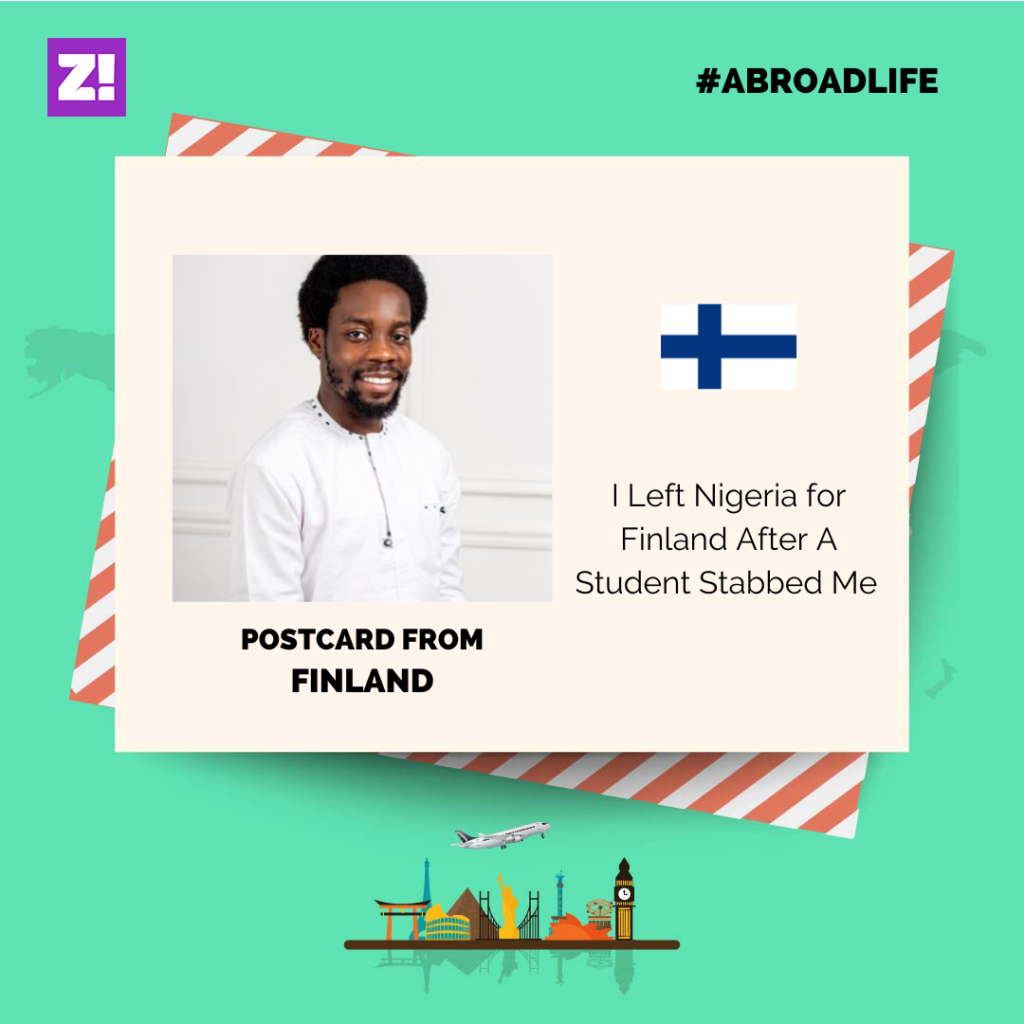
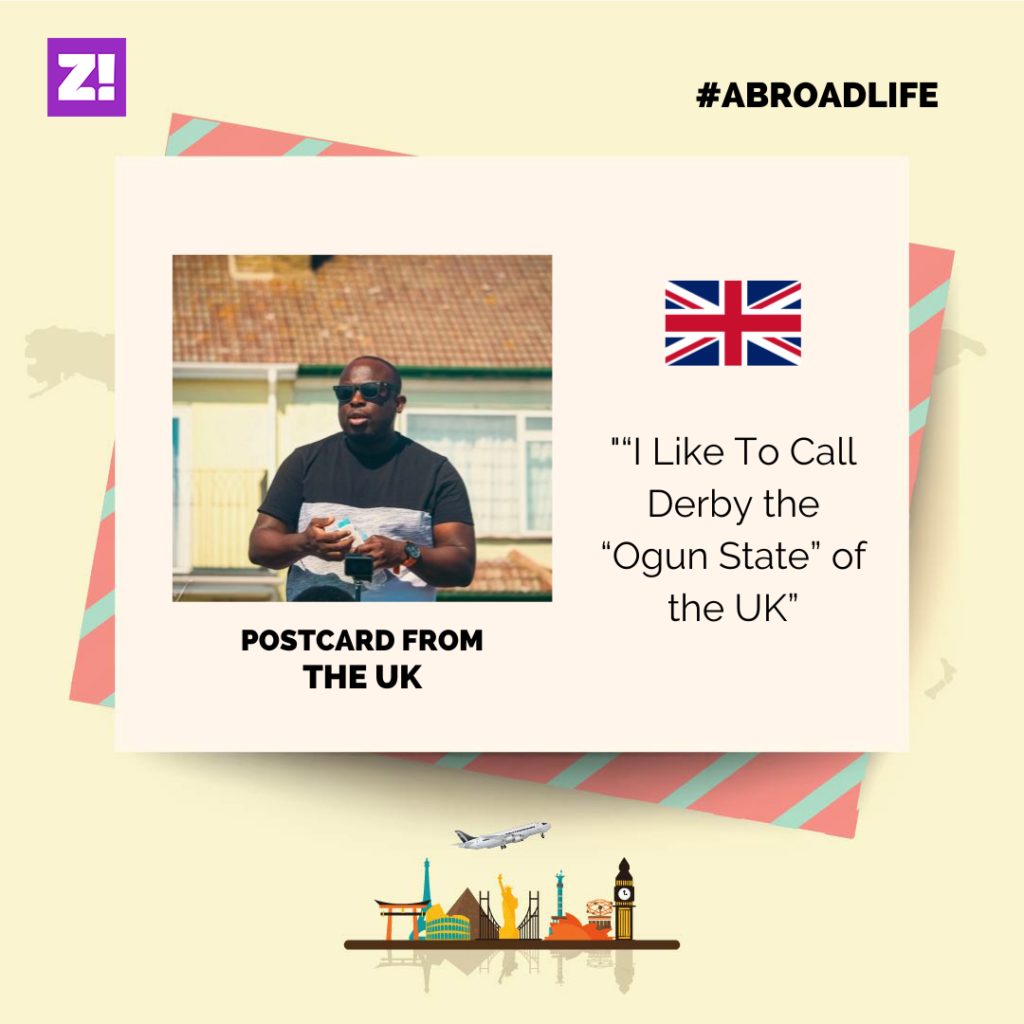
This week’s Abroad Life subject is Adeoju Samuel Adesina, aka Sammy Desh, a Nigerian who relocated to Finland in his third year of university due to student union attacks on his life in 2010. Eleven years later, he returned to Nigeria in 2021 to vie for a legislative seat in the 2023 elections.
He shares with us the details of his exit from Nigeria, his experiences in Finland, and his political journey so far in Nigeria.
What sparked your motivation for politics?
I’d need to start from the beginning. I stumbled upon university politics at Obafemi Awolowo University (OAU). This was from 2007-2010. Someone running for the position of Chairman of my hall of residence had my name recommended to him as one who could galvanise people for campaigns. He then came to me and asked me to help mobilise people to vote for him as Chairman, which I accepted.
However, it was a surprise because I hadn’t been involved in elections before that time. Interestingly, I got people to vote for him galvanised people and won elections for four different candidates running for student union offices.
I was involved in several social justice causes around school, like fighting against tuition increments or releasing unjustly arrested students. I found fulfilment in this, especially when other students benefitted from it.
But this had downsides, such as attacks. One of these attacks made me leave the country for Finland.
Attacked?! How did that happen?
So it occurred during one of the student agitations in 2010 during my third year in university. A student burnt another student alleged to have stolen some money with a hot iron. While we tasked ourselves (i.e., me and some residence hall executives) to apprehend the student in question, he took refuge with a clique of guys called the DSM.
It was when we approached them to pick up the guy that everything turned violent. The Student Union Government (SUG) president, Paul Alaje, was hurt. I was stabbed in the arm with a knife.
My mum was so scared for my life, and to add insult to injury, there was an Academic Student Union of Universities (ASUU) strike for about four months. It was then my parents decided I had to move to Finland.
So sorry this happened to you. What was the process for migration?
With Finland (as with every other country), the easiest route for migration is through a study permit, which I used. To get information on all the schools in Finland, I first logged into a website called studyinfinland.fi. If you click on the English language option, it has all the info you would need on schools in Finland and the processes involved. You can apply to the website if you open it during the application cycle. With that, you don’t have to pay any application fees.
However, I had to follow the steps. I provided the documents needed, such as my international passport, transcript, WASSCE certificate etc.
Once you’re done with the application, you’ll get a confirmation email and a schedule for a general exam. I hear it’s now online. But in 2010, it was a physical exam, which I wrote in Ikeja, Lagos.
If you pass the exam, you have to go for an interview I had to travel from Nigeria to Accra, Ghana, for that exam. That interview serves as a way for them to judge and understand your English proficiency. They’d also ask for your preferred course of study while in Finland. If you ace the interview, you get your admission letter, and you pay your tuition, which is about €5k. After this, you can apply for resident permit at the embassies in Abuja. It’s that straightforward.
What was schooling in Finland like?
It was excellent. I had to start from scratch when I got to Finland, studying Business Management, but the teachers there were helpful. However, I needed to work and study at the same time, and it was there I got my first political gig in Finland as part of a campaign team.
Nice! What was that like?
In school, I wanted to see how the political atmosphere was; it was a job that was paying at the time. So I helped galvanise people in one or two political campaigns, sending SMS to people. Politics there is almost the same way in Nigeria, with many people trying to persuade people to receive certain ideologies for the betterment of the country.
Aside from politics, I also got to work with a media house, Poland Today, and did some business on the side with friends. It was a great experience.
What made you move back to Nigeria?
I’ve always been a ‘Nigeria-centric’ person. Even from the very first day I arrived in Finland, I didn’t have plans to spend my entire life outside the country. I’ve always had a passion for politics and service. I love helping people, and this makes me happy. But I wanted to help people on a large scale. And this is what made me decide to return to Nigeria and enter politics.
What was the process like?
Unfortunately, due to COVID, I lost hundreds of thousands of euros from my side businesses. I saved some money, but it wasn’t enough to call me rich.
When I returned to Nigeria in February 2021, a good friend connected me to Dipo Awojide’s company, where I became Chief of Staff. I began to receive connections from him, got exposed to various people, and started networking and finding political connections.
Was this how you started politics in Nigeria?
Yes. It began when representatives from two political parties (which I wouldn’t like to disclose) came and promised me tickets to governorship without contesting in the primaries, which I very much refused.
I then got another offer from a friend who knew the Chairman of Accord Party, who knew the man running for governorship in Osun State, Akin Ogunbiyi, who was a billionaire, PhD holder, and that role model Nigerian. He inspired me to register for the Accord Party and my interest in the Osun State House of Assembly.
I also decided to stay in my family house for a while to assimilate into the environment and get to know the people around me. Luckily, my father’s name, Adeoju, was familiar, so it wasn’t too hard.
I then introduced myself to Ogunbiyi, spoke with him, and told him about my qualifications and what I had to offer. He liked me right away.
Did you later run for the Osun State House of Assembly?
No, I didn’t. I only became an aspirant, not a candidate. Before I came to the party, the members already had someone they wanted to put on the ticket. The preferred candidate was also an Osun State-level executive for the party. So, I was a spoiler for them for coming into their system, plus I had the governorship candidate’s backing.
The back and forth was long, but we had to conduct a primary election, which I won. Now, after a primary, the party has to send your name to the Independent National Electoral Commission (INEC), but my name was never sent. Instead, it was that of my opponent. Because of this incident, I decided that I’d no longer be a party member.
Wow, so sorry. I hope this hasn’t changed your mind about politics?
Yes, I will likely join another political party. I’ve had offers from the two leading parties in Nigeria (PDP and APC) to join them. I consider this recognition as one of the good things that came out of this past election. In my constituency, many people know me; I’m no longer a stranger. I was also able to sell myself to a lot of people. So now, I have my supporter base and people that would like me to contest again.
Those are the few positives from everything that happened. I’m hoping we can get to a point in Nigeria where we can comfortably and confidently say elections are free, fair, and credible. But at the moment, we don’t have one. I believe, however, that we’re moving in the right direction. Especially because you can now check for over-voting, thanks to the Bi-Modal Voter Accreditation System (BVAS).
Things are getting better. And I hope they can keep getting better. We can’t give up. Not yet, anyway.
Psst. I need your help making Abroad Life the very best series it can be. If you have a great story for us, can you take two minutes tops to fill this form? You’re the best!
The Independent National Electoral Commission (INEC) collation of results for the 2023 gubernatorial election ends today, March 21, 2023.
Here is a summary of how the top parties won, the incumbent governors that have been re-elected into power, and the parties that still control off-cycle election states:
The Kebbi governorship election is declared inconclusive by INEC due to overvoting in 20 out of 21 LGs.
Adamawa governorship election has also been declared inconclusive by INEC. It is expected that there’d be a rerun election.
Which party led the race?
Apart from the four states where INEC suspended collation, Governors have been declared across the remaining 24 states. The All Progressives Congress won 15 states, the People’s Democratic Party (PDP) won eight states and the New Nigeria Party (NNPP) with one state (Kano).
Which states had their incumbent governors reelected?
Eleven incumbent governors ran for re-election in Adamawa, Bauchi, Borno, Gombe, Kwara, Lagos, Nasarawa, Ogun, Oyo, Yobe and Zamfara. However, only six states had their incumbent governors re-elected into power. They are:
Sanwo-Olu, the incumbent governor and APC candidate in Lagos state, has been reelected governor in Nigeria’s commercial capital with 762,134 votes, thereby beating his rival, Gbadebo Rhodes-Vivour of the Labour Party. This was amidst allegations of voter suppression.
Ogun State – Dapo Abiodun
Incumbent governor and APC candidate of Ogun State, Dapo Abiodun, won his re-election with 276,298 votes to emerge the winner of the keenly contested election. Ladi Adebutu of the PDP came second with 262,383 votes.
Mai Mala Buni has been re-elected Governor of Yobe State, winning in all 17 local government areas of the state with a total of 317,113 votes.
The candidate of the Peoples Democratic Party (PDP), Alhaji Sharif Abdulahi, came a distant second with a total score of 104,259.
Nasarawa State – Abdullahi Sule
Sule of the All Progressives Congress (APC) acquired 347,209 votes to beat his closest contender, David Ombugadu of the Peoples Democratic Party (PDP), who got 283,016 votes.
How many off-cycle election states does each party rule?
Only 28 states participated in the 2023 governorship elections. The remaining eight states (Anambra, Bayelsa, Edo, Ekiti, Imo, Kogi, Osun, and Ondo) will hold theirs later. This is due to a different election cycle usually caused by litigations.
However, this means that certain states will maintain their party strongholds. Let’s see how many states each major political party in Nigeria still has:
All Progressives Congress (APC) (4)
The APC holds power in these off-cycle states – Ekiti, Imo, Kogi and Ondo.
This means that Biodun Oyebanji (Ekiti), Hope Uzodinma (Imo), Yahaya Bello (Kogi), and Rotimi Akeredolu (Ondo) would all get to keep their seats as governors — in the meantime.
People’s Democratic Party (PDP) (3)
Bayelsa, Edo and Osun are under the PDP and will not hold elections. Douye Diri, Godwin Obaseki and Ademola Adeleke, respectively, are still governors of these states.
All Progressives Grand Alliance (APGA) (1)
Only Anambra State under the All Progressives Grand Alliance would not hold elections. Anambra is also the only state in Nigeria that the party controls. Charles Soludo remains governor of Anambra State.
How many states do the parties control overall?
If one adds up the states won from elections to the states a party still rules due to off-cycle polls, here are the results:
The All Progressives Congress (APC) now controls 19 states in Nigeria.
The People’s Democratic Party (PDP) has a stronghold in 11 states.
The New Nigeria People Party (NNPP) now rules Kano State, beating the incumbent APC.
The All Progressives Grand Alliance (APGA) maintains dominance in Anambra state.
Thank you for following the 2023 governorship and state assembly election coverage with us. Learn more about politics, governance and policies and be a part of a cool community by joining our WhatsApp community here.
The Independent National Electoral Commission (INEC) collation of results for the 2023 gubernatorial election has officially started across 28 states in Nigeria. Here are the results declared:
Seyi Makinde is re-elected governor of Oyo State
Seyi Makinde, the PDP candidate in Oyo state has been declared the winner of the 2023 gubernatorial race in the state. This is with 435,026 votes. This would be Seyi Makinde’s second term as governor of Oyo State.
He is also the only G5 governor that didn’t lose his election.
Sanwo-Olu wins Lagos re-election bid
Governor Jide Sanwo-Olu of the All Progressives Congress (APC), secured his re-election bid after winning 18 out of 19 local governments declared so far.
In Eti-Osa, results are yet to be collated. Voting has been postponed in one of the key polling units (VGC) due to last-minute logistical changes from INEC.
Rhodes-Vivour wins Amuwo-Odofin LGA
Gbadebo Rhodes-Vivour of the Labour Party (LP) won the Amuwo-Odofin LGA of Lagos State.
You look like Igbo we will not allow you vote Govt thugs threatened Yoruba woman @Sisi_Yemmie who came out to vote in Lagos. Igbos were stopped from exercising their political will. pic.twitter.com/6c1V3WkcGH
There may be a post-election court tribunal for Lagos State
Yesterday, Rhodes-Vivour went on Twitter to reassure supporters that their votes will be rightfully defended. In Nigeria, we know there’s only one way you can do that – in a court of law.
Every vote cast for me was done in the face of intimidation and risk of personal harm. Every such vote must count. Defending every one of those votes is a sacred duty. I will defend your votes – this is my vow to every LP voter.
The 2023 gubernatorial elections have kicked off across 28 states in Nigeria today. States like Anambra, Bayelsa, Edo, Ekiti, Imo, Kogi, Ondo and Osun States won’t have elections today, as they operate a different cycle.
Also holding today are the Esan Central/Esan West/Igueben Federal Constituency election halted during the February 25 Presidential and National Assembly polls. This resulted from the omission of the Labour Party logo and that of the Enugu East Senatorial District, which was shifted following the killing of Oyibo Chukwu, the party’s candidate in the district, on February 22.
Here are the updates so far:
Violence in Lagos State
Voters in several parts of Lagos State have complained of harassment and intimidation by political party agents and thugs.
No one can intimidate me!! I have every right to carry out my duty No amount of abuse or vitriol will work.. You are a public servant!! I have taken note of all your thugs!! pic.twitter.com/XeUJ6M3RzN
A Twitter user (@omoelerinjare) claims that his uncle was attacked with his ear bleeding in the Desa Ibeju Lekki polling unit for refusing to vote for the APC.
A voter with his polling unit in Ibeju-Lekki High School, Lagos, also said, “APC thugs just finished beating me now in my polling unit, 007 Ibeju 1, at the premises of Ibeju High School, Ibeju-Lekki Lagos. They were chasing everyone they feel will vote for LP. I intervened and they descended on me and started beating me.”
“They were 13 thugs that were beating me. The thugs dragged me out of the premises and dragged other LP voters in my PU out. They smashed my phone. Agberos have taken over the polling units in Ibeju.”
APC thugs just finished beating me now in my polling unit, 007 Ibeju 1, at the premises of Ibeju High School, Ibeju-Lekki Lagos. They were chasing everyone they feel will vote for LP. I intervened and they descended on me and started beating me.
At Ward E3, St Stephen’s School, Adeniji Adele, Lagos Island, the incumbent governor of Lagos State, Babajide Sanwo-Olu made his way to vote at around 10 a.m. He was seen to be ‘calming down his supporters.’
At 11 a.m., Citizen learnt that security operatives killed a voter as thugs, allegedly sponsored by the PDP, attempted to disrupt voting in Gboko South at polling units 026 and 004 of Benue state.
Other states seem to be peaceful
Other states, such as Kwara and Delta, are seeing peaceful voting process so far.
Be sure to get the latest coverage on the 2023 gubernatorial elections right here on Citizen! If you want to be part of the conversation, you can join our community here.
This is because INEC would need to take their time to manually configure over 176,000 Bi-Modal Voter Accreditation System (BVAS) machines for each polling unit across the country. And that, my friends, ‘takes a lot of work’.
How we imagine INEC officials after reconfiguring 176,000 BVAS machines
But now that these elections have been postponed, what do you need to know?
Campaigns continue until March 16
All party supporters and patriotic citizens are free to continue ‘moving the ministry’ of their preferred candidate — up until midnight of Thursday, March 16, 2023. This is in alignment with the 2022 Electoral Act.
If you get caught after the said date, don’t say we didn’t warn you.
INEC is ready to release election materials for access in court
Recently, two contenders during the presidential elections (Peter Obi and Atiku Abubakar) filed ex parte applications. The purpose was to seek permission to access election materials from INEC.
However, INEC was against this, as they insisted that it would disrupt the elections. Rather, in a show of good faith, they assured them that the election materials would still be made available to them if needed in court. But only until after the elections.
Political parties can also apply to get certified True copies of backend data on the BVAS. This is just in case there are any trust issues.
Now you know the updates! Citizen promises to give you the full gist of the 2023 gubernatorial elections come March 18! Stay sharp and stay glued to our election results screen! Or join us on WhatsApp.
On March 1, Nigeria’s electoral body, INEC, announced Bola Tinubu of the ruling All Progressives Congress (APC) as Nigeria’s president-elect, and none of his co-contestants was happy.
The losers, Peter Obi and Atiku Abubakar
Just two days after the announcement, the duo filed two separate ex-parte applications to the Court of Appeal. Its purpose was to inspect the materials used by the Independent National Electoral Commission (INEC) during the elections.
That way, if there was any manipulation or mago mago done to the election result figures, they can easily catch INEC red-handed.
If it does, then it’s best to learn how this works. Let’s dive right in:
How are post-election tribunals set up?
Firstly, we must understand that election courts are not the same as regular courts. This is handled by specialised courts called election petition tribunal courts, which are usually run by the Court of Appeal.
The 2022 Electoral Act gives us the basic guidelines and principles of setting up a post-election tribunal under various sections:
Section 130 (1) states that “No election and return at an election under this Act shall be questioned in any manner other than by a petition complaining of an undue election or undue return (in this Act referred to as an “election petition”) presented to the competent tribunal or court in accordance with the provisions of the Constitution or of this Act, and in which the person elected or returned is joined as a party.”
Section 130 (3) (a) states that the Court of Appeal should set up the tribunal not later than 30 days before the election, with the register for tribunals opened seven days before the election.
Who can file for a post-election tribunal?
Sadly, only political candidates that participated in the election can file for a post-election tribunal. Patriotic citizens are not on the list.
What is the election tribunal timeframe?
An election petition must be presented and filed within 21 days of the declaration of the result.
Once a candidate fails to file his/her petition within 21 days, he/she loses the right of action. The petition would be declared null and void.
Also, the election petition must be heard and judgement delivered within 180 days from the date of the filing of the petition.
Is there more than one post-election tribunal?
Presidential candidates can decide to go to the Supreme Court if they are not satisfied with the judgement from the Court of Appeal.
However, if you’re a national or state assembly candidate, the Court of Appeal is your final bus stop. Once they give a ruling, it cannot be petitioned in a higher court.
With that being said, you can be sure to watch out for Citizen updates on the 2023 post-election drama. Stay tuned!
The Nigerian Voter is a series that seeks to understand the motivations that drive the voting decisions of Nigerians — why they vote, how they pick their candidates, why some have never voted, and their wildest stories around elections.
Editorial Note: The Nigerian Voter is a platform for Nigerians to passionately discuss policies and politics with little interference to individual opinions. While our editorial standards emphasise the truth and we endeavour to fact-check claims and allegations, we do not bear any responsibility for allegations made about other people that are founded in half-truths.
The subject of today’s “The Nigerian Voter” is Victor, a travel consultant in his mid-twenties who is a resident of Lagos State. He told us about his shattered dreams for Obi as president, his reasons for preferring a second term with Babajide Sanwo-Olu as Lagos State governor, and his thoughts on the other Lagos gubernatorial candidates for the March 11 elections.
When was the first election that you participated in?
The 2023 election was the first election I participated in. This is because I never had an interest in politics until the EndSARS movement when people came out to protest in large numbers and were also killed. I always felt that nothing in the political system of Nigeria could change, but something very special happened during EndSARS — there was just this newfound belief that people had the power in their hands to make the country work. This belief birthed in me the desire to vote. I no longer wanted to sit on the fence and criticize the government. I registered for my Permanent Voter’s Card (PVC) in 2021 and voted in 2023.
Who did you vote for during the 2023 presidential elections and why?
During the presidential elections, I voted for Peter Obi of the Labour Party. I don’t vote based on parties but rather based on individuals. Peter Obi was my best choice because I saw his background as an economist and I felt he could fix up our economy. I was so disappointed when he lost.
The All Progressives Congress (APC) at the federal level has failed us woefully, especially in my area of expertise.
For instance, in Jonathan’s time, it is possible for you to see the Naira to Dollar exchange rate between ₦180-₦200. But now, with a ₦740 to a dollar exchange rate, a round-trip ticket from Nigeria to London would cost you nothing less than ₦3.3 million through Virgin Airways. This was a place that people used to go to for ₦110,000 back in the day. This has really discouraged people from travelling.
Now that Tinubu is president-elect, have you accepted the current administration?
Well for me, no. I’ve not accepted that man as my president, but at the same time, I don’t want to get my hopes high. He may not be Buhari but he still had a crucial role to play towards his administration.
I’m just watching and waiting for what happens over the next couple of months regarding the post-election tribunals.
Have you ever taken an interest in Lagos State governance? What are your thoughts?
Yes, I have. I firstly believe that it is Babatunde Fashola that really made the positive changes in Lagos, not Tinubu. Then Akinwunmi Ambode did his best, then Sanwo-Olu came in.
I believe that the current governor has tried in his capacity. A lot of projects have been going on such as The Blue Rail Project, the invention of new road networks, and even safety too. If you go back to some years before now, there are areas in Lagos that you can’t even go to once it’s 7 p.m. due to thug harassment. But Sanwo-Olu has been able to take care of those boys and make the roads safe for travel.
For instance, there was a friend of mine that came to Lagos recently and arrived in Oshodi at midnight. I was so scared for her safety, but she got to her place unhurt. It was even the touts that were helping her and warning others that she shouldn’t get hurt. I was really amazed. This would have been a very risky move for her to make some years back.
He has also tried in education. I spoke with a friend who is a teacher, and she told me that the education system has improved greatly in the last four years. The curriculum now has been made to properly prepare students towards the needs of the outside world. With all these testimonies, I feel the activities and governance of Lagos State have been a success so far under Sanwo-Olu.
So is it fair to say that you’d vote Sanwo-Olu for re-election as Lagos State governor?
Yes, this is definitely what I’m doing. I’ve noticed that Sanwo-Olu always tries to make amends for his wrongs. I know some think he is doing this just for his re-election, but this is a trait I’ve always noticed in him. Some leaders (whom I’d rather not name) would prefer that the country burns than listen to what you have to say. But that’s not Sanwo-Olu.
For instance, look at this cash scarcity issue. He has made sure that all Bus Rapid Transit (BRT) vehicles have their fares cut to 50% and the same is true for vehicles under the National Road Union of Transport Workers (NURTW). That is the act of a leader that listens and cares for people.
(Editorial note: Sanwo-Olu did reduce the fares of all state-owned transportation services by 50% in February 2023. However, there is no news on a fare reduction from the NURTW.)
What would you then say about his lack of accountability towards the Lekki Toll Gate shootings?
One thing people don’t realise is that there is no established fact on who gave the order for the shooting. This October would make it three years since the tragedy happened, but we still don’t know for a fact. So how can you then accuse Sanwo-Olu directly for anything?
Also, I feel the administration of Lagos is purely run as a godfatherism thing. This is not to say that Sanwo-Olu is completely a puppet. But what if the order came from above and was completely out of his hands? That is something that would not be publicised. He tried to pay the medical bills for victims as well as set up a panel of inquiry. Is that the best he could do? Not quite, but I’d not hold that against him. I really don’t think that Sanwo-Olu is responsible for what happened, until we are aware of who gave the order.
(Editorial note: Sanwo-Olu did set up a trust fund of ₦200 million to compensate victims of the Lekki Toll Gate shootings. He also set up a panel of inquiry. However, it is not clear if the trust fund was set aside specifically for medical bills or not.)
What would you say about the other Lagos gubernatorial candidates?
I know of the Labour Party guy (Gbadebo Rhodes-Vivour) and Jandor of the People’s Democratic Party (PDP). For Gbadebo, I’d say that I never knew him until after the presidential election. I feel he is personally running off the wave of support for Peter Obi, which honestly is smart in a sense. I don’t blame him for it. However, this doesn’t mean that the man has elaborated fully on what he has to offer Lagosians.
For Jandor, I don’t know his portfolio. I only know that Fashola said that he was his cameraman when he was in power.
What are those problems that you’d like Sanwo-Olu if re-elected?
Well, now that we have a Tinubu presidency incoming, I want Sanwo-Olu to have a very firm grip on the agberos or touts. I don’t want Lagos to be violent from the activities of these people again just because Tinubu is president.
I’d also like for him to continue his work on infrastructure. He has been trying but there are many places in Lagos that still has bad or poorly maintained roads.
In the end, after all said and done, a Nigerian politician would always be a Nigerian politician. I’m not expecting him to be a Messiah, but he should try as much as possible to make life easy for the average Lagosian. That’s all I require.
On March 11, Nigerians in various states across the country would be heading out to the polls to vote for who they want to be the next governor of their states. However, everyone seems to be focused on the elections of a particular state — Lagos.
An aerial view of Victoria Island, Lagos [Encyclopedia Britannica]
But what makes the city such a ‘hot cake’ and a talking point for many Nigerians? Who are the contestants for the state’s governorship race? What requirements do these people need to meet to be eligible for election as governor?
Let’s dig in here:
What makes Lagos so valuable?
The answer is straightforward — the city generates a lot of money which politicians can embezzleuse to take it to the next height.
Lagos is also Nigeria’s financial hub, with all major banks headquartered in the City. It is home to the Nigerian Stock Exchange [NSE] and accounts for over 80% of the country’s foreign trade flows.
It is also known to be Africa’s largest metropolitan city, with a population of 15.4 million people of various skill sets contributing to the economy. As a result, it is seen as a profitable consumer market for multinational companies. This includes companies like MTN, Shoprite, Starlink, etc.
Lagos is Africa’s largest metropolitan city [Premium Times]
Lagos also has a very generous pension plan for ex-governors. Even though the Lagos State House of Assembly called out and revised the pension plan in 2021, ex-governors are entitled to 2 cars that can be changed every four years, household staff, and 100% of the basic annual salaries of an incumbent governor and deputy, amongst others.
If you ever become Lagos State governor, you’re made for life.
Who is in the race for Lagos State governor?
We have 16 candidates vying for the position, but three out of the 16 candidates are currently gaining traction. They are:
Babajide Sanwo-Olu (APC)
The incumbent governor is seeking re-election for a second term in office alongside his deputy, Obafemi Hamzat.
Even though he has had achievements such as a free health policy for children and establishments of hospitals across the grassroots, his tenure has been largely marred by the event of the 2020 Lekki Toll Gate Shootings and his lack of accountability for the tragedy.
This has reduced public trust in his administration.
A member of a political party and sponsored by the same party
Educated up to at least School Certificate level or equivalent.
Now you know everything about the Lagos State elections! If you’re a Lagosian and a registered voter, come out on March 11 to vote for your favourite candidate in the gubernatorial polls!
Citizen also promises to give you real-time updates on the Lagos state election next Saturday. Join us on WhatsApp to not miss out.
As fans of the president-elect are jubilating, many Nigerians on the side of Labour Party presidential candidate Peter Obi are not taking the defeat too well. Neither are the PDP supporters of Atiku Abubakar.
Some have even said there is enough evidence for the Labour Party to take to court, given suspicions of massive rigging.
This is our true president and we won't take no for an answer until he emerge that throne
This was due to Rotimi’s unjust removal from the ballot paper by INEC after he had won the PDP primaries in December 2006.
According to INEC, he was removed due to an indictment or accusation of corruption by the federal government. The Supreme Court later deemed it as invalid.
Amaechi became governor without campaigning.
The many court cases of Peter Obi
Even the Labour Party’s presidential candidate has had his share of ‘work experience’ regarding post-election court cases.
Obi didn’t take his L peacefully as he defended his right to Anambra’s highest seat in the election petition tribunal.
He later won the case in March 2006 after almost three years.
He was impeached in November of the same year, but the court overturned his impeachment, and he returned to office in February 2007.
Obi was again removed after the 2007 Anambra State gubernatorial election, but the judiciary intervened by ruling that he should be allowed to complete a full four-year term.
The 2023 elections would not be the first to have accusations of electoral fraud. This happened in the April 2007 Ondo State elections between Olusegun Agagu and Olusegun Mimiko.
In April 2007, Agagu was declared the winner of the Ondo State elections by INEC. Mimiko then submitted a petition to the Ondo State State tribunal in what would be a year-long case.
Mimiko later won in August 2008 after it was revealed that Agagu won the election through invalid votes.
Adams Oshiomhole vs Oseirheimen Osunbor
The Ondo State governorship elections weren’t the only election being contested in April 2007. The Edo State governorship election also entered the state’s election tribunal.
This was between Adams Oshiomhole (defendant) and Oserheimen Osunbor (winner).
The case was filed on May 14, 2007, and was won by Oshiomhole in March 2008. The election won by Osunbor was annulled, as the votes in his favour were found to be fraudulent and ill-obtained.
Buhari Vs Obasanjo
Unlike the other four, this court case did not end in victory for the defendant.
When Muhammadu Buhari challenged the victory of Olusegun Obasanjo as the winner of the 2003 presidential elections, the petition sadly got dismissed by the Supreme Court.
Buhari complained of massive rigging, election irregularities and the Independent National Electoral Commission (INEC) mismanagement of votes.
What happens next?
As we await further post-election news, what would be the outcome?
Will the Labour Party take a step back and admit defeat? Will they go to the Supreme Court and challenge Tinubu’s incoming presidency?
Citizen promises to give you the updates once we have them.
Three days after the 2023 presidential elections, Nigerians all over the world are holding their breath and clinging to the edge of their seats as they await the long overdue results.
Here’s all that has happened:
Contrary to what we thought, election results were uploaded manually
One of the measures put in place by the Independent Electoral Commission to ensure a smooth electoral process was the electronic transmission of results. But the spokesperson for INEC, Festus Okoye, released a report saying results from polling units would be electronically transmitted to IReV, but collations would be manual.
Disparities between figures Nigerians recorded at their PUs and INEC’s
A lot of heat has come upon INEC for releasing falsified results. A spokesperson for the Obi-Datti presidential campaign council claimed that the presidential result from Ekiti state had been uploaded on February 20, five days before the elections.
But we fact-checked this, and our checks revealed the screenshot, which was trending on social media, was in fact fake.
Petition for the INEC’s Chairperson visa to be revoked
In the spirit of holding leaders accountable for their actions, Nigerians are dragging Mahmood Yakubu by his metaphorical shirt, and asking the UK, USA and Canada to revoke his visa for rigging Nigeria’s presidential election in favour of APC. The petition currently has over 285,600 signatories.
Rumours of a runoff election to determine the president
For a candidate to be declared President, they must have 25% of votes in 2/3rd of all the states, including the FCT, and also the highest number of votes. From the election polls, we’ve seen the four contending parties show strength in their different regions.
This is inaccurate. For a candidate to be declared President, they must have 25% of votes in 2/3rd of states and the FCT. For this purpose, the FCT is treated as a state and the minimum expectation is 24.67 states or 24. In addition, they must win the popular votes. 🧵 https://t.co/AIY1JD8osJ
Businessman and investor Thaddeus Attah, contesting under Labour Party, beat renowned singer and actor Bankole Wellington who contested under the People’s Democratic Party. Against speculations that he only won because of his party, some people have claimed he was absent from the TL because he was busy campaigning street-to-street.
On February 27, 2023, the EU released an official statement saying that while the Nigeria presidential elections had gone on as planned, the lack of transparency and operational failures challenged the citizen’s right to vote. So even though our electoral commission failed to address the numerous allegations of violence and vote buying, the EU acknowledges this was far from a free and fair election.
Lagos state alleged dinner party
An invitation card began circulating the media in the earlier hours of Tuesday, February 28. And the event was allegedly between the executive governor of Lagos state, Mr Babajide Sanwo-Olu and the Igbo captains of industry, such as the Executive Chairman of Chisco group of companies, Chief Dr Chidi Anyaegbu and the Chairman/CEO of Air Peace, Mr Allen Onyema.
But the media aides of the Governor have since come on their platform to tag the flyer as fake news.
INEC is collating the 2023 election results, tensions are high, and I can bet my last ₦500 that — even though you’ve had to resume work — it’s probably not the first thing on your mind today. Don’t let these colleagues add to what’s already doing you.
The bad news amplifiers
It’s like these ones just turned on post notifications for the most horrible news. Yes, we know everything is going to shit, but please, #ProtectYourMentalHealth.
Team “Why do you care so much?”
If you check it very well, they’re probably already processing their japa papers, so they don’t care what happens. Lucky for you, Angela, but this is my own future.
The overly serious ones
Anyone who’s 100% focused on work today obviously isn’t normal. I said what I said.
The suspiciously happy ones
They might be supporters of a certain overall-best-in-rigging party. You don’t need anyone to tell you they don’t mean you well.
The low-budget INEC officers
They have all the figures from every polling unit in the country. On the bright side, you can always go to them for the latest, but if they’re on your work team, sorry for you because you’ll have to do their work in addition to your own.
The tribal advocates
Avoiding this set of people is just common sense unless you want to get tempted to slap someone’s child and embrace unemployment.
Your boss
Today should’ve been a public holiday. No one should have to answer to capitalism when we’re trying not to die from anxiety.
Buhari may have promised us free and fair elections, but what we’ve witnessed since the polls started yesterday has been anything but fair. On top of intimidation and violence, while most are done voting, some have not voted at all. Zikoko Citizen got some updates from a polling unit in Rivers state where an election didn’t happen.
The turnout at the unit was interesting, with some voters getting there early enough
This happened at a polling unit in Ward 14, Obio/Akpor LGA. People were eager to vote, with some first-time voters getting there as early as 8:30 a.m. to cast their votes.
Everyone was there but the INEC officials. This happened in many other polling units nationwide, where people had to wait for the INEC officials to show up.
12pm no inec officials at my polling unit.
Polling unit is paragon1 Ekwulobia ward 1 Aguata Anambra State.
Two officials later came and said they had no clue there was a polling unit there at all
Two INEC officials eventually showed up and said they weren’t aware that there was even a polling unit . They said they’ll inform their office and ensure that the assigned agents get there.
Two hours passed, and there was still no sign of INEC or any voting materials at the polling unit. A concerned voter called INEC’s helpline to report the situation at the polling unit and was told they’ll receive the officials soon.
The materials finally came, but someone forgot to bring the result sheets
At 3:16 p.m., an INEC official finally showed up, curiously conveyed in a vehicle with PDP agents. But what made things even more suspicious was when the voters were told that all the materials were now available, except that they conveniently forgot to bring the result sheets. The official wanted to leave to get them, but they held him down.
Someone called INEC again; this time, they were hostile and dismissive to the caller. The officials on site wanted to start accreditation without the results sheets, but the people said, “No way”.
After being tired and frustrated the whole day, people left, and no vote was cast at the polling unit
As it turned out, there were other polling units where voting also didn’t happen
These polling units had voters, but they didn’t have the votes. There are many polling units where people have been disenfranchised across the country, and INEC needs to cancel whatever results come from these places and carry out a rerun.
APC and INEC do not provoke me!!! I flew from the USA to Nigeria to vote in Imo state. No election has taken place in my LGA Oru East yet funny results are being published. God will punish @inecnigeria if they declare a winner from this sham you call an election. Rubbish! pic.twitter.com/TMXtr6CrEm
Do you have a similar case in your polling unit? Talk to Zikoko Citizen by joining Citizen Situation Room on Whatsapp. You can also follow the election results live on our portal as INEC is collating them.
It’s the day after the 2023 presidential elections, and Nigerians are holding their breaths. While most are done voting, some are still voting.
Everyone is waiting to see who will be the next tenant at Aso Rock — and we are getting pretty anxious while doing so.
But we at Citizen are here to tell you today to calm down.
Here’s why:
Election results are not released immediately
Examples are the 2015 and 2019 presidential elections.
In 2015, the elections were held on 28 and 29 March, but the results were released on the 31. In 2019, the elections were held on February 23, and results were released three days after on the 26th. This is because the ballots take time to count and assess (usually between two to three days), and INEC tries to be as accurate as possible.
Results take time to collate
Nigeria has 176,846 polling units across 36 states and the FCT. As you have counted results in your PU, they will count in all PUs across the country. The results will move from individual PUs to local governments before they are transmitted to the states, from where they move to the national collation centre in Abuja, where they are all counted and the INEC chairman will declare the final votes.
Why can’t everyone just send their results to Abuja via email?
Voting ongoing
While voting might be over in your PU, there are several PUs across the country where polls are still open. This is due to factors like the late arrival of electoral officers, not enough electoral officers, and lack of voting infrastructure. While many ballots are on their way to central collation centres, some people are still voting.
BVAS/iREV wahala
Nigeria introduced the Bimodal Voter Accreditation System (BVAS) machine to make the voting process easier, tackle over-voting, and make result collation faster. Unfortunately, the BVAS has had its battles and INEC has questions to answer.
Because BVAS was supposed to make it easier to transmit results, Nigerians have been counting on INEC Result Viewing Portal (IReV) where results are to be uploaded live. Unfortunately, both BVAS and iREV are facing serious challenges and are currently unreliable.
While one cannot say that this is a deliberate ploy by INEC to rig the election, it calls into question their efficiency and transparency, if results are being uploaded and people can’t see them clearly.
When INEC said results would be uploaded on its portal, it failed to mention one would need eagle eyes to see them. In what world is this an equation of transparency and openness? pic.twitter.com/CO2pmVxKTB
There have never been elections without court cases
Is it a Nigerian election if the losers don’t defend their stance in a court of law? Surely not.
In 2019, results were released in February. However, INEC still had to withdraw 64 certificates of return and give them to the winners of court cases in May.
There could be the possibility of a runoff election
Let’s not forget that we have three main contenders for Nigeria’s iron throne instead of the usual two political parties.
If any of the candidates do not get a simple majority of votes and 25% of votes in 24 states, we, as citizens, may need to come out to vote again in a runoff election.
So, for now, drink water, sleep well and take it easy. Also, follow Citizen’s 2023 election tracker for updates on the results. We got you!
In the meantime, let’s try our best not to distribute fake election results. If in doubt, send a message to the Citizen Situation Room on Whatsapp and we will fact-check for you.
The polls are starting to close for the 2023 presidential elections, and polling unit results from various states across the country have started trickling in, along with other stories. Here are the updates:
Some polling units started the voting process late
Voters in Wumba village, Abuja, experienced difficulties in the voting process. This was due to excess voter turnout. Voters in Yenagoa, Bayelsa had only started sorting ballot papers around 7 p.m. (WAT).
Voters in some polling units in Sangotedo and Ajah could not vote. This happened due to the absence of INEC officials. A member of the Citizen Situation room narrated to us how she had to sadly go home after fourteen hours of waiting at the Sangotedo primary school polling unit.
Protests at a polling unit in Sangotedo, Lagos. Voters are angry because INEC officials are yet to show up for the polls. pic.twitter.com/5jgyrwJ2pX
There was election violence in various parts of Nigeria
Voters in Lagos, particularly in the Ikate-Elegushi and Aguda, experienced various forms of voter suppression. This included thuggery, harassment of voters and destruction of election materials in polling units.
A writer at Zikoko, Omemi, relayed to us how she witnessed voter harassment when she followed her voter friend to her polling unit:
“We were at the polling unit on Oba Elegushi street at 11 a.m. when a group of men, who looked like hoodlums, came and destroyed plastic chairs and scattered the environment. The first set of ballots were cancelled as a result. Even the INEC official ran away with the ballot papers and only returned after much pleading.”
Polling unit results have been seen to trickle in
Polling unit results are slowly being collated at local levels, and have started to be collated in various wards in the country. Citizen has an election tracker for polling unit result updates as they develop.
The long-awaited 2023 presidential and national assembly elections are finally here. Here’s what we’ve noticed so far:
Polling units opened late
Zikoko Citizen gathered updates across polling units in Lagos, Calabar and Anambra states indicating that voter accreditation started hours later after the appointed time of 8 a.m. Some, up till now (11 a.m. WAT), have yet to see signs of INEC officials at their polling stations.
No sign of any inec official at my polling unit, Ekwulobia Aguata LGA Anambra State.
The funny thing is inec will commence their distribution of material from here.
So if the town that headquartered inec hasn't seen any of her officials, how much the other towns. pic.twitter.com/xiR277zQnK
The Citizen team is also out, and we spotted some officials from the Economic and Financial Crimes Commission (EFCC). What could they be up to? We’ll send in more updates here.
Tinubu arrives at the polling unit in Ikeja
Tinubu entering Ikeja polling unit [Ope Adetayo/Aljazeera]
Supporters of the BAT jubilantly greeted the All-Progressives Congress (APC) candidate as he arrived at his polling unit to vote amidst a stream of bodyguards.
Voting has been temporarily suspended in Ibadan
Voting has been temporarily suspended at Oyelakin Balogun community primary school, Sanyo Ibadan. The local government is Ibadan South East. Polling Units are 36, 37 and 38.
According to INEC’s rules, there should be three polling officials per unit, but only two are currently present. An electoral observer is filling for INEC; accreditation will be completed before voting starts.
Voters have also complained that the BVAS machine is malfunctioning.
Security officials detain loiterers
Nigerians not participating in the voting process were picked up by security agents and detained for loitering.
President Buhari casts vote for successor
Today would be the last day that Buhari would vote as president of Nigeria — and the first time that he’d be absent from the ballot papers in 20 years.
Against the Electoral Act’s mandated secret ballot, he revealed his ballot paper to show he voted for APC presidential candidate, Bola Tinubu in his hometown of Daura, Katsina.
Peter Obi votes in Anambra
Peter Obi votes in Anambra [Channels Television]
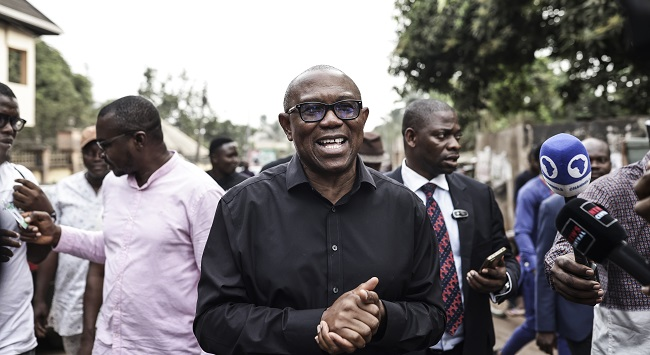
The presidential candidate of Labour Party (LP), Peter Obi, has cast his vote in his hometown of Agulu in Anambra State.
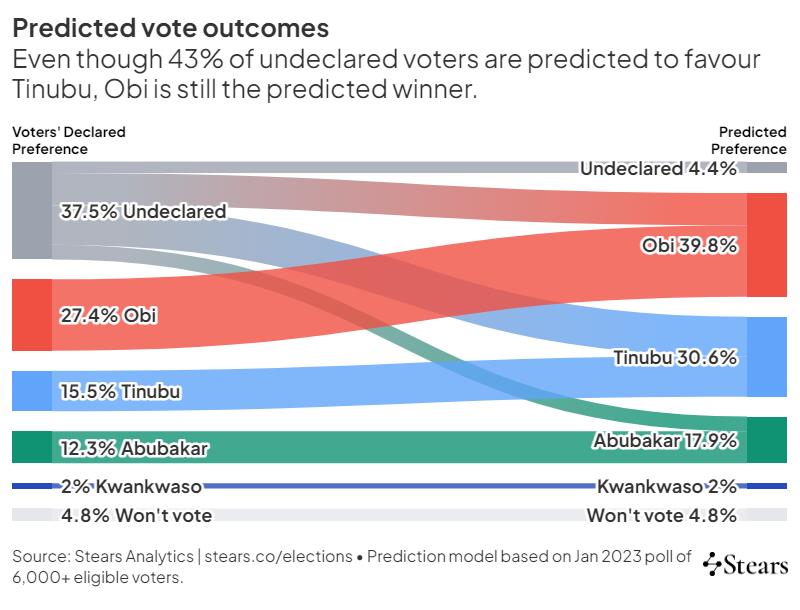
According to the Stears predictive poll, Obi can only win if he has a high voter turnout in the polls. Read more here.
But what happens if violence occurs in your polling unit? What if you get picked up by security agents illegally? If there is anything you should know about Nigeria, it’s that we have a large history of election violence. But do not be deterred, you’ve got this.
We have a list of mobile phone apps and websites that could possibly save your life in the eventuality of violence:
The Election Violence Incident Tracker(Evit.ng)
Launched in February 2023, the Election Violence Tracker displays in real-time the early warning signs and triggers of election violence across the country.
In particular, voters in Lagos, Osun, Kwara and the Federal Capital Territory (FCT) would be able to use the pilot phase of this app during the 2023 elections.
Users can also:
Report cases of electoral violence.
Identify potential risks with an incident analysis dashboard
Detect early warning signs.
Inform security agencies
Generate relevant reports to identify problem areas throughout the elections.
aptResponse
There is the possibility of getting arrested on Election Day, and aptResponse is here with the perfect lawyer plugs.
The app was built by a Senior Advocate of Nigeria, Boma Alabi. With the app, you can get emergency legal aid. You can also report an incident, receive critical information on the law and be part of a community where legal tips for citizens are being shared on the app
Think of helpOs like ride-hailing apps, Bolt and Uber, but for medical emergencies.
In case one is injured and in need of grave medical attention due to election violence, all you need to do is to type the location of your polling unit and an ambulance would come to the rescue.
Barring any last-minute changes — like in 2019 — the 2023 general elections will go on as scheduled on February 25, 2023. The elections, especially for the top job of the president, are seen by many as crucial and likely to set the direction of Nigeria for years to come.
Without wasting time, here are a few things to expect in the 2023 elections.
Higher voter turnout than in 2019
2019 recorded historic lows, with only 34.75% of registered voters showing up at the polls, less than the 50.96% historical average.
The three states with the lowest voter turnout were Lagos (18.95%), Abia (20.16%) and Rivers (21.09%). On the other hand, the three states with the highest voter turnout were Jigawa (55.67%), Katsina (50.74%) and Sokoto (50.13%).
Nigeria has an unwritten agreement of alternating the presidency between the North and the South. Two of the frontrunners in the 2023 presidential race are from the South. Therefore, expect a much-improved turnout from the southern states.
The looming possibility of a runoff
Nigerian elections typically get decided on the first ballot. This is due to the duopoly between the leading parties, the People’s Democratic Party (PDP) and the All Progressives Congress (APC). However, the emergence of a third force in the Labour Party (LP) and the New Nigeria Peoples Party (NNPP) means there’s a good chance the big two won’t dominate as they usually do.
The constitutional requirement for winning the presidency is not just a simple majority but winning with a spread of at least a quarter of votes in two-thirds of Nigerian states. Many people interpret this to mean 25% in 24 states. If nobody meets these requirements, then a runoff happens, which INEC will conduct within 21 days of the first round of balloting. We wrote everything you need to know about that here.
Heavy security presence
First-time voters may be surprised by the presence of heavy security officers during the polls. To ease your mind, they’re only there to ensure the smooth conduct of the election.
Neither the military nor the police will interfere with the democratic process — unless you go out of your way to be a nuisance. The Electoral Act empowers presiding officers to call on the police to arrest voters who may be impersonating. Underage voting is also not allowed.
Free flow of traffic
This is what Ikorodu road in Lagos looked like on election day in 2019.
[Empty Lagos roads on election day. AFP]
It’s best to sort out your needs before this Saturday’s polls. If you had Owambe planned, you should revisit your calendar to postpone because polls will severely restrict traffic during voting hours. Please don’t say we didn’t do anything for you.
Party agents
There are over 176,000 polling units in Nigeria. On election day, each of them will be monitored by party agents. These are people accredited by political parties and INEC to watch proceedings during the voting process. You would see them wearing tags indicating the parties they represent.
Party agents can call the attention of election officials if they suspect someone isn’t who they claim to be, that is, an impersonator. Per the Electoral Act, they can also challenge a count at the end of polls if they believe the presiding officer made an error. The presiding officer must do a recount, but only once.
Party agents are pretty observant. During the counting process, if they notice that a voter’s choice isn’t clear on the ballot paper, maybe because of smudged ink that leads to a vote cast for two different parties, they’ll object loudly. So as not to have your ballot voided, shine your eyes when voting. We did a video explainer on that here.
What else should I know?
If you need help determining where your polling unit is, click the link here to confirm or follow the prompt in the screenshot below.
We also did an explainer here on how to survive election day. Our election tracker goes live on February 25. Get yourself up to date with verified results from across the country by visiting this link.
Ladies and gentlemen, in five days, Nigerians will be charting a new way for the country at the Presidential polls on February 25.
Who shall be considered worthy of seating on Nigeria’s iron throne as president?
As we prepare to use our Permanent Voter’s Card (PVC) to answer this question on February 25, it’s not enough to know the steps needed as a first-time voter. You also need to know how your votes are compiled and how a winner emerges.
For this purpose, we have decided to curate a list of how election results are processed and transmitted.
But before we get into that, Zikoko Citizen will be publishing 2023 election results live as they are being collated and verified on the INEC server. You can follow here as we will give you field updates too.
Now, the breakdown:
What are the processes?
Transmission of results is simply the process of transferring or conveying election results from one point to another.
According to the 2022 Electoral Act, there are two processes involved in the collation of results — the manual and electronic process.
The Manual Process
Counting of ballot papers
The manual process of collation consists of four steps:
Counting of ballot papers (which citizens use in selecting a candidate at the polls)
Recording of results in specific election result sheets (also known as EC8A)
Approval of election result sheets by polling agents
Physical delivery of results to collation centres.
The Electronic Process
The Bi-Modal Voter Accreditation System (BVAS)
This process includes the use of new technologies from the Independent National Electoral Commission (INEC). These include the Bi-Modal Voter Accreditation System (BVAS) and the INEC Result Viewing Portal (IReV). The use of the electronic process also applies from the polling unit to all the levels of collation.
With the electronic process, only two steps are involved:
Recording of accreditation data: The BVAS is used to cross-check for genuine voters in a system known as voter accreditation. The data collected after is recorded on the BVAS.
Direct transmission of election results.
Results from the electronic process also have the ‘final say’, as it is used to resolve problems that may arise from the manual process in case it disappoints.
Now that we know about the collation process, how are the results processed and transmitted to you?
The transmission of results
After a voter casts his or her ballot on Election Day, it is not unusual for them to go to their respective homes.
But, unknown to these voters, this is where the real ‘work’ begins for election officials.
After votes have been recorded on the EC8A form, the presiding officer does two things:
Use the BVAS to take a clear image of the result sheet and transmit the image for collation to the IReV.
Takes both the BVAS machine and result sheet physically to the ward collation centre and submits the result to the collation officers.
Now, the collation officer at this stage has an important job to do — make sure that the result figures on the IReV, the manual election sheet, and the BVAS machine all tally. It is also done this way so that collation officers can have access to the IReV.
After this, the figures are then sent to the Local Government Area unit, then the state, and then the National Collation Center in Abuja.
If a particular candidate gets the highest number of votes from accredited voters at the national level, then he or she receives ‘Odogwu’ status as the winner of that election.
Now that you know how you will get the results, are you ready to vote?
Don’t forget to march to the polls on February 25 for the presidential and national assembly elections. There will also be voting on March 11 for the state assembly and gubernatorial (governorship) candidates.
But as rare as it sounds, Nigeria’s political history is sprinkled with the tales of many great women and their exploits. From Funmilayo Ransome-Kuti to Chief Alimotu Pelewura, women have been involved in Nigeria’s struggles towards democratic freedom.
One of these women is Margaret Ekpo, Nigeria’s first female politician who was known to mobilise women around the country for social justice causes. Let’s tell her story here
Ekpo as Nigeria’s First Female Politician
As a wife and teacher, Ekpo’s political interests grew due to her husband’s displeasure with the poor treatment of Nigerian doctors by colonial masters. She, later on, started her political journey in 1945. This was by joining the National Council of Nigeria and the Cameroons (NCNC) at a political meeting in Aba.
She was responsible for the formation of the NCNC women’s wing. This was along with the wife of the leader of the party, Flora Nnamdi Azikiwe. Azikiwe became its first president with Ekpo as vice-president.
In 1953, she was nominated by the NCNC for a seat in the regional House of Chiefs. In 1954, she established the Aba Township Women’s Association which she used to fight for the economic rights and protections of women as well as the expansion of their political rights.
As the ‘boss lady’ of the ‘new market’ group, she was able to gain the trust of a large amount of women in the township. She channeled their energies into exerting political pressure on the government. By 1955, women in Aba outnumbered male voters in a city-wide election because of her work.
In 1960, Ekpo became the president of NCNC women’s wing after Flora Azikiwe became the first lady. As president, she continued to lead women in canvassing for party candidates across the country, forming a formidable campaign team.
Ekpo won a seat in the Eastern Regional House of Assembly in 1961. This made her become the first Aba woman to attain this achievement. Her position enabled her to fight for the progress of women in economic and political matters. This includes the availability of transportation on major roads leading to markets. After a military coup ended the First Republic, she took a less prominent approach to politics.
Ekpo the Activist
Ekpo started her activism in 1949. This was during a protest in Enugu at Iva Valley mining site. Coal miners requested a wage increase and their ring-leaders were shot by colonial officers.
Ekpo got in touch with other women leaders around the country (most notably Funmilayo Ransome-Kuti) and they declared a day of national mourning for the victims. This helped draw attention to the incident not only in Nigeria, but also across the world.
During the demonstrations on the day of mourning, she made a controversial speech that stepped on the toes of the British.
She was later arrested because of this. Alongside her were her contemporaries Jaja Nwachukwu (the first Speaker of the country’s House of Representatives), Samuel Mazi and Nwachukwu Abengowe. They were harassed and threatened with deportation. In retaliation, the women of Aba threatened to set the town ablaze. Eventually, Ekpo and the others were set free.
In the early 1950s, a fellow police officer murdered Mrs Onyia. This was because she rejected his advances. The authorities covered up the murder to avoid controversy. However, Ekpo and the Aba women stormed the Enugu Prisons Department. They demanded to see her burial site.
When the white superintendent rebuffed them, they threatened to break the prison gates and enter forcibly. The guards allowed them in. They exhumed the body and carried out an autopsy. They found out the truth and executed the guilty warden.
Honours and Awards
In 2001, the government named Calabar airport after her. Her name graces the Ekpo Refectory at the University of Nigeria, Nsukka and various other buildings and structures across the nation. Until her death in 2006, she was the Life Patron of the National Council of Women Societies (NCWS).
But his most effective weapon seems to be the G5. What is the G5, how successful has it been, and where is the G5 now?
Meet the G5
The G5 Governors [The Cable]
‘The G5’ are a group of five high-profile governors in the PDP that have gone rogue and no longer support their party’s presidential candidate, Atiku Abubakar.
This is due to their belief that the PDP’s regional composition is biased against the South, with a Northern presidential candidate and a Northern party chairman, Iyorchia Ayu. Thus, they’ve only had one condition for supporting Atiku — Ayu should step down as party chairman and let a Southerner have his place.
But the G5 are refusing to let the sleeping dogs lie, and left the Atiku support train. Even three of these governors have been reported to fully endorse Peter Obi.
The G5 governors are Nyesom Wike of Rivers State (the ringleader), Samuel Ortom (Benue State), Seyi Makinde (Oyo State), Okezie Ikpeazu (Abia State) and Ifeanyi Ugwuanyi (Enugu State).
Their chances of swaying the polls ahead of the 2023 elections have drastically reduced. This is due to Obi’s growing influence amongst citizens of their states, with opinion polls such as Bloomberg giving the candidate’s chances of winning as high as 60%.
Worst of all, the G5 governors seem to be losing their resolve on hating Atiku.
The political beef we’ll focus on for today is decades old and was between legendary Nigerian political heavyweights Obafemi Awolowo and Samuel Akintola. It got so bad that it laid the foundations for one of Nigeria’s most violent protests — Operation Wet-e.
To understand what Wet-e is all about, we need to understand the timeline of events, from when things fell apart between Akintola and Awolowo, to the rise of the 1966 military coup.
A Timeline of Events
1959 – Awolowo becomes the leader of the Action Group party (AG) while Samuel Akintola becomes deputy leader and Premier of the Western Region.
Jan 1962 – There is a fallout between Awolowo and Akintola concerning a suggestion for an alliance with the Northern People’s Congress (NCP). This results in factions for both men within AG.
[newsletter type=”gov”]
Feb 1962 – Akintola and faction walk out of AG Jos Convention. Akintola loses his position as Western Premier.
Akintola’s violence
May 24, 1962 – A new premier, Dauda Adegbenro seeks a vote of no confidence in Akintola from Western House of Assembly. Akintola’s faction smashes windows and beats up members of parliament during meeting.
May 29, 1962 – Nigeria’s Prime Minister, Tafawa Balewa, declared an emergency parliament. Awolowo and his faction were sent to jail for 10 years imprisonment for storage of ammunition. Akintola went home free.
Dec 1962 – State of emergency parliament is lifted.
Obafemi Awolowo going to jail [The News Nigeria]
The start of Operation Wet-E
Jan 1963 – Akintola is reinstalled as Western Premier. He then forms the United People’s Party (UPP) consisting of his allies from Action Group. Enters into a coalition government with the NCNC party
1964 – UPP evolves to become the Nigerian National Democratic Party (NNDP).
1965 – Massive rigging occurs by the NNDP during Western regional elections. This is in a bid to remain in power. Defeated politicians retaliate by pouring gasoline on opponents. This is Operation Wet-E.
15 January 1966 – Military personnel take over the country with Nigeria’s first-ever military coup.
March 1966 – Major Emmanuel Ifeajuna, one of the coup’s leaders, admits that coup plotters were tired of corruption and incompetence. They also reveal Operation Wet-E was the breaking point that finally motivated them to take action.
The Nigerian Voter is a series that seeks to understand the motivations that drive the voting decisions of Nigerians — why they vote, how they choose their candidates, why some have never voted, and their wildest stories around elections.
In this week’s edition of ‘The Nigerian Voter’, we’ll discuss voters’ fears of election violence ahead of the 2023 elections and how these fears are entrenched in 6 election cycles of violence since the start of democratic rule in 1999.
This has resulted in harassment and beating for supporting some candidates.
One such event was during the Labour Party’s presidential candidate, Peter Obi’s Lagos Rally, on February 11, 2023. Some Peter Obi supporters were attacked by thugs with machetes and other weapons, on their way to the Tafawa Balewa Square (TBS).
When this happened, there was a lot of public opinion on voters’ fears of election violence. Most of the accounts were terrified of harassment from thugs by the ruling All-Progressive Congress (APC).
The violence during the election in lagos is going to be worse than what we all saw today. All i want to say is, it's not worth risking your life. Victims of 20.10.20 died for nothing. If you must go out to vote, turn back at the slightest resistance. Nigeria(ns) will fail you.
Well, who can blame them? Since Nigeria’s independence in 1960, there has been no moment’s rest concerning election violence, with more than 1,800 deaths. And entering democratic rule in 1999 didn’t help either.
Let’s look into the statistics here:
History of voter election violence since 1999
There was widespread violence following allegations of fraud regarding the 1999 election that ushered in the presidency of Olusegun Obasanjo. It is estimated that about 80 people died. In 2003, at least 100 peoplewere killed during incidents of violence triggered by federal and state elections.
In 2007, over 300 people lost their lives due to electoral violence four years later, with pre-election violence claiming more than 70 lives.
Again, in 2011, post-election violence led to the death of at least 800 people over three days of rioting in 12 states across northern Nigeria — the worst case so far in the country’s political history.
“The violence began with widespread protests by supporters of the main opposition candidate, Muhammadu Buhari, a northern Muslim from the Congress for Progressive Change, following the re-election of incumbent Goodluck Jonathan, a Christian from the Niger Delta in the south, who was the candidate for the ruling People’s Democratic Party,” noted Human Rights Watch.
During and after the general elections in 2015, more than100 people lost their lives, according to the International Crisis Group. And finally, the European Union Election Observation Mission said about 150 people were killed due to violence linked to the last national elections of 2019.
Sadly, citizens are not the only ones that suffer from election violence. A closer look at the figures shows that election officials from the Independent National Electoral Commission (INEC)
A Trend of Election Violence Against Election Officials (2019-2022)
In November 2022, the electoral commission said it had recorded 50 attacks in 15 of the country’s 36 states and the capital since 2019. It may probably have been more, as data from the Armed Conflict Location and Event Data Project (ACLED), suggests that might be an estimate.
According to data from ACLED represented by Al Jazeera in December 2022, there have been more than 100 attacks associated with elections since the last elections in 2019. At least 67 of them were recorded on non-election days between January 2019 and December 2022.
But why is there election violence?
There are many reasons why election violence has risen to an all-time high since the start of Nigeria’s democracy. Some of them are:
To gain wealth and profit
Firstly, politics is the most profitable sector in Nigeria. And the stakes are extremely high. Holding a position in government holds the key to power, which in turn provides access to the country’s wealth. Winners gain all, and losers are sometimes left with nothing, including their followers, investment and integrity.
The result is that political actors often prepare strategies to achieve their objectives that can include violence.
Lack of strong state institutions
Those involved in electoral governance are vulnerable to coercion or manipulation. On numerous occasions in past elections, there have been allegations of infractions committed by officials of the electoral body or security agencies in favour of one party or another. This, in turn, has led to some political actors enlisting the support of armed non-state groups. These groups sometimes operate in conflict with state institutions and sometimes compete with them. In some instances, there is cooperation.
The frustration of Nigerian citizens
Many Nigerians are frustrated by the economic, social and political situation in the country. People are frustrated by poverty, inequality, perceived injustice, illiteracy, youth unemployment, hunger, corruption, human rights abuse and insecurity.
Added to this is the lack of sensitivity and inadequate responses of the government.
This is a major reason behind the increase in civil and militant protests and criminal violence in Nigeria.
What is the solution to electoral violence?
Here are some solutions that we feel are necessary to curb electoral violence:
More effort is also needed to build the capacity of relevant institutions. Two key ones stand out: the electoral and security agencies.
Nigeria’s electoral body (INEC) plays an important role in reducing electoral violence. The regulation of party activities and the conduct of elections should be consistent with the country’s laws and directives. And its actions should be transparent. This will strengthen stakeholders’ confidence in the institution and process of the elections.
Election security should be demilitarised. While policing can feature the armed forces in supporting roles, it is important to balance their role during elections with rule of law and respect for human rights. Suspects should be arrested, prosecuted and served justice (devoid of political influence) after a fair hearing.
Nigeria has relevant laws to curb electoral violence. The implementation and enforcement of these laws should be a priority.
INEC should also promote public education using both traditional and new media-based advocacy.
Political parties, civil society groups and media also play important roles in influencing public opinion and mobilising people. Political parties should check, and when necessary condemn and sanction their members and followers engaged in electoral violence. Civil society groups should demand greater accountability and transparency of the election process as well as educate and mobilise the public.
On February 13, 2023, the Independent National Electoral Commission (INEC) announced that 240 polling units (PU) nationwide would be excluded from voting. However, don’t worry. It’s not for the usual reasons.
The commission explained that there’d be no elections in these 240 PUs because between June 2021 and July 2022, when the Continuous Voter Registration (CVR) was on, no single voter chose those polling units as their preferred voting point. There was also no transfer to these affected PUs.
Which polling units are affected?
The polling units cut across 28 states of the federation. INEC shared the complete list via its Twitter page. Here are a few screenshots of some of the excluded PUs.
What else should I know?
The INEC chairman Mahmood Yakubu explained that polling units increased in 2021 from 119,973 to 176,846, adding over 56,000 PUs to the existing number. This process is called delimitation.
In simple terms, this refers to the drawing of electoral boundaries by dividing them into wards and polling units. The last time such a thing happened was in 1996.
The chairman also spoke on the mock accreditation exercise on February 4. He said the feedback INEC got from it was that many Nigerians weren’t aware of the location of their PUs. He promised that a phone number would be available soon for people to send texts to confirm the location of their PUs.
INEC also said voters whose PUs have been changed would receive text messages from them.
How can I locate my PU?
If you’re a registered voter unsure where to vote, visit this link here. All you’ll be required to provide is your name, date of birth, and state and local government of registration. Oh, there’s a captcha test too, but that’s easy. Alternatively, you can locate your PU using your voter identification number (VIN).
A comprehensive list of PUS by name, code number and their locations by state, local government and registration area will be made available by INEC soon.
You should also sign up for our Game of Votes newsletter. We help you make sense of news jargon and keep you up-to-date, especially with election news. Make the subscription of a lifetime here.
For the 2023 elections, the Independent National Electoral Commission (INEC) has announced that there are 94 million eligible voters, an 11.3% increase from the elections held in 2019. This means that Nigerians are getting more voter educated and now understand better the need to exercise their rights to vote.
However, there’s still a need to emphasise that beyond getting registered, it’s even more important to turn up on election day to cast your vote for your candidate.
Over the years, we’ve experienced a decrease in voter turnout. In the 2011 elections, out of 73.5 million registered voters, only 53.7%, i.e. 39.4 million people, came out to vote.
In the next election year, 2015, 67.4 million registered to vote, but only 43.7%, 31.7 million people voted.
2019 recorded the lowest voter turnout in Nigeria’s history since democracy at 34.5%. Out of 82.3 million registered voters, only 26.5 million people voted.
So, what were the reasons behind the declining voter turnout through the years?
Voter Apathy
Voter apathy is a problem Nigeria has been battling for years now. This is partly due to citizens’ mistrust of the electoral system and elected officials’ failure to meet expectations. This discourages people from voting as they believe that their votes would count for little, and in the end, nothing ever really changes.
Insecurity
For months now, INEC offices have faced attacks around the country. Also, many politicians sadly and wrongly believe that elections are a do-or-die affair. Thus, sometimes, thugs are employed to disrupt the voting process. This only increases the tensions among voters and consequently leads to low voter turnout.
Unfortunately, our persistent problem of low voter turnout has adverse effects on the country. Let’s break this down:
It results in wasted resources
The federal government has spent a total of ₦444.5 billion for the past three elections. However, due to the low turnout during elections, over ₦255 billion was wasted. Every four years, INEC submits a budget for elections that covers the cost of logistics and provision of electoral materials, but it ends up being for nothing if nobody shows up to vote.
It directly influences the outcome of elections
In an election, a winner is declared based on the majority vote. But in a scenario where only 35% of citizens come out to vote, the election itself might be flawed. We should understand that these elections determine the quality of our lives for the next four years. So everyone would use the power in their hands to ensure the best possible candidate comes out victorious.
The day we’ve all been waiting for is almost upon us: we’re 15 days away from Nigeria’s 2023 presidential elections. Some people are anxious about the chaos that might follow after the elections, and others have decided to start fasting and praying to ensure their candidate is victorious at the polls.
But, whatever the case might be, here are some things you must do to at least get through election day and get home in one piece:
Dress properly for the occasion
Make sure you wear light clothes since you might be standing for some time while awaiting accreditation and voting. Also, make sure your shoes or footwear are especially comfortable, just in case you need to run.
You should also take extra care to note the following:
You can’t wear clothes with colours that represent any party
You are not allowed to carry campaign materials to polling units
If you are found guilty of this, according to the electoral act, you’d be required to pay a fine of ₦100k or face imprisonment for six months.
Vote properly
After accreditation, you’ll be given a ballot paper to thumbprint within the box of your preferred party. Make sure your mark appears only within the box and doesn’t cross any lines.
If it does, your vote will be considered invalid. After months of campaigning online, don’t let your village people get you when it’s finally time to cast your vote.
Elections are an opportunity to fight for our lives, but the only weapon you’ll need is your Permanent Voter’s Card (PVC). If you’re caught in possession of any harmful weapon, you’ll be fined the sum of ₦100k or face six months imprisonment.
Don’t take or give money
This probably looks like bad advice under the administration of President Bubu and Meffy, especially if the now rare naira notes are being shared.
But taking money from people on election day counts as “undue influence”, and this attracts a fine of ₦100k and up to 12 months imprisonment. So, run away from the temptation; you wouldn’t want to go from your polling unit to prison.
Don’t campaign
Every election season, many people become political analysts, shouting and swearing with almost everything that their candidate is better. Which is fair, except everything should end when you get to your polling unit. Don’t try to convince anyone to vote for your candidate.
If you’re caught doing so within 300 meters of a polling unit, you’d pay a fine of ₦100k or face 6 months imprisonment.
Hopefully, you take some of the advice we’ve given, and if you refuse to, may the odds be ever in your favour.
The Citizen Situation Room and Helpline are your ultimate plugs for real-time gist and drama on the 2023 elections. Join the conversation today!
Are you signed up to our Game of Votes newsletter yet?We help you make sense of news jargon and keep you up-to-date especially with election news. Make the subscription of a lifetimehere
The Nigerian Voter is a series that seeks to understand the motivations that drive the voting decisions of Nigerians — why they vote, how they choose their candidates, why some have never voted, and their wildest stories around elections.
This week’s subject of The Nigerian Voter is Yusuf, a 26-year-old postgraduate student at the University of Ibadan. He tells us about his past voter experiences, why he is a big fan of Atiku Abubakar and his reasons for believing that the plans made against Atiku by the G5 don’t hold water.
Have you ever been voted in any election before?
I voted in 2015 and 2019. I also participated in the “Deliver Oyo” campaign group in 2018.
What was the campaign all about?
The campaign was all about the 2019 candidates and what they had to bring to the table. We were at the frontlines, granting interviews and developing goals and strategies that the candidates could possibly use to win the elections. It was around that time that the #NotTooYoungtoRun movement became very popular and soon became an Act. We had very young candidates here in Oyo state. Some of them didn’t win their elections, and others were later made appointees of the government of the day.
That’s dope! Who did you vote for in 2015 and 2019, and why?
In 2015, unfortunately, I voted for Buhari. In 2019, I voted for Atiku. The funny thing with Buhari in 2015 was that I didn’t exactly support him.
What do you mean?
Well, I know his history well enough. People think his political career began when he planned that coup between 1984 and 1985. However, this is not true. Buhari was at the forefront of various coups. Even after he became the Head of State and Petroleum Minister, with the way we handled the government, I knew that he wasn’t the one for us.
However, I decided to vote for him because of one person — Fashola. Most of us who were from the South-West but were not in Lagos admired how he ran Lagos and believed he would be the template for all All Progressive Congress ( APC) governors. We felt that if he is supporting Buhari, and we supported Buhari because of Fashola, then he would make Minister. Also, there would be more chances of his work being replicated in other states too, including the South-West.
Therefore, I voted for Buhari not because of his person, but mostly because of the intelligent people he has had to work with. I felt that even if he couldn’t do his job right, his people would be there to pick up the slack. I guess I was wrong.
Why did you vote for Atiku in 2019?
I believed he was the better candidate. I was part of the election cycle, so I knew a lot about politicking and how these elections are run. With Buhari and Atiku as forerunners, it was a matter of settling for one of the lesser devils. This is because I strongly believed that no party asides from the two major parties can win at the level of the presidency.
Atiku had the qualifications. I feel his allegations of corruption are being over-exaggerated by the media. It’s not as deep as we see it.
Do you still have plans of voting for Atiku in 2023? If yes, why?
I think Atiku is our only chance of booting the APC out of the presidency. People think that there can be no president worse than Buhari, but I disagree. I believe that things can be even worse with an APC candidate taking over from Buhari. Our democracy is very fragile and we cannot allow someone who doesn’t respect the tenets of democracy to get to that office in Aso Rock.
Our presidential system of government is structured in such a way that it gives the president so much power. I think the closest system to ours is the American system, and even then, theirs has a lot of devolution or distribution of power.
Why that statement? What makes you so?
Because it’s in the constitution. Let’s start from 1999 till date. When Obasanjo was president, he was able to control even things that happened in the National Assembly. This is for both the House of Representatives and the Senate.
The only person that didn’t mix both arms of government was Yar’Adua, and that was because he passed on shortly after he became president. Even Goodluck Jonathan at one point interfered with the affairs of legislation. The constitution was even written by military personnel, so it has this ‘Decree 36’ sort of vibe with the centralisation of power that Aguiyi Ironsi did in 1966.
That’s why Atiku is campaigning for state autonomy because states in Nigeria do not control their resources. The Federal government controls their resources and gives them derivation at the end of the month.
The point is, we can not allow someone that doesn’t respect the tenets of democracy to be given that level of power. This is also a major reason why I am with Atiku.
But with the decline of Atiku’s popularity over the last months, do you think he still has a chance of winning?
The decline of his popularity is on social media oh, not physically. Let’s do a breakdown. There are 36 states in Nigeria, with 17 in the South and 19 in the North. Atiku’s running mate is someone who has been in government since 1999. He was James Ibori’s commissioner for 8 years. After Ibori left, he was also involved in 2 more tenures. The reason why I am bringing this up is to prove that Okowa is a political heavyweight.
Even when Rivers State governor, Nyesom Wike first entered the political sphere, Okowa was already a commissioner of several tenures.
Atiku also has the support of so many people in the South-South. There’s Delta, Okowa’s state. There is Bayelsa, which is a traditional PDP state and currently has a PDP governor. Rivers State is a traditional PDP state too but may be difficult to win because of Wike’s beef with Atiku. There is Akwa Ibom State, where Udom Emmanuel is a PDP governor. There is also Akpabio whom APC did not give his return ticket, but he still has that PDP structure.
This means that there is solid hope of Atiku winning in the South as well as the North. It also means that Southerners, especially the South-South, have a great chance of making it to the presidency in the next couple of years. Obi is gaining ground in the South-East sure, but that doesn’t change the fact that the region is traditionally PDP too. What the PDP needs to get is at least 25% in all the southern states.
Another point is, in all the states in Nigeria, with the way the election is, the state Obi wins, Atiku will come second. The state Tinubu wins, Atiku will come second. And yet, we say he doesn’t have a chance? Here in Oyo state, people would say that Atiku can’t win because Seyi Makinde is a G5 governor. But did they see the massive mobilisation that happened, even before Atiku announced that he was running for the presidency? Atiku has been in the PDP and has held Oyo state down before his campaign started.
Yes, things have boiled down concerning his online campaign, but that doesn’t change the fact that this election is still between the APC and PDP.
You mentioned the G5. Who are they, and what do they represent?
The G5 is a group of five governors on the platform of the PDP. They are saying that they cannot support a transition of an APC Fulani man to a PDP Fulani man. In other words, they do not support a Fulani-Fulani transition for the presidency and feel a Southern president should emerge instead.
Governor Nyesom Wike of Rivers State leads the G5. Other members include Seyi Makinde of Oyo State, Samuel Ortom of Benue State, Ifeanyi Uguwanyi of Enugu State and Okezie Ikpeazu of Abia State.
Can you say that the G5 still has an impact on the elections and the PDP?
They don’t. As it stands now if they proclaim the candidacy of Atiku, some of them will lose their elections. If you look at the G5 governors, only Nyesom Wike is not returning to power. Samuel Ortom is contesting for the Senate in Benue. Same with Ifeanyi Ugwuanyi of Enugu and Ikpeazu of Abia state. Seyi Makinde is seeking re-election for governor of Oyo state. So it’s only Wike in this group that has nothing to lose.
At this stage of the election, if my governor in Oyo State starts to campaign against Atiku, he will campaign against aspirants for the Senate and House of Representatives.
In fact, during the Atiku campaign, the three Senate aspirants for Oyo South, Oyo North and Oyo Central and the 14 aspirants for the House of Representatives were all there to welcome Atiku. My point is that their election is tied to Atiku’s victory at the polls. The G5 can work for any candidate they like, but it has to be lowkey. I even feel like the nature of their group is unfounded.
How so?
I’ll keep referencing Oyo State because I am from here. So in Oyo State, we have four-axis — Ibadan (state capital), Oke-Ogun, Ibarapa and Ogbomosho. Since 1999, Ibadan has been the one producing the governors. Ibarapa has never made a governor, but they are not complaining or saying that ‘it’s their turn’. For Makinde’s campaign in 2019, he even came out to say that he is not running as an Ibadan man but rather as someone competent.
If he has said that, why can’t he give Atiku the benefit of the doubt?
This dispute’s genesis was that one couldn’t have a Fulani-Fulani transition. Look at Wike now. He succeeded Rotimi Amaechi, both of whom are from Ikwerre local government. Why didn’t he say he would wait for a candidate from another zone to aspire for governorship before he stepped up?
My point is that if one wants to polarise the election along regional lines, Atiku will still win. If he doesn’t win states in the South, he will come second in those states. At this stage of our democracy, it’s not about the region.
If it was the ‘turn of the South’ like they claim, why was Wike lobbying to be Atiku’s running mate at the primaries? These are questions that one should ask. You can’t be the beneficiary of a same-zone transition and still complain. However, the decisions of these governors can affect who citizens would vote for in their various states. For instance, Ortom’s leaning toward Peter Obi of the Labour Party could affect voter decisions on Atiku.
What would you say of Obi, Tinubu and Kwankwaso as candidates?
As I said earlier, the candidate of the APC (Tinubu) does not respect the tenets of democracy. He has had a hand in the affairs of Lagos State from 1999 till date. I also have a personal grudge against anyone (including APC members) that had a hand in October 2020 #EndSARS massacre. They have House of Representative aspirants that I can vote for, but I can’t vote for anyone APC at the central level. I just can’t.
As for Peter Obi, I’m not voting for him right now because I feel his party is not a major party yet. You can’t build structures, campaigns, and everything else you’d need to survive a presidency in five months. If he keeps going this way, though, who knows? He could be our next president in 2027.
For Kwankwaso, his New Nigeria People’s Party (NNPP) doesn’t have a fanbase outside of Kano state. I believe he is depending on Kano state being a swing state to have an edge, but that’s too much of a stretch.
How are you mobilising people to vote in this election?
To be honest, I don’t see why you are a Nigerian living in Nigeria with the current state of the economy and not vote.
If people no longer believe in the Nigerian project to vote, then honestly they shouldn’t bother.
There are 31 days left to the governorship elections, and as we promised, Zikoko Citizen will keep you updated on important election information. In this article, we’ll look at the Centre of Commerce, Kano state and the aspirants vying for its governorship seat.
Meet the candidates
Sixteen political parties will take part in the governorship election for Kano state. The leading candidates are Yusuf Abba Kabir of the New Nigeria Peoples Party (NNPP), Gawuna Nasir Yusuf of the All Progressives Congress (APC) and Wali Mohammed Sadiq of the People’s Democratic Congress (PDP).
Yusuf Abba Kabir
Yusuf Kabir was born January 5, 1963. He has served as Kano’s state Commissioner of Works, Housing and Transport. In 2019, he contested in the Kano state gubernatorial elections under the PDP but lost to the current governor, Abdullahi Ganduje. He appealed the election result, but the case was dismissed in court. He’s once again running for governorship but this time under the NNPP.
According to an opinion poll conducted by NOIPolls in October, Yusuf Kabi will likely emerge victorious at the polls.
Gawuna Nasir Yusuf
Nasir Gawuna, born on August 6, 1967, is the current deputy governor of Kano state. He’s also the preferred candidate of the incumbent governor.
In 2014, he was Kano’s state Commissioner of Agriculture before he became deputy governor of Kano state in 2018 after the resignation of his predecessor, Hafiz Abubakar.
Wali Mohammed Sadiq
Sadiq Wali is the son of the former minister of Foreign affairs, Aminu Wali. On March 31, 2022, Sadiq Wali resigned from his role as Kano state Commissioner of Water Resources to pursue his governorship ambition.
He was declared the winner of the PDP gubernatorial primary election for Kano state. But in December 2022, a federal high court in Kano disqualified him and appointed Mohammed Sani Abacha as the authentic candidate for the PDP.
However, things took an interesting turn when the Independent National Electoral Commission (INEC) released its list of gubernatorial candidates for the 2023 election. Wali Sadiq, not the court-approved candidate, Mohammed Sani Abacha, was listed as the PDP’s gubernatorial candidate for Kano state.
When you look at the candidates going for Kano’s gubernatorial seat, it’s clear that we should pay more attention to the state elections, not just the presidential election. Because the people we trust with the leadership of our states play a more direct role in ensuring our lives as Nigerians get better. You
Did you know these facts about Kano?
Kano is the most irrigated state in Nigeria, with about 20 dams producing about 2 million cubic metres of water to support its agricultural and industrial activities.
It has the highest number of out-of-school children in the north.
It is a major producer of non-staple crops like sweet potatoes and tomatoes.
Are you signed up to our Game of Votes newsletter yet?We help you make sense of news jargon and keep you up-to-date especially with election news. Make the subscription of a lifetime here
It is 17 days to the start of the 2023 presidential elections. The pressure has only gotten werser, with various opinion pollsshowing which of the ‘Big 4’ of Nigeria’s presidential candidates could win Nigeria’s iron throne.
The ‘Big 4’
So far, all the opinion polls released have had an inconclusive winner — until the release of Nigeria’s first predictive poll by Stears Insights. And the winner? None other than Labour Party candidate Peter Obi! He was declared the winner by a whopping 27% ahead of APC’s Bola Tinubu (15%), PDP’s Atiku Abubakar (12%), and NNPP’s Rabiu Kwankwaso (2%).
[Premium Times/Pendrops]
But you must be wondering — what the heck is a predictive poll, and how did Stears come about their results? Let’s show you how they did it here:
What is a predictive poll?
Before getting into the nitty gritty of a predictive poll, it is important to note one key thing about previous opinion polls, which is the appearance of silent voters.
Silent voters do not reveal who they would vote for as their preferred candidates. The ANAP poll of December 2022 gives a good example of this:
However, with Stears, they found a solution to this: create a proprietary estimation model that predicts scenarios for the most likely voting patterns for silent voters within a data set. With this, one can have a comprehensive “prediction of the future” concerning the 2023 presidential elections. Thus, the name “predictive poll”. Get it?
Now that we understand what a predictive poll is let’s look at how Stears came to their conclusion and the various scenarios in which Obi was declared the winner.
The methodology behind Stears predictive poll
To make a nationally representative poll, Stears interviewed 6,220 people — making it the largest public opinion electoral poll for the 2023 elections. People from the sample data set were randomly selected by state and gender to mirror the distribution of registered voters in Nigeria. All 36 states and the FCT were polled.
One unique thing about the sample size and breakdown is that it enables one to make predictions at the state level, which is a unique feature of Stears’ predictive poll.
Now that we know about the methodology let’s review the scenarios.
The silent voter turnout scenario
Stears’ predictive model analysed the preferences of the transparent voters and the revealed preferences of silent voters to estimate the most likely preferred candidate for each silent voter.
The model assigns 43% of undeclared votes to Tinubu. This suggests that most silent voters are Tinubu supporters. However, Obi is still the predicted winner when the reassigned silent voters are added to the declared voter count.
The high voter turnout scenario
NB – Red stands for Peter Obi, Sky blue stands for Tinubu, Green stands for Atiku, and Dark Blue stands for Kwankwaso
Stears created a high-turnout scenario and applied it to the prediction model. This includes everyone who declared an intention to vote. This is except for those who still needed to collect their PVC. Undecided voters who were unsure whether they wanted to vote are also included.
In this case, Obi gets 41% of the vote, holding a comfortable lead over Tinubu, based on the model’s predictions. The high-turnout scenario corresponds to a turnout of roughly 80% on election day.
The low voter turnout scenario
NB – Red stands for Peter Obi, Sky blue stands for Tinubu, Green stands for Atiku, and Dark Blue stands for Kwankwaso
Even though one might want to be optimistic, let’s face it. Nigeria has had a sordid history of low voter turnout for elections since 1999. Therefore, one needs to account for a scenario where the voters simply don’t show up.
The low-voter turnout scenario only included people who:
Had their Permanent Voter’s Card (PVC);
Stated that they are sure about their chosen candidate;
Felt very confident in the electoral process;
Were sure they would vote;
Felt safe going out to vote.
In a low voter turnout scenario, Tinubu edges the vote. The low-turnout scenario resulted in a turnout of roughly 28% on the day.
Now you’ve seen how your vote counts in making your favourite presidential candidates win the elections. Make sure to rush to the polls with your PVC come February 25. Defend your rights and fight for your life!
Stears Insights is a data & intelligence company providing subscription-based data and insight to global businesses and professionals. Stears’ mission is to become the world’s most trusted provider of African data & insight to global professionals.
Zikoko Citizen writes the news and tracks the 2023 elections for citizens, by citizens in our weekly newsletter, Game of Votes. Make the subscription of a lifetime here.
The Nigerian experience is physical, emotional, and sometimes international. No one knows it better than our features on #TheAbroadLife, a series where we detail and explore Nigerian experiences while living abroad.
This week’s Abroad Life subject is a Nigerian Twitter influencer who’s known as Oluomo of Derby. He lives in Derby, United Kingdom, where he doubles as a business entrepreneur and founder of the Nigerians in UK Community. He speaks with us on migrating to the UK, starting his community of 9,500 members and his views on the 2023 elections back home.
What motivated you to move to the UK?
Mostly my desire to have a better life than the one I was living in Nigeria. I grew up with a single parent, my mother. Paying bills for a family of five wasn’t easy for her. Many years ago, my uncle advised me to continue my education in the United Kingdom, so I could have more chances of providing a better life for myself and my family back home.
What was the migration process like?
I did my undergraduate degree in mechanical engineering on a student visa. After my graduation, I was able to get a work permit and the rest is history.
What was school like?
It was a unique learning experience for me. The teaching process was more practical than Nigeria’s theory-based style. I could therefore assimilate everything much faster and easier. UK nationals usually see Nigerians as smart, so I was tagged “a bright lad”.
Focusing on school while working odd jobs, which I needed to pay my bills, wasn’t the easiest thing to. Sometimes, you want to go out with your friends, and you need money to finance the outings. I had to consistently remind myself of my goals to keep from giving up. The good part was that my uncle gave me shelter during my stay at the university. I didn’t have to worry about rent, at least.
How did you transition from mechanical engineer to business entrepreneur?
I’ve always wanted to be an entrepreneur. After university, I got a job in London where I made less than £2k a month. It sounds like a huge amount of money, but there are so many bills to pay: rent, car insurance, the British council tax, regular tax and black tax. By the time I paid those bills every month for three years, I realised I couldn’t continue working under someone. This strengthened my resolve to be an entrepreneur.
My friend who runs a business in Derby offered to train me as a business entrepreneur. I was under her for a few months before I started my own business. At the end of the day, finances will always be a key factor in choosing a career.
How are the living expenses in Derby compared to London?
Living in London is very expensive. I wrote a thread on Twitter a couple of months ago, about how London is like Lagos in the areas of cost of living and the general “hustle and bustle”. On the flip side, Derby is this peaceful town with affordable living conditions. I’d like to call it the “Ogun State” of the UK.
For instance, in London, you can rent a room for about £700 a month, but the same room in Derby will be £350 a month, with bills all-inclusive. If it’s a house, you can rent that for £700 in Derby while you’d pay £1,400 for the same house in London.
WOW
Yup. And the one in Derby would be a well-furnished house with a driveaway, garden, everything. That’s why it’s always advisable to live in cheap cities around London like Northampton, especially if you’re new to the UK. And it’s always better to seek a Nigerian community in whatever new country you live in, so you don’t get stranded.
How did you build a Nigerian community with over 9,000 members in the UK?
The idea came to my head in March 2022. I noticed other diaspora communities, like the Indian, Filipinos, Polish and so many others, have made a lot of progress in terms of the standard of living for their community in the UK, but Nigerians? Not so much. We always say we’re intelligent, but as a community, we’re not doing so well with issues like tuition fees, job hunting, accommodation and what have you.
I decided to take it upon myself to build a community to make sure these issues become a thing of the past. I achieved membership growth by partnering with other Twitter influencers in the UK plus calls for membership on my own platform.
What are the benefits of being in this community?
Personal development trainings, career networking, job opportunities, real estate ads and even speed dating. Essentially, the Nigerians in UK Community is a home away from home. Recently, we started political awareness meetings to remind ourselves of the elections that’s about to take place at home. And we started a movement for members to contact their family back home to collect their Permanent Voter’s Card (PVC).
We didn’t tell our members to vote for any particular candidate because everyone has the right to vote for whoever they choose. We don’t organise rallies, but our members attend the candidates’ rallies to show their support. For instance, I went with some to Labour Party (LP) candidate, Peter Obi’s London rally in 2022, where we had the opportunity to speak with him and Aisha Yesufu on his plans for implementing diaspora voting here in the UK.
Why Obi?
We’ve tried the People’s Democratic Party (PDP) for 16 years, and they didn’t change Nigeria. We’ve tried the All Progressives Congress (APC) for eight years, and that didn’t work out either. We’ve heard about national gridlocks, fuel scarcity, nepotism, inflation, high level of unemployment, Buhari’s “medical tourism”, insecurity, kidnapping, etc. I cannot in my right mind vote for another APC candidate after everything that could go wrong HAS gone wrong with Buhari. Nigerians are tired of suffering. We can’t keep going in the same direction.
I’m not saying Obi is a Messiah, but compared to two bad eggs, he looks like a saint.
So you make sure your members remember their Nigerian roots?
Yes, I do. I use my Twitter platform to educate Nigerians on politics and policies like minimum wage, unequal distribution of wealth, etc. Lately, I’ve also hosted a lot of Twitter Spaces with political analysts to keep Nigerians abreast of the 2023 elections.
It’s important that even as we work towards making a living for ourselves here, we never forget who we are — Nigerians.
If you’re a Nigerian and you’ve been able to get the new naira notes (without stress), say hi.
*inserts cricket sounds*
It has been “survival of the fittest” to get Nigeria’s new naira notes. Ever since CBN governor, Godwin “Meffy” Emefiele launched them in November 2022, Nigerians have not been able to get easy access to these notes.
To add to the commotion, a crazy deadline was earlier set for January 31, 2023, for phasing out the old naira notes. But still, no new naira notes were in sight.
However, today is February 1, which is a day after the deadline. Has anything changed? Here are the latest updates we have concerning CBN and this issue so far:
The deadline has been extended to February 10
Nigerians currently have 9 days to stop spending the old naira notes before it ‘expires’. Although Nigerians can still deposit old notes at banks after this deadline, it just would cease to be legal tender.
But there is STILL a scarcity of new naira notes in banks
Most commercial banks in Nigeria have found it very hard to obtain an adequate supply of new naira notes from the CBN. This has produced very frustrated Nigerians who have even fought at Automated Teller Machines (ATMs) in a bid to get the new naira.
Nigerians struggling to get the new Naira notes from an ATM in Lagos
But this doesn’t seem to go down, even with the extension deadline. A teacher, Ebele* in Ajah, Lagos told Citizen about her ordeal with collecting new naira notes from commercial banks as of today.
According to her “As I’ve done for the past five days, I went to five different ATMs close to my place of residence and three of them weren’t dispensing cash at all. The remaining two have only been dispensing money in N100 denominations. Even when I went to Fidelity Bank at Ajiwe, they were only able to give me up to N5000 in N100 and N20 notes.
A software developer based in Abuja, Favour* told Citizen that he has gone “completely cashless” since the naira note scarcity started.
“I can remember the last time I used an ATM on January 14. On that day, I went to the Guaranty Trust Bank branch in Kubwa for almost five hours to ‘cop’ my new naira notes. Only for me to reach my turn and these naira notes had finished, both in the bank and everywhere. Since that day, it’s only cashless transactions I have been making with my bank app.”
But even mobile banking apps are having issues
For the past couple of days, many Nigerians like Favour have been going the cashless route via mobile app and USSD transactions, but even that hasn’t worked out.
Popular commercial banks like Guaranty Trust Bank (GTBank), United Bank for Africa (UBA), Zenith bank and even digital banks like Kuda have had complaints from several customers. This is concerning their inability to make transactions on the respective bank apps, amongst other issues.
I have been having some issues with withdrawals and cash transfers since yesterday on my account. The issue is the withdrawal limit placed on my account.
Besides, I am unable to sign in to my dashboard on the bank app.
Gtbank did me shege today. POS declined my card, Couldn't transfer cos app was showing invalid details, USSD wasn't working too. Thankfully my heritage bank became my saving grace. See eh, e dey always good to have back up for everything in case of necessities. pic.twitter.com/OWErhi9Orx
According to a source from Fidelity Bank at Ajiwe, Ajah, these sets of people are heavy contributors as to why the new naira notes are so scarce.
“Most times, these POS operators come in through the back of the bank premises very early in the morning (before working hours) and are able to withdraw the already scarce new notes in high volume. The banks also need the money too so they can’t refuse.” the source said.
Money changers are also not left out. In a viral video released on January 30, large volumes of new naira notes were sprayed at a wedding, which makes one wonder — are the new naira notes really scarce, or are they hoarded?
One thing Nigerians can agree with for sure is that Meffy certainly needs to provide an effective means of supplying the new naira notes nationwide, otherwise things could really start to get ugly.
We write the news and track the 2023 elections for citizens, by citizens in our weekly newsletter, Game of Votes. Make the subscription of a lifetime here.
The Nigerian Voter is a series that seeks to understand the motivations that drive the voting decisions of Nigerians — why they vote, how they choose their candidates, why some have never voted, and their wildest stories around elections.
This week’s subject of The Nigerian Voter is Tolu*, a 200-level Mass Communication student in his early twenties schooling at the Federal University of Technology, Minna. He is passionate about voting, but with exams clashing with the elections, he and 26,000 other students at his school can’t travel home. He tells us of his frustrations with the educational system, his desire to vote and who he hopes can win this election.
When did you first enter university, and how many strikes have you experienced?
I got admission in 2019 but resumed in 2020. I was in school from January to March 2020, when the COVID-19 pandemic lockdown started.
I was at home from March to December 2020 due to COVID-19 and a strike from the Academic Staff Union of Universities (ASUU). 2021 was the only year that I had a full session. In 2022, I was in school from January to March before the eight-month strike that ended in October. That is two strikes already in three years.
Wow. How would you say the strikes have affected you?
By now, I’m supposed to be in my final year (400 level), but I’m still in the second semester of my second year. I’ve not even written exams.
I’ve not been able to make progress with my goals in life. There were so many things I planned and put in place.
For instance, I had a summer job shortly before I entered university. The manager there liked me and promised I could return and work there in my 300 level for Industrial Training (IT). Now the manager that promised that opportunity was transferred last year. If there were no strikes, I’d have worked there by now. Now I can no longer do it there, and my chances of working at the firm in future have been cut short.
It has also affected my grades too. When I returned from the 2020 strike, some lecturers claimed that they had misplaced all the test scripts we had written before the strike. Hence, they gave people random scores and the “random score” I got wasn’t so favourable and it brought down my Grade Point Average (GPA).
Also, this has affected me mentally because I’m slowly but surely losing hope in the educational system. It makes me wonder if having an education is worth it or not.
Who do you think is the cause of the strikes?
Well, I can’t say lecturers for sure because my parents are also in the educational system. It is not easy to teach endlessly and not have your salaries paid monthly. A politician can’t be there taking your money, and you don’t do anything about it. So I’d say a larger portion of the blame goes to the politicians.
But I’d also like the lecturers to have compassion for us. We understand their plight, but it is also our future that they are using to fight for their rights.
Since the recent strike was called off in October 2022, how have you coped with your academics?
We had it rough for the first three weeks with back-to-back classes and tests, but now we’ve adjusted. I have classes from 8 a.m. to 6 p.m. every day. Even though it is stressful, I like it in a way because it is helping us to meet up with the school calendar. We are far behind because of these strikes. We have no option.
Is the schedule by any chance clashing with the elections?
Firstly, I should say that it almost affected my collecting my Permanent Voter’s Card (PVC). We closed for the holidays three days to Christmas Day. If I didn’t make up my mind to collect it before resumption, I’m not sure I’d have ever been able to collect it again.
As to how it’s clashing with the elections, my exams start on February 20. I also have exams on February 24, which is the day before the presidential elections.
How does this affect you?
My residence is in Kogi state, a 7-hour drive from Minna. I cannot finish exams by 2 p.m. and then make a 7-hour drive to Kogi state just to vote. My parents will not support that, with the insecurity on that route.
I also have exams after February 25 as well. If I go back home, there is no way I’d be able to prepare that weekend (being election weekend). Only people from Niger state can go back home, and even then, it’s a five-hour drive at best. People from far distances like mine can’t go back. FUTMINNA has to realise that they are disenfranchising the rights of over 26,000 students in this school to vote.
I’ve been following the news in other schools too, and I’ve seen that 7,000 students have raised their grievances on this issue on social media platforms. I’m very sure that if universities decide to give a one-week break before the elections, I can bet that at least 10,000 students would use the opportunity to vote.
Why do you have so much passion for voting?
It’s because I’m very much concerned about the country’s well-being. The well-being of this country ultimately affects my future. There have been occasions when I was in my room, and I shed tears just because of the state of this country. And the only way I can change things is by voting.
But now I can’t even do that anymore. How can I be preparing since June 2022 to vote and now that the elections are almost here in 2023, I can’t vote? It hurts me a lot. The 2023 elections are possibly the only chance I’d have to rewrite the story of my country and my educational future. And now I’m about to lose that because of my school. If the presidency falls into the wrong hands, I will lose 8 years of my life. And eight years plus my current age is a lot. I might probably have had children by then. I don’t want my kids to live in a destabilised country.
Right now, public universities are talking about how to increase school fees. The current fee we pay here at FUTMINNA is N39,000. Even then, the money took a lot of work for most people. Some had to go on social media and open GoFundMe accounts to raise money for their tuition. How would things be if they increased it to N80,000, for instance? If you have a good country, the school fees would be regulated. I know how much my parents spend on my fees and well-being in this school, and I know they don’t have savings at the end of the month. Voting in this election is my only chance of making things right and ensuring that affliction doesn’t prevail a second time.
What are your plans going forward with the elections? Have you accepted your fate?
If it’s the will of God, I’ll vote. I’m being optimistic that things could change between now and election day.
Who would you vote for if you were able to, and why?
I’d vote for someone with competence and charisma. I’d vote for someone who I can hold accountable. I’d vote for who has a track record, and Peter Obi of the Labour Party (LP) is that person.
What about the other candidates?
I may not be old enough to have been around when the other candidates were at the peak of their political careers, but I’ve read books and watched their presidential town halls. Who has presented the most sensible points to us? Who can we look at his antecedents, at his past and say that he is a bit capable of rebuilding Nigeria?
I have been to Anambra state and I see what he did with the road network and it’s worthy of commendation.
In terms of education, what do you think Peter Obi would do for you if he became president?
When he came to Niger state, he assured us that our four years course would be four years. He also promised us SME skills for entrepreneurs. He will also give people small-scale loans for students who wish to do business while in school. He also promised to teach people online and technical skills.
Even though you might not be able to vote, are you mobilising others to exercise their rights?
Well, I know my parents and siblings are going to vote. Before I saw my exam schedules, people in my state planned to rent buses to transport people to polling units to vote.
Even in school, I make sure that I reach out to people back home to remind them to vote on February 25. My friends and I do the same thing here at school to anyone willing to listen.
Nonetheless, there are still a few of us who have enough passion and can put our lives on the line to go out there and vote.
We write the news and track the 2023 elections for citizens, by citizens in our weekly newsletter, Game of Votes. Make the subscription of a lifetime here.
The machine is expected to eliminate one of Nigeria’s biggest electoral problems — voter identity fraud. This is to be achieved using both thumbprint and facial recognition technology.
But really has the problem been solved? Even though the system has some great benefits, BVAS has disappointed us more than once.
One begins to wonder if we can trust the BVAS to give us a free and fair election.
Let’s dive deep into these ‘failures’:
The Osun state elections
On July 16, 2022, Ademola Adeleke of the People’s Democratic Party (PDP) overthrew incumbent governor Gboyega Oyetola with 403,371 votes. This made him clinch the highest seat in Osun state — that of the governor. Here’s how we imagine the after-party must have been:
What is over-voting and what does BVAS have to do with it?
Over-voting is simply a case of the number of votes cast being more than the number of accredited voters. Usually, after an election, the votes cast are transferred to a ward collation result form or “Form EC8A” after which the BVAS scans the forms.
If the number of votes cast on the form EC8A doesn’t tally with the number of accredited voters on the BVAS system, it simply means that there is foul play and the election should be cancelled. This is in accordance with Section 51 of the 2022 Electoral Act.
In the tribunal, it was noted that there were cases of over-voting in over 749 polling units in the state. This led to the reduction of Adeleke’s votes from 403,371 votes to 290,666 votes. This was significantly lower than the 314,921 polled by Oyetola.
This was due to the slow connectivity of the BVAS machines and even its inability to recognise voters’ faces.
The Abuja council elections
February 12, 2022, was also a bad day for BVAS usage in the Federal Capital Territory, as voters in cities such as Kubwa, Abaji and many others had challenges with BVAS.
After all said and done, how can INEC build trust in citizens once again concerning the BVAS?
How can INEC restore trust in the BVAS?
Improvement of BVAS software: The BVAS operating software should be upgraded to have a feature that enables the camera to detect or capture/focus on the object of interest, such as the entire result sheet.
INEC should electronically transmit and publish the number of accredited voters on its results viewing portal (IReV).
More mock exercises of the BVAS should be done before the elections
Ward collation result forms should be electronically transmitted straight to the IRev, and not physically compared with BVAS.
We write the news and track the 2023 elections for citizens, by citizens in our weekly newsletter, Game of Votes. Make the subscription of a lifetime here.
Eyo Ita was born in Creek Town in present-day Odukpani LGA of Cross River State, South-south Nigeria. Ita attended the Presbyterian Hope Waddell Training School in Calabar before pursuing his tertiary education at London University and Columbia University in New York. He stayed in the U.S. for 8 years.
While in Calabar, he was exposed to the teachings of James Aggrey, who pursued academic opportunities for African students in Historical Black Colleges and Universities (HBCU) in America. Calabar became a training ground for some nationalist politicians due to the early site of secondary schools in the city and the influence of people like James Agrrey.
Prof. Eyo Ita
The many feats of Eyo Ita
Here is how Ita changed the face of Nigerian politics:
He formed the Nigerian Youth Movement (NYM) in 1934 and galvanised the Nigerian youths for nationalism. This factored into Nigeria’s independence from Britain.
Created the Youth Charter in 1938 to form complete autonomy of Nigeria within the British empire on a basis of equal partnership with other member states.
Campaigned vigorously for African education in the 1930s.
Became Vice-President of the National Council of Nigeria and the Cameroons (NCNC). This was a strong political party during the colonial and early post-colonial years.
Formed the National Independence Party (NIP). It became one of the five Nigerian political parties that sent representatives to the July 27, 1953 London Constitutional Conference. This helped to establish a federal system of government, a Federal Executive Council (FEC) amongst other developments.
In 1951, major elections were held in the Eastern region of Nigeria with Eyo Ita becoming leader of the Eastern government.
While Eyo Ita is long dead and not often talked about, it was the courage of Nigerian nationalists like him that birthed a desire for freedom among young Nigerians. It was a spirit which was embodied during the #EndSARS protests of 2020, to demand for Police reforms in Nigeria.
This is a part of Zikoko Citizen’s election history education series. To read more, turn on post notifications and follow us on social media @zkkcitizen (IG); @zikokocitizen (Twitter).
We write the news and track the 2023 elections for citizens by citizens in our weekly newsletter, Game of Votes. Make the subscription of a lifetime here.
As we advance towards Nigeria’s presidential election on February 25, there will be two kinds of voters — those who are veterans on the polling grounds and first-timers who get to the polling unit and are confused.
If the latter is you, then thank us. As your fairy godparents, we decided to put together the various processes for Election Day.
What are the election processes?
Generally, elections are in four stages. Each of these stages happens in a sequence.
They are:
Voter accreditation
Voting
Sorting of ballots and counting
Collection and declaration of ballots
Voter accreditation
Here, voters present at the polling unit will queue up in an orderly manner. They would then present their Permanent Voter’s Card (PVC) to presiding officers.
To ensure that your details are correct, voters will also place their fingers on the card reader. This ensures that their biometrics match what the PVC presented on the BVAS.
Voting
After officials have made sure that you’re a genuine voter, then you can be allowed to cast your vote. (The voting and accreditation processes are simultaneous).
To vote, you’d be issued a ballot paper. Then you’d be required to head into a voting booth where you thumbprint on the ballot paper in the box of your preferred party.
When thumbprinting, make sure the mark appears within your preferred party’s box and doesn’t cross any lines.
If it does, rest assured that your vote has gone to voicemail, as it will be declared null and void.
Counting and sorting of ballots
Now, as a voter, you have a choice after the second stage — go home and pray that your candidate wins, or stay back and secure your vote by sorting out the ballots.
Here, the ballots are then arranged according to party eg all Labour Party (LP) votes are neatly counted and arranged. This way, you get to ensure that your vote is intact and hasn’t been bought from another party.
The ballots are also counted in full view in this phase and sent to the state’s Independent National Electoral Office (INEC) office for further collation.
Collation and declaration of votes
Here, there are different levels of collation — from the one at the wards, to the state and then to the federal.
For every level, the sum of results from across the components of each level is recorded.
At the federal level, whoever has the highest number of votes then will be declared as the winner of the election.
We hope you’ve been able to get full clarity on what you need to know about election processes. Make sure to come out to the voting polls and make your decision come February 25!
We write the news and track the 2023 elections for citizens, by citizens in our weekly newsletter, Game of Votes. Make the subscription of a lifetime here.
Although the ruling All Progressives Congress (APC) has received its fair share of defections over the past year, this woman’s case might be the juiciest because of the drama attached.
But who is she, what happened between her and the APC and what are some of the claims she has made about Tinubu and the APC?
Who is Naja’atu Muhammad?
Naja’atu’s political career was boosted as a senate nominee for Kano Central District under the Action Congress of Nigeria (ACN) in 2007 before they merged with other parties and became APC.
Until her resignation on January 22, 2023, she was the Director of Civil Society in Tinubu’s campaign team.
What went wrong between her and the APC, causing this drama?
The Naja’atu-APC fallout
The first sign of ‘love gone bad’ between Naja’atu and the APC was when she filed her resignation letter to the APC National Chairman, Abdullahi Adamu.
According to Naja’atu, she could no longer participate in party politics due to “recent developments in the political and democratic space.”
However, Naja’atu didn’t waste time sharing the developments, as she had an exclusive interview with Whistlers the day after her resignation.
In the interview, she gave more context into her leaving the APC due to Tinubu’s ‘ill health’ and ‘dementia’.
The day after the interview, Naja’atu must have decided that party politics were still ‘her thing’ after all. She pledged allegiance to her former boss’s rival — Atiku Abubakar of the PDP.
According to her, she chose Atiku because she didn’t have the “luxury of time” and thus had to pick between “the devil and the deep blue sea.”
At this point, the disloyalty was too much for Tinubu’s presidential team. On January 24, 2023, they fired back by saying that Naja’atu didn’t actually resign, but was sacked.
According to Tinubu’s Adviser on Public Affairs, Mahmud Jega, Naja’atu was fired for incompetence and leaking vital information to rival parties.
He also said that she resigned when she found out that they knew about her disloyalty.
Are you for real?
Since then, it’s been nothing but disses from Naja’atu concerning the inner workings of the APC. Let’s outline four of them:
Tinubu’s illnesses
During her interview with Whistlers, Naja’atu revealed that Tinubu has Alzheimer’s because “he couldn’t even hold a cup of tea.”
She also hinted that he sleeps almost all the time and may have dementia, as he could no longer decipher simple terms and meanings.
“Tinubu bribed APC governors for the presidential ticket”
Naja’atu also sat down with THISDAY Newspapers to give them more exclusive gist.
According to her, the APC presidential primaries were rigged, as ballot papers were already marked with Tinubu’s name on it. She also claimed that there are clips of APC governors sharing money given by Tinubu after the primaries.
“Northerners are plotting for Shettima to take over”
During the THISDAY interview, she also released another bombshell on why some Northerners are running for Tinubu. This is so that Tinubu’s running mate, Kasim Shettima, can become president if his health fails.
According to Naja’atu, “Some people from Maiduguri called me asking, ‘Hajia, why did you do this? You have now punctured our interest. Our son is going to be president, and you’re talking like that? After all, look at Tinubu; he cannot do it. We’re all for Kashim.”
“Terrorist Kabiru was arrested in Shettima’s house”
Naja’atu in an interview with AriseTV also accused Shettima of being in cahoots with terrorists.
According to Naja’atu, “Kasim Shettima has been associated several times with the funding of terrorism. We should not forget Kabiru Sokoto, who was one of the most wanted terrorists in 2016. He was found and arrested in Shettima’s house.”
Last week, Afrobeats artist, Paul Okoye of PSquare shared his concerns about Nigerian students still in school when they were supposed to be collecting their Permanent Voter’s Card (PVC)s.
Out of the 74million youths eligible voters , 26million of them are students and they are all back in school, most of them registered during the Asuu strike .. it’s 10days remaining for collection 🤷🏾♂️ @inecnigeria why are students still in school by now ? 🤷🏾♂️
Despite the varying opinions, one thing is for sure — 3.2 million Nigerian students stand a significant chance of being left out of the polls come February. Let’s break down the problem, why it matters and who needs to take action.
During that period, the students weren’t just sitting at home and washing plates. Over 3.8 million students out of 7.2 million youths went to their Local Government Area (LGA) wards to register for their PVC ahead of the 2023 elections.
However, no one thought about how the students would collect their PVCs after the strike. This is now the bone of contention. Since they resumed in October, there have been tons of lectures and assessments to make up for lost time, which makes them too busy to travel for PVC collection. But that’s not all.
There are reports that some universities are scheduling exams during the election period. So not only can they NOT collect their PVCs, but there is also a likelihood that they will be excluded from voting.
Why does this matter?
There are two answers to this. The first is that students are youths. Youths make up the largest number of voters for the 2023 elections, with 37 million people. Students are the largest in terms of occupational distribution, with 26 million people.
Now, who will be left to vote if you take away the people who make up the numbers? This will cause low voter turnout, ultimately affecting who could become our next leaders in February.
The second is the hindrance of the law. According to the 2022 Electoral Act, no individual can vote outside where they registered for the PVC. Many students already attend universities that are miles away from their local government areas, and are significantly affected.
What has been done to address this?
Non-governmental organisations such as Yiaga Africa have called out the National Universities Commission (NUC) to refrain from scheduling examinations during elections.
But what about collecting their PVCs? Time is ticking fast. The NUC also needs to give these students a pass to go home and pick this up. They deserve to be decision-makers during an election that will determine the next phase of their lives.
We’re weeks away from the 2023 general elections, and the country is buzzing with anticipation. Politicians are running helter-skelter trying to convince voters they are the best thing since sliced bread, and people are burning bridges with friends who aren’t supporting their choice of candidates.
Given the importance of the upcoming elections, the electorate, like never before, is keeping an eye out for anything that smells or looks like electoral fraud, also known as rigging.
Unfortunately, rigging has always been an ugly characteristic of our elections. Some of the ways politicians rigged elections in the past are:
Threaten electoral officials
One of the easiest ways elections were rigged in the past was by threatening the Independent National Electoral Commission (INEC) officials. This would mainly happen if the candidate is a strong political figure or belongs to a prominent party.
Presence of the military
Elections shouldn’t be a do-or-die affair, and very rarely, if not never, would the help of the military be needed during the voting process. So, once a polling unit is militarised, it makes voters afraid and discourages them from voting.
Vote buying
This is the most common method of election rigging. Many people need money, and unfortunately, politicians take advantage of this. People in need of food or money happily sell their votes in favour of these politicians.
Thuggery
This is another popular method of rigging elections. Thugs are recruited to disrupt the voting process or steal and destroy electoral materials.
This, consequently, leads to a low turnout of voters or the polling unit is altogether cancelled.
Bribery
In 2017, an INEC official, Christian Nwosu, pleaded guilty to receiving a ₦30 million bribe from former petroleum minister Diezani Alison-Madueke to compromise the election in favour of the Peoples Democratic Party (PDP).
Electoral officials are often promised appointments, money and properties if they agree to compromise the election’s integrity.
Fortunately, these things may soon become a thing of the past as the government has recently taken steps to clamp down on electoral fraud.
Introduction of BVAS
For the 2023 general elections, INEC will use the Bimodal Voter Accreditation System (BVAS) for voters’ authentication. Unlike the smart card reader, BVAS authenticates not only a voter’s fingerprints but also has a facial recognition sensor.
It would also help INEC officials electronically upload results from the polling units. This has automatically created a problem for politicians who clone or buy Permanent Voter Cards (PVCs). No wonder some have opposed INEC’s plan to use it in the elections.
The new electoral act
On February 25, 2022, President Buhari signed a new electoral act which might make electoral fraud even more difficult. Some key points of the act are:
Political parties cannot receive anonymous donations.
Political parties cannot create, recruit or train an “army” to carry out their objectives.
Ballot papers with any marks or stains will be rejected.
Hopefully, this election will go as seamlessly as possible, and people will be able to vote for the candidate of their choice without having to face intimidation or be victims of electoral violence.
You can read more about the regulations in the electoral act guiding the upcoming regulations here.
Are you signed up to our Game of Votes newsletter yet?We help you make sense of news jargon and keep you up-to-date especially with election news. Make the subscription of a lifetime here