Notice: Function _load_textdomain_just_in_time was called incorrectly. Translation loading for the wordpress-seo domain was triggered too early. This is usually an indicator for some code in the plugin or theme running too early. Translations should be loaded at the init action or later. Please see Debugging in WordPress for more information. (This message was added in version 6.7.0.) in /home/bcm/src/dev/www/wp-includes/functions.php on line 6121
1999 Constitution | Zikoko!
  • What Are the Forces Holding Up the Constitutional Amendment?

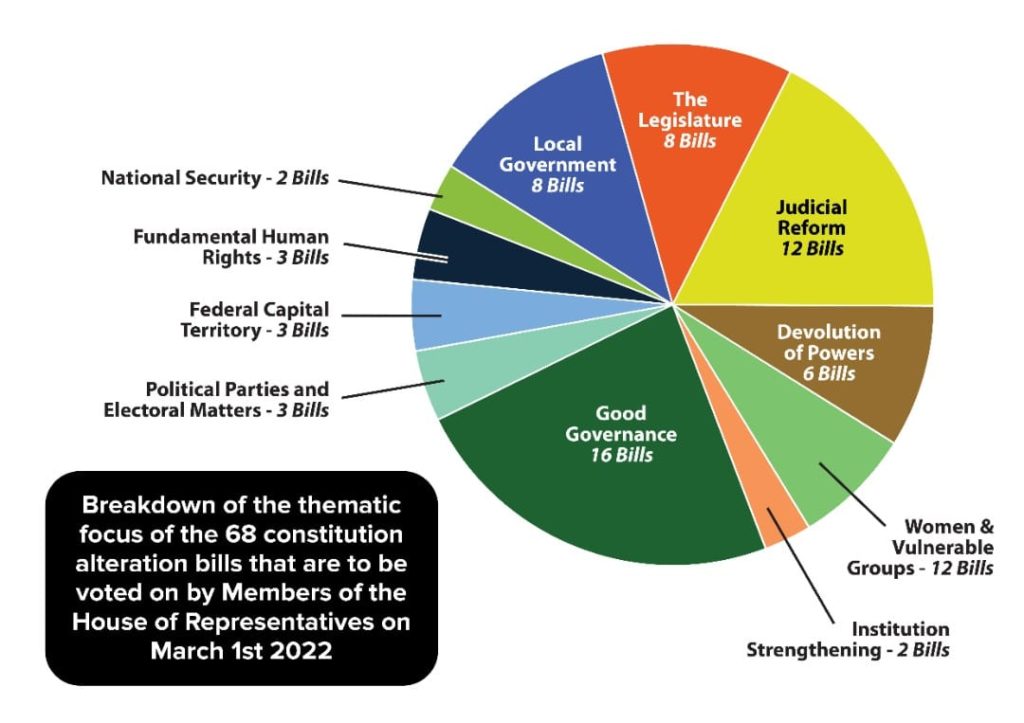
    On March 2, 2022, the National Assembly voted on 68 bills to amend the 1999 Nigerian Constitution for the fifth time. The bills covered restructuring, electoral reform, welfare, and the advancement of women’s rights. For the process to be complete, the bills passed by the Senate and House of Representatives also have to be passed by at least 24 of Nigeria’s 36 State Houses of Assembly.

    But state lawmakers have aired the National Assembly

    Nine months later, more than half of the Houses of Assembly are yet to give their response. This delay puts the 9th National Assembly in a tight situation as they have only six months left to put these bills on the president’s table before their tenure expires in June 2023.

    The Speaker of the House of Representatives, Femi Gbajabiamila, expressed his frustration with the delay. This was during a lecture organised by the National Institute for Legislative and Democratic Studies (NILDS) on December 12, 2022. The Senate President, Ahmad Lawan, and Kaduna State governor, Nasir El-Rufai, were also present at the event. 

    Lawan pleaded with El-Rufai to lobby his fellow governors to take action on the bills. However, El-Rufai tackled him with some demands for the National Assembly that were pressing on his mind. 

    Give Federal Government control of VAT collection

    Value Added Tax (VAT) is a tax paid when goods are purchased and services rendered. Currently, the Federal Government, through the Federal Inland Revenue Service (FIRS), collects VAT nationwide and then remits certain percentages to state and local governments. The Federal Government enjoys this arrangement but state governments have started rebelling.

    The Rivers State government dragged the Federal Government to court in 2021 and won the battle to collect VAT. However, the FIRS isn’t letting go easily and threatened to fine anyone who stands in the way of its bag.

    El-Rufai wants the National Assembly to end the tug-of-war by removing VAT from the constitution’s concurrent list. This list gives state governments some control over VAT collection. Instead, the National Assembly should move VAT to the exclusive list. This is so that only the Federal Government can collect VAT. This would render the court judgement invalid. 

    El-Rufa believes that the Federal Government being in control of VAT collection is the only way Nigeria can make enough money to spread around and sustain every state.

    Pass state and community police bills before leaving office

    The National Assembly and state governors have been in a tug of war concerning the issue of state policing for the longest time. The governors have maintained that unless state policing is passed by the Senate, they’re not going to blink an eye toward any of the bills.

    But why are governors so adamant about state policing being passed and why are lawmakers so against it?

    The governors see the state police system as an answer to the insecurity issues in the country. However, lawmakers are scared that the governors may not be able to pay the police officers’ salaries on time. They may also use police officers for ulterior, sinister motives. Governors like Nyesom Wike, Dave Umahi and many others have been guilty of showing lawmakers pepper with the police.

    Decentralisation of offshore mining and exploration

    If the National Assembly decides to listen to El-Rufai, the federal government will stop having control over 100% of solid minerals in the country. El-Rufai could really just be thinking of how to cash out if a mineral resource like oil is ever found in his state.

    The local government should be peculiar to each culture

    This speaks to the recent clamour for local government autonomy, as the state governments control the local governments. These local governments have now turned to playthings in the hands of their creators. As the closest tier to the people, they can hardly seem to do anything without their oga’s intervention.

    El-Rufai is begging that each local government should be unique to its own culture. This is so that they can serve the people better without doing things like this:

    After his speech, El-Rufai then replied Lawan’s request. He said he can never retire to the National Assembly because he simply doesn’t have the patience to lobby for issues.

    We can only wish Lawan and his colleagues good luck as they race against time to complete the constitutional amendment process.

  • What National Assembly Got Wrong About Amending Constitution

    There are many Nigerians who hate the 1999 constitution and just want it completely scrapped. This has been their one prayer point for years:

    The National Assembly is amending the constitution

    The sentiment is that the constitution is a fraudulent document that was brought to life under unfortunate circumstances and doesn’t fully accommodate the Nigerian experience. For those critics, the 1999 constitution is a malaria drug being used to treat a kidney infection.

    Despite agitations for a new “people-driven” constitution, the Nigerian government is not interested in the hard work of compiling a new one from scratch. So, the only middle ground to address the concerns about its inadequacy is to amend it. A constitutional amendment is basically like a home revamp — you want to get an AC to replace the standing fan, get a couple of new throw pillows, and maybe throw a new rug in the centre of the room. 

    The National Assembly has been in the news a lot over the past week following the constitutional amendment votes of March 1, 2022. Lawmakers in the Senate and House of Representatives voted on 68 bills with issues ranging from restructuring, welfare, to women’s rights. The simple rule of the vote was that each bill must be passed in both chambers. Failure to pass in one chamber was a failure to pass in both.

    The National Assembly is amending the constitution

    We’ve already highlighted some of the most impressive bills approved by the lawmakers. Here is a look at their worst decisions.

    1. No judicial reform

    For context into this particular subject, let us remind you that more than 70% of inmates in Nigerian prisons are awaiting trial. Some of them have been in prison awaiting trial for so long that if they were immediately convicted for their suspected crime, they’d have finished their sentences.

    Now let’s play a quick game of Yay or Nay:

    Who wants a judicial system that ensures timely dispensation of justice? Now, who wants a constitution that provides timelines within which civil and criminal cases have to be determined at trial to eliminate delay in justice delivery? Also, who wants a system that allows courts to conduct trials remotely, virtually and online with the full aid of modern technology? If you voted Yay for all, then you’re not ready to be a senator.

    The House of Representatives voted Yay on all three bills, but the Senate went in the opposite direction and rejected them. Who does judicial reform hurt?

    The National Assembly is amending the constitution

    2. No punishment for changing parties

    “Cross-carpeting” and “defection” are words that have become popular in political circles in Nigeria because of how much politicians don’t sit down in one place. Many of them switch between the same parties to pursue their personal interests so often that the average politician has been a member of at least two parties. A controversial part of this culture is when elected public office holders abandon a party that helped them win the office and take that advantage to another party.

    A bill was introduced to terminate the tenures of such office holders, but it was rejected by the Senate. This doomed the bill even though the House of Representatives passed it. Failure to punish elected officials who fail to take their mandates seriously upholds a culture that allows politicians to do as they please without consequences. It’s not a surprise that the bill didn’t pass because it’s the same people that would be affected by it that made the decision. It’s like expecting goats to vote against guarding yams.

    The Nays have it.

    3. Voting for torture?

    The 1999 constitution prohibits torture and establishes the right to dignity for every Nigerian, but torture enjoys free rein in Nigeria. Security agencies are known to torture and dehumanise Nigerians and get away with it especially because it’s so loosely defined. For lawmakers that claim to care about the wellbeing of Nigerians, closing the loopholes that fuel this culture should be an easy decision.

    An alteration bill was introduced to have the constitution clearly define acts that qualify as torture, inhuman or degrading treatment. Both chambers voted against the bill, handing torture specialists in security agencies a lifeline.

    4. FCT Minister slot

    As the child of circumstance that it is, the Federal Capital Territory (FCT) is not administered by a governor, but a minister that’s appointed by the president. Seven FCT ministers have been appointed since 1999 but none of them is an FCT indigene. There have been campaigns by FCT indigenes to change this, and there has even been a court judgement in their favour.

    However, when lawmakers voted on an alteration bill that would make it unconstitutional to appoint an FCT minister that’s not an indigene, the House voted yes, but the Senate voted no.

    5. Blocking women

    A lot has been said about the performance of gender-based bills voted on by lawmakers on March 1, 2022. We have written extensively about their rejection, and the general attitude of the National Assembly towards gender-based bills will continue to be a blot on its records.

    Passing any of the five gender-based bills would have enhanced the inclusion of women in politics, governance and society, but the National Assembly said:

    Dont Do That Avengers GIF - Dont Do That Avengers Black Panther - Discover  & Share GIFs

    6. No name change for Barkin Ladi LGA

    This is a very strange one and we’ll explain why. Of the 68 bills considered, six of them were about changing or correcting the names of some local government areas across the country. Five of them passed, but the one that sought to rename Barkin Ladi local government area of Plateau state to Gwol LGA was rejected by both chambers.

    Gwol is the ancestral name of the indigenous people living in the local government area, and they want the name to reflect their identity, not Barkin Ladi which is from the Hausa language. The renaming issue is a subject affected by ethnoreligious sentiment and a similar bill was defeated in 2017.

  • What Did National Assembly Get Right About Amending Constitution?

    A lot of noise has been made about the choices of the National Assembly lawmakers that voted on March 1, 2022 on bills to amend Nigeria’s 1999 constitution.

    The constitution establishes the principles that guide the running of a country. Amending the constitution is basically like redecorating your home — you want to repaint the room, maybe add a new stool and change the worn-out leather of the couch.

    Lawmakers in the Senate and House of Representatives voted on 68 bills with issues ranging from restructuring, welfare, to advancing women’s rights. The simple rule of the vote was that each bill must be passed in both chambers. Failure to pass in one chamber was a failure to pass in both.

    The National Assembly is amending the constitution

    Here’s a look at some of the most commendable decisions made by lawmakers.

    1. Local Government autonomy

    This is the current state of local governments in Nigeria:

    The National Assembly is amending the constitution to favour local governments

    State governors have turned local governments into their plaything and remote-control their activities so that there’s no independence. This arrangement means that the tier closest to the people is unable to serve them in any meaningful way without approval from oga at the top

    Federal lawmakers passed two important bills on March 1 that could prove vital to freeing local governments from bondage. One of the bills establishes local governments as a tier of government with guaranteed democratic existence, and the second bill separates the accounts of the state and local governments. 

    Bye bye to this:

    The National Assembly is amending the constitution to free local governments

    2. Financial independence of judiciary and legislature

    The Supreme Court ruled against President Muhammadu Buhari’s attempt to use an executive order to free state judiciary and legislature from the financial bondage of state governors in February 2022. The National Assembly has now passed a bill to codify this very important independence in the constitution. 

    3. No pension

    As if the National Assembly is not already a big drain on the national budget, a bill was considered to make it law for the country to start paying pensions to presiding officers of federal and state legislative chambers. Thankfully, common sense prevailed and both chambers voted against it. 

    It’s easy to suspect this pension bill was only ever considered by lawmakers so they could be praised for voting against it. And if that was the plan, it worked because that’s what we’re now doing here.

    4. Restructuring exclusive list

    One of the biggest issues in Nigeria since 1999 has been the centralisation of too much power in the Federal Government. The short version of the argument is that the centre is too strong and has its fingers in everything, denying state governments the freedom to take significant control of their own individual economic fate. The exclusive list contains items that only the National Assembly can legislate on, robbing state governments of control.

    Lawmakers approved five bills that would remove some of the items from the exclusive list and empower state governments more. The items being taken off the list are airports, correctional services, railway, power generation, transmission and distribution, and fingerprints, identification and criminal records. 

    5. Independent Candidacy

    The 1999 constitution recognises only political parties as sponsors of candidates for elections in Nigeria. This freezes out candidates who don’t want to play the game that goes on at the level of party politics. Lawmakers have now approved an amendment that would make it possible for individuals to run on their own independent platforms.

    6. Advancing human rights 

    Lawmakers also voted for two alteration bills that advance human rights in Nigeria. One of the bills makes free, compulsory and basic education a fundamental human right, and the other compels the government to ensure rights to food and food security.

    7. Rejecting VAT bill

    Money is a great motivator for conflict, and Nigeria’s restructuring debate has mainly centred around control of revenue generation and management. State governments challenged the Federal Government on the collection of Value Added Tax (VAT) in 2021 and even secured a crucial victory in court. The Federal Government’s position has always been that its tax collection duty is backed by the constitution. But this is not constitutionally sound, and the government is only now just making attempts to alter the constitution to get that unquestionable backing. Lawmakers in both chambers threw the bill out. The fight goes on.

    The National Assembly is amending the constitution

    8. Cabinet nominations

    Remember how mad everyone was that President Muhammadu Buhari ran the first five months of his government without appointing ministers? And remember how much of a lesson he learned from that episode that it took him only two months to nominate ministers for his second term? Well, there’s a new bill that ensures the most time any president or governor can take before nominating ministers or commissioners cannot be more than 30 days.

    9. No immunity

    Lawmakers also voted against a bill that would protect members of the legislature and the judiciary with immunity from criminal prosecution. The privilege of immunity is only enjoyed by federal and state executives and even the status of that has been debated. Another victory for common sense.

    10. Census timeline

    Imagine you’re the head of a house, but you’re not sure how many people live under your roof. You have to buy foodstuff and clothes for everyone every now and then, but you’re not sure how many people you’re actually buying for so you do guesswork all the time. One day, there are 200 million people living there, the next day it’s probably 180 million people. 

    The National Assembly is amending the constitution

    Could be 5 million people or could be 5,000. Who cares to count?

    The global standard timeline to conduct a census is every 10 years. Nigeria’s last census was conducted in 2006 and promises to conduct a fresh one keep getting postponed every year. On March 1, lawmakers voted for a bill that would specify the time frame for the conduct of censuses going forward.

    What happens now?

    All the bills passed by the Senate and House of Representatives also have to be passed by at least 24 of Nigeria’s 36 state Houses of Assembly.

    And then President Buhari has to sign them. There’s a long journey ahead, and some of these bills won’t make it to the finish line.

  • Does the National Assembly Hate Nigerian Women?

    There was one moment during a plenary session in the House of Representatives on March 1, 2022 when lawmakers openly jumped for joy. The chamber was filled with cheers, wide smiles and fist bumps that would make you think they’d just solved world hunger or negotiated debt cancellation for Nigeria. However, what they had just done was vote against a bill that would have given women special seats in federal and state legislative chambers.

    In the Senate chamber, just across the hall from the representatives in the National Assembly complex, the mood was not so different when they voted against the same bill. The Senate President, Ahmad Lawan, was in a fit of laughter that lasted for nearly 30 seconds as he recorded the vote. He said he was reluctant to declare that the vote had failed, but it was hard to believe him.

    The National Assembly keeps disappointing Nigerian women

    What happened in those two chambers on March 1 was a missed opportunity to advance the rights of women in what has been a robust constitutional amendment process.

    Constitutional what now?

    The National Assembly is alienating Nigerian women again with the constitutional amendment

    Think of the constitution as a document that guides how a home operates. It outlines how the head of the family is chosen, how they’re supposed to take care of the home and how everyone else conducts themselves so the home does not collapse.

    Since human behaviour is guided by the social times we live in, the way people lived 40 years ago would be different from the present — hopefully for the better.

    And this is why the constitution leaves room for itself to be updated occasionally. Nigeria’s current constitution was enacted in 1999 and has been updated four times since then.

    After years of consultation on a new list of amendments, the National Assembly voted on 68 bills covering many issues. Five of those bills especially affected women.

    The National Assembly keeps disappointing Nigerian women

    The main rule was that each of the bills had to be approved by both the House and the Senate. Failure in one chamber meant failure in both.

    What did the National Assembly do to the women?

    This is the short version of how lawmakers voted on all the bills that affected women:

    The National Assembly keeps disappointing Nigerian women

    Here’s the long version:

    1. No special seats

    Only 4% of the 469 lawmakers in the current National Assembly are women — a statistic that spotlights the low visibility of women in elected office in Nigeria. This bill would have created 111 exclusive seats for women in the National Assembly and 108 seats in the 36 state legislative chambers if it had passed. It would also not have prevented women from contesting for other seats against male candidates.

    The most popular argument against this bill is that it would inflate the size of legislative chambers at a time when many Nigerians are calling for a reduction, especially in the size of the National Assembly and wages of lawmakers.

    2. No citizenship for foreign husbands

    Section 26(2)(a) of the 1999 constitution allows any foreign woman married to a Nigerian man to become a citizen by registration. Nigerian women have no such gift to hand to their foreign husbands. This would have been corrected if lawmakers voted for a bill to fix it on March 1.

    But they said:

    The bill failed to pass in the House of Representatives. When House Speaker, Femi Gbajabiamila, tried to explain the importance of passing it, in an attempt to force a second round of voting, a lawmaker off-camera said, “We know this thing; we don’t like it.”

    The bill was passed in the Senate, but that won’t matter.

    3. No affirmative action in party politics

    The low representation of women in elected public office is partly tied to their low representation in party politics. This was why a bill was proposed to ensure 35% of executive committee positions of political parties are filled by women. Many parties have promised to do this on their own in the past but hardly implemented it. Codifying it in the constitution would force implementation. The bill failed in both the Senate and House of Representatives.

    The National Assembly keeps disappointing Nigerian women

    4. No indigeneship

    The bill on indigeneship would have allowed a woman who is married to an indigene of another state for more than five years to automatically become an indigene of that state. Since Nigerian women face so many issues over getting cleared for appointive and elective positions based on indigeneship alone, this bill should have passed easily. The bill would also allow anyone to become an indigene of a state where they’ve been resident for 10 years. It passed in the Senate but failed in the House of Representatives.

    The National Assembly keeps disappointing Nigerian women

    5. No cabinet quota

    The cabinet quota bill was another attempt to ensure at least 10% of federal and state cabinets are filled by women. A frustrated Gbajabiamila found a way to force the bill through in the House after increasing the quota to 20%. When lawmakers rejected it through electronic voting, he ignored the result and put it up to a voice vote, the mode of voting in which they shout “Aye” or “Nay” like it’s 1982. He then passed the bill even though it was hard to tell which side’s voice was louder. The Senate voted against the bill anyway.

    At the end of the day, women finished with zero bills passed in their favour.

    The National Assembly keeps disappointing Nigerian women

    How are Nigerian women taking this?

    What Nigerians should be worried about is not just that all those bills were rejected, but the manner in which they happened. Lawmakers jumped in glee and rejoiced over the rejection of the bills like they weren’t alienating half of the population. 

    This happened while the nation’s Second Lady, Dolapo Osinbajo, was seated in the House of Representatives chamber to observe the process and press for women’s rights. The First Lady, Aisha Buhari, had also been present in both chambers when the bills were presented on February 23. 

    The rejection of the bills did not sit well with Nigerian women who mobilised and protested in front of the National Assembly complex on March 2.

    Their demands were simple: enhanced inclusion of Nigerian women in politics, governance and society. This is not too much to ask for, but the National Assembly has a history of standing in the way.

    The National Assembly keeps disappointing Nigerian women