Notice: Function _load_textdomain_just_in_time was called incorrectly. Translation loading for the wordpress-seo domain was triggered too early. This is usually an indicator for some code in the plugin or theme running too early. Translations should be loaded at the init action or later. Please see Debugging in WordPress for more information. (This message was added in version 6.7.0.) in /home/bcm/src/dev/www/wp-includes/functions.php on line 6121 Zlatan Ibile | Zikoko!
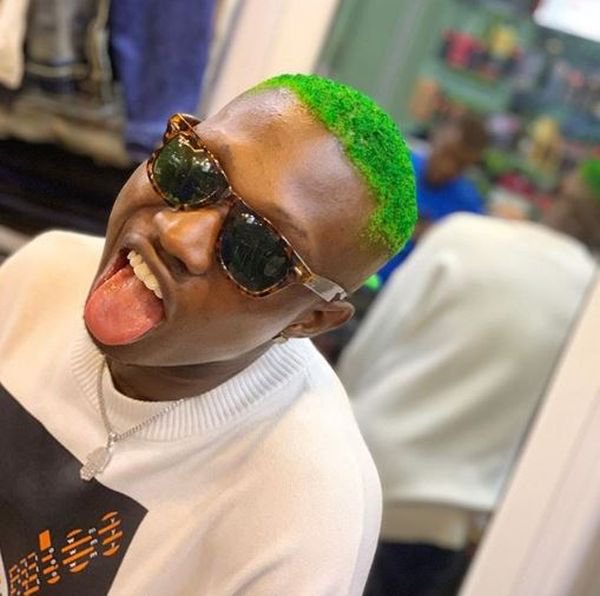
It’s 2019. Zlatan Ibile, a green-haired lyricist from the slums of Agege, is the hottest rapper in Nigeria. He’s everything you didn’t know you needed. Like if someone found a way to make amala and catfish pepper-soup work as a combo.
Zlatan is a certified pop star now. There’s no arguing that. To be honest, no-one can say how and why he came this far, so quickly. He’s not the first Nigerian rapper to bring the music of the streets to the mainstream. He’s not the first to have such frequent brushes with controversy either.
One moment, he was one of thousands in the dark underbelly of Nigerian music, where Naijaloaded holds sway, and the next moment we were shouting ‘kapaichumarimarichupaco’ and doing the Zanku into 2019.
Zlatan kicked off the year in 2018, ironically. Like watch-night services and prayer sessions in the years before the economy swallowed our faith in God, “Killin Dem” was the song that ushered many Nigerians into the new year. Since then, Zlatan has refused to let go of our necks.
He’s managed to achieve all his success without losing what makes him distinct: his energy. The defining feature of Zlatan and his work is its capacity to move you, even when he’s trying to be serious. It comes from an energy that’s contagious. It’s peer pressure at its finest. And by god, it’s beautiful to listen to and watch in action.
Think about “Am I A Yahoo Boy” for instance. It’s supposed to address claims that the two are internet fraudsters. On any day, that’s a serious allegation. But as soon as the beat comes on, your home training evaporates and your legs start to fight for freedom. Like it or not, you soon find yourself dancing to a song that packs 30 years of counterculture into three minutes.
If you’ve (refused to succumb to your problems and) partied in 2019, you’ll know what happens when a Zlatan Ibile song comes on the speakers. It’s like someone sprinkled hard drugs in the air. Only this time, it’s a rare form of cocaine that compels people to jump and stab their feet in the air.
The only other person who has this capacity is his friend, Naira Marley. Unlike him, Zlatan can combine his energy and affinity for street culture with being a rare likeability. He’s like the neighbourhood delinquent who worms his way into your family until he earns the right to show up for Sunday dinner unannounced.
The best example is probably not any of his songs, even though each one sounds like a war chant and a celebration of unexpected dollars rolled into one. It’s those videos of him laying his adlibs over newly recorded tracks. Even without an accompanying beat, they sound like you’re expected to do something. You get the same feeling as when your father opens the door to your room and stands at the entrance, silently staring into your eyes. You don’t know what you’ve done wrong but you just want to fix up your life and make up for your mistakes.
It’s that energy, coupled with Rexxie’s beats that has made certain DJs build their entire club mix around his music. It’s why Tekno returned from an unfortunate hiatus and had to tap Zlatan for a low-budget Zanku ripoff titled “Agege”. Because when you’ve copied a person’s sound and featured him on the song, naming it after their neighbourhood is a small ask. It’s why Zlatan’s music is what gets the party moving; whether it’s the first or penultimate song on your tracklist.
It’s why I think we should go further and make it an informal rule at least; it should be illegal to party without Zlatan’s music.
I know this sounds like a joke. In a sense, that’s what it started as, but since I started writing this, I’ve gotten more reasons why this is necessary.
The Morality prefect inside you is probably asking, “Segun, wazz all this?” Get over yourself and your Sunday school lessons. This is bigger than us all. This is about love, a shared identity and most importantly, social equality. This is about passion.
You see, Zlatan is a kind of cross-cultural, inter-class mixologist. Think of him as a member of Major Lazer. Only, instead of generic Carribean vibes, his forte is making music that forces you to lose your self-control, whether you’re a 12-year-old selling gala in traffic or a billionaire looking to reconnect with the simpler days of his youth. Zlatan’s voice attacks the legs, which makes sense because the Zanku is also known as ‘legwork’.
Anyone with the ability to get people dancing across generations and social classes has to use his ability for something more than Eko Hotel shows and Instagram likes. That’s why we need to weaponize his music to do what Buhari, 30+ years of NYSC and Jollof rice have struggled to achieve.
It’s difficult to harbour resentment towards anyone for being richer than you when you’ve danced “Zanku” together at an owambe, with bottles of beer raised to the high heavens as a sign of togetherness.
Making Zlatan’s music a compulsory part of our lives will bridge tribal & social prejudice. The broke Yoruba transporter from Oshodi will see his wealthy Igbo brother from Port Harcourt and as they both ‘gbe body’ to Shotan, they’ll find that they have so much more in common than they know.
It’s only a short distance from there to world peace.
Midway through “Opotoyi“, Naira Marley’s first song since his release on bail as he faces charges of fraud, the rapper stops what is a fast-tempo dance song to preach:
“Ko s’ogun aiku, iku lo gara ju, werey to’n s’ogun aiku fun gan, t’oba ku tan bawo lo se fe gba refund“
In English: “There’s no way to beat death; if there’s anyone who’s gullible enough to pay for such charms, how will he get his refund if he dies?”
In isolation, it would be a confounding statement, but as a part of “Opotoyi”, it is a targeted show-off of street smarts that stands out on a song that’s little more than an exercise in crass shit-talking, delivered in perfect street lingo.
In the last few months, the rapper/singer, real name Afeez Fashola, has become a phenomenon mired in controversy. Not much is known of his early life. He moved to the UK as a teenager. According to a recently-surfaced news report, he was one of many young people declared wanted by Lewisham Police for crimes ranging from robbery to sexual assault on a night bus in 2014. He made a light splash in the UK rap scene shortly after before a brief hiatus.
When he returned, he was the perfect hybrid of two cultures. Naira Marley raps in a mix of Pidgin, English and Yoruba in a drugged drawl spiced with a South London accent. In subject matter, he’s more similar to Obesere, the vulgar Nigerian fuji icon than Kida Kudz, another Nigerian/UK rapper from his generation.
A string of hits and ample use of social media, buoyed by strategic friendships with Lagos socialite, Rahman Jago and one of the hottest commodities in Nigerian music, Zlatan Ibile, shot him into the top 10 of streaming charts and made him a party staple.
Since March 2019, Naira Marley has owned at least two of the 10 most streamed songs in Nigeria. In a notoriously fickle music space like Nigeria’s, such a drastic change in fortunes often inspires artists to tighten their bootstraps. Not Marley.
Over the course of three months starting April 2019, Naira Marley grabbed a seat on the back of outrage and shot himself to infamy. On April 6, soft-spoken singer/songwriter Simi criticised internet fraudsters in a Live session on her Instagram. Simi has an appetite for social commentary on issues from football to politics; and after several tweets on the topic, a fan had told her to leave yahoo boys alone.
The IG live session appeared spontaneous but it was not unwarranted. As Simi would go on to say, “I’m not the problem, the world is laughing at us”. Nigeria has earned an unhealthy reputation for breeding a daring strain of internet fraudsters who, in 2017, earned themselves the 3rd spot in global internet crimes.
They are the more imaginative spawn of the ‘pen pal’ fraudsters of Nigeria’s 1980s, and more profitable as well — About N127 billion was lost to cybercrime in Nigeria in 2015, according to Professor Umar Danbatta, CEO of the Nigerian Communications Commission. They haven’t discarded the old playbook either — Nigerian prince scams still rake in over $700,000 a year, as this report by the CNBC claims.
In a sea of vitriolic responses to Simi’s video, Naira Marley stood tall, launched his own Instagram live session and offeredreasons, including reparations for the transatlantic slave trade, on why internet fraud is justified.
The events that followed read like the final chapters of a Ben Okri book. Days later, on April 22, Naira Marley took to Instagram to accuse Simi of snubbing him at an event, “@symplysimi I saw u at d homecoming last night, u look sad & upset.. why? Am I a yahoo boy?” he wrote beneath a picture of him. The caption has since been changed.
No publicity is bad publicity, someone once said. And once online conversation pushed the spat to viral proportions, it was only a matter of time before Naira would take advantage. Released on May 9, “Am I A Yahoo Boy”, a trap single featuring Zlatan, expanded on Marley’s IG video by asking rhetorically, if the two were in fact internet fraudsters. Within hours, the song shot to the top of digital streaming charts.
Naira Marley may have offered answers on the song but the EFCC wanted more. As the cock crowed in the wee hours of May 10, Zlatan, Naira Marley and three others were arrested during a raid on Zlatan’s residence at Ikate, Lekki, Lagos.
While Zlatan regained his freedom after days of questioning, Naira Marley’s fate was more thorough. On May 30, the rapper was arraigned before a Lagos court on 11 counts of violating the Cyber Crimes Act of 2015, and granted bail in the sum of 2 million naira. Days later, Marley was free.
Many had first expected Naira Marley’s first song after his arrest to be a plaintive reaction to his stint in jail. Music typically reflects the state of whoever’s making it. As shown by every artist from Sinzu to Zlatan, who recorded “Four Days In Ekotie-Eboh” upon his own release, time behind bars typically inspires bars of the written kind.
Instead, Naira released “Opotoyi (Marlians)”, a lewd song for drunken nights, filled with vulgar appraisals of the female body and drug use. In any other artist’s case, it would have gone down as a wasted opportunity to attract valuable sympathy. For Naira Marley however, his devotion to a certain way of life and his efforts to celebrate it trump everything else.
https://www.instagram.com/p/BxSYYarAhRs/
Despite introducing himself to the audience as a semi-IJGB schooled in Lagos street life, Naira Marley has always shown allegiance to the latter part of his identity. His early releases wouldn’t sound out of place on a London DJ’s playlist, but over time, Naira has gradually unveiled his ‘real face’.
From his frequent Instagram Live sessions to his very public responses to trending issues and his affiliation with suspected gang members, even when singing about seemingly innocuous topics like football on “Issa Goal” or the paparazzi on “Illuminati”, Naira has always offered up subtle and sometimes overt praise for two of the biggest scourges that are defining a generation of Nigerian youth today — internet fraud and drug abuse.
Covered by the sheen of celebrity and glossy music videos, Naira Marley can be easy to digest. At best, he’s seen as a playful charlatan; at worst, a harmless nihilist. It belies the fact that the real-life version of the persona that he offers is much darker.
You’ve seen him before; the average street boy who is as quick to hustle for a wad of notes as he is to explore the shorter route there. He doesn’t care what you think; he is often eager to project power, physical or financial. He is one of the people who make up Naira Marley’s core fanbase.
https://www.instagram.com/p/Bs55zK5DvVS/
The “Marlians”, as they are called, are a survivalist bunch, groomed in a dog-eat-dog world where morality is a fickle construct and strength in numbers is a policy. While well-meaning Nigerians applauded on Twitter his arrest, they complained that EFCC chose to arrest him on his birthday.
The burning question of how Naira Marley secured their attention and devotion and became a “national star” is worth discussing. For decades, the music of Nigeria’s most culturally-vibrant ghettos has often existed in its own vacuum – with only a few artists making the journey to nationwide acceptance and becoming relative ambassadors. The analogy that best describes this process is crossing the third mainland bridge.
No one crosses the Third Mainland Bridge except to meet a need on the other side. In a sense, it can feel more like a journey between social classes, than a trip on a 14km-long bridge. One end of the bridge has always felt left out when it comes to popular music.
It’s easy to recognise what we’ve come to describe as street music – amateurish production, aggressive delivery, subject matter that focuses on dance or occasionally larger-than-life ideas ranging from ‘hustle’ to ‘fate’.
https://www.instagram.com/p/BpXdh3cDARU/
Since Kerewa became a national hit and topic of concern among Nigerian parents fearing for their impressionable young kids, the music of Nigeria’s slums has only ever blown up courtesy of acceptance on the other side of the bridge – in Lekki’s snazzy clubs and lounges, behind location filters and retro-cameras of highbrow Lagos and its islands.
The Shaku-Shaku sound and dance that dominated 2018 are the most definitive examples. According to its biggest ambassadors, Slimcase and Mr Real, Shaku-Shaku and the drum-heavy sound of hit songs like”Legbegbe” and “Diet” became integral parts of the culture in Agege, a not-so-highbrow area of Lagos since 2016. Yet it did not reach nationwide acceptance until the dance became a social media phenomenon, with celebrities from Genevieve to D’banj taking stabs at it.
It soon showed up in the Island’s biggest clubs. DJs, ever the willing suppliers, found the songs to fit – and introduced new audiences to its stalwarts. Collaborations spurred more hits and by the time concert season came in December 2018, the only thing that mattered was Shaku-Shaku.
On your first attempt to juggle your memory, it would appear Naira Marley’s journey happened on the shoulders of the Zanku – the dance style popularised by Zlatan that leveraged Shaku-Shaku’s entry into the mainstream and hasn’t gone away since.
The reality is much less linear: Naira Marley crossed the third mainland a lot earlier, in the most innocuous of ways. It happened thanks to a song you may remember from that one time Nigeria’s World Cup jersey stunned the world – 2018’s “Issa Goal”.
https://www.youtube.com/watch?v=im22OgaMImk
Unknown to most of his audience prior to its release, the song presented Naira Marley as a UK resident who was in love with the country of his birth and had the lingo to earn his place alongside Lil Kesh and Olamide . It was also picked up by Coca-Cola as the Nigerian National Team’s unofficial theme song for the 2018 World Cup. It was a move which, unwittingly, put him in a class alongside other prominent young Nigerians with more friendly brands, like Alex Iwobi and Wizkid.
His follow-up, “Japa” contains a more overt reference to credit card fraud, but if anyone heard, and some people raised concerns, everyone soon got drowned out by the noise of feet stomping on both sides of the bridge.
“Am I A Yahoo Boy” will perhaps go down as the most definitive song in Naira Marley’s career. The song’s title was the perfect query for the situation that birthed it – which is why it is worth noting that both artistes glorify internet fraud on a song which was supposed to acquit them of these accusations. Naira Marley’s arrest was celebrated in certain circles as a quick reaction to a budding menace. And it would have an effect, just not the one we expected — Marley’s message had stuck.
In the eyes of his fans, he’s become the street kid who’d made it enough to earn himself a love/hate relationship with the elite. He’s known by everyone from A-list artists to an audience out of Nigeria and the UK that loves his music but refuses to accept his violent nihilism — a way of life that Marlians are all too familiar with. What’s not to aspire to?
Make no mistake; Naira Marley knows exactly what he’s doing. Behind the braids, droopy eyes and seemingly haphazard behaviour is an artist who cross-pollinated Nigerian andUK street culture to produce a hybrid that has done what countless PR firms and record labels have struggled to pull off.
He’s dropped three songs since his arrest in May: “Why”, “Opotoyi” and “Soapy”. If you’re willing to explore the pattern, it goes far beyond his recent releases; he’s learned to pick the most targeted song titles, using words that draw instant reaction or take advantage of a trend.
“Issa Goal” made him one of the faces of a country’s appearance at the World Cup. “Japa” brought a common slang to life by embodying a generation’s obsession with evading haters, hard times or in his case, London’s Met Police. “Illuminati” was an attempt to elevate perceptions of his stardom by name-dropping a group that is believed by some to give musicians stardom in exchange for their souls. “Am I A Yahoo Boy” took advantage of the heavy buzz following his defence of internet fraud. “Opotoyi” stamped the “Marlians” as a community. Each of these songs has been streamed over one million times.
His latest release, an unfortunate dance single titled “Soapy” is an effort to strengthen his hold on that community. The song references his stint in jail and has been described as an effort to draw attention to the terrible conditions in Nigerian jails. However, on the morning of its release, Naira Marley took to social media to unveil the “Ijo Soapy”, the accompanying dance style that mimics public masturbation. It has taken only a few days for the song to become a menace.
“Don’t you trust me; trust me, I don’t trust myself” – Naira Marley (“Jogor“, Zlatan, Kesh and Naira Marley, 2018)
What Naira Marley represents isn’t just his music. The rapper may be his own biggest fan and his brand of pedagogy is largely self-serving. What more evidence does one need than that cringe-worthy self-comparison to Africa’s greatest individuals – Fela Kuti, Nelson Mandela – on “Am I A Yahoo Boy?”.
Yet it’s finding a greater audience than we expected because it’s the reality of a street culture that we’ve ignored for so long. It’s why the primary defence by most of his fans is that his music reflects reality; they’re correct. If terms like ‘maga’, ‘opotoyi’, ‘ase’ seem to be entering the popular lexicon, it’s because they were already in use before – albeit on the wrong side of the bridge.
The best evidence of the diversity of Naira Marley’s clan is best found on his Instagram. Hundreds of his fans have volunteered submissions of themselves doing his Ijo Soapy. Those who have made it to his page are more varied than you’ll expect; a group of young Peckham teenagers dancing around in circles, young Nigerian women in glossy lace at an Owambe, a stripper and not least by any means, Lil Kesh.
https://www.instagram.com/p/Bp_7wWADVjb/
He may be an outcast in the hallowed halls of Naija twitter. But in the places where it often matters, away from the moral certitudes of ‘woke’ conversations, Naira Marley has held himself up a beacon of rebellion and young adult angst.
Like Simi did in April, many of Naira Marley’s colleagues have described his newest offering as what it is — a new low. Dancer, Kaffy is the latest person to do this. “In the history of Naija dance, I’ve never seen a more disgusting dance immoral dance called Soapy. It should never be encouraged,” she wrote in an Instagram post.
https://www.instagram.com/p/BzbV-IxBwb1/
For all its worth, her voice and that of many others count. But when compared with the viral rates with which new videos of people dancing Soapy are popping up on social media, the reality gets even more worrying.
The question we need to ask is this: Are we ready for an artist who does not care what anybody thinks and has a horde of raucous if misdirected young adult males hanging on his every pronouncement?
Naira Marley knows what he’s doing, do we?
Did you enjoy this? You should sign up for our weekly pop culture newsletter, Poppin’. You’ll get to know what we’re up to before anyone else + insider gist, reviews, freebies and more. If it sounds like your deal, sign up here.
There’s so much music out there that it’s hard for even the most loyal fans to stay up with their favourite artists or what’s new and hot right now. That’s why we’ve created #BumpThis – a daily series that features the one song you need to listen to, every day. Don’t say we never did anything for you.
In 2017, the Migos were at the top of their fame. Every rap-leaning artist who hadn’t created an identity set in stone had jumped on this three-tiered wave whether in sound, cadence or appearance. The Street Billionaires, a group of four rappers, Gbafun, IJay, Candy Bleakz and Lemon, seemed to be the most intense iteration of that wave.
The group’s 2016 debut was a refix of Migos’ “Bad and Boujee” which earned them a sizeable following. The music video in particular presented them as the Nigerian street version of the group, complete with their eponymous flow, outlandish jewellery and rainbow-hued shirts.
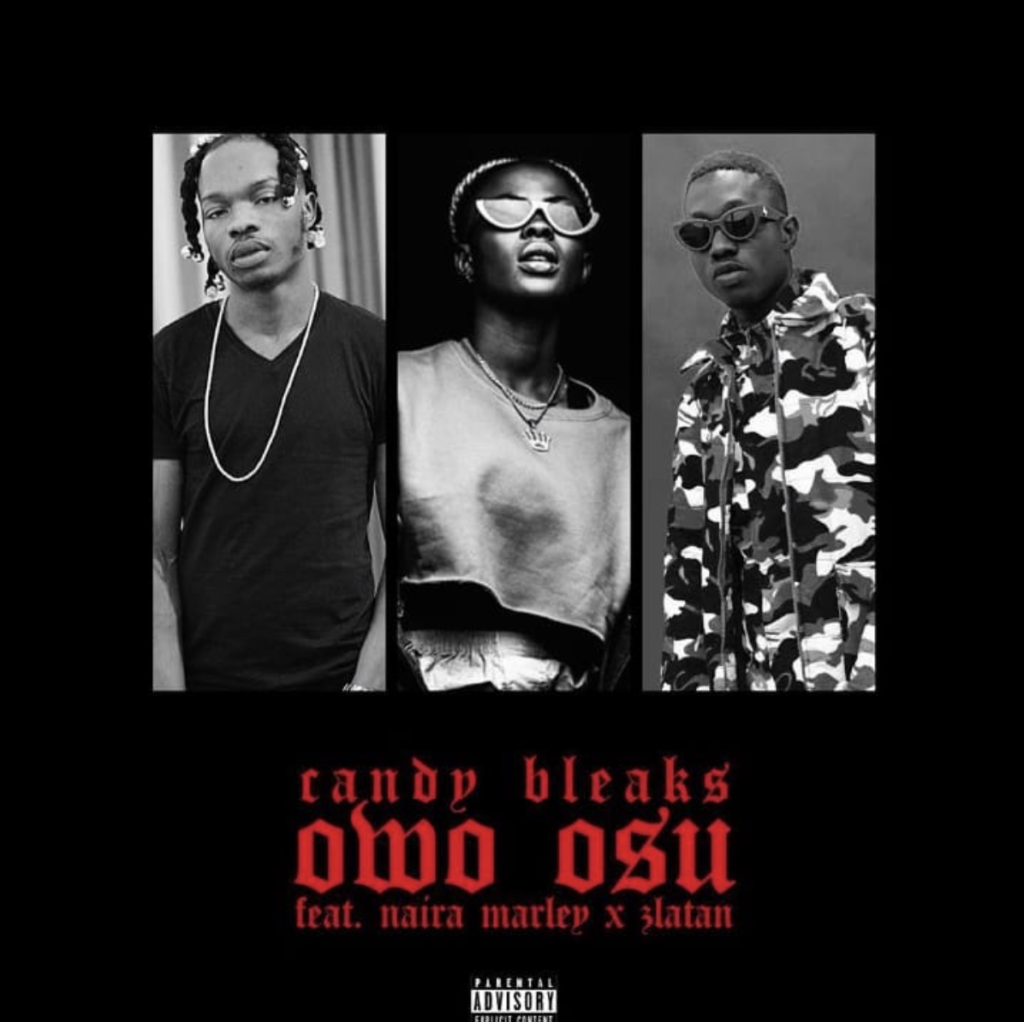
The group’s first lady, Candy Bleakz, rides yet another wave with her debut, “Owo Osu”. Over the last two years, Candy’s grown her following on Instagram with freestyles and comedic commentary – increasingly one of the more popular scripts for success in the digital age. To find her way around her solo debut, she enlists help from two heavyweights of the Zanku sound, Zlatan and Naira Marley.
Street Billionaires – “Bad and Boujee (Refix)” | YouTube
Their Chocolate City affiliation didn’t drum up much attention. But a 2018 follow-up, “Owo Mi Da” hinted that for these less-than-privileged former hobbyists (The budget for the video for “Bad and Boujee Refix” was 95,000 naira), the Migos wave was merely a starting point.
Zlatan Ibile, arguably the breakout star of 2019, repels any suspicions that he has eyes anywhere but on the bag. It’s one of the common tropes of the Zanku sound he has helped popularise; aspirational raps by young hustlers intent on getting paid, not surprising considering the street lifestyle and bootstrapping that birthed the sound.
He delivers a typical high-energy verse, building on the familiar adlibs, like “Kuronbe!” that dot the song from start to finish. See, Zlatan is not in the business of performing for free or a half-full bag, as he emphasises. Then as if to press the point home, he asks one of his more chronic debtors why he’s guzzling cold bottles of beer if he hasn’t paid up.
Turns out she could do without them. Candy’s rebellious-girl-next-door persona is more believable than you’d expect as she teases anyone who’s broke and unfortunately within earshot in her native Yoruba. “Sho ti gb’owoosu” (Have you gotten your monthly pay?), she asks matter-of-factly.
Candy’s lyrics seem to taunt salary earners and the inevitable spending limits that come with a fixed income. As the song goes on, it becomes obvious that ‘owoosu‘, (literally ‘salary’ in Yoruba), is an epithet for just about any source of income.
Zlatan’s BFF, Naira Marley has only just secured a temporary respite from detention, after being charged for internet fraud in May. His verse here doubles down on the gleeful boss talk that caught the attention of the EFCC and earned him the troop of fans he calls “Marlians“.
“Money is money, my guy. As long as it’s not Ogun Owo (Blood Money), my guy“, he proclaims. Statements like that will obviously do nothing to help the rapper’s cause or absolve him of any suspicions.
But it is totally on-brand – Naira Marley has increasingly begun to feel like everyone’s problematic friend. You swear you’re against anything he stands for. That’s until he come through with the best cruise you’ve had in ages and you suddenly decide he’s a necessary evil. Here, it manifests in how this subtle nod to fraud is most likely to be the part of the song that sticks in your head, along with the other reckless boasts that he splatters on his verse.
Whatever scepticism you may have about Zanku and its potential lifespan, or its alleged ties to internet fraud, Candy Bleakz’s summer bop is a necessary reminder to secure the bag. Enjoy the guap (and the music) while it lasts.
Stream “Owo Osu” by Candy Bleakz w/ Zlatan Ibile and Naira Marley here.