Notice: Function _load_textdomain_just_in_time was called incorrectly. Translation loading for the wordpress-seo domain was triggered too early. This is usually an indicator for some code in the plugin or theme running too early. Translations should be loaded at the init action or later. Please see Debugging in WordPress for more information. (This message was added in version 6.7.0.) in /home/bcm/src/dev/www/wp-includes/functions.php on line 6121 travelling | Zikoko!
Imagine hopping on a plane and arriving in a foreign country alone. The only familiar face you’ll see will most likely be yours. It may be daunting, but if you prepare well and leave Nigeria with all the items on our list, you’ll be fine.
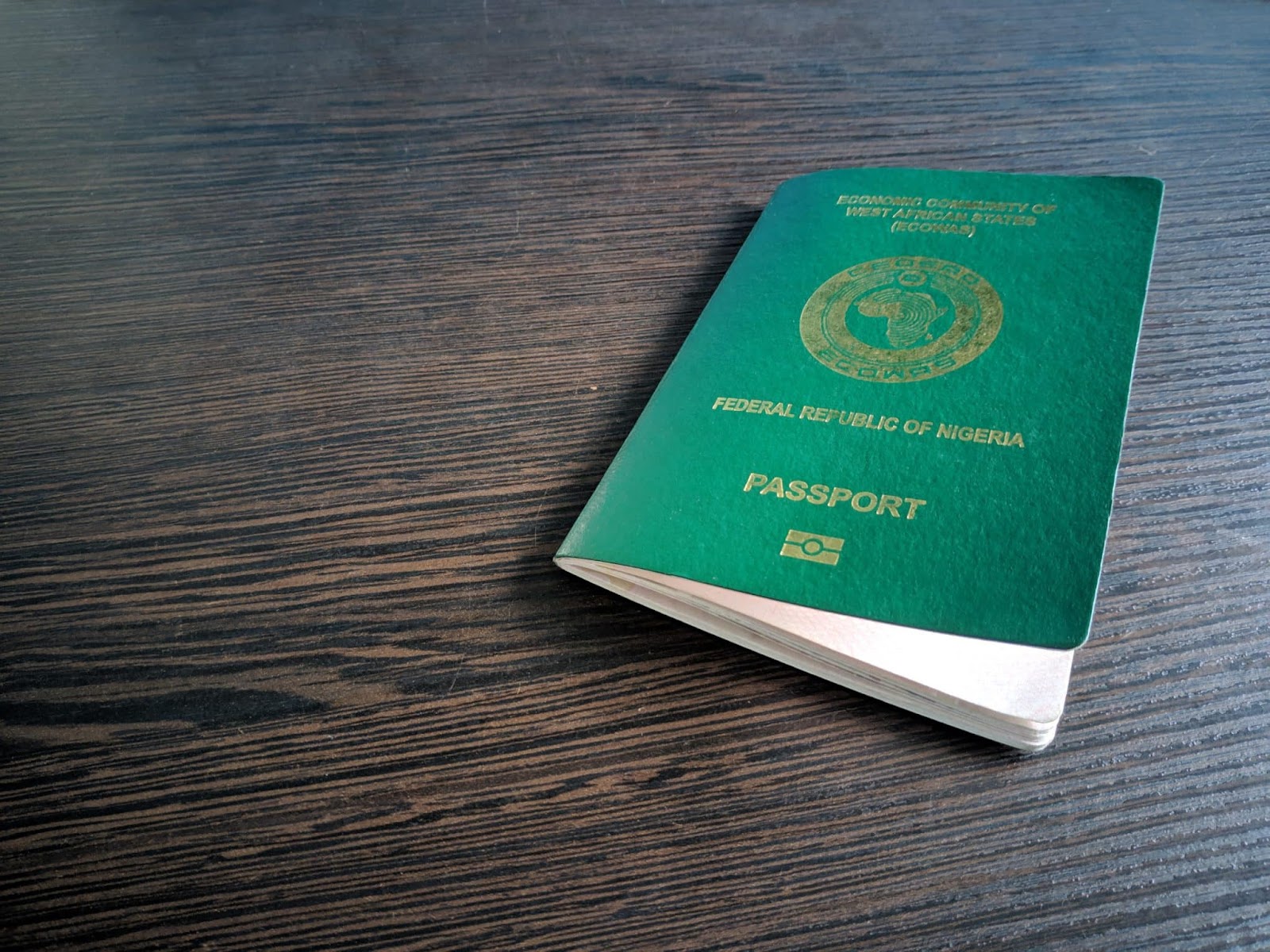
A credible form of ID
Image source- Biometric update
We know you’re an adult and won’t forget your travel documents and ID, but this is your reminder to double and triple-check that you’re actually with it before you board that plane. Just in case you still somehow forget, as long as you booked your flight with Tramango and opted for their travel insurance, you’re good. They treat their customers like egg and will be there for you 24/7.
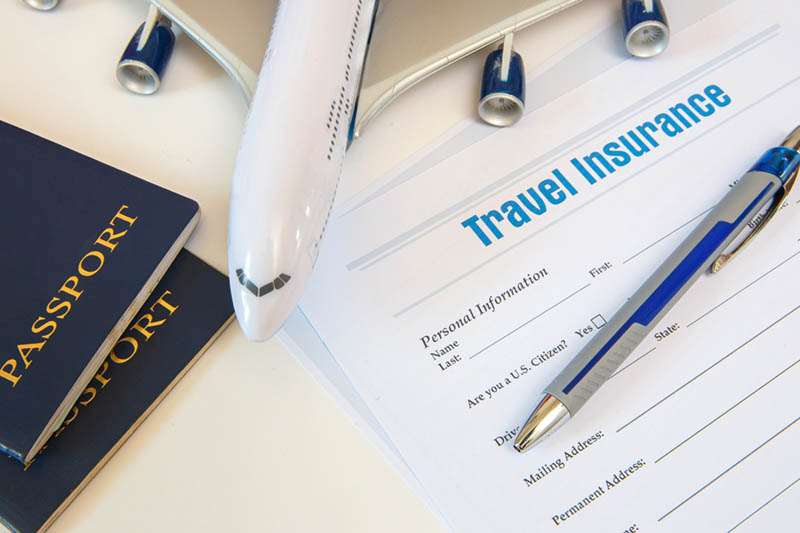
Travel insurance
Image source- CDC.gov
You can never tell what’ll happen before or during your trip. Your flight might get cancelled due to weather conditions. You might lose your passport, fall sick or lose your baggage in a foreign country. That’s where travel insurance comes in. You’ll get support, coverage and some refund if you experience any of that. Who better to help you with your travel insurance than Tramango?
Cash
Image source- tenor
It might be a cashless society but don’t forget you’re going to a country you’ve probably never been to before. You don’t know what might happen there, so take as much cash (that wouldn’t look suspicious) as you can so you don’t end up stranded in an unfamiliar country.
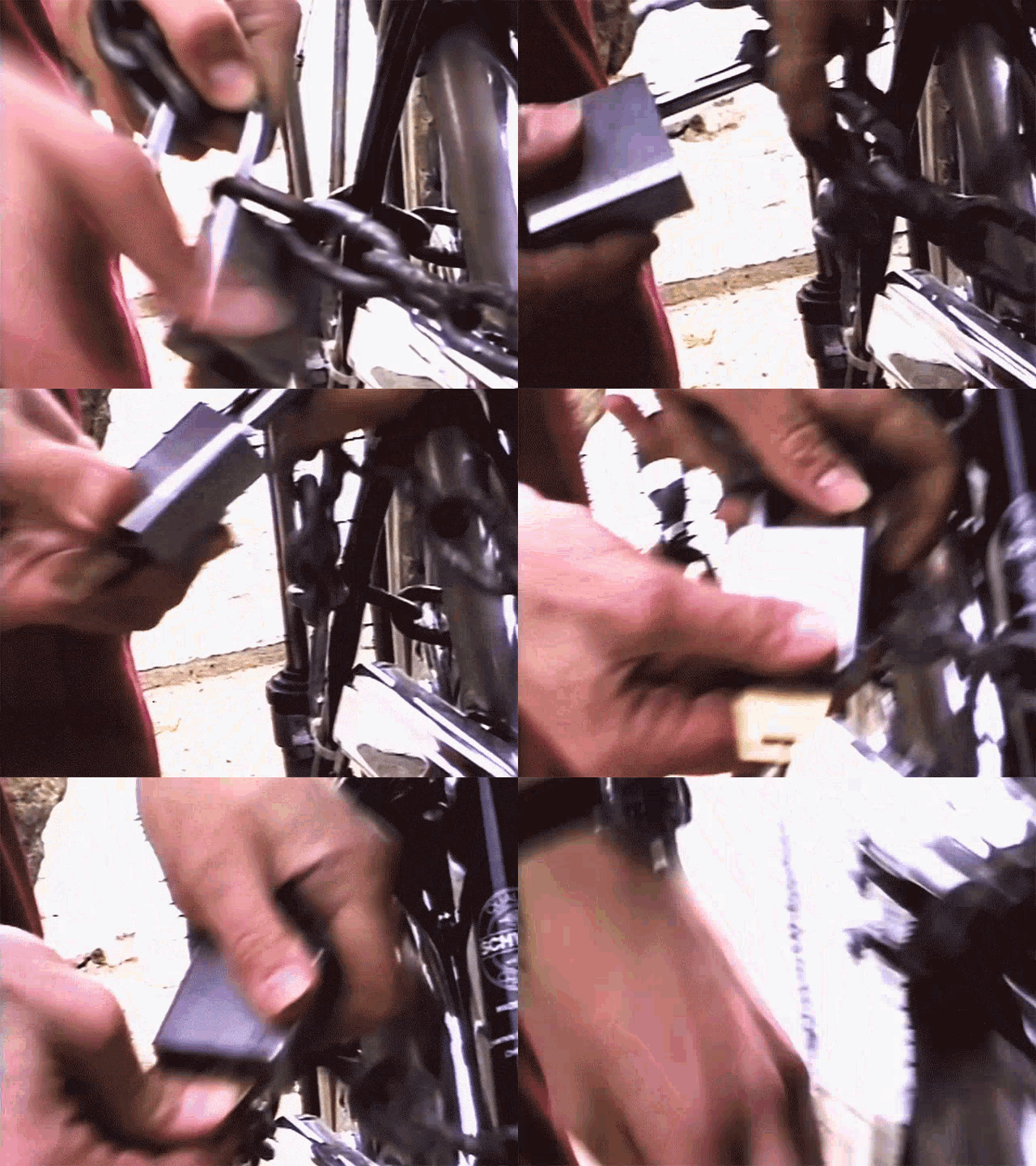
Locks
Image source- tenor
While Tramango ensures your flight is as seamless and safe as possible, you’ll need to protect your privacy and safety once you arrive at your destination. Make sure you pack locks for everything from your bags to extra locks for less high-end hotel room doors. If it can be locked, lock it and hold on to the key.
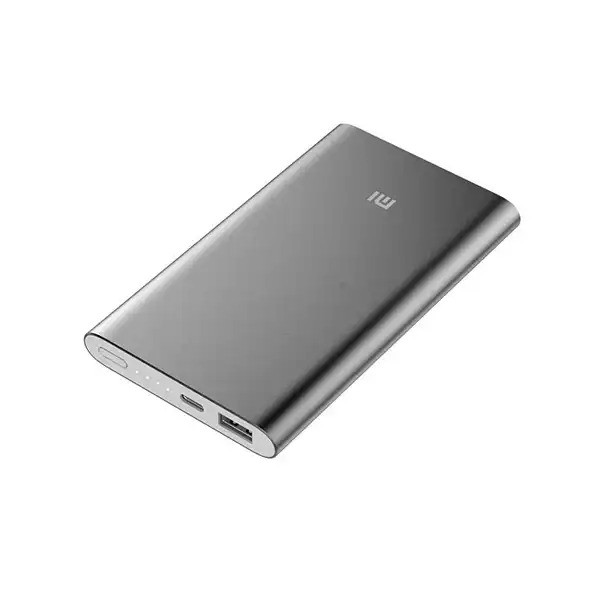
Power bank
Image source- Skit store
We’re not saying the country you’re going to will have an epileptic power supply like a particular country whose name begins with an “N”. All we’re saying is it’s better to be safe than stuck in the middle of nowhere with a dead phone and no one to turn to.
A tour guide
Image source- tenor
You can request one before you get to the country you’re visiting. They’ll make your stay much easier, and you won’t end up wandering about with no aim. You also get someone who’ll take (hopefully) Instagram-worthy pictures of your adventures. While Tramango makes your travels seamless and convenient, your tour guide will make your stay fun.
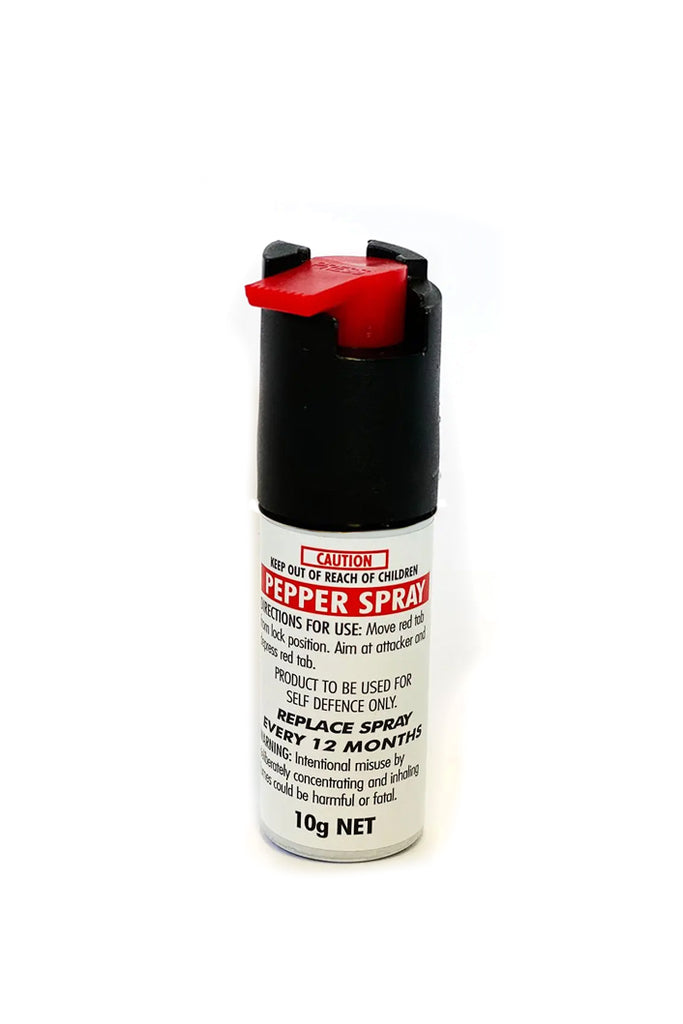
Pepper spray
Image source- Cloud 9
Honestly, anything that’ll hurt in direct contact with the eyes will work. You just need to be able to protect yourself from anything mon foreign soil.
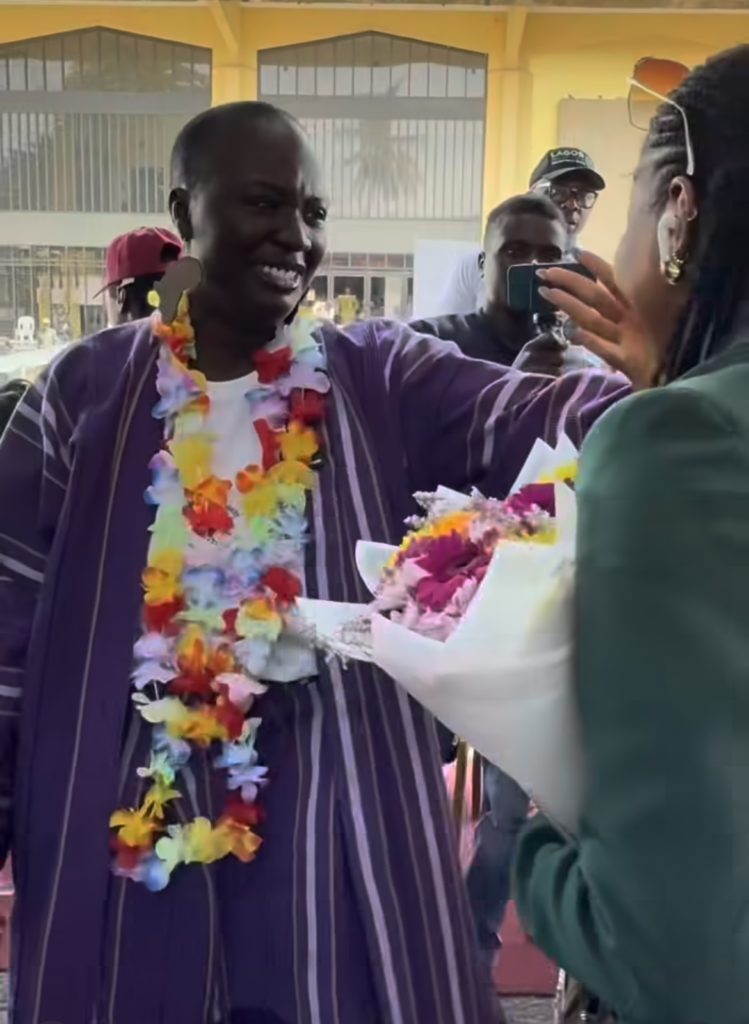
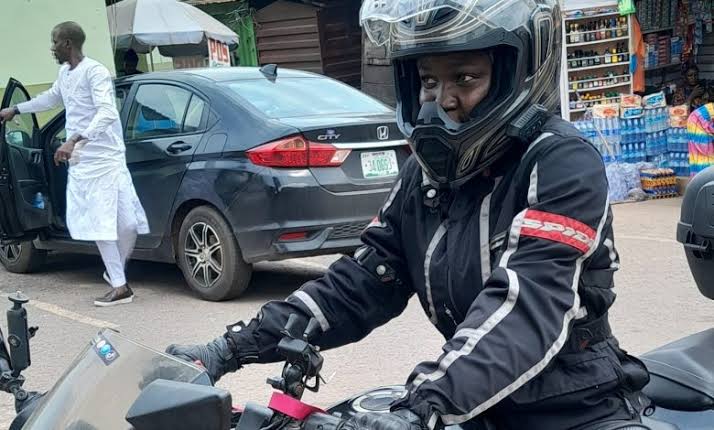
Pelumi Nubi has finally completed her ambitious drive from London to Lagos on Sunday, April 7, 2024, traversing 17 countries in over 68 days before reaching her final destination. At the University of Lagos, the 29-year-old arrived to massive fanfare from supporters who’d followed her story since she set out in January.
While Nubi is currently getting her flowers, she joins a list of other brave Nigerians who have embarked on long-distance adventures.
Akpevwe Ogboru
An officer of the Nigerian Customs Service, Akpevwe Ogboru, made history in 2023 as the first woman to embark on a journey through 12 African countries on a motorcycle. Akpevwe commenced from Lagos on November 10, 2023, and arrived at the Seme-Krake border post, a crossing point between Benin Republic and Nigeria, on December 3, 2023. She covered an impressive distance of over 8,000 km, making stops in Benin, Togo, Ghana, Cote d’Ivoire, Liberia, Sierra Leone, Guinea-Bissau, Senegal, Gambia, Mali, Burkina Faso and Togo.
Babatunde Tomori
In 2022, UK-based Nigerian, Babatunde Tomori, drove a Volkswagen passenger bus, the brand most often used for danfo, from London to Lagos. He set out in June 2022 and arrived in Nigeria on August 5, 2022. The adventurer admitted that the journey took two months and some weeks because he got distracted during some of the stops.
Abubakar Duduwale
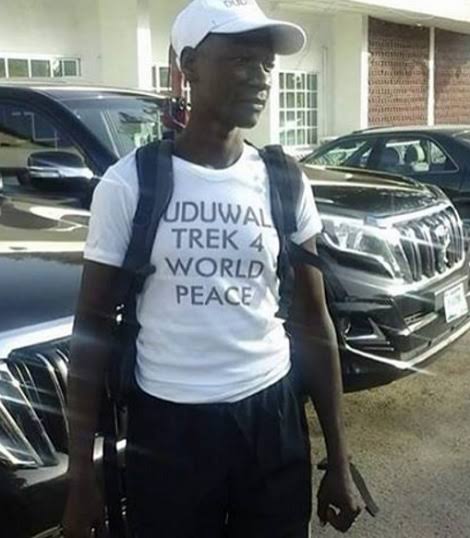
In 2015, Abubakar Duduwale caught the attention of many Nigerians after embarking on a long-distance trek in honour of President-elect Muhammadu Buhari. Duduwale trekked 788 km from Yola to Abuja for Buhari’s swearing-in ceremony. “The reason why I am trekking from Yola to Abuja is to express my joy and solidarity with President-elect Muhammadu Buhari.“ Despite going over 18 days by foot, he, unfortunately, didn’t get to meet the president.
Akinrodoye Dare
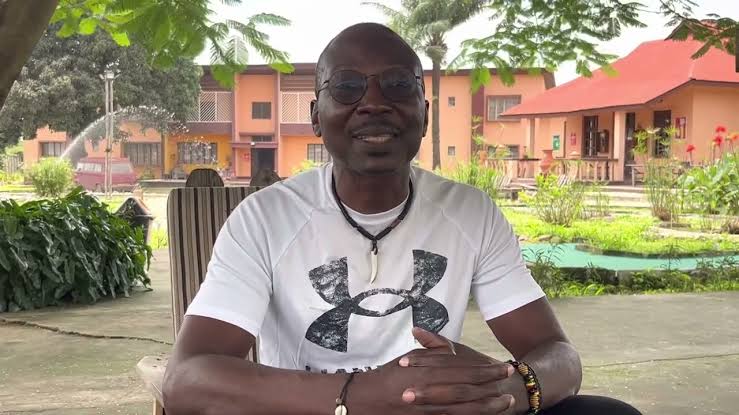
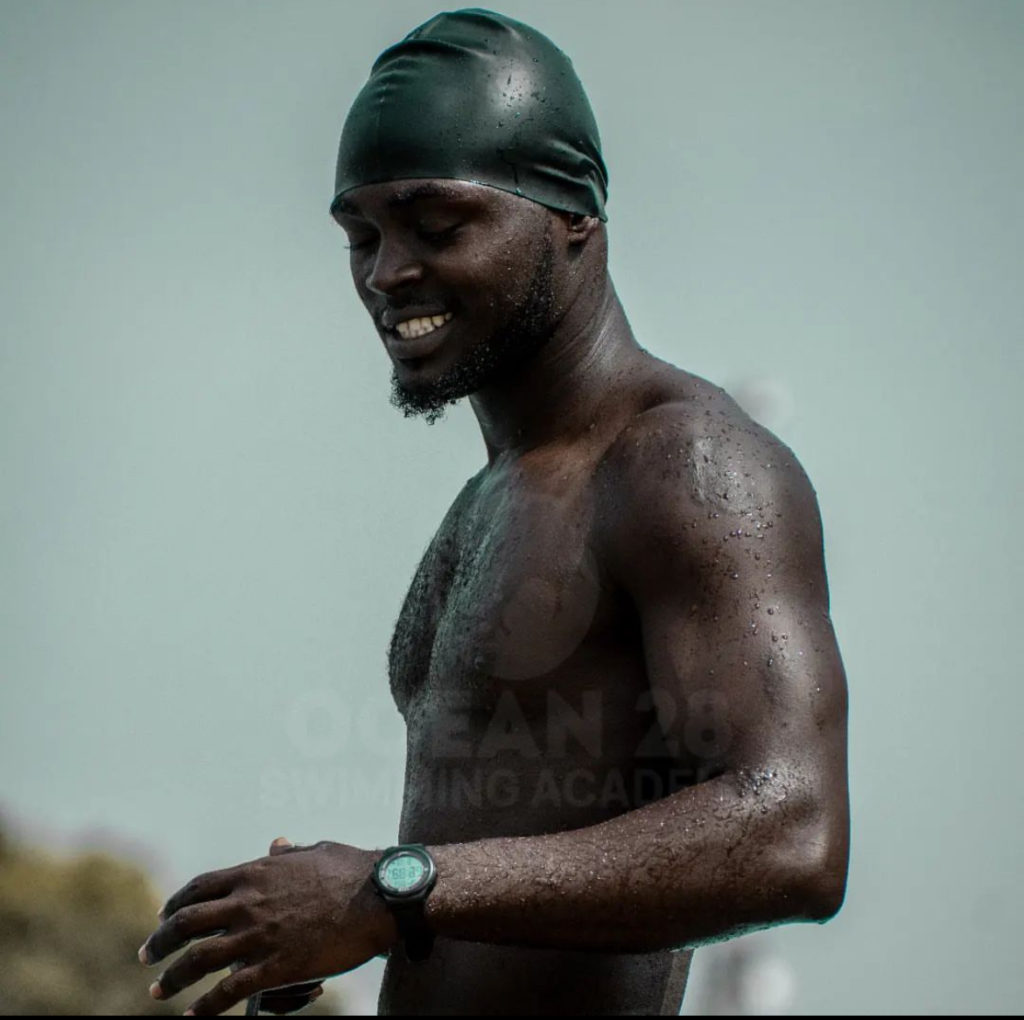
In a bid to raise awareness for mental health issues, Nigerian swimming coach, Akinrodoye Dare, swam the 11.8 km (Mainland Oworonshoki to Island Adeniji Adele) length of the Third Mainland Bridge in Lagos on Saturday, March 30, 2024. He completed the ambitious swim in two hours and 33 minutes, making him the first Lagosian to record the impressive feat.
The biggest women-only festival in Lagos is BACK. Get your tickets here for a day of fun, networking and partayyyyy
Fehintoluwa Okegbenle
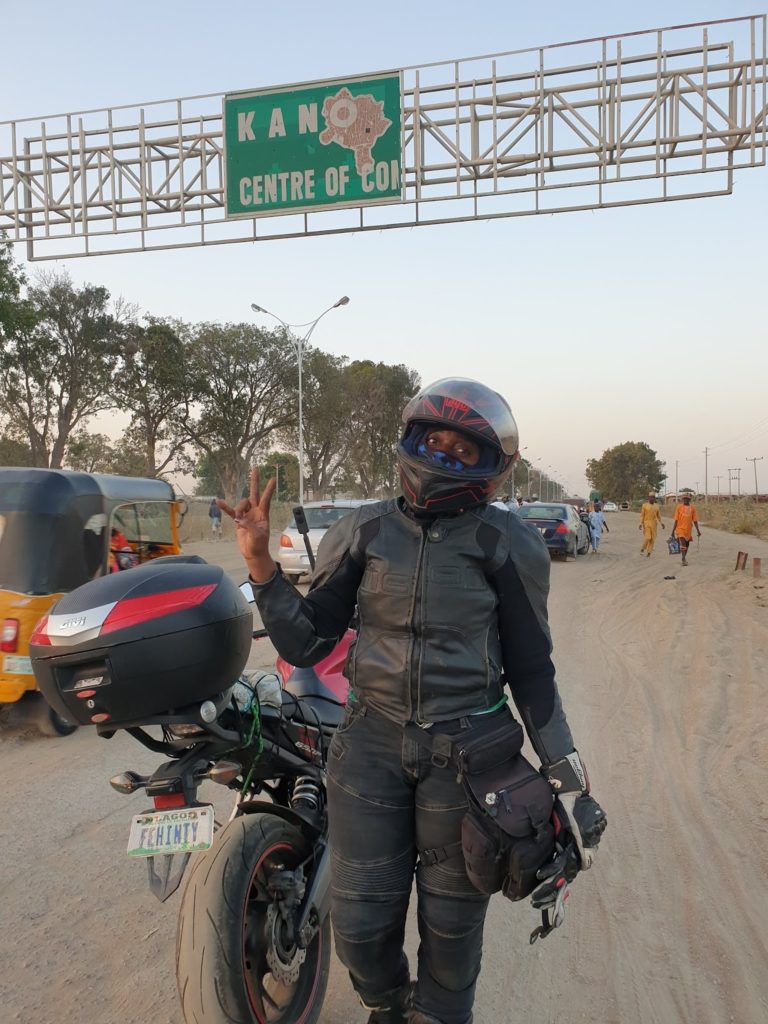
In January 2022, Fehintoluwa Okegbenle, a female Nigerian biker, traversed 22 states in the country on her power bike. She completed the ride in seven days and made stops in Ogun, Oyo, Osun, Ekiti Kogi, Abuja, Kaduna, Kano and Taraba, among other states. During an interview, Fehintola said the ride was inspired by her love for adventure and a need to give life to tourism in Nigeria.
Hafsah Olayemi
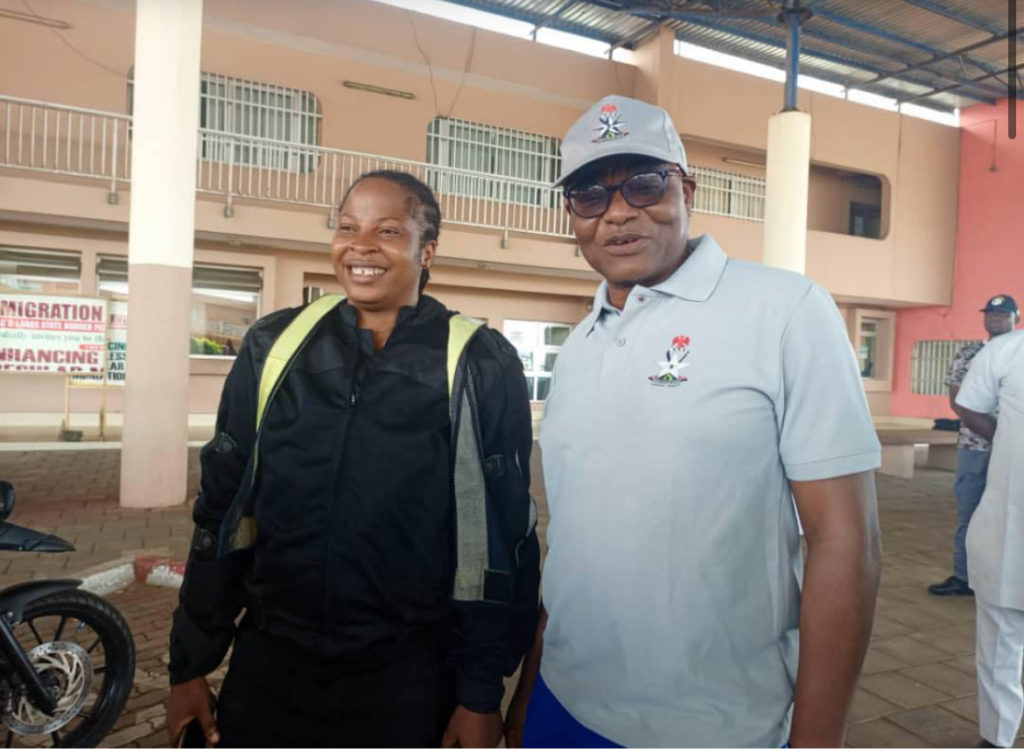
Nine months after she started biking, Nigerian immigration officer, Babatunde Hafsah Olayemi, became the first female biker to visit all 19 northern Nigerian states in one stretch. Out of curiosity about the North and her love for adventure, Hafsah kicked off from Abeokuta on June 4, 2023, and spent the next two weeks on the ambitious ride, covering about 5920 km.
[ad]
Kunle Adeyanju
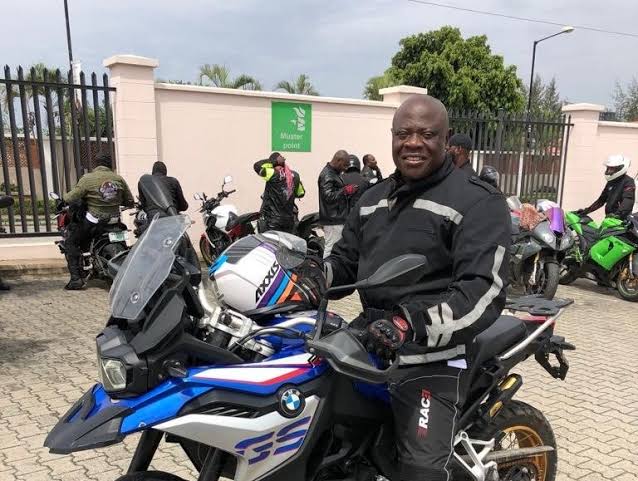
UK-based Kunle Adeyanju made history in 2022 after he motorcycled from London to Lagos to raise awareness for polio. Adeyanju commenced his journey on April 19, 2022, and spent the next 40 days traversing 16 countries before he arrived in Lagos, Nigeria, on May 29, 2022. He covered about 12,000 km, visiting France, Spain, Morocco, Casablanca, Mauritania, Cote d’Ivoire and Accra, among other countries.
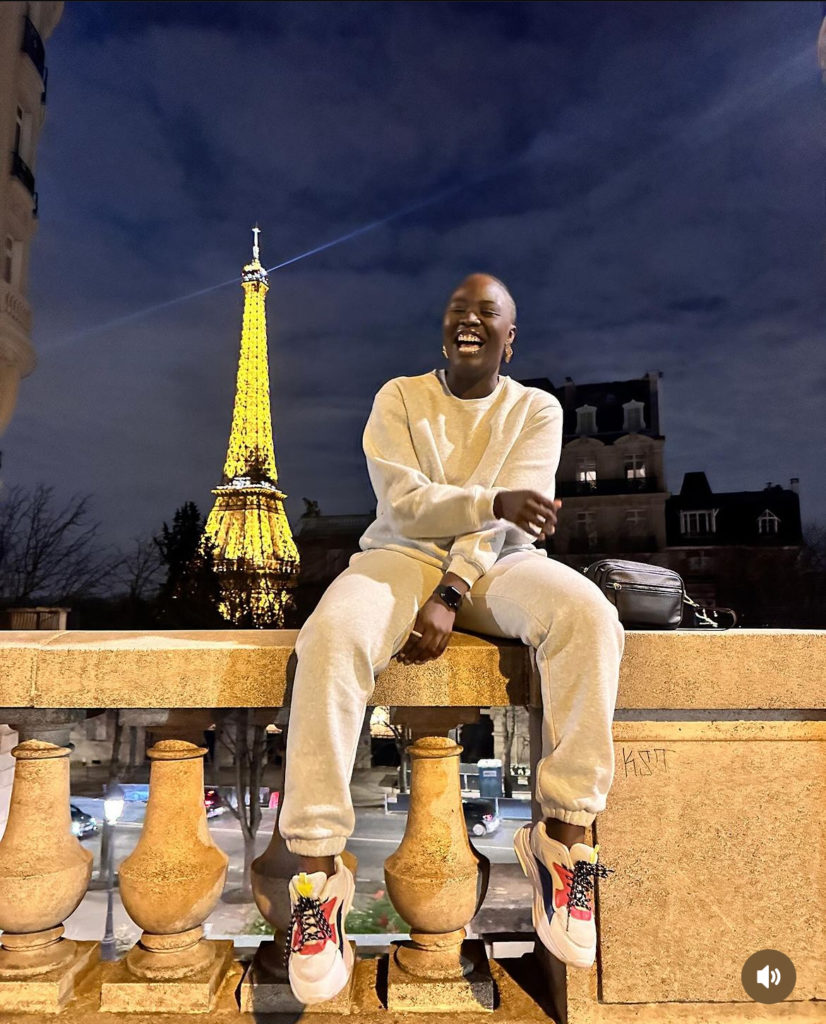
Pelumi Nubi’s solo car trip officially kicked off on January 31, 2024. She started off in London and updated followers via an Instagram post, saying she arrived in France on February 1.
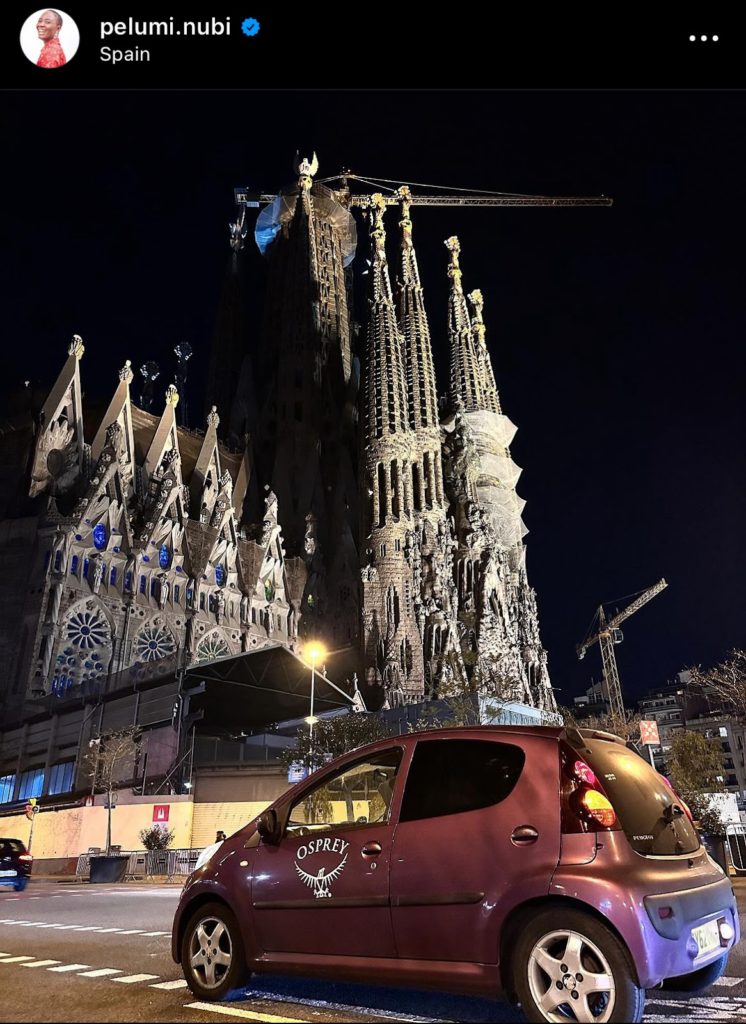
In another post shared on February 4, three days after she set off from Paris, the content creator arrived in Barcelona, Spain, marking the second stop on her ambitious journey. She spent some days exploring the country and reached 100k followers on Instagram.
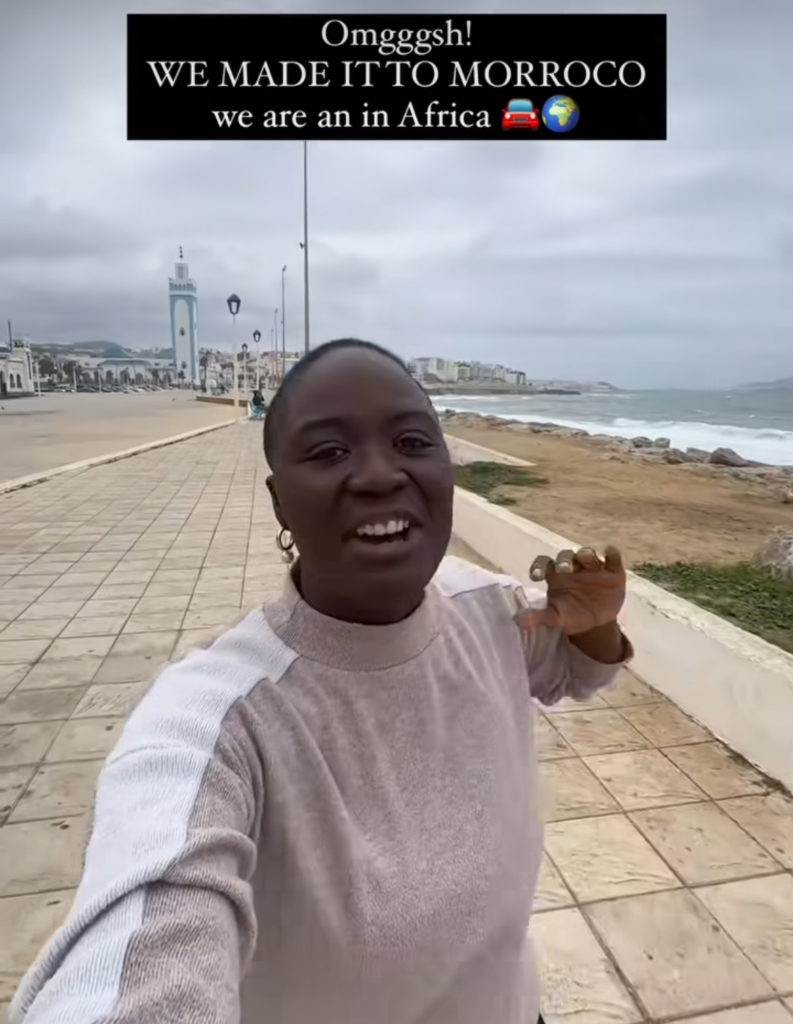
After six adventurous days in Spain, she announced her arrival in Morocco — the third country on her itinerary — on February 10.
Over the next 14 days, Pelumi explored cities in Morocco and drove through the dreaded desert wasteland, No Man’s Land — a three-kilometre strip that separates the country from Mauritania.
The biggest women-only festival in Lagos is BACK. Get your tickets here for a day of fun, networking and partayyyyy
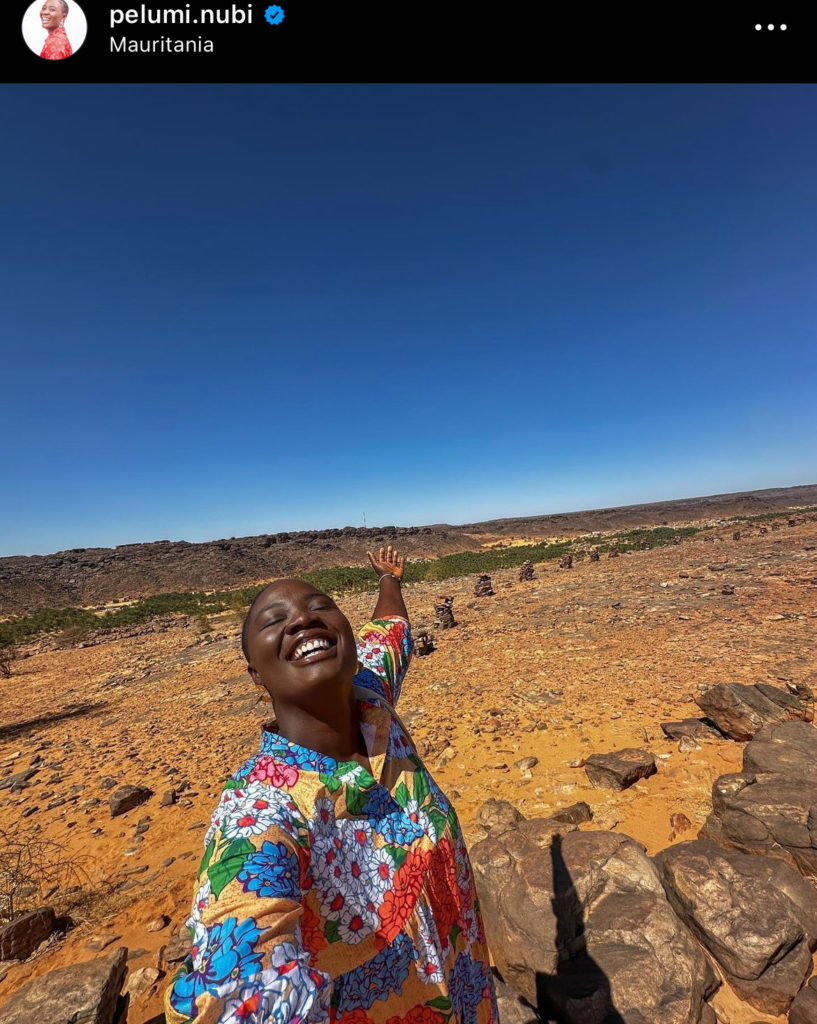
She announced her arrival in Mauritania on February 24.
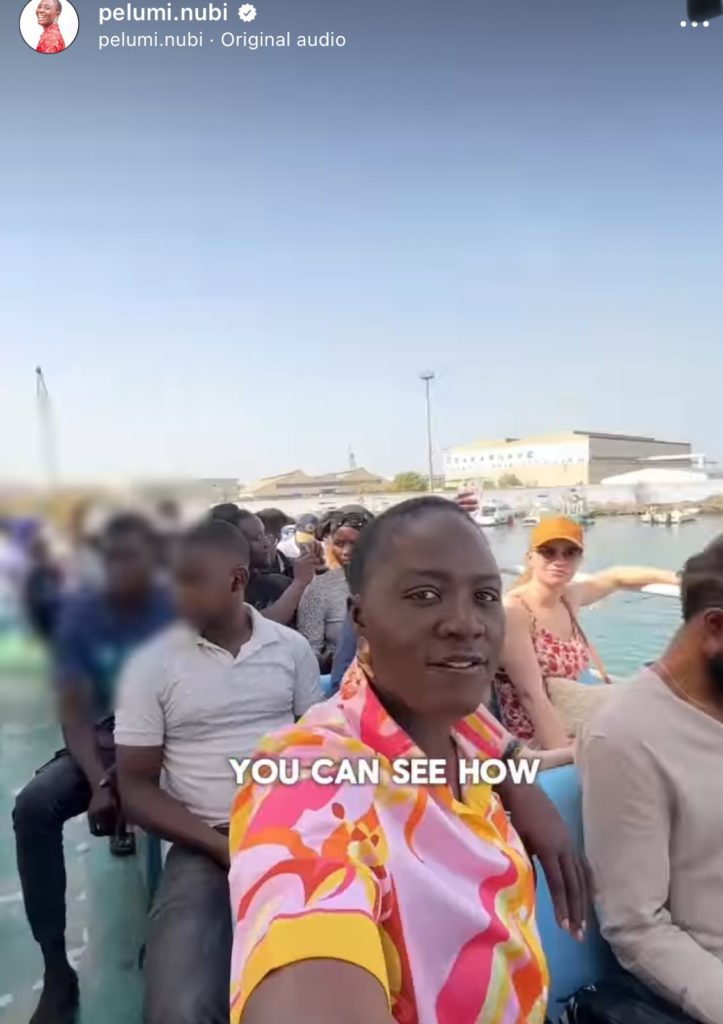
On March 3, about a month after the journey kicked off, Pelumi arrived in Senegal.
She spent a few days exploring some tourist attractions, visiting the tallest statue in Africa, located in Senegal’s capital city, Dakar, and Goree Island, a former transatlantic slave trade hub.
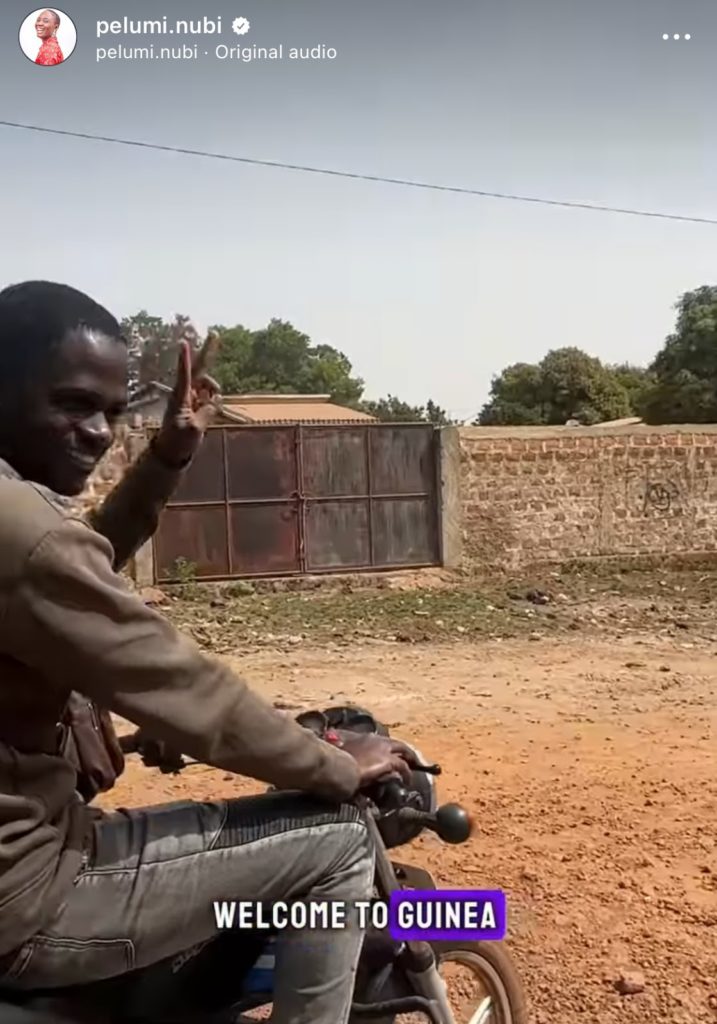
She announced her exit on March 7 and made it to her next stop, Gambia, on March 8. She spent 24 hours in Guinea Bissau before she made it to Guinea, the ninth country on her list, on March 14.
On March 17, she headed to Sierra Leone, where her entry was delayed over her “right-hand drive” car, which had been banned in the country in 2013. However, a kind border officer stepped in and secured her entry.
Still in Sierra Leone as of the date of publishing this report, her next stop is Liberia, after which she has five more countries before arriving in Lagos, Nigeria.
The road trip, estimated to last two months, is on track as she’ll likely complete it in the last week of March 2024.
In an alternate universe free from the claws of capitalism, I’d be a traveller. This would mean freedom from sapa and to achieve this, I plan to become the President of Nigeria because it looks like being a tourist is part of the job description. When President Bubu first got into office in 2015, he made many head-turning promises that he has found challenging to fulfil. One of these promises was to end medical tourism and as we all know, he failed.
As with the common phrase, “All men do is lie,” Bubu was no different. He too dey lie. Bubu has spent more than half a year going abroad at different points for medical treatments; even more, he’s currently in London for a dentist appointment.
During the 2023 general elections, many Nigerians hoped to finally get a president that wouldn’t ghost us for medical excursions overseas, but it looks like there’s something about the Aso Villa that turns you into an Ajala the traveller—globe trotting often for medical purposes.
On March 21, 2023, the press learned about the news that Nigeria’s president-elect, Bola Tinubu, was travelling to Europe for medical care. However, Tinubu’s campaign and media aides debunked the rumours, claiming he went to rest from the election activities, which, to be fair, is understandable. Tinubu finally returned to Nigeria on April 24, and barely three weeks later, it’s in the news again that he has packed his bags to continue his exploration of Europe. The reason this time is that the journey abroad is a “working trip” to meet investors and prepare for the inauguration on May 29.
My issue in all of this isn’t about Tinubu’s possible interest in being a tourist but rather how his administration might be eerily similar to Buhari’s. Nigerians already have enough PTSD from Buhari ghosting the country for months, without us hearing from the Presidency, and the last thing we want is for affliction rising the second time..
What else happened this week?
Two Dead After Wedding Ceremony in Kano
On May 11, news broke that two people were confirmed dead and eight were hospitalised after drinking tea at a wedding ceremony in Sheka, Kumbotso Local Government Area, Kano State.
The tea is being reported to have been prepared with a local leaf called Zakami and a combination of other drugs. Thankfully, the hospitalised victims were effectively treated and discharged to go about their day-to-day activities.
The spokesperson of the Kano State police command, SP Abdullahi Haruna, says that although no formal report was made to the police station, an inquiry will be made into the accident.
Video of the week
“I will switch to Ogogoro”
“I will never stop, it’s an inevitable devil”
🤭🤭
With the FG set to implement a tax rate increase on alcoholic drinks, we visited a beer parlour to find out how Nigerians felt about this.
On May 22, the National Youth Service Corps (NYSC) will mark its 50th anniversary. Do you think it’s time for the programme to be scrapped?
Ehen one more thing…
Nigerians face several challenges every second of the day, from lack of stable electricity to traffic congestion, or “go slow,” as they call it. But have you ever wondered how the term “go slow” came to represent traffic congestion? We have the answer here.
To ensure you don’t miss out on the next edition of Game of Votes, subscribe to the newsletter here.
So you’re planning to travel back home or to Lagos for Detty December in this sapa-demic? Wow, very brave. Since we can’t stop you from making this choice, the least we can do is mentally prepare you for all the wahala you’ll go through on your December trip.
Good luck.
Flight tickets are more expensive than two Asake tickets
Someone needs to explain why everything is expensive in December. Are we the ones who gave birth to Jesus?
If you thought flight and bus tickets were expensive during the year, get ready to meet holiday ticket prices because your account will cry hot tears. And that’s not the end. Regular bikes and taxis will also start calling crazy figures, as if they’ve been waiting for you to help them complete the house they’re building in the village.
Traffic everywhere
The amount of traffic you’ll jam this holiday season (especially if you go to Lagos) will make you wish you’d just sat in one place. There’ll be traffic on your way to the airport or bus park, traffic on your way out of there, traffic heading to where you’ll stay, traffic at your estate gate, traffic in your home and traffic in your life. As a matter of fact, half of your life will be spent in traffic.
Like Davido said, “E choke!”
Airport people will ask you to “Do Christmas” for them
This is one of the most annoying things you’ll experience at the airport. If you breathe to the right, billing. If you breathe to the left, billing. By the time you finish dropping small ₦500 here and there, all your money will finish, and you’ll end up trekking from the airport to your house.
You need to hold ransom money
To avoid stories that touch, kindly travel with your ransom money, so in case you get kidnapped, they won’t have to stress about calling your relatives. What if your family uses Glo, and the call doesn’t go through? Or they use GTB, and their bank app doesn’t load on time? Help the kidnappers to help you, please.
Quick question to bus drivers: where do all your buses go during the holidays? Because they’re always plenty during the year, but as soon as it’s Christmas, you have only four buses (so you increase the price). We know what you people are doing.
Delayed flights
If your flight is by 5 p.m., get ready to leave that airport by 9 p.m. at least. But that’s only if you get to the airport early. Because if you get to the airport by 4:30 p.m., there’s a high chance you’ll miss your 5 p.m. flight. I don’t know how they do it, but they’d delay flights if you’re early or on time but disappear if you’re a minute late. I honestly think it’s jazz.
Family members will ask about your weight and marriage date
If questions about your weight or marital status don’t pop up when your family picks you up from the airport or bus park, know they’re saving it for when you get home. The moment you enter your front door (and throughout the holiday), you’ll start dealing with “Ahn ahn, what are you eating?” and “This your cousin is getting married next year. Shey we should still be praying for your own?”
You that hasn’t been on a date in two years? Pele, dear.
Everyone in Lagos will be busy or angry at something
This is for people going to Lagos.
As soon as you enter, you’ll feel the need to start rushing even if you have nothing to do. Don’t worry. It’s not a spiritual attack; it’s the Lagos spirit. Everyone here moves like they’re in a life-or-death situation. When you think about it, living in Lagos is an extreme life-or-death sport.
If you’ve lived long enough in Nigeria, you should already know travelling by road isn’t exactly suya and sunshine.
But with air ticket prices the way they are, we’ll all need to embrace road trips soon. You can even pretend to connect with your adventure-loving self and plan a trip with your friends. Don’t go without knowing these tips, though.
Start your trip early
Whether you’re travelling interstate or within a state, leave early. Especially if you’re moving from Lagos. You don’t need me to tell you why.
Have money
Because what’s a road trip without buying orisirisi on the way? You’ll also run into the odd police checkpoint, and you may be asked to “show love”.
Eat ahead
Traffic, checkpoints, and the usual bad roads can increase your travel time. Because, Nigeria. Don’t let hunger kill you.
Don’t eat before your trip
Imagine entering into a crater-sized pothole with a stomach full of beans. It’s either you kill your travel mates with hydrogen sulphide — or kill yourself with embarrassment when you have to beg the driver to let you do a “number two” in the bush.
Buy pain relievers
Remember those pot-holes we mentioned? Better buy paracetamol.
Look poor
In case you still don’t know, Nigeria has an insecurity problem. Don’t go displaying your iPhone 14 Pro Max and giving unknown gunmen any ideas.
Google Maps is your friend
Don’t rely on interstate traffic markers if you intend to drive yourself. They’re so few and far between, and you might find yourself in Yobe if you aren’t careful.
Don’t pick up hitchhikers
Hitchhiking isn’t even in our culture, so if you like, go and pick ayamatanga on the road. Na you sabi.
Share your location with friends
Because it’s just common sense.
Take pictures
Because after all this wahala, it’s unlikely you’ll want to make another road trip anytime soon. You should keep memories of the beautiful landmarks you’ll encounter.
Navigating life as a woman in the world today is interesting. From Nigeria to Timbuktu, it’ll amaze you how similar all our experiences are. Every Wednesday, women the world over will share their experiences on everything from sex to politics right here. This is Zikoko’s What She Said.
Image credit: Upsplash, @vitaelondon
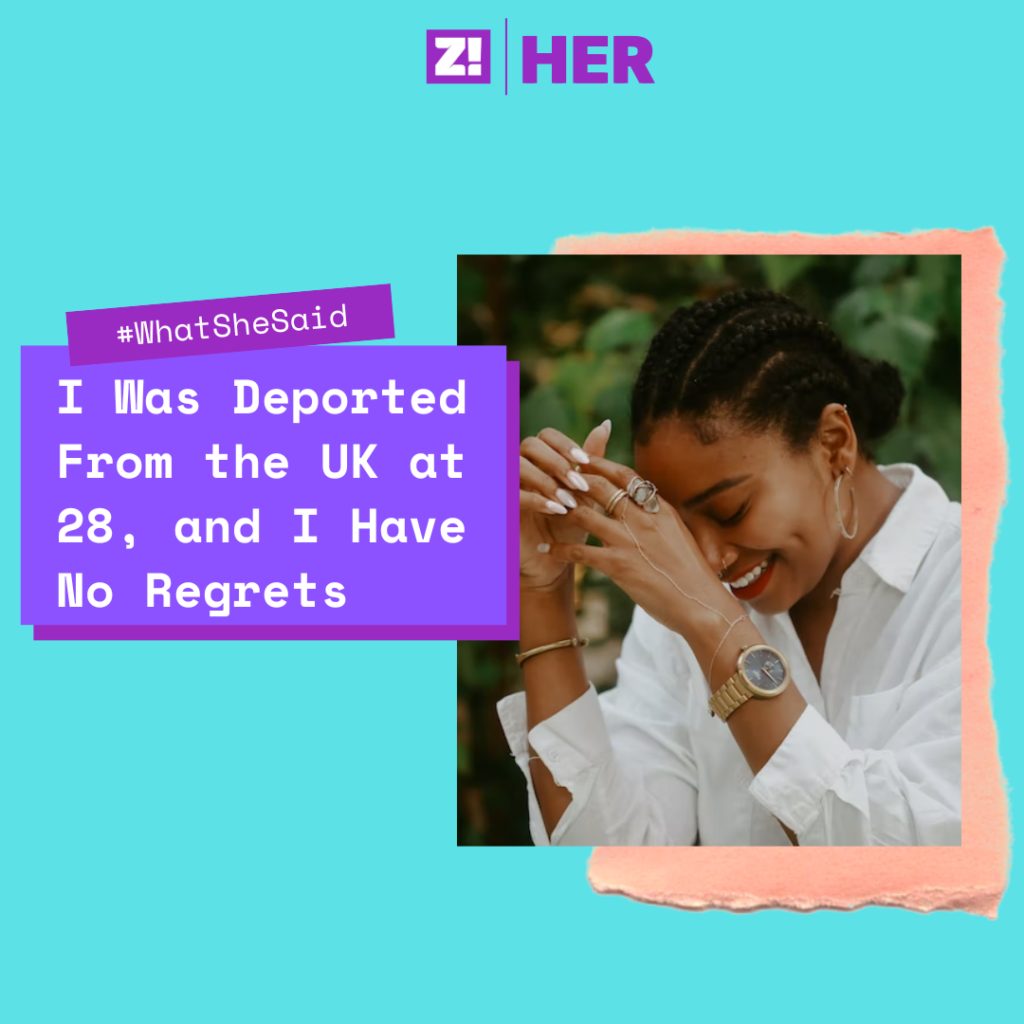
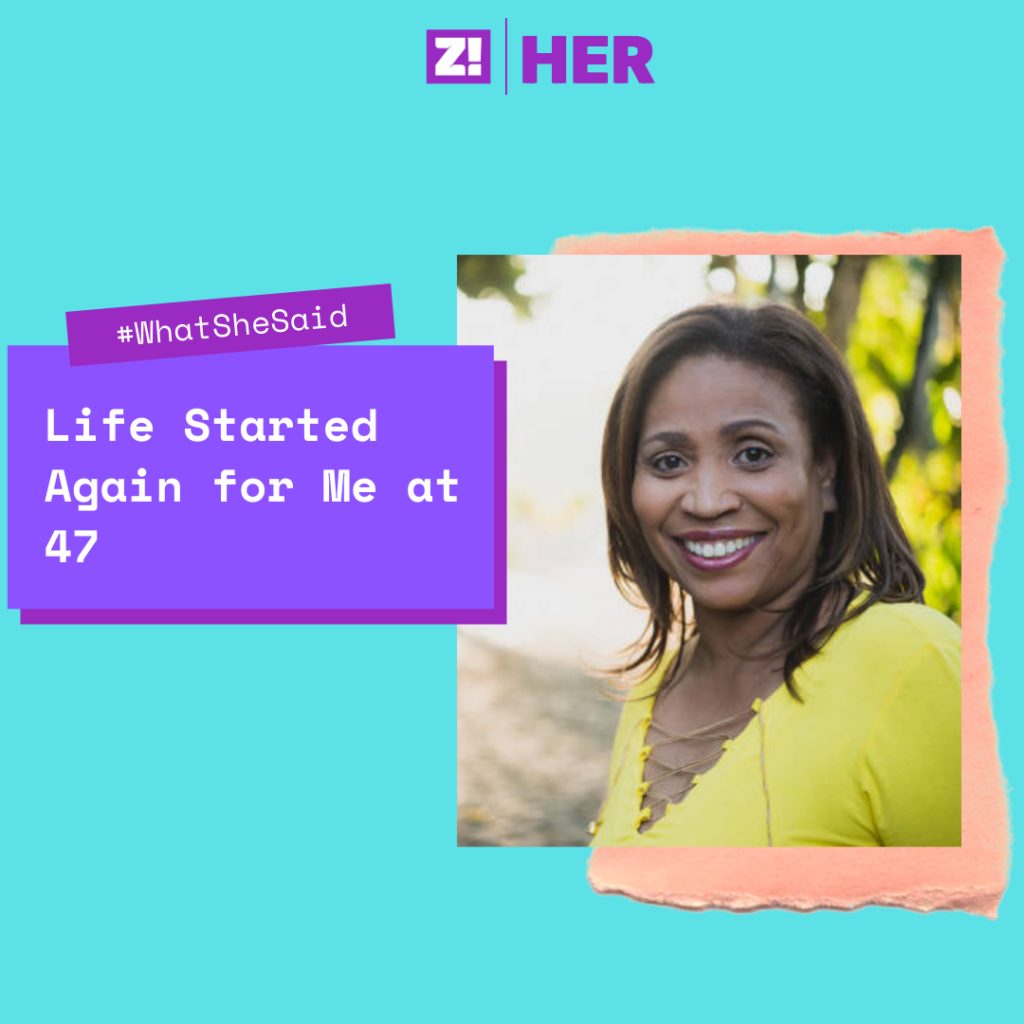
This week’s #ZikokoWhatSheSaid subject is a 45-year-old Nigerian woman. She talks about spending the last 22 years in the UK moving from one menial job to another, not wanting her daughter to see her retire as a shop worker and finally going back to university.
What’s something about life you’re enjoying?
Working towards going back to school next year. It hasn’t been easy though. I didn’t think I’d actually care to get another degree after my bachelor’s in education in 1999. It took three months for me to even find my university certificate to apply for the programme I’m currently considering.
So what prompted your decision to go back to school?
After 14 years of working in retail stores in the UK, I’d like to get a proper white-collar job, possibly in a government office as administrative staff.
Retail is a time-consuming and physically tasking job. As I get older, I don’t see myself being able to keep up with loading shelves and working late nights.
An office job would come with much higher health insurance and retirement fund than my current job, and I’d get to close at 6 p.m. and stay home with my husband and daughter during public holidays.
Now that my daughter is eight and a lot more independent, I can sit down to work on my applications without so many distractions.
Before your daughter, what made getting a new job difficult?
I got into the UK illegally in 2001. I couldn’t settle in as an immigrant until 2008 when I married her dad. So at first, retail jobs were a means to getting paid in cash rather than opening up a bank account. It’s not possible to get one without proper papers.
Omo. So how did you get into the UK?
Through my older sister. She and her husband decided to take a trip with their three-year-old daughter to Cardiff, in 2001 and took me along. I was 24. After two months of living there, I couldn’t imagine coming back to Nigeria. I lived in Lagos with no job or real plans for the future. So when it was time to return, I told my sister I wanted to stay back.
Of course, she advised against it, but I felt I could manage on my own.
And she was cool with that?
No. But she couldn’t physically drag me back.
Image credit: iStock clipart
Did you have any plans?
I’d heard stories of a lot of Nigerians moving to the UK by refusing to leave after coming for a holiday. Of course, no one ever named names, but I knew there was some truth to the gossip. I felt like I could do the same.
I didn’t think beyond staying back with the family friend we’d stayed with during our two-month holiday.
So how did you scale through?
Well, I got a cleaning job that paid cash. They didn’t ask me questions about my work permit. And since my brother-in-law schooled in Cardiff for his master’s, he was able to get me fake working papers through some of his friends.
You weren’t caught. How?
I made sure I didn’t walk around unnecessarily. If I didn’t have any houses to clean, I was home. But I knew hiding didn’t change the reality that I could be caught at any time. All it took was one random ID check or a phone call to the police from a colleague who didn’t like me. I made it as far as I did because of God.
My sister was also a huge support system. Back then, renewing visas wasn’t as complicated as it is now. So whenever my sister or her husband had a friend going back to Nigeria, I’d give them my passport and they’d pay for it to get stamped. We did that like once a year.
Wow
Yeah. We tried to tick all the boxes as much as we could under the radar. Plus, Cardiff is a small town, so people rarely got into your business.
I can’t imagine what it felt like to constantly be afraid
I wasn’t thinking about that. I made the decision to stay and understood the consequences. There was no going back.
After almost two years of living with my friend, I had to find my own place. She’d gotten pregnant and wanted her boyfriend to move in. I never liked the guy. Imagine coming home to an entitled white man who didn’t seem to have any plans for his life. There was no way I’d be comfortable putting up with him in those tiny UK flats.
Were you prepared to move out?
Yes and no. I honestly didn’t have a plan on how to get a permanent residence visa in the UK, but I was saving up to explore my options with school. The sudden transition from having a home to potentially being homeless was going to slow down the process.
So what happened next?
I got another job. This time, one of my colleagues from the cleaning company linked me with a man who needed someone to manage a home for homeless old people around the neighbourhood. He needed someone to make sure things didn’t get out of hand whenever he was out of town.
The pay wasn’t great. But at least, I got a room to myself and didn’t have to pay for rent anymore.
He didn’t do a background check on you?
He was an old man. I don’t think he cared. I just had to reassure him I had two years of experience in cleaning. The work extended to much more than cleaning though — I had to manage the daily activities of the guests — but what other options did I have?
What gave you peace of mind, considering your illegal status?
Mostly church. It was my happy place; my faith kept me together. I also had someone I started dating in 2004. We met in church when I first moved to the UK and things gradually grew between us. He was a Jamaican man born in Britain.
He knew about my situation and supported me the best he could, but there were days I just wanted to go back home.
When did things start coming together for you?
2008. But before then, things completely fell apart.
What happened?
I decided to get a new job in 2005. I’d spent a year working at the house, but I didn’t feel fulfilled spending my entire day stuck inside. I started to look out for store jobs that paid in cash. I didn’t want to continue with a cleaning job.
How’d that go?
The job I got was at a food store owned by an older Nigerian woman. She was a citizen, and quite friendly, so I opened up about my issues with documentation to her. It took me four months to get to that point of trust, but it was the worst mistake I made in the UK.
A few weeks after our conversation, immigration officers showed up at the store. Luckily, I was walking down to the store with my boyfriend that morning, so he followed me to their office.
Do you think your boss snitched?
Maybe. I never got a chance to confront her. Anyone working at the store could’ve overheard our conversation, or even a customer, who knows? But they came straight toward me, and I knew the last four years were going down the drain.
Omo
They took me to their office and things moved fast from there.
Since my boyfriend was a British citizen, he was able to intervene.
How?
The paid visa I’d gotten through my sister had expired a few weeks before I was caught. So my boyfriend told the officers he was the reason I hadn’t gone back to my country yet. He explained he wanted to travel back to Nigeria with me to get married, hence the delay. He also got a good immigration lawyer to plead for my passport to not be stamped since we’d be getting married soon.
Did you still have to leave the country?
Yes. I had a week to pack up and leave. But a year later, my boyfriend came to Nigeria for our wedding. We got married and moved to the UK immediately after our marriage certificates were ready.
Before then, I won’t deny I’d lost hope. I wasn’t happy to be back in Lagos sharing a room with my niece and not having anything tangible to do every day. But I kept in touch with my partner through phone calls, and sometimes, Facebook.
A part of me felt ashamed.
Why shame?
At 28, and after four years of living abroad, I didn’t have anything good to show for it. Compared to my older sister, my life was pretty unsuccessful. She was 31, married with two kids at that point, and to my parents, those were achievements. Praying was the only thing that kept me together during that one year in Lagos.
Thinking about it now, would you have done things differently?
No. I’m happy I took the risk in my early 20s. It wasn’t the wisest decision, but I’m here today. The struggle taught me I can survive anything. That’s why I’m not bothered about going back to school at 45.
The only thing I’d change is coming back to the UK in 2008 after we got married, and sticking to the same menial jobs because it was the only thing I knew how to do. I don’t want to retire as a store attendant.
I hope you’re able to change careers
Thank you. I also want my daughter to be proud of me. I see how excited she gets when my husband talks about his job as a psychiatrist. I want her to look at me with the same pride when I talk about my day too.
If you’d like to be my next subject on #WhatSheSaid, click here to tell me why
Yes yes, you deserve to be in Dubai, shaking your ass in thongs on a yacht. But do you know how to do it all on a budget? No? Well, we’re here for you with an estimate of how much the visa fees, ticket, accommodation and a bit of enjoyment costs for a Dubai trip.
Photo credit: Sascha Bosshard, Upsplash
Dennis*, 28
In May 2022, I travelled to Dubai with a ₦600k budget to take care of hotels and flights, and $1000 (₦425,500) for the nine days of the trip. Ideally, the visa is the first thing to sort out, and it typically costs ₦70k. But due to the Nigerian factor and how much our compatriots have messed up in the United Arab Emirates (UAE), the government put out restrictions on Nigerian male travellers.
The policy basically states that travellers under 35 years of age require parental consent before visas are issued. That means you’d have to apply for a visa for you and a parent with a considerable age difference who bears the same surname. But 35-year-old married men are exempted. All you need to do is apply using a marriage certificate.
The people who don’t fit into either category, like me, pay ₦185k as visa fees. That’s more than a 100% increase from what it was in 2020. The visa was issued a week after, and I paid for my flight. Qatar Airways cost ₦336k for a direct flight.
I stayed at Studio M Al Barsha Hotel region for nine days. I chose it because it’s more residential, and it’s easier to access food from there. As opposed to more central areas like Bur Dubai or Jumeirah Beach Residence (JBR), it was more affordable. 1300 Dirhams (₦150,597) covered my hotel fees; the additional taxes rounded it up to 1500 Dirhams.
I spent a lot of time at the Dubai Mall shopping for clothes at Zara, American Eagle and Gold Shouk, a more traditional market in Al Dhagaya. Everything rounded up to $1000 (₦425,500), but my biggest splurge was on the gold jewellery for my family and a few friends at Deira market.
Deira market is also the place to buy Nigerian food. I got tired of eating biryani ( basically white rice with egg and chicken concoction) and Chinese in the morning, afternoon and night. I think the spot is called Enish. I can’t remember how much I spent, but it was a lot more than what the pounded yam and egusi would be in Nigeria. I’d say it’s worth it though.
After draining my pockets on clothes, gold and food. I went into the fun activities; everything from Ski Dubai to the Dhow Cruise, which cost about 300 Dirhams (₦34,753) each. But the thing I’d recommend to try first is visiting Aqua Park and dune bashing in the Safari — they’re so thrilling! The museum of the future is also a good spot for tourists. It felt out of this world being there. So, these activities came down to $1500 – $2000 (₦638,250 – ₦851,000).
If there was anything I wish I was more prepared for, beyond the money I spent on shopping alone, it would be speaking English in Dubai. English felt useless over there because most locals didn’t fully understand what I was saying. So it’s either you get a tour guide or speak broken English. For instance, rather than say, “Can you take the four of us to Dubai Mall”, you may want to say, “Dubai Mall, four people, you go?” Just random stuff to ease communication.
My whole trip was a little over $2000 (₦851,000). The visa cost ₦75k and that didn’t include the required travel insurance. But to avoid the hassle of getting it myself, I got an agent. The only thing I did was book my flight with Emirates which cost about ₦380k. I think the ticket was more expensive than normal because I bought it a week before my departure date.
For my accommodation, I was going on a girls’ trip to celebrate my sister’s birthday, so we really wanted to splurge. We stayed in the central business district. It was a prime area around the Dubai International Financial Centre and compared to locations downtown, the area costs a lot more. But we were splitting three ways, so it wasn’t bad. The room was $120 (₦51,060) per night for each of us, and we were there for eight days. So, if you’re alone and you want to be in the central area, you need to budget at least $300 – $500 (₦127,650 – ₦212,750) per night for the basic luxury rooms. Airbnb is the easiest platform to book a place.
We had a friend who got us Nigerian food from Deira market. I think I ate more Nigerian food in Dubai than any other type of food. We also visited Enish, a bar that served Nigerian food. But most of my money went into shopping and Uber fares.
I got most of the clothes I wanted for my kids from Deira market and did a bit of shopping in Dubai Mall — everything cost about $1000 (₦425,500). For cabs, I was spending between 30 – 100 Dirhams (₦3,475 – ₦11,584) depending on the distance.
If you’d like to share your travel adventures with Zikoko or want to know the cost of travelling or living in a particular country, click here.
When Mr Eazi dropped his Life is Eazy, Vol. 2 – Lagos to London album in 2018, we didn’t think anyone would attempt the road trip. Yet, here we are four years later, and a similar seemingly impossible feat of travelling across the 16 cities on a motorcycle is a casual day on Kunle Adeyanju’s bucket list, a Nigerian man who calls himself an adventurer, entrepreneur and author.
On the 19th of April, 2022, he tweeted the commencement of his journey from London to Lagos on a motorcycle. He successfully arrived in Lagos on Sunday, 29th May 2022. Over the years, the “daredevil” has gone on adventurous trips like climbing Mount Kilimanjaro, bungee jumping, skydiving and a three-day trip from Lagos to Ghana on a bicycle. Clearly, Kunle is no stranger to danger. Here’s everything we know about his 41-day transatlantic journey.
Why did Kunle embark on this unimaginable bike ride?
In March, he announced his decision to hold back from enlisting as a volunteer to fight in the Russian-Ukrainian War. With 20,000 foreign fighters already enlisted, Kunle wanted to divert his energy to aid charitable causes in Nigeria. That’s when he made the decision to journey to Lagos, a distance that could beat the 2017 Guinness World Record of 11,315.29 km held by Mark Beaumont (UK), for the longest travelled on a motorcycle.
Well, the goal was set in partnership with the Rotary Club of Ikoyi Metro D9110 to raise ₦20 million. As a rotary club member since his university days and current District governor-elect of the Ikoyi charter, it is no surprise that this charity ride is in collaboration with the group. The club is a charter of the Rotary organisation that provides humanitarian services worldwide. Each charter is expected to execute projects that support local communities.
100% of the funds donated on Kunle Adeyanju’s trip are expected to be channelled towards the charter’s goal to raise awareness for polio, primary health care and rural employment schemes. As for his welfare during the trip, Kunle has not confirmed how he plans to cover the cost. What has been evident from his tweet is that biking enthusiasts and Rotary club members across different African countries have assisted him with accommodation, bike repairs and occasional top-ups on food and water.
With a business of his own, Kunle also tweeted that he’d be making a 10% matching grant to each donation. Exactly how much has been raised so far is unclear, but the ₦20 million target was increased to ₦100 million as he continued to document parts of his experience between cities on YouTube and Twitter. The increasing attention has attracted more and more international organisations to partner on the cause, so the ₦20 million target increased.
Online spectators are motivated to support Kunle’s charity plans in partnership with the Rotary Club. After his tweet on the 19th of April, Kunle gained 2000 followers in 24 hours. The anticipation has continued to increase in the last 36 days of the trip as spectators wait to see how much of the journey will be achieved.
To the main event: The last 36 days
Kunle’s transatlantic move: London – France – Spain – Gibraltar – Morocco – Western Sahara – Mauritania – St Louis – Senegal – Gambia – Mali – Côte d’Ivoire – Ghana – Togo – Benin – Lagos.
Day 1 – 6: Europe
Following the thread from his Twitter updates between the 19th and 24th of April, Kunle navigated through the first three cities in six days. From London, he rode to Dover, a major port in South East England. Dover to Calais, his next destination, is the shortest distance between Great Britain and Europe. Crossing into France through Calais, Kunle rode to Borges as his final point for Day 1.
Over the next two days, Kunle covered two provinces in Spain. On day two, he covered 702 km from France to Girona, Spain, and rode another 458 km on day three. By day six, he arrived at Algeciras, in the southern part of Spain, and stopped at Gibraltar.
How did he cross over to Morocco from Spain?
Day 7 – 11: Crossing into Africa, navigating the Sahara and connecting to Mauritania
Kunle announced his arrival in Africa with a tweet on the 25th of April, day 7. It is unclear how he crossed the Mediterranean, but there is speculation that a ferry was involved. While Kunle has not confirmed any details, online sources show that once a week, a ferry departs from Gibraltar to Tangiers Med in Morocco. It takes about 80 minutes for the ferry to cross. However, the service is provided primarily to Moroccan workers in Gibraltar. Other options are available, but you typically require a train or boat to get further into Morocco.
On arrival, Kunle was hosted by the rotary club members of Tangier Marina Bay. He stated that the outing went on till 1 a.m., and by 10 a.m. the next morning, he was on his motorcycle from Tangier to Marrakech.
After a day of touring the scenic views, Kunle rode to Agadir, another major city in Morocco. Agadir is on the fringes of the Sahara Desert and proved to be a slightly more challenging terrain for our rider. Kunle documented that his journey through the desert took two hours. After safely navigating the heinous winds, he arrived at El Ouatia (also known as Tan-Tan Beach) and enjoyed the view of the Atlantic from the shores.
By day 11, Kunle travelled to El Ouatia, the border of Morocco to connect to Mauritania. He travelled deeper into the Sahara Desert and ended up in Western Sahara. He covered his longest distance yet, navigating his way into Nouadhibou, Mauritania on day 12.
Day 13 – 20: Entering West Africa from Mauritania
At 11 a.m. the following day, Kunle rode to the capital city of Mauritania, Nouakchott, and shared tweets about his unpleasant experience in both Mauritanian cities. He vented about everything from the lack of hospitality from the locals to the horrible encounter with immigration going into St. Louis, Senegal, on day 14.
In St. Louis, he was hosted by a rotary club couple who owned a beach house. By day 15, Kunle set out for the capital city, Dakar. Days 16 to 18 were dedicated to resting and networking with delegates like the Nigerian ambassador to Senegal. Day 19 was spent promoting the cause of his charity ride, and the next day, he rode to Saloum de Delta, Senegal.
Day 21 – 27: Arrival into West Africa, broken wheels and entry into Côte d’Ivoire
On day 21, Kunle rode to Tambacounda, the largest city in Senegal, and ended the day at Kidira, a town on the Senegal – Mali border. Days 22 to 24 were filled with bike checks and hangouts with Malian bikers in Dabola, a city in south-central Mali.
Unfortunately, Kunle dented the rim of his bike in an attempt to avoid a collision with a bus, after a series of interrogations by the Senegalese border police officers, on his ride from Dabola. It was dark, and Dabola is on the other side of Senegal’s national park, so it was imperative for Kunle to get help.
Luckily for him, he noticed a village 200m away and pushed his bike there. He called on an interpreter, who had helped him navigate his way from Dabola, for help. At 2 a.m. the next morning, Kunle hired a vehicle to Kayes in the western area of Mali. With the help of rotary club members and the bikers he met in Mali, he was loaned a replacement wheel in Bamako, Mali’s capital.
There have been no confirmations on how long it took to fix the bike, but with the delay averted, Kunle’s updates on Twitter showed he spent the 12th to 14th of May resting in Bamako. Those three days count as days 22 to 24.
On Day 26, the 16th of May, Kunle tweeted his arrival at Burkina Faso. The following morning, he arrived at the Ivorian – Burkina Faso border and tweeted about his entry into Côte d’Ivoire.
Day 28 and counting: Getting into Lagos
On day 28, Abidjan was the destination. Three days later, Kunle tweeted a picture of his arrival at the Cape Coast, and eventually, Accra, Ghana. At that point, he had covered 11,301 km in 31 days.
On the 27th of May, Kunle departed from Ghana and began his trip to Lome. Only 298.5 km away from Lagos, Kunle’s Twitter followers anticipated his arrival. From his Twitter updates, it’s unclear how long Kunle spent in Lome, but within that time, he visited government agencies like the Ministry of Health and connected with rotary club members to discuss the goal of raising awareness on issues like polio.
After what seemed like a 24-hour tour of Lome, Kunle shared details of the assistance he got from the protocol officer at the Nigerian embassy, Madam Rita. According to the tweet, Madam Rita was behind his ease of access between the borders of Lome and Cotonou. Pictures of Kunle’s arrival in Benin Republic were shared the next day.
On the 29th of May, Kunle was received by other Nigerian bikers at the Seme borders. There haven’t been any updates on how much money has been raised or what’ll be next for this adventurous biker. For now, he’s lodged for an all-expense-paid stay at the Radisson Blu Hotel Ikeja, a well-deserved welcome into Lagos after 41 days of transatlantic riding.
Details of the journey were covered under the official hashtag: #LondontoLagos
Navigating life as a woman in the world today is interesting. From Nigeria to Timbuktu, it’ll amaze you how similar all our experiences are. Every Wednesday, women the world over will share their experiences on everything from sex to politics right here.
Today’s subject for #ZikokoWhatSheSaid is a 50-year-old mum of three living her life backwards. She talks about the ups and downs of having a police dad, navigating adulthood without a solid plan and the moment of epiphany that reset her life.
What was it like growing up in the 80s?
We moved around a lot when I was a child. My dad was an Assistant Commissioner of Police in Lagos, and his job made sure we moved to a new place every other year. Those trips were the most exciting thing about having a police dad. I knew we were always going to try someplace new — and loved it.
I was born in Lagos and lived in the officer’s quarters at the Police College in Ikeja. The first time we moved, I was nine. We went from Lagos to Makurdi in Benue State and moved between three towns in Benue: Makurdi, Ida and Otukpo. Eight years later, my father was redeployed and we settled down in Oji river in Enugu State, where we lived until my father retired from the police force and moved to Delta State.
What were the best parts of your road trips?
I miss the drive between towns. The fruity scent of my mum’s perfume in my dad’s Peugeot 504. The cool breeze as my dad drove through highways…
Didn’t you lose friends with all of this moving about?
My parents were pretty strict. My dad in particular. He was very strict about minding his business, which meant ensuring his kids didn’t mingle with the neighbours or make friends. He made sure we didn’t wander outside the compound. Our lives looped around home, school and church. It didn’t help that our flat at the barracks had its own compound. That seclusion made it so boring — the kids at the communal side of the barracks seemed to have all the fun. We didn’t even have a TV to watch. It was so annoying. The only form of entertainment we had was standing by the window in the living room and watching the other kids run around, roll tyres and get dirty.
I made my first set of friends in secondary school, but I didn’t feel attached to those relationships. Leaving right in the middle of a school term was second nature to me — it never felt like I was losing anything.
You never snuck out of the house?
Hm. Once bitten, twice shy.
Ghen ghen… Tell me about the once.
My older brother snuck out one day after school while my sister and I looked on. He was having the time of his life that afternoon, rolling tyres, throwing sand around with the other kids and laughing. All that laughter disappeared when my dad rode his bicycle into the compound. We didn’t even have enough time to call him back into the house. It was my dad’s belt that brought him inside. When my mum returned from the market, he received another round of beating. Nobody had to tell us to never try it again after that.
That’s harsh.
Yeah. Anyway, being stuck in the house got me obsessed with reading novels. I started saving any money I got to buy books. I also climbed a lot of trees. When we lived in Otukpo, our compound had been surrounded by tall mango trees, and we were allowed to play with them. It was fun racing my brother and sister to the top, and up there we were rewarded with cool breeze and juicy mangos.
Climbing trees made me feel daring, brave.
Wild. Deciding on a Netflix show is where my bravery ends.
LOL. I also remember things like hiding in the farm behind our house in Maiduguri to avoid going for a secondary school entrance exam that was miles away from home. My father threatened to not send me to school for the whole year, but I didn’t care. He eventually enrolled me at a school close to the house. My mother used to beat me for soaking my clothes in the bathroom for days and locking myself in the bathroom to avoid my chores. I was quite the coconut head.
When was the first time you got to do what you wanted?
Way way later. My adult life was pretty uneventful. When I got into uni, I wanted to experience new things in a new town. Sadly, as a broke Nigerian student, that dream had to take a back seat. I was also too shy and reserved. My mates were chilling with their razzlers.
Razz what?
LOL. That’s what we called the men chasing us back then — what you guys call toasters. I had my razzlers, but I was too reserved to go for any of their advances. I only hung out with one person — let’s call her Amanda — who would drag me to Aba to chill. After uni, the “fun” ended.
And what started?
Job-hunting. I moved to Lagos to find a job. My friends were going into the banking sector, but I couldn’t see myself working as a banker. I wasn’t sure what I wanted anyway. I got a job as a supervisor in a barbing saloon, but it still didn’t feel like the right place. I complained to my father and he advised me to work as a teacher since I had a degree in English — that wasn’t something I wanted either. Eventually, I asked my sister, who’d moved to the UK, to start sending clothes I could sell to my friends in Lagos. I did that for a few years but got fed up with the hustle in Lagos and moved back to Port Harcourt. I started the search for a new job again and met the man I married in the process. The years went by, and I still couldn’t find a job. When we started having kids, I started the clothing business again to support my family. My life pretty much shut down, until I turned 47.
Tell me what went down.
I had a moment of epiphany. I got married with three lovely kids, but I was always angry. I didn’t even realise how bad it was until the evening I was watching a series on Zee world and my eight year old daughter walked in to ask a question, and I snapped at her. She wasn’t being difficult; I was just transfering aggression.
I was angry at my status. It felt like one minute I was a 17-year-old getting admission into uniport, to study English, taking trips to Aba to visit my friend and enjoying life. Then suddenly, all that time — 33 years — had gone by and nothing exciting happened in between. I didn’t own anything for myself and my friends who’d chosen banking had solid careers. That reality built some kind of resentment in me. I wanted more, but it felt late at first.
At first?
Yes. Things changed once I renewed my mind. It meant allowing myself to become the coconut-headed child I once was. It meant trusting God again on the plans he had for me, believing I wasn’t a failure just because time had gone by. The first step was to build something my fears wouldn’t let me believe I was good enough to do. I decided to open up a creche the next year.
A creche?
Yeah. Six years after graduating from uniport, my close friend Amanda opened a primary school in Abuja. The parents at her school kept requesting a creche section for their younger kids, but she wasn’t interested in expanding. She called me up a few times to take up the opportunity and set up my own place. I wasn’t ready.
I shoved the conversation away until after the incident with my daughter. I went to see her to talk through the emotions. Her advice was to get past the anger and try something new. She mentioned setting up the creche again, and it just felt right.
I set up the school in 2020, and it’s gradually grown. I started off with only two staff, and now I have five. New kids come in each year.
What does it take to run a creche?
Continuously learning. You have to be open-minded and keep up with new trends to teach kids. The years they spend in creche are usually the most formative ones, so I’m very particular about exploring teaching strategies.
I started this school when I was 48 — a year after that moment of epiphany at 47. This year, I turned 50, and with each moment that passes, there’s something new to learn about teaching. Google had to be my best friend, and it was hard at first. I had to ask my own kids for help — you know that’s not an African mother’s forte. So learning to keep my school up to date has been the hardest thing. I have to be, how do you guys say it…
Woke?
Yes. “Woke.”
LOL. Looking at how your parents trained you, I’m curious about how you’ve trained your kids.
Haha. I used to be as strict as my parents, but it didn’t work with my kids. As they got older, they only became more rebellious and distant. At one point, I was called in by the principal because my son was suspended for stealing from the cafeteria. That was the moment I knew my father’s austere approach wasn’t going to work. I needed to find a balance.
At first, they didn’t trust me, but I kept trying. I let go of the stern boundaries and gave them room to socialise — our communication became more open. They could politely challenge me with ideas, and I was fine stepping back. As time went by, they started talking to me about things I could only dream about before — crushes at school, places they wanted to see — and I loved every bit of it.
That’s so sweet. What does a 50-year-old woman who manages a school look forward to in 2022?
Travelling! Last December, I decided to go on a trip with my kids, sister and her kids to see my dad. He retired and moved to Delta State after serving in the police force for almost 32 years. We couldn’t afford a train ticket, so we decided to take a train from Abuja. My elder brother felt it was a careless decision. But I didn’t want to overthink it.
I drove to Lokoja and bought the train tickets at a station there. It was a slow ride, but I enjoyed the scenery. It took me back to those moments in the Peugeot 504 with my family again. There was no breeze from zooming down the highways, but I had the trees and the sun.
The next thing on my list is to go on a safari in Kenya. I want to know what the sun feels like around the world. It’s small small sha. I’m starting life backwards — it’s scary, but I love it.
For more stories like this, check out our #WhatSheSaid and for more women like content, click here
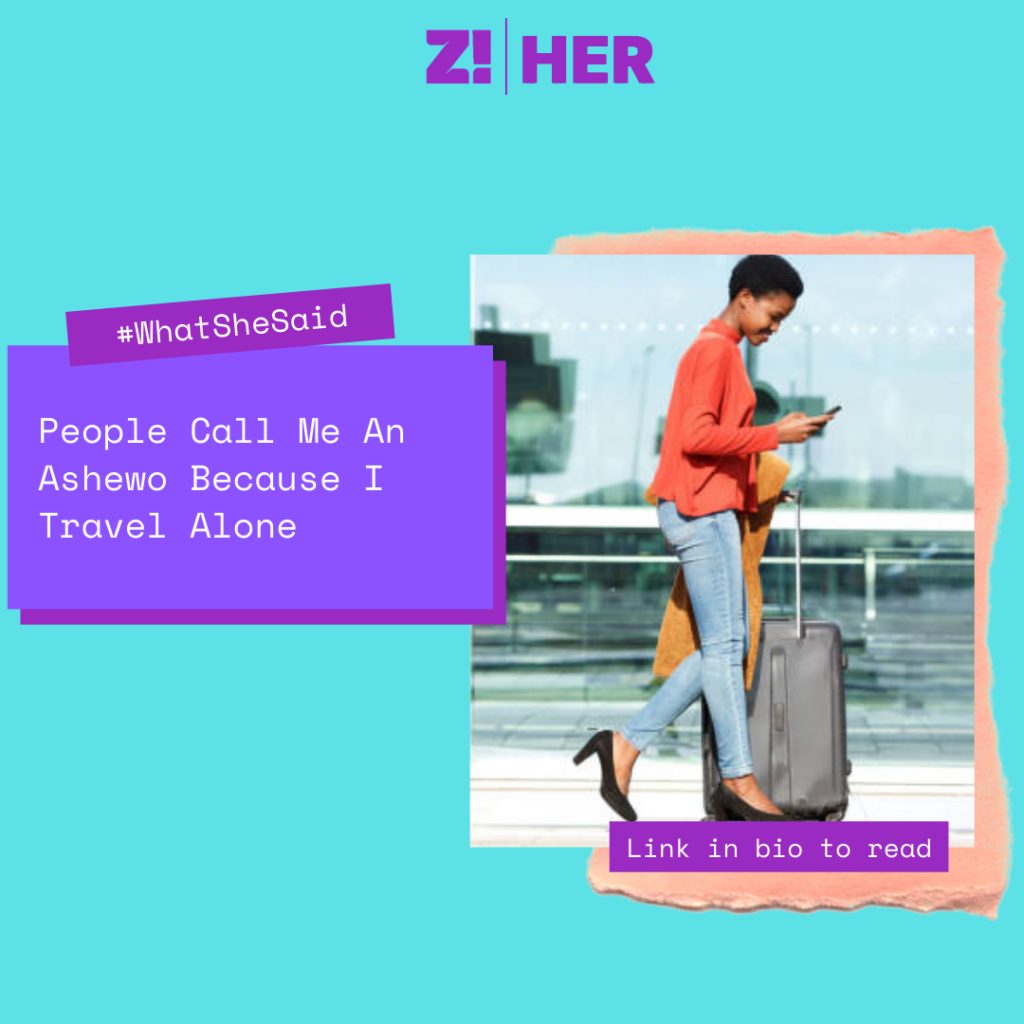
The subject of this week’s What She Said is a 25-year-old Nigerian woman who has travelled to over fifteen countries alone. She talks about how this love for travelling started, the way she’s stigmatised at airports and in hotels, and her dream to attend aviation school.
What was growing up like?
Life was good until I turned seven. When my parents were together, I travelled abroad every holiday, including Easter and mid-term breaks. I was happy. Our house was always so lively because of the parties we had, and I had a lot of friends.
However, things changed when my dad started beating my mum. Eventually, he sent her away. It was just me and my dad for a while, until I ran away to be with my mum.
Ran away?
After my dad sent my mum out of the house, he instructed security to never let her in again. The day I ran, my mum had come to visit me, and when security informed my dad she was around, he ignored them.
I remember taking my shoes, sneaking out the back door and running through the compound to the gate. By the time security realised what was happening, I was outside the gate. I hopped into my mum’s car, and she drove off.
A few days later, we had to return to pick up my school uniform and some other clothes.
Wow. How did your dad feel about you running away?
He wanted me to come back. He even bribed me with gifts. I would collect them but still not go back to his house.
There was a time he sent me to live with his sister in the UK. I wasn’t going to school or anything, just staying with my aunt. Eventually, my mum came to the UK and took me back with her to Nigeria. I don’t know why, but he just wanted to take me away from my mum.
I’m not his only child. He has a son with another woman, but we did not grow up together and I barely spent any time with him partly because he is nineteen years older than me. Up until 2014/2015, I told everyone I was an only child.
How did your parents eventually settle fighting over you?
I made my decision and stopped accepting anything from him. The only thing he did for me was pay my school fees. At a point he even stopped funding my baby girl trips, but my mum did for a while until she couldn’t anymore.
What are these baby girl travels and why couldn’t she fund them anymore?
My baby girl travels are the trips I take out of Nigeria every year. My dad stopped funding them when I was 10 and my mum continued. My mum sold jewellery, clothes and even drinks.
Then in 2012, she stopped because the country got worse. Business wasn’t as good anymore, so she couldn’t afford the trips.
How did you cope with that?
Well, I had just gotten into university and knew I had to continue the lifestyle by myself. I started looking for loans, but nobody wanted to give a broke student money.
Growing up, I was usually given expensive things or taken to luxurious places. Once you taste luxury, you would do almost anything to keep it. There are places I can’t eat because I don’t feel comfortable. I never used to eat street food because my mum told me that I would get food poisoning. The first day I tried it in university, I actually did have food poisoning. I only recently started buying roasted corn outside. When I was younger, we used to plant corn and roast on the grill ourselves.
When the loans didn’t work out, I started looking for jobs. I reached out to one of my dad’s friends who helped me get a job as a personal assistant to one of his friends. I had to remind him about his meetings and schedule his flights for him. It was a remote job and he paid me ₦99k a month.
He said 100k was too much money for a young girl, so he removed the 1k. When he relocated to the US, he started paying me in dollars.
How long did it take before you could travel again?
It took two years before I could go on my next trip. In 2014, I travelled to three different countries in one summer because I asked my aunt for money. Luckily for me, she had enough money to spare, so she agreed.
When she asked for the cost of the trip, I increased the price. That’s how I was able to go to London for a week, Dubai for four days, and Paris for two days.
E for Enjoyment. Did your aunt keep funding your trips?
No, she didn’t. I picked up three other jobs as well. The same friend of my dad’s that helped me get the PA job called me up one day and after asking me a few questions, asked for my email address.
I lied a bit and claimed I could do some of the things he asked, so I had to do a lot of research on the job. When I checked my email, there was a job waiting for me. The email contained three documents. My job description, payment information and an NDA.
What was the job about?
If I tell you, I would have to kill you. The second job was because I was recommended by the first company. Both jobs paid in dollars and helped fund my baby girl lifestyle.
I go to Abuja steadily. My excuse is to buy kilishi and suya, but it’s actually because I just need to be on a plane. Dubai is my second home, Greece is my third and London is my fourth. I have also been to the US, UAE, France, Russia, Jamaica, Rwanda, Serbia, Italy, Germany, Austria, Switzerland, China, Mexico, Bahamas, South Africa, Kenya, and many more. I love to travel because I love being on planes.
Are there countries or cities you’ve wanted to travel to but couldn’t?
Nope. There are, however, places I want to go but would not want to pay for the trip myself. I want to go to the Maldives or Santorini, but I’m waiting for my next significant other to pay for the trip for me.
Another way I’ve been able to travel so much is because the men I have dated usually pay for some of them. The goal is to travel to all the countries in the world.
Wow. When did you discover you loved planes so much?
One day when I was about five or six, I was on a solo night flight. It was the period my dad sent me to live in the UK with my aunt. Since my mum was not coming with me, I travelled alone. There was a lot of turbulence and people crying, shouting and praying that the plane shouldn’t crash. I wasn’t scared. One of the flight attendants came to sit with me so I wouldn’t be scared, but I told her not to worry and she left.
The seat belt sign was on, but I took off my seatbelt and started walking around, holding on to chairs the way I saw the flight attendants do. I even went to people crying and tried to calm them down.
The flight attendant saw me and yelled at me to go back, so I did. When we landed, she asked me why I wasn’t scared despite all the turbulence. I told her that I felt safe, and I knew planes crashed, but that particular one wouldn’t. I listed all the possible reasons why other planes like it crashed and why the crash rate was so low.
She took me to the flight deck and I saw the captain, the first officer and all the buttons. The flight attendant told him what I did, and he made me sit in his chair and put his cap on my head. I cried because I was so happy. At that point, I knew planes were my obsession.
That sounds so cool. That means you’ve been travelling alone for a while now. What’s that like?
Well, people are constantly asking strange questions.
At the embassy, they ask how I pay for my trips. Before I divorced my now ex-husband, the process was easier because I’d just say he was the one paying for it.
A lot of my flights are paid for by the company I work for, and I usually fly first class or business class. Getting visas that way isn’t really difficult because it’s a work trip.
My personal trips are easier because I have a very long travel history that started when I was a child.
I never feel safe travelling alone because men have harassed me physically and verbally. They assume I’m a prostitute because I travel alone. At the airport, people call me ashewo.
When I check-in at the hotels, the hotel staff ask if I’m expecting anyone else even after I’ve told them I’m travelling alone.
Travelling by road in Nigeria is a herculean task because of the bad roads, multiple police checkpoints and probable kidnap attempts but what’s travelling by road in Nigeria like for women? I spoke to nine Nigerian women about their experiences, here’s what they had to say:
Timinu, 24
I used to travel by road a lot and I felt safe. I was only scared of road accidents and I’d ease myself by listening to music or reading a book. But now, with all the stories of kidnappings happening in the South West, I am getting increasingly scared. I travelled to Lagos five weeks ago and I haven’t been able to leave because of fear. I don’t want to be a hashtag.
Onyinye, 30
I lived in Delta and schooled in the north so I would travel in a big marcopolo bus with over 40 other people. It was so big that people would buy tickets to stand. It’s a long journey and the drivers try not to stop at night. One time when I was 19, I was making the trip back to school as usual and sometime in the evening, I offered a man that had been standing all through the trip a space to seat. I slept off shortly after.
At about 2 am I noticed someone was touching me. I waved it off and slept again but ten minutes later, it happened again. I kept my eyes closed and waited, only to discover that the man I gave a space to sit was touching me. I screamed and guess who got blamed? Me.
Wumi, 21
When I was in a long-distance relationship with my partner, I used to travel a lot. I was a student, so I would make the trip after classes. She lived in a state that was quite far from mine. I never felt safe travelling. One time, I woke up to this man rubbing my thighs. I shouted at him and he adjusted. I was really tired so I slept off again. This time, I woke up to him moving my dress up.
I couldn’t sleep again. There were four other men in the car and I didn’t want to make a fuss so I just sat there feeling violated till the trip ended. Do you know this idiot had the guts to ask for my number?
Road travel has made me hate travelling. I’m always anxious and constantly thinking of how to protect myself. There’s also the fact that male passengers can be extremely mean to female passengers for no reason. One time, I was travelling with my sister and the driver stopped so people could ease themselves. My sister went to buy tissue paper first so she took a bit more time than others. One of the male passengers started calling her names and slut-shaming her for wasting time. When I tried to stand up to him, another guy threatened to slap me for talking like that. Another thing is if a woman is complaining about an issue, the men either try to shut her up or ignore what she’s saying until it affects them too. It’s so disgusting.
[ad][/ad]
Ivie, 25
In December 2016, I travelled to the village for my sister’s traditional wedding. I had to go alone because my parents had left already and my other siblings had work. The journey went on smoothly until I got to my final destination, Aba around 12 am. My sister who was supposed to pick me up couldn’t because the park was too far from her house and it was late.
All my family members were worried. My father eventually spoke to the driver who said he’d look after me till the next morning. He gave me a space in his bus to sleep and turned on the air conditioner all night. He even offered me food. I was so scared but nothing bad happened to me.
The next day, trust men, he asked for my number. I told him to give me his and I never called. When I was going back, I used GIG.
Tare, 21
In April, I was travelling with two of my friends — a girl and a guy, when police stopped us on the road. They told the guy to come down because he was the only guy in the vehicle. They searched his phone and his luggage. I was worried they’d check my phone next and see all the queer pictures and then they would out me to my parents before extorting me. They let him go but that incident left a scar.
Louisa, 23
My mom, sister and I used to shuffle between Lagos and Anambra or Owerri between 2011 to 2018. My dad had relocated to the East and we always wanted to spend holidays with him. Travelling by road is the ghetto. Paying for 3 flight tickets was expensive, especially around peak periods so we either took a bus or my mum drove.
With Public transportation, men disrespected us a lot. We would book a seat and someone else would take it because we are women. I hated having to wear jeans or some other uncomfortable clothing so that if anything happened, I could run easily. Another reason I wore jeans was so that in case anyone tried to rape me, my chances of getting away safely were higher. The disadvantage of wearing jeans is that whenever the bus stops for bathroom breaks it’s a struggle to pee. Those toilets are the fastest places to get infections so you have to do your business outside. This means finding a place by the road that is open but still secluded enough to keep your private parts covered. By the time you’re done, all the men are complaining about how women always take time.
Travelling in a private car with my mom driving is a different story. The security personnel on the road stop us and say things like, “Madam this work na oga suppose dey do am.” We would also have to leave late when we are sure there are enough cars on the road and only buy fuel at popular filling stations. Also, motorists get more hostile when they realise it’s a woman behind the steering wheel.
Travelling by road is not safe for women either way; not in our private car and definitely not in public transport.
I was travelling back to Ife from Ibadan a couple of years ago. I remember being comfortable at the back of the bus as the bus wasn’t full. I was sitting next to a man in his 30s and I had a lot of stuff on my lap that I couldn’t put in the trunk. After about an hour on the bus, I decided to rearrange the things in my lap and what did I find? The man next to me had his left hand in my crotch. Like between my legs. I honestly became paralysed. I was shocked because how the hell did I not notice? I felt like I caused it because I wasn’t vigilant enough — I was too relaxed. I shouted at the man and he started acting like he didn’t know what happened. He said it was a mistake. He came down before I did and apologized again. That made me even more confused because was it really a mistake? I wasn’t alright for days after the incident.
Bemigho, 21
Safety while travelling by road in Nigeria depends on how much you can spend to travel. If I’m not booking a flight to the east, then I’ll just enter one of those private siennas. It’s almost like travelling in your own private car. It is safe and you get space to yourself but that is interstate travel though. I feel safer travelling interstate in Nigeria than just commuting within Lagos. I used to trust Uber or Bolt but even those aren’t safe anymore. Whenever I’m in Lagos, I have a bottle of pepper spray in my bag. If you come close to me try anything funny, I will spray your daddy!
Omo, 24
In 2015, I was returning to Akwa from Lagos. I was only 18 at the time. When we got to Benin, a guy on the bus I boarded asked for my phone to make a call, but I politely declined. He got angry and started shouting at me. I said, “This is my phone, why are you upset?” He started threatening to beat me. He actually tried to hit but I defended myself — thanks to my fingernails, they did a good job on his face. After the fight, he kept threatening me.
Everyone else kept quiet and pretended they weren’t seeing him harass me. I noticed the guy texted his friends to meet him at Onitsha, that they had something to fix. I got scared and called the driver’s attention to it. That was when everyone started shouting at him and I think it’s because they also felt at risk.
Immediately we got to Asaba, the driver stopped at the nearest police checkpoint and handed the guy over to them, that was what saved me that day.
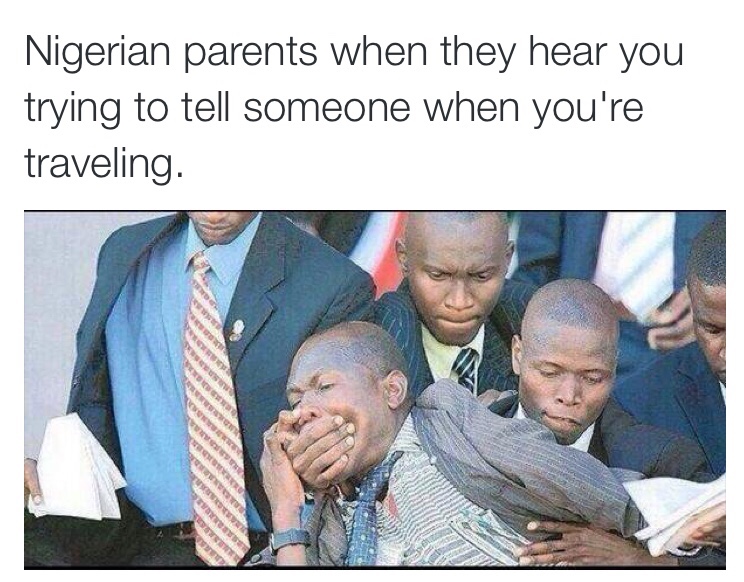
So you’ve had your visa interview, got your visa and you’re finally about to take that trip you’ve planned for years. But your mom has told you not to tell anyone you’re travelling until you get back. You’re wondering why? We’ll tell you.
Your village people don’t want you to travel
This one goes without saying. If your village people, who hate your family because you’re more successful than them find out you’re traveling, they can easily get you. They’re witches so they’re in the air; you’re in a plane, so it goes without saying that you’re in the air. It’s the best place to get you. All they need to do is make the aircraft develop faults that would lead to a crash. If you’re not going to tell people you’re not travelling, family members top that list.
“This boy is not going anywhere”
You’re not Santa Claus
Traveling to the abroad means you have money. Nigerians don’t want to know otherwise. You’re going there to blow one million dollars everyday so why shouldn’t your family and friends get their share? They’ll disturb you everyday to buy shoes and chocolates for them. And if you say no, you’re proud and evil. Don’t say no, just don’t let anyone know you’re traveling.
To Avoid “Whining”
Okay maybe this isn’t one of your mother’s reasons but it’s a valid reason. Once you mistakenly step inside an airplane, people automatically think you’ve arrived. When they see you, they start calling you “Money man” or “Oga Madam”. When they start using names like that for you, people will think you have money and your helper might think you don’t need their help because you’re already an Oga Madam. You know how Nigerians are.
To Avoid Deliveries
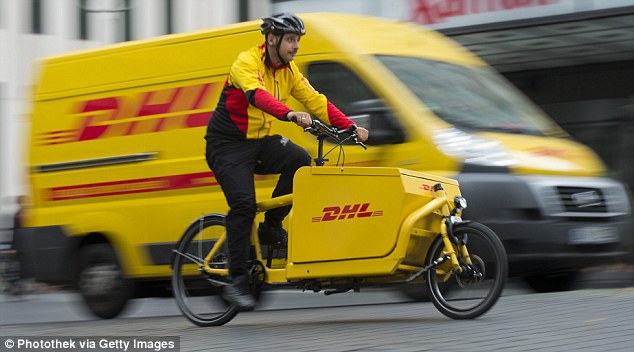
You’re not DHL. It’s when you travel people will begin to remember that they have an uncle in Atlanta that they want to take fish to, and get shoes from. Or that they want to buy Crocs. And they won’t pay for your extra luggage. Let’s be guided please.
And if you still go ahead and tell people you’re travelling, after all we’ve done for you, whatever befalls you is your problem not ours. You know what they say about a word? Well, that’s right; it’s enough for the wise.
Every week, we ask anonymous people to give us a window into their relationship with the Naira.
In this story, a man will do anything legal for money. Like, anything.
Age: 32.
Industry: Informal
When did the hustle start for you?
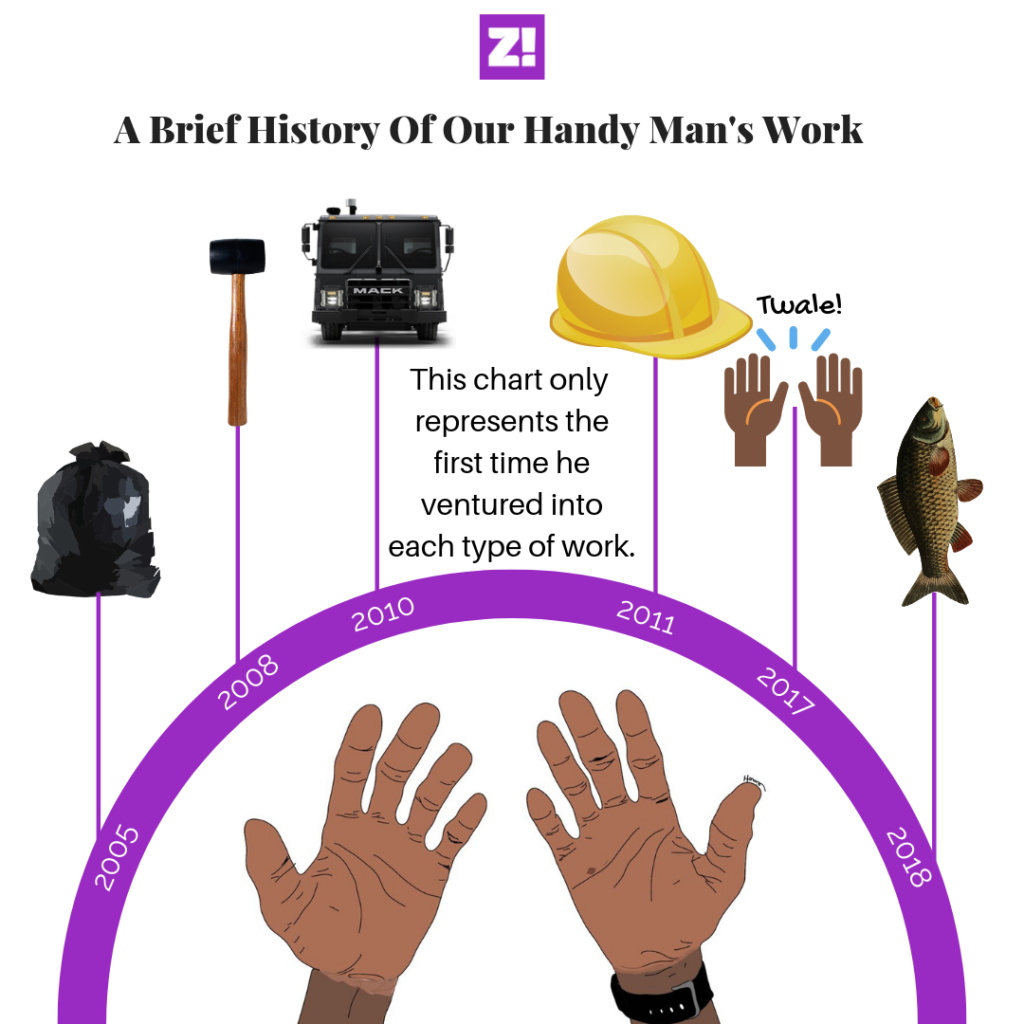
2005. Inside Main Market, Onitsha. That time, I used to do Striker work–walking around the market and helping people sell clothes. So if they give us cloth for ₦1k, we’ll sell at ₦1,500, and so on.
I was also born and brought up in Onitsha. My parents are Yoruba, but the way hustle carries everybody, that’s how it carried my parents. My father butchered cows, and mumsy was selling food. That time, I could only speak English and Igbo, no Yoruba or pidgin.
I still did a lot of other work in Main Market, like picking plastics. By 4pm every day, we’d start going around the market, picking plastics till 7pm. Our pay was ₦15 per kilo, and one bag of plastic used to be like 10kg.
This was when I just finished SS3.
My actual plan after secondary school was to be a lawyer. And it really started in my mind then because, whenever people were fighting in school. I was the one that used to resolve it. Also, I really loved Government–especially the parts when they’re talking about our history and past leaders.
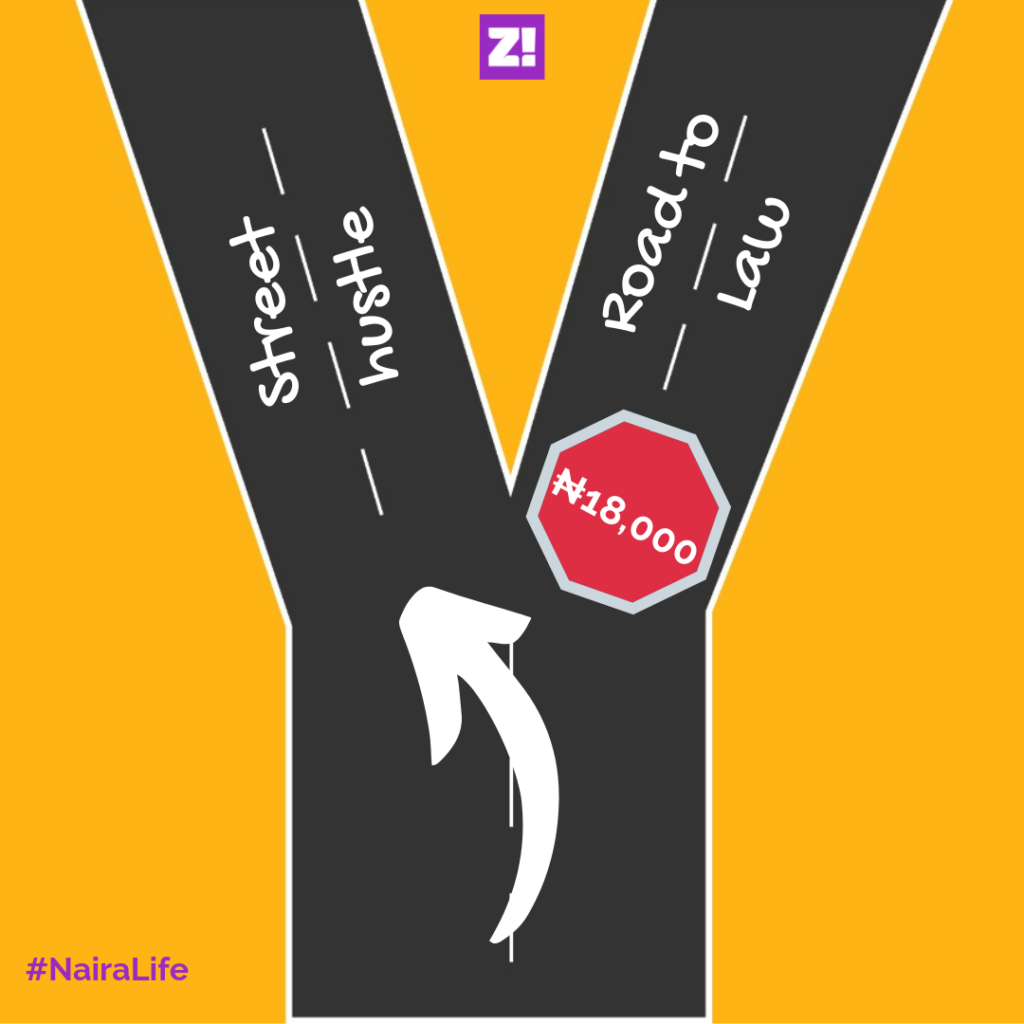
See, the main reason I didn’t push on with my education was because there was no money. What ruined me was I couldn’t afford to pay for WAEC. Ordinary ₦18k. I would have written with 2004/2005 set. Those days, I think I almost went mad on top of this matter.
So it was when I missed WAEC that year that I entered hustle.
I sold minerals, pure water. Packed gutter. Packed dustbins. I had hands to pack anything that needed to be packed.
What was the moment from those days that you can’t forget?
December 21st, 2007. I used to live with a friend. By this time, my father had already died, and my mother relocated back to Kwara.
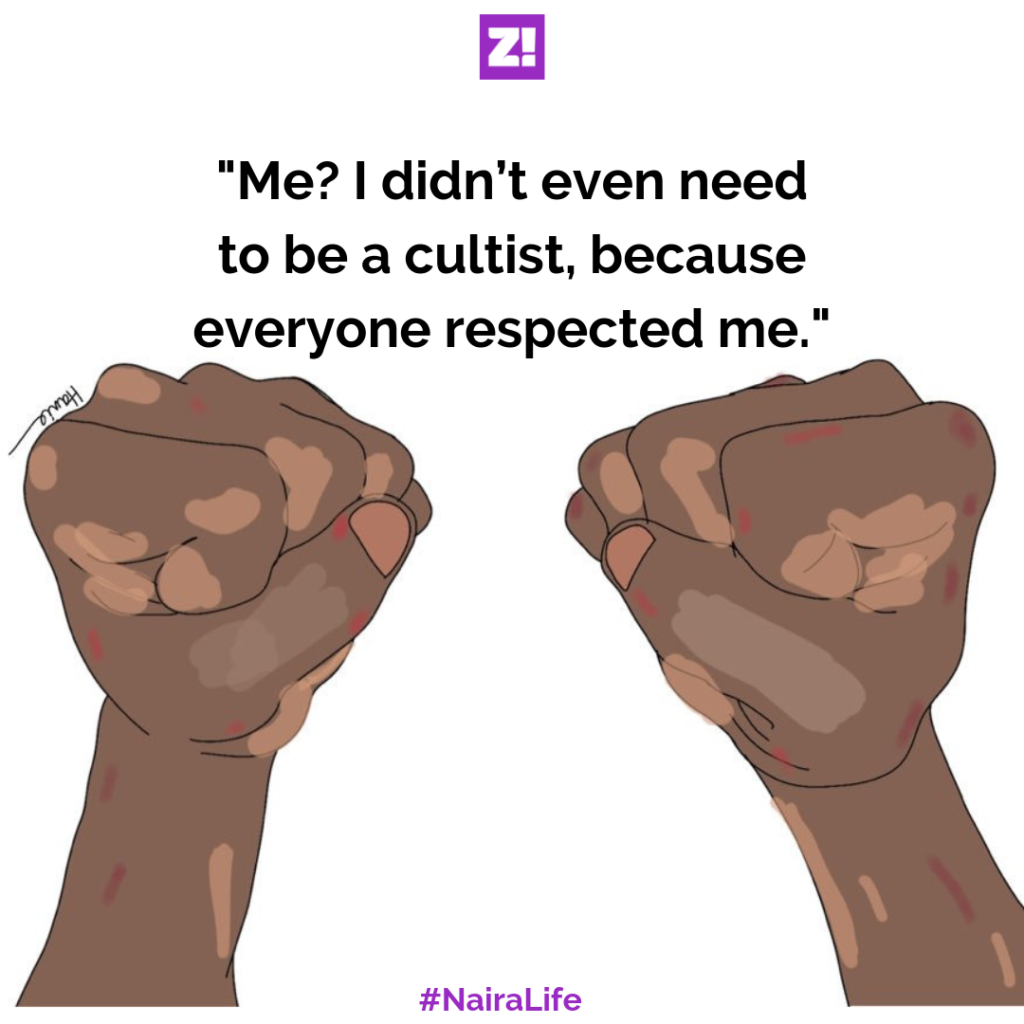
My friend had issues with some guys, and those guys were cultists. Me? I didn’t even need to be a cultist, because everyone respected me.
Sha, we went to the guys’ place, and that’s how shouting started, and then fighting.
Later, in the night, my guy was at the junction. Not too long after I told him I was going inside, some men came in a Hummer that night. People who saw the car said it was about 4 guys. They told him to help them locate a place. “Come and show us the place na.” That kain thing. When he entered the car, they drove off. And he was gone. Just like that.
Ehn?
Ritualists. Sha, three days later, Police came, and the gist was “the last person everybody saw him with was his friend.”
In fact ehn, the policemen walked up to me and were asking, “we’re looking for so-and-so.” They were asking me about me.
“He’s not around..” Omo, as they left, I took off. People said if they catch me, it might be death or 25 years in prison.
So I was hiding from place to place, for two weeks. Whenever I stayed long at one place, the guys there will pursue me saying, “abeg be going before Police will come and pack all of us.”
Then my older brother just called me one day and said, “You can’t be here, let’s go to Lagos.”
And so one early morning, before I could even shower or brush my teeth, I was on my way to Asaba. I had only the sweater I was wearing, ₦20 in my pocket, and my phone–a Nokia 1110.
We took a luxurious bus, standing, to Lagos. ₦600. This was January 2008.
Mad o.
You see Lagos? That’s where the real hustle started. We had some family in Lagos, and so when they asked me what I wanted to do, I told them I’d like to learn tailoring. But my uncle had other plans, and that’s how I ended up selling building materials in Mile 12. While I was selling, I started learning how to dismantle things–air-conditioners, freezers.
I did this until the beginning of 2009.
The thing about working iron is that, I had to work under sun and rain, doing the hard work of dismantling for scrap. So even though I was making ₦1k to ₦3k per day, I’d work one month, and fall sick the next month.
So mumsy told me to leave the work. I became jobless for the next 6 months, even though I was constantly looking for work.
One time, I went to Lagos Island, I saw a sign for a shop that needed a sales boy, selling ceramics and pots. I got the job; ₦15k/month. Sales got bad, and I had to leave. So in the end I stayed there from July till December 2009.
I was unemployed for another 5 months. Then in May 2010, I started rolling with this guy who was a trailer mechanic.
I told him straight, “Guy, I’m sure you don’t like how I always ask you for Garri money. I need a job. If you hear of anything, tell me abeg.”
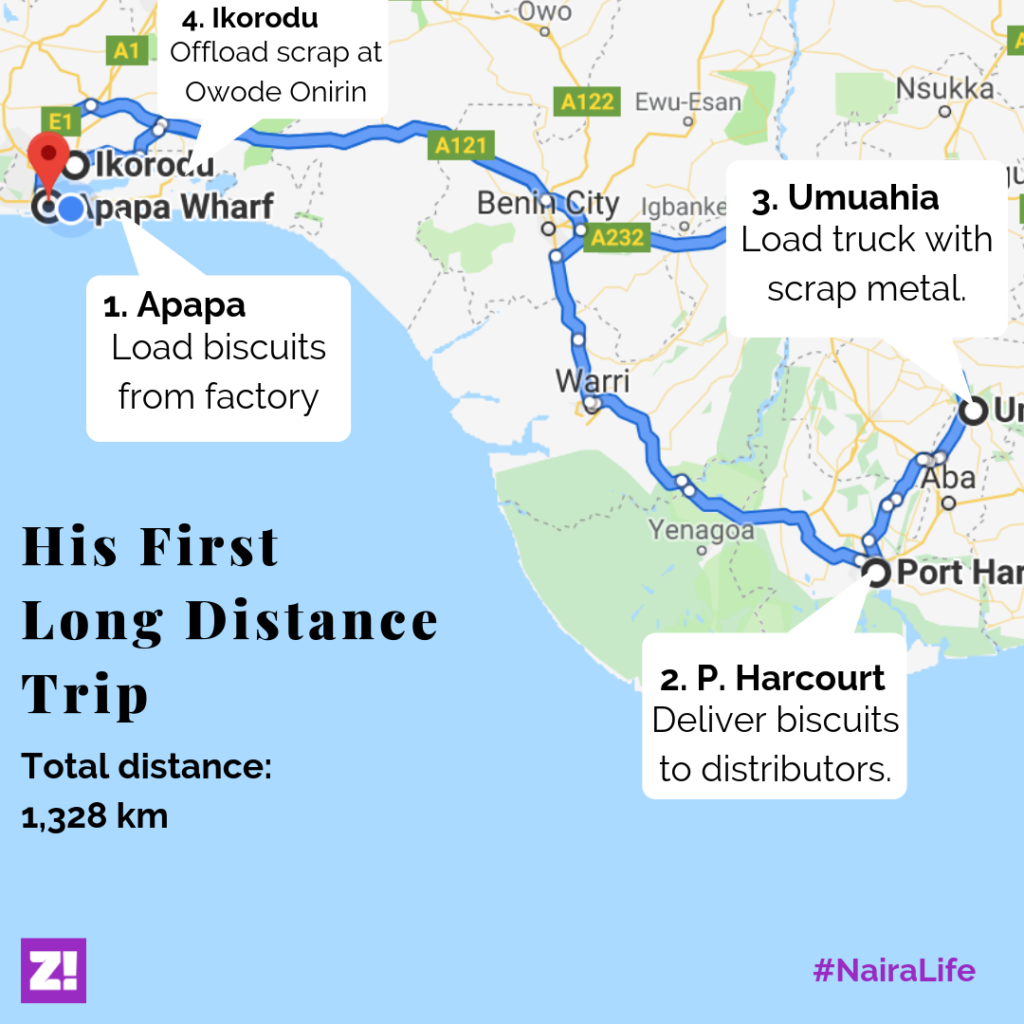
One week after I told him, he called me around midnight. A driver needed a Motor-boy for his trailer. It was a 40-feet trailer–a CR7 Mack. I took it straight. We were picking containers from Apapa Wharf and delivering around Lagos. He used to pay me ₦5k per trip, and sometimes we did up to 5 trips a month.
What does a Motor-boy do?
I wash the trailer, fix the tyres, check engine oil and water levels. Then I also help check my side, for when a driver can change lanes. I tried to get my Oga to teach me how to drive, but he didn’t teach me.
So one day, I called my friend and said, “oya show me Gear 1.” And I started learning small-small. Not too long after that, they sacked my Oga.
The next Oga I had was paying me ₦200, while we were making ₦6k a day. But we were working with a Biscuit company, so biscuit was free at the factory. So, I was living on biscuit and water.
Then I did some work for a man working in the factory, and when he liked what I did, he gave me a job in the factory.
I started there December 26, 2010. The money they were paying was ₦850 per day, every two weeks. I was at the vehicle loading section, because them see say I get strength. I used to compete with one other guy who was bigger than me, over who will load more trailers. We used to load up to 10 trailers a day.
Work was 6-6, but loaders used to close late, sometimes up to 11pm.
So ₦11,900 every two weeks?
When my first pay came in January, omo, I happy die. I went home and was looking at the money. I was like, what if I spend all this money and I end up not having a job again? So I started trying to save ₦5k every month and eating mostly factory biscuits.
But the problem I had was that, because of how hard my work was, I was always hungry. So all the money I was trying to save went back into food.
One day, our boss wanted us to work overtime again. Just after everyone had showered and was ready to leave. It vexed me, because we don’t get paid for working extra. It looked like he didn’t really care about us.
The next day, one trailer driver asked me if I wanted to be his Motor-boy. At first I didn’t agree, but he told me that he’d treat me well. I accepted.
Now, this was when I entered the real road life. December 2013.
One thing I’ll never forget about him is, everything he ate, I ate. Any food he bought for himself, he bought for me.
After Mile 12 days, this was my highest paying job. My first four days, ₦15k. What we were doing was carrying biscuits from this factory that I just left.
Not too long after, they sacked my boss. So I had to get another job. The Biscuit factory moved from Apapa to Shagamu, Ogun State, and I was lucky to get another Motor-boy job.
But I quit that one later.
Ah, why?
One day, he went to go and drink and carry Ashawo. When he came back, he forgot that he left someone sleeping under the trailer to secure the trailer battery and fuel tank. This man just drove off, and was already on his way to Lagos when he remembered me.
Then I got another boss. Really good man. One time someone from his village asked him to come home, he went and never returned.
I worked with more people, and started to relax more. I used to cry a lot when I worked at the factory but now I wasn’t crying.
I was now getting up to ₦70k per month. But the problem with trailer life is that you eat a lot. So na food I dey use am buy.
2015, I made my first trip to the North. We were carrying biscuits across the North; Kaduna, Maiduguri, Gusau.
Then Zaki Biam–ah, they used to rob too much. Armed robbers with checkpoints and military uniforms.
Maiduguri in early 2015, we used to see dead bodies on the road to Maiduguri sometimes. One time, we were parked along a highway and this small truck just packed, offloaded rice. Inside bush o.
Later, another truck came, and there were men. They were wearing military uniforms, and they covered their faces in those turbans and masks?
Who were they?
Omo, me I no know o. Sha, After then, we went to Gusau, to pack oranges for offloading at Ore Toll Gate. I never went back to Maiduguri again, but I won’t forget that journey because, when we got to Kogi, my Oga parked the trailer, came down, and told me to enter the driver seat.
That was the first time I drove my own trailer in my life, and when I got back to Shagamu, I got my first trailer job.
Mad.
So when I started, they were paying ₦20k per month. But we don’t really care about the money they pay us. It’s the money we make on the road that’s the koko–up to ₦80k. It was this period I started saving. Also, I now had my own Motor-boy. I made sure I treated him well.
Nice. How long did you do that for?
Not long. Kasala burst. I had a small room I rented in Shagamu, and there was someone staying with me. I was in Lagos for a family thing. My room caught fire, burnt my neighbour’s room.
How did it happen? I had gas cylinder. The person staying with me cooked noodles. And when he finished, instead of turning off the gas, you know what he did? He just poured water on it. Like a Kerosene stove. But the gas was still open of course.
A few minutes later, he wanted to smoke, and as he used his lighter; GBAO.
Ah.
When I got back home, the person I was staying with had run away, but the Landlord was waiting with Police. They collected all my savings, ₦350k, and they came back for more. But when they came, I done ja. This was April 2017.
I didn’t get another job again for one year. All I was doing was helping people park and shouting twale for change.
But in July 2018, I finally got my current job, selling grilled catfish.
Between 2005 and now, how you see life?
Wait, make I off my cap.
See, life is hard for a poor man. Even worse for a person without a proper handwork. The worst thing is to not have an education. Life is just really hard. There’s a kind of hunger you have when you have very few options in life. Na that one I get.
I struggle to sleep because of all the times I was working on trailers. But the struggle continues.
Only advice my mumsy gives me is, don’t steal. Don’t do rituals.
Some days, she doesn’t even care whether or not I give her money. All she wants to do is hear my voice.
I believe one day, it will be well. If na by who work pass, I no fit carry second. I work for what I eat. My own is, I just want to make it before my mother dies. Because after God, she’s next.
How much is your salary now, and how do you spend it?
I was collecting ₦20k, but now I’ve started collecting ₦25k. See, my spending is straightforward. I save ₦5k. I send my mum ₦5k. I survived on ₦15k and the tips that people give me when they come to buy fish.
I save, just in case anything happens, I can have backup.
How much money is a good salary right now?
₦70k, and I go dey okay. I’ve collected this salary before, but trailer job is different. In a trailer job, we spend money as it comes. We collect money, work a lot, and spend a lot. Because it’s physical work. But I’ve seen how I managed with ₦20k, so ₦70k will be enough now. Also, I’ve done all the types of hard, physical work. I can do office work. I can read and write.
What’s something you want to buy you can’t afford?
Right now? Clothes. And paint, because the room I’m staying, the paint done peel.
What size do you wear?
Shirt size; Small. Jeans; 29-30. Shoes; 40-41.
What do you think about when you think about the future?
Guy, many things. The first thing I want to do is build a house for my mother, I don’t care if I’m living inside one room. When my father died, my spirit could take it. But if my mother dies without me giving her a better life, ah.
Then I want to build a home for homeless people. Free. This is my biggest dream. Just come and live, then we’ll help you get work, so you can also get work for other people.
I want to wipe tears. I want to help people forget, and think of bright things.
Wait, what of that your friend in Onitsha?
Ah, yes. One time when I was a Motor-boy and we weren’t too far from Onitsha, I told my Oga I wanted to go into Onitsha to visit someone. When I went back to the hood, I heard the good news and bad news.
He came back. What happened was that, when he entered that Hummer, he said he didn’t remember anything that happened. But when he finally escaped from where they were keeping them–he escaped with someone–he found out that they were in Shagamu.
The bad news is that, they say when he came back, he moved out of the area not too long after. Nobody knows where he went.
I’ve never seen him since that December 21st, 2007.
The end.
Check back every Monday at 9 am (WAT) for a peek into the Naira Life of everyday people.
But, if you want to get the next story before everyone else, with extra sauce and ‘deleted scenes’ just subscribe here. It only takes a minute.
The visa application struggle is very real with our not-so-much-loved Nigerian passport, and a lot of us have learned that the hard way. However, there are still a few countries that will have us with no hassle! Check out these African countries you can visit visa-free.
Thank God, sha. We never cast for here.
1. Cape Verde – West Africa
A former Portuguese colony, this beautiful island country is located on the West African coast. The official language is Portuguese, and the national language is Kriolu. Cape Verde has amazing weather and is a great choice for a visit.
2. The Comoro Islands – East Africa
Comoros is a constellation of islands off the south-east coast of Africa, east of Mozambique and north-west of Madagascar. Although The Comoro Islands is listed as visa-free for Nigerians, we still have to get visas on arrival. Life. There are lots of exciting touristy things you can do on the islands, so you should definitely check it out.
3. The Gambia – West Africa
Africa’s smallest country, The Gambia is absolutely beautiful and is known for its diverse ecosystems around the central Gambia River, abundant wildlife, beaches, and so much more. It has it all. Nigerians can visit The Gambia visa-free for up to 90 days.
4. Ghana – West Africa
As part of ECOWAS benefits, Nigerians can enter our sister country visa-free, but sometimes, visas may be given on arrival. Ghana is famous for its slave-trade historic artefacts, beautiful beaches and parks, and Shatta Wale lol. You should definitely visit.
5. Kenya – East Africa
Kenya is a beautiful country with incredible wildlife. Nigerians can visit for up to 90 days, visa-free. From fun rides through the safari to snorkelling, Kenya is one of Africa’s most impressive vacation locations.
6. Madagascar – East Africa
Madagascar is situated off the South East coast of Mozambique and is the world’s 4th largest island. Different species of palm trees surround the waters and you can go swimming or snorkelling in the Indian Ocean. In Madagascar, Nigerians receive visas on arrival.
7. Chad – Central Africa
Chad is located in the central African region and is home to a wide variety of wild animals. You can visit Chad visa-free and can pay a visit to the Zakouma National Park which has 44 species of large animals and many species of birds. There are also many interesting sandstone formations.
8. Mauritania – West Africa
Mauritania a beautiful desert country situated between Morocco, Mali, Algeria, Senegal, and the sweep of the Atlantic Ocean. On arrival, Nigerians can acquire a visa. You can cross the desert on a camel, or explore Chinguetti, an impressive “Old City”; a crumbling, sandstone village, with various antiquated mosques and a few libraries.
9. Mauritius – East Africa
Mauritius is a gorgeous island nation located along the coast of the Indian Ocean, off the southeast coast of Africa. Mauritius is an English/French-speaking country with a tropical climate, clear and warm sea waters and beaches. A perfect romantic getaway spot, you can go snorkelling, swimming or scuba-diving. For 90 days, Nigerians can visit Mauritius visa-free.
10. Seychelles – East Africa
Seychelles is located off the coast of East Africa in the Indian Ocean and is bordered by other islands like Zanzibar, Madagascar and Mauritius. The beautiful country of 115 islands boasts of a diverse blend of cultures and has some of the best beaches in the world. It offers Nigerians a visitor’s permit for one month.
They are the Head Sleepers of the Sleep Society. If you have the slight misfortune of sitting next to them, expect to have your shoulder become their pillow. You should also expect to find their slight spittle mixed lightly with sweat on your clothes.
2. The Eaters
If it comes wrapped up in something and sold in trays balanced on heads, these ones are buying.
It is not wise to part them from their food. They’re generally the first to ask the driver where he is stopping to eat.
Merchandise of choice usually includes but are not limited to; Gala, Chinchin, Akara and Bread, Boiled eggs, Ekpa etc.
Consequently, they also will regularly request to relieve themselves on the way.
3. The Debaters
For these ones, a journey is always an opportunity to get on the debating stage, and it doesn’t take much to get them rolling.
Topics generally include any popular issue. From Daddy Bubu’s frequent holidays to the abroad to whistle-blowing and finding money in strange places.
All it takes is the bus bouncing over a small pothole in the road and away they go.
But try to steer clear of the general area surrounding their mouths, they tend to be spitters as well. Although, it’s not their fault, all that talking has made their lips numb.
4. The Cellcoholic *Yes, it is a word
You can tell them by the earpiece/headset in their ears or the phone pressed tightly to their heads. From personal to business call, they’ll make it all. By the end of the journey you’ll start to feel like you know them better.
“Don’t worry Brother Ignatius, the container will come in on time”.
5. The Assistant Drivers
As the name implies, they’re the driver’s second-in-command. Usually riding shotgun, or in the row behind the driver, their functions include but are also not limited to;
– Helping the driver see sudden, upcoming potholes
– Warning the driver of an oncoming trailer
– Monitoring the driver’s speed and keeping tabs on fuel level.
So the next time you’re travelling with public transport in Nigeria, keep watch for these 5 people.
You travelled for business? Pleasure? It doesn’t quite matter which. All that matters is that you temporarily escaped the mad house of your beloved Nigeria. Temporarily. And now, it is finally time to go back. Long sigh.
We know exactly how you feel. Because every time you’ve had to go back, you are like:
1. Kai, it’s time to go already?
Abroad, I’m gonna miss you.
2. You are already thinking about your next trip.
3. Then you spy all those Nigerians at the boarding gate…
Supporters club of life and destiny.
4. And you’re real happy to hear folk speaking a familiar language.
Doesn’t matter if you are Yoruba and they are speaking Tiv, Naija knows Naija.
5. Until the familiar Nigerian energy starts making you tired inside.