Notice: Function _load_textdomain_just_in_time was called incorrectly. Translation loading for the wordpress-seo domain was triggered too early. This is usually an indicator for some code in the plugin or theme running too early. Translations should be loaded at the init action or later. Please see Debugging in WordPress for more information. (This message was added in version 6.7.0.) in /home/bcm/src/dev/www/wp-includes/functions.php on line 6121 Strike | Zikoko!
Nigerians and strikes are five and six. You can’t honestly claim to have had the full Nigerian experience if you’ve not taken part in one, or been affected by them. If you’ve passed through the public school system then ASUU must have wiped a cord around your neck. And if you’ve had to buy fuel, you must have seen shege waiting your turn at a filling station.
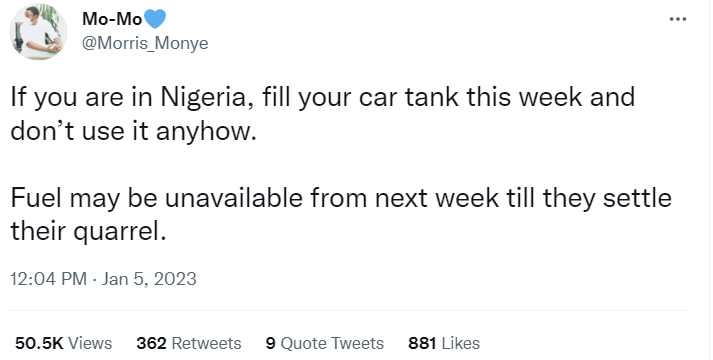
On that last point, it looks like things are about to get pretty rough as oil tanker drivers in the country have threatened to go on strike. And it’s not for the usual reasons.
What’s the wahala this time?
The truckers who transport fuel to depots across the country have a union. It’s called the “Petroleum Tanker Drivers branch of the National Union of Petroleum and Natural Gas Workers” aka PTD-NUPENG.
On January 5, 2023, it was reported following a press briefing in Abuja that PTD-NUPENG planned to go on strike over the highhandedness and harassment by security agencies. Its national chairman, Lucky Osesua, said that men of the military task force in Port-Harcourt burnt two of its trucks carrying High Pour Fuel Oil, otherwise known as black oil, on Tuesday night.
The excuse for burning the trucks was that they allegedly carried crude oil. PTD-NUPENG said the drivers politely presented documents showing that they weren’t carrying crude oil. The task force was like…
Sigh. What else is there to the gist?
Beyond the point that burning oil is wasteful as well as bad for the environment, a fight between truck drivers and security agencies isn’t good for Nigerians. Fuel is scarce and expensive to get in many places across the country. So this fight simply makes a bad situation worse.
On social media, Nigerians are anticipating that it might escalate which could lead to hoarding and ultimately, longer queues.
We hope the government steps in to resolve this issue quickly. We have enough wahala as it is, let’s not add another strike to it.
On October 31, 2022, the Joint Drivers’ Welfare Association of Nigeria (JDWAN) commenced a seven-day strike in Lagos State due to indiscriminate harassment and extortion by managers of parks and garages in Lagos State.
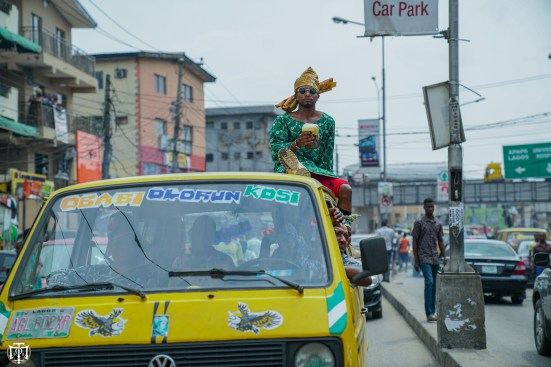
For a city known for its trademark yellow buses, it’s a strange sight to wake up on a Monday morning and find them absent from the usually busy traffic routes.
The strike has left Lagosians stranded and waiting in line for the few available buses on the roads, as seen in videos posted on social media. Predictably, the scarcity of buses has led to price hikes along several routes.
Citizenspoke to some bus drivers for their thoughts on the strike.
Segun — a bus driver plying Obalende to Ajah
“The bus fare from Obalende to Ajah is ₦700. It was ₦500 earlier last week, but fuel scarcity made it ₦700 mid week. For the loading of passengers at the bus stop, we pay ₦6000 daily — ₦3000 at Obalende, ₦3000 at Ajah.
“Immediately I collect money from my passengers, I pay it to the enforcer that helps me call in passengers. They give us tickets marked with the date so we can’t even think of outsmarting them when they ask us for their money the next day.
“I support the strike because the daily extortion eats into our profits. I used to own three buses, and I leased two out to other drivers. I thought they were ripping me off with their poor weekly returns but I’ve seen things for myself. I now own just one bus that I drive myself and the agbero payment is ruining my business. If I complain and refuse to pay, they’ll damage my side mirror, windshield or something valuable in my bus.”
The strike hasn’t affected me, it’s business as usual. They said the strike will reach seven days but I don’t think they’ll complete it because these are commercial buses and anyone can come out at any time. Obviously, I still want the government to do something about the strike because the agberos extort us a lot.
“As I am now, I’ll pay for loading and booking. From junction to junction, the money we pay every day is ₦7000, I swear to God. I heard there was a meeting with the government before the strike commenced but I wasn’t a part of it.”
Akinleke — a driver in Bariga
“The strike affects me as I’m in transportation for Lagos State. I used to work with the local government until I had an accident that affected me in 2020. MC Musilliu collected our work from the local government. Before then, national transport unions were different from local ones but MC collected all of them.
“The strike is supposed to be from Monday to Monday, but look outside, you can still see vehicles going about their business.”
*Dele — a driver in Yaba
“The government needs to call LASTMA, the task force and even the police to order. They collect money from us and it’s not little. If the task force holds you they would extort anything between ₦80,000 and ₦100,000. How much do we make?
“Agbero will collect, task force will collect, LASTMA will collect, police officers will collect and they’ll do it with force because the Lagos State government gives them the avenue to do so. Can they try this in other states? We work for others to eat.
“Honestly, I don’t really mind if it’s just the agberos extorting us, we can manage that. But when you add the rest including the task force and LASTMA, those are the problems. The government should do something about that.”
*Subject’s name has been changed to protect his identity.
On November 5, 2018, while some unlucky student was fighting for the last seat in the Keke so he could get to school early, the Academic Staff Union of Universities began an indefinite strike.
The reason? Well, according to ASUU, the Federal Government has been doing them wayo for a minute.
The men in Abuja have refused to approve better salaries or pay agreed allowances for lecturers in public universities.
Lowkey, this strike is just a rebirth of one that supposedly ended in September 2017.
When he was calling the lecturers to arms, The National President of the Union, Prof. Biodun Ogunyemi said something along the lines that the lecturers will not resume until “government fully implements all outstanding issues as contained in the MOA of 2017, and concludes the renegotiation of the 2009 agreements.”
So, what is this MOA?
It’s simply a memorandum–an agreement with terms that the FG agreed to fulfil in the coming future.
Apparently, a day in real life is equivalent to 10 years in Aso Rock.
Think of the Memorandum as a final attempt to ensure some decorum, like when the Barbers Association agrees on prices for haircuts and makes all the barbers paste it on their mirrors. Why would that be necessary, you ask?
Well, the FG and ASUU have been at it for quite a while. In the last 19 years, ASUU has had to pull out the lecturers for a cumulative 40 months.
40 months equals three years and four months. That’s six months less than a presidential term. That’s six months less than it should take to get a Bachelor’s Degree.
What it means is that, if you spent four years in a Nigerian University, odds are you were out of school for an average of eight months.
That’s one month less than it takes to make a baby, which then explains a lot of things.
It’s created a very big problem for ASUU. Everyone knows that thunder hardly strikes in the same place but ASUU has been doing it for decades.
So when the issue of gaps in our academic calendars comes up, the blame mostly goes in one direction – The Academic Staff Union of Nigerian Universities aka ‘ASUU’ aka “Super Strikers” aka “Sango’s Children” aka… the names go on.
The truth though is that most of these strikes happen over money.
That’s right – we all have the same problems, even when you’re an association with hundreds of members in the 60s and 70s.
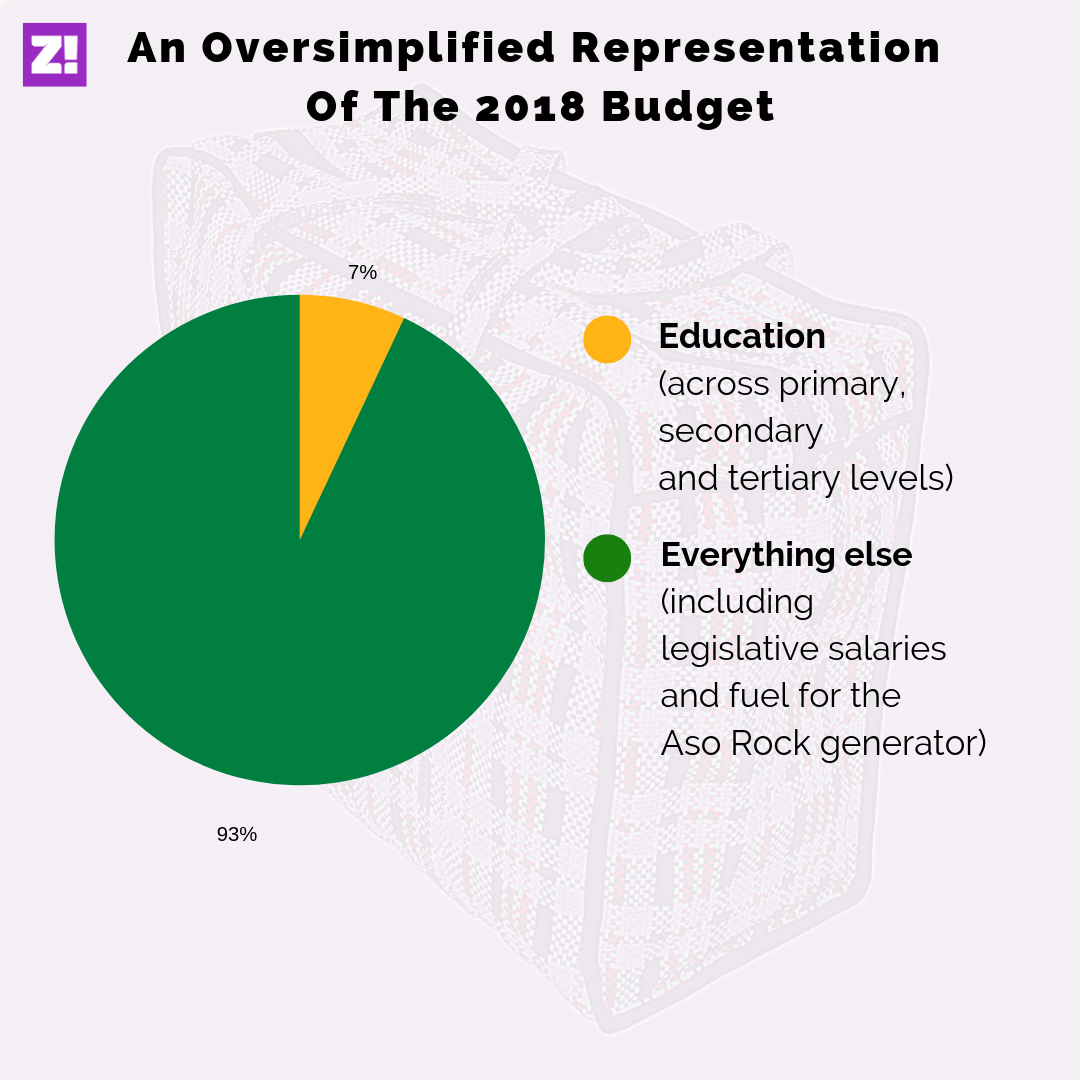
For years, ASUU has maintained education deserves a larger chunk of the budget than it gets. And they’re right.
Over 60% of Nigeria’s population is aged below 25 i.e people who should be getting an education.
Yet, only a measly 7% of the 2018 budget was allocated for education at all levels.
For context, the United Nations recommends that all countries allocate 26% of their national budgets to education.
But Naija no dey ever hear word.
Remember something about the ‘renegotiation of the 2009 agreements’?
Well, every time ASUU goes on strike, the FG pulls out its mediators, holds several meetings at midnight with the lecturers, agrees to a new set of terms.
The strike gets called off.
And everyone moves on.
Till they remember nothing has changed.
Rinse, Repeat.
It’s a vicious cycle. While the rest of the country resumes work or school today, undergraduates around the country will have their lives on hold for the 63rd day running.
Despite seven meetings, ASUU and the FG have failed to reach an agreement on a way forward.
After a meeting at the end of December 2018, ASUU’s Oga at the Top dropped the names of 11 universities where lecturers are underpaid’.
He also said “the government kept saying they were working on it. If they pay that money, we will have something to take back to our members.”
So, yes, money is the problem. But odds are if you asked the FG, you’d get one response…
It’s now two months and counting since students around the country were made to start their Christmas holidays early, or take quick vacations to bae’s house.
You’ve heard all the regular bits of advice by now; learn a trade, read some books, travel (if you have dollars), pick up a hobby, and put your time to good use.
Either way, negotiations are ongoing. ASUU and the FG have scheduled another meeting for Monday, January 7.
Let’s hope the money flows and the halls can be filled again.