Notice: Function _load_textdomain_just_in_time was called incorrectly. Translation loading for the wordpress-seo domain was triggered too early. This is usually an indicator for some code in the plugin or theme running too early. Translations should be loaded at the init action or later. Please see Debugging in WordPress for more information. (This message was added in version 6.7.0.) in /home/bcm/src/dev/www/wp-includes/functions.php on line 6121
sickness | Zikoko!
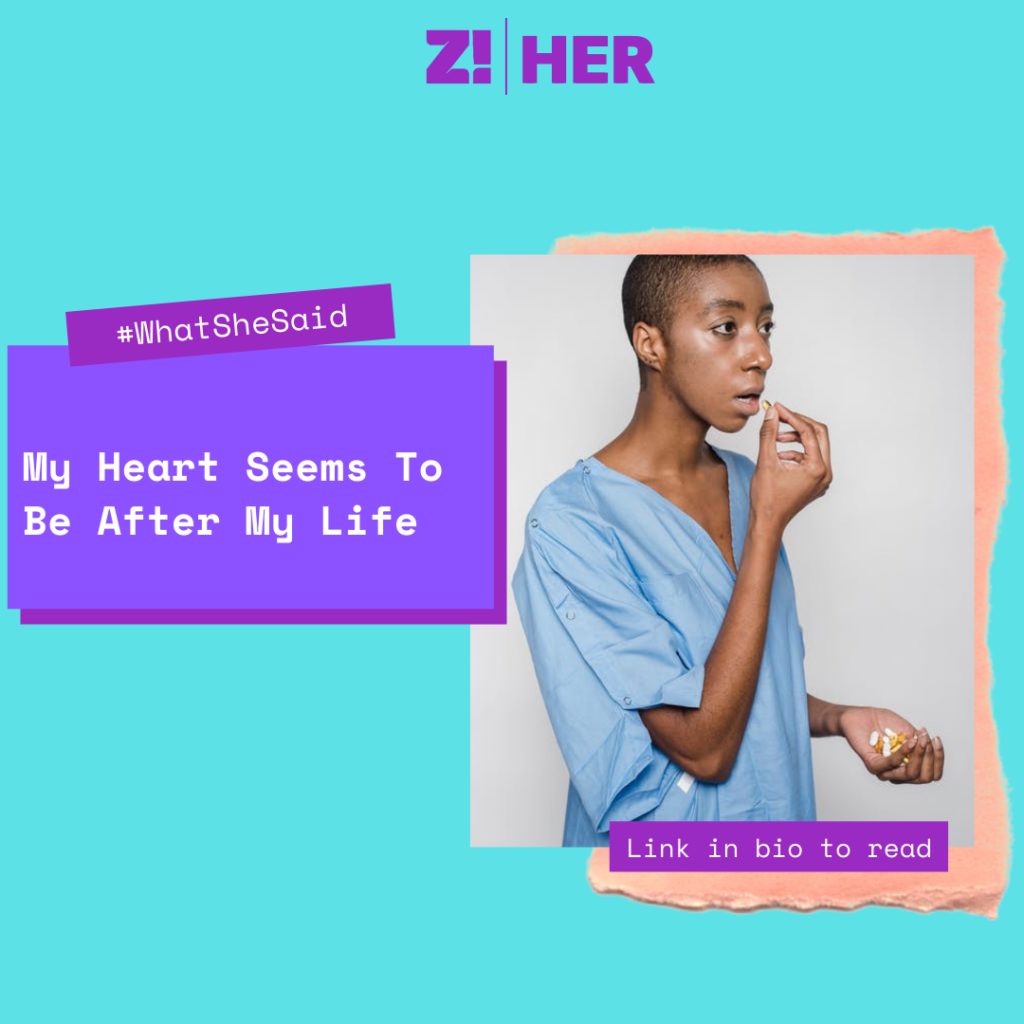
  • What She Said: My Heart Seems To Be After My Life

    The subject of today’s What She Said is a 23-year-old Nigerian woman who is no stranger to the hospital. She talks about having breast lumps, dealing with heart attacks and an enlarged heart at 23, and enjoyment being her driving force. 

    Tell me something interesting. 

    I have had five heart attacks between 2020 and 2021. 

    Wait, how old are you again?

    23. I’ll be 24 in December. 

    Let’s start from the beginning. Before the heart attacks. 

    Well, before the heart attacks was the inflamed appendix. When they found out, I was rushed into surgery. After the appendix was sorted, I was diagnosed with an ulcer three months later. I was 18 and in my second year of university. One thing I did notice was that after I graduated from university, the ulcer reduced to almost nothing. I guess stress had been a major factor. 

    That’s good, right?

    Yeah, it is. Then towards the end of 2019, I started feeling pain in my right breast. When I went for a scan, it turned out I had breast lumps. I freaked out a bit because my mum is a breast/cervical cancer specialist nurse. I had grown up knowing how dangerous lumps are. On the 5th December 2019, I got surgery to remove the lumps. 

    How was surgery like?

    The surgery went okay. It was done in the late morning and when I woke up by late evening, I was able to walk down the hospital stairs to my dad’s car. 

    The only abnormality was that during the scan they said I had two lumps, but during surgery, they removed four. 

    What was more stressful than the surgery, was post-surgery hospital visits. I spent most of my December going to the hospital to get my dressings cleaned. I even spent half of my birthday in the hospital. It was a very sobering day. 

    In between all of this, the lab results of the lumps came back and it turned out I had Benign Proliferative Breast Disease without Atypia. 

    What’s that?

    It means I have a disease that causes cells to grow excessively and abnormally. While it is not cancerous, it slightly increases my chances of having breast cancer. It also causes me pain from the cells that are lumped together. Currently, I have two lumps in my breasts. 

    Wait, you have to regularly remove the lumps?

    Well, yes, but I have decided not to. I just have regular breast exams now. If I keep removing the lumps, I may have no breasts left. I’ve gotten used to the lumps. Well, as used to it as the pain will allow. 

    Also, the last time I went to remove the lumps, the doctor narrowly missed slicing off of my nipple. I don’t even know how he did that, but I have blanked that part out of my mind. 

    Do you know I just clocked you haven’t even started talking about your heart attacks? 

    I have too many health issues, that’s why. With the ulcer and breast lumps, there’s still potential PCOS to deal with and ovarian cysts. 

    I am so sorry. That’s a lot

    Well, my main issue now is my heart. It seems to be after my life. I have had a total of five heart attacks between 2020 and 2021. Two major ones, and three minor ones. 

    The first major one happened in May 2020. Before that, I had been having severe chest pain since February 2020. I brushed it off as ulcer pains, stress, or my body healing from the surgery. This was because the pain was in the middle and right side of my chest. The chest pain kept increasing. It got to a point where I could barely exercise and was tired all the time.

    Then May 1st, 2020, I was cooking when my dad called me to his room. As I entered, I felt a pain radiating from my chest down my right arm. I fell, but luckily my dad caught me and started massaging my heart. I laid on my parents’ bed till the doctor came. 

    After that heart attack, I went to see a doctor. He gave me medication for the ulcer, and I really wanted to shout at him that what was wrong with me was more than an ulcer, but I didn’t. I faithfully took my medication. Then on the 28th of May, heart attack number two happened. 

    This one happened in my room and if not for my brother entering just as I fell on the floor, I may have been telling a different story now. After that, my mother carried my health on her head.

    Wait, why was that doctor treating you for just an ulcer?

    A lot of doctors kept saying I was too young to have any heart problems. Throughout all my hospital visits, I had to be asking questions and pushing them to do tests. The doctor just looked at my age and cancelled any thought of anything heart-related. Also, it’s probably because the pain is on my right side, rather than the left as it usually is. 

    When a doctor finally diagnosed me with ischemic heart disease, my first thought was “so no more alcohol for me again? I’m finished.” The doctor gave me three different drugs and sent me home. 

    Then I had to deal with comments from outsiders about my size. It took all my willpower to not punch people that asked stupid questions. My life was in the balance and people were asking me why I was so small. To top it off, I was put on a restrictive diet. 

    This sounds like so much, I am so sorry. How did you cope?

    I was barely coping. I threw myself into work (I’m a writer/editor), read, and my tribe of friends really helped to ground me but it was still hell. 

    I was in so much pain, and there was physical and mental exhaustion. I was managing well then on the 24th of June, heart attack number three happened. 

    This heart attack led to the diagnosis that truly tipped me over the edge. They told me that the right side of my heart is enlarged. The doctor tried to play it off as nothing too serious, but I knew it was bad. I was having shortness of breath, cold hands and feet and chest pain. 

    I got home after this diagnosis and cried. I was down for a whole week, and then I entered a self-destructive spiral. I was eating and drinking anyhow and was skipping my medication. 

    What grounds you now? 

    At first, nothing grounded me. From 2018 to the middle of 2020, I was just floating through life. It’s only from lockdown, I was forced to finally confront my mortality and my life and my baggage. I became more honest with myself and I realized I had to get back as much of my sanity as possible. I stopped self-destructing so much and started taking my medication again. I also found out I have an incredible tribe of friends. I started journaling and doing stretches. 

    I guess you can say I am currently grounded in the knowledge that everything is useless and when you break life down, the core of its meaning is nothing and that’s okay. I am here for a good time and not a long time. Just because my body seems to hate being alive, doesn’t mean I have to let it make me miserable all the time. I am seizing my joy by fire by force. Enjoyment is my driving force. 

    Overall best in enjoyment.

    That’s me. It’s just that it gets lonely being chronically ill. I can’t get into a serious relationship because I don’t want to bother anyone with my health issues. I also won’t have sex because I’m afraid I might pass out. It has been two years without sex now. Being chronically ill is a very lonely place to be, but I’m currently at the most emotionally healthiest I’ve been all my life.

    I’m lucky I have a supportive family. Both my parents have tried for me. My uncles and aunts too. Although they get on my nerves sometimes, like when they complain about what I eat when they see me snacking. I eat healthy 90% of the time. They should allow me to have my guilty pleasures. I have lost my mind too many times to be policed by people like this. 

    I know they mean well, but they should allow me. I am in pain every day of my life. The least I can do is enjoy what I can. 

    For more stories like this, check out our #WhatSheSaid and for more women like content, click here


    [donation]

  • I Paused My Life At 18 To Take Care Of My Terminally Ill Sister

    As told to Hassan.

    A couple of weeks ago, I overheard a doctor talking to an ex-patient. The tenderness in the doctor’s voice piqued my curiosity. During the course of the conversation, he sounded incredulous because someone had died. For someone so used to death and dying, the doctor was visibly shaken. A few prodding questions, a couple of phone calls and consent later, I had the story that led to this article. 


    My sister died at 11.47 p.m. on Friday. I’m not sure what her last words were, but she must have probably called out for me, saying, “Mummy, don’t leave me.” 

    Mummy? I can tell that you’re a little confused. To understand why she used to call me mummy, we need to go back to the beginning. 

    ***

    4 years ago:

    My sister was a vibrant, playful, four-year-old child. At least until the pain came. Young children in pain can’t fully express themselves with words because of their limited vocabulary. However, they show discomfort by either writhing in pain or becoming dull and withdrawn. In my sister’s case, it was the latter. She quickly became a shadow of herself; solemn and reclusive. Her withdrawal worsened so much that her dad, who’s actually my brother, had to beg me to take her to the hospital. 

    My first question was, “Where’s her mother?” to which he replied, “She abandoned me and ran off with another man.” — we’ll get to her uselessness later.

    So, thus began our journey of doctors, syringes and repeated rounds of diagnostic tests.

    ***

    Everyone who saw us at the hospital always asked: “Is she sick?” or “Is she visiting someone?” To which I smiled and responded, “She’s sick.” The next thing was for them to say: “How can a child this active and pain-free be sick. What’s wrong with her?” With a tight smile, I’d say: “Nephroblastoma“, pause, and add “a cancer of the kidneys.” The response would be a characteristic “Oh…”

    Another question I always got was “Who’s she to you?” To which I’d reply, “my sister.” Since we were related by blood [her dad, my brother], I preferred calling her sister rather than my niece.

    It took us six months before we got her diagnosis. In that period we had gone from one general hospital to another in Lagos before finally landing at the University of Ilorin Teaching Hospital. This change had required leaving my job in Lagos to take of her for six months in Ilorin. In that time frame, we experienced one major surgery, numerous rounds of chemotherapy, multiple blood transfusions, and various forms of brokeness. 

    Her dad would shuttle between Lagos and Ilorin and send money, grudgingly. 

    630 Nigerian Children Stock Photos, Pictures & Royalty-Free Images - iStock

    Her mother simply never showed up or called. The most effort she made was to send her sister to take a photo of the sick child. 

    My sister got tired of waiting for her mother to show up, and she started to say: “Iya Amirat [name of my sister’s immediate older sibling] didn’t come to see me, so she’s not my mummy. You’re my own mummy.”

    This newfound bond made things tricky for me because she was always scared that I’d leave. She never let me out of her sight. She’d follow me if I had to go buy medicines, or even if I was going to the toilet. One time, she yanked off her drip because I was going to get medicine outside the hospital compound. She was definitely not letting her new mummy go so easily. 

    One thing that struck me about that period was that all the kids in the ward who had similar symptoms as my sister died. Some died while on admission, others, like my sister, died after a brief period of recovery. The doctors kept asking if we lived near a refuse or telecommunication mast or anything that might have predisposed her to the illness. To which I always answered, “No”. Then they’d scratch their head trying to figure out how best to help her. 

    The solution always came back to chemotherapy.

    One round of treatment cost us ₦15,000. And she had to undergo treatment three times a week. This was minus treatment for some of the side effects of chemo, and minus the tests she had to take before starting chemo. Every treatment cycle involved her hair falling out, a bout of malaria, a lot of blood samples, and her dad complaining that he didn’t have money. 

    When her dad asked us to return to Lagos, I didn’t put up a fight. At that point, I was tired of his complaints and I was also tired from uprooting my life. That’s how we abandoned the treatment halfway to restart our lives in Lagos. 

    Things were going well until one year later when the illness returned. Before then, she had returned to her playful self. I had also been saving from my salary to finally attend University. Our fairy tale was shattered because the sickness came back with twice as much force. Her breathing was the first to struggle, then the pain came along.

    Once again, we found ourselves back at the hospital from which we had run.

    ***

    We had barely spent a week in the hospital when my sister gave up. I’ll never forget the time because at 11:30 p.m. on that day, I had rushed to the pharmacy to get some drugs for her. At that point, she was already gasping for air. The doctor met me on my way back from the pharmacy and pulled me aside. She told me, “Your sister has given up.” I replied, “Is she sleeping?” Then the doctor said, “She’s dead.” To which I replied, “Dead bawo?”

    At that moment, I wanted to give up. I felt betrayed. After all we had gone through, she abandoned me. How could she be gone like that? I had just asked her a few minutes ago what she wanted to eat, and she had responded. What happened to our promise of beating this illness together? Did those words hold no meaning to her? 

    Looking back, the signs were there that it was her last week. She had to bend to breathe, she was always in pain, and had to lie in the foetal position to be comfortable. But we had passed through worse, so I thought this too would pass. 

    I take consolation in the fact that God knows best.

    ***

    Pain ages people. It turns adults into wizened old people, and it makes adults out of children. Part of the reason I miss my sister a lot is that we related like age mates. Even though I was eighteen at the time and she was barely five, we found a lot of common ground in conversation. I found that I could talk to her about my struggles and she could also confide in me. 

    In addition to her precociousness, she was also smart. My sister knew the name of her favourite doctors, the name of tests like Full Blood Count, or medical jargon like PCV. She also quickly learned to associate hospital gates with a lot of pain. 

    There were also extreme mood swings where things got thrown at you. Or she could become so lively and animated that you had no choice but to participate in her joy. 

    I sometimes feel guilty that her father didn’t have enough money for us to stay back and finish the treatment. Then I also get angry that her mother never showed up. In her short life, my sister learned that pain could be both physical and emotional. For that reason alone, I can’t ever forgive her mother. There’s a part of me that still believes that if her mother was present she might have held on for longer.

    I’m grateful for the experience. I’ve come to understand how precious the gift of life is. I’m grateful for the time I got to spend with my sister, however short. Most of all, I’m grateful for the privilege to be the mother she never had.


    Editor’s Note: 

    Balikis, the subject of the story shared her story to spread awareness of Nephroblastoma and to also seek ways the Nigerian government can help in the early detection of the illness. 

    [donation]

  • “We’re All One Sickness Away From Poverty” — A Week In The Life Of A Caregiver

    “A Week In The Life” is a weekly Zikoko series that explores the working-class struggles of Nigerians. It captures the very spirit of what it means to hustle in Nigeria and puts you in the shoes of the subject for a week.


    The subject of today’s “A Week In The Life” is a medical practitioner who has been taking care of a sick parent since last year August. He tells us about the frustrations of the healthcare system, the mind-blowing financial costs and the emotional tolls an illness exerts on a person.

    MONDAY:

    My days are so similar that they’ve become a blur — it starts at 6 a.m. and ends at 9 p.m. From the minute I wake up and take my bath, I’m running errands: get X tests done here, buy Y drugs at another place, run to Z place to get blood. I’m always on the move because there’s usually a lot happening with a sick person. My first errand today is buying antibiotics outside the hospital for my dad. I start my waka by making a few calls to pharmacies to compare the prices of the medicine. After securing a decent price, I make arrangements for pickup and delivery.

    It’s 4 p.m the next time I look at a clock. Between running around to pick up medicines and calling my mum for updates about my dad, I wonder where my day went. I also don’t remember if I’ve eaten today. But I don’t have time to ponder over this because I have to take over from my mum in the ward — we alternate the cleaning and feeding of my dad — while she goes home. Depending on my dad’s mood when I’m done feeding him, we either have a conversation or he asks to sleep. He’s in the mood for a conversation today, so I pass time with him while waiting for the doctors to start their evening rounds. I can’t wait to leave the ward, get food and sleep because the cycle begins again tomorrow.

    TUESDAY:

    When the doctor told me that my dad’s condition was multiple myeloma, I cried because I had no one to vent to. Multiple Myeloma is a cancer of plasma cells, and one of the symptoms is brittle bones. The damage to my dad was so bad that his hip removed from its joint. I’ll never forget the days leading up to his admission at the hospital. We were always home alone [Mumsi had to go to work]. One morning, I broke his hand while trying to move him from the bed to a chair. One minute I was trying to move him and the next, I heard a loud kpa sound. I was so scared because I had never seen so much shock and pain on my dad’s face before. For his sake, I had to compose myself and reassure him that it’d be okay.  I called his physiotherapist immediately I left his room, shouting, “My daddy’s hand has broken. It has broken.” Even though the physiotherapist gave me first aid tips, my mind was still not at rest. I experienced flashbacks where I’d relive the memory of the bone breaking throughout that week. In the middle of a task, I’d hear the kpa breaking sound and become sad all over again. This memory is why I can’t complain about the hospital stress because I know whatever pain I’m going through, my dad is going through times ten of it.

    It’s sad to say this but I’d been shielded from reality as a medical practitioner before this. Being on the other side has shown me what patients and their relatives pass through. My mum and I had to rent a hotel outside the hospital because the “living area” allocated for patients’ relatives is jam-packed because we’re in the middle of a pandemic, and the general building design is not old people friendly. 

    One time my dad needed blood and I kept following up with the blood bank for three days without show. It wasn’t until the fourth day when I went to the blood bank with a friend, who was a medical practitioner in the hospital, that they finally attended to my dad’s case. I was livid and people had to hold me from losing my shit. It’s crazy that I had to know someone to get blood. Since that day, I started wearing my scrubs to the blood bank and the ward since we’re all mad. 

    WEDNESDAY:

    My dad got admitted at the hospital on a Thursday, and I remember thinking to myself: “The health care system is fucked.” My first introduction to the anyhowness of the system was when I had to carry my dad on a wheelchair to the last floor twice. Apparently, there was light but the elevator wasn’t working. I know I paid at least nine people ₦500 here and there to either help me lift my dad or fast track his settling in. That first week was also difficult because we didn’t have access to my dad except during visiting hours, and he required constant attention. In retrospect that first week wasn’t bad. At least compared to the weeks that followed. We still had peace, and he was still responding to chemotherapy. If only we had known that the coming weeks would show us pepper. 

    THURSDAY:

    You’re one illness away from poverty doesn’t hit home until it happens to you. It can only be experienced, not explained. When my dad got admitted, I thought we’d just do chemotherapy then surgery and we’d be done in a month. LMAO. 

    After the surgery, it has been one complication after another — respiratory distress, swelling of the body, low PCV. And we’ve had to run tests to locate the problem. At one point, I was averaging about ₦60,000 per day on tests and drugs. Then we had to switch him to a class of antibiotics because of postoperative complications, which cost ₦10,000 for one. I died when the doctor said he was going to need 15 vials. This is minus surgical implants, diapers, money for surgery, dressing gauze, irrigation solution for wound dressing. It was that day that it clicked in my head why my customer told me I had spent over a million naira on drugs alone. Illnesses are not only financially draining, they also drain you emotionally. I’m constantly having to reassure my mum things will turn out fine. Today, one of my uncles was crying over the phone because he couldn’t send money to help us, and I also had to reassure him that it’d be fine. The curse of being an only child is having to be strong for everyone even when you’re clueless about how to get money for drugs. 

    Same today the nurse came to tell me that my dad exhausted his Clexane [a drug to prevent bedridden patients from developing a clot] and I couldn’t say anything because it’s a non-negotiable daily drug. At ₦2700 per vial, we’ve been buying the drug for him every day for almost seven weeks. I’m at my wit’s end, and I’m tired of this place. Even though it’s less than two months, it feels like I’ve been here for six months.

    FRIDAY:

    My mum is a superwoman abeg. Has she been scared? Yes. Has she been composed? Yes. Has she shown up? Double Yes. Her presence has made this ordeal a bit bearable.  I don’t feel completely alone anytime I see her. It helps that she’s a positive soul with so much good vibes. Sometimes she’ll call me to say “Daddy finished eating his food, and he ate it all by himself.” Other times I’ll see her petting my dad to eat and my dad pretending not to like the attention and fuss — he knows he can’t try serenre with me because I don’t have time. 

    Yesterday my mum was looking stressed, so I told her to go home early to rest. Today, she came back looking refreshed. I feel bad anytime I remember how this whole ordeal made me selfish to her. As a result of the emotional stress from running around, I didn’t realise I was transferring aggression to my mum. It wasn’t until a friend pointed out my aggression to me that I saw I had been too caught up in how I was feeling to remember that my mum was feeling the same way too. I apologised to her, and I’ve become less selfish. I like how refreshed she looks so I’m going to tell her to take a few more days off. I really can’t afford for both my parents to break down at the same time. I can’t afford it.

    God, I know I’ve questioned you during this period, but I pray my dad’s quality of life goes up and he gets better. We deserve this rest. I haven’t gone home in seven weeks, and I’m looking forward to sleeping on my bed. I miss my friends. I miss my old life. I just want things to go back to normal. 


    Check back every Tuesday by 9 am for more “A Week In The Life ” goodness, and if you would like to be featured or you know anyone who fits the profile, fill this form.

  • The #NairaLife Of A Draining Sickness

    Every week, Zikoko seeks to understand how people move the Naira in and out of their lives. Some stories will be struggle-ish, others will be bougie. All the time, it’ll be revealing.

    Tell me about the day you knew something wasn’t right. 

    I woke up in the middle of the night feeling funny. I’d slept like two hours earlier, but something woke me up. I decided to check my blood pressure  – I’m hypertensive. 

    Wait, how old are you? 

    27 soon. Anyway, I checked my BP, and it was high. I tried to relax for a bit, then I checked again. 

    What happened? 

    It just went higher and I started hallucinating and seeing numbers I wasn’t supposed to be seeing. I think it got to the 170 – 91 mm Hg range. 

    Woah.

    So, I went to the hospital. My heart was racing, but I think that’s because I was panicking – I’m a generally anxious person. At the hospital, it lowered to 160-89 mm Hg. But they admitted me for two days. In that time, I did blood tests and all, turned out I had malaria. 

    Malaria spiked your BP? 

    Yep. Based on my past with malaria and BP, I believe it was also the cause of the spike. I also had to do an ECG to check my heart. 

    The ECG seemed okay, although it showed I’d been hypertensive for a while. I ran other tests, collected three injections. 

    I can’t get past the part where you’re 27 and already worrying about your BP. 

    I’ve been actively treating it for two years – it’s also hereditary. Anyway, I got discharged and went back home. 

    I don’t imagine this was free, eh? 

    My health insurance covered it, so you could say it was free. I’m sure it would have been costly if I paid myself. The first time I did ECG without an HMO, it cost me ₦25k. Also, the admission, since it was a private hospital, couldn’t have been less than ₦150k. 

    Okay, what happened next? 

    I went back home though I still had one more injection to take. My energy levels were down, but I assumed it was the drugs. I was just going about my day, trying to relax. I collected my last injection one day after I was discharged, but around 11 p.m. that day, it started. 

    Tell me. 

    I started feeling feverish, and I tried to brush it off. The fever kept getting worse. I was freezing with locked windows and no AC.

    So, you had to go back to the hospital? 

    Well, not immediately. I didn’t want to go back, abeg. I just wanted to sleep through it. It felt like my veins were frozen, but they were also hurting. The way your body hurts from cold. 

    So, I called my babe, and we prayed together. She couldn’t come. 

    Lockdown, eh?

    Yes. She stayed on the phone with me all night as I drifted in and out of sleep. By morning, I couldn’t take it anymore. I went to wake up my housemates. I suspected it was COVID. I’d read that people have COVID and think it’s malaria. I wondered where I got it from because I’d been very careful and mostly stayed indoors. 

    Underlying conditions? 

    Yep. People with underlying conditions are more susceptible to COVID. Anyway, my flatmates took me to the hospital. I had to see the doctor again, and they were confused. They ran more tests and found nothing, not even the malaria I had three days prior. But my blood work showed my white blood cells had spiked. 

    Your body was fighting an infection. 

    Yep. Also, HMO covered these tests. 

    Nice. 

    By the way, I’d messaged my family to tell them I might have been exposed, and I just wanted to get tested. You don’t want to unknowingly infect other people. 

    They prescribed antibiotics. 

    How did that go? 

    I didn’t use it. 

    Why?

    I had zero faith in the doctor I met on that shift. He didn’t inspire any confidence. That same day,  on the recommendation of another doctor, an in-law, I went to get tested for COVID at Yaba. Then I went back home to wait. 

    How long did you have to wait? 

    A while. I came back and went into isolation, because I have flatmates. I was in complete isolation for a week, and after the first week of just waiting, my flatmates were like, abeg abeg. And everyone barged into my room at once. 

    “Alaye, if it’s COVID, we all already have this shit.”

    Rascals. 

    Hahaha. My babe too was like, “There’s no way I can stay in my house, knowing you’re going through this.” But I stayed sceptical. One of my friends actually had COVID and was self-isolating. He could relate to all the things I was feeling. And he was like, “We need to plan for the worst-case scenario.” 

    What did that mean? 

    We set up a telemedicine COVID plan. Basically, you can always speak to a doctor, and in cases where you need medical support, a doctor can attend to you at home. They were also going to provide meds, but on the condition that the results came back as positive. 

    Did you pay for that?

    Yeah. This wasn’t covered by my HMO. It cost ₦160k. So, all I was doing was calling, relaying symptoms, while we waited for results. By the end of the first week when all of this began, the fever was gone, but I was extremely weak. 

    I also couldn’t eat, because of acid reflux. I had to switch up my diet to oats and fruits; those were the only things I could eat that didn’t cause immense pain. One week’s stash cost me ₦54k. 

    What? 

    Hahaha. Yes. While I was speaking to people about what I was feeling, someone recommended celery. A bunch costs ₦3k, and when you blend them, it only fits into a cup. I was doing a bunch a day. Plus strawberries and the grapes. Immediately I started this though, my acid reflux reduced. In three to four days, I could eat normal food with little pain. 

    By the second week, there was no pain, but some bloating remained. I was mostly on oatmeals, pancakes, egg whites, chicken, and fruits – apples, grapes, watermelons, bananas – oh my Jesus, I ate bananas.

    Did you yo though? 

    Hahaha. I didn’t yo. 

    What happened next? 

    Three weeks later, there was no result. But my strength was coming back. At this point, I was consciously pushing myself, keeping a positive mindset. But the whole thing messed up my head. 

    How bad? 

    I felt like I was going to die. Since I didn’t get any response, I was paranoid. I had to get another test done. I went through someone to get it done immediately at a private testing lab. Everything cost me ₦70k. 

    What did the results say? 

    Negative! It felt good. Funny thing is, the day after I did this second test was the day I got my COVID result from Yaba. Negative too. That’s when it got more interesting: if I didn’t have COVID, then what was wrong with me? 

    Exactly. 

    At this point, my symptoms were gone, except the body pain and fatigue. Anything remotely strenuous was difficult. 

    Then my blood pressure started spiking again. They did tests to make sure I didn’t have any issues with my heart or minor strokes. I had to fund all of this myself. 

    Omo. Why didn’t you use HMO again?

    I wasn’t going through the hospital – I got frustrated because they weren’t saying anything useful.

    Some weird rash showed up on my body, so I had to do a blood culture test. They found nothing. The theory, especially with the rash, was that maybe my body was fighting itself – maybe an autoimmune disease. So, we tested for that.  I did an ESR test for inflammation in two different places. One said my result was normal, the other said something was extremely wrong. 

    I did anti-ANA, anti-SNA, all negative. Turns out there’s nowhere to do the test in Nigeria, so the lab had to send my blood outside the country. 

    Where?

    Turkey. 

    Have you been to Turkey though? 

    Hahaha. My blood has been. During this period I was waiting for my blood to come back, something new started: headaches. I went to see a neurologist, and he said it was tension headaches. They sent me a prescription; antidepressants, stress relievers. 

    At this point, I was really tired, so I didn’t buy any of them. 

    Sigh. 

    And then the neurologist asked, have you tested for typhoid? Then just to be sure, I tested for typhoid, CT Scan and – I can’t even remember the last one. The CT scan alone was like ₦40k. The typhoid tests came as negative, so did the CT scan. Somewhere in the mix, I did an X-Ray. 

    And again, I was back to that question —

    “What the hell is happening to me?”

    Yes. At this point, I was physically, mentally and financially exhausted. I lost 10 kg in two and a half months. By the end of July, I was like, I no do again, and stopped talking to all the doctors or going to the hospital. A doctor even started suspecting that we should run tests for connective tissue disorder. My anxiety peaked.

    It was like, I dunno what the hell is happening, but it feels like my body is shutting down. 

    Sigh. 

    I only kept eating healthy. My father even sent agbo – that helped. I just went about my life, but it created some mental health struggles for me, which is not good for my BP. Someone, another doctor friend, said I should test for typhoid. 

    Again? 

    Again. But this time, instead of just testing in my stool, I tested in my blood too. When the results came out, there was no typhoid in my stool, but there it was in my blood. Paratyphoid. 

    Para what? 

    Paratyphoid. I even did an HIV test for the fun of it. Negative. I began typhoid treatment, but my body wasn’t going well with the drug. The day after I started using it, I vomited. It shook me. 

    In the end, though, the malaise stopped. 

    The anxiety?

    It multiplied. My fear of death has now spiked. I understand that at some point in time, we’ll all die, but the fear of death has now become so high that it has now hindered me from doing anything that poses any risk. My body is currently in a constant state of fight or flight. Some days, I have two panic attacks. The occasional chest pains come at night. 

    Dude, when does it get better?

    I dunno, to be honest, because I’m still living in it right now. I’m just trying to stay positive, even though it’s very very difficult. 

    In all of this, where was work? 

    Hahaha. Let’s just say I’m in a place of leadership at work, such that my whole unit can run without me being involved on a daily basis. My team mostly covered for me, doing the heavy lifting. The first month, I called in sick. In all of it, I didn’t work for only a month and a half. 

    How were you funding all of this? 

    My savings. I had about ₦2 million in savings in April 2020. By August, I had ₦800k in savings – basically my house rent. 

    So, you spent ₦1.2 million? 

    I spent over ₦815k on meds and tests. I can’t even remember the random ₦50ks and – wait, did I tell you about that time I went to have my eyes and ears checked because I thought that was the cause of my headache? Oho.

    The remnants of my savings went into fix my car.

    Your car was sick too? Damn. 

    I planned to travel to be with family outside Lagos, and that meant I had to fix the backlog of things to get my car in a full roadworthy condition. 

    What did this drain do to your perspective? 

    We’re all a sickness away from bankruptcy. That money wasn’t supposed to go to what it went for, but I was also grateful I had that type of money in savings. 

    Imagine if I had depended 100% on my HMO.

    On a scale of 1-10, where are you now? 

    I’m at a 4 or 5. As much as I’m smiling right now, I still have the mental wars I’m dealing with daily. Last night, I had a panic attack in my sleep. Can you imagine? My anxiety leaves my body stressed, which affects my BP, which feeds my panic.

    A vicious cycle.  

    What measures are you taking to make sure that you’re financially prepared when the next one comes?

    First of all, if I wasn’t in the high-income bracket, over ₦800,000, I won’t have been able to ditch my HMO and look for better solutions. Secondly, I’m upgrading my HMO plan to be able to go into any hospital to get care.

    Most importantly, I need to move to a country where healthcare is more dependable and affordable or free.


    Click this photo to get started!
  • 1. When he is frowning up and down the house and you ignore him, he’s like:

    “Can’t you see I’m not okay?”

    2. When you finally ask him what’s wrong, he’s like:

    “You don’t even have compassion.”

    3. When he has a small headache, he’s like:

    “Somebody help me oh!”

    4. When men have to go to the hospital for treatment, they’re like.

    “This is how people die oh!”

    5. When you try to do anything that doesn’t involve waiting on them hand and foot, they’re like:

    “You don’t care about me!”

    6. When he has to take his medicine, he’s like:

    Medicine? Again?

    7. So what if he had to go through period cramps?

    Ehn Mr man?

    8. Or go through hours and hours of labour multiple times?

    Obviously nobody would hear word.

    9. And they say women are the weaker sex!

    Imagine!