Notice: Function _load_textdomain_just_in_time was called incorrectly. Translation loading for the wordpress-seo domain was triggered too early. This is usually an indicator for some code in the plugin or theme running too early. Translations should be loaded at the init action or later. Please see Debugging in WordPress for more information. (This message was added in version 6.7.0.) in /home/bcm/src/dev/www/wp-includes/functions.php on line 6121
Project Management | Zikoko!
  • The #Nairalife of the Project Manager Confident About His Safety Nets

    Every week, Zikoko seeks to understand how people move the Naira in and out of their lives. Some stories will be struggle-ish, others will be bougie. All the time, it’ll be revealing.


    The recurring theme in this #Nairalife is safety nets. The 32-year-old project manager in the story saved up ~₦21m in about five years. Now he lives in a country with free healthcare and earns $90k/year. He may have 101 problems right now, but being broke isn’t one.

    Here’s how he got there.

    What’s your oldest memory of money?

     When I was six or seven, my allowance was ₦20. Every morning, I found the money on the table without fail. One day, I found two ₦20 notes and took both to school without thinking much about where the second note came from.  

    When I got home, my mum asked me why I took more than I usually did, and I had no good answer. It was at that moment I realised that I didn’t confirm if the extra money was meant for me. I’ll never forget the punishment I served. But it was a lesson in contentment and accountability. This event taught me not to touch any money that doesn’t belong to me. 

    What was it like growing up?

    My dad was an insurance executive and my mum was a nurse. Both of them had thriving careers, so we were very comfortable. We were the typical working-class, upwardly mobile Nigerian family of the late-90s and early 2000s. My dad changed cars every three years because of where he worked. We had two drivers, and I was dropped off and picked up from school every day. I was pretty much a “get-inside” kid. 

    So when did you actively start thinking about money?

    When I was 15 or 16. I’m the last of my parent’s four kids, and there’s a 12-year age gap between me and my eldest brother. Somehow, my brother convinced my parents to pay me for house chores and I was getting ₦500 – ₦1000 for this. However, it wasn’t set in stone. This was the first time I earned money. 

    Things changed at home around the same time. 

    What do you mean?

    In 2007, my dad decided to run for political office. The people around him made him feel like he stood a chance, so he sunk his savings into his campaign. 

    He lost the election, and there was nothing to return to post-election. He’d resign from his job to focus on his campaign, even though his company’s board advised him not to. 

    Omo.

    My mum retired from work in 2003, so she didn’t have a regular stream of income either. Things became a little shaky. The drivers were the first to go, followed by small adjustments.

    What sort of adjustments?

    The plan was for me to go to university in the UK. But when this happened, the plan changed to a private university in Nigeria.

    In hindsight, things weren’t entirely rough – my parents had some financial structure we fell back on. We had houses, so we didn’t have to worry about rent. My parents also had some investments in stocks, which gave us some financial cushion. It was the first time I saw how safety nets worked. That event spurred my interest in keeping resources aside for rainy days.

    How did that manifest?

    When I got into university in 2007, my allowance was ₦15k. By the time I left in 2011, it’d increased to ₦20k. During my time in school, I made sure to save every month – ₦2k here, ₦3k there. It helped me build my savings muscle. 

    What happened after uni?

    NYSC. I served in the south-south and worked at an architecture firm as a site supervisor. The pay was ₦10k/month and the federal government also paid ₦19800, which brought my monthly total to ₦29,800. My boss also tipped me between ₦1k and ₦2k every weekend. 

    The cost of living in the state was low and I could live comfortably on ₦500 per day. There were barely any additional expenses. I lived on my salary at the firm and saved most of my government allowance for the whole year. At the end of my service year, I had about ₦180k in savings. 

    Sweet.

    I returned home, moved in with one of my siblings and started job hunting. Three months later, I got a job in a telecom serving firm. My salary was ₦60k. 

    However, the people that ran the place were unserious. Three months into the job, I hadn’t received an offer letter, which was a red flag for me. Fortunately, I found another job at a furniture company.

    How much did they offer you?

    ₦60k. When I told the people at the telecoms servicing firm I was leaving, they finally sent me a proper offer letter, bumping my salary to ₦130k. But my heart wasn’t in the job anymore, so I did the next best thing.

    You used their offer letter as leverage, didn’t you?

    I did and renegotiated my salary with the furniture company. We settled for ₦90k, and I resumed work in July 2013. The most interesting thing about the job was the high-network individuals I met. It was eye-opening. 

    Tell me more. 

    The furniture company helped HNIs set up their homes. I could be called into a meeting to give a presentation and the client would be this wealthy person I’d seen on TV. It was a thrill watching them listen carefully to what I had to say about our plans for their spaces. Like, they were genuinely interested and asked questions. For a 22-year-old, this was a massive confidence booster. 

    I guess I also started thinking of how to unlock an extra means of income. A few months into the job, I found it. 

    What did you find?

    I always cleaned up nicely and looked good. I usually wore trad outfits to work on Fridays, and people always asked me who made the outfits for me. Although I didn’t know how to sew clothes, I had relationships with the guys who did. 

    So, I started telling people that I could make attires for them if they wanted. Like that, I was in business. I’d take their measurements, and give them fabric samples to select from and a three-week timeline to deliver the clothes. 

    My 9-5 definitely helped pick things up. I was close to how the business ran, so I knew how sales were closed, and how to interact and manage people’s expectations. I took these lessons, scaled them down, and applied them to this fashion business I started. 

    What were the margins like?

    They were pretty good. A yard of fabric was about ₦500, and I needed between three and four yards for each order. That was ₦2k. Then I paid the tailors between ₦2k and ₦2500. 

    When it was ready, I sold the trad for ₦12k to ₦13k. Sometimes, as high as ₦15k. 

    Man. You were making at least ₦8k in profit from each order 

    Yes. On average, my profit ran into ₦40l – ₦60k every month. By this time, my salary had also increased to ₦100k. That was pretty good money for me.

    How good?

    I didn’t need to spend what I earned from my 9-5. I saved my salary for the next three years without touching it and ran my life with whatever I made from my business. 

    Fascinating

    In 2015, I was just turning 25 and was thinking about what to do next. My boss’s wife kind of gave me the clarity I needed. 

    She’d joined the business and was firing and hiring people at will. Then at one point, she queried me for taking two days off work. She claimed it wasn’t approved even though we had a conversation about it. The penalty was a salary deduction for that month.

    I wasn’t even bothered.

    Why not?

    While I was away from work, I got an order and made about ₦200k in profit. I made 2x my salary in one day. It was enlightening, and I realised that the 9-5 might be taking too much of my time.

    Ah. That point of no return. 

    I started looking for an exit, which came when I found another means of income — interior design. A friend referred me for my first job because of my experience at the furniture company. I made about ₦600k on that job alone. The following month, I got another project. Then the third one came. In a few months, I made about ₦1.3m doing what I did at my 9-5 for ₦100k. 

    I was like, mad o. 

    LMAO.

    By the end of 2016, I quit my job. But I didn’t go straight into starting a business. I needed a break to map out my next steps. So I returned to school for my Masters. I spent the next two years there. 

    Did you do anything for money during this time?

    Nah. I focused on school. It helped that I didn’t have to. My parents chipped in for my school fees, but I was in charge of my upkeep and accommodation. I had ₦3.5m in core savings and about ₦1m from my recent side gigs. I lived on this throughout my time in school.

    Safety nets, eh?

    Absolutely. I graduated in August 2018. A few days after my convocation, I got a call from someone I’d been referred to. They had a ₦375k project for me, and I got right to work. However, I didn’t use my usual guys for some reason. I went for cheaper labour, and it cost me. The guys messed up the job. Naturally, I wasn’t paid my ₦175k balance. 

    That wasn’t even the most painful part. 

    It wasn’t?

    A few months later, I found out the guy I did the job for was a nephew of the state governor. I couldn’t help but think that I lost a plug there. 

    I took the lessons and moved on.

    Sorry, man. But how easy was it to get jobs when you got out of school?

    My referral network made sure I had projects to do — ₦80k here, ₦100k there. Then a big one came in November 2018. The first person I designed for in 2015 was expanding their space and commissioned me for the interior design. Because of my background in architecture, they also made me a project manager. The scope of the project ran into ₦6m. I executed the project and got paid. 

    Baller. 

    My payments were spread over a few months, which worked because I wasn’t sure when the next job would come. That said, I was now certain that I could make the business work.

    What happened next?

    Growth. In 2019, I was busy from one project to another. I did some work for some good brands that paid well. I moved into a mini-flat in March and the rent was ₦500k. I bought a Nigerian-used car in April for ₦750k and spent ₦400k on early mechanic work. By the end of the year, I had saved about ₦6m. It was a good year. 

    Also, I got into a new talking stage with an ex-girlfriend in the same year. She lived in Canada and we hung out when she came home for Detty December in 2018. That kicked things off again and we wanted to give the relationship another shot. However, she didn’t want to do long distance. This put japa on the table for me. In December 2019, I wrote IELTS and officially began plans to join her in Canada.

    What did this mean for your business?

    On some level, I stopped consciously trying to grow it. I thought it’d be selfish to grow the brand, hire people and let them go in the end. I just kept to the level I was.

    Fair. What was your planned relocation route to Canada?

    It was originally going to be via Express Entry. But Covid happened, and they stopped the draw. My girlfriend and I decided that I’d come in on a visitor’s visa and apply for permanent residency when we got married. I was set to leave in December 2021, but a new wave of Covid hit. As a result, flights were grounded and borders were closed. I didn’t leave until May 2022. 

    The months must have dragged slowly

    Not really. In August 2021, I got a huge project and the cost came to about ₦53m. Since I’d planned to leave at the end of the year, I brought someone on board and agreed to a 60/40 split. My profit from the job was going to be ₦8m. 

    When I couldn’t leave in December, I focused on the job. However, the guys I was working for didn’t stick to their timelines. We were supposed to complete the project in January 2022, but it went on and on because they wouldn’t tidy up things on their end. Gradually, the relationship turned sour and they terminated the contract right after I left in May 2022. My business partner and I cut our losses and moved on. In the end, I made ₦6m from the project. 

    I’d started a new life in Canada anyway.

    True. How’s it been going?

    Pretty good. I got married in mid-2022, and my wife and I filed for Permanent Residency afterwards. 

    I became a permanent resident in January 2023. 

    Congratulations. What were the first few months in Canada like, financially?

    I came to Canada with about ₦21m saved up from my efforts in the past few years. This was about C$40K, and it helped me settle in. My wife took care of the rent and I picked up groceries and other miscellaneous. My average spend was C$1200 – C$1300/month. 

    Also, I still got some jobs in Nigeria. But since I wasn’t on the ground, I found someone to execute and I supervised them from here. At the end of each project, we split the profits. This brought in a few million naira.

    Once my permanent residency was approved in January 2023, it was time to transition back into construction and project management. I’d taken a course on project management the previous year. So I started job hunting. 

    How did that go?

    A few rejections here and there, but I got a job in February. 

    In construction?

    Yes. I’m not a project manager at a construction company. The pay is C$90k per annum. That’s C$7500/month.

    This is my first salary job since 2016. Mostly, it’s to provide some financial security while I settle in here. In a few years, I’m hoping to start up my own thing. Fingers crossed.

    Fingers crossed. What’s your current mindset about money?

    Since 2018, I’ve been saving at least 70% of my income because I felt Nigeria could happen anytime. Now I feel like I’ve saved fairly enough, and I’m confident about my safety nets. Also, the possibility of things going awfully wrong is low because of where I now live. The government of Canada has our back. In addition, there is my pay, which is a miracle considering I don’t have any Canadian work experience. 

    The bottom line is that I’m in a safe space and can afford to take a foot off the pedal. Money is for spending right now. At least until I start thinking about starting my own business here. It’s why I’m excited about our wedding ceremony in Nigeria later this year. 

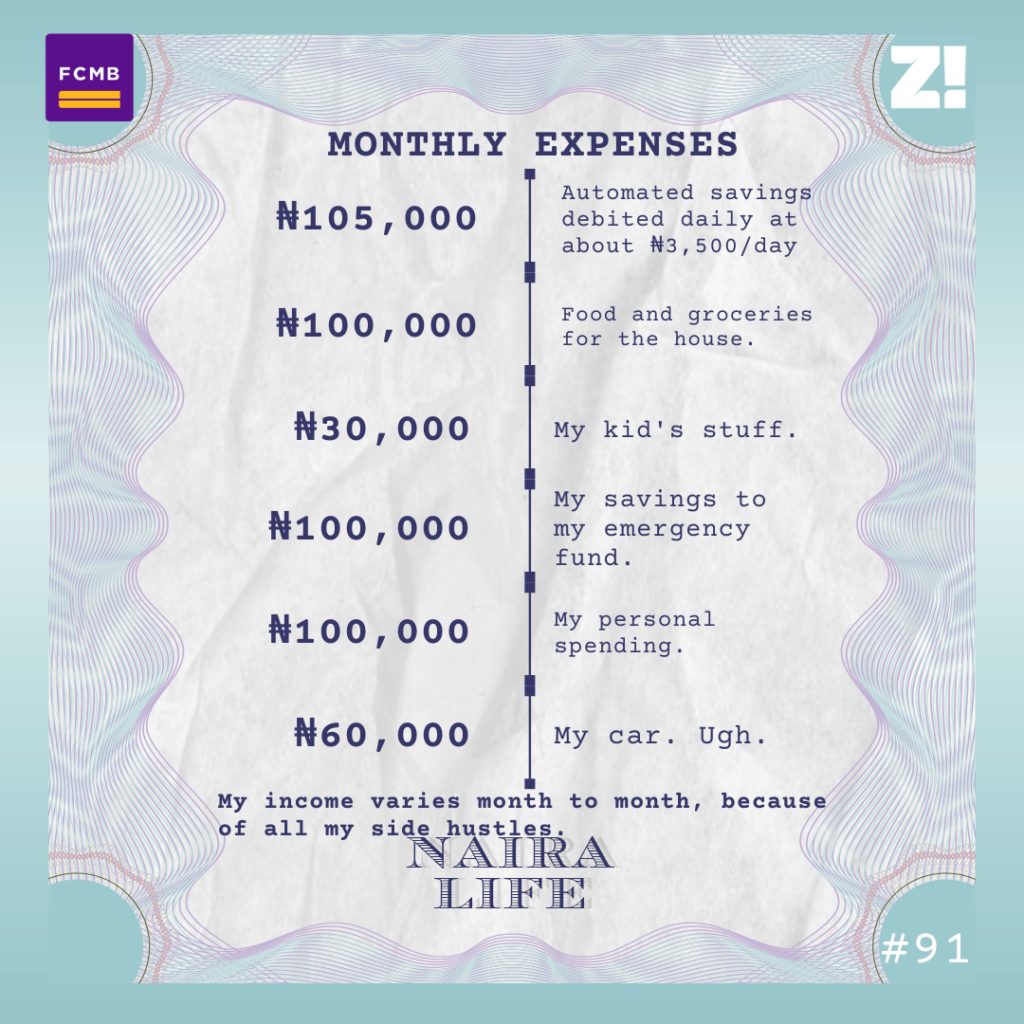
    Exciting. Speaking of spending, what do your monthly expenses look like?
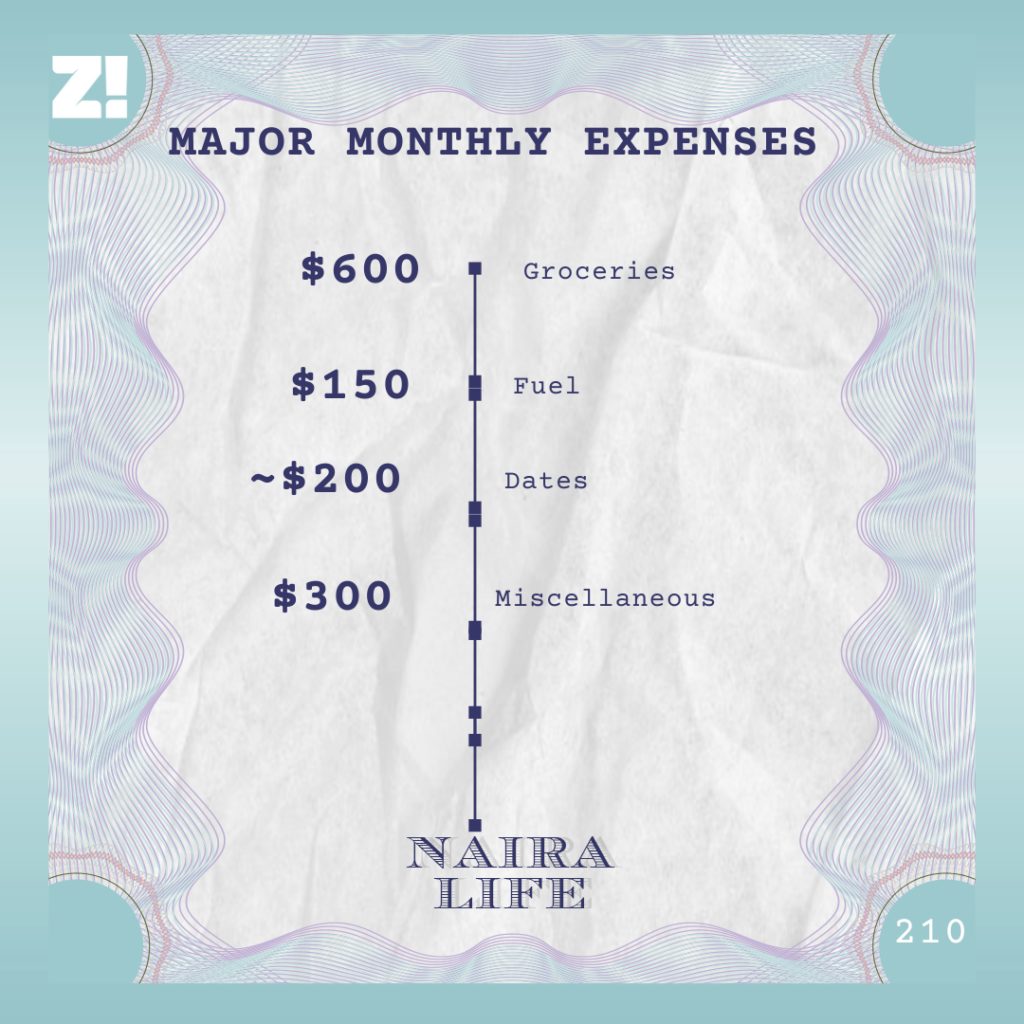
    What about your savings?

    It’s distributed across Canadian Dollars, US dollars and Naira.

    Canadian Dollars – ~ C$13K

    U.S Dollars – $4k

    Nigerian Naira – >₦2m

    Love it for you. Is there anything you want but can’t afford?

    To be fair, nothing at the moment. I’d have said a second passport but I’m already on the path to getting that. No rush. 

    God when. I have to ask, when was the last time you felt really broke?

    Not since my adult life started. I started building a secure chest as soon as I could. And as the years progressed, I delayed instant gratification of giving in to it would put me in a vulnerable financial situation. I really don’t remember the last time I was broke. 

    Energy. Is there a part of your finances you wish you could have been better at though?

    Maybe I should have started actively investing. Not just save money but get it to work. A primary goal in the next three years is to build an investment portfolio. 

    Let’s circle back in three years and see how that goes. 

    Haha. No worries. What’s your financial happiness on a scale of 0-10?

    It’s a 7 or an 8. I’m just happy about where I am, man. I’m planning my wedding, and I have the finances for it. I have some travel plans in the works and I can afford them. Most of all,  I have the safety net to cover my immediate needs. There’s definitely room for improvement, but am I doing badly? Nah.


    If you’re interested in talking about your Naira Life story, this is a good place to start.

    Find all the past Naira Life stories here.

  • The #NairaLife Of A Project Manager Whose Investment Choice Is Artworks.

    Every week, Zikoko seeks to understand how people move the Naira in and out of their lives. Some stories will be struggle-ish, others will be bougie. All the time, it’ll be revealing.

    Let’s start with the old memory of you that has money in it. 

    That will be my pocket money. I’m sure I was in JSS 1. My mum would give me ₦50 to school and tell me to bring back ₦30 change. Then whenever my dad was around, my dad would give me ₦100 and say, go and enjoy yourself. 

    This sounds familiar. 

    The problem with the ₦50 is that in my school, I could either buy a snack or a drink, never both. I also had to worry about boarding students who’d come ask me for money — I was a day student at the time. 

    There was one bully who even took my ₦30 change one time. When I got home, I got a serious beating. 

    Eishhh. Sorry. What was money like growing up though? 

    Hmm, money was a bit hard. My dad worked with the government — the security side of things — so he was hardly around. Funny thing is, I always thought there was money, haha. There was a time he travelled and didn’t come back for a really long time. 

    Woah. 

    My mum’s a doctor. She had to sell her stuff, starting with her car, and then she started a bunch of businesses to support the family. My mum had a salon, a tailoring shop and a business centre. She did her best to make us comfortable, but there were six children , and there’s only so much you can do. 

    When I got to uni — a private university — paying things like school fees was still a struggle. 

    When did you get into uni? 

    2003. I knew how to draw, so I started making art for money.

    Like, actual art? 

    Yep. I was making portraits and all. Itwasn’t much, but at least I didn’t have to ask for pocket money. 

    How would you say people were receiving your work, generally? 

    Ah well, there was some sort of showcase in school then. I showed up with everything I had, and I sold up to ₦100k worth of stuff that day. Big money at the time, hahaha. 

    What a wow. 

    Around that time, I was just learning everything I could. I learnt graphic design, basic web development and calligraphy. Any skill I had to make money. I even wrote letters for people with the calligraphy I learned. Then I started organising events to make more money. I think this whole experience shaped me because I’ve been independent for as long as I can remember. It also pushed my siblings too as they grew older. 

    It looks like heavy sacrifices were made. 

    I had things I really cared about doing but couldn’t because I have siblings, and I’m the oldest. By the time I left uni and started working, I was either saving for my events or saving for school fees. It pissed me off back then, but it had to be done. 

    I’m really curious about your dad, and the long absence. 

    At first, I thought it was just work, but he was absent for a long long while. He disappeared in 2012, and by 2014, I had to go look for him. When I eventually found him, he’d met a woman and gotten married. At some point in all of this, he had dementia. 

    Woah. 

    So, I have a step sister somewhere. Anyway, back to me. My first job was in 2009. It was at an events management company. I think my salary was 80k, and I remember this because there was one time I had to drop my entire salary to pay for a sibling’s school fees. I remember saying to myself that I didn’t want to have six children. The struggle to take care of them. Ah. 

    How did you survive? 

    Lucky me, I had a good boyfriend at the time. So for all the times I dropped my salary, he was always there to support me. He kept me going. Now, about my dad…

    About your dad.

    Thing is, he’d always been my hero. The strange thing is that my dad wanted us to get the best education, except he wasn’t there to pay for the good schools. I mean, he paid the first school fees for my education at a private university. But it was my mum that paid for the rest. There was one time I’d reached out to him for money, and he’d say, “Oh, I’ve sent it.” We didn’t have ATMs in school then, so you had to go through so much trouble to get to a bank. 

    I’d get to the bank and meet an empty account. Then I’d sit on the stairs of the bank and just cry. It happened so many times that I stopped going to the bank altogether. 

    Walk me through your job history over the past decade. 

    In one breath: I started at an events management company in 2009, earning ₦80k. One year later, I was earning ₦100k. Then I moved to an energy company in 2011 that paid ₦120k. The following year, I was at another company for ₦150k. 

    In all that time, I was doing corporate stationary for companies, and the average package was giving me up to 250k. I was helping people plan events and getting paid for that too. 

    By 2013, I worked for an international NGO as a project manager, and that paid me 400k. Then in 2015, pregnancy. That was tough. 

    How did you cope?  

    I wasn’t really active or going anywhere. My only support system was my mum and siblings. I couldn’t use my usual hospital because I couldn’t afford it at the time. It was crazy. My child’s dad asked me to choose between being with him or having a baby.

    Ehn? 

    If someone has to tell you to choose, there’s no point. So I chose the baby. Now, he comes and goes as he pleases, mostly for christmas and on birthdays. Anyway, I had two million in savings. When I moved back home to be with my family, I burned through all of it. We had bank issues at the time: my dad was defaulting on a loan and the house was collateral. We didn’t lose the house, but lawyers cost money. Maintaining the house cost money. Antenatal cost money. When I had my baby, I had to switch to baby food because I wasn’t producing enough milk — I was depressed. I didn’t get a job until seven months after I had my baby in 2016. 

    Getting a job post pregnancy helped a lot with stability. I work at a Media and Production company, and I’m still a Project Manager. Outside my 9-5, I’m juggling a few things, consulting for events and some talent management, and also selling gift items. I try to keep multiple streams of income. 

    I wonder how these experiences have shaped your overall perspective on money. 

    They say money doesn’t guarantee happiness. Omo, it’s a very good start. It brings a much needed kind of peace and when my people are happy, I am happy.

    Owning it is not a measurement of success for me, so I give as much as I can. 

    I’ve noticed that we can’t all make money the same way, so I focused on what I loved and spread it. 

    I don’t necessarily see millions in my account every month because the money I make goes out almost immediately. I don’t count my savings. In my head, it’s already paying for something lol. I just make sure I can take care of the things that matter and live each day.

    What’s your guilty pleasure?

    When I’m in a bad mood or having an emotional rollercoaster, I go restaurant hopping or buy myself a dress to feel better even if it means using up all the money I’ve just made. 

    This life na one. Let’s look into the rest of your expenses. 

    What’s something you wish you were better at?

    Documenting my finances and knowing what to invest in. 

    Do you have any investments currently? 

    I invest in art. You find established artists that have work spanning 20 years or works that have been to auction houses. If you buy from auctions, you then throw them back into auction houses in a few years. It would have increased in value. 

    There are some works now that, sadly, — when the artist passes away, the value increases. It’s safer to have art in your house than to have jewelry. You could literally have a painting on a wall, valued at a million dollars, and no one would know. 

    So, I just collect and keep. My oldest piece I collected was from seven years ago. My current private collection can’t be worth less than ₦5 million. 

    Some people just love art, not because of the value, but because of how it makes them feel. I’m keeping my own collection for my child. 

    Fascinating. Away from art, what’s a small purchase you made recently that significantly increased the quality of your life? 

    A microwave. I’m a workaholic and the microwave solves a lot of my problems. It warms my food, pops my corn, heats up drinks. 

    It pretty much makes my life warmer. 

    I felt that. 

    Haha! I can’t function without food or coffee, and it warms both. It can even make noodles. It’s very functional.

    When was the last time you felt really broke? 

    Broke-broke? Last year. We had a family incident that made us technically empty our bank accounts. I had to put a halt to my routine, hitch rides with my neighbour to work, cook from home and more. Then I had to work twice as hard to recoup and pay off loans for a few months.

    I think the moment for me was seeing my account balance at the final ₦4k, and knowing I had no money elsewhere. That used to be my Uber budget for a day, but I had to stretch it for a week. 

    On a scale of 1-10, how would you rate your financial happiness? 

    I’d say 6 sha. I remember when I used to sit and cry because I needed ₦500 to eat. Concoction rice with palm oil and Iru. I told myself I’d never ever put myself in a situation where I’d have to beg or cry. I’ve come a long way since then, but you’ll always want more regardless of what you have, especially if there are important things you need to do for yourself. 

    Random question. What’s that your ₦30 bully up to these days? 

    Oh, in 2019, she reached out randomly and invited me to her wedding. 

    Ah, how was it? 

    I didn’t go. 


    Click on the photo!
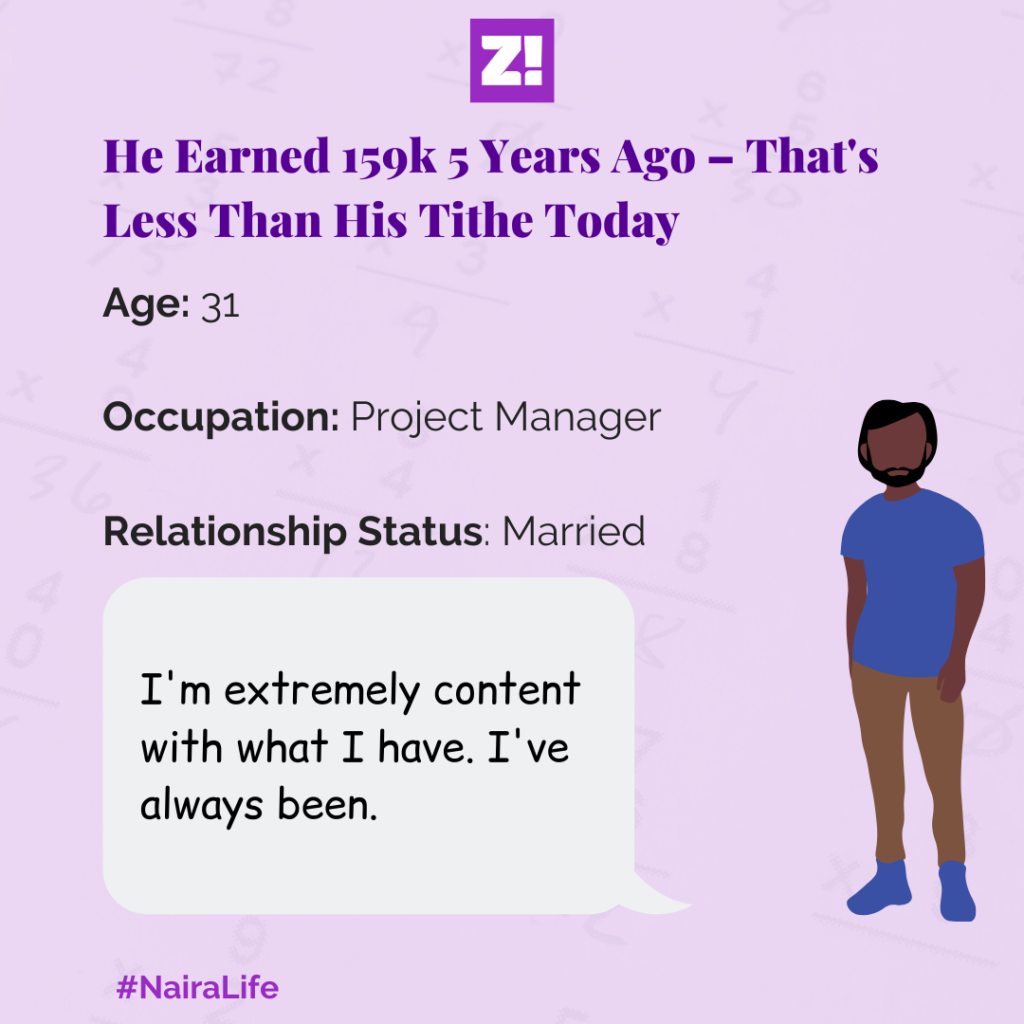
  • He Earned ₦159k 5 Years Ago – That’s Less Than His Tithe Today

    Every week, Zikoko seeks to understand how people move the Naira in and out of their lives. Some stories will be struggle-ish, others will be bougie. All the time, it’ll be revealing.

    Today’s subject is a guy who knows how to be the life of the party and the workhorse too.


    What was the first thing you did for money? 

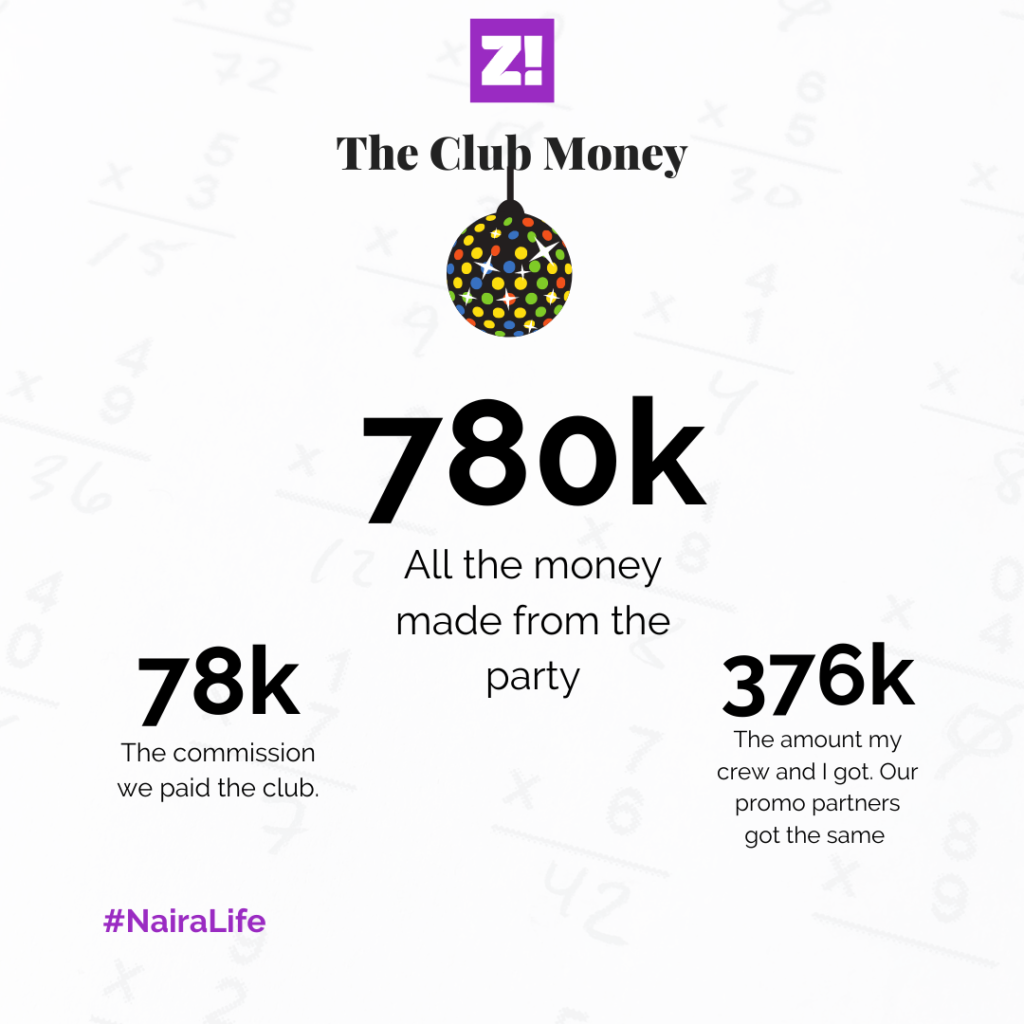
    I organised parties in university. I started in 200 level, 2007. My first party flopped like hell. Then I realised the clubbing dynamics of Lagos nightlife. Before, we were running after the public school guys. That didn’t work, so we started running after the private school guys with money. The second party cost me zero naira to organise. I made ₦376,000.

    That’s interesting. Where did the money come from? 

    Basically I went to the club and offered them a certain type of percentage. So I said hey, we are willing to let you guys keep all the money from drinks and 10% from the gate (fee). Then we went to meet a new and upcoming club within the school too and said hey, are you willing to do a collaboration party? They agreed.. So most of the costs for running around, printing IVs and stuff like that, I kind of like moved that cost to them, including the transportation and running around costs.

    And for me in my own crew, it was myself, two siblings and my girlfriend – family. 

    Zero costs incurred. 

    Yep. I continued for a while until I finished uni in 2010. I tried to continue, but I realised that I had lost the connection and the crowd. Most of the people in my set were gone. When you go back to school, it’s like Uncle Agbaya, what are you doing? 

    Did you have a stash at the time? 

    ₦800k+ in my account. In typical baby boy fashion, that’s when I decided to move out. I moved in with one of my friends, and he was the turn-up lord. It was a lot of money then, but –

    –Aha, the but.

    Under six months, the ₦800k was remaining ₦100. Initially, you’re partying, buying foodstuffs, girls are constantly coming and eating, and then the babes start reducing when the money is going down. That’s when I went back to the house like a prodigal son, and started looking for work. I haven’t stopped working since.

    Your first job. What was that like? 

    ₦55k a month. During NYSC. I got a job while I was serving – it was an administrative role in a consulting firm. In fact, I used part of that money to buy Blackberry Bold 2.

    My salary became ₦109k after a year, so what did I do? I joined the office ajo, sold my Blackberry and bought a car. 

    How much did that cost?

    ₦300k. After selling by Blackberry, I was using one kpalasa – in fact, it was my mum that gave me the phone. But I was driving a car, hahaha.

    I’m trying to make sense of your cashflow at the time. What was it like getting by on ₦109k, fuelling a car?

    Here’s the trick, I was doing consulting and most of the time we had to go outside Lagos, I was getting ₦7,500 per day stipend. Another ₦5,000 laundry – this was receiptable though. I remember earning up to ₦252k a month. I was 22 and still serving at the time o. 

    What type of conversations were you having with your fellow NYSC people?

    None. One time, they told me to come and sign register for my ₦9000-something allowance, the woman said ‘you’ll lose it o’. I said ‘take it ma’, hahaha.

    Waawu.

    I was outside Lagos at the time o, earning more than that in two days. 

    Mad o. Do you miss those days? 

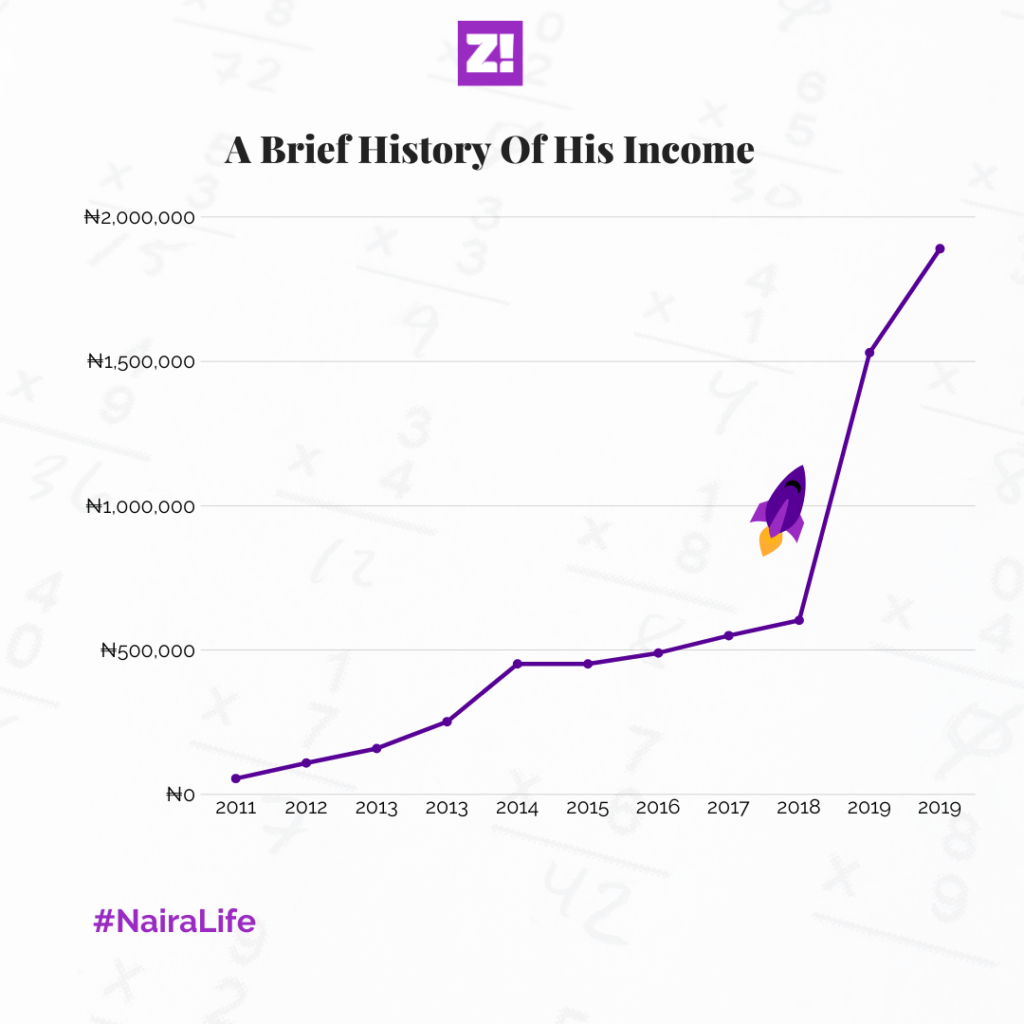
    No I don’t, hahaha. It’s been an interesting career. I was promoted thrice in three and a half years, climbed from ₦55k to ₦159k. 

    What were you doing right? I mean, the obvious thing is “I worked hard, I focused on my job, I did my best” but what do you feel you were doing, that everybody that was working hard wasn’t doing? 

    To be honest I’m not sure. I knew I was very good at work. I knew I was very good at whatever I was doing. But I think something always stands out – I’m extremely decisive. So if I decide to do something – and this could be bad though – I go for it, whether I break fences or make enemies. In my last job, my strongest point was the ability to achieve business goals. That’s what my manager always said. And everybody likes people like that in their team. Because once you’re able to achieve the target, that’s it. You always get favoured. 

    Anyway, back to service. I finished in 2011. But by the end of 2014, I was earning ₦372k. I had changed jobs. But the hack is the perks.

    Tell me about that.

    What I was actually taking home was ₦452k. At this new job, I was working on special projects. That meant that sometimes I was working on partnerships, other times, talent scouting and acquisition. I did that till 2016. I left at ₦490k, and then I took my first pay cut ever, my choice. So basically, I took ₦7.2 million per year instead of waiting for a few months and climbing to 9-point-something.

    Interesting. 

    But I just knew that I was going to be stuck where I was. I knew I was doing the wrong thing. I knew I wasn’t in the career line that I wanted. So I hit the reset button.

    There was no story to it. They sent me the offer. I looked at it, and I said yes. There was no whining. 

    There are certain things that are important to me at different points in my life. Like when I moved after three promotions, I moved for money. Solely for money. Not career. And then when I moved out of money, it was for me being able to build my career. 

    And when I was getting married, I married someone who was contented as well. That meant no spousal pressure. I got married at 27, by the way.

    Interestingly I saved more with that pay cut. 

    How?

    The working environment changed. I wasn’t as invested in depreciating assets. When you work in the bank for example, you spend so much on buying suits, buying shoes, buying watches and all of that. But where I moved to, it was mostly t-shirts –

    Ohooo, a startup.

    Yeah. I mean, I’ve always been a saver, but I started saving more when I got into tech. 

    So, were you a consultant?

    No. Now I was still actively in a special projects role in management. 2017, 550. Beginning of 2018 I was earning 603.

    2019?

    5,250. Wait, 4,250 first, then 5,250 after 3 months.

    That is clearly not naira, and there’s no outcome where there aren’t a lot of zeros here.

    Hahaha, dollars. Net. I went from a ₦9.6 million per year package in January to 22 or so. 

    How does a person go from – what, ₦55k? – to ₦22 million in less than a decade? 

    It’s actually interesting, thinking about it hahaha. I’m laughing because I’ve never sat down to reflect. Maybe whenever I feel sad again, I should just…

    Think about how far you’ve come.

    Yeah. Maybe you should start charging people for this. But after me sha. 

    Hahaha. 

    I realise now that at every point, I’ve never really felt like I should have been earning more. Basically, I’ve always been extremely content. 

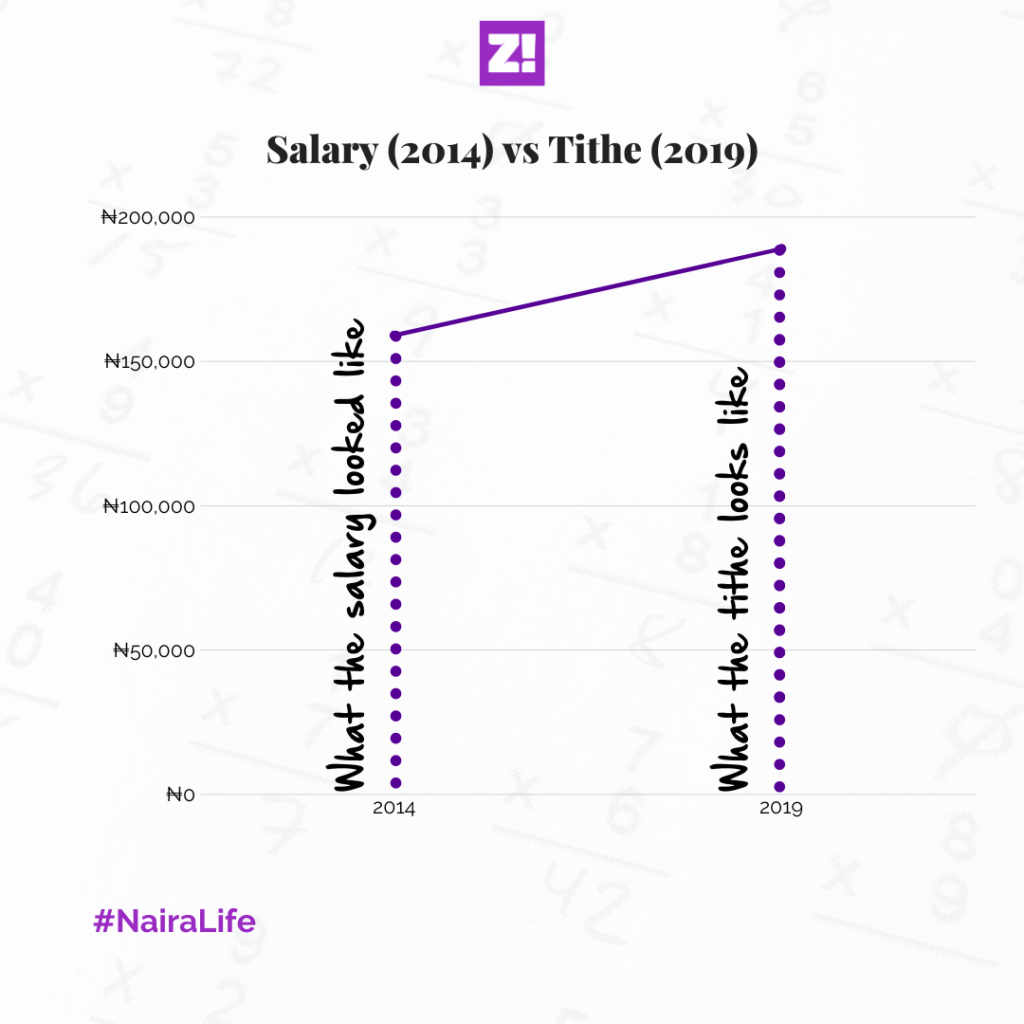
    You know, what I was earning in mid 2014 is equivalent to what I’m tithing now. 

    Wollop. Start again. 

    It’s a little more that what I earned, but you get it.

    Someone bring me a choir!

    Hahaha. I’m not sure if this is related, but I always keep my living expenses low. For example, my living expense hasn’t grown significantly since I was on ₦9 million a year. Also, I don’t think of my income as just mine. I think about it as a unit. 

    Ah, you and your wife?

    And kid, the real oga, hahaha. That kid chops the most part of the income. So household income is currently at ₦2.5 million a month. 

    I’ve been wanting to ask a married person, do you run a joint account? 

    No we don’t have any joint account. We keep it separate, but we have a system. Take for instance, if we want to buy a car, we put all the funds together and buy that car. Regardless of who earns what. So that’s kind of how we operate. If we want to do investment for Treasury Bills, it’s done for the family. 

    Not as individuals.

    Yeah. I tend to pull in most of the funds, but for the family still. That’s how I see money, because anything can happen any time.

    Any time! 

    At the end of the day, the money belongs to the unit. It’s just that one person has more earning power as a unit. 

    So let’s break down monthly expenses. 

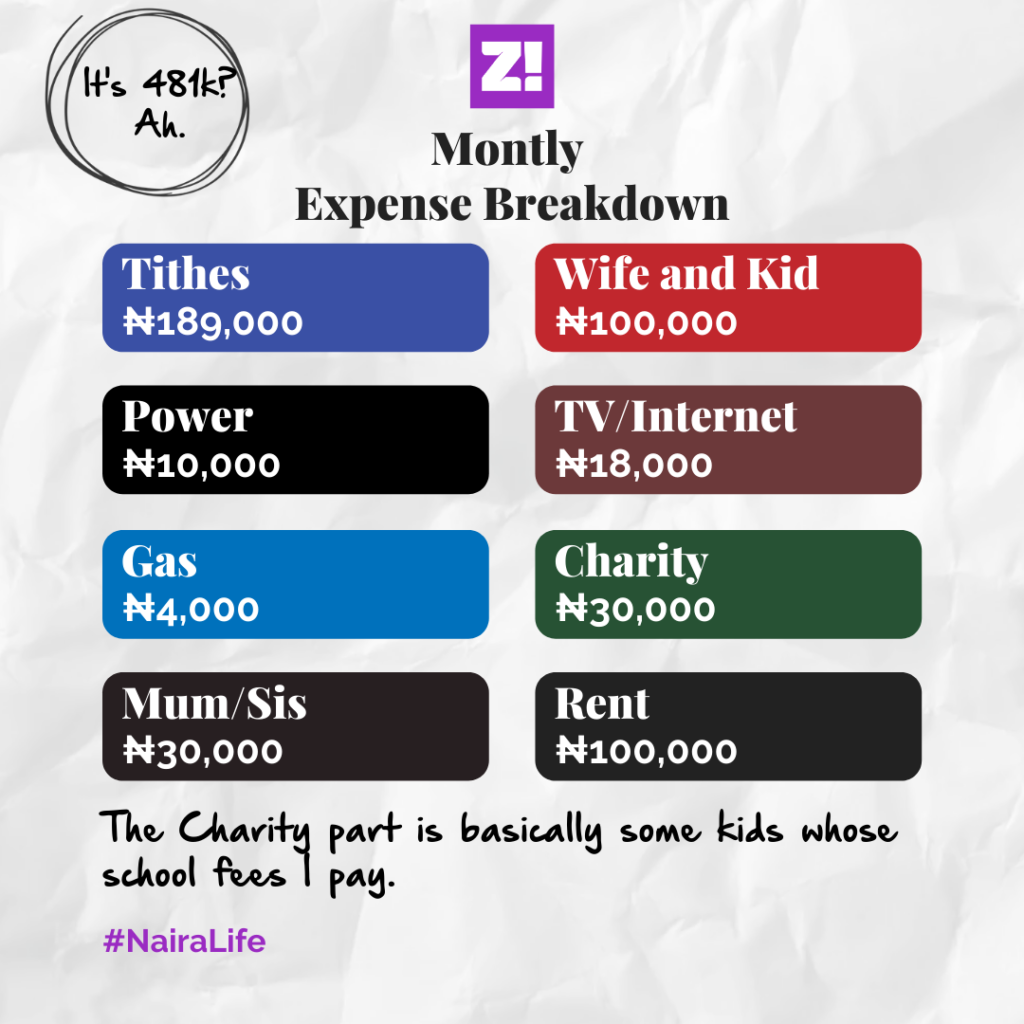
    ₦450k

    As in, all your expenses?

    Including rent. I remove rent monthly, lock it in a savings, set a maturity date, then I give the landlord yearly.

    So, let’s break down the ₦450k.

    We have things we take care of. I pay the rent, she handles feeding. Sometimes it climbs to ₦500k.

    So for my last rent, I managed to save up to 1.8, even though rent was ₦1.2 million. That meant that for the next month, I didn’t even touch my salary. 

    It’s a little over 450, but I have some side investment that pays me ₦100k. That covers extra stuff. But ₦450k is the unshakeable running cost, all things being equal. 

    Incredible. So, ₦450k out of 1.9. What happens to the rest? 

    Investments, savings, some of them go into stuff that might come up but mostly investments. 

    You have ₦1.45 million that you can do anyhow. Your potential lau lau budget.

    Yeah thereabouts.

    Let’s create a scenario of how you spend the ₦1.45 million. 

    I leave the rest to stay denominated in dollars. I have a monthly savings budget, a monthly investment budget minus your rent. I juggle a bunch of investments: treasury bills, mutual funds, and dollar investments. 

    I’m always looking for investment opportunities, but medium risk. I prioritise medium risk and low risk investments. I don’t do the high risk because I’ve probably not had enough time to sit down and understand it.

    What’s something you wish you could invest in, in Nigeria, more easily?

    I’m not sure. Two things around that; before, I was the kind of person that’ll be like Nigeria will be great. But more and more, it’s chipping away from that confidence. And when you start to have kids, you start to kind of like lose hope and…

    And start thinking about their future. 

    Yes. So by this time now, it’s more or less about how much investments can I do abroad. 

    Your true country?

    Yes my true country. So that the day I decide to… You know, Nigeria is actually my true country, I really love Nigeria. So did many of the people in my circle who have gone. I don’t think I want to just yet. I don’t think I’ve reached that point just yet. 

    You were saying something about the investments that helps you pay for the ₦30k.

    On the side consulting; income can come through those avenues. It used to happen frequently but now, I spend more of my time at my current job. The thing is, if you want to be seen as a performer, you need to be able to block out the noise. And when you start to do side gigs, it can become noise. I feel this needs my focus 100% till I’m able to build something. 

    I feel you.

    And there’s no urgent request to increase income right now. 

    How much do you feel like you should actually be earning?

    Once in a while, I struggle with imposter syndrome. And I’ll say sometimes, I don’t think I should be earning more than 12 million, a year. If I was going to get promoted in my last job, which was what happened in June, I would have been earning 12m. This job is the quantum leap.

    What is something that you really want but you can’t afford?

    A house. I don’t have plans for it yet, but I have a picture of the kind of house I want. It’s so clear. A terrace house. I can see it, but I don’t have a strong desire to get it now.

    You have pension and health insurance, right?

    Yeah, plus car and home insurance. I’m flirting with the idea of life insurance, because tax wise, it reduces my tax liabilities. 

    Ehn? 

    If you have a life insurance, the amount that they use to calculate your income tax goes down. 

    Just for bants, when was the last time you felt really broke? 

    I think it’d have to be when I was earning 550k. But broke for me is not when I run out of money, but when I run out of pocket money. 

    What is something you honestly wish you could get better at? 

    Reading. And if I’m able to focus the way I have focused every other part of my life in getting better at reading, I won’t see what happened as a quantum leap. 

    I have a very poor attention span. Meaning I can be very excited for a while, which makes it difficult for me to pick up a book and read. I read articles and management reviews though, 

    Because they help you get better at work. 

    Exactly. 

    On a scale of 1-10, happiness levels. 

    I’ll say seven. Money is fickle, and that uncertainty is where the remaining three sits. I’ve been lucky, but I also believe that luck is when preparation meets opportunity. 

    I worked hard to get here, without a doubt.