Notice: Function _load_textdomain_just_in_time was called incorrectly. Translation loading for the wordpress-seo domain was triggered too early. This is usually an indicator for some code in the plugin or theme running too early. Translations should be loaded at the init action or later. Please see Debugging in WordPress for more information. (This message was added in version 6.7.0.) in /home/bcm/src/dev/www/wp-includes/functions.php on line 6121 naira | Zikoko!
Idris Okuneye AKA Bobrisky, a popular Nigerian socialite, was arrested by the Economic and Financial Crimes Commission (EFCC) on Wednesday, April 3, 2024, for mutilating some naira notes. On April 12, 2024, a Federal High Court in Lagos sentenced her to six months in jail without the option of a fine.
What was her crime?
The EFCC spokesman, Mr Dele Oyewale, confirmed the arrest and stated that Bobrisky was arrested on four different counts to which she pleaded guilty. During the judgment, Justice Abimbola Awogboro mentioned that Naira mutilation has become a menace that’s damaging the country’s image. Bobrisky’s sentence was to make an example of how Naira Abuse will be treated going forward
But is the sentence fair?
Naira Abuse has long been a criminal offence in Nigeria, but spraying naira notes when dancing has also been a part of the Nigerian culture for ages; this law hasn’t seen much enforcement in the past. Before Bobrisky, on February 1, 2023, the Independent Corrupt Practices Commission (ICPC) arrested Nigerian actress, Oluwadarasimi Omoseyin, after a video of her spraying and stepping on the new Naira notes circulated on the internet. Just like Bobrisky, she bagged six months of imprisonment.
According to the 2007 CBN Act, the punishment for naira abuse — which includes spraying, stamping, engraving, selling and mutilation — is a fine of ₦50,000 or six months imprisonment. For a first-time offender, members of the public believe that the sentence with no option of a fine was made out of bias, but Oluwadarasimi Omoseyin was also sentenced with the only difference being that she got the option, of a fine because she was a first-time offender who pled guilty. She was eventually granted bail on February 15 2024, but for Bobrisky the case is not the same.
Although Bobrisky is also a first-time offender and has pled guilty with a promise to change and use his platform to educate people about the naira abuse, he wasn’t granted bail. This begs to question if there is some sort of bias behind the decisions of the court.
[ad]
When did this one start?
The police have started taking Naira Abuse more seriously, rounding up more offenders in the last several months than they ever have before. One Simon Idio was arrested on February 12, 2024, for selling the naira. Who knows what might come next?
To learn other possible ways you might be breaking the law, click here.
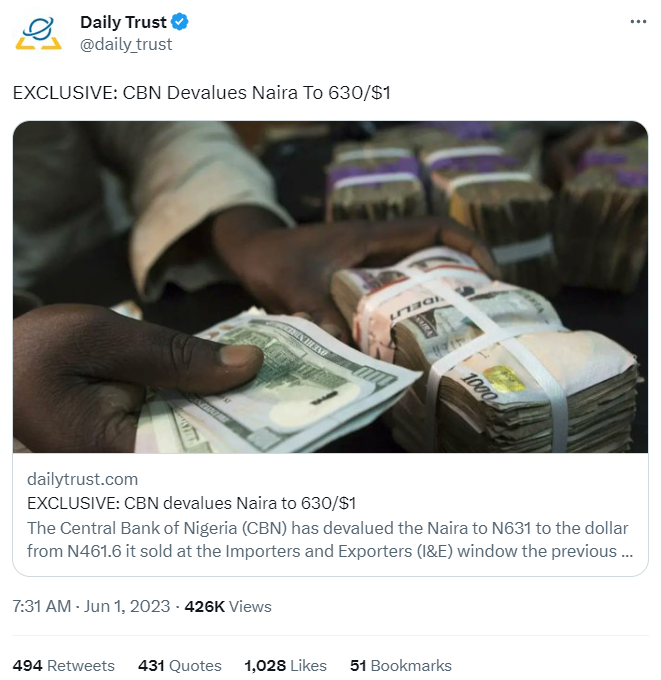
On June 1, 2023, Daily Trust newspaper exclusively reported with the headline “CBN Devalues Naira To 630/$1”. On its Twitter page, the news has received over 426k views at the time of writing. It has also been retweeted 493 times.
On Wait First, we divide claims into three categories. A valid claim is a fresh banana. A false claim is a burnt dodo. And a misleading claim is cold zobo.
So, how valid is this claim?
Background
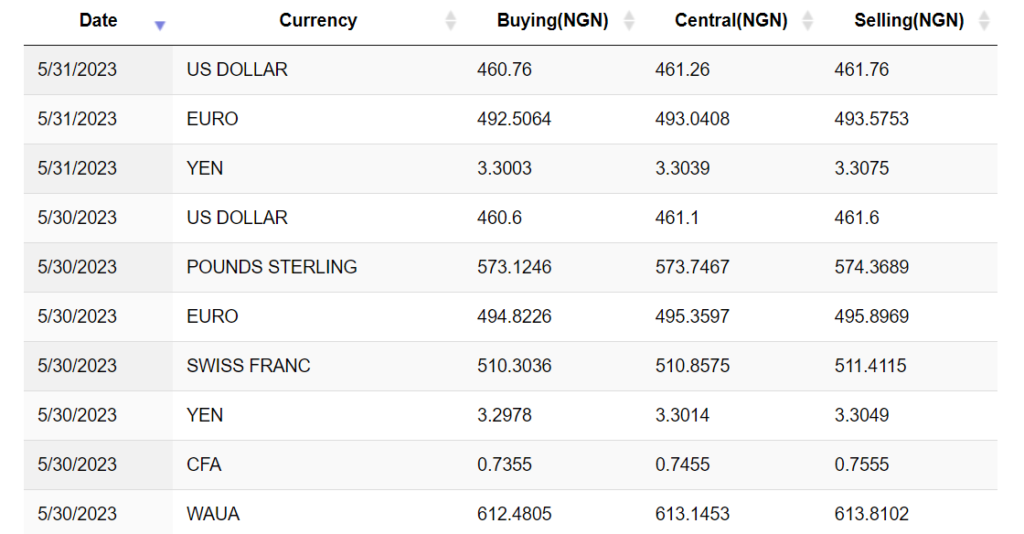
According to the news report by Daily Trust, the Central Bank of Nigeria (CBN) devalued the naira from ₦461.6 to ₦631 to the dollar. It then sold at the new rate in the “Importers and Exporters (I&E)” window on May 31.
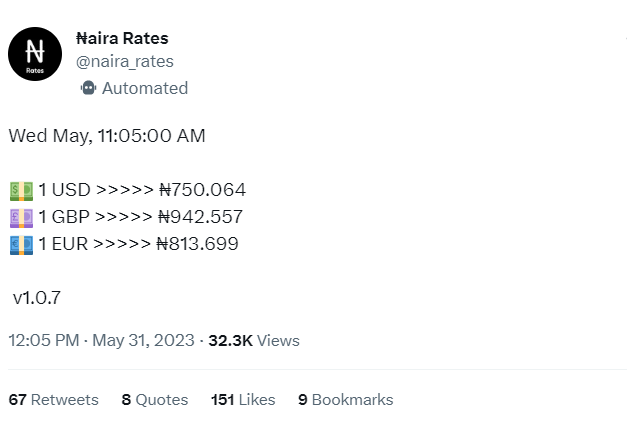
Nigeria currently runs a multiple exchange rate system. The CBN provides its rates, and the parallel market, commonly known as the black market, provides another. The gulf between the two creates arbitrage. This is a situation where people trade in currencies by taking advantage of differing prices for the same currency.
As of May 31, the CBN’s rate was ₦461.26 to the dollar.
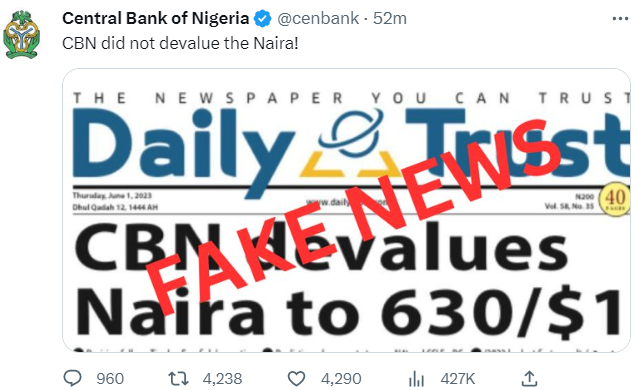
Not long after the news report was released, the CBN released a screenshot describing it as “fake news”.
The CBN then followed up with a statement signed by its acting director of corporate communications, Isa AbdulMumin. It read:
“The attention of the Central Bank of Nigeria (CBN) has been drawn to a news report by Daily Trust Newspaper of June 1, 2023, titled ‘CBN Devalues Naira To 630/$1’.
We wish to state categorically that this news report, which in the imagination of the newspaper is exclusive, is replete with outright FALSEHOODS and destabilising innuendos, reflecting potentially willful ignorance of the said medium as to the workings of the Nigerian Foreign Exchange Market.
For the avoidance of doubt, the exchange rate at the Investors’ and Exporters’ (I&E) window traded this morning (June 1, 2023) at ₦465/$ and has been stable around this rate for a while.
The public is hereby advised to ignore this news report by Daily Trust in its entirety, as it is speculative and calculated at causing panic in the market.
Media practitioners are advised to verify their facts from the Central Bank of Nigeria before publishing in order not to misinform the public.”
Verdict
The CBN has come out to state that the claim by Daily Trust is emphatically false. Therefore this news is nothing but burnt dodo.
Hi friend! For the past few months, we’ve helped you say on top of Nigerian politics, policies and governance or have we? In less than 2 mins, tell us what you think about Zikoko Citizen here, and we owe you an interesting story next week.
In William Shakespeare’s play Romeo and Juliet, we’re introduced to this unforgettable line by Juliet Capulet that goes: “What’s in a name? That which we call a rose by any other name would smell as sweet.”
The rest of the world might side with Juliet here, but Nigerians might beg to differ. We have a very strong affection for names and their connotations. For example, in 2012, when former president Goodluck Jonathan decided to honour MKO Abiola by changing the University of Lagos to MAULAG, students of UNILAG protested and even sued the president, who eventually had to back down. In another example, Osun state has been in fisticuffs over the years following a proposal to change it to the State of Osun — weird, we know.
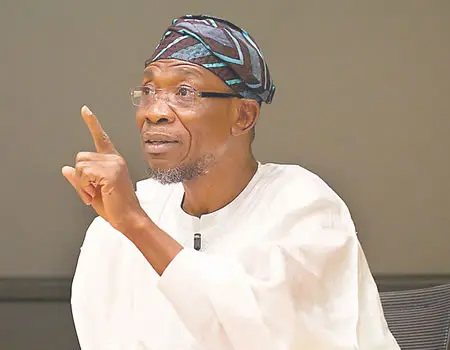
[Rauf Aregbesola, former governor of Osun / Vanguard]
Given that the naira scarcity has dominated discussions over the last few weeks, we decided to look into how our currency even got its name in the first place. If you already know, then chapeau to you. If you don’t, the answer may (or may not) surprise you.
A brief history of our currency
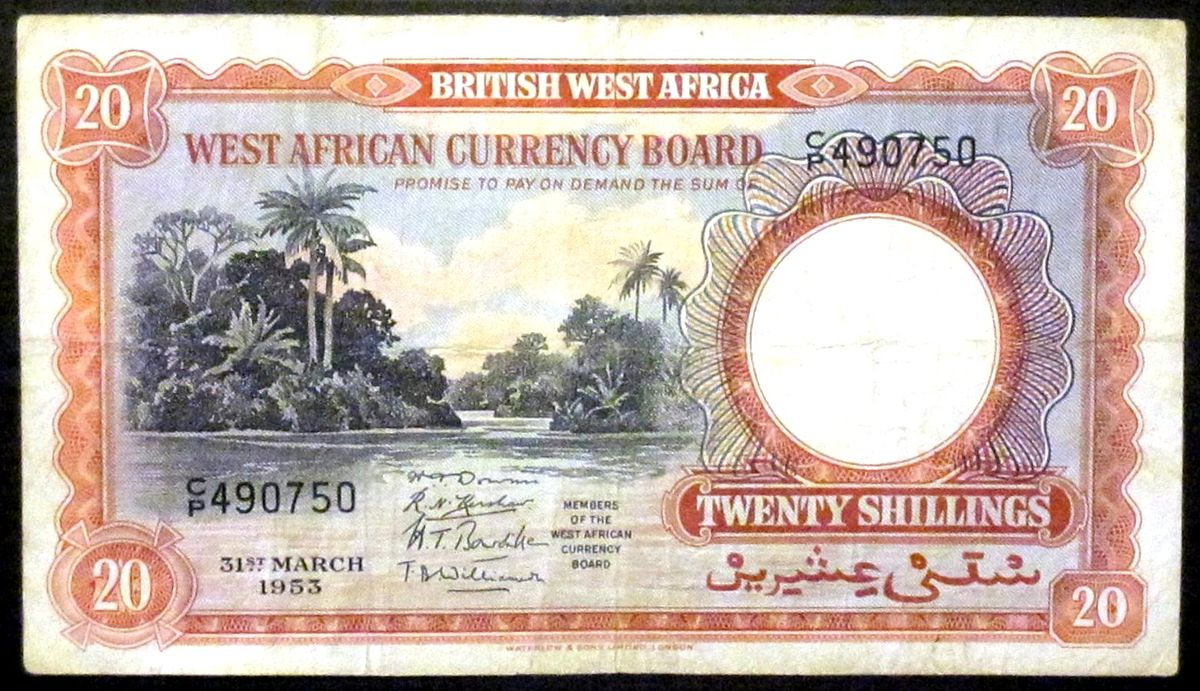
Between 1907 and 1958, Nigeria used the British West African Pound issued by the West African Currency Board that was set up by the British authorities. This was the currency used across British West Africa. At the time, the pound and the pound sterling were at parity; that is, one pound equalled one pound sterling.
[Twenty-shilling note / West African Currency Board]
The Central Bank of Nigeria (CBN) was established by parliament with the CBN Act of 1958. By July 1959, it began operations and started issuing the Nigerian pound, which was in use until 1973.
How the naira got its name
On January 1, 1973, the Nigerian naira was introduced. It was exchanged at ₦2 to £1. At the time, Obafemi Awolowo was the federal commissioner for finance. He had the honour of naming our currency, now fifty years old.
A firsthand account of what inspired the name comes from his daughter, Olatokunbo Awolowo-Dosunmu. Here’s what she said in a 2016 interview with Punch when asked how her father came about the name “naira”:
“He just took the name of Nigeria and collapsed it to Naira. That’s what he told us, and that was how he arrived at the name ‘naira’, and that was when he was the federal commissioner for finance.”
For this and his contributions towards the creation of the Nigerian state, he has been immortalised by having his portrait grace the ₦100 note. But that’s not all there is to it. He’s also said to have named the kobo. How did that one come about? Well, kobo is a corruption of the word “copper”, which coins were made of then.
As of today, March 13, 2023, £1 is now exchanged for ₦912. Crazy eh?
That said, could Awolowo have created a sexier name for our currency? Probably, lol. Would a sexier name have allowed the naira’s value to appreciate over the years? Clearly not, which was Juliet’s point all along.
Since the beginning of the year, every day for Nigerians has not been the day the lord made. We have been fuelled purely by chaos.
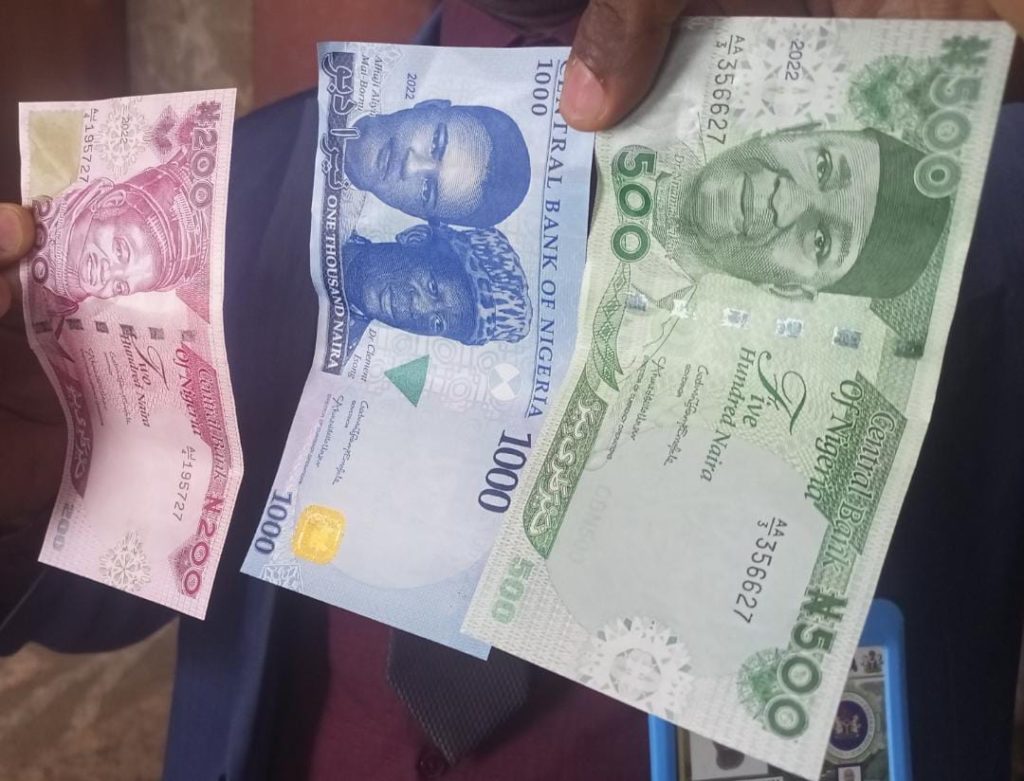
One of the problems started on October 26, 2022, when the Central Bank of Nigeria (CBN) governor, Godwin “Meffy” Emefiele, announced plans to redesign the ₦200, ₦500 and ₦1000 notes. A month later, the new banknotes were unveiled. Although some people predicted that it might be difficult for Nigerians to adjust to this change, no one could have foreseen the level of discomfort Meffy’s Naira makeover has caused.
What has happened?
Naira scarcity
Nigerians have been dealing with Naira scarcity while racing against CBN deadlines of January 31, 2023, subsequently extended to February 10, 2023.
Despite this, Nigerians have had to take the labours of Hercules to get their hands on the new notes.
Due to the tensions the Naira has created, some states, Kogi, Zamfara, and Kaduna, sued the Federal government at the Supreme Court over the current scarcity of banknotes.
After many complaints, on February 16, 2023, President Bubu tried to channel his inner Superman by approving the use of old ₦200 notes till April 10, 2023. But this has proven to be hardly helpful as statistics show that the old ₦200 notes make up only 9.19 per cent of the currency volume in the last seven years.
Meffy’s reason for the Naira redesign was to fight corruption and inflation, but so far, it seems like Nigerians have had to pay a high price for this. Let’s look at some things the Naira scarcity has cost Nigerians.
Their businesses
Since the Naira scarcity problem started, many traders have had to bear losses, especially those who sell perishable goods because they haven’t had enough customers.
Photo credits: Twitter/The Voice Of Port Harcourt/@TheVoiceOfPHC
Some traders don’t have bank accounts, and others who do and accept transfers have faced network challenges. This situation has forced many of them to slash the prices of their goods, though they might be incurring losses. Some herders complained that a big cow that’d usually be sold for around ₦400k now goes for ₦270k.
Their lives
On February 17, 2023, a 32-year-old woman, who was nine months pregnant, died in a specialist hospital in Kano because her husband didn’t have the new naira notes to pay the hospital on time.
The woman was in labour by the time they arrived at the hospital, and her husband tried to pay the requested ₦8,528 with the old notes but it was rejected. The hospital had no POS machine, and they asked the man to transfer the money instead, which he did. But the cashier had to wait to confirm payment. The medical personnel also refused to proceed with the treatment until the evidence of payment was brought.
The payment wasn’t confirmed until after three hours. The hospital requested an additional fee of ₦4000 for blood service, and the payment also had to be confirmed. This time, the man pleaded with them to proceed with the treatment, and they finally rushed her to the labour room around 1 a.m.. Unfortunately, his wife and child didn’t make it.
Their means of transportation
Many commuters have had to trek or face embarrassment from bus conductors who have refused to collect old notes. It’s 2023, and our train stations still only accept cash as a payment medium. It’s almost like if you can’t pull a miracle to get cash in hand, then the best thing for you would be to stay home or exercise your leg muscles and walk.
No one knows when or if the current wave of suffering in the country will end anytime soon. All we can do is hope that the new administration coming in after the upcoming elections will make our lives easier than it is currently.
Every week, Zikoko seeks to understand how people move the Naira in and out of their lives. Some stories will be struggle-ish, others will be bougie. All the time, it’ll be revealing.
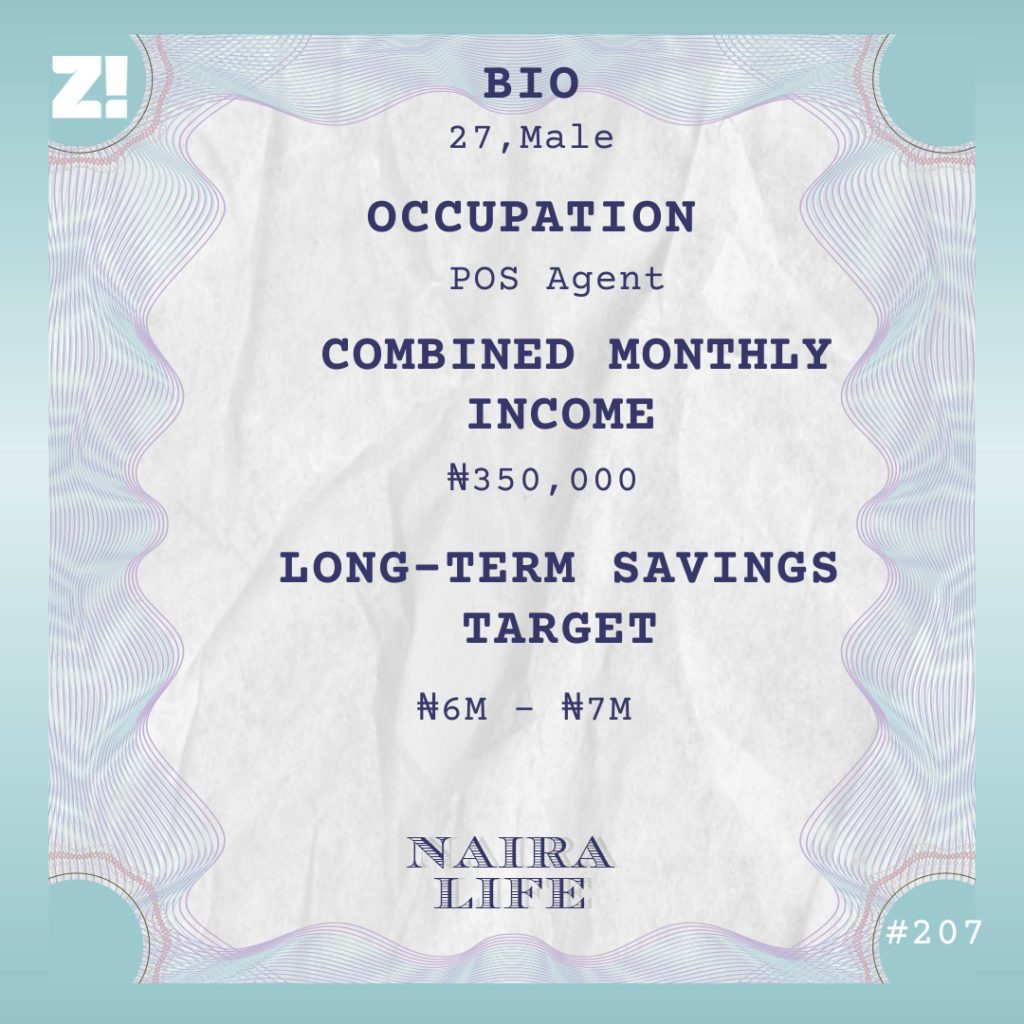
The 27-year-old in this #NairaLife worked security jobs for nine years before saving up to launch his POS business. But now, he might need to find something else because the current cash scarcity is a sign of events to come.
So, what are his options?
What is your first memory of money?
I’d say it was earning my first salary at my first job. 15k in 2011, and I’d just finished secondary school.
Why was this a significant moment?
My mum didn’t want me to get a job because she wanted me to go to school, even though it was almost impossible at the time. She was raising four kids on her ₦20k teaching salary. At numerous points, she picked up extra tutorials and even had a small shop, but what she made was barely enough to cover the family’s basic needs.
You must have noticed I haven’t mentioned my dad.
I was waiting for us to get there. Where was he in all this?
I’ve never known my dad to keep a job. He was a real estate agent, but it was never a regular stream of income. So he didn’t contribute financially, even though we all lived together.
My mum carried all the load as best as she could. We lived in a single room until we could afford a 2-bedroom apartment. I didn’t even see a TV set in our house until I was 16 or 17.
Ah, I get it. Back to the job
I knew working was the only way I could help ease my mum’s financial burden, so that ₦15k was everything. My boss liked me for some reason and made me a supervisor, so I didn’t have to operate the machinery or do any heavy lifting. However, I walked almost 40 minutes to work every day the entire time I worked there, which was about two years.
Out of curiosity, what could ₦15k do in 2011?
It wasn’t what you would call big money, but it was good for me. For context, a bag of rice was about ₦7- 8k, and I could get a pair of jeans for less than ₦4k.
This job gave me my first taste of financial freedom.
However, I quickly realised I wasn’t good at keeping money, so I did the next best thing.
What was that?
My older sister was much better with money. Somehow, she always managed to keep money aside for future use, so I asked if I could save with her. At the end of every month, I’d send ₦4k to her and forget about it. Two years later, I had about ₦92k saved. I left the factory job around this time too.
Why did you leave?
A guy I worked with at the factory had moved on to a security company. In 2013, he reached out and asked if I’d like to join him. I got the job and my pay jumped to ₦25k.
In the beginning, I worked single 24-hour shifts and took the following days off. Later, I picked up extra shifts on my days off. My salary increased to ₦45k, but I also had to go to work every day. This went on for a year and a few months.
In 2015, my former boss at the factory contacted me to tell me he could use my help. He offered me ₦30k/month and an opportunity to work night shifts to increase my earnings. I accepted the offer — the pay wasn’t as great as what I earned from my double shifts at the security company, but at least, I didn’t have to work every day of the week.
That makes sense
I should mention, I’d increased my monthly savings to ₦10k/month.
A few months after I returned to the factory job, my mum picked up the conversation about my returning to school.
See, it took a lot of strength to agree to it. I feared that returning to school would affect my earnings and cash flow. Secondly, I didn’t feel particularly book-smart. But my mum wouldn’t let it go. In 2016, I got into a part-time programme at a polytechnic. I was 21 years old.
How did that go?
The polytechnic is in another state, so I quit my factory job. One of the first things I did upon resumption was to find another job, and I started working as a security staff again. My salary was ₦25k and I only worked single shifts because of my class schedule.
Three years later, I wrote my final exams and got my diploma.
Well done
Thanks, man. This was 2019, and I’d managed to save about ₦200k with my sister’s help. When I returned home, I started planning to launch a business. First things first, I needed more money to raise some capital. So I returned to the one thing I knew how to do and had contacts for.
Another security job?
Yes. I picked up two shifts and earned ₦55k from both. Fortunately, one was at an office that closed by 4 p.m., giving me a break for the rest of the day.
The goal was to save enough money to raise business capital, so I started keeping ₦25k with my sister every month. I was also sending ₦20k home to my parents, so I was relying on the tips — anything between ₦500 and ₦1500 — I got during my shifts to cover my basic expenses.
I finally quit in February 2022 after saving ₦500k. It took three years, but I could eventually leave the security gigs behind and start something of my own.
Whew. Did you know what business you wanted to pursue?
It took some time, but I decided to start a POS business. A close friend had been in it for a few years and promised me it was profitable for him. He was making about ₦15k per day, which I thought was fair.
The only problem was I still hadn’t learned to handle cash without spending it. But I braced myself and decided I would be disciplined with money.
How does someone set up an agent banking business?
First, you need to find a suitable spot, preferably one where people can easily find you. Then you find out who is in charge of the spot and talk to them about renting it. If it’s a piece of land, you need a kiosk or something you’ll use as a shop. Most importantly, you need to apply for a POS machine. My friend helped me apply for mine — I submitted documents, paid ₦30k, and got the device almost immediately.
The whole process cost me about ₦100k. I kept another ₦100k in the wallet and ₦200k in cash. And I was in business.
Exciting
It started a little slow as I was making between ₦1500 and ₦1800 every day. But when I considered that I could make up to ₦70k a month — more money than I ever made at any of my security jobs — I saw it was a good call.
My customer base increased in months, and so did my earnings. I’m not even sure when it picked up; one day, I just realised I’d started averaging ₦200k/month. This was in the second half of 2022.
What did this mean for you?
I could take better care of my people. I increased my parents’ allowance to ₦60k/month and picked up a couple more financial responsibilities within the family.
It also meant I could expand to a new location. Unfortunately, this didn’t work out as I hoped. I wasn’t making enough to cover the costs of operations, so I shut second shop down.
Finally, I figured it was time to get my own place. I found an apartment in December, and the rent is ₦170k/year.
So much growth. Love to see it
Thank you. One of my goals at the beginning of 2023 was to raise capital for a new business venture. Now, I’m not sure it’ll be possible. Not when the business is being threatened by the Central Bank of Nigeria’s cashless policy. I can read the writing on the wall. POS business will be redundant soon, and it’s giving me sleepless nights.
When did you first think there might be a threat to your business?
From the moment the CBN announced the naira redesign and new withdrawal limits. My first thought was, “It’s time to sit up and think of what is next.”
I can still manage for the next two to four years because I don’t think Nigerians will fully switch to cashless transactions before that time. But I also want to be proactive. The current cash scarcity is a sign of things to come, and I need to prepare for the worst.
Speaking of, how’s the cash scarcity affecting business?
I’m making more money now than I did in the previous months. The problem is it’s difficult to get cash to operate.
Walk me through how you source cash these days
It takes a lot of planning and strategy. I leave my house at 5:30 a.m. to beat the ATM queues. And if I’m lucky, I get to withdraw money from one of the machines. The sad part is most banks don’t allow you to withdraw more than ₦20k per day. Luckily, I have multiple bank accounts. Between them, I withdraw up to ₦100k daily.
But on days when I don’t get money from the banks, I buy money from businesses that operate with cash — mostly filling stations and wholesale stores. For every ₦100k I get, I pay them an extra ₦6k.
Fascinating
It’s stressful and more expensive, so the withdrawal charges have increased. Before, customers only had to pay ₦100 or ₦200 for withdrawals between ₦1k and ₦10k. Now, it’s ₦400 to withdraw ₦2k and ₦1k to withdraw ₦10k.
At the end of each day, I make between ₦13k and ₦15k. More people need cash, so the volume of daily transactions has gone up.
How do you feel about it?
I’m not happy about the increase in withdrawal charges. However, if I don’t get cash, I can’t open the shop, and I won’t make money for that day. It’s either I make the best of it or close down the business.
Isn’t there a workaround that would benefit POS agents and customers?
It’s out of our hands. The banks need to give people access to their money again. The withdrawal limit at the ATMs is currently ₦20k/day, which doesn’t work. When the banks start paying people money over the counter, and the ATM withdrawal limits go back up, everything will return to normal. I expect this will happen before the end of February or when the elections are over.
So how are you planning for when this business isn’t profitable for you anymore?
The plan is to save up for a 2006 or 2007 Toyota Corolla and sign up to be a driver on Uber. Sadly, this will cost me nothing less than ₦2.5m. This same car was about ₦1m two or three years ago.
The second option is to become an agent for online betting companies. Nigerians gamble a bit, and I like businesses that give me cash flow. I believe I can make this happen by 2024, and I shouldn’t need more than ₦1m to be in business.
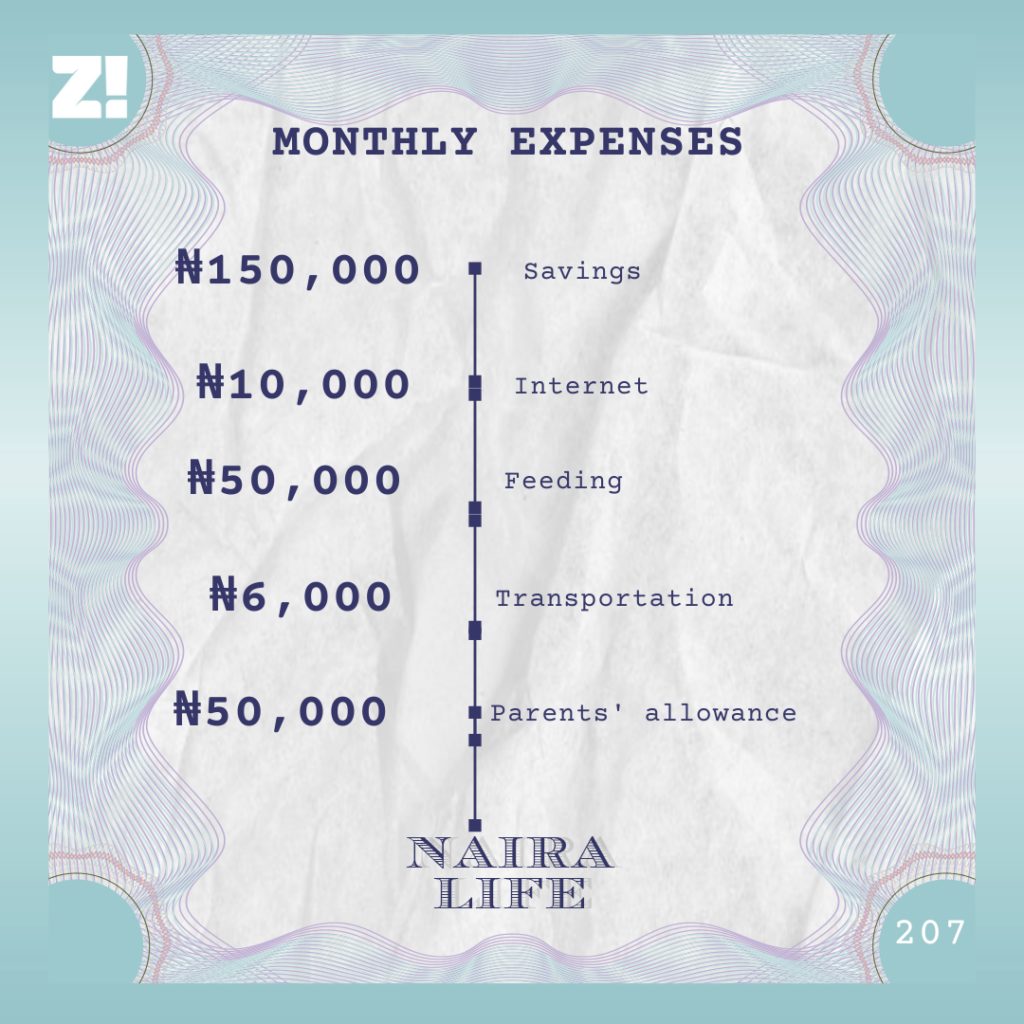
I currently save ₦150k/month and have ₦600k in my savings. If nothing changes, I should raise the capital I need by the end of the year. I wish I could save a minimum of ₦200k every month, but that’s not been possible.
Why not?
Family obligations. My sister is in fashion school. I pay my parents’ rent and send them a monthly allowance. Also, my dad was recently diagnosed with prostate cancer, and his drugs cost ₦20k/month in addition to other hospital bills.
I’m really sorry about your dad
It’s all right. I love that I can take care of these expenses even if it means I can’t save as much as I’d like. My thinking is, I’ll still do everything I want to do; it might just take me a longer to get there. I don’t think it matters how long it takes.
That’s a good way to think about it. How much do you make in an average month now?
₦200k – 250k from my POS shop. I make an extra ₦100k from trading gift cards on the side.
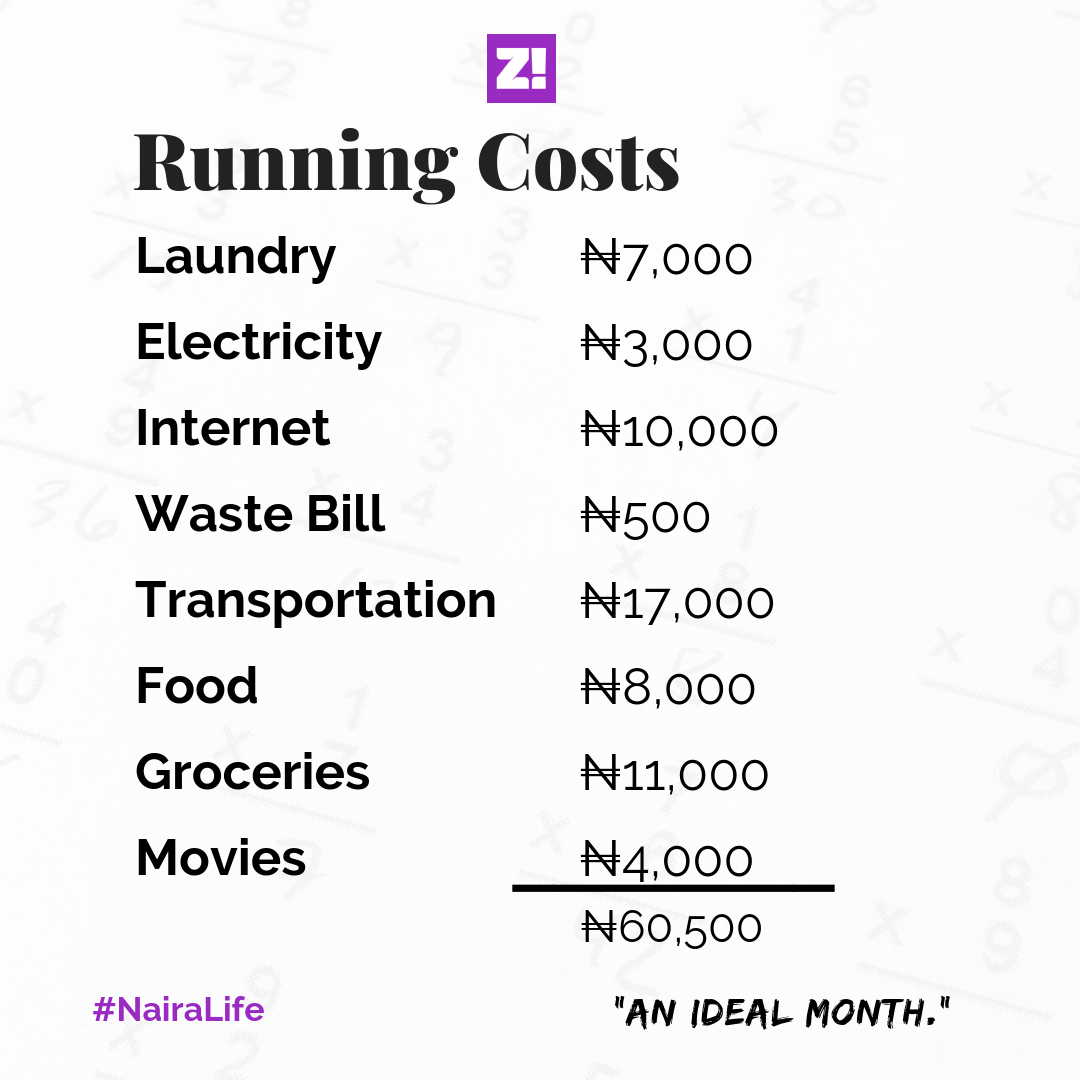
Gotcha. What do your recurring monthly expenses look like?
Have you considered other financial management options besides saving?
I feel like I’m a little late to the party. Everything I know about financial management is from accounts I follow on Twitter. In fact, I only stopped saving money with my sister when I found out in 2022 that there were apps that could do this.
However, my constant need for cash hasn’t allowed me to explore financial investments. At the moment, I can’t leave money compounding for years because of my short-term plans.
Where do you imagine you’ll be in five years?
I’d have started another business. The only reason why I want to try out transportation or online betting is to raise money for my long-term project.
Tell me more
I want to open a pharmacy and supermarket within the next five years. I won’t run the daily operations of the pharmacy because I don’t have a license, but I’ll put the money down and be in the background. I’ll need about ₦6 – 7m, so it’s my long-term saving goal.
I think I’ve done well considering where I’m coming from, which is why I believe I can pull it off. Money gives freedom. As I earned more money over the years, I’ve been able to do things I didn’t think I could.
How would you rate your financial happiness on a scale of 0-10?
6. I haven’t totally figured out a primary means of income beyond the POS business. If I had assurances it would still be as profitable as it is now in the next five years, the number would probably be 8.
But there are no assurances. It’s okay, though. I saved my way here, and I don’t intend to stop now.
In these stressful times, you need to do whatever it takes to find cash. Even if that means seducing a POS agent. Follow these steps to date one and have your cash problems solved today.
Break up with your current partner
Does your current partner have cash? If they don’t, what are you people doing together? Break up with them and look for someone who can add value to your life.
Spend all your cash
You can’t take this seriously if you’re not truly motivated. Spend that last ₦500 in your hand so you know you have no choice but to find cash somewhere else.
Find a POS attendant with plenty cash
Don’t waste your time on a POS attendant who doesn’t have cash. You must stay focused on the goal at all times. What’s the use of a POS attendant who doesn’t have plenty cash?
Cook food for them
The way to any human being’s heart is through their stomach — even though it’s their pocket you’re trying to get to. Even spirits at the T-junction accept food as payment for good fortune.
Or get them fuel
Even if they have cash, fuel scarcity is still stressing them out. Bringing them fuel is the most romantic thing you can do for a POS attendant in a time like this.
Call them sweet names
There’s no need to ask anybody out. There are more pressing matters at hand. Just start calling them “baby” every day and showing up at their place with food or fuel. Boom, you’re in a relationship.
Start dropping hints
Send them random photos of new naira notes captioned “Thinking about you”. You can also ask them silly questions like, “If you were a naira note, which one would you be?” Anything to hint that you didn’t come here to play; you’re here for business.
If nothing works, carry gun
If they’re forming ignorance, negotiate with them at gunpoint so they know this is a purely transactional relationship and they can’t be hiding cash. Desperate times require desperate measures.
If you’ve ever taken a good look at your naira banknotes, you’d notice 99% of the known faces on them are male. The only exception is the ₦20 note — the one that’s not even enough to buy sachet milk anymore because of inflation.
Everyone knows about the military dictator who’s the face of the ₦20 note, but do you know about the busy-looking woman moulding pots on the back of the note?
Well, her name is Ladi Kwali, and we found the most interesting things you should know about her.
Kwali was born on a Sunday
Hajiya Hadiza Ladi Kwali was born in the Gwari region of Northern Nigeria in 1925. Ladi means, “Born on Sunday”, and Kwali is the name of the Gwari village where she was born.
Pottery was her first life skill
As a child, when she should have been outside playing with friends, Kwali learnt how to mould pots from her aunt using a method called “coiling and pinching”.
[BBC]
Rich people were Kwali’s clientelé
Even as an apprentice and later when she relocated to Abuja, clients like the Emir of Abuja were on her roster.
She’s the first female potter at Michael Cardew’s training centre
Kwali studied at the training centre run by the legendary British potter, Michael Cardew. She’s the first ever woman to train in the art of advanced pottery techniques.
[BBC]
She was world-famous
Kwali pioneered African ceramic art modernism. She gained international visibility and admiration through exhibitions and practical demonstrations arranged principally by Cardew. She remains notable for London exhibitions at the Berkeley Galleries in 1958, 1959 and 1962.
[BBC]
She won prestigious national awards
Kwali received various awards such as the member of the Most Excellent Order of the British Empire (MBE) in 1977. In Nigeria, she also won the National Order of Merit (NNOM) in 1980 and the national honour of the Officer of the Order of the Niger (OON) in 1981.
She got a doctorate
Even though Kwali never went to school, she received an honorary doctorate from Ahmadu Bello University in 1977 and became a part-time lecturer in the university.
[BusinessDay]
She was immortalised after death
After Kwali died on August 12, 1984, a major street in Abuja was named the Ladi Kwali Road in her honour.
[BBC]
And, of course, she’s the only known woman who ever made it on any Nigerian currency note.
The long-awaited day is finally here. Today, December 15, 2022, the Central Bank of Nigeria (CBN), under Godwin “Meffy” Emefiele’s orders, will publicly release new naira notes for the ₦200, ₦500 and ₦1,000 denominations.
We spoke to some Nigerians about their thoughts on the new banknotes and asked one question, “What’s the first thing you’ll do when you get your hands on the new naira notes?”
Here’s what they said.
Damola
My friend went to the bank yesterday to withdraw a lump sum of about ₦300k. The bank gave him the new naira notes and I was fortunate enough to see them this morning. The notes are average. It’s just as if they went to put filters on them. I prefer the old notes, seriously.
On what I’m going to do with the new notes? Well, it’s just for spending. Everyone needs cash now since Christmas is around the corner.
Tunde
I run a logistics business so definitely the first thing I’m spending the new notes on is fuel. I’ll also service my bikes and maybe get Christmas items for myself and my family.
Feyisayo
I’m not anticipating the release at all. I think I’ve overgrown the thrill of acquiring new naira notes probably because the value of the currency is nothing to be happy about. I’m not looking forward to it. I’m a little curious to see how they look but beyond that, no extra feelings at all.
Still, if I get my hands on the new notes first thing I’ll spend them on? Probably transport fare and then groceries.
Karina
I’ll keep them in my purse and laugh out loud. For sentimental reasons, I’ll hold on to the new notes. I’ll probably not spend till the old notes are out of circulation. Besides, there’s no difference between the old and new notes — just shades of colour. How are we sure that when the new notes get dirty and start fading they won’t look like what we currently have?
Toluwani
I’ll take a picture of them and send to my family group chat.
Victor
I’ll stare at them so as to recognise them physically and differentiate from counterfeits. But I think I’ll still use the old naira notes until they’re completely phased out. I know there’s a risk that banks won’t accept old notes after some time has passed but I’ll still keep mine.
People can be somehow. You may offer someone the new notes and they’ll say they want the old one. Some don’t even know the old ones have expiration dates. This delays transactions. So I’ll still have both. If I’m going out for example, I could have ₦4k old and ₦4k new — just to be safe. I don’t want to be fully dependent on the new notes because I don’t know if they’ll be generally accepted.
Deborah
Touch them to have a feel. Did the texture change? Or is it just the colour that was changed? I’ll take a closer look too. I’d most likely keep them until next year, because I’m not sure conductors or drivers will collect them yet. So to be safe, I’ll definitely not spend them until next year when I’m certain that’s what everyone is using.
Timi
Naira is useless, so I’ll basically spend them lol. I’m a collector of notes so I’d keep the old ones alongside the other currencies of any country I’ve visited as reference. I’ll also make sure to break them into change so I can see the various redesigns in their different types. First thing I’ll spend on? Either food or a hangout since it’s December.
Chiamaka
I’d most likely not spend them until it’s necessary — possibly on transport or food or some other necessity. Oh, and take pictures of them and post on my status, lol.
Niyi
I’ll take a picture of them and most likely spend them on fuel. I have no issues with the policy to be honest. I just don’t use cash much but for the people who pack my dirt and clean my office, I pay them in cash. They might not be fully informed about this policy so that may be interesting to see. I’ll probably give them the new notes and tell them about the new policy. Cue the weird looks and questions like “Oga, wetin be this?”
Abisola
I’ll hold them in my hand to get myself familiar with their new features and differentiate them from fakes. I won’t spend them immediately, but keep them for like three days. Because I’m not ready to buy fish by the roadside and have to start explaining that the new denominations are legit.
It’s not a secret that Nigeria is a telenovela series, with twists, mysteries and turns at almost every point. Unfortunately, these plot twists never bring Nigerians the happy endings we want and at this point we’re tired of our character development arc.
On October 26, 2022, the Central Bank of Nigeria (CBN) announced its plans to redesign the naira to combat counterfeiting and manage inflation. Nigerians weren’t too pleased by the news and even the Minister of Finance, Zainab Ahmed, didn’t like it. But at least we had hopes that maybe the makeover would be impressive.
Okay, what happened next?
When President Buhari unveiled the new notes on November 23, 2022, let’s just say the designs looked… interesting.
Is it just us or do they look like someone’s tie and dye project?
What did Nigerians say?
Nigerians were more disappointed than outraged, as these new notes looked like someone ran them through Snapchat filters.
During an interview on Channels Television, the presidential candidate of the African Action Congress (AAC), Omoyele Sowore, claimed the CBN spent about ₦218 billion on the new designs.
While we can’t say how accurate Sowore’s figures are, we know producing these new banknotes must be expensive. But could this money have been spent better? Let’s look at some alternatives.
ASUU
There’s a saying amongst federal university students that, “Every generation experiences an ASUU strike.” It’s funny until you wake up one day and realise you’ve been in 100 level for two years. Just this year alone, federal universities were on strike for eight months. If some of the redesign fund was injected into the education sector, we’d have a better system.
Flood victims
Climate change is ruining the environment, and Nigeria is already feeling the brunt of it. This year, we faced one of the worst flooding disasters in our history, with over 600 deaths and 1.3 million people displaced. Unfortunately, the federal government’s response to this has been underwhelming. The victims would have appreciated some of the money the government used to redesign the banknotes.
Fix bad roads
“I’m going to repair bad roads,”has become a mantra for politicians. But once they get into power, they wash their hands off their campaign promises and pick them up four years later for another campaign.
We can’t say we’re shocked at the government’s decisions so far. We can only hope that with the coming 2023 elections, we’ll vote for people who can address the challenges Nigerians really care about.
President Buhari and Godwin Emefiele of the Central Bank of Nigeria (CBN) are pretty set in their decision to apply makeup to naira banknotes for the first time in 20 years.
Even though the Minister of Finance, Zainab Ahmed, has called it a bad idea, the new banknotes will enter circulation on December 15, 2022. Buhari launched the new Snapchat filter designs on November 23, 2022, and the CBN has even started a countdown to when the old naira notes will stop being valid in 2023.
We know the redesign of the ₦200, ₦500 and ₦1,000 banknotes doesn’t involve changing the faces on them. But if it did, these famous deceased Nigerians have credible claims.
Funmilayo Ransome-Kuti
She’s most popularly remembered as the first Nigerian woman to drive a car, but Funmilayo Ransome-Kuti was more than that. She wasn’t called the Lioness of Lisabi for no reason as she pioneered many groups that championed women’s rights. She founded a political party and was the first woman appointed to the Western House of Chiefs.
Shehu Shagari
No single elected Nigerian president is on any of the naira banknotes, and Shagari can be the first as he’s the country’s first elected president.
Gambo Sawaba
Sawaba has been regarded as the most jailed Nigerian female politician due to her resilient activism. She campaigned against child marriage, unfair labour practices, and championed women’s rights. For her troubles, she was publicly flogged, had her hair shaved with a broken bottle and was imprisoned 16 times. If anyone has a claim to belonging on a naira banknote, Sawaba shouldn’t even need to raise her hands.
Anthony Enahoro
As one of Nigeria’s pro-democracy activists, Enahoro was the first to move the motion for the country’s independence in 1953. It’s why he’s regarded as the “Father of Nigerian Independence”. What more do you need to do to get your face on a naira banknote?
Gani Fawehinmi
Gani Fawehinmi was a human and civil rights lawyer known for his vibrant activism for the underprivileged. He gained local and international recognition for his work but also suffered persecution by the government.
Margaret Ekpo
Like Sawaba and Ransome-Kuti, Ekpo was a rights activist and social mobiliser who created political pressure groups to fight for the interests of Nigerian women.
Taslim Olawale Elias
He already has the face of someone disappointed in the naira’s value
Elias was Nigeria’s first post-independence Minister of Justice and Attorney-General of the Federation. He went on to serve as the Chief Justice of Nigeria (CJN) and president of the International Court of Justice (ICJ). He also received 17 honorary doctorate degrees from various universities around the world.
Ameyo Adadevoh
If not for the intervention of Dr Ameyo Adadevoh, Nigeria’s ebola crisis of 2014 would’ve been worse than the eventual 20 confirmed cases and eight deaths, including her own. She made the ultimate sacrifice to protect millions from a similar fate. What more do you need to have your face on a naira banknote?
Ken Saro-Wiwa
The brutal General Sani Abacha regime killed Ken Saro-Wiwa and eight other activists in 1995, for their agitation against the environmental damage caused by crude oil extraction in Ogoniland. No compensation will restore his life, but his face on a naira banknote will immortalise him and the issues he fought.
Dora Akunyili
Dora Akunyili watched her sister die as a result of complications from taking fake medicine and made it her life’s mission to ensure it didn’t happen to anyone else. As the head of the National Agency for Food and Drug Administration and Control (NAFDAC), Akunyili fought powerful drug counterfeiters to keep millions of Nigerians from falling victim.
Chinua Achebe
The story of African literature would be incomplete without the contribution and impact of Chinua Achebe. Things Fall Apart is the most widely studied, translated and read African novel.
Fela Anikulapo-Kuti
He’d probably roll in his grave if his face appears on a naira banknote considering many of the issues he sang about still exist decades after his death. Even his arch-nemesis, Buhari, is currently president. But much of his life and music was devoted to activism to make the country better, so he has a valid claim.
We have some very important questions Meffy needs to answer.
Who exactly redesigned these notes??
The only thing the designer did was to change the colours of the old notes and we’re a little bit confused. We want to know who’s responsible.
We just want to talk
What’s the real occupation of the designer?
We’ve seen these new notes and we can only assume it’s the tie-and-dye project of a secondary school student or a makeup artist experimenting with new colours.
How much will this redesign cost taxpayers?
Printing money is expensive and Nigeria spent about ₦281 billion on new notes between 2016 and 2022.
We need to know how much the CBN spent on this Snapchat makeover and how much the designer collected without conscience.
How much time did this even take?
Now that we think about it, it’s not a surprise the CBN fast tracked the unveiling date of the notes. We can clearly see the designer spent 10 minutes to find the right filter and submitted to Meffy for approval.
It’s the definition of soft work
Is this intentional?
Nigerians love to drip and display their wealth but these new notes are about to cramp our style. If Meffy’s plan to fight inflation is to release these ugly notes to stop Nigerians from having too much of it in circulation, then he’s an evil genius because it’s working.
Naira has been experiencing terrible mood swings these past few weeks. One moment everyone’s calling for Meffy’s head, and some people are clapping for him the next moment. Still, no one is quite sure what mood the naira will be in by December. Like everything else this present administration has touched, naira has been through a lot.
Even the wisest of us have been humbled as the stubborn naira simply doesn’t respond to decrees — regardless of if they come from God’s spokesman.
Either the IMF likes it or not I decree the Naira will rise again#ArrestingTheArrester
We told you about how the governor of the Central Bank of Nigeria (CBN) , Godwin Emefiele, whom we all know as Meffy intends on redesigning some of the naira notes which triggered a severe response from the market. Basically, naira fell.
The CBN tried to stop naira from reaching the ground by going after bureau de change (BDC) operators, accusing them of speculating against the naira and creating a dollar scarcity. At the time, the naira was trading at about ₦816 to a dollar.
Despite this move, the naira refused to rise. Remember what we told you earlier about the naira being stubborn? It doesn’t respond too kindly to threats.
In fact, it got worse and traded at ₦872 to the dollar on November 7.
The naira strikes back
As the saying goes, all good things come to an end. But so too, do bad things. The naira finally got tired of the disrespect and said “enough”. From heading to relegation, the naira began its march towards redemption.
By the next day, November 8, the naira gained on the dollar, from ₦872 to ₦850. Over the following days it kept appreciating rapidly and by yesterday, November 13, it was trading at ₦671 to the dollar.
At the moment, the naira appears to be winning and we know Meffy is literally smiling to the bank now.
But the big questions are why did this happen? And how long will this surge continue?
So far, the CBN hasn’t explained to the public why the naira is performing well. And a lot of inside sources appear to be hush-hush on the matter.
According to Nairametrics, the naira’s recent rise is because there is a reduced demand for dollars. Several BDC operators they spoke to said that an initial rise of the naira made some people careful about buying more dollars.
Another reason they gave was that the CBN may have injected some dollars into the foreign exchange (forex) market which has cooled off demand. There are no public records of this however. If this is true, it would explain why the naira is bouncing about like a big man.
How long can we expect the naira to appreciate?
No one can confidently say. Remember that all good things come to an end. Nigeria gets most of its dollars from the sale of crude oil. So, an improvement in oil earnings could, in theory, sustain the naira’s exchange rate.
Also, the festive season is approaching so if more IJGB people return, there might be a few more dollars to go around.
But keep in mind that this is Nigeria. Anything can change in the twinkling of an eye. Don’t say we didn’t tell you.
Despite the Finance minister having zero ideas on the matter, Meffy isn’t turning back on his plans to release the new naira designs on December 15, 2022. Here are three things we at Citizen would love to see (or not see) with the new naira notes:
We are tired of seeing great Nigerian women relegated to the back of the naira notes.
What happened to women like Funmilayo Ransom-Kuti, Queen Amina, Margaret Ekpo, and the rest of them? They too, need to stand out boldly at the front of the naira notes like the men.
More pop culture icons
Have you ever reasoned that the lack of Nigerian pop culture icons may be what is making our naira fall?
Maybe if we are always seeing Burna Boy and Asake on our naira notes every day, we may decide to thrash dollar notes in the bin and appreciate our currency more.
Have any more ideas on what you wish to see on the Naira? Let us know.
Last week, we reported on how former president, Olusegun Obasanjo, aka OBJ, added a big feather to his cap. He led a team of mediators that brought the warring parties in the Tigray War in Ethiopia to a peace accord.
The signing of the agreement signaled the cessation of a two-year war that had claimed more than half a million lives. Success has many friends and sure enough, congratulatory messages started pouring in.
Former number two to OBJ and current flag bearer of the Peoples Democratic Party, (PDP) Atiku Abubakar joined the train.
In a series of tweets, Atiku heaped praises on OBJ and made a host of flattering comments, including promising to nominate him for a Nobel Peace Prize.
If for nothing else, he is most deserving of a Nobel Peace Prize, and I will nominate him when entries are open for nominations.
I mean yeah, sure. Anyone can get a Peace Prize these days, including the prime minister of Ethiopia who in a cruel twist of fate, went to war in Tigray. But that’s a story for another time. The real gist of the matter came in Atiku’s next tweet.
Why does Atiku want OBJ’s face on the redesigned naira notes?
Africa is blessed to have a statesman of such impeccable democratic credentials as Chief Obasanjo. A man whose image ought to be in the redesigned Naira note to inspire future generations of Nigerians to sacrifice for their nation and continent.
Not to be outdone in his lavish praise, Atiku went ahead to say that beyond the Peace Prize, he wants OBJ’s face on the redesigned naira notes. And that set a lot of bells ringing.
The All Progressives Congress (APC), says that Atiku is looking to humiliate OBJ. Femi Fani-Kayode, an APC spokesperson, said that Atiku’s offer was a Greek gift. His words:
“This is the same man that is now calling OBJ a statesman and is saying he deserves a Nobel Prize and that his face should be on the naira.
“Atiku is lying. He does not mean a word of it. He’s offering a Greek gift. He is playing politics.
“Deep down he hates OBJ with a passion and he has always done because the President outfoxed and outpunched him at every turn when he attempted his treacherous move to usurp him and take his place as President.”
Beyond the criticism, there are questions about how such a move would be implemented in practice. Typically, currency notes carry portraits of individuals who are no longer living.
You can observe this in all the naira denominations made in honour of specific individuals. The very few exceptions to this rule globally are in places where monarchs are sovereign rulers, like in the United Kingdom.
So suggesting that OBJ should be on the naira note can only mean one thing. And it’s not nice.
Another difficulty that presents itself is that putting OBJ on a note would almost likely mean taking someone out. I don’t suppose any of the families of the current guys on the ₦200, ₦500 and ₦1000 notes will be cheering that move.
On October 26, 2022, the Central Bank of Nigeria (CBN), through its governor, Godwin “Meffy” Emefiele — the crusader who just loves conducting experiments with our money — announced that it would redesign our big boy banknotes: ₦200, ₦500 and ₦1000.
We know you don’t take money matters lightly so we’d love to help you understand why this is happening.
Who sent Meffy work to redesign?
When Meffy calls for a special press briefing, you should know something’s cooking. No one saw it coming when he announced at the October 26 briefing that Buhari had given his blessing for the CBN to put some make-up on our most elite banknotes. He said he’s observed all the terrible things done to the naira notes and it was time to restore order. The CBN just wants to put the…
As the senior man of the Nigerian economy, Meffy gave us a breakdown of the reasons for redesigning the naira. Here they are:
It’s long overdue
According to Meffy, the global best practice is for the CBN to redesign banknotes every five to eight years. But Nigeria hasn’t redesigned banknotes in 20 years and Meffy needs to show Buhari he’s working.
Nigerians are hoarding too much cash
Meffy said Nigerians are hoarding over 85% of naira banknotes in circulation outside the banking system. Nigerians are hoarding his notes and he wants them back.
To be honest, we can’t say we blame people who aren’t leaving their money in banks knowing the numerous bank charges they pay and the regular disappearing acts of the money in their accounts.
Banknotes need a bath
Lowkey, it’s been a while since we saw fresh naira notes and Meffy doesn’t like that. Omo, we can’t complain and maybe clean banknotes will allow the naira to gbera against the dollar.
Producing fake banknotes is too easy
Meffy also doesn’t like how technology and advancement in printing has made it easy for fraudsters to produce fake naira banknotes. So… he wants to throw them a fresh challenge?
Meffy thinks the redesign will give the eNaira a helping hand and boost Nigeria’s drive for a cashless economy.
Meffy wants to choke kidnappers
Times are about to get very hard for kidnappers if Meffy’s plan works. Apparently, the news of Nigerians paying millions in ransom has reached his ears and he wants to put an end to it. Meffy’s plan is to mop up the cash outside the banking system and dry up ransom payments for kidnappers.
What else should you know?
The new banknotes will launch on December 15, 2022 and coexist with the old ones until January 31, 2023. If you’re still holding the old banknotes by February 1, 2023, Meffy says you’re on your own.
The good news is the CBN has ordered banks to open their currency processing centers to accommodate cash deposits. You now have enough time to dig up those naira notes buried in your backyard. And the sweet part is Meffy has ordered banks not to charge you for cash deposits to ensure a smooth transition.
It’s time to say goodbye to your beloved old banknotes and prepare to say hello to new ones. Meffy just needs to tell us where to show up for the welcome party.
Much like everything else in Nigeria, it’s a hard time for the naira. The currency’s value against the dollar has been falling for decades. But the alarming freefall of what little value it has left seems to suggest it doesn’t have a praying mother.
…only a praying father
The naira slumped to N710 per $1 at the parallel market just days after we also found out Nigeria doesn’t earn as much as it needs to service debt. The naira’s depreciation is at the worst level it’s ever been, and right now, it’s barely hanging on for dear life.
The naira’s race to the bottom
One of the reasons for the naira’s troubles is the scarcity of dollars in the official Investors & Exporters window. This has pushed many to the parallel market where Bureau De Change (BDC) operators are king.
Nigeria’s foreign exchange earnings are derived from crude oil export profits, proceeds from non-oil exports, diaspora remittances and foreign direct investment (FDI). But all these channels have been inadequate in plugging the dollar shortage in the market.
The rising inflation rate, which hit 18.6% in June, has further damaged trust in the naira and fueled even more demand for dollars.
It’s so bad that the governor of the Central Bank of Nigeria (CBN), Godwin Emefiele, was desperate enough to threaten Nigerians not to buy dollars with the naira. And speaking of that guy….
Meffy the naira crusader
Emefiele (or Meffy for short) eats a big portion of the blame for the rags-to-more-rags story of the naira. When he assumed office in 2014, the dollar exchanged for ₦167 on the black market. Eight years and dozens of failed experiments later, the exchange rate has risen to ₦710 per dollar.
Meffy has done quite a terrible job, but no one can accuse him of not trying his best to cover the naira’s nakedness numerous times.
This man has given it his all. But sometimes, you cannot do more than yourself.
Meffy the naira scapegoat
On Wednesday, July 27th, 2022, senators agonised over the state of the naira because it’s touching everybody. Senator Biodun Olujimi put it best when she said, “What’s happening to the dollar [sic] is a replica of what’s happening to Nigeria.”
The senators resolved to invite Meffy to the chamber to explain the rapid depreciation of the naira to them. It’s quite like being called to the principal’s office to explain why your SS3 set is the worst in the school’s history.
Unfortunately, this meeting will take place behind closed doors and won’t be accessible to the public. But we don’t imagine Meffy has any new ideas on how to save the naira, and Buhari just wants to print more money.
We don’t know who else is out there capable of saving the naira from the further damaging disgrace that’s impacting Nigerian lives negatively. But based on his eight years of history, it’s probably not Meffy.
While we wait for a saviour, we just have one appeal to the dollar:
On Friday, September 17, 2021, a video of the Central Bank of Nigeria’s (CBN) governor, Godwin Emefiele – lovingly called Meffy by the interwebs – went viral. In it, Meffy was calling out abokiFX — a website popular for publishing currency exchange rates. While speaking to journalists, he said that abokiFX engages in “foreign exchange manipulation and speculation”, and that Olumide Oniwinde, the owner of abokiFX, is an illegal foreign exchange dealer.
Meffy also warned that “those who feel they want to support him (abokiFX) to fight me, come out, let’s fight”.
So basically this was Meffy that day:
Why Is The CBN After abokiFX?
abokiFX posts information about the exchange rate of the naira. The website provides official Bureau De Change (BDC) and black market rates of the naira, including other forex information.
But the Central Bank is not convinced that publishing information is all abokiFX or its owner does. According to Meffy, the owner of abokiFX, Olumide Oniwinde, directly benefits from the rates he quotes daily on his website.
At the press conference, Meffy questioned the operations of abokiFX:
Have Nigerians ever asked how abokiFX collects its data?
How many BDCs have seen staff of abokiFX come in to ask for daily rates?
How many BDCs send daily returns on exchange rate to abokiFX?
How does abokiFX determine what the FX rate is?
How does abokiFX collect its data?
How can an unlicensed single person be the one that sets exchange rates in a country?
Why is abokiFX setting the exchange rate in Nigeria?
Why is Olumide Oniwinde targeting Nigeria?
The CBN is concerned about how abokiFX comes about the exchange rate information it displays on its website. The CBN believes that abokiFX is setting the price of the naira out of its own imagination so that its owner can benefit from the fake rates by selling naira at unnecessarily high prices.
Section 2 of the CBN Act gives the CBN the power to ensure price stability of the naira. By looking at the activities of abokiFX, the CBN is exercising this power.
What Is The Real Forex Rate of the Naira?
The official exchange rate to the dollar is ₦410.60. The CBN says this rate is the genuine rate and that it has enough dollars to meet the needs of every Nigerian who needs dollars to import goods, pay international school fees or do other things.
The CBN claims that every Nigerian can buy dollars and other foreign currencies they need at the official rate and that banks will attend to Nigerians even if their dollar needs are more than the recommended amount.
But some Nigerians don’t believe this. They say that the exchange rate to the dollar at the BDC and parallel market is still at ₦570 and Bureau De Change operators and black market operators are still relevant in the forex market.
Why Do Nigerians Buy Forex From Black Market Operators?
The reason why many Nigerians patronise BDC operators and black market forex dealers aka “Aboki Wire” is because of the lack of access to foreign currency at the banks. Some Nigerians claim that bank officials keep forex while others claim that banks won’t sell dollars or other foreign currencies to them to pay for visas and other personal things.
According to a comment from a Nairametricsarticle:
Since 2015, the CBN has banned 41 items including rice, furniture and textiles from access to forex so as to “help conserve foreign reserves”. The CBN also banned the sale of forex to Bureau De Change operators to help stop illegal activities. But these moves may be part of the reasons why the unofficial rate of the naira to the dollar and other currencies keeps increasing.
At the moment, the price you have to pay to get dollars may just depend on who you believe more — Meffy or Aboki Wire.
A Week In The Life” is a weekly Zikoko series that explores the working-class struggles of Nigerians. It captures the very spirit of what it means to hustle in Nigeria and puts you in the shoes of the subject for a week.
The subject of today’s “A Week In The Life” is a freelance product designer. He earns in forex while living in Nigeria. He talks to us about navigating time zone differences, landing foreign clients, and his battles with a sedentary lifestyle.
MONDAY:
Unlike most Lagosians, my day begins in the evening. I’m awake when people are asleep and I’m asleep when people are awake.
Work typically starts at 3 p.m. for me and ends around midnight or early morning. I’m a product designer in Nigeria working with a foreign company, so my sleep pattern is ruined.
As long as I’m getting paid in forex, I don’t mind.
It’s wild that I got into this life because of an Instagram message. I had just quit my job, was running on vibes and panicking when an acquaintance texted, “Hey, do you want to work for a foreign company?” You’d have been worried if you saw the way I jumped at the offer. It was so bad that I didn’t negotiate with my employer. The speed and casualness with which he agreed to my initial price told me I had sold myself short.
For me, the prospect of earning in dollars was simply too good to be true. I had just quit a job without a plan and here I was. Now, I know I could have bargained better, but that’s all past.
These days, every working hour is paid for. Although, I try to strike a balance — I don’t work more than 12 hours during the week, and if I can help it, I don’t work on the weekends.
Since I work in a different time zone, I also try to use my mornings to relax. I use the time my oga is sleeping to get a few things done. Like today, I woke up at 11 a.m. The first thing I did was stretch a little. Then I replied to messages from the night before and tried to skip. Around noon, I had a light breakfast and napped.
By 3 p.m., I was feeling very rested and ready to seize the day.
TUESDAY:
The first thing I said when I woke up this morning was “God forbid bad thing.” I had a nightmare that I was back to earning in naira. If you see the speed I woke up with ehn.
I’m saying God forbid bad things for a couple of reasons. Beyond the better pay — which is important — foreign jobs give superb feedback. Any small thing, they’ll throw words of affirmation at you: you’re beautiful, your design is great. In fact, my employer says I’m the best in the world. I’m usually like, “Okay sir, if you insist.”
You can move mountains and some Nigerian employers may not acknowledge it. To them, you’re being paid a salary so do your work. Being appreciated alone is a big win in my books.
Another good thing — and I’m not shading anyone — is the developers I work with. They are beasts. You give them your design, and they implement it exactly as it is. Whew!
There’s less back and forth between designers and the developers, and they actually listen to me because it’s my field. Also, they trust that I know what I’m saying — wow.
I had a nice meeting with the tech team at work today. Although I started the day feeling low on energy, the feedback from the conversation I had with them gingered me. I’d thought I was going to get through my day doing the barest minimum, but now, I’m inspired to do more.
It feels very relaxing to work in an environment where I’m valued and my work is appreciated. Naturally, it makes me want to go above and beyond.
My goal for this week, as with every other week, is to finish all my tasks before the weekend so I can relax. I won’t be caught dead in front of a laptop if Chelsea is playing, or if my guys are outside balling.
WEDNESDAY:
People come up to me every time asking how they can land foreign jobs. I tell them the same thing: exposure.
You have to put yourself out there. That’s the major difference between being good and being seen. The sweet spot is having the skill and being visible. There are many good designers out there, but no one knows them.
I make sure to always update my portfolio and my LinkedIn page. I’m always shooting out cold emails. I’ve come a long way from posting my designs primarily on Instagram to using LinkedIn. Regardless of what platform you use, it’s important you put yourself out there.
Today, I already sent out a cold email on LinkedIn and started a conversation. It works for me because I also have the experience to back it up. I tell newbies in the game to document their process. Beyond daily challenges, explain the problems you identified and why you decided to redesign an existing app that works perfectly.
Once you can state a problem and explain how you arrived at a solution, you’re almost there. The next step is to share widely and add to your portfolio. These are the things you’ll send as proof when reaching out to foreign companies.
Another thing that’s important to note is that if you’re not using platforms like Upwork and co, it’s always advisable to ask for a down payment before doing any work. These streets are dangerous and you don’t want to say “I thy known”.
Personally, I’ve not had any bad experience and to God be the glory. If someone runs me street, I can just start crying.
THURSDAY:
As the week comes to a close, I’m not as exhausted as I usually am. In fact, this is the first week I’m not actively looking forward to the weekend. Weekends are sacred for me because that’s when I get to spend all the money I’ve been making.
If I work long hours during the week, the weekend is to spend the money made from that time.
I overheard some people talking about how they had no plans for the weekend, and it made me flashback to a year ago. The difference between then and now is massive. Now, I dey ball die. When people stylishly ask me what has changed, I tell them to ask me straight and not go through the corners — life is good. Dollars is sweet.
Fortunately or unfortunately, the dollar to the naira exchange rate is high. I don’t know whether to thank the government or to curse them. But oh my God.
Beyond the financial aspect, I’m also not on the same level skill-wise as I was last year. Global exposure has sharpened my skill. Every day, I’m improving my craft.
I’m grateful to be able to provide for myself and my family, but I’m scared that Nigeria can unravel the false safety I feel at any point. I’m comfortable here, but there’s no infrastructure. Terrible roads, no hospitals, no security. It’s scary that if anything happens to me in Nigeria, money can’t save me.
All in all, I recognise my privilege and don’t rub it in people’s faces. The country is in shambles and doesn’t work; I’m lucky and not special.
But there’s only so much luck I can have, that’s why I’m also planning japa.
FRIDAY:
Ladies and gentlemen, the weekend is here. The best two days of the week where we’re free from the reach of capitalism.
I’m happy that the weekend is here for two reasons: one is that I’m not working. The other is that I finally get to set up my home gym. One of the casualties of working from home has been my stomach. Before now, I didn’t have a potbelly, but working from home has changed that. And it’s so difficult getting myself to exercise. I try to stretch but succeed at that maybe once a week.
When God touches my heart, I jog maybe once a month. I hate that shit so much because it’s so tasking. However, being active is now a top priority for me. It’s so easy to get lazy and die because you’re sitting down at home chasing money.
My health has taken a toll because of this lifestyle: I sleep at odd hours, I have a potbelly, I take supplements because I’m indoors all day, and I don’t eat healthily. I also spend a lot of time staring at a screen.
I hope that in a few years from now, I can break out of this freelance life. Maybe I’ll get some respite then. I hope to be the one employing freelancers or I’m in a reputable company earning internationally competitive rates regardless of where I live. Maybe if I’m still in Nigeria by then, $1 will be worth ₦1,000…
But all that one is future thinking, I have pending problems in the present. Today, I’ve made up my mind to go and buy dumbbells and floor rolls for exercise. This will join my skipping rope and exercise mat. Little by little, my home gym is coming to life. I must not die before I reach the future of my dreams.
Check back every Tuesday by 9 am for more “A Week In The Life ” goodness, and if you would like to be featured or you know anyone who fits the profile, fill this form.
Is your bank account receiving the right type of currency, or should you be paid in something totally different? Take this quiz and we’ll let you know:
Citizen is a column that explains how the government’s policies fucks citizens and how we can unfuck ourselves.
CTRL J – Japa
Last Friday, Jason Njoku, the CEO of Video-on-Demand platform Iroko TV dropped a not-really-bombshell bombshell on Twitter. He announced via a blog post and Twitter threads that the tech company is fully exiting (read: leaving) Africa after so many years of losses and losses.
Amidst a series of reasons about why the company loses about $300k monthly because of its Africa operations, Jason Njoku spoke of how the CBN Naira devaluations of this year and the previous years have greatly affected the business. For example, in 2015, a N3,000 annual plan was introduced for customers, which was converted at $18 (N166/$). In 2017, that N3,000 plan became $8.33 (N360/$). Today that N3,000 plan is $6.3 (N477/$). And there’s still more devaluation coming, allegedly.
You can see what happens when a currency keeps falling to another. Money keeps leaving the table. Miraculously.
Why Is The Naira Always Falling To The Dollar?
One phrase – Demand Imbalance.
Nigerians generally need dollars to meet a lot of obligations – including for international school fees, business travels, medical expenses, international airlines tickets, student maintenance allowance, including the importation of crucial raw materials.
What’s more? There is no actual dollars to meet those demands. Our traditional means of gaining dollars which gives us 90% of foreign exchange earnings is through the sale of crude oil, but the Covid-19 pandemic means we are selling less oil for even lesser prices.
Our other sources are all depleted at this time. The Forex reserves which is supposed to serve as a buffer in these times has a little over $36 billion dollars in its coffers, an amount certainly not enough to bridge the dollar demand gap.
All of this means that when the market smells a dollar scarcity, traders begin to hoard the dollar. The price then goes up and and you need more Naira to buy it. The Naira’s bandwidth is then widened through devaluation to allow for a purchase of dollars, and cycle continues.
How Will You Survive These Times?
Tbh, we don’t know. You can send a mail to Godwin.Emefiele@cbn.gov, or pray that oil prices miraculously begin to trade for around $70 and above. But, reading all of our Naira Life stories is a good place to start. May the force be with you, and with us.
Check back every weekday by 10am for more Zikoko Citizen stories.
Money makes the world go round and if you’re Nigerian, the Naira makes you sad. Very sad. We tried to imagine the kind of energy the different currencies would have if they were students.
1) U.S dollars is that talented and popular kid that everyone likes.
Dollars secretly hates everyone but doesn’t show it.
2) Pound Sterling is the smart kid that can’t understand why other people aren’t smart.
Pound Sterling is definitely a snob and keeps to himself.
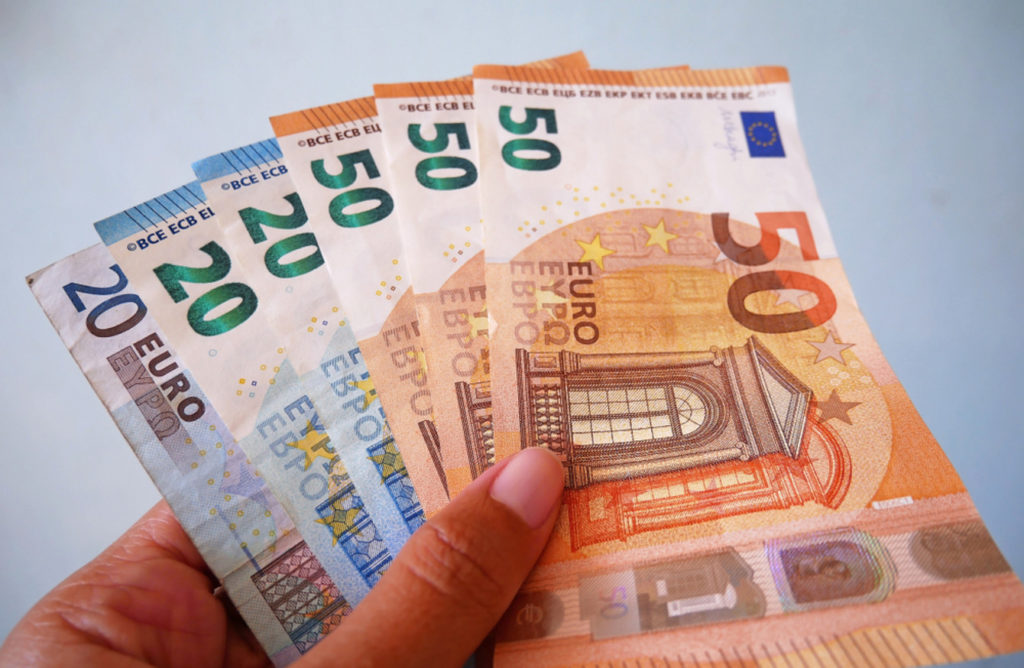
3) The Euro is that transfer student no one paid attention to until she came first in class. Now, everyone is wary.
Euro likes group work and collaborations.
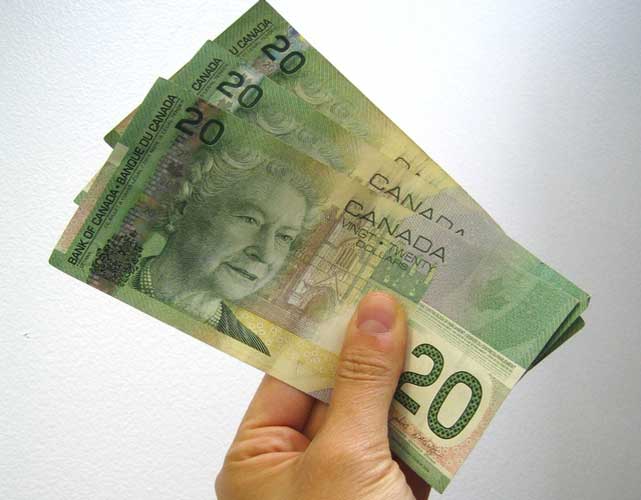
4) The Canadian dollar is the kid who was assistant class captain and has now made it his life mission to be class captain.
His tactics is to rally the marginalized towards his cause.
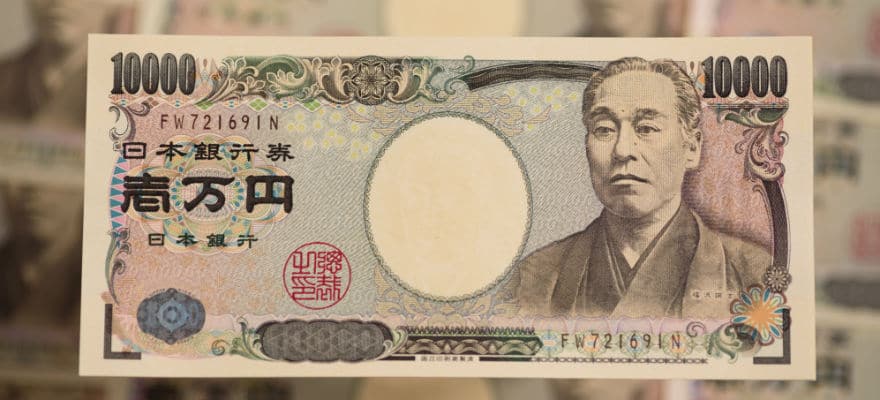
5) The Japanese Yen is that kid with integrity. They’ll write their own sibling name in the noisemaker list and submit to the teacher.
This is the kind of person that cheats in an exam and reports his/her self.
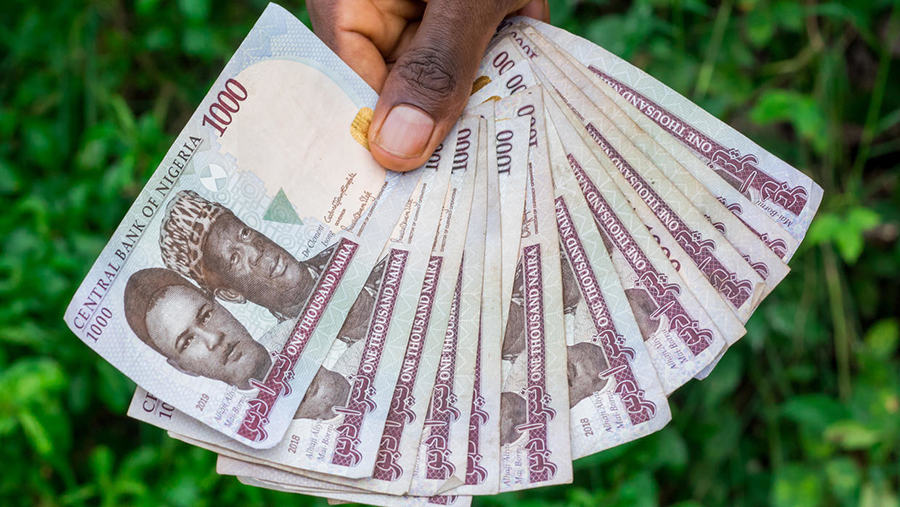
6) The Naira is that kid who always raises their hands and gives the wrong answers.
They brag about knowing all the answers but still fail exams. In addition, they always blame everyone but themselves for failure. Olodo rabata.
How well do you actually know the Naira? If you’ve ever paid attention to the notes you spend every other day, this quiz shouldn’t be too hard for you. So, prove you actually have money by getting more than 7/11.
How long will it take for you account balance to finally catch up with your expensive tastes? Well, this quiz is here to tell you when exactly you’ll become the filthy person you were always destined to be.
Many Nigerians have either been unemployed, underemployed or in a bad job at some point in their work history. To make you appreciate how far you have come, we created a quiz to guess your first salary.
Unlike how much you have sitting in your account, your net worth is the total measure of your wealth — the difference between your assets and your liabilities. So, based on your lifestyle choices, we will try to guess what your current net worth is.
It doesn’t matter if you just won 45 million Naira after spending 90 days locked away with alleged fence jumpers. Or if your Liverpool predictions finally came through with BonanzaBet. If there’s anything sure to ruin your day, it will definitely be converting your earnings into Dollars.
Goes without saying, any chance to have anyone beside Awolowo and the likes staring you down when you open your wallet would be a welcome development, no? Well, this could be our reality, if the ECOWAS Eco ever comes to fruition.
Made up of 15 member states, the leaders of The Economic Community of West African States, are making attempts to have Africa as a better-integrated continent. On July 1, 2019 they adopted the name ‘ECO’ for the planned single currency to be introduced in the West African region.
So What Does This Mean For Nigerians?
Let’s ignore the fact that ‘ECO’ sounds like the name of a 90s Nigerian University cultist, should it become the single currency of Nigeria and the rest of the 14 West-African member states, here’s what we can expect:
Nigeria Will No Longer Hide Their Face When Ghana Walks Into The Room.
That’s because a single currency will mean the abolition of exchange rates.
Even though one Ghanaian Cedi currently exchanges at 67.16 Naira, with the introduction of the Eco currency, all our broke sins shall be wiped away and we will become new again.
This goes for all countries involved, even the 8 Francophone WA States (Benin, Burkina Faso, Guinea Bissau, Ivory Coast, Mali, Niger, Senegal and Togo) which currently use the CFA Franc as a uniform currency.
By doing this, trade between all countries in the region will be made infinitely easier!
Nigeria Will Be Able To Focus On Exporting Their Jollof.
With a single currency, there will be a realistic reduction in the cost of engaging in trade. By so doing, the countries involved will focus on what they do best and exchange it for goods other countries produce. Jollof rice for Ghana’s gold is a fair trade, no?
Nigeria’s Central Bank Won’t Be Able To Carry Shoulders Anymore.
And that’s a good thing. No other country’s central bank will be be either. This is the currency union will have one central bank, completely independent of any state, which will be invaluable in improving price stability.
So why aren’t our wallets filled with Eco notes Right Now?
Well, because man proposes and God Well, He disposes.
Case in point, this isn’t the first time this plan has been suggested. The idea to have a common currency has been raised four times, the first being in the year 2000, when 6 leaders of the Anglophone WA states agreed to create a harmonised monetary union.
Here’s why it’s so hard to achieve.
Because to adopt a single currency, the African states have to pass these tests:
1.Each country has to achieve single digit inflation of 5% or less. In 2018, Ghana’ inflation rate was at 9.84%. Nigeria’s inflation rate, as of February 2019 was 11.31%. It is no easy feat to achieve.
2.ECOWAS also requires all member states to achieve a budget deficit to GDP ratio of 4% or lower before the currency is dropped. It is currently projected that Ghana’s debt to GDP ratio will be 62% by the end of 2019. Nigeria, around 26% in 2020, when the currency is expected to launch.
It’s going to be incredibly hard to achieve.
And if that isn’t hard enough, the reality is, African countries do not necessarily trade among themselves. Overseas trade makes about 80% of total trade on the continent, while trade between African countries accounts for about 10%.
Every week, we ask anonymous people to give us a window into their relationship with the Naira – some will be struggle-ish, others boujee–but all the time, it’ll be revealing.
Here: a lady who cares deeply about fresh food, tells us how she keeps her finances on a leash.
I have many first salaries. The first money I made was Uni in 2011; 300-level and I just sold something that made me ₦2,500. I remember sending part of the money to my siblings. I think I bought them airtime.
“Are you sure you have to send me this money? You need it o.” That’s what my brother said.
But anyway, my next first salary was my NYSC salary, and it wasn’t just the usual ₦19,800. My Place of Primary Assignment also paid me ₦65k.
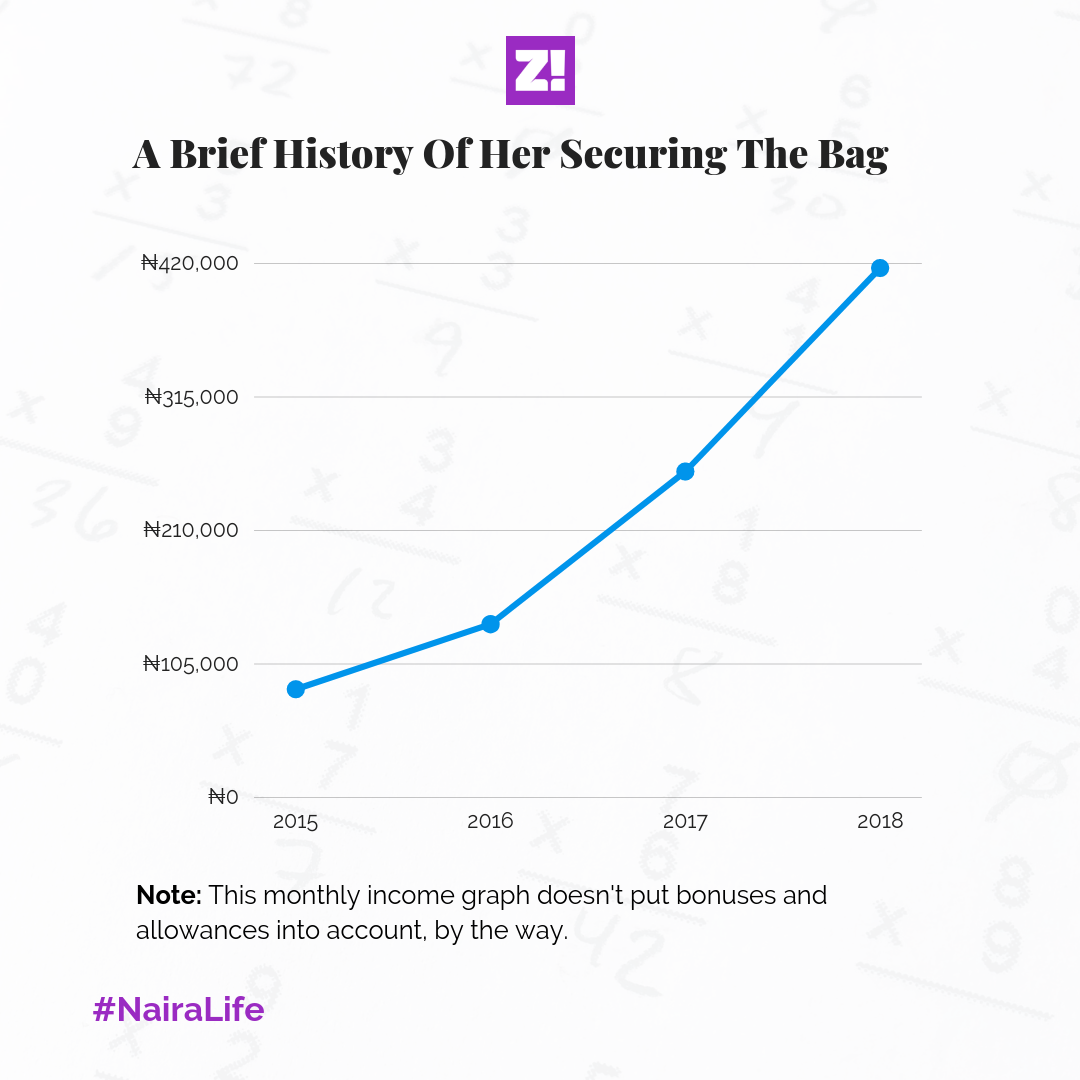
Then to my first post-NYSC salary, my take-home was ₦136k. The annual package was about ₦3.15 mil. (Annual package is the total income earned that year, and they’ll include the money that gets taxed, paid to the pension manager and bonuses).
Where does your money go?
So first, I’m always saving. When my salary enters, my personal rule is to not touch it, until I’ve first of all looked at my budget. I have a budget on lock till December because I have projects, travel plans. So I have to know at what point I need to pay for what, and when I’ll be able to afford it.
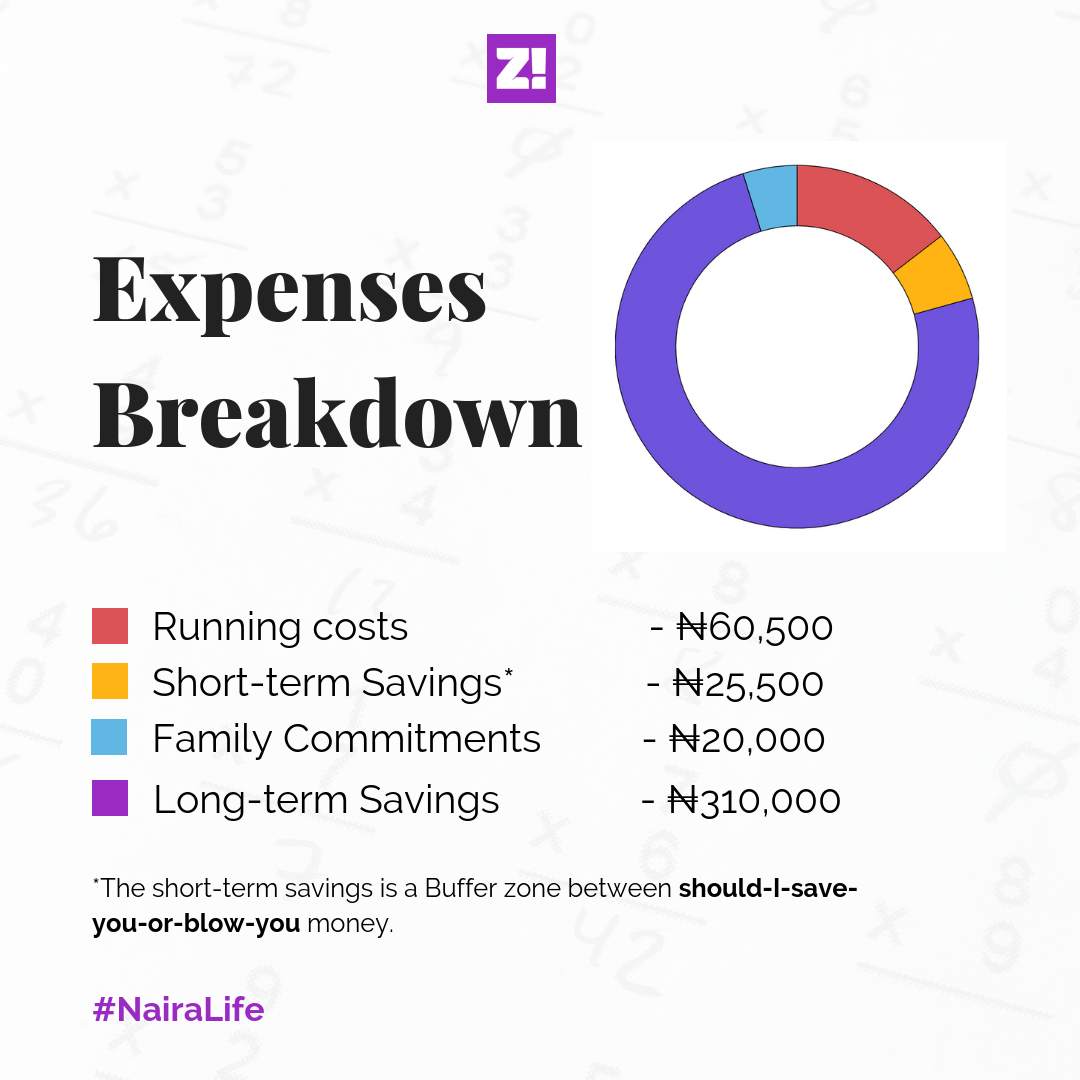
I like to think about my savings in two brackets; short term and long term. My long-term savings is about ₦310k, and it’s for the more tangible things, like investments. My short term is around ₦25k every month.
I also have to say that it’s very rare for me to save the whole long-term savings every month. It happens somewhere around once in 3 months.
For my running costs, I don’t have a lot of expenses so I always budget about ₦60k.
This isn’t always realistic though. Sometimes, all it takes is one day of reckless grocery shopping.
When it’s looking like I’m going to be in trouble, I just pause–check my account, wallet, everything. Then I check my remaining commitments and bills for the rest of the month. I may have to adjust some things or borrow.
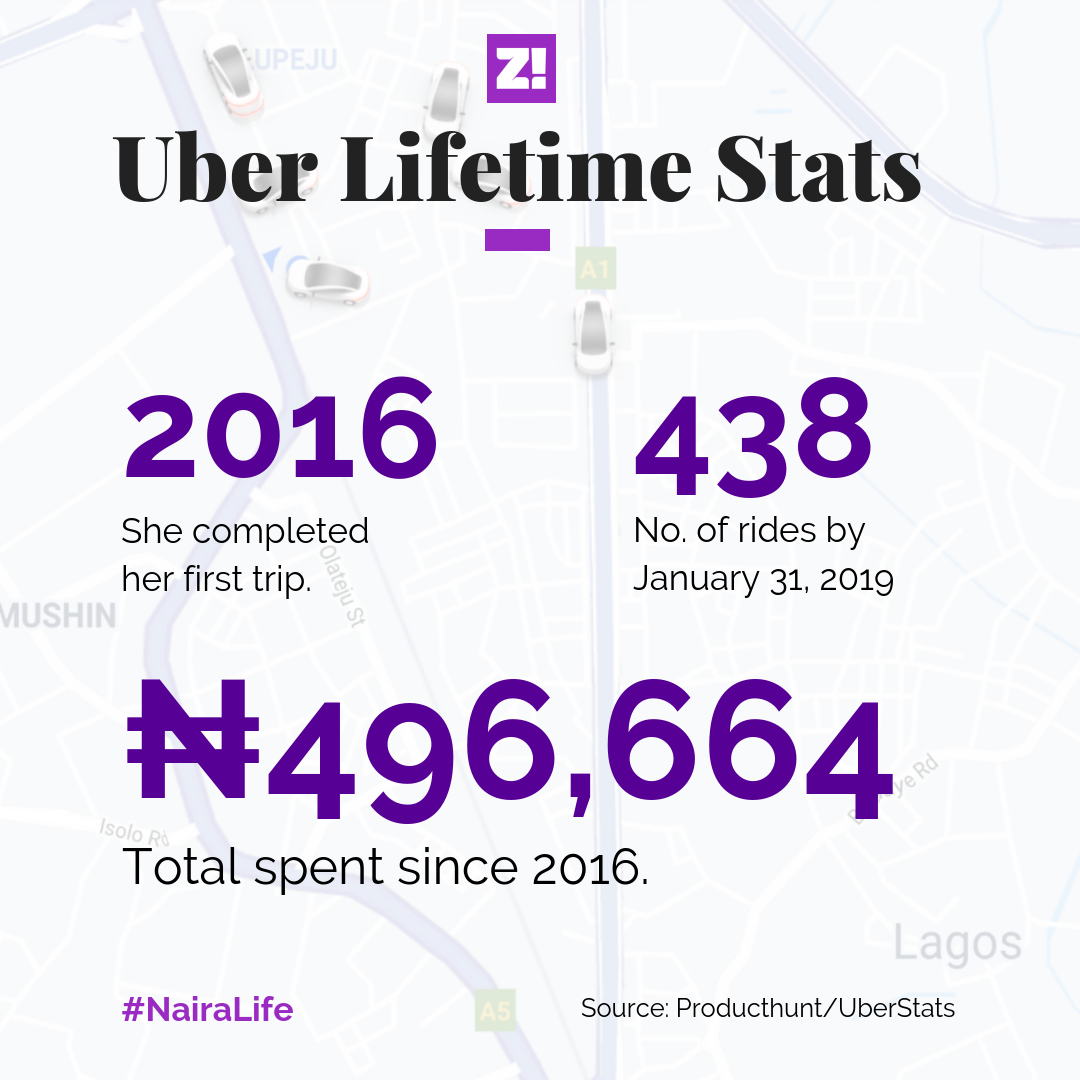
But as long as I’m not taking Ubers, or spending too much on food, staying super-conscious, I’m good.
What do you spend the short-term savings on?
Small things tend to pop up–like bridal showers and the occasional Aso-Ebi – like once in 3 years. I tend to be selective about the Aso-Ebi I indulge in, and it’s not even about the money. I think it’s an imposition, and it’s cancelled in my books.
But to be honest, what tends to take the bulk of my money is fresh food. Every other weekend, I might just blow like 4k. I used to have a groceries budget. Used to.
My Uber budget has almost disappeared because I have a car now. My ₦6,500 full tank lasts me for 2 and a half weeks.
I still Uber every now and then. Public transport to work used to cost me ₦400 a day, to and fro. It was actually ₦300–the extra ₦100 is for the occasional fruits I buy en route.
What do you think about what you currently earn?
I dunno, really. I never realise how little I was earning, just until I’m earning more. But I’m content with it.
What was the old job like?
It was quite prestigious. You walk into a room–any room–tell them where you work, and everyone falls in line. But it was also die-on-the-job work. It trains you to become a soldier. After 2 years, I quit mostly because I was looking for a better quality of life.
Now, I’m lucky to be at a job where I have a good quality of life and I earn good money.
Realistically, what is great money for you?
First of all, it can’t even be in Naira.
How much money are we talking here?
Bastard money. Just leave it like that.
What’s something you can’t afford but totally want now?
Property. It’s not even a want. You should always be looking to own property because you can’t be paying rent in this Lagos. But for how long will I save to buy a property of ₦30 million really?
What does your ₦250k/year rent currently fetch you?
Oh a studio apartment–one room, a kitchen and a bathroom. You know, my leave allowance used to be my rent money. My former job used to pay my leave allowance in the month rent was due.
Do you ever think about retirement?
I really haven’t thought about it, but maybe I’ll go to where rich people are, find someone to marry me, then start doing rich people things.
…
Okay on a serious note, I know the goal is to find something I enjoy doing to the point that I don’t have to retire. Currently, I’m not there yet, I’m just winging my whole career.
Once in a while, I just remember “oh, we have this pension thing!” and then I check. It was a little over ₦1.6 million at my last check.
What’s the last thing you paid for that required serious planning?
My car. All of my long term savings last year went into my car. I copped it for ₦2.9 million. My agent gave me a pretty good deal.
Tell me the most stressful miscellaneous you’ve had to pay for?
Definitely car trouble. ₦25k or so. Or when I have to fix something in the house, like the annoying plumbing that spoils overnight.
I’m constantly over-planning, so big expenses hardly catch me unawares.
So, you have an emergency fund?
Remember that 20-something-thousand? That’s supposed to be my emergency fund–in fact, I named it “Contingency” in my spreadsheet. So by the end of the month, I’m like “wait, no emergency. Oh, nice. Spend that money girl.”
Another bad habit I have is that, say I budget ₦40k for something and it comes at ₦20k, I just go yayyyyy, and then I blow the rest on food.
This financial satisfaction thing, where will you say you are at right now?
Between ₦136k to ₦416k, I think there’s a point you get to where you’re just okay. You don’t have to worry about some basic stuff–a comfort zone. So about life satisfaction, I’m content.
When did you hit the comfort zone?
I’m not sure, but the move that gave me peace of mind also gave me good money. My previous take-home when I quit was ₦256k, so it was both.
About that annoying 5-year question;
I’ve always failed this. People ask me, and they’re never satisfied with my answer. They find this hard to believe, but I’m not the most ambitious. I’m not big on ambition, but I can’t compromise on competence. I believe in cultivating competence, even if all that’s required of you is washing plate at The Place.
Career-wise, I’m totally winging it.
Let’s try this question again, but short-term.
One of my goals this year is to actively seek out investment opportunities. I did a 7-year Sukuk bond in 2017 that will give me a 16% profit. I also invested in an Online Agric investment platform in October 2018. You pay like ₦250k in stages and you get an estimated ₦100k profit.
Also, there’s the ₦50k Ajo I just do with the money I don’t really need with part of my long term savings.
When it comes, I’m balling.
You do pretty well with money.
To be honest, I think knowing where you are with money gives you power. I know what I can’t afford for the rest of the year. When I get paid, I don’t touch my money until I look at my budget. Like, I’m always rushing to my laptop to check my spreadsheet before I touch it. I also have a separate account for my running costs.
Any side hustles?
I have this one where I’ve put in a total of about ₦200k. I started last year, selling stuff online with a friend. We split the damage 50/50. We’re on our third inventory cycle, and for the first time, we don’t have to put any money into it.
3rd inventory?
Yeah, the stuff we sell. The first inventory, we put in money of course. The 2nd cycle, we put in a little less money. Then the 3rd cycle, the only reason we put in money was to increase our inventory.
How’s that going?
We sell on Jumia, and that one is pretty easy. But the Instagram part? If selling on Instagram will not teach you patience, nothing will. Constant engagement is exhausting.
I’m thinking about what you said earlier about ‘quality of life’
Quality of life for me means quiet in my head. I just want to be able to slow down, and think clearly. Not necessarily money. I remember this one night at my last job:
I’m working overnight with two other superiors. Between them is a total of 25 years of work experience. I totally respect their commitment to the work, but I know right there that I don’t want to live like that for long.
That moment was my trigger.
Check back every Monday at 9 am for peeks into the Naira Life of everyday people.
If you’d love to share your Naira Life with us, tell us here. You’ll be anon, of course 🙂
As much as Nigerians love money, they can be very clueless about it. Things like how to invest and grow your savings or manage your money efficiently can be confusing for the average Nigerian. Like how many of us even know what mutual funds means? So if you are confused about money as we are then you need to be following these social media accounts ASAP.
Tunji Andrews
@TunjiAndrews is the Lead Economist at Time, Trade and Commodities (TTAC) and a media personality. Asides his Twitter page, his show ‘The Money Business and Economy Show’ on Nigeria Info FM offers a treasure trove of financial tips.
Nairametrics
@Nairametrics is a financial literacy and business new site. Beyond the site, their Twitter page is packed full with financial advice and tips that are updated pretty regularly.
Ugo Obi-Chukwu
@Ugodre is the team lead at Nairametrics. He is also a chartered accountant with over 16 years of experience in financial management and corporate finance. So you already know he knows his shit.
Arese Ugwu
@smartmoneyarese is the author of the best selling book ‘The Smart Money Woman’. She is also the founder of Smart Money Africa, a personal finance blog that will offer you better financial advice than just there’s rice at home.
Nimi Akinkugbe
@MMWithNimi has a Bachelor’s degree from the London School of Economics and was once General Manager and Head, Private Banking and Director of Stanbic Bank. She also runs a personal finance site called ‘Money Matters with Nimi’
Moe Odele
@Mochievous is an experienced finance attorney and startup advisor. She runs a social enterprise called ‘Scale my hustle’ which helps new entrepreneurs launch and grow successful businesses.
Oluwatosin Olaseinde
@tosinolaseinde is the founder of ‘The Money Africa’. She’s a chartered account with over 8 years of experience in finance.
The Money Africa
@themoneyafrica offers insight into everything money. From financial literacy, to how to grow your money in ways that don’t involve MMM type of schemes they’ve got you covered.
Tomie Balogun
@tomiebalogun refers to herself as a millennial investment expert. And if you scroll through her Instagram page you’ll find that she lives up to her promise.
If you know any other great accounts, please share!
Imagine you picked up your phone right now and saw a credit alert – 1 million naira. What will you do with it?
We asked these 10 Nigerians what 1 million Naira will do in their lives right now and their answers were very interesting.
“1 million naira would help me jumpstart a side hustle or get a car for uber or land for agriculture. Nobody would know I have the 1 million abi?” – Ayoola
Because financial freedom is bae.
“Hayyy. I’ll use it for rent and to get a Macbook. Oh and to fix my car too” – Folarin
One million can help you fix up your life.
“Omo nothing actually apart from saving for a new car” – Pepo
How long do you want to be about that bus life?
“Mennn…I will first of all go somewhere like Hard Rock and get drunk to calm my navs. Then I’ll buy car.” – Sade
Because you just can’t come and die.
“I’ll buy music equipment and become a DJ on weekends sha because I have a full time job please” – Bankole
Just see the way DJ Cuppy is flourishing.
“I’ll use it to pay for an MBA, straight up” – Biodun
School fees is expensive please.
“Travel as far as it’ll take me” – Toke
Have you seen the price of tickets?
“Ermm…not much, but it will be good cash to invest” – Dayo
Shey Dangote started from somewhere too.
“Bills, bills, bills” – Sudeen
Can’t let Nigeria come and kill you.
“Resign from my job first and foremost, then maybe invest some of it” – Eniola
Who has time for a 9-5 when you are a millionaire.
“I’ll use it to start processing relocation papers immediately” – Olanrewaju
Canada loading.
“Plenty! Where do I collect this money please?” – Tomiwa
Well, we have good news. STAR is sharing money and there is actually a way you can get this million or even millions by August.
Go to your nearest bar or supermarket. Ask for STAR Lager Beer Limited Edition Bottle.
Make sure it’s the Limited Edition Bottle.
Open the bottle and hold on to the crown cork.
You’ll see a code on the crown cork. Now dial *566*20# and enter the code you see. Follow the prompts until you redeem your prize.
Just look at all these people that have already won their own one million.
Do any of them have two heads? So go grab a bottle, and stand a chance to win.
Don’t forget, you also stand a chance of winning thousands of naira in airtime.
So whatever you do, don’t carry last.
Destiny awaits, the question now is, are you ready?
During the past few months, we have seen the Naira drop in value against other currencies like a plane falling from the sky. Ridiculous! If you have had to do forex transactions you will understand these situations.
1. When you are planning to do masters abroad
Is it really worth it?
2. And you are thinking of a way to convince your parents to pay for it
Maybe God will touch their hearts.
3. When you finally tell them your plans
And you want to go to study fashion design or theatre in London? You need to go for deliverance!
4. Shopping for birthday clothes on a foreign website and your shopping cart is full
Is it not better to manage what I have? Let me #BuyNaijaToGrowTheNaira
5. When someone mistakenly asks you what you earn in Dollars
Please don’t do this.
6. When you see someone on your Instagram flaunting wads of foreign currency
Now following, pls kindly follow back sir. Epp Me.
7. When a Ghanaian says your country is now like Zimbabwe
Don’t let the devil use you today please!
8. When someone mentions travel abroad and vacation in the same sentence
Please carry your unfortunate self and go away.
9. When you realize Benin Republic, Ghana and Mozambique have stronger currencies
See our life! Why us? What an embarrassment!
10. When you realize you have one $100 or £50 in your vault from two years ago
Isn’t God good!! I’m laughing straight to the bank!
In light of the new Forex restrictions and the depressing state of our currency, it’s only expected that we do the most Nigerian thing we can: at least try to find some humor in it.
So here are 15 tweets about the Naira that are guaranteed to make you laugh.
1. The tweet about one head being better than two.