Notice: Function _load_textdomain_just_in_time was called incorrectly. Translation loading for the wordpress-seo domain was triggered too early. This is usually an indicator for some code in the plugin or theme running too early. Translations should be loaded at the init action or later. Please see Debugging in WordPress for more information. (This message was added in version 6.7.0.) in /home/bcm/src/dev/www/wp-includes/functions.php on line 6121
Muhammadu Buhari | Zikoko! Muhammadu Buhari | Zikoko!
  • Nigerians Should Stop Doing These Weird Things for Politicians

    One of the greatest feelings for Nigerian politicians is knowing they have people who are in love with them enough to do anything for them. 

    Nigerian politicians enjoy a lot of public goodwill

    And love makes you do strange things, but some people on this list like to overdo things. We need them to think more before they act.

    Showing your naked bum bum to the internet

    Nothing prepares you for logging onto social media and seeing the bare asscrack of someone’s grandfather at the beach calling on God to help his candidate win. Yet, Nigerian actor, Ebun Oloyede, didn’t consider this when he subjected millions of Nigerians to a video clip of himself completely naked, with a back view no one asked for or deserved.

    We’re pretty sure Oloyede hasn’t dedicated this much to a film role before, so why do it for politics? Let this be the last time, sir.

    Drinking gutter water

    For most people, voting for a candidate who goes on to win an election is always a cause for celebration. Most normal people would put an extra piece of meat on their rice or go out for a few bottles of beer with friends. But for Aliyu Muhammad Sani of Bauchi State, Buhari’s re-election victory in 2019 was his excuse to take a full dive into a rubbish-filled gutter. 

    Nigerian politicians enjoy a lot of public goodwill

    [The Guardian]

    Sani had promised to swim inside a gutter and drink drainage water if Buhari won, but maybe this is the one time it was okay to act like a Nigerian politician and not go through with a promise. To clarify, swimming in a gutter of rubbish is bad for your health and for our eyes.

    Trekking interstate

    Nigerian voters have upheld a tradition of doing interstate treks as a declaration of love for their favourite candidates so much that it’s got weird. The most infamous of the trekkers is Suleiman Hashimu who walked 750 kilometres in 18 days from Lagos to Abuja to celebrate Buhari’s 2015 victory. Buhari rewarded him with a handshake and eight years of whatever Nigeria currently is.

    Nigerian politicians enjoy a lot of public goodwill

    Dahiru Buba, another infamous Buhari trekker, who made a trip from Gombe to Abuja with his legs in 2015 needed financial help in 2020 to treat limb pains that developed after his unnecessary walk. 

    You’d think these consequences would dissuade future trekkers, but some supporters are already trekking from state to state for 2023 presidential candidates.

    Fighting your friends for politicians

    The trend of severing ties with longtime associates over support for politicians has grown over the past eight years as online political discourse has become more toxic. 

    Nigerian politicians enjoy a lot of public goodwill

    The big attraction of democracy is it allows everyone to responsibly table their points of view without fear of bad blood, but that isn’t always the case between supporters in different camps. 

    What’s worse about this hostile trend is the politicians they’re fighting these battles for are publicly friends when elections are over and don’t care about your private relationships. Yet, there you are, cutting off your own friends.

    Nigerian politicians enjoy a lot of public goodwill

    Election violence

    Electoral violence is a feature as old as Nigerian politics itself, and it’s just sad that the pawns of the game are yet to realise they mean nothing in the grand scheme of things. People who’ll be abandoned to their fates after elections are the ones physically manipulating the process for unqualified people to march into office. 

    Nigerian politicians enjoy a lot of public goodwill

    The trend of electoral violence has tipped downward over the past few election cycles, but those who haven’t got the message must realise they’re running a fool’s errand.

    Stuff on Buhari: The President’s Weirdest Decisions We Thought Were April Fool’s Day Jokes But Weren’t

  • We Need to Talk About Aisha Buhari

    This is Zikoko Citizen’s Game of Votes weekly dispatch that helps you dig into all the good, bad, and extremely bizarre stuff happening in Nigeria and why they’re important to you.

    Subscribe now to get the newsletter in your email inbox at 8 am every Friday instead of three days later. Don’t be LASTMA.

    We Need to Talk About Aisha Buhari

    If Aisha Buhari was a fruit, she’d be a strawberry — wonderful aesthetics on the outside, but you’re not always quite sure what you’ll get when you dig your teeth in. 

    As Nigeria’s first lady since 2015, she’s had a reign no one would be able to accurately describe as uneventful.

    We Need to Talk About Aisha Buhari

    Aisha Buhari’s first true moment in the spotlight came in 2016 when she criticised her husband’s running of the Nigerian government. In response, while standing next to Angela Merkel, one of the world’s most powerful women, Buhari said his wife belonged in the kitchen and the bedroom. 

    The episode painted the president as an ancestor from a forgotten ancient past and endeared many people to his wife — the public figure unafraid to speak truth to power in service of the people. But the first lady’s character development arc since that episode is the stuff of an Oscar-worthy film.

    In 2018, many Nigerians had questions when Aisha Buhari accused her aide of collecting ₦‎2.5 billion cash gifts on her behalf only to keep the loot for himself. Even her occasional anti-government rants started to look suspicious when some of them appeared to be fuelled by her frustrations about her brother’s political issues with her husband’s ruling party. And how can we forget the video clip of her fight with her in-laws in 2019, and another off-camera fight with another in-law that led to gunshots inside Aso Rock?

    We Need to Talk About Aisha Buhari

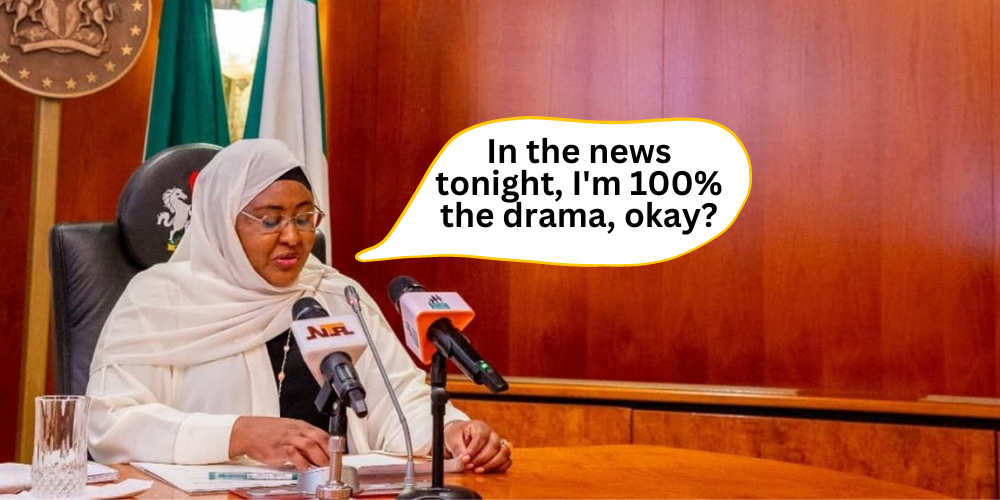
    The year is 2022, and Aisha Buhari’s capacity for attracting ugly news headlines is stronger than our national grid’s willpower. The first lady became a dinner table subject this week when she allegedly ordered the arrest of a university student, Aminu Muhammed, who used Twitter to call her a fat freeloader feeding on Nigeria’s wealth. I’m paraphrasing here.

    The first lady’s action proved counterproductive because now the internet is littered with a multitude of mean-spirited jokes at her expense. This barbaric overextension of state powers to deal with a personal slight that’s a civil case of alleged defamation is the kind of thing that tells you Nigerian politicians don’t exactly understand the times they live in. Have you met the internet, bro?

    We Need to Talk About Aisha Buhari

    What else happened this week?

    Protect INEC at all costs

    As the gatekeeper of what we call democracy in Nigeria, the success or failure of the Independent National Electoral Commission (INEC) is tied directly to the country’s future. So, seeing another INEC office go up in flames this week was a dreadful sight. The latest attack in Ebonyi is the fifth on an INEC local government area office in the past four months.

    Attacks on INEC facilities have become a trend in Nigeria and are designed to either damage the agency’s capacity to conduct elections or scare even more voters away from exercising their voting rights due to the threats of violence. 

    Election candidates may want to use their voices more to ensure this doesn’t become a more common sight.

    Have you seen this video?

    Question of the week

    Fuel scarcity was back in full force again this week. How have you been navigating the latest crisis?

    Click here to tweet your answer to @ZikokoCitizen on Twitter.

    Ehen, one more thing…

    Three Nigerian men caused an international incident when officials found them hiding on the rudder of a ship that travelled for 11 days from Nigeria to Spain.

    The country is hard, but things can always get worse if you don’t seek greener pastures with a clear plan.

  • These Famous Nigerian Faces Belong on Your Naira Banknotes

    President Buhari and Godwin Emefiele of the Central Bank of Nigeria (CBN) are pretty set in their decision to apply makeup to naira banknotes for the first time in 20 years.

    Even though the Minister of Finance, Zainab Ahmed, has called it a bad idea, the new banknotes will enter circulation on December 15, 2022. Buhari launched the new Snapchat filter designs on November 23, 2022, and the CBN has even started a countdown to when the old naira notes will stop being valid in 2023.

    These Famous Nigerian Faces Belong on Your Naira Banknotes

    We know the redesign of the ₦‎200, ₦500 and ₦‎1,000 banknotes doesn’t involve changing the faces on them. But if it did, these famous deceased Nigerians have credible claims.

    Funmilayo Ransome-Kuti

    These Famous Nigerian Faces Belong on Your Naira Banknotes

    She’s most popularly remembered as the first Nigerian woman to drive a car, but Funmilayo Ransome-Kuti was more than that. She wasn’t called the Lioness of Lisabi for no reason as she pioneered many groups that championed women’s rights. She founded a political party and was the first woman appointed to the Western House of Chiefs.

    Shehu Shagari

    These Famous Nigerian Faces Belong on Your Naira Banknotes

    No single elected Nigerian president is on any of the naira banknotes, and Shagari can be the first as he’s the country’s first elected president. 

    Gambo Sawaba

    These Famous Nigerian Faces Belong on Your Naira Banknotes

    Sawaba has been regarded as the most jailed Nigerian female politician due to her resilient activism. She campaigned against child marriage, unfair labour practices, and championed women’s rights. For her troubles, she was publicly flogged, had her hair shaved with a broken bottle and was imprisoned 16 times. If anyone has a claim to belonging on a naira banknote, Sawaba shouldn’t even need to raise her hands.

    Anthony Enahoro

    As one of Nigeria’s pro-democracy activists, Enahoro was the first to move the motion for the country’s independence in 1953. It’s why he’s regarded as the “Father of Nigerian Independence”. What more do you need to do to get your face on a naira banknote?

    Gani Fawehinmi

    These Famous Nigerian Faces Belong on Your Naira Banknotes

    Gani Fawehinmi was a human and civil rights lawyer known for his vibrant activism for the underprivileged. He gained local and international recognition for his work but also suffered persecution by the government.

    Margaret Ekpo

    These Famous Nigerian Faces Belong on Your Naira Banknotes

    Like Sawaba and Ransome-Kuti, Ekpo was a rights activist and social mobiliser who created political pressure groups to fight for the interests of Nigerian women.

    Taslim Olawale Elias

    These Famous Nigerian Faces Belong on Your Naira Banknotes

    He already has the face of someone disappointed in the naira’s value

    Elias was Nigeria’s first post-independence Minister of Justice and Attorney-General of the Federation. He went on to serve as the Chief Justice of Nigeria (CJN) and president of the International Court of Justice (ICJ). He also received 17 honorary doctorate degrees from various universities around the world.

    Ameyo Adadevoh

    If not for the intervention of Dr Ameyo Adadevoh, Nigeria’s ebola crisis of 2014 would’ve been worse than the eventual 20 confirmed cases and eight deaths, including her own. She made the ultimate sacrifice to protect millions from a similar fate. What more do you need to have your face on a naira banknote? 

    Ken Saro-Wiwa

    These Famous Nigerian Faces Belong on Your Naira Banknotes

    The brutal General Sani Abacha regime killed Ken Saro-Wiwa and eight other activists in 1995, for their agitation against the environmental damage caused by crude oil extraction in Ogoniland. No compensation will restore his life, but his face on a naira banknote will immortalise him and the issues he fought.

    Dora Akunyili

    These Famous Nigerian Faces Belong on Your Naira Banknotes

    Dora Akunyili watched her sister die as a result of complications from taking fake medicine and made it her life’s mission to ensure it didn’t happen to anyone else. As the head of the National Agency for Food and Drug Administration and Control (NAFDAC), Akunyili fought powerful drug counterfeiters to keep millions of Nigerians from falling victim.

    Chinua Achebe

    The story of African literature would be incomplete without the contribution and impact of Chinua Achebe. Things Fall Apart is the most widely studied, translated and read African novel.

    Fela Anikulapo-Kuti

    These Famous Nigerian Faces Belong on Your Naira Banknotes

    He’d probably roll in his grave if his face appears on a naira banknote considering many of the issues he sang about still exist decades after his death. Even his arch-nemesis, Buhari, is currently president. But much of his life and music was devoted to activism to make the country better, so he has a valid claim.

  • How Politicians Use Nigerian Women Without Rewarding Them

    At an event in Abuja on October 10th, 2022, President Buhari made an announcement that would make you mistake him for a feminist.

    How Politicians Use Nigerian Women Without Rewarding Them

    The president directed the Minister of Justice, Abubakar Malami, and Minister of Women Affairs, Pauline Tallen, to brainstorm on possible constitutional and legal changes that would create a level playing field for Nigerian women in politics and governance. 

    On the surface, Buhari’s call might get Nigerian women excited about inclusion. But history has shown that the president’s action is just another one of those political moves intended to use and dump voters — in this case, Nigerian women. We’ll explain.

    How Politicians Use Nigerian Women Without Rewarding Them

    The president made his remarks when his party, the All Progressives Congress (APC), inaugurated its Women Presidential Campaign Committee. This special committee of over 900 high-profile women is separate from the central campaign committee for the party’s presidential candidate, Bola Tinubu.

    Buhari’s directive was a clear ploy to get those women to spread the gospel that his government is pro-women and will remain so if they vote for the party in 2023. But there’s enough paper trail that shows it’s nothing but shameless pandering. 

    A blast from the past

    In March 2022, Nigerian lawmakers in the House of Representatives and Senate voted on five women-centric bills. The bills proposed to:

    1. Create 111 exclusive seats for women in the National Assembly and 108 exclusive seats in the 36 state legislative chambers.

    2. Allow foreign husbands of Nigerian women to become citizens by registration.

    3. Fill 35% of executive committee positions of political parties with women.

    4. Allow a woman to automatically become an indigene of her husband’s state after five years of marriage.

    5. Fill at least 10% of federal and state cabinets with women.

    All the proposals failed in either one or both chambers. 

    How Politicians Use Nigerian Women Without Rewarding Them

    In fact, lawmakers in the House of Representatives gleefully jumped for joy after denying Nigerian women fundamental rights. Buhari’s APC controls both chambers of the National Assembly.

    Nigerian women and the 2023 elections

    4,223 candidates will contest for 469 seats in the National Assembly in the 2023 elections, but only 380 (9%) are women. 

    How Politicians Use Nigerian Women Without Rewarding Them

    It’s the statistic that ensures the dismal representation of women in elective office won’t improve after the elections. And decisions like the ones the National Assembly lawmakers made in March keep women out of the picture in the places that matter. But they’re a very cherished voting bloc that usually receives empty promises when it’s time for elections.

    Who’ll save Nigerian women from exploitation?

    The truth is that Buhari’s charge to his officials is nothing but another case of pandering to Nigerian women. He’s well aware that the National Assembly, controlled by his party, has thrown gender inclusivity in government into the bin. Even Buhari himself promised women would make up at least 35% of his second-term cabinet, only to end up with 16% after his election.

    How Politicians Use Nigerian Women Without Rewarding Them

    Nigerian women are one of the most active groups during elections, which is normal because they make up half of the country. But the reality of their population isn’t represented in the make-up of Nigeria’s elective or appointive offices. It’s important that before women cast their votes in 2023, they’re confident they’re voting for people that truly have their best interests at heart.

    The exploitation of the women voting bloc didn’t start with Buhari, but it’s time for Nigerian women to demand better with their votes. They’re valuable for more than just elections.

    ALSO READ: Does the National Assembly Hate Nigerian Women?

  • How Come These Nigerians Are Getting National Honours?

    On October 11th, 2022, President Buhari will host a ceremony at the Aso Rock Villa to confer national honours on 437 recipients. These honours are the nation’s most premium, the kind that you win and can legitimately use “Do you know who I am?” unprovoked in an argument with a random stranger.

    These national honours are a recognition of meritorious service to Nigeria, mostly for Nigerians but also awarded to some outstanding foreigners.

    For example, one of the recipients of this year’s honours is the late Dr Stella Adadevoh who courageously limited the spread of Ebola in Nigeria in 2014. Another recipient is Abdullahi Abubakar, an imam who hid and protected 262 Christians from being killed during a religious crisis in Plateau State in 2018. Josephine Agu, an airport cleaner who returned $12,200 she found in a toilet, will also receive the honour.

    Some public officeholders also get these honours by default. But if there’s anything to expect about a national honours list, it’s that everyone can’t agree that every recipient deserves it. And there are some names on Buhari’s list that have raised eyebrows, but first…

    What are the Nigerian national honours?

    Here’s a list of the national honours Buhari is awarding Nigerians — and seven foreigners — this year.

    1. Grand Commander of the Niger (GCON)

    2. Commander of the Order of the Federal Republic (CFR)

    3. Commander of the Order of the Niger (CON)

    4. Officer of the Order of the Federal Republic (OFR)

    5. Officer of the Order of the Niger (OON)

    6. Member of the Order of the Federal Republic (MFR)

    7. Member of the Order of the Niger (MON)

    8. Federal Republic Medal I (FRM I)

    9. Federal Republic Medal II (FRM II)

    These are some of the award recipients raising eyebrows

    Ogbonnaya Onu for CON

    How Come These Nigerians Are Getting National Honours?

    This man has been the Nigerian Minister of Science and Technology since 2015 and it’s impossible to say he’s covered himself in glory. 

    In 2016, unprovoked, Onu promised that Nigeria would hack the local production of pencils within two years. Six years later and his promise has entered voicemail alongside the 400,000 new jobs he promised. 

    We didn’t ask for flying cars or landing a Nigerian on the moon o. Ordinary local pencil production and he didn’t deliver, so why does he deserve a CON?

    Adamu Adamu for CON

    How Come These Nigerians Are Getting National Honours?

    This man supervised some of the worst ASUU strikes in Nigeria’s history, so who was he really serving to deserve a CON? And to award him at a time when university students have been sitting at home for over eight months is just rubbing salt into the wound.

    Mamman Daura for CON

    How Come These Nigerians Are Getting National Honours?

    Mamman Daura is also getting a CON for being an “elder statesman”, but you may remember him as Buhari’s nephew. Blood isn’t just thicker than water; it can also get you a national award.

    Sabi’u Yusuf for OON

    How Come These Nigerians Are Getting National Honours?

    Sabi’u Yusuf is another awardee with blood ties to the president and it’s just easy at this point to call this the Buhari family honours list. Yusuf also serves as Buhari’s personal assistant and was once involved in a confrontation with the first lady, Aisha Buhari, that resulted in a gun discharge inside Aso Rock Villa. Being the president’s favourite young nephew gets you an OON.

    Femi Adesina

    How Come These Nigerians Are Getting National Honours?

    For all the years of talking down on Nigerians and calling Buhari “the ramrod straight man” one too many times, Femi Adesina, the president’s vuvuzela, is also being rewarded with an OON.

    The Federal Government has disowned the list of award recipients reported by the media and promised to release the authentic list when appropriate. But we’ll all see on October 11th, won’t we?

  • What We Learnt from Buhari’s Presentation of the 2023 Budget

    On October 7th, 2022, Muhammadu Buhari presented his final annual budget as the president of Nigeria. 

    What We Learnt from Buhari's Presentation of the 2023 Budget

    He proposed a bill of ₦20.51 trillion to the National Assembly in a long speech that surprisingly didn’t put us to sleep. Here are the things we learnt from his presentation of the 2023 budget.

    Buhari is proud of his achievements

    Buhari has only seven months left until the end of his eight-year reign as Nigeria’s president, so it’s expected that he’d be in a reflective mood. 

    He travelled down memory lane to talk about his supposed achievements in the areas of infrastructure and good governance.

    He also talked about his government’s “impressive” investment in improving Nigeria’s power generation to 4,000 megawatts. Let’s not forget that this figure is serving a country of over 200 million people. 

    The president also forgot to mention the seven times the national grid collapsed this year and stressed Nigerians.

    Buhari wants your taxes

    What We Learnt from Buhari's Presentation of the 2023 Budget

    Bring before me all your taxes so I can afford a medical trip to London

    Nigeria wants to be a baller, but it’s currently on a mechanic’s income, and Buhari doesn’t like that so much. The president described revenue shortfall as the “greatest threat to Nigeria’s fiscal viability”. 

    And his most prominent solution for addressing that is checking inside the pockets of Nigerians to collect taxes, but sapa has already beaten the government to it.

    Everyone is worried about crude oil theft

    What We Learnt from Buhari's Presentation of the 2023 Budget

    One of the main causes of Nigeria’s revenue shortfall is decreased earnings from crude oil which is the nation’s main source of income. This decrease is due to the activities of oil thieves who are lining their personal pockets with resources that belong to everyone. 

    What We Learnt from Buhari's Presentation of the 2023 Budget

    The Senate President, Ahmad Lawan, described the thieves as “the worst enemy of Nigeria” in his opening speech. We don’t know if that’s because he really cares about Nigerians or because the situation potentially puts his own jumbo allowances in jeopardy. 

    Buhari and the Speaker of the House of Representatives, Femi Gbajabiamila, also raised concerns about the theft. We just didn’t hear them propose concrete solutions to stop the stealing.

    Buhari isn’t worried about Nigeria’s gbese

    What We Learnt from Buhari's Presentation of the 2023 Budget

    Even though Nigeria isn’t making as much as it needs, and is using much of its meagre revenue to service heavy debt, Buhari still isn’t worried. 

    With Nigeria’s total public debt at ₦42.9 trillion, Buhari considers Nigeria’s position as within acceptable limits compared to other countries. So, he thinks this is an “I better pass my neighbour” situation even if both neighbours are stranded in a sinking boat in the middle of the Atlantic Ocean. 

    In Buhari’s proposal, Nigeria will even borrow an additional ₦8.8 trillion to finance the 2023 budget.

    ASUU strikes are forever?

    Nigerian students have been sitting at home for eight months due to the strike action by university lecturers over the government’s failure to respect agreements made several years ago. 

    Students watching Buhari’s 2023 budget presentation wouldn’t have been too pleased to hear the president say his government won’t sign any agreements it can’t implement due to scarce resources.

    The president proposed that the government and the people jointly share the cost of education and build a more sustainable system. He didn’t elaborate on how this can happen, but you can imagine it won’t be his problem for much longer.

    Buhari has set a standard

    Before Buhari became president, Nigeria’s budget presentation and passage used to be chaotic, especially with timelines. But this is the third consecutive year that a national budget will be signed before the beginning of the year it’s proposed for. The timely passage of the budget helps better with implementation and fosters a healthy process. It’s not much, but it’s not nothing. Sai Baba, maybe?

    Buhari loves his National Assembly bromance

    What We Learnt from Buhari's Presentation of the 2023 Budget

    In his final budget presentation, Buhari didn’t miss the opportunity to note that he’s enjoyed the massive support of the current National Assembly for his second term in office. 

    Critics have called them a rubber stamp assembly for being yes-men to Buhari, but the president, who loved getting their many yeses, gave them a shoutout before he dropped the mic.

  • Buhari Needs to Do These Things Before He Leaves Office in 2023

    On May 29th, 2023, Muhammadu Buhari will hand over his trials and tribulations as Nigeria’s president to a new landlord of Aso Rock Villa.

    He’s already delivered his last speech at the United Nations’ General Assembly (UNGA) and his last boring pre-recorded Independence Day speech as he approaches the end of his second term. But before he leaves, it’s important that he ticks certain boxes, from fulfilling promises he made before he became president to random stuff we think needs closure.

    These are the seven things we expect Buhari to do over the next seven months before he leaves Aso Rock Villa.

    Lift 100 million people out of poverty

    Nigeria is home to one of the largest populations of poor people in the world. It’s why many young people are trying to japa to escape sapa. Buhari’s mishandling of the economy is responsible for the mess. In reaction to the worrying population of poor people, he made an ambitious promise in 2019 to lift 100 million Nigerians out of poverty before he leaves office. 

    With only seven months left, the president needs to show us the 100 million people he lifted out of poverty, their addresses, genotypes and next of kin.

    Actually end Boko Haram

    When the Nigerian government postponed the 2015 elections due to the activities of Boko Haram terrorists in the northeast region, Buhari wasn’t a big fan of the decision. This was his reaction.

    Since he’s been president, he’s declared many false and premature victories over Boko Haram and has been left with eggs on his face. Boko Haram’s terrorism may have significantly decreased over the past seven years of Buhari’s reign, but the group still has fighting power and exists as the Islamic State West African Province (ISWAP). It’d be a shame if the terrorist group outlasts the president after all the mouth he’s made. 

    Buhari needs to close that terrorism chapter of Nigeria’s history before he returns to Daura.

    Repay his gbese

    With Buhari at the wheel, Nigeria’s total public debt shot up from ₦12.1 trillion in 2015 to ₦42.9 trillion in June 2022. The more he borrowed, the more he pushed for debt forgiveness or cancellation at every international meeting with world leaders, including at his last UNGA in September 2022. 

    And since no one’s interested in cancelling the debt Buhari helped Nigeria rack up, he has to figure out a way to repay in the seven months he has left.

    Return foreign exchange rate to where he met it

    The Buhari campaign made many eye-catching campaign promises in 2015, and one of the spiciest was the promise to make ₦1 the same value as $1. 

    But that same naira currently trades at over ₦700 to $1, seven years after he promised to do magic.

    At this point, we don’t even want him and Meffy to do magic again; just return the naira’s value to where he met it in 2015.

    Do a live interview

    For the most part of his presidency, Buhari has avoided live interviews like a plague. 

    He’s settled for pre-recorded speeches read off teleprompters and a rare couple of interviews with journalists that were cut and joined together inside a studio. 

    Buhari should indulge Nigerians and do just one live interview before he leaves office. We want to check something.

    Be treated by a Nigerian doctor

    Improving healthcare in Nigeria was another one of the promises that stood out during Buhari’s campaign in 2015. But Nigerians saw his true colours when he assumed office and left even his own State House clinic to rot while he fled to the United Kingdom to treat headaches and whatever kept him there for three months in 2017. 

    Buhari has clung stubbornly to the claim that he can’t be treated by anyone but his UK-based doctors. But just before he retires, we’re going to need him to receive medical care — even if it’s paracetamol — from a Nigerian doctor.

    Call Abacha a thief

    Everyone and their grandchild know who Abacha is — a thief who stole billions of dollars from Nigeria’s treasury and died before he could spend the loot. And despite the fact his government has recovered millions of dollars stolen by Abacha, Buhari has failed to retract his past comments that his old friend never stole Nigeria’s money. We’re going to need him to eat those humble pies on national TV before he drops the mic and retires to Daura.

    Or London.

  • What We Learnt from Buhari’s Trip to Imo

    It’s not every day Buhari leaves Abuja for another part of Nigeria that’s not his home in Daura. His top three destinations are usually London, London and anywhere that’s not Nigeria.

    Buhari in Imo

    Catching international flights, not local feelings

    But Buhari made the rare local trip to Imo State on Tuesday, September 13th, 2022, and there are a few things that didn’t escape our watchful eyes. 

    These are the things we noticed about Buhari’s trip to Imo.

    Buhari is healthier than ever

    We just need to get it out of the way that Buhari is looking way more dashing as he approaches the end of his second term in office. He’s gone from looking like in 2017:

    …to looking like the Fresh Prince of Daura in 2022:

    Buhari in Imo

    All those London trips are finally paying off

    We know feeding fat on the Nigerian treasury is a healthcare routine that’s impossible to match, but we’re still going to need him to write a blog post to give us all the tea. Because why’s this guy looking like he’s ready to compete in the Olympics?

    When Buhari promised change seven years ago, he really meant for his own health status. Or maybe this is just how you look when you’ve been on leave from work for seven years.

    Buhari needs a hug

    Buhari in Imo

    Buhari used his Imo trip to take yet another familiar dig at the “Nigerian elite” whom he blamed for not protecting Nigeria’s interests for decades. He blamed them for infrastructural decay, especially the lack of development of the railway system and power.

    The president’s major complaint was even though he’s apparently racking up achievements in the areas previous governments failed, the Nigerian elite isn’t washing his feet, touching the hem of his garment and patting him on the back for a job well done.

    Buhari in Imo

    We’d ask the First Lady to give him a hug for us, but she’s probably back to her Dubai base. Since the Nigerian elite has refused to, who’s going to hug Buhari for us? Xoxo, Mr President.

    Buhari’s in love with Uzodinma

    Buhari in Imo

    A bromance made in the Supreme Court

    Remember how we said it’s super rare for Buhari to make local trips? Well, it’s even super rarer that he visits the same state more than once, especially in a region where he’s not very popular. 

    Yet, this was Buhari’s second visit to Imo State in one year, after a previous visit in September 2021. And that can only mean Governor Hope Uzodinma has his nudes and blackmails him into making these rare trips, or he really loves the governor and would do anything to help him boost his political profile.

    Buhari in Imo

    Nothing says “besties” like matching outfits

    Uzodinma is a man of his name

    Buhari in Imo

    Buhari was in Imo to commission three key projects in the state: a renovated State House of Assembly building and two roads that may or may not be completely ready for people to use. 

    Buhari, like us, only just found out that “Uzodinma” actually means “good road”, and we suddenly feel like that’s why the governor has a hard-on for road projects. Now, we wonder if “Okorocha” means “good statue”.

    Buhari 1 – 1 IPOB

    Before Buhari landed in Imo Tuesday, his people must have been wary that the sit-at-home order declared by the Indigenous People of Biafra (IPOB) would taint his appearance. The order was in honour of the Tuesday court appearance of the group’s leader, Nnamdi Kanu, who’s facing treason charges in Abuja. 

    Many expected that the sit-at-home would mess with Buhari’s visit and undermine his status as the country’s commander-in-chief. Even though there was a sizable crowd that defied the order and welcomed him, the state capital was still largely deserted. So maybe we’ll call a tie here.

    Buhari in Imo

    The compliance with the order illustrates just how much the president has lost authority in the southeast region over the years, and how much more the government needs to do to end IPOB’s sit-at-home mandate that’s crippling socio-economic activities in the region.


    ALSO READ: What We Learnt from Nyesom Wike’s London Tour

  • How to Get Away With Stealing in Nigeria — a Jolly Nyame Masterclass

    Let’s pretend to write the script of an award-winning film.

    EXT. DANBABA SUNTAI AIRPORT, TARABA STATE

    Imagine you’re returning to your home state after four years of being away. As you emerge from a private jet, there’s a crowd of mekunus who erupt in cheers and scream your name. 

    It’s a Saturday, so it’s hard to know for sure if they’re there because they’re unemployed or they really just love you. But you’ll take anything.

    You touch down in your white agbada, happy to be back home, and your rich friends are there to shake your hand. The mekunus all want to touch the hem of your garment. You’re happy to allow them, but there are too many, so you ask them to, “Dress back a bit.” 

    How to Get Away With Stealing in Nigeria — a Jolly Nyame Masterclass

    “Give me some air, please.”

    You’re not ready to go home yet because you’ve spent most of the last four years indoors. You’re an extrovert that needs some outside noise, so you head to a stadium that’s named after you. 

    Your rich friends are there, and so are the mekunus who are still fanning about because it’s a Saturday and there’s no Premier League football to watch because of the Queen’s death. They call this a grand reception, and everyone is in a jolly mood.

    How to Get Away With Stealing in Nigeria — a Jolly Nyame Masterclass

    To the victor, the spoils

    It’s time for speeches and the Speaker of the House of Assembly mounts the podium to say really nice things about you on behalf of the absent state governor. He addresses you as, “Your Excellency” and “an iconic figure” so everyone knows you’re a man of timbre and calibre. Then he calls your return home “an epoch-making occasion” so you know he went to school and isn’t a nepotism baby. He concludes his speech with something about forgiveness.

    How to Get Away With Stealing in Nigeria — a Jolly Nyame Masterclass

    “Forgive and forget, baby. You’re not vengeance.”

    It’s now your turn to mount the podium and address your adoring fans — your rich friends and the mekunus who are still there for some reason. A vote of thanks is important, so you appreciate the retired military general in Abuja who made your return home possible.

    These are tears of joy

    And for your coup de grace, it’s time to talk about the people who were the reason you’ve not been home for four years. You should diss them for keeping you from the comfort of your lovely bed, but you’re not Nyesom Wike and you don’t have his merry band of jesters or the charisma to pull it off. 

    How to Get Away With Stealing in Nigeria — a Jolly Nyame Masterclass

    You’re not him

    As the Christian you are, you forgive your haters with your church mind that doesn’t allow you to wish them evil for sending you away from home. You say, “I hold no grudges against anybody, and I’ve forgiven all who God used to send me to prison.”

    Prison ke? Who are you?!

    You’re Jolly Nyame, and you’re a convicted thief. And the haters you’re forgiving are the people who made sure you faced justice for your crimes. 

    Unfortunately, this is all real life.

    Who’s Jolly Nyame?

    In 1992, the people of Taraba State elected Jolly Nyame as their governor, but his tenure was cut short by the 1993 military coup of General Sani Abacha. Six years later, in 1999, he won another election as governor and a re-election in 2003. This leaves him with the rare flex of having won three governorship elections in Nigeria — a very exclusive club.

    How to Get Away With Stealing in Nigeria — a Jolly Nyame Masterclass

    But when Nyame left office in 2007, the Economic and Financial Crimes Commission (EFCC) knocked on his door to bring him the gospel of anti-corruption. “You’ve been a bad boy,” the EFCC said. Naturally, Nyame didn’t agree

    “Whatever this is about, it wasn’t me that stole the ₦1.64 billion, but I may have taken ₦180 million out of a ₦250 million contract I approved to buy stationery for government offices. I’ll return that small change but leave me alone after,” he said, but not in those exact words.

    The EFCC didn’t leave him alone, and the two parties dragged the case in court for years while Nyame tried unsuccessfully to become a senator in 2011 and 2015. Finally, in May 2018, Justice Adebukola Banjoko of the FCT High Court considered the evidence again Nyame and gave her ruling:

    How to Get Away With Stealing in Nigeria — a Jolly Nyame Masterclass

    Justice Banjoko sentenced Nyame to 14 years in prison, but he fought this judgement at the Court of Appeal which shaved his prison time down to 12 years. Still unsatisfied with his mini-victory, the former governor pressed ahead to the Supreme Court to overturn his sentence, but he lost. 

    These aren’t tears of joy

    Many reasonable people would say this was his final bus stop, but Jolly Nyame’s God doesn’t wear flip-flops — he’s an ordained reverend after all.

    Manna from heaven Buhari

    The government of Buhari (of anti-corruption fame) announced on April 14th, 2022, that the president had granted a pardon to 159 prison inmates and ex-convicts who begged for it. Jolly Nyame was one of the lucky ones. Nigerians were pressed about the pardon, but Nyame couldn’t care less. He was a free man eight years ahead of schedule.

    The presidency explained in April that Nyame got his pardon due to life-threatening ill-health. But that hardly looked the case when the former governor finally made his grand re-entry to Taraba State on Saturday, September 10th, 2022, welcomed and feted by the same people he stole from.

    How to Get Away With Stealing in Nigeria — a Jolly Nyame Masterclass

    What’s the lesson here?

    Nyame’s victory lap in Taraba has naturally received some backlash online: 

    Not only has Jolly Nyame got a slap on the wrist for a crime with far-reaching implications on the lives of people he swore to serve, he’s walking around acting like his release vindicates him. Even worse, the people in government are licking the underside of his boots.

    With the 2023 elections around the corner, a man who robbed his state blind is now promising to help reshape its future. It’s a situation that calls for the head of those who released him to get checked by a doctor or a friendly taser.

    Nyame’s Taraba homecoming was ugly, chaotic and an insult to the Nigerian justice system, and the only lesson to learn from it is if you want to steal and get away with it in Nigeria, steal big.

    How to Get Away With Stealing in Nigeria — a Jolly Nyame Masterclass

    ALSO READ: Why Everyone Is Angry Buhari Pardoned Two Thieves for Easter

  • Game of Votes: Terrorism Will End in December. Buhari Has Promised

    This is Zikoko Citizen’s Game of Votes weekly dispatch that helps you dig into all the good, bad, and extremely bizarre stuff happening in Nigeria and why they’re important to you.

    Subscribe now to get the newsletter in your email inbox at 8 am every Friday instead of three days later. Don’t be LASTMA.

    Game of Votes

    Finally, some good news for Nigerians: Buhari’s special Christmas gift is to end terrorism completely by the end of the year.

    Game of Votes

    President Buhari’s ascent to the number one seat in the country rested on his promise to end insecurity in Nigeria. Voters believed him easily because he’s a retired military general and that should mean he can crush terrorism with just his side eye if he stares really hard.

    Game of Votes

    But the president must have only been squinting at terrorists as insecurity escalated over the past seven years. He definitely tightened the noose on Boko Haram, but a different kind of terrorism with no religious buzz rose in other regions of the country. Those terrorists have attacked Nigerians in their homes, on the road, on train tracks and even at the airport.

    The president is sick of that now and has ordered the country’s security agencies to do their jobs and secure the country. The Minister of Interior, Rauf Aregbesola, who’s known more for announcing public holidays than his spectacular failure to manage internal security, announced the government’s new resolve at a joint security press conference this week.

    The minister said the day is coming when Nigerians can sleep with their two eyes closed again because their security is guaranteed. And by December 2022, peace is scheduled to be restored to every inch of Nigeria. Buhari has ordered it and so shall it be.

    The government’s latest promise would be the kind of news to toast cheap bottles of wine to, except we’ve been here before many times under Buhari. We’ll believe it when we see it.

    What Else Happened This Week?

    Unpaid Police Officers Are Losing Their Wives to Okada Riders

    Game of Votes

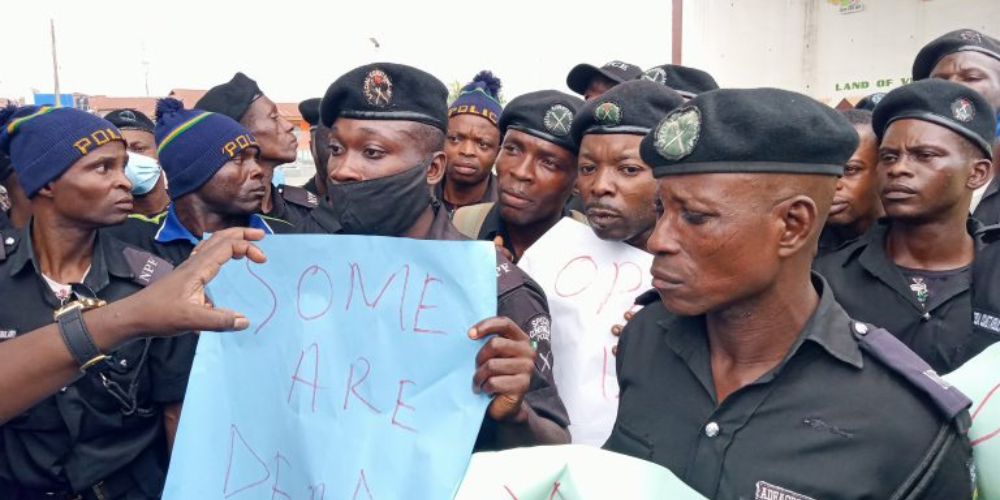
    Even by Nigerian standards, police officers taking to the streets to protest against unpaid wages is a terrifying nightmare. Yet, that’s what police special constabularies in Osogbo, Osun State did on September 7th, 2022.

    For context, these officers are part of the Community Policing Constabulary Scheme. They assist the main police force with grassroots tasks like intelligence gathering and reporting cases. So, they’re like the errand boys of the Nigeria Police Force (NPF).

    The constables complained that the government failed to pay their salaries for 18 months, and you can imagine what that means with the state of this economy. Inflation is skyrocketing and the cost of living isn’t anybody’s mate right now. But even worse than that, the protesters were unhappy that the sapa choking them was making them lose their wives to okada riders. It was enough of a significant problem that one of them wrote, “Okada riders are sleeping with our wives” on a placard at the protest.

    Game of Votes

    The NPF didn’t roll out tanks, water canons and tear gas against the protesters like they do to civilians. But the Osun State Commissioner of Police, Adewale Olokode, did have strong words for them. He called them an embarrassment and expected them to communicate their grievances more privately according to protocol.

    Every worker deserves his fair wages, and it’s abundantly clear why the government should never neglect to pay the allowances of police officers. A failure to do so is the kind of thing that leads them to extort innocent Nigerians, and extortion is just the gateway drug for crooked cops to get worse. The government should pay them so they can get their wives back.

    Have You Seen This Video?

    Question of the Week

    What are the names of the two top politicians who recently turned skit makers? (Hint: One is a former minister and the other is a former senator.)

    Click here to tweet your answer to @ZikokoCitizen on Twitter.

    Ehen, one more thing…

    We may not be in the days of Noah, but deadly floods have wrecked thousands of lives in 33 states and the Federal Capital Territory (FCT) since the beginning of the year. Buhari says he’s on top of things, but who believes anything that guy says these days?

  • Queen Elizabeth II’s “Relationship” With Nigeria in Pictures

    Queen Elizabeth II of the United Kingdom has died after 96 long years on this rock planet. She ascended the throne in 1952, just eight years before Nigeria finally became independent from the colonial grips of her British empire.

    We look at her relationship with Nigeria through the lenses of many cameras over the decades.

    1956: Queen Elizabeth II’s first time in Nigeria

    Queen Elizabeth’s first excursion visit to Nigeria happened in 1956. She spent 20 days after landing on January 28th, making a lit entrance in this borrow-pose Rolls Royce:

    Queen Elizabeth II's "Relationship" With Nigeria in Pictures

    Here are a lot of black and white pictures from the visit:

    [Image Source: Nigerian Finder]

    Queen Elizabeth II's "Relationship" With Nigeria in Pictures

    [Image Source: Arewa Cycle]

    Queen Elizabeth II's "Relationship" With Nigeria in Pictures

    [Image Source: Guardian Nigeria]

    [Image Source: Nigerian Nostalgia Project]

    [Image Source: Nigerian Nostalgia Project]

    Queen Elizabeth II's "Relationship" With Nigeria in Pictures

    [Image Source: Facebook/TalkRealSolutions]

    Queen Elizabeth II's "Relationship" With Nigeria in Pictures

    [Image Source: Only Africa Facts]

    The Queen got some colourful pictures too:

    Queen Elizabeth II's "Relationship" With Nigeria in Pictures

    [Image Source: Nigerian Nostalgia Project]

    Queen Elizabeth II's "Relationship" With Nigeria in Pictures

    [Image Source: Study HQ]

    Queen Elizabeth II's "Relationship" With Nigeria in Pictures

    [Image Source: Nigerian Info]

    [Image Source: Nigerian Nostalgia Project]

    And she had adoring fans at the time too, or people who just needed to make their urgent ₦2k:

    Queen Elizabeth II's "Relationship" With Nigeria in Pictures

    [Image Source: Nigerian Nostalgia Project]

    2003: Queen Elizabeth II’s reunion with Nigeria

    Queen Elizabeth visited Nigeria a second time for the Commonwealth Heads of Government Meeting (CHOGM) summit in 2003. She spent only two days, so you only get two pictures from her visit.

    President Olusegun Obasanjo played host: 

    Queen Elizabeth II's "Relationship" With Nigeria in Pictures

    [Image Source: Alamy]

    ALSO READ: Operation London Bridge: Queen Lizzie Is Dead

    Handshakes with Nigerian presidents

    President Obasanjo was Nigeria’s only democratic president to host Queen Elizabeth, but she hosted others in her country.

    Like President Yar’Adua:

    Queen Elizabeth II's "Relationship" With Nigeria in Pictures

    [Image Source: Dominic Lipinski/PA Images]

    Queen Elizabeth II's "Relationship" With Nigeria in Pictures

    President Jonathan and his orange juice:

    Queen Elizabeth II's "Relationship" With Nigeria in Pictures

    [Image Source: Getty Images]

    She also shook hands with this guy:

    Queen Elizabeth II's "Relationship" With Nigeria in Pictures

    [Image Source: Presidency]

    …on more than one occasion:

    Queen Elizabeth II's "Relationship" With Nigeria in Pictures

    [Image Source: Presidency]

    And then, there was this one time she synced in formation with the Nigerian High Commissioner, George Oguntade:

    Queen Elizabeth II's "Relationship" With Nigeria in Pictures

    [Image Source: Vogue]

    ALSO READ: But How Does Queen Elizabeth II’s Death Affect Nigeria?

  • But How Does Queen Elizabeth II’s Death Affect Nigeria?

    Queen Elizabeth II of the United Kingdom lived a long eventful life, but she finally died at the age of 96 on September 8th, 2022. 

    The queen’s exit is the end of an era and its impact isn’t limited to just her home from where colonialism did a global tour. Her death will directly impact many things in Britain from the nation’s anthem to its banknotes. 

    But what impact can the queen’s death possibly have in Nigeria?

    We’ll probably name something after her

    But How Does Queen Elizabeth II's Death Affect Nigeria?

    As Nigeria’s former monarch, it should come as no shock to anyone when the Nigerian government decides to (re)name something important after Queen Elizabeth.

    Serial presidential aspirant, Adamu Garba, is already ahead of everyone and suggesting the University of Nigeria, Nsukka (UNN) be renamed in the queen’s honour

    We can expect the Nigerian government to do oversabi and name the Fourth Mainland Bridge or soon-to-be-completed Second Niger Bridge in her honour.

    There may be a public holiday

    But How Does Queen Elizabeth II's Death Affect Nigeria?

    The United Kingdom will likely set aside a day as a public holiday in honour of the queen. As part of the Commonwealth of Nations, Nigeria may decide to adopt this holiday, but this isn’t set in stone. We can always do with an extra holiday sha, and treat it as a final gift from the queen. Buhari, make it happen!

    ALSO READ: Why the FG Needs to Give Us More Public Holidays

    Renegotiate Commonwealth membership

    Speaking of the Commonwealth of Nations, the queen’s death is expected to affect the political association that’s been criticised as a post-colonial legacy of the British empire. It’s a PR club to launder the history of an empire that colonised and exploited the world. And the queen’s death may be the catalyst to finally burn it to the ground.

    But How Does Queen Elizabeth II's Death Affect Nigeria?

    Those Benin Bronzes

    Over 100 years after British soldiers destroyed the Benin Kingdom and stole thousands of artefacts, many of them remain scattered all over the world. While many institutions are starting to return these artefacts, the British Museum which houses the biggest collection has insisted on hanging on to them. They keep telling Nigeria:

    Maybe King Charles will press the museum’s neck to return them in an attempt to earn some low-hanging goodwill?

    Buhari has a trip to plan

    But How Does Queen Elizabeth II's Death Affect Nigeria?

    Buhari can’t allow a good excuse to travel to the UK go to waste, and the queen’s death is a reason as good as any. Expect our travel blogger-in-chief to hop on a plane anytime soon to go console King Charles.

    But How Does Queen Elizabeth II's Death Affect Nigeria?

    ALSO READ: Operation London Bridge: Queen Lizzie Is Dead

  • How Buhari Should Spend the $23m Abacha Loot

    General Sani Abacha died 24 years ago, but he’s still Nigeria’s OG sugar daddy in 2022. The evidence of his massive stealing of Nigeria’s assets in his five-year military regime continues to outlast him.

    How Buhari Should Spend the $23m Abacha Loot

    On August 23rd, 2022, the United States agreed to return to Nigeria the sum of $23m which Abacha stole over two decades ago. The US alone has returned more than $334.7m linked to the former dictator. 

    But as nice as it is for Nigeria to get some of its money back, there’s been a lack of transparency in how the returned Abacha loot is spent. Nigerians just aren’t feeling the impact directly enough. 

    How Buhari Should Spend the $23m Abacha Loot

    For example, the government wants to spend the fresh $23m on projects like the Abuja-Kano road, the Lagos-Ibadan Expressway and the Second Niger Bridge.

    But we have other ideas on more tangible ways to spend it:

    Giveaway, obviously 

    It’s not easy to be a Nigerian these days. You just need to look at the state of the economy to agree everyone needs some credit alerts. 

    Call it hardship allowance or allowance for igbo and shayo, but everyday Nigerians need to personally feel touched by the Abacha loot.

    Give it to ASUU

    How Buhari Should Spend the $23m Abacha Loot

    The Academic Staff Union of Universities (ASUU) has been on its annual leave strike for the past six months because of its unending conflicts with the Federal Government (FG). The two parties have left thousands of students stranded at home while they battle over money and control. FG should think about throwing the $23m ASUU’s way to end the strike… for now.

    Compensate Nigerian students

    Speaking of those stranded students, there have recently been conversations about how they should be compensated. This $23m from our sugar daddy Abacha should do some leg work in appeasing them for the time lost at home without education.

    How Buhari Should Spend the $23m Abacha Loot

    ALSO READ: Why Nigerian Students Deserve Compensation for ASUU Strike


    Bribe the national grid

    The national grid has been a relentless opp to Nigerians, especially in 2022, with many breakdowns and blackouts. The government can make it stop by bribing it to chill or something. 

    Jollof rice festival

    The way to anybody’s heart is through their stomach and what better way to feel the impact of Abacha’s recovered loot than for the government to feed everyone? 

    $23m feels just right enough to throw a Guinness World Records-breaking Jollof rice festival. Everybody gets a taste of the national cake rice!

    How Buhari Should Spend the $23m Abacha Loot

    Expensive sacrifice at a T-junction

    Transparency International estimates that Abacha may have stolen up to $5 billion from Nigeria between 1993 and 1998. We’re yet to get half of that money back. 

    How Buhari Should Spend the $23m Abacha Loot

    We can use this little $23m to offer an expensive sacrifice to the gods to help in the recovery of everything that took flight under Abacha’s watch. You spend money to make money.

    Pay bounty on oil thieves

    Buhari recently complained that oil thieves are partly to blame for Nigeria’s revenue-generation issues. Some of these thieves are “big men” cashing out from robbing Nigeria. We can use the Abacha loot to place bounties on their heads to encourage citizens to help security agencies to find them more easily.

    How Buhari Should Spend the $23m Abacha Loot

    Tithe

    It’s important to always give unto Caesar — and unto the Lord — in style.

    ALSO READ: There’s a Place for Animals in the Nigerian Public Service

  • The Baby Boomers Still Running Things in Nigeria

    The average age in Nigeria is 18 years old, but the country’s affairs are mostly run by baby boomers born between 1946 and 1964. 

    The Baby Boomers Still Running Things in Nigeria

    Nigeria’s “leaders of tomorrow” have been waiting for eternity to take over as promised and take charge of their own future but the queue isn’t moving fast enough.

    The Baby Boomers Still Running Things in Nigeria

    And even though you can be too young to run for office in Nigeria, you can never be too old.

    So, in honour of Baby Boomers Recognition Day, we look at the Nigerian leaders holding up the queue and keeping the leaders of tomorrow out of the room.

    Muhammadu Buhari, 79

    The Baby Boomers Still Running Things in Nigeria

    Nigeria’s current president is the oldest to ever sit in the top seat. He was a military dictator between 1983 and 1985 when he was booted out. He must have forgotten something in that office because he returned 18 years later to contest presidential elections four times before he finally won in 2015. He’s set to finally retire to his livestock farm in Daura when his second term ends in 2023.

    Theodore Orji, 78

    Theodore Orji served as Abia State governor for eight years and could have retired immediately as he was already 70+ when his tenure ended in 2015. But he jumped straight to the Senate and contested again in 2019. Thankfully, he says he’ll retire when his current term ends in 2023 to make way for younger people.

    Senator Abdullahi Adamu, 76

    The Baby Boomers Still Running Things in Nigeria

    Senator Abdullahi Adamu hasn’t had a moment of rest since he actively joined politics in 1977. He’s worked with many political parties and was a minister under General Sani Abacha

    He later won an election as the governor of Nasarawa State in 1999 and served two terms until 2007. He became a senator in 2011 and remained in the Senate until he was elected the national chairman of the All Progressives Congress (APC) in 2022.

    Atiku Abubakar, 75

    The Baby Boomers Still Running Things in Nigeria

    Atiku is one of the favourites to win the 2023 presidential elections, but he’s been playing that game since 1992. If the former vice president wins, Nigeria would go from one septuagenarian to another. And if he loses, history shows there’s nothing to stop him from running again in 2027.

    ALSO READ: Atiku Can’t Stop Running for President Despite His Record

    Bola Tinubu, 70

    The Baby Boomers Still Running Things in Nigeria

    Bola Tinubu is another favourite to win the 2023 presidential election who could continue Nigeria’s septuagenarian line of presidents. He was a senator in the 1990s and served two terms as Lagos State governor before settling into an alleged godfather role for the next three governors. He now has his sights on the Aso Rock Villa as his retirement home.

    Ahmad Lawan, 63

    The Baby Boomers Still Running Things in Nigeria

    He’s not exactly 70+ but he’s a baby boomer and one of the longest-serving lawmakers in Nigeria. He’s risen from being a House of Representatives member to becoming the Senate President and landlord head of the National Assembly which makes him the third most powerful person in Nigeria currently. And he’s already started targeting the number one position.

    Nicholas Mutu, 62

    He’s also not 70+ but Nicholas Mutu is another baby boomer who’s clung to power in Nigeria. At the age of 39, he was elected the representative of Bomadi/Patani federal constituency of Delta State in 1999. He’s simply never left since then and is a proper National Assembly landlord himself.

    Femi Gbajabiamila, 60

    The Baby Boomers Still Running Things in Nigeria

    He’s the youngest person on this list but as the Speaker of the House of Representatives, Femi Gbajabiamila is currently the fourth most powerful person in Nigeria. And he’s climbed all the way over there by nailing down a seat in the chamber since 2003.

    ALSO READ: The Dramatic Impeachment Stories of Nigerian Governors

  • How Buhari Negotiated With Terrorists and Lost

    When terrorists attacked a train on the Abuja-Kaduna rail line in March 2022, it represented a new low for the Buhari administration. The terrorists bombed the rail line, killed nine people and kidnapped dozens of passengers.

    The attack made a mockery of President Buhari’s supposed success in tackling insecurity. What Nigerians didn’t know at the time was that the government’s incompetence didn’t end there.

    Buhari’s bold face

    On August 11th, 2022, President Buhari met with representatives of the hostages in his castle in Abuja. He assured them that he was doing his best to ensure the release of the 31 hostages still left with the terrorists over four months after the attack. 

    The president also noted that the release of some of the hostages over the past few weeks was due to the efforts of his government.

    How Buhari Negotiated With Terrorists and Lost

    The face of someone that’s proud of doing his best even when his best isn’t enough

    But then, all the tea about how the terrorists continued to fool the president after the attack came from the mouth of his own senior special assistant, Garba Shehu.

    What we thought was happening

    Weeks after the train attack and abduction of the passengers, the terrorists demanded the release of their comrades in the government’s custody.

    One of their known leaders, Abu Barra, also demanded the release of his children. He accused the government of forcefully keeping them in custody in Adamawa. The government didn’t respond publicly to these demands and maintained a bold face. This was in line with the government’s policy of not negotiating with terrorists and defeating them in press statements instead.

    How Buhari Negotiated With Terrorists and Lost

    But the terrorists kept demanding ransom from the families of their hostages and lined their pockets with hundreds of millions of naira. This led to the release of some of the hostages in different batches over the past four months.

    But new revelations show Buhari could have secured the release of the hostages without their families having to lose money in ransom. The only problem was the president tried and failed quite spectacularly.

    ALSO READ: What Happens When Nigerian Police Officers Clash With Soldiers?

    What really happened

    The release of the hostages for ransom has attracted more ridicule for the Buhari government. To fight back against the accusation that it’s done nothing to help the hostages, Shehu spilled the beans on some details that should have probably stayed inside the pot.

    How Buhari Negotiated With Terrorists and Lost

    In an interview with BBC Hausa on August 12th, 2022, Shehu said the government cooperated with the terrorists when they first took the hostages. They reached an arrangement that would allow the terrorists to get what they want so the government could get the hostages back. What could possibly go wrong?

    For its part of the gentleman’s agreement, the government took care of the pregnant wife of one of the terrorist leaders. On the government’s watch, fully-funded by taxpayers, she delivered twins. 

    The government, feeling very generous, handed her over to her husband’s parents, fulfilling the demand of the terrorists for her release. This was the first time the government scratched the back of the terrorists and you’d expect the terrorists to scratch back. But what’s a little oath-breaking for terrorists? 

    When it was time to fulfil their own part of the bargain, the terrorists said:

    How Buhari Negotiated With Terrorists and Lost

    Still marinating in his humiliation and (probably) concerned about the poor hostages, Buhari succumbed to more demands from the terrorists. Remember those children Abu Barra said were in detention in Adamawa? Well, the government sent a plane to pick them up and gift-wrapped them to the terrorists.

    But did the terrorists give the president a reacharound for his troubles?

    Instead, they started asking him for money. And this was the point Buhari realised the terrorists were hustling him like a JJC in Oshodi Underbridge.

    How Buhari Negotiated With Terrorists and Lost

    We assume no one was holding a gun to Shehu’s head when he made these revelations, so why did he make them despite being very embarrassing to Buhari?

    Well, he did it so that he could say, “People shouldn’t say the government is doing nothing.” And this only proves that if there’s one thing Buhari hates, it’s insult. But public humiliation is fine.

    ALSO READ: Buhari’s Old Tweets That Have Aged Like Fried Rice

  • Buhari’s Old Tweets That Have Aged Like Fried Rice

    No one knows tomorrow, but Nigerian politicians are fond of talking like they have a crystal ball and know how the future plays out. As long as the goal is to get them into office, they can use mouth to build an ocean in the middle of the desert or command $1 to be the same as ₦1.

    Buhari tweets.

    This is the case of Muhammadu Buhari before he became president and his tweets that have aged as well as fried rice.

    An important question in 2015 and 2022

    Buhari tweets.

    After seven years of Buhari, Nigerians can still be attacked travelling by road, rail, or air.

    Bubs, we’re also begging

    The unemployment rate was 6.4% at the end of 2014 but is now 33% after seven years of Buhari.

    Buhari tweets.

    ALSO READ: Buhari’s Weirdest Decisions We Thought Were April Fool’s Day Jokes But Weren’t
    Incompetence Pro Max

    Buhari tweets.

    This was tweeted by a man who, years later, can throw a dinner party in the thick of a national tragedy.

    Fuel queues yesterday, today and forever

    Those fuel queues haven’t disappeared. If anything, they’ve worsened dramatically.

    Laughs in subsequent medical issues

    Went on to spend over 200 days abroad on medical leave.

    Who is Boko Haram?

    Buhari tweets.

    Buhari has gone on to claim many victories over Boko Haram even though nearly 100 Chibok girls are still missing.

    The more things change…

    This is even more valid in 2022 than it was in 2015. After seven years of the tweet’s author being in charge, death tolls have only skyrocketed. But we can agree with Buhari on one thing: Nigerians do deserve better.

    ALSO READ: The 2023 Presidential Campaign Promises We Already Find Laughable

  • More Things Buhari Needs to Ban to End Insecurity

    It’s well-established by now that it’s dangerous to leave the Buhari government to think about anything by themselves. So, it’s no surprise that the president is now considering a nationwide ban on okada operations. Why? To fight insecurity, of course. The logic is that banning motorcycles makes it harder for terrorists to operate in the manner they currently do.

    The government believes banning okada is a small price for Nigerians to pay to finally say goodbye to killings across the country. This got us thinking about how many more things the government should ban to achieve its goal. 

    If we were allowed to be part of the National Security Council (NSC), here are the things we’d recommend for banning so that peace can reign.

    Poverty

    Poverty undoubtedly provides a steady supply of recruits for terrorism and crime in general. It’s easier to convince someone that has nothing going for them to enlist for a life of destruction. Building a more prosperous country for all automatically blocks this pipeline and insecurity would quickly reduce as a result. It’s simple maths.

    But the only reason it’d be hard for the government to ban poverty and build a prosperous country is that they’d have to actually put in stellar work to pull it off. But alas….

    Amnesty programmes

    More Things Buhari Needs to Ban to End Insecurity

    “Go and sin no more” has become a strategy that the Buhari government has perfected for the worst sinners. The Federal Government has its Operation Safe Corridor programme for repentant Boko Haram terrorists, and some state governors have also offered amnesty deals to terrorists in their territories. Even a wanted terrorist with a ₦5 million bounty on his head recently scored a chieftaincy title in Zamfara.

    There’s nothing to show that these peace deals for terrorists are working, so it’s time to put an end to them. Send terrorists to prison or to God.

    ALSO READ: Zamfara State Gives Award for “Best in Terrorism”

    Prison breaks

    More Things Buhari Needs to Ban to End Insecurity

    Speaking of prison, Nigeria has been failing miserably to keep criminals in prison while they await trial or serve their prison terms. More than 4,000 prison inmates who have escaped since 2020 are still on the streets. It’d be nice if the government actually focuses on excelling at things within its control. No more prison breaks, please.

    5G

    It’s already been blamed for a global pandemic, so what’s one more thing in Nigeria? 5G has actually had a tough time finding a home here, and we may as well just ban it so that terrorists don’t have access to even better connectivity to make the government look even more incompetent. 

    Firecrackers and knockouts

    More Things Buhari Needs to Ban to End Insecurity

    Since we’re just banning anything now

    Firecrackers have already tasted bans in some states so it wouldn’t even be shocking to fully ban them. Firecrackers already sound like guns and explosives. If you’re thinking like the Nigerian government, you want to ban them now before they develop minds of their own and grow to become guns and bombs.

    Lai Mohammed

    More Things Buhari Needs to Ban to End Insecurity

    You can’t defeat insecurity with lies and propaganda. And there’s something about Lai Mohammed always claiming Nigeria’s security is improving that feels like it’s adding to the problem. To do better at tackling insecurity, we need to stop people who may hide the truth about the situation. And who better to start with than Lai?

    Ban it

    ALSO READ: Buhari’s Weirdest Decisions We Thought Were April Fool’s Day Jokes But Weren’t
  • What If Abacha Never Died?

    24 years ago on June 8th 1998, General Sani Abacha died five years after he launched a military coup to take over Nigeria. What caused his death? It depends on who you ask. The official cause of death was that he died of a heart attack. But word on the streets was that he was poisoned by prostitutes who used an apple — you know, the same device that logged us out of the Garden of Eden. 

    Abacha’s death caused a ripple effect that altered the course of Nigerian history. But what if he never died? What would Nigerian history look like then? Let’s find out.

    He’d be president for life

    What If Abacha Never Died?

    Before his death, Abacha’s government was transitioning Nigeria from military rule to democratic rule. But the kind of democracy Abacha planned to transition Nigeria into was as democratic as a mushroom is a fruit. 

    For starters, he arm-twisted all five political parties he approved at the time to nominate him as the only presidential candidate on the ballot. If he’d stayed alive to win that election, you’d expect that he’d have written the Nigerian constitution on his toilet seat and kept himself in power for life.

    What If Abacha Never Died?

    Nigeria would run a monarchy system

    Sani Abacha didn’t come off as a guy that’d just be content with a life presidency. You just get the feeling he’d want his image to continue to loom large, long after he was gone. In 2022, it just so happens that his oldest surviving son, Mohammed Abacha, is on the ballot for the 2023 Kano governorship election. So it’s very likely he’d have wanted to directly transfer power to his children.

    ALSO READ: Is the Abacha Stove Making a Comeback?

    Twitter wouldn’t exist in Nigeria

    President Buhari banned Twitter for seven months because his controversial tweet was deleted and everyone was mad about it. But Buhari is learning work where Abacha was, because the first person to make an inevitable joke about President Abacha’s tribal marks would easily get Twitter a permanent ban in Nigeria. VPNs wouldn’t work too and we’d have to sneak into Cameroon to tweet amala slander.

    What If Abacha Never Died?

    Buhari would be Abachas Lai Mohammed

    It’s hard to see a path that leads Buhari to become the president he is today if Abacha stayed alive. But despite Abacha’s terrible human rights atrocities and the well-documented fact that he was a big-time thief, Buhari is a strong defender of Abacha’s legacy. This makes it easy to imagine that in an Abacha lifetime presidency, Buhari would be his Lai Mohammed.

    What If Abacha Never Died?

    NTA would be Nigeria’s only media station

    It’s no secret that Abacha wasn’t a great fan of the media. So, if he didn’t die 24 years ago, there probably would be no Channels TV to win “Best Station” for 12,000 consecutive years. All Nigerians would have would be an NTA remote-controlled from Abacha’s bedroom. The inflation rate and unemployment rate wouldn’t even exist.

    What If Abacha Never Died?

    General Sani Abacha’s place in Nigerian history cannot be forgotten for better or for worse, but it’s probably best for everyone that he left when he did. May affliction not rise a second time.

    ALSO READ: An Abacha in Agbada Is Trying to Return to Power

  • The Wildest Sob Stories Ever by Nigerian Politicians

    As a Nigerian politician, having a sweet mouth is a highly desirable skill, no doubt. You can have great plans for your voters, but you need proper storytelling skills to stimulate them. You know? Something to keep the people going. 

    The Wildest Sob Stories Ever by Nigerian Politicians

    It’s not enough to say you’ll provide free education, you have to remind your voters that you couldn’t go to school when you were young because there was no one to provide free education for you. Or that you were forced to travel to school on foot across seven seas and mountains because there were no schools in your community.

    But as a voter, it’s useful to have it in the back of your mind that politicians are trying to game you. If politicians have to deceive or manipulate you to get what they want, they will — and they do. The goal is the elected office they want, and sometimes they’ll tell you sob stories to appear more relatable to you so you can vote for them. 

    You have to jazz up and always look at the merit of their actual plans, and not just their corny grass-to grace stories.

    The Wildest Sob Stories Ever by Nigerian Politicians

    With the campaign season for the 2023 elections kicking into gear, we compiled Nigerian politicians’ greatest hits of sob stories. And you should expect to see more of them.

    Goodluck Jonathan (2010)

    The Wildest Sob Stories Ever by Nigerian Politicians

    “In my early days in school, I had no shoes, no school bags. I carried my books in my hands but never despaired; no car to take me to school but I never despaired. There were days I had only one meal but I never despaired. I walked miles and crossed rivers to school every day but I never despaired. I didn’t have power, didn’t have generators, studied with lanterns but I never despaired.

    In spite of these, I finished secondary school, attended the University of Port Harcourt, and now hold a doctorate degree. Fellow Nigerians, if I could make it, you too can make it.”

    Muhammadu Buhari (2014)

    The Wildest Sob Stories Ever by Nigerian Politicians

    “It’s a pity I couldn’t influence the reduction of the cost of nomination forms. I felt heavily sorry for myself because I don’t want to go and ask somebody to pay for my nomination forms, because I always try to pay myself, at least for the nomination. N27 million is a big sum.

    Thankfully I have a personal relationship with the manager of my bank in Kaduna and I told him that very soon the forms are coming. So, whether I am on red, or green or even black, please honour my fund request otherwise I may lose the nomination.”

    Atiku Abubakar (2018)

    The Wildest Sob Stories Ever by Nigerian Politicians

    “I started out as an orphan selling firewood on the streets of Jada in Adamawa, but God, through the Nigerian state, invested in me and here I am today. If Nigeria worked for me, I owe it as my duty to make sure that Nigeria also works for you.”

    ALSO READ: Can a Nigerian Lawmaker Represent Constituencies in More Than One State?

    Rotimi Amaechi (2022)

    “I don’t come from a privileged background. I grew up poor. I understand how it feels to go without some meals in a day. I know the pain of lack and the agony of want. I know what it means to see your parents toil just to keep a roof over your family’s head. I know what it is to feel the weight of expectation when you are the only one in your family who enjoys the opportunity to attend university. I know what it is to scrimp and save and struggle.”

    Atiku Abubakar (2022)

    This guy, again.

    “Who could have ever imagined, an 11-year-old village orphan, who had to rear other people’s cattle to raise money to feed his family, would have the opportunity to go to school for free, rise through the cadre of a decent profession, establish successful businesses, and become the Vice President of this country? That’s the Nigerian dream and that’s my story. That’s the possibility I want to pass to you and your children. No matter your current circumstances, that shouldn’t limit your success in life. There shouldn’t be any limit to what you want to achieve if you’re willing to work for it.”

    ALSO READ: Time Is Running Out for You to Register for Your PVC

  • Why Everyone Is Angry Buhari Pardoned Two Thieves for Easter

    If there’s one thing about President Buhari, it’s that he hates corruption. Or, at least, he says he hates corruption — it’s all he ever talks about. He rode to power on the back of a firm promise to make corruption disappear, as if Nigeria is a circus and he’s a skillful magician.

    Seven years down the line and corruption is still taking bites out of Nigeria’s national cake like it’s agege bread. The Buhari administration has failed to convince Nigerians of its capacity to effectively fight corruption. The statistics also show he’s not been doing a great job.

    Why Everyone Is Angry Buhari Pardoned Two Thieves for Easter

    Buhari’s most common defence for his terrible performance is that corruption is fighting back — whatever that means. And to prove that he’s trying his best, he regularly points to the fact that two former state governors were jailed for corruption under his administration. That used to be a reasonable defence until very recently.

    Who are these former governors?

    NOT the former governors

    Jolly Nyame was the governor of Taraba State between 1999 and 2007. The High Court in the Federal Capital Territory (FCT) found him guilty of stealing over N1.6 billion and sentenced him to 14 years in prison in 2018. The Court of Appeal and Supreme Court later reduced the sentence to 12 years.

    Like his brother-in-crime, Joshua Dariye was the governor of Plateau State between 1999 and 2007. He also represented Plateau Central senatorial district in the Senate between 2011 and 2019. In 2018, the FCT High Court found him guilty of stealing over N2 billion and sentenced him to 14 years in prison. The Supreme Court later reduced the sentence to 10 years.

    Buhari granted presidential pardon to Jolly Nyame and Joshua Dariye and everyone is angry

    Jolly Nyame to the left and Joshua Dariye to the right

    Fun fact: Nyame and Dariye were jailed by the same person.

    Her name is Justice Adebukola Banjoko.

    ALSO READ: Buhari’s Weirdest Decisions We Thought Were April Fool’s Day Jokes But Weren’t
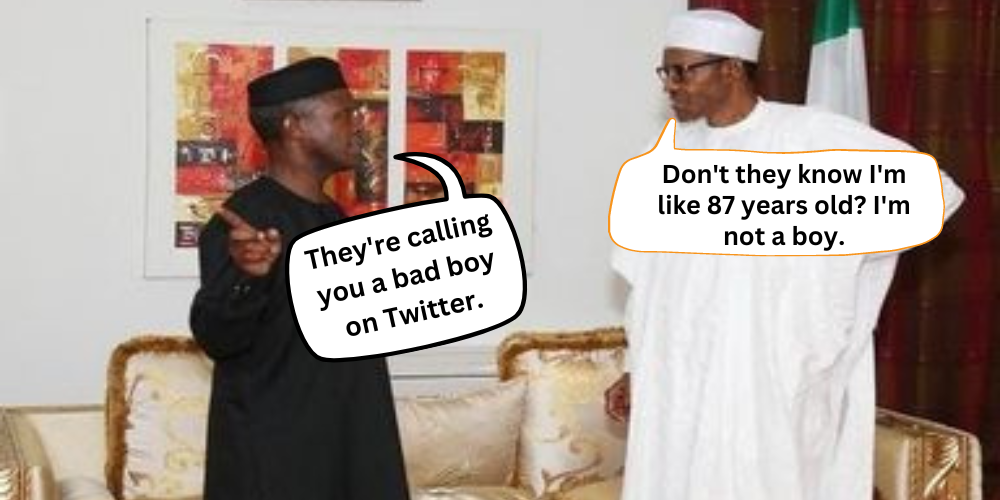
    Buhari’s Easter gift

    As Nigerians prepared for Easter on April 14th 2022, the Buhari administration announced the pardon of Nyame and Dariye. They were among 159 prison inmates and ex-convicts who received a presidential pardon by simply asking for it.

    What’s a presidential pardon?

    Section 175 of Nigeria’s 1999 Constitution (as amended) grants a Nigerian president the power to pardon convicts and ex-convicts in the country. This pardon may come in the form of total freedom, replacing a death sentence with a prison sentence, or reduction of a prison sentence. This is called a prerogative of mercy. 

    Why Everyone Is Angry Buhari Pardoned Two Thieves for Easter

    The president exercises this power in consultation with the National Council of State (NCS).

    What council is that?

    The NCS is an organ of the government given life by Section 153 (1)(b) of the constitution. The council is empowered to advise the president on at least six specific subjects. One of such subjects is the prerogative of mercy.

    The president is the chairman of this council and the vice president is the deputy chairman. Members of the council include all former presidents and heads of government, all former Chief Justices of Nigeria, the Senate President, the Speaker of the House of Representatives, all current state governors and the Attorney-General of the Federation (AGF). 

    Why Everyone Is Angry Buhari Pardoned Two Thieves for Easter

    The council is crowded and very male.

    ALSO READ: Time Is Running Out for You to Register for Your PVC

    How did Nyame and Dariye get pardoned?

    Buhari reconvened the Presidential Advisory Committee on Prerogative of Mercy and Clemency in September 2021. The objective of this committee was to visit prisons across Nigeria and make recommendations to the president on who deserves mercy. 

    Members of the committee were drawn from the Federal Ministry of Justice, Ministry of Special Duties and Intergovernmental Affairs, Christian Association of Nigeria, Islamic Society of Nigeria, National Human Rights Commission, Nigeria Police Force and Nigerian Correctional Service.

    By the end of September 2021, the committee already had 320 applications to sort through to determine who deserved a presidential pardon. The committee presented its report to the president who then presented a memo of that report to the NCS where a final decision was made.

    Nyame and Dariye managed to make this list somehow, for unclear reasons.

    What does the pardon mean for Buhari’s anti-corruption stance?

    The cases against Dariye and Nyame each took 11 years to conclude in court. And Buhari’s decision to pardon them after three years in prison washed all that hard work away. It’s unsurprising that the pardon hasn’t enjoyed public support.

    More than anything, the pardon of Dariye and Nyame ridicules Buhari’s anti-corruption stance as one big lie. Especially since critics believe releasing the two former governors is a barter arrangement for them to provide political assistance for the 2023 general elections.

    The next time Buhari laments that corruption is fighting back, he should look in the mirror where he’ll find the man responsible.

    ALSO READ: What Does Buhari’s Anti-Corruption Report Card Look Like? (Hint: It’s Terrible)

  • What’s an Executive Order and Why Has Buhari Signed 11 of Them?

    The President Buhari administration has broken a few records: record unemployment rate, record poverty rate and the world’s largest rice pyramids. But one other little-known trail-blazing feat of his government is how much he loves an executive order. Before you ask, no, it has nothing to do with the Peaky Blinders.

    Let’s focus.

    Since Nigeria’s return to democracy in 1999, none of its three presidents before Buhari signed an executive order. But the former military dictator from Daura has signed 11 since 2015.

    Executive order in Nigeria is synonymous with the Buhari administration

    Best in Signing.

    What’s an executive order?

    There’s no precise judicial definition of what an executive order is but think of it as a wuru-wuru-to-the-answer kind of legislation. Before a law is passed, it has to go through a lawmaking process in the National Assembly. This lawmaking process can take months or years before it lands on the president’s table. 

    On the other hand, an executive order is a shortcut to this long process. A president can use it to issue a directive without going through the painful process of begging the National Assembly for approval.

    How useful is an executive order?

    Even though executive orders allow a president to shortcut legislative review, they still need to not clash with established laws, especially the constitution. For example, the Buhari administration ran into problems when Executive Order 10 violated this principle. 

    ALSO READ: Supreme Court Tells Buhari to Drink Executive Order 10 And Mind His Business

    It’s important to note that the signing of executive orders is fairly new in Nigeria’s political establishment, so there’s not a lot of material on its inner workings. But we know it largely follows the format of the American system. 

    Executive order in Nigeria is synonymous with the Buhari administration

    Basically, an executive order is used to manage the operations of the Federal Government. It’s a document the president uses to give teeth to certain policies.

    Here’s a rundown of all 11 executive orders signed by President Buhari’s administration.

    Executive Order (EO) 1

    While Buhari was on his record-breaking 103-day medical leave in London in 2017, his vice president, Yemi Osinbajo, signed the administration’s first four executive orders while he was acting president. He signed the first three executive orders on May 18th 2017.

    Executive Order 1 addressed the promotion of transparency and efficiency in the Nigerian business environment. It was designed to facilitate the ease of doing business in the country.

    EO 2

    This executive order mandated the timely submission of annual budgetary estimates by all government agencies.

    EO 3

    This executive order addressed support for local content in public procurement. All Ministries, Departments and Agencies (MDAs) of the government were directed to grant preference to local manufacturers of goods and service providers.

    ALSO READ: Buhari’s Weirdest Decisions We Thought Were April Fool’s Day Jokes But Weren’t
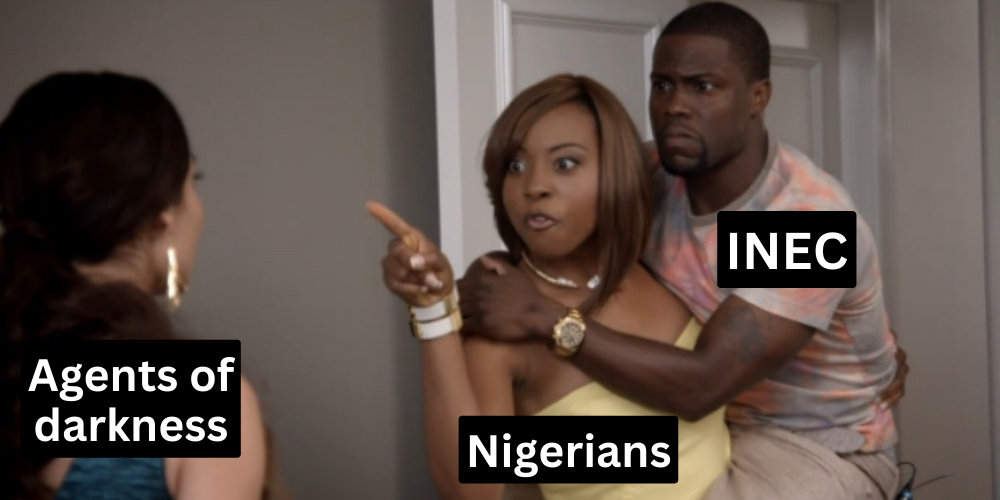
    EO 4

    This executive order addressed the Federal Government’s Voluntary Assets and Income Declaration Scheme (VAIDS). The government offered tax amnesty to taxpayers who hadn’t been fulfilling their tax obligations. Defaulters were asked to regularise their tax affairs before March 2018. 

    This is the fourth and final executive order signed by Osinbajo as acting president on June 29th 2017.

    Executive order in Nigeria is synonymous with the Buhari administration

    And it was the last time he was ever acting president

    EO 5

    This order was Buhari’s debut, signed on February 6th 2018. With Executive Order 5, Buhari ordered government agencies to give preference to Nigerian companies and firms over foreigners when awarding contracts. The order also stopped the Ministry of Interior from giving visas to foreign workers whose skills are readily available in Nigeria.

    Executive order in Nigeria is synonymous with the Buhari administration

    EO 6

    This executive order addressed the preservation of suspicious assets connected with corruption. The order allowed the government to assume control of assets linked to ongoing criminal investigations and trials. Buhari signed the order on July 5th 2018.

    EO 7

    This executive order enabled private sector entities to construct and refurbish roads across Nigeria in exchange for tax benefits from the government. Buhari signed the order on January 25th 2019.

    EO 8

    This executive order provided a 12-month period of grace for Nigerian taxpayers to voluntarily declare and pay tax on their offshore assets through the Voluntary Offshore Assets Regularisation Scheme (VOARS). In exchange, they wouldn’t be prosecuted for tax offences and offences related to offshore assets. 

    Buhari signed the order on October 8th 2018.

    EO 9

    Buhari used this order to mandate that Nigeria must become open defecation-free by 2025. 

    The order directed that all public places including schools, fuel stations, places of worship, market places and hospitals must have accessible toilets within their premises. Buhari signed the order on November 20th 2019.

    EO 10

    With this order, Buhari directed the financial independence of the state legislature and judiciary whose purse strings are controlled by their governors. The president signed the order on May 22nd 2020, but the Supreme Court nullified it on February 11th 2022. The court ruled that the order violated the principles of the separation of powers set by the constitution.

    Executive order in Nigeria is synonymous with the Buhari administration

    EO 11

    This order addressed the maintenance of national public buildings. Buhari directed all Ministries, Departments and Agencies of government (MDAs) to set up maintenance departments and make them functional to preserve government assets. Buhari signed the order on April 6th 2022.

    Since executive orders are fairly new to Nigeria’s dispensation, it’s still difficult to appropriately measure their implementation and impact. As things currently stand, no one really knows if executive orders change things significantly, but they’re provocative. One thing we do know for certain is that Buhari loves signing them as much as he loves flying to London.

    Executive order in Nigeria is synonymous with the Buhari administration

    ALSO READ: Game of Thrones: Who Wants to Be Nigeria’s President in 2023?

  • Buhari’s Weirdest Decisions We Thought Were April Fool’s Day Jokes But Weren’t
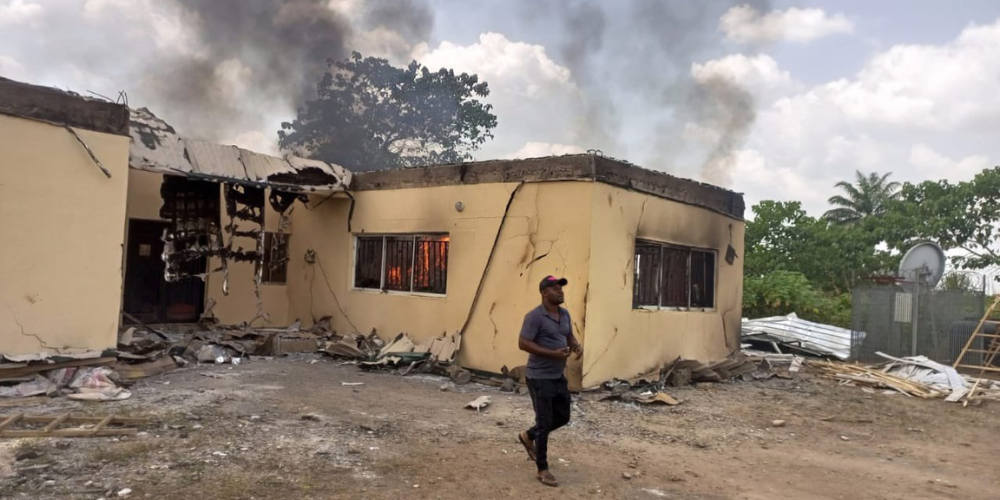
    Leadership is hard. Being the president of a multi-ethnic and multi-religious country of over 200 million people like Nigeria must be even harder. So, maybe we have some sympathy for whoever dares to occupy that seat.

    But there are certain actions that presidents take that make us scratch our heads, wondering if they’re being serious or messing with us like it’s April Fool’s Day. 

    President Buhari is no stranger to making some of these baffling decisions and leaving Nigerians caught in a confused state of crying and laughing. 

    For April Fool’s Day, we compiled some of President Bubu’s decisions that should have stayed in the drafts.

    Twitter ban

    All Twitter did was delete an offensive tweet that Lord Commander Buhari tweeted on his account, and he went into 48 Laws of Power mode to suspend the social media service in June 2021. 

    Buhari and April Fool's Day jokes

    Law 15: Crush Your Enemy Totally

    Buhari lifted the suspension in January 2022 but has refused to tweet on his personal account. All that aggression for what?

    Cutting down trees to fight dollars

    One of Buhari’s most defining battles as president in the past seven years has been to defend the dignity of the naira against the dollar. He’s not doing a great job because $1 was ₦197 when he assumed office in May 2015, but $1 is now ₦416 in 2022. However, his failure to arrest the decline of the naira doesn’t mean he hasn’t put up a spirited fight because he once cut down trees to make the naira valuable. 

    Buhari and April Fool's Day jokes

    What did these trees in Abuja do to harm the naira? Well, they provided shed for money changers who were selling dollars at black market rates considered to be harmful to the value of the naira.

    Closure of land borders

    Supreme Leader Bubu woke up one morning in August 2019 and ordered that Nigeria’s land borders be shut down, because of rice. The man took “There’s rice at home” too literally and crippled international trade with neighbouring countries because he wanted to stop the smuggling of foreign rice into Nigeria. 

    Buhari and April Fool's Day jokes

    Immediately the borders were shut, the inflation rate increased consistently for the next 19 months. Buhari approved the reopening of the land borders in December 2020 and has said that the policy failed, but that it also succeeded. There’s a set-up for a good joke here, but we’re not great at the comedy thing like the president.

    ALSO READ: Why’s Everyone Fighting Over Section 84 of the Electoral Act?

    Amnesty for Boko Haram terrorists

    Buhari and April Fool's Day jokes

    There’s a Nigerian tailor making a killing every time Boko Haram members graduate as “repentant” terrorists

    Boko Haram terrorists are directly responsible for the death of around 35,000 people and the displacement of more than two million people since 2009. A 2021 report by the United Nations Development Programme (UNDP) noted that the terrorists’ activities have indirectly led to 314,000 additional deaths.

    Yet, Buhari in his wisdom started a rehabilitation programme called Operation Safe Corridor for terrorists to surrender in exchange for amnesty. More than 1,000 former “repentant” terrorists have graduated from this programme and have been reintegrated back into society, and more than 35,000 are waiting in line

    Buhari and April Fool's Day jokes

    ALSO READ: How Buhari Has Freed 1,629 “Repentant” Boko Haram Members

    Despite the international support that the rehabilitation programme has, local support has been impossible to get. The still terrorised communities that have to embrace these supposedly-repentant terrorists have especially not been very welcoming. Some of these communities have asked Buhari to host the “repentant” terrorists at Aso Rock instead. That’s not an unreasonable demand.

    Souvenir killjoy

    “Buhari bans souvenirs at government events” is not a headline that made the rounds enough, but that’s something the president did in 2016. Buhari banned Federal Ministries, Departments and Agencies (MDAs) from buying and distributing bags, t-shirts and other souvenirs at events such as conferences and seminars. He did this to cut down on government spending. 

    Seeing as Nigerians love to party, we assume the MDAs received Buhari’s memo, laughed it off as an April Fool’s Day joke and ordered more rechargeable mini hand fans to distribute at the next government owambe.

    ALSO READ: The Motion: Should First-Class Graduates Get Automatic Government Jobs?

  • Game of Thrones: Who Wants to Be Nigeria’s President in 2023?

    Nigeria’s Game of Thrones for the 2023 presidential election is currently at the point where everybody and their grandmother is laying claim to the Iron Throne. We recently made a list of some of the aspirants in the race, but a few more people have declared their intention since then to replace President Buhari in 2023.

    Let’s see who’s shooting their shots at the most difficult job in the country. 

    Atiku Abubakar

    Atiku Abubakar is a 2023 presidential election candidate

    You may remember Atiku Abubakar as Nigeria’s vice president between 1999 and 2007. What you may not know is that he’s been involved in every single presidential election since 1993. To clarify: he’s been either a vice presidential candidate, presidential aspirant or candidate in Nigeria’s past seven presidential elections since the 1990s. But he’s only made it to the general election ballots for the presidential position twice: in 2007 and 2019.

    When he officially declared his intention to join the race for the 2023 presidential election on March 23rd 2022, the former vice president said he was obeying the “brave voices” of Nigerians who told him to try again. He wants Nigerians to remember him as the 11-year-old village orphan that reared cattle and rose through adversity to become successful. 

    Atiku’s big rallying cry for the 2023 election is to unify Nigerians, and we’re guessing he’s going to need more than cellotape to pull that off.

    Peter Obi

    Peter Obi is a 2023 presidential election candidate

    Politicians lie all the time about how they joined an election race because ordinary people pressured them to run, but that’s hardly the case for Peter Obi. Since he stopped being Anambra State governor in 2014, his name has always popped up as a viable potential for the presidency. 

    For the 2019 presidential election, Obi settled for being a vice presidential candidate alongside Atiku. This time around, he’ll be running head-to-head against Atiku for the ticket of the Peoples Democratic Party (PDP). 

    For his campaign, you can expect a lot of promises about saving Nigeria by saving money, and a lot of statistics about China.

    ALSO READ: Why Nigeria (Probably) Needs a 102-Year-Old President

    Aminu Tambuwal

    Aminu Tambuwal is a 2023 presidential election candidate

    Aminu Tambuwal has been a busy politician by all standards. He won his first election to enter the House of Representatives in 2003 and won two more before he left in 2015 as Speaker. From the National Assembly, he jumped right into the governorship seat for Sokoto State in 2015 and won a second term in 2019. 

    He’s also jumped parties as regularly as the national grid collapses. He started from the All Nigeria Peoples Party (ANPP) before he jumped to the Democratic People’s Party (DPP) and back to the ANPP and then almost immediately to the PDP. He stayed with the PDP for seven years before he jumped to the All Progressives Congress (APC) in 2014, and then back to the PDP again four years later. 

    This is not the first time Tambuwal is eyeing the presidency too. He finished second behind Atiku in the PDP’s primary election four years ago, and the two will do battle once again for 2023.

    Nyesom Wike

    Nyesom Wike is a 2023 presidential election candidate

    Without context, Governor Nyesom Wike of Rivers State does things like this:

    Wike has been a cornerstone of the PDP for years and his retirement plan after eight years as Rivers State governor is the presidency. When he officially announced his intention to run for the top seat, he mentioned that his strategy is to take power from the APC and save Nigeria.

    We’ll let him use his own words to describe his claim to the presidency, “When a mad man flogs you, don’t run. If you run, the mad man will pursue you. If he flogs you, take a stick and flog the mad man. If you do that, the mad man will start running. This APC requires people to say, ‘Enough is enough,’ and I’m that person that can tell them.”

    We can be sure that the 2023 presidential election will be anything but boring with this one around.

    With primary elections set to start in April 2022, more people may join the 2023 presidential race. But not to worry, we’ll keep you updated.

    ALSO READ: These People Want to Lead Nigeria But Who Are They?

  • What Should You Do When Buhari Visits Your City?

    If your city’s name is not London, then it’s not every day that it’s blessed with the presence of travel blogger, President Buhari. The United Kingdom has seen his gap-toothed smile more times than Lai Mohammed has spoken the truth.

    But the president will make a local stop in Lagos State on Tuesday, March 22nd 2022 on a work visit.

    What’s he looking for?

    President Buhari is in Lagos State for four things, and none of them is about the heat cooking the city.

    The high point of his visit is the commissioning of a new international terminal at the Murtala Muhammed International Airport. The last terminal was commissioned in 1979.

    That’s 43 years if you were counting

    The new terminal is expected to process over a dozen million passengers annually and decongest the operations of the old terminal. But will it stop airport officials from still harassing you to drop something for the boys? We can’t say at this time.

    Buhari’s second order of business is to commission the Dangote Fertiliser Plant in Lekki. He’ll also do inspection tours of the Lekki Deep Sea Port and Dangote Refinery. 

    Unfortunately, Chief Inspector Babatunde Fashola won’t be there to find cameras

    How should Lagosians react?

    Buhari leaving Abuja for anywhere inside Nigeria is a big deal, because you know he actually wants to be in London instead. But when he decides to step into your city, what are your options?

    Be a human red carpet 

    What you should do when Buhari visits your city

    If you’re a Buharist, the president’s visit to your city is easily the best thing to happen to you that week. Or month, if you don’t have a lot going for you. A presidential visit presents the opportunity to activate that Sai Baba devotion and show that you’re his Number 1 fan. Rolling out that red carpet for him is so outdated; you can become the carpet yourself.

    Take a sick day off work

    If you’re a Buhari hater, the president’s visit to your city will likely make you feel sick. Take a day off and tell your employer that your pet goat died or something and working is not on your list of priorities that day.

    ALSO READ: Why Is Buhari Using Nigeria’s $1 million to Do Giveaway for Afghanistan?

    Remind him of youth unemployment

    You also want to take a sick day off work, but you don’t have any work because you’re one of the 22.3 million Nigerians who are unemployed. You can join Buhari’s welcome party and display a placard to remind him that he’s not doing his job well. He may spot you as his convoy drives past, or he may be too busy not caring.

    What you should do when Buhari visits your city

    Stay at home

    For a place like Lagos, a presidential visit is also a test from God or the Devil — it’s hard to tell. Roads are blocked, there’s a lot of vehicular diversions and you’re stuck in traffic sweating like a Christmas goat. Your recourse is to stay home and pray the president leaves as quickly as possible. Going outside for anything that needs four wheels may lead to “Had I known.”

    What you should do when Buhari visits your city

    Flee the city

    The thought of Buhari drawing the same oxygen in the same city as you is not one you even want to entertain. Run.

    What you should do when Buhari visits your city

    ALSO READ: How Buhari Has Freed 1,629 “Repentant” Boko Haram Members

  • What Needs to Happen for This Fuel Scarcity to End

    You know how it is when you host a guest and tell them to feel at home, so they enter your kitchen and take a shit in the sink? That’s what this ongoing fuel scarcity is starting to feel like.

    The fuel scarcity crisis has to end now

    It all started when someone slept on their job and allowed the importation of contaminated fuel. It was a terrible lapse in judgement, but nobody is above mistakes, so we’ll let it slide. That being said, why are we still dealing with fuel scarcity more than six weeks later?

    We all thought this mess would be sorted in a matter of days, and we’d return to our stress-free Nigerian lives. But after all this time, we’re still queueing for fuel and dealing with the rising prices of petrol and diesel. Hell, some people are even stealing generators in the middle of all this.

    We’ve heard all the excuses and midnight apologies from President Buhari, but this fuel scarcity is feeling too at home. It looks like we’ll need to take extraordinary measures as a nation to earn the favour of the god of surplus. We have some suggestions on the things that need to happen to end this crisis.

    Buhari gets treatment from a Nigerian doctor in Nigeria

    The fuel scarcity crisis has to end now

    There’s nothing wrong with him that a few misplaced plasters can’t solve.

    Buhari has been president for nearly seven years, and he hasn’t taken anything as basic as paracetamol from a Nigerian doctor. This is despite the fact that taxpayers have sunk billions of naira into the State House Clinic for him and his family to feel fresh. In the middle of this fuel scarcity chaos, he still found time to travel to London to chill with his doctors for two weeks.

    The very first sacrifice we need to make to end the scarcity is for Buhari to return home so a Nigerian doctor can treat the earache preventing him from hearing the cries of Nigerians. Seriously, what can Dr Higginbottom do that Dr Komolafe can’t?

    Tinubu tells us his real age

    If there’s one thing we don’t like, it’s controversy over the age of our leaders. We’ve gone through this with Buhari, and now Bola Tinubu wants to be president with too many question marks hanging over his head. Is he 69 as he claims, or is he a World War I veteran like his haters allege? He should confess. There’s no shame in being old. After all, there’s a 102-year-old woman also running for the president’s seat and we think she rocks.

    ALSO READ: Why Nigeria (Probably) Needs a 102-Year-Old President

    Someone must explain why lawmakers get hardship allowance

    The fuel scarcity crisis has to end now

    What do Nigerian lawmakers do that entitles them to a monthly hardship allowance of over N1 million? Sitting on comfortable seats to shout “Aye” and “Nay”? Or rejecting sensible reforms to our laws? What’s hard about their jobs? If anyone needs hardship allowance, it’s you that’s reading this article while standing in your 157th fuel queue since February 2022.

    We need to know how Lai Mohammed sleeps at night

    The fuel scarcity crisis has to end now

    Lights on or off? On his stomach or back?

    We’re not going to call Lai Mohammed a liar, but we’ll say that he’s not a huge fan of telling the truth. What we’d like to know is his creative process and how he manages to sleep at night doing the things he does.

    Does he sleep with one pillow or two? Is his bedsheet made by Abba Kyari’s tailor? Does he sleep standing up or hanging upside down like an old-timey vampire? We need to know so this fuel scarcity can end immediately. 

    What does Governor Ayade smoke?

    The fuel scarcity crisis has to end now

    No one is as creative at naming annual budgets as Governor Ben Ayade of Cross River State. From “Budget of Infinite Transposition” to “Budget of Kinetic Crystallization” and “Budget of Quabalistic Densification”, this guy is the Shakespeare of naming ceremonies. Let’s not forget the “Budget of Olimpotic Meristemasis”, “Budget of Blush and Bliss” and “Budget of Conjugated Agglutination”.

    Clearly, there’s some illegal unnatural substance involved in his creative process, and he needs to tell us so this fuel scarcity can end. Or he can just introduce us to his English teacher. We’d like to have a couple of words.

    Okorocha must explain those statues

    At a time when he was owing pensioners as governor of Imo State, Senator Rochas Okorocha spent millions of naira erecting statues of “heroes” like Jacob Zuma of South Africa. He said it was to improve Imo State’s tourism profile, but we really need him to tell the real truth, especially as he wants to be president. What was the reason?

    Expose who’s “stealing” our fuel

    We found out this week that about 107 million barrels of crude oil lifted for domestic consumption disappeared without a trace in 2019. This amounts to billions of naira ending up in private pockets.

    Mr Billionaire, Tony Elumelu, also complained that only less than 3,000 barrels of crude oil make it to one terminal that should be receiving over 200,000 barrels a day. These are not criminals coming like thieves in the night. These ones are knocking on doors and taking out all your furniture because someone in the house sold them without putting the money in the family account.

    And if we cannot get to the bottom of this blatant stealing, Buhari should do the reasonable thing and sack the Minister of Petroleum Resources for being terrible at his job. But we don’t imagine Buhari is so eager to sack himself.

    ALSO READ: Fuel Scarcity + National Grid Collapses — How are Nigerians Coping?

  • 82 People Killed in 3 Days: Everything We Know About Kebbi Massacres

    There used to be a time when mass murder was news in Nigeria. But it’s just another Saturday these days, which is a tragedy of its own.

    Many parts of the country have become killing fields ruled by armed groups with no clear purpose. This week, Kebbi State was the witness of two different massacres that are already taking the backseat.

    Here’s everything we know about these attacks.

    Slaughter of vigilantes

    When residents received reports that bandits were attacking villages in Sakaba Local Government Area of Kebbi on March 6th, 2022, vigilantes mobilised to confront the bandits. The vigilantes were members of Yan Sakai, an ethnic militia group that was established to fight crime in many parts of northern Nigeria. The group has been banned by governments in a few states over extra-judicial activities. But the Yan Sakai keeps operating because, apparently, Nigeria’s security forces are already spread too thin.

    Unknown to the vigilantes responding to the March 6th attack, the bandits were luring them into the forest. According to traditional rulers who spoke to BBC Hausa thereafter, the bandits hid on top of trees, herded the vigilantes to a target spot and opened fire on them. 63 vigilantes were reported killed in the attack, but the death toll has been reported by residents to be higher. 

    Buhari’s strong words

    President Muhammadu Buhari has made many failed promises to contain insecurity across Nigeria. He has even resorted to warning the criminal groups to stop. In reaction to the massacre of the vigilantes in Kebbi, he offered condolences and more strong words.

    He said, “This egregious level of criminality is shocking and I want to assure Nigerians that I will do all it takes to tackle this monster decisively. My greatest preoccupation is the threat to life posed by these murderous gangs and remorseless outlaws who have no slightest regard for the sanctity of life.”

    President Buhari also directed security forces to be more proactive and double their efforts to stop future attacks.

    ALSO READ: “We Are All Smokers in This City!” — The Life of Port Harcourt Residents Under the Soot

    Slaughter of soldiers

    Buhari’s strong words did not get across, as the bandits struck again on March 8th, 2022. This time, they attacked the convoy of the deputy governor of Kebbi State, Samaila Yombe, who was visiting Kanya community in Danko Wasagu LGA.

    A unit of about 30 soldiers of the 223 Army Battalion were part of the convoy that was escorting a commanding officer who’d joined the deputy governor for the visit. The bandits — an estimated 150–200 men — attacked the deputy governor’s convoy, and killed 18 soldiers, including Yombe’s security aide. The deputy governor narrowly escaped death himself.

    Yombe said, “The bandits mixed up with the inhabitants of Kanya in such a way that it was difficult to differentiate and fight them. The bandits were equipped with PSA AK-P rifles — much heavier calibre weapons than AK-47.”

    What is the government doing?

    The military has failed to officially confirm the number of solders that were killed, but more have been deployed to Kebbi State after the massacres. The spokesperson of Defence Headquaters, Major General Bernard Onyeuko, said at a media briefing on March 10th, 2022 that “severe action” will be taken to redeem the situation.

    President Buhari has not delivered more strong words as he continues his medical leave in London. But the Kebbi State governor, Atiku Bagudu, urged residents to pray for those that were killed, and for more strength for Buhari to fight the bandits.

    The wives of some of the soldiers killed in the March 8th attack also protested at the residence of the 223 Army Battalion Commander on March 10th, 2022. They chanted, “Whatever will happen, let it happen,” and burnt tires in front of the commanding officer’s residence.

    The activities of armed groups in many states in northwestern Nigeria has disrupted thousands of lives with many dead and many more displaced from their communities. Bandits were officially designated as terrorists in January 2022. The designation was intended to intensify the war against the armed groups and contain their reign of terror. But, as Kebbi showed this week, not much has changed.

    ALSO READ: Everything We Know About the Murder of Ayanwola Bamise

  • Why Is Buhari Using Nigeria’s $1 million to Do Giveaway for Afghanistan?

    The hallmark of great philanthropists is that they don’t boast about every good deed they do. We assume that is why the most generous President Muhammadu Buhari didn’t announce that he gave away $1 million of Nigerian taxpayers’ money to Afghanistan.

    President Muhammadu Buhari gave away $1 million to Afghanistan

    He would have got away with it too, if not for the big mouth of the people he donated the money to. The Secretary-General of the Organisation of Islamic Cooperation (OIC), Hissein Brahim Taha, announced on March 3, 2022 that Nigeria donated the $1 million to the Humanitarian Trust Fund for Afghanistan.

    Remember the Taliban?

    When the United States of America withdrew its military presence from Afghanistan in August 2021 after 20 years of fruitless war, the country’s democratic government quickly fell to the Taliban. The jihadist group taking over the country was a bad look for America, so sanctions rolled in. International organisations froze billions of dollars in aid and assets to Afghanistan, plunging the country into a huge humanitarian mess. As a result, millions of Afghans are now facing starvation.

    The OIC resolved at a December 18, 2021 meeting to launch the Humanitarian Trust Fund for Afghanistan to address the humanitarian crisis. The organisation begged its members to help prevent an economic collapse in Afghanistan by making donations to help millions of Afghans that are in danger.

    What’s Nigeria’s business with an Islamic group?

    The Organisation of Islamic Cooperation (OIC) describes itself as “the collective voice of the Muslim world”. The organisation exists to safeguard Muslim interests in economic, social and political areas. It was founded in 1969 by 30 Muslim-majority countries following the burning of a mosque in Jerusalem. Today, the OIC has 57 member states including Afghanistan, and Nigeria, even though our country is not a Muslim-majority state. 

    So how did we get in?

    In 1969, the Nigerian government was fighting a civil war to prevent Biafra from breaking away. General Yakubu Gowon, a Christian from Plateau state, desperate to win the war, tried to shake hands with every potential ally he could find.

    This was his groove:

    The OIC held its first Islamic Conference in Morocco in September 1969, over two years after Nigeria’s war started. Gowon sent a delegation with Nigeria granted an observer status, which is like the talking stage of a relationship. Over the next nearly 20 years, the OIC fell in love and started pressuring Nigeria to regularise and fully enter into a proper marriage. Many Nigerian governments, including Buhari’s military administration of 1983 to 1985, refused to cement the relationship because of Nigeria’s status as a multi-religious state.

    President Muhammadu Buhari gave away $1 million to Afghanistan

    General Ibrahim Babangida eventually made Nigeria a full member in 1986 without the approval of the governing organs of the military government at the time.

    Critics have always condemned Nigeria’s membership as a ploy to “Islamise” the country, a theory that gained more ground since Buhari became president and attended an OIC meeting a day after his second term inauguration in 2019. But former Christian presidents, Olusegun Obasanjo and Goodluck Jonathan, have similarly attended OIC meetings and ignored calls to pull Nigeria out of the organisation. The late Umaru Musa Yar’Adua also attended.

    Back to that $1 million

    President Muhammadu Buhari gave away $1 million to Afghanistan

    The Nigerian government has failed to address last week’s announcement, but it’s easy to draw a straight line between Buhari’s donation and Nigeria’s OIC membership.

    And despite whatever good intentions were behind it, critics have questioned why a country that’s a recipient of foreign aid itself is spreading aid around. 

    Some critics are also quick to point out that the humanitarian problem Buhari is trying to solve with that donation is also an immediate concern in Nigeria. 22.8 million Afghans face acute food shortages, according to the United Nations’ World Food Programme (WFP). The same agency estimates that 13 million Nigerians are facing hunger, including 4.4 million of them in Borno, Adamawa and Yobe. Other critics are just worried the money is going into the pockets of the Taliban even though the OIC has pledged to have safeguards against that.

    More than anything, the big picture of this whole episode is that Section 10 of the 1999 Constitution forbids Nigeria from adopting any religion as the state’s religion. Yet, Nigeria is a member of an OIC whose overriding objective is to safeguard the interests of Islam. 

    Buhari’s donation should once again resurrect debates about whether Nigeria should continue to be a member.

  • Should You Trust Buhari’s Plan to Feed Out-of-School Children?

    President Muhammadu Buhari’s administration is finally taking some major steps to address a troubling challenge with educating millions of Nigerian children.

    There are more out-of-school children aged 5-14 years in Nigeria than there are people in Togo.

    The United Nations Children’s Fund (UNICEF) says there are at least 10.5 million out-of-school children across the country — the highest globally.

    Lagos state governor, Babajide Sanwo-Olu, removed two of them from the streets in January 2022.

    The Alternate School Programme will target out-of-school children

    Best in Photo Ops. PhD.

    How did we get here?

    The swelling population of out-of-school children has been fuelled by socio-cultural and economic factors that have worsened over the years. Repeated attacks on schools that have led to the death and abduction of hundreds of students, especially in the north, have also not helped.

    Some of the children most affected are girls, children with disabilities, children from the poorest households, in the streets, or affected by displacement or emergencies, and children in geographically distant areas. 

    The danger of having millions of out-of-school children who have limited future prospects is clear to everyone.

    The Alternate School Programme will target out-of-school children

    The almajiri “school system” has illustrated this many times (Image vis BBC Hausa)

    Nigeria has been trying to deal with the problem for years, which is why there was an idea.

    Alternate School Programme

    President Buhari in January 2021 inaugurated a Presidential Steering Committee (PSC) on the Alternate School Programme (ASP) and charged members with a simple goal — take the gospel of education to children on the streets.

    OMG, will they be snatching kids off the streets?

    The Alternate School Programme will target out-of-school children

    No. Well, yes; but it’s complicated.

    The out-of-school children being targeted by the programme are those loitering at the markets, motor parks, mechanic and spare parts villages, almajirai and street beggars.

    The children will be gathered in groups by the government and taught four subjects including mathematics, and English language.

    Talking about the programme at a media briefing on February 17, 2022, the Minister of Humanitarian Affairs, Disaster Management and Social Development, Sadiya Umar Farouq, said, “We’re going to take the schools, teaching and learning to the places where these children are; be it in the sangaya setting, or in workshops where children are being used or in the shops where we have this kind of children.”

    Why is an education programme being led by the Minister of Humanitarian Affairs, Disaster Management and Social Development, you ask?

    That’s where the food comes in

    The Alternate School Programme will target out-of-school children

    The Alternate School Programme is not just about the education of out-of-school children, but also about their social protection.

    The Federal Government claims to feed almost 10 million schoolchildren with its National Home-Grown School Feeding Programme (NHGSFP). The programme started in 2016 and provides a daily meal for pupils in year one to three in public primary schools.

    The feeding cost of ₦70 per child was recently increased to ₦100, raising daily spending to ₦1 billion.

    One of the programme’s main goals is to encourage enrolment of students. But critics have faulted it because they don’t trust that it’s helping to improve enrolment and believe it’s just another outlet to divert public funds.

    The NHGSFP will now be adapted for the Alternate School Programme for out-of-school children too. Farouq says children will be fed as they are educated.

    And we all know lunch period is the best part of school.

    Is that all?

    The steering committee adopted a work plan to guide the effective implementation of the Alternate School Programme in October 2021. Part of the plan includes onboarding the children to traditional schools after the end of the programme. They will be onboarded for further vocational skills acquisition and to relevant National Social Investment Programmes.

    “Will there still be food?”

    Status of Alternate School Programme

    The committee has been meeting for more than a year now, but the implementation timeline is unclear.

    The minister, Farouq, said at the February 17 briefing that spots where the children will be reached are being identified all over the country.

    But if implementation fails, we can always trust Agent Sanwo-Olu to use them for photo ops save more.

    The Alternate School Programme will target out-of-school children

    Two at a time, baby!

  • What Buhari Hates about Electoral Act He Just Signed

    Supreme Leader President Muhammadu Buhari finally signed the Electoral Act Amendment Bill into law on February 25, 2022.

    He rejected it five times since 2018 and needed some encouragement to finally sign, but Nigeria can finally prepare for the 2023 general elections.

    Nigerians can rejoice that a new Electoral Act has been signed

    What is this Electoral Act about?

    Elections in Nigeria are majorly guided by the laws in the Electoral Act.

    These laws determine if we’re casting votes with cowry shells or ballot paper.

    The Electoral Act is pivotal to the conduct of elections in Nigeria

    The last major changes were made in 2010 when Goodluck Jonathan was still president.

    Much of the content of the Electoral Act 2010 has since been considered outdated, but Buhari refused amendment proposals, until now.

    How’s this my business?

    Voters should care about the Electoral Act

    Nigerian elections are not the most trusted in the world, especially locally.

    Much of this lack of trust is informed by how elections are conducted and how easy they are to manipulate.

    Some of the things that make this culture of manipulation easy can be fixed by updating the laws.

    As a voter, the signing of this bill is good news because it’s filled with improvements that can build trust.

    What improvements?

    We can’t go over everything yet, but here are some nice ones:

    Electronic transmission of results

    This law gives the Independent National Electoral Commission (INEC) the freedom to determine whether election results are transmitted manually or electronically. 

    Manual transmission of election results has made vote-rigging easy to do in Nigeria for years. 

    The electronic transmission will fix that in a big way, and INEC is very interested.

    Overvoting

    Election rigging is a game of numbers. You want to make sure 2+2 = 7, and be able to turn 6 upside down to become 9. 

    The Electoral Act eliminates fraud

    Even when ballot boxes are snatched, it’s to ensure voters in that location don’t contribute to the final tally. 

    The numbers can sometimes be overcooked so that there are more votes than voters. This is called overvoting. 

    The old law only accounted for overvoting when it exceeded the number of registered voters, but the new one is more specific and targets the number of voters that actually show up on election day. 

    If only 12 out of 100 registered voters are accredited for an election, then the result cannot show that 13 people voted.

    ALSO READ: How Bubu Caused National Day of Protest

    Electronic accreditation

    Upgrading the Electoral Act to accommodate technology has been needed for a long time

    [Image via Channels TV]

    The new law has legalised the electronic accreditation of voters. INEC could electronically accredit voters in the past, but this was inadmissible in court because it was not backed by law.

    Upgrading the process that confirms the number of people that show up to vote is an effective way to prevent easy manipulation.

    Review of results

    INEC now has the power to review election results that are declared by its officers under duress. 

    Politicians have in the past intimidated electoral officers to declare results in their favour against the wishes of the officers

    It was impossible for INEC to overturn such fraudulent results on its own authority even with evidence of intimidation. No more of that illegality with this new law.

    Inclusive

    The new law places a burden of responsibility on INEC to ensure that polling units are equipped to cater to people living with disabilities. 

    This includes the provision of communication materials such as Braille, sign language interpretation, etc.

    Campaign duration

    According to the old laws, candidates were only allowed to campaign for 90 days before election day. The new law allows them 150 days. 

    This gives voters a lot more time to get to know candidates, ask hard questions and make better choices. We hope.

    What’s Buhari unhappy about?

    We mentioned before that Buhari has rejected five different opportunities since 2018 to review the laws.

    While giving his post-signing speech on February 25, he mentioned that he was still uncomfortable about one thing in the bill he signed.

    Section 84 (12) stops serving political appointees from voting or being voted for at the convention or congress of their parties.

    This means a minister in Buhari’s government cannot contest for an executive or legislative position without first having to resign from office.

    They could contest in the past and only needed to resign from office 30 days to the election after they had secured the party’s ticket.

    Buhari considers Section 84 (12) a constitutional violation of the rights of appointees and wants it amended immediately.

    But critics have already tackled him and asked lawmakers not to amend the section.

    What happens now?

    INEC is expected to release election guidelines and the timetable. The 2023 general elections are finally underway.

    And the very first step for you as a voter is to start with getting your PVC.

    May the best candidates win.

    ALSO READ: What Does Buhari’s Anti-Corruption Report Card Look Like? (Hint: It’s Terrible)

  • How Bubu Caused National Day of Protest

    If democracy was a car, elections would be petrol.

    Sure, you need an engine, tyres, and a working aux, but the petrol is kind of important to get the whole show on the road.

    Nigeria is racing down to the 2023 general elections, but President Muhammadu Buhari is refusing to put petrol in the car.

    The National Day of Protest is asking Buhari to finally sign the electoral bill

    Nigerian elections are currently guided by the electoral laws signed in 2010.

    It’s clear to everyone that these laws need to be updated to catch up with the present.

    But the man in charge of making the final approval isn’t known for his speed.

    Sai Baba says No

    When the National Assembly passes a bill and sends it to the president, he has 30 days to approve or reject.

    President Buhari has been presented with five different electoral amendment bills since 2018.

    He has refused to approve a single one.

    The National Day of Protest is asking Buhari to finally sign the electoral bill

    He rejected the first one in March 2018. This amendment reordered the line-up of elections in a way that governors were elected before the president. Buhari didn’t like that so he vetoed it.

    He aired the next draft sent to him in July 2018. Ignoring a bill past the 30-day deadline is an automatic rejection.

    The National Day of Protest is asking Buhari to finally sign the electoral bill

    The president rejected another amendment proposal in September 2018 due to drafting errors and cross-referencing gaps.

    Another one was rejected in December 2018 because it was too close to the election and could cause operational issues.

    Buhari every five minutes:

    The National Day of Protest is asking Buhari to finally sign the electoral bill

    New National Assembly, new issues

    The current National Assembly has been trying to ensure Nigeria has updated electoral laws before the 2023 general elections.

    Some of the headline proposals in the bill include the electronic transmission of results and expansion of campaign spending limits.

    A version of the bill sent to Buhari in 2021 was officially rejected in December because it made direct primaries the only mode for electing party candidates.

    The president promised that he would sign the bill if that particular proposal was removed.

    The National Assembly has done exactly that and sent him a new version on January 31, 2022.

    This has been Buhari’s reaction since then:

    The National Day of Protest is asking Buhari to finally sign the electoral bill

    National Day of Protest

    The National Day of Protest demonstration staged on February 22, 2022 is an effort by a coalition of civil society organisations to force the president’s hand to sign the bill.

    Nigeria should already have an outlined timetable for the 2023 elections. 

    But the Independent National Electoral Commission (INEC) is waiting on the president’s decision because signing the bill would impact the timeline of events.

    Buhari’s failure to sign the Electoral Act Amendment Bill 2022 into law is not only a betrayal of his own words, but it is also slowing down Nigeria’s ability to prepare for 2023.

    President Buhari’s spokesperson, Femi Adesina, in a statement on February 21 accused the protesters of playing cheap politics.

    He said the president is doing due diligence to ensure the bill is “as near-perfect as possible” before his March 1 deadline.

    The 2023 presidential election has already been scheduled to happen on February 18, but that is now in danger of being moved.

    Nigerians are taking to the streets of Abuja today to ask Baba Go Slow to move a bit faster and fuel the car.

  • What Does Buhari’s Anti-Corruption Report Card Look Like? (Hint: It’s Terrible)

    When Muhammadu Buhari was sworn in as the Head-Nigga-in-Charge president in 2015, he was a man on a mission.

    His to-do list contained three things he promised to deliver within four years – improve the economy, eliminate insecurity and crush corruption.

    Buhari's anti-corruption fight has been a major battle for his administration

    Seven years later, much of what we have are audio victories we never get to see.

    It was only months into his administration that he said resident terrorist group Boko Haram was technically defeated. Never mind that that same group has killed thousands of Nigerians since then.

    Daredevil bandit groups have also become a huge problem in the north and had to be declared terrorists recently.

    The country has suffered two historic economic recessions under Buhari, and his government’s talking point has been that we exited those recessions rather quickly. So, best to be thankful.

    Buhari's anti-corruption campaign has not been as impressive as promised

    In the area of Buhari’s anti-corruption fight, it has been hard to separate the big lies of the government from what is actually true.

    Corruption conviction rates have been rising, including the imprisonment of two thieving former state governors who are members of the president’s own party.

    Buhari's anti-corruption campaign got two former governors jailed

    But despite what those conviction figures say, there are many stories of ongoing corruption that suggest the government has not done enough to fight it, and may even be enabling it.

    Loot recovered from the thieves of yesterday have been reported stolen once again by a new generation of thieves.

    Buhari's anti-corruption campaign has suffered many setbacks

    If only there was an international organisation that could establish a rating system for the government’s anti-corruption efforts.

    The result of Buhari's anti-corruption campaign is mostly determined by Transparency International's CPI

    Hello, Transparency International

    Transparency International is a non-profit organisation combating global corruption since 1993.

    One of its most prominent projects is the annual Corruption Perceptions Index (CPI) which provides a window into public sector corruption around the world.

    The organisation created its first CPI in 1995, ranking 41 countries on how much corruption was perceived to exist in their public sectors and how that impacts political, economic and social development.

    Over 20 years later, the CPI now regularly ranks 180 countries around the world with scores ranging from zero to 100.

    A high CPI score indicates a clean system with very little corruption taking place, while a low CPI score means, well, you’re in the trenches of corruption. 

    Buhari's anti-corruption efforts have not lifted Nigeria enough

    How has Buhari’s anti-corruption campaign fared?

    The year before Buhari became president, Nigeria was ranked 136th out of 180 countries on perceived corruption, scoring 27 out of a possible 100 marks.

    How exactly has Nigeria performed under the African Union’s proclaimed Anti-Corruption Champion (which is a real title)?

    What Buhari's anti-corruption report card looks like

    You know you have to hide all the belts in the building before you show your parents this kind of result.

    Why Nigeria’s CPI rating is poor under Buhari 

    Buhari has never directly reacted to a CPI report, but his government has turned rubbishing it into an annual ritual.

    In campaigns regularly led by the administration’s vuvuzela, Lai Mohammed, the company line has been that the CPI is not scientific enough to capture Buhari’s giant strides against corruption.

    Buhari's anti-corruption efforts have not had enough giant strides

    This is a valid criticism of the CPI that’s repeated by governments whose countries finish on the wrong end of the rankings.

    Transparency International has admitted that the CPI does not pretend to measure the reality of corruption but the valid perceptions of it. 

    That’s what the ‘Perceptions’ in Corruption Perceptions Index (CPI) stands for.

    The low ratings for Buhari’s anti-corruption efforts have long been attributed to the failure of anti-graft authorities to diligently prosecute high-profile corruption cases.

    High-ranking officials like Ibrahim Magu and Abba Kyari have not had serious charges filed against them despite damaging corruption allegations. Many other cases against high-profile officials have also moved slowly in the courts for years.

    President Buhari has cried numerous times about the slow pace of the justice system. He has often recalled the supposedly more efficient system of ‘guilty until proven innocent’ he adopted as a military dictator in the 1980s. 

    Like that worked out well for anybody.

    Perception or reality, what’s clear is that Buhari inherited a corrupt nation in 2015, has done barely anything to move the needle, and will deliver a corrupt nation to the unlucky person he hands over to in 2023.

    Unless he finds a way to score above 50 by the end of this year.

    Buhari's anti-corruption campaign is heading towards a disastrous end when he leaves office in 2023
  • Uncle Yemi Osinbajo has done it again. This time, he has shown out for guys about the dreadful SARS situation.

    Why does it seem like whenever Baba Bubs goes on one of his frequent medical trips, things just seem to work a little better? Somebody help me say political gimmicks good governance.

    On Tuesday August 14, the Acting President aka Uncle Yemi gave directives to the Inspector General of Police, Ibrahim Idris to overhaul the Special Anti-Robbery Squad (SARS).

    We were shook!

    Especially because all our complaints had always been brushed off as false or exaggerated.

    Just a few weeks ago, Assistant Commissioner of Police, Yomi Shogunle still trolled Nigerians with this irresponsible tweet. He should better switch careers if he wants to be making silly jokes online.

    Oh, you remember SARS, the police unit that was so infamous for their abuse of power and Nigerian citizens, we had to write you a survival guide?

    https://www.instagram.com/p/BcUyVmPn2NS/?taken-by=endsarsmovement_now_

    This is just one of the many, many videos people have used to back their complaints. Let’s not even go into pictures and narratives. But we’re all lying, hey. The #EndSARS movement has been going for at least two years! Nonstop police brutality for two years.

    While we’re overjoyed that our pleas and relentless #EndSARS campaign finally made some headway, we still have some doubts.

    Way too many people have been unlawfully killed, jailed and extorted for us to just accept it, and things are often not what they seem in Nigeria. Gotta stay woke.

    First of all, it is important to note that this overhaul doesn’t mean the police department is going to be scrapped.

    This overhaul is more like a reform. In summary, the state SARS will be broken down and the officers reassigned to the already existing Federal SARS (there will only be FSARS). I know what you’re thinking, but chill. We are told that this is only going to be after investigations into the existing abuse allegations have been done, as well as mental evaluations and retraining.

    Again, I know what you’re thinking, because even the Federal SARS people abuse the citizens.

    The new FSARS is to be strictly intelligence-driven and their duties are to be restricted to the prevention and detection of armed robbery, kidnapping, and apprehension of offenders related to the stated offences. Nothing else.

    At least that’s what they’re telling us. Me I’m only a reporter.

    How are the illegal arrests going to stop, you ask?

    Well, the new FSARS officers are now mandated to go about bearing proper identities. They will have a ‘new’ uniform so there will be no more random black-polo-clad-hoodlum-looking-ass-niggas jumping out of unmarked space buses. At least this will curb the possibility of the officers being impersonated by armed robbers and such. Also, THEY ARE NO LONGER AUTHORISED TO STOP AND SEARCH! Let’s forget the fact that I still saw the same SARS doing that just yesterday.

    What can we do if we still get harassed?

    Call the police lol. Honestly, I don’t have an answer for this. This is a commendable move on Uncle Yemi’s part, but we worry about the enforcement and implementation. Hopefully, this is not just another one of those reforms that don’t change anything at the end of the day.

    And if you’re like me that is happy about this development but still believes this is just pre-election gra-gra and doesn’t trust anything this government does, I hope you’ve gotten your PVC o!

    If you haven’t, there are two more weeks for you to register. Hurry! If you need any help, we gatchu!

  • We all know the Governor of Ekiti State Ayo Fayose, and we know how much he loves wahala!

    He’s really not the type of person that avoids controversies, in fact, he lives for it.

    You’ve not forgotten all the trouble he gave Madam Aisha Buhari, have you? Madam Aisha was so angry!

    Now, he has come again. This time, his petty game is 10/10! Just look at how he dragged President Buhari’s administration:

    Uncle Fayose is not even here to play.

    We can’t blame Uncle Ayo Fayose this time around, this is the Federal Government’s fault.

    Daddy Bubu, what are you doing?

    Sorry for yourself!

  • This DISASTER happened in Japan on November 8, 2016.

    The road was fixed in 2 days and was opened for use on November 15.

    We only have one question. HOW???

    Please are we all on this same planet?

    How long has the Nigerian Government been fixing the Lagos – Ibadan expressway again?

    Are we not doing ourselves in this country?

    President Buhari, is this how we will continue?

    All Nigerian politicians who have a chance to fix things but ignore them, remember this:

  • This Guy Made A Mixtape For Buhari And It’s Hilariously Accurate!
    A lot of Nigerians have been displeased with our honourable president, Muhammadu Buhari and they are not hiding their mouth. A creative Nigerian has created a mixtape, just like the Ministers List we made months ago.

    Twitter user @Dousche_Bag created this epic mixtape about Buhari’s performance so far, using the titles of popular songs by popular American musicians as his inspiration!

    These are our favs:

    1. Hello (From A Private Flight)

    Inspiration is from  Adele’s “Hello”.

    2. Sai My Name, Sai My Name

    Inspired by Destiny’s Child’s “Say My Name”.

    3. Campaign Papi (feat Osi’Banj)

    Inspired by Drake’s other name “Champagne Papi”.

    4. How Low Can You Go (Oil price Diss)

    Inspired by Ludacris’ song of the same name.

    5. How Much A Dollar Cost?

    Inspired by Kendrick Lemar’s song also of the same name.

    6. I Can’t Stay One Place (When I’m With You)

    Inspired by The Weeknd’s “Can’t Feel My Face”.

    7. The Blame Game

    Inspired by Kanye West’s “Blame Game”.
  • TBT – 8 Beautiful Pictures from the Nigerian Presidential Transition


    Nigeria made history a few months ago when Muhammadu Buhari became the first politician to ever unseat a president at the ballot box, and almost as impressive as that feat, was the peaceful relinquishing of power by the sitting president, Goodluck Ebele Jonathan.

    The super talented @TYBello was present at the memorable transition, and as we edge closer to Buhari’s 100th day in office, we decided to gather our favorite pictures from the event for our not-so throwback Thursday:

    1. This awesome shot of our President, Muhammadu Buhari.

    https://instagram.com/p/3V54qQEbPL/?taken-by=tybello

    2. The one of our Vice President, Yemi Osinbanjo.

    https://instagram.com/p/3V6ZdMEbP_/?taken-by=tybello

    3. The one of former President, Goodluck Ebele Jonathan.

    https://instagram.com/p/3V4EG_kbMX/?taken-by=tybello

    4. This wonderful shot of Nigeria’s past and its future.

    https://instagram.com/p/3VyqlrkbEh/?taken-by=tybello

    5. This gorgeous shot of Nigeria’s current power couples.

    https://instagram.com/p/3V9L4lkbDr/?taken-by=tybello

    6. This beautiful exchange between Buhari and GEJ.

    https://instagram.com/p/3TRX_HkbNI/?taken-by=tybello

    7. This one of the ‘Three Kings.

    https://instagram.com/p/3V-t71kbF-/?taken-by=tybello

    8. This one of GEJ’s final goodbye.

    https://instagram.com/p/3WFpLREbAP/?taken-by=tybello


    To see more gorgeous pictures, go visit TY Bello’s instagram page here, now, don’t forget to share this with your friends and followers.