Notice: Function _load_textdomain_just_in_time was called incorrectly. Translation loading for the wordpress-seo domain was triggered too early. This is usually an indicator for some code in the plugin or theme running too early. Translations should be loaded at the init action or later. Please see Debugging in WordPress for more information. (This message was added in version 6.7.0.) in /home/bcm/src/dev/www/wp-includes/functions.php on line 6121
Mali | Zikoko!
  • This Is What An African Music Hall of Fame Would Look Like

    A hall of fame solidifies the iconic work a person puts into their craft.

    We should have an African music hall of fame, a museum to highlight the impact of its music on society and honour the significant contributors to the industry. But since we don’t have one yet, we can only imagine it would feature these greats.

    Miriam Makeba

    Mama Africa wrote, sang and performed music, acted in movies like “Come Back Africa” and campaigned against the apartheid — even got exiled from South Africa as punishment. While on exile in the U.S, she performed at the birthday party of US President John F. Kennedy at Madison Square Garden in 1962. Due to her exile from South Africa, she moved around a lot, eventually holding nine passports and honorary citizenships from ten countries — her situation is the grace japa warriors pray for. Her discography boasts nine albums, including the Grammy-Award winning “An Evening With Belafonte/Makeba”.

    E.T. Mensah

    The Ghanaian “King of Highlife”, E.T Mensah championed Highlife with his Tempos Band throughout the 1950s. In 1940, he joined the Tempos Band originally created by the European soldiers stationed in Accra. Soon, Mensah became the leader of the band which disbanded and was reshaped in 1946 to consist of only African musicians. Mensah’s popularity grew worldwide when he performed with Louis Armstrong in 1957.

    Angelique Kidjo

    The Beninese singer-songwriter, actress and activist was born into a family of artists. Her father was a musician; mother, a theatre director and choreographer. She first gained success as a teenager with her version of Miriam Makeba’s “Les Trois Z”. She performed as a backup singer for local groups and as a lead vocalist for Pili Pili, an Euro-African jazz and rock band in 1985. In 1991, she signed to Island Records and made four albums. Since then, she’s gone on to record 11 more, with five Grammy Awards to her name.

    Fela Anikulapo-Kuti

    Abami Eda, as Fela’s also called, was a Nigerian musician, bandleader, composer, instrumentalist and activist. His music is robust, endures in relevance, and his lyricism is unapologetic in delivery. He sang in Pidgin English, Yoruba and didn’t cater to the Western audience. As his music grew popular, the ruling class were not having it because of his political messages, and raids were launched on his Kalakuta Republic — his iconic home. Under military rule, Fela’s music grew too political for labels to publish and his commentary brought him at loggerheads with the soldiers. He was in jail for 20 months under Muhammadu Buhari’s first government. After his release, he continued to make and perform music until his death in 1997.

    Brenda Fassie

    She was the IT babe of her era and went by nicknames like MaBrr, Queen of African Pop, The Black Madonna, Madonna of the Township — titles that capture her brilliant musicianship and closeness to the grassroot. Due to the consistent anti-apartheid lyrics in her music, she enjoyed massive popularity. Among her multi-platinum selling albums is “Memeza”, South Africa’s best-selling album of 1998. Brenda’s impact earned her the 17th spot among the top 100 Great South African according to public vote, and the 2005 Lifetime Achievement Award at South African Music Awards.

    King Sunny Ade

    KSA performs juju music crafted out of ancient oriki — poetic lyrics to praise-singing people in high places. He ushered the steel pedal guitar into the Nigerian pop music scene and is the first juju musician to accompany the music with tenor guitar, clarinet, synthesizers and vibraphone in an effort to imitate the traditional juju instruments that were hard to carry on the road. His 1983 album, “Synchro System”, earned him a Grammy nomination — the first for a Nigerian artist. In 1998, he bagged another nomination for his album, “Odu”. Although he’s never won a Grammy, he’s regarded as one of the world’s greatest band leaders. KSA’s elite musicianship shows in his guitar prowess and impeccable dance moves when he comes alive on stage. 

    Oumou Sangaré

    She’s considered the queen of Wassoulou, a region in Mali that heavily inspired her music, which advocates for women’s low status in the society. Oumou has recorded ten albums and received awards like Commander of the Order of Arts and Letters of France (1998), Ambassador of Food and Agriculture Organisation (2003), Artist Award at WOMEX 2017, all for her music and women’s rights advocacy.

    Hugh Maskela

    Dubbed the Father of South African jazz, Hugh Maskela was highly recognised for his beautiful compositions that addressed South African apartheid. While touring Africa in the 1970s, he worked as a teacher for a year in Guinea, played with Fela Kuti’s band and recorded five albums. He has over 45 albums to his name today.

    Umm Kulthum

    Umm Kulthum’s career spanned over four decades, from the 20s to the 70s, and her emotive performances captivated audiences across Africa and beyond. Her vocal range, mastery of maqam (Arabic musical modes) and improvisation made her an unparalleled artist. Her songs explored themes of love, patriotism and social justice, resonating deeply with the Egyptian masses and elevating her to a symbol of cultural identity and national pride. Umm Kulthum passed away in 1975, but her legacy as the “Star of the East” lives on.

    Sir Victor Uwaifo

    A multidisciplinary artist born in Benin, Nigeria, Victor Uwaifo started playing music in secondary school. He played at St. Gregory’s College, in Lagos, and with Victor Olaiya’s All Stars band before moving to E.C Arinze’s highlife group. At 24, he released his popular track, “Joromi”, in 1965 — the same year he founded his Melody Maestros band. The song won him the first gold record certification in Nigeria and Africa, courtesy of Philips, an old British record label. Throughout his career, he experimented and developed sounds like Akwete, Shadow and Ekassa.

    Ali Farka Toure

    Regarded as one of Africa’s most important musicians from Africa, Ali Toure is the creator of desert blues — a fusion of traditional Malian music and African-American blues. Many of his songs have featured in films and documentaries like the geo-quiz segment of The World PRI-BBC, the short film titled “L’Assedio”, 2018’s “Black Panther”, Nintendo’s Animal Crossing games and more. He passed away in 2006, but till today, he’s on the list of 100 greatest guitarists of all time, as seen on Rolling Stone and Spin Magazine.

    Mahotella Queens

    Talent scout and music producer, Rupert Bopape, formed Mahotella Queens in Johannesburg in 1964. Originally a band of five South African women, the supergroup, famous for their unique harmonies, guitar-led mbaqnaga music and fast-paced dance, now has three — Hilda Tloubatla, Nobesuthu Mbadu and Amanda Nkosi. Since the group’s inception, they’ve made hundreds of recordings, mostly for the international audience. Their music has been recognised and sampled by new generation artists like Cassper Nyovest.

    Dorothy Masuka

    https://youtu.be/9owfn3ljW-g

    Dorothy Masuka was a renowned Zimbabwean musician known for her powerful voice and versatility in blending jazz, traditional African rhythm and afro-pop. Her music career began in the 1950s when she moved to South Africa and established herself as a prominent jazz singer. Her 1993 hit song “Hamba Nontsokolo” addressed migrant workers’ struggles and catapulted her to fame. Masuka fearlessly tackled political and social issues through her music, collaborating with notable artists like Miriam Makeba.

    Mounira Mitchala 

    She’s a Chadian musician known for her soulful voice and captivating performances. She blends traditional Chadian melodies with contemporary African and global influences, creating a unique and eclectic sound. Her lyrics are a blend of local languages — Arabic, Sara and French — showcasing her commitment to promoting the language diversity of her country. Mounira has released several critically acclaimed albums, including “Talou Lena” (2010) and “Tchad” (2014). Her music addresses social issues and promotes unity and resilience, elevating Chadian music.

    Khaled

    Algerian singer, songwriter and multi-instrumentalist, Khaled, has been active in the industry since he was 14. His 1986 album, “Kutche”, shot him to the limelight and introduced rai music — an Algerian genre characterised by its folk music, Western influences and elements of pop, reggae, and funk — to a broader audience. Khaled’s bold voice and charismatic stage attracted audiences across continents to rai. His music has influenced artists like Rachid Taha, Acid Arab and Soolking.

    Take the survey here.

  • Nigerians, Let Mali Teach You About Getting Your Government To Work.

    There is nothing Nigerians haven’t tried in order to gain the government’s attention on just how ⁠— for lack of a better word ⁠— displeased, we are with their leadership.

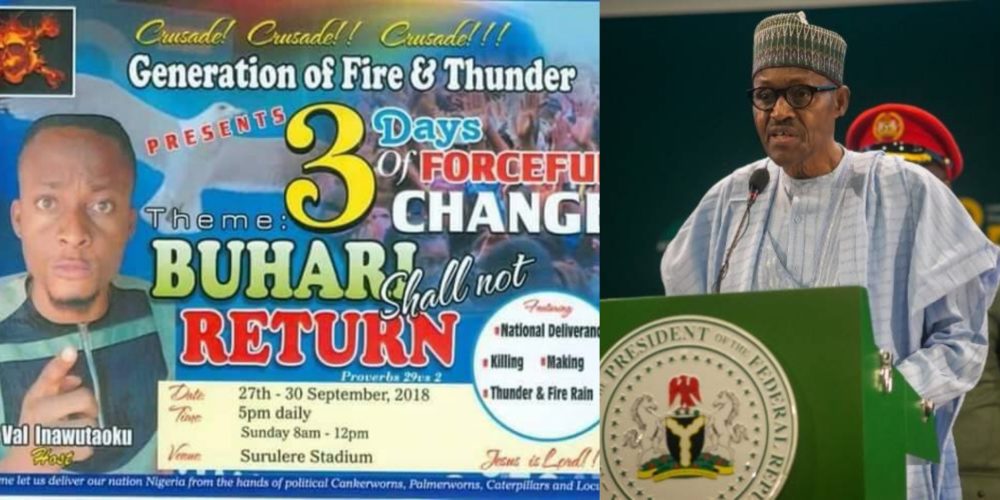
    We’ve held church crusades.

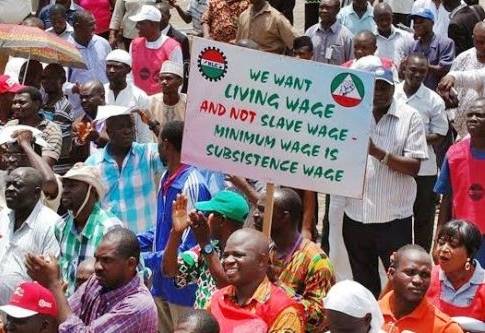
    We tried nationwide strikes.

    We’ve attempted and succeeded at coups. We’ve held protests and tested the occasional name-calling. But nothing, nothing at all looks like it’s going to get the government to pay university workers their due, disburse a livable minimum wage, fix up the health sector, repair all the terrible roads and get children off the streets and into schools etc., etc., anytime soon.

    With these trial and error methods gone out of the way, it might be time for Nigerians to look in another direction; it might be time for us to try “The Mali Approach”.

    Now you might wonder, what is the ‘Mali Approach’? To explain, let’s examine the country’s state capital, Bamako.

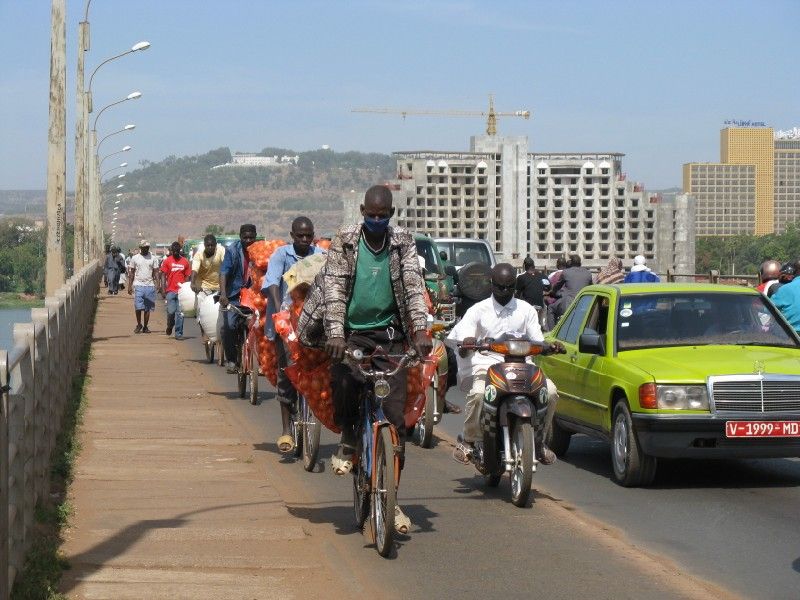
    Bamako, Mali.

    Mali has a largely agricultural economy — 70% of its workforce engage in the trade. The most productive agricultural areas of the country lay along the Niger River, which is between Bamako and Mopti. The north of Bamako is home to the largest concentration of cattle in the country. 

    Bamako is also the nerve centre of Mali; local and international trading in the country’s agricultural produce, livestock and fish take place here. It is a major link to a principal port of trade with Dakar. What this means is that Bamako is quite integral to the existence of Mali. It is so important that, without the state capital, Mali would lose about 36% of its GDP.

    That’s why what you’re about to read is shocking: You know what a group of people in Mali did to the roads leading up to Bamako in August 2019?

    They blocked it.

    Now, why would they do a thing like that?

    Two words: bad roads.

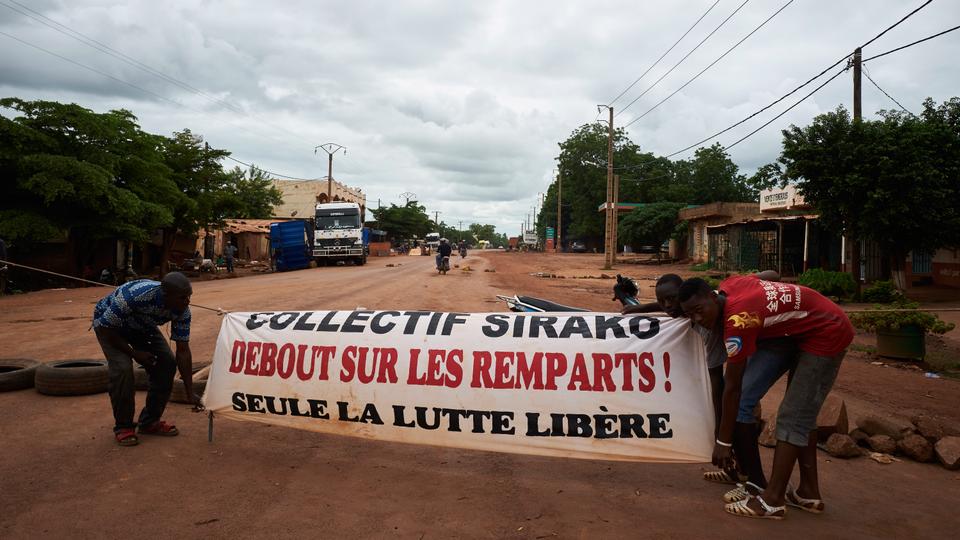
    Mali is a country plagued with close to impassable roads. Multiple directives on the internet warn travellers and visitors to be careful of its roadways. Having had enough of the government’s nonchalance to fixing the roads, a group called Sirako (which translates to “about the roads” in the country’s Bambara language), joined residents in blocking the main way leading up to the country’s capital. This blockade went on for about four days, gravely disrupting trading activities in the country.

    The blockades.

    The blockades started on August 23 in the western city of Kayes. Hundreds of residents blocked the main bridge over the Senegal River.

    By day four, the protests had spread to other regions: over 1000 trucks loaded with merchandise for trade were stuck outside of the city’s capital – Bamako.

    Attempts by the government to have the blockades removed proved abortive — the Prime Minister couldn’t get representatives of the people to budge.

    Within the time the blockades stood, dealers in fruit feared for their produce, which were stuck in trucks unable to access the city capital. Bus passengers had to walk kilometres to make it into Bamako.

    The country was in a standstill, because a few citizens decided, enough was enough.

    The aftermath of the blockades.

    By August 28th, less than a week after the blockades started, the government released an ’emergency’ 5.0 billion CFA francs, for the resumption of a major highway project to fix the roads leading up to the city capital.

    See where a little strong head can get you?

    Now, this might not work in the Nigerian context because well, you don’t need to do much before tear gas makes an appearance during protests. But, it does make you think. Hitting the government where it hurts just might be the way to go.

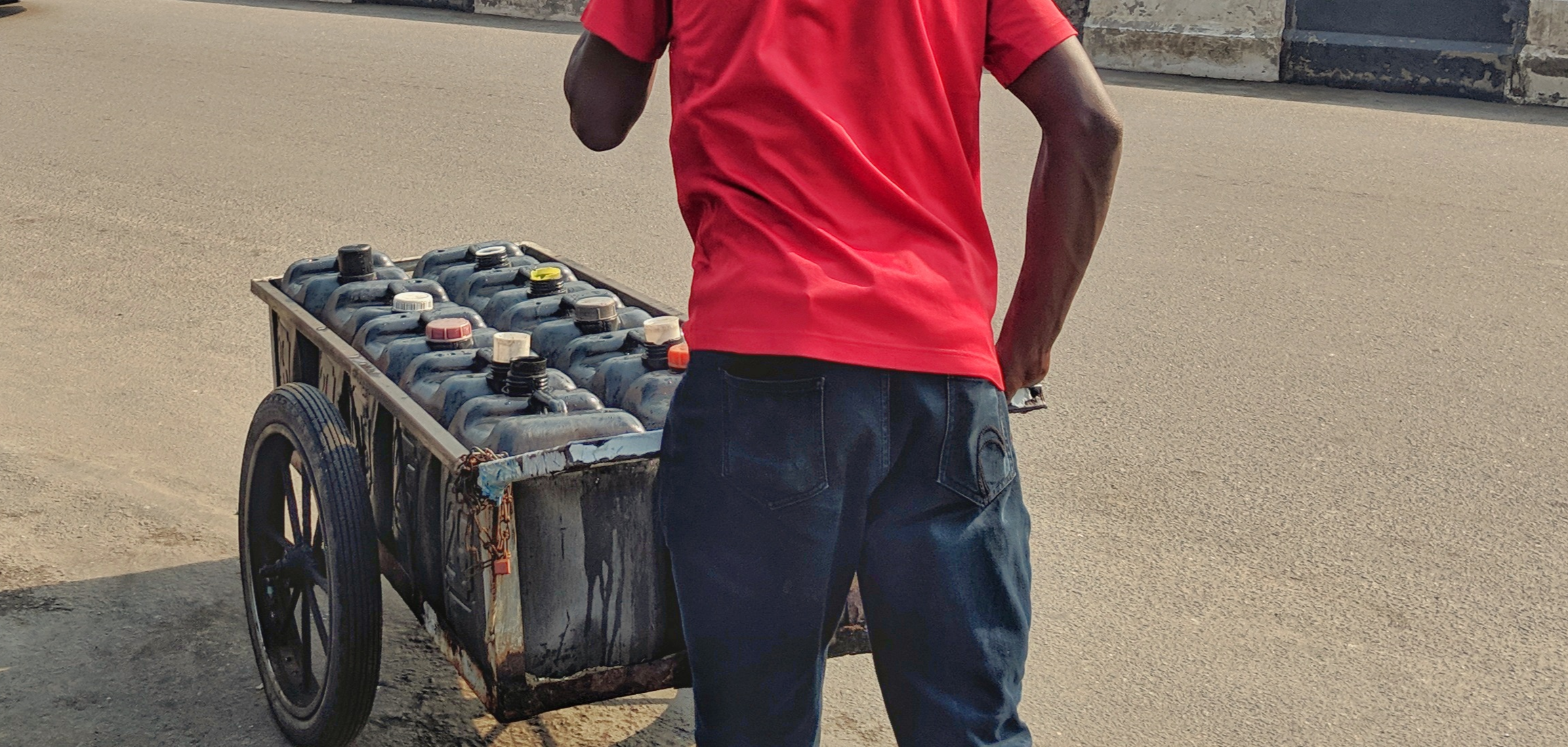
  • In this story, we talk to a man who spends his days selling water out of his cart, and his nights keeping watch. 


    Age: 27

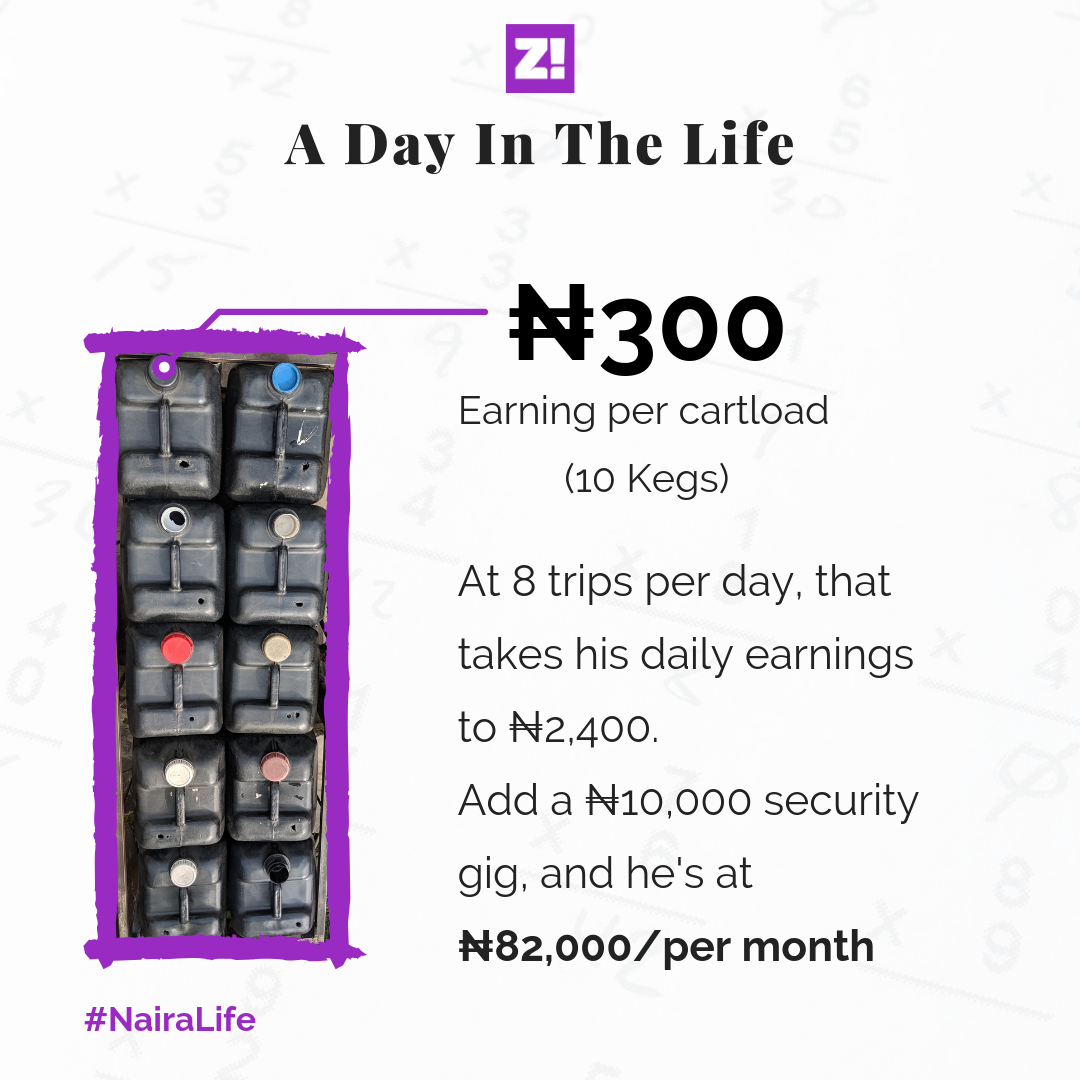
    Income: ₦82,000/month

    When did this hustle start?

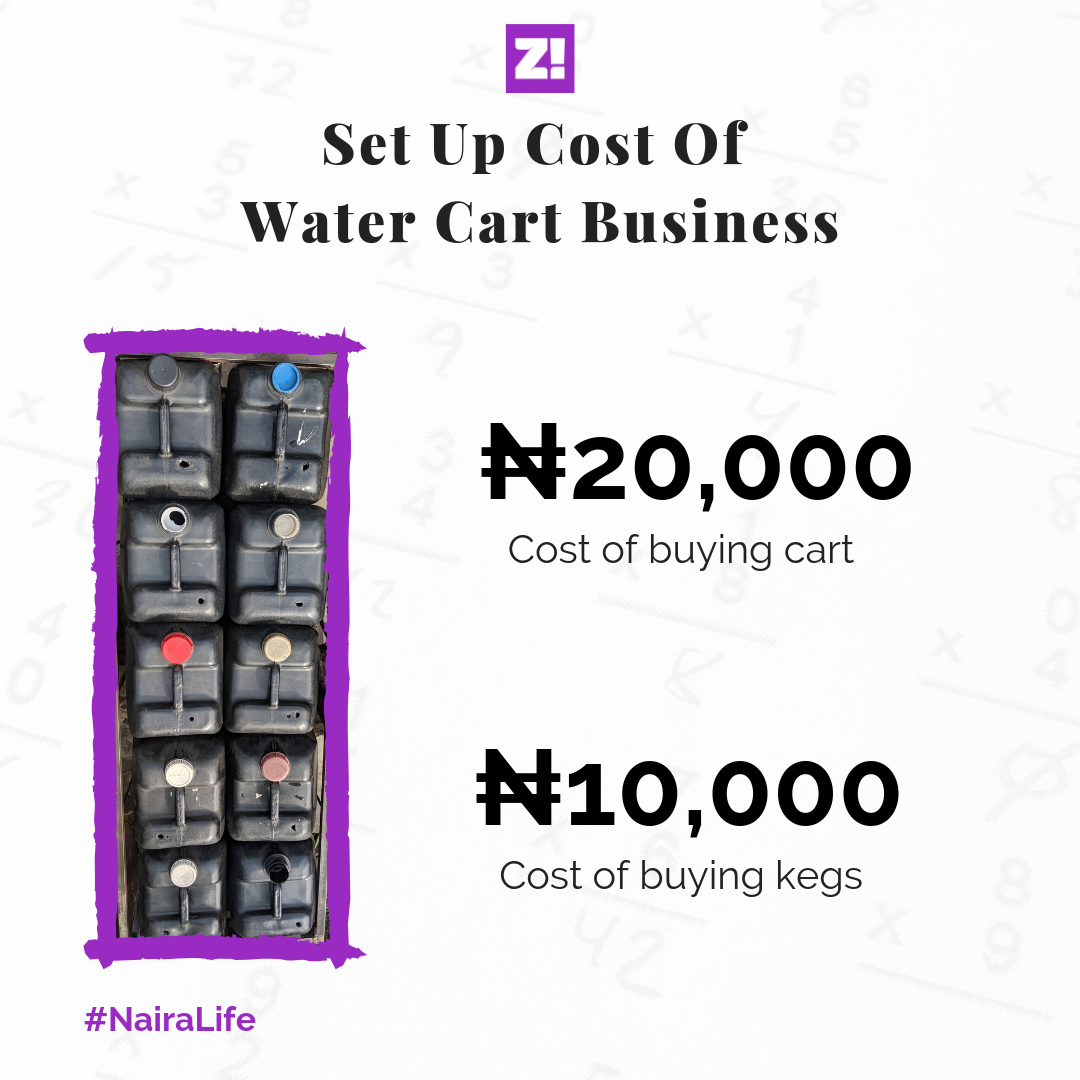
    I first came to Lagos around that time Jonathan first became President after Yar’adua died. The first job I started then was fetching water and selling. That time, water used to be sold for ₦20. I’ve been selling water since then.

    What’s your average water selling day like?

    I always sell between 6 to 8 carts. But on some very good days, I can sell up to 10 carts. My best water days are actually Monday and Thursday. I buy every keg for ₦10 when there’s light then sell each one for ₦40. When there’s no light and they pump water with a generator, each keg is ₦20.

    Then recently, I delivered water to one man, and he asked me if I could come and stay as security in his office compound every night to avoid burglars. He offered me ₦10,000. So that’s where I sleep. 

    So how do you spend your money?

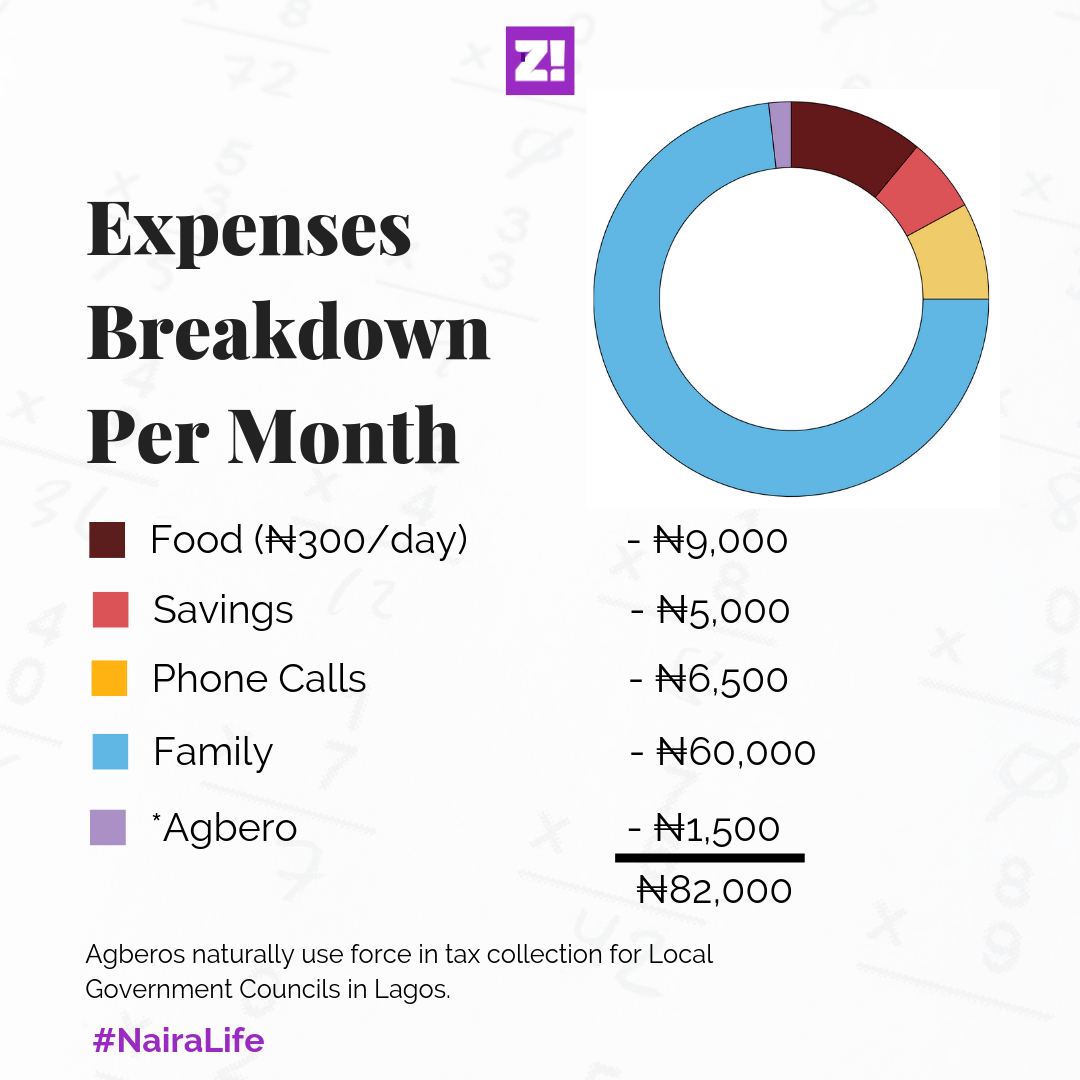
    I try to spend no more than ₦300 on food everyday. Then whenever I’m sick, I buy medicine. I try to call my family every time. Every time I call home, it costs me at least ₦500. 


    Ah, ₦500?

    Yes, every time I have to call my family back at home, it costs me ₦500 every 2 minutes. International call.


    Tell me about your family.

    My parents are from Kidal in Mali. It’s in Tuareg territory. So I’m Tuareg. Tuaregs were fighting to leave Mali and form their own country in 2012. We didn’t really support the movement and fighting in Kidal, because we didn’t want to follow those Tuareg to form new country.


    Why?

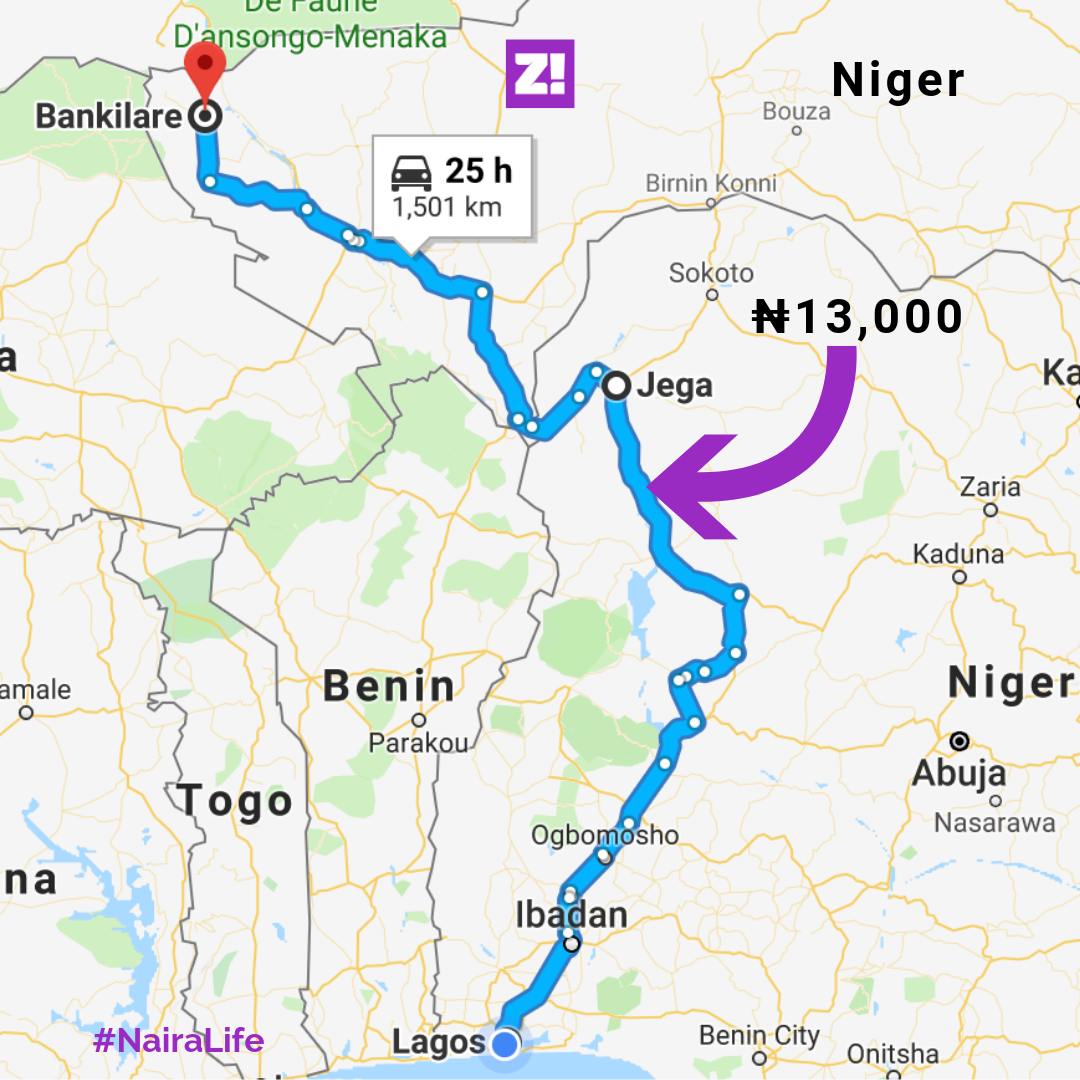
    Those Tuareg that were trying to form the new country are light-skinned. We’re dark-skinned. They won’t treat us well, so we just stayed with Mali. They didn’t succeed in the end. But my family moved to Bankilare in Niger. That’s where they live now.

    I have a wife that I married in 2017, we also have a daughter. My wife is 21 now. Then I have my father, my mother, and two sisters. The first one is 19 and the second one is 15.


    Does anyone of them go to school?

    My wife? No. My 15-year-old sister was going to school when she was younger, but no money again, so she’s no longer going to school. She dropped out of Primary School in 2013.


    Does your wife work?

    No, she just takes care of the child and maybe does small-small things at the market. But she doesn’t really work. Every month, I try to send home 100,000 CFA every month. That is about ₦60,000.

    Then she keeps 20,000 CFA and distributes the rest among my father, mother, and sisters.


    Back to Lagos; how far with these Agbero people?

    Those ones? They’re always mad. If they see you and you don’t have a Local Government Ticket, they’ll collect ₦5,000. But if you have a ticket, ₦50 every day. Then another thing that takes money once-once; immigration card. Every 6 months, we have to re-register at the immigration office for ₦1,500.


    Do you pay rent?

    No o. Because that security job is a night job, that’s where I sleep. If I earn more money, maybe I’ll try to get a place to stay.


    Do you keep aside any money?

    Yes, I try to save ₦5,000 every month. The money is supposed to be what I’ll use to travel back home. So, to travel back home, I need ₦100,000. Last time I travelled home was 2017.

    Because I need to take things for the family when I’m going home. For example, I’m going to buy clothes for the whole family. I want to travel around May or June.

    What’s the most vexing thing you’ve spent money on?

    It’s not even money I spent, but it pained me. One time like this, I went to the place where we buy water, it’s like when I removed my wallet to pay, I forgot to put it back in my pocket.

    By the time I went back to check it, someone had carried it. That wallet? It had ₦35,000 inside that I was supposed to send home.

    My head scattered. My chest was paining me.


    What do you think about your hustle, between 2014 and now?

    I’m getting old now. I really wish I had gone to school. Because if I know how to read and write, there are some jobs I’ll be able to do.  For example, I can get a better security job in a good place that will pay me well. Or even learn driving and become a driver.


    What are your plans for the next one year?

    I really just have to travel home. When I get home, I’m going to farm. I hate farming, but I have to do it. I’ll grow maize. What I grow, they’ll eat. The rest, we’ll sell.

    I also hope that when I come back, I find a better job, like good security work. Or even driving–this one, I have to learn reading and writing first.


    Right now, the only thing I want is for my family to always have food to eat.

    That’s why I’m here.

    Two things: 

    Check back every Monday at 9 am (WAT) for a peek into the Naira Life of everyday people. If you’d love to share your Naira Life with us, tell us here. You’ll be anon of course 🙂


    But, if you want to get the next story before everyone else, just subscribe here. It takes only one minute.