Notice: Function _load_textdomain_just_in_time was called incorrectly. Translation loading for the wordpress-seo domain was triggered too early. This is usually an indicator for some code in the plugin or theme running too early. Translations should be loaded at the init action or later. Please see Debugging in WordPress for more information. (This message was added in version 6.7.0.) in /home/bcm/src/dev/www/wp-includes/functions.php on line 6121
IPOB | Zikoko!
  • Wait First: Was IPOB Responsible for Ebonyi Sit-At-Home Shooting?

    A viral video shared on different platforms, including Twitter and WhatsApp, claims that gunmen were shooting in a market in Ebonyi on July 4, 2023. In the clip’s background, a male voice says, “Destroy them, destroy them, sit at home. Nnamdi Kanu must be released.”

    On Wait First, we sort claims into three categories. If it’s true, it gets a fresh banana rating from us. A false claim is burnt dodo, and a misleading claim is cold zobo.

    So is this video true, or is it doctored?

    Background

    Nnamdi Kanu is the leader of the separatist group, the Indigenous People of Biafra (IPOB). He has, however, been in the custody of the Department of State Services since his re-arrest in June 2021. He was initially captured in October 2015 but escaped. His current incarceration is happening despite a court order mandating his release

    According to fact-checkers at the Centre for Democracy and Development (CDD-West Africa), the IPOB first issued a sit-at-home order in August 2021. The order grinds all economic activity to a halt in the southeastern part of Nigeria. According to the IPOB, it will be held every Monday until Nnamdi Kanu is released. The order was revised to only occur on days when Kanu was due in court.

    CDD reports, “On June 14 2023, Finland-based Simon Ekpa, leader of Autopilot (a faction of IPOB), issued a statement which declared a five-day sit-at-home order in the southeastern part of Nigeria. Ekpa stated that the order would hold from 3 to 5 July and continue from 7 to 10 July.” 

    ALSO, READ: Who’s This Simon Ekpa Guy Running IPOB?

    Verification

    The CDD fact-checked the video. Here’s what they found:

    “The CDD War Room can confirm that the video emanated from Abakaliki, Ebonyi state. The video was not doctored, and investigations proved that it first surfaced online on July 4, 2023.

    Credible media agencies like Premium Times and Vanguard News have reported that the incident did occur at the Ishieke market in Ebonyi state. 

    However, it’s not certain whether the gunmen are members of IPOB or otherwise. 

    IPOB is yet to claim responsibility or deny the activities of the gunmen.”

    Verdict

    The claim that gunmen attacked and shot at a marketplace in Abakaliki, Ebonyi state, on July 4, 2023, is true and, therefore, fresh banana. However, IPOB is yet to claim responsibility for it.

    Download the Citizen Election Report: Navigating Nigeria’s Political Journey
  • Who’s This Simon Ekpa Guy Running IPOB?

    If you’re up to date with the news, you may have heard about increased unrest in the South-East region blamed on the secessionist group, the Indigenous People of Biafra (IPOB). The group’s leader is Nnamdi Kanu who’s still in the custody of the federal government in spite of a court order demanding his release

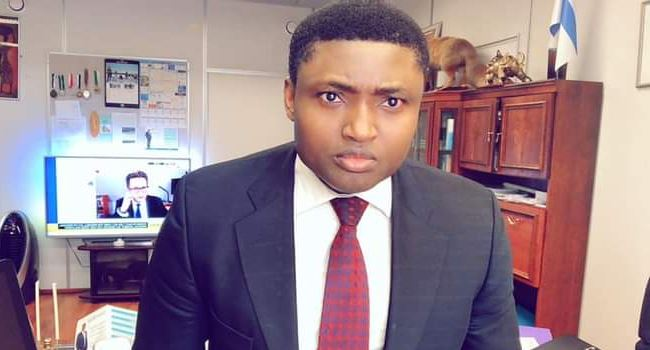
    While Kanu remains imprisoned, a self-acclaimed disciple of his, Simon Ekpa, has taken centre stage. If you’ve been on Twitter and Facebook long enough, you’ve likely seen his name pop up. So, who’s Simon Ekpa?

    From running for Nigeria to fighting against Nigeria

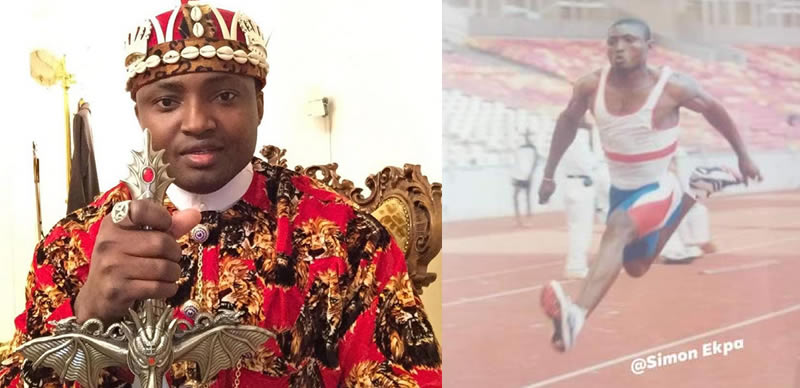
    Simon Ekpa was born on March 21, 1985 and the first thing that stands out about him is he once represented Nigeria as an athlete. In fact, he was a silver medallist at the 2003 African U-20 Championships.

    However, Ekpa has gone from flying the Nigerian flag to pushing for the disintegration of the country. When he  was nominated for an award by the Institute of Management Consultants (IMC) in 2021, he publicly rejected it

    He said, “I’m not interested in anything that’ll move Nigeria forward because Nigeria is not structured nor created to move forward, so anybody trying to move Nigeria forward is already a failure.”

    Publicly available records show Ekpa is a native of Ebonyi State but is now based in Finland. He describes himself on his Twitter account as “a human rights activist, CEO, senior legal advisor at Ekpa & Co Oy, legal researcher, author, analyst, Finnish politician, Biafra Spokesperson.” 

    The last bit is only partly true. In July 2021, Ekpa was named as a director for Radio Biafra following the arrest of Nnamdi Kanu. This was what shot him to the IPOB limelight. Yet, IPOB sacked him from the role that same month for refusing to sign the code of conduct governing the operation of the broadcasting station.

    What’s Simon Ekpa currently up to?

    Ekpa has been very vocal in his support for the realisation of Biafra. His voice has grown even louder with the 2023 elections looming on the horizon. 

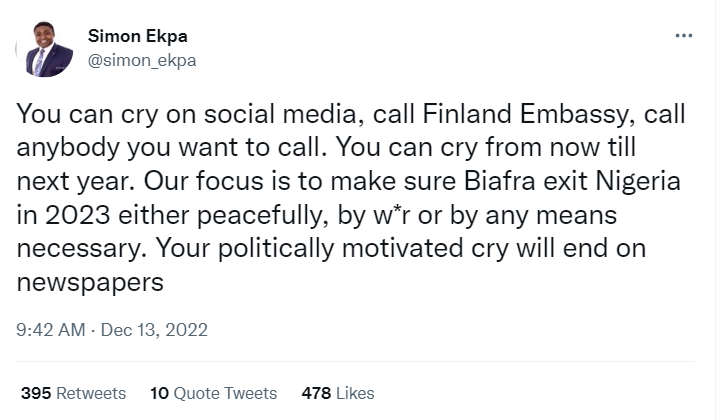
    He’s also been at the forefront of the sit-at-home orders which have had very serious socio-economic consequences in the South-East. On December 12, 2022, the Igbo group, Ohanaeze, called for his arrest over the destruction and killings in the region. The IPOB have also distanced themselves from Ekpa but that hasn’t deterred him from going about his activities.

    Online, various groups have petitioned the Finnish government to arrest him for his provocative statements believed to be fueling instability in the region. This hasn’t escaped Ekpa’s notice and he’s mocked those efforts.

    How has the government responded?

    Curiously, the Nigerian government hasn’t looked much in Ekpa’s direction. Maybe because they already have the real IPOB ringleader in custody, or because they see Ekpa as merely a noisemaker. There are other sinister reasons that have been suggested that have to do with the coming elections. 

    Whether the government will step up on this matter remains to be seen. However, there’s little doubt that if allowed to continue, the disruption posed by Simon Ekpa might have some impact on voter turnout in the South-East next year.

  • How Atiku Plans to Deal With IPOB, ASUU… and Wike

    On December 11, 2022, the presidential candidate of the People’s Democratic Party (PDP), Atiku Abubakar, and his running mate, Ifeanyi Okowa, were guests at a town hall hosted by Channels TV. The two-hour townhall focused on the PDP’s plans for Nigerians if the party is allowed to return to Aso Rock Villa.

    What did Atiku say?

    In his opening remarks, Atiku said Nigeria is going through its worst existential challenge since the civil war, describing the country as disunited due to security and economic issues. 

    The candidate believes his experience makes him uniquely qualified for the position of president more than the other candidates. Don’t forget this is his sixth attempt trying to become Nigeria’s president.

    On IPOB

    Atiku believes the central issue regarding the Indigenous People of Biafra (IPOB) is the realisation of Biafra. He noted that the options for that to happen are either another civil war or negotiations, and indicated his preference for the latter. Atiku also believes more autonomy for subregions will quell agitations.

    On ASUU

    On the recurrent strikes by members of the Academic Staff Union of Universities (ASUU), Atiku says he’ll clear all their backlogs. A very bold promise.

    “I’m going to increase the funding level (of education) as against what’s currently obtained. There’s no doubt about that because I’m a firm and committed believer in education.

    “I’ve undertaken to say, whatever backlog — we’re going to clear all the backlogs and make sure that you go back to classes and students go back to school.”

    On insecurity

    Atiku has plans to emulate the UAE to tackle insecurity in Nigeria. He’d know a lot about that seeing as Dubai is his second home.

    “The security architecture I admire is the UAE security architecture and it’s primarily based on monitoring. You don’t see policemen in uniform in UAE, you don’t see soldiers but virtually everybody is being monitored on a daily basis and particularly if you are a visitor, from the moment you step into the country or go out, anywhere you’re going, you’re being watched and that’s the deployment of technology as far as security is concerned.

    “That’s to say we’re aiming for the ultimate, but we have to deal with our current security structure. How we reform it to ensure we give our people a more secure environment to undertake their own legitimate businesses wherever they may be, whether in the rural areas, semi-urban and so on.”

    On Wike’s unending beef

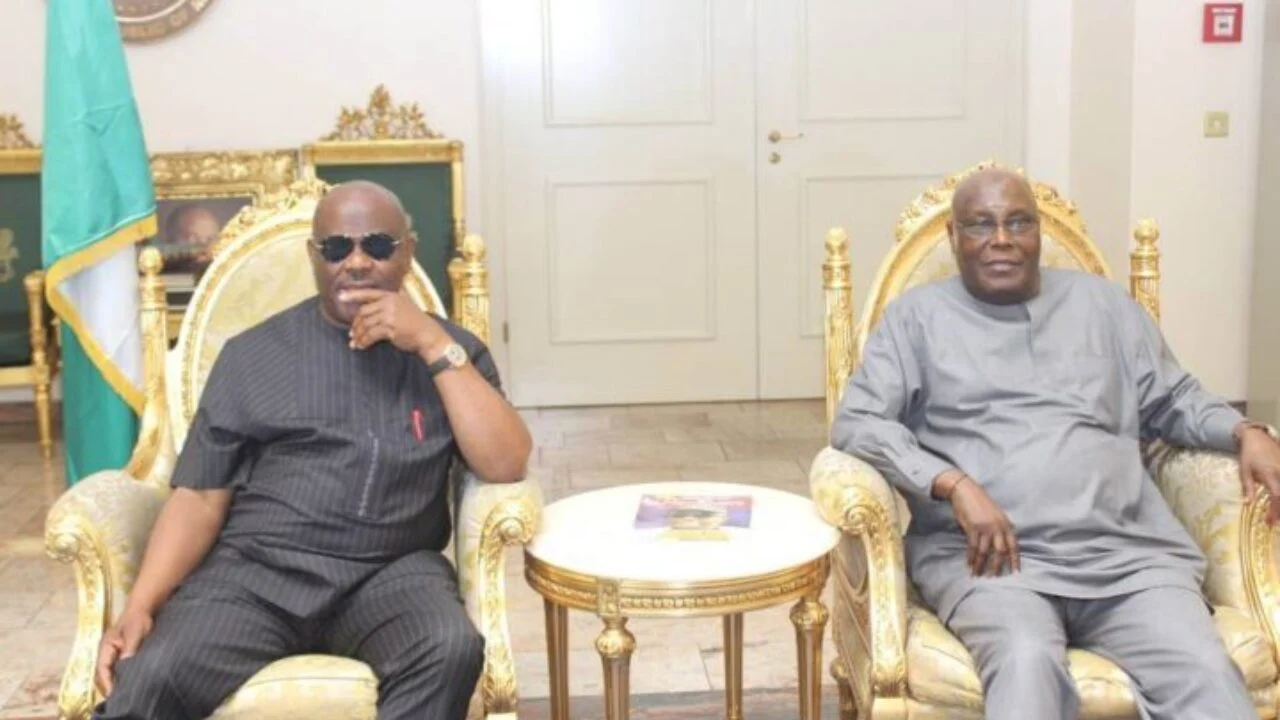
    Atiku said he tried on his part to square things with Nyesom Wike who he defeated at the PDP primaries to clinch the presidential ticket. 

    “I’ve met Wike two times in Port Harcourt, two times in Abuja, one time in London, personally. It’s not on my part; it’s on the other side. I’m waiting for him.”

    Dear Wike, we’re all waiting for your reply.

    On privatisation

    Atiku has long been a champion of privatisation which has earned him equal measure of praise from his supporters and criticism from those who say he wants to sell state assets to his friends.

    He responded to a question on why he’s fixated on selling public assets.

    “I’m not fixated but I think that’s best for the country. I mean, let’s be honest with ourselves, we have four refineries and they’ve ceased functioning; I don’t know for how many years now and every year we budget money for overhauling the refineries that don’t work. Please, let’s give it to the private sector.

    “In every great nation in this world, you find out that it’s the private sector that’s driving the economy — they provide the jobs, they provide the prosperity, and they do everything. Why should we be different? So, I’m not fixated.”

    On Deborah Samuel

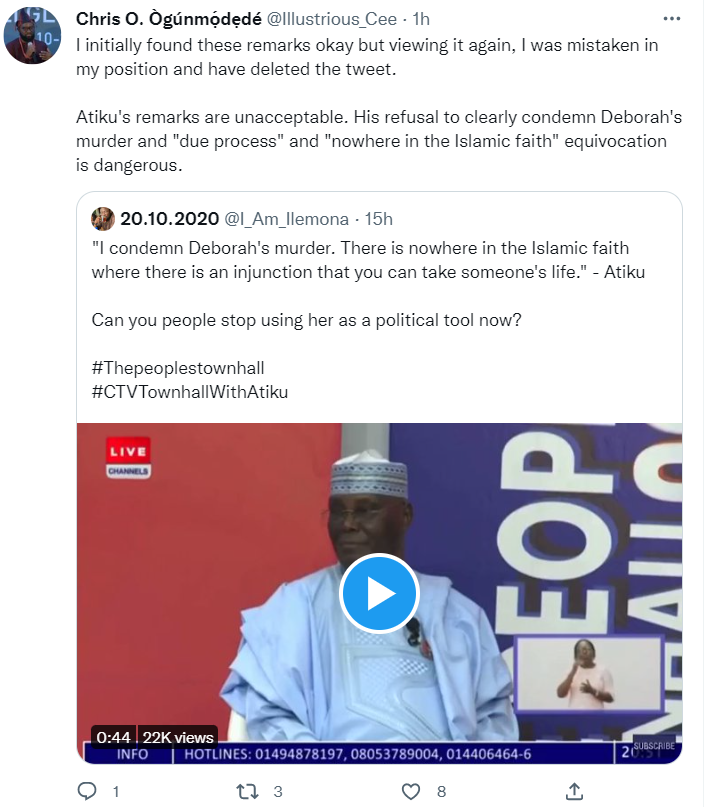
    Atiku also addressed the controversy surrounding the death of Deborah Samuel, a 19-year old Christian killed by a mob of her classmates in Sokoto over allegations of blasphemy. Atiku’s Twitter account had posted a statement condemning her death, before later deleting it.

    When asked why he deleted the tweet, the candidate said it was posted without his approval. But he made it clear that he later condemned the murder.

    Not everyone’s buying his answer though.

  • What Peter Obi Said About IPOB, Others at “The Candidates”

    Day Four of “The Candidates” town hall series for 2023 presidential candidates hosted Peter Obi of the Labour Party and his running mate Datti Baba-Ahmed on November 21, 2022. The duo faced some tough questions from the host of the series, Kadaria Ahmed, and the studio audience. Here are the highlights of the evening.

    Petrol subsidy

    Kadaria asked Obi his plans on how to deal with Nigeria’s budget deficit. This led to a debate on petrol subsidy payments and Obi didn’t mince words. “I believe that subsidy must go. What we have today as subsidy is organised crime.” 

    Obi said petrol subsidy payments have taken a huge chunk of Nigeria’s budget and promised to provide an alternative. He pointed to modular refineries and Aliko Dangote’s refinery as options to explore to reduce the cost of refining oil.

    Foreign exchange rate

    Obi said to solve the exchange rate problem, Nigeria needs to look at its underlying cause. “The naira is weak because we have weak reserves driven by low exports. There aren’t enough exports bringing foreign revenue.” Obi believes that once Nigeria becomes productive, the naira would rebound.

    IPOB

    A couple of tricky questions about the Indigenous People of Biafra (IPOB) surfaced. Kadaria asked Obi about his stance on self-determination and Nigeria’s unity. 

    “Once you do things based on fairness and equity, you’ll see unity. We’ll form a government of national unity.”  

    Obi said he would listen to all agitators and dialogue with them. “There’s nothing wrong with agitation. You can’t attack people for expressing their opinion. People agitate everywhere, even in my house. You sit down and listen to them before you say yes or no.”

    Climate change

    On climate change and Nigeria’s flooding crisis, Obi believes part of the problem is rooted in the management of Rivers Niger and Benue. He said that Egypt’s Nile River, which is much larger, is properly managed. 

    “Over the years, contracts have been awarded to dredge the Niger and Benue. If they’d been doing that, we’d have water transport and (properly) channel the water. Nobody will collect contracts and go away under our government.”

    Pressed on whether he was committing to dredging the rivers, Obi said yes.

    Electricity

    Obi plans to revamp the power sector, despite the cost. “I’ve done the numbers well,” he said, “we can fund the power sector.” His strategy includes varying tariffs which would exist across various bands for low income and high income neighborhoods. Obi wants richer neighborhoods to fund the poorer ones. He says he’ll get subsidised tariffs for them. “I’ll declare war on power,” he added. 

    He said Nigerians will be able to generate up to a certain number of megawatts without license while cutting down on taxes and levies. “There’ll be regulation, but we won’t waste people’s time.”

    Fighting corruption 

    Obi said he’ll bring corruption to a minimum. “I’m not going to fight corruption by being vindictive. We’re going to make sure there are proper investigations and everything. We’ll operate by the rule of law. Where we even need to negotiate, we will. There are other countries who have done it better and I’ve learnt from them.” 

    Folks, that’s Day Four of our coverage of “The Candidates” presidential town hall series. Follow us on Twitter, Instagram, and Tiktok for more coverage of the series. You can also follow Daria Media on Twitter and Facebook and Instagram.

    ALSO READ: Here’s What Rabiu Kwankwaso Wants to Do as Nigeria’s President

  • Here’s Why Nnamdi Kanu Is Still in Prison Despite Release Order

    Nnamdi Kanu, the leader of proscribed separatist group, the Indigenous People of Biafra (IPOB), has a cat and mouse history with the Nigerian government. 

    The British-Nigerian activist gained prominence when he launched Radio Biafra in the United Kingdom with which he spread his agenda calling for the breakaway of Biafra from Nigeria.

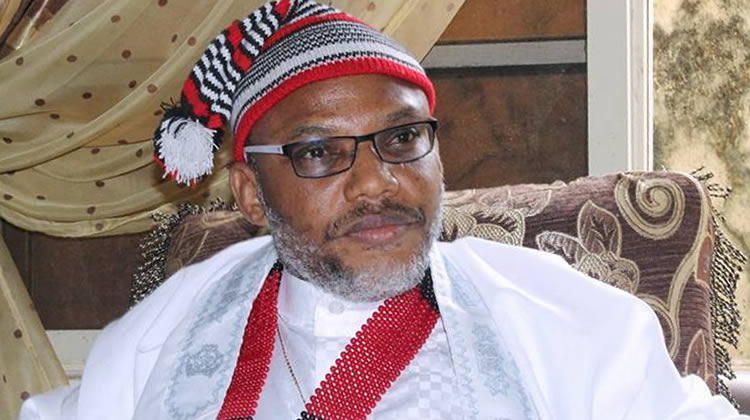
    Nnamdi Kanu [Image source: Punch]

    Kanu was first arrested in Lagos in October 2015. He was detained for over a year and a half despite court orders demanding his release. In April 2017, he was released on bail on health grounds. 

    However, he skipped bail and went abroad. He also went against another of the terms set for bail by granting interviews to champion the IPOB movement.

    Road to his recent arrest 

    In June 2021, Kanu was rearrested and brought to Nigeria to face trial on treason charges. The Attorney-General of the federation, Abubakar Malami, gave no details as to where he was arrested, except to say that it was the collaborative effort of Nigerian intelligence and security services.

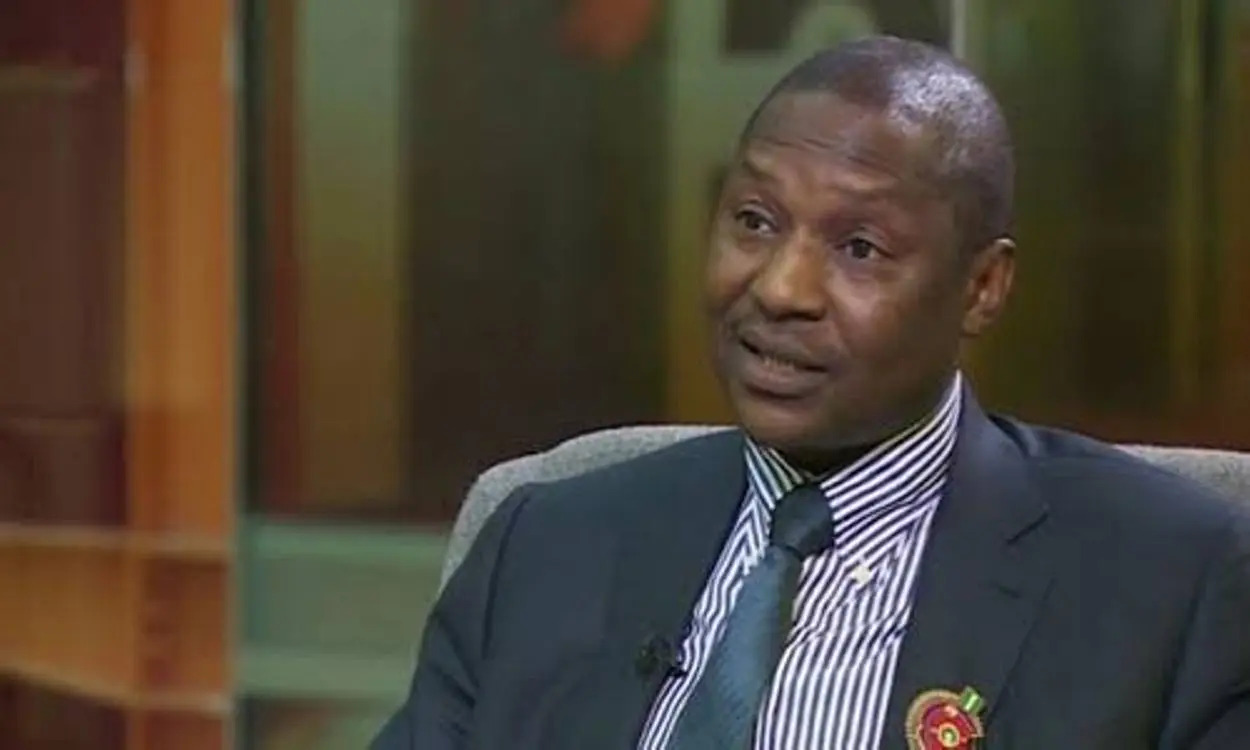
    Abubakar Malami [Image source: Vanguard]

    In April 2022, eight out of 15 charges brought against him were struck out by the Federal High Court in Abuja. The federal government in May 2022, amended the charges against Kanu and listed his lawyers as accomplices. 

    In July 2022, a group backed by the United Nations called for the release of Kanu from detention. Almost immediately, a northern coalition of 52 groups rejected the call for Kanu’s release, underscoring the highly sensitive and political nature of the matter.

    Recently, on October 14, 2022, an appeal court sitting in Abuja freed Kanu of all terrorism charges. It also ordered his release and the payment of compensation of up to ₦500 million. The court noted that the federal government violated all known laws when it forcefully extradited Kanu. The extradition was done from Kenya to Nigeria for the continuation of his trial.

    Why is Kanu still in custody? 

    The government said it would not release Kanu despite the court ruling. It said instead, it would review its legal options and could institute other charges against him. He remains in the custody  of the Department of State Services (DSS).

    Malami, the Attorney General, said that although the basis upon which Kanu was freed was based on rendition — that is, the process of sending a suspected criminal to another country for interrogation — it was not, in his opinion, sufficient enough. He provided four reasons why the government couldn’t release him.
    In his words, “In arriving at a decision whether to release or not release (Kanu), one; you look at the rule of law, two; you look at the public and the national interest, three; you look at the security situation, four; you look at international diplomacy.”

    He argued that Kanu had jumped bail before and could not be trusted to not do so again. Malami also argued that his history suggests that he could incite people again after his release. He feared that he could use his influence to launch a foreign attack against Nigeria.

    This is not the first time this is happening. In 2017 for instance, despite a court ruling ordering the release of Ibrahim El-Zakzaky, the leader of the Islamic Movement of Nigeria, the Nigerian government  refused to do so, stating that the continued detention was in the “security and public interest.”

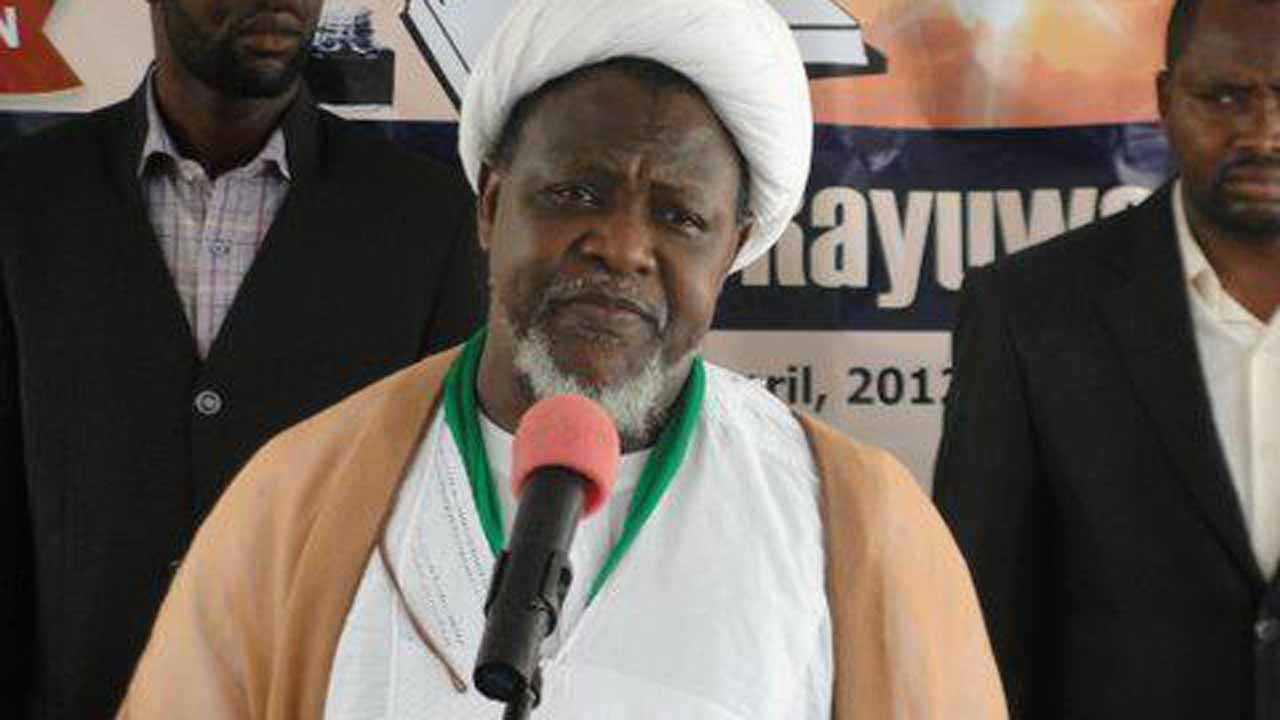
    Ibrahim El-Zakzaky [Image source: Guardian]

    Where does this leave Nnamdi Kanu? 

    His legal team has pleaded with the DSS to grant him access to a physician, following a court order. 

    It remains to be seen if they would comply.
    ALSO READ: What Nnamdi Kanu’s Freedom Means for Nigerians

  • What Nnamdi Kanu’s Freedom Means for Nigerians

    To his support base, Nnamdi Kanu is the saviour of the Igbo people from the clutches of the Nigerian government. To the Nigerian Government, he’s a terrorist and a threat to democracy. But for the rest of Nigeria, Nnamdi Kanu is simply the leader of the Indigenous People of Biafra (IPOB), a sect prominent in championing the secession of the southeast region from Nigeria to create its own independent state called Biafra.

    Image Source: Afolabi Sotunde/Reuters

    Kanu’s first arrest

    In October 2015, the Department of State Services (DSS) arrested Kanu in Lagos after arriving from the United Kingdom. The government later charged him to court on charges of terrorism and felony. In April 2017, the Federal High Court in Abuja granted him bail on “medical grounds”, but jumped bail months later after a Nigerian Army raid on his home, and he wasn’t seen in public for over a year.

    In June 2021, the Nigerian government announced that Nnamdi Kanu was miraculously back in custody in Nigeria.

    The government refused to disclose how Kanu was arrested and back in the detention of his buddies at the DSS. But he claimed he was illegally arrested in Kenya and extradited to Nigeria without due process. 

    From that point onwards, it’s been nothing but a seemingly unending court case,  accusations of inhuman treatment and counter-accusations between Kanu and the Federal Government. Imagine being forced to wear the same outfit, without any washing, for five months. 

    Kanu’s imprisonment heightened unrest in the southeast, especially with a controversial sit-at-home order implemented on Mondays across the region. The curfew has been blamed for the increase in criminal activities and violence in the region

    Image Source: Daily Post Nigeria

    A bittersweet release 

    On October 13, 2022, the Court of Appeal sitting in Abuja, the Federal Capital Territory (FCT), ruled Kanu’s arrest and extradition illegal and dropped all terrorism charges against him.

    You can only imagine how Kanu must have felt as he heard the verdict. 

    But, don’t rejoice yet. He has still not been released from DSS custody. Why?

    Well, it’s due to the Federal Government, again. This time, the Attorney-General of the Federation, Abubakar Malami, declared that Kanu was only discharged but not acquitted. He added that there were other issues predating Kanu’s rendition “on the basis of which Kanu jumped bail” which remained “valid issues for judicial determination.”

    In other words, the FG is pissed at Kanu’s jumping bail five years ago and wants to show him shege. 

    What are the people saying?

    Well, we have seen a number of mixed reactions to Kanu’s release. His supporters in the southeast region are happy, as this means no more sit-at-home orders from IPOB and getting back to their normal lives. 

    But there are still fears of IPOB lashing out if the Federal Government detains him further. After all, the current Buhari-led government is known for disobeying court orders. 

    There are also fears about Kanu’s potential influence on the 2023 elections and the fate of Peter Obi, the most prominent 2023 presidential candidate from the southeast region. Nigerians are curious to see whether he’ll be Obi’s ally or foe.

    Time will surely tell. 

  • Now, Why Would Nigerians Do A Thing Like Beat Ike Ekweremadu Up?

    If you had even the faintest glimmer of a 2G connection this weekend, then chances are, you caught wind of the attack on former Deputy Senate President, Ike Ekweremadu by purported members of the Indigenous People of Biafra (IPOB) in Nuremberg, Germany.

    In videos replicated on social media, one of which had 31.7k views at last count, we saw as the politician was pelted with eggs and dragged from all sides while he attempted to honour an invitation to give the keynote address commemorating the Second Annual Cultural Festival and Convention.

    The question is:

    What Would Make Nigerians Do A Thing Like That?

    Look, we’ll be the first to admit that politicians aren’t in the top 10 or 10,000 of the average Nigerian’s faves. They’re overpaid, they skim off the top ⁠— even on video, they use godawful catchphrases during elections (#NextLevel?) which, coincidentally happens to be the time they tend to remember regular Nigerians exist.

    But is that enough reason to beat them up in public and displace their hats?

    Nope! The answer you’re looking for is definitely NO.

    According to IPOB, their grouse with the former Senate leader lay in his alleged support of an institution that tagged their organisation a terrorist body i.e the Nigerian government. This, together with the charge that he dared visit Germany to celebrate a New Yam Festival, when his kinsmen were being attacked back home by alleged herdsmen.

    Are these claims founded?

    To the Indigenous People of Biafra, a secessionist group ⁠— absolutely.

    While the emancipation of Biafra from Nigeria remains the bedrock of IPOB, the former Deputy Senate President has at many points called for a restructuring of the country. Restructuring aims at a strategy to bring government as close as is possible to its people.

    The literal opposite of what IPOB hopes to achieve.

    But, it’s understandable that a government official has a stance that is pro the unity of a country, as opposed to its piecing apart.

    On the matter of his performative visit abroad while attacks run rampant back home, Nigerian farmlands, villages and communities have been the subjects of incessant attacks by groups alleged to be herdsmen. Igbo states like Enugu being no exception. Very recently, it suffered the loss of Reverend Father Paul Offu at the hands of assailants suspected to be Fulani herdsmen.

    However, while anger at a politician making arguably unnecessary visits abroad, despite the safety of kinsmen back home is at stake is very understandable, it should never come to the point where physical attacks on his person are resorted to. It is beyond abhorrent behaviour.

    How is Ekweremadu holding up?

    Better than you would expect actually. While his ego and maybe even certain body parts have been considerably bruised, he isn’t letting the attack fuel a vengeful agenda.

    In a press release on his Twitter profile, Ekweremadu had this to say:

    “Much as I am disappointed in their conduct, especially as I am one of the persons who have spoken up on justice for Ndigbo, the Python Dance, judicial killings in Igbo land and elsewhere both on the floor of the Senate and in my written and personal engagements with the Presidency and the media as well as rallied the South-East Senate Caucus to secure Mazi Nnamdi Kanu’s release with Senator Enyinnaya Abaribe taking him on bail to douse tension in the South East, I, nevertheless, do not hold this to heart against them, for they know not what they do.”

    Way to be the bigger man!

    So is this the last we’ll hear of politicians being attacked abroad?

    Well, going by a statement released by IPOB, that would be a no.

    According to the organisation’s spokesman whose very real name is Emma Powerful

    • Governors David Umahi of Ebonyi, Ifeanyi Ugwuanyi of Enugu, Okezie Ikpeazu of Abia and Willie Obiano of Anambra state better stay in their domestic lanes and steer clear of foreign sojourns because IPOB members worldwide have been directed to attack them on sight.

    Violence is never the answer, can somebody please page IPOB this news, before they do something unforgivably stupid?