Notice: Function _load_textdomain_just_in_time was called incorrectly. Translation loading for the wordpress-seo domain was triggered too early. This is usually an indicator for some code in the plugin or theme running too early. Translations should be loaded at the init action or later. Please see Debugging in WordPress for more information. (This message was added in version 6.7.0.) in /home/bcm/src/dev/www/wp-includes/functions.php on line 6121 Investments | Zikoko!
This is debatable, but the most dangerous venture, apart from dodging a Nigerian mother’s slap, is investing in land — especially in Lagos. If it’s not the fear of getting scammed, it’s navigating “omo onile” and hoping you aren’t buying land in an area that’ll be demolished by the government in the future for one reason or another.
However, land remains a valuable long-term investment option, and you can invest safely by following these tips I got from discussing with Grace Ogunlaja, the lead consultant at I-Brow Properties.
Check for the type of land
Not all land in Lagos is for residential purposes. Some have been earmarked for agricultural, commercial, or even mixed use. Buying a residential land and using it to produce pure water may earn you visits from the authorities, and you’ll probably lose ownership. Some lands can even be in locations under territorial dispute. You can verify the type of land at the state Ministry of Lands (or Lands Bureau).
Does it have a title?
You should always confirm the land title with the land seller or real estate developer. Do NOT purchase any land without a title.
A title can be the Certificate of Occupancy (AKA, C of O) or Governor’s Consent. The C of O is a state-provided document demonstrating land rights to an individual; It proves ownership. Governor’s Consent is given when someone buys land that already has a C of O and wants to notify the Governor and the general public that the land has a new owner.
Land title differs from the deed of assignment or receipt the land seller gives after purchase. Those documents just indicate that you’ve bought something. You still need to confirm you didn’t buy stolen property, or worse, land that’s been mapped out for government purposes. Like a coastal road project, for instance.
Run away from “freehold”
Some real estate agents in Lagos will try to sell you land and claim it has freehold rights, meaning you own the land in perpetuity (or forever) and can use it for anything. This doesn’t exactly work because all land belongs to the government. Also, freehold isn’t exactly a land title, and chances are that the land isn’t free from government acquisition. When in doubt, always verify at the Ministry of Lands.
Go with your own surveyor
The seller may try to convince you that the land already has a registered survey plan approved by the State’s Surveyor General, but those can easily be falsified. You should always go with your own surveyor to pick the land coordinates and verify them at the ministry.
Get familiar with the authorities
When buying land, you must verify everything with the Ministry of Lands because land issues quickly become complicated in Lagos state. If proper verification isn’t done, you risk losing your investment.
Also, verification doesn’t end with buying the land. You also need to obtain building approval from the state government before doing anything on the land. If you build something different from what was stated on the approved building plan, the government has the right to demolish it without giving any compensation.
Remember: The government can come for your land
It’s important to make peace with the fact that the government can claim land for major projects at any time, even if the owner has a C of O or Governor’s Consent. The only difference is, having the correct land titles gives the owner the right to sue the government or collect compensation. The owner has no compensation or fighting rights if it’s untitled land.
Every week, Zikoko seeks to understand how people move the Naira in and out of their lives. Some stories will be struggle-ish, others will be bougie. All the time, it’ll be revealing.
Let’s start from the beginning. What’s your earliest memory of money?
During the festive season in the north, where I grew up in the 90s, kids would go on yawo — a Hausa term meaning to walk around. I started going on these walks with my siblings and other kids when I was five years old. We’d dress in our Christmas and Sallah bests, and go to neighbour’s houses to get food and ₦10 or ₦20, which we’d then spend on sweets.
I have memories of falling asleep at random houses, thoroughly exhausted from the long walks. Then, one of my many older siblings would come and pick me up.
You came from a large family. What was that like financially?
My dad was educated and had a business. My mum was a stay-at-home mum who dabbled in businesses once in a while. We had everything we needed. We also had two cars and lived in a nice neighbourhood.
We weren’t super rich, though, and I knew that because most of my older siblings went to top primary and secondary schools. But when it got to the last three kids — I’m the lastborn — we had to go to cheaper schools. Plus, at some point, we stopped having cornflakes for breakfast. I think it was a combination of the economy and my dad getting older.
But my parents made sure we developed a sense of self that wasn’t tied to money.
How so?
My parents discouraged anything that was overly money-centric. We weren’t allowed to sell or exchange stuff for money. If they heard one of us exchanged a banana for ₦20, they’d scold the culprit like they did blood rituals.
They encouraged us to come to them for what we needed and not worry about making money. If you went to them with an outrageously expensive want, my dad would trick you into not wanting it anymore so he wouldn’t have to buy it. It worked most of the time. So, I never worried about money and just relied on what they and my older siblings could give me.
When did you first earn money for yourself then?
2009. I was 16 and had just finished secondary school when I joined a modelling/ushering agency through my older sister. People always stopped me on the road to ask me if I wanted to model because I was tall. So I thought, “why not?”
All I had to do was dress nicely and stand at events, and I made roughly ₦15k – ₦20k per month. It was mostly fun. I met celebrities all the time, but it also had its downsides.
What downsides?
I once worked with an event organiser who called me and the other ladies riff-raffs and fought with the agency because, according to her, we didn’t look good enough for the event. There were also the men who kept trying to date me. But I was just there for the vibes.
The money was a nice-to-have, and no one at home asked me for it. I was still at it when I resumed uni in a different state. But then, I only took the gigs when I was home for holidays. At school, I relied on foodstuff and the monthly ₦10k – ₦20k allowance from home. I also got random cash from my big sister and a lecturer who was like a sugar daddy without the sugar.
Wait, what?
My sister sort of introduced me to him. He took a liking to me, but all we did was talk in his office every other day. After our chats, he’d give me ₦5k for lunch.
My first and second years at uni were pretty chill because I always had money, but I always spent it as fast as it entered. If I ran out of money, there was always an older sibling to ask.
What were you spending money on, though?
I had an appetite — still do — for nice things: clothes, human hair, food and phones. By this time, though, I’d learnt that taking all my needs to my parents would only end up in, “Why do you need this thing?” So I had to sort the money by myself.
I’d also learnt how to be friendly with men for money, especially since I stopped the ushering gigs in my third year.
Why did you stop?
I gained weight. Plus, I was schooling in a different state and wasn’t always available when they called, and they soon stopped calling me. I stopped and started writing for money instead.
How did writing come into the picture?
I’ve always been an avid reader, but I didn’t really write anything until 2013. Someone I liked ghosted me, so I started using it as an avenue to rant.
Then, I began to explore creative nonfiction and found out I liked it. Later, I stumbled on an article by an engineer-turned-writer who had a blog and a reasonable following. I was studying engineering, so I thought we had that in common.
I emailed him, telling him I was an engineering student who recently started writing and wanted his thoughts on my writing. He responded, and I started to guest-publish on his website for free. Then he started a company in 2014 and gave me small admin tasks, paying me a ₦5k monthly data stipend.
Was that all you were doing at that time?
I also did a six-month industrial training for school. I got paid ₦15k/month, which was exciting until I removed transport money and realised ₦15k didn’t cover anything. Luckily, I stayed with my sister during my IT, so she usually filled the gaps.
I graduated in 2015, and while waiting for NYSC, I kept on with the ₦5k admin task. Sometimes, he paid more, especially when he needed my help with extra operational tasks. But I needed more money, so I got a technical sales job at an inverter company. The offer was ₦15k/month, but two weeks in, they noticed I was smart and familiar with the technical concepts, so they decided to make it ₦25k instead. Me, I just wanted any additional income, so I didn’t even mind the ₦15k.
But I resigned after six months because of NYSC. My PPA was in the civil service, where I got paid ₦15k/month in addition to the ₦19,800 allowance. I also still had the ₦5k admin gig.
My brother and writer boss both helped out with my ₦90k house rent, so I just spent on transportation and food.
Did you have any savings?
To be honest, I’ve never been good at saving money. I know how to spend, and also know how to manage when there’s little, but saving just isn’t my thing.
I took another writing gig in May 2016 for a travel blog, writing 40 – 50 short SEO articles a month for ₦15k. I only did it for three months, though — I ran out of content to write on.
Yikes
I continued with my boring civil service job till service ended in September 2016. I was too proud to stay unemployed, so I’d been sending out applications since July. I interviewed with a startup media company, but they asked me to return after NYSC.
So, I hit them up again in September and got hired as a junior writer. The salary was ₦80k/month. I had to move to Lagos, so I moved in with a cousin. The commute was hell, though — the cousin lived at Argungi, and the office was at Yaba. It was probably for the best that I got laid off after two months.
Ah. What happened?
They were downsizing. So, I officially entered unemployment, but still hellbent on working for a startup. Working with cool young people was a breath of fresh air, and I didn’t want to go back to the civil service.
Although I moved back in with my parents, I was very picky with the jobs I applied to and stayed unemployed for about seven months. I still had the ₦5k admin job, though.
In July 2017, a friend introduced me to a tech hub, and I got employed to do PR, communications and social media for ₦100k/month. I was still staying with my parents, so I had no bills. But I left the job in December.
Another job?
I was told to resign. It was a chaotic husband and wife business, and a really toxic work environment. One day, I was just like, “Fuck this” and was rude to my manager. So they asked me to resign.
I was unemployed again, but this time, I wasn’t just looking to work at a startup; I was looking for structure and a clear career path.
Did you find one?
Luckily, I did. I resumed a marketing role in January 2018. My salary was ₦137k/month, and I had to move back to Lagos to stay with my cousin again. It felt like good money because I could afford to go out for drinks and buy myself nice things. I also stopped the ₦5k admin tasks to focus on my job.
Two months into the job, I moved out of my cousin’s house because I wanted independence. I rented a ₦20k/month room in a colleague’s house. I also chipped in ₦10k each month for other household expenses. It was my first major “billing” as an adult.
After sorting out rent, internet and maybe transportation, I’d blow the rest of my salary on drinks, then run to my siblings for money when I became broke. Even when my salary increased to ₦150k in August, I still always asked my siblings for money.
Did you ever think this was a problem?
I didn’t realise it was until one of my siblings visited me in Lagos and saw where I was living. She was like, “It’s better you come back home instead of just getting by.” It forced me to think about my life and realise I was actually tired of not having money.
So, I started to look for financial advice. I learned how to use Excel and started tracking my expenses on a spreadsheet, but I continued to struggle with saving. A friend told me something I can’t forget. She said, “You can only try to earn more, not squeeze what you already have to live the life you want. You just need to make more money.” But I was following passion and wanted to stay in tech startups that couldn’t pay me those big salaries.
By the end of 2018, I started to want better for myself financially and decided it was time to start earning more. I went back to my spreadsheet tracker and calculated that I’d have some financial leeway if I earned ₦40k extra. So, I went looking for side gigs and found one writing copy for a tech founder who paid that exact amount.
Nice. How was work going?
I got promoted to the head of my team in 2019, and my salary increased to ₦250k. With that, I could afford to move to a bigger three-bedroom flat that I shared with two other people.
The rent was flexible. I paid ₦195k/quarter for my room and didn’t have to spend anything else because it came furnished.
I had to stop the ₦40k side gig after a couple of months because of my increased responsibilities at work, and my job became my only source of income. But I started getting restless about earning more again. I looked at my spreadsheet and decided I needed to earn ₦400k per month.
So, I started job hunting. I put in my three-month notice in January 2020 and left in March. I was interviewing for a ₦450k job, and I had it in the bag, but COVID happened, and everyone froze hiring. Unemployment again.
Oh no. What did you do?
I thought COVID would be gone in a month, so I cut down my expenses to survive while I waited it out. Two months passed, and nothing had changed. Also, I had no savings.
I was violently job hunting and taking as many side gigs as I could. I was probably running on like ₦50k/month. I also relied heavily on my siblings and the goodwill of my friends.
I had to leave my apartment in July when no job came, and returned to live with my parents. I kept applying for jobs, and in September 2020, I landed a job in Ghana for $1,400.
Whoosh. Did you have to move to Ghana?
Not immediately. I worked remotely for two months, so they sent my salary in naira. It was around ₦600k — no thanks to CBN’s rubbish rate. But the job was a lifesaver. To finally earn money after five months of unemployment and enduring scrutiny from Nigerian parents was such a relief.
As usual, I blew the money. I used to work out of cafes just because, and went to brunch every week. But it was the first time I’d spend like that and still have money in my account at the end of the month. My brain clicked on the fact that I’m earning more now, and should keep a better eye on my spending. So, I began attempting to save.
[ad][/ad]
Was the attempt successful?
Uhmm, not exactly. I did some lifestyle upgrades because I’d been practically suffering for the past two years. So, I upgraded my wardrobe, bought wigs and started contributing about ₦50k monthly to the food expenses at home. I also started buying gifts for friends to reciprocate how they came through for me when I was broke.
I eventually moved to Ghana in 2021 to work at the office, and my finances became a bit tighter. Living in Ghana was expensive, and $1,400 per month didn’t do so much. I should mention, though, that I travelled a lot within Ghana and stayed in resorts on mini-vacations, so that took a lot of my money. I also became a prolific Instagram shopper. I didn’t pay for accommodation or feeding because the company provided it. But by September, I decided I needed more money again.
And you started job hunting again
Yup. A friend founded a startup and offered me ₦1m/month and stock options to lead influencer marketing. I moved back to Nigeria to live with my parents — for free, as usual — in 2022.
I thought getting a car would be nice, so I saved ₦500k from my salary for three months. But when I got ₦1.5m, I decided the job was stressing me out, so I quit on a whim and decided to survive on the money while I found something else.
It looks like you were no longer scared of unemployment
I’d gotten used to it, so what was the worst that could happen? I got a ₦960k offer a month later, but the money wasn’t enough to afford the lifestyle I was used to, and wasn’t commensurate with the level of work I’d have to do. So, I turned it down.
I eventually landed my current job about three months later as a sales operations specialist.
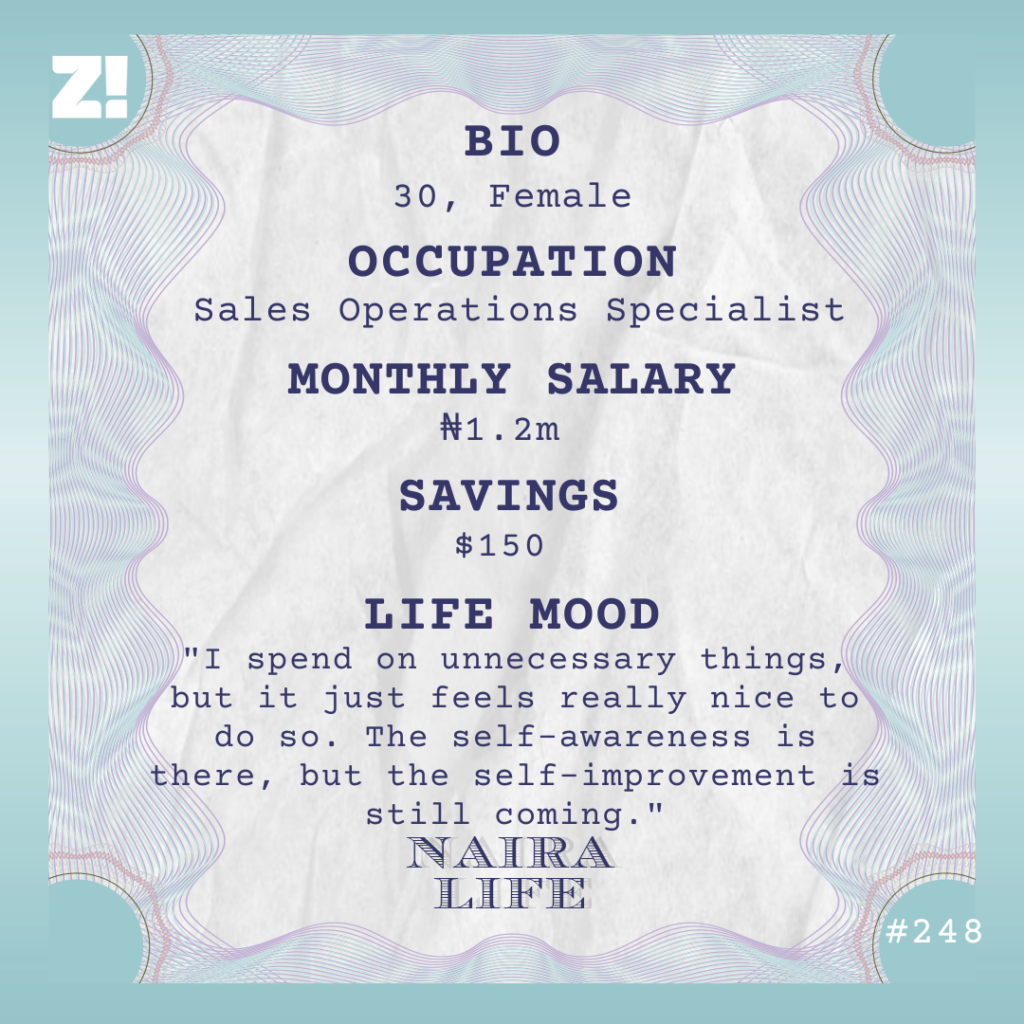
₦1.2m/month isn’t exactly a jump from my previous role, but I work with it. I moved to Lagos again and stayed with a boyfriend, and then another friend for the rest of the year. In January 2023, I took a ₦4m loan from work, got an ₦800k/year apartment, and used about ₦2.5m to renovate and furnish it.
How has going through several phases of unemployment and income growth impacted your perspective on money?
Working hard doesn’t guarantee having money — people can have money just by virtue of who their parents are. You can work hard, but the value you’ll get for your labour is typically tied to your socio-economic status in life. For instance, a poor carpenter will have poor clients and might never make enough to be rich.
However, I think being extremely rich borders on immoral. That kind of wealth is usually a result of the capitalist ideology where you mostly have to take from people or not care how anyone else fares as long as you maximise personal gain. Everyone could make do with less. So, I just want to be comfortable. I don’t want to be very very rich.
Right now, my life is a mix of gratitude and guilt. I feel extremely lucky to be able to have the life I have, where my major responsibility is myself. But there’s also guilt because I know what bare minimum is, and I don’t think humans should have to survive on bare minimum.
Also, all the clichés about money are true. You need money to make money, and we’re often never satisfied. I remember when I thought a ₦400k job would make me happy, but look at me now, I’m still passively looking for something that pays more.
Curious. Do you think you live above your means?
Oh definitely. I don’t have any money left over at the end of the month because I spend on a lot of things I don’t need. Take my princessing budget, for example. I know how to do my hair and lashes. But I want to go to a nice place so someone else can do them for me.
I also don’t have to go out for drinks or buy stuff from Instagram as often as I do. It just feels really nice to make these unnecessary expenses. The self-awareness is there, but the self-improvement is still coming.
Do you ever worry about not having savings?
I am. I’m trying to optimise my financial lifestyle to fix that, but it’s not easy. Right now, a chunk of my money goes into renovating my apartment and getting more furniture.
I have about $150 in savings, and that’s just about it. I try to save ₦150k per month, but I always end up spending what I manage to save.
Can you break down your typical monthly expenses?
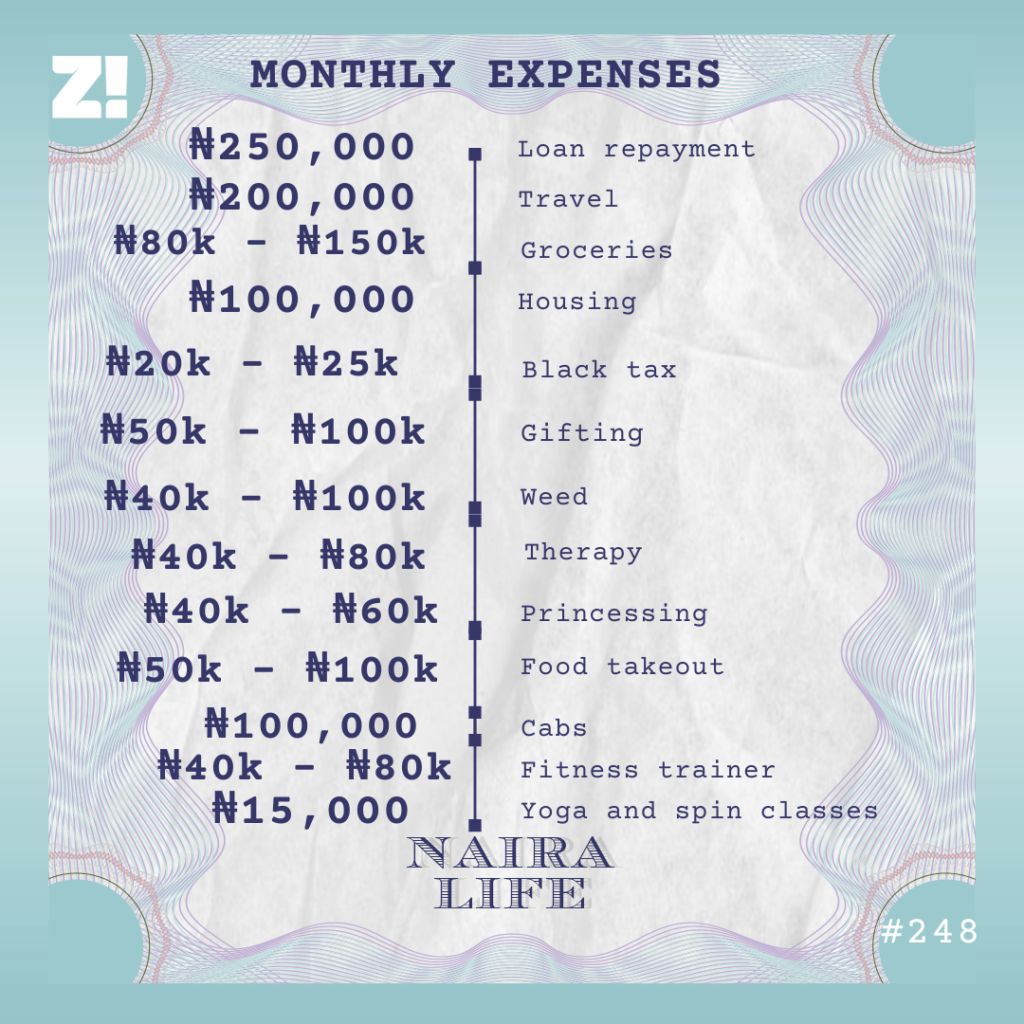
The loan repayment is towards the ₦4m loan I took from work earlier this year. I pay back 30% each month and will pay it all off by January 2024. My princessing budget is essentially what I spend on my nails, hair, lashes and all that stuff. It gets higher in a month when I have an event to attend.
In some great months, I usually have ₦70k extra after all my expenses as a buffer till salary enters. In the months I don’t, I turn back to my siblings. They’re my safety net. I usually support them too, though. So, I’m not just taking.
Is there something you want right now but can’t afford?
I’d like to get breast reduction surgery. I got a ₦2.8m quote last year but haven’t gotten around to it. I’d also like to get a car. My budget is ₦4.5m. Who knows what that’d get with the current exchange rate?
How would you describe your relationship with money?
It’s very weird. I monitor my expenses, but my savings and investments are non-existent. I don’t think I’ve ever downloaded an investment app. I guess I’m just indifferent to trying to control my money, so I just track it.
I record every amount I spend and know where the leakages come from, but I’ve just been unable to stop the extra expenses. Maybe after this conversation, I’d be embarrassed enough to actually do something about it. I work in a Fintech, and I’m learning more about how people manage their finances, so let’s hope something comes out of that.
How would you rate your financial happiness on a scale of 1-10?
7. It could be so much worse. I think you get better at making money the older you get. I believe that I can make more money if I want to and put in the work needed. In summary, I just try to maintain gratitude for where I am.
If you’re interested in talking about your Naira Life story, this is a good place to start.
Today’s #NairaLife subject reminds me of myself, minus the $150k in savings, of course. It’s great to save for the future, but what happens when you don’t have enough money to live the life you want now? Come back and answer when you’ve read the story.
On Love Currency, our subject may not have $150k, but she’s been saving since she was 10. Now, she’s saving more than half her salary and planning her relocation to the UK — which may or not be because of her boyfriend.
Enough savings talk. What’s the craziest career pivot you’ve seen? For our first Hustleprint story, we got Jemima Osunde to tell us how she makes the most out of Physiotherapy and Nollywood.
In this letter:
Last Month in Money
#NairaLife: She’s Saving For Her Future, and She’s at $150k
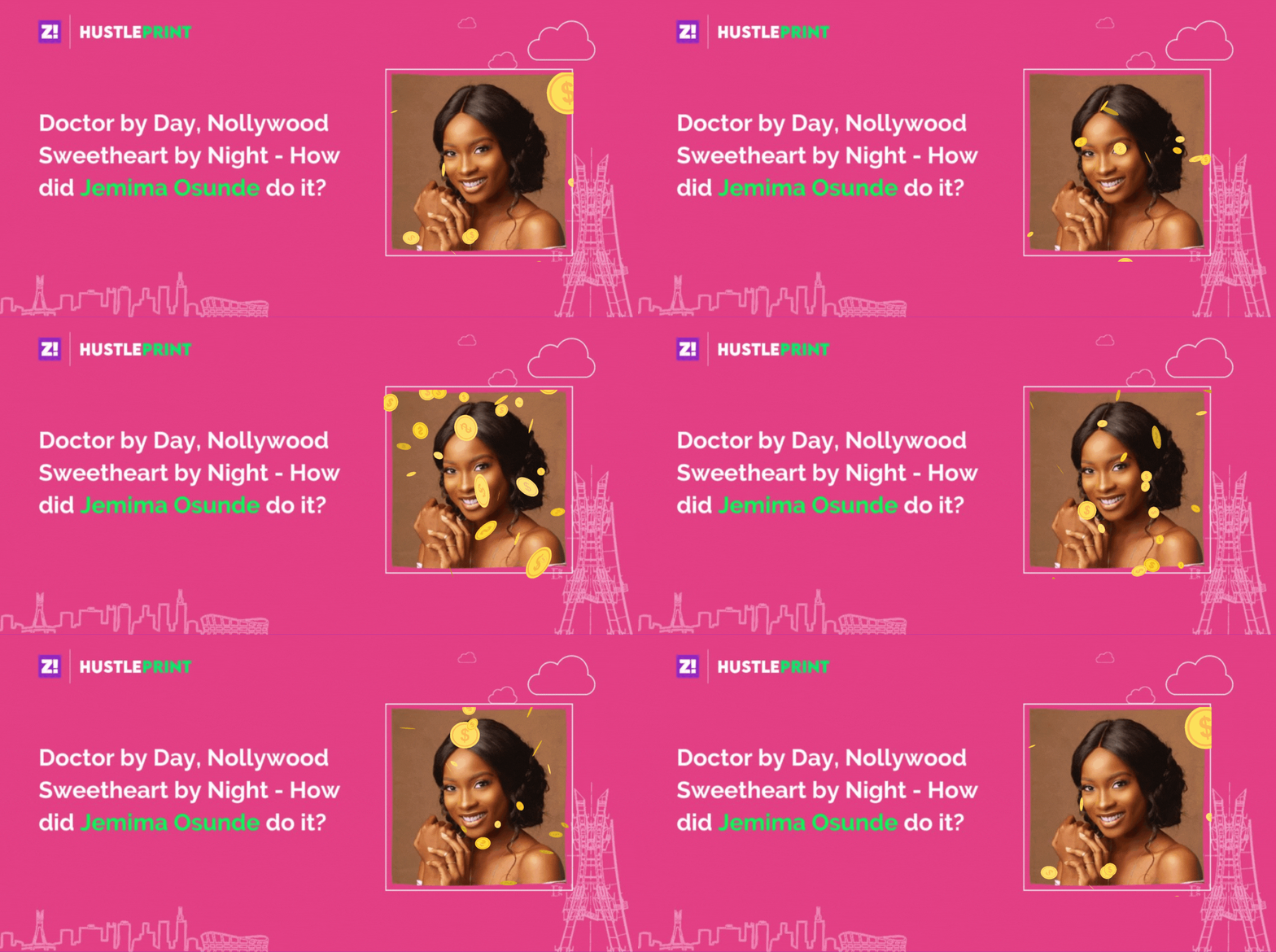
HustlePrint: Doctor by Day, Nollywood Sweetheart by Night, How She Do Am?
#LoveCurrency: Dating in Port Harcourt on a ₦249k Lab Scientist Salary
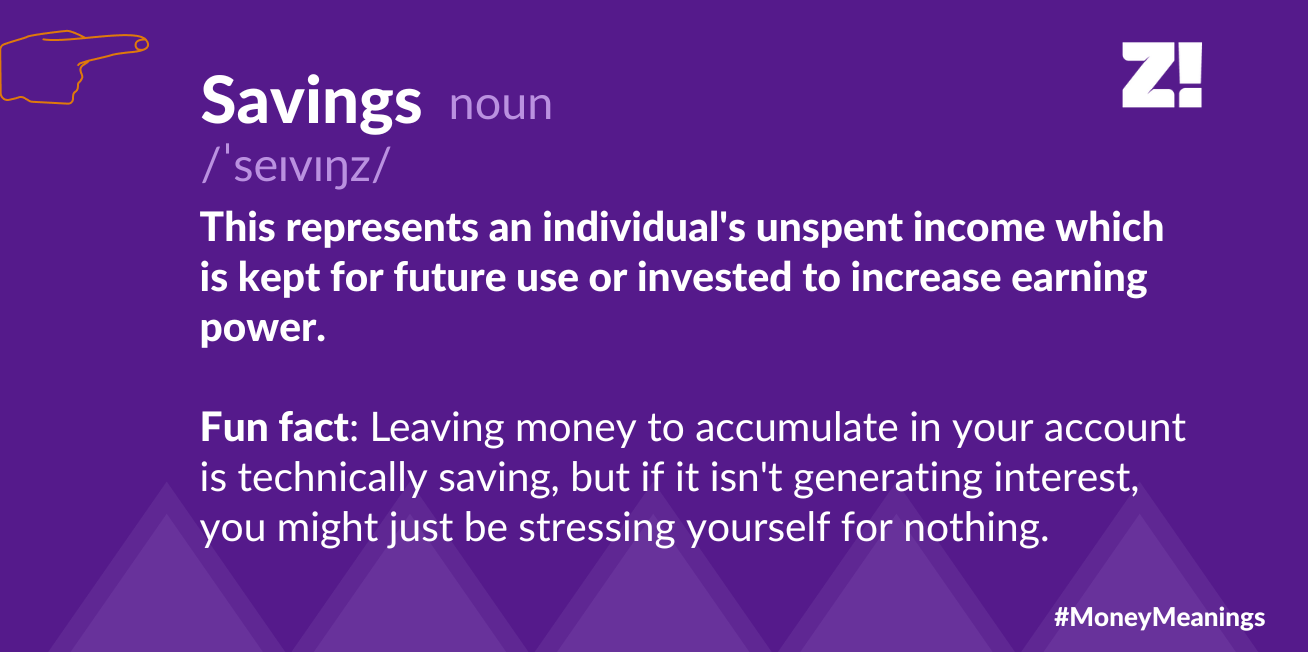
Money Meanings: “Savings”
Game: #HowMuchLast
Where The Money At?!
Last Month
In Money
₦48,809,521,349.60 That’s what £88 million looks like in naira, and it’s what Chelsea paid to Shakhtar Donetsk for Mykhailo Mudryk’s controversial signing. Controversial because Arsenal also had eyes for the winger, but as they say, money answereth all things.
₦30,000,000 That’s the amount of new naira notes the Central Bank of Nigeria (CBN) in Bauchi claims to allocate daily to all banks in the state. Does anyone know how much is allocated daily to other states? Because the long queues for cash don’t seem to be letting up.
Four days to go CBN’s deadline extension for depositing old naira notes ends on February 10th 2023. Do you think it’ll also mean an end to the current new-naira-notes scarcity?
She’s Saving For Her Future, and She’s at $150k
The 28-year-old lawyer on this #NairaLife has over $150k in savings but put her financial happiness at 5/10. Why? Because the money is for her future, and she needs money for now.
I want reliable information to make business and lifestyle decisions to live a Sparkling Life. I want to bank with Sparkle, because it’s digitally simple ✨
Doctor by Day, Nollywood Sweetheart by Night, How She Do Am?
“My self-given nickname is “one true self”. I’m an acting physiotherapist, doctor-actress, health worker-entertainer, whatever version people prefer. I’m one person living the best of both worlds, that’s what makes me who I am.”
Dating in Port Harcourt on a ₦249k Lab Scientist Salary
Peace* is working two jobs, saving more than half her salary and planning her relocation to the UK. In this story, she talks about saving since she was 10, getting back together with her ex after a year and her father’s disapproval of marrying at a young age.
An excerpt: “I used to keep some part of whatever money I was gifted in a pink purse she gave me. Even though I kept the purse in her room, I remember sneaking out random ₦200s and ₦300s to give my uncle who lived with us then. He promised to buy me a car when I was in university.”
We can’t say we’re about the money and not actually help you find the money.
So we’ve compiled a list of job opportunities for you. Make sure you share this with anyone who might need it because in this community, we look out for each other.
Due to what is probably a fear of risk, a lot of Nigerians would rather let their money sit in a savings account than invest. Because of that, we compiled a list of the best investment options in Nigeria right now along with explanations.
1. Mutual Funds
A mutual fund is a pool of investments made by different investors for the purpose of investing in a wide array of securities (real estate, equity, bonds etc) in an attempt to avoid major risk. Basically, it’s a company that brings a group of people looking to invest money and does that on their behalf.
Mutual funds are managed by professional money managers who allocate the fund’s investments and try to produce capital gains and/or income for the fund’s investors (depending on the investment objectives outlined in its brochure). Each investor owns shares of the mutual funds and these represent a share of the fund’s holdings.
2. Stock Market
A stock is a financial instrument sold by companies as a means to raise capital that represents ownership in a company and proportionate claim on its assets and earnings. When a person owns shares in a company, it means that the shareholder owns a slice of the business equal to the number of shares held (out of the total number of the company’s outstanding shares). E.g. If a company has 1 million shares and an individual possesses 100,000 shares, that person owns 10% of the company.
3. Bonds
A bond is a long-term agreement between a borrower (usually corporate or governmental) and a lender (investor) that contains the details of a loan and its payments. A bond has an end date when the principal of the loan is due to be paid to the bond owner (investor) and usually includes the terms for variable or fixed interest payments that will be made by the borrower.
Bonds are used by companies, municipalities, states, and governments to finance projects and operations.
4. Real Estate
Investing in real estate is one of the safest ways to invest money. Build/buy a house or land and rent or lease it out for a regular montly or yearly income. As long you don’t do it in a war torn area, you should be good.