Notice: Function _load_textdomain_just_in_time was called incorrectly. Translation loading for the wordpress-seo domain was triggered too early. This is usually an indicator for some code in the plugin or theme running too early. Translations should be loaded at the init action or later. Please see Debugging in WordPress for more information. (This message was added in version 6.7.0.) in /home/bcm/src/dev/www/wp-includes/functions.php on line 6121
Internet Fraud | Zikoko!
  • #NairaLife: He Almost Became a Yahoo Boy. Now He’s a POS Agent

    Every week, Zikoko seeks to understand how people move the Naira in and out of their lives. Some stories will be struggle-ish, others will be bougie. All the time, it’ll be revealing.

    Nairalife #249 Bio

    What’s your earliest memory of money?

    When I was seven years old, an egbon adugbo (older street guy) would come to our one-room apartment every other day after I returned from primary school and give me ₦20 to buy whatever I wanted. When I got older, I realised he was actually coming to see my 15-year-old sister, and the money was so I’d give them some privacy. 

    I didn’t even like staying indoors after school, so I’d have happily left to play with friends without the money. 

    Were your parents aware of this?

    If they knew, they didn’t care. My late dad was an interstate driver and was hardly around. My mum was a sweeper in the civil service. We weren’t really a close family; my parents didn’t even have a relationship. In fact, I think my birth was due to an unplanned pregnancy because I have two older sisters, and my immediate elder sister is eight years older than me. 

    When I was eight, my dad stopped coming home, and even though the financial burden was already on my mum, it became heavier. My mum hustled to help us live as comfortably as possible, but her mothering stopped at providing money. Nothing else mattered. I usually joke that I was raised as an orphan.

    Why do you think so?

    My mum didn’t care where you were or what you did as long as you found something to eat, so she’d only have to worry about school fees and house rent. My sisters sheltered me from this for as long as they could, but when dad left, they also had to leave to hustle. 

    They had graduated from secondary school. For my mum, it meant it was time for them to start bringing money home. My eldest sister moved in with a boyfriend, and my other sister lived at the amala spot where she worked. 

    What did your sisters’ leaving mean for you?

    They — especially my eldest sister — were the closest thing to a mother figure I had. Their leaving made it obvious I’d soon need to start providing for myself. And I started the moment I entered secondary school. My mum, because of her job, always left home before I woke up. But she wouldn’t drop money, so I had to sort out transport and feeding costs by myself. 

    One of the first things I did for money was to help a woman who had a buka nearby to set up and fetch water in the morning before going to school. She usually gave me ₦200 or ₦500 every day, depending on how fast people came to buy food. 

    After school, I’d go to a neighbour who sold screen guards and phone accessories in his shop. I’d help him arrange the screen guards into packs because they came disassembled, and he’d pay me ₦500 for every 100 screen guards I completed. Sometimes, I stole some screen guards to resell for anything between ₦200 – ₦250 to the guys who sold from wheelbarrows.

    So, you were hustling

    But I wasn’t making much at the end of the day. After removing what I needed for food and transport, the rest went to my mum. However, she still always grumbled about how there was no money, and she was sweeping all day to survive. After graduating from secondary school in 2016, I left home too. 

    Why?

    I didn’t know what to do with my life, and I couldn’t think about that at home. Left to my mum, I just needed to continue hustling, which wasn’t a problem. But I wanted something that matched the stress I was going through.

    Where did you go?

    At first, I moved in with an older friend. He rode an okada for a living, and it seemed profitable, so I decided I was going to do it too. He introduced me to someone who’d bought an okada and needed a rider for a hire purchase arrangement, but the man refused to give it to me. I don’t blame him sha. I was just 16, and he must’ve been sceptical about trusting a small boy who could either crash it or run away with it.

    I spent two weeks at my friend’s before I became uncomfortable because the guy was managing too. I decided to visit my eldest sister and see if she could find me a job. Instead, she sent me to school.

    Sounds like it isn’t what you wanted

    I was looking for quick money, but she argued school would give me a better opportunity to make money. So, I took JAMB and got into a polytechnic in 2018. She paid the ₦58k/session tuition but made it clear I’d need to sort myself out in school. 

    In school, I attached myself to one guy who had a computer business centre. I helped with literally everything; from making photocopies, student registrations, to taking passport photographs. My salary was ₦10k/month.

    What was surviving on ₦10k like?

    School took most of it. It was a very low period for me. Other students had social lives, but I could only afford to attend class and go to work. I even had to squat in the hostel. 

    Then I noticed this guy who always came to the business centre. He was in my department and was a baller. I heard he was generous, so I decided to try to be his friend. Maybe he’d also ball and reach my side.

    How did that go?

    The next time he came to the business centre, he was with friends, and they were gisting about football. I chipped in, and we just vibed. That was also the day I realised why he came there so often. A co-worker at the business centre told me the guy was a yahoo boy, and my boss was his picker.

    What’s a picker?

    Someone who collects money on behalf of a yahoo boy. I’m not sure what their arrangement was, but the guy — let’s call him Bobo — always came to collect money or discuss their operations with my boss.

    I didn’t mind what he did. I just wanted to get close to Bobo. I started moving with the people he moved with and was always around him in school. I’d occasionally visit him at his off-campus apartment, where he lived with a few guys, for the food and drinks. Sometimes, he’d randomly dash me ₦5k. These gifts and the earnings from the business centre carried me through school until he graduated in 2019.

    Did you get involved with his “yahoo” work, though?

    Not while he was in school. But it wasn’t due to a lack of interest on my part. I wanted to make money too, and not have to wait for hand-outs. 

    Bobo’s place was what guys call HK — a headquarters for yahoo boys. Even though I visited occasionally, they hardly talked about their operations with me. I only know they ran several scams: bank, international romance and phishing — where they’d steal accounts after people click and share passwords via fake links. 

    But Bobo asked me to speak with someone once. It was one of those bank scams where they send you an SMS saying something is wrong, and you need to call them. When the victim called, the person who was supposed to speak to them wasn’t around. Bobo was like, “You speak good English. Just tell them so and so”. It worked, and he gave me ₦5k after but didn’t ask me to do anything again. This happened just before he left school. I figured he didn’t trust me, and decided to just let him be.

    How was work at the business centre going?

    I got a salary increase to ₦15k in 2019. My boss also started allowing me to take the laptop home because of some student project gigs we got. This allowed me to also take on other gigs on the side, earning an average of ₦15k extra per month.

    I finished my ND in late 2020 and had to leave the school hostel. I’d saved up about ₦70k, so I used it to buy the old laptop I used for work from my boss. My thinking was, at least I’d have something to work with if I had to continue writing projects for students. 

    I was still in touch with Bobo, so I moved in with him temporarily. He’d just gotten a Benz, and when I saw it, I was like, “Omo. How many projects do I want to write that will give me Benz?” So, I started disturbing him to show me the way. Maybe it was because I now had a laptop, but he agreed. That’s how I almost became a yahoo boy.

    Almost?

    I pulled out at the last minute. Bobo said I’d need to swear a loyalty oath with an Alfa before officially joining them. I was ready to do it, but a few days before the oath-swearing, one white-garment lady stopped me on the road and basically said I’d die if I went on with my weekend plans. I’m not religious, but I was scared o. 

    I couldn’t tell Bobo I wasn’t doing again. I just quietly left his place the next day and went to my eldest sister’s house. He never called me till this day.

    I’m curious. How does one become a yahoo boy? Are oaths always involved?

    It depends on how the HK is run. When I moved in with Bobo, the HK was no longer at his place. It was somewhere else, though he still ran it. Their group was closed to most people, and they didn’t allow just anyone to get into the circle. But I’ve heard that other HKs freely recruit young smart boys in one place and just do the work. 

    When Bobo’s group “cashed out”, they split the money among themselves, but the major players took the biggest cuts. While I was with them, they never had any issues with the EFCC. Bobo used to leave his phones in the house, but was held a few times by police because of his cars. He always settled them sha.

    I see. What did you do after returning to your sister’s house?

    I didn’t do anything for two months. Then she convinced her husband to employ me at his car parts store. He brought me on to supervise the guys who worked for him and make sure they didn’t cheat him or exchange the parts with fakes. That paid ₦20k/month.

    What were your expenses like?

    I wasn’t spending much because I didn’t pay rent or worry about feeding. But my mum would occasionally call for money, so I usually sent her ₦8k – ₦10k every month. That said, I made it a point to save at least ₦5k every month. I saved the money in a kolo I stored inside the ceiling.

    That was my pattern for about two years till I left my sister’s place in January 2023.

    Why did you leave?

    If I didn’t leave, her husband and I would’ve exchanged blows at some point. The man was verbally abusive and treated me like a houseboy. I only put up with it because I needed to save to rent an apartment and get a POS machine. 

    I’d decided to start a POS business because a friend was making ₦10k – ₦15k daily from it. Plus, it didn’t need much capital to start. I’d already spoken to a woman in the market who agreed to have me put a stool in front of her shop. All I needed was about ₦30k to apply for the machine, ₦100k in the wallet and another ₦100k in cash to start. I also used ₦10k to print a banner.

    Did all that come from your savings?

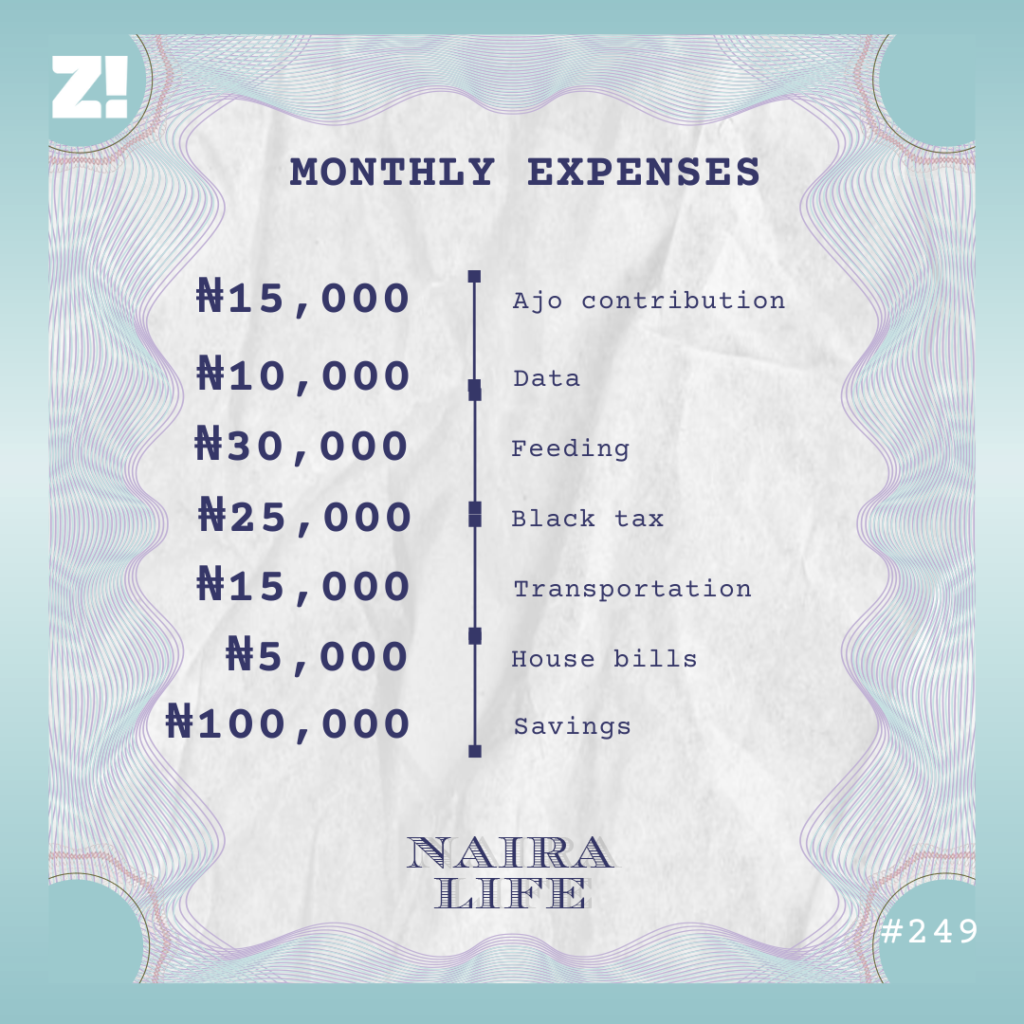
    I had only about ₦200k in my savings, so I started a ₦15k monthly ajo contribution. I packed the ₦165k contribution in February and added it to my savings. I used ₦250k to start the POS business, and ₦80k to pay my half of the rent for the one-room apartment I currently share with a friend. The balance went back into my savings.

    But the moment I started the business, the cash scarcity due to the naira redesign started.

    Yikes. What did that mean for business?

    It was tough in the beginning because I had mostly old notes, and people were scared of collecting them. But I partnered with the market women so they could give my notes as change, and I’d collect whatever new notes they had. Sometimes they sold it. I’d exchange one old ₦1k note for ₦700 or ₦800. 

    I’d also wake up early to queue at ATMs to collect cash or buy new notes at ₦1k per ₦10k from interstate drivers. But I also made a lot of profit. Withdrawal charges were as much as ₦200 for every ₦1k, and I made around ₦20k – ₦25k each day, depending on how much cash I was able to get. When I didn’t get new notes, I sat down at home. 

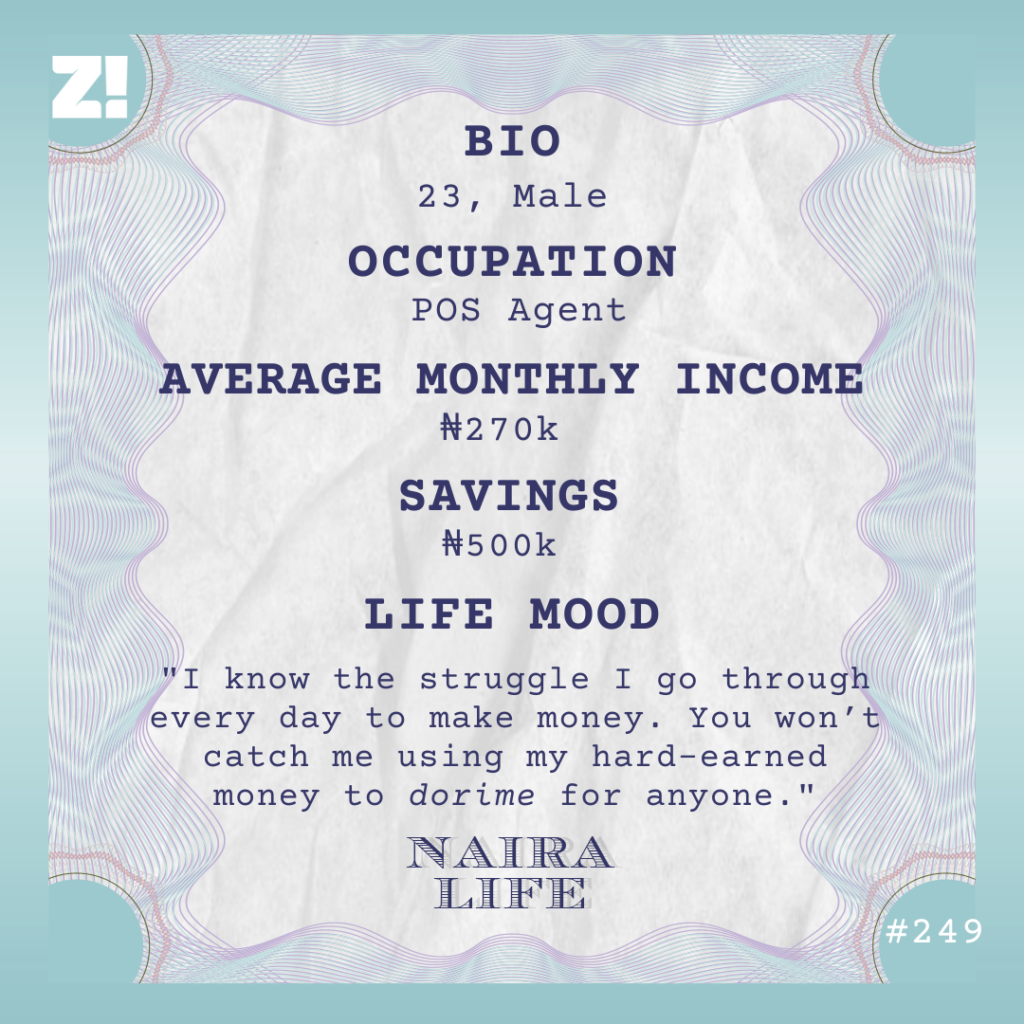
    The cash situation got better in April, and now I make an average of ₦8k daily and about ₦270k monthly.

    Would you say it’s sufficient to meet your needs?

    It is for now. I know there are guys my age who make more money, and sometimes, I’m tempted to feel ashamed of myself for being an ordinary POS agent, but I try to be grateful. I can meet my essential needs without running around or doing “yes sir” for anybody. 

    Of course, I don’t intend to do this business forever, but comparing myself to people driving Venzas and Benzs right now would just be greed. 

    Where do you imagine you’ll be in five years?

    Ah. Five years is too far. I don’t even know what tomorrow holds. But I may either return to school for my HND or find a way into tech. I signed up for a free web design course just last month and have been practising on my laptop at night. So far, it’s been very confusing, so I don’t know if it will work. If it doesn’t, I’ll look for another thing to try.

    Rooting for you. What do your recurring monthly expenses look like?
    I imagine you’ve grown past the kolo savings stage

    I still save small change in my kolo from time to time, but the bulk of my savings is in the bank. I currently have about ₦500k saved. I’m considering saving some in those apps that allow you to save in dollars because of the way the naira is falling. But I’m scared of the app shutting down and carrying my money with it.

    LOL. Valid. How would you describe your relationship with money?

    I’m learning self-control. I’ve never really been a heavy spender — I never even had money — but I was fascinated with people who had it and was ready to do anything to make it. If I hadn’t had that encounter with the white garment lady now, it’d probably be a different story today.

    In a way, I’m grateful I didn’t start yahoo yahoo. I’m making a little money now, but I’m not spending like I thought I would. Maybe it’s because I know the struggle I go through every day to make money. You won’t catch me using my hard-earned money to dorime for anyone. The opposite would’ve been the case if I made money from internet fraud.

    Is there anything you want right now but can’t afford?

    Anything? Maybe a house so I can rent it out and collect money while I sleep. Won’t you ask me about my financial happiness?

    LOL. Oya, rate your financial happiness on a scale of 1-10

    7. I don’t know what I’ll do if I stop the POS business today, but I think I’m doing pretty well for myself right now.


    If you’re interested in talking about your Naira Life story, this is a good place to start.

    Find all the past Naira Life stories here.

    [ad][/ad]

  • Narcos Nigeria: The Curious Case of Abba Kyari

    Imagine that life is a movie and your name is Abba Kyari, a deputy commissioner of police.

    The day is June 11, 2020, and you are in the green chamber of the House of Representatives, the centre of all attention.

    I wonder if they know I have skeletons in my closet.”

    Elected lawmakers are calling you the toast of the Police Force and the best thing since soft agege bread.

    This scene would likely happen at the end of a celebrated career that has put many bad guys behind bars.

    The credits would roll and our supercop would live happily ever after.

    Abba Kyari's life has taken a dramatic turn

    But things are falling apart for DCP Abba Kyari since he made that appearance at the National Assembly.

    One year after his red carpet ceremony, he was exposed as a collaborator in an internet fraud case involving convicted international fraudster, Hushpuppi.

    To clear his name, he first claimed he was a middleman tailor for Hushpuppi, and then claimed he was conned by him to make an illegal arrest.

    Unfortunately for him, it was the Federal Bureau of Investigation (FBI) from across seven seas that had all the dirt so the allegation was hard to shake.

    Since this is Nigeria, it has been seven months and authorities have failed to make any meaningful progress in investigating and confirming the case against him.

    “When you find yourself in a hole, stop digging” is usually a commonsense approach for most people, but Abba Kyari is not most people.

    What is a suspension?

    Abba Kyari does not know what suspension means

    When you are on suspension from work, it would usually mean that you are, well, suspended, but we now know that Abba Kyari does not like to be idle.

    Nigeria’s most infamous supercop turned a moment of forced rest into an opportunity to try his hand at other things. Who doesn’t like multiple streams of income?

    Abba Kyari is out to get all the bags

    The National Drug Law Enforcement Agency (NDLEA) namedropped Kyari at a media briefing on Monday, February 14, 2022, as a principal suspect in a major drug trafficking case.

    He was already replaced as the head of the elite Intelligence Response Unit (IRT) last year, but our supercop is not a man to be stopped by protocols.

    From what we have now been told by the NDLEA and the Police, Kyari was instrumental in a drug bust in Enugu state.

    While that would be commended under different circumstances, it is the point where Abba Kyari’s story takes another wild twist.

    Narcos: Nigeria

    Abba Kyari: Who, What Shot The Sheriff? - THE DAILY CRUCIBLE

    Coming soon to a Netflix near you.

    This is the NDLEA’s retelling of what Kyari has been up to:

    Allow us to break it down for you:

    On January 21, 2022, Kyari called an NDLEA officer in Abuja to tell him his IRT team had arrested suspects who were smuggling 25 kg of cocaine into Enugu from Ethiopia.

    Our anti-hero proposed that his team and his informants be allowed to take 15 kg to resell and replace with dummy powder.

    To sweeten the deal, he offered to help his NDLEA contact sell 5 kg of the remaining 10 kg, leaving only 5 kg to be tested and used to prosecute the suspects.

    At this point, we just have to assume this guy was out of fucks to give about getting caught, or it was just another regular deal to him.

    Four days after initial contact, he was caught on camera passing $61,400 to the NDLEA officer for his cooperation.

    Kyari had since then been airing the NDLEA’s messages after they told him to come and face the consequences of his bad decisions.

    We have questions

    The very obvious red flag in this whole story, of course, is how Kyari still held such a commanding position that he was able to call the shots on a drug bust.

    He wasn’t only suspended from the Force, he had already been immediately replaced as the head of the IRT.

    This incident speaks to the institutional rot that fueled 2020’s historic EndSARS protests against police brutality and impunity.

    Even worse is that Kyari’s IRT had been accused of many extra-judicial actions before his internet fraud case finally drowned him last year.

    The failure of authorities to reach any serious conclusions on his pending case reflects poorly on the government’s claims of reforming the Police.

    Police vs NDLEA

    Clearly unsettled about being exposed as having rogue agents, the Police Force has also released its own version of events.

    The short version is this:

    The long version is the two drug traffickers arrested in Enugu have apparently confessed they were being helped by NDLEA agents. 

    Their contacts had been helping them operate unhindered at the Akanu Ibiam International Airport since 2021.

    This explains how they were able to successfully clear the drugs before Kyari’s team picked them up outside.

    The one good thing that has come out of this whole episode is that Abba Kyari is now in custody, arrested by the police and handed over to the NDLEA alongside four other officers.

    If this was a movie, we know for certain this is not the end.

    We should be expecting a sequel of our supercop’s adventures in detention and maybe beyond.

  • Naira Marley Might Know Exactly What He’s Doing

    Midway through “Opotoyi“, Naira Marley’s first song since his release on bail as he faces charges of fraud, the rapper stops what is a fast-tempo dance song to preach:

    Ko s’ogun aiku, iku lo gara ju, werey to’n s’ogun aiku fun gan, t’oba ku tan bawo lo se fe gba refund

    In English: “There’s no way to beat death; if there’s anyone who’s gullible enough to pay for such charms, how will he get his refund if he dies?”

    In isolation, it would be a confounding statement, but as a part of “Opotoyi”, it is a targeted show-off of street smarts that stands out on a song that’s little more than an exercise in crass shit-talking, delivered in perfect street lingo.

    In the last few months, the rapper/singer, real name Afeez Fashola, has become a phenomenon mired in controversy. Not much is known of his early life. He moved to the UK as a teenager. According to a recently-surfaced news report, he was one of many young people declared wanted by Lewisham Police for crimes ranging from robbery to sexual assault on a night bus in 2014. He made a light splash in the UK rap scene shortly after before a brief hiatus.

    When he returned, he was the perfect hybrid of two cultures. Naira Marley raps in a mix of Pidgin, English and Yoruba in a drugged drawl spiced with a South London accent. In subject matter, he’s more similar to Obesere, the vulgar Nigerian fuji icon than Kida Kudz, another Nigerian/UK rapper from his generation.

    A string of hits and ample use of social media, buoyed by strategic friendships with Lagos socialite, Rahman Jago and one of the hottest commodities in Nigerian music, Zlatan Ibile, shot him into the top 10 of streaming charts and made him a party staple.

    Since March 2019, Naira Marley has owned at least two of the 10 most streamed songs in Nigeria. In a notoriously fickle music space like Nigeria’s, such a drastic change in fortunes often inspires artists to tighten their bootstraps. Not Marley.

    Over the course of three months starting April 2019, Naira Marley grabbed a seat on the back of outrage and shot himself to infamy. On April 6, soft-spoken singer/songwriter Simi criticised internet fraudsters in a Live session on her Instagram. Simi has an appetite for social commentary on issues from football to politics; and after several tweets on the topic, a fan had told her to leave yahoo boys alone.

    The IG live session appeared spontaneous but it was not unwarranted. As Simi would go on to say, “I’m not the problem, the world is laughing at us”. Nigeria has earned an unhealthy reputation for breeding a daring strain of internet fraudsters who, in 2017, earned themselves the 3rd spot in global internet crimes

    They are the more imaginative spawn of the ‘pen pal’ fraudsters of Nigeria’s 1980s, and more profitable as well —  About N127 billion was lost to cybercrime in Nigeria in 2015, according to Professor Umar Danbatta, CEO of the Nigerian Communications Commission. They haven’t discarded the old playbook either — Nigerian prince scams still rake in over $700,000 a year, as this report by the CNBC claims.

    In a sea of vitriolic responses to Simi’s video, Naira Marley stood tall, launched his own Instagram live session and offered reasons, including reparations for the transatlantic slave trade, on why internet fraud is justified.

    The events that followed read like the final chapters of a Ben Okri book. Days later, on April 22, Naira Marley took to Instagram to accuse Simi of snubbing him at an event, “@symplysimi I saw u at d homecoming last night, u look sad & upset.. why? Am I a yahoo boy?” he wrote beneath a picture of him. The caption has since been changed.

    No publicity is bad publicity, someone once said. And once online conversation pushed the spat to viral proportions, it was only a matter of time before Naira would take advantage. Released on May 9, “Am I A Yahoo Boy”, a trap single featuring Zlatan, expanded on Marley’s IG video by asking rhetorically, if the two were in fact internet fraudsters. Within hours, the song shot to the top of digital streaming charts. 

    Naira Marley may have offered answers on the song but the EFCC wanted more. As the cock crowed in the wee hours of May 10, Zlatan, Naira Marley and three others were arrested during a raid on Zlatan’s residence at Ikate, Lekki, Lagos.

    While Zlatan regained his freedom after days of questioning, Naira Marley’s fate was more thorough. On May 30, the rapper was arraigned before a Lagos court on 11 counts of violating the Cyber Crimes Act of 2015, and granted bail in the sum of 2 million naira. Days later, Marley was free.

    Many had first expected Naira Marley’s first song after his arrest to be a plaintive reaction to his stint in jail. Music typically reflects the state of whoever’s making it. As shown by every artist from Sinzu to Zlatan, who recorded “Four Days In Ekotie-Eboh” upon his own release, time behind bars typically inspires bars of the written kind. 

    Instead, Naira released “Opotoyi (Marlians)”, a lewd song for drunken nights, filled with vulgar appraisals of the female body and drug use. In any other artist’s case, it would have gone down as a wasted opportunity to attract valuable sympathy. For Naira Marley however, his devotion to a certain way of life and his efforts to celebrate it trump everything else.

    https://www.instagram.com/p/BxSYYarAhRs/

    Despite introducing himself to the audience as a semi-IJGB schooled in Lagos street life, Naira Marley has always shown allegiance to the latter part of his identity. His early releases wouldn’t sound out of place on a London DJ’s playlist, but over time, Naira has gradually unveiled his ‘real face’. 

    From his frequent Instagram Live sessions to his very public responses to trending issues and his affiliation with suspected gang members, even when singing about seemingly innocuous topics like football on “Issa Goal” or the paparazzi on “Illuminati”, Naira has always offered up subtle and sometimes overt praise for two of the biggest scourges that are defining a generation of Nigerian youth today — internet fraud and drug abuse.

    Covered by the sheen of celebrity and glossy music videos, Naira Marley can be easy to digest. At best, he’s seen as a playful charlatan; at worst, a harmless nihilist. It belies the fact that the real-life version of the persona that he offers is much darker.

    You’ve seen him before; the average street boy who is as quick to hustle for a wad of notes as he is to explore the shorter route there. He doesn’t care what you think; he is often eager to project power, physical or financial. He is one of the people who make up Naira Marley’s core fanbase.

    https://www.instagram.com/p/Bs55zK5DvVS/

    The “Marlians”, as they are called, are a survivalist bunch, groomed in a dog-eat-dog world where morality is a fickle construct and strength in numbers is a policy. While well-meaning Nigerians applauded on Twitter his arrest, they complained that EFCC chose to arrest him on his birthday. 

    The burning question of how Naira Marley secured their attention and devotion and became a “national star” is worth discussing. For decades, the music of Nigeria’s most culturally-vibrant ghettos has often existed in its own vacuum – with only a few artists making the journey to nationwide acceptance and becoming relative ambassadors. The analogy that best describes this process is crossing the third mainland bridge.

    No one crosses the Third Mainland Bridge except to meet a need on the other side. In a sense, it can feel more like a journey between social classes, than a trip on a 14km-long bridge. One end of the bridge has always felt left out when it comes to popular music.

    It’s easy to recognise what we’ve come to describe as street music – amateurish production, aggressive delivery, subject matter that focuses on dance or occasionally larger-than-life ideas ranging from ‘hustle’ to ‘fate’. 

    https://www.instagram.com/p/BpXdh3cDARU/

    Since Kerewa became a national hit and topic of concern among Nigerian parents fearing for their impressionable young kids, the music of Nigeria’s slums has only ever blown up courtesy of acceptance on the other side of the bridge – in Lekki’s snazzy clubs and lounges, behind location filters and retro-cameras of highbrow Lagos and its islands.

    The Shaku-Shaku sound and dance that dominated 2018 are the most definitive examples. According to its biggest ambassadors, Slimcase and Mr Real, Shaku-Shaku and the drum-heavy sound of hit songs like”Legbegbe” and “Diet” became integral parts of the culture in Agege, a not-so-highbrow area of Lagos since 2016. Yet it did not reach nationwide acceptance until the dance became a social media phenomenon, with celebrities from Genevieve to D’banj taking stabs at it. 

    It soon showed up in the Island’s biggest clubs. DJs, ever the willing suppliers, found the songs to fit – and introduced new audiences to its stalwarts. Collaborations spurred more hits and by the time concert season came in December 2018, the only thing that mattered was Shaku-Shaku. 

    On your first attempt to juggle your memory, it would appear Naira Marley’s journey happened on the shoulders of the Zanku – the dance style popularised by Zlatan that leveraged Shaku-Shaku’s entry into the mainstream and hasn’t gone away since. 

    The reality is much less linear: Naira Marley crossed the third mainland a lot earlier, in the most innocuous of ways. It happened thanks to a song you may remember from that one time Nigeria’s World Cup jersey stunned the world – 2018’s “Issa Goal”.

    https://www.youtube.com/watch?v=im22OgaMImk

    Unknown to most of his audience prior to its release, the song presented Naira Marley as a UK resident who was in love with the country of his birth and had the lingo to earn his place alongside Lil Kesh and Olamide . It was also picked up by Coca-Cola as the Nigerian National Team’s unofficial theme song for the 2018 World Cup. It was a move which, unwittingly, put him in a class alongside other prominent young Nigerians with more friendly brands, like Alex Iwobi and Wizkid. 

    His follow-up, “Japa” contains a more overt reference to credit card fraud, but if anyone heard, and some people raised concerns, everyone soon got drowned out by the noise of feet stomping on both sides of the bridge. 

    “Am I A Yahoo Boy” will perhaps go down as the most definitive song in Naira Marley’s career. The song’s title was the perfect query for the situation that birthed it – which is why it is worth noting that both artistes glorify internet fraud on a song which was supposed to acquit them of these accusations. Naira Marley’s arrest was celebrated in certain circles as a quick reaction to a budding menace. And it would have an effect, just not the one we expected — Marley’s message had stuck.

    In the eyes of his fans, he’s become the street kid who’d made it enough to earn himself a love/hate relationship with the elite. He’s known by everyone from A-list artists to an audience out of Nigeria and the UK that loves his music but refuses to accept his violent nihilism —  a way of life that Marlians are all too familiar with. What’s not to aspire to?

    Make no mistake; Naira Marley knows exactly what he’s doing. Behind the braids, droopy eyes and seemingly haphazard behaviour is an artist who cross-pollinated Nigerian and UK street culture to produce a hybrid that has done what countless PR firms and record labels have struggled to pull off. 

    He’s dropped three songs since his arrest in May: “Why”, “Opotoyi” and “Soapy”. If you’re willing to explore the pattern, it goes far beyond his recent releases; he’s learned to pick the most targeted song titles, using words that draw instant reaction or take advantage of a trend.

    “Issa Goal” made him one of the faces of a country’s appearance at the World Cup. “Japa” brought a common slang to life by embodying a generation’s obsession with evading haters, hard times or in his case, London’s Met Police. “Illuminati” was an attempt to elevate perceptions of his stardom by name-dropping a group that is believed by some to give musicians stardom in exchange for their souls. “Am I A Yahoo Boy” took advantage of the heavy buzz following his defence of internet fraud. “Opotoyi” stamped the “Marlians” as a community. Each of these songs has been streamed over one million times.

    His latest release, an unfortunate dance single titled “Soapy” is an effort to strengthen his hold on that community. The song references his stint in jail and has been described as an effort to draw attention to the terrible conditions in Nigerian jails. However, on the morning of its release, Naira Marley took to social media to unveil the “Ijo Soapy”, the accompanying dance style that mimics public masturbation. It has taken only a few days for the song to become a menace.

    “Don’t you trust me; trust me, I don’t trust myself” – Naira Marley (“Jogor“, Zlatan, Kesh and Naira Marley, 2018)

    What Naira Marley represents isn’t just his music. The rapper may be his own biggest fan and his brand of pedagogy is largely self-serving. What more evidence does one need than that cringe-worthy self-comparison to Africa’s greatest individuals – Fela Kuti, Nelson Mandela – on “Am I A Yahoo Boy?”. 

    Yet it’s finding a greater audience than we expected because it’s the reality of a street culture that we’ve ignored for so long. It’s why the primary defence by most of his fans is that his music reflects reality; they’re correct. If terms like ‘maga’, ‘opotoyi’, ‘ase’ seem to be entering the popular lexicon, it’s because they were already in use before – albeit on the wrong side of the bridge. 

    The best evidence of the diversity of Naira Marley’s clan is best found on his Instagram. Hundreds of his fans have volunteered submissions of themselves doing his Ijo Soapy. Those who have made it to his page are more varied than you’ll expect; a group of young Peckham teenagers dancing around in circles, young Nigerian women in glossy lace at an Owambe, a stripper and not least by any means, Lil Kesh.

    https://www.instagram.com/p/Bp_7wWADVjb/

    He may be an outcast in the hallowed halls of Naija twitter. But in the places where it often matters, away from the moral certitudes of ‘woke’ conversations, Naira Marley has held himself up a beacon of rebellion and young adult angst.

    Like Simi did in April, many of Naira Marley’s colleagues have described his newest offering as what it is — a new low. Dancer, Kaffy is the latest person to do this. “In the history of Naija dance, I’ve never seen a more disgusting dance immoral dance called Soapy. It should never be encouraged,” she wrote in an Instagram post.

    https://www.instagram.com/p/BzbV-IxBwb1/

    For all its worth, her voice and that of many others count. But when compared with the viral rates with which new videos of people dancing Soapy are popping up on social media, the reality gets even more worrying.

    The question we need to ask is this: Are we ready for an artist who does not care what anybody thinks and has a horde of raucous if misdirected young adult males hanging on his every pronouncement?

    Naira Marley knows what he’s doing, do we?

    Did you enjoy this? You should sign up for our weekly pop culture newsletter, Poppin’. You’ll get to know what we’re up to before anyone else + insider gist, reviews, freebies and more. If it sounds like your deal, sign up here.

  • Internet Fraud’s Marriage To Naija Music Could Go In Different Ways

    Thanks largely to the grand efforts of the Nigerian rapper, Naira Marley, internet fraud and just how much it has penetrated Nigerian society have been standing front and centre or lingering in the background of online conversation for weeks now.

    As his ubiquitous name hints, Naira Marley, whose real name is Afeez Abdul, has created an online persona that revolves around his love of the bag and marijuana, alongside his music. He’s added another feather to that cap by donning the role of spokesperson for internet fraud sympathizers.

    It began with a series of retorts to Simi’s put-down of cyber-crime in this video and peaked with the release of rhetorically-titled “Am I A Yahoo Boy?”, a song which addressed claims that he, and fellow rapper, Zlatan Ibile, are internet fraudsters.

    Either they were foreshadowing or just using a very elaborate music video to draw even more attention to themselves, the two, alongside three others, were arrested by the Economic and Financial Crimes Commission. Marley’s arrest and the shenanigans he’s been up to have overshadowed another issue; that of yahoo-yahoo and its marriage of circumstance to Nigerian music.

    Many Nigerian musicians have stained their white with yahoo money at various times, wittingly and unwittingly. And more money is always useful; they’re in an industry that’s low on cash beneath the charade of overlit music videos. But what happens from there? I’m thinking it’s either of these;

    • Nigerian Gansgta Music

    The original gangsta rap, a sub-genre of hip-hop, emerged when gangsters – the street and mid-level criminals, gang members and drug dealers, and people close to them began to tell their grimy real-life stories on wax. Now imagine that, but in Nigeria with songs like “The 10 Bombing Commandments”, and “Lexus RX350 Music”. My point is we can still get something good out of this mess.

    • The G-Boy Music Monopoly (*insert evil laugh here*)

    Now that everyone’s agreed that we’re broke, individually and as a nation, it shouldn’t be hard to notice that music and entertainment is one of the few sectors that’s growing while everything else shrinks. A big part of that is down to the funding, and the federal government’s budget for 2019 sure as hell doesn’t have a provision for “Wizkid, Davido, Don Jazzy and friends”. The clue is in the nods; like how M.I Abaga praised internet fraudsters and blessed their hustle for keeping Nigerian music alive, so to speak, on an episode of Pulse Nigeria’s Loose Talk Podcast. So what happens when the proceeds from internet fraud become the go-to source of seed funding for music startups? Which brings us to the next alternate universe.

    • A Yahoo-Music Cabal

    What if the proceeds from internet fraud become the ONLY source of seed funding for music startups? There are already signs of what it would sound like; quite a few musicians have earned their keep and name by praise-singing certain ‘gentlemen with questionable income’. I thought about the best way to say that last one. It wouldn’t be new. For centuries, artists were entirely funded by families, dynasties and empires. So picture it. Record labels named according to the scam? Wire Records Inc. Genres by most profitable country?

    • An Underground G-Boy Music Scene

    Naira Marley and Zlatan Ibile didn’t just crawl out of the woodwork. Both artists have been making music for years. They represent a lane of street rappers from mainland Lagos that popped with Small Doctor in 2016. The subject matter dates way back though. Some people mention Olu Maintain’s 2007 mega-hit, “Yahooze” as a landmark moment.

    D’banj’s “Mobolowowon” features a supposedly personal tale featuring credit card fraud that seems a direct inspiration for Naira Marley’s “Japa“, a 2018 sleeper hit. In both songs, where the rapper, cast as a survivalist anti-hero, repeatedly evades arrest by officers of the UK Police. Since 2012 and Reminisce’s “Too Mussh“, indigenous rappers and singers have been naming benefactors and friends by name. Some of them are, you guessed it, gentlemen of questionable behaviour.

    To be fair, the behemoth that is Nigerian music is too strung up on dancing and immediate returns on hasty, large-scale efforts to cultivate a rap scene for 100 Stacks, the retired g-boy from Agege. Nigerian music has eyes on it now, and the bar for entry is rising. So sorry, 100 stacks.

    Naira Marley’s recent arraignment before a Federal High Court in Lagos is proof that the powers that be are hip to the times (or in simpler terms, STREETS IS WATCHING), it’s unlikely this moment alone would undo almost a decade’s worth of cultural influence. Get strapped; we’re in for some very interesting times.

  • “You’re One Tragedy Away From Becoming A Yahoo Boy”

    In certain cultures, adulting is marked with rituals, tests and celebrations. But when you’re Nigerian, adulting often comes at you without warning. Adulting comes in different forms; bills, family, responsibility, and you guessed it, a child.

    Everyone who’s crossed that bridge has a unique story. Stories that can help you see you’re not alone. That’s why every Thursday at 9am, we’ll bring you one Nigerian’s journey to adulthood, the moment it happened and how it shaped them.

    The question we’ve been asking is, “when did you realise you were an adult?”

    The first guy is a 24-year-old student. He lives with his friend from university in a flat on the outskirts of Lagos. They only go to school when they can’t avoid it. This is how their typical day goes: wake up, get high, play loud music, eat, get high, nap, ‘work’. He’s always ‘working’, on his phone during the day or on his laptop at night.

    He insists he can’t do it sober. His morning starts with a cocktail of uppers and marijuana. On nights when he has too much to do, his roommate says they need to use drugs – 5mg of Rohypnol to sleep.

    “Going hard is my superpower. I’m a very independent person. If I need things, I just go for them. I don’t ask for help.  Sometimes, it’s not the smartest thing to do because you end up running from the actual solution. If I had told my Dad about my school trouble, I would have graduated with a degree.”

    “My parents lived in Ketu when I was born. My mum went to her salon in Agege every day she could and my dad was never around. Grownups have to hustle, I know, so my Grandma filled in for them and raised me. After a while, I stopped going back home with my mum.”

    “My childhood is a difficult time to think about for some reason. I lived between Agege and Ketu. The only thing I really looked forward to was spending time with my dad during the weekend. You know how boys tend to have issues with their fathers? I can’t relate to it. He’s the kind of guy who would do anything for his kids. “

    “Most people think growing up means having children, or moving out or even getting a job.  But all those things are normal to me. I wasn’t scared of any of it.”

    “Sometimes, when things were shaky, I’d think about how my dad worked so hard just to live an uneventful lower-middle-class life. You’re either rich or broke in Nigeria. I respected my dad’s hustle, I’ll always do – but I didn’t want that mediocre money.”

    “As soon as I was done with secondary school, I started trying to get a job. I was around 16, 17. I managed a game centre in Agege – that’s how I bought my first phone. I just kept chasing the bag. When you’re on the streets, it’s easy to find one hustle or the other. But most people knew I liked to work. They were willing to show me what was popping at the time and I learned very quickly. My parents didn’t know I had started doing yahoo until I started sending good money home. This was around 2014. It just felt to me like the ideal thing to do.”

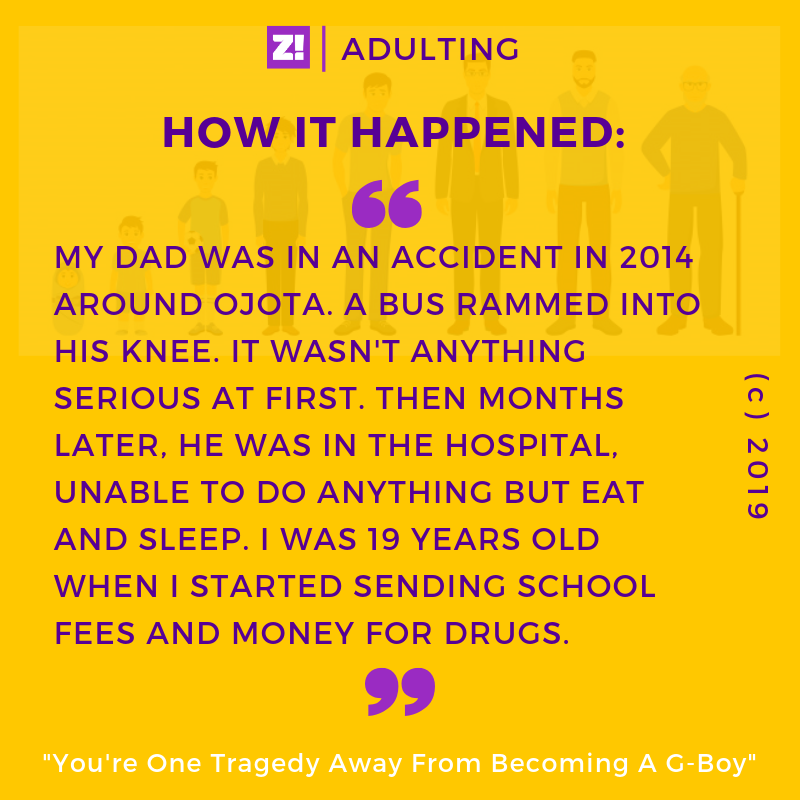
    “Where I come from, people don’t wait to be adults to start doing adult things. So when shit hits the fan, I’m hardly caught off guard. My dad was in an accident in 2014. He was on a bike around Ojota. I don’t know if the bus lost control or was just reckless but it rammed into his knee. It wasn’t anything serious at first, we thought we could manage it; then months later, it began showing serious signs of damage. Next thing, my dad was in the hospital, unable to do anything but eat and sleep. When the hospital bills started coming, handling them wasn’t a problem. Then they became more frequent, and added a few more zeros.”

    “Nothing prepares you to go from taking 50 naira from your parents to providing for them. I was 19 years old when I started answering calls from home to send school fees and money for drugs. My mum left her salon to tend to him. Lo and behold, I was the only person with a steady income”

    “Going hard comes naturally to me, but that period made me a different person. Getting money online was my sole motive. Nothing else mattered at the time. I worked twice as hard as I did before; two times the sleepless nights, two times the endless anxiety of not knowing what’s next, two times the fear of not being able to pay bills. I shut everyone else out. I wanted no new friends except people that helped my hustle. My friends partied while I stayed up at night, spamming dating sites. I had chosen my priorities.”

    “A lot of things in my personal life suffered, especially my education. Yahoo is a jealous lover, especially when your father’s life is on the line and it’s your only hope. But what happened to my schooling pains me like a physical wound. Because I was working through most nights, I was always too tired for the morning lectures. Then after a while, I stopped going to class altogether. When I consider the reality on ground, many of my choices are usually easy to make. But that school one was very hard.”

    “I remember one time I decided to salvage things and just be more serious with school. I promised I wouldn’t hustle for a month and started going to classes again. It was as if my entire family crashed in that period. I barely managed two weeks before I faced the facts. When it was time for my set to graduate in 2015, I knew I wasn’t going anywhere”

    “After about six months, my dad left the hospital but he’d lost his civil service job. They didn’t take him back when he got better and he had trouble getting a new job for obvious reasons – so I got him a car and set up a small voucher business. If I had to do an estimate, I’d say I spent over 5 million naira on family alone in that period. If I hadn’t come up with that money, my dad would probably be late now. The only reason my family still stands is because I knew how to get that money. The easiest way to get money in Nigeria right now is Internet fraud.”

    “Times are hard for g-boys now. The game is changing everyday. Most of my money still comes from love scams but our hustle has gone way past that. The big money is in the more complicated frauds, jobs that take tens of people working in different parts of the world; like wire transfers and hacking. The most popular g-boys on Instagram and Snapchat – guys like Hushpuppi and Expensive Aboki Wire are into these kinds of fraud but it’s not easy to get into those circles. It’s either you hustle your way there or you join everybody else to do juju.”

    “It’s like an accepted tool of the trade now. Even policemen will advise you; “How far? How you go be yahoo boy and you no get money to buy car? Shey you no go do Juju?”

    “I’ve been hearing that line for years. Going fetish just feels to me like taking things too far. There have to be limits but I get that some people don’t respect that. That’s probably why people think we just hustle out of greed. Everywhere on social media now, people are judging yahoo boys. When they want to talk, it’s usually about how we’re destroying people’s lives and whether we ever think about the people on the other side.”

    “It’s hard to imagine a fraudster with empathy but I actually pity my client. I do. I think about how disappointed and blindly hopeful these people must feel. But I don’t think losing 10,000 dollars when you have 100,000 dollars is a big deal; that’s just 10%. If take 90% of all she has, that’s a different discussion.”

    “It’s easy to judge g-boys. But what if I told you people who work 9-5 don’t work as hard as yahoo boys. They see the balling and social media but no-one knows about the sleepless nights. You’re always working, round the clock. There are bank fraud jobs where boys have to sit in front of a laptop and hit refresh every minute for up to eight hours. If my client hits me up at 2am with something that can spoil my job, I have to respond. You have stay ready for anything. That’s why we use drugs the way we do. You can’t come up with these things when you’re sober. Do you know how hard it is to convince someone who has never seen you to give you money?”

    “But what’s the alternative? The cost of living a good life in Nigeria is too high for the average Nigerian with a regular job to afford. All it takes is one small sickness and your entire family is in poverty. Internet fraud isn’t easy. It’s just the way out. And I may not have known it then, but in this country, you’re one tragedy away from becoming a yahoo boy.”

    “What if I hadn’t taken that way out? If I hadn’t started yahoo when I entered university, I’d have started it after I graduated. There’s a part of me that always wants more. Family may have turned my grind up but my reality that has kept me on it. This country has nothing to offer me.”

    “My dad is better now but he still limps. My mother is back at her salon too. But the family income isn’t strong yet, so I’m still playing in my position. We never talk about it but everyone knows where he stands. My father hardly takes decisions now without talking to me. I’m like a father to my siblings now. My only regret in all of this is that I can’t graduate. All my university is offering me is a certificate of attendance.”

    “I owe it to myself to go back to school though. I like to think I can apply my grind and spirit in other fields. That’s why I’m moving to Asia for two years to get a degree. When I get back, I’ll go into agriculture and invest in music too.

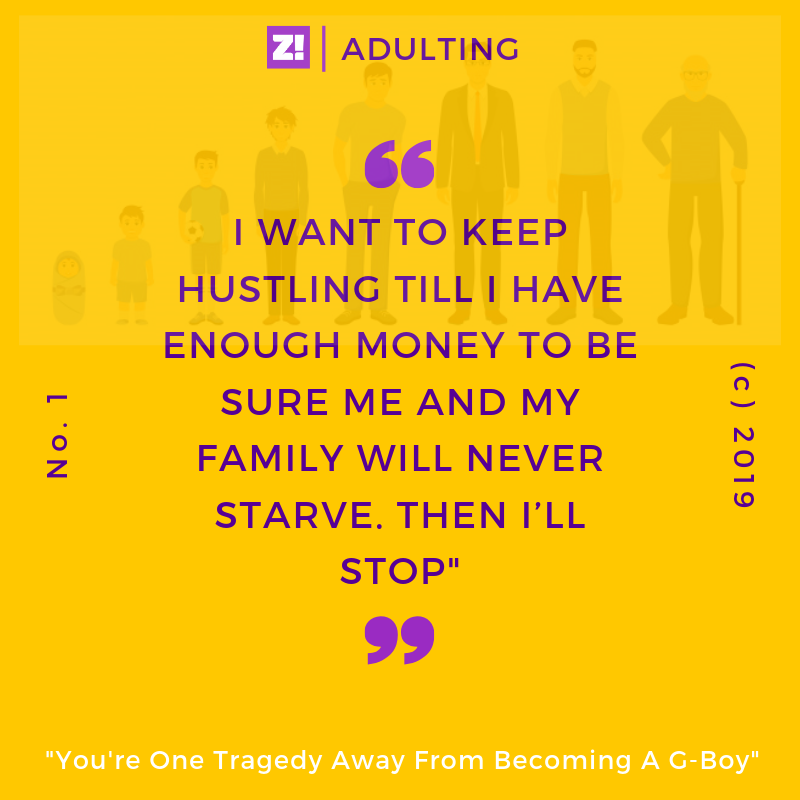
    “Most boys don’t like to hear this but the truth is we can’t do this forever. I don’t want to be doing this with a kid and a wife at home. There’s a right time to leave. For me, that time is when you can stand on your own – you have land in acres, houses bringing in rent. I want to keep hustling till I have enough money to be sure me and my family will never starve. Then I’ll stop”

    Update (May 8, 2018)

    Internet fraud is illegal under Nigeria’s laws. Under the Cybercrime Act 2015, hackers found guilty of unlawfully accessing a computer system or network, are liable to a fine of up to N10 million or a term of imprisonment of 5 years (depending on the purpose of the hack). The same punishment is also meted out to Internet fraudsters who perpetuate their acts either by sending electronic messages, or accessing and using data stored on computer systems. Advance Fee Fraud and other Fraud Related Offences Act 2006 also provides sanctions for individuals found to be obtaining money by false pretenses and intent to defraud.