Notice: Function _load_textdomain_just_in_time was called incorrectly. Translation loading for the wordpress-seo domain was triggered too early. This is usually an indicator for some code in the plugin or theme running too early. Translations should be loaded at the init action or later. Please see Debugging in WordPress for more information. (This message was added in version 6.7.0.) in /home/bcm/src/dev/www/wp-includes/functions.php on line 6121 Human Interest | Zikoko!
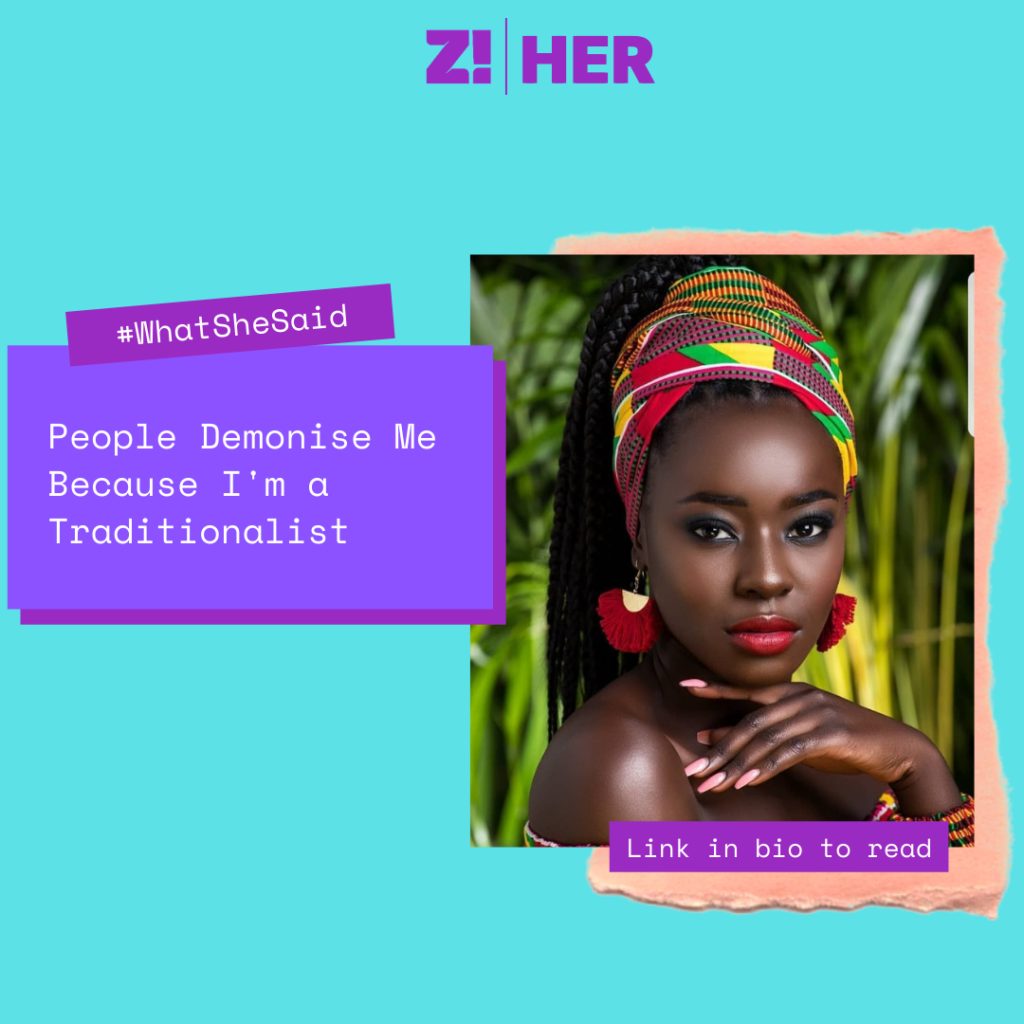
This week’s What She Said is a 35-year-old Igbo woman. She talks about compartmentalising herself so people would treat her humanely as a traditionalist, and things she does to combat the stigma attached to traditional worshippers.
Tell me about growing up.
I grew up in Asaba and it was so much fun. We would climb trees at my grandmother’s house, play catcher and race with tyres.
I asked a lot of questions and was always indulged by my parents. You can say I grew up spoiled. I didn’t have a lot of restrictions. I could do anything I wanted as long as I had a good reason to. My dad was a lawyer with an extensive library that I was in charge of. I decided who to loan out books to and my judgment was never really questioned. So while I was spoilt, I was also responsible.
How did having a childhood like this affect you as an adult?
I became my own person on time. I knew it was okay to have an opinion and believe in the things I believed in solely. I grew up with a lot of powerful women, and I learnt by shadowing them. They taught me early that my voice mattered.
But as I got older, I started to compartmentalise myself.
Why?
We are traditionalists in my family, and I’ve realised this affects how people relate with me.
I’ve been making waist beads commercially for about six years. I’ve worn waist beads all my life. I started making them to help women pause and look at their bodies. I believed if they continued to do this, they would realise how beautiful their bodies were.
I also have a beads line for spirituality. I have bracelets that are tailored to the day you are born — like a Zodiac bracelet but using the Igbo days of the week. I only tell people this on a need-to-know basis.
As a traditionalist, I keep my business separate from my religion because I don’t want Nigerians to say I’m selling juju and collecting people’s destinies with beads.
When did you realise you had to make this distinction?
As early as I could talk. I went to a Catholic primary school, and when I was in Primary 1, I was used as an example of what an idol worshipper was and why people shouldn’t eat from me. My mum had a proper blow out and asked them why they thought it was okay to teach that to children.
Outside my house, I learnt people like me were demonic, bad people who hypnotised others to make them do what they want. With the rise of Pentecostalism in the 90s, the hate became worse. Catholicism tried to convert us with love, Pentecostalism taught people to demonise us — we wanted them dead because they worshipped differently.
So when I was outside, I learnt to censor myself.
That’s painful. Has anything changed in recent times?
A bit. People now want to know their roots, how their ancestors worshipped. When I’m not making beads, I’m writing programmes that teach people how to infuse spirituality in their lives, just the same way they do yoga and such.
People have this perception that if you’re a traditional worshipper, you have to look a certain way. So I am deliberate about the way I dress and everything. My life mission is to show people that they can “worship idols” and be baby girls and boys while doing it. I think this helps with how people see me — they may still want to bind and cast me, but it helps.
For more stories like this, check out our #WhatSheSaid and for more women like content, click here
Hi there! While you are here do you want to take a minute to sign up for HER’S weekly newsletter? There’ll be inside gist from this series and other fun stuff. It’ll only take 15 seconds. Yes I timed it.
The subject of this week’s What She Said is a 55-year-old Nigerian woman who is a Christian and a feminist. She talks about how discriminatory experiences as a female worker in church made her change churches and how she became a feminist.
When did you first notice life was harder for women?
I think I must have been 15. I grew up with five sisters and a brother. My brother is the last born, while I’m the oldest. Before my mother had our brother, much to the disappointment of my father, she kept having baby girls. So, my sisters and I grew up knowing that it was important to have a brother.
I was 15 when he was eventually born, and from that moment everything changed. Before he was born, my father treated us like queens. I remember they used to call him “daddy girls”, but once my brother was born, they replaced “girls” with my brother’s name. We all lived to serve him. In one instance when he was about four or five years old, we were supposed to eat something for dinner and my brother said he wasn’t eating that. He wanted rice, which is what we ate for breakfast and lunch. My father ordered us to make rice instead. Or was it the time that my father was going through a hard time financially, and I and my immediate younger sister had to stop going to school so he could enrol my brother in a private school?
I didn’t really notice it was a boy versus girl problem. I noticed that my parents had favourites and we girls were not their favourite. It made sense because my brother is the last born and they always treat last borns like they’re fresh agege bread and hot beans.
Haha. So did it affect you in any way?
If it did, I can’t really say. It was normal to us back then. As I grew older and started to see more of the world, I saw that that was the way the world was. When I was 18/19, I was with someone whose mother used to lay his bed and do his laundry. This was when he was on campus. She would come every week to pick his dirty clothes and arrange his things. It was somehow to me, but I didn’t think it was because he was a boy. Me, I was an adult even before I even started school — maybe the last thing my mother did for me was to breastfeed me. Being the first girl, I had a lot of responsibility.
At what moment did you realise that this was not normal?
I should start from when it actually registered that it was a man’s world. This was after university, when I decided that I wanted to pursue my calling to be in ministry.
I went to a bible school my church organised and was refused admission because I am a woman. What the person in charge of admissions initially told me was that there was no space that session. Then later he asked what did a woman even want from the programme? He didn’t know that I knew some higher-ups. I eventually got in.
I was indeed the only woman in the programme. My husband wasn’t a pastor or even a minister. Till today, he’s not. So I got a lot of comments from even my friends asking why I was doing the programme. I told them God called me, but they were not comfortable with that information. That was how I went through the programme, finished, graduated and started working in the church.
What was the experience like?
Very political and biased against women. People had opinions that I didn’t have the right to be teaching bible classes or leading the evangelism team. They didn’t always say it to me. But because I was more religious than my husband, they said that “I was wearing the trousers in the family.”
When women led things like charity events and children’s events, they expected me to be there. But those things weren’t for me.
A lot of times, I felt like quitting, but I knew I wasn’t doing it for men. And my husband kept reminding me about this. There was a time a guest minister gave me reasons why my role in church as a teacher wasn’t for me. He showed me bible scripture even. My husband was a bit radical. He wasn’t religious, but he told me to be a change in the system.
Did you?
I tried, but I soon realised that I was part of the problem.
How?
I was generally harsher to women. On the other hand, I gave easier passes to men and forgave their excesses. On one occasion, we found out that one of our members, a young unmarried woman, had gotten pregnant for another church member. The church member was a young man who worked as a mechanic. The young unmarried woman was the sister to one of the pastors, who was also a really wealthy businessman. I think that this pastor made some threats about dealing with the young man when he found out about it. Before the next Sunday, the young man had committed suicide. Before he committed suicide, I remember blaming the young woman and saying she must have lured him, asking what did she go and do in his house — I didn’t even know whether they slept together in his house. But I was quite critical of women.
Then after he committed suicide, the narrative became that the young woman had destroyed the man’s life. Back then, I completely agreed.
It didn’t take long before I started realising my own flaws. I thought to myself, but this isn’t normal. For years, when I counselled couples about to get married, I would ask the woman if she knew how to cook. I didn’t even ask the man if he was making money or had a good job. After I realised what a problem this was, I stopped doing it and started asking the men if they could cook.
How old were you then?
In my 30s.
Did realising that there was a problem help you start fixing it?
No. My energy did not carry it. I eventually left the church and joined a church where there seemed to be more women leaders, even though they were pastor’s wives. They were given the freedom to minister and that was good. This was the 90s, by the way.
I didn’t stay there for long too because I started to notice that there seemed to be a lot of pressure on women to be married. And if you were single or divorced, or your husband didn’t attend church with you, you’d be discriminated against. And they’ll be feeling sorry for you as they’re discriminating against you. I can’t explain it. A few people there thought I was a prostitute. Imagine me going to church with my two children and my own car and someone walking on the road with their husband and child was shaking their head at me. Under hot sun o.
Lmao.
I eventually went back to my old church after the pastor and his wife came to talk to me about it. They were very persuasive, telling me about how the units I led were not growing. When I returned and tried to introduce some new things to the church, I was met with a lot of resistance.
What kind of new things?
Dressing was the main point for me. In the church I left, women dressed really well and colourfully. In this church, the women wore really dull colours. Especially the workers. There were a lot of rules on what they could wear for service or to their own events — like weddings. I wanted to change that. There were rules about no jewellery, no synthetic hair, no trousers. I used to be conservative, but when I left, I dropped all of that and started dressing differently. With the resistance, I just decided to leave again and this time, like the song says, “No turning back, no turning back.”
Haha. So what happened next?
My husband and I moved countries, and we started going to a baptist church. I wasn’t a worker. It was good to be away from the politics. There didn’t seem to be a lot of wahala in the Baptist church. You know Oyinbo people don’t have wahala.
Distancing myself helped me start and pray about ways I could actually serve God. So I started teaching women on my own.
That sounds interesting.
It is. Then very recently, we moved back and my son got married. You know how you children are. Before the wedding, the bride, my daughter-in-law said she didn’t want some things at the traditional wedding. For example, she said she wasn’t going to go on her knees. She told the alaga that they shouldn’t say or sing anything that made her feel like property. And that they shouldn’t ask her to sing the same thing.
I told her, but this is the way things are done. There was a lot of back and forth. One of my sisters jokingly said, “She’s in a feminist na. That’s how they do.” I didn’t think too much about it. We all compromised on a few things and moved on. I think it was a few months after the wedding that I was talking to her — my daughter-in-law — and she got talking about her values as a feminist. She would often say, “This life no balance for women. You self, check am.” She asked me, “Do you like the way you’re treated like a second-hand citizen?” And since then, she’s been teaching me about feminism.
So would you say that you’re a feminist?
Last year when my daughter-in-law told me about what the feminist coalition did in Nigeria, I was proud and honoured to call myself a Nigerian woman. I took it one step further and called myself a feminist.
Haha. How do you marry your Christian values with your feminist values?
They’re not conflicting. Jesus said we should love everyone. Not men more, not women less. And that’s what he did. So it’s about treating everyone the same way, no matter who they are.
I had no idea how big the problems women face are and how much of it is done by people in the name of the God of whatever religion they’re from. That’s not good. We should treat women better.
Right?
As I’m teaching the word of God, na so I’m preaching that we should treat everyone equally. This life must balance by force.
For more stories like this, check out our #WhatSheSaid and for more women like content, click here