Notice: Function _load_textdomain_just_in_time was called incorrectly. Translation loading for the wordpress-seo domain was triggered too early. This is usually an indicator for some code in the plugin or theme running too early. Translations should be loaded at the init action or later. Please see Debugging in WordPress for more information. (This message was added in version 6.7.0.) in /home/bcm/src/dev/www/wp-includes/functions.php on line 6121
Fuel hike | Zikoko!
  • Renewed Worries as Fuel Price Hike Strikes Again

    There’s no fun way to announce this, so let’s just rip out the band-aid. In breaking news, the Daily Trust reports that fuel price has increased in Abuja to ₦617 per litre. 

    It’s all anyone is talking about. Fuel is currently the number one trending keyword on Twitter.

    This isn’t pretty news for many Nigerians who looked forward to renewed hope when President Tinubu was sworn into office. 

    A tale of two eras

    At his inauguration, Tinubu went off-script and announced the removal of the fuel subsidy. This announcement, in more ways than one, signalled the start of a new era. For context, the average retail price of fuel in April was ₦254 per litre.

    At the time of the announcement, Tinubu was greeted with applause by some Nigerians. Exactly 50 days later, not many people are applauding him, as painful realities have set in.

    Granted, the removal of the subsidy was a foregone conclusion. All the leading presidential candidates promised that it would be gone. A decades-long experiment that amounted to trillions of naira finally led Nigerians to see that it was no longer sustainable. However, there have been continued debates on whether Tinubu’s approach was the best.

    Tinubu’s early moves in office suggested he was undertaking neoliberal economic reforms, which he was implementing all at once. These include the unification of the exchange rate and the widening of the tax base. While he was lauded in several quarters for the boldness and swiftness with which he undertook them, there were fears that all these measures implemented in one go could exert pressure on the economy.

    KPMG, in its economic snapshot for June, noted: “We are of the opinion that while these reforms and adjustments are bold and indeed necessary to maintain long-term macroeconomic stability, the timing could be adjusted to allow households and businesses to adjust. 

    “However, the government appears to have decided on a strategy to push through all its difficult and needed reforms all at once and as fast as possible while it is still easier to do… This approach has, however, had mixed success across countries.”

    Download the Citizen Election Report: Navigating Nigeria’s Political Journey

    Reduction in fuel consumption, increase in fuel price

    On Monday, the Nigerian Midstream and Downstream Petroleum Regulatory Authority (NMDPRA) announced that fuel consumption has declined since the removal of the subsidy. Not surprising since people are now rationing fuel due to the increase in cost. But by just how much has consumption dropped?

    Here’s what Ahmed Farouk, the Chief Executive of NMDPRA, had to say about that:

    “In January, consumption was 62 million litres per day. In February, 62 million litres per day. March was 71.4 million litres per day. In April, it was 67.7 million litres per day. May had 66.6 million litres per day. By June, it was 49.5 million litres per day. In July, it’s 46.3 million litres per day.”

    Farouk noted that the new figure of 46.3 million litres per day represented a 35% reduction compared to the 65 million litres per day before the subsidy removal. 

    A drastic reduction in the demand for fuel should ordinarily result in a fall in the price of fuel. On the contrary, fuel price is going up. 

    One possible explanation for this is the exchange rate. Nigeria imports its refined crude using dollars, and with the naira falling relative to the dollar, it will reflect in the prices. We can only hope the price will reduce when Dangote’s refinery begins operations, which is still projected for year’s end.

    Meanwhile, the Nigerian National Petroleum Company Limited (NNPCL) raising petrol prices in Abuja from ₦537 to ₦617 per litre will signal other independent marketers nationwide to follow suit. The price of petrol varies across states. Prices are expected to be higher up north than down south due to transport and logistics costs.

    Renewed hope vs renewed worries

    In an earlier report about Tinubu’s economic growth plan, we noted that the euphoria Tinubu earned in his early days in office would eventually run out. This was echoed by political commentator Feyi Fawehinmi when he said, “Tinubu’s early moves have all been plucking low-hanging fruits. But you still have to credit him for bothering to pluck them… [He] will eventually run out of easy wins; the test starts then.” 

    Between the labour unions clamouring for an upward review of the minimum wage, a running court case disputing his right to be president, and millions of Nigerians feeling the economic crunch, Tinubu is in a race against time to deliver the renewed hope that he promised. Whatever ace he may have up his sleeves, now’s the time to play it. 

  • How Are Nigerians Surviving the Fuel Price Hike?

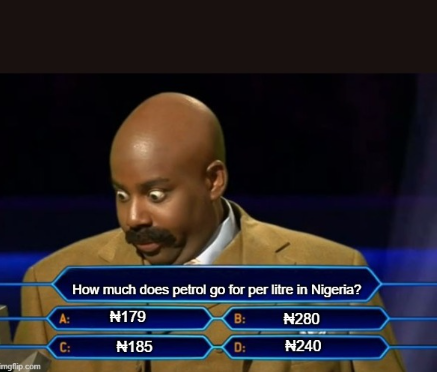
    Say you were on the hot seat of Who Wants to Be a Millionaire, and had a ₦1 million question to answer. (please play along here, I know for some of you, that’s chicken change) 

    What’s the current price of petrol in Nigeria? What’s your answer going to be?

    The question looks easy enough on the surface, but it’s tricky to answer. For ₦1 million, you’d have to think deeply and here’s why.

    In July 2022, the Nigerian National Petroleum Company (NNPC) quietly approved the increase of fuel from ₦165 to ₦179 per litre. With this information, you might be tempted to settle for option A — but not so fast. 

    In that July, oil marketers set the price at ₦185, so maybe option C then? 

    Then again, the latest reports in the news say that oil depots across the country are selling at ₦240 per litre, with fears of scarcity looming till June 2023. Option D is looking sexy now, isn’t it?

    Hold that thought for a bit because Citizen spoke to a couple of Nigerians who aired their minds on the ever-fluid price of fuel. It shouldn’t surprise you to hear that in some places it goes as high as — or even higher — than option C, ₦280 per litre. 

    In short, no one knows the actual cost of fuel in Nigeria. Here’s what some of our respondents said.

    ALSO READ: Nigerians Cry About Another Fuel Scarcity but Buhari Unlooks

    Noa, Abuja

    The thing with Abuja is, the fuel price is the same, ₦185 per litre. The issue is, would you see it to buy without joining a long queue? No.

    You’d have to queue. You have filling stations that sell between ₦280 and ₦290. Those are the ones we call the “black market filling stations.” They always have fuel. I suspect that the depots that sell at ₦185 provide fuel for these filling stations who then sell at ₦285. The excess profits are then split among themselves. Because when you ask them why they’re selling at such a high price they’d say it’s because of the amount they got it which simply isn’t true.

    On how it has affected me, well, thankfully, we’ve had stable power. Some days it’s up to 20 hours.

    For my water production business, most of my vehicles run on diesel. The last time I got diesel was at ₦900 per litre. I’ve had to scale down on production because the cost of diesel keeps skyrocketing. I’m now thinking of more efficient ways to sell water. So, to sum up, there’s fuel — but there’s no fuel if you catch my drift.

    Toyin, Osun

    I bought fuel last night at ₦270 per litre. Of course, that’s on the high side, but what can we do? Man has to survive, and it’s not funny. 

    Today, I had to take public transport to work. What used to be ₦100 is now ₦200. Some transporters even went as high as ₦300. Life’s hard.

    Tunde, Oyo

    I run a logistics business in Ibadan, and we are deeply impacted, especially our bikes. We buy fuel from between ₦250 and ₦300 per litre. Very few stations sell at ₦185 — maybe two or three of them. And the queues there are unimaginably long.

    Our customers want us to deliver to them on time because that’s the selling point of the business. So obviously, we can’t join these queues when we run out of fuel. This means we’re forced to buy at these high prices. This has also increased our delivery fees.

    Not all customers understand, but what can we do? It’s a spiral effect that harms small businesses like us. I also had to increase the salary of my workers too. The current situation is annoying and frustrating.

    Olayiwola, Lagos

    Before, when I filled my fuel tank, either the SUV or jeep, it used to go for ₦10k. Now that the cost of fuel has gone up, filling your tank requires almost double the amount.

    It’s not as if there aren’t places to get fuel at ₦185 per litre, but the consequence is waiting in long queues. I’m an entrepreneur and time’s money for me. Also, there’s no guarantee that you’d get fuel when it’s your turn.

    Now I have to get at ₦250 or ₦260. But what’s even ridiculous is that recently, it’s been hard to get fuel at these places. Even at the inflated cost, you may not easily see fuel to buy without queueing. The major impact is that I’m forced to work from home. There’s almost no justification for going to the office.

    SUBSCRIBE TO OUR GAME OF VOTES NEWSLETTER FOR INSIGHTS AND COVERAGE OF THE 2023 NIGERIA ELECTIONS