Notice: Function _load_textdomain_just_in_time was called incorrectly. Translation loading for the wordpress-seo domain was triggered too early. This is usually an indicator for some code in the plugin or theme running too early. Translations should be loaded at the init action or later. Please see Debugging in WordPress for more information. (This message was added in version 6.7.0.) in /home/bcm/src/dev/www/wp-includes/functions.php on line 6121 english | Zikoko!
In January 2020, a Nigerian policy advocate, Ebenezar Wikina, confronted Nexford University in an email after he was asked to prove his English language proficiency before enrolling in a business program.
Wikina’s refusal to take a language proficiency test forced Nexford to review its admission policy. This was the foundation for the #ReformIELTS campaign— a policy advocacy movement that has mobilised over 80,000 people across Africa to challenge language discrimination in the global education system.
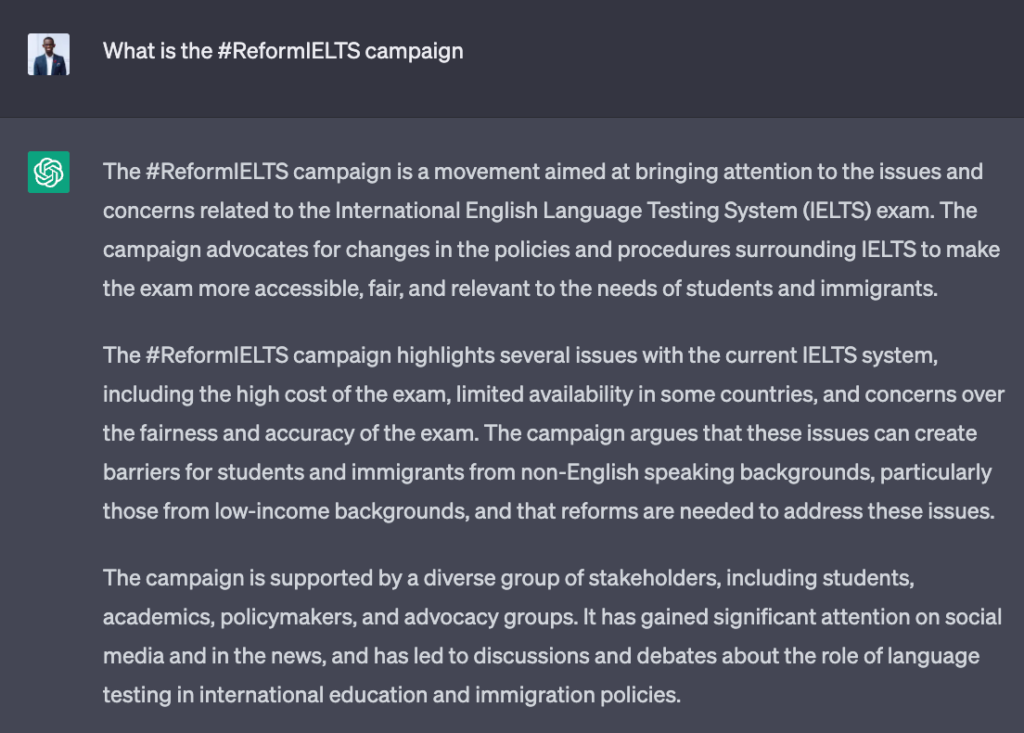
What ChatGPT says about the #ReformIELTS campaign
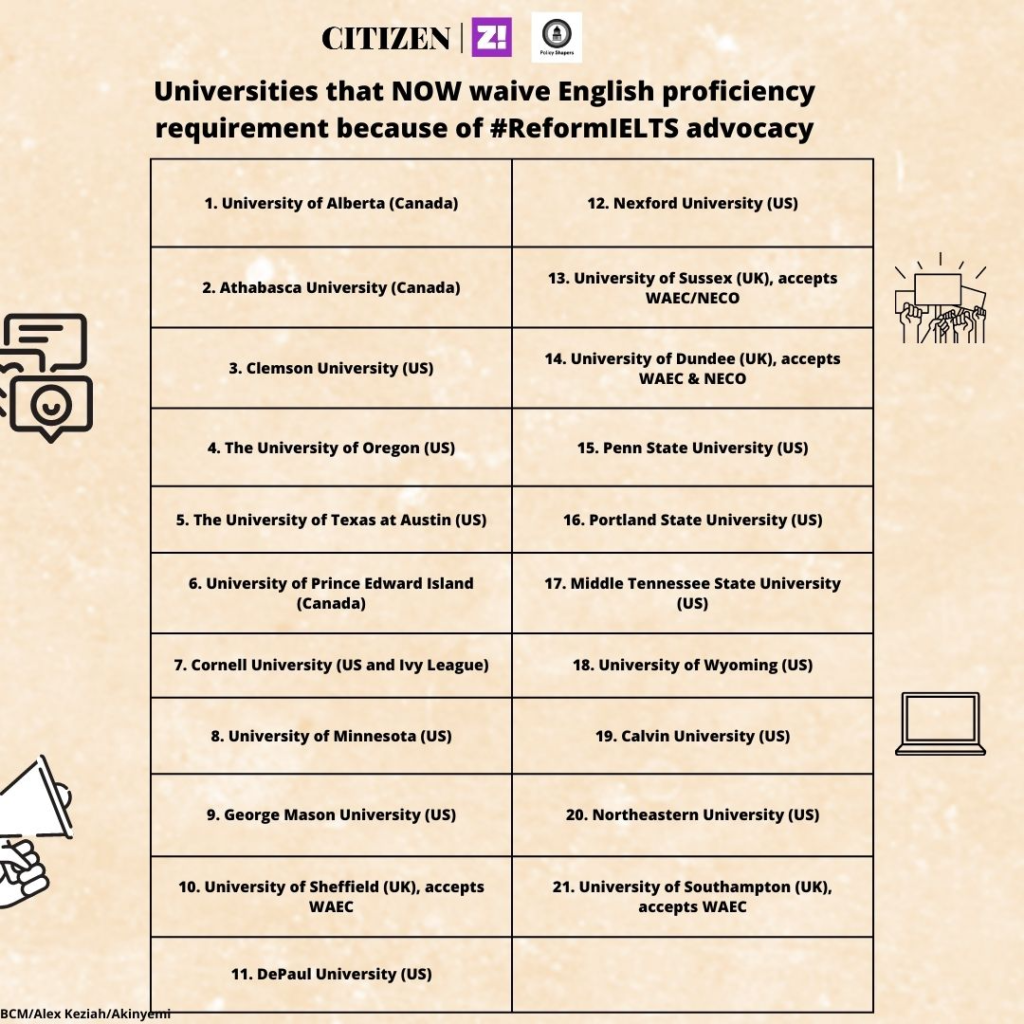
The campaign, which has featured on more than 500 media platforms globally, led to 20 universities across Canada, the United States, and the United Kingdom, removing the IELTS/TOEFL barrier for applicants from English-speaking countries in Africa.
While Wikina has been at the forefront of this reform, Policy Shapers, a policy reform and advocacy organisation he founded in August 2020, has been the organised fighting front.
Policy Shapers have engaged the UK government’s Home Office in a policy debate. For every intellectual gbas from the Home Office, Policy Shapers responded with a greater gbos.
Is it even possible for a young person to be a policy advocate?
But how did these young Nigerians achieve this level of bravery, and how can you do something like that?
Let’s talk:
Policy Advocacy 101
Policies are the decisions and principles of organisations and establishments that determine how they act or treat people who deal with them. Those Lagos restaurants that refuse people entry because of how they are dressed are acting based on their internal policies.
Policies can be discriminatory—like how Lagos restaurant policies are anti-baddies—bad or need to be amended to meet new needs.
Every time you see a policy you don’t like and you speak against it; you are doing the work of a policy advocate— like how Wikina refused to write IELTS at Nexford.
If you take it forward by telling your friends about the policy and they take action with you, leading to the policy being reformed or eliminated, you are doing policy advocacy.
With 62% of Nigeria’s population under 25 years of age, organisations like Policy Shapers believe in youths as the major stakeholder in Nigeria and should be part of the policy dialogue and decisions that decide their future.
So, in case you’re still wondering, yes, you have a role to play in the policy decisions made in Nigeria because you will be affected whether or not you do something. The price of bread or shawarma, the cost of internet data, the price of Netflix and Prime subscriptions, or whether or not delivery companies are successful all depend on policy decisions.
How Policy Shapers influenced policy decisions in 20 universities globally
Simple answer: Obasanjo’s internet.
In my speech 🗨 to Nigeria's Vice President last week, I asked for FG to support the #ReformIELTSPolicy campaign and he responded in agreement saying that "as an English-speaking country we should definitely be beneficiaries of some concession from @ukhomeoffice"#PolicyShaperspic.twitter.com/rQgtnqHvfu
Policy Shapers encouraged many young people like you, to use email and social media, and a Change.org petition to ask abroad universities to stop asking us to prove we can speak English.
After #EndSARS protests against Police Brutality in 2020, the group felt it was safer to protest and advocate online. They used the People, Data, and Time (PDT) principle. Here’s what that means according to them:
People: Every policy advocacy campaign should be about people. The model we piloted through this campaign was not to directly lead every aspect of this advocacy. On the contrary, we empowered and inspired young people in Nigeria and the diaspora to take the lead in engaging institutions. One person who has been very influential in this entire process of engaging schools, and has now inspired many others to follow him, is Dr Olumuyiwa Igbalajobi, a Nigerian post-doctoral research fellow based in Canada. Dr Olumuyiwa single-handedly wrote to almost 100 schools seeking policy changes and we are so glad to have someone so passionate working with us.
Data: For government officials, the numbers must make sense. This is why we produced over 20 pages of evidence in collaboration with over 80 young people in our Advocacy Taskforce to back our argument for the inclusion of Nigeria and Anglo-African countries in the UK’s Majority English Speaking Country (MESC) list. These data points have helped us drive the message of our campaign and we produced it
Time: Change takes time. In our fast-paced AI world, it’s easy to want change to take place immediately but it doesn’t always work like that in the policy world. We must remain patient and resolute till the end. Since the incident with Nexford University in January 2020, it has taken more than 50 months of persistence before we arrived here. When you want something, don’t stop until you get it, right?
Policy Shapers is building a community of young policy enthusiasts to co-create policy ideas and advocate for a better Nigeria. Learn more about how to join here
This piece is produced as part of the partnership between Policy Shapers and Zikoko Citizen to deliver policy analysis to young Nigerians.
“A Week in the Life“ is a weekly Zikoko series that explores the working-class struggles of Nigerians. It captures the very spirit of what it means to hustle in Nigeria and puts you in the shoes of the subject for a week.
The subject of today’s “A Week in the Life” is Adeola Badmus, an Abuja-based IELTS tutor. She talks about her struggles with teaching proud adults, Nigerians who think they shouldn’t write IELTS and why she loves her job so much regardless.
SUNDAY
My Sunday tutorial sessions are in the afternoon, and I don’t go to church, so I sleep in until 9:30 a.m. When I get up, I do my morning skincare routine. While my skincare mask is on, I clean my apartment. After that, I take my bath and go back to bed.
My session usually starts at 1 p.m., but today, I decided to chill because I knew I wouldn’t have to deal with the traffic at City Gate on weekends. It would be a smooth 20-minute trip from Lugbe to Central Business District in town.
My plan worked to the “T”: I stepped into my workplace at exactly 1 p.m.
IELTS has four parts: Listening, Reading, Writing and Speaking. Today, I taught Speaking, my favourite class.
People communicate with each other every day — with friends, family, colleagues — but once you start asking them questions and expecting them to give you answers, to practise for a test, everything changes. You see people changing their accents and stumbling over their words, unsure of what they’re saying and making mistakes they may not make on a normal day. People behave differently when they’re being monitored; they feel judged. My job is to make sure they perform well in such situations.
During the class, someone expressed discomfort. She said, “I’m sorry. Can I take that again?” after answering a question. I asked why, and she said she felt like she had just messed up, from the way I was looking at her. I hadn’t even said anything. It’s funny to see adults squirm under perceived pressure, a wicked kind of fun, but it’s just interesting to watch otherwise hard guys and babes become very feel self-conscious. I spent the next few minutes making small talk with my students and trying to draw them out of their shells. I always make sure students can be comfortable with me at all times.
By 5 p.m., I got dinner from a cafe on the next street and headed home, where I had a private class from 6-9 p.m. waiting for me. I ran the three-hour private listening classes virtually, and today’s client is in Dubai. She struggled with names, especially “Kramer” because the letters “C vs K” confused her, but I walked her through several examples.
After the class, I was exhausted and slept off while scrolling through Facebook.
MONDAY
On Mondays, I have morning and afternoon sessions: 9-12 and 1-4 p.m.
Teaching adults is not the same as teaching children. It’s actually more difficult. Teachers can punish difficult secondary school students who are misbehaving. Growing up, my teachers scolded or flogged me, or sent me out of the class. But all these are off the table when you’re teaching adults.
Managing petulant adults is a skill that requires patience and diplomacy. And that’s what a lot of teachers don’t know. There’s a student who got transferred to my class today. He complained that his previous teacher was rude. While reporting to my boss, he said, “I’m in his class, but I’m not his child.”
Many of my students are people with jobs and responsibilities. They come to classes from their place of work, and many have multiple jobs and families to support. So I have to consider that they’re stressed already, and I’m careful not to give them more than they can handle.
The costs of japa-ing are not cheap, so some of them are upper-middle-class snobs — people wey get bread, so I also have to manage big egos. Some of my students are professionals like senior doctors and nurses who want to get a better life abroad.
A lady came to my class during the afternoon session and was sizing everyone up like we were all beneath her. She looked me over and asked my boss, “Do you think this one has anything to offer me?”
I smiled gracefully. I’m in Abuja after all.
I’ll just give her two weeks. She’ll want to be my best friend.
That incident made me remember the Indian guy who joined my class last year. He was surprised to see a Nigerian teach IELTS so well. He said, “How come you know English this well?”
He told me he had Nigerians working under him, and he saw us as half-baked. He had also wanted to sign up with an American prep centre because he didn’t think a Nigerian could teach him. Funny, because he wasn’t exactly the brightest student. I didn’t know how to respond to such a backhanded compliment, but I brushed it off and got on with teaching. When his results came out, he passed quite all right, but he wasn’t among the best performers in my class, so what was up with the snobbery?
If not for confidentiality and ethics, I would have rubbed my best students’ results in his face. It’s tough dealing with snobby clients like these, but it’s the job I chose, so I do my best to handle them.
TUESDAY
When students get frustrated, they start complaining, “Why do Americans and British people force us to write IELTS?” They say it’s unfair for Nigerians because English is our official language. The common argument is that many indigenes of Western countries have a very poor command of the English language, many of them are illiterate.
And I get it, but I explain that the British Council grading system is not placing applicants against illiterates, they’re measuring us up against educated indigenes. They want to attract competitive talent, people who’ll add value to their economy.
WEDNESDAY
Today, a former student sent me $500. He used to have doubts about his abilities, but he passed his test in flying colours and is now in Canada.
When former students send me gifts like this, I’m always emotional. It’s a gift to be able to help people’s dreams come true. My current job is the healthiest I’ve ever had, and my students really help me shine. But it wasn’t always like this.
At my previous job in Ibadan, I endured an abusive environment and barely escaped rape. The job didn’t pay much, and during COVID, they slashed my salary. I had to take extra classes to make extra money. I was barely hanging on. I no longer looked forward to stepping out of my house in the mornings.
But when a staff sexually assaulted me at work, and the boss said, “Not every man can be around a woman and not be tempted,” I knew I had to leave.
A few weeks later, a friend recommended me to my current company. I sent in my IELTS results and attended an interview. They liked me so much that they relocated me to Abuja. Now, they pay a major portion of my rent, and I work with the best people. My salary has increased twice in nine months, and my employers seem to care about my growth.
Hi, I’m Ama Udofa and I write the A Week in the Life series every Tuesday at 9 a.m. If you’d like to be featured on the series, or you know anyone interesting who fits the profile, fill out this form.
You read some English words and want to throw some hands. Who was behind the spelling of those words? What was the thought process? Why did they borrow the word from another language? So many questions.
1. Diarrhoea
Really though, how does a word spelt as ‘diarrhoea’ make sense as dai·uh·ree·uh? Who coined this word? What was the reason?
2. Queue
Someone just lined up a bunch of unnecessary letters behind Q. Why? I can only imagine the low self-esteem that the letters ‘ueue’ feel.
3. Croissant
Croissant woke up one day and decided to be kwa·son. The ‘r’ and the ‘t’ are in the spelling for decoration. Don’t get me started on how all the vowels sound different.
4. Lingerie
Lingerie has the cutest spelling for a word that ends up being pronounced as laundry.
5. Charcuterie
I personally pronounce this word as ‘coochie fairy’ and I have no desire to learn the actual pronunciation. It’s a borrowed word, so I’m not surprised that the spelling and pronunciation are unnecessarily hard.
6. Silhouette
Maybe I’m the one that doesn’t know how to spell sha because I suffered during the silhouette challenge last year.
7. Rhythm
The people who borrowed rhythm from the Greeks forgot to borrow the second ‘y’ and now all of us are living in the bondage of ‘rhythm’. There’s definitely an easier way of spelling the word out there, we’ve just not found it yet.
Antonyms are words which are opposite in meaning to each other (e.g. good and bad, Nigerian politicians and accountability). This quiz is a test of two things: your understanding of antonyms and comprehension abilities.
People who score above 7/10 definitely have superior English skills.
There are some common mistakes even the best English speakers make, and we’ve created a quiz to test you on 15 of them. Honestly, unless you’re a lesson teacher on the side, we don’t expect you to get up to 11 right.
Patrick Obahiagbon is a Nigerian politician who became a bit of an internet sensation a few years back, thanks to his obsession with convoluted words. Now, we’ve gathered 11 sentences from a few of his speeches to see if you can decipher what the living thesaurus was trying to say.
Last week, we made a quiz that tested if you were smart enough to nail real Common Entrance questions. Now, we’ve taken it up a notch with real ‘Use of English‘ JAMB questions. It’s time to see if you’re smarter than the average SS 3 student.
If variety is the spice of life, then Nigeria is the kind of pepper soup dish that would have Toke claiming the sweat on her brow is ‘glow’.
Here’s the super-new episode of VRSUS by the way. #ShamelessPlug #NaWeDoAm
You know the basic facts – over 200 million people, 200 tribes and languages, 36 states, three major ethnic groups all live together in Nigeria. We’re in a melting pot if there ever was one. It’s little surprise that no single language, not even our lingua franca, English is spoken across the country.
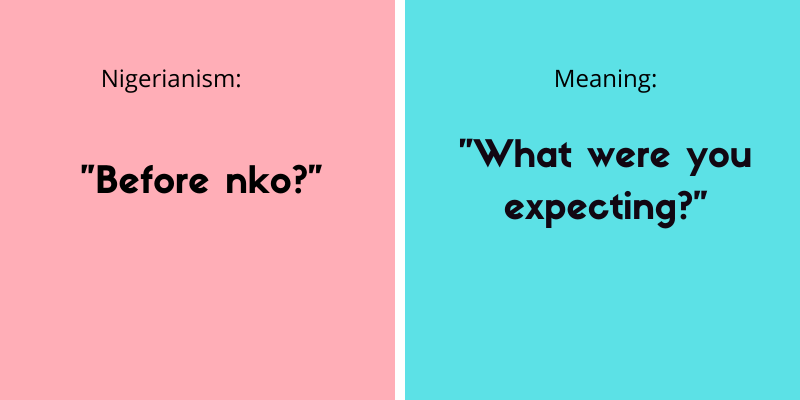
But if you listen enough, one of the best things about being Nigerian is how we’ve injected common terms with new meaning and created a set of terms that only Nigerians understand.
People call them Nigerianisms. We may not have all of these codified into a dictionary but I will have you know that Nigerian English is the fastest growing variety of non-native English in the whole world.
That grammatically wrong term you’ve been using (insert the wrong term) could become more common than you realise; which poses a small, itsy-bitsy lirru problem.
I honestly believe Nigerians are funny from birth, and it shows in our Nigerianisms. But some of these terms have become so annoying that we don’t want to imagine a world where everyone speaks them too.
That said, in the global interest, these are the 7 most annoying Nigerian-isms. I hope we wake up tomorrow and forget them so we can avoid an eventual apocalypse where the only rational person is, you guessed it, your old English teacher.
“SEE FINISH”
So the basis of this is simple. See finish is pretty much the lazy version of “familiarity breeds contempt“. The problem is you can’t say this thing without sounding like you’re about to start a fight; you say ‘the reason for this situation is see finish’ and someone takes it as an insult.
What kind of world are we creating where a simple phrase can get you on Instablog for fighting inside gutter? Nah plis.
“COME AND BE GOING”
I want you to think deeply about what a person means when they say “This guy. Oya come and be going to your house“. Do you feel this slight sense of chaos swimming in your head? Do you feel the need to moonwalk in several directions at once? Imagine a non-Nigerian in the same shoes.
I have a theory. This particular Nigerianism was introduced to our lexicon by the spiritual agent of confusion – the same guy who tweets on behalf of Bashir Ahmad and made Cynthia Morgan change her name to something no-one (including her) can seem to remember.
“MY DEAR”
This is one of those many British slangs that found its way into Nigerian English. That’s not necessarily a bad thing except we’ve turned it into a condescending way of referring to people we don’t rate, or putting them in their supposed place.
How many times have you said something smart, only for the oldest person in the room to say “My dear, nothing works like that“. It’s also become a fave of creepy men who hang out near ATM stalls and mutter as a term of endearment to every girl or woman who passes by, “You look so cute, let me help you, my dear”. Ewww. Delete please.
“THEY”
Nigerians use ‘they’ like a swiss army knife. We use it to refer to a random group of people as in “They said Buhari is actually Jibril from Sudan”. Sometimes, it refers to an imaginary hater e.g “They told me I wouldn’t make it; look at them!”.
“They” is the lethargic way Nigerians describe any and everybody including groups we are a part of e.g “
“OPEN EYE”
You would assume everyone keeps their eyes open fairly often; I mean, it’s how we see, right? That is until a Nigerian tells you that someone has ‘open eye’ which is basically slang for “greed”.
My only problem is there’s no way to accuse a person of having open eye without sounding poor, frustrated and unfortunate.
“TAKE IN”
To the rest of the world, to ‘take in’ mostly means to understand or assimilate. But when you’re a Nigerian with women in your life, it means one of them is now pregnant. Now, apart from making it sound like women go to a government facility to ‘take babies in’, it just strips reproduction of all its beauty.
She doesn’t want to take in, dammit. She wants to be pregnant. Only Nigerians can make pregnancy sound like a football tactic.
“UNCLE” & “AUNTY”
I get that the idea that we’re all related is super cool and all that. But thanks to Nigeria, odds are you’ve spent your entire life referring people you don’t know from Adam as “Uncle” or “Aunty”.
As you get older, you begin to notice that people call you the same thing as well. A random kid walks up to you and says “Uncle, help me carry my ball from that tree”. Yea, I love your zeal and all but I don’t really know your dad or mum like that.
That’s all folks. Let’s come together and save the world from eternal confusion. As with everything Nigerian, it begins with you. If she’s not ingesting entire morsels of fufu in quick succession, she’s not taken anything in. Thanks, my dears.
1. Politician, Chief of Staff to Governor Adams Oshiomole of Edo state is also known as Igodomigodo.
Hon. Patrick Obahiagbon, when he’s not carrying out his political duties, he is busy making us grab our dictionaries as we try to understand his incredibly complex English. Here are some of the most hilarious speeches he has given:
2. When he addressed Unilag students at the United Nations International Youths Day.
3. When he gave his opinion on the Rivers state crisis of 2015.
4. When he was passionate about the controversy going on in Edo state.
5. When he said what he really felt about the opposition party.
6. When he said “Rejectmenta”.
7. When he apologized to his audience.
8. When he complained about the state of some roads in the country.