Notice: Function _load_textdomain_just_in_time was called incorrectly. Translation loading for the wordpress-seo domain was triggered too early. This is usually an indicator for some code in the plugin or theme running too early. Translations should be loaded at the init action or later. Please see Debugging in WordPress for more information. (This message was added in version 6.7.0.) in /home/bcm/src/dev/www/wp-includes/functions.php on line 6121
Electricity Tariff | Zikoko!
  • Did the NLC Really Lock up Discos’ Offices in the Country? 

    There’s new drama every day in Nigeria. Since we entered 2024, we’ve dealt with fuel scarcity, inflation, a drunk electricity grid, and electricity tariff wahala, but apparently, we’re only in episode 2, season 1. 

    In April 2024, the electricity tariff costs increased by over 240% for Band A users and fuel price jumped from ₦600 per litre to as high as ₦1000 per litre in May 2024. The National Labour Congress (NLC) relayed messages of displeasure to the Federal government regarding this situation, but not much has changed. 

    In an unexpected move, The NLC on Monday, May 13 2024, shut the gates of the Ibadan Electricity Distribution Company in Ilorin, Kwara State seeking the reversal of the electricity tariff earlier imposed. The Union members were at the IBEDC offices in Challenge and Baboko market areas in Ilorin as early as 7 a.m. to lock the gates and prevent anyone from going in. The same happened at the Discos in Lokoja, Abuja, Ikeja, Benin, Jos, Kaduna and other locations across the country.

    [ad]

    The Chairman of NLC in Kwara state, Comrade Muritala Olayinka said that the union was carrying out the instruction of the National Secretariat and that the offices would remain locked until the order to reopen them came from Abuja. 
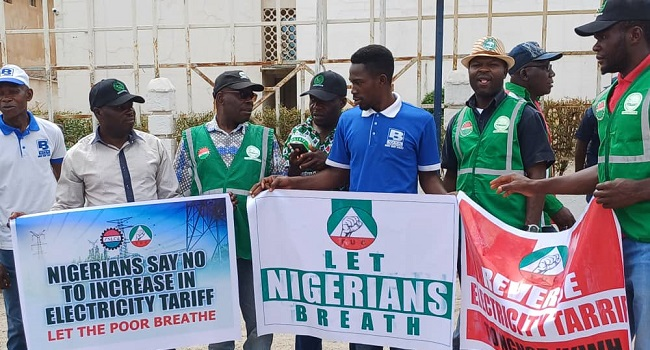
    NLC members at a DisCo office

    Earlier, the labour unions had given the NERC  a May 12 deadline to withdraw the recent hike in electricity tariff or face the consequences, and their actions have shown how much they’re standing on business. 

    Following their protest on May 13, 2024, the President of the Nigeria Labour Congress, Joe Ajaero said that their actions became necessary because Nigerians were wallowing in power poverty, especially after the tariff hike when the government promised extended hours of power supply.

    He also went on to say that the government had ignored their letters and complaints, and that people were paying high amounts for electricity but not getting power supply, and that it was an unbecoming situation. 

    Pending when the federal government responds to their complaints and strike actions, it is unclear when or if the picketing actions against electricity distribution companies will continue.  

    Read: NEPA Has Favourites And You Might Be One of Them

  • Nepa Has Favourites and You Might Be One of Them

    Like the 10 fingers, electricity bands are not equal. If you’ve ever wondered why the electricity rarely trips off in certain parts of the country while some areas only get light on public holidays, your answer is here.

    There are five bands according to the Nigerian Electricity Regulatory Commission (NERC). They include Band A, B, C, D and E.

    Band A

    These are Nigeria’s true rich kids. Users who fall under this band are entitled to a minimum of 20 hours per day. With states like Lagos, FCT, Oyo and Edo receiving the highest electricity rations, it is expected to find Band A customers in this category. Areas in Lagos with this amount of electricity include Akowonjo, Abule-egba, Ikeja, Ojodu, Oshodi, and parts of Yaba whose band currently costs ₦225 per kw/h. 

    Band B

    If you’re part of this class, you are also rich and privileged. Band owners here get a minimum of 16 hours of light per day. With the national grid falling multiple times during the year, you still fall within the priority list of your electricity provider. This band costs between ₦61 – ₦64.07 per kw/h depending on their tariff plan. 

    [ad]

    Band C 

    This class of people aren’t doing too bad. Because Nigeria’s electricity generation is low, we’d probably rank them as comfortable. People who fall under this band have a minimum of 12 hours of electricity per day. At least, if you go to work for twelve hours, there’s a good chance you enjoy light for the other half of the day. This band pays between ₦48.50 to ₦52 per kw/h.

    Band D

    If you only ever get light from midnight till dawn, then this is probably your class. Folks in this class enjoy what many Nigerians would call “stable light”. But hey, you get to charge your devices and iron your work clothes just before dawn. It’s a quiet type of luxury. This band costs between ₦32 to ₦52 per kw/h depending on the tariff plan and demand. 

    Band E 

    This is the lowest band that electricity service providers offer to customers. Users have access to a minimum of 4 hours per day and honestly, that doesn’t sound like enough hours of the day. On the bright side, they only cost between ₦32 – ₦43 per kw/h. 

    Thankfully, the government is working on electricity supply. Read why Nigeria may soon be having an uninterrupted power supply. 

  • Electricity Tariff Went Up Again In Nigeria. Did You Know?

    A new year may be upon us, but Nigeria’s trials and tribulations remain the same as a country. The new naira bank notes are still not in full circulation yet, and queues at filling stations are gradually becoming the new norm. And now, to top it all up, notwithstanding the current state of our crippling economy, electricity distribution companies (DisCos) decided to increase the price of tariffs by over 17% quietly. 

    electricity tariff price

    What exactly went down?

    A few days ago, some electricity consumers around the country drew attention to the fact that there has been a price of electricity tariffs. For instance, the Abuja Electricity Distribution Company (AEDC) changed its tariff price from ₦57.55 to ₦68.2, so rather than getting 34 units for ₦2000, you’d be getting 29. When complaints were filed to the AEDC, they responded by simply saying the change was in compliance with an order from the Nigerian Electricity Regulatory Commission (NERC). 

    Why did NERC increase the tariff price?

    According to the NERC’s Multi-Year Tariff Order (MYTO), tariff prices and rates are subject to change and review relative to economic factors like inflation, exchange rates and generation capacity. However, the issue here is that perhaps to avoid public outrage, no announcement was made to tell people about these changes. It’s almost like Nigerians are cursed to see an endless cycle of shege from every sector of the country. 

    electricity tariff price

    What has the government said so far?

    On January 5, 2023, the minister of state for power, Goddy Jedy-Agba, was in a meeting with the National Union of Electricity Employees (NNEE). When asked about the recent hike in tariff, he surprisingly denied knowledge of it. Instead, he asked Nigerians to speak with the NERC chairman. 

    electricity tariff price

    So, once again, it looks like we’re on our own.

  • Electricity Tariffs Are Going Up, But We Don’t Even Have Light

    Even if you never seem to have light for long enough to cook beans, your electricity bills keep going up.

    Two months ago, I bought 77 units for ₦5k. Last week, imagine my shock when I got 51 units for the same ₦5k.

    For the 100th time. I wonder why I’m still in this country. So because misery loves company, I reached out to fellow Nigerians who are having to deal with the skyrocketing costs of electricity while getting a lot less supply.

    Ahmed, Lagos

    Even though my electricity bill has doubled over the past six months. I still spend more than ₦30k to fuel my generator. The first time DisCos increased the price two years ago, they promised that we’d receive more power. I didn’t mind because no one likes generator noise, and I didn’t have any problems paying more money if I was guaranteed more electricity. For some time it seemed things were improving. But suddenly, the bills kept increasing and the quality of service fell off. Nowadays, I have a lot less light than I had two years ago — I went from receiving an average of 15 hours of power supply a day to less than 8 hours of electricity, even though I’m paying a lot more money now.

    RELATED: Will Nigeria’s Fuel Scarcity Be Over Soon? We Have Updates

    Oluchi, Jos

    These NEPA people came to collect money yesterday. They demanded  ₦25k. For what? The only electrical appliances we use in my parents’ house are energy-saving bulbs, a TV and a fridge and we don’t even have steady power. They keep bringing these outrageous bills, and we’ve asked them for a prepaid metre, but they said we must pay off outstanding bills of ₦1.5m before they install it. From where na? 

    Even as it is, they don’t even read the metre to gauge our power consumption; they just estimate any random figure and slap it on the bills so that they can steal money. But me I don’t even have their time. Yesterday, I just counted ₦5k and gave them, let everybody calm down. If they insist to collect ₦25k from me for NEPA bill, they’ll have to carry gun.

    Olamide*, Uyo

    Omo, let’s just say that I now know why my mum always used to shout at me for leaving lights on. 

    Sylvia, Ibadan

    It’s been crazy, but what will I do na? Not pay for electricity? Everything is doubling in price every day, and IBEDC has decided to go the way of Nigerian brands: increase the price but reduce quality. I no longer even get up to 10 hours of light a day. Sometimes, I even go for days without electricity. With the current fuel scarcity, it’s been a truly stressful time for me as I work from home. Last week I couldn’t get anything done and I’m sure my boss got tired of my excuses, but na Naija wey we dey. 

    Kedei, Abuja

    I used to buy power for ₦10k before and it’d last me for a month. Right now, ₦10k only lasts for three weeks at best. And that’s with serious monitoring o. I switch on my air conditioner for some time until my bedroom gets cold, then I switch it off. I only leave my water heater on for 10-15 minutes daily so I can have enough hot water to use twice a day.

    CONTINUE READING: Airlines Are Sending Ticket Prices to the Moon. Can They Do That?