Notice: Function _load_textdomain_just_in_time was called incorrectly. Translation loading for the wordpress-seo domain was triggered too early. This is usually an indicator for some code in the plugin or theme running too early. Translations should be loaded at the init action or later. Please see Debugging in WordPress for more information. (This message was added in version 6.7.0.) in /home/bcm/src/dev/www/wp-includes/functions.php on line 6121 elections | Zikoko!
The 2023 general elections had many surprises, and for Adamawa state, more election drama is set to unfold in the coming weeks.
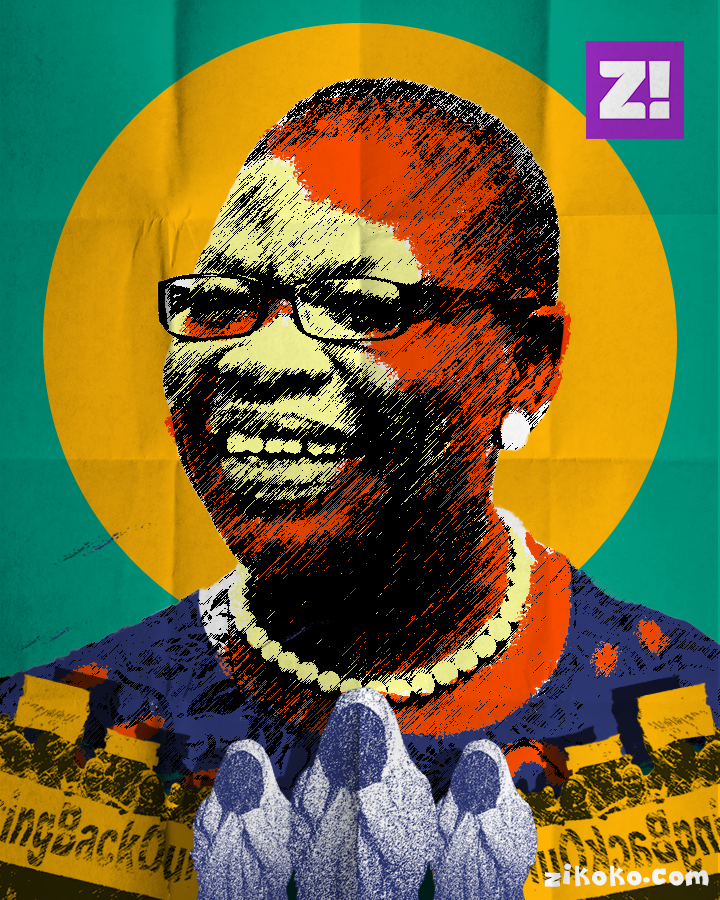
Adamawa’s governorship elections caught the interest of many Nigerians because of its potential to produce Nigeria’s first female elected governor if Aishatu “Binani” Dahiru of the All Progressives Congress (APC) emerge victorious. However, her opponent is the state’s incumbent governor, Ahmadu Fintiri of the People’s Democratic Party (PDP).
On the D-day of the March 18 governorship elections, Fintiri was in the lead with 421,524 votes, and Binani trailed behind with 390,275 votes. But, the election was declared inconclusive for two reasons:
The vote margin (i.e. 31,249 votes) between Fintiri and Binani exceeded the cancelled votes.
Due to electoral violence and overvoting, elections were cancelled in 69 polling units which affected about 37,016 potential voters.
On March 27, 2023, the Independent National Electoral Commission (INEC) announced that supplementary polls would be held on April 15, 2023.
However, it’s unfortunate that the supplementary elections conducted in Adamawa can be described as a show of shame. We will break down some key things that happened during the elections.
Journalists weren’t allowed to observe the collation process
It’s customary for journalists to cover the collation process in every election, but armed security officers prevented journalists from entering the collation centre during the supplementary elections in Adamawa state. When asked why, the security officials said it was “an order from above”.
A winner was declared before the conclusion of the collation process
The results of the elections started trickling in, and it showed Fintiri in the lead in 10 out of 20 local governments. But, the Returning Officer suspended the collation process at 1 a.m. and said the results announcement would resume by 11 a.m. the next day, April 16.
However, the state’s INEC Resident Electoral Commissioner (REC), Hudu Ari, shocked Nigeria when by 9 a.m., he announced Aishatu Binani as the winner of the governorship elections.
According to Sections 64 and 65 of the Electoral Act, the winner of an election can only be announced by a Returning Officer appointed by INEC, but it looks like Hudu decided to take matters into his own hands.
The 'anyhowness' that is peculiar to Nigeria reared its head again.
This time in Adamawa State as the candidate of the APC, Aisha Binani was declared the winner of the governorship supplementary election before all votes were collated. pic.twitter.com/pvNZQT9N8I
While many Nigerians were still trying to figure out the magic happening in Adamawa, Binani hurriedly gave an acceptance speech thanking the people for electing her. She also said her win would encourage other women to participate in politics.
INEC annuls the declaration
As we already said, only a Returning Officer has the right to declare the winner of an election. INEC condemned the action of the REC and described it as a “usurpation of the power of the returning officer”. The declaration of Aishatu Binani as the Adamawa state election’s winner was rendered null and void, and the election process was suspended.
Hudu Ari might be looking at jail time
The seemingly rogue REC, Hudu Ari, has been summoned to the INEC headquarters in Abuja. According to Section 120(4) of the Electoral Act 2022, he might be sentenced to 36 months imprisonment for announcing a false result.
BREAKING NEWS
At its meeting today, 18th April 2023, the Commission discussed matters arising from the Adamawa Governorship election and decided to:
1. Write to the Inspector-General of Police for the immediate investigation and possible prosecution of the
On April 18, 2023, INEC announced that it hopes to close the controversial chapter on Adamawa’s governorship elections by Thursday, April 20, 2023. Nonetheless, the 2023 general elections have shown us so far that there are a lot of internal issues INEC needs to work on because it’s almost as clear as day that they’re too compromised to trust with conducting free and fair elections in Nigeria.
I’ve always believed that many Nigerian scriptwriters aren’t aware they are sitting on a plot goldmine enough for a dozen seasons of TV.
This month, we’ve seen people tear their Nigerian passports and politicians electing themselves into power using voter intimidation and violence— we also learnt that people born in inter-tribal marriages are considered to have ‘tainted blood’. But, the icing on the cake is that some Nigerians are taking sides with a racist against fellow citizens.
On March 22, 2023, in a Sapele community in Delta state, a group of youths came out to protest the removal of the Board of Directors of the oil and gas company Seplat Energy PLC.
The gist here’s that on March 3, 2023, the Federal Government (FG) and the Ministry of Interior withdrew the work and resident permit of Seplat’s CEO, Roger Brown. This was due to a petition filed against him by the workers over allegations of racism, bullying, discrimination, sacking and retiring of Nigerian workers without due process and favouring foreign workers. An instance was when he refused to promote a qualified Nigerian, Emeka Onwuka, to the Chief Financial Officer (CFO) position. Instead, he hired a fellow Irishman, Mr Alaisdair Mackenzie.
Before FG revoked his resident and work permits, Brown received several invitations to address these allegations, but he snubbed them.
The Board of Directors, led by Basil Omiyi, has refused to remove Brown from his position as CEO. They, instead, have passed a vote of confidence and accused the media of trying to spread false information.
Sadly, it’s 2023, and Nigerians don’t have to japa to experience racism.
What else happened this week?
Women Go Topless to Protest Election Results
So far, there have been mixed reactions to the results of the gubernatorial elections held on March 18, 2023. In Abia state, there have been celebrations over the victory of the Labour Party candidate, Alex Otti, but the same cannot be said for Nasarawa.
Abdullahi Sule of the All Progressives Congress (APC) won his re-election bid as governor of Nasarawa. But the women in the state are rejecting this result, accusing him of rigging himself for a second term. On March 23, 2023, they took to the streets topless to express their anger with songs and placards telling INEC to let their votes count as they don’t want Governor Sule, but instead the People’s Democratic Party (PDP) candidate David Ombugadu.
In all this, it’s almost funny how despite having four years to prepare for elections, INEC still somehow manages to lose even more credibility every election season.
Video of the week
Here’s how the people of Abia State reacted when the Labour Party’s Alex Otti was declared the winner of the recently held governorship election.
I would describe the presidential elections of February 25, 2023, as an experience. While some supporters of opposition parties are still waiting for INEC to say they somehow declared the wrong winner, other people have started preparing for the March 18 gubernatorial elections like they’re marching into war.
These people wouldn’t be entirely wrong, as many were victims of voter disenfranchisement and electoral violence in the last elections. So, to ensure that this doesn’t repeat itself on March 18, some Nigerians have decided to tap into their creative side by wanting to bring dogs and other pets to the polling units to scare thugs who might want to disrupt the elections.
Polling units around Nigeria were going to be filled with the scariest and toughest lineup of pets in the country, but unfortunately, the Nigerian Police Force (NPF) has once again decided to rain on our parade.
On March 7, 2023, the NPF released a statement saying Section 126(1) of the Electoral Act classifies dogs as offensive weapons that can be used to cause harassment and intimidation by their owners. Therefore, pets are banned from polling units, and the police discourage people from violating this law.
So, maybe we should start looking for other ways to defend our votes and leave the animals out of it because the last kind of trouble anyone wants is one from the Nigerian police.
What Else Happened This Week?
Light at the end of the tunnel of Naira scarcity
If there’s one thing the Nigerian government’s good at, it’s making unnecessary policies that only serve to make our lives harder. In November 2022, President Bubu launched the newly designed naira banknotes, and the Central Bank of Nigeria (CBN) announced that it’d become the official tender from February 10, 2023.
Since the redesign, we’ve entered a rat race trying to get our hands on the new naira, which has proved harder than finding good roads in Ogun state.
However, after weeks of suffering, POS extortion, bank queues, and court cases, the Supreme Court finally came to our rescue on March 3, 2023, when they announced that the old banknotes should remain Nigeria’s legal tender until December 31, 2023.
Some commercial banks have already started paying customers old banknotes over the counter. And although some traders still refuse to accept them as payments, the CBN’s acting Director of Corporate Communications, Dr Isa Abdulmumin, has come out to reassure Nigerians that they can now receive the old banknotes as a form of payment.
Lagos state governor, Babajide Sanwo-Olu, has choked us this week on social media with his achievements while in office. Can this help tip the elections in his favour in the gubernatorial elections?
The build-up to the 2023 elections has been a marathon for many Nigerians. On February 25, 2023, the national elections (Presidential and National Assembly) were held, and we finally know who our next president is.
However, it’s important to note that we aren’t at the finish line yet. On March 11, 2023, state elections (Governorship and State House of Assembly) will be held nationwide.
Gubernatorial elections will be held in 28 states, and 11 incumbent governors will be seeking a second term in office to continue their good work or reign of mediocrity.
Who are these governors?
Babajide Sanwo-Olu, Lagos state
Sanwo-Olu, unlike his predecessor Akinwunmi Ambode, won the party ticket to contest for a second term. But, he has probably not had peace of mind since his party, the All Progressives Congress (APC), lost Lagos state at the presidential polls.
Since then, he has taken out time to hawk the gospel of his achievements on social media. He mentioned the expansion of the Bus Rapid Transport (BRT) system, the construction of hospitals around Lagos, and the development of the education sector with infrastructure, free education and affordable tuition rates for tertiary schools.
It’s also important to mention that he seriously warned containers to stop falling off bridges and advised people to roll up their windows to avoid getting robbed on the Eko bridge. He also banned motorcycles and ride-hailing companies like Gokada, leaving thousands with no source of income.
Bala Muhammed, Bauchi state
This PDP governor and former FCT Minister is expected to win his re-election bid with little to no hiccups.
On December 9, 2022, his campaign got a boost when the former governor of Bauchi state, Mohammed Abdullahi Abubakar SAN, publicly endorsed him during a state dinner.
Mai Mala Buni, Yobe state
Mala Buni, a former Chairman of a political party in 2006, the Advanced Congress of Democrats (ACD) and a two-time National Secretary of the APC. In his first six months as governor, he constructed a Damaturu-Ultra Modern Market worth ₦2.8 billion and a 200-bed capacity hostel at the Dr Shehu Sule College of Nursing and Midwifery at the cost of ₦215.9 billion. He also invested heavily in the area of security and agriculture.
In December 2022, a 16-year-old boy was arrested for allegedly insulting him on social media, which is, unfortunately, becoming the norm for Nigerian politicians.
Seyi Makinde, Oyo state
Seyi Makinde is unfortunately recently remembered by many as being part of the Aso-ebi boys, the G-5 governors.
If he wins the forthcoming elections, he will be the second governor in Oyo state’s history, after Ajimobi Abiola, to get a second term in office. However, his chances are slim, given that his party, the Peoples Democratic Party (PDP), is facing infightings.
On March 6, 2023, the Labour Party (LP) adopted him as their governor, abandoning their governorship candidate, Tawfiq Akinwale. Given the recent upset the LP has caused in the political scene, it would be interesting to see how this plays out in Seyi Makinde’s favour.
Bello Malawalle, Zamfara state
You might remember Bello Malawalle as the governor who signed the death penalty bill into Law for bandits, cultists and kidnappers to end insecurity in the state.
The governor of the gateway state believes one term (good or bad) deserves another. Many traditional leaders like the Orimolusi of Ijebu-Igbo, and Oba Lawrence Adebajo, have supported him.
They’ve also thanked him for fixing some of their roads which makes you wonder who started this trend of thanking politicians for doing their jobs in the first place.
Ahmadu Finitri, Adamawa state
Former State House of Assembly speaker served as Adamawa’s acting governor (July – October 2014) following the impeachment of then-Governor Murtala Nyako.
He became the state governor again in 2019 under the PDP and is expected to emerge victorious in the gubernatorial elections.
Abdullahi Sule, Nasarawa state
Abdullahi Sule is a businessman and engineer who co-founded Sadiq Petroleum Nigeria Limited in Lagos. He later became the CEO of African Petroleum (AP) in 2001. The state monarchs and civil servants have rallied behind him for his re-election bid to ensure his victory.
AbdulRahman AbdulRazaq, Kwara state
AbdulRahman first contested for the Kwara state governorship seat in 2003 but was defeated by the state’s golden boy, Bukola Saraki. The same thing repeated itself in 2007. The story, however, finally changed in 2019 when AbdulRahman contested under the All Progressives Congress.
The current Senate president, Dr Ahmed Lawan, recently lauded AbdulRahman’s administration, saying he surpassed the achievements of his predecessors in two years. We’ll see soon if Kwara state indigenes agree with this statement.
Inuwa Yahaya, Gombe state
This state governor is one of the very rare politicians believed to have fulfilled his campaign promises. For instance, as promised, the state government increased the education budget allocation by over 60% and revamped over 150 schools.
Many people believe Inuwa Yahaya is a governor most deserving of a second term in office.
Babagana Zulum, Borno state
This professor and former Ramat polytechnic Rector became Borno state governor in 2019 under the APC. His administration has tried to battle and solve the insurgency problem facing the state for years. He has also been the target of many assassination attempts by Boko Haram.
Babagana is one of the governors who have the backing of his people. In August 2022, he was awarded the Best Governor of the Year in the Leadership Excellence Awards.
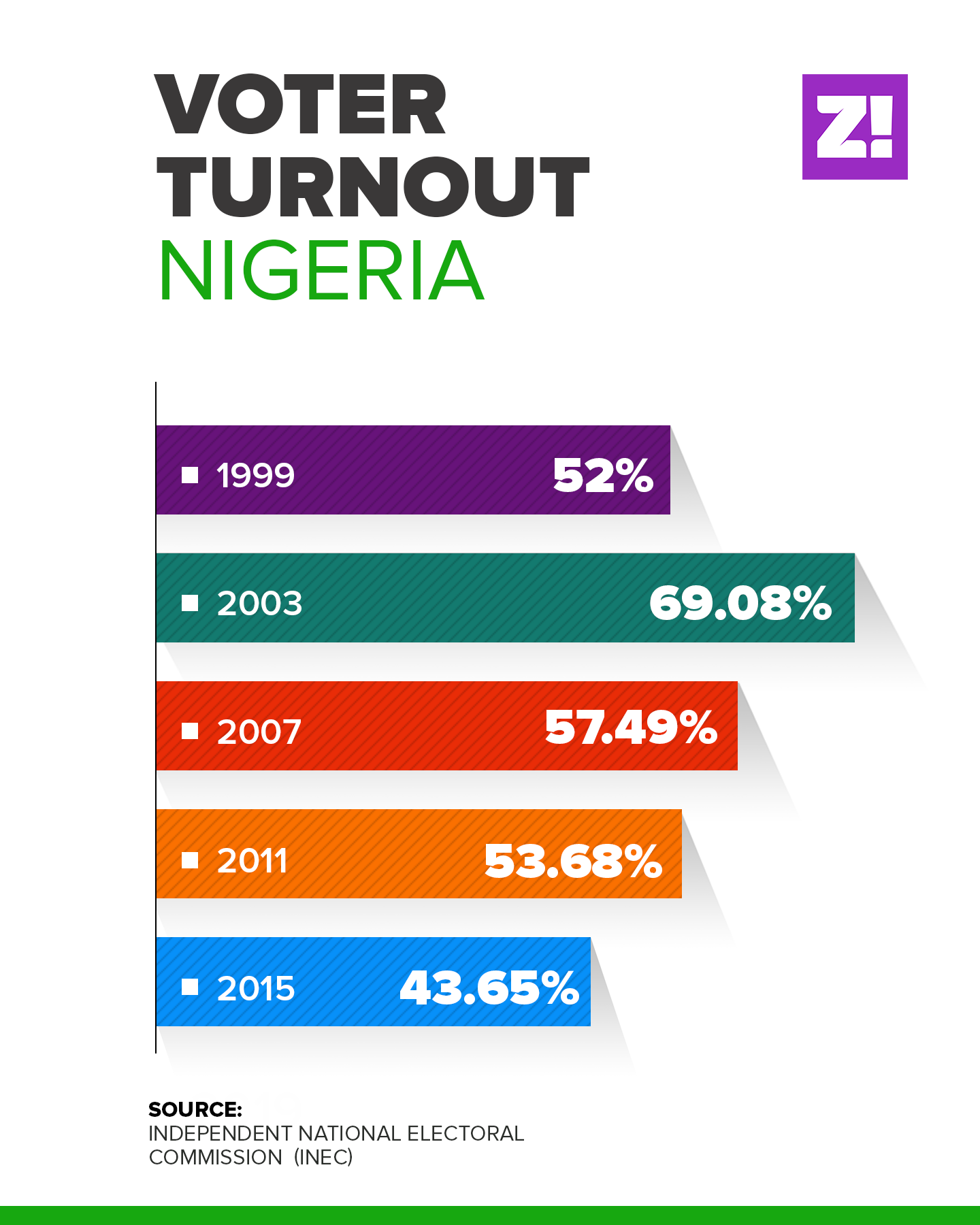
Unfortunately, Nigeria witnessed the worst voter turnout in its history at 27.1 per cent in the recently concluded national elections. Hopefully, this changes on March 11, 2023, for the gubernatorial elections because the last thing we want to do is give certain people a free pass to steal our mandate.
Sunken Ships is a Zikoko series that explores the how and why of the end of all relationships — familial, romantic or just good old friendships.
In this episode of Sunken Ships, Kiki* (22) shares why she blocked her uncle and how it goes beyond supporting different candidates.
What was your relationship with your uncle like pre-elections?
Kiki: Pretty normal. You know how in every Nigerian home, there are different kinds of uncles? The rich ones who always give you money, the stingy/broke ones, the one you’re convinced is a pervert, the cool one and the rest? He was one of the rest. A bit younger than my dad, but not young enough that we had things we could relate to. His children are also younger than me, so we didn’t have much to talk about.
However, we weren’t enemies. I spent holidays in his house, and when we had family events, we had proper conversations. He didn’t treat me like a child who didn’t know anything, but he provided support only someone older can give. He’d send me articles he read and thought I was interested in so we could talk, but he also sent those ridiculous BCs and bulk messages on Whatsapp. He was okay, and so was our relationship.
How did the fight start?
Kiki: I won’t call it a fight, but we started having issues over WhatsApp. I hardly use the app, but that day, I decided to check people’s statuses. That’s when I saw that he’d put up the poster of a particular candidate running for President. I swiped up to have a conversation with him because I couldn’t believe who he supported. I wanted to know his thought process if any. He didn’t reply immediately — probably because of work — but we eventually had a conversation.
The words he sent that day shocked me. I wanted to scream at him, but I maintained my peace. We had this long back and forth that ended with me blocking him. I didn’t have the strength, and he wouldn’t change his mind.
A week later, while I was out with my mum, she stopped by his house. When we got there, he brought up the fact that I’d blocked him to my mother. It’s one thing for him to support someone who’s incompetent, but to report me to my mother over it? I lost it. I reminded them that I’m an adult and can decide I no longer want certain people to have access to my life. My mother told me it didn’t make sense for me to fight family because of politicians. That people have a right to vote and campaign for whoever they want. I told her it’s more than that.
Kiki: If someone doesn’t align with my values, I can also choose to remove their access to me.
It’s not just about picking a different candidate. I think that’s very reductive of the issue. You can disagree on the policies of different candidates. Candidate one wants to increase tax by 5%, and candidate two wants to reduce it by 3%. Or one candidate wants to make Lagos the capital of Nigeria, while another wants to make Edo state the capital. These are differences you don’t have to cut off friends and family members over.
But he’s endorsing a corrupt, terrorism-affiliated, allegation-heavy candidate whose policies might as well lead to the end of my life. I’m upset that he supports someone who’ll most likely make millions of people suffer. I have every right to choose to no longer associate with someone who willingly chooses death and suffering.
It shows his beliefs and values align with said candidate. If the candidate he supports has made degrading comments about people from certain tribes, it means my uncle feels the same way. If the person is known to align with thugs and thieves, then that’s something my uncle stands for. I don’t stand for those things, so why should I keep him around?
What’ll happen after the elections?
Kiki: Nothing. He’s still blocked and will forever remain blocked. Why should he remain in my life? He’s been reporting me to family members, and they’ve called and begged, but that’s their business. I don’t know why they think my uncle and I must talk by force.
After years of fleeing from anything government and law related, I finally decided it’s time to get familiar with Nigerian politics and its wahala.
For the past week, I’ve been hearing how the Shehu Shagari elections of 1979 were dramatic AF. Everywhere I turn, someone is comparing the ongoing 2023 elections drama to it. So I decided it was time to put on my amebo gear and get to work.
Luckily (or unluckily) for me, I stumbled on The 1979 Elections, a 212-page book on the subject.
According to this book, in 1960, everything was all well and good for a country that’d just emancipated itself from the clutches of colonisers. Nigerians were enjoying independence. They actually had cash to spend.
Yes, Meffy baby, it’s you I’m looking at.
And they’d just conducted their first elections. But somehow, they were already talking about the domination of Northern Nigerians in government.
The southern political parties weren’t the happiest about this, but they picked their sandals off the ground, dusted themselves and decided to try again four years later.
Except, as usual, Nigeria said…
General market, go round the block one more time.
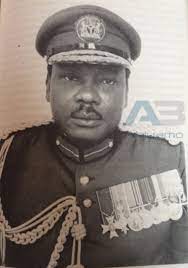
In came Nigeria’s first military government led by General Aguiyi Ironsi in 1966.
General Aguiyi Ironsi
Which led to a ten-year military rule, featuring Yakubu Gowon, Murtala Mohammed and one of the owners of Nigeria’s internet, Olusegun Obasanjo.
Who sent these people this military rule message?
By 1979, the military government had basically handed over.
Like those Iya arugbos who share souvenirs at burials, they put everything in place for the elections and eventual civil rule.
Election day comes, and Nigerians head to the polls to vote for the person they want to lead them. My people just wanted to do what’s best for themselves after years of early bedtimes and being parented by the Nigerian military.
Five days later, at 12:40 PM, FEDECO, the 1900’s INEC, released the election results.
This result might be the only straightforward thing in this book.
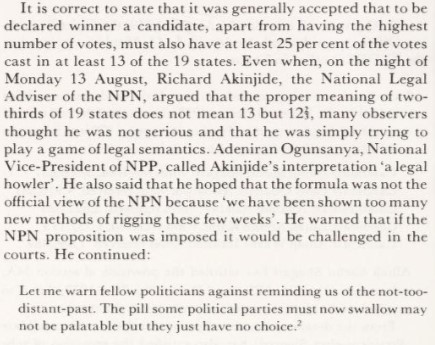
Shehu Shagari, with a total of 568,857 votes, won the presidential elections and was announced president-elect. But as it turns out the people chasing Nigeria right now have been at it since colonisation, because why did FEDECO release results if they weren’t ready?
This is why you should be straightforward in all you do, BECAUSE LOOK AT FEDECO CAUSING ISSUES FOR AN ENTIRE NATION.
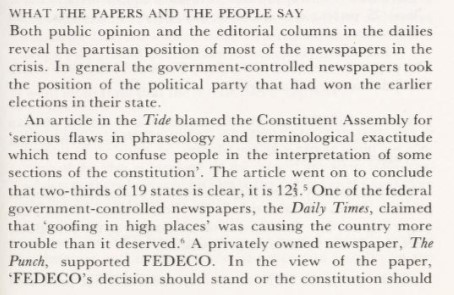
This caused kasala in 1979 Nigeria. Which was really the fault of the lawmakers, because, if they made the law easy and simple to understand, old men with grandchildren in the university won’t banter words with each other in public because of elections.
I don’t care if the conversation fits, I shall now be using legal howler in my daily interactions.
Less than 24 hours after the commotion and brouhaha, FEDECO stuck to their koboko, and named Alhaji Shehu Sahagari the winner of the 1979 elections.
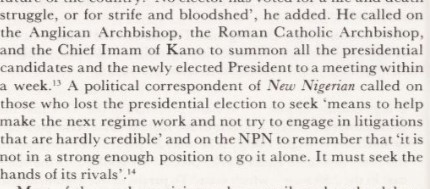
The New Nigeria newspaper – a publication that clearly had it out for Shagari and refused to remove their leg from his trousers – started peddling the accusation that Obasanjo of the internet, the transitioning head of state, was in ACTIVE support of Shehu Shagari’s presidency.
After the president-elect was announced, most Nigerians didn’t know how to feel.
Again, let it be known that I do not tell lies. Do you see that they’re also complaining about the words used in the constitution and how it can lead to multiple interpretations?
Why is politics filled with theatrics and drama? Isn’t there an easier way to do it? Maybe, come out like it’s testimony time, and tell us the plans you have for Nigeria, instead of putting us through all the drama.
“Hi guys, these are the things I want to do for Nigeria. These are my credentials; this is my family lineage.”
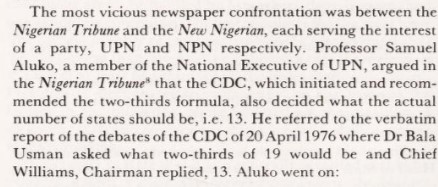
And then the newspapers started fighting each other on behalf of the candidates.
I love a good media tussle
After a while, everyone started noticing that the matter, like the current governor of Lagos state, had ironed gators into its jeans. Things were getting too hot. So, Chief Fani Kayode, like a pokenosing neighbour, carried his legs from nowhere, and went to beg the spiritual leaders.
Why is New Nigerian always trying to start up shit?
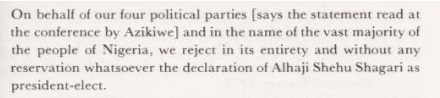
The top three presidential contenders, Awolowo, Azikiwe and Waziri, were clearly listening, which is why they held a press conference, rejecting Shehu Shagari as the president-elect.
I mean, if you believe in something, then you believe in it, right?
But as the Nigerian electoral body that they were, FEDECO told the three musketeers:
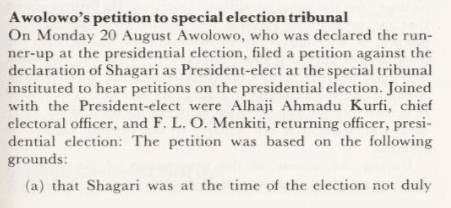
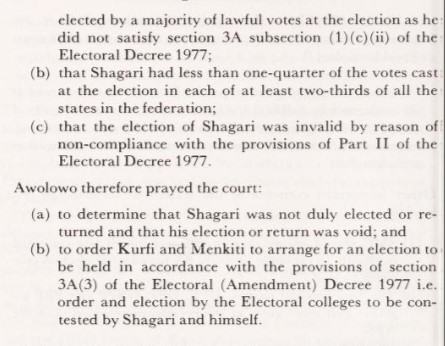
But Awolowo decided to take the matter to the distinguished court by himself. He filed a petition at the electoral tribunal, stating that Shehu Shagari wasn’t duly elected.
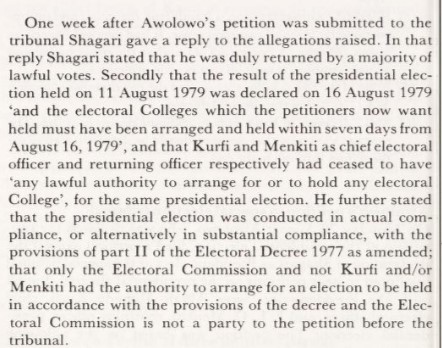
One week after, Shehu Shagari finally decided he also had a mouth and could speak.
Long and short, Shagari looked Awolowo in the eye and went:
The case spent less than a month in court, and the tribunal finally gave their judgment: Shehu Shagari for president. If you don’t like it, kneel down and face the wall.
But surely, someone who dragged Shehu Shagari through the Nigerian media and judiciary system wouldn’t suddenly stop because the electoral tribunal said no?
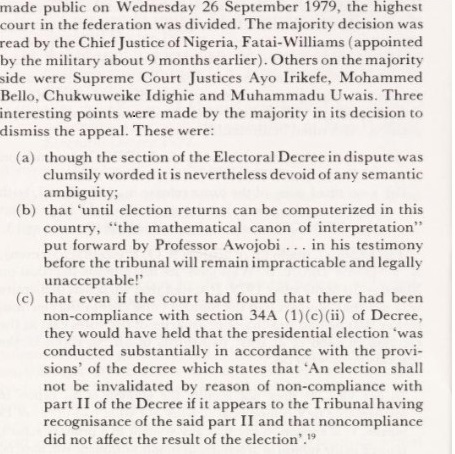
Awolowo dragged Shagari to the supreme court on the exact same basis as before, Shehu Shagari wasn’t duly elected. But the court wasnt having it and basically told him and his appeal to get out.
The court decreed Awolowo had no case or foot to stand on, and Shehu Shagari was the winner of the 1979 election.
This was the most confusing piece of literature, I’ve ever read.
THIS IS WHY I HATED GOVERNMENT IN SCHOOL. Wetin be this😩😩
Next Saturday, the current governor of Lagos state will be seeking re-election. But how has he fared over the past four years? Here’s what his report card looks like.
Year One
He banned motorcycles in Lagos
In January 2020, less than a year into his tenure, Governor Sanwo-Olu decided that commercial motorcycles were no longer a part of the mega plan he had for Lagos and that they just had to go. It didn’t matter that the state had a terrible traffic situation, or that most people had no alternative.
The result: Lagosians had to trek… everywhere. Ride-hailing companies like Gokada, Max, and Opay laid off thousands of people, leaving them without a means of livelihood.
On March 11, 2020, Sanwo-Olu closed down the Eko Bridge in the early hours of the day without prior notice, causing a lot of people to be stuck in traffic in other areas.
The result: Commute became harder for people and the traffic got worse. The bridge was later reopened, but it was closed again after a fire gutted a section of it last year. It’s remained closed ever since.
The Lekki shootings happened under his watch
On the 3rd day of the ENDSARS protest, the 20th of October, Sanwo-Olu announced a curfew that would start at 4 p.m. This was ignoring the fact that it was a weekday and many people were outside. People kicked back against it, and the curfew was moved to 8 p.m. By 7 p.m., Sanwo-Olu called in the army and they arrived at the toll gate.
The result: Dozens of people were massacred at the gates and Sanwo-Olu still denies any involvement in the incident.
Year Two
He told people to roll up their windows when they got robbed
In 2021, after the Eko bridge was finally reopened, insecurity had gone up in Lagos and people were getting robbed in traffic on the bridge. What did he say? “Roll up your windows and stay safe.”
Year Three
He “increased” the salaries of civil servants in Lagos
In October 2022, Sanwo-Olu announced that he was going to increase the salary of civil servants in Lagos by the end of the month.
Result: 2022 is gone, and 2023 is here, but the pay raise is yet to be implemented. Why that is the case, it’s currently unclear.
He asked containers to stop falling off the Ojuelegba bridge
Who knew that all we needed to do was to just ask nicely and containers would stop falling?
Containers falling off bridges have been an issue for so long in Lagos. Since 2015, at least 20 people have been killed in accidents involving containers in Lagos State. Instead of erecting a simple barrier on these bridges to prevent huge trucks from using them at all, he simply said he’s not going to tolerate containers falling off bridges anymore. We’re sure the containers won’t try it again.
He bought 62 fire trucks for the Lagos state fire service
This is commendable considering how often fire outbreaks happen in markets and different areas of Lagos. Sanwo-Olu inaugurated 200 fire trucks in October 2022 to be used by the fire service authorities in the state for quick response to fire outbreaks.
Year Four
He commissioned Lagos’s first light rail
Earlier this year, Sanwo-Olu commissioned the first phase of the Lagos Blue Line with President Muhammadu Buhari. It’s a light rail system that had been planned as far back as 1983 before it was scrapped by the same person, Muhammadu Buhari. The line runs from Okokomaiko to Marina, and we were told to expect two more lines after this one.
This is expected to ease up traffic within Lagos over time. But a few days ago, fire razed a section of the blue line and the fire service was reported to be super late to the incident.
Overall Grade: E
Why? Despite the pockets of work he did here and there, he oversaw one of the worst cases of human rights abuse this country has seen in the past few years.
Everyone dreams of retiring early with money that scares poverty for good. Nigerian politicians have discovered that the key to achieving this dream is being a member of the Senate.
What’s the Senate?
Nigeria’s National Assembly consists of two chambers, the House of Representatives and the Senate. The Senate, also called the Red Chamber, is modelled after the federal Congress of the United States. For equal representation, it’s composed of 109 senators, with the 36 states represented by three senators each.
The Senate is the highest law-making institution in the country, with the authority to impeach the president, vice president, and other executive officials.
For many Nigerian politicians, the Senate seems to be where most of them hope to end their careers, and we’ve seen this repeatedly happen, especially with former governors.
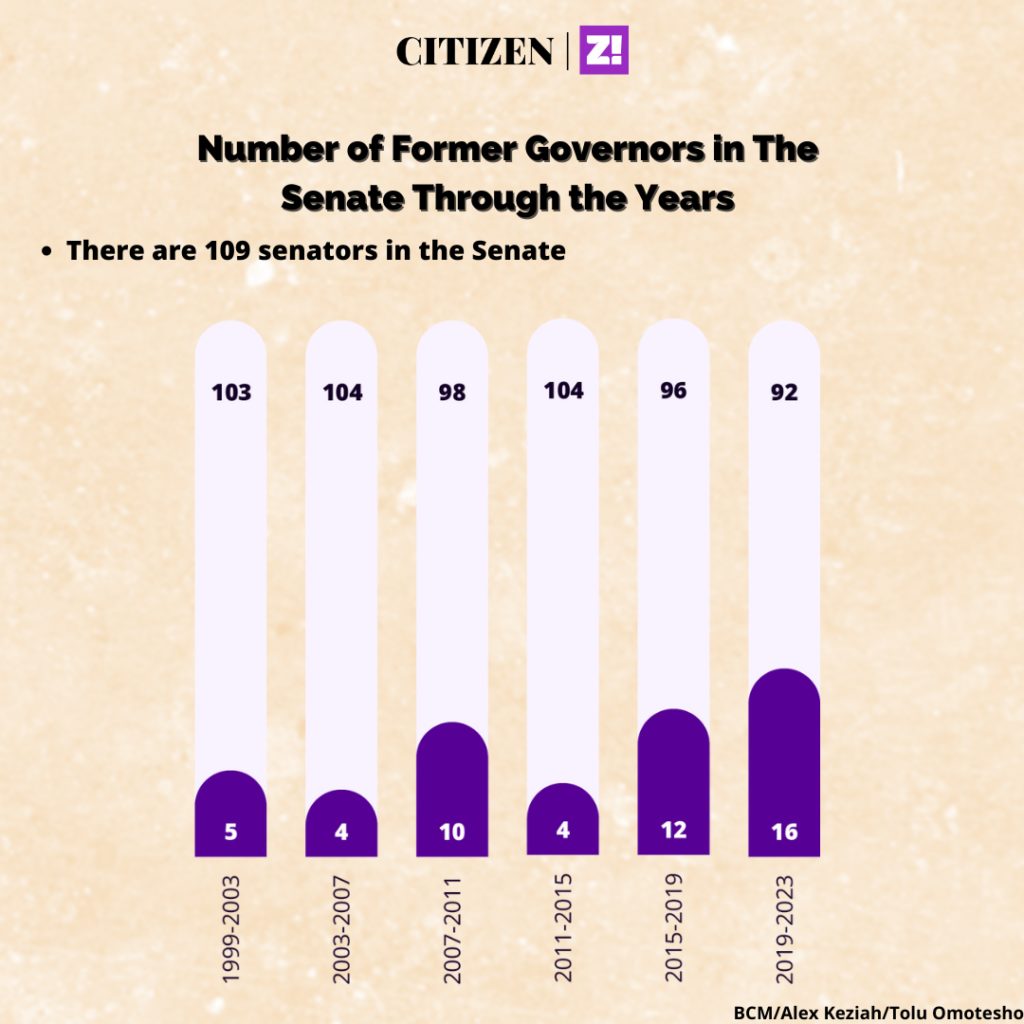
The current 9th Assembly consists of 16 former governors representing their state. They are:
Danjuma Goje
He was not only the Minister of State, Power and Steel from 1999-2002 but also served as the Governor of Gombe state from 2003 – 2007 under the People’s Democratic Party (PDP).
He now represents Gombe Central in the Senate and was re-elected to represent the region in the 2023 national elections held on February 25, but this time, under the All Progressives Congress Party (APC).
Ibrahim Gaidam
Ibrahim Gaidam is a three-term governor of Yobe state. He was formerly the deputy governor till he took office in 2009 when the then-Yobe state governor, Mamman Bello Ali, died of Leukemia.
Gaidam stayed in office till 2019, after which he joined the Senate to represent the Yobe East district.
Kashim Shettima
Many people now know Shettima as APC’s vice-presidential candidate for the recently conducted 2023 presidential elections. He was a former two-term governor of Borno state, from 2011 to 2019, before representing Borno Central in the Senate. He is now the Vice-President of Nigeria in waiting.
Aliyu Wammako
He served as the governor of Sokoto state in 2007 and currently represents Sokoto North district in the 9th Assembly (2019-2023).
Adamu Aliero
He was the former governor of Kebbi state from 1999 to 2007, after which he became a senator representing Kebbi Central.
He was also re-elected in the elections held on February 25, 2023, defeating the incumbent governor of Kebbi state, Atiku Bagudu.
Kabiru Gaya
Kabiru Gaya was the governor of Kano state from January 1992 to November 1993. He was elected to the Senate to represent Kano South in 2007. He has since remained in office for the past sixteen years.
Ibrahim Shekarau
This former Minister of Education (2014-2015) was previously Kano’s governor from 2003 to 2011. He represents Kano Central in the Senate and won his re-election in the recently concluded elections.
Theodore Orji Kalu
Theodore Orji was governor of Abia state from 2007 to 2015. He currently represents Abia Central in the Senate.
Orji Uzor Kalu
This Nigerian politician also doubles as a businessman. He’s the Chairman of SLOK Holdings, the Daily Sun and New Telegraph newspapers.
He was Abia’s state governor from 1999-2007 and represented Abia North in the Senate. He was also successful in his re-election in the election held on February 25, 2023.
Sam Egwu
Sam Egwu was the governor of Ebonyi state from 1999-2007. He became a member of the Senate in 2015, representing Ebonyi North. However, he lost his third term bid as a senator in the last election to APC’s Onyekachi Nwaebonyi.
Chimaroake Nnamani
Chimaroake’s a medical doctor who served as Enugu’s governor from 1999 to 2007.
He first joined the Senate to represent Enugu East in 2007. He lost the seat in the 2011 elections under controversial circumstances. He ran again for the same seat in 2015 but was again unsuccessful. However, his luck finally changed in 2019 when he beat the incumbent Senator, Gilbert Nnaji.
Rochas Okorocha
Rochas currently represents the people of Imo West in the Senate, but before now, he was their state governor from 2011 to 2019.
Ibikunle Amosun
Amosun’s a two-term governor of Ogun state (2011-2019).
In 2019, he was accused of illegally importing about 4 million rounds of ammunition and many firearms without obtaining the necessary approvals. Despite calls for his arrest and probe, nothing was done.
Instead, he’s now a member of the Senate representing Ogun Central. Nigeria’s sometimes a joke that writes itself.
Seriake Dickson
Seriake Dickson’s a lawyer who, unlike many of his counterparts, was a member of the House of Representatives (2007 -2012) before becoming governor.
He was Bayelsa’s governor from 2012-2020 before joining the Senate to represent Bayelsa West.
Abdullahi Adamu
He was the governor of Nasarawa state from 1999 to 2007 and currently represents the people of Nasarawa West in the Senate.
Tanko Al-Makura
This politician and businessman was Nasarawa’s governor from 2011-2019. After this, he was elected into the Senate to represent Nasarawa South.
This trend of ex-governors becoming legislators has repeated throughout our history from as far back as 1999. Let’s break this down.
Former governors in the 8th National Assembly (2015-2019)
Enyinnaya Abaribe: Deputy governor of Abia state from 1999-2003. He joined the Senate in 2019 to represent Abia South.
Theodore Orji: joined the Senate in 2015 and represents Abia Central.
Godswill Akpabio: joined the Senate in 2015 and represents Akwa Ibom North-West district.
Akume George: Benue state governor from 1999-2007, joined the Senate in 2007 to represent the people of Benue North-West.
David Mark: Niger state governor from 1989-1990, joined the Senate in 1999 to represent Benue South.
Sam Egwu: joined the Senate in 2015 to represent Ebonyi North.
Rabiu Musa Kwankwaso: Kano state governor from 1999 to 2003 and 2011-2015. He became a senator in 2015 to represent Kano Central.
Bukola Saraki: Kwara state governor from 2003-2011. He became a senator in 2011 for Kwara Central.
Jonah Jang: Plateau state governor from 2007-2015. He joined the Senate in 2015 to represent Plateau North
Abdullahi Adamu
Aliyu Wammako
Sani Yerima: Zamfara state governor from 1999-2007. He joined the Senate in 2007 to represent Zamfara West.
Former governors in the 7th National Assembly (2011-2015)
Abdullahi Adamu
Danjuma Goje
Sani Yerima
Bukola Saraki
Former governors in the 6th National Assembly (2007-2011)
George Akume
Sani Yerima
Abdullahi Adamu
Danjuma Goje
Godswill Akpabio
Theodore Orji
Aliyu Wammako
Sam Egwu
Rabiu Musa Kwankwaso
Former governors in the 5th National Assembly (2003-2007)
David Mark
Felix Ibru: Delta state governor from 1982-1983. He joined the Senate in 2003 to represent Delta Central district.
Tunde Ogbeha: Akwa Ibom governor from 1987-1988. He joined the Senate in 2003 to represent Kogi West.
Iyiola Omisore: Deputy governor of Osun state from 1999-2003. After his time as deputy governor, he joined the Senate in 2003 to represent Osun East.
Former governors in the 4th National Assembly (1999-2003)
Ike Nwachukwu: Imo state governor from 1984-1985. He joined the Senate in 1999 to represent Abia North.
Melford Okilo: the first governor of Rivers state from 1979-1983. He joined the Senate in 1999 to represent Bayelsa.
David Mark
Maina Maaji Lawan: Borno state governor from 1992-1993. He joined the Senate in 1999 to represent Born North.
Ali Modu Sheriff: Borno state governor from 2003-2011. He joined the Senate in 1999 to represent Borno Central.
It’s not surprising that in certain areas, Nigeria might be considered backward. Some legislators have been in power since the 90s with the same old ideologies. It’s almost like the Senate has become a vacation home with guests who refuse to leave for new people and minds to take over.
We hope this changes eventually, but looking at what has happened recently in the elections, it might be difficult for this to happen anytime soon.
This is Zikoko Citizen’s Game of Votes weekly dispatch that helps you dig into all the good, bad, and extremely bizarre stuff happening in Nigeria and why they’re important to you.
Subscribe now to get the newsletter in your email inbox at 8 am every Friday instead of three days later. Don’t be LASTMA
The Rivers state governor, Nyesom Wike, is one of the Nigerian politicians that should get an honorary degree in Theatre Arts. A word many would ascribe to him is “drama,” and in the days leading up to the 2023 elections, this has proved very true.
Wike was one of the presidential aspirant of the Peoples Democratic Party (PDP), but lost to Atiku Abubakar in the primaries. However, Wike hasn’t taken this defeat lying down. Instead, he has sabotaged PDP’s presidential campaign in every way he can.
Asides from leading a rebellion against the PDP leadership with his aso-ebi boys, the G-5 governors consisting of Seyi Makinde (Oyo State), Okezie Ikpeazu (Abia State), Samuel Ortom (Benue State) and Ifeanyi Ugwuanyi (Enugu State); he also cancelled Atiku’s presidential rally in Rivers state under the guise of them lacking the capacity to fill the stadium.
But, despite his mean-spirited attacks on his party, he hasn’t openly declared support for another candidate. However, some third-party informants say he has thrown his weight behind Bola Tinubu, the presidential candidate of the ruling party, the All Progressives Congress (APC).
After months of trying to let peace reign, Atiku has finally had enough. In a statement on February 22, 2023, he called out the Rivers state governor, describing him as “a con man and a chicken hiding under the costume of a lion”. He also accused him of planning to use violence in the state to hand Tinubu the win. Looking back at everything Wike has put the PDP through in this election period, you can’t help but wonder if he’s really all bark and no bite. If he’s truly displeased with the party, why not defect to a different one? In January, he said he’d be announcing his preferred presidential candidate, but it’s one day before the presidential elections, and we’ve not heard a beep from him.
Is he shying away from supporting his candidate with his full chest, or is he playing chess while we’re stuck on checker’s?
What else happened this week?
The chef who’s a serial robber gets caught
Like the song goes, “Crazy things are happening”. Nigerians have been trying to survive the government since we crossed into this year, and now it looks like we have to be extra watchful with other Nigerians.
On February 23, 3023, the Lagos State Police Command arrested and detained a cook, Wilfred Amoussou, under the suspicion of drugging and robbing his employers. Allegedly, this isn’t Wilfred’s first rodeo as he has done this to many victims over the years, particularly in the Ikoyi, Parkview and Banana Island axis.
2023 needs a restart button because, so far, it’s not giving.
The Supreme court adjourned the case again against the Naira redesign to March 3. Do you still think they can help us in our fight against Meffy?
Ehen one more thing…
It’s one day to the presidential and national assembly elections. You can check the results as they are being released live, here or join our WhatsApp community to get updates, fact-checks, and talk to other voters.
Elections are over, and we’re all antsy at the edge of our seats for the results. But it’s clear INEC will take their time with it.
Here are seven things to do so anxiety doesn’t finish you as we wait for the election results.
Lie to yourself
The fate of the nation is being decided, but you’ve done all you can now. So, tell yourself everything is fine and nothing out of the ordinary is happening outside.
Watch your favourite show
Turn on your TV, and watch that show that brings you joy. Even if the joy is only temporary.
Eat and drink your way through the day
A distraction is a distraction. Eat and drink (not alcohol, please) your way through the wait. It might be hard to keep anything down, but it’s better than twiddling your fingers and hyperventilating.
Read anything
A book, a magazine, the words on a billboard — anything that isn’t Twitter or the news.
Try to get some work done
Adulthood sucks, but money must be made. And sadly, this is Nigeria, so nobody will give you a mental health break. It might be hard to actually focus, but there’s no harm in trying.
Be around other people
It’s tempting to sort through your emotions on your own, but try to leave your room and speak to other people too. Enjoying people’s company and talking it out as its own benefits.
Take a Nyquil and sleep
If all else fails, take a break from the day and just sleep.
Check here for live updates on the ongoing presidential and legislative elections
We’ve wondered what our favourite celebrities would be like as our classmates, therapists and co-workers. So with the 2023 presidential elections less than 24 hours away, it’s time to reimagine them as presidents.
Reminder: Before your fave celebrity runs for president, remember to vote for the real-life candidates at tomorrow’s polls.
Pete Edochie
The no-nonsense president, he’d make strict policies based on life “back in the days”, and we’d have no choice but to follow them. If we don’t, he’d stress us with one parable after another until we’re frustrated. Chiwetalu Agu would be on board as his Vice President.
Osas Ighodaro
Outside of being the finest president in the world, Osas would exchange boring Agbadas for Dye Lab boubous and custom Jewel By Lisa print dresses. As for her primary goal, based on her Joyful Joy Foundation, it’s clear she’d focus on strengthening Nigeria’s healthcare sector.
Wizkid
If you think we didn’t see Buhari most times because he was focused on his travel blogging side hustle, get ready because with Wizkid as president, we’d only see him on Independence and Democracy days. Even though he’d spend 80% of his time airing us, he’d still set up an effective committee to do the work because, in the end, he has his Starboy rep to maintain.
Ayra Starr
Nigeria’s first Gen Z president? Big slay. Best believe short skirts, crop tops and blonde hair would become our official uniform. Ayra would fight for world peace, ensure good vibes for all and prioritise mental health for the youth. She’d also let go of all the gragra titles that come with being president. No more MFR, OON, NTA, PWC. Just President Ayra.
Burna Boy
A country where the government gives you copious amounts of igbo and shayo every time you chop breakfast? Inject it, please. The only problem with a Burna Boy presidency is we won’t be able to correct him when he’s wrong. If you talk too much, President Burna would kick your head and insult you.
He’d put all of us in trouble by mocking the US military on Twitter until they launch nukes at Nigeria. But Blaqbonez would be an excellent commander of the Federal Republic with enough bling-bling to rival an American rapper. A swagged-up leader for sure.
Patience Ozokwor
Patience Ozokwor’s presidency would be the opposite of Ayra Starr’s. She’d make everyone dress appropriately and call her “Mummy President”. Every office in Nigeria would be mandated to do morning devotions, and she’d tell foreign leaders to “Fuck off” in a way that pleases God.
Portable
Portable’s presidency would be chaotic AF because he’d turn Nigeria into a reality show. He’d call out ministers, governors and even the First Lady on his Instagram Live if they do anything wrong. But at least, he’d curb looting of funds with his callouts, and no one will be able to do anything about it because, like he’s said so many times, you can’t R.I.P him.
Odunlade Adekola
No one would take President Odunlade seriously, and that’s what he’d use to his advantage. Even though Odunlade would crack jokes and deliver memeable moments on most of his broadcasts, his tenure would bring improvement for Nigerians because he’d work with his conscience. A fun effective leader? I stan.
Tems
No one knows how Tems would blow up and win the elections despite going against popular candidates, but she’d be so good at being president that we wouldn’t mind. Tems will be a stress-free president who wants to do her work and return to Aso rock to paint and sip wine. She’d also be the first president to wear sunglasses at every presidential event, from inauguration to handover.
The 2023 elections in three days will go down as one of Nigeria’s most important historical events.
In the days leading up to the elections, we’ve experienced many interesting curves:
For the first time, there’s a third force party serving as a threat to contenders from the two major political parties;
The youths are the highest proportion of registered voters at 39.5%;
Voters will be accredited not manually but with technology using the Bimodal Voter Accreditation System (BVAS).
Out of anticipation, several polls have been published to predict the winner of the 2023 presidential election.
Using data from the voter turnout and the voting patterns of previous elections since 1999, a group of private observers; John Analoh, Ayomide Gbadegesin and Femi Labiyi, have predicted six possible outcomes for the upcoming elections.
The winner will be decided after a run-off
A run-off means a winner will be decided after two rounds of voting. This would happen if neither candidate got the majority votes, i.e. 25% of votes in 24 states. And this is very likely because each presidential candidate is a powerhouse in their own right.
Peter Obi, the Labour Party (LP) presidential candidate, is expected to have many votes from the South-East, South-South and North-Central states. But Bola Tinubu, the presidential candidate for the All Progressives Party (APC), may win critical states like Kaduna, Borno and Kano.
Also, the presidential candidate for the Peoples Democratic Party (PDP), Atiku Abubakar, is expected to win or come a close second in many states and even in the South-South regions.
So, while Bola Tinubu may get the most votes, he might be unable to pull off 25 per cent in 24 states.
Atiku Abubakar wins the election
For this outcome, although Peter Obi might have the most votes in the South-East. Atiku would get many votes from states in the South-South region, especially in Delta state.
Also, while the North-West and Noth-East regions vote in favour of Bola Tinubu, Atiku would win in APC powerhouses like Jigawa, Katsina and Zamfara. This would ultimately propel him to victory.
Bola Tinubu wins the election
In this scenario, Tinubu wins comfortably in the South-West region and is voted favourably for in the North-East and North-West regions, particularly in Kano, Kebbi, and Kaduna.
And although Peter Obi might perform well in the South-East, Atiku is also expected to pull strong figures from the South-south region.
Atiku Abubakar win the election
If Atiku does exceptionally well in South-south regions and APC strongholds like Jigawa, Katsina and Zamfara. In that case, he could have the majority vote in 24 states.
Bola Tinubu wins the elections
It’s also probable that while Tinubu does a clean sweep in the South-west, he would also come a close second in the South-south, northeast and north-west regions. This would very easily push him to victory.
Peter Obi wins the elections
In this scenario, the elections will end with the third-force candidate, Peter Obi taking the coveted prize.
For this to happen, Rabiu Kwankwaso, presidential candidate for the New Nigeria Peoples Party (NNPP), gets good numbers in the North-West and some parts of the North-east region. And Peter Obi wins Lagos and gets the majority votes in the North-Central.
While we can’t say who the winner will be, the one thing that can be confirmed is that the 2023 elections will shape Nigeria’s future.
For Navigating Nigeria this week, Citizen spoke to Samson Itodo. Itodo is a lawyer and the founder of YIAGA Africa, an NGO dedicated to promoting democratic norms across the continent. He famously led the #NotTooYoungToRun campaign to lower the minimum age for elective office in Nigeria. Itodo touched on several issues, including youth participation in the democratic process, unfair competition in Nigerian politics, resistance towards BVAS, reforming the campaign financing model and why he believes you don’t need a PVC to vote.
YIAGA Africa has monitored elections over the last decade and achieved notable milestones. In what way is the 2023 election different from previous ones?
This election is different for different reasons. The first one is that compared to other polls, this election is regulated by a new set of laws. The new Electoral Act will handle this election, but it’s not just the Act; it’s the provisions of the Act.
For this particular election, the Act permits the electronic transmission of results. It wasn’t part of the electoral process previously. Electronic accreditation now has the force of law. Look at things like timelines for specific activities. This cycle, we had early primaries. Primaries started in April 2022 till June. Previously, primaries would begin around September or October. So parties have had five full months of intense campaigning. This is one way things are different.
Another one is the number of registered voters. Compared to previous electoral cycles, we’ve increased the number of registered voters by over ten per cent. We’ve added 9.5 million new registered voters to our voter register. In 2019, there were 84 million registered voters. Now there are 93 million. What that means is it increases the cost of elections.
That’s an understated point
This election is notably different regarding the actors because it’s transitional. There’ll be a change of guard. The incumbent in the presidential election isn’t running. His party has fielded a different candidate. The actors are different, but in some cases, it’s still the same actor. Some parties have fielded the same candidate for two or three election cycles, depending on the political party.
For this particular election, it’s the fact that there seems to be a third force which is the third difference from other polls. Previously, the election was between the two main parties, but now, we have a third force, and young people drive it.
Yay for Gen Z
One last thing that is different is the level of insecurity. For two to three electoral cycles, we’ve always grappled with insecurity, but now, there’s a multidimensional insecurity that we’re grappling with. It’s banditry, farmer-herder crisis, kidnapping, insurgency and unknown gunmen. The same discussion we had in 2015 on insecurity is the same we’re having. But now, every part of the country has its security challenges.
These are some of the differences. On the whole, you can sense on the part of Nigerians that this is an opportunity to elect leadership that can fix our challenges.
As we head into the election in a couple of days, there’s naira and fuel scarcity simultaneously. This new monetary policy introduced in the buildup to the polls changes the entire dynamics.
For some people, the level of suffering will push them to go and vote. It’ll influence how they vote. Some others may feel the hardship is too much and stay away from voting. It could go either way.
You mentioned the third force. Can they shake things in the coming elections?
Nothing is happening now that hasn’t happened before. What you see happening now is what happened in 2015 that led to the alternation of power. What’s different is young people have decided to look for alternatives outside the two traditional political parties. It behoves young people and Nigerians in this third force to galvanise. Because it’s about the number of people you can get to the polling units to vote — and not just vote — but vote for you as a candidate.
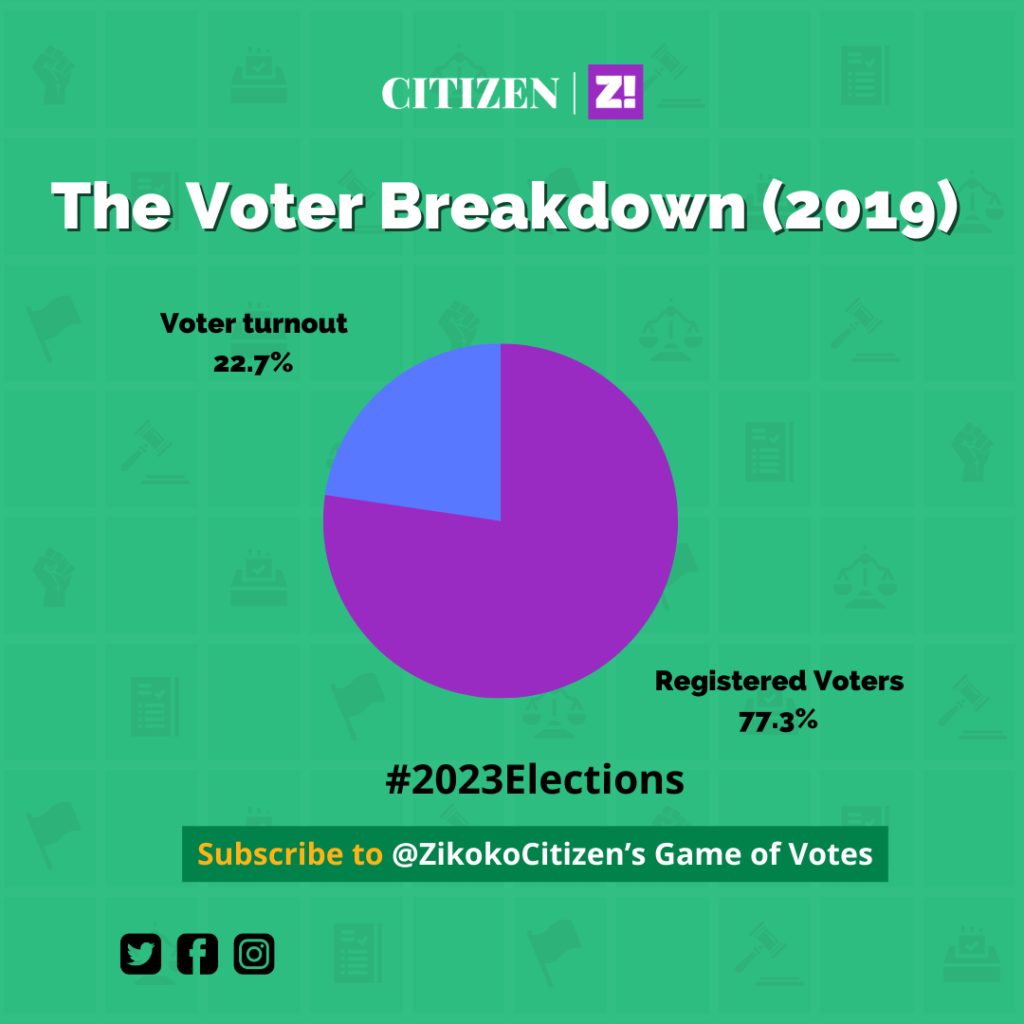
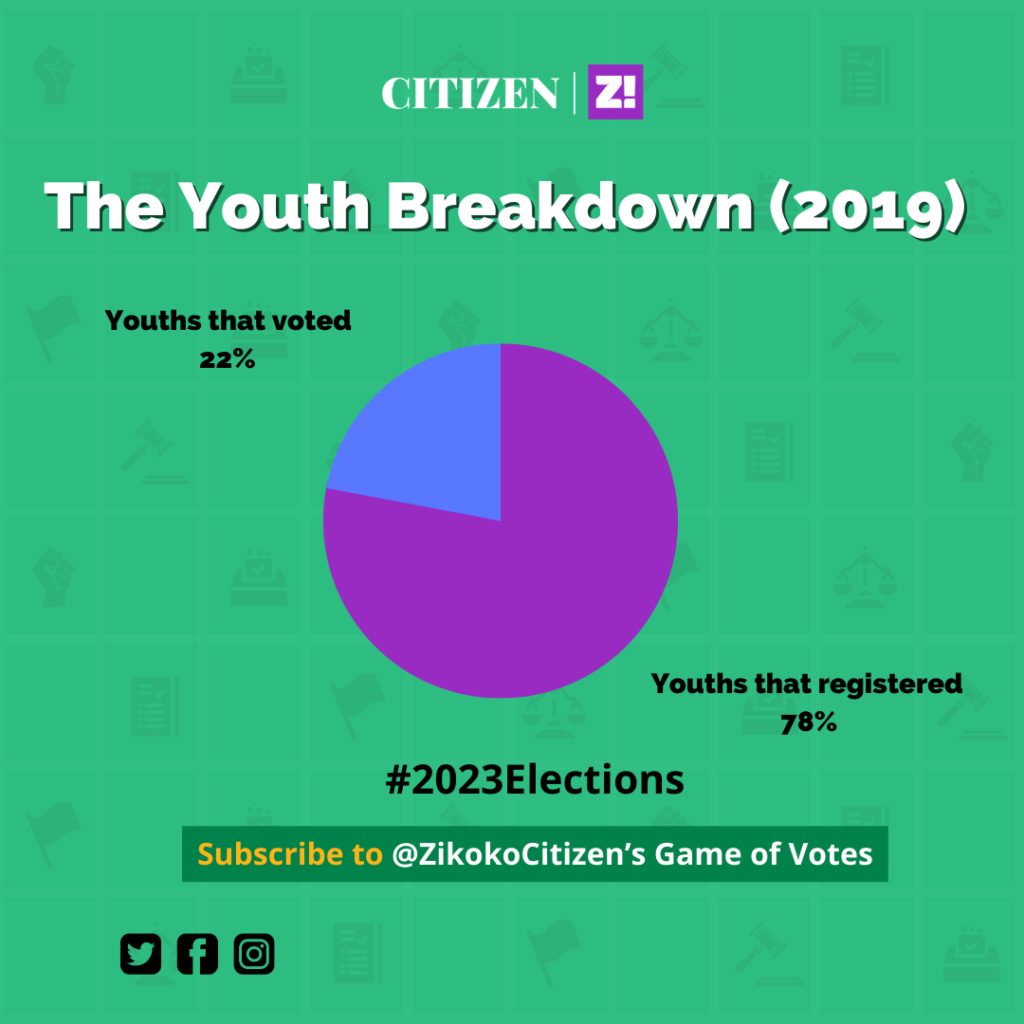
This hype and enthusiasm will come to nought if people don’t attend elections. We could have performed better as a country regarding turnout for elections. In 2019, the turnout was 35 per cent, which could be a lot higher. Out of that 35 per cent, the number of young people that showed up for the election was poor. Fifty-one per cent of young people were on the voters register, and only 29% came out to vote.
Over 40 per cent of young people are on the current voters register. But the big issue is, will these young people show up for the elections?
Hmm. A drop from 51% in 2019 to 40% in 2023. Doesn’t this burst the myth of youth participation in the political process?
No, it doesn’t. The reason is that — and this is where INEC needs to review its classification — in 2019, they classified young people as 18 and 35. Surprisingly this time, it’s between 18 and 34. So even INEC’s data is questionable, and we’re currently in talks with INEC to review that age classification because the age classification is 18 and 35, not 18 and 34.
You recently tweeted about disinterest in fair competition. Can you talk about that?
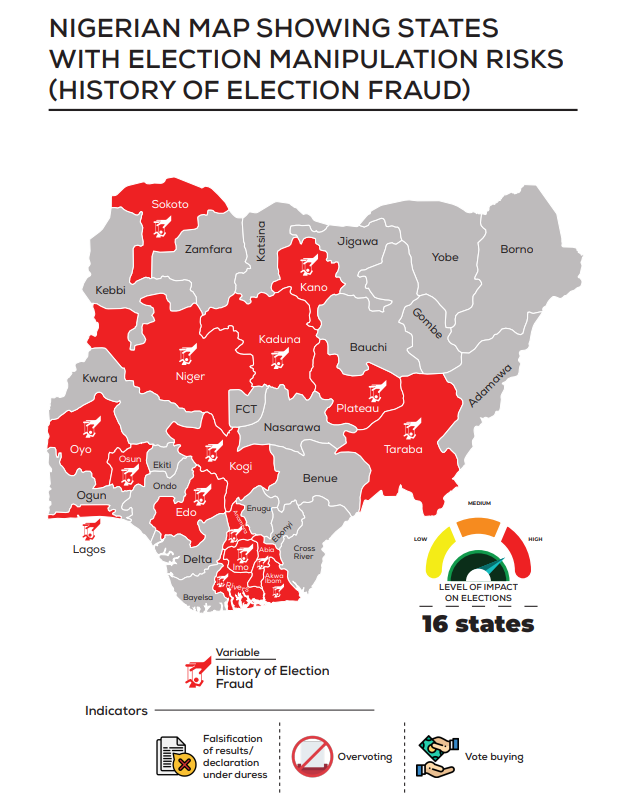
YIAGA Africa is part of a cohort of civil society organisations, and we released the election manipulation risk index (The report covers the period between February 2019 and January 2023). It’s a tool that scans election manipulation in the buildup to the elections. Nigerians must know that election manipulation isn’t limited to what happens on election day. They can manipulate them even before.
Wow
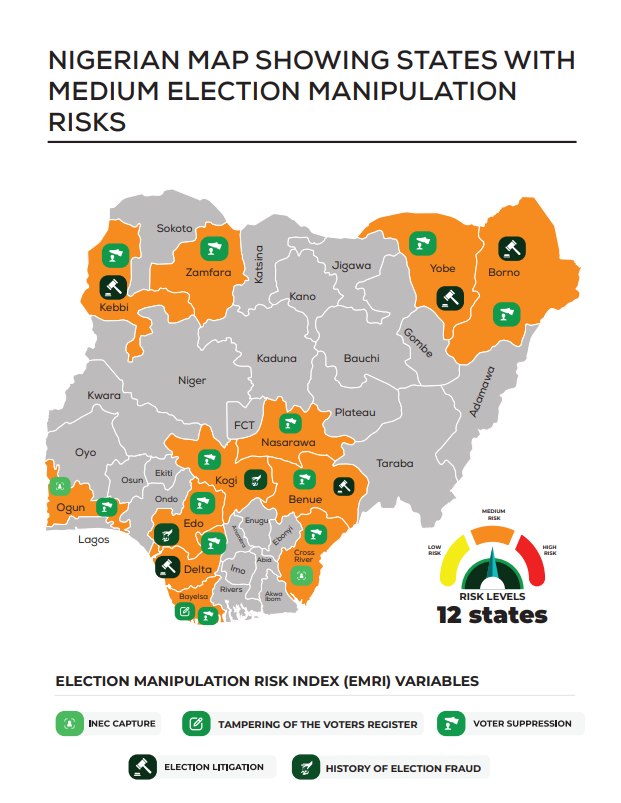
We’re tracking that information, and we’re tracking six variables that we see as a pattern for manipulation. One is INEC capture, two is resistance to the Bimodal Voter Accreditation System (BVAS), three is voter suppression, four is frivolous election mitigation, five is a history of election manipulation, and lastly, the tampering of the voters register.
When we looked at these threats, we clustered states into high-risk, medium, and low-risk. It is high risk if we find three or more variables in a state. When we ran the analysis, 22 states were considered high risk for election manipulation.
When you look at the pattern, it’s clear that most political actors aren’t interested in credible elections. They want to subvert the process to secure power at all costs. Let me put it in street language; they want to rig this election at all costs.
Chilling stuff
That’s why I said in that tweet that there needs to be more interest from most political actors to have credible elections. You can see them doing everything possible to undermine the process. Most politicians don’t care about democratic principles or credible elections. All that matters to them is to be declared winners. It doesn’t matter how they procured the victory and forced themselves on people, and that’s very sad.
We’ll publish a second iteration report by February 20. We hope that some of these high-risk states, the ones in red, will go to yellow and that the medium ones stay high.
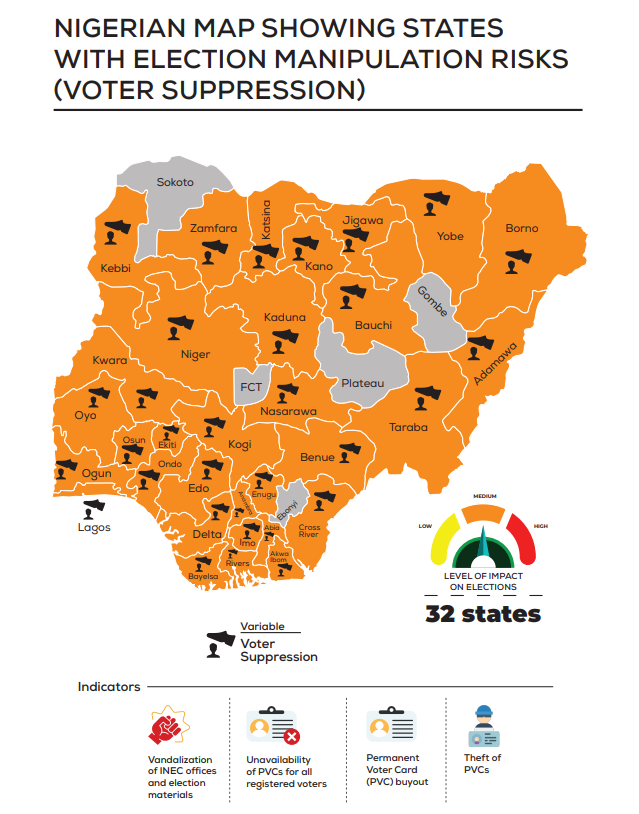
You look at the data on voter suppression, and it’s disturbing. We’ve been receiving reports, confirmed by the police, that politicians are buying off PVCs. When you do that, those people can’t vote. Politicians are going to opponent strongholds and buying off PVCs in those locations, thereby suppressing their votes.
[newsletter type=”gov”]
Thirty-two states have this element of voter suppression which is very disturbing. If you look at states with a history of electoral manipulation there’s either falsification of results, overvoting or vote buying during elections. We have to keep an eye on these states.
We’re publishing this to inform the electorate and prevent rigging the 2023 elections.
Kudos to YIAGA Africa for this extensive report. In light of recent events in Osun state, how confident are you in INEC’s ability to conduct elections using BVAS and IReV?
I’m very confident. The BVAS is a remarkable and innovative tool that limits multiple voting, election rigging and voting by proxy. Now that it has the force of law, politicians are scared of the BVAS and the INEC Election Results Viewing Portal (IReV). These two technological tools are game changers.
I urge Nigerians to support using the BVAS because it will limit election manipulation.
Let’s talk more about these tools
The BVAS is a device, while IReV is a web portal. We need to make a distinction between these two. For me, issues like the Osun judgment raise the salience and even add more credibility to the BVAS. Here’s why.
The BVAS identifies and tracks multiple voting or overvoting. The BVAS contains the voters’ register in a particular polling unit on election day. You need to register to vote. It verifies your biometrics — fingerprints, and facial identity. We talked about overvoting in some polling units (PU) in Osun because there was the BVAS. There’d be no way to track overvoting if it weren’t available. You can’t follow overvoting using manual accreditation. That’s one.
Interesting
Two, what happened in Osun, which Nigerians need to know, is that when the BVAS concludes accreditation, the data uploads to INEC’s server. The thing with uploads is they happen at different times. They occur in days. Sometimes when the network is unreliable, it won’t upload the data to the cloud.
There are over 3,000 PUs in Osun and over 3,000 BVAS machines. One of the parties applied for a report just after the election. INEC issued them the report, but it was incomplete because all the figures had yet to be uploaded on INEC’s server. The mistake INEC made was that the report should have indicated that it was provisional, but INEC didn’t. After the whole upload was concluded, INEC issued a final report which it tendered at the tribunal.
Three, the tribunal asked INEC to present all the BVAS used in the over 700 PUs contested. They brought the BVAS. The court checked them one after the other and compared what was on the BVAS with what was in the final report. Both of them were consistent. The big question is, what is the primary source of accreditation data? The primary source of accreditation data is the BVAS. If you will rely on something other than what was uploaded online, at least rely on the device. The figures in the BVAS and the final report were consistent, so why did they rely on an incomplete report to deliver their judgment? In any case, you should read between the lines.
Hehehe
The other thing the public should know, which the law is clear on, is where there’s overvoting, you cancel the votes in that PU, and you don’t apportion votes. When you cancel, you need to declare the election inconclusive. Then you conduct elections in those affected PUs, provided the total number of people who collected their PVCs in those affected PUs is higher than the lead margin. They ignored that particular provision in the law and ruled in the way they wanted, which is unacceptable. It’s an attempt to cast doubt on the BVAS.
The public must also know that BVAS is an electronic device for accreditation. But, someone has to copy the figures from the BVAS into the result sheet. That process has human interference because it’s a manual process. When there’s a manual process, there may be errors in copying figures. This is why young people voting in the elections should be vigilant at the PUs when elections have ended. They should ensure and verify that the number on the BVAS is recorded on the result sheet because politicians can compromise officials and have them record false figures. This leads to overvoting, cancellation and declaring results inconclusive.
See scope
That’s something Nigerians should be mindful of. The BVAS has its limitations, but it’s a tool that’ll deepen the integrity of our elections.
A BBC investigation raises the problem of misinformation by influencers in Nigerian politics. How’d you think Nigerians can protect themselves?
The first thing is to verify, verify, verify. Only trust some information that comes your way because many are fake. That’s one. Two, determine your source of information and stick to those credible platforms. If you check how those fake news purveyors work, sometimes they clone website addresses of credible media and news platforms. You have to check.
Refrain from consuming news in haste. Self-regulation is the best way to deal with issues around fake news.
The third thing members of the public can do if they’re looking for information on election results, it’s that INEC has the power to declare results. INEC has provided the IReV portal. Go and sign up. Create an account, and you can download the result on your own.
We at YIAGA Africa are also working with a TV station in Nigeria. We have the election results analysis dashboard (ERAD). So for Nigerians who don’t have email accounts, stay glued to your TV sets. We’ll provide you access to real-time results as they come, primarily because of the ERAD and the IReV. We’ve done this in the Ekiti and Osun elections.
We must be careful about how we share information, especially on WhatsApp. Just know that this is a political season, and politicians have their “infrastructure” as part of their campaign strategy to continue to dish out propaganda.
You have to decide, a personal effort. There are also reporting platforms for fake news. Platforms like Meta and Twitter have tools where you can report fake news. Counter it immediately if a piece of information is circulating and you know it’s fake. Don’t wait for anyone to tell you to do that. Counter it and provide accurate information out there.
The Electoral Act limits campaign financing, but it’s hard to see how they enforce them with blatant vote buying occurring. Thoughts?
Politicians don’t want to regulate political finance reforms. They are the culprits. In all these attempts at limiting the influence of money, who makes the law? These same politicians believe so much in money. Some of them know the only power they have is money. They’re not popular in their communities, so they buy votes.
Just look at the primaries. How many of the political candidates were elected out of the free will of the members of their parties? A lot of them bought their nomination. They procured delegates. When you procure delegates to elect you, that’s not an election. I look forward to the post-election period. Let’s discuss political finance reforms.
Fingers crossed on that one
But it’s essential to make a distinction. First, if you want to run elections, you have to spend money. The conduct of elections is a logistic operation, and when you have those, you’re going to spend money. You’re going to host meetings, give people refreshments, recruit agents to keep watch over elections, train them, move them around, run campaigns, use technology, procure data, etc.
So, elections involve spending money. We have a problem with this obscene commercialisation of the process where everything’s just determined by money. The leadership selection process is based on the highest bidder rather than one with the qualifications, competence and character to run for office.
No loud am
You have the introduction of dirty money into our politics. That’s where we need regulation. So you look at the current Electoral Act and see why politicians aren’t interested and are just gaming the system. On the one hand, the Act says INEC can impose limits on contributions. Contributing to a party or candidate, it’s ₦10 or ₦50 million, and it mustn’t exceed that. But another provision in the law says you can donate more than ₦50 million as long as the party can show and demonstrate the funding source.
But you also say, on the other hand, that INEC has powers to impose limitations. So you give INEC power with the left and take it with the right.
LMAO
You see this sort of inconsistency, and it’s deliberate. Politicians don’t want limitations on spending. They don’t want to limit money’s influence because it means retiring from politics, and they don’t want to be retired. I can think of a few things to do.
One, INEC has the power to audit and sanction political parties because it’s the regulatory body based on the provisions of the constitution and the Electoral Act. How many political parties have been audited? How many reports have been made public, and how many parties have been sanctioned?
The second is parties need to rethink their revenue generation mechanism. This is where maintaining an accurate and authentic register of members is critical. Members of parties aren’t paying dues because they don’t see the value in doing so. Political parties are owned by individuals who have the money to run the affairs of parties.
Why’s that? Isn’t it shameful that state party leaders are in the governors’ pockets? It’s the governor that funds the political party structure. The governor pays the salaries of party officials, which is unacceptable.
So when the primaries eventually come, the governor already has the entire party structure under his control. How do you expect internal democracy to flourish in those political parties? Parties need to think about ways of generating income.
One of the parties says it has over 40 million members. Imagine if those 40 million people pay ₦1000 as annual dues. Think about how much money they could raise. You don’t need to charge nomination forms of ₦50 million or ₦100 million. These are some of the things to consider.
I didn’t see this question coming, haha. Where did you get that from? There are a few things we need to change within our electoral process. It’s challenging to be a voter in Nigeria. You show up to INEC (at least) three times in Nigeria.
First, you show up to register. Second, you show up to collect your PVC. Third, you show up to vote. Now, that’s a lot of time. Yes, it’s a sacrifice, but we can still do things differently. Any commission should first consider itself as a service provider. As you’re providing services to the people who are your clients, they are king. In business, the customer is king.
If you ask me one thing, I want people to vote anywhere they find themselves. Two, you don’t need a PVC to vote. Once you have your National ID and you’re 18, go cast your vote. Ultimately, it’s about the voters. Democracy is about people, and how they express their choice is central to democracy. When you say democracy is a government of the people, by the people and for the people, it connotes that people are at the centre of deciding. That process of decision-making is critical to the success of any democracy.
This thing where we make it difficult for people to express their right to vote is something we need to address, and if you do that, you’ll be shocked by the number of Nigerians voting during elections. You’ll also make voting fun and exciting for people. Don’t make it stressful. Yes, several things account for the stress, but we have all it takes to make voting more straightforward. Any commission should set that as its target. How do we serve the Nigerian voter effectively?
Every four years, Nigeria’s enters another election season when politicians visit places they’ll never set foot in again to whisper sweet nothings into voters’ ears.
For the 2023 elections, nothing has changed. Politicians are again making promises they’ll probably forget or find difficult to fulfil if they get what they want.
Let’s take a look at some of them so far.
Fuel will become ₦100 per litre
On January 25, 2023, during a live appearance on Channels Television, Dan Nwanyanwu, presidential candidate of the Zenith Labour Party, promised to revitalise our refineries in 3-4 months.
Source: blueprint.ng
Also, he would build modern refineries in all six geo-political zones. Thus, by the end of his first six months, fuel would be sold for ₦100 per litre, saving us from the problem of independent marketers.
Everyone wants a leader who’d lead them fearlessly into battle. Hamza Al-Mustapha, presidential candidate of the Action Alliance (AA), plans to be just that.
Source: Vanguard
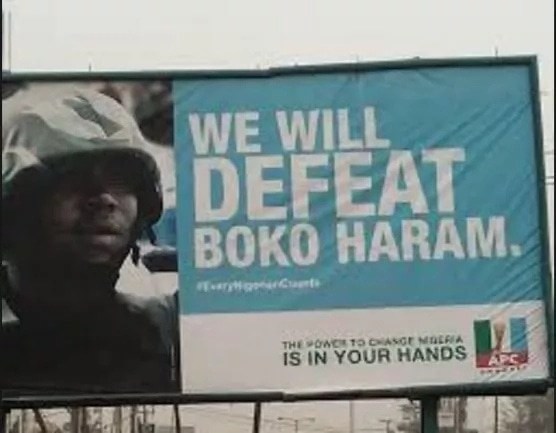
During an interview with the British Broadcasting Corporation (BBC) Hausa, he said that if elected president, he’d end our insecurity and terrorism crisis within six months. But that’s not all; he plans to spend his weekends and holidays in the Sambisa forest, where notorious extremist groups like ISWAP and Boko Haram are often camped.
Creation of 30 million jobs
One of the things Adebayo Adewale, presidential candidate of the Social Democratic Party (SDP) has on his agenda is the creation of 30 million jobs.
Source: Vanguard
He plans to achieve this using cryptocurrency. It sounds promising, but Nigerians have seen this film before, and we didn’t like the ending.
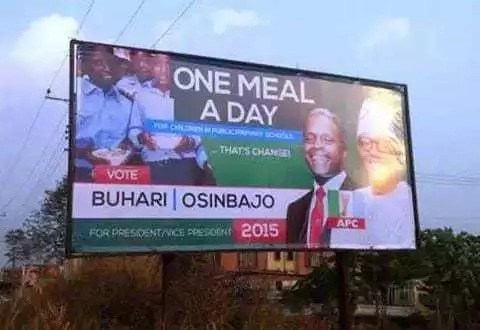
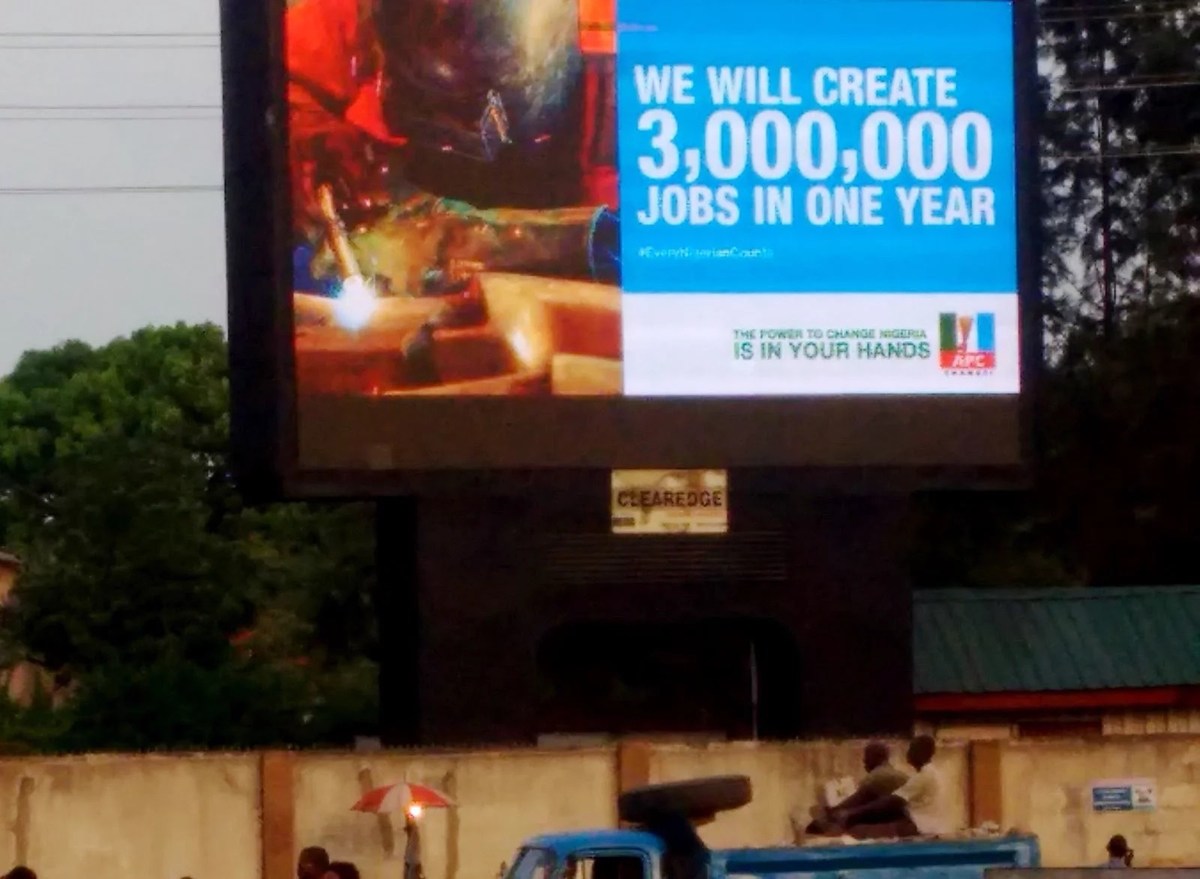
In 2015, President Buhari promised to create 3 million jobs annually, but gave us a 33% unemployment rate instead.
No more generators or foreign education
Presidential candidate of the African Democratic Congress (ADC), Dumebi Kachikwu, has castles in the air, too.
Source: Leadership.ng
While explaining his manifesto, he said if elected, he’d draft a Nigerian Patriot Bill that’d ban public officers from giving their children foreign education.
He also plans to restrict their access to private and foreign hospitals, generators and boreholes for as long as the ordinary people can’t afford these amenities.
In theory, most of these campaign promises sound like good plans and a step towards making our lives easier. However, why do we hear nothing from these politicians after elections, and their campaign promises end up looking like lies?
No punishment for failed promises
Sadly, there is no provision in the law that holds politicians accountable for their campaign promises. As such, fulfilling it or not is entirely up to their hardly reliable goodwill.
Lack of funding
While some elected officials have plans to fulfil what was promised, they soon realise Nigeria –and by extension, states– are only rich on paper. For instance, a report last year showed that Abia state hadn’t paid some of its workers for 22 months. In such situations, the elected government would have to solve the existing problems before fulfilling his campaign promises.
Need for restructuring
Early December 2022, President Buhari, while addressing members of the Senior Executive Course (SEC), accused state governors of being responsible for the poverty level as they were looting local government allocations. According to the president, the local government chairmen would pocket half of what was allocated and thus fail to embark on necessary projects.
An evil we’ve been dealing with for a long time is corruption, and it, unfortunately, begins at the grassroots level. If we’re to experience any real change, the entire system would need to be cleaned and restructured.
Are you signed up to our Game of Votes newsletter yet?We help you make sense of news jargon and keep you up-to-date especially with election news. Make the subscription of a lifetime here
The 2023 general elections are weeks away, and we can already tell they’ll differ from previous election years. For one, there’s renewed interest in the election proceedings, and people are ready to vote in a new administration.
Let’s look at some significant differences in numbers between the 2023 and 2019 elections.
Registered voters
In 2019, we had a total of 84 million voters. But, things are looking better this year, as the Independent National Electoral Commission (INEC) has noted an 11.3% increase in registered voters in 2019, bringing us to a total of 94 million registered voters.
Youth involvement
Another major difference between the 2019 and 2023 elections is youth participation. In 2019, the number of youths registered to vote was 22.3 million. However, youths make up the highest number of registered voters for the upcoming elections at 37 million. This is definitely a welcome improvement that should continue in the future.
However, regardless of the improvement in voter registration, it would be all for nothing if people don’t come out to vote.
In 2019, we recorded the lowest voter turnout for the first time since Nigeria’s democracy, at 34.75 %. According to the International Institute for Democracy and Electoral Assistance (I-IDEA), Nigeria’s voter turnout was the lowest of all African elections held between 2017-2019.
Some factors responsible for this low turnout include insecurity, apathy, election postponement and poor planning.
Hopefully, things will change in the forthcoming elections, and people will finally understand the type of power they have in their hands.
We’re weeks away from the 2023 general elections, and the country is buzzing with anticipation. Politicians are running helter-skelter trying to convince voters they are the best thing since sliced bread, and people are burning bridges with friends who aren’t supporting their choice of candidates.
Given the importance of the upcoming elections, the electorate, like never before, is keeping an eye out for anything that smells or looks like electoral fraud, also known as rigging.
Unfortunately, rigging has always been an ugly characteristic of our elections. Some of the ways politicians rigged elections in the past are:
Threaten electoral officials
One of the easiest ways elections were rigged in the past was by threatening the Independent National Electoral Commission (INEC) officials. This would mainly happen if the candidate is a strong political figure or belongs to a prominent party.
Presence of the military
Elections shouldn’t be a do-or-die affair, and very rarely, if not never, would the help of the military be needed during the voting process. So, once a polling unit is militarised, it makes voters afraid and discourages them from voting.
Vote buying
This is the most common method of election rigging. Many people need money, and unfortunately, politicians take advantage of this. People in need of food or money happily sell their votes in favour of these politicians.
Thuggery
This is another popular method of rigging elections. Thugs are recruited to disrupt the voting process or steal and destroy electoral materials.
This, consequently, leads to a low turnout of voters or the polling unit is altogether cancelled.
Bribery
In 2017, an INEC official, Christian Nwosu, pleaded guilty to receiving a ₦30 million bribe from former petroleum minister Diezani Alison-Madueke to compromise the election in favour of the Peoples Democratic Party (PDP).
Electoral officials are often promised appointments, money and properties if they agree to compromise the election’s integrity.
Fortunately, these things may soon become a thing of the past as the government has recently taken steps to clamp down on electoral fraud.
Introduction of BVAS
For the 2023 general elections, INEC will use the Bimodal Voter Accreditation System (BVAS) for voters’ authentication. Unlike the smart card reader, BVAS authenticates not only a voter’s fingerprints but also has a facial recognition sensor.
It would also help INEC officials electronically upload results from the polling units. This has automatically created a problem for politicians who clone or buy Permanent Voter Cards (PVCs). No wonder some have opposed INEC’s plan to use it in the elections.
The new electoral act
On February 25, 2022, President Buhari signed a new electoral act which might make electoral fraud even more difficult. Some key points of the act are:
Political parties cannot receive anonymous donations.
Political parties cannot create, recruit or train an “army” to carry out their objectives.
Ballot papers with any marks or stains will be rejected.
Hopefully, this election will go as seamlessly as possible, and people will be able to vote for the candidate of their choice without having to face intimidation or be victims of electoral violence.
You can read more about the regulations in the electoral act guiding the upcoming regulations here.
Are you signed up to our Game of Votes newsletter yet?We help you make sense of news jargon and keep you up-to-date especially with election news. Make the subscription of a lifetime here
For months, the All Progressives Congress (APC) has gone around the country hawking their candidates like fine bread. President Buhari has been missing for most of the campaigns until yesterday when he blessed Yola with his presence and endorsed Senator Aishatu Binani’s bid as Adamawa’s governor. If she wins, she will make history in Adamawa and as Nigeria’s first female governor.
Who is Aishatu Binani?
A serving senator of the 9th Assembly
Aishatu aka “Gimbiyar Adamawa”, meaning the Princess of Adamawa, was a former House of Representatives member representing the Yola North/Yola South/Girei federal constituency (2011-2015). She is currently the Chairman of the Senate Committee on Sustainable Development Goals (SDGs) and also serves as a member of the 9th National Assembly – the only female senator from the north to do so.
First female governorship aspirant to represent a major political party
On May 27, 2022, Aishatu emerged winner of APC’s governorship primaries for Adamawa state, defeating her close rival, former EFCC boss, Nuhu Ribadu.
You would think a female aspirant wouldn’t be out of the norm with the population of women in Nigeria. However, women have, for years now, struggled to get adequate representation in politics and government, with the House of Assembly shutting down any bill seeking equal rights and opportunities.
Mother of all empowerment
Aishatu isn’t known only for her political upheaval but for her philanthropy which has endeared her to her constituents. She has empowered them with scholarships, ICT facilities, and healthcare services.
Regardless of her win at the APC primaries, she has had to fight many opps to her governorship aspiration so far.
On October 13, 2022, a federal high court in Yola nullified APC’s governorship primaries and annulled her victory. But her village people finally let her go when on November 24, 2022, the Court of Appeal overturned the ruling and reinstated her.
Our First Lady, Aisha Buhari, was very busy last year, from shuffling Nigeria and Dubai to dealing with trolls; she also gave her two cents on a female governorship. In a meeting with stakeholders on November 18, 2022, she threw her weight behind Nuhu Ribadu and claimed Adamawa wasn’t ripe for a female governor. What happened to women supporting women?
For some reason, it seems like the thought of a female governor makes many people uncomfortable. Here are some examples of women whose governorship dreams were shut down:
Aisha Al-Hassan
Many people called her “Mama Taraba” for her influence in the state.
In 2015, she contested Taraba’s gubernatorial seat under APC and was declared the winner in November. However, her victory didn’t last long, as the Appeal Court soon reversed the judgement.
Gbemi Saraki
Sibling rivalry is nothing new except that in the Saraki family, rather than fight for food or clothes, the reason for their feud was Kwara’s governorship seat. In case you didn’t know, Gbemi Saraki, current Minister of State For Mines and Steel Development, is the sister of former Senate President Bukola Saraki.
After his tenure as Kwara state governor, Gbemi had plans to succeed him, but rather than pitch camp with his sister, he decided to side with the other candidate. And her attempts to win the gubernatorial elections proved futile.
A big conversation right now is ensuring more female representation, especially in government. And if Aishatu emerges victorious, it would definitely be a big win for women and a great way to kick off 2023.
If there’s one thing the Buhari administration has taught us over the years, it’s always to expect the worst possible outcome. Due to several reasons, such as the unreasonable high costs of living, insecurity and corruption in public offices, many Nigerians have feverishly waited for 2023 as they’d finally have a chance to hopefully kiss the current administration goodbye and bring a new one into power.
This is why the recent statement on January 9, 2023, from the Independent National Electoral Commission (INEC) Chairman, Mahmood Yakubu, of the possibility that the 2023 general elections might be cancelled or postponed may push many people into a season of prayers, fasting or sacrifices in hopes that this doesn’t happen.
What’s their reason for possible cancellation/postponement?
INEC believes that this issue hinders the chances of a free and fair election and till a solution is found, the upcoming elections are at risk of being cancelled.
We’ve seen this before
2011
Unfortunately, we can’t call this the first time elections have faced the threat of cancellation and postponement. On April 2, 2011, former INEC Chairman Attahiru Jega called off the voting process in some areas and postponed the elections altogether. His reason was the logistics issue they encountered, as some parts of the country couldn’t get electoral materials on time.
2015
In 2015, INEC postponed the national elections (National Assembly and presidency) initially scheduled for February 14 and 28, 2015, to March 28, 2015, and the state elections to April 11, 2015. This was mainly due to security reasons as some parts of the country, particularly in the northeast, were being ravaged by Boko haram insurgents. So, INEC thought it was best to give security bodies time to secure the area well enough to hold elections.
2019
Sadly, 2019 wasn’t different from other election years as the elections were also postponed, but this time due to logistics issues caused by bad weather and arsonists’ attack on INEC offices.
Although INEC has come out to say they are ready to deal with possible challenges, it’s not difficult to see that a pattern has developed through the years. Regardless, we can only hope that INEC finds a way to clear every hurdle in its way, as the people are ready now more than ever to exercise their electoral rights finally.
Politics isn’t the only affair that needs elections. Too many tiring arguments need to be settled once and for all. Isn’t it a good idea for us to just vote on them as a country?
The GOAT of Afrobeats
This conversation has gone too far and needs to be solved with an election. Burna, Davido and Wizkid will be on the ballot, but we can also smuggle in Tiwa Savage and Asake to make it look like it’s free and fair.
Lagos vs Abuja
Lagos folks think they’re the coolest. Abuja folks think they’re the best thing since sliced bread. Let’s put this to a national vote so we can hear what everyone else thinks.
Asake vs Seyi Vibez
This shouldn’t even be up for debate. But since some Nigerians on Twitter have started bantering over who’s better and who’s copying who, we need to vote on this for the sake of national peace.
Whether or not semo is trash
You’d think food vendors would stop selling semo? But that hasn’t happened yet, so clearly, people still buy it. We need to have an election about whether or not it’s really trash, so we can fish out the bad eggs among us.
Island vs mainland
One side will accuse the other of having dirty water, and another side will accuse the other of being no fun. But what does everybody else think? Let’s find out at the polls, please.
Is Ashimolowo a bad bitch?
This question has been left unanswered for too many years. If you think Ashimolowo might actually be a baddie, get your PVC ready!
Is Zikoko on crack?
Well, I guess there’s only one way to know for sure…
One unfortunate feature of Nigerian elections that has refused to go away is violence in varying forms. It’s the kind of baggage no one wants, but everyone has to deal with it because some people still treat elections as do-or-die.
What’s happened now?
On November 27, 2022, unknown people set fire to the office of the Independent National Electoral Commission (INEC) in Izzi Local Government Area of Ebonyi State. The incident happened around 10 a.m.
Did anyone get hurt?
Fortunately, no one was hurt in the attack. But INEC lost some materials, including:
Unknown number of Permanent Voters’ Cards (PVC)
340 ballot boxes
130 voting cubicles
14 electric power generators
Large water storage tanks
Office furniture
We’ve seen this before
On November 10, 2022, arsonists attacked INEC offices in Abeokuta South, Ogun State and Ede South, Osun State. You can’t help but notice the sad trend in these events.
Over the past three years, similar attacks have occurred in different parts of the country: Abia, Rivers, Anambra, and Imo. According to the INEC chairman, Mahmood Yakubu, about 50 INEC offices have been attacked by arsonists in 21 states.
What does this mean for the 2023 elections?
The electoral process is sabotaged
One of the critical things needed for a free and fair election is the availability of important things like PVCs and ballot boxes. The attack on the INEC office in Abeokuta South destroyed 65,699 uncollected PVCs. This creates a problem for INEC to reproduce new cards which we can’t say always works out. If those PVCs aren’t replaced it would deny some Nigerians their rights to vote.
Political apathy
Attacks on INEC offices are designed to heighten tensions and keep voters away from polling units because they seem unsafe. Nigeria already has a big issue with low turnout of voters and apathy caused by threat of violence will only make it worse. After all, who wants to be an unwilling martyr?
Hopefully, the Nigerian security forces will take appropriate measures to secure INEC offices better and find a way to arrest the criminals. The fate of the country being decided at the polls depends on it.
Citizen is a column that explains how the government’s policies fucks citizens and how we can unfuck ourselves.
A few weeks, ago we wrote about the by-elections that will be taking place on December 5, 2020, including the most important things you need to know.
In addition to that, we will be writing about the candidates in the Bayelsa West and Bayelsa Central senatorial by-elections. This is because it is important for you to have a good knowledge of the candidates in the forthcoming by-election in Bayelsa state, so that you can vote more wisely.
It is advisable that your polling unit is very near to your residence because of the restricted movement on election days.
If you have also relocated to another place outside the where you initially registered, you will have to transfer your registration to a polling unit within your new area of residence as you cannot vote in a polling unit without prior registration.
You can transfer your registration by following the guidelines on the INEC website. However, you must do so at least 60 days before an election.
We hope you’ve learned a thing or two about how to unfuck yourself when the Nigerian government moves mad. Check back every weekday for more Zikoko Citizen explainers.
The US elections is holding today. But as Americans go out to the polls, it is easy to think Donald Trump is a version 2.0 of the average Nigerian politician – refined, composed and less tricky.
Well, we’re here to tell you “na lie“. Trump is just a Nigerian politician who stays in the abroad Nigerian politicians run to. You don’t believe us? See for yourself.
1. When He Said He won’t Leave Office Because of A “Ballot Scam”
Which Lagos State governor called a press conference to say that his challenger was arrested for spending “fake American dollars”, and that his records are at the Gbagada General Hospital?
Becoming a Nigerian politician is a long and tedious process many people are unwilling to go through. But we’ve hacked it for you and broken it down into these 10 simple steps so that you can become a Nigerian politician and start living your best life.
1. You have to start by becoming a political activist.
Call out corrupt politicians on every platform possible and amass a large following. Renounce politics and all politicians because they are the devil’s spawn. Make it clear that you’d rather sell your kidney than become one of them.
2. When you’ve become a very well known activist and a voice of the people, use your popularity to collect political appointment from the same people you were criticising.
After you collect your appointment jump through hoops to defend your appointees and blame everything on the previous government. Rain is falling too much? The previous government embezzled the money that was meant to pay rainmakers to hold the rain.
3. Now, start making promises that you have no intention of ever keeping.
You will give Nigerians 24/7 light and free WiFi. You will build 20 schools in one week. You will reduce the exchange rate to $1 to ₦1. With you, corruption shall go to an early grave.
4. As you progress in your political career decide whether it’s broom or umbrella you want to be carrying.
There are 68 political parties in Nigeria but you know the fastest way to get a post is to carry broom or umbrella.
5. Next find yourself a godfather or godmother to sponsor your career.
You think political campaigns are cheap? Better be ready to drop it down low so you can get sponsorship.
6. Practice your fighting skills especially if you are gunning for a place in the National Assembly.
Maybe ask Uncle Dino for some tips.
7. You have to show Nigerians that you are one of them.
You might be worth millions of (laundered) naira but that doesn’t mean you will stop taking okada or buying corn on the road like the average Nigerian.
The script is to act like you feel their plight, so get in character and act like your life depends on it.
8. As a politician you also need to get yourself security by whatever means.
Hire cultists, militants or religious extremists. What’s your business if they end up becoming a terrorist group because you funded them.
9. You have to get your wardrobe on check too. Get a tailor to sew plenty agbadas for you.
Only make white. White is the colour of serious politicians.
10. Once a year share bags of rice to a few people and take a thousand pictures.
Bathroom slippers too isn’t a bad idea. Depends on the kind of message you intend to pass.
Any time Nigerians accuse you of not doing your job publish the pictures online to show them that you are a very hardworking politician.
Now that we’ve shown you the way go forth and flourish as the baby girl or baby boy politician we know you have the potential to be.
Citizen is a column that explains how the government’s policies fucks citizens and how we can unfuck ourselves.
On October 31 2020, there will be by-elections in Bayelsa Central Senatorial District; Bayelsa West Senatorial District; Nganzai State Constituency, Borno State; Cross River North Senatorial District and Obudu State Constituency, Cross River State.
Other by-elections will hold in Imo North Senatorial District, Lagos East Senatorial District; Kosofe 2 State Constituency, Lagos State; Plateau South Senatorial District; Bakura State Constituency, Zamfara State; and Ibaji State Constituency, Kogi State.
The Lagos State by-elections were confirmed when the INEC Resident Electoral Commissioner in Lagos State, Sam Olumekun, served a notice of election at the Lagos East Senatorial district and at the Kosofe State House of Assembly Constituency on August 17.
A by-election is an election that is held to fill a vacant legislative seat when a member of the legislature has resigned or died, and their seat has been declared vacant.
In the case of Lagos State, the death of Senator Adebayo Osinowo, representing Lagos East Senatorial District, and the death of Tunde Braimoh representing Kosofe 2 at the Lagos State House of Assembly meant that a by-election to fill their seats was needed.
2. Where Is Lagos East Senatorial District?
Section 71 of the constitution makes it compulsory for every state in Nigeria to be divided into three senatorial districts, and every senatorial district must have a member who will represent it at the Senate.
Senatorial districts comprise Local Government Areas.
In Lagos, Lagos East senatorial district comprise 5 Local Government Areas, including: Epe Local Government Area, Ibeju/Lekki Local Government Area, Ikorodu Local Government Area, Kosofe Local Government Area and Somolu Local Government Area.
The wards that make up the Kosofe 2 constituency include: Ketu-Alapere, Ikosi/Ketu, Isheri/Olowo-Ora, Agboyi 1, Agboyi 2 and Odo-Ogun/Ajegunle.
3. Who Are The Contenders In The Lagos By-Elections?
12 candidates will be contesting in the Lagos East senatorial by-elections while 8 candidates will be contesting in the Kosofe 2 by-elections.
For the Lagos East senatorial district by-elections, Muyiwa Adebanjo of the Action Alliance (AA), Mercy Adeoye of the African Action Congress (AAC), John Kome of the African Democratic Congress (ADC), Adebowale Ogunlaru of the Action Democratic Party (ADP) and Adetokunbo Abiru of the All Progressives Congress (APC) are some of the aspirants.
Others are Olusola Babatope of the Allied People’s Movement (APM), Florence Trautman of the Labour Party (LP), Adijat Lawal of the New Nigeria People’s Party (NNPP), Babatunde Gbadamosi of the People’s Democratic Party (PDP), Olakunle Adisa of the National Rescue Movement (NRM), Saheed Aluko of the Social Democratic Party (SDP) and Taiwo Temitope of the Young Progressive Party (YPP).
For the Kosofe 2 constituency by-election, John Akerele of the Action Alliance (AA), Sadiq Olawale of the African Action Congress (AAC), Saheed Wasiu Obafemi of the All Progressives Congress (APC), Adekunle Oladapo of the Labour Party (LP), Muyideen Agoro of the New Nigeria People’s Party (NNPP), Ademorin Adelaja of the National Rescue Movement (NRM), Sikiru Alebiosu of the People’s Democratic Party (PDP), and Mary Abojeh of the African Democratic Congress (ADC) are the aspirants.
4. What Are Their Plans?
Mr Tokubo Abiru of the APC has stated that he will focus on making Lagos to be granted a “special status” if elected as Senator representing Lagos East senatorial district, considering that Lagos is the entertainment, financial and commercial capital of Nigeria.
He also said he will focus on the completion of the Lagos-Ibadan expressway, the reconstruction of the Ikorodu-Sagamu road and the reconstruction of the Ikorodu-Epe-Ijebu-Ode highway if he is elected into office as a senator.
Babatunde Gbadamosi of the PDP has also stated that his plans are based on “quality representation” for the people, and that he will make sure negative laws are amended if elected.
Chief Yeye Florence Trautman of the Labour Party (LP) is described as “International Female Gender Activist cum Public Speaker, an American Artiste, Film Producer an agriculturalist/Farmer”, but nothing can really be found of her mainfesto online, including that of other aspirants.
5. What are the voter numbers?
INEC has stated that over 1.4 million registered voters will participate in the October 31 by-elections of the Lagos East Senatorial district.
INEC also added that over 280,363 registered voters will participate in the Kosofe 2 State Constituency by-election.
However, not all registered voters have their Permanent Voters Card (PVC), which makes them ineligible to vote in the elections.
It is advisable that your polling unit is very near to your residence because of the restricted movement on election days.
If you have also relocated to another place outside the where you initially registered, you will have to transfer your registration to a polling unit within your new area of residence as you cannot vote in a polling unit without prior registration.
You can transfer your registration by following the guidelines on the INEC website. However, you must do so at least 60 days before an election.
*Update
The by-elections will now hold in 11 states in Nigeria on December 5, 2020 after INEC was forced to postpone the elections because of the violence that greeted the aftermath of the #EndSARS protests.
We hope you’ve learned a thing or two about how to unfuck yourself when the Nigerian government moves mad. Check back every weekday for more Zikoko Citizen explainers.
This is Zikoko’s Game of Votes Weekly Dispatch. We share the most important things that happen in Nigeria every week. 5pm Thursdays. Stay woke.
Beggi Beggi, E No Good O
Who knew Yahaya Bello, governorof Kogi State, was so influential? He definitely yields some kind of power over the who’s who in Nigerian politics if a whole Madame First Lady, Aisha Buhari, and Nasir El Rufai, Kaduna State Governor, can kneelin front of residents of Kogi state during a campaign on his behalf, begging them to vote him in for his second term as governor.
Where Did This Happen?
Their theatre performance held at the Confluence Stadium in Lokoja, in front of a teeming crowd and an intrigued audience. We were intrigued when we heard that the hardcore El-Rufai fell on his knees, telling everyone to disregard the fact that Bello didn’t do anything worthwhile in his state during his first term.
Even more ridiculous was the fact that El-Rufai deemed it reasonable to blame Yahaya Bello’s failings on his youth, stating that everyone should forgive him for his bad governance: “For every one that the governor has offended, I’m asking all of you to forgive him. He is young; he is supposed to make mistakes. When you are young, you make mistakes but you learn from them.”
Hmmm, colour us shocked that El-Rufai took a cue from Daddy Bubu with a spinoff of the lazy Nigeria youths mantra as if that’s a good enough excuse for Governor Bello’s ineptitude and nonpayment of salaries.
And Where Was Yahaya Bello While This Was Happening?
Right beside the two jokers grinning from ear to ear, probably thinking up ways to spend that N10 billion that was approved by the Senate two days to the Kogi state elections; budget padding things.
Nothing New, Just Election Insecurity Here And There
Bayelsa and Kogi state held their gubernatorial election on Saturday, and as usual, mayhem and hell broke loose on election day. What would Nigeria be if thugs don’t appear to snatch ballot boxes and disrupt every electoral proceeding, basically spitting in the face of INEC?
Okay, Seriously, What’s New?
Amid all the sporadic shootings and killings in the rerun senatorial elections in Kogi, Dino Melaye’s stated that his nephew got killed by a policeman’s bullet. Is this true or not? We’re not sure; it came from the horse’s mouth, so even though we take everything Melaye says with a pinch of salt we’re trying to believe that he wouldn’t joke about something so serious, least of all try to use it for political clout.
Meanwhile…
Meanwhile, Goodluck Jonathan was hella upset with members of his political party because of his allegeddisagreement with the ex-governor of Bayelsa State, Seriake Dickson, over PDP’s decision to have Douye Diri run as the candidate for the Bayelsa State governor race.
The tea is that Goodluck Jonathan didn’t throw his weight behind Douye Diri; he didn’t lift a finger to support that poor man’s campaign, subtly giving APC a chance to become theruling party in Bayelsa for the first time in history. The beef must have been strong for Daddy Jonah to quietly sabotage his party because of personal grievances, hope this won’t come back to bite him in the ass sha.
DID YOU MISS THIS?
Bukola Dakolo’s case was dismissed by Justice Oathman A. Musa, who said that she was “insensitive” to the court of law and totally “sentimental”; Timi Dakolo had a lot to say about that matter.
The African giant is taking over the world! On the heels of his expected trip to South Africa, after saying he’ll NEVER go back there, Burna Boy gets nominated for the GRAMMYS baby!
NOT.THE.NEWS
Do you remember all the drama that Nigerian politicians have engaged in throughout the years? Do you even recall the name Dimeji Bankole? Well, since the 2010s are wrapping up we decided to create a list of some of the biggest political scandals Nigerians have been forced to experience by our craziest leaders.
Our fellas are still on the Jollof Road chopping the life of their heads but they’ve finally given a hint that all might not be as rosyas we thought on this road trip. Regardless of that though, we still believe they’re living the best life right now, at least they get to see all of West Africa while we are stuck here in Lagos traffic.
Ministry is moving
The dispatch is growing. If you enjoyed reading this, share this with someone, you hear?
Are you subscribed to our political newsletter Game of Votes? You should be subscribed to our political newsletter, Game of Votes. Here’s a link to subscribe if you’re not.
We tell you the most important things that happened in Nigeria, during the week, in a way that won’t bore you to death.
This is Zikoko’s Game of Votes Weekly Dispatch. We share the most important things that happen in Nigeria every week. 5pm Thursdays. Stay woke.
Beggi Beggi, E No Good O
Who knew Yahaya Bello, governorof Kogi State, was so influential? He definitely yields some kind of power over the who’s who in Nigerian politics if a whole Madame First Lady, Aisha Buhari, and Nasir El Rufai, Kaduna State Governor, can kneel in front of residents of Kogi state during a campaign on his behalf, begging them to vote him in for his second term as governor.
Where Did This Happen?
Their theatre performance held at the Confluence Stadium in Lokoja, in front of a teeming crowd and an intrigued audience. We were intrigued when we heard that the hardcore El-Rufai fell on his knees, telling everyone to disregard the fact that Bello didn’t do anything worthwhile in his state during his first term.
Even more ridiculous was the fact that El-Rufai deemed it reasonable to blame Yahaya Bello’s failings on his youth, stating that everyone should forgive him for his bad governance: “For every one that the governor has offended, I’m asking all of you to forgive him. He is young; he is supposed to make mistakes. When you are young, you make mistakes but you learn from them.”
Hmmm, colour us shocked that El-Rufai took a cue from Daddy Bubu with a spinoff of the lazy Nigeria youths mantra as if that’s a good enough excuse for Governor Bello’s ineptitude and nonpayment of salaries.
And Where Was Yahaya Bello While This Was Happening?
Right beside the two jokers grinning from ear to ear, probably thinking up ways to spend that N10 billion that was approved by the Senate two days to the Kogi state elections; budget padding things.
Nothing New, Just Election Insecurity Here And There
Bayelsa and Kogi state held their gubernatorial election on Saturday, and as usual, mayhem and hell broke loose on election day. What would Nigeria be ifthugs don’t appear to snatch ballot boxes and disrupt every electoral proceeding, basically spitting in the face of INEC?
Okay, Seriously, What’s New?
Amid all the sporadic shootings and killings in the rerun senatorial elections in Kogi, Dino Melaye’s stated that his nephew got killed by a policeman’s bullet. Is this true or not? We’re not sure; it came from the horse’s mouth, so even though we take everything Melaye says with a pinch of salt we’re trying to believe that he wouldn’t joke about something so serious, least of all try to use it for political clout.
Meanwhile…
Meanwhile, Goodluck Jonathan was hella upset with members of his political party because of his alleged disagreementwith the ex-governor of Bayelsa State, Seriake Dickson, over PDP’s decision to have Douye Diri run as the candidate for the Bayelsa State governor race.
The tea is that Goodluck Jonathan didn’t throw his weight behind Douye Diri; he didn’t lift a finger to support that poor man’s campaign, subtly giving APC a chance to become theruling party in Bayelsa for the first time in history. The beef must have been strong for Daddy Jonah to quietly sabotage his party because of personal grievances, hope this won’t come back to bite him in the ass sha.
DID YOU MISS THIS?
Bukola Dakolo’s case was dismissed by Justice Oathman A. Musa, who said that she was “insensitive” to the court of law and totally “sentimental”; Timi Dakolo had a lot to say about that matter.
The African giant is taking over the world! On the heels of his expected trip to South Africa, after saying he’ll NEVER go back there, Burna Boy gets nominated for the GRAMMYS baby!
NOT.THE.NEWS
Do you remember all the drama that Nigerian politicians have engaged in throughout the years? Do you even recall the name Dimeji Bankole? Well, since the 2010s are wrapping up we decided to create a list of some of the biggest political scandals Nigerians have been forced to experience by our craziest leaders.
Our fellas are still on the Jollof Road chopping the life of their heads but they’ve finally given a hint that all might not be as rosy as we thought on this road trip. Regardless of that though, we still believe they’re living the best life right now, at least they get to see all of West Africa while we are stuck here in Lagos traffic.
Ministry is moving
The dispatch is growing. If you enjoyed reading this, share this with someone, you hear?
Are you subscribed to our political newsletter Game of Votes? You should be subscribed to our political newsletter, Game of Votes. Here’s a link to subscribe if you’re not.
We tell you the most important things that happened in Nigeria, during the week, in a way that won’t bore you to death.
This is Zikoko’s Game of Votes Weekly Dispatch. We share the most important things that happen in Nigeria every week. 5pm Thursdays. Stay woke.
Beggi Beggi, E No Good O
Who knew Yahaya Bello, governorof Kogi State, was so influential? He definitely yields some kind of power over the who’s who in Nigerian politics if a whole Madame First Lady, Aisha Buhari, and Nasir El Rufai, Kaduna State Governor, can kneelin front of residents of Kogi state during a campaign on his behalf, begging them to vote him in for his second term as governor.
Where did this happen?
Their theatre performance held at the Confluence Stadium in Lokoja, in front of a teeming crowd and an intrigued audience. We were intrigued when we heard that the hardcore El-Rufai fell on his knees, telling everyone to disregard the fact that Bello didn’t do anything worthwhile in his state during his first term.
Even more ridiculous was the fact that El-Rufai deemed it reasonable to blame Yahaya Bello’s failings on his youth, stating that everyone should forgive him for his bad governance: “For every one that the governor has offended, I’m asking all of you to forgive him. He is young; he is supposed to make mistakes. When you are young, you make mistakes but you learn from them.”
Hmmm, colour us shocked that El-Rufai took a cue from Daddy Bubu with a spinoff of the lazy Nigeria youths mantra as if that’s a good enough excuse for Governor Bello’s ineptitude andnonpayment of salaries.
And Where Was Yahaya Bello While This Was Happening?
Right beside the two jokers grinning from ear to ear, probably thinking up ways to spend that N10 billion that was approved by the Senate two days to the Kogi state elections; budget padding things.
Nothing New, Just Election Insecurity Here And There
Bayelsa and Kogi state held their gubernatorial election on Saturday, and as usual, mayhem and hell broke loose on election day. What would Nigeria be if thugs don’t appear to snatch ballot boxes and disrupt every electoral proceeding, basically spitting in the face of INEC?
Okay, Seriously, What’s New?
Amid all the sporadic shootings and killings in the rerun senatorial elections in Kogi, Dino Melaye’s stated that his nephew got killed by a policeman’s bullet. Is this true or not? We’re not sure; it came from the horse’s mouth, so even though we take everything Melaye says with a pinch of salt we’re trying to believe that he wouldn’t joke about something so serious, least of all try to use it for political clout.
Meanwhile…
Meanwhile, Goodluck Jonathan was hella upset with members of his political party because of his alleged disagreementwith the ex-governor of Bayelsa State, Seriake Dickson, over PDP’s decision to have Douye Diri run as the candidate for the Bayelsa State governor race.
The tea is that Goodluck Jonathan didn’t throw his weight behind Douye Diri; he didn’t lift a finger to support that poor man’s campaign, subtly giving APC a chance to become the ruling party in Bayelsa for the first time in history. The beef must have been strong for Daddy Jonah to quietly sabotage his party because of personal grievances, hope this won’t come back to bite him in the ass sha.
DID YOU MISS THIS?
Bukola Dakolo’s case was dismissed by Justice Oathman A. Musa, who said that she was “insensitive” to the court of law and totally “sentimental”; Timi Dakolo had a lot to say about that matter.
The African giant is taking over the world! On the heels of his expected trip to South Africa, after saying he’ll NEVER go back there, Burna Boy gets nominated for the GRAMMYS baby!
NOT.THE.NEWS
Do you remember all the drama that Nigerian politicians have engaged in throughout the years? Do you even recall the name Dimeji Bankole? Well, since the 2010s are wrapping up we decided to create a list of some of the biggest political scandals Nigerians have been forced to experience by our craziest leaders.
Our fellas are still on the Jollof Road chopping the life of their heads but they’ve finally given a hint that all might not be as rosy as we thought on this road trip. Regardless of that though, we still believe they’re living the best life right now, at least they get to see all of West Africa while we are stuck here in Lagos traffic.
Ministry is moving
The dispatch is growing. If you enjoyed reading this, share this with someone, you hear?
Are you subscribed to our political newsletter Game of Votes? You should be subscribed to our political newsletter, Game of Votes. Here’s a link to subscribe if you’re not.
We tell you the most important things that happened in Nigeria, during the week, in a way that won’t bore you to death.
I miss 2015. Back then, my biggest problems were deciding my parental finesse of the month, deciding what classes I’d grace with my presence or losing my mind over what colour this dress is (blue and black ftw!).
2015 was also the year Nigerians were taken for a jolly good ride by the man we now call President. Back in 2015, Buhari, decked in a suit and Hi-fiving his adorable grandchild made a couple of promises that seemed too good to be true, and that’s probably because they were.
The dreams we got sold were so sweet, it’s 2019 and I’m still throwing away salute. That’s by the way — a promise is a promise is a promise, so we have a few questions to ask our dear president, especially with elections coming up in only a couple of weeks:
Did you lose our 5k in the mail?
Back in 2015, Buhari promised Nigeria’s unemployed youth a monthly stipend of 5 000 each.
And while yes, ₦5 000 probably won’t go very far in these trying times of 100 Gala, it was a grand idea, so we waited for him to come through.
And wait we did. On a trip to Saudi Arabia in 2016, Buhari relayed an epiphany that very sadly escaped him in 2015. The ₦5000 stipend would be better utilised for infrastructure, so LOL… sorry to everyone expecting money.
By the end of 2016, the government had a change of heart and decided to in fact disburse the ₦5 000 to Nigeria’s poorest.
The question is, where is my 5k? And no way I don’t qualify. I may or may not have chugged Garri and groundnut without water for a week in 2017, and it’s not because I enjoy being choked.
The Post-NYSC salary, how far?
This was one of my favourite promises of 2015. After suffering through CDS and monthly clearances, a shining light awaited if a job wasn’t immediately available.
A whole year’s salary while you got your shit together coupled with enrollment in a vocational school — all on the government’s tab. How very thoughtful.
Anyway, we’re sure he only forgot about this, somebody please make sure he sees this to maybe jog his memory.
Good job on the school feeding programme, but can Lagos get a little love?
The president promised a free meal with fruit for primary school students, and from all indications, it has been moderately successful in some states of the federation.
Over 7.4 million students currently benefit from the programme. While there are confirmed bottlenecks, the programme is a work-in-progress, and has increased school enrollment, so that’s great.
However, the programme currently caters to only students from Basic 1-3, leaving those in nursery classes and grades 4-6 in the dark. Plus, it’s only available in 24 states. Can the others, Lagos included get a little love?
Still sure about this?
I mean, it’s 2019 and we’re still getting headlines like this.
Do you remember saying you’d create 3 million jobs annually? Because we do.
Even though the Minister of Labour – Mr Chris Ngige will have us believe 7 million jobs were created between 2015 and 2017, the actual figures are less, way less.
Since the assumption of office, up until 2017, the Presidency has been responsible for the creation of only 2.8 million jobs. A far cry from the 6 million jobs we were promised for two years.
Plus unemployment rates are doing a madness, and reached a worrying 23.1% by the third quarter of 2018.
See how sweet mouth can be a problem?
In 2019, it’s a little okay. Or what do you feel, Bubu?
Back in 2015, when we had no idea how good the Dollar rate we were enjoying was, the APC made it apparent that ₦216 to a Dollar was not a figure to get accustomed to.
We should have listened and maybe voted another way. But somehow we were under the impression that they meant to reduce and not nearly double the exchange rates.
In less than 100 days, you’ll be making a choice over which people will steer this green-white ship for another four years. I’m talking about the 2019 General elections starting February 16, 2019.
Nigerians around the country will go out to vote new ̶r̶u̶l̶e̶r̶s̶ leaders into office. From the House of Reps all the way up to the Presidency. You know the drill.
You’re probably one of these people:
“Oga, I don’t even know who to vote for, because everything just seems confusing”
“I know who I’m voting for, and I’m super ready!”
“I don’t have a PVC, and that might or might not suck”
“What are you talking about?”
Whichever one you are, we have something to tell you. See these politicians? Most of them want to use our future to play Ludo and Monkey-post. We will not take it!
This is what’s up
Who’s running? What are they doing? What does it all mean in the big scheme of things?
We’ll keep you posted on only the most important stuff from the past week. Once a week. Mondays. 5pm.
No clickbait. No B.S. No heinous threads or epistles.
Just 5 straight-to-the-point absolute need-to-knows. In 3 minutes. All of this, while making sure you don’t get bored to death.
Life is too short for fake news.
If you call this dispatch “politics for people who hate and/or don’t understand politics,” you’ll be goddamned right.
Subscribe to the Game of Votes Weekly Dispatch by clicking here. The first issue will be here before you know it.
Election season is upon us and we’ve never had a more interesting and more diverse crop of presidential aspirants.
And because politics in Nigeria reminds us of secondary school we couldn’t help but re-imagine some of our 2019 presidential aspirants as secondary school students.
Fela Durotoye is the smart kid who is always the first to put up his hand when the teacher asks a question, whether he knows the answer or not.
Teacher: What’s 2 plus 2?
Fela: If you really believe in yourself, the answer will be 22.
Oby is the kid who will write names of noisemakers, put her best friend’s name and submit it to the teacher.
She’ll even add x2 if she catches you talking again.
Donald Duke is the fresh kid everyone likes and is very popular.
He was Social prefect once and everyone loved him. The whole school thinks he can do no wrong.
Sowore is the one all the teachers used to call useless boy and now he wants to prove them wrong by becoming head boy.
He gets called into the principal’s office every single day.
Moghalu is the smart kid who always comes first and everyone thinks he has two heads.
But the day he came second he went to report to the Principal that the person who came first didn’t deserve it.
Eunice Atuejide is the transfer student who came in SS2 and nobody knew until she said she wanted to become head girl.
The boys like her because she refused to join the Girls’ Guide.
Atiku is the rich kid who was Assistant Class Captain once and has now made it his life’s mission to become Class Captain.
He has been trying since JSS1, he is in SS3 now.
Buhari is the one who has been trying to become class captain since JSS1, when they finally gave it to him in SS3 he decided to show the whole school pepper.
And he’ll continue to show us pepper till he graduates.
Eighteen other Nigerians have also come out to say they want to run for president. Who else do you think we should add to this list?
Come February 2019, the elections will be here again, and for the third time since I became eligible, I’ll be on the sidelines.
Considering how much noise was made about registration in the months before the deadline, I feel like trash. I know there are a lot of us out there.
The good old question remains; how do you get young people to vote? Everybody wants to be 18 so they can cross many things off their bucket lists – but voting is hardly ever one of them.
Young people have an attitude to voting that sits somewhere between ‘Wetin concern me’ and ‘Call me when they start sharing dollars’.
Keep in mind ‘young’ here means persons between the ages of 18 – 25 –definitely not Dalung.
It’s not hard to see why the actor dies in this movie.
Voter turnout in Nigeria has consistently dropped over the last three elections.
It’s almost the same case with SUG elections. Good luck remembering the days when student unions could shake the country.
Now the average student is like my colleague Eniola, who described her feelings for campus politics with this short expose –”I didn’t give a shit. It didn’t matter.”
None of this makes me happy. So in an effort to nip the problem at the bud, I’ve looked back at my attitude to elections over the years.
I don’t like what I found.
Election season usually starts like this:
Segun to the world: “Guy. Dem don dey ring bell for this guy. INEC says election na February next year.”
World to Segun: *crickets x 3*
In Nigeria, elections start when posters go up. It’s in the Bible. Unfortunately, my brain becomes shy when it’s time to remember this.
Imagine coming home nearly a year to the election and having to confirm your house address because posters have turned the entire street into a collage. That’s how I feel every four years.
Between that and the Atiku trends on Twitter, there’s no other way to know elections are here.
“GET YOUR PVC yen yen yen”
I really wanted to register to vote ahead of 2019. I talked to people and planned my weeks around it.
Except something always came up. A football match, a new album, food, sleep. Over the years, I’ve found that my scepticism has gotten the better of me.
If you say it’s a case of wondering if my vote would really count, you’ll be right.
“But me I go talk, me I go speak my mind” – Eldee the Don
Not having a voter’s card has never stopped me from talking about governance around election time though.
What I’ve noticed is that people like me have these conversations for different reasons–to compare opinions, to hide mouth odour, or to just appear smart.
Not everyone’s really interested at this point and it shows.
“Can you people shift for me? I want to tweet.”
You know when they offer you rice at a friend’s house and your self-respect says no, then you smell it and your priorities somersault?
Few months to the elections, after Olamide makes the first election jingle, the buzz builds to the point where FOMO sets in and everyone becomes a pundit.
Maybe it comes from worrying that people are doing something way more fun than you are. Or that they’re selling us at dozen price in one Whatsapp group. Either way, the noise gets louder with each election year.
But will you vote?
Unfortunately, all the hot takes never really convince us to do the deed-voting.
To be fair, there are reasons – like the fear factor.
No one wants a situation where one moment you’re exercising your civic duty, the next minute you’re channelling Usain Bolt and wondering if you’ll ever see your slippers again.
Fun fact: I’m one of these people.
So we stay at home–but when results are announced, the country sings the same old song.
“Dem don rig am”
Soldier go. Soldier come. Barracks still dey.
If there’s one thing I’ve learned, it’s that elections go as fast as they come.
We talked, tweeted, wrote on Facebook, created memes and sent BCs on WhatsApp – all the things we’ve been made to believe don’t matter. And they made a difference.
That’s why we need to sit up and do things differently. Don’t overthink it.
It could be that easy or even less expensive, like hosting group conversations on WhatsApp.
The basic thing is this – just get involved.
That way, we can start talking about the right candidates and holding office holders accountable.
Will we change everything at once? No.
But I’ve found that talking to the people around me has gotten them more interested in changing things; some of them want to help their favourite candidates with their campaigns, others just can’t wait for election day.
It’s a long way from getting all young people to change their voting habits, but it’s definitely a good place to start.
Yesterday Aunty Oby declared her bid to run for presidency. Now, this might be the best news we’ve gotten since Burna Boy dropped Ye (our new national anthem).
As expected what is likely to follow after this announcement is a slew of interviews and press runs.
So here’s a public service announcement for all the members of the Nigerian Press. There are a thousand and one questions we should be asking Oby Ezekwesili right now, but they shouldn’t include any of these.
May we meet you?
So what we will call your husband if you win? Is it first husband?
If you become president where will you find the time to be cooking for your husband/will you still be cooking for your husband?
What does your husband think of you running for presidency?
Do you think Nigeria is ready for a female president? Don’t you think you should wait a few years for your turn?
Don’t you think you’d stand a better chance running alongside a man as Vice President?
You can never win, so why are you running?
So if you win how are you going to balance being president with your family life?
If you become president, how do you think it’ll affect your home?
Do you think as a woman you are up to the task of being president?
Did you ask for your husband’s permission before you declared?
What of your pastor? Did you ask for his permission?
As a woman do you think you have what it takes to become the president of Nigeria?
You know you should be asking? About her plans to fix the country’s debt situation, or how she’s going to provide more jobs, or improve national security. Thanks and God bless.
We know how to get PVCs, but we thought, wouldn’t it be awesome to actually show everyone how our PVC experiences went?
“Hey guys, if you don’t have a PVC, don’t come to the office. Register to get your PVCs, and work remotely.”
That’s Tomiwa, our Captain and Chief Patriot. He already had his, so he just Situation Roomed us from the office.
A bunch of people on the team were on the hustle; Bankole, Toketemu, Folarin, Sade, Lanre, Sudeen.
So, how did the exercise go?
Time: 8:36am
Sudeen: “I’m at the INEC Office already. Got here before 8am sharp. My number is 96. This is Sudeen, reporting from INEC office in Iyana Ipaja, Lagos.”
Sade: Jesus. I guess I’m screwed.
Tomiwa Aladekomo: Content people, why is Sudeen, our Finance Manager outshining you in documentation of your experiences? Where’s everyone else? Still in bed?
Toketemu: We’re on our way!
What’s your struggle?
Fu’ad: I registered in Rivers State in 2011 and I’m not sure if I threw away my TVC or lost it. Apparently, I need to go and print my INEC details online first. So I’m somewhere trying to get it printed now. And I’m in Surulere.
Toketemu: Folarin and I are lost here. False stop.
Fu’ad: Lmao. I was there about an hour ago. There’s a designated INEC LGA office. It’s in Small London. (You can check the INEC office address in your LGA here.)
Time: 11.40am
Toketemu: This is Toke reporting live from Small London. For the record, Folarin and I walked from Masha to Small London. True patriotism right here.
Sade: Almost at Small London too.
Tomiwa: How’s it going?
Toketemu: There are about three lists and our names are on the third list but the officials are almost halfway through the first. The crowd doesn’t seem large, but apparently, there’s about 170 people on the lists. They’re on number 46 now. And they close at 3pm. (INEC announced new timelines for registration)
Toketemu: Officers in uniform get preferential treatment.
Ayoola: Elderly people too.
Time: 12:10pm.
Sudeen: It’s my turn now. I got my form now, about 4 hours later. Those of us with TVCs have different forms. They’ve been following the process since, not taking bribes.
Fu’ad: The process is a little broken. There’s a Telemundo element to my situation. I have no TVC, but I have my Voter Identification Number. To get a new TVC, I have to go to the Local Government I registered, but then I want to transfer. And I need a TVC to transfer. So, I’m just going to go back to INEC and cry.
Toketemu: Still here, waiting. They are still on the first list. This isn’t looking very likely.
Sudeen: Hey Fu’ad, don’t worry, it’s easy. Just go to the INEC website. As long as you’ve registered before, all you need to find your V.I.N is the state where you registered and your Date of Birth.
Tomiwa: I never changed my voting location, meaning that I spend every Election Day in the first place I registered, my parent’s. If there are easier locations to register in, might make sense to just hang with a friend or something on Election Day and use one of those.
Lanre: My case seems slightly easy. Lost my PVC so I simply need to do a printout of my previous PVC registration. And then get a police report and affidavit.
Bankole: Why is everyone in Lekki trying to register at the same goddamn place? Makes no sense.
Lanre: It’s the only location in Eti-Osa Local Government.
Time: 1:43pm
Sudeen: I’m done. I managed to get my wife to come along. Another girl came here, she’ll be 18 next week. They told her to come back only after she’s clocked 18. She also has to come back with her birth certificate.
Toketemu: It’s a bust here, told us to come back tomorrow morning the only chance you have is to come first thing in the morning. Then we thought if we got our names on the list today we’ll be attended to first in the morning but apparently, the rule here is new day new list. The process is way slower than I thought.
Time: 2.29pm
Fu’ad: Come back by the end of the year to get your PVC
Bankole: Hustle
Toketemu: Oh wow
Tomiwa: Nice. Did they give you the TVC as well?
Fu’ad: I have no need for it. My Voter information is online (without the photo). I printed it and gave them. This slip is all I need to show up with year-end to collect my PVC, according to the INEC official here.
I noticed it’s a very “Internet-friendly” process here. People who are transferring and don’t need new TVCs can just go online. But then again, maybe that’s my INEC place.
Bankole: THAT IS NOT WHAT HAPPENED AT MY PLACE. They acted like they were doing people a favour. I mean, these people were like “we’ll attend to only 100 people today”
Fu’ad: Well, maybe that’s the number they might have the range for? I think it’s a general design problem with the process, and the people at the INEC office doing the registering are on the receiving end. I went in the morning and they were polite. I went in the afternoon, and they were cranky.
Tomiwa: I’m surprised Internet Cafe businesses haven’t sprung up to help people with this. Guess people don’t want to pay money to vote.
Bankole: They shouldn’t. And if you’re having obvious capacity problems, like only one registration point for a bigass LGA like Eti Osa, shouldn’t more be opened?
Tomiwa: Sudeen and his family are the winners of today’s sprint. Where’s Pepo and Eniola though?
Eniola:
The most important hacks you need to know:Find the closest INEC office to you and go there early, before 8am preferably.
Go with valid documents if need be,
Most importantly, for a more detailed walkthrough, visit getyourpvc.com, and in 5 minutes, it’s totally okay if you call yourself a PVC expert.
If you’ve already registered to get your PVC, tell us, how did your experience go?
We know that politics is a messy game and politicians can never be trusted. When it comes down to it, they’ll tell you whatever you want to hear that will get you to put your guard down.
And then after they’ll come and be doing you anyhow.
Their campaign speeches and posters are always full of promises. Then when they get into power, they’ll start to change mouth.
Just look at these 12 campaign posters from the 2015 elections and see all the lies that full everywhere.
Bros Ambode promised to “make Lagos work for all”, but the people of Otodo Gbame community beg to disagree. Lagos is not working for them at all. Like, not one bit.
So many promises for “a better society”, but markets are getting demolished “by mistake”. Is it fair? No, is it fair?
These ones promised us electricity, affordable kerosine and security. How much more electricity and kerosine have we had? Just how much more secure do we feel?
Zero corruption? Discipline? Of who? By who?
Are our passports not still being made in Malaysia? And what about the GEO bill that has been lingering in the Senate forever? What is being done about it?
Maybe this campaign poster was seeing into the future, because it cannot be a representation of any kind of reality; whether past or current. Which inflation went down? Is it the one in formerly rotund bellies heavy with food? Okay, okay…maybe it’s that one.
Eyss, just move away with your nonsense trust. Is it you that cannot trust Naija doctors to take care of you? We should now trust you to do what? You’re looking for our trust, where is your own?
Erm..there’s sha still bad roads now. Infact, worse roads sef. So…hafa?
I’m not even sure which generation they’re talking about.
Which good term? No vacancy ko, no accommodation ni. Isn’t it another person that is there now?
This one is just a big WAWU! All the many incidences of Fulani Herdsmen attacks and religious killings, how many have been addressed personally by the Government? Abeg, abeg…comot for here.
Hmm! Only saviour indeed! In that case Nigeria is already doomed then. If her
“only saviour” has left for medical checkup. How will we ever survive? Who will deliver us?
Nigerian politicians are just one kind, and this next post is proof:
Incase you don’t know (or currently living under a rock), the most controversial elections ever took place in the U.S on November 8, and shockingly, Donald Trump won the election!