Notice: Function _load_textdomain_just_in_time was called incorrectly. Translation loading for the wordpress-seo domain was triggered too early. This is usually an indicator for some code in the plugin or theme running too early. Translations should be loaded at the init action or later. Please see Debugging in WordPress for more information. (This message was added in version 6.7.0.) in /home/bcm/src/dev/www/wp-includes/functions.php on line 6121
Court case | Zikoko!
  • Everything We Know About Bobrisky’s Naira Abuse Conviction

    Idris Okuneye AKA Bobrisky, a popular Nigerian socialite, was arrested by the Economic and Financial Crimes Commission (EFCC) on Wednesday, April 3, 2024, for mutilating some naira notes. On April 12, 2024, a Federal High Court in Lagos sentenced her to six months in jail without the option of a fine. 

    What was her crime?

    The EFCC spokesman, Mr Dele Oyewale, confirmed the arrest and stated that Bobrisky was arrested on four different counts to which she pleaded guilty. During the judgment, Justice Abimbola Awogboro mentioned that Naira mutilation has become a menace that’s damaging the country’s image. Bobrisky’s sentence was to make an example of how Naira Abuse will be treated going forward 

    But is the sentence fair?

    Naira Abuse has long been a criminal offence in Nigeria, but spraying naira notes when dancing has also been a part of the Nigerian culture for ages; this law hasn’t seen much enforcement in the past. Before Bobrisky, on February 1, 2023, the Independent Corrupt Practices Commission (ICPC) arrested Nigerian actress, Oluwadarasimi Omoseyin, after a video of her spraying and stepping on the new Naira notes circulated on the internet. Just like Bobrisky, she bagged six months of imprisonment. 

    According to the 2007 CBN Act, the punishment for naira abuse — which includes spraying, stamping, engraving, selling and mutilation — is a fine of ₦50,000 or six months imprisonment. For a first-time offender, members of the public believe that the sentence with no option of a fine was made out of bias, but Oluwadarasimi Omoseyin was also sentenced with the only difference being that she got the option, of a fine because she was a first-time offender who pled guilty. She was eventually granted bail on February 15 2024, but for Bobrisky the case is not the same.

    Although Bobrisky is also a first-time offender and has pled guilty with a promise to change and use his platform to educate people about the naira abuse, he wasn’t granted bail. This begs to question if there is some sort of bias behind the decisions of the court.

    [ad]

    When did this one start?

    The police have started taking Naira Abuse more seriously, rounding up more offenders in the last several months than they ever have before. One Simon Idio was arrested on February 12, 2024, for selling the naira. Who knows what might come next?

    To learn other possible ways you might be breaking the law, click here.

  • P&ID vs Nigeria: UK Court Throws Out $11 Billion Award Against Nigeria

    The Business and Property Court in London has ruled in favour of the Nigerian government in its legal case against Process and Industrial Developments (P&ID) Limited, an engineering and project management company, squashing an $11 billion arbitration award initially issued in favour of the company. 

    P&ID vs Nigeria: UK Court Throws Out $11 Billion Award Against Nigeria

    Here’s what you should know about the situation and how Nigerians are reacting.

    What happened?

    It started in 2010. P&ID entered into a business agreement with the Nigerian government, and the plan was to build a gas processing plant in Calabar, Cross River State. It was a contract billed to last 20 years.

    Two years later, P&ID claimed the deal couldn’t pull through because the Nigerian government didn’t keep their side of the agreement. According to them, the FG failed to put in place the required infrastructure to kick off the project. 

    The company took the case to court.  On January 31, 2017, a tribunal ruled that the Nigerian Government should pay $6.6 billion in damages to the company, as pre and post-judgment interest at 7%.

    The FG applied for an extension after the ruling and the application was granted by Judge Ross Cranton in September 2020.

    In the application, the FG alleged that P&ID tried to defraud the country with the deal, adding that officials of the company paid bribes to secure the contract.

    In March 2023, the FG argued in a trial court that the P&ID deal was conceived through dishonest means, and as such the awarded sum, which had risen to $11 billion due to the 7% pre-and post-judgment interest, should be thrown out. 

    Court Rules in favour of Nigerian Government 

    On October 23, 2023,  Justice of the Commercial Courts of England and Wales, Robin Knowles, upheld Nigeria’s prayer on the ground that the P&ID contract was obtained by fraud.

    If Nigeria had suffered a negative ruling, this would have seen a significant hit to the country’s foreign reserves. As of May 2023, the foreign reserves stood at $34.4 billion.

    How are Nigerians reacting?

    The ruling has sparked reactions from Nigerians on social media. Almost everyone acknowledges paying the sum would have seriously affected the country’s already weak economy.

    Tweets below:

    You’ll have your fill of grilled, peppered or fried meat and many more at Zikoko’s meat festival on November 11. Have you bought your Burning Ram ticket? You can do that real quick here.

  • What Is An Ex Parte Order?

    Citizen is a column that explains how the government’s policies fucks citizens and how we can unfuck ourselves.

    Lately, Nigerian courts seem to be issuing a lot of ex parte orders. On November 6, the Central Bank of Nigeria obtained an ex parte court order freezing the accounts of 20 individuals and public affairs companies linked to the #EndSARS protests.

    The CBN was able to freeze the accounts of 20 #EndSARS campaigners after a written address to a Federal High Court in Abuja stating that the funds in their accounts might have been linked to terrorist activities.

    Afterwards, Justice Ahmed Mohammed froze the accounts for 180 days subject to renewal, but said anyone who was not satisfied with the ruling was free to challenge it.

    Also, on November 9, 2020, one Kenechukwu Okeke filed an ex-parte motion against 50 #EndSARS “riots promoters”, stating that they breached public defence, public safety and public order.

    Read: Who Has Powers Over The Nigerian Police?

    What Is An Ex Parte Order?

    Ex parte is a Latin term that is gotten from the phrase from “one side to a dispute”. In law, an ex parte motion means that a party to a case wants a court order carried out without hearing from the other party, so as to preserve the important things in a case.

    So, in the CBN’s case, for instance, the motion was sought and the court order were carried out without the presence of the other parties i.e. the 20 accused people whose bank accounts were allegedly used in carrying out terrorist activities.

    What Is The Purpose Of An Ex Parte Order?

    If Mr A and Mrs B are in dispute over ownership claims on a portion of land and Mr A wants to sell the disputed land to Mr C, who is an innocent third party, Mrs B can seek an order of ex parte order of interim injunction from the court so that Mr A will be unable to sell the land to Mr B.

    If the law does not allow Mrs B seek this order, Mr A might sell a land that is still does not belong to him, a situation that will be very hard to reverse.

    So, the purpose of an ex parte order is to protect the main issue in a matter like land or money, before both sides begin their case in court.

    Read: How Is A Law Passed In Nigeria?

    Are Nigerians Officials Abusing Ex Parte Processes?

    Ex parte orders are supposed to be temporary and are not to last more than 14 days.

    Section 12 (1) of the Federal High Court (Civil Procedure Rules) 2000 states that “no order made on motion ex parte shall last for more than 14 days…or last for another 14 days after application to vary or discharge it has been argued”.

    In other words, ex parte orders are not supposed to last more than 28 days, even if they are extended. This is because, by nature, they are only supposed to be temporary.

    Unfortunately, Nigerian courts now generally issue ex parte orders for 90 days and up to 180 days, in the case of an extension.

    One can only hope that court processes are not abused in Nigeria.

    We hope you’ve learned a thing or two about how to unfuck yourself when the Nigerian government moves mad. Check back every weekday for more Zikoko Citizen explainers.


    [donation]

  • A Thief Was Caught In Lagos But The Judge Asked Him To Carry Buckets Of Water As Punishment
    On one peaceful day, instead of facing his work, a 28 year old labourer, Chikwandu, went to steal a phone worth N6,000 from someone’s van that was jejely parked on the street.

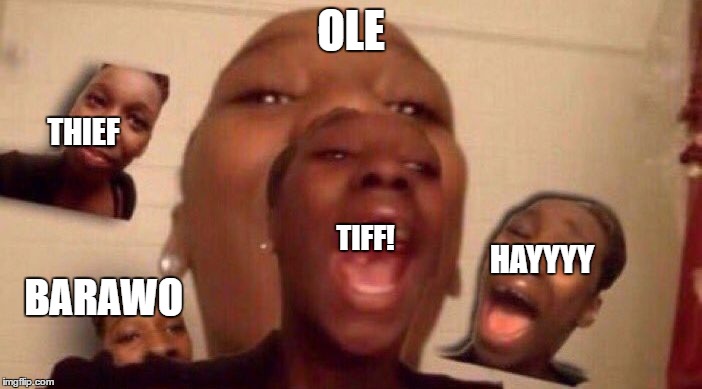
    And because everyday is for the thief and one day is for the owner, someone caught him the act and shouted:

    He got arrested and was charged to court for stealing in an Ebute Metta Chief Magistrates’ Court.

    Instead of sentencing him to court, the judge, Chief Magistrate B.O. Ope-Agbe, ordered him to fill up two buckets with water and carry them up and down a flight of stairs 100 times.

    He should kuku use the punishment to build his muscles as per fit fam.

    Who knows, maybe there aren’t enough spaces for petty thieves in prison sef.

    [zkk_poll post=43325 poll=content_block_standard_format_6]