Notice: Function _load_textdomain_just_in_time was called incorrectly. Translation loading for the wordpress-seo domain was triggered too early. This is usually an indicator for some code in the plugin or theme running too early. Translations should be loaded at the init action or later. Please see Debugging in WordPress for more information. (This message was added in version 6.7.0.) in /home/bcm/src/dev/www/wp-includes/functions.php on line 6121
cattle | Zikoko!
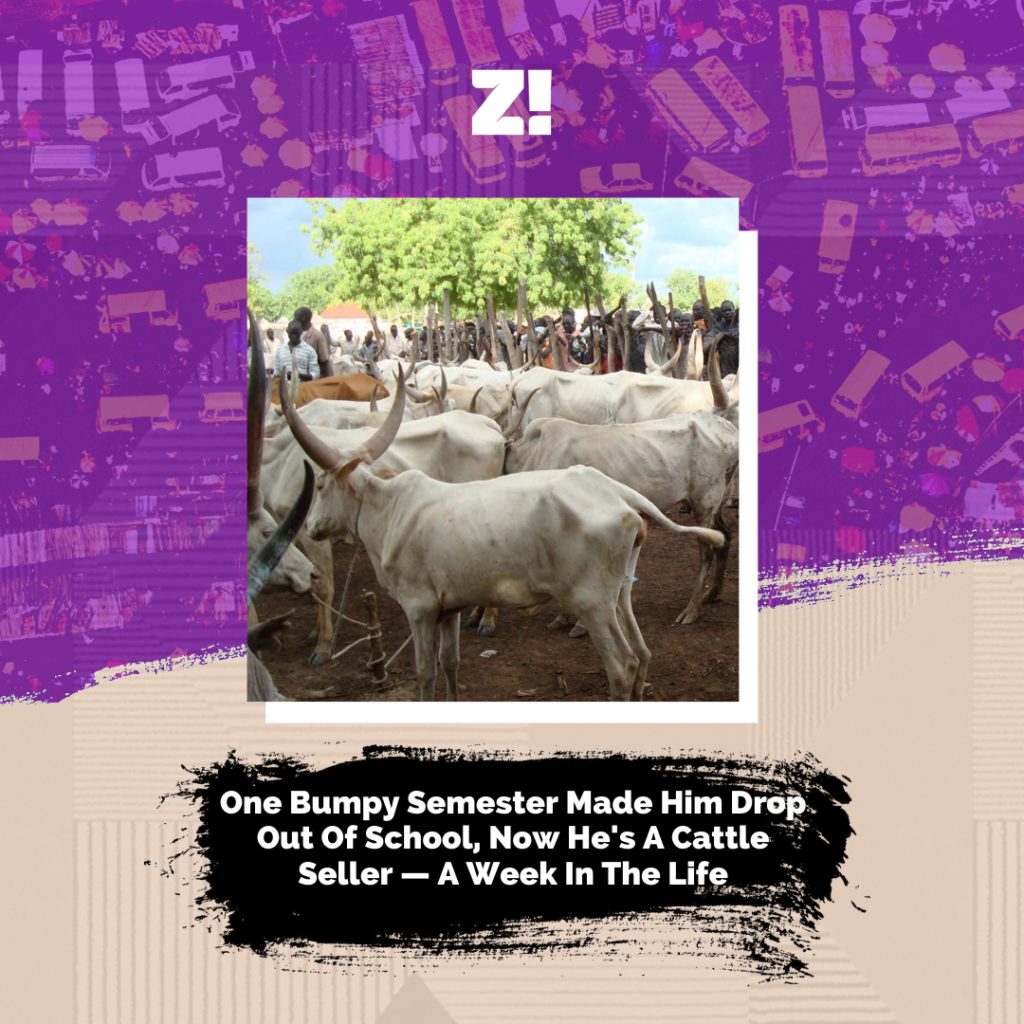
  • One Bumpy Semester Made Him Drop Out Of School, Now He’s A Cattle Seller — A Week In The Life

    A Week In The Life” is a weekly Zikoko series that explores the working-class struggles of Nigerians. It captures the very spirit of what it means to hustle in Nigeria and puts you in the shoes of the subject for a week.


    The subject of today’s “A Week In The Life” has been unlucky. One bad decision in conjunction with a faulty educational system took him from studying a professional degree to selling cattle. Now, he’s trusting God and waiting for his big break. 
    MONDAY:

    I’m awake before my alarm rings. I unlock my phone to check the time and it reads 3:25 a.m. — this means I’m up early by five minutes. Every day, for the past six weeks, I’ve been waking up in the middle of the night for tahajjud prayers. 

    I roll out of bed, perform ablution and drop on my praying mat. It’s a little bit past 4 a.m. when I’m done praying so I go back to sleep. The next time I open my eyes, it’s 5:30 a.m. and I’m just in time for morning prayers. Although standing up requires a little effort, I manage it.  From this point, my day starts in full swing. 

    I say my prayer, have a bath, wash plates from the night before and cook breakfast. By 7:00 a.m., I’m out of my house and on a bike to the market where I sell livestock for a living. The first thing I do when I get to the market is survey prospective animals for sale. Because I do not [yet] own any cattle; I start my day by convincing people to let me handle the sale of theirs. After negotiations, we usually settle on a cost price, after which I’m free to add my own markup. Sometimes, if a cow costs ₦250,000, I can sell it for ₦255,000 or ₦260,000. The final price depends on the bargaining power of the customer. For expert customers, I usually end up selling at the cost price so the owner doesn’t make a loss. In scenarios like this, my commission ranges between ₦1,000 – ₦2,000. At all at all na him bad pass. 

    Mondays are typically slow. All the parties have happened over the weekend and there aren’t any more till the next weekend. So, after surveying prospective animals, I spend my Mondays feeding and cleaning them up to look healthy for sale during the week.  I also stock up on support items like ropes, feed, etc so I can at least have something to sell and show for my efforts at the close of the day. 

    My plan for today is simple: make at least ₦1,000 to cover food and transportation back home. 

    TUESDAY:

    Cows are very wicked. And that’s why I always carry my cane anytime I’m feeding or cleaning them. For any cow that is proving stubborn, I use my bulala to reset its head. Yet,  these animals can be sneaky. One time when I wasn’t looking, a cow hit me on my chest with its horn. The blow packed enough force to make me sore for a few days but not enough force to make me bleed. After that incident, I became extra careful around the animals. 

    Truthfully, not all cows are wicked. Some are gentle, easy-going and even allow you to touch them. Currently, I have one cow that fits that bill. Although it has been paid for, I’ve been taking care of it for a month. It’s such an easy-going animal that I sometimes wish it were mine. 

    But it’s not and I’m just a caretaker. I can’t wait until I start going to the North to buy my own cattle. Until then, I’m going to be spending my days, like today, cleaning, feeding and caring for the animals. 

    WEDNESDAY:

    Sometimes when I compare how much I make on average versus my expenses, I ask myself what I’m doing here. My average daily commission falls somewhere around ₦1,000 – ₦2,000. Bike to and from my house costs ₦400. Food that can sustain me for the kind of work I do costs me around the same: bread and beans costs ₦300 while fufu or eba costs ₦400. Whatever is left goes into my kolo for the rainy days. Sometimes, in a week, all I make is transport money with nothing to save. 

    For me, this reality is twice as painful because I used to be in the university until I dropped out in my final year. Most times, I find myself thinking that with my level of exposure I should be in a better place. But Allah knows best. 

    This afternoon, after some older men sent me to buy recharge cards and Amala, I found myself thinking about my life.  

    It started with a carryover in 200 level, although the repercussions only surfaced in my final year. In my department, one of the requirements to be eligible for final professional exams was having zero carryovers. However, because of a mixture of my negligence and horrible record keeping, I wasn’t aware that I had failed a course. At least, not until when I was prevented from registering for final year. I was asked to retake the course I had failed and that meant an automatic extra year. 

    Then I made a bad decision. 

    Because I was very active in school, and because of the shame and stigma I associated with having an extra year, I dropped out. 

    I got a job at a restaurant, continued to lie at home, and allowed one year to pass me by. By the time my parents found out what had happened, the school had removed me from their system. I begged, wrote letters, and even lobbied, but I was told I couldn’t be reabsorbed into the system. Even though I was on a good academic standing, I was kicked out for not deferring the admission and just ghosting. While I take full responsibility for my actions, I wish I had someone to tell me that a carryover wasn’t the end of the world. 

    Because I did not and I lived with the stigma of failure alone, I made the wrong decision. Now, all I’m left with is menial jobs and no professional degree. 

    I’ve accepted my fate and the part I played in making it so. But on days like this, my regrets are fresh again. My only consolation is that I believe that not everyone is destined to work a white-collar job. Perhaps this is my destiny and I should bear it with more humility. Whenever I wake up to pray at night, the one thing I ask God is that the things I’ve lost should not be greater than what I’m going to achieve in the future. 

    THURSDAY:

    I try as much as possible to fast on Thursday to cut down the cost of feeding. Additionally, I also use the day to reflect and be grateful for my life so far. Although I’ve lost a lot, there’s still a lot to be grateful for. 

    Today, I’m especially grateful for a good support system; my parents and siblings, and friends who have encouraged me. I haven’t been the best person or been in the best of places but they’ve been rock solid. 

    Sometimes, when I complain of the fact that I’m almost thirty with nothing to show for it, they encourage me to go further. Also, when necessary, they do not hesitate to tell me difficult truths. 

    For the first time in a long time, I’m starting to feel like my old self and starting to pick myself up. The first sign is that I’m feeling restless again. More than ever, I’m constantly thinking of ways to save up money to buy livestock from the North. Even if I buy just one cattle or sheep, I’ll know that it is mine. With the income I earn, I don’t know how I’ll do it but I’ll make it work one way or another. 

    It has to work because my plan of going back to school depends on it. I can not, in good conscience, ask my parents to fund my education again, especially after what happened the last time. My dad is a retiree and my mum has my four siblings to take care of. I have to sort myself out even though I don’t yet know how. 

    On some level, I understand that this is a trial, so I’m constantly praying to Allah for forgiveness and the strength to see this through. I also understand that it’s not the trial that matters but your attitude while undergoing said trial. 

    I don’t have the answers but I know that my life story will not be defined by my mistakes. Even if I don’t know how I’m going to achieve any of my dreams, I’m going to try. I want my life story to be a testament to the fact that you can be at your lowest point and still pull yourself out. I believe that there’s no limit to what you can achieve as a human being. 

    I may not have all the answers but I have God. And his presence alone is sufficient for me.


    Check back every Tuesday by 9 am for more “A Week In The Life ” goodness, and if you would like to be featured or you know anyone who fits the profile, fill this form.

  • Who Let The Cows Out: What The Anti-Open Grazing Laws Mean

    On Friday, September 10, 2021, the Lagos State House of Assembly passed two bills to be signed into law by the governor: a bill on the collection of Value Added Tax (VAT) in Lagos state and a bill on the prohibition of open grazing in Lagos State.

    The anti-open grazing bill follows an agreement by the 17 governors of the southern states in Nigeria, who met in Asaba, Delta state on May 16, 2021. They agreed to sign laws prohibiting the open grazing of cattle in their states and the movement of cattle by foot across the southern region of Nigeria by September 1, 2021.

    Since the meeting, ten southern states have passed anti-open grazing laws in their states, namely: Bayelsa, Rivers, Oyo, Ekiti, Enugu, Lagos, Ondo, Akwa Ibom and Osun States. Abia and Ebonyi states say that they already have similar laws in place, while the Ogun State Governor is yet to sign the bill into law.

    Delta state is still working on its anti-open grazing bill, while Imo, Edo, Anambra and Cross River States are not currently working on any anti-open grazing law.

    What Is “Open Grazing”?

    Open grazing is when cattle and other domestic animals are allowed to roam freely and consume grass or plants on whatever lands they come across.

    In Nigeria, up to 2,000 people die every year due to deadly clashes between farmers and cattle herders over rights to openly and freely graze. These clashes made about 62,000 people homeless between 2015 and 2017.

    There is usually disagreement over land or water when herders allow their cattle to roam into farmers’ lands. At other times, conflict happens because the livestock of the herder has either been stolen or farmers have prevented herders from grazing on their land.

    Will The Anti-Open Grazing Laws Stop The Deadly Clashes?

    The anti-open grazing laws in southern Nigeria are supposed to stop cattle herders from allowing their livestock to graze anywhere in public. This is supposed to prevent any more opportunities for farmers and cattle herders to clash. But it is not that simple.

    Saleh Alhassan, the National Secretary of Miyetti Allah Kautal Hore — an association for cattle herders, has described the law as “satanic and empty”, and that members won’t obey the anti-open grazing laws. The association has also claimed that its members have freedom of movement as guaranteed by Section 41 of the constitution, even though lawyers are quick to point out that the constitution means free movement should be enjoyed by humans and not cattle.

    The Miyetti Allah Cattle Breeders Association (MACBAN), another association for cattle herders, has warned that the price of a cow may cost ₦2 million if the Lagos State government passes the anti-open grazing law because it will be expensive to rear cattle in the state.

    Now that some southern states have begun passing the anti-open grazing laws, cattle herders will have to breed their cattle in enclosed spaces like ranches or grazing reserves if they do not want to run afoul of the law. Already, President Muhammadu Buhari has approved the review of 368 grazing reserves in 25 states in Nigeria, and some states like Zamfara and Gombe have begun plans to establish ranches for cattle herders.

    The frequent clashes in Nigeria between farmers and cattle herders is a situation that is not going away anytime soon because it borders on the tough questions concerning the right to movement and the right to property. A lot of careful laws and policies will have to be employed to address the situation. For now, we will have to wait and see what happens next.

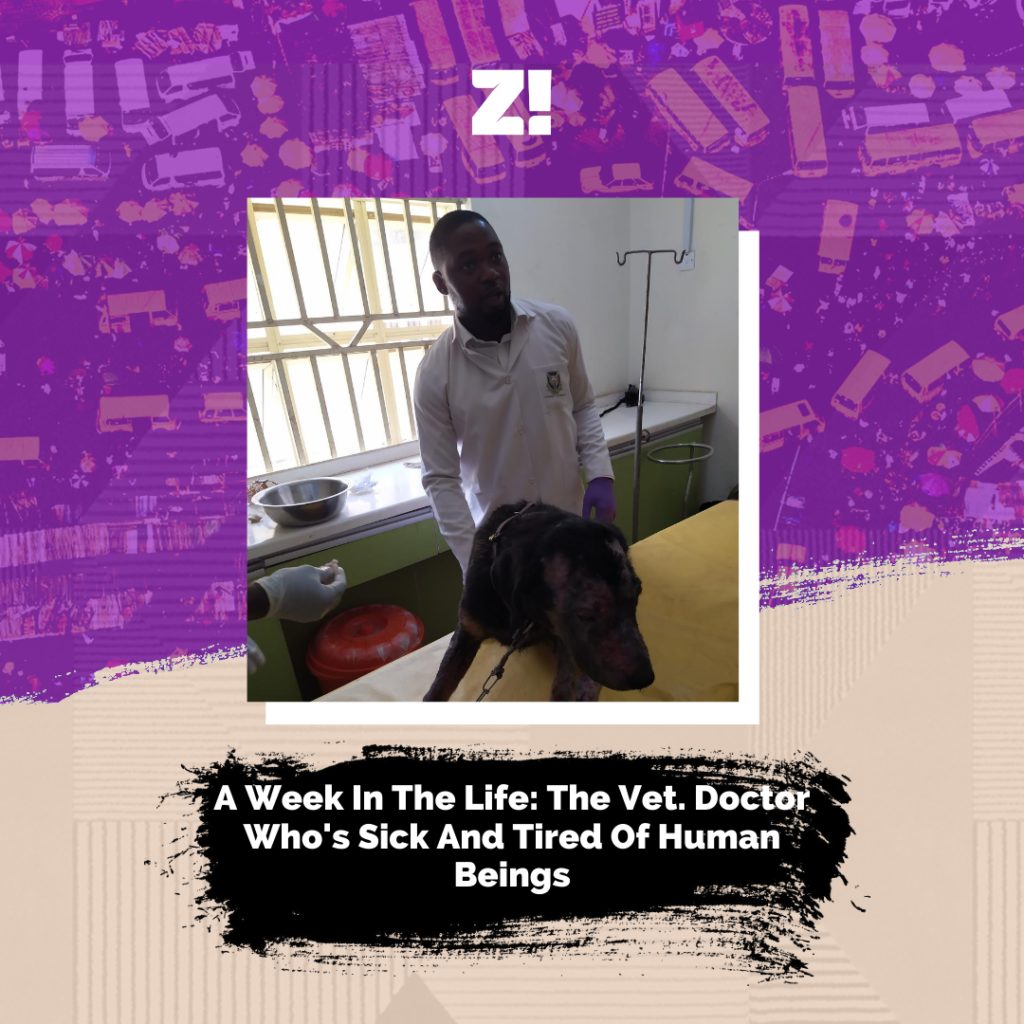
  • A Week In The Life: The Vet. Doctor Who’s Sick And Tired Of Human Beings

    “A Week In The Life” is a weekly Zikoko series that explores the working-class struggles of Nigerians. It captures the very spirit of what it means to hustle in Nigeria and puts you in the shoes of the subject for a week.


    The subject for today is Dr Asekun Ajibola, a veterinary doctor. He talks about being frustrated with the elders in his profession, the hidden dangers with the meat we consume, and his ticket out of all this mess.

    MONDAY:

    I wake up by 5:30 am on most days. Sometimes when I’m extremely tired, like today, I don’t stand up until 6 am. After leaving my bed, I do some house chores and then iron my shirt for the day. I’m lucky that I live only 30 minutes away from work, so, when I’m done having my bath and dressing up, I still have time. I resume work by 8 am and it’s just 7 am, so I decide to pass the time by reading.  As a veterinary doctor, it’s important to read every day if you want to avoid disgrace. Many people who bring their pets to the clinic have already googled their pets’ symptoms extensively and it’ll be embarrassing if you can’t answer their questions. Also, as a result of the ignorance surrounding this profession in Nigeria, we constantly have to prove ourselves.  

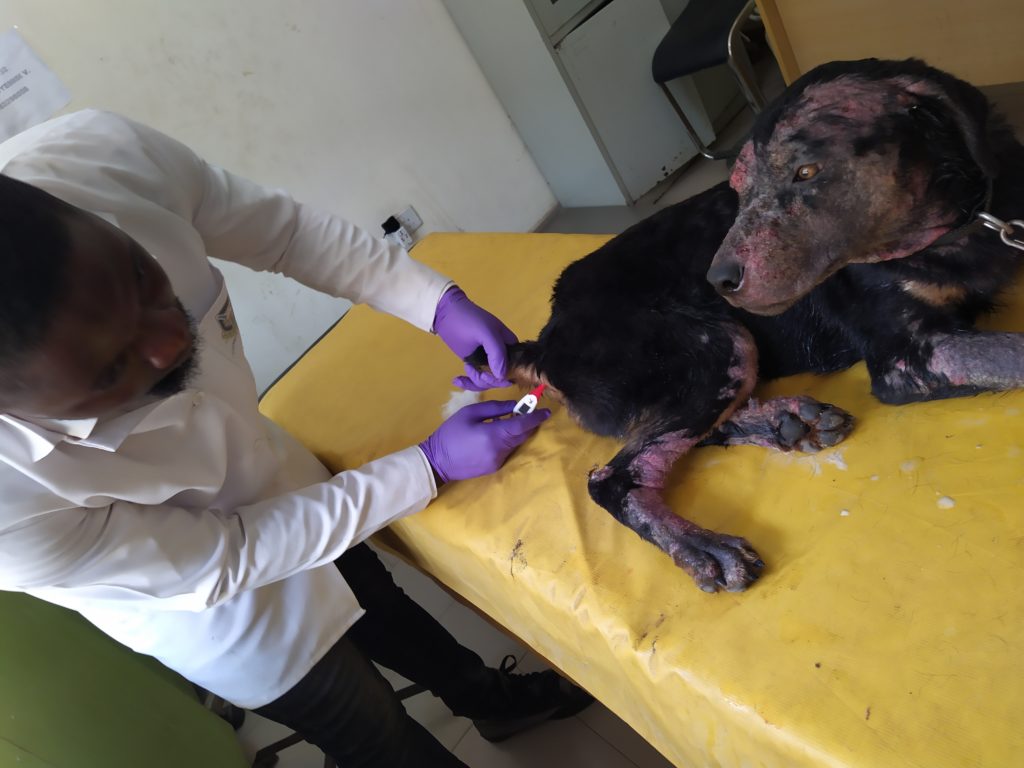
    You’ll hear people say that they’ve never been to a vet clinic before or that they didn’t know it existed. You’ll also hear people ask how can they keep pets or afford my services when they haven’t eaten well themselves? I’m used to these things so I just shrug it off. It doesn’t take away from the fact that I enjoy my job. For me, the best part of my job is trying to deduce what’s wrong with an animal.  Everyone knows that animals can’t speak so you just have to observe the animal and ask the owner questions. Sometimes, we discover that owners are not observant and they don’t know what’s going on. Figuring out what’s wrong with the animal with little or no help at all always makes me feel like a superstar. 

    I’ll never forget the day that they brought a monkey to the hospital. It had been stooling and vomiting and for a while. The little guy was weak and at some point, we lost him. I remember having to do chest compressions to manually pump his heart back to life. It was a big deal for me because, before that incident, I’d never treated a monkey. Obviously, we read about them and wrote exams on them, but I’d never had that practical feel. 

    I remind myself to stop daydreaming and focus on my reading. Because of the nature of my job, I can’t predict how my day will be. It’s better to read what I can now because once I’m done, my day officially begins.

    TUESDAY:

    When I tell people that I’m a vet, the first thing they want to know is if I’ve been chased by a dog before. I tell them that the answer is yes. And they always sound surprised. I don’t know if people think that because I’m a vet, the dog automatically knows so it won’t chase me. The dog thing is even a stereotype because we also treat birds, fishes, rabbits, all kinds of animals — how many people do I want to tell? I just indulge them and tell them my story of being chased by a dog.

    It was after my NYSC and I was trying to hustle some money. A friend reached out to me that someone needed to vaccinate her dog who had missed his routine vaccine. I agreed to go because I needed the cash. On getting to her house, the dog [caucasian breed] was already barking and wrangling the cage. I told the lady to hold her dog well and she agreed. She brought the dog out and hooked the chain to its collar. I don’t know what happened, maybe she wasn’t holding the dog well, but it slipped from her hand.

     Our senior colleagues had told us several times to ask for an escape route once we get to a client’s house. For some reason, that day, I totally forgot.

    As the dog charged towards me, adrenaline spiked in my body. There was a tree inside the house that till today, I don’t know how I jumped on. I can’t explain how I was able to jump that high. I stood on the branches looking down.

    The girl was like “are you not a veterinarian?” and I was very angry. Does the dog know that one?  If a dog is coming at you furiously, what kind of training do you expect them to give us in school to overcome that situation? I had to tell her to calm her dog down.

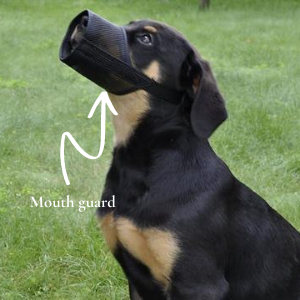
    I instructed her on how to wear a mouth guard for the dog and I didn’t approach until the dog was properly restrained. Since that time, it’s always at the back of my mind. Anytime I go to someone’s house, I’m always like “bro/lady, please leave the door open. Don’t lock it so that if anything happens, I can run.” You can lose your life because some dogs are wicked and they’ll go straight to your neck where your jugular vein is located. If they bite down, you’re dead. Assuming you’re in a country with good medical facilities, you can still survive. But in Nigeria? – There’s no reward for bravery. Your life’s on the line and you have to be careful.

    All these are not my problem for now. My problem today is getting to work because I am tired.

    WEDNESDAY:

    I’m working late today. Ideally, I get off work by 6 pm. But someone brought in their pet by 5:50 pm so we had to stay back to treat. It was an emergency where we had to perform surgery. It’s sad that even though I work 8 am – 6 pm from Monday to Saturday, and sometimes, even Sunday, my profession is not recognised in this country. The job takes so much of your time, and you sacrifice so much, but you get nothing in return.

    The case of veterinarians in this country is pathetic and discouraging. As a vet, how many youths know about us? How many people have visited the clinic? There are a lot of things we are lacking in this profession. When you finish school, the surest route is to become a lecturer because you know that you’d get paid reasonably well, or you go into private practice. Some people who run farms and big poultry farms will employ like three vets to monitor and diagnose diseases and even formulate feeds.

    Veterinary medicine is wide, but in Nigeria, the opportunities are limited. Vets are supposed to be a part of food safety – For example, in abattoirs where they kill cows for their meat, there are so many zoonotic diseases that can be gotten from animals. Vets ensure that meat not fit for human consumption is flagged. In this country, if they condemn your cattle because the animal is diseased (it has a communicable disease) the government is supposed to compensate the farmer at least 60% of the worth of the animal. But nobody will compensate you in this country. A lot of times when vets condemn the meat and bury it, the farmers will go to where it’s buried to fetch it so they can sell. In some cases, to prevent this from happening, the vet will compensate the farmer out of pocket. 

    If you’re working in a hospital or abattoir, you work every day. So, there’s literally no break and it’s just like human medics. You can’t plan your schedule because you can’t plan sickness. People can bring their pets anytime. 

    It’s very annoying because some of the older colleagues meant to be fighting for us are only fighting for their pockets. As long as they are getting paid higher than human medic[doctors], they are happy and they don’t care what’s going on. However, we still have some fighting for us despite everything. If you ask a young vet for their plan, you’ll hear that they either want to become lecturers or get employed by the Ministry. If none of this happens, there’s no future. Whenever I see human medics [medical doctors] who have a thousand times the opportunity we have leaving this country, I just shake my head for my profession. Thankfully, we have the japa route and that’s what people are now looking at.

    What me I’m looking at is time. I just want to finish documenting this treatment plan so I can go home, turn on Netflix and just chill with my Blacklist series.

    THURSDAY:

    Today, at work, I can’t help but think about Nigeria. I keep thinking about the fact we’re in trouble and many people don’t even realise it. For example, a high percentage of the meat we consume has antibiotic residue in it. This is because cattle are mostly reared by people who don’t understand the implication of things. What happens is that these people treat their animals with antibiotics like metronidazole [flagyl] which is banned in animals meant for consumption. The worst part now is that they treat animals with these drugs a day before they are meant for slaughter. There’s not enough withdrawal period for the drug to leave the animal’s body so the drug stays in the meat. This is where vets are supposed to come in because we have kits that can detect these residues in dead animals. But then, you’ll see that a state like Lagos which slaughters the most amount of cattle per day has like only 8 – 12 vets on its payroll. How do you now expect these people to monitor everywhere?  It’s even worse because poultry animals are also given these antibiotics and those ones can be slaughtered anywhere. At least cattles are still slaughtered at the abattoir. 

    Maybe when we say we’re not feeling fine and we need some antibiotics to help us feel better, they’ll say we are resistant to them. The sad part is that it’s as a result of what we are eating because people don’t value our services. But, will I now say that I won’t eat? 

    In fact, let me go and eat because it’s time for lunch. Thank God that the work is light today. 

    FRIDAY:

    Today, I wake up tired. I’m always tired but I still have to show up at work. I remind myself that it will get better and the situation won’t be like this forever. I am sure because I am hardworking and I don’t give up.

    It’s just sad that I spent 6 – 7 years in school [including strikes] alternating between clinics, class, internships, and studying. There was no time for anything else. Only to come out and realise that I don’t have any other skill outside of my certificate. In an ideal society, a certificate should be an optimal meal ticket until the day you die. You shouldn’t need to stress yourself about trying other things unless you want to. I believe that as a vet, your job should be able to afford you the basic needs in society. However, that’s not the case here: Many times, if you don’t have any other skill and you’ve expended all your energy getting the certificate, you just have to die on the line in this profession. 

    Another alternative for many of us is school admission so we can leave. With the way things are going in this country, it’s a surprise that vets still exist at all. Obviously, I’m not really surprised because we are trained to be versatile. That’s why we are all trying to learn new skills no matter how hard it is.

    Personally, the skill I’m learning is to japa; to get out. The hope that it’ll get better kills Nigerians faster than anything. On the one hand, a little part of me is hopeful that things will get better. On the other hand, I’ll also like to go somewhere where people know my worth, I’m comfortable, and they appreciate me. My work should speak for me and I shouldn’t have to struggle for recognition every time. I’m still looking forward to a Nigeria where people recognise vets and give us the respect we deserve. 

    All this won’t matter if I don’t get up from this bed. I have to rush because I’m running late for work.


    Editor’s note: Dr Ajibola says the 8-12 vets in Lagos is an estimate and may not necessarily be the reality.

    Check back every Tuesday by 9 am for more “A Week In The Life ” goodness, and if you would like to be featured or you know anyone who fits the profile, fill this form.