Notice: Function _load_textdomain_just_in_time was called incorrectly. Translation loading for the wordpress-seo domain was triggered too early. This is usually an indicator for some code in the plugin or theme running too early. Translations should be loaded at the init action or later. Please see Debugging in WordPress for more information. (This message was added in version 6.7.0.) in /home/bcm/src/dev/www/wp-includes/functions.php on line 6121
caregiver | Zikoko!
  • I Paused My Life At 18 To Take Care Of My Terminally Ill Sister

    As told to Hassan.

    A couple of weeks ago, I overheard a doctor talking to an ex-patient. The tenderness in the doctor’s voice piqued my curiosity. During the course of the conversation, he sounded incredulous because someone had died. For someone so used to death and dying, the doctor was visibly shaken. A few prodding questions, a couple of phone calls and consent later, I had the story that led to this article. 


    My sister died at 11.47 p.m. on Friday. I’m not sure what her last words were, but she must have probably called out for me, saying, “Mummy, don’t leave me.” 

    Mummy? I can tell that you’re a little confused. To understand why she used to call me mummy, we need to go back to the beginning. 

    ***

    4 years ago:

    My sister was a vibrant, playful, four-year-old child. At least until the pain came. Young children in pain can’t fully express themselves with words because of their limited vocabulary. However, they show discomfort by either writhing in pain or becoming dull and withdrawn. In my sister’s case, it was the latter. She quickly became a shadow of herself; solemn and reclusive. Her withdrawal worsened so much that her dad, who’s actually my brother, had to beg me to take her to the hospital. 

    My first question was, “Where’s her mother?” to which he replied, “She abandoned me and ran off with another man.” — we’ll get to her uselessness later.

    So, thus began our journey of doctors, syringes and repeated rounds of diagnostic tests.

    ***

    Everyone who saw us at the hospital always asked: “Is she sick?” or “Is she visiting someone?” To which I smiled and responded, “She’s sick.” The next thing was for them to say: “How can a child this active and pain-free be sick. What’s wrong with her?” With a tight smile, I’d say: “Nephroblastoma“, pause, and add “a cancer of the kidneys.” The response would be a characteristic “Oh…”

    Another question I always got was “Who’s she to you?” To which I’d reply, “my sister.” Since we were related by blood [her dad, my brother], I preferred calling her sister rather than my niece.

    It took us six months before we got her diagnosis. In that period we had gone from one general hospital to another in Lagos before finally landing at the University of Ilorin Teaching Hospital. This change had required leaving my job in Lagos to take of her for six months in Ilorin. In that time frame, we experienced one major surgery, numerous rounds of chemotherapy, multiple blood transfusions, and various forms of brokeness. 

    Her dad would shuttle between Lagos and Ilorin and send money, grudgingly. 
    630 Nigerian Children Stock Photos, Pictures & Royalty-Free Images - iStock

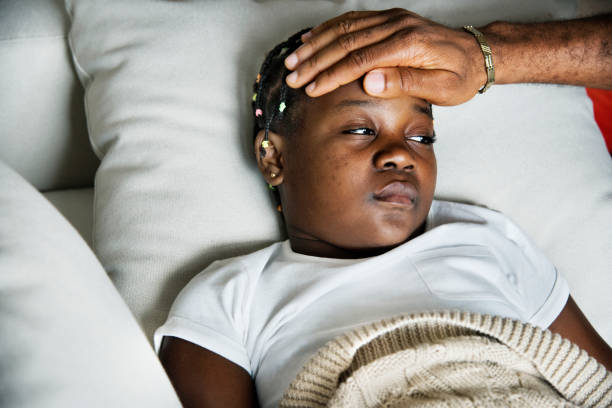
    Her mother simply never showed up or called. The most effort she made was to send her sister to take a photo of the sick child. 

    My sister got tired of waiting for her mother to show up, and she started to say: “Iya Amirat [name of my sister’s immediate older sibling] didn’t come to see me, so she’s not my mummy. You’re my own mummy.”

    This newfound bond made things tricky for me because she was always scared that I’d leave. She never let me out of her sight. She’d follow me if I had to go buy medicines, or even if I was going to the toilet. One time, she yanked off her drip because I was going to get medicine outside the hospital compound. She was definitely not letting her new mummy go so easily. 

    One thing that struck me about that period was that all the kids in the ward who had similar symptoms as my sister died. Some died while on admission, others, like my sister, died after a brief period of recovery. The doctors kept asking if we lived near a refuse or telecommunication mast or anything that might have predisposed her to the illness. To which I always answered, “No”. Then they’d scratch their head trying to figure out how best to help her. 

    The solution always came back to chemotherapy.

    One round of treatment cost us ₦15,000. And she had to undergo treatment three times a week. This was minus treatment for some of the side effects of chemo, and minus the tests she had to take before starting chemo. Every treatment cycle involved her hair falling out, a bout of malaria, a lot of blood samples, and her dad complaining that he didn’t have money. 

    When her dad asked us to return to Lagos, I didn’t put up a fight. At that point, I was tired of his complaints and I was also tired from uprooting my life. That’s how we abandoned the treatment halfway to restart our lives in Lagos. 

    Things were going well until one year later when the illness returned. Before then, she had returned to her playful self. I had also been saving from my salary to finally attend University. Our fairy tale was shattered because the sickness came back with twice as much force. Her breathing was the first to struggle, then the pain came along.

    Once again, we found ourselves back at the hospital from which we had run.

    ***

    We had barely spent a week in the hospital when my sister gave up. I’ll never forget the time because at 11:30 p.m. on that day, I had rushed to the pharmacy to get some drugs for her. At that point, she was already gasping for air. The doctor met me on my way back from the pharmacy and pulled me aside. She told me, “Your sister has given up.” I replied, “Is she sleeping?” Then the doctor said, “She’s dead.” To which I replied, “Dead bawo?”

    At that moment, I wanted to give up. I felt betrayed. After all we had gone through, she abandoned me. How could she be gone like that? I had just asked her a few minutes ago what she wanted to eat, and she had responded. What happened to our promise of beating this illness together? Did those words hold no meaning to her? 

    Looking back, the signs were there that it was her last week. She had to bend to breathe, she was always in pain, and had to lie in the foetal position to be comfortable. But we had passed through worse, so I thought this too would pass. 

    I take consolation in the fact that God knows best.

    ***

    Pain ages people. It turns adults into wizened old people, and it makes adults out of children. Part of the reason I miss my sister a lot is that we related like age mates. Even though I was eighteen at the time and she was barely five, we found a lot of common ground in conversation. I found that I could talk to her about my struggles and she could also confide in me. 

    In addition to her precociousness, she was also smart. My sister knew the name of her favourite doctors, the name of tests like Full Blood Count, or medical jargon like PCV. She also quickly learned to associate hospital gates with a lot of pain. 

    There were also extreme mood swings where things got thrown at you. Or she could become so lively and animated that you had no choice but to participate in her joy. 

    I sometimes feel guilty that her father didn’t have enough money for us to stay back and finish the treatment. Then I also get angry that her mother never showed up. In her short life, my sister learned that pain could be both physical and emotional. For that reason alone, I can’t ever forgive her mother. There’s a part of me that still believes that if her mother was present she might have held on for longer.

    I’m grateful for the experience. I’ve come to understand how precious the gift of life is. I’m grateful for the time I got to spend with my sister, however short. Most of all, I’m grateful for the privilege to be the mother she never had.


    Editor’s Note: 

    Balikis, the subject of the story shared her story to spread awareness of Nephroblastoma and to also seek ways the Nigerian government can help in the early detection of the illness. 

    [donation]

  • “We’re All One Sickness Away From Poverty” — A Week In The Life Of A Caregiver

    “A Week In The Life” is a weekly Zikoko series that explores the working-class struggles of Nigerians. It captures the very spirit of what it means to hustle in Nigeria and puts you in the shoes of the subject for a week.


    The subject of today’s “A Week In The Life” is a medical practitioner who has been taking care of a sick parent since last year August. He tells us about the frustrations of the healthcare system, the mind-blowing financial costs and the emotional tolls an illness exerts on a person.

    MONDAY:

    My days are so similar that they’ve become a blur — it starts at 6 a.m. and ends at 9 p.m. From the minute I wake up and take my bath, I’m running errands: get X tests done here, buy Y drugs at another place, run to Z place to get blood. I’m always on the move because there’s usually a lot happening with a sick person. My first errand today is buying antibiotics outside the hospital for my dad. I start my waka by making a few calls to pharmacies to compare the prices of the medicine. After securing a decent price, I make arrangements for pickup and delivery.

    It’s 4 p.m the next time I look at a clock. Between running around to pick up medicines and calling my mum for updates about my dad, I wonder where my day went. I also don’t remember if I’ve eaten today. But I don’t have time to ponder over this because I have to take over from my mum in the ward — we alternate the cleaning and feeding of my dad — while she goes home. Depending on my dad’s mood when I’m done feeding him, we either have a conversation or he asks to sleep. He’s in the mood for a conversation today, so I pass time with him while waiting for the doctors to start their evening rounds. I can’t wait to leave the ward, get food and sleep because the cycle begins again tomorrow.

    TUESDAY:

    When the doctor told me that my dad’s condition was multiple myeloma, I cried because I had no one to vent to. Multiple Myeloma is a cancer of plasma cells, and one of the symptoms is brittle bones. The damage to my dad was so bad that his hip removed from its joint. I’ll never forget the days leading up to his admission at the hospital. We were always home alone [Mumsi had to go to work]. One morning, I broke his hand while trying to move him from the bed to a chair. One minute I was trying to move him and the next, I heard a loud kpa sound. I was so scared because I had never seen so much shock and pain on my dad’s face before. For his sake, I had to compose myself and reassure him that it’d be okay.  I called his physiotherapist immediately I left his room, shouting, “My daddy’s hand has broken. It has broken.” Even though the physiotherapist gave me first aid tips, my mind was still not at rest. I experienced flashbacks where I’d relive the memory of the bone breaking throughout that week. In the middle of a task, I’d hear the kpa breaking sound and become sad all over again. This memory is why I can’t complain about the hospital stress because I know whatever pain I’m going through, my dad is going through times ten of it.

    It’s sad to say this but I’d been shielded from reality as a medical practitioner before this. Being on the other side has shown me what patients and their relatives pass through. My mum and I had to rent a hotel outside the hospital because the “living area” allocated for patients’ relatives is jam-packed because we’re in the middle of a pandemic, and the general building design is not old people friendly. 

    One time my dad needed blood and I kept following up with the blood bank for three days without show. It wasn’t until the fourth day when I went to the blood bank with a friend, who was a medical practitioner in the hospital, that they finally attended to my dad’s case. I was livid and people had to hold me from losing my shit. It’s crazy that I had to know someone to get blood. Since that day, I started wearing my scrubs to the blood bank and the ward since we’re all mad. 

    WEDNESDAY:

    My dad got admitted at the hospital on a Thursday, and I remember thinking to myself: “The health care system is fucked.” My first introduction to the anyhowness of the system was when I had to carry my dad on a wheelchair to the last floor twice. Apparently, there was light but the elevator wasn’t working. I know I paid at least nine people ₦500 here and there to either help me lift my dad or fast track his settling in. That first week was also difficult because we didn’t have access to my dad except during visiting hours, and he required constant attention. In retrospect that first week wasn’t bad. At least compared to the weeks that followed. We still had peace, and he was still responding to chemotherapy. If only we had known that the coming weeks would show us pepper. 

    THURSDAY:

    You’re one illness away from poverty doesn’t hit home until it happens to you. It can only be experienced, not explained. When my dad got admitted, I thought we’d just do chemotherapy then surgery and we’d be done in a month. LMAO. 

    After the surgery, it has been one complication after another — respiratory distress, swelling of the body, low PCV. And we’ve had to run tests to locate the problem. At one point, I was averaging about ₦60,000 per day on tests and drugs. Then we had to switch him to a class of antibiotics because of postoperative complications, which cost ₦10,000 for one. I died when the doctor said he was going to need 15 vials. This is minus surgical implants, diapers, money for surgery, dressing gauze, irrigation solution for wound dressing. It was that day that it clicked in my head why my customer told me I had spent over a million naira on drugs alone. Illnesses are not only financially draining, they also drain you emotionally. I’m constantly having to reassure my mum things will turn out fine. Today, one of my uncles was crying over the phone because he couldn’t send money to help us, and I also had to reassure him that it’d be fine. The curse of being an only child is having to be strong for everyone even when you’re clueless about how to get money for drugs. 

    Same today the nurse came to tell me that my dad exhausted his Clexane [a drug to prevent bedridden patients from developing a clot] and I couldn’t say anything because it’s a non-negotiable daily drug. At ₦2700 per vial, we’ve been buying the drug for him every day for almost seven weeks. I’m at my wit’s end, and I’m tired of this place. Even though it’s less than two months, it feels like I’ve been here for six months.

    FRIDAY:

    My mum is a superwoman abeg. Has she been scared? Yes. Has she been composed? Yes. Has she shown up? Double Yes. Her presence has made this ordeal a bit bearable.  I don’t feel completely alone anytime I see her. It helps that she’s a positive soul with so much good vibes. Sometimes she’ll call me to say “Daddy finished eating his food, and he ate it all by himself.” Other times I’ll see her petting my dad to eat and my dad pretending not to like the attention and fuss — he knows he can’t try serenre with me because I don’t have time. 

    Yesterday my mum was looking stressed, so I told her to go home early to rest. Today, she came back looking refreshed. I feel bad anytime I remember how this whole ordeal made me selfish to her. As a result of the emotional stress from running around, I didn’t realise I was transferring aggression to my mum. It wasn’t until a friend pointed out my aggression to me that I saw I had been too caught up in how I was feeling to remember that my mum was feeling the same way too. I apologised to her, and I’ve become less selfish. I like how refreshed she looks so I’m going to tell her to take a few more days off. I really can’t afford for both my parents to break down at the same time. I can’t afford it.

    God, I know I’ve questioned you during this period, but I pray my dad’s quality of life goes up and he gets better. We deserve this rest. I haven’t gone home in seven weeks, and I’m looking forward to sleeping on my bed. I miss my friends. I miss my old life. I just want things to go back to normal. 


    Check back every Tuesday by 9 am for more “A Week In The Life ” goodness, and if you would like to be featured or you know anyone who fits the profile, fill this form.