Notice: Function _load_textdomain_just_in_time was called incorrectly. Translation loading for the wordpress-seo domain was triggered too early. This is usually an indicator for some code in the plugin or theme running too early. Translations should be loaded at the init action or later. Please see Debugging in WordPress for more information. (This message was added in version 6.7.0.) in /home/bcm/src/dev/www/wp-includes/functions.php on line 6121 Canada | Zikoko!
On Monday, January 23, 2024, the IRCC — Canada’s department responsible for immigration matters — announced that the Canadian Government is setting a cap on the intake of international students, among other immigration law changes.
According to a statement from the department, the decision became necessary as “the integrity of the international student system has been threatened”. The influx of international students has put pressure on housing, healthcare and other services in the country.
Canada remains one of the top destinations for Nigerians looking to relocate in search of greener pastures. So if you’re a Nigerian considering Canada for your studies or relocation plan, here’s what you should know about the latest development.
No more spousal work permits for undergraduates
The IRCC will stop granting work permits to spouses of international undergraduate students. Spouses of international graduate school students or students taking a professional programme (medicine or law) remain eligible for open work permits.
A cap on study permits
The IRCC plans to approve approximately 360,000 study permits in 2024, a 35% decrease from 2023. This intake cap will last for a period of two years. 2025’s limit will be announced later this year.
[ad]
Provincial study permits based on population
The IRCC will apportion study permits to Canadian provinces based on their population. The provinces will be free to distribute the study permits across the available learning institutions authorised to admit international students. Henceforth, study permits submitted to the IRCC will require an attestation letter from the province or territory. A process for applying for an attestation letter will be announced before March 2024.
No postgraduate study permit for graduates of private career colleges
According to the IRCC, starting on September 1, 2024, international students who physically attend private career colleges that have been licensed to deliver the curriculum of a public college will no longer be eligible for a postgraduate work permit after graduation.
The Nigerian experience is physical, emotional, and sometimes international. No one knows it better than our features on #TheAbroadLife, a series where we detail and explore Nigerian experiences while living abroad.
For this week’s Abroad Life, we’ve decided to give potential Canadian residents the do’s and don’ts on navigating their financial life in Canada, so you don’t have to.
Nigeria is not the easiest country to live in. Traffic jams, irregular power supply, unemployment, poverty etc are some of the many stumbling blocks in the average Nigerian’s way — which is why they are desperate to leave.
Canada, amongst other countries, is one of the promised lands for a japa aspirant. But it’s not enough to travel there. How do you navigate important aspects like finances?
We decided to explain a tweet that broke it down for you, so you don’t have to:
Setting up the BEST bank account
To set up a regular bank account, you’d need a visa or passport, immigration papers, Social Insurance Number (SIN) (if you have one) and address verification.
This consists of a temporary residency permit, your Confirmation of Permanent Residence (COPR), or your work or study permit.
However, you must know the rates involved to set up the best bank account.
Using newcomer rates from any bank is risky because there is a tendency to pay higher interest ratesonce the deal expires.
To avoid this, use the website ratehub.ca to find banks that can give the best rates after your first-timer deal expires.
Build up good credits
Unlike Nigeria, Western countries are very particular about credits and how one manages them.
Credit is a flexible form of finance that allows you to access a certain amount of money loaned (known as your credit limit) according to your needs, at any given time.
Credits are maintained when the user makes timely payments and doesn’t exceed the credit limit. Credits are necessary to buy a home, rent an apartment, or get a car loan.
Get a secured credit card from your bank, and understand credit before using it.
Always file your taxes
Unlike Nigeria, Canadians take accounts of government taxes very seriously. But as a newcomer, it could be difficult wrapping your head around the math.
Most new immigrants to Canada tend to take the first available job without research — which is not entirely the best.
Understand the Canadian job market, network with people, and get recognised certifications. Take a job that pays what you deserve. You can visit the website here for more steps to get a good-paying job in Canada.
The Nigerian experience is physical, emotional, and sometimes international. No one knows it better than our features on #TheAbroadLife, a series where we detail and explore Nigerian experiences while living abroad.
This week’s Abroad Life subject decided to quit her banking job in Nigeria and become a permanent resident of Canada in 2004. This was after she had stayed in the country as a visitor for eight months due to a series of fertility treatments. She tells us her motivations for leaving Nigeria, how she got her permanent residency papers in Canada and the ups and downs of residing there.
What was your motivation for moving to Canada?
Two things motivated me — safety and fertility treatments.
Safety was a huge priority for me. The crime rate was increasing, with no one being safe from thieves and armed robbers no matter where they found themselves. In Nigeria, I was a banker who sometimes worked late into the night. I was robbed of my gold jewellery twice, and money at gunpoint while waiting in traffic. From then on, I grew from disliking to hating the Nigerian government. I felt I could lose my life at any time. This is not exclusive of the poverty, corruption, bribery and what-have-you that cripples the country daily.
I also had a series of fertility treatments for eight months, as I had one child and was hoping for another. But during that period, I found out that the immigration system in Canada was friendly, and one could process their papers for permanent residency. I immediately latched onto the opportunity to find a better future for myself and my family in Canada.
Wow! How would you describe the healthcare you received?
The good thing with Canadian doctors is that you can be sure you’re in good hands. Their healthcare is excellent. The doctors also fear lawsuits and wouldn’t like barking up the wrong tree. Everything is so precise and professional. It was even done in a government clinic, not a private one, so I could trust that the doctors would be honest (since they weren’t gaining anything). Usually, you’d need to pay with health insurance, but since I was still considered a foreigner back then, I paid in cash. It wasn’t expensive at all.
Nice! So how did you process your migration?
I was on a temporary visa and didn’t reside permanently in Canada immediately. After undergoing the treatments in 2003, I then asked my employers at the bank for more time on my maternity leave. But they refused to give that extra grace.
Because of that, I resigned.
Since the work pressure was gone, I focused on finding ways to get permanent residency in Canada. I found a lawyer who advised me to process my papers through the “skilled worker” class. At the time, there was a self-test to see if one was eligible for the role, and due to my former role as a banker, I scored high marks in the banking category. This also helped me to get a great score overall on my assessment. I became the principal applicant for my family, and we permanently relocated later that year. I gave birth to my second and last child in the following year, 2004.
Did you experience any culture shocks?
Yes, I did.
Firstly, Canadians are not as warm and friendly as Nigerians. They love to mind their business a lot. It even affected my daughter because she started having an identity crisis — should she act Nigerian or Canadian? One must learn that not greeting or visiting people doesn’t mean they are bad. Some of them are not all bad, but most have this issue. In a way, this trait teaches you about self-sufficiency.
Are there benefits to living in Canada?
Yes, there are. Their education system is great. If you like to self-develop, this is the country for you. In Canada, you never stop learning. You’ll learn until you want to cry.
It’s also easy for you to transition career paths. I transitioned from banking to social work. I feel safer where I live in Ottawa. I can wear a gold chain to a party, I can be in traffic and not be afraid (unlike Nigeria). I can drive late at night, which profits me more because the roads are free. The public transportation system is very clean and cheap. It’s amazing here.
How did you make the switch from banking to social work?
I started working as a social worker in 2007 when I did my Bachelor’s degree in sociology here. In 2015, I decided to have a Master’s degree in Social Work, due to its lucrativeness.
I recently started working for the Ontario Government this month due to my social work service. It has been great so far.
That’s great! Are there any disadvantages to living in Canada?
The only thing I can think of is racism. There is a huge absence of racial diversity here. You can find 70 white students and five blacks in a classroom. The race count is always very disproportionate.
There was this one time during my Master’s that I noticed I was marked down in a particular course because I was black (I always got a B-), while my white counterparts would get an A+ for the same answers. I’d probably have graduated with a bad grade if I hadn’t confronted my lecturer. In the end, she started giving me an A+ after she realised I had caught her in the act.
However, I wouldn’t say it affects your chances of doing well in Canada. So long as you have the skillset and you’ve done your Master’s (they always favour people with a Master’s degree).
Would you ever go back to Nigeria?
Of course, yes. I miss Nigeria daily – the warmth, the parties, and the ability to get cheap local food. However, the only way I’d ever go back is if there is a change in government and a visionary leader. If things remain the status quo, I would rather retire here.
The Nigerian experience is physical, emotional, and sometimes international. No one knows it better than our features on #TheAbroadLife, a series where we detail and explore Nigerian experiences while living abroad.
This week’s subject on Abroad Life is a tech bro who was tired of life in Nigeria without income and power supply, so he decided to continue his education and find work in Canada. He shares his difficulties with managing expenses and making friends as an international student.
When did you decide to move abroad?
In 2019, a family member kept telling me about Canada and the opportunities I could get there, including a post-graduate work permit after school and higher chances of permanent residency than in most other countries. I wasn’t obsessed with it in the beginning, but a year later, I started to compare the pros and cons of living in Nigeria versus abroad. I realised I could build my tech skills, work, and get my master’s degree at the same time. Being in a country that works will also help, considering the power issues in Nigeria and all.
I should’ve applied in 2020, but after much procrastination, I applied in June 2021 and got admission two months after, in August.
What challenges did you face in Nigeria?
It started when I applied to study electrical engineering at a university and was given physics instead. I didn’t like it, but I had to study it for five years. It made me resent the whole system. Fast forward to a year after school in 2019, I got interested in tech and started learning software engineering full-time through paid online courses. But it wasn’t easy because of the power issues. There was hardly ever light where I lived in Lagos, so I always had to pay for a workspace. At that time, I wasn’t even working. My parents always wondered when I would get a job, but with my degree, I couldn’t get jobs that were good enough for me.
So, Canada. What was the relocation process like?
I had to get the necessary documents and secure my medicals. The visa application wasn’t so difficult because we had an agent “running” it for me, but you see the medicals? I was traveling to Abuja literally every week to get it sorted. I also had to bring proof of funds. The entire process took like four months to complete. You have to be highly meticulous when filling out your papers, otherwise, you could be made to restart the whole process. Plus, I’m a big procrastinator, so the process took so long.
When did you arrive in Canada?
Late in January 2022.
Did you experience any culture shocks?
Yes. Especially with respect to titles. No adult here cares about your “ma” and “sir”.
Also, I’d say making friends is hard here. In Nigeria, it’s easy to get people to help you with one or two things, but not here. You’re just on your own most of the time, and it’s dangerous because what if there’s an emergency? It can be a very solitary life here.
Don’t Nigerian communities offer assistance?
You’d be shocked that some Nigerians don’t want you to succeed. They’d rather not tell you about the system so you can suffer the way they did when they first arrived. It’s hard to find someone who’s loyal or trustworthy enough to call your friend, even among fellow Nigerians.
Can you share some of your experiences on this?
I was part of an Afro-Caribbean society when I first arrived, and I made friends with a Nigerian called Dapo. I remember wanting to learn tips on how to survive in Canada and always asking him questions, but he never made time to explain things to me. He was always busy and never picked his calls. Imagine how that felt for a new immigrant with no family here. I had to find my feet on my own.
What would you say are the benefits of living in Canada?
There’s a system that works for everyone. Even if you didn’t go to school, you can find a job that would pay the same thing as someone who went to school. School is almost a luxury or second thought here because it doesn’t affect your income level. I can also get drugs at a subsidised rate here. They allow students to ride public buses for free, using a card that’s valid until September 2023.
What are the disadvantages?
Managing finances and running costs is hard for a student. My rent is $900 a month. I earn $300 a week as an admin assistant in a call service company ($15 for 20 hours per day), and it’s not always assured. Some days, there may be no work, so I won’t get any money. I also pay taxes of $100 every month. The only thing helping me is that my parents send me money that covers some part of the rent. It’s hard to save because as I receive my income, it goes out almost immediately.
Getting a job was also very hard. It took nearly two months before I got one in Canada. This is because many international students are applying for the same jobs. I even had a friend who waited six months before getting a job.
How are you juggling work with school?
It’s not an easy task. I’ve had some sleepless nights. Most times, I have to discuss my class schedule with my manager so they can create a work schedule based on the days I’m free. Sometimes, I’d go to work in the morning and then have an afternoon lecture. I know some people who work overnight. You also need to be careful and set out time to cover up for the days you didn’t read, so as not to slack on your academics.
Would you ever return to Nigeria?
Yes, I definitely will. I miss the air and warmth of Nigerian people in Nigeria. Here, friendship seems forced. But I’ll return only after I’ve got my master’s degree, perfected my software engineering skills, and made some money. Nigeria is not the place you want to return to without a good job.
How much money do you think you need?
The way Nigeria is going, any amount of money I call right now may not be sufficient in the next two months or so. I don’t want to be too specific, but hopefully, I’ll return in the next four to five years or so, when I’ve made some millions.
The Nigerian experience is physical, emotional and sometimes international. No one knows it better than our features on #TheAbroadLife, a series where we detail and explore Nigerian experiences while living abroad.
This week’s #AbroadLife subject spent nine years in Canada, returned to Nigeria for nine years, and moved back to Canada in 2021. After all her tears, she’s settled in Canada again. And she has a lot to say about the dating scene there.
When did you first move to Canada?
The first time I came was in 2001 because my family had gotten Canadian permanent residence (PR).
But I moved for university when I was 17 in 2003. I had to first do one year of secondary school because I was too young.
Moving to another country at 17 sounds scary
Yeah. I was still a child. Thankfully, I had a soft landing. Because I came in as a PR, I didn’t have to worry about a student visa or pay international student school fees. I had healthcare, went to a private boarding school and got a $250 monthly allowance which, somehow, I finished every month.
Even though I knew my parents were rich, I still felt like the poorest in my school because of the type of people there. For example, I had a friend whose dad was an ambassador. She’d randomly invite her friends to stay with her at expensive hotels. Of course, I said yes every time. Another time, her dad was having a party outside the country, and a private jet came to pick her and five of her friends. I couldn’t go because I hadn’t become a citizen and gotten my passport yet.
When did you become a citizen?
I became eligible in 2005 or 2006, but I didn’t apply for citizenship until 2007. I got it in 2009.
What was uni like?
My course was a four-year programme. I started in 2004 and graduated in 2011.
ASUU strike?
LMAO. First of all, I never wanted to go to university. I just wanted to make furniture. That was my passion. But as someone with Nigerian parents, is skipping university even an option?
In my first year, I failed so bad, they advised me to take the next two semesters off. Because if I failed those too, they’d have to expel me. So for the summer semester of 2005, I was in Nigeria. After that, I returned to Canada. The next semester was the fall semester, and even though I wasn’t attending classes, I decided to write and help students do their research for money. I even told my dad not to give me an allowance so I could fend for myself. He still paid rent sha.
LMAO
In January 2006, I resumed and changed my major from psychology to social development and women’s studies. I was doing pretty well until I got pregnant in September the same year.
Ghen ghen
My dad disowned me. Then he changed his mind. But he made me promise I wouldn’t drop out. I tried my best, but sometime in 2007 when I was heavily pregnant, I dropped out.
What’s it like having a baby in Canada?
Oh, it was pretty great. I had my baby in a private room, with a great doctor and a jacuzzi, and I didn’t pay a dime.
Why?
My Ontario Health Insurance Plan covered it.
There’s an incident I can never forget. After I had my baby, I returned to school. I was pushing my baby in a stroller, struggling to hold my books at the same time, and a white girl walked up to help me. As we strolled, she began to complain about the prime minister taking away welfare, especially for a black single mother like me who must struggle to pay student loans. I was speechless. Why did she just assume all that? I was coming from a five-bedroom house my dad bought after I had my baby, in a brand new car my dad bought, to a school where all my fees had been paid.
Is that racism I hear?
LMAO, Canada can be very racist. I’ve experienced profiling here, but a lot of the time, I don’t know how to react. I’ve even been called the ‘n’ word while eggs were hurled at me from a moving car. This probably has nothing to do with my race sha, but white boys on skateboards robbed me of my purse with my phone and wallet when I was heavily pregnant.
Omo
In 2008, I decided to return to Nigeria, where I worked for a bit before returning to Canada to finish school in 2009. Between 2010 and 2012 when I returned to Nigeria, I did a couple of menial jobs.
Like…
First of all, I sold vacuum cleaners from door to door. While doing that, I learnt one of my biggest lessons living in Canada.
Tell me
I’ll tell you three, so people who want to move to Canada can know. First, don’t fill out forms that ask for social insurance numbers if they’re not directly from your bank. Even then, be careful. At my vacuum sales job, I gave them my social insurance number because I thought they needed it for payment purposes. Nope. Just like they can use it to pay, they can also use it to charge you. I was charged $3k for the demo vacuum even though I used it for their work.
The second is, before you move, get a letter from FRSC stating you can drive, so you don’t have to wait a year to get a license. Trust me, life is much easier here when you can drive around.
Third thing: Don’t open accounts for anyone. I once opened a phone account for someone, and they ran up a phone bill and didn’t pay. Never again.
Taking notes
After the sales job, I worked as a telemarketer. I could only do it for two months because, really, you can only get told, “Never call this house again, “n-word”” so many times. It was brutal, and I hated it.
Then I got a sales rep job at a store, where something happened that made me return to Nigeria in 2012.
What happened?
The major reason why I returned is I was tired of paying electricity and water bills for a five-bedroom house on my own. I could’ve moved to a smaller apartment, but it just felt like it would defeat the purpose of the house. Also, my child was five, and I’d been taking care of them alone for the most part. I broke things off with her father who lived in Nigeria the year she was born. I wanted us to reconnect with family.
At my store job, I met a Nigerian woman who told me she’d been working at another branch of the store for 23 years, and my future flashed before my eyes. I didn’t want to tell another Nigerian girl I’d been working at a store for 23 years, 23 years from now. I wanted to return to Nigeria and do something more.
What did you do?
I went to culinary school. I like working with my hands. From there, I built a career in Nigeria and even became a consultant for restaurants.
What did moving back feel like, though?
At first, I hated it. I was in a place with no sanity. One of the first things that got to me was the bad driving. My God, Nigerians are such terrible drivers. Then things like electricity, buying fuel, water and the Nigerian police, just made me hate living there. In Canada, things just work. People know the rules and follow them.
It took me a couple of years, but I eventually settled in Nigeria. In fact, I like to say I was at the best point in my life when I moved back to Canada in 2021. I had a good business making decent money, a group of close-knit friends I hung out with at least once a week, I was around family and had a nice apartment. It was beautiful.
Why did you move back?
Because I promised my child we would move when they finished JSS 3, so they could get used to the Canadian system before university. It was just time.
Was this move different?
Oh, absolutely. For almost a year, I cried every day. In the shower, in bed, while driving, tears. When I came in 2003, I was a student, so my life was pretty organised by the school system and whatever programmes they had. This time, I had to be responsible for myself.
Here’s another piece of advice for Nigerians trying to move to Canada: Move to a city. Especially if you’re coming alone — without a partner. I know cities like Toronto are more expensive, but if you move to a less populated area, loneliness will finish you.Trust me, I’ve been there. Texting and calling your friends and family in Nigeria is not enough.
For three weeks, the only person I saw was my child. You might say you have friends who live an hour away, but nobody wants to drive for one hour to visit you because you’re lonely. And you can’t drive to visit them because you’re busy. Just move to a place with lots of people.
Chai
Amidst all this loneliness, I had to work extra hard because the first restaurant job I found wasn’t even paying enough to cover rent. I had to cook and deliver Nigerian food on the side. Also, my credit score had become terrible when I wasn’t around, so I couldn’t even get a nice apartment or a brand new car. It was sha tough. And let’s not even get into the dating scene.
Actually, let’s do that
Both Nigerian men and women in Canada are suffering, but for different reasons. Nigerian women can’t find men, and they don’t want Nigerian men.
From what I’ve seen, Nigerian men come here and become comfortable doing mediocre jobs, earning not so well, and they don’t want better for themselves. Like why are you comfortable being a plumber or an Uber driver without any side hustles or plans for the future?
Have you seen the Nigerian women in Canada? It’s like Nigeria’s hottest women were handpicked and brought here. And these women are hardworking, jumping from job to job to increase their earnings. A foreign woman would probably be fine dating a plumber with no future plans, but not a Nigerian woman.
If men want to come here and whore around, they can do that. There’s plenty of fish in the sea. But the dating pool? The potential Nigerian men for Nigerian women to be in serious relationships with? It’s not looking good.
I’m sha currently seeing someone. But it’s not long-term because he wants children. I don’t.
Would you date a non-Nigerian?
If the person was African, I could try. There’d be some cultural similarities we could work with. But a white person? Nope. If my soulmate is a white person, I would like them to be assigned to someone else, please.
I have to walk on eggshells with white people because I hate having to replay scenarios or things they said in my head, wondering if they were making a casual comment or being racist. The lines could be so blurred.
Do you have an example?
At an old job, I was admiring some flower pots when my white boss said, “You’d like to steal them, wouldn’t you?” I know he wasn’t being racist, but not knowing how to react to situations like that can be stressful.
Recently, a white girl asked to touch my hair at a store. First, I politely declined, but when she asked again, I had to decline with a firmer tone. Now, I’m the rude black girl and probably a reason she sees black people differently. Those little cultural differences and blurred lines can just be frustrating jare.
Do you think you might move back to Nigeria?
Right now, I don’t think so. I’m here alone because my child had to move back to Nigeria after encountering some issues here. So when the time for university comes, they’ll return.
No more loneliness?
I moved to the city this year, so no. My brother’s house is a 15-minute walk from mine, I have friends I can visit not so far away, I’m happy and smiling now.
Wouldn’t you like to read a newsletter that helps you dig into all the good, bad and extremely bizarre things happening in Nigeria and why they’re important to you? Then you should sign up for Game of Votes.
Want more Abroad Life? Check in every Friday at 9 A.M. (WAT) for a new episode. Until then, read every story of the series here.
The Nigerian experience is physical, emotional, and sometimes international. No one knows it better than our features on #TheAbroadLife, a series where we detail and explore Nigerian experiences while living abroad.
This week’s subject on Abroad Life left Nigeria for the US in 2014. Last year, she moved to Canada. Why? The US has too much immigration wahala. She thinks more Nigerians should come to Canada because “things work” there.
When did you leave Nigeria?
Eight years ago, in July 2014.
That’s a long time ago. Why did you leave?
My parents wanted me to. I was already in my first year at Afe Babalola University, but they thought it’d be great to send me abroad instead. I saw a chance to leave Nigeria, so of course I took it
Was the US the only option?
For my parents, yes. For me, nope. I wanted to go to Hungary or Ukraine because that’s where people from my class in secondary school were going.
Expectation vs reality: US edition
First, I expected it to be colder. But I got there in the summer and visited my aunt who lived in California first, so it was definitely not cold. Also, I expected to find it hard to fit in because I was new. Imagine a 17-year-old moving to a new country on her own. But I found that people were nice, and I made friends easily.
Generally though, I didn’t have too many expectations.
I’d imagine moving at 17 was scary
Oh, it was. But thankfully, I’d been in boarding school since I was 10, so I was used to being away from my parents. Also, being away from home gave me a new-found sense of freedom I couldn’t get when I was in Nigeria, under the wings of my parents, especially my dad.
What did you do with your new-found freedom?
I just went to parties. That’s it. My home training didn’t allow me go too far.
So settling was easy for you?
I’m thankful for one thing, and that’s the two friends I made on the second and third day of school in Arkansas. They’re Rwandan and Congolese respectively, and they were my close friends throughout university. I’m still really close with one of them.
I’m grateful because many people don’t make friends that early and end up struggling with things like loneliness and even depression. Also, it was the beginning of me having only African friends throughout my three-year stay in Arkansas.
It’s giving racist
When you stay in a very white city in Arkansas, you encounter a lot of racism. It’s not the violent kind, but you notice an air around the white people like they think they’re better than you. They’re nice, but only from afar. There are also comments they make that just make you go, “What?”
Give an example
I can never forget this one. So on my third day in school, I was in the kitchen area, warming up some food, when a white student walked up to me to say hi. As the conversation went on, he asked where I was from, and I told him “Nigeria”. He said, “Oh, so your father must be the president then.” And when I said no, he said, “Oh, so vice president?” When I said no again, he just said okay and left. It’s like he was surprised a “regular” Nigerian could afford to send their kid to the US for school.
What of the Black Americans?
They have a thing where they act like they’re better than Africans. I remember one condescendingly telling me, “Oh, your accent is so thick and African”. I just kept them at arm’s length and rolled with my fellow Africans.
When I graduated and moved to California, which is more diverse than Arkansas, I made some Asian-American and white friends who were more open-minded. But still, no African Americans.
Why did you move to California?
For work. The initial plan was to study medicine after biology because in the US, you need a bachelor’s before you can study medicine. But med school fees were looking scary so I just decided to work and chase a Green Card instead.
Have you got it?
Nope. Immigration in the US is tough. I had to leave because I ran out of time and legal options, and refused to marry anyone for papers, real or arrangée. I moved to Canada in June 2021.
Have you been back in Nigeria ever since?
Only in 2016. My mum and siblings have all come to visit since I got here, but I haven’t seen my dad since 2016. I miss him.
Why’s he never visited?
I have no idea. He even got an American visit visa but never came. I want to visit Nigeria this December but these flight prices dey choke.
What’s the plan with Canada now?
I’m currently in nursing school, and I graduate in October next year. After two years, I can apply for permanent residency (PR) myself. That’s the plan. In the US, I would’ve had to find a job with a company willing to apply for on my behalf, and it’s a lottery, which makes it difficult to know how long it takes.
Canada vs America
For immigration, Canada is better. Healthcare, Canada wins. Safety, Canada wins. The people here are also much nicer. But for taxes, the US wins. They can finish you with taxes in this Canada. As a working-class person, it’s difficult to become rich off your salary because of how much you’re taxed. But I like to think about it like this; healthcare is free, so why not?
How do you qualify for free healthcare?
I have no idea. I think it’s a province-by-province thing. I live in Alberta, and healthcare is free here for students. But I don’t think it applies to students in Ontario.
You spoke about taxes. Do you have a job?
Unlike in the US, international students in Canada can work outside the school campus. So I work at a hospital, babysit and work in disability support. I get taxed for all three jobs, but I’ll get all the money back in December because my annual income is too low to fall within a tax bracket.
What’s your social life like?
Pretty great. I decided to move to Alberta because a close friend from secondary school moved and has lived here since 2013. We reconnected, and she’s introduced me to her Nigerian friends. Oh, and yes, there are a lot of Nigerians in Canada! I absolutely love it.
What do you miss most about Nigeria?
The food. Even when we cook Nigerian food here, it doesn’t taste the same.
What do you hate most about being in Canada?
Uhm… Just the fact that I’m a student. I can’t wait to graduate and get my PR. I went from studying biology in the US to hustling for Green Card for three years to moving here for school again. I can’t wait to finally finish and settle.
Yeah —
Oh wait! Canada is also bloody expensive compared to America. Food, petrol, everything. Expensive.
Do you think more Nigerians should move to Canada?
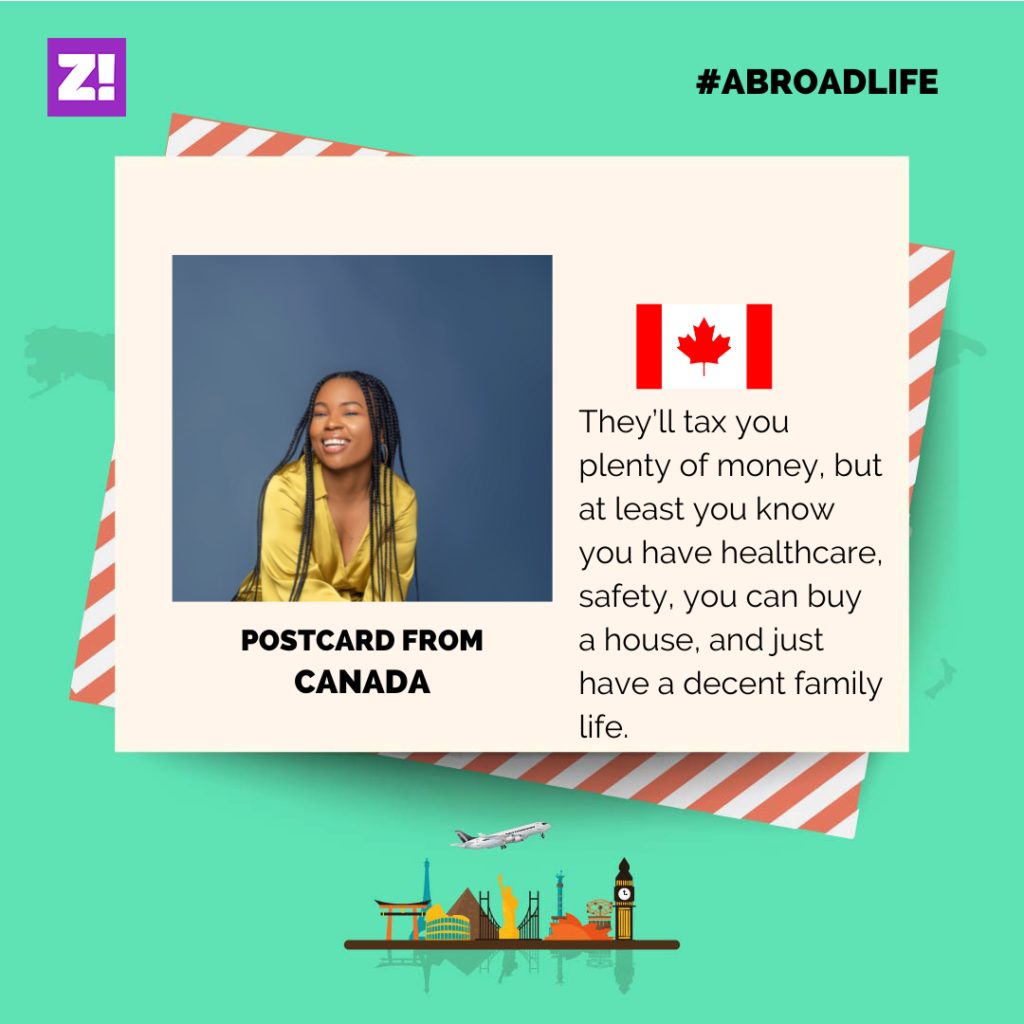
Absolutely. I have friends who moved here in 2018, got their PR in 2021 and bought a house this year [2022]. If you’re a hard worker, the system will work for you. They’ll tax you plenty of money, but at least you know you have healthcare, safety, you can buy a house, and just have a decent family life.
Want more Abroad Life? Check in every Friday at 9 A.M. (WAT) for a new episode. Until then, read every story of the series here.
Hey there! My name is Sheriff and I’m the writer of Abroad Life. If you’re a Nigerian and you live or have lived abroad, I would love to talk to you about what that experience feels like and feature you on Abroad Life. All you need to do is fill out this short form, and I’ll be in contact.
The Nigerian experience is physical, emotional, and sometimes international. No one knows it better than our features on #TheAbroadLife, a series where we detail and explore Nigerian experiences while living abroad.
If you worked with villages whose inhabitants had to order drinking water off Amazon but still avoided the internet like a plague, you probably wouldn’t think Canada is great. That’s the life of this week’s subject on #AbroadLife, and she can’t wait to leave.
When did you move to Canada?
January 2019. I came here for my master’s.
Why Canada?
First of all, I’d looked forward to moving out of Nigeria since I finished university in 2017. The plan was to move abroad for a master’s but not anywhere in Asia or the US.
Ah. Why?
At the time, I was dating a guy who lived in China, and he’d been learning Mandarin for five years. I’m terrible at learning languages so I couldn’t see myself going to a place where I had to learn a different language to survive. Then I’d read online, in books and articles, and found out from people who live in Asian countries, that Asians are very racist. White people still have some sort of political correctness with their racism, but Asians will clearly show they don’t like you. I stayed all my life in Jos and encountered many Chinese and Indian people; even in Nigeria, they aren’t nice to Nigerians.
At some point, I got a tuition-free scholarship in Germany, but I rejected it for the same language reason. I didn’t want to learn German.
What about America?
Omo, Trump was moving mad at that time. Immigration rules kept changing. It’s bad enough someone is an immigrant, but being an immigrant in a country that’s difficult for immigrants is a no-no.
What was the process for relocating to Canada like?
It went well until Nigeria tried to ruin it by restricting people from paying for anything more than $100 online. I had to reach out to an aunt in the US to help me pay.
Was that your first time abroad?
No. In 2010, I went to Scotland to visit my mum who was doing her PhD there. In fact, my sisters and I tried to move there to stay with her, but we were denied because the entire family wasn’t moving. My dad had decided to stay in Nigeria because he liked his job here, and the embassy thought we couldn’t be divided as a family.
A year later, a friend whose mum was also doing a PhD in the UK tried to move there with their siblings and without their dad. They got their visa. That’s when I knew visa decisions are between you, the immigration officer and God.
LMAO. Expectation vs reality: Canada edition
My expectation was everything would be smooth sailing; I’d come here, do my master’s, get a recognised degree, everyone would be dying to employ me and I’d build a great community of friends with like minds.
LMAO. This doesn’t sound like it ended well
Reality: I struggled to find a community, realised winter is a bitch no matter how many jackets you wear, fell in snow and ice multiple times, got my degree even though it cost me my entire mental health, and eventually realised job-hunting is hard.
I don’t even know where to start
LMAO. The thing with jobs is that different cities have different needs. So you can study development economics — like I did — and when you graduate, find out your city actually needs teachers and healthcare workers. Many foreigners find themselves in situations like this and struggle.
I —
Another expectation people have is they can visit all their friends who live in Canada when they get here. The truth is Canada is big, their friend probably doesn’t live in the same province as them and travelling costs an arm, a leg and a kidney. And they probably also won’t have the time to travel because they’re working all the time.
What about the community?
Black people are a minority in Canada. If you live in big cities like Toronto and Vancouver, you’ll see many black people. But if, like me, you stay in a more remote city, it’s like finding gold. It’s difficult to build community because white people here are unexposed. They hardly see black people, and they’re not well travelled or willing to learn about other cultures. So it’s just stereotypes and racism left, right and centre.
I used to go swimming a lot before, and my God, if you see the way children would gather at the pool and stare. It was obvious they hadn’t seen a black person before. And their parents’ reactions were always to drag them away and say, “Don’t stare. Don’t stare.”
There’s this thing people say about Canadians being the nicest people ever. On the surface level, it’s true. But when you live here for some time, you realise it’s all a load of bullshit. They’re just smiling and nodding; they’re not listening to the things you say. They’re just being nice for niceness’ sake.
Canada’s PR in the mud
Nigerians coming to Canada might also think there’s blazing internet everywhere here. LOL. In my region, there’s an entire 10-hour-drive highway with absolutely no network. They advice people to travel that highway with a satellite phone. Also, I work with villages, and they have just dirt roads.
You work in a village?
Yes. I work as a development economist for the local government, and my focus is on helping village businesses get customers so the communities can get better.
How’s that going?
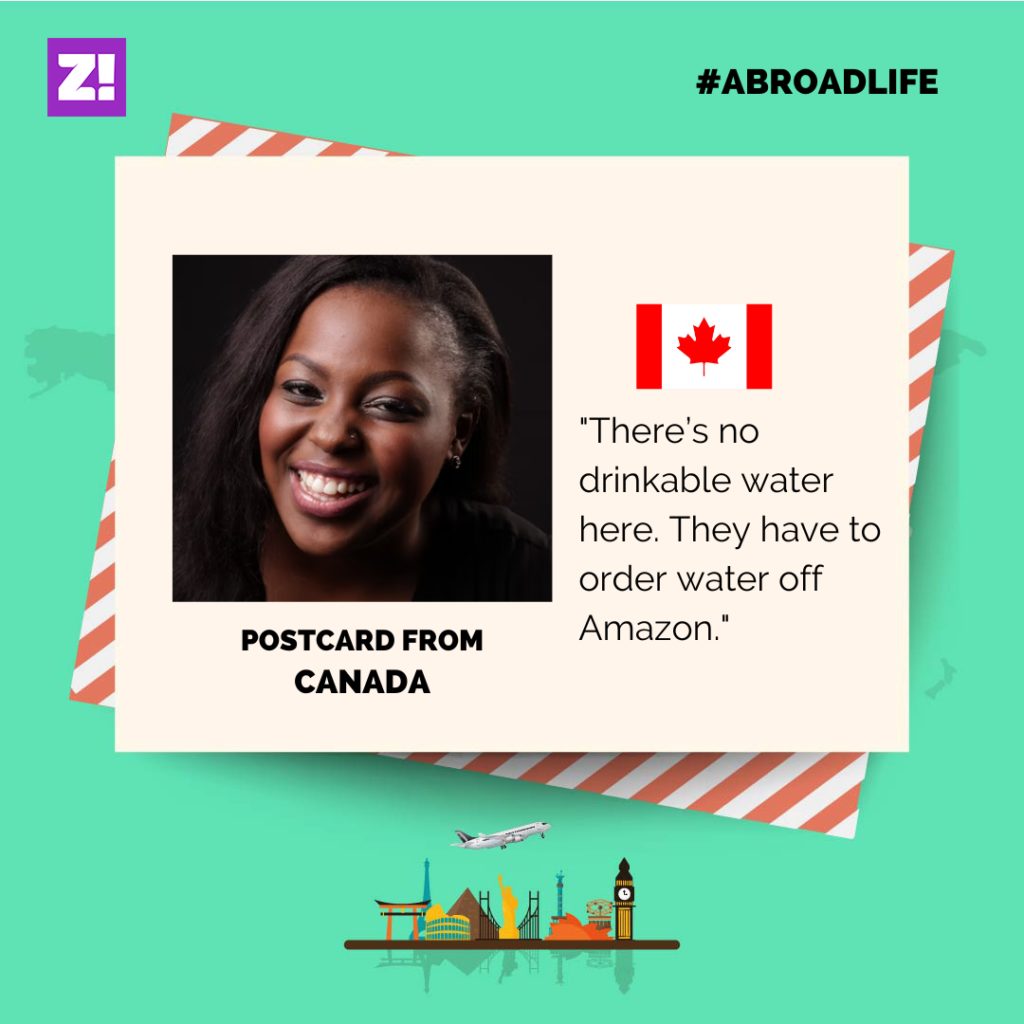
Village life is one-kind o. There’s no drinkable water here. They have to order water off Amazon. The people here don’t have the community and vibrancy you’ll see in Nigerian villages. They just look dejected, wallow in their suffering and complain about the government. They don’t even eat well. It’s just stuff like Oreos and soda all the time. When some of them eventually move, they forget home.
You know I said my job is to help businesses make more money?
Yep
It’s hard. For context, the villages I work with are like a three-hour drive from anywhere else. So tell me why these people avoid the internet like a plague. Apart from using it to get the essentials like water, they don’t want to have anything to do with the internet. It’s like they think it’s evil. How would they see customers from outside if people don’t even know they’re there?
All of this sounds terrible. Why don’t you leave?
I get paid really well. That’s why I’ve been here for this long. But I’m currently applying for other jobs and taking on certification courses. I think I’ll be ready to leave by the end of 2022. Maybe this time, to a private-sector job.
Are you coming back to Nigeria?
I wanted to, right after my master’s in 2020, but the news of danger and the terrible economy kept me here. My end goal is to move to a predominantly black country sha.
Why?
I need to be surrounded by black goodness.
What’s that?
It’s a vibe black people give that white people can’t.
Hey there! My name is Sheriff and I’m the writer of Abroad Life. If you’re a Nigerian and you live or have lived abroad, I would love to talk to you about what that experience feels like and feature you on Abroad Life. All you need to do is fill out this short form, and I’ll be in contact.
The Nigerian experience is physical, emotional and sometimes international. No one knows it better than our features on #TheAbroadLife, a series where we detail and explore Nigerian experiences while living abroad.
When this week’s subject on Abroad Life decided to move to Canada, her only form of research was watching Nigerian YouTubers in Canada telling people why they should come. Now, she wishes they were more open about loneliness, finances and the weather.
When did you decide to leave Nigeria?
After End SARS. I mean, I had a life plan, from when I was a little girl, to leave Nigeria for my master’s after NYSC. I didn’t actively follow this life plan, but you see, after that End SARS, something just switched in me that made me start planning to japa.
Why did you choose Canada?
Should I be honest with you? It’s because of YouTubers. I made my decision to travel to Canada entirely based on what I saw on YouTube. You know, all those “Travel as a student and get Canadian Permanent Residence (PR)” videos.
Prior to End SARS, I was eager to leave. I was already dissatisfied with the annoying and unappreciative work cultures of companies in Nigeria. Then I did some work for someone in the UK. The way she gave me feedback and praised me, and even the pay, made me realise working in Nigeria was not all that. It wasn’t enough to make me work actively towards leaving sha. I was just going from workplace to workplace, getting frustrated. But when End SARS happened, and I started really considering leaving, the prospect of working outside Nigeria gave me even more ginger.
Did you tell people you were travelling?
Nope. I did it lowkey partly because Nigerians just don’t tell people they’re travelling, and partly because I was afraid if it fell through, people would be overly sympathetic, and that would make me feel even worse. I just wanted to land before people knew.
What was the process like?
By December 2020, I put together all my important documents, like WAEC and IELTS results, and statement of purpose. Then I got scammed by the people who were supposed to help me get my university transcripts. Luckily, the school didn’t require official transcripts so I was able to process everything smoothly, and I got my admission in January.
I had to pay some part of my school fees by February to secure a seat, so my family and I contributed some money for it. By May, I applied for a visa which I received in September, about ten days after school resumed. I just deferred and left Nigeria in December. Scratch that… Benin Republic.
Ehn?
A few days before I travelled, the Omicron variant of COVID was discovered in Nigeria, and Canada said no flights from Nigeria. Many Nigerians who wanted to leave had to go to neighbouring countries to travel from their airports. Me, I chose Benin Republic.
Expectations vs reality: Canada edition
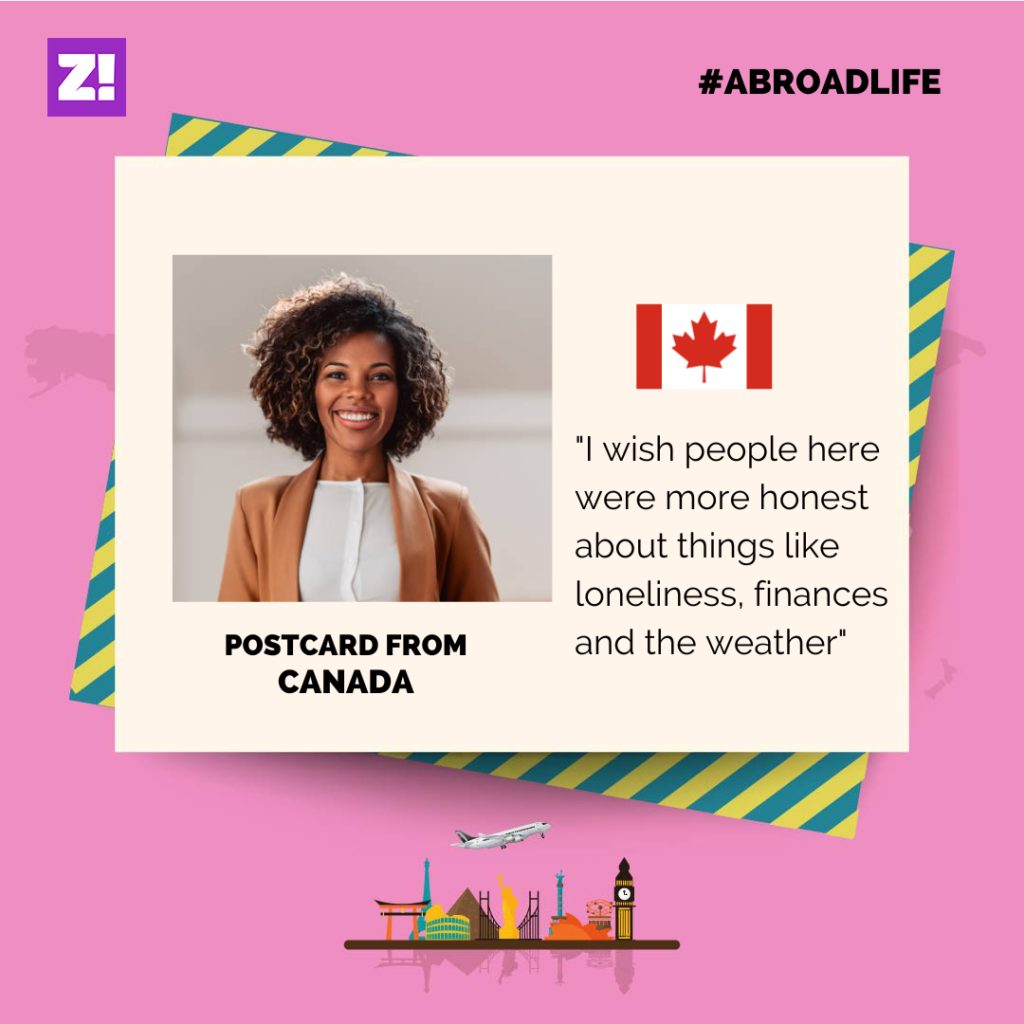
How do I even start? You see those YouTubers? They need to be stopped. All they do is sugarcoat the reality of living in Canada. I wish they were more honest about things like loneliness, finances and the weather, so people can be more prepared or even decide if they still want to come here.
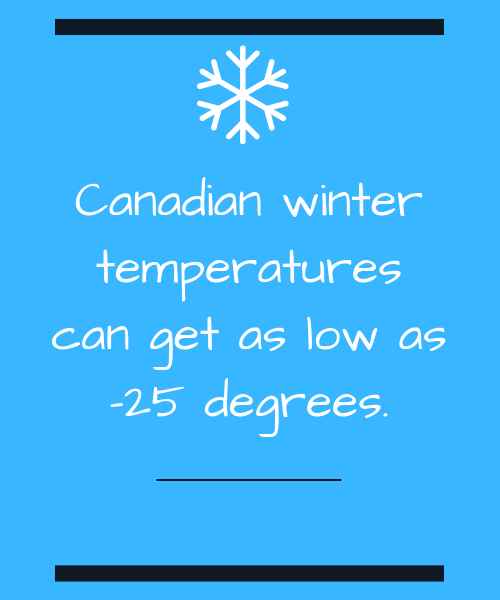
Let me start with the weather. I understand people say Canada is cold, but I didn’t think it’d be this cold. You can never be prepared for the cold that’ll hit you. I now decided to come in December. During winter. See, I suffered. And I had to spend money on clothes because I saw online that I shouldn’t bring so many clothes. Big mistake. Clothes here are expensive. And making money is hard.
The first job I did here was carpentry and welding, the only job available for international students at the time. I don’t even want to talk about how difficult it is to do that kind of job when you’ve never done it before. Honestly, I would’ve been fine just staying at home, jobless and attending school online, but there were bills to pay. Phone bills, house bills, many bills.
I also wish I had an idea of what it’s like to be in a place where you hardly know people. The sadness and loneliness that hit me when I got here was unreal. If I complained to my Nigerian friends, they’d say stuff like, “But you’re abroad. You have money. There’s light. There’s peace”. But I didn’t have money, and I was losing my mind.
In retrospect, I think if I calmed down and did actual research, I would’ve picked a different country.
Where?
The UK. I understand people find it difficult to settle anywhere, but I think the UK would’ve been a bit easier for me. The railway system is great so I can visit friends. People there talk about entering a train and just going wherever they want. Me, I can’t even visit a friend who lives in the same province because Canada is huge and the trains are not so connected.
Did it get better?
It did. I’ve got a better job now that pays above minimum wage. It’s a care job that I found online. I’ve also moved to live with my family friend. School is online. But I probably won’t stay here after my master’s. I don’t want to spend the rest of my 20s chasing PR and stuck in this boring place. I’d probably move to the UK to work. There, I can be happier and more social. Maybe after some time, I’ll come back here and try this PR thing again. But right now, I can’t wait to leave Canada.
Hey there! My name is Sheriff and I’m the writer of Abroad Life. If you’re a Nigerian and you live or have lived abroad, I would love to talk to you about what that experience feels like and feature you on Abroad Life. All you need to do is fill out this short form, and I’ll be in contact.
Navigating life as a woman in the world today is interesting. From Nigeria to Timbuktu, it’ll amaze you how similar all our experiences are. Every Wednesday, women the world over will share their experiences on everything from sex to politics right here.This is Zikoko’s What She Said.
Today’s #ZikokoWhatSheSaid subject is Meye Ebie, a 40-year-old Nigerian woman. She talks about how she found out she may never have kids, the dating scene for black people in Canada and what enjoyment looks like at 40.
What’s something you love about turning 40?
Not giving a fuck anymore. Not about marriage, not about kids, all I have to do is focus on myself. I’m tired of degrading my peace trying to date men. The Canadian dating scene hasn’t been the best experience for me either, especially with these 40+ men.
LOL. Let’s start from the beginning. What was the dating scene like while you were in Nigeria?
I’d say the guys back home were much more respectful. At least, they’d feed you. Here, people assume you’re after their money. No one wants to go to a restaurant. They’d rather meet up at a park, and that’s no different from going to walk my dogs. It’s a waste of time.
I spent my 20s in Nigeria, and the guys actually cared to impress me then. I was a hot cake too. They’d buy me gifts and chase me for weeks just to get one date. That’s how it should be, but men here want to skip all of that.
Lol. Did you have any serious relationships back then?
Oh yes. I had one when I was 28. He is three years younger, but I was sure I would’ve married him if I didn’t have to leave for Canada. He wanted to make a long-distance relationship work, but I wasn’t interested. I felt distance would eventually end the relationship. Doing it earlier was better.
Now, he’s married with two kids and we’re still on talking terms. I loved being with him because It never felt like he was younger than me. We had conversations I wish I could have with the men I’m meeting now. He talked about his dreams; I knew exactly what he wanted from life. There were no games.
Is that something you think is missing from your dating life right now?
Yeah. It’s like men my age are having a mid-life crisis and want to be young and free. What I want right now is a man who can hold a decent conversation. Not just a night of drinks and sex, then it’s all over. I want to laugh, go dancing and have a genuine connection. I’m tired of wearing expensive makeup and dressing up to meet boring men.
LOL. I’m sorry it’s been tough on the streets.
When I moved to Canada in 2013, I was 30. My seven older siblings and friends were already badgering me about meeting someone, and I was worried time was running out too. Being in a new space didn’t make it easier to find someone after my last relationship ended. The easiest way to meet men was online because I was adjusting to my new life.
I was living with my older brother in Alberta and shuffling between classes, watching my older brother’s kids and trying to earn money on the side. There was no time to go out and meet new people, so I tried dating apps. At first, I was focused on dating only black men.
How did that go?
That was a big mistake. Whether they were Nigerian or Ugandan, the African men were all the same.
Like the Nigerian man I dated when I was 32. I’d been in Canada for two years at the time. I thought being with him was great because of course we shared the same culture, so I assumed our values were the same. A few months into the relationship, it turned out he was married and had kids back home. I even found copies of his marriage certificate and a kid’s birth certificate in a drawer, and he still tried to deny it. He spent the next week calling and crying about how sorry he was.
LOL… And after that?
The next was a year later and a guy from Haiti. I knew he had grown kids, but while we were dating, a newborn popped up. I confronted him, and his offer was that I should be his fifth baby mama rather than leave. I didn’t have the energy to be upset at that point, so I asked him to drop me at home and never contact me. As usual, he called a week later to cry and explain.
It always ends in tears.
Then the following year, there was the Hawaiian guy with three children from his ex-girlfriend. I can’t blame him because my instincts told me to run from the beginning. That was the last time I dated a black or brown-skinned man.
My friends tried to make me go on some blind dates, but desperately hooking me up just never worked out.
So were the white guys better?
LOL. I did have one decent relationship when I was 33. We met on Facebook at a time when I felt even lonelier than I had when I first moved to Canada. I’d moved out of my brother’s house to get more time to myself, and worked at a department store I hated. The endless loop of going to work and coming home made me sad. I eventually got two dogs, but I still wanted to be with someone.
So when this white guy started sending texts on Facebook asking about my day, it felt good. As things started to get serious, I made it clear to him that I wanted a relationship that would lead to marriage. He didn’t object, so I committed myself to him.
Awwn… Sweet
For the first three years, sure. After that, I realised he was a douchebag. All he wanted was a partner to live with, cook and clean after him. A housekeeper with relationship perks, essentially. All the talk of wanting to marry me suddenly seemed unreasonable to him. I didn’t have any more time to waste and that ended the relationship in 2018.
I’ve been single ever since, dealing with the ups and downs of dating apps.
LOL. Is it better now that you’re older?
Not at all. 40+ men are out here looking like grandfathers and expecting to date an Agbeni Darego at their age. It doesn’t make any sense. The worst part is how they play mind games.
Take my last potential date for example. He was a white older man, and we’d been chatting for a while. When we finally wanted to meet, he kept talking about seeing me during the week. Since I have a busy schedule with a job and school, I asked him to choose a specific date to plan my week out. Suddenly, he got defensive. His response was, “What if things don’t work out between us? Why waste time planning?”
That sounds weird.
It was. I didn’t understand why he was on a dating app in the first place. The point is to go on dates to see what happens. After that, he went on about how he was hurt in his last relationship, but I’ve been on these apps for eight years. I wasn’t falling for that.
Why stay on the app for eight years if it hasn’t been great?
It’s either that or nothing. I don’t trust my friends to hook me up, and I don’t have the energy to dress up to meet someone I’ve never had a conversation with. With online dating, it’s easier to screen people out of your life.
Like the guy I’m chatting with right now. He claims that he’s over his fiancée and wants to get into a relationship with me. I’ve asked him many times to explain why the engagement ended, but he has no tangible reason except, “It was her fault.” There’s no part that was his fault, and that already tells me he’s not serious. It’s better to meet those kinds of people online than to waste a date to find out.
LOL. I see.
Besides, I’m not bothered that I’ll never find a man. I was a hot cake in my 20s, and I’m a hot cake now.
A baddie at 40. Love it! So 40 may be your best year at this point?
LOL. Yeah, but the toughest transition into 40 has been accepting that I may never have kids. I found out almost two years ago when I was rushed into the emergency room. I was at work and started feeling extreme abdominal pains and couldn’t move. The doctors thought it was a gallstone that would eventually pass, but when I couldn’t walk without assistance for a week, they ran more intense tests.
That’s when they found the fibroids.
I’m so sorry.
Thanks. One of the fibroids is located too close to my womb, so if I chose to do surgery this year, I could lose my womb in the process. I’ve always loved kids. I have five older sisters and two older brothers, and they all have kids of their own now. I took care of each of them at some point and always wanted mine too. Accepting that it may never happen was hard. At first, I was worried, scared but… I don’t know. There was anger, grief and finally, acceptance.
I’ve blamed God and myself these last two years, but fibroids aren’t something any woman can control or avoid. I had to come to terms with that reality. I have to fight for my health.
I’m sick of waking up every morning and feeling pain around my hips and waist like my grandmother. I’ve also realised that I don’t have to worry about the idea of not having kids so much.
What do you mean?
The only person that could’ve made this choice more emotional for me would’ve been my mother. She passed away in 2018, and she’d cry knowing I’ll probably never have kids. But without her, more grandchildren aren’t exactly a priority for anyone. My dad is 89 and has at least 10 grandkids. His bloodline is secured, so I have the space to do me.
But you still want them, right?
A part of me does, but I have my nieces and nephews. When that stops being enough, I can adopt or get someone’s sperm and go for surrogacy. The options are endless.
My siblings and friends who are invested in me having kids have advised me to freeze my eggs, but the financial and mental stress involved isn’t worth it. I’m already in enough pain. I’m not interested in the hormonal injections and egg retrieval process. All because I want to create life? No, please. The unending badgering about marriage is enough stress. I want to be single and happy in peace right now.
I just turned 40, and I’d like to focus on enjoying that.
What does “enjoying 40” look like for you?
Beyond accepting that I may never have kids and not giving a fuck about that or marriage. The beauty of 40 is that it can be anything I want it to be.
Right now, I’m trying to get another degree, so I can get out of my department store job. I want to give myself a lot more options than I’ve had in the past. There’s so much life ahead of me, and that’s enough to look forward to every day.
If you’d like to be our next subject on #WhatSheSaid , click here to tell us why
The Nigerian experience is physical, emotional, and sometimes international. No one knows it better than our features on #TheAbroadLife, a series where we detail and explore Nigerian experiences while living abroad.
The only reason today’s subject on Abroad Life is still in Canada is because she’s waiting for her citizenship. She’s been there for 12 years and she’s tired of the cold, the boredom and the racism.
When did you decide to leave Nigeria?
12 years ago. When I was 15 and just out of secondary school, my mum visited Canada for the first time, came back home and said, “You’re going to Canada for university.”
Just like that?
Just like that. My plan was to study in the UK because that’s where I’d been before, and I was more familiar with it. The only thing I knew about Canada was that it was cold. Canada wasn’t even one of the countries anyone wanted to go to at that time, the way everyone wants to go there now.
Six months after she told me, I left Nigeria. By that time, I’d turned 16. I didn’t go straight into university when I got to Canada, I did a year of A-levels first.
Expectation vs reality: Canada Edition.
I expected it to be cold, lonely and boring. The cold part was true. I had to wear gloves and sweaters all the time so I didn’t get frostbite.
And the loneliness?
It didn’t become true until I left university. A-levels and university were not so bad because the schools I went to had a lot of Nigerian students. That helped me settle in well because I still had people around me I could go out to eat Nigerian food with. It was when adulthood kicked in — I got a job and started living on my own — that I realised that I could feel really alone in a place that had lots of people.
That sounds sad—
Around this time I also realised that the trope about Canadians being the nicest people on earth was a goddamn lie. Racism happens very often here too, but it’s just not as “in your face” as in other places. It’s subtle.
One time, my friends and I went to a liquor store to get some drinks. All of us were Africans. The guy at the counter refused to sell to us, even after we showed him ID, and when we demanded to see the manager, he threatened to call the police. It’s little things like that from time to time.
When I called the company a few days later, they apologised and said they knew the specific employee I was talking about and he wasn’t a manager.He was just a guy who liked to do stuff like that.
You don’t seem to be enjoying Canada that much.
LMAO. I always want to be back in Nigeria.
How often do you come back?
At least once a year since I got here. First, it started as a mandate by my parents that I needed to be home every Christmas as long as I was dependent on them. I think it was their way of keeping an eye on me. The older I got, the more I realised I liked being in Nigeria, so even after my parents couldn’t make me go back anymore, I found every opportunity I could to make the trip.
There are a lot of things about Nigeria that make me want to stay there — the people, the atmosphere, the fun and the sun. The sun is really important to me. There’s something about being in a country that’s cold and gloomy most of the time that just makes you feel like you’re depressed. I grew up in Nigeria where I was in the sun a lot, so being away from the sun is a no-no for me. It also gets really boring here. There really isn’t a lot of fun activities to do. When I’m in Nigeria with Nigerians, I feel more alive.
Any plans to move back?
I was in Nigeria from August 2021 to February 2022. I only came back to Nigeria a few weeks ago because I got a job. Before I left for Nigeria in 2021, I quit the job I had been at for five years, sold everything I had and told myself I was finally moving back home, but somewhere deep down, I wanted some security so I was still applying for jobs in Canada. When I was in Nigeria, I told everybody I was back and the responses I got were confused, like, “You have the life everybody wants over there. Why are you coming back?” Those responses sort of shook me, so when I got a job offer, I came back.
When I got back here, everything felt wrong. It’s like I made the wrong decision to come back. I have no strong ties — not in friendships, relationships or experiences — in Canada. I’m just here for the job.
I’m curious: why did you stay after university?
Immediately after university, I did my master’s, and after my master’s, I got a job, and it was just a convenient series of events. And then I stayed five years at that job.
That makes sense. What do you have planned for your future?
Because I came here as a student, the process for getting citizenship takes longer and is much more complicated than it would be for someone who came as a permanent resident. First I have to apply for permanent residency, get that, and wait a few years before I apply for citizenship. After that, I can go wherever I want.
The truth is, as much as I want to move back to Nigeria, I need to be logical and ask myself if moving back to Nigeria as it is now is a good idea. I currently work in a university helping black students with inclusivity. Will I get such social work opportunities in Nigeria or will I get home and sit in my parents’ house? Is Nigeria as safe and secure as Canada? Are there as many amenities there as I have here? These are the questions I have to ask myself before making the decision to drop everything and fully move back home.
I’ve already been here for 12 years, a few more years to get my citizenship won’t be bad.
Apart from Nigeria, where else would you go?
Once I get my citizenship, the plan is to leave these western countries and go to a tropical country where I could get great work opportunities. So it doesn’t have to be Nigeria. There are many possibilities within Africa. I also want to travel a lot and relax for a bit. I know I’m not old, but I’m tired of working.
Want more Abroad Life? Check in every Friday at 9 A.M. (WAT) for a new episode. Until then, read every story of the series here.
Hey there! My name is Sheriff and I’m the writer of Abroad Life. If you’re a Nigerian and you live or have lived abroad, I would love to talk to you about what that experience feels like and feature you on Abroad Life. All you need to do is fill out this short form, and I’ll be in contact.
The Nigerian experience is physical, emotional, and sometimes international. No one knows it better than our features on #TheAbroadLife, a series where we detail and explore Nigerian experiences while living abroad.
Today’s subject on Abroad Life talks about getting the chance to move to the US, opting out finding out she had to move to Canada within a 3-day period, and her struggles with navigating adulthood for the first time in Canada.
When did you decide to leave Nigeria?
I was in SS 3 when I first had the idea to leave Nigeria for good. Growing up, my family went on vacation to the UK and the US every summer — we interchanged every year, but when I got to SS 3, everyone started talking about how they wanted to go abroad to study and not come back, and that suddenly seemed like a great plan.
LMAO. What did you do about it?
Because my secondary school had a lot of people going abroad to study over the years, schools abroad usually came to convince students to attend their schools. When I showed my parents the fees I would be paying if I went to one of those schools, they laughed and told me to go and buy JAMB form for Unilag.
What happened next?
In the months before I wrote POST UTME, we went on a trip to the US and an interesting series of events followed, that meant I’d have to return to the US soon.
Tell me.
We hardly travelled with my dad because he had work, so this time too, it was just my mum, my two older siblings and me. We were visiting my parents’ friend when another person’s name came up as a mutual acquaintance. After some connections, we found out that the woman, let’s call her Mrs B, was someone my dad helped with a police case before he retired from the police force, and she was close friends with my parents’ friend, so we all decided to pay her a visit. She was excited to see us. Omo, the case must have been big because the way she was thanking us ehn, you would think we gave her a million dollars. We called my dad and it took him a while to remember her, but he eventually did.
After all the pleasantries, she invited us to stay at her house for a few days.
Just like that?
Just like that o. She was the nicest woman ever.
In the midst of all the conversations, my mum mentioned that I was trying to move to the US to school and settle and the woman offered to house me and help us make everything work. Right before my eyes, they started making plans — the high school I’d go to before I was able to go to college, how I’d transition into a permanent resident through my marriage to an American, everything. And she was happy to help. She had children my age, so it would be easy to fit in and live with her.
JUST LIKE THAT?
Just like that. My mum asked if I was interested in the arrangement and I said I was, so we returned to Nigeria to renew my visa before I returned to start my new life.
The visa process took about a month and after I got my new visa, my mum and I travelled back to the US.
How did this period make you feel?
I was excited because I was finally getting what I wanted. In my first week in the US, I was sure I was going to have the best life ever. Remember I said the woman had children my age? I fit in like a glove.
One week later, my mum had to return to Nigeria; that’s where reality hit. Four days before she left, she sat me down to talk to me about the implications of what I was about to do — I couldn’t come to Nigeria whenever I liked because I was going to be trying to secure a Green Card. Travelling out of the country could ruin the plan. I would have to miss my sister’s wedding the following year. She also hinted that I might need to marry an American if I wanted this to work fully. She tried to balance it out by saying she and my siblings would visit me every year, but the damage had been done.
I cried every day for the next three days because, omooo, it was too much to take in.
When my mum noticed I was crying, she called my dad and told him I wasn’t going to be able to do it, so they booked my flight and I returned to Nigeria.
[newsletter]
LMAO! How old were you?
This happened in 2017, so I was 16.
Tell me what happened next.
I returned to Nigeria just in time to write POST UTME to study law at Uninlag — an exam for which I was ill-prepared. I failed. It was a tough period for me because I’d now seen all my options go wrong right before my eyes.
My parents didn’t want me to stay at home, so they found a private university in Nigeria for me to go to. They had started a new session, but they didn’t have an issue with me joining mid-session to do A-Levels.
Nice.
One day, about six months after I resumed, my dad called me to tell me he had started the process for me to go to school in Canada, but I needed to focus on my education and get good grades in Nigeria first to show I was serious enough to travel. I didn’t think too much about it.
A few weeks later, he came to check on me, and while he was with me, he called my mum. My mum didn’t know the phone was on speaker, so she asked him if he had told me my Canadian visa came through. He panicked, put the phone off speaker, and just replied, telling her he hadn’t. But me, I already heard what I heard. My Canadian visa was ready? I was excited.
My dad wasn’t as excited as I was. He told me to relax and focus on my education in the Nigerian school, and if I did well, I would travel.
Omo. Were you able to focus?
I didn’t have to. Three days later, they called me and said, “Pack your bags. We’re coming to pick you tomorrow. You’re going to Canada on Friday.” It was Tuesday.
Once again… Just like that?
LMAO! I was dumbstruck. I didn’t know what to tell my school friends who didn’t know anything about my travel plan.
“Hi guys, tomorrow is probably the last time you’ll ever see me because I’m leaving this school and going to resume in a different school in Canada.”
It was hard, but I sha told them. They were happy for me.
The next day, they came to pick me up, and two days later, I was on a plane to Canada.
Tell me your first thoughts about Canada.
It was cold! I travelled a lot growing up, so being in Canada didn’t seem different from being in the US. But the cold? Omo, I didn’t expect it.
Can I tell you an embarrassing fact?
I’m listening.
The concept of Canada was new to me. I didn’t know a place like Canada existed until a few months earlier when my parents started the process, so I didn’t know it was a super cold place. I resumed school immediately.
What was it like settling in?
It was difficult at first. I arrived in winter and didn’t come here with winter clothes or shoes, so I had to go out every day to buy stuff that I would need to settle in — clothes, shoes, household items.
I also had a hard time settling in school. In the hostel, I stayed in the room with one Nigerian and two other people of different nationalities, and if not for the Nigerian, I would have lost my mind. The room was always so dirty and filled with weed smoke, so we couldn’t stand it. We eventually left and I got a shared apartment.
At school, it was hard as well. First of all, people couldn’t pronounce my name, so I had to give an English name that wasn’t even mine so they wouldn’t butcher my real name every single time. After the first semester though, I got a bit more confident and told everyone not to call me the English name again. It took them a while, then it clicked.
You know what’s most interesting to me about being in Canada?
I want to know.
The surrealness of adulthood. I keep marvelling at the fact that I can make my own decisions and live on my own. The fact that I had to find an apartment by myself and have to constantly stock it with food and household items with my own money, and at my own convenience amazes me. When I first got here, I spent money anyhow on the most random things, but, omo, sapa is everywhere and I had to learn not to overspend if I didn’t want to go broke. The realisation that I didn’t have my parents here to give me money every time set me straight. Now that I have a job as a librarian at school and make my own money, I’m learning to save and only spend money on essentials.
It can also be really scary because people in my situation find themselves making decisions they typically wouldn’t make. Many of the Nigerians I know here vowed not to smoke weed in Canada, but when you see a weed dispensary on every corner you turn to, offering weed in every way, shape and form, the pressure to try it outweighs your self-control.
Is that the situation you find yourself in?
All my life, I’ve always stayed away from drugs because they’re just not something I’ve ever considered. Apart from the fact that I haven’t strongly considered it too, I’m scared that my parents will one day find out if I did drugs and they would be so disappointed, they would ask me to return to Nigeria.
Being made to return to Nigeria before I can complete school and get my permanent residence here is something that scares me terribly.
Hey there! My name is Sheriff and I’m the writer of Abroad Life. If you’re a Nigerian and you live or have lived abroad, I would love to talk to you about what that experience feels like and feature you on Abroad Life. All you need to do is fill out this short form, and I’ll be in contact.
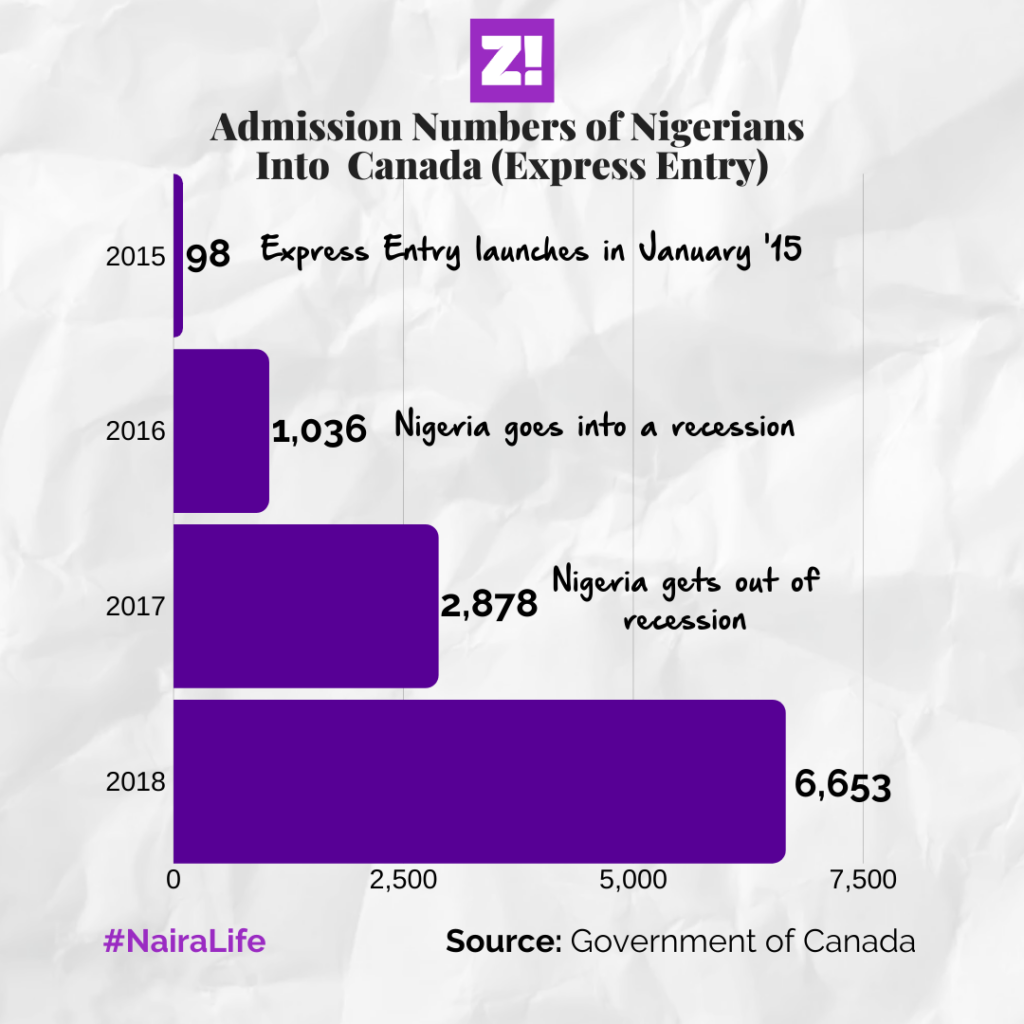
How to migrate from Nigeria to Canada- In 2019, Nigeria was the fourth leading source country of immigrants into Canada, right after India, China and the Philippines, with over 12,000 Nigerians becoming Canadian permanent residents. That number had seen a steady growth since 2015 with more Nigerians moving to Canada than the previous year. There’s little doubt that the number would have been greater in 2020, but the restrictions due to COVID spoilt people’s plans.
For Nigerians, Canada presents a new home and a new place to settle because the migration process is straightforward, and the success rates are almost guaranteed once you have every prerequisite needed. It also helps that the official language of Canada is English, therefore there is no language barrier from helping Nigerians to settle.
With COVID travel restrictions reducing, there is no better time than now to prepare your japa to Canada. If you’re a Nigerian looking to migrate to Canada, here are all the ways you should consider.
1. The Express Entry program
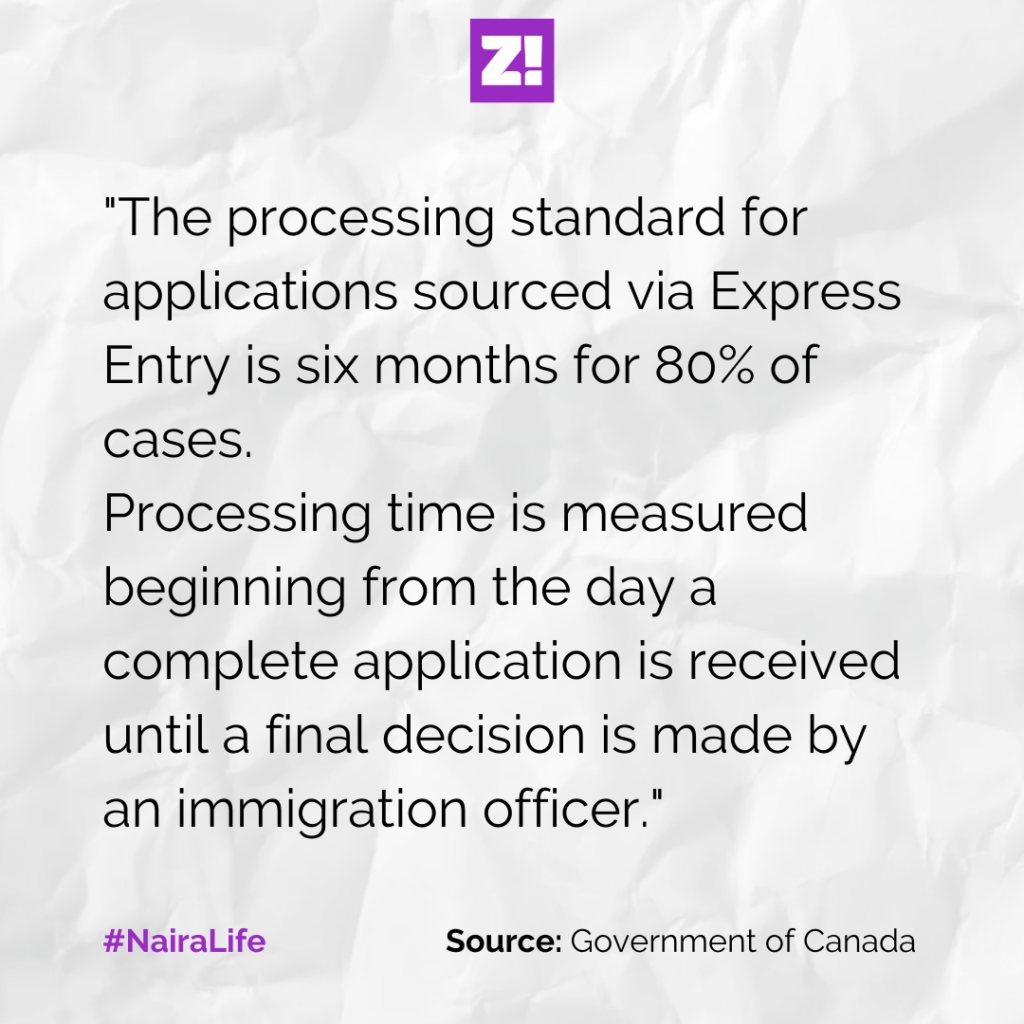
The Express Entry program is the most popular path for Nigerians to successfully migrate to Canada. It’s also the fastest because you can complete it in six months. In 2019, Nigeria was the 2nd leading country of citizenship of successful Express Entry candidates, ranking behind India.
There are three immigration programs under the Express Entry program namely, Federal Skilled Worker Program, Federal Skilled Trades Program, and Canadian Experience Class. As much as having a job offer increases your chances of success with the Express Entry program, you do not need to have a job offer from a Canadian organisation to immigrate through this system.
Once you begin your application with the Express Entry program, you will be given a Comprehensive Ranking System (CRS) score based on your age, education, language proficiency based on your IELTS score, and work experience. This is why it is called the point-based system. If your CRS assessment scores you high, you will be given an Invitation to Apply (ITA) for permanent residence in Canada.
Here’s how it typically works: When you finish your study in Canada, you will be able to obtain a Post-Graduation Work Permit (PGWP) that allows you work in Canada for up to three years. Having Canadian study and work experience is highly valuable when you finally decide to apply for a permanent residence through the Canadian Experience Class or through Provincial Nominee Programs. Your CRS score will factor in your Canadian degree and work experience, and grant you higher points.
According to the Canadian government, family reunification continues to be a priority, as it is key to Canada’s future, particularly as they work to recover from COVID-19. The program allows for the sponsorship of spouses, common-law partners, conjugal partners, dependent children, adopted children, parents, grandparents, or orphaned relatives under the age of 18.
To sponsor a family member to become a Canadian permanent resident, the sponsor must: be an adult citizen or permanent resident of Canada, live in Canada if they’re a permanent resident, and prove that they have the resources to support the person they’re inviting into Canada.
If you have a family member living in Canada, reach out to them to find out if they are willing to sponsor your visa application for permanent residence.
4. Provincial Nominee Program (PNP)
If you’re looking to work and settle in a specific Canadian province, you could benefit from the Provincial Nominee Program. Out of Canada’s 10 provinces, only two ( Nunavut and Quebec) don’t have at least one PNP.
Through PNPs, Canadian provinces nominate economic-class immigration candidates who fit their labour market needs. So if you’re applying through the Express Entry program, and somehow you have skills that a certain province needs, they’ll nominate you, and this means you get 600 extra points. In the point-based system, getting 600 extra points means you’re guaranteed to be invited for permanent residence.
You can directly apply to a PNP or you can send an expression of interest to the province looking for someone with your skills through your Express Entry profile.
5. Start-Up Visa Program
Entrepreneurs with innovative business ideas that can create jobs for Canadians and compete at a global scale are welcome to apply to the Start-Up Visa Program. The process for applying for a start-up visa is a bit more complicated than the others, but in the end, it’s totally worth it.
7 important things to know before moving to Canada
Just like in Nigeria, the cost of living varies, depending on where you choose to live. It can be expensive to live in major cities like Toronto and Vancouver, so take this into account before you decide where to move to. You also have to pay for services like air conditioning, home phone, internet, and other things you might not be used to paying for, and they’re expensive. Get ready.
You’ll only be able to use your Nigerian license for a maximum of 90 days after you get to Canada. After this, you have to go through a series of tests to become a certified Canadian driver.
In Canada, life goes on even with extreme winter. Make sure you do your research on where you would like to stay based on the temperatures during summer and winter. It’s coldest in the north and the west is warmer than the east. You should also research what types of clothes, home and car to get.
The price you see listed on the item is not the price you pay. Products have taxes on them. Don’t be shocked when you pick an item and have to pay just a bit more.
Tipping for services is a way of life. Get ready to tip people that offer you services.
Job hunting in Canada might be tricky. Be ready to do some non-career jobs while you search for a job that suits you. Don’t wait to get a blue-collar job before you start working. Bills will choke you.
Don’t ruin your credit score. Because Canada is a credit-based economy, it might be easy to live above your means and when you’re not able to pay the amount you owe, it’s terrible for your financial reputation.
10 fun things to do once you get to Canada
Try poutine and maple syrup. Poutine is Canada’s signature dish, so you should definitely try it.
Visit Niagara Falls.
Visit the Notre Dame Basilica Cathedral.
See grizzly bears and polar bears in their natural habitat.
The Nigerian experience is physical, emotional, and sometimes international. No one knows it better than our features on #TheAbroadLife, a series where we detail and explore Nigerian experiences while living abroad.
The subject of today’s Abroad Life is a 21-year-old woman who left Nigeria for Canada in 2018. She talks about the extreme cold, struggling to fit in, her church making life hard for her and why she doesn’t feel at home in Canada.
When did you decide you wanted to leave Nigeria?
2018. I was in my final year of secondary school. My school allowed us to take the SAT, IGCSE and other exams that gave us the opportunity to study abroad. I knew about the exchange rates, so I wasn’t on my parents’ neck about wanting to go abroad. Luckily, they wanted me to travel too. We found a school in Winnipeg, Manitoba and I came here.
What did you expect Canada to be like?
I had been to the US a few times to visit family, so I didn’t expect a dramatic difference. I knew it would be cold, and I told myself “It’s going to be a boring version of the US.”
Why?
That’s what I’d heard.
Is that what it was?
The part about the cold was true. After a few days, I knew I wanted to leave. I didn’t think I would survive. In winter here, it gets really depressing because we’re all indoors and everything is gloomy. And you can’t complain too much because the people you’re complaining to live in the same condition. If you’re trying to go out without a car in winter and you miss your bus, you have to wait in the cold till another one comes. It’s crazy!
The place in Winnipeg where I stayed was pretty nice, but the population was mostly old people, so things were quiet and slow. I’m used to it now, but I didn’t like it at first. I didn’t want to spend my prime years in a boring area.
What was happening in school?
I was finding it hard to settle in. I resumed two weeks late because of some visa wahala and people already had friend groups. It was surprising to me because I thought things like that only happened in secondary schools. First of all, I’m a reserved person, and now people were already in groups? It wasn’t easy.
Even with the lecturers, it wasn’t as easy as I thought it would be. When I resumed, I met one of my professors to tell him about why I missed classes, my visa wahala and all that. I sat down and told him the full story with details, and his response was “Check the portal”. It pained me. I know that in Nigeria, you can whine lecturers and have some nice conversations with them. This one was just too official. It was one of the times I felt like I would rather be in Nigeria.
Damn. How did you survive?
I made a friend and they helped me settle in better.
What other communities did you find useful for integration?
I had church, but soon realised that that wasn’t going to work out.
How?
You know how they say you can’t dress the way you like in Nigerian churches, but if you go to the same church’s branch abroad, they’ll let you dress how you like? It was the opposite for me. In Nigeria, my church wasn’t big on dressing, calling people out and all that. When I started attending its Winnipeg branch, it was a whole different story. That was almost the only thing they spoke about— calling out people with dreads, piercings and all that. They said if we were in Nigeria, we wouldn’t be able to do all that, so we also couldn’t do it in Canada.
Is everyone in your church Nigerian?
Every single person. On some days it felt good because the older people had Nigerian parent vibes and it’s stuff like that you see and miss your parents, but on most days, you didn’t feel accepted. I had to leave. The church I attend now has younger people and they’re more liberal in the way they approach things.
Nice. I’m curious about your relationship with the friends you left in Nigeria.
It’s not as good as it used to be. We can’t communicate as often as we used to, so it’s just there. I’m much better now than when I first moved here though. My sister is here too and we live together with my cousin.
The thing people say about Canada being Nigeria 2.0. Is it true?
I don’t know about the entire Canada, but here in Winnipeg, you can’t step out and not see a Nigerian. We’re everywhere. It’s helpful because when you’re new here, you don’t feel so alienated. One time when I got lost, I didn’t ask anyone for directions until I met a Nigerian woman who went the extra mile to follow me along the way I was going just to be sure I was right.
But with all the Nigerians here, I still don’t feel so at home.
Why?
Food. I miss Nigerian food.
Haha. What are your plans for after school?
I want to become a permanent resident here. I’ll probably stay here in Winnipeg, move to a better area, get a car, and be able to travel and move around during winter. I like the fact that I can be here in my quiet city and be surprised when I explore more interesting places.
Hey there! My name is Sheriff and I’m the writer of Abroad Life. If you’re a Nigerian and you live or have lived abroad, I would love to talk to you about what that experience feels like and feature you on Abroad Life. All you need to do is fill out this short form, and I’ll be in contact.
The Nigerian experience is physical, emotional, and sometimes international. No one knows it better than our features on #TheAbroadLife, a series where we detail and explore Nigerian experiences while living abroad.
The subject of today’s #AbroadLife is a 22-year-old man who left Nigeria immediately after secondary school. He talks about being lonely in Canada and why he wants to come back home but can’t just yet.
When did you decide that you wanted to leave Nigeria?
I didn’t make the decision. My parents made the decision for me right after I left secondary school. I didn’t want to leave, but when your parents make that type of decision for you at 17, there’s really nothing else you can do.
Why didn’t you want to leave?
I liked it in Nigeria. All my life, I’d heard people complain about Nigeria. They’d say, seriously and jokingly, they wanted to leave. Most of those jokes had Canada as the dream destination for Nigerians, I liked it at home.
In retrospect, I realise that I just hadn’t seen enough of life. I was shielded. My parents are super comfortable, so there was no need for me to complain. Everything I needed, I got.
You felt safe.
Yes. I’ve always been the person that takes family as the most important thing there is, so because I was with my family, I was okay.
How did it feel moving away?
I knew that I was going somewhere better, but I wish I stayed. The quality of the education I came here to get is definitely better than what I would have gotten in Nigeria. One thing I knew I would always miss being a part of was watching my two little sisters grow. I’m the first born and the only guy. I mean, yes, it was 2016, there was video calling technology, but it’ll never be as good as being there with them.
I consoled myself with the thought that I’d probably be home from time to time, and they’d also visit me often.
How has that worked out?
It’s been five years and I’ve not seen them since I left. I’ve seen my parents, but my sisters have not been able to travel.
Damn.
All of that has added to the extreme loneliness I suffer over here. I miss home so much. It gets really bad sometimes. Soon, all those long video calls won’t cut it anymore.
How do you deal with loneliness?
COVID has changed the way people interact. For example, when I was lonely before, I’d go out with my friends or we’d play sports together. But since last year, I’ve just sat indoors, in front of my computer, doing whatever. It doesn’t help that when I have a new close friend, they have to leave Canada shortly, sometimes for work, and sometimes to move back home.
I have a job now though. It started as a school internship, but they decided to keep me. Now they’re paying me more, and I have a sense of security. I also went into photography full time last year, and I recently got my first bookings to shoot at two different events. Things are looking up financially.
That’s nice. How far gone are you with your education?
I’ll be done next year. I can’t wait.
Is that when you’re planning to come back home?
I think I’ll eventually have to wait until then. I try to go home every year, but every time, something happens. This was the year I already promised myself and my friends that I would come. I already had a prospective date in mind and we’d made plans to fuck shit up when I got back, but I don’t think I’ll be able to travel. I can’t even break the news to them yet. They’ll be heartbroken.
Why can’t you travel?
It’s a lot of reasons: first of all, I’ve not taken the COVID vaccine, and I don’t want a case where I’m not allowed back into the country for something as simple as that. Flights are expensive, I have some visa and passport issues, and all that. I thought I’d be able to sort all of that out before next month, but it looks like I’ll be spending my hot boy summer in Canada.
Omo.
Exactly. And honestly, Nigeria isn’t the best place to be at right now. I hear and see all the news about insecurity and it breaks my heart. My family is in Nigeria, so I care, but I’d also rather not be in a place where I’m not safe.
I remember being an active part of the EndSARS protests online. It was heartbreaking for me.
Do you think you’ll settle in Nigeria or Canada?
The best scenario for me right now would be to become a Canadian permanent resident so that I can visit Nigeria whenever.
Nice…
Scratch that. The best scenario would be for my family to join me here.
Hey there! My name is Sheriff and I’m the writer of Abroad Life. If you’re a Nigerian and you live or have lived abroad, I would love to talk to you about what that experience feels like and feature you on Abroad Life. All you need to do is fill out this short form, and I’ll be in contact.
If you’re like me, you probably have it in the goals you wrote at the beginning of they year that you want to move to Canada before 2020 runs out. If you’re still in Nigeria, don’t be too hard on yourself. It was a really tough year.
There’s still about 19 days left though, so you have the opportunity to end the year on a high note. Follow the instructions in this article and we’ll show you how to be in Canada before the year runs out.
1. Enter bus to Benin
Just get to Benin first and tell the first person you see that you want to get to Canada. They’ll know what to do from there.
2. Photoshop yourself in Canada
Look at this guy and tell me with your chest that he’s not in Canada.
3. Change your profile location to Canada
If you believe it enough, who’s stopping you. Those people that have Canada on their Twitter bios, who told you they are physically in Canada? My sister, jazz up.
4. Go with a ride-hailing service
Many people don’t know this, but if you plot Canada on your Uber app, you’ll actually see a fare estimate. The question is: do you have the money? You might also need some cash to bribe all the immigration people along the way.
5. There’s Ontario in Abuja
Don’t dull. The Ontario in Canada and the Ontario in Abuja, there’s no difference.
6. There’s another whole Canada in Abuja
No wonder Abuja people never want anybody to come to their city. So this is what they have. Ontario AND Canada. My brother, book your flight to Abuja now!!
7. Hide under a plane
This one is dangerous, but it’s high risk, high reward. The people in the airports, they don’t check all the parts of the plane before take-off. So try your luck. If they catch you, try again the next day (or when you come out of prison).
Citizen is a column that explains how the government’s policies fucks citizens and how we can unfuck ourselves.
Did you know that 16,925 sought asylum from Nigeria to Europe in 2019 alone, making Nigeria the country with the 8th most asylum seekers to Europe?
After news broke that DJ Switch, the disc jockey who filmed shootings at the #LekkiMassacre and shared live on Instagram, had been granted asylum to Canada, we decided to explain the right of asylum and the asylum process.
The right of asylum is an ancient judicial right in which a person that is persecuted by their own country may be protected by another authority, such as a church or a country. This right was recognised by Egyptians, Greeks and Hebrews before it was adopted into modern tradition.
If a person in Nigeria is being harrassed, violated or persecuted because of their race, nationality, sexual orientation, political opinion or tribe, they can seek asylum to another country.
How Do Modern Political Asylums Work?
Article 14 of the Universal Declaration of Human Rights states that “everyone has the right to seek and to enjoy in other countries asylum from persecution”.
The United Nations 1951 Convention Relating to the Status of Refugees and the 1961 Protocol Relating to the Status of Refugees guides national legislation concerning political asylum.
Under these agreements, a refugee is a person who is outside that person’s own country because of fear of persecution on “protected grounds”.
Since the 1990s, victims of sexual persecution on the basis of their domestic sexual violence or their sexual orientation have been protected in other countries, if the person can prove that their country does not protect them.
Asylum Laws In Different Countries:
Different countries in the world have laws regulating asylums.
1. France
In France, the right of asylum is guaranteed under the 1958 constitution. This constitution draws from France’s 1946 and 1783 constitution which guaranteed the right of asylum to “anyone persecuted because of his action for freedom”, and who is unable to seek protection in his own country.
France also follows international agreements on the right of asylum such as the 1951 United Nations Convention Relating to the Status of Refugees.
2. United States
The United States recognises the right of asylum of individuals as specified by international and federal law.
Since 1980, over 2 million refugees have arrived in the United States.
3. European Union
The European Union welcomes asylum seekers, known as asylees.
However, the Dublin convention of 1990, the Eurodac regulation and the Dublin regulation of 2003 regulate how member countries of the European Union can take in asylum seekers.
Canada’s Immigration and Refugee Protection Act requires that every person seeking to enter Canada must appear for an examination at a port of entry to determine whether the person has a right to enter Canada or may become authorised to enter and remain in Canada.
A port of entry is a place where a person can lawfully enter a country. It can be an airport, a seaport or a land border.
Individuals can make an asylum claim in Canada at a port of entry or at an office of the Canada Border Services Agency (CBSA) or at the Immigration, Refugees and Citizenship Canada (IRCC) office. CBSA or IRCC officials will determine if an individual is eligible to make a claim.
Factors determining an individual’s eligibility to make a refugee claim include whether the claimant has committed a serious crime made a previous claim in Canada or received protection in another country.
All eligible refugee claimants receive a fair hearing at the Immigration and Refugee Board of Canada (IRB), an independent tribunal. Each case is decided on its merits, based on the evidence and arguments presented.
In making its decisions, the IRB considers whether the claimant meets the United Nations (UN) definition of a convention refugee, which has been adopted into Canadian law or is a person in need of protection.
The UN defines Convention refugees as people who have a well-founded fear of persecution based on race, religion, political opinion, nationality or membership in a particular social group.
Under Canada’s Immigration and Refugee Protection Act, a person in need of protection is a person in Canada who would be subjected personally to a danger of torture, a risk to their life or a risk of cruel and unusual treatment or punishment if they were returned to their home country.
A lot of Nigerians seek asylum yearly, and this is worrying, as it shows that a high level of injustice is being done to many Nigerians on the basis of their religion, tribe, political opinion or sexual orientation.
Nigeria must work harder at becoming a safer country for everyone.
We hope you’ve learned a thing or two about how to unfuck yourself when the Nigerian government moves mad. Check back every weekday for more Zikoko Citizen explainers.
Things are looking dire in the country. People are already dusting their jaapa documents. As much as we need to stay back and fix the country, sometimes you just feel so choked and need to get out.
When you finally land in Canada a.k.a Nigeria Annex, there are certain things you need to do.
1. Breathe fresh air
When you first land in the airport, first fill your lungs to maximum capacity with air that does not smell of oppression and fundamental human rights breaches.
2. Throw away your powerbank
Power bank? For what? Please fling it once your plane lands in Canada. None of that life anymore.
3. Take a road trip
You might aslo want to travel around from the Cabot Trail to the Okanagan Valley without fear of being kidnapped, attacked by bandits, robbed or dying in a road crash.
4. Take a walk in the midnight
Ever taken a walk in the middle of the night? Here’s your chance. Because the areas are generally safer, you don’t have to worry about getting mugged or murdered for walking late.
5. Protest
Since Nigeria has told us that we’re not guaranteed our constitutional rights to protest, you can do it in Canada. You can protest anywhere, anytime. Pro tip: I suggest you protest at the Nigerian embassy.
The Nigerian experience is physical, emotional, and sometimes international. No one knows it better than our features on #TheAbroadLife, a series where we detail and explore Nigerian experiences while living abroad.
On Abroad Life today, Deyo tells us how his curiosity and passion for solving the electricity problem in Nigeria took him from the hydroelectric station in Kwara State to Canada and why he plans to return to Nigeria to implement all he’s learning.
How long have you been in Canada? AKA Abroad Nigeria
January made it five years, so five and a half years.
Wow! That’s a long time
When I first came here and met people that had been here for five years, I had the same reaction but five years later it still feels like I’m new.
What part of it feels new to you?
It’s mostly because I still meet people that have been here for decades, who moved here from Nigeria, and all over the world.
People say that everywhere you go in Canada, you’ll see Nigerians. How true is that?
It’s hard to survey. I’m in Ottawa and there’s a sizable number of Nigerians here, but if you compare it to Toronto, that number is nothing. You’ll find more Nigerians in Toronto than in any other place in Canada. I’m four and a half hours away from Toronto by road. That’s where some of my Nigerian friends are, so if I want to see them I’ll just drive there.
Ottawa and Toronto are in the same province which is Ontario, so in this province I’d say there are many Nigerians.
Do you know why Nigerians decide to stay in Toronto?
Toronto is a really big city. It’s like the Lagos of Canada. It’s a very metropolitan city, and it’s very busy so there are a lot of opportunities. It also has industrial activities so people go there to find opportunities.
When did you decide that you wanted to leave Nigeria?
I worked at Jebba Hydroelectric Power Station in Jebba which is a border town between Niger and Kwara state. The hydroelectric facility there uses water from a flowing river to generate electricity. At that point, I was looking to further my career and my experience there exposed me to renewable energy. The Nigerian power sector had too many problems for me to feel comfortable to develop professionally. I felt like going abroad would help me get some exposure and experience. The plan was to come back because I am mind blown at the amount of resources we have in Nigeria. I was exposed to how electricity was generated and all I could think about was how to scale it so that the entire population gets electricity, because we’re a huge population and the demand for electricity is high, but the supply is low.
Canada is very big in renewable energy so I chose to go to Canada.
Wait, so this isn’t a japa story?
Nope. I came to get some exposure, and then fix some problems.
It’s nice to see a different mindset. After five and a half years, would you say you have that same outlook?
Even though it’s taking a while, the answer is yes. People say things are bad in Nigeria and it’s silly to return and try to make it better but the fact is that things are bad all over the world.
So from Jebba to Ottawa, how has the self-development journey been?
I came out here as a student to do my masters. The opportunity to get into Canada was more on the studying part. That was the most feasible way for me, because if it was just getting a job, I wouldn’t be able to compete with other people. So coming to study was the approach. I came as a student, and I finished my masters in 2016.
The course — Systems Science — was very complex; the description is “a course about solving complex problems” and based on my exposure in the Nigerian power sector, I can say the problem in Nigeria is complex. I have been in the system and I know what’s going on there so I said to myself, “okay, Systems Science is good”. It was also a good segue from my Systems Engineering background in UNILAG, even though I didn’t finish that one with a first class or a 2.1.
So, a systems engineering background, masters from the university in Ottawa, and background in electricity generation in the power sector. You must have been hot cake.
I thought I’d be hot cake as well but soon I realised that these streets are tough. All around the world, an economy is an economy. Nobody just gets handed anything. I have seen many Nigerians come here and expect to ‘blow’ immediately. In trying to leave Nigeria, they burn bridges and then face reality when they get here. It doesn’t always end well.
So while still looking for a job, with my Canadian university masters, I started working at a warehouse, picking orders.
A Warehouse. How did that make you feel?
To me, it was unfair. It felt unfair because I felt that someone with a masters degree program in my discipline was not supposed to be doing such jobs. This was so far from my evaluation of what things would be. I had even engaged my fiancée before coming so that when I got my masters, I would bring her over, marry her, and then focus on the rest of my self development. Everything looked nice on paper. In retrospect however, that was one of my best learning experiences. I still work at that same company, but I rose through the ranks to where I am today.
She joined me later though and even though we had some paperwork problems that meant she had to go back to Nigeria for about two years with our son, she’s back and we’re all here together with our permanent residence, and with our son as a full citizen.
How did it feel raising a child away from home?
One word: Adventurous. At the point of fatherhood, I had already been through and survived enough life’s circumstances for me to realize that having an optimistic attitude would help me through my greatest challenges as I venture through life. So I just took it one day at a time.
I’m going back to the top now. How easy was it getting a student visa?
There’s nothing easy in this life but I don’t want to discourage anyone. They’ll give you a list of documents you need. Make sure you have all of them and follow due process. If you get rejected, which I did, take it as feedback and work towards not getting rejected again.
When you first got to Canada, what was the first difference you noticed?
The weather in Canada is as bad as people say it is. I came in winter with just a fleece jacket and when I got off the plane I thought there was some disaster going on. It was so bad, I had to run back into the plane to ask a guard if he knew what was happening outside. I usually like to keep an open mind, so a lot of the other stuff was just normal to me.
Like Racism?
Yeah any kind of discrimination, I don’t like using that word (racism). I don’t see it a lot, or if it happens to me I don’t engage in it. I try to navigate it and think maybe the person is having a bad day and acting like this but not that they’re being racist.
With this pandemic and everyone being at home, how has that affected you as a father, worker and husband?
I’m in charge of Quality Assurance for Information Systems where I work — the enemy of a software developer. To carry out that role there’s no need to be in the office so I’ve been working from home. The challenge with working from home is my son doesn’t want to hear any stories; he doesn’t understand what work is and why it is necessary, so he wants to play when he wants to play and I find that challenging because at first I tried to explain to him but now the challenge is being able to balance my work with his play time; I can’t really argue with whenever he wants to play. I never win, it’s just having to balance my time and work, that’s the challenge for me right now. My wife is very supportive.
Children…
So, where would you rather be, Canada or Nigeria?
It depends on a lot. Right now there’s a very interesting conversation going on globally around energy, energy access, energy efficiency, and energy security. With the way the world is, with the pandemic and all, being in Nigeria might be frustrating because everyone is meant to be staying indoors and how can you stay indoors without stable electricity. So I would love to be in Nigeria, but I wouldn’t want to be stuck in Nigeria because I’m not where I want to be in my self development journey. I still keep close contacts with a lot of people in the power sector in Nigeria and we talk about how to move things forward from bottom up but it’s not so straightforward.
I’m putting in the work though. I hope it works out.
What do you miss about Nigeria?
Family, friends and Owambe food.
I hope we see you soon.
Want more Abroad Life? Check in every Friday at 9 A.M. (WAT) for a new episode. Until then, read every story of the series here.
Students in Nigerian universities have stories to tell, but hardly anyone to tell them to. For our new weekly series, Aluta and Chill, we are putting the spotlight on these students and their various campus experiences.
This week’s subject is Akinola Oluwafemi. He talks about his desire to study in Canada because of his discontent with the Nigerian education system and how he tried to leave twice but couldn’t because the universe happened.
When did you get into school?
2015. I chose UNILAG, because, for some reason, my parents thought federal universities were better than private universities. Also, most of my friends from secondary schools were filling in UNILAG in their application forms. There was this whole hype around the school — about its fun and freedom — and for someone who was coming from a restrictive secondary school, that was a big deal. However, I went to UNILAG because there was no choice. I couldn’t care less about any university in Nigeria, I wanted something more.
What did you want?
A university outside of Nigeria. I didn’t want to study here.
Lmao. All of us.
Yeah, but that wasn’t going to happen at the time. So, I opted for UNILAG and applied to study Electrical Engineering. Apart from my love for innovation, I’ve always wanted to have the “Engineer” tag. It sounded cool. My parents didn’t oppose my decision, and I suspect that they even loved the idea of it. Luckily, I got in. That was a silver lining.
What happened when you got in?
Man, I still believed that the Nigerian education system didn’t have a lot to offer me. I was here but I was hell-bent on studying abroad and I continued to put pressure on my parents to let me go. I used to say I was in UNILAG for tutorials, to prepare me for the Canadian experience. In my first year, I was just in school physically. I was going to classes only for attendance. My sights were set on the remaining five months I had left to spend before I japa.
What happened?
Life oh! 2016 was weird. The second semester of 100 level came and it was time to leave. I’d written the TOEFL exam and everything was ready. I applied to University of Manitoba to study Electrical Engineering and I got accepted. All I needed to do was pay the acceptance fee.
But that didn’t happen?
I got another offer from my aunt in the UK. Her children weren’t living with her, so she wanted me and my brother to come to the UK and attend one of the universities there. She’d been in the UK for a long time and claimed that she had some international student privileges that were going to be useful for me and my brother. Well, that complicated things.
You needed to make a decision
Pretty much. And my parents left me to decide. They could afford University of Manitoba, but it was still a lot of money. Also, my aunt really wanted me to come to the UK, so I was like “Okay, I’m going to forfeit the University of Manitoba admission, and I did.”
Two weeks after the payment deadline had passed, she called that there was a new development. She found out that we weren’t qualified for the aid. She would still have to pay a whole lot to get us in.
Ah. That sucks.
Now, the UK university was more expensive than University of Manitoba. She said she could take one person. We agreed that my brother should go. After a week, she called again to inform us that she couldn’t take any of us due to a lot of factors.
Whoa!
It wasn’t her fault, though. She got the wrong information. I reached out to University of Manitoba to see if I could still continue the process there. That didn’t happen. There was no extension and they had already registered the students that were coming in that year. That was the last straw. My parents were already pissed and were off the case. They were like I should continue at UNILAG, and that was it.
It be like that sometimes.
I wasn’t going to let that be the end of it. I continued to coax my parents. My dad had moved on, so there wasn’t a way there. But I got through to my mum. She enrolled me for SAT classes and the plans were set in motion that I would try a US university this time. I paid for the classes and exams.
But something else happened, didn’t it?
You bet that it did. The SAT exam day clashed with an exam I needed to write at school. It would have been easier if it was a test, but it was a whole ass exam for a compulsory course and a prerequisite for another course. I needed to pass it before I could register for the next one. Also, the professor was the most-dreaded lecturer in the faculty. Now, I needed to make another decision. If I didn’t write the exam, I would have an automatic extra year. And I wasn’t sure if I was willing to take that risk for something I wasn’t sure would come through.
I’m guessing you chose to write the UNILAG exam
Yes. My parents were pretty adamant that I wrote the UNILAG exam. They promised that I could always write the next SAT. That made sense, so I sat for the school exam. When the time came to write the next SAT, they’d already moved on and I couldn’t convince them this time. They were like maybe that was how God wanted it — you know how Nigerian parents are. So yeah, it turned out that I was going to spend all five years at UNILAG.
Oof. You were looking forward to leaving Nigerian and studying abroad and you tried twice, but it didn’t happen. What did you do to move on from that?
It took me a while to accept it. There was a process to coming to the realisation that it wasn’t just meant to be. I blamed myself for how I handled the University of Manitoba thing. For the longest time, I beat myself up for it. At first, it affected the frequency with which I went to class. For a while, I wasn’t sure what the point was. It wasn’t what I wanted. But when I realised that UNILAG was the only thing I got, man, I had to stand up and go on about my business as usual. I couldn’t lose in two places if you know what I mean.
I’m curious, do you think your privilege had something to do with it?
Yes, I guess it did. But also, University of Manitoba was just the right fit because I could get an international student loan. Everything was set, so it definitely felt like I screwed it up.
Did you ever settle into UNILAG?
Yeah, but it was a slow, agonising process. I spent my first two years trying to get out. By the time I realised that I wasn’t going anywhere, I’d missed out on so much. I hadn’t made friends or anything, so it was basically just me trying to find my place two years later than I should have. It wasn’t until 300 level that I started to blend in, became a normal UNILAG student, and started to enjoy the school.
Did this affect your grades in any way?
It did, actually. They were just there when they could have been so much better. I couldn’t complain, to be honest. If I had been invested from the start, chances are that they would be mad. The whole reason I wanted to leave this country and its education system was built around this idea I had that I couldn’t get much from the system. And I was running with that until I went for IT and had an epiphany. My IT changed my life.
Tell me about that.
I got an opportunity to run the 6-month IT at Total. And man, it was tough to get a spot there, More than 1000 students across Nigeria applied for it. There were a series of tests we had to write at each of the four stages. The toughest part was the waiting period. I didn’t even wait for them — I had started my IT at a radio station. When they eventually notified me that I had gotten it, I couldn’t believe it. For the first time in some time, I was truly happy.
I know what you mean.
I started there and everything just felt like a dream. They didn’t pay a lot of money to student interns, but there were a couple of benefits. I stumbled on the payment logbook and I saw these outrageous numbers. People were actually earning so much in a country I was desperate to leave. This did a lot to change the way I saw this country.
Lmao
I was somewhat cool with my supervisor and I told him my japa story. He’d been abroad and he was like living there is overrated. He advised that I learn how to play my cards right and I would see that there’s a lot to do and experience here.
Facts. How was the Total experience?
I was in the Information System and Technology department and everything I had to worry about was making sure the communication systems worked perfectly. It was surreal, to be honest. I was seeing and using all these stuff I had read about in the textbooks. I’ll admit that I geeked out. I thought I was having all the fun I could until it was time to go offshore.
Was that fun?
The best! I was in the Gulf of Guinea for about 6 weeks, surrounded by the ocean, working for one of the biggest oil companies in the world. What could beat that?
You didn’t want it to end, did you?
Nah, but it had to. I tried to extend my internship and they were okay with it. But UNILAG had to sign off on it and it was going to be a long process. So, I had to let it go and go back to school. I left with all this energy and motivation. In fact, I’m looking to go back there.
So how’s your final year going?
Not bad. The major thing to do now is to write my project and leave. However, ASUU strike and the Coronavirus have put everything on a pause, so I’m still here. It will end soon, though. I’m sure of that.
I know you said your outlook about the country has changed since your IT, but are you still looking to move out?
Yes, I wouldn’t rule it out. I still need to experience something new in another country. The difference now is if I leave, I’m sure that I’m coming back. There’s a lot to do here.
Are you currently studying in Nigeria or elsewhere and have a story to share about your life in school? Please take a minute to fill this form and we will reach out to you ASAP.
Can’t get enough Aluta and Chill?Check back every Thursday at 9 AM for a new episode. Find other stories in the series here.
What’s up, Zikoko Fam? It would mean the world to us if you spared a few minutes to fill this Reader Survey. It’s so we can bring you the content you really want!
In a land of dust, and time of ashy skin, the fate of your social clout rests on the type of presents you get your friends…the name: thoughtfulness. Here are five thoughtful gifts to make your friends go: “who send you message?”
Cold Medicine
With all the dust in the air, everyone is either sneezing or coughing. For friends experiencing allergies, you can offer to refill their prescriptions. In addition, you could also get Vitamin C tablets as they are very helpful during this period. They help to boost immunity and prevent breakdowns that are common during this season.
Lotion
If you are a good friend like me, you certainly do not want your friend setting off any bushfire from all that ashy skin. You can go the whole mile; from lip balm, to hand lotion, to body lotion. The goal is to let my people moisturize!
The difference your gift makes.
Water Bottle
I do not say this lightly, this the period to drink loads of water…and also mind your business. A whole lot. All that dry weather results in dehydration and you obviously do not want your friends to gas out on you. If you want them to be alive to witness you get married, give birth to little unemployed rascals, then buy them water bottles so they can drink water to their heart content and live long.
Not this size but you get the idea.
Canada-style Clothing
Seriously, what is the difference between Harmattan and Winter? See this as preparing your friends for greatness. This is the chance to gift them something multi-purpose – useful in their interim country (here) and also in their real country(abroad). Thick clothes are vital for surviving the intense cold during this season.
Money
Let us be serious for a minute, money can keep you warm, moisturize you, hydrate you, and even revitalize you. This is the gift to end all gifts. The best part? They won’t see it coming because they have been blindsided by all the Detty December they had to do. No need to thank us, we are here to serve you.
Did we miss any gift? let us know in the comment section.
Every week, Zikoko seeks to understand how people move the Naira in and out of their lives. Some stories will be struggle-ish, others will be bougie. All the time, it’ll be revealing.
She’s 28, currently living in Canada with the love of her life but this wasn’t always the plan. This is a story about how it unfolded.
Let’s start from the moment you knew it was time for Canada.
That would be 2017, precisely. I’d applied to yet another Masters’ program and gotten accepted. The tuition became an issue as I couldn’t afford it at the time.
My brother suggested I take the immigration route, saying it was cheaper than paying so much for school and then getting a job later. I wasn’t really interested because I felt immigration was going to be tedious. But I’d been on the Masters’ waka for five years at the time, and I just wanted to reach my goal.
Then one day –
Ah, the one day.
One day, I heard people shout “UP NEPA” after being without light for almost a week.
I just lost it.
Hahaha. It just had to be NEPA.
I realised I’d known this phrase since I was a kid and was wondering if I’d like my kids to see it as a norm.
Then I logged on to Twitter and all the frustrating things about Naija just rushed at me. I messaged my brother and we started researching how I could move. Right now, my entire family is on the track to moving out hahaha. I have a sibling in the U.K. also looking at a permanent move to Canada too.
Ha. Japa Clan.
Hahaha. Just my siblings actually.
Tell me about the first money Canada collected from you.
IELTS, in 2018. ₦65,000. The first time I wrote it, I didn’t get the score I wanted. By the time I was ready to write it the second time, it was already ₦75,000.
Wait, what do you mean you didn’t get the score you wanted?
IELTS is made up of four parts: speaking, reading, writing, listening.
Each part carries a total score of nine. They’ll also have a cumulative grade for you. Since the express entry was a point-based system, it works very well for you to score at least 8-7-7-7 (8 in speaking, 7 in the rest). These scores carry weight when you’re trying to see what cumulative score you might get on the Canadian immigration ranking tool. The ranking tool is to calculate points ranging from education to work experience to marital status, to age, to English language proficiency.
So whatever your cumulative points sum up to here determines if you’re qualified to enter the pool of people that will be eligible to apply for the Canadian express entry.
I scored 6.5 in writing, which messed up my entire result.
You were working while writing these exams, right?
Yeah, at an advertising agency as a client services executive. ₦80k a month. So I saved some of my income for a couple of months, while my brother sent me the balance.
Okay, what else did you pay for on this highway to Canada?
I had to pay ₦15,000 to have my transcripts sent to an evaluating body in Canada. That took a while, because of ASUU strike.
Oh, look at Nigeria fighting back to keep you.
Hahahaha. If I hear.
Anyway, I paid for that, got a reference number, and that reference number is what I used to create a profile. The evaluation money cost ₦88k when you change it to naira. It was actually paid for by my brother because the money was too much for me at the time. Also, you get a police certificate to confirm that you have no criminal record in Nigeria. That one cost me ₦3,500.
Ah, clean slates only.
Yep. Also, my husband and I were already dating at this point, and our plans aligned perfectly.
Hmm. Holy Canada. Holy Matrimony. Hearing husband for the first time in this conversation.
Hahaha. Remember that second IELTS that I wrote? I got 6.5 again. So my husband suggested that we merge our applications together and be on the journey as a unit.
Wait, did you just say unit, like a Voltron? Please explain how this works.
Hahaha. Yes, they let you do this. Apart from individuals applying, you can actually apply as a unit. Whether with child or not. For unit applications, there has to be a primary and secondary applicant. So if I’m applying with my husband who has better qualifications and IELTS scores, he’ll be the primary applicant, while I’ll be the dependant.
There are a few benefits to being the primary applicant. Like, the application profile, and correspondence. If you get permanent residency too, the secondary applicant can’t go without the primary applicant. So if the primary applicant dies, everything done burst.
Two seconds.
If you’re married, it increases your score. If you have a Masters’ Degree, it increases your score, if you have a PhD, even higher score. Then there’s the proof of funds part. For a single person, you need to have $12,000 CAD. Basically, they want you to be able to fend for yourself for at least 6 months, in case you don’t get a job immediately. As a couple, we had to keep $15,772 CAD. Applications for right of permanent residency cost us $550 CAD per head.
More payments.
My husband had money saved for years from work; God bless him. He was pretty frugal even though he earned a lot, so he covered most of the expenses.
There’s the medicals part. Basically, you need paperwork to show that you’re medically fit and you won’t be showing up in Canada with diseases that will require quarantine and stuff. That cost ₦28,000 per head.
The thing about the process is, the money can be overwhelming. But as each one came, we knocked it off. I had help from family, and of course from my husband.
Then one day, you just get a response and everything changes.
Slow down. How long did it take you to finally get a response?
The entire processing time took five months and eight days. The entire journey from that UP NEPA, took one year and 4 months.
On the 8th day after the five months, we got a request asking us to submit our passport. Then we had to wait two weeks for the passport to be returned to us.
The waiting.
Ah, it was hell. Anxiety. Anticipation. Prayer. Everything. Doubt, because what if we didn’t submit all the documents? Constantly calling to check the status of our application. And the theoriesss.
Theories?
Yes. We started formulating theories based on how long it’d take to get a response time, based on everyone else we’ve heard about. Some people waited three months, some three weeks. Others, a month. Some people even waited for a year. We heard people were refused for the tiniest reasons. When you’re not in control of a situation, it makes you over-analyse. You put in so much thoroughness into this process, and you just want a positive response.
Must have been crazy.
When the email finally came, it was at 5 am telling us to go and submit our passports. My husband worked out of Lagos and had to travel back to Lagos. We tracked that passport every day because people could still get rejected after sending their passport.
When we went to pick up the passports, it was there, stamped. Our visas to Canada. I cried, ah, that moment.
Ahhhhh.
We hid it in weird places. I first hid mine inside Garri then –
You what?
Yes now, hahaha. Then I started panicking that the Garri might erase the visa. Then I hid it in one tiny part of my box.
Tell me about the first day at work after collecting that passport.
Hahahaha. I didn’t even feel like working. Our salary was actually late, and my boss was cranky. I wanted to tell them ‘bye bitches’ but I had to calm down and resign properly, so I don’t burn bridges. At this time, I was earning ₦150,000.
Did you get a raise?
Nah. New job. Here, I was working comms proper.
At this point, how many jobs had you worked in Nigeria?
Chai. Four.
I’m wondering how you must have felt at your first job, and how you felt when you knew it was time to leave.
I got my first job two months after NYSC, I was so excited. I saw myself breaking boundaries. But you see, by the time I resumed at my last job in January, I was already done with working in Nigeria. I was already imagining carving a wonderful career for myself outside Nigeria.
In fact, I resumed at my new job with the singular goal of saving as much as I could for the japa goal.
What will you say was your true final act here?
A wedding.
Married in Nigeria, happily ever after in Canada. I’m assuming that this wedding money didn’t come out of the $15k CAD.
Nah. Family chipped in. Friends too – they covered most of the costs in a sense. But we made sure everything was on a low budget. It ended up costing a total of about ₦2.5 million.
I’m adding this wedding costs as part of your road-to-Canada money. Filed under send-forth party. What were the other last-mile costs on this road to Canada?
First of all, the money we spent between the wedding and when we travelled, came from what people sprayed us mostly. They sprayed about ₦370k. Mostly just running costs for living, going to see friends, buying stuff, etc.
Exactly one month after the wedding, we travelled.
And your flight tickets?
₦996k.
Muritala Muhammad Airport scenes must have been lit.
The usual – overweight bags. The final bye-byes. The tears.
Bye-bye, bye-bye to mummy. Bye-bye, bye-bye to daddy.
We got on our flight. 10-hour layover at Frankfurt. Another 12 hours to Canada.
Is there like a housing block when you enter Canada, where they’re like, “Ah welcome o. While you’re trying to get your life together, take this bunk space and pillow.”
Hahaha. We booked an Airbnb before we left. $30 CAD per night for two weeks. That money came from that $15,772 CAD that Canada wanted us to have.
Also, people stay with relatives while they try to get a place. Others find kind Nigerians that offer to house them till they get a place. Some even get their accommodation before leaving Nigeria.
There are Whatsapp Groups for this thing yo.
Mad o. How long does it take to burn through $15k CAD in a new, strange country?
Depends on who’s spending. We haven’t burned through ours.
It’s incredible, all of it, and now I’m wondering; what does this future look like?
My husband is taking a licencing exam so he’ll be able practice in Canada – he works in healthcare. I’m currently enrolled in an IT program that will expose me to amazing employers. It’ll also let me get a prestigious certificate for free. Something that would have cost $600 CAD. You know, I used to be scared of life in IT. But look at me. I’ve mostly found it fascinating.
What about healthcare, covered?
All the privileges of a Canadian citizen, except voting and joining the army.
Amazing. Wait, one more thing, I did the math about how much this journey cost.
Okay.
This is including your wedding cost because that was your send forth party as far as I’m concerned. And including the proof of funds, which is still getting to you.
Yeah.
All of this, the money that made this possible was about 8.8 million.
Ehn? Hahahahaha. Wait.
I just told my husband, but he doesn’t believe. I think he’s in denial. He said his brain isn’t calculating it properly.
Remember, you still get to keep almost half of it – the proof of funds. Have you ever thought about how much all of it cost?
Nope. We made sure not to. Because it’ll drive us crazy.
Oopsy, sorry to ruin it for you.
Hahaha, it’s okay.
In truth, it looks like the actual fees and processing costs a little less than 2 million when you take out your proof of funds.
Yes. That’s true. Not bad at all. You calm down better when you take everything step by step and keep your eye on the price. You never know where help could spring up from.
This is a formality, but on a scale of 1-10, what’s your happiness –
– 12. I can basically dream without fear of my dreams not coming to fruition because the system/environment is against me.
I can literally change my career and there’s already help in place to help me take the new leap. No fear. No hassles.
With the way Nigerians play Canada up on Twitter streets and Facebook alleys, you would think it were some promised land with arms opened wide for West African immigrants or at least a country with a leader who has the utmost respect for everyone — lazy youth or no. In reality, Canada is turning down Nigerian visa applicants faster than they can say ‘5AM in Toronto’ and their prime minister is a black-face wearing weirdo. But tell that to the average Nigerian and see if they care.
Leading the charge of Nigerians giving -0 fucks about anything that isn’t the skies between Murtala Muhammed and Toronto Pearson, is the subject of today’s Abroad Life – Wale. A pre-MBA student who recently moved to Ontario.
I’ve never been to the Great White North, so I had to know :
First things first, is Canada as great as everyone hypes it up to be?
Man, Canada is great, I can’t even lie. Funny thing is, maybe because I had my visa since last year, I had ejected my brain and my spirit from Nigeria way before I even moved here, so that has kind of reduced the hype in my mind. But forget, even with that, it’s actually really mad.
Okay, that’s what you’d have said. Because passing this Canadian visa interview is now as serious as SS3 WAEC, what are three things you absolutely must have on deck to pass it?
Let me see, you need your documents, all the basics like your proof of funds, landed documents. That kind of thing.
Then um… look, if I’m being honest ehn, whatever it is you need for your visa interview, just check Nairaland. It’s there.
Wait. Documents I get, but what concerns Nairaland with visa interview?
Boyyy! When I was trying to get my visa, I was checking on Nairaland every day as if I was in a relationship with it. Because I was applying for my visa myself, and the Canadian embassy is now ruthless with Nigerians, I needed all the hacks in this life I could get, and know where all those hacks are? Nairaland!
It was from there I learnt to be super extra with my application. Nobody asked for it, but when I was applying for the visa, I packaged my GMAT and TOEFL scores for them. Let everybody know it’s school I came to do, not asylum. Please dear.
LMAO. That deep?
That deep oh. But I mean, this doesn’t always work. Sometimes it gets crazy, and they deny applications regardless of how hard you prepare.
Nairaland has something for you still!
A wow.
See, if you get denied, there’s usually some letter or email the embassy sends you explaining why your application got turned down. Through Nairaland, I learnt you could apply for GCMS notes. These notes give you fuller details as to why your application was denied so you can make up for whatever they found wrong in the application process. That you won’t enter your country, Canada is a lie oh, Nairaland won’t stand for it!
Okay, with this Nairaland Ph.D in visa applications, how long did it take you to get your visa?
I remember exact dates. I applied June 12th 2018, and didn’t get it until August 30th 2018. But — it was actually ready by the 29th, only, I deliberately left it for a day.
Now, why would you do a thing like that?
God bless you oh. So I had already started classes with the school I currently attend even from Nigeria, but the deadline for registration was August 30th. With the way it was set up, if I collected my visa on the 29th, I would have had to fly out to Canada that night, start physical classes and registration the next day. I already had a presentation due and there were tests holding the week after. Only me! So I decided to just wait it out for a little bit.
And how did that work out for you?
See, I didn’t realise how much I needed my city and how much my city needed me man. That one year I did in Lagos when I could have been in Canada … oh well, kashamadupe.
LOL. So how empty will my account have to be to get this visa?
Not very empty. It costs maybe 100 – 250 dollars. And that’s Canadian dollars, so nothing too crazy.
So clearly, you’re in Canada for school. We’re going to pretend this isn’t an obvious question and ask if there’s any other reason you chose to move abroad.
Well, because Nigeria is trash. When I was a corper, I got queried at work because it was a bad place and everyone just kind of took whatever treatment they got and grumbled about it quietly. I always spoke out. When I got a proper job, my salary was a monthly, ‘open for a surprise’ event. Whatever the employers felt like giving that month, just take. I resigned in December last year and just said yeah, I’m not working until I go to my real country for school abeg.
Yikes. Throw this country away. But speaking of school, how does Nigeria’s education system match up with Canada’s?
Well, first of all, Nigeria’s education system is non-existent. I’m actually learning here. I attended UNILAG and got so frustrated with my department, that I had to send my HOD a really rude text message, he had to involve my parents you know. Like the frustration had gotten up to here.
But that’s not to say your work isn’t cut out for you here. I have tests every other day, and these are like 10 mark tests, then attendance counts, in-class assignments carry marks as well. Like I had to pencil in a 20-minute window for this interview because I have a test in two-hours. But with every step, you actually feel like you’re learning and not like someone is forcing their notes from 1982 down your brain.
Like last week, we had a lecture on Friday and when everyone was leaving the class, we saw our lecturer had started to pick up the litter everyone left behind. He said because it was a Friday and no one would have come in to clean until Monday, so everyone stayed back and made sure they tidied up. That small event would have played so differently in a Nigerian classroom.
Oop. Somebody let ASUU see this. So for education, that’s Canada 1, Nigeria 0. How about say, transportation? Okay funny thing, where I stay in Ontario, there are no Ubers, or any ride-hailing services, really. Think there’s a law prohibiting them. But that aside, there’s the train, buses are always on time, I mean the bus I take to class comes every hour, so it leaves at 5:50, next is 6:40 and so on. Almost like clockwork. Then there are trains, metros. You can’t be comparing danfos with all that now.
Yeah, no. Fully digging Nigeria’s grave here, but how about security?See, rock your afro, walk at night, do backflips on the sidewalk, or not… no SARS will stop you, there are hardly any robberies. But if you stay somewhere like Toronto, which has a higher density of people, then it’s a little less safe.
Must be nice. Okay, so what’s one thing Nigeria has that Canada doesn’t?
Nothing. Next question.
LMAO. Not even amala?
Who amala epp?
Ah!
I mean yes, family and friends. I miss them. It’s why my watch is still set to Nigerian time so I can check in on them at appropriate hours. But see, everything I need is here.
Is there a Nigerian community where you are?
Hmm, there are some Nigerians, like here and there. But, let me tell you something. If you think Nigerians want to japa, then you haven’t met Indians. These people collect loans to leave their country for Canada. In my class, there’s me, the only black person, then like 4 Canadians, 1 Sri Lankan and the rest are Indians. No be joke.
Wait what?
Seriously. My Indian friends joke that they feel like they are in Punjab sometimes. The minute the Indians get here, they’re hustling for that Permanent Residency (PR). So if you think Nigerians are about that Canadian life, you just wait, let the Indians teach you a thing or two.
A real wow. So how long have you been enjoying Canadian breeze?
About 4 weeks. Here’s to many more. Although, the cold here is mad I can’t lie. Currently growing my hair out for warmth, because while everyone is still rocking t-shirts and shorts here, I don’t know how, I’ve been wearing cardigans and thick jeans since day one. Winter gets really crazy, so I have to be ready to give it back.
Haha. So do you keep up with Nigerian news?
Not if I can help it.
Oh Lord. Well, shameless self plugging here, if you want to keep up with Nigerian news, and by news I mean weekly dissing of politicians that want to stain our whites home and abroad, then make sure to subscribe to Zikoko’s newsletter, which I write – Gameofvotes.
I have survived 26 rotations around the sun. In that time, I have suffered through some of the worst Nigeria’s educational system has to offer and borne witness, first-hand, to the failings of the government to its people. If anyone knows a thing about disappointments and lemon conversions, it’s me. But for all of my resoluteness, nothing has quite prepared me for having the exit gates of Nigeria, repeatedly shut in my face through succinctly worded, visa rejection letters.
I felt the very first stirrings to leave the country in 2014. This was two years post-graduation. With a Business Management 2:1 in my bag, and a seal of determination yet to be tampered with by the Nigerian polity, I was certain the sky and gainful employment were well within my reach.
Spoiler — I was wrong.
When one year of belly-churning interview waiting rooms, online examinations, the occasional bottom-bare Skype interview and impersonal email rejections grew into two, it became imperative that I leave the country hell-bent on making me little more than an unemployment statistic. However, one afternoon’s gander at international tuition costs and accommodation fees, even at the ₦150 exchange rate, quickly convinced me to keep the fate in my job search and make things work regardless, intra-state.
In March of 2015, fortune, or what I imagined at the time to be fortune, finally smiled at me. I got selected to a graduate-trainee program at one of Nigeria’s leading banks. I was elated and convinced it was the start of something great in my life.
Spoiler – while, I wasn’t wrong, my aspirations were grossly overestimated.
Let me tell you a little something about my current role. Forget grand end of year bank parties and workers, advertised singing Christmas carols — when you are assigned to be a Customer Relations Officer at a Nigerian bank (my position for the past few years), here’s what you’re really signing up for: a 7 day work-week (weekend autonomy is forsaken for ATM duty and ad-hoc staff roles). Work hours that span between 7am and 7pm, together with the occasional dabble in street marketing to bring customers in. The bank also keeps an almost zero-tolerance stance on sick days, and if that isn’t enough, the good times are topped with a crippling uncertainty over the future, seeing as the promotion structure is restrictive at best and nebulous at worst.
All of this for the very beginnings of a six-figure salary. While the majority of my peers have begun the rites of marriage and starting families, both concepts are so foreign and far away from me as to be otherworldly.
For the past three years, this has been the summation of my work life and interactions. While I am ever grateful to not stare down the barrels of unemployment every morning; there’s nothing quite like living your life as a series of ‘justs’ to make you aware of how bleak Nigerian futures promise to be. “Just keep the job, who knows what God has planned for the future?” “Just marry now, money will come later”. “Just keep the faith, everything else will fall into place”. The uncertainty is exhausting. I’ve seen the job market, I know Nigeria’s economic projections, I have seen the future of Nigeria for me, and it holds no real promise. I want out.
On the advice of a mentor already settled in Canada, I resolved to apply for a student visa. My hopes lay in earning an MBA, with a subsequent work permit to begin the process of integrating legally into Canadian society. My jail-break from Nigeria was finally in motion.
Armed with a valid passport, my admission letter to a University in Ottawa, WAEC and NYSC certificates, a copy of my transcript and a Statement of Account I believed sufficient to encompass school fees and consequential costs, I made my first application to the Canadian embassy in April of 2018.
I won’t get into having to freeze my expenses for anything that wasn’t life-threateningly important to raise the necessary fees. Or having to ask my retired parents and working siblings to chip in when my frugality couldn’t suffice. I won’t even dwell on the fresh hell of retrieving my University transcript, only to be told I had an outstanding course by the school management, 6 years post-graduation; but I will speak a little on the non-refundable visa fees I have had to expend on this exit strategy of mine.
.
At my last count, I have spent upwards of ₦200,000 on 4 non-refundable visa application fees. That’s a full month’s salary, plus substantial change, all to be told an unceremonious no. I concede it’s necessary to the process, but I imagine I am not alone in thinking a downward fare review would be invaluable to Nigerians, especially when the rate of denials is put into consideration.
When I got my first rejection letter from the Canadian embassy in June of 2018, about 8 weeks after applying; the most inconsequential things popped into mind within the first minute. First, that I wouldn’t be using the resignation letter already typed up and sitting in my drafts – just yet. And second, a wanton giggle at the memory of mouthing a strong “AMEN”, when the security guards at the visa application office, asked if I was headed to Canada.
Shortly after came the overwhelming feelings of despondency. Fears I had been grappling with reared their heads: would I never have the chance to leave the country? Was I fated to continue at this job forever? Seeing as previous attempts at finding new employment had proved abortive? What could my next steps be? I read through the reasons for the denial — an absence of strong ties to Nigeria, dismal travel history, the shortage of funds and the fear that I wouldn’t return to Nigeria if given the opportunity — so much, they just might be etched in my brain.
After permitting myself some time to sulk, I began to consider the appropriate courses of action to re-applying for a Canadian visa.
Per the rejection email — I couldn’t get married just yet to create strong ties. More funds could be pooled from family to suit their financial requirements, while there was nothing I could do to allay their fears of remaining in Canada.
I resolved to build a travel history, using money I would much rather have channeled towards my schooling, to better my chances.
I applied for a visiting visa to the US in July of 2018, together with a mammoth crowd of people looking for an out — whether temporary or permanent.
At precisely 9:15am, my interview began in full view of other Nigerians craning to hear what was asked, to better prepare themselves for their round. Following a series of questions, a blue parcel was slipped into my hands — my ₦76 000 application had been denied before 9:30 am.
Keeping with the denial streak, my visa application to the United Kingdom was also rejected in December of 2018. This was thankfully remedied by an approval to visit Dubai in the same month. By which time, through the help of family and more savings, a substantial increase had been made to my account balance.
Fast forward to February 14th 2019 when — bolstered by a swollen account balance, and some travel experience, I tried my hand and applied to the Canadian embassy to have another chance at a needed life change.
For the second time, I paid a non-refundable application fee to study in my chosen University, again I paid out ₦63,520 for the visa application fee. Gathered all the prerequisites, and made sure to keep a solemn nod when asked if by the security guards if I was headed to the Canadian and not the South African office.
With more hope than I should reasonably have allowed, I waited to hear back from the embassy. Going against my better judgement, I spent an unspeakable amount of time bingeing on YouTube videos of life in Ottawa and Ontario, planning for my life there. When I got the email, on April 13th 2019, requesting that I return to the embassy to retrieve my Passport, without an accompanying directive to proceed to medicals (as an approved application would have requested) I felt that same despondency attempt to rear its head; but I allowed no room for it.
Instead, I am choosing to focus on only the positives, viewing the rejections as an opportunity for some introspection and of course, a chance to raise more money.
Because, while the goal hasn’t been shifted, the goal post may have been subjected to some change.
These days, you can find me returning from a day’s work spent conversing strictly in English, to spend my time poring over IELTS practice materials. No, a sudden need to certify my ability to speak the English Language didn’t come over me; but I am setting my sights on Dublin, where I hope the luck of the Irish will favour a Nigerian just looking to lead a better life.
*This story was written on behalf of the protagonist. Some events have been modified to protect their identity.