


For Navigating Nigeria this week, Citizen spoke to Samson Itodo. Itodo is a lawyer and the founder of YIAGA Africa, an NGO dedicated to promoting democratic norms across the continent. He famously led the #NotTooYoungToRun campaign to lower the minimum age for elective office in Nigeria. Itodo touched on several issues, including youth participation in the democratic process, unfair competition in Nigerian politics, resistance towards BVAS, reforming the campaign financing model and why he believes you don’t need a PVC to vote.
YIAGA Africa has monitored elections over the last decade and achieved notable milestones. In what way is the 2023 election different from previous ones?
This election is different for different reasons. The first one is that compared to other polls, this election is regulated by a new set of laws. The new Electoral Act will handle this election, but it’s not just the Act; it’s the provisions of the Act.
For this particular election, the Act permits the electronic transmission of results. It wasn’t part of the electoral process previously. Electronic accreditation now has the force of law. Look at things like timelines for specific activities. This cycle, we had early primaries. Primaries started in April 2022 till June. Previously, primaries would begin around September or October. So parties have had five full months of intense campaigning. This is one way things are different.
Another one is the number of registered voters. Compared to previous electoral cycles, we’ve increased the number of registered voters by over ten per cent. We’ve added 9.5 million new registered voters to our voter register. In 2019, there were 84 million registered voters. Now there are 93 million. What that means is it increases the cost of elections.
That’s an understated point
This election is notably different regarding the actors because it’s transitional. There’ll be a change of guard. The incumbent in the presidential election isn’t running. His party has fielded a different candidate. The actors are different, but in some cases, it’s still the same actor. Some parties have fielded the same candidate for two or three election cycles, depending on the political party.
For this particular election, it’s the fact that there seems to be a third force which is the third difference from other polls. Previously, the election was between the two main parties, but now, we have a third force, and young people drive it.
Yay for Gen Z
One last thing that is different is the level of insecurity. For two to three electoral cycles, we’ve always grappled with insecurity, but now, there’s a multidimensional insecurity that we’re grappling with. It’s banditry, farmer-herder crisis, kidnapping, insurgency and unknown gunmen. The same discussion we had in 2015 on insecurity is the same we’re having. But now, every part of the country has its security challenges.
These are some of the differences. On the whole, you can sense on the part of Nigerians that this is an opportunity to elect leadership that can fix our challenges.
As we head into the election in a couple of days, there’s naira and fuel scarcity simultaneously. This new monetary policy introduced in the buildup to the polls changes the entire dynamics.
For some people, the level of suffering will push them to go and vote. It’ll influence how they vote. Some others may feel the hardship is too much and stay away from voting. It could go either way.
You mentioned the third force. Can they shake things in the coming elections?
Nothing is happening now that hasn’t happened before. What you see happening now is what happened in 2015 that led to the alternation of power. What’s different is young people have decided to look for alternatives outside the two traditional political parties. It behoves young people and Nigerians in this third force to galvanise. Because it’s about the number of people you can get to the polling units to vote — and not just vote — but vote for you as a candidate.
This hype and enthusiasm will come to nought if people don’t attend elections. We could have performed better as a country regarding turnout for elections. In 2019, the turnout was 35 per cent, which could be a lot higher. Out of that 35 per cent, the number of young people that showed up for the election was poor. Fifty-one per cent of young people were on the voters register, and only 29% came out to vote.
Over 40 per cent of young people are on the current voters register. But the big issue is, will these young people show up for the elections?
Hmm. A drop from 51% in 2019 to 40% in 2023. Doesn’t this burst the myth of youth participation in the political process?
No, it doesn’t. The reason is that — and this is where INEC needs to review its classification — in 2019, they classified young people as 18 and 35. Surprisingly this time, it’s between 18 and 34. So even INEC’s data is questionable, and we’re currently in talks with INEC to review that age classification because the age classification is 18 and 35, not 18 and 34.
You recently tweeted about disinterest in fair competition. Can you talk about that?
YIAGA Africa is part of a cohort of civil society organisations, and we released the election manipulation risk index (The report covers the period between February 2019 and January 2023). It’s a tool that scans election manipulation in the buildup to the elections. Nigerians must know that election manipulation isn’t limited to what happens on election day. They can manipulate them even before.

Wow
We’re tracking that information, and we’re tracking six variables that we see as a pattern for manipulation. One is INEC capture, two is resistance to the Bimodal Voter Accreditation System (BVAS), three is voter suppression, four is frivolous election mitigation, five is a history of election manipulation, and lastly, the tampering of the voters register.


When we looked at these threats, we clustered states into high-risk, medium, and low-risk. It is high risk if we find three or more variables in a state. When we ran the analysis, 22 states were considered high risk for election manipulation.
When you look at the pattern, it’s clear that most political actors aren’t interested in credible elections. They want to subvert the process to secure power at all costs. Let me put it in street language; they want to rig this election at all costs.
Chilling stuff
That’s why I said in that tweet that there needs to be more interest from most political actors to have credible elections. You can see them doing everything possible to undermine the process. Most politicians don’t care about democratic principles or credible elections. All that matters to them is to be declared winners. It doesn’t matter how they procured the victory and forced themselves on people, and that’s very sad.
We’ll publish a second iteration report by February 20. We hope that some of these high-risk states, the ones in red, will go to yellow and that the medium ones stay high.
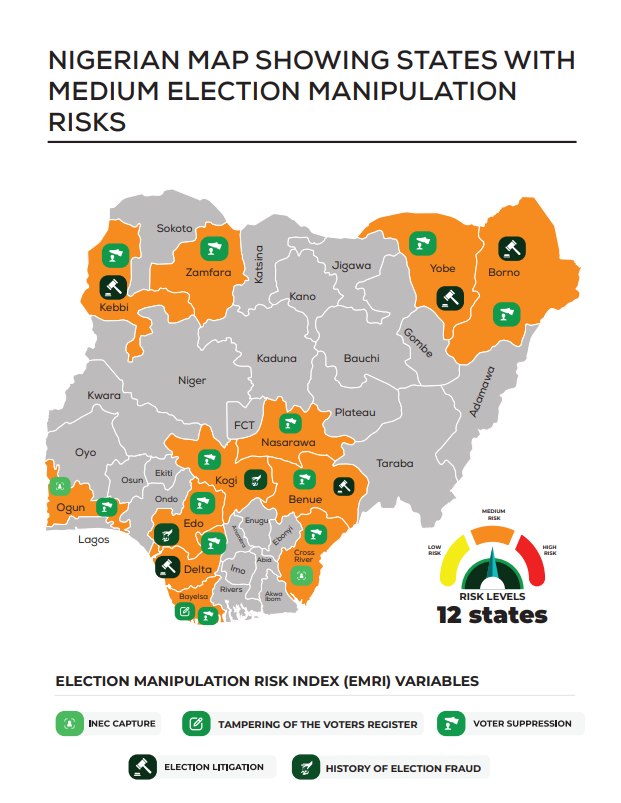
You look at the data on voter suppression, and it’s disturbing. We’ve been receiving reports, confirmed by the police, that politicians are buying off PVCs. When you do that, those people can’t vote. Politicians are going to opponent strongholds and buying off PVCs in those locations, thereby suppressing their votes.
[newsletter type=”gov”]
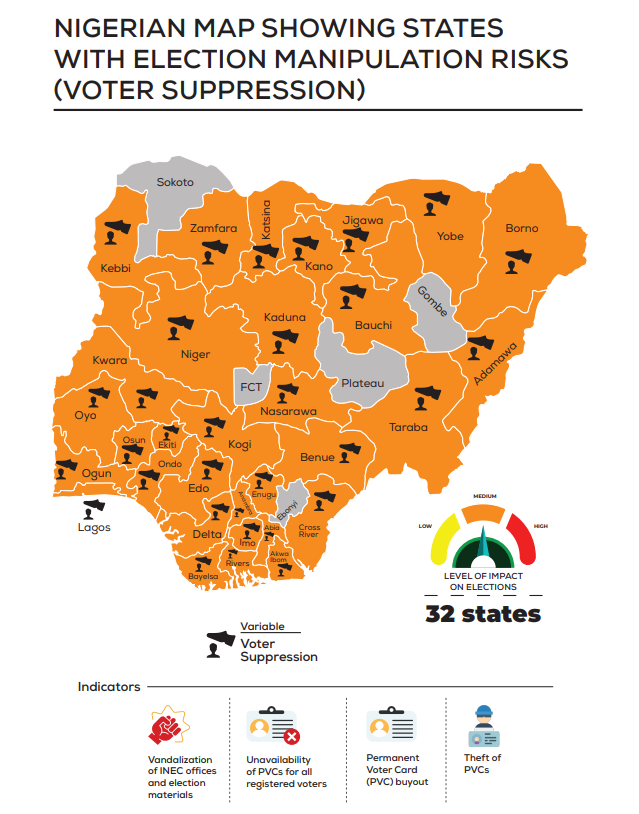
Thirty-two states have this element of voter suppression which is very disturbing. If you look at states with a history of electoral manipulation there’s either falsification of results, overvoting or vote buying during elections. We have to keep an eye on these states.
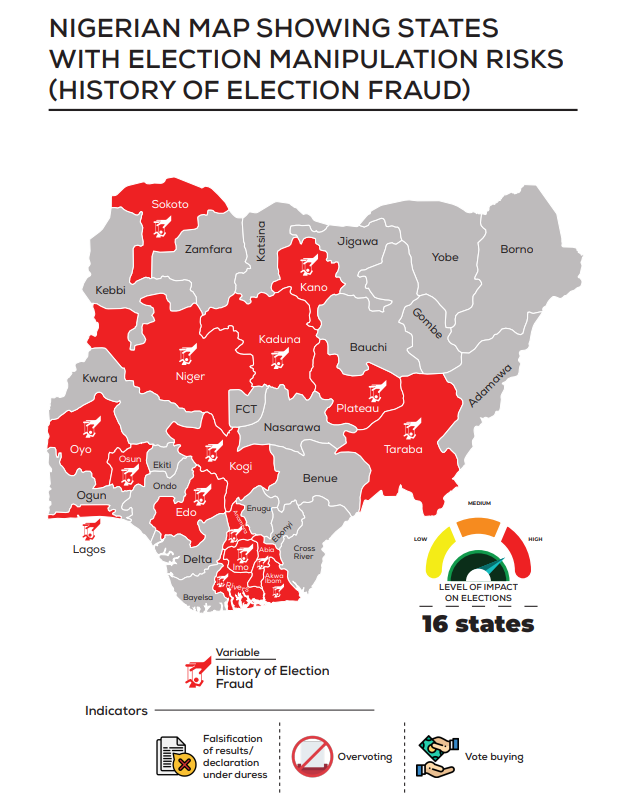
We’re publishing this to inform the electorate and prevent rigging the 2023 elections.
Kudos to YIAGA Africa for this extensive report. In light of recent events in Osun state, how confident are you in INEC’s ability to conduct elections using BVAS and IReV?
I’m very confident. The BVAS is a remarkable and innovative tool that limits multiple voting, election rigging and voting by proxy. Now that it has the force of law, politicians are scared of the BVAS and the INEC Election Results Viewing Portal (IReV). These two technological tools are game changers.
I urge Nigerians to support using the BVAS because it will limit election manipulation.
Let’s talk more about these tools
The BVAS is a device, while IReV is a web portal. We need to make a distinction between these two. For me, issues like the Osun judgment raise the salience and even add more credibility to the BVAS. Here’s why.
The BVAS identifies and tracks multiple voting or overvoting. The BVAS contains the voters’ register in a particular polling unit on election day. You need to register to vote. It verifies your biometrics — fingerprints, and facial identity. We talked about overvoting in some polling units (PU) in Osun because there was the BVAS. There’d be no way to track overvoting if it weren’t available. You can’t follow overvoting using manual accreditation. That’s one.
Interesting
Two, what happened in Osun, which Nigerians need to know, is that when the BVAS concludes accreditation, the data uploads to INEC’s server. The thing with uploads is they happen at different times. They occur in days. Sometimes when the network is unreliable, it won’t upload the data to the cloud.
There are over 3,000 PUs in Osun and over 3,000 BVAS machines. One of the parties applied for a report just after the election. INEC issued them the report, but it was incomplete because all the figures had yet to be uploaded on INEC’s server. The mistake INEC made was that the report should have indicated that it was provisional, but INEC didn’t. After the whole upload was concluded, INEC issued a final report which it tendered at the tribunal.
Three, the tribunal asked INEC to present all the BVAS used in the over 700 PUs contested. They brought the BVAS. The court checked them one after the other and compared what was on the BVAS with what was in the final report. Both of them were consistent. The big question is, what is the primary source of accreditation data? The primary source of accreditation data is the BVAS. If you will rely on something other than what was uploaded online, at least rely on the device. The figures in the BVAS and the final report were consistent, so why did they rely on an incomplete report to deliver their judgment? In any case, you should read between the lines.
Hehehe
The other thing the public should know, which the law is clear on, is where there’s overvoting, you cancel the votes in that PU, and you don’t apportion votes. When you cancel, you need to declare the election inconclusive. Then you conduct elections in those affected PUs, provided the total number of people who collected their PVCs in those affected PUs is higher than the lead margin. They ignored that particular provision in the law and ruled in the way they wanted, which is unacceptable. It’s an attempt to cast doubt on the BVAS.
The public must also know that BVAS is an electronic device for accreditation. But, someone has to copy the figures from the BVAS into the result sheet. That process has human interference because it’s a manual process. When there’s a manual process, there may be errors in copying figures. This is why young people voting in the elections should be vigilant at the PUs when elections have ended. They should ensure and verify that the number on the BVAS is recorded on the result sheet because politicians can compromise officials and have them record false figures. This leads to overvoting, cancellation and declaring results inconclusive.
See scope
That’s something Nigerians should be mindful of. The BVAS has its limitations, but it’s a tool that’ll deepen the integrity of our elections.
A BBC investigation raises the problem of misinformation by influencers in Nigerian politics. How’d you think Nigerians can protect themselves?
The first thing is to verify, verify, verify. Only trust some information that comes your way because many are fake. That’s one. Two, determine your source of information and stick to those credible platforms. If you check how those fake news purveyors work, sometimes they clone website addresses of credible media and news platforms. You have to check.
Refrain from consuming news in haste. Self-regulation is the best way to deal with issues around fake news.
The third thing members of the public can do if they’re looking for information on election results, it’s that INEC has the power to declare results. INEC has provided the IReV portal. Go and sign up. Create an account, and you can download the result on your own.
We at YIAGA Africa are also working with a TV station in Nigeria. We have the election results analysis dashboard (ERAD). So for Nigerians who don’t have email accounts, stay glued to your TV sets. We’ll provide you access to real-time results as they come, primarily because of the ERAD and the IReV. We’ve done this in the Ekiti and Osun elections.
(You can follow the election updates on Zikoko Citizen’s 2023 election results page in partnership with Stears Insights)
We must be careful about how we share information, especially on WhatsApp. Just know that this is a political season, and politicians have their “infrastructure” as part of their campaign strategy to continue to dish out propaganda.
You have to decide, a personal effort. There are also reporting platforms for fake news. Platforms like Meta and Twitter have tools where you can report fake news. Counter it immediately if a piece of information is circulating and you know it’s fake. Don’t wait for anyone to tell you to do that. Counter it and provide accurate information out there.
(Before you spread that news, why not Wait First? And check Zikoko Citizen’s flagship dedicated to fighting misinformation online)

The Electoral Act limits campaign financing, but it’s hard to see how they enforce them with blatant vote buying occurring. Thoughts?
Politicians don’t want to regulate political finance reforms. They are the culprits. In all these attempts at limiting the influence of money, who makes the law? These same politicians believe so much in money. Some of them know the only power they have is money. They’re not popular in their communities, so they buy votes.
Just look at the primaries. How many of the political candidates were elected out of the free will of the members of their parties? A lot of them bought their nomination. They procured delegates. When you procure delegates to elect you, that’s not an election. I look forward to the post-election period. Let’s discuss political finance reforms.
Fingers crossed on that one
But it’s essential to make a distinction. First, if you want to run elections, you have to spend money. The conduct of elections is a logistic operation, and when you have those, you’re going to spend money. You’re going to host meetings, give people refreshments, recruit agents to keep watch over elections, train them, move them around, run campaigns, use technology, procure data, etc.
So, elections involve spending money. We have a problem with this obscene commercialisation of the process where everything’s just determined by money. The leadership selection process is based on the highest bidder rather than one with the qualifications, competence and character to run for office.
No loud am
You have the introduction of dirty money into our politics. That’s where we need regulation. So you look at the current Electoral Act and see why politicians aren’t interested and are just gaming the system. On the one hand, the Act says INEC can impose limits on contributions. Contributing to a party or candidate, it’s ₦10 or ₦50 million, and it mustn’t exceed that. But another provision in the law says you can donate more than ₦50 million as long as the party can show and demonstrate the funding source.
But you also say, on the other hand, that INEC has powers to impose limitations. So you give INEC power with the left and take it with the right.
LMAO
You see this sort of inconsistency, and it’s deliberate. Politicians don’t want limitations on spending. They don’t want to limit money’s influence because it means retiring from politics, and they don’t want to be retired. I can think of a few things to do.
One, INEC has the power to audit and sanction political parties because it’s the regulatory body based on the provisions of the constitution and the Electoral Act. How many political parties have been audited? How many reports have been made public, and how many parties have been sanctioned?
The second is parties need to rethink their revenue generation mechanism. This is where maintaining an accurate and authentic register of members is critical. Members of parties aren’t paying dues because they don’t see the value in doing so. Political parties are owned by individuals who have the money to run the affairs of parties.
Why’s that? Isn’t it shameful that state party leaders are in the governors’ pockets? It’s the governor that funds the political party structure. The governor pays the salaries of party officials, which is unacceptable.
So when the primaries eventually come, the governor already has the entire party structure under his control. How do you expect internal democracy to flourish in those political parties? Parties need to think about ways of generating income.
One of the parties says it has over 40 million members. Imagine if those 40 million people pay ₦1000 as annual dues. Think about how much money they could raise. You don’t need to charge nomination forms of ₦50 million or ₦100 million. These are some of the things to consider.
Last year, the Kofi Annan Foundation inducted you into their fold. Congrats. You’ve also said you’d like to be the INEC chair someday. What’s the first thing you’d implement if that happens?
I didn’t see this question coming, haha. Where did you get that from? There are a few things we need to change within our electoral process. It’s challenging to be a voter in Nigeria. You show up to INEC (at least) three times in Nigeria.
First, you show up to register. Second, you show up to collect your PVC. Third, you show up to vote. Now, that’s a lot of time. Yes, it’s a sacrifice, but we can still do things differently. Any commission should first consider itself as a service provider. As you’re providing services to the people who are your clients, they are king. In business, the customer is king.
If you ask me one thing, I want people to vote anywhere they find themselves. Two, you don’t need a PVC to vote. Once you have your National ID and you’re 18, go cast your vote. Ultimately, it’s about the voters. Democracy is about people, and how they express their choice is central to democracy. When you say democracy is a government of the people, by the people and for the people, it connotes that people are at the centre of deciding. That process of decision-making is critical to the success of any democracy.
This thing where we make it difficult for people to express their right to vote is something we need to address, and if you do that, you’ll be shocked by the number of Nigerians voting during elections. You’ll also make voting fun and exciting for people. Don’t make it stressful. Yes, several things account for the stress, but we have all it takes to make voting more straightforward. Any commission should set that as its target. How do we serve the Nigerian voter effectively?
Join the Citizen Situation Room and Helpline on WhatsApp today to get real-time gist and drama on the 2023 elections.


