Notice: Function _load_textdomain_just_in_time was called incorrectly. Translation loading for the wordpress-seo domain was triggered too early. This is usually an indicator for some code in the plugin or theme running too early. Translations should be loaded at the init action or later. Please see Debugging in WordPress for more information. (This message was added in version 6.7.0.) in /home/bcm/src/dev/www/wp-includes/functions.php on line 6121 Bird Story Agency | Zikoko!
Tanzania’s rapidly growing ‘Bongo’ film industry is going full steam ahead, with British actor, Idris Elba, planning a major studio in the country.
British actor Idris Elba plans to open a major film studio in Tanzania after holding initial talks with President Samia Suluhu Hassan.
Tanzanian’s Director of Presidential Communications, Zuhura Yunus, recently made this announcement during a media briefing session on the outcome of President Hassan’s trip to the 53rd World Economic Forum in Davos, Switzerland.
“The president met with Idris Elba and his wife Sabrina, and they are keen to invest in a film studio in Tanzania,” said Yunus.
“Discussions on the project have just begun, and if successful, the project will help not only Tanzania but also Eastern and Central Africa,” she added.
Elba, who was born in Britain to a Ghanaian mother and a Sierra Leonean father, has previously spoken about his plans to help develop the film industry on the continent.
“Young Africans view me as a leader or a beacon. And I feel like I could bring something. So I’m keen to bring what I’ve learned in media and amplify it in Africa,” he told South Africa’s SA People in August last year.
And while this recent news is a shot in the arm for the country, Tanzania has worked hard over the years to package and position its film industry for international success.
Despite having low budgets and limited production skills and equipment, the country’s filmmakers have matured the local ‘bongo’ films to rival Nigeria’s Nollywood and Kenya’s Riverwood.
In September 2021, Vuta N’kuvute made history by becoming the first Tanzanian feature film to screen at the Toronto International Film Festival. It has also been screened at various festivals in Germany, South Africa, the USA, Brazil, Switzerland and Tanzania.
The Swahili film, which tells the story of a young woman whose romance blossoms on the back of a political revolt woman during the final years of British colonial Zanzibar, won the Tanit d’Or at the prestigious Carthage Film Festival in Tunis.
It also took home four awards at the 18th edition of the Africa Movie Academy Awards, held in October 2022 in Lagos. It won the Oumarou Ganda Prize for Best Fiction at FESPACO 2021 and the Special Jury Prize at the Seattle International Film Festival 2022.
The most significant success for the film, however, came in September 2022, when it became Tanzania’s official entry for the Oscars 2023 Academy Awards under the Best International Feature Film category.
“The future of Tanzanian cinema is finally in our hands. A wave of Swahili filmmakers is growing every day with pride, intelligence and boldness,” said Amil Shivji, the film’s co-producer.
Tanzania also saw three of its films streamed on Netflix in 2022, marking a great start in the international market. Binti, produced by Angela Ruhinda, became the first Swahili movie streamed on Netflix, followed by Bahasha and Nyara: The Kidnapping (2020), respectively.
But Tanzania’s prolific film industry did not start with the Bongo films and movies in the early 2000s.
The industry dates back to 1961 when the government of the new nation of Tanzania established the Government Film Unit in 1963, the Tanzania Film Company in 1968, and the Audio Visual Institute in 1974.
These institutions produced, distributed, and exhibited films, albeit films that propagated the Ujamaa socialist policies of president Julius Nyerere’s government.
Over the years, the government has continued to support the film industry with incentives and new regulations.
The Tanzania Film Board, in October 2022, embarked on a programme to coordinate the production of films with local strategic content featuring the country’s richness in several avenues to market the country’s attraction.
“We want a vibrant and aggressive film industry,…we are training the local producers to enhance quality, competitiveness and national identity films,” said the film board’s executive secretary, Kiagho Kilonzo.
The government also reduced filming permit fees to help filmmakers produce high-quality movies. According to the new regulations, filmmakers pay US$21 to get a filming permit, down from the previous US$215.
Non-profits like the Zanzibar International Film Festival, established in 1997, have also continued promoting Tanzania’s film industry.
The annual festival screens approximately 70 domestic and foreign productions and hosts capacity-building sessions for upcoming filmmakers, including workshops, masterclasses, debates and network events.
In a 2021 report, the UN cultural agency, UNESCO, revealed that Africa’s film and audio-visual industries could create over 20 million jobs and contribute US$20 billion to the continent’s combined Gross Domestic Product (GDP).
Market and consumer data company Statista says that Africa produces about 5,500 films per year, of which Tanzania manages around 500 yearly.
According to the Tanzanian Minister of Culture, Arts and Sports, Mohamed Mchengerwa, the country has at least 30,000 people employed in the filmmaking business, and the entertainment and arts industry contributes at least 19.4 per cent to the economy.
Aggressive production of local content, lower subscription rates, all to increase African pay-TV viewer numbers in a competitive market.
by Conrad Onyango, Bird Story Agency
Africa’s pay television industry is projected to add 16 million new viewers over the next five years as top players step up the battle for compelling and affordable local content.
Between 2022 and 2028, the continent’s pay-TV subscribers are projected to rise by 38% to 57 million, according to a new report by research firm, Digital TV research. Revenue growth, however, will be much lower.
Pay-TV revenues on the continent are forecast to reach US$6.44 billion by 2028, up by 29 per cent from US$4.99 billion in 2022, signalling that consumers are likely to benefit from falling monthly subscription rates.
South African Pan-African pay-TV giant MultiChoice (with 21 million viewers), China’s StarTimes (19 million) and France’s Canal+ (11 million) account for 89 per cent of all Africa’s pay-TV subscribers and are tipped to lead the fight for viewer numbers.
The market is also unlikely to see any new major entries.
“No new major players will start. Instead, these three operators will battle for supremacy – often by cutting prices,” said Principal Analyst at Digital TV Research, Simon Murray.
MultiChoice, in half-year results released November 2022, showed that its linear pay-TV subscriber base – measured on a 90-day active basis – rose by 1.0m (5%) to reach 22.1m viewers on the back of aggressive investment in local content production.
In 2022, the operator added two local channels and increased annual hours of local content in its library by 15 per cent to 73,000 hours. MultiChoice’s new local offering includes a new season of Big Brother Naija in Nigeria and two co-productions (Blood Psalms and Girl, Taken) in South Africa, with more in the pipeline.
“The group is currently producing the epic original drama series, Shaka Ilembe, which will be broadcast during 2023 and is already receiving significant international interest,” said MultiChoice in a statement.
Last year it also rolled out regional adaptations of popular telenovelas. For example, 1Magic’s The River was adapted for Kenya (as Kina) and Angola (O Rio). It said another seven local productions are in the pipeline.
In South Africa, MultiChoice has 9.1 million subscribers, with the rest of Africa sharing the remaining 13 million viewers.
StarTimes has also pushed local programming, with a commitment to collaborate with local content owners and producers across the continent, focusing mostly on the Kenya and Nigeria markets.
In December, it launched a 100-episode drama series, KIU, on its local content channel Rembo TV. Rembo, with a footprint that covers Kenya, Tanzania and Uganda, has a language policy requiring 60% of content to be in Kiswahili, 30% in English and 10% in vernacular languages.
“It is our commitment to continue supporting Kenya’s creative industry through commissioning more original productions as we seek to enrich our subscriber’s television viewing experience,” said StarTimes Chief Executive Officer Hanson Wang.
KIU production adds to StarTimes’ growing array of exclusive local content production and is advertised as featuring Kenya’s top casts, directors and scripts. Other exclusive programmes launched by StarTimes in 2022 include Kupatana and NIA.
The Canal+ strategy to boost local content has been through aggressive acquisition of major local film production studios and co-production agreements – or raising ownership stakes, including with its closest rival, MultiChoice.
In August 2022, Canal+ completed the acquisition of Rwanda’s first digital streaming platform, ZACU TV, culminating in the launch of a channel that airs 100% Kinyarwanda content. The French operator also bought out Nigeria’s most famous Nollywood movies producer Rok Studios, in 2019 and, from 2020, has been upping its shares at MultiChoice in tranches-growing it to a current 26%.
Industry analysts reckon operators will prioritise innovative ways of meeting dynamic viewer demands – simplicity, flexibility, customization, and convenience – to attract more eyeballs.
Secretary General of the Consumer Federation of Kenya, Stephen Mutoro, told bird in an interview that content, ease of access and affordability would drive more subscriptions.
“Competition would be welcome. Its not really competitive now. But content is king. MultiChoice enjoys the edge on exclusive popular content like EPL football. But then there are other consumers who enjoy non-football content offered by StarTimes and others,” said Mutoro.
These sentiments are also shared by analysts at Oxford Economics and Accenture in their joint survey covering Africa, which highlights local programming as a key differentiator in the industry across the globe.
“Research from Oxford Economics and Accenture finds that consumers value personalization and simplicity in their media experiences – and companies that innovate along these lines should emerge as winners,” said Oxford Economics Senior Research Manager, Thought Leadership, Sundus Alfi.
Pay-TV providers are not the only pan-Africa operators following these guidelines, however. Nascent video streaming services on the continent are tightening the competition for subscriber viewer numbers.
Dataxis, a global business intelligence and media company, projects that Africa’s video streaming market will have more than 15 million subscribers by 2026.
As in pay-TV, MultiChoice-run Showmax commands the largest number of African subscribers, at close to 2 million, followed closely by international player Netflix, with 1.5 million users. These players, too, are investing significantly in local content production.
The resulting stiff competition is expected to enhance the quality and exclusivity of content as well as tariff structures, to the benefit of viewers – with Mutoro singling out pay-TV players as having the upper edge on both access and reliability, over streaming counterparts.
“Pay-TV platforms use gadgets with reliable power supply. Streaming use narrow screens, such as phones, that are susceptible to running out of power. In the peri-urban and rural areas, access to streaming is impossible, over unreliable and expensive data bundles,” Mutoro explained.
African music is witnessing explosive growth on YouTube, in a marked departure from the continent’s past struggle to gain a foothold in the global scene.
by Seth Onyango, Bird Story Agency
More African hits are reverberating far beyond the continent’s borders, amplified by the global music reach on YouTube and other streaming services. Growing smartphone adoption and affordable and fast internet in Africa also drive the local consumption of music on YouTube. From the catchy Afrobeats and soulful sounds of Afro-soul to the energetic rhythms of Afropop and the traditional melodies of African folk, the diversity of African music is captivating listeners worldwide.
To most African musicians, YouTube has revolutionised how music is consumed, providing a platform for independent, undiscovered African artists to reach a global audience and gain success without the need for major record labels. As more people turn to YouTube for entertainment and to watch virtual concerts, subscriber traffic has increased steadily. African music is quickly rising among the most-viewed and most streamed. Here are some of the most viewed songs by African artists on YouTube at the time of writing.
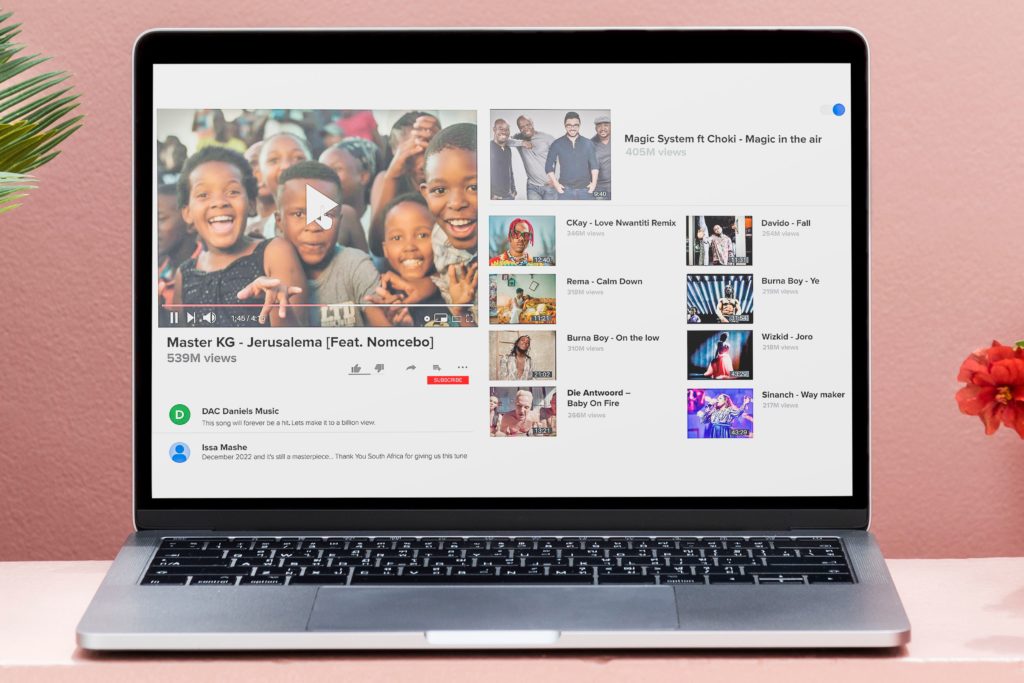
Jerusalema by Master KG –– 539 million views
Jerusalema is breaking records as the most viewed African music video on YouTube, with an impressive 539 million views. The track, released in November 2019, received a music video in December.
Magic in the Air by Magic System ft Choki ––405 million views
Magic in the Air is a mesmerising hit single released in 2014. With over 400 million views, it’s not just the most-viewed West African music video on YouTube, it’s also the second-most-viewed African. This infectious track is sure to get you moving and singing along.
Love Nwantiti Rmx. by CKay –– 346 million views
Love Nwantiti is a standout track from Ckay’s 8-track EP, CKay the First. Its addictive rhythms and melodies earned it a remix with Afro-pop star, Joeboy, and Ghanaian singer, Kuami Eugene, released in 2020. The revamped version became a global sensation thanks to its viral success on TikTok.
Calm Down by Rema –– 318 million views
Rema’s Calm Down has cemented its place as one of the highest-viewed Afrobeats music videos on YouTube, surpassing the impressive 300 million views mark. This hit single has continued to soar to new heights, further solidifying Rema’s status as a world-class artist. He recently teamed up with international pop sensation Selena Gomez on a remix of the club banger, which already has 210 million views.
On the Low by Burna Boy –– 310 million views
On the Low by Burna Boy has achieved the impressive feat of accumulating over 300 million views on YouTube, making it one of the few African songs to reach this milestone. The track was released on November 16, 2018, combining Afrobeat and dancehall elements. Produced by Kel P, this mid-tempo love song has been praised for its smooth, infectious sound.
Baby’s on Fire by Die Antwoord –– 266 million views
Baby’s on Fire has captivated audiences worldwide, accumulating over 266 million views on YouTube and solidifying its place as the second most-watched South African music video on Youtube after Jerusalema.
Fall by Davido –– 254 million views
Fall has achieved tremendous success with over 200 million views on YouTube and Gold certification in the United States and Canada. The song’s popularity has helped to elevate the Nigerian singer’s international profile and boost even more sales.
Ye by Burna Boy –– 219 million views
Nigerian singer, Burna Boy, unleashed a fiery and infectious anthem with Ye, a standout track from his critically acclaimed third studio album, Outside. Released on August 6th, 2018, Ye quickly rose to the top of the Nigerian charts and has become one of the most-watched African songs on YouTube. Its dynamic blend of Afrobeat and hip hop, paired with Burna Boy’s commanding vocals and catchy hooks, make it a must-listen for fans of contemporary African music.
Joro by Wizkid –– 218 million views
Wizkid has achieved massive success on YouTube with his hit song, Joro, which has garnered over 200 million views and counting.
Way Maker by Sinach –– 217 million views
The hit gospel song, Way Maker, has made a huge impact on YouTube, racking up over 200 million views and securing its place as the most-watched African female video of all time. With its uplifting message and powerful vocals, it’s no surprise Way Maker has resonated with audiences across the globe.
Content creators from Kenya, Nigeria and South Africa dominated the inaugural TikTok Top Content Creators Awards 2022.
by Bird Story Agency
Former rugby player turned food vlogger, Dennis Ombachi AKA @theroamingchef, emerged victorious at the inaugural TikTok Top Creator 2022 Awards. The Kenyan content creator, known for his culinary exploits, took home the Africa Winner award with Nigerian comedian, Charity Ekezie (@charityekezie), as the runner-up.
The TikTok Top Content Creators Awards took place in Nairobi and saw winners walk away with #TopCreator2022 trophies across various categories. The ceremony followed a highly competitive, eight-day-long public voting process on the popular social app. According to a statement by TikTok Africa, the inaugural award “recognises and awards content creators across Sub-Saharan Africa for the immense talent and creativity they brought to the platform in the past year.”
Boniswa Sidwaba, Head of Content Programming for TikTok in Sub-Saharan Africa, explained that the award aims to recognise and reward content creators for their positive impact on the platform’s users. “With these inaugural awards, TikTok aims to give creators in Sub-Saharan Africa the recognition they deserve and to encourage them to tell the African story while spreading joy at all times”.
Dancing queen, Ifeoma Efiokwu, @e4ma on TikTok, won for the West Africa region, with Maduakor Faustina Chisom (@berby_picxy) as her runner-up. South Africa dominated the southern Africa region, with @Pilot_onthegram, an aviation and lifestyle content creator and the first South African pilot to be verified on TikTok. Lindokhule Khoza @.lindokuhle_khoza was her runner-up.
Kenyan beauty enthusiasts, Natasha Gwal @natasha_gwal and @beautyby.nita, were the winner and first runner-up for the East African category. Roy Kanyi, a Kenyan content creator, considers the awards a motivating development for creators like himself. “Many will be more committed to the platform because the award confirms it cares for its creators and pushes for networking among them, which of course, comes with its share of benefits”.
With the growth of the social media market, TikTok continues to appeal to audiences from across the continent. According to Dataxis, a digital data hub, TikTok built a 31.9% market share within Nigeria by 2020. The popularity of the platform on the continent has prompted TikTok to invest further in its growing customer base. In December 2022, TikTok Africa collaborated with Ghana to put together one of the biggest Afrobeats music festivals in Black Star Square, Accra.
The platform’s African content creators are also seeing increasing demand for their creative skills. Fintech and marketing agencies are leveraging their experience to create and amplify marketing campaigns. According to Forbes Africa, TikTok has an advertising reach of 28.9 million users in northern Africa and 7.9 million in southern Africa, as of 2021. While the platform has started paying creators through its Creator Fund, most use other means to make money.
“Lately, creators are actively approaching corporate organisations. But only as long as the product and services to be marketed are consistent with the creator’s content”. Nkululeko Dladla, a South African-based social commerce specialist, added that because TikTok is visually driven, it is more appealing when showcasing products and services. “In South Africa, TikTok can be a powerful tool for fintechs to reach a younger, more digitally savvy audience”.
Through his art exhibitions, Onoja Jacob is promoting peace among communities in Jos, North-Central Nigeria.
by Dorcas Bello, Bird Story Agency
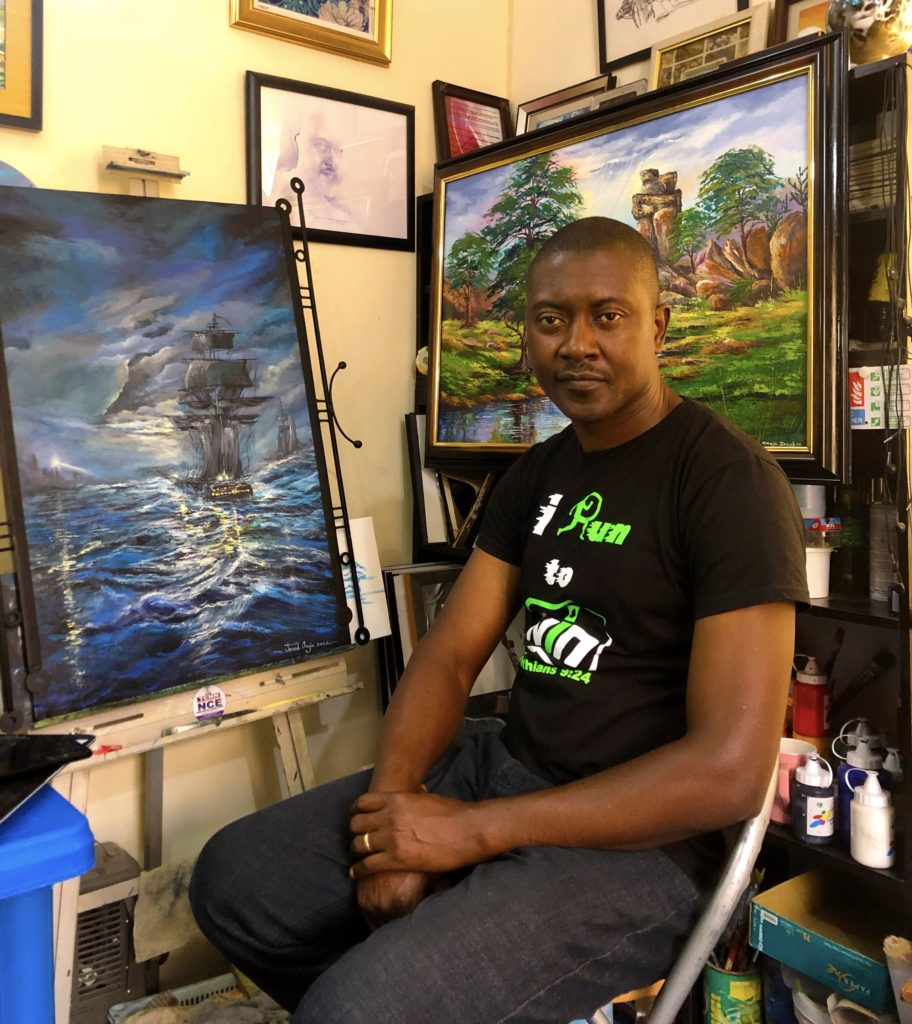
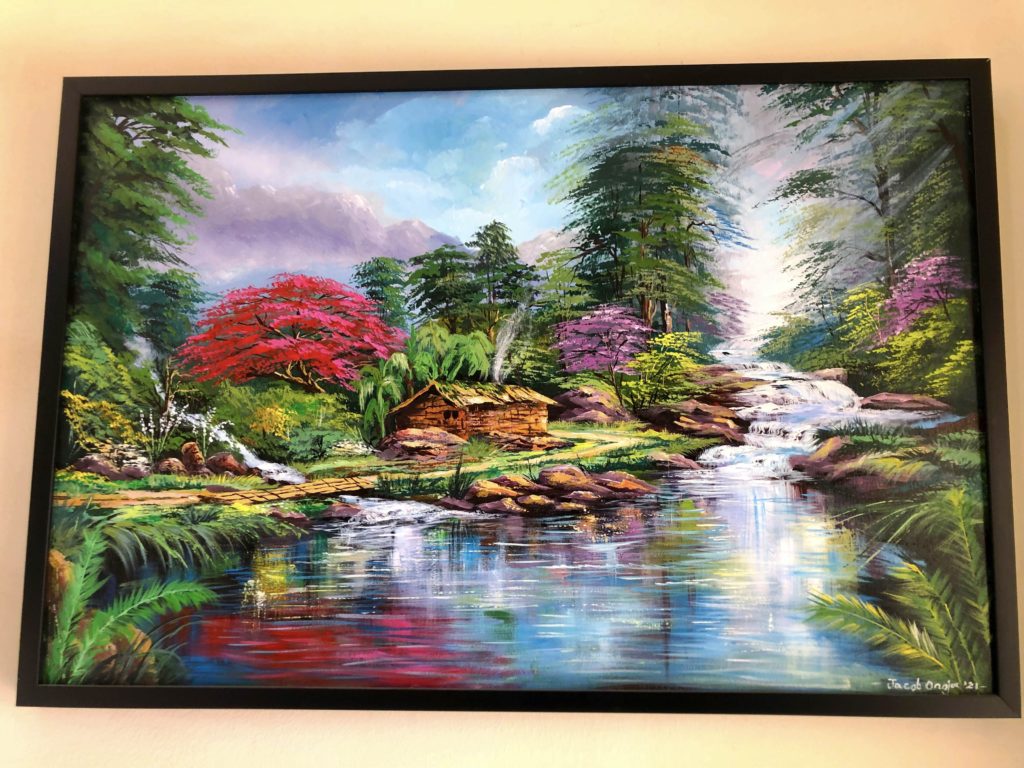
When Jacob Onoja opens the door to welcome guests into his house in Jos, Plateau State, the first thing that catches one’s eyes are the exquisite paintings on the walls. This is an artist who lives and breathes art.
“As far back as I can remember, I have always loved scribbling, drawing, painting and visualising imaginary things in the sky. I did it in my teenage years, and I still do in my adult life,” he said.
Onoja started to paint professionally in 1987 when he opened a studio, the Diadem Art Gallery. To refine his talent, he enrolled at Ahmadu Bello University, where he earned his first degree in fine and applied art. After his mandatory NYSC year, Onoja displayed some of his paintings at the NICON Hotel in Abuja, and after attaining a master’s degree at Ahmadu Bello University, enrolled for a doctorate in art history. Earning his doctorate in 2014, he then joined the University of Jos as a lecturer. But he never let go of his private studio engagement.
“It hasn’t been an easy ride juggling academics and private studio practice, but what keeps me moving is the long-term impact of my work. I have already started seeing the fruit of my labour as some of my students are now professional artists,” he said.
While Onoja uses his brush to depict a wide range of subjects on his canvases, the theme of peace is close to his heart.
“I was born and still live here in Plateau State, a place that has suffered insecurity, both cross-border and inter-communal,” he said.
Through his art, Onoja projects peace as a value presented not only as a right but something every individual needs to consciously strive for. This he describes as a form of community therapy.
“I try to tell stories of peace to entrap people into my space of therapy,” he explained.
In 2014, Onoja launched an annual exhibition called “Landscapes and More” that brings people from within and outside of Plateau State together to discuss peace as they experience the stories behind his paintings. Since then, it has been held every December as an artistic event to “wrap up the year”.
“It is a time of the year I look forward to, and many attendees have made it their annual routine,” he said.
One of those who’ve been attending the exhibition is Nenkinan Deshi.
“Onoja’s consistency in bringing peace messages is so healing… the scars of the instability in our state that I had nursed for years have been healed by the exhibitions. I appreciate his work and determination to preach peace through his art,” Deshi said.
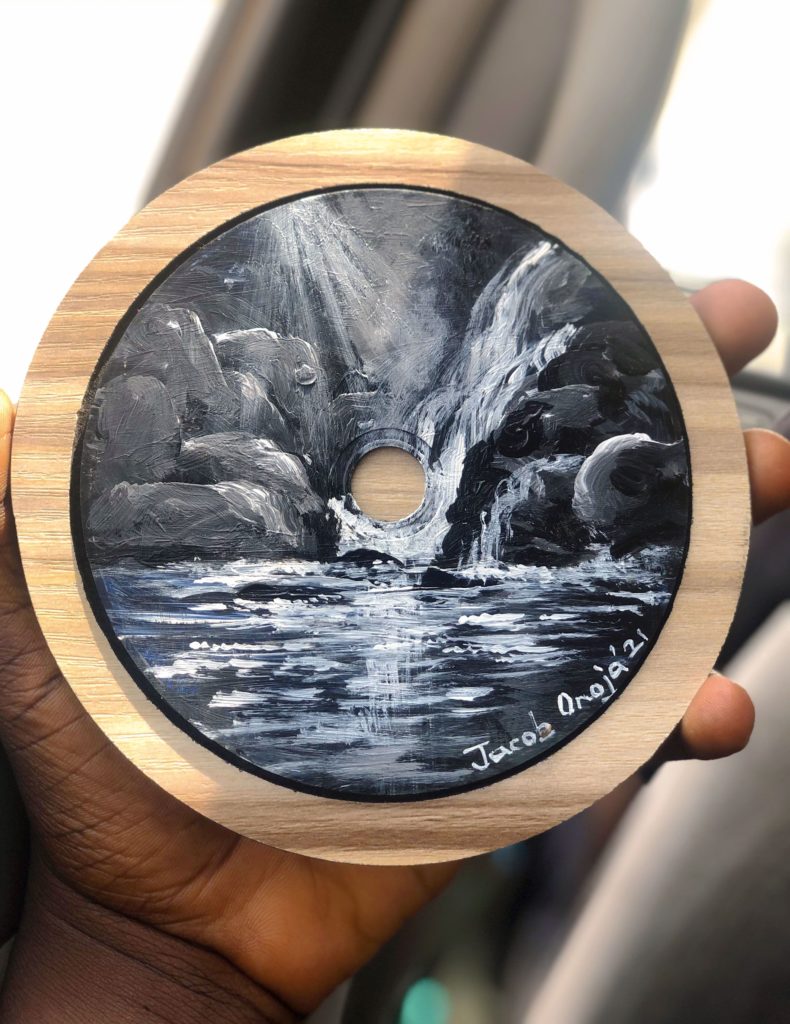
Onoja says he draws inspiration for his work from nature: flowers, buzzing bees, the skyline, waterfalls, everything nature offers. But above all, he is inspired by the divine.
Onoja’s work enabled him to lead the Zaman Tare project, a peace partnership between CANFOD, an NGO based in Abuja, and the European Union, from January 2018 until January 2020. Zaman Tare means “peaceful co-existence” in Hausa.
Its impact was summed up by Anas Ibrahim Suleiman, a community youth leader in Nasarawa Filin Ball, one of the “hot zones”:
“I have never experienced something so great and more than ever before, I have seen the need for us to work for peace together as a community,” said Suleiman.
Onoja has been engaged in other group and solo exhibitions, with some of his paintings appearing in foreign publications and receiving great patronage. He also says art pays most of his bills besides being a fulfilling career. His paintings sell between ₦7k ($15) for the smallest size, to ₦350k ($780) for the big pieces. However, the prices can also be higher depending on the place and organisers of the exhibition.
To speak to a broader audience, Onoja has gone digital and is also using Non-Fungible Tokens (NFTs) to sell his work.
“Digitalisation, especially the NFTs, is revolutionising African art. More creatives should leverage the technology to advertise and sell their artworks,” he said. On future plans:
“I want to grow and nurture this ‘baby’, the Diadem Art Gallery, into a huge enterprise specialising in collecting paintings and exhibitions on (the) theme of peace and co-existence,” he said. “I will continue to devote all my energy to art, my career as a lecturer and peace crusader”.
Rolling Stone expanded the 2023 version of the Greatest Singers of All Time to 200 from the original 100 count, and for the first time, eight Africans, including Miriam Makeba, Fela Kuti, Tabu Ley and Burna Boy, have made the list.
by Bird Story Agency
Rolling Stone, one of the world’s leading music publications, kicked off the new year with an update to its “200 Greatest Singers of All Time” list, which they first released in 2008, honouring the best vocalists in pop music.
“These are the vocalists that have shaped history and defined our lives – from smooth operators to raw shouters, from gospel to punk, from Sinatra to Selena to SZA,” Rolling Stone editors wrote. The publication released the list on January 1st, 2023, featuring eight African singers in the compilation.
They looked for “originality, influence, depth of an artist’s catalog and breadth of their musical legacy” when compiling the list.
Sade Adu is the highest-ranked African singer at position 51. Rolling Stone said the Nigerian-British singer has “proved herself the ultimate smooth operator,” adding that “her languid cool has a way of making everyone else sound histrionic.”
Following closely was South African vocal powerhouse, Miriam Makeba, ranked 53rd and described as “a fountain of vocal personality.”
“Indeed, to listen to her now, years after her death is to experience an artist who brilliantly communicates the joy of being alive,” the publication wrote about Makeba.
Egyptian Umm Kulthum was the third highest African on the list at position 61, with Rolling Stone saying she “has no real equivalent among singers in the West.”
“Her potent contralto, which could blur gender in its lower register, conveyed breathtaking emotional range in complex songs that, across theme and wildly-ornamented variations, could easily last an hour, as she worked crowds like a fiery preacher,” they added.
Other African singers who made the list include Senegalese tenor, Youssou N’Dour (69), South Africa’s Simon “Mahlathini” Nkabinde (153), who the publication described as “a peerless figure in the history of South African music, gifted with a cloud-rattling basso profundo groan, and a knowing, playful, at times diabolically incisive sense of what to do with it.”
Africa’s leading rumba singer-songwriter, Tabu Ley Rochereau of the Democratic Republic of the Congo, came in at 178th. “His voice was almost startlingly sweet, but he sang with so much pure transport, he never cloyed,” Rolling Stone wrote.
Nigerian superstars, Fela Kuti and Burna Boy, rounded up the African featured artists at positions 188 and 197, respectively. The publication said Burna’s voice is “sweet like caramel, but it can also soar on slickly produced tracks like his recent megahit, Last Last,or the 2019 gem, Anybody, excited by deep bass accents and insanely sophisticated polyrhythms.”
According to Rolling Stone, the top five greatest singers of all time are Mariah Carey, Billie Holiday, Sam Cooke, Whitney Houston and, at No. 1, African-American soul and Motown superstar, Aretha Franklin.
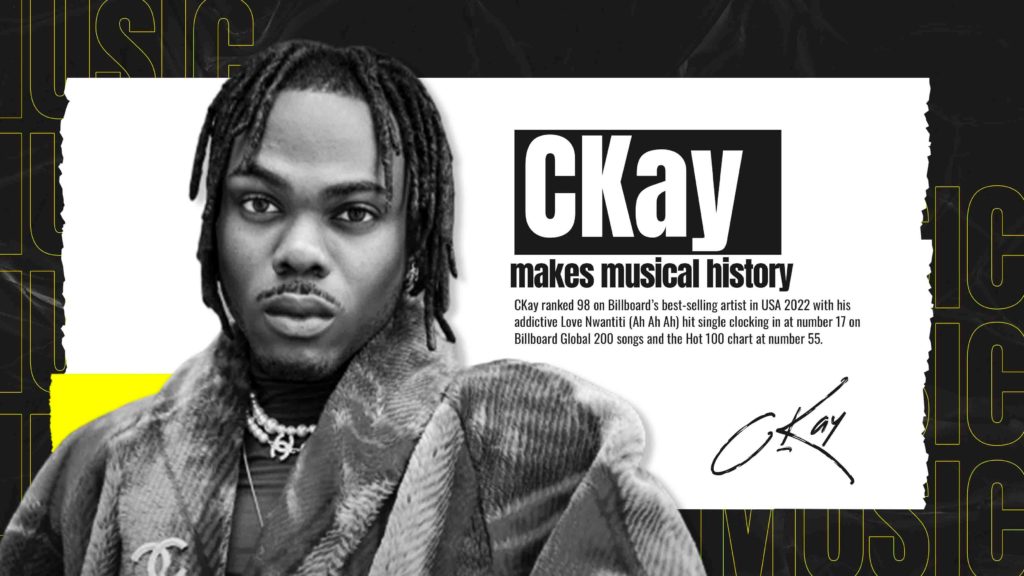
Nigerian singing sensation and producer, CKay, has made musical history as the first-ever African artist to feature in the top 100 Billboard Artist year-end chart, a milestone that underpins Afrobeat’s meteoric rise and shakeup of the global music scene.
By Seth Onyango, Bird story agency
The popular musician came in at number 98 on Billboard’s best-selling artist in USA 2022 with his addictive hit single, Love Nwantiti (Ah Ah Ah), clocking in at number 17 on Billboard Global 200 songs and the Hot 100 chart at number 55.
2022 has been another stellar year for African music and the success is likely to continue through 2023, with Nigerian artist, Burna Boy, set for a history-making concert at London Stadium on June 3, the first African artist to headline a UK stadium, according to Rolling Stone.
On April 2, CKay’s Love Nwantiti, which first debuted in 2019 and went viral with a string of international remixes on TikTok, topped the inaugural Billboard U.S. Afrobeats Songs Chart. It has surpassed 1 billion streams on Spotify and is also one of the year’s most Shazammed songs.
Tems, Wizkid and Fireboy DML also made appearances on the Billboard 100 with their hits Wait For U, Essence remix and Peru. Tems co-wrote Lift Me Up with superstar, Rihanna, a track featured in the recently premiered Black Panther 2: Wakanda Forever. Rema’s remix, Calm Down featuring Selena Gomez, also appeared on the global 200 at number 124, with Burna Boy’s Last Last featuring on the global 200 at number 156.
Trends show that African music, not just from Nigeria, the biggest export market, but also from South Africa, the Democratic Republic of Congo and Tanzania, is making waves globally. It is no longer surprising to hear the track Jerusalema, from South Africa’s Master KG, on European or American radio, or for Afro tunes to feature on celebrity social media posts, or for African artists to appear on highly-rated American talk shows.
African musicians are also coming into money. Burna Boy (AKA the African giant) filled New York City’s Madison Square Garden to capacity, becoming the first African artist to sell out the famed Garden of Eden, performing in front of over 20k people.
International music stars are also collaborating more with African musicians. Although this is not new, it is only in recent years that these collaborations have gone mainstream. This year alone, Rema featured Selena Gomez (Calm Down), Burna Boy teamed up with Ed Sheeran (For My Hand), and Future featured Tems and Drake on Wait For U.
Over the past decade, the continent’s music landscape has changed dramatically, with new fusions blended into existing genres to create a magical cocktail, birthing superstars like Fally Pupa, DJ Maphorisa and more. These artists and others have also become some of Africa’s most-cherished brand ambassadors. With more African musicians collaborating on songs across the continent, music is fast becoming more than entertainment.
According to United Nations Education, Science and Cultural Organisation (UNESCO), music fosters what African politics has struggled to achieve – unity. African music is also increasingly seen in totality rather than in isolated artists or styles. Billboard, the US publication that monitors reviews, events and styles related to the music industry, perhaps acknowledged it best:
“Over the past couple of years, Africa has exploded as a major player on the global music scene. From U.S. labels scooping up breakout African artists such as Burna Boy, Tiwa Savage, and Davido to the ascendancy of African streaming platform Boomplay and the inroads of majors Universal, Sony, and Warner Bros. on the continent, the stage is set for a lucrative new future for African music,” reads its latest review of Africa’s music scene.
As the continent’s music scene explodes (along with its population and economy), African musicians are grossing millions from world charts and securing major deals with international recording labels. Big royalties from various entertainment media like Skiza, YouTube, Boomplay and Spotify are at the heart of this movement.
Artists are now more aware of the gaps in the industry and the needs of their fans, with coveted honours like the All Africa Music Awards, BET and Grammys putting African artists in the spotlight. Legendary musical names are also not fading; Salif Keita, Yousour N’dor, Fatoumata Diawara and Anjelique Kidjo are still drawing large numbers, partly due to the exposure but also the timelessness of their music. Even “fallen” maestros like Manu Dibango, Lucky Dube, Franco Rocherau and Kanda Bongo Man are still in the groove posthumously.
Wizkid has made history by becoming the first African to win an award at the 50th edition of the American Music Awards (AMAs).
By Bird story agency
Grammy award-winning singer, Wizkid, has made history. He is the first African to win an award at the American Music Awards (AMAs), held on November 20, 2022, at the Microsoft Theater in Los Angeles.
Wizkid, who was not present at the ceremony, won the Favorite Afrobeats Artist award. This category was introduced earlier in the year, highlighting the global influence of Afrobeats on the international music scene.
He bested fellow nominees, Burna Boy, CKay, Tems and Fireboy DML to win.
The 32-year-old artist also won the Favourite R&B Song award for his collaboration with Tems on the hit song, Essence. He defeated Beyonce, Bruno Mars and SZA to clinch the award. Tems won Favorite Hip Hop Song for her contribution to Future’s Wait For U, which also features Canadian rapper, Drake.
This feat comes days after Wizkid headlined New York City’s iconic Madison Square Garden in a sold-out show on November 16. Two days before, he’d joined Apple Music to perform at Roundhouse, London, to promote his latest album, More Love Less Ego, which was released on November 11.
More Love Less Ego comes two years after his acclaimed album, Made in Lagos, the longest-charting Nigerian album of all time on the Billboard World Albums chart (50 weeks).
AMA winners are voted entirely by fans. Nominees are based on key fan interactions — as reflected on the Billboard charts — including streaming, album and song sales, radio airplay and tour grosses. Measurements are tracked by Billboard and its data partner, Luminate, in the eligibility period of September 24, 2021 through September 22, 2022.
Award-winning visual artists, Gbenga Adeku, Dotun Popoola and Samuel Anyanwu are converting Nigeria’s plastic, metal and textile waste into beautiful art and getting global recognition for their work.
By Gabriella Opara, Bird story agency
Artwork by Uzoma Samuel. Photo Credit: Uzoma Samuel
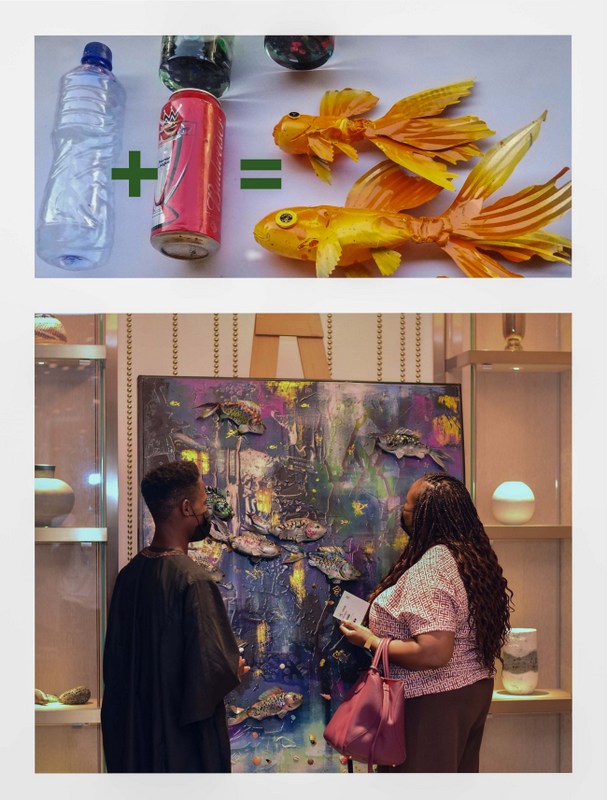
A typical workday in the life of Gbenga Adeku starts with sorting through materials in his studio. Then, he digitally sketches out his concepts and collaborates with contract workers to bring them to life. Based in Osun State, Nigeria, this visual artist transforms plastic waste into something valuable.
Adeku didn’t have this perspective on plastic art seven years ago. He’d recently completed his fine and applied art degree at Obafemi Awolowo University but chose to be a freelance illustrator because it paid more at the time. However, a chance encounter with Dotun Popoola, a metal sculptor, sparked his passion for plastic art.
“Dotun Popoola made it easy for me to transition from being a freelance illustrator to a full-time studio artist. His roadmap was inspirational because he is big on art that solves problems. I was keen on that. Seeing him do a lot with metal motivated me to do a lot with plastic,” said Adeku.
In 2018, Adeku started a full-time career as a professional upcycle artist. After the International Breweries Plc’s Kickstart initiative awarded him a grant, he founded his studio, Orinlanfiju, with his father, Segun Adeku.
“I read an article about how a PET bottle might survive 300 to 400 years before it breaks down and realised that plastic is present everywhere, including the air and our food. I concluded that upcycling is a better approach, to take the waste and turn it into something of higher value,” he said.
Adeku has been creating upcycle art for four years.
“I used to collect PET bottles and other recyclables at events. After setting up my studio, I started purchasing used plastics from local women. It’s quite affordable, a dozen for a penny, so I get a lot. My group and I collect, sort and use heat to reshape them. We experiment a lot; some ideas work, some don’t. But most often, we get interesting results, even if we have to spend months working on each part,” he said.
A recent collaboration with Nike will help transition Adeku’s signature art of ants and fishes to merchandise.
“Fish signify aquatic life, whereas ants stand for terrestrial life. Because ants rely on waste to sustain their economy, I think they are environmentalists. They work hard every day to find things along the way; an ant is never broke. It gets around barriers. Nigerians are extremely resilient, like ants. This idea rubbed off on Nike when they decided to open their flagship store in Nigeria. The idea of ‘Just Do It’ syncs with my art,” he explained.
Gbenga Adeku and guest at his art exhibition. Photo credit: Gbenga Adeku
Dotun Popoola, a metal sculptor, has a similar viewpoint on his work. He recycles abandoned metal to protect the environment.
“I like what I do. It contributes to the Sustainable Development Goals to protect the environment. My metal sculptures are a protest against environmental decadence. They’re a call to repurpose and upcycle the vast amount of trash endangering the earth,” said Popoola.
There’s a distinction between recycling, repurposing and reusing. As an upcycler, I give dead things a meaningful new life while preserving the earth. I feel like I’m one of the people saving this environment while making art, playing my role powerfully,” he added.
He asserts that raising young people to be change-makers and environmentalists is another way to protect the environment. Explaining his passion for mentorship, he said:
“Over the years, I’ve tried to encourage young visual artists in Nigeria and around the world. I had ten outstanding sculptors exhibit in my studio in October. I chose five top ones, some of whom will go for residency in India, and another, in the USA. That I can make a difference in their lives is a fantastic privilege. I see it as contributing to society, which is one of my core values.”
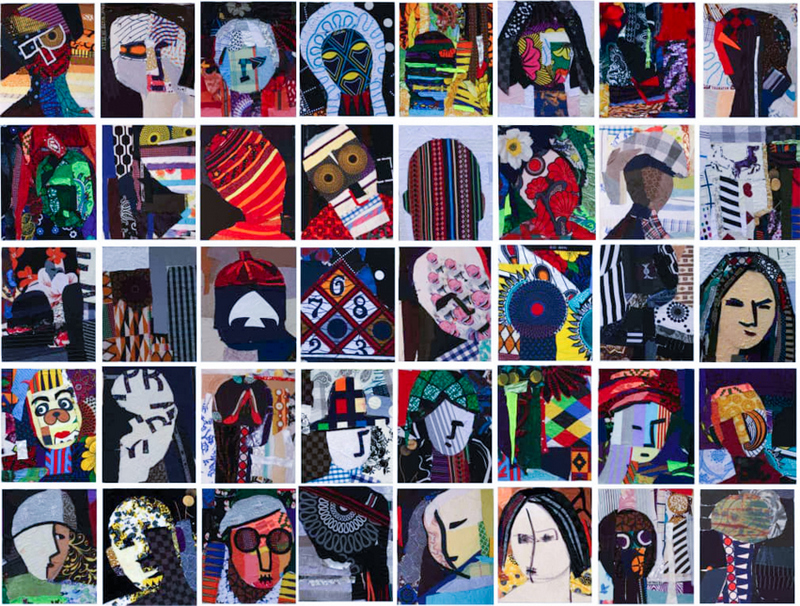
Elsewhere, Uzoma Samuel Anyanwu, who grew up in a home of tailors, had first-hand experience with the effects of fabric waste. To solve the problem, he quit his job as a full-time photographer to become a textile artist in 2012.
Anyanwu, who describes himself as an experimental artist, combines his abilities as a visual artist, photographer and upcycler to produce portraits on canvas using fabrics. He views it as a lifelong endeavour rather than merely a studio practice.
“Fabrics have long been the object of my attention. I’ve been tinkering with them since I was a baby. My mother was a seamstress, and she taught my siblings and me the trade. Many individuals view my work but don’t grasp its fundamental concepts. I’m pleased they love my work, but I also use it as an avenue to educate them about climate issues,” he said.
A decade after he started, Anyanwu is still struck by the amount of fabric waste he can get his hands on. With studios in Lagos, Owerri and Port Harcourt, he gets discarded fabric from fashion houses, tailors and markets.
“We can’t use them all up at once. The sacks of fabric we receive last us for a year or two, and we never throw them away because they’re always useful to us,” he explained.
Sourcing for fabric is easier than he thought because discarded pieces are everywhere.
“We approach some people, and some approach us. Some offer us large quantities for free, others sell them to us at low cost. The highest I’ve paid for a sack of fabric pieces is ₦8k (appox. $18). We usually get them in bulk towards year-end because that’s when tailors sew Christmas clothes, and everyone wants something trendy. Old fabric get thrown out; new ones leave pieces behind.”
Uzoma Samuel with one of his fabric art pieces. Photo Credit: Uzoma Samuel
His work as a fabric artist is a community endeavour. The amount of work it takes to find fabric, learn about them, classify them, draw and make his collage art keeps his studios busy all year long. Because of how time-consuming the work is, Anyanwu outsources some of it to contract staff, which sometimes includes his neighbours.
“Telling stories is my profession. I spend a lot of time researching each fabric’s backstory to ensure I accurately convey it. I have to hire individuals on an hourly, daily or weekly basis, depending on the workload of each project. My assistants, mentees and interns participate. I occasionally ask my neighbours and relatives for help, and we all work together,” Anyanwu said.
Despite the months and years required to source art materials, one thing that drives these visual artists is the desire to see a cleaner, waste-free environment.
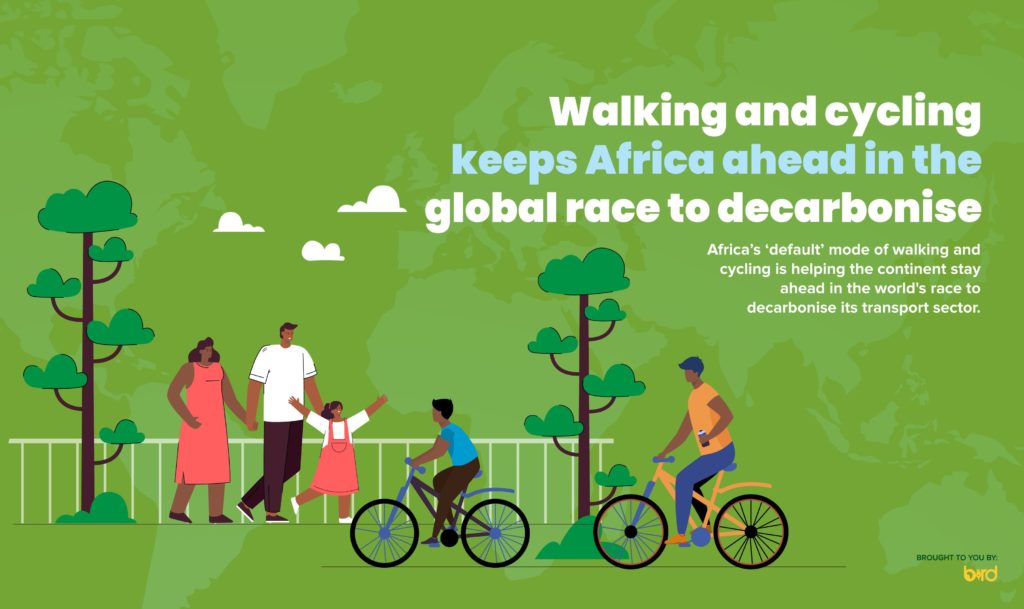
For all those forced to walk or cycle to work or school every day, a new report highlighting the positive climactic impact will not bring much relief. But in the global race to decarbonise, the impact of the millions who walk, is huge. Now, how to keep these increasingly affluent commuters, “green”?
By Conrad Onyango, bird story agency
Africa’s ‘default’ mode of walking and cycling is helping the continent stay ahead in the world’s race to decarbonise its transport sector.
Only one in every three Africans benefits from motorised modes of transport daily, according to UN-Habitat, making it the region with the lowest access to public transport in the world. While that statistic – which is likely to change substantially as Africa’s economy develops – is a negative for those concerned, it is a huge positive for the world.
The United Nations Environmental Programme (UNEP) shows that up to 78 percent of people walk for travel every day to access healthcare, education, shops, jobs and transport, often because they have no other choice.
Two new reports view these as a blessing in disguise and are building a case for walking and cycling as the most affordable and sustainable transport modes.
A new report, Walking and Cycling in Africa – Evidence and Good Practice to Inspire Action calls for more focus and investments into non-motorised modes of transport to keep the impending rise in carbon emissions at bay as more cars enter Africa’s roads, thanks to rising incomes and urbanisation.
“In Africa, where there is an incredibly high modal share in walking and cycling, decarbonization of the transport sector means retaining and enabling people to move safely in their cities by foot or bicycle,” said UNEP Africa Office,Acting Director and Regional Representative Frank Turyatunga.
Up to one billion Africans spend 56 minutes walking or cycling for transport every day, generating the least noise and air pollution of any commuting population in the world, according to the report by UN Human Settlements Programme (UN-Habitat), the UN Environment Programme (UNEP), and the Walk21 Foundation.
However, governments need to act to support walking and cycling. While the continent accounts for just 3 percent of the world’s registered vehicles, it is home to 20 percent of global road traffic deaths. More than 260 000 people were killed on African roads in 2019. Of these 36 percent were pedestrians and 3 percent were cyclists. That makes African countries among the least safe places to walk and cycle in the world.
Walk21 Foundation Chief Executive Officer, Bronwen Thornton, said the continent’s leadership and policymakers need to start building better facilities to increase the value of – and people’s satisfaction with – walking and cycling.
“We can put walking and cycling at the heart of planning and investment for our streets and neighbourhoods. They are the solution to the multiple challenges we face and usually at lower costs than the alternatives,” she said.
The latest Climate Reality Barometer by Epson shows walking and cycling among actions that Africans in Kenya, South Africa, Morocco and Egypt are planning to embark on or are currently engaged in, to minimise the impact of climate change.
Of 26,205 people surveyed across 28 markets, 87.2 percent plan to embrace non-motorised transport and 31.8 percent have done so over the last 12 months.
Over the past year, 18.6 percent of those surveyed made a shift to renewable energy.
“We hope that the Barometer’s insights will help governments, industries and individuals to step up their efforts to avert climate disaster. While we know there is a long way to go, we believe we can build a better future if we work together and act now,” said Epson Global President, Yasunori Ogawa.
According to the Barometer, more than eight in 10 people (80.2%) cite having witnessed climate change in their daily lives as the most influential factor in building awareness.
“Planning for the long term and enabling people to take climate action now is the most powerful action countries can take to sustain climate optimism, reduce carbon pollution and build resilience to climate impacts,” said environmental scientist and Co-CEO of Change by Degrees, Tara Shine.
The authors of the Walking and cycling Africa report call for improved urban planning and design that focuses on how to bring people and places together, as many cities begin to accelerate a COVID-19-related expansion on walkways and bike lanes.
“There is a window of opportunity for change in the way we organize our transport systems,” said the United Nations Human Settlements Programme, Director for the Regional Office for Africa, Oumar Sylla, of the immediate post-COVD period when governments are still looking to enhance the wellness and resilience of their populations.
Among African cities that are already making progress are Addis Ababa – with a plan to build 1,000 km of pedestrian routes and cycling lanes – and Yaounde, which has strict plans around pedestrian access.
Kenya’s government has also committed to investing in walking and cycling infrastructure.
Zambia, Ghana and Senegal have Pedestrian Safety Action plans that promote investment in safer road crossings, wider footpaths and protected bike lanes, as well as shelter for pedestrians from weather, secure bike parking, lighting, and improved access to public transportation.
A Kenyan environmental law student is seeking a patent for her healthy, edible cups and plates, designed to wage battle against the mountain of plastics that threatens marine life. She already has an airline customer lined up.
By Sheila Mwalili, bird story agency
Daring, beautiful dreams are spiritual fuel for 22-year-old Sheryl Mboya. She’s an environmentalist and law student at Mount Kenya University who’s on a quest for a cleaner and healthier environment. And she believes she has the answer: edible cups, plates, and spoons.
Mboya’s answer may sound fanciful but at just 22 she’s got the credentials to make her case. So much so that a national airline has signed on for her first products.
Snackuit – edible cups, plates, and spoons that substitute single-use plastics tableware – was born out of the anguish Mboya felt after seeing thousands of plastic cups being tossed into trash bins at eateries, after use. This was happening everywhere she looked, including hospitals, offices and get-together spots.
What disturbed her most was that the destination for the trash was not only dumpsites but, all too often, rivers – and the ocean.
“Whenever I would go to a hospital or an office and I felt thirsty, I’d pick a cup, drink water and throw it only to pick another one a few minutes later. This is what everybody does. So I felt that this was happening because there was no alternative.” she explained.
According to the UNEP’s From Pollution to Solutions report of 2022, 400 million tonnes of plastic are produced annually and 7 million of those manufactured between 1950 and 2017 have become waste. The report further states that the equivalent of a garbage truck is dumped in the ocean every minute, threatening biodiversity and damaging marine ecosystems. At the same time, greenhouse gas emissions associated with plastics are expected to rise to 6.5 gigatons by 2050.
To do her part, Mboya resolved to avoid single-use plastic and started carrying her water bottle around to use. But this, she realised, was not solving the problem in the larger scheme of things. She was just a lone warrior in an overwhelming anti-plastics war.
So Mboya and a team of 20 young people founded GreenX Telemechanics Limited to be part of the solution. The result of their research and early testing is their first product: Snackfruit.
“I love to term Snackuit as a similar way you can eat the ice cone once you’re done eating your ice cream, gelato, or sorbet. So once you finish your dinner or coffee, you can then eat your cup, plate, or spoon.” Mboya explained.
The team, which has already set its eye on mass production even as it awaits intellectual property approvals, partnered with Kenya Airways through their Fahari Innovation Hub to facilitate the adoption of the product in the aviation industry.
“During the research process, we identified the aviation industry as one of the largest users of plastics, so we wanted to cater to that need, but ultimately we also target every single market, including individual consumption.” said Mboya.
Kenya Airways, for its part, would be more than happy to replace single-use plastics used for in-flight meals. This would be a first for any airline.
“Edible cutlery is a brilliant concept that will revolutionize food packaging and how we eat. It is a fantastic, healthy solution for the entire ecosystem. We ardently support and co-develop innovations by the youth and entrepreneurs that seek to secure a healthy planet for all.” Kenya Airways Innovation Hub Lead, Grace Vihenda said.
The Snackuit idea is currently under intellectual property protection locally through the Kenya Intellectual Property Institute (KIPI) and globally through the World Intellectual Property Organisation (WIPO).
“Snackuit is an excellent idea. It’s tasty and one can snack on it as they consume their meal or even afterwards. It’s also good for the entire ecosystem as it doesn’t contain toxic chemicals. I believe the innovation deserves all the support we can master as a nation.” David Owino, an Artificial Intelligence technician at GreenX explains.
The biggest challenge to Snackuit so far has been viability, explained Mboya. Would it hold hot drinks and meals? How palatable would it be?
To address this, the team came up with a product made of gluten-free wheat flour and sugar substitutes to ensure it is sugar-free but still tasty. It is also cholesterol-free.
It also comes in a variety of flavours such as butterscotch, and if it is not consumed by the users and ends up in any water body, it will dissolve within a day, making it “good food for marine life and plants, too”.
“In the testing process, we noticed that the cups leak when we put water in them. We went back and made some adjustments but then noticed they became too hard.
Fortunately, we have now found the right formula that holds the product together and softens it as you eat or drink.” Mboya explained.
She’s also not oblivious to market forces.
“Plastics have a huge market, and to find an alternative, you must move systematically. For a start, we’re looking to start with the aviation industry, then the hospitality industry, before moving towards the larger individual consumer market.” she said.
Nutrition Association of Kenya chairman Henry Ng’ethe said a positive market reaction to Snackuit would allow Mboya’s team to place a premium on their product early on and then wait for mass production to reduce costs. Market sentiment would allow for higher costs thanks to the social – and in this case, environmental – good of the product.
“Gluten-free flour costs about 200 Kenya shillings (approximately 2 US$) per kilogramme. The cost of production for mass consumption of Snackuit is therefore likely to be very high.” says Ngethe.
“Overall, it is a very good initiative and should be supported because if we eradicate plastic pollution in our water bodies even by 10 per cent it’ll help address climate change, resulting in improved rainfall and ultimately food security both nationally and globally.”
For now, however, Mboya’s greatest bet is the GreenX team, family, friends, mentors, and university fraternity.
“Innovation is the solution to a myriad of challenges facing humanity; it is what will lift developing countries out of poverty. I appreciate the Snackuit idea that Sheryl has come up with, and I appeal to those willing to partner with her to support her in fully developing the innovation to encourage other young people with great ideas. This will not only make them productive but also self-reliant.” said her mother, Ruth Areri.
In 2017, Kenya announced a total ban on single-use plastic bags to clean up the country’s rivers, seas and waterways, making it one of the first African countries to make such a commitment.
Mboya’s icon is the late environmentalist Wangari Maathai who used the story of a hummingbird to drive her point home that every individual effort, however, insignificant it may seem, counts in keeping the planet healthy.
Like the hummingbird, she says: “I might be insignificant, but I certainly don’t want to be like the human beings watching the planet going down the drain. I will do the little I can.”
Local content is beginning to outcompete international films in Africa as rapid smartphone penetration and an affordable and expanding internet bring African creatives closer to audiences.
By Seth Onyango, Bird Story Agency
African creatives are finding a new audience among the youth, who according to the latest Africa No Filter report have grown their proclivity for local content.
The narrative change organisation’s report indicates Africans are consuming African films equally as much as they consume the US or international content.
“Most respondents watched films every week, whether local/African films (67%) or US/international films (66%). Among respondents who had watched between one and seven films, slightly more respondents had watched local or African films (57%) than international or US films (53%),” the report reads in part.
Regionally, North Africans were the least likely to have watched a film (45%) but were equally as likely to have watched local/African and US/international films (51%).
West Africans were marginally more likely to have watched local/African films (70%) compared to international films (67%).
“International films received a marginally greater audience in East Africa (78%) and Southern Africa (73%) compared to local/African films. Respondents from Côte d’Ivoire were most likely to have watched a film, whether local/African (86%) or international/US (76%),” Africa No Filter, a donor collaborative that supports African narratives, reports.
“Given the minor discrepancies, it seems that audiences are as interested in watching local/African films as they are in watching international ones.”
Recent studies also show that Africa’s young population is helping to drive video subscription business revenue for streaming services as content on the go shakes the African media market.
Digital TV Research’s figures now show the continent will have 13.64 million paying Subscription-Video-on-Demand (SVOD) by 2027, up from 4.90 million at end-2021.
Household SVOD subscriptions will still remain low compared to more mature markets like Europe.
Digital TV Research further shows some 6.6% of TV households will pay for at least one subscription by 2027 – up from 3.9% at end-2021.
International streaming services like Netflix have also taken note of the shifting trend in Africa towards local content and are now co-producing both films and reality series like the popular Young, Famous & African.
Tellingly, Netflix now has a category of “Made in Africa” and “Nollywood” which highlights how serious it conceives the African market.
While Africa’s ballooning youth population and growing middle class could represent a profitable niche for streaming services, this could also be a big opportunity for African production industries.
However, Nigerian film critic Wilfred Okiche, warns that Nollywood may, for now, have lost its shine and that the Netflix “opportunity” should be handled with care.
“For independent Nollywood filmmakers, the Netflix relationship is a lifeline to an industry badly in need of structural uplift, having hit something of a plateau with both video and theatrical, its two primary distribution models,” Okiche argues.
Netflix, Showmax, Disney, and Amazon have been studying consumer habits on the continent to appeal to its one billion-plus audience.
Netflix has about 2.6 million subscribers in Africa and wants to grow that number to 5 million by 2025. The number of people watching movies on the platform is said to be much higher, factoring in family sharing by its premium subscribers.
Netflix’s chief rival, MultiChoice’s Showmax, which has invested heavily in original African content, is beginning to reap the reward as African content now accounts for 40% of its viewing.
MultiChoice is Africa’s largest pay-TV group, available in 50 African countries. Its streaming service launched in 2015 and is available in 46 African countries, as well as in Britain and France, where it targets the African diaspora.
In April this year, the streaming service said it will double its investment in creating movies and shows set in its biggest markets of Nigeria, Kenya, and South Africa.
Meanwhile, the Africa No Filter report further found that African writers are not writing for local audiences, the continent’s readership also hardly reads for pleasure.
Hardly any respondents had also read a book in the month before the interview; 75% with 71% had not read any African authors.
“This indicates that African authors are not attracting an African youth audience. We also compared the respondents’ reading habits, asking how many books by African and/or international authors they had read for pleasure over the last month,” Africa No Filter notes.
When Onyinye Gift Ikechukwu engaged her creativity and entrepreneurial spirit, something interesting happened.
By Victor Eyike, bird story agency
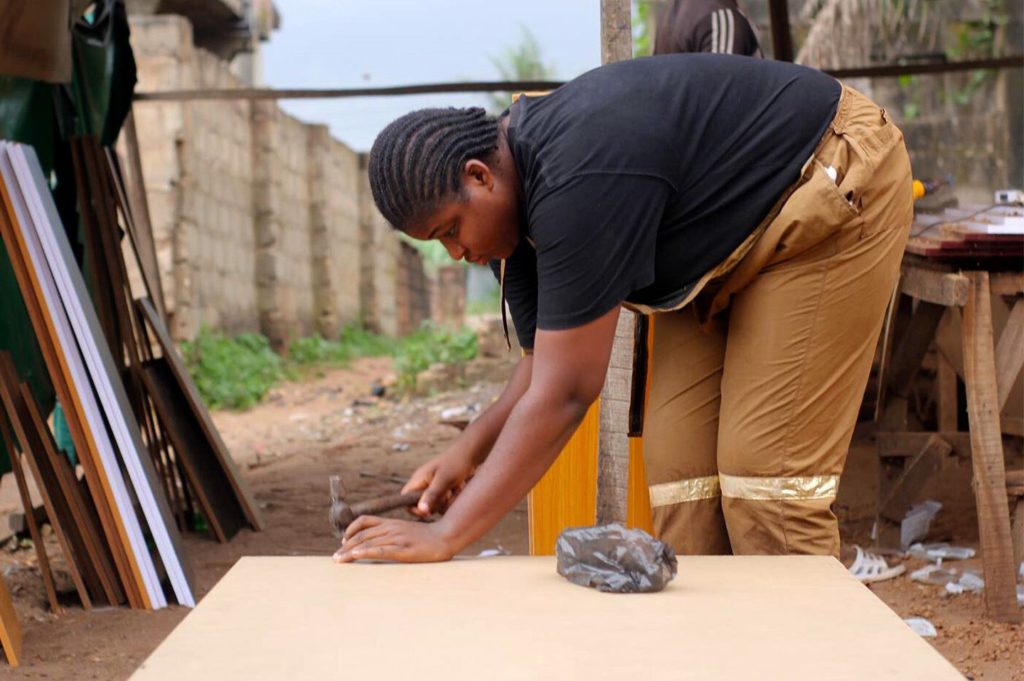
In a yard down on Benin City’s popular 5-Junction Road, ten men gather for a daily ritual. They are greeted by a strongly built young woman wearing workman’s tan overalls and leather shoes, who leads them in prayer. Afterwards, the men pick up their tools and head their various ways, each to a carpentry workstation of their own. Onyinye Gift Ikechukwu, the woman in the overalls, does the same.
Ikechukwu is the proprietor and chief designer of Cheeo Furnitures — a hub open to skilled furniture builders in this city in Edo State.
Work starts in earnest in the yard, where several pieces of furniture, including tables, chairs, beds and other pieces of home decor, are already complete and on display for sale.
“The yard is usually open to any furniture maker. So, different people come here to work. I start my day by praying and changing to my uniform before sorting out the materials for use in the day,” Ikechukwu explained, before getting down to work.
Although there are several other furniture yards on this stretch of road, Cheeo is unique. In most yards, a businessman owns the business and the artisans — many extremely skilled — work for a wage. At Cheeo all are equal — everyone rents space and retains their independence. And Ikechukwu has gained something of a cult status amongst her fellow artisans. Where many people see her as an unwelcome intruder into the menial, “man’s world” of the furniture-making business, her co-workers at the hub see her as something of a local hero.
Furniture maker Chude Smart said Ikechukwu’s open-yard concept not only accorded the artisans space to work but attracted more customers. It also provided something they can’t get working alone.
“Whenever we’re here, we’re supported by our mates. Sometimes we borrow materials from one another. It makes the work easy and fast,” he said. speaking his local dialect.
Ikechukwu also offers something the artisans would not get elsewhere: social media marketing. Ikechukwu turns to social media – particularly Instagram – to market the products in the yard.
“The bottom line is, there are so many skilled furniture makers, You just have to put your work out there through social media platforms and try to reach clients before your competitors,” she said.
Although Ikechukwu had qualms when she ventured into furniture making, she was determined to make her mark in a male-dominated furniture manufacturing sector that rakes in more than ₦50 billion (almost 120 million US dollars) annually, according to the Nigerian factual site, Nigerian Finder. Only 19 at the time, she was ready to ride out whatever challenges came her way.
“I was seeking admission into the tertiary institution at that time and I was getting declined, so I desired to try something different. I tried several skills, but it just wasn’t working for me. Then I tried furniture making and I knew it was the real deal,” she said.
Although she did manage to continue with her studies, Ikechukwu’s parents were not comfortable with her decision.
“My parents were sceptical about it, especially my mother. I was coming back home with injuries and they wished I focused on something else. But now they have adjusted, they clearly see I have a deep passion for it and whole-heartedly support me and my work,” Ikechukwu said.
Despite their early reservations, Ikechukwu now credits her father, Ikechukwu Chidele, with providing some her most important support.
“My father was instrumental to my growth. His drive and diligence as a spray painter motivated me. At some point, I almost ventured into his industry but then I knew that was not my calling, So I delved into furniture making,” she said.
For his part, the elder Ikechukwu seems to now be a lot more comfortable with his daughter’s decision.
“I was surprised when she started a furniture design business. At first, I was scared she may be overwhelmed by the work to the detriment of her studies but over time, Onyinye has shown zeal and resilience. I am proud of her for what she is doing. She has my blessings in what she chose to do in life,” Ikechukwu Chidele said.
Even Ikechukwu’s mother, Ikechukwu Udoka Magdalene, has become one of her greatest supporters, and credits her daughter for changing her perception of the craft.
“I was always bothered about her safety and how she would be able to combine schooling with furniture design. She has been doing a fantastic job and I am extremely proud of her, Udoka said.
Though the daring move may be breaking down gender bias, Ikechukwu, like many Nigerians from average families, can’t afford to look back. Cheeo has now become the lifeblood of the family. It pays the bills and funds her own further education.
‘I am the firstborn child in my family, I have two siblings. My father is a spray painter while my mother is a local gospel singer who makes and sells snacks. I am not from a wealthy home, but my parents have been doing their best to ensure we have a roof over our heads and go to school,” she said.
“I wasn’t born into affluence, but I was taught to keep hustling by my parents. With my furniture business, I am now able to chip in, besides paying my fees.”
Having passed her examinations and qualified to attend university, Ikechukwu is now studying at the University of Benin, one of the most prestigious tertiary institutions in Nigeria.
“My parents always wanted me to get a formal education, irrespective of my desire to be a furniture maker. I had my primary and secondary education in Benin City, Edo state. I am studying public administration at the University of Benin,” Ikechukwu said proudly.
Looking back she says that it was worth it all despite the ridicule she suffered from friends — especially for doing the many odd jobs required to initially raise capital for her now booming furniture business.
She also confesses to being tempted to quit college and go full-time into business, but said doing so would “literally kill my parents, who have struggled so much to ensure I and my siblings get a good education.”
“Honestly, I have been worried that someday I may succumb and quit schooling. But still, I know education is vital and I have to keep balancing my schooling and work,” she added.
She is also extremely aware of how important her business is to the families of the other woodworkers who use her hub facilities. Buying materials in bulk helps increase their profit margins.
“We get our materials from different suppliers. Some sell their boards at a cheaper price compared to others,” she said.
Ikechukwu has now earned the respect of her colleagues, not just for starting the hub but also for her woodwork. At first over-protective, they now see her as one of themselves.
“They don’t discriminate at all. There is mutual respect here in the yard. Although some clients are sceptical of trusting me with their work, I try to convince them with pictures and videos of my previous jobs to earn their trust. So my gender as a female doesn’t really hinder my work,” she said.
On average, she makes about 200 sales a year.
“Although the cost of production is increasing insanely, the market is still buoyant and profitable,” she said.
But it is not always smooth sailing. Like any business venture, Cheeo has its ups and downs, especially when customers dry up.
“I get discouraged sometimes, we keep waiting for customers but get nothing. This weighs me down mentally but then I have to stay motivated and keep pushing,” she said.
She remains bouyed by local customers like Chuks Ideh, who likes the quality she gets from Ikechukwu.
“I always prefer to make my furniture from scratch than purchasing from a vendor. Furniture is an asset we can’t do without in our homes. I do not care if it’s a man or woman handling the job, as long as it meets my requirements,” Ideh explained.
Furniture buyer Ibidun Joy said buys from Ikechukwu because of the reliability she finds from the yard’s artisans.
“It’s difficult to get a reliable furniture maker, So when I search for one, I always seek recommendations from my friends. I have seen Onyinye severally whenever I come to purchase furniture from the yard. What she is doing is great. She deserves all the accolades,” Ibidun said.
Those sentiments are shared by Franca Suwe, a second-time customer, visiting the hub to buy a queen-sized bed frame.
“The furniture business is a very stressful venture. I remember my brother, who was a furniture maker, always looking stressed trying to please very difficult customers. I once saw (him) struggling to just complete a wardrobe with a customer breathing down his neck. Onyinye is doing great, and I will continue to buy my furniture from her,” Suwe said.
“It takes a lot of convincing to close a deal because some clients prefer men while others will make almost unrealistic demands, especially on completion. Sometimes, I get lucky and get instant clients, especially those who see my work on my Instagram page,” Ikechukwu in turn explained.
Amos Ighorodje is one of the customers who found her online.
“I wanted to make a wardrobe for my room and when I mentioned it to a colleague in the office, he immediately referred me to (the) Cheeo Furniture page. Though I liked what I saw, I was sceptical when I saw that it was run by a woman, but she proved me wrong by delivering a top-notch wardrobe that is the envy of my friends,” Ighorodje said.
While many Nigerians insist on buying imported furniture, designer Bright Are called on Nigerians, particularly the “elite” to support local enterprises.
“Some potential customers believe it’s always better to import their accessories because they will get good quality, and a wide variety at very moderate prices. That’s a major problem for domestic furniture designers. It would help grow us and the economy if Nigerians can start patronising local furniture,” he said.
But Onyinye sees an opportunity in the challenge mounted by imported goods. That opportunity is to improve her quality and ensure competitiveness to win more customers.
Her eye is set on turning Cheeo into a household name and top furniture manufacturing company in Nigeria – and beyond.
“In the next 10 years, I hope to make Cheeo furniture a household name in Africa with unique products to compete in the export market,” she concluded.
With the growing use of blockchain technology, African artists are harnessing its benefits to create communities of sellers and boost their creations in a global marketplace.
By Patrick Nelle, bird Story Agency
It’s an ordinary day on the web for a diverse group of African creatives; or at least, as ordinary a day as it has been since they found a new and exciting way to advance their careers.
“Ordinary” now involves a daily gathering on Twitter Space for a long chat. The creatives mostly come from Nigeria (Lagos, Enugu, Lekki, Port-Harcourt, and other cities), but they rarely, if ever, see one another. Photographers, painters, animators… just six months ago they didn’t even know of each other’s existence. Yet, today, they have a strong community, working together to build names and sell their art on NFT marketplaces, like OpenSea, Tezos, Foundation, and others.
NFT stands for Non-Fungible Token. It’s a digital asset based on blockchain technology (the same that is used for cryptocurrencies), that includes the name of the owner of the asset, in the blockchain. This allows the platform on which the NFT was created to keep track of who is holding it or trading it – a viable solution for artists who lack a marketplace to create financial value from the artwork they produce.
“It helps artists to secure their work and control their revenue. He has access to the international market from where he is – in a country like Cameroon, for example. He will be able to get his royalty paid to him in perpetuity. Anytime the piece of art is resold, the artist will have an opportunity to earn a royalty”, explained Frisco D’Anconia a.k.a Kofi Akosah, the president of Africa Blockchain University, an organisation which promotes blockchain technology adoption across Africa.
To leverage NFT opportunities, African artists are building communities to provide mutual support and promote each other. An example is the Art Support System, which came about when 24-year-old Nigerian photographer “1Jubril” saw an opportunity to promote African artists and artwork on NFT marketplaces.
“Art support system is a community of artists-turned-friends, built out of genuine vibes and love to give artists the support within the blockchain ecosystem,” he said.
“The recipe is quite simple, it consists in engaging each other with art posts on social media by sharing, liking and commenting. It also consists in experience-sharing, he further explained. The ultimate vision is to promote genuine African art and to champion African values on the road to becoming a force on the global stage, making it together without leaving anyone out,” 1Jubril explained.
1Jubril joined the NFT space on February 1.
“Like anyone, I didn’t know anybody”, he recalled.
He followed a few people and joined spaces hosted by other artists. While he never got to meet them in person, he was inspired to create a group focusing on the opportunities for NFT art. From conversation to conversation, the space and the number of participants started to grow.
“There’s been massive support. We’ve been expanding our reach. On Twitter, you can only have 75 people in the group. I periodically remove inactive people. So the group today is not the initial 75,” he said via Twitter messaging.
The community attracted many young artists and has already been transformative for their careers. Temi OG, a pencil artist based in Nigeria, is among the group of emerging artists.
“I got into the NFT community in February this year, through a friend on Instagram. I thought that NFT was only for digital artists, not for traditional artists like myself”, she recalled.
She had tried it before but didn’t really understand anything about it, she confessed. After being introduced to the NFT Twitter community, she started to connect with people and quickly learned how to navigate the NFT universe.
“It actually took me two months to make my first sale, which was an amazing feeling,” she remembered.
The NFT appeal is also striking a chord in people who initially don’t have an artistic background. Based in Port Harcourt, Stanley Ebonine designates himself an “entrepreneur who sees problems as an opportunity to provide solutions”.
Known on Twitter as Odogwu Stanley, Ebonine initiated the CruzMetaNft project. His goal is to demystify NFTs in Africa and help to boost African arts and culture, both physically and digitally – including in the Metaverse.
“I am neither an artist nor a photographer”, said the 29-year-old who as of 2019 was still running the maritime business company founded by his father in Port-Harcourt.
“My vision is to create a next-generation service through an NFT Blockchain to give our community and the rest of the world an equal chance to see African culture like never before. We sincerely believe that our project can create a globally-accepted service in promoting African culture, and collaborate with talented African artist creators, innovators, blockchain and smart contract experts,” he further detailed.
The Art Support System community has been very supportive of the project, Ebonine said. Since starting his NFT journey, he has produced 15 NFT art pieces, himself. He is also a collector and has so far acquired 6 NFT artworks from African artists.
According to 1Jubril, Art Support System now has over 250 members. As Twitter allows only 75 people per group, he is turning to other apps to scale the community. That is important as there is growing interest from Ghana and South Africa, as well as from the rest of the continent.
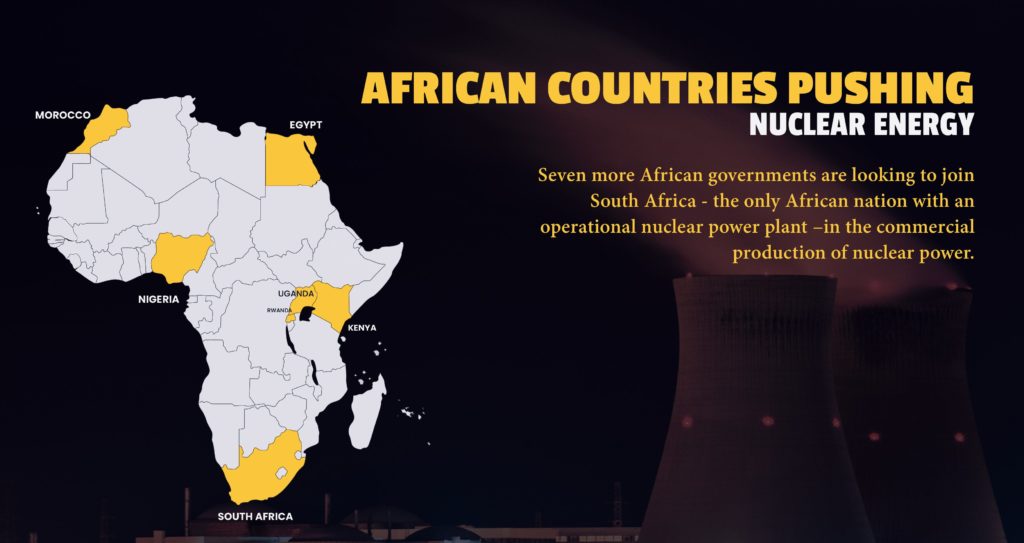
Seven more African governments are looking to join South Africa — the only African nation with an operational nuclear power plant — in commercial production of nuclear power.
By Conrad Onyango, bird story agency
At least seven African countries are at various stages — commissioning, shopping for vendors and mapping appropriate sites – in the roll-out of nuclear power plants, as a majority eye 2030 as a start-date for generating electricity from nuclear energy.
Egypt is currently the only country to have begun construction, following the formal launch of a site in July. The US$25 billion project, being developed by Russian state energy corporation Rosatom, will have total installed capacity of 4.8 gigawatts (GW) made up of four, 1,200 megawatt reactors, when complete.
“Egypt has joined the nuclear club. The plant will be the largest project of the Russian-Egyptian cooperation since the Aswan High Dam. Having its own nuclear energy industry has been a dream for the Egyptian people for more than half-a-century,” said Rosatom Director General Alexey Likhachov, during the launch.
Kenya is also inching closer to the development stage, after identifying two coastal sites — Kilifi and Kwale counties — earlier in the year, to put up the country’s first nuclear power generator.
The country’s Nuclear Power and Energy Agency (NuPEA) has estimated the project would cost about US$50 million, with construction works planned for 2030, a test run four years later and full operations projected for 2036.
“There is a need to complement the existing renewable energy sources in Kenya to meet the projected energy demand while achieving low carbon development, through alternative low carbon source,” said NuPEA Chief Executive Officer, Collins Juma, during the Tenth Review Conference of the Parties to the Treaty on the Non-Proliferation of Nuclear Weapons early August.
Uganda is considering three sites — on the Kyoga, Kagera and Aswa rivers — for the construction of two 1,000 megawatt reactors, by 2031. This follows agreements reached by the country’s Ministry of Energy with Russian and Chinese investors.
Last month, Uganda’s President Yoweri Museveni requested of Russian Foreign Minister Sergei Lavrov that Russia help the country build East Africa’s first nuclear power plant. In May, the International Atomic Energy Agency (IAEA) gave Uganda the green light to start building and production of nuclear power.
After a false start, Nigeria is starting all over again. Nigerian Nuclear Regulatory Agency opened bidding for construction of a 4 gigawatt nuclear plant in March, 2022 — and the country is reportedly betting on the four-reactor power plant with an equivalent of a third of the country’s total installed capacity, to address power outages.
In 2016, the West African nation reportedly sealed a US$80 billion plan for four nuclear stations with Rosatom but this never materialised.
After the discovery of uranium deposits four years ago, Tanzania is looking to help from Rosatom and its subsidy Uranium One, which has a license to mine uranium in the Mkuju River within the Selous Game Reserve, to build a research reactor and subsequently set up a commercial nuclear plant.
In June, Morocco advanced its plans for nuclear energy after the release of a report that gives its legislators recommendations for making a switch to renewable energy sources.
“Morocco has invested in solar and wind energy, and it is now eyeing nuclear energy to ensure its electricity needs in the future… we now need a national decision to start producing electricity from nuclear energy,” Energy Transition and Sustainable Development Minister Leila Benali was quoted as saying, by Moroccan media.
The report follows an almost seven-year feasibility study of for a nuclear reactor and will guide the country’s parliament, which is expected to deliberate on it through the year. Morocco is largely an energy imports-reliant country, importing up to 90 percent of its annual energy requirements.
Rwanda is also making significant strides after signing a deal with Rosatom to build a center of nuclear science and technologies, in October 2019.
In August, 100 Rwandans are expected to graduate in the field of nuclear science and technology and in the next two years, a centre of nuclear science and technology is scheduled to be constructed in the Bugesera Industrial park.
While other countries are chasing after large projects, Rwanda plans to build two Small Modular Reactor (SMR) units, each with a capacity around 100 megawatts.
A 2022 forum report by the Mo Ibrahim foundation shows that small modular reactors can be mobilised more quickly and present more short-term opportunities for nuclear power in Africa.
“Large nuclear power plants are subject to cost overruns and construction delays,” according to the report titled, The Road to COP27; Making Africa’s Case in the Global Climate Debate.
South Africa’s Koeberg nuclear power station — owned and operated by state-run power utility Eskom – is the only nuclear power plant on the continent. It has an installed capacity of 1,940 megawatts.
As more countries push on with the switch to low carbon electricity, South Africa has been eyeing an additional 10,000 megawatt in nuclear power capacity. However, there has been widespread opposition by an anti-nuclear lobby.
At the peak of the COVID-19 pandemic in 2020, Alexander Erinle couldn’t help thinking about how the fashion world had ground to a halt because of self-isolation and social distancing. This led to the creation of Thrill Digital, a Nigerian tech start-up that seeks to revolutionise fashion in the digital world and with it, an entire metaverse.
By Gabriella Opara, bird story agency
After receiving a US$40,000 grant in 2021 from Epic Games, a US video game and software development company, Thrill Digital launched Astra. This “metaverse”, which includes fashion, gaming and crypto-currency to create a virtual world, is helping to set the pace for the metaverse in Africa. But it didn’t start out this way.
Thrill Digital was created by Nigerian fashionista Alexander ‘Delz’ Erinle in 2020 as a fallback plan in the post-Covid-19 pandemic era. Then, the metaverse exploded – and the impact was felt in Africa, as elsewhere. He and co-founders Niyi Okeowo and Luke Jeffers saw an opportunity.
“While we were developing Thrill XR, the metaverse became more popular; that’s when we realised what we were building was a metaverse. We rebranded and gave it its own name–Astra,” says Erinle.
The building blocks for a “metaverse” (a virtual version of the real world that uses virtual reality, augmented reality, virtual currencies and other devices to offer an immersive online experience) are not new; online stores have been in existence for decades, as have virtual reality games, virtual reality headsets and augmented reality programs. But the virality of cryptocurrencies, together with the move online during COVID-19 lockdowns, has given the concept wings.
During the lockdown, Erinle wrote an article in which he created scenarios, shared his resources, and talked about his experience building Thrill Digital.
The article caught the attention of Sallyann Houghton, Industry Manager for Fashion/Apparel at Epic Games, who later encouraged Erinle to apply for an Epic MegaGrant. The grant made the launch of Astra possible.
While Astra was created to “revive the fashion industry with digital technology in a post-pandemic world” the UX designer and co-founder of Thrill Digital explained that his company has now become so much more than a fashion tech start-up.
Astra has become Astraverse, a metaverse home to many virtual cities and activities.
Erinle is not doing this alone. He is part of a team that consists of co-founders Jeffers and Okeowo complemented by Adekunbi Ajai, Charles Egbejule, and Femi Falade who bring diverse inputs in art, architecture, design, fashion, virtual and augmented reality.
Ajai, the Virtual Reality Architecture Lead at Astraverse, believes that Thrill Digital is thriving because of its work culture and the vision of the minds that create the products.
“We are a diverse team that’s constantly growing. Everything we do, even our work culture, is futuristic. We all work remotely. I’ve only met Erinle in person twice since we started working together in 2020. Currently, we hire on a contract basis, so our staff strength is sometimes as high as 30, and sometimes as low as five. It depends on the assets under development at Astra,” she explained.
With plans to create Non-Fungible tokens (NFTs) and an “Astra Token”, Erinle believes his start-up is ready to take up the task of introducing metafashion and metacommerce to consumers.
“Astra’s business model is business-to-business (B2B) and business-to-consumer (B2C). While we want to bring brands to the metaverse, we also want to give a good customer experience. We’re sustainability-driven, with the concept of having an NFT-first supply chain. Products will first exist as 3D assets that customers can try on with avatars, buy with a cryptocurrency, then have a physical version delivered to them,” he said.
Astra plans to offer 3D assets such as fashion items like bags, clothes, shoes, accessories, and more. These digital items will be acquired digitally with cryptocurrency. Consumers’ avatars can then wear them as often as they like within the Astraverse.
Non-Fungible tokens (NFTs) refer to digital items which are unchangeable. These items can be artworks, digital clothes, cartoon characters, architecture models or original photographs. Owning an NFT is comparable to having a limited edition of a bag or clothing, where the ownership of it signifies that it was bought directly from the creator of the item.
The Ethereum cryptocurrency website explains NFTs as “tokens we can use to represent ownership of unique items. (NFTs) let us tokenise things like art, collectables, even real estate. They can only have one official owner at a time and they’re secured by the Ethereum blockchain – no one can modify the record of ownership or copy/paste a new NFT into existence.”
In a 2022 report, The State of Fashion and Technology, the authors warn that the forerunners of fashion in the virtual world will face hurdles in consumer adoption because “78 percent of people who have already ventured into virtual worlds say they miss physical interaction when doing so”.
“As a result, many players will likely hang back to see evidence of commercialised use cases and a tangible ROI(return on investment) before investing. For others that want to capture the commercial opportunity, the biggest short-term revenue potential lies with virtual assets that can be traded, transferred, or used for payment,” the report adds.
Nevertheless, there’s plenty of room for growth and commercialisation.
“Pioneers in the metaverse have shown there is a business case for fashion brands to invest in virtual worlds… Global spending on virtual goods reached an estimated $110 billion in 2021, more than doubling the total in 2015, with around 30 per cent attributed to virtual fashion.It is expected to grow at roughly the same rate as the gaming market to be worth around $135 billion or higher by 2024” the report adds.
With African metaverses like Africarare and Ubuntuland already up and running, economists predict that a metaverse ecosystem could add US$40 billion to Africa’s economy within a decade.
Another new entrant into the fashion tech business is Balboa Tachie-Menson, a Ghanaian who launched her digital fashion house, Balm Labs, at the peak of the pandemic.
Balboa has explained how the lockdown motivated her to focus on her digital fashion business.
“I believe (the African fashion industry) is going in the right direction. I think digitalisation will make it more efficient and refreshing. I had created Balm Labs prior to moving back and started working on the business plan a few months before I left San Francisco. However, what motivated me to really focus on my project was the country going into lockdown. It gave me the time to focus and create,” she said in an article published on the Jendaya website.
According to Statista, Africa’s market share in fashion revenue is an estimated US$8.56bn and is expected to have a compound annual growth rate (CAGR) of 16.46 percent, resulting in an estimated value of over US$13bn by 2025.
Despite the infinite opportunities in fashion tech and the metaverse for Erinle and others, access is one of the greatest hurdles for many consumers.
For increased engagement in extended reality (virtual and augmented reality), access to the reliable internet in terms of stability, speed and spread are critical.
According to Erinle, internet speed is key to both gaming and the shopping experience in the metaverse. But he and his team are nothing if not proactive.
“For many people, extended reality is difficult to access, which is why we’re not starting playastra.com with VR/AR; we’re doing it straight on the laptop. The main problem we have is that the internet speed in Africa isn’t fast enough for the online gaming and shopping experience. So, at the moment, our target market is people in the diaspora first,” Erinle explains.
“Our approach is ‘by Africans, for the rest of the world’.”
According to GSMA, 4G adoption in large parts of Africa will double to 28 percent by 2025, compared to a global average of 57 percent. The 5G adoption is still in its early stages in Africa but by the end of 2025, 5G is expected to account for 3 percent of total mobile connections in the region.
Charles Egbejule, Lead Digital Fashion Designer at Astraverse, said the challenges won’t deter the team. He is working to combine the physical and digital aspects of fashion for utilitarian use.
“Very few fashion items can live from generation to generation. But, at Astra, we’re exploring ways where you can associate a digital item with its physical counterpart. Instead of the physical item being the hallmark of utility, its digital representation is nested with utility, becoming a vessel that has different aspects. This could serve as a coupon, ticket, discount, or exclusive access,” he said.
“We’re in talks with fashion brands, fashion weeks, and fashion media to see how we can bring this immersive and new technology into the traditional space. We also have plans to host live events where people can connect physically with the team,” Egbejule continued.
Digital fashion is not the only thing Thrill Digital wants to be known for. In his pitch for the Metaverse Start-up Award, Erinle told the story of Astraverse and its AI Avatars and Astronauts, to audiences at the Metaverse Summit in July.
“Astraverse is a network of virtual cities in the metaverse, where you can create and enjoy virtual experiences. Built on our 3D NFT marketplace protocol, Imagineer, these cities are based on the following experiences tied to our Astra Token, NFTs, and real-world utility,” he said during his presentation.
These virtual cities will have dedicated activities assigned to them. One Astra city will feature NFT racing games; another will be host to virtual banking. Yet another will have obstacle course games, virtual events, a city for mediation, and so much more.
One way Thrill Digital plans to expand the cities in Astraverse is by collaborating with other developers, tokenomics experts, modellers, designers, fashion experts, architects, and more.
“We at Astraverse launched a grant program of $250,000 to work with Web3 Designers, Developers, Strategies, and more on the Astra Metaverse,” Okeowo, who is also Art Director at Thrill Digital, shared in a LinkedIn post.
Currently, Astra is in its fundraising stage while it builds its products, and seeks to collaborate with fashion companies and other creators in the digital space. So far, it has raised US$1 million, including its $40,000 grant from Epic Games and pre-seed funding of US$300,000. The company hopes to raise an additional US$3 million before the end of 2022.
While Thrill Digital has moved beyond its initial focus on fashion, other Nigerian companies have been quick to see a gap. One is The Hacedor, a Nigerian fashion tech start-up that is also an Epic MegaGrants recipient.
The Hacedor positions itself as “the first Nigerian digital fashion house creating 3D visualisation and immersive experiences for the fashion industry.” Spearheaded by its Co-founders, Idiat Shiole and Quosim Akinyemi, the company focuses on creating sustainable fashion by creating 3D visualisations of clothing using extended reality.
This birthed their first product, Virtual Fashion Galleria (VFG), where consumers can play a game of pairing different clothes in the gallery together before making a purchase.
Idiat Shiole is popularly known for her brand, Hadeeart Atelier, which has collaborated with Dress X and Daz Studio. Seeing herself as a metaverse tailor, Shiole believes that her work as a digital fashion designer is necessary because the metaverse is here to stay.
“These things function together: digital fashion design, artificial intelligence, and augmented reality. Metaverses would continue to assist fashion designers. Imagine buying a digital copy of a product and getting an original physical version of it. Virtual fashion in the metaverse reduces the chances of getting a fake product. With NFTs, you can distinguish between original and fake, get exactly what you pay for, and that’s how phygital (physical and digital) products work,” Shiole states.
Shiole’s perspective reflects the thought process of many businesses and individuals in virtual fashion. A part of BOF’s The State of Fashion and Technology report states, “In a sense, these NFTs are digital collectibles… Brands are starting to add more “utility” to collectible NFTs, which could make buying one more worthwhile to consumers and translate into a long- term opportunity for brands.”
Idiat Shiole believes that virtual fashion would eradicate the problem of fashion waste that leads to environmental issues.
“I’m creating a sustainable brand with Hadeeart Atelier and The Hacedor. That is why I’m taking my time to source for sustainable materials, fashion pieces that are biodegradable, (and) which customers can recycle when they’re no longer interested in wearing them.”
The metaverse may be virtual for many users but it is very real for Erinle and his team and for many other creators, for whom the thrill and infinite opportunities of a galaxy of metaverses opens boundless horizons for African entrepreneurs, innovators and creatives.
From starting Trace magazine in his bedroom to launching a variety of products under his media company True Africa, Claude Grunitzky has always been a media trailblazer. He also has a way with words.
by Lerato Mogoatlhe, bird story agency
Claude Grunitzky is an expert at turning simple ideas into compelling stories that leave audiences wanting more. That’s a formula that saw him sell one of his early creations – Trace – (precursor to the widely popular Trace TV) in his 30s. His latest foray into African media, TRUE Africa, sees him doing the same, while making his content widely accessible via podcasts. He keeps blazing trails.
Take his latest idea of telling the “simple things happening in Africa now.”
“There are a lot of young girls and women who are very active in STEM and programs created to help women learn to code, creating a new generation of digital entrepreneurs. It’s a simple story – some African women love mathematics and are good at it. Some are high achievers in academic circles. We took this simple story and expanded it with a precise angle about what girls and young women are doing and tell a chronological story, from getting a skill set,” explains Gurnitzky.
It is evident, says Grunitzky, that young girls and women in Africa are “creating industries that Africa needs for its place in the world.”
And so, “With a twinkle in my eye,” he says, he had another simple idea: why not profile young girls and women in Africa who are breaking the glass ceiling in male-dominated industries with careers that are a testament to the power and impact of women in Africa?
The resulting editorial series, Limitless, was launched in 2021 through feature stories that profile girls and young women who turned their simple ideas into successful careers and businesses, from arts and culture, literature, tech, and telecommunications to medicine, media, aviation, science, and entrepreneurship.
Limitless is now also a free eBook featuring 21 of these trailblazers. Their successes range from leading a telecoms company, being one of a handful of Black women neurosurgeons in South Africa, redefining Africa’s approach to venture capital, pioneering Sci-Fi writing in Botswana; a journalist who turned into a high-impact PR professional and a musician who is breaking boundaries in Kenya.
“Limitless paints a different picture that is not often seen in traditional media. Because Africa’s birth rate is so much higher than other parts of the world, traditional media paints the picture that African women are providers, mothers, and nurturers. We are showing that certain women are choosing a different path of achievement, building things, and creating in sectors and environments normally dominated by men. Women who don’t get a lot of press mentions but are making change happen behind the scenes and not taking the credit,” Grunitzky explains.
More than anything, Limitless is an ode to his mother, who inspired the idea. Grunitzky had a bad bout of COVID-19 before the vaccines were developed. His mother helped take care of Claude and his partner’s four-year-old son.
“I ended up having many conversations about what would have happened had she gotten an education. She never finished primary school; she was in the generation where women were not supposed to go to school. It was guys who were sent to school in my home country, Togo. She was telling me about the life that she could have had had she benefited from education, an environment with emulation and simulation that would push women to achieve,” Grunitzky says.
“She ended up becoming a seamstress, and that was very respectable. Still, as an intelligent woman who is extremely astute in reading people and situations, she could have done a lot, so I started thinking about women in the new generation who are refusing the status quo and changing norms because they don’t want to be confined to the roles that African societies have imposed on them,” he adds.
Grunitzky started talking to friends who were high achievers, and they recommended more friends, and pretty soon, TRUE Africa had a list of more than 100 women.
“The hard part was narrowing it down to 21 women, and we wanted to do that so that we would have diversity in representation geography and industry – technology, environment, engineering; and that sectoral balance was really important as well. We wanted to focus on young women who were teenagers and young adults, and women who were blossoming into high-powered positions.”
Besides the eBook, a partnership with Africa No Filter, Limitless also birthed a podcast broadcasted in English, French, and Portuguese.
Grunitzky believes that the key to success is finding your own lane and winning formula; and turning this into more impact. This is what turned his first venture, Trace magazine, into a pioneering platform. Back in his 20s, he saw a gap in hip hop, R&B, and Black culture in London.
As Trace grew “extremely influential in the world of Hip Hop, R&B and Black culture in general,” so did his appetite for impact, so he moved to New York to be on the biggest media stage that existed and to be the centre of a certain type of Black and Hip Hop culture.
Trace was the first publication to write about Black culture from a global perspective, with news and perspectives from places like Ghana, Brazil, and Japan. His lane? “Always placing the Black experience and creativity at the centre of our storytelling, and that became a winning formula because Trace became a media company, funded by Goldman Sachs,” Grunitzky says.
He sold Trace in his 30s. “I was a full circle, having started in my bedroom, funded by one of the most prestigious financial services companies, and then growing around the world and active in America, Europe, and Africa.”
Grunitzky’s next simple idea was to turn his focus to Africa. “I felt that the continent was the next frontier of the stories that needed to be told, and demographic speaking, the world’s growth was going to come from Africa over the next century.”
He wanted to be a catalyst for the telling of African stories and to champion young African voices worldwide, “always starting with that pride that comes with an African who is not ashamed of having a different point of view and who doesn’t live with the burden of these post-colonial inferiority complexes that many Africans have.”
TRUE Africa’s launch was a roaring success. The platform had more than 300 000 readers within six months of launch. 2017, however, proved challenging. TRUE Africa’s traffic came from Facebook, so when the platform changed its algorithms to fight misinformation in the lead-up to the US presidential elections, TRUE Africa had less prominence on the Facebook feed. The loss was felt instantly.
“We could shut down or keep it moving,” he recalls.
He wrote a proposal to the Google News Initiative.
“The substantial funding that allowed us to live to tell the tale. We also started thinking about how else we could grow and looked at funding models beyond advertising revenue,” Grunitzky says.
TRUE Africa University was born. It’s an online learning platform for storytellers. It offers courses, masterclass, and mentorship by leading media experts. It’s supported by the Massachusetts Institute of Technology.
“The education piece is the most important part of what I am doing. I benefited from real mentorship while coming up as an entrepreneur and successful people showing me the ropes,” he explains.
Grunitzky says founding True Africa put him in vibrant ecosystems and gave him the opportunity to work with emerging writers, social media managers, and photographers from across the continent. He realised that while brilliant, many of them worked in silos and didn’t have anyone showing them how to grow, make a living, establish their reputation in the industry and be successful. To this end, TRUE Africa established a mentorship system to help its talent learn from the best in the industry.
“With the university, the training element can also be impactful in the long run,” he says. “The pivot allowed us to thrive,” he adds.
TRUE Africa has also ventured into films and has started producing films about environmental challenges and successes in Africa.
“TRUE Africa is going to become — over time — an important player in the media in Africa.”
At the heart of his success lies Grunitzky’s conviction that there are no limitations to what a brand can do with African stories — turning simple ideas into compelling content that connects the continent.
Entrepreneur Kunle Adeyanju is someone who leads by example. Riding through 42 cities in 13 countries, he has campaigned to stamp out polio and at the same time, see Africa for himself. What he found runs counter to prevailing narratives.
By Gabriella Opara, bird story agency
It’s 6 am, the sun is rising and Kunle Adeyanju is getting ready for a big day’s travelling on his motorbike, Eagle – after just four hours of sleep. Today’s journey is different, though. It’s the celebratory leg of an epic 13-country tour and he’s heading to Kwara from Lagos, escorted by a group of fellow bikers, to be celebrated in his hometown for his successful journey.
It is barely two weeks since he arrived in Lagos, the final destination of an epic #LondontoLagos trip, and while Adeyanju may have reached his advertised destination, he is continuing on another journey – raising funds to ensure a polio-free Africa. Today’s ride “home” is part of that effort – a crusade that is both important for the country and intensely personal.
“My best friend Sanjo got polio when he was a child. It was a traumatic experience. Although he died recently, many years after contracting the virus, Sanjo’s health was never the same and I didn’t want someone else going through the same thing as he did,” Adeyanju explains.
In 2021, this entrepreneur and father of two decided to travel across Africa on a motorbike to raise funds in his personal war against polio and began charting routes and plans, reading up on the travel situations in the 13 African countries he intended to visit.
He prepared by reading widely, including referencing online resources like the CIA World Factbook, which has information and latest statistics on countries around the world. He made a number of “informed decisions” like not to visit Burkina Faso, based on the information he came across – decisions that would make him question the prevailing “narrative on Africa” later on.
The journey started on April 19, 2022.
A self-proclaimed adrenaline junkie, Adeyanju has visited over 75 countries and plans to travel to more. Yet, he said, this experience was far better than jetting into overseas destinations.
“This ride has been the most exciting adventure of my life because I discovered humanity. I discovered a much richer story than posing with concrete or sitting in a high-speed train,” he explained.
Each country, he said, was unique in its challenges and its delights. The places he enjoyed visiting the most were Senegal, Mali, and Ghana because of the reception he got. He had the toughest experiences crossing the Sahara and in Mauritania.
“The Sahara is a very dangerous place to be. It’s hostile to life. I was in a sandstorm that lasted for 1 hour, 40 minutes. The gale force of the wind lifted me off the ground. To survive, I laid my bike on its side and burrowed myself against it so that my body weight (95 kilos) and that of my bike (190 kilos) became one. It was hot, I got injuries from where the sand hit against my exposed skin like needles.”
What kept him alive, he said, was his survival instinct – and his children’s instruction to: “Go on the trip but come back home no matter what.”
Mauritania, he said, offered different challenges.
“I wasn’t fighting the elements. Transactions as a foreigner in the country were dismal. Their currency (the ouguiya) was 1 ouguiya to 400 euros until recently. Now, it’s 1 ouguiya to 40 euros. But I was unaware of the change and the locals ensure foreigners stay uninformed. Things were very expensive and beyond that, I was maltreated,” Adeyanju said of the experience.
Collaborating with the Rotary Club Ikoyi Metro, where he is currently president-elect, Adeyanju is crowdfunding to sustain the eradication of polio, and for the renovation of a primary health-care centre in Ikereku, a village in Oyo state.
Initially hoping to raise 20 million naira (around 48,200 US dollars), in May he increased his target to 100 million naira (around 241,000 US dollars). He made the announcement on social media, urging people to donate via a bank transfer to the Rotary Club Ikoyi Metro or on GoFundMe. Adeyanju has promised to personally add ten percent of all donations, to the funding drive.
In August 2020, Nigeria was declared polio-free by the World Health Organization (WHO), making it the last African country to be free of the virus. But, according to Adeyanju, the only way to completely eradicate the virus and prevent its re-emergence is through continual awareness and vaccination against the disease.
His reception throughout the trip was encouraging. He was hosted by ambassadors, Rotary Clubs and individuals in several countries he visited. Additional donations were made by bikers and individuals in Abidjan, Côte d’Ivoire, Lagos, and Lome, some of whom challenged Adeyanju to engage in various activities.
Adeyanju hopes to finish a travelogue about his trip – one that will set the record straight regarding travelling in Africa.
“My book is 50% done, and will most likely be published two months from now. It details all the experiences of this adventure. After it’s published, we’ll make a film as well.”
Although this trip takes him a step closer to achieving everything on his bucket list, he plans to do more.
“A year from now, I will travel from Lagos to Israel. Then from Israel, I will travel to Tibet because I want to ride on the Tibetan plateau. After that, I will ride to Everest basecamp to climb the mountain,” Adeyanju said.
Years ago, after well over a decade working for international corporations, Adeyanju quit his job to focus on his philanthropic pursuits and adventures. With a TEDx talk and two books behind him, his current work advising businesses allows him the flexibility he needs.
“I can’t do this if I’m tied down to a company, which is why I became an entrepreneur in 2018. Now, I’m able to adjust my schedules for adventures like this, working around it if I have to,” Adeyanju said.
He never misses a chance to keep everyone updated on his YouTube channel and Twitter page. Sharing his experiences on his blog, he said, was therapeutic, particularly during the difficult times.
“I read about the #LondontoLagos journey on Twitter, and I was captivated that there’s a route from London to Lagos by bike. I was also intrigued that Kunle Adeyanju was doing it for humanitarian reasons. I wanted to know more about it, so I followed him on Twitter. His updates have been very enlightening,” said Adetutu Ajiduah, a luxury sales expert.
Just like Olabisi Ajala, a Nigerian globetrotter popular in the 1950s, Kunle Adeyanju regards himself as an adventurer.
“My grandma nicknamed me Lionheart when I was ten. And I nicknamed my motorbike Eagle when I got it. Because, when an eagle meets a storm, it faces it, head-on, soaring higher. A lionheart can only ride on an eagle.”
With philanthropist Bill Gates and Twitter CEO Parag Aragwal congratulating him for his efforts, the world is taking notice of Adeyanju’s initiative.
Marketing is a key component of the Adeyanju’s strategy. Upon his arrival in Lagos, Adeyanju collaborated with Radisson Hotel and The Palms Mall to have a “meet and greet”. Tunde Muyibi, Marketing Manager for The Palms Mall, shared his excitement about Adeyanju’s trip.
“A lot of us don’t know our continent as well as we should. But, through his journey, we could learn more. Kunle Adeyanju is our modern Ajala the Traveler,” he said.
The big take-away from his adventure, however, is how wrong the narrative on Africa, actually was. The reality on the ground, was very, very different, he found, as he made his way from country to country.
“One thing I learned on my journey is that there is a need to tell the true African story. We are a diverse and friendly people. The negative narrative peddled about us around the world is untrue,” Adeyanju says.
In the end, he ventured into Burkina Faso while waiting for an entry visa to travel through Côte d’Ivoire.
According to him, Burkina Faso, a place described as “dangerous and unfriendly” by the CIA World Factbook, turned out to be very welcoming and safe. He was glad he had embarked on this journey to learn and experience diversity and the true spirit of African hospitality.
For bronze caster, Alex Agbonmwenre, the return of the Benin Bronzes is about far more than the return of looted artefacts. It is also a reminder that the craft, which found a patron in Benin 800 years ago, has continued through an unbroken lineage of master craftsmen, ever since. And those master craftsmen can be found today, in Igun Street, a UNESCO World Heritage site.
By Victor Eyike, bird story agency
Standing in Igun street, the centre of African bronze casting for the past ten centuries, Alex Agbonmwenre could tell a story about the British forces that razed Edo and destroyed the Benin Empire, carrying off the famous bronze figures made for the court hundreds of years before, in this very street.
But as a bronze caster, he is focused on the story of the craft itself. And his story starts way before the arrival of the first Europeans in this part of the world. It begins with a skilled artisan arriving at a walled, well-organised city in around 1280, during the reign of Oba Ogualo.
“Igun street represents hundreds of years of traditional casting… Igun originated from Igungha, an immigrant from South Sudan who was passing through Benin City… but was arrested and labelled a spy,” explained Agbonmwenre.
“When the Oba of Benin questioned him, he confessed that he was not a spy but a brass smith artisan. The Benin Palace was impressed and instead of persecuting him, they gave him Igun as his base of operations.”
That origin story has several versions, as well it might, given that it is nearly 800 years old, but Igungha and Igun are common to all of them. Alongside Ifé, Oyo, and Dahomey, Benin was part of a number of west African kingdoms and civilisations that from the 12th century sprawled across what is today – thanks to colonial-era map drawers – southern Nigeria and the Republic of Benin. The Benin Empire was effectively brought to an end by the expeditionary force in 1897.
A few kilometres off the busy Ringroad Square in Benin City, in Edo State, Nigeria, today, Igun street seems ramshackle, some of the ancient buildings upgraded, others weather-beaten and still, almost defiantly, home to a long tradition of bronze casting and moulding. The street is listed as a World Cultural Heritage Site by the United Nations Scientific and Cultural Organization (UNESCO).
Lining many of the buildings constructed out of red sand, stand rows of artefacts on display, as if in supplication, waiting for a welcome approach from an admiring suitor.
Further down the road, an automobile garage interrupts the endless display of sculptures of all sizes and colours. At a shed next to a spare parts store, cars get attention from mechanics dressed in greasy overalls.
As the activities of the day kick off, at first slow and measured, the casters go through a number of religious rituals. They pay homage to their god of iron, before starting the casting process. Each has a shed to display their wares, which are cast in isolation, usually at the back of the sheds, where the casters enjoy a quiet environment to meditate while carrying out their work.
According to Agbonmwenre, 42. the casting process remains a highly private affair. It remains managed by the caster’s guild, the very same guild sanctioned by the Oba Oguola all those hundreds of years ago when craftsmen’s guilds were the lifeblood of the city. The guild has guarded its secrets and kept bronze casting limited to a few families, all this time.
“This site is open to all, but we do not tolerate recording because unscrupulous people may steal our concepts and replicate them elsewhere,” he explained.
Agbonmwenre started casting while still a teenager.
“I started having a deep interest in sculpturing and bronze casting, when I was 16. Back then, our parents ensured we developed a particular skill. When every other person settled for Iron bending and other skills, I opted for bronze making,” he said.
“I moved here when I was 19. I have a space here where I practice my craft. My son also lives here and assists me with the process. Coming here, I had high expectations; I wasn’t scared because I knew I was coming to meet other casters. Igun is a street fully occupied by bronze casters.”
Agbonmwenre, who lives with his family in a compound on the street, explained that bronze casting is the process of pouring molten bronze into a hollow mould to create a positive bronze sculpture or object. Methods of bronze casting, like lost wax, ceramic shell, and sand casting, are used to produce bronze sculptures, instruments, medals, tools, plaques, and other art items.
“There is no rule when it comes to making your artefacts. I use the lost wax method where a precisely detailed wax model is formed over a clay core,” Agbonmwenre explained.
“When the model is complete, clay is carefully applied over the wax. It is then heated, melting the wax, which exits from a narrow channel. Next, molten metal is poured into the mould. Once cool, the hardened clay is chipped away, leaving behind an image now cast in bronze.”
Agbonmwenre said life in the street is routine as all bronze casters usually go through the day casting, praying, and watching sports.
“There is unity here in Igun. We don’t see ourselves as competitors. I can’t estimate the number of casters here, but we are more than 20. We all have our sheds where we operate. Also, we all belong to the Igun Bronze Casters Guild, a union that protects our rights,” he added.
Other casters agreed to talk but declined to be named and appear on camera. They agreed that business was good.
‘We don’t have problems when it comes to selling our works. We initially did our works for the Oba’s palace, but soon, other people became interested, and we started making sales,” said one of the casters.
For Agbonmwenre, although casting is a time-consuming and expensive process, it is a paying venture because of the demand, both locally and abroad.
“In a year, we produce about 50 bronze artefacts. I can’t estimate how much profit we make, but depending on what the clients want, we make a profit. Sometimes, we wait for a client to place an order before we start working. The industry is profitable,” he said.
Although there is no fixed price for the artefacts, the cheapest artwork costs 20,000 naira (around 50 US dollars).
One of the customers, Tosin Aiyeni, travels from Lagos to Benin to purchase the artefacts and resell them at a higher price.
‘Most of our customers are based in Lagos. So most times, we travel to Igun to purchase these artefacts and take them to Lagos to sell,” she said.
Another dealer, Austin Ebinedia, said he had been in the business for more than four years, and the trade paid his bills and provided enough income to live comfortably.
“I have been purchasing bronze artefacts for over four years, and Igun is special to my customers and me,” he said.
For Agbonmwenre, the secret is to ensure diversity in customers, with some buying directly for personal display purposes, others buying for institutions, as well as selling to dealers.
“People from different walks of life patronize us. Institutions and Individuals do contact us with intentions to buy,” he explained.
Ahmed Iredia, also a caster in Igun, explained that while bronze casting was important to the Edo State economy, it also offered a window into the past.
‘The Benin bronzes offer historians and archaeologists precious opportunities to understand better the empire in which they were created. While oral history and artistic heritage have long been central to Benin’s understanding of its past, the bronze adds to that rich cultural identity,” he said.
Alex Agbonmwenre, a master bronze caster in Igun street, Benin.
But even as Agbonmwenre and his fellow artisan go through their work, there is palpable excitement in the air about the return of the heritage items taken by the British in 1897.
The two largest collections of Benin Bronzes are located in the Ethnological Museum of Berlin and in the British Museum in London, while the third-largest collection is located in several museums in Nigeria.
“From history and what our forefathers told us, the British were extremely jealous and used force to take away the artefacts from the Oba’s Palace,” Iredia said.
In February 2022, two relics were returned to Nigeria. However, the government is pursuing the recovery of many more.
Chief Sam Igbe, a ceremonial palace chief, welcomed the return.
“We are ready for the return of our cultural relics, and we have plans to ensure people can easily access them in a museum,” he said.
And one of those involved in the push for the return of the artefacts is Gold Iroh.
“We started the negotiations a long time ago. It was a leap of faith. Surprisingly, most of the European countries responded positively. I guess they realised the artefacts were special to us and significant to our heritage,” Iroh said.
For Agbonmwenre and others, while the return is a sign of Africa’s increasing assertiveness, the publicity surrounding the Benin Bronzes has had a more important effect. It has reminded Africans of the existence and importance of cultures and civilisations from an era prior to the colonial period. One to be proud of and which can be seen to this day – and which African from across the continent can come and see for themselves.
“The return will help eliminate a lot of myths surrounding these artefacts and make people understand that no spiritual or evil forces are attached to them. The return of the looted heritage is significant because of an upsurge of tourist visitations to this state, which will boost the economy,” said Agbonmwenre.
The 12th edition of ZUFF, Nollywood’s major film festival, raised the question of whether the world’s second-largest film market by the number of films can tap the continent’s huge film-making potential and leverage changing economic and technological realities.
By Bob MajiriOghene Etemiku, bird story agency
Nollywood’s premier film industry event, the Zuma Film Festival, or ZUFF resumed after a two-year hiatus to a changed world… one in which online work and video meetings and the streaming of entertainment have become the norm, globally. And one in which Africa has become a single market, under the Africa Continental Free Trade Area, or AfCTFA.
Named for Zuma Rock, an inselberg outside of the capital Abuja, May’s event, themed “Show me the money” (“Show me di pepper”, or “owo”, in pidgin), was refreshingly introspective.
Up for debate was the uncertainty surrounding the Nigerian, and indeed the African, film industry over what renowned actor, entrepreneur, director and producer, Emeka Ike, 55, called “Old Nollywood to New Nollywood”.
For an industry whose massive growth can in large part be linked to a revolution in cheap digital video cameras and DVDs in the 1990’s and which thanks to the limitations of streaming in Nigeria, has remained insulated from more recent digital advances, the latest developments in streaming and in the market are both alarming and a huge opportunity.
The “Old Nollywood”, was a world of evergreen stars such as Ike, Sola Sobowale, Pete Edochie, Ireti Doyle, Kanayo O. Kanayo, Patience Ozokwo, Nkem Owoh, Joke Silva, Richard Mofe Damijo and Genevieve Nnaji, among others who were household names across Africa in the late 1990s and early 2000s.
According to Ike, who was one of the panelists at this year’s ZUFF, Nolllywood succeeded because it employed a different but innovative approach to film-making, resulting in mass appeal.
“One thing that makes movie production in Nigeria unique is that while the rest of the world produces movies for theatre before they go to television, Nigeria produces movies for television first rather than for theatre,” he said.
“Our films are first produced in DVDs, and this increases the number of people interested in buying into the market either as marketers or consumers. Most Nigerians hardly go to film houses to see movies but have only to buy a DVD, slot in their favourite movies, and enjoy our movies in the comfort of their homes. But we will soon lose the market because we are no longer using DVDs to promote our movies. Instead, we want to rely on digital methods because of ‘modernity’.”
He warned that the emerging “New Nollywood” would keep struggling unless it borrowed from the strategic approach of the “Old Nollywood” and set itself on a “reboot of sorts”, leveraging on the dynamics of technology and market trends not only at home but elsewhere in Africa and globally.
Nollywood makes over 1,000 films a year and employs more than a million people, placing it between India’s Bollywood and Hollywood, according to Canon, the global camera equipment manufacturer.
Nigerian scholar Ugo Ben Ebelebe of UK’s Griffith University, said Nollywood is already leveraging the latest in digital technology to not only remain relevant but also to raise much-needed funding.
In an article, Reinventing Nollywood: The Impact of Online Funding and Distribution on Nigeria Cinema, he argues these far-reaching transformations are being driven by “New Nollywooders” who are tech-savvy and are leading and embracing innovation, using crowdfunding and content distribution via online platforms.
This virtual space not only breaks down physical and administrative boundaries but also bureaucratic hurdles across the continent, allowing for a wider audience for Nollywood’s creative content, an example being South Africa’s DSTV and sister firm, GOtv, streaming Nollywood content for its subscribers across Africa.
According to Victor Okhai, president of the Directors Guild of Nigeria, gatherings such as ZUFF and an upcoming November 2022 film festival are important both for benchmarking and for enhancing collaboration across Africa.
Nollywood has recently seen collaboration with Gollywood (Ghana) and Riverwood (Kenya) and several other would-be African “woods”.
Okhai added that Zuff was also a way to leverage AfCTFA, which has opened numerous opportunities for creatives and film production on the continent. Already, Nigeria and South Africa have signed a treaty to enhance collaboration on “audio-visual cooperation”.
“Our filmmakers may no longer get problems with visas to South Africa to work,” Okhai said.
Terrence Khumalo, Manager: Film Certification at South Africa’s National Film and Video Foundation, explained the treaty’s potential.
“We will be working on a legal framework that puts the treaty into some kind of action. The treaty allows actors in both countries to pull resources together to minimize unanticipated risks. It also allows them access to the markets of their respective countries,” he said.
Nigeria has also signed an agreement with Cameroon on joint film production and is negotiating another deal with Burkina Faso.
To grow its industry, Nigeria’s government is leading a drive to enable Africa’s creatives, actors, and film producers “tap the continent’s diverse and rich cultural heritage, unique geographical features, fauna and flora beside the groundswell of creative youth talent.”
Addressing the funding challenge, Nigeria’s Minister of State for Federal Capital Territory, Ramatu Tijani Aliyu, said the government recognises the potential of the Nigerian film industry, which has an estimated contribution of 2.3 per cent to national GDP.
She added that there is room for public-private partnerships with two banks — Access bank Plc and the Bank of Industry — offering the NollyAccess loan and the BOI NollyFund, respectively, to help Nollywood grow and become a benchmark for Africa.
Other investments came from a collaboration with the African Development Bank (AFDB), which the minister said made a $500m facility available to Nollywood by the end of 2021.
To further support the industry and other African film producers, the Nigerian government is set to introduce specific incentives such as a Pioneer Status Incentives (PSI), a tax holiday to cover the production of digital movies, animation, videos, television programmes, commercials (including online distribution and exhibition), music production, publishing, and online digital music distribution, production of cameras, motion picture and slide projectors, overhead transparency projectors, and photography for tourism purposes.
Beyond the fanfare and talks, ZUFF 2022 showed the potential of African film production and that film has can be a rallying point for African creativity, resourcefulness and innovation.
“Nigeria has been able to use this festival and Nollywood to demonstrate the big brother role that we have played in the African Union. Nollywood is one of the biggest acts on the continent; if you travel from Zaire, Kinshasa to Accra in Ghana you’ll find Nigerian films all over,” said Fidelis Duker, the man who birthed the concept of the Abuja International Film Festival (AIFF) in 2003.
Yet despite its heavyweight stature, Nollywood must still address issues relating to the “old” and “new” Nollywood. Will the November 2022 film festival in Abuja help to further address these transition issues? Time will tell.
It is evening and daylight is fading fast along the Jinja-Tororo road as it passes through Buwenda Village, Uganda. The road is dry, littered with shrivelled leaves dancing on vacant murram-sidewalks − their rustling clearly audible as they roll along the dusty ground. The lush green vegetation surrounding the neighbourhood is the source of birdsong as the day winds down. The weaverbirds in the neighbourhood are still busy, as are the women in the textile workshop at Kilombera Weaving.
Kilombera is the local name of a weaverbird found in the area. The male birds spend hours weaving an intricate and attractively designed nest in a desperate bid to attract a mate.
The Kilombera workshop, on the other hand, has both men and women practitioners, all busy producing ornate kikoy cloths, baskets, bags and other beautiful products that are destined for overseas markets, either via visiting tourists or via exporters who are finding ready markets for beautiful handmade goods, all over the globe.
On a typical day, activities at the workshop reach their apogee around noon. Betty Korutindo is immersed in her work, arranging yarns on a beam to form the patterns that will be threaded into a loom. The yarns are organised into stripes, requiring laborious threading.
Korutindo is one of a growing number of workers in the industry whose fortunes have changed significantly since they joined the industry.
They have been helped by the transformation of markets in Africa and elsewhere, thanks to the growing opportunity for online sales by both individuals, who might have come across African products on a trip to the continent, as well as major retailers and even luxury brands.
For some time, baskets and other handmade products from Africa have found buyers through Amazon, Wayfair, Etsy and on fair trade platforms, where they first got noticed.
Now, luxury brands have joined the fray. Brands such as Prada, Chloé, Celine and Dolce & Gabbana are selling luxury woven tote bags inspired by Ghana’s Bolga and Kenya’s Kiondo handmade bags.
Purchasing one online could set you back anywhere between 500 and 4,000 US dollars.
Colourful handwoven African sisal baskets made by women’s co-operatives are also being sold on online marketplaces like the Africanmarketbaskets.com which sources products from artisans and sells them wholesale in the US and Canada.
From Tanzania to Morocco to Ghana, weaving is helping to create African entrepreneurs, many of them women.
In Somalia, the skill has also become a source of income and provided economic empowerment for many women in Internally Displaced Persons (IDP) camps while in Morocco, Beni rugs have gained such worldwide attention and soared in prices to such an extent that only the affluent can afford them.
In Bahir Dar, Ethiopia, weaving has helped bridge the employment gap in the populous East African state, while in Akatarong’ot village in Kenya’s arid Turkana, a 30-year-old, mother of seven, Alice Korea has just received a monthly payment from the Hunger Safety Net Programme (HSNP), a government initiative. It is not much, but enough to buy her raw materials to support her basket weaving business, buy food and educate her children.
With two children in high school, she is relieved to have a regular source of income — and the independence that comes with that.
“I am so happy I can educate my kids and buy food. We don’t need charity and pity… we need the government to create a market for our products because key markets are far,” she said.
She is in a group of women making baskets, mats and brooms which are transported to Kitale, the administrative town of Trans Nzoia County for large-scale trade — and then to the capital, Nairobi.
The Akwete Women’s Weaving Cooperative in southeastern Nigeria has built a reputation for making hand-woven cloth (Akwete). Their motifs are created by a supplementary weft structure on a warp-faced, plain-weave ground, with the white and lurex enhanced with multi-coloured patterns. Women in Nigeria and elsewhere in Africa are increasingly choosing richly woven cloth like this for their wedding outfits, replacing imported “white wedding” wear.
The same is happening in Tanzania, Togo, Burundi, Rwanda, Liberia and South Africa, where weaving has become a financial model that creates a cycle of entrepreneur-driven growth among women, resulting in permanent financial independence for the artisan.
Back at Buwenda in Uganda, women working here are among those that have been able to abandon a way of life characterised by women staying at home to nurse children while their husbands went out to work.
Today, these women have polished their craft to deliver making beautiful kikoys, baskets and bags and take home a fixed income to support their families.
Korutindo’s journey is an incredible one, from stultifying poverty to community-wide influence.
“Before I got this job, I used to be a stay-home mum but now life has changed and I can educate my kids and cater to other needs,” she said.
At the other end of the workshop, Godfrey Dhafa engages a group of tourists placing their orders for hand-woven kikoys. The materials will be ready within three weeks of their stay in Uganda.
A deal inked with Eco Mama Global (EMG), a conscious, grassroots organisation based in Vancouver, Canada, under which the latter will purchase products directly from the workshop and sell them abroad, has him in good spirits.
“Our mission is to enhance the quality of living for families in poor rural areas through education of women involving environmental sustainability, permaculture, holistic health, natural birthing and yoga,” reads the organisation’s vision, in part.
At the workshop, visitors are regularly awestruck by the richness of the products — which extend to scarves, shawls, mobile and tablet bags, changing mats, hooded towels, burp cloths and baby bibs.
Some of their products take as long as a week to create, depending on the design. The level of artistry and intricacy achieved in the handloom fabrics is difficult to replicate and certain weaves/designs are still beyond the scope of modern machines.
According to Dhafa, the advantages of the business are that it provides sustainable employment to a relatively small but skilled labour force, is eco-friendly and has the flexibility of small-scale production, while also being able to adapt to market requirements. It also establishes a bond between buyer and manufacturer.