Notice: Function _load_textdomain_just_in_time was called incorrectly. Translation loading for the wordpress-seo domain was triggered too early. This is usually an indicator for some code in the plugin or theme running too early. Translations should be loaded at the init action or later. Please see Debugging in WordPress for more information. (This message was added in version 6.7.0.) in /home/bcm/src/dev/www/wp-includes/functions.php on line 6121 Bills | Zikoko!
Normalise calling your abroad folks in the middle of the night just to cry, so they can know that there’s fire on the mountain, and the mountain in this case is your bank account.
Tell them you want to know what foreign currency feels like
If you know anything about abroad people, you’ll know they’re always eager to tell you how nice everything is abroad. So, why not have them extend the gesture to what the currency feels like too?
Remind them of when you were in the trenches together
Make them nostalgic with throwback pictures of when you were both in Nigeria, then follow up with stories of how everything is hard and you need urgent ₦2k to see front. It’ll be in your account before sundown.
Offer to send them dry kponmo
It doesn’t even have to be kponmo, but something that’s hard for them to find abroad would definitely slap. Stockfish and Maggi cubes can work wonders.
Tell them you found land in the village
They want somewhere to tie down their dollars and pounds, and that’s where you come in. You can find them a piece of land in the village and bill them to pay for it. It might not be your money but at least it’ll touch your account.
Make it easy for them to send you money
Getting them to agree is one thing, but how you’ll receive the money is another. Don’t shoot yourself in the foot by not planning it well. Luckily, there’s Busha to help you take away the headache of receiving money from people abroad.
If you run a business, are a freelancer, or just need to receive crypto payments from abroad, you can easily get paid internationally using Busha Commerce. All you have to do is sign up on their website to get started.
The 9th National Assembly will be dissolved in less than two months, but it looks like they’re focusing on finishing some side quests.
On April 13, 2023, a harmonised version of the Peace Corps Bill passed the third reading and was forwarded to President Buhari for assent within 30 days. This Bill would change the name “Peace Corps of Nigeria” to the Nigerian Peace Corps. And it’ll transform the agency from its volunteering template into one funded by the federal government.
The road to this has been challenging. The Bill was first proposed by the National Assembly in 2017, but it was rejected by the president based on lack of funds and concerns over it replicating existing security agencies. Amidst these concerns, there were reports of the members of the National Assembly taking bribes to pass the Bill.
Regardless, the Bill was reintroduced in 2019, and this time, the National Assembly claimed that it had addressed the previously raised issues.
We need to know, however, who the Peace Corps of Nigeria are and its functions.
History of the Peace Corps of Nigeria
PCN was founded on July 10, 1998, by Dr Dickson A.O., who was 25 years old, to engage unemployed youths, productively: by giving them purpose and engaging them in paramilitary activities.
Some of the functions of the Peace Corps are:
Job creation through the provision of alternate employment
Social and economic development through volunteering programmes and partnerships with Non-Governmental Organisations (NGOs) and governments.
Organising immunisation, census and sanitation programmes.
Check criminal activities and insecurity with volunteers who form vigilante groups or neighbourhood watch.
Hopefully, the approval of this Bill will ease the Peace Corps in performing their duties, and it won’t be another proxy for corrupt politicians.
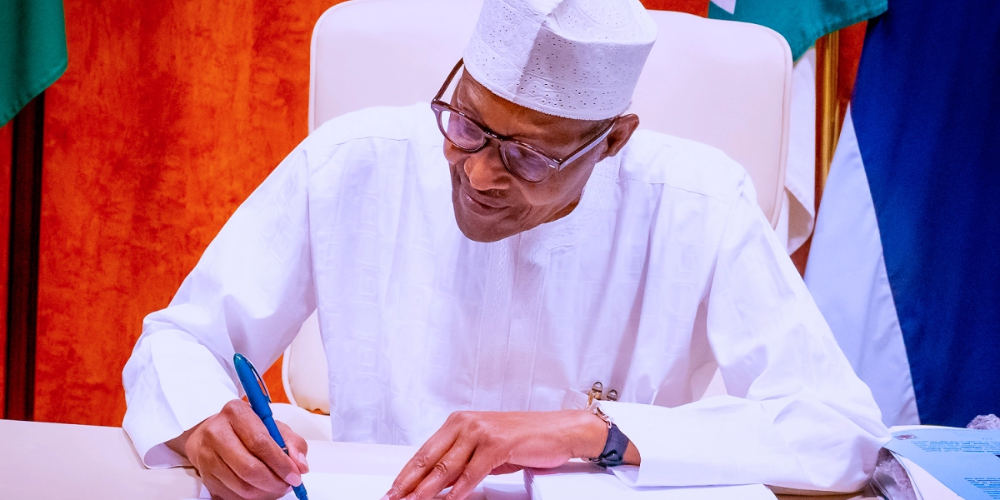
President Bubu has 64 days left in office, and it seems he’s looking to go out with a bang, as on March 17, 2023, he signed 16 constitutional amendment bills.
But what might interest you the most is that a particular bill might permanently erase the phrase “Up nepa” from the Nigerian vocabulary.
This is the Fifth Alteration Bill No. 33, Devolution of Powers (National Grid System), which grants Nigerian states the power to generate, transmit and distribute electricity to areas covered by the national grid.
It’s no secret that Nigeria’s power sector is dilapidating, seeing as no one bats an eye anymore when the national grid collapses every Eke market day. And despite the fact we have the potential to generate 12,522 megawatts of electricity, our poor infrastructure has limited us to only around 4000.
According to the World Bank, around 43% of the Nigerian population doesn’t have access to electricity from the national grid, and about 22 million small-unit generators are in use by Nigerians. This explains why we’re ranked 171 out of 190 in electricity access.
But with the Devolution of Power Bill, we might be looking at a new dawn very soon.
How exactly will this bill help with power supply?
As we’ve already said, state governments now have autonomy over power generation and distribution which means they can take advantage of the state’s resources to provide a more diverse and sustainable means of power generation.
Nigeria is blessed with renewable energy that is unfortunately underutilised. In the North, solar and wind energy is abundant.
And the oil and gas in the South-South and South-East can drive electricity generation from thermal energy.
Lagos state already has plans to utilise its solar and gas energy to provide at least 18 hours of electricity by the end of this year.
Good morning Lagos.
A few days ago, President @MBuhari signed bills granting states more autonomy in key areas like electricity, railways, and the judiciary, empowering Lagos to take charge of our own growth.
With President Muhammadu Buhari counting down to his Aso Rock exit, he’s been ticking off last-minute items on his bucket list. The latest was granting assent to 16 constitution amendment bills on March 17.
Buhari received 35 bills from the national assembly but only assented to 16. So what are these bills, and how do they concern you?
Bill No. 1
If you’re from Ebonyi state, you want to pay attention to this bill. This bill, titled “Fifth Alteration (No.1)”, is to alter the Constitution of the Federal Republic of Nigeria, 1999, to change the names of Afikpo North and Afikpo South Local government areas (LGA). They’re now known as Afikpo and Edda, respectively.
Bill No. 2
This bill concerns people from Kano and is titled the “Fifth Alteration (No.2)”. It’s to amend the Constitution to change the name of Kunchi LGA. It’s now known as Ghari LGA.
Bill No. 3
Gather here if you’re from Ogun state. The “Fifth Alteration (No.3)” is a bill to change the names of Egbado North and Egbado South LGAs. They’re now known as Yewa North and Yewa South, respectively.
Bill No. 4
The Fifth Alteration (No.4) is to correct the name of Atigbo LGA; and for related matters. The LGA is in Oyo state. Its correct spelling is Atisbo.
Bill No. 5
The Fifth Alteration (No.5) is to correct the name of Abia/Akpor LGA to Obio/Akpor; and for related matters. If you followed the elections closely in Rivers state, this LGA might ring a bell.
Bill No. 6
Fifth Alteration (No.6) is a Bill that seeks to alter the Constitution of the Federal Republic of Nigeria, 1999, to provide for the financial independence of State Houses of Assembly (HOA) and State Judiciary and related matters. This means that state HOAs and state judiciary now have financial autonomy. That’s a good thing.
Bill No. 8
The Fifth Alteration (No.8) regulates the first session and inauguration of members-elect of the National and State HOA. This bill provides a procedure for how assembly sessions should go.
Bill No. 9
The Fifth Alteration (No.9) is to delete the reference to the provisions of the Criminal Code, Penal Code, Criminal Procedure Act, Criminal Procedure Code or Evidence Act from the Constitution. This makes the constitution less voluminous since these Acts are codified separately into law.
Bill No. 10
The Fifth Alteration (No.10) amends the Constitution to exclude the period of intervening events in the computation of time for determining pre-election petitions, election petitions and appeals, and related matters.
Essentially, periods in filing election petitions are sacrosanct, and no extenuating circumstances are considered. However, with this bill, pre-election petitions can now be excluded from the period if a party raises a preliminary objection or interlocutory issue (i.e. judgement given provisionally).
The Fifth Alteration (No.12) is to alter the Constitution to provide for the post-call qualification of the Secretary of the National Judicial Council; and for related matters.
Bill No. 15
The Fifth Alteration (No.15) Bill amends the Constitution to delete the item “prisons” in the Exclusive Legislative List and redesignate it as “Correctional Services” in the Concurrent Legislative List; and for related matters. While it may appear trivial, the name change is significant as it’s symbolic of what reform is, which is to correct behaviour and not necessarily punish for the sake of it. This bill also means states can now build correctional facilities instead of just the FG.
Bill No. 16
The Fifth Alteration (No.16) Bill is to move the item “railways” from the Exclusive Legislative List to the Concurrent Legislative List; and for related matters. As in the previous entry, states can now create railways—and earn revenue from them—just like the FG.
Bill No. 17
I like to call this the “Up NEPA Bill”. The Fifth Alteration (No.17) Bill alters the Constitution to allow states to generate, transmit and distribute electricity in areas covered by the national grid; and for related matters. Fingers crossed, many states will take advantage of this.
Bill No. 23
In Fifth Alteration (No.23), the Bill seeks to alter the Constitution to require the President and governors to submit the names of persons nominated as Ministers or Commissioners within sixty days of taking the oath of office for confirmation by the Senate or State House of Assembly.
The days of “Baba Go Slow”, when Buhari had to wait till September 2015—after being sworn in on May 2015—to submit a ministerial list, are gone. Publicly elected officials need to hit the ground running. However, it remains unclear what the penalty is if they default.
Bill No. 32
The Fifth Alteration (No.32), the Bill amends the Constitution to correct the error in the definition of the boundary of the Federal Capital Territory, Abuja, and related matters.
Bill No. 34
The Fifth Alteration (No.34) alters the Constitution to require the government to direct its policy towards ensuring Nigerians’ right to food and food security. More rights for us? Amen to that!
As a way to curb the spread of COVID-19 aka Coronavirus, President Muhammadu Buhari has announced that there will be a lockdown and a restriction on movements in states with the highest number of coronavirus cases; Lagos, Abuja, and Ogun.
Even though certain things have been put on hold during this time, there are still things that haven’t been paused, like bills. Paying important bills like electricity, internet etc will prove to be a hassle this period. However, we’re here with a way to make things easier.
1) Airtime
It’s safe to say that your neighborhood credit guy/girl isn’t going to want to risk getting infected or getting bodied by police so they’re not going to be at their usual spot this period. Top up your airtime using PAGA.
2) Internet
Without the internet, how else will we be able to keep track of what’s going on in the outside world and receive WhatsApp BCs from loved ones about how onions scattered around your house will scare Miss Rona away? Renew your subscription with PAGA and give your mother rest of mind by assuring her that you are in fact eating handfuls of garlic and drinking boiling water.
3) Cable TV
Don’t let boredom be the reason Nigerian police use you to catch trips because you left your house to look for an open DStv office. Renew your subscription from the comfort and safety of your home using PAGA so you can keep watching Keeping Up With Kardashians in secret.
4) Electricity
Do you really want to be the person who has their light cut during a pandemic due to outstanding bills? Because make no mistake, Nigerian electricity providers WILL do it. They won’t hear “I can’t go outside as an excuse.” Pay your bills from home using PAGA.
5) Boomplay
You can’t possibly go through this lockdown without music. Renew your subscription to Boomplay Music with PAGA and create your very own Lockdown Playlist full of songs you can:
Dance to like no one’s watching (because no one is watching).
Workout to
Cry to whenever you feel lonely
The Paga app is available for free in the Google and Apple play store.
What’s up, Zikoko Fam? It would mean the world to us if you spared a few minutes to fill this Reader Survey. It’s so we can bring you the content you really want!
Now that I’m an alleged adult supposedly in charge of my own life, a thing I wish I’d been warned about regarding adulthood was bills. Bills are, without a doubt, the fucking worst. A lot of them come around the same time as your paycheck, taking a huge chunk of it before you even realize wtf is going on.
With that in mind, here are 5 bills that will kick your ass in this hellish phase of life called adulthood.
1) Food
Remember how you pissed you would get as a child when you wanted fast food but your parents told you there was rice at home or when a particular thing was cooked for the entire family and you asked for something different but were told to shut up and “eat the damn food”?
As an adult providing food for yourself, don’t you see things now from their point of view?
2) Hospital Bills
As an adult, scheduling your own hospital appointments and handling the bills, you’ll get to understand what was really going through your parents’ minds all the times they decided to treat you themselves instead of just taking you to the hospital.
3) Rent
All I’ll say is that most of the people you see with roommates would much rather live alone. They don’t because they can’t afford to.
4) House Repairs
Few things feel worse than returning from work to find your apartment flooded because a water pipe in the wall exploded. Houses (and a lot of the things in them) are bound to have faults at some points. Is this really the way life is supposed to be or do all humans unknowingly share their living spaces with poltergeists? Who knows?
What’s up, Zikoko Fam? It would mean the world to us if you spared a few minutes to fill this Reader Survey. It’s so we can bring you the content you really want!
In a Nigerian home, there’s a very fine line between being a child and being an adult. 21 might be the official legal age for most things like voting or drinking but if you think that’s when you come of age then you are a joker. To prevent your parents from calling a family meeting on your head, here’s how you really know you’ve come of age in a Nigerian home.
When your mum starts putting two pieces of meat on your rice.
Is this me
When they ask for your opinion during a family meeting.
You mean you want my opinion??
When you are still out at 7pm and your mother hasn’t called you ten times
I don’t understand what’s happening right now
When they start using style to ask you if you have a boyfriend/girlfriend.
Is this a trick question?
When your parents stop sending you pocket money just because you got one small job like that
Am I not your child again?
When they start asking you what you are still doing in their house.
Is it not our house again?
When they bring NEPA bill and your parents ask how much you are going to contribute
But when did this one start?
When your mum starts asking you for grandchildren
Please ma stop this rough play
When you can go out without dropping 5 working days notice
Ehn sho mo age mi
When during family prayer your parents only prayer point for you is to get married and leave their house.
When did this one start?
When you tell your parents you have a boyfriend and they reply ‘Thank God o!’
Is it that serious?
But the surest way to know you’ve come of age is when they give you signs you’re ready to become a parent. Are you ready to have a child? Watch this video to find out what Nigerians have to say about parenthood.
Today, Nigerian twitter is lit with this discussion. Again. Who should pay on a date? But we can all agree that circumstances can be different right? So we thought of 3 instances:
1. If you invite someone out on a date, who should pay?
I may be wrong, but if you set a date up with someone who would otherwise be undisturbed in their house – and not spending money – shouldn’t you pay for whatever activity you both indulge in? Isn’t that just common courtesy? Social etiquette dictates that the person extending the invitation should be the one who pays for the meal. I know some people disagree but come on!
Why will you tell someone to leave their house (where they weren't spending money) and go on a date with you, and tell them to split bill?
2. When you invite someone out, and they bring their friends, should you pay for the friends too?
Again, I may be wrong, but if someone invites you out on a date, isn’t it just wrong to bring your friends? Asides from the financial implications, the person wanted to spend time with you and you brought a convoy. Then, the person should pay for them too? Really? Come on guys, these issues are not that hard if you just respect the other party. Seriously.
3. When someone organizes a birthday hangout, how should the bills be handled?
See, this is double edged. But let’s try. It’s your friends birthday, they’re inviting you to hangout. Wouldn’t you have thought of giving the person something for their birthday? As a friend, you shouldn’t go and rack up bills for another person that you don’t intend to pay a part of. I mean, who are you?
I don’t disagree with this tweet. Contribute oh! And don’t show up to a party empty-handed. That’s just rude. Guys, it’s just decency and respect. That’s all. If you have those, then you would probably do the right things.