Notice: Function _load_textdomain_just_in_time was called incorrectly. Translation loading for the wordpress-seo domain was triggered too early. This is usually an indicator for some code in the plugin or theme running too early. Translations should be loaded at the init action or later. Please see Debugging in WordPress for more information. (This message was added in version 6.7.0.) in /home/bcm/src/dev/www/wp-includes/functions.php on line 6121 ATIKU ABUBAKAR | Zikoko!
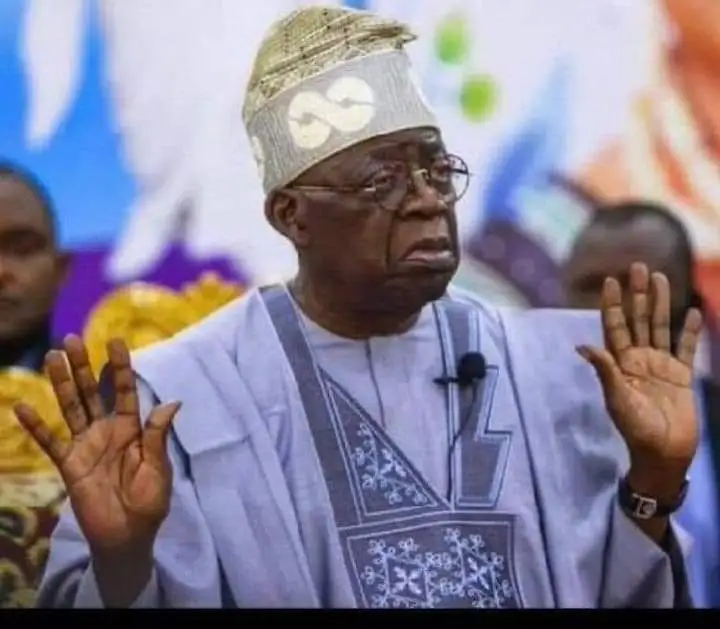
On 6 January 2023, the All-Progressives Congress (APC) presidential candidate, Bola Ahmed Tinubu, caused quite a stir on social media timelines with a photoshopped picture of him appearing on a campaign billboard.
The victim of the act was Ebuka Obi-Uchendu, host of the popular reality TV show, Big Brother Naija (BBN). In the photo, both Tinubu and Ebuka seem to be sharing the same pose, clothes, and even his wedding ring.
Sadly, this isn’t the first time politicians have been accused of the photoshop act. Here are some other cases:
Atiku receiving a handshake from Trump
During Atiku’s 2019 presidential campaign, a picture of him with a former American president, Donald Trump, was circulated. This was to clear rumours about his ban in the U.S.
However, Africa Fact Check revealed that President Muhammadu Buhari was the original person in the photo in April 2018.
Peter Obi with “Tinubu’s Insignia” Cap
Shortly before the Labour Party (LP) presidential candidate joined the party in May 2022, a post by Facebook user Taiwo Olaore was circulated. In the photo, Obi was wearing Tinubu’s insignia cap at an event. This drove the narrative that Obi was a supporter of Tinubu’s campaign or “BATified”.
However, further checks by The Cable revealed that the cap was digitally imposed on his head, as he wore no cap in the original photo.
However, this was thoroughly disputed by Buhari himself. He came out to assure the public that he has not been replaced by a double.
Tinubu with Joe Biden
Shortly before his Chatham House visit in 2022, a photo of Tinubu speaking with the current president of America, Joe Biden, was circulated.
However, the APC campaign media director, Bayo Onanuga, cleared the air that the photo had been doctored and there the presidential candidate’s last location then was at Abuja.
But over the past few weeks, especially since the candidate of the Labour Party (LP), Peter Obi, released his manifesto, the Obidient movement has accused Atiku of stealing inspiration from their own candidate. The argument of Obi’s supporters is that most of Atiku’s speeches on the campaign trail don’t reflect what’s contained in his own document.
So, what exactly is contained in the candidate’s 115-page manifesto?
Insecurity
The Plan
Massive recruitment into all of Nigeria’s security outfits especially the Nigeria Police so that additional 1,000,000 policemen and women will be added to the existing total of less than 400,000 — in 4 years
Insecurity is one of Nigeria’s most pressing problems. Atiku’s plan to address that is to recruit one million police officers in line with the United Nations’ recommendation. The recommendation states that the ideal ratio should be one police officer to 450 citizens. Statistics agree that Nigeria is severely under policed. However, does the country really need a million new police officers? Let’s do the math:
Nigeria currently has 340,000 police officers in service and an estimated population of 211.4 million citizens. To meet UN standards, we need 470,000 new officers, not a million.
It’s also unclear if Atiku has thought of how he would pay these officers. The cost of weapons, training and welfare also come to mind. For example, if one estimates ₦150,000 a month as the average salary for 500,000 additional police officers, that’s an additional ₦900 billion yearly to a budget heavily financed by debt.
Agriculture
The Plan
Continue to improve the agriculture sector’s access to financial services, through NIRSAL by de-risking lending to the sector by commercial and development banks. The overall goal is to improve the financial capacity of the farmers and other agricultural producers to adopt new technologies and increase their resilience to economic shocks.
Even though Atiku’s plan for agriculture isn’t comprehensive enough on problem-solving, it’s impossible to disagree with him on the need to improve access to finance for farmers.
The Central Bank of Nigeria (CBN) has spent over ₦1 trillion in the past seven years. These seven years were used to fill the gaps in food supply with interventions like the Anchors Borrowers Programme. But those gaps have not been filled. Many factors such as the Russian-Ukraine war, the after effects of COVID-19, and even basic things like motorable roads are still against us.
Finance
The Plan
Our primary concern shall be the maintenance of macroeconomic and financial system stability. We shall pursue policies that minimise systemic risk and boost investor confidence. We shall endeavour to bring inflation to the single digits, maintain exchange rate stability and institutionalise fiscal discipline.
Atiku’s answer to inflation is developing the financial sector — banks, pension, insurance and capital markets. But he wasn’t clear enough on how he’ll address the root causes of inflation like soaring food prices, naira depreciation, and overdependence on imports.
Power
The Plan
Government shall create an environment that will enable distribution companies to recover full costs for power supplied to their consumers with a firm commitment to a metering program for all customers. The scourge of electricity theft will be dealt with through a viable partnership between investors in the distribution companies and the government with legislative support for prompt action against electricity theft.
No power system is free of losses. For distribution companies, these losses include metre tampering, false metre readings and unmetred supply. One thing Atiku could have clarified was his plan to remove the commitments of these power losses from firms.
It’s not entirely a new idea, as distribution companies suggested performance improvement plans and loss-reduction targets in 2021. A project like this clearly needs money. But with ₦1.3 trillion electricity intervention fund already down the drain, who will help these firms?
Education
The Plan
Responsibility for funding and control of public primary education shall be transferred to the local governments. Senior secondary and tertiary education, provided through universities, polytechnics, monotechnics, and Colleges of Education (CoEs) will be under the jurisdiction of State governments in the manner that best suits their individual or collective purposes.
On the issue of senior secondary and tertiary education to be given control under the state government, Atiku first mentioned in August 2022 that this was due to the fact the first set of schools were originally under regional government, and the successors are the states.
But one of his aides, Paul Ibe, later covered for him, saying that he instead plans to have a “phased devolution of power.” Something looks fishy.
The Nigerian Voter is a series that seeks to understand the motivations that drive the voting decisions of Nigerians — why they vote, how they choose their candidates, why some have never voted, and their wildest stories around elections.
This week’s subject of The Nigerian Voter is Kachi*, a businessman in his late 30s who told us about his wildest election story and who he wants to become Nigeria’s next president.
Have you voted before?
I voted for Goodluck Jonathan of the People’s Democratic Party (PDP) in 2011 and 2015.
Why him?
I believed Jonathan was the man to take us forward with our economy. I also never saw Buhari as an option, especially with his military history and everything else.
How would you define your past voting experience?
I voted in Abuja both times. 2015 wasn’t so interesting, but 2011 was fun. We gathered in a primary school and there was no violence. We all stayed and counted the votes in our polling unit and Jonathan won it. I can also remember that was when the smart card reader was introduced and it was a new technology for us. That was the first time we got Permanent Voter Cards (PVC) too.
What’s your favourite thing about Nigeria’s electoral system?
I think it’s the introduction of new technologies such as the Bimodal Voter Accreditation System (BVAS) and others. I think if perfected, they can stop electoral fraud and ensure a better experience for voters.
What’s your least favourite?
I dislike the fact people have to travel to polling units where they registered to vote. I should be able to vote from wherever I am. If I registered in Abuja, but I’m currently in Anambra, I should still be able to vote from Anambra instead of going all the way back to Abuja. It’s a big inconvenience.
Any wild election stories?
I can’t say I had a crazy experience that happened to me personally. But I remember one incident that happened to my colleague in Edo State when we served as election observers for the governorship election in 2020. She was taken by some hoodlums who thought she was an INEC staff. It was crazy. It took like two days for the police to find her.
Wild
Election observers aren’t allowed to interfere with the process of an election by voting and I was observing with an NGO at the time.
How come you didn’t vote in 2019?
I had major bone surgery around the elections and wasn’t fit to vote.
Sorry about that. Are you voting in 2023?
Of course, my vote will be for Atiku Abubakar of the PDP. I believe he’s the most experienced candidate at this time. During his tenure as vice president in the Olusegun Obasanjo administration, he was basically responsible for Nigeria’s economic gain as the head of the National Economic Council (NEC).
That administration recorded the highest level of growth in Gross Domestic Product (GDP) in Nigeria. Obasanjo attested to Atiku being solely responsible for this. He also presided over the Federal Executive Council (FEC) meetings a few times when Obasanjo was abroad, not like now when Buhari travels with his full powers without handing over responsibilities to Osinbajo.
Is that the bar?
Atiku has also presented a sound manifesto that calls for restructuring and devolution of powers in Nigeria. This is something I support because I know the job of fixing Nigeria isn’t for one man only. I know whoever is clamouring for restructuring should have the political will, and Atiku has it.
He’s been pushing for restructuring since 1999. The PDP has also been pushing for restructuring in one way or the other. The messiah system of governance won’t work. Allow other regions to develop themselves. Buhari decided to run Nigeria as a one-man show, and look where that landed him. Our local governments are doing almost nothing and our state governors are nothing but money sharers. All the tiers of government need to work hard to develop Nigeria.
Are you mobilising people to vote?
Yes, I’m using my influence on social media to get people to vote. I’ve also bought some campaign materials for my constituency and around Abuja metropolis to be shared. I’m giving my staff an election bonus to be able to travel to their various local government areas to vote.
If we asked you to describe the 2023 presidential election campaigns, what word would you use?
Whichever word just ran through your mind, we know it doesn’t rhyme with “boring” or “dry”, because the campaign season has been entertaining.
Millions of Nigerian voters have picked their candidates for the 2023 presidential election, but we won’t know who has more supporters until February 2023. But because some people want to see the future, they’ve been organising polls to frame the picture of what will happen. These polls represent the most dominant public opinion and we looked at five of the biggest polls to see which candidate is leading.
The candidate of the People’s Democratic Party (PDP), Atiku Abubakar, and the All Progressive Congress (APC) candidate, Bola Tinubu, ended up with 13% each. Rabiu Kwankwaso of the New Nigeria People’s Party (NNPP) finished lastwith only 3% of voters rooting for him.
Tinubu finished the poll with 16% of voters in his corner and Atiku finished in third place with 9%.
Fitch Institute Research — Bola Tinubu
Obi’s flawless record as the winner of presidential polls ended when Fitch Solutions, a research company, released its own report and crowned Tinubu the most likely winner.
However, Tinubu’s projected victory wasn’t without a comma as Fitch also projected it would cause social unrest in Nigeria especially due to his choice of another Muslim as vice-president.
We2Geda — Peter Obi
When We2Geda asked 15,438 registered voters across Nigeria in September 2022 who they plan to vote for, 51% of them crowned Obi. 25% of them ended up in Atiku’s corner and Tinubu had to settle for 19% of respondents.
Further analysis also showed Obi remained a favourite in four geopolitical zones: North-Central, South-South, South-West, and South-East, while Atiku was the poll leader in the North-East and North-West zones.
Nextier — Peter Obi
When Nextier polled 2,000 Nigerians in rural areas, they also crowned Obi as Nigeria’s next president. Nextier excluded the home states of the leading presidential and vice-presidential candidates in conducting the poll.
Who’s the winner?
After much deliberation and collation of facts, the winner of the 2023 presidential election polls is… Peter Obi!
But how effective are opinion polls on Nigerian elections?
Polls aren’t considered a big deal in Nigerian elections, but facts don’t lie and neither does history. In 2010, 53% of people from the NOI poll believed that Jonathan would win the 2011 election, and he did. Buhari also won the NOI poll of 2014 with 32% and later became president in 2015. He also won the NOI poll of 2018 ahead of the 2019 election and look who’s still our president.
If the history of polls tells you anything, it’s that they can be very reliable. However, it’s still nothing but a waiting game until Nigerians elect their new president on February 25, 2023.
It’s the World Cup in a few days and while Nigeria won’t be taking part, there are no hard feelings as there’s enough drama at home to keep us occupied. With things getting intense ahead of the 2023 elections, we’ve seen presidential candidates buckle under pressure with twists and slips.
Being the troublemakers that we are, we’ve compiled the top four embarrassing moments of the presidential campaigns so far.
Atiku has his “emi lokan” moment
We start with the unifier. Atiku Abubakar of the People’s Democratic Party (PDP), had his first major gaffe at an interactive session on October 14, 2022. Addressing the Arewa Joint Committee, Atiku was asked what his plans were for the North.
We should have known he was up to no good when he turned up in sneakers. He took the mic, and the words that came from his mouth were in stark contrast to his goal of unifying Nigerians.
His words: “I think what the average northerner needs is someone who is from the North, and who also understands the other parts of Nigeria, and who has been able to build bridges across the rest of the country. This is what the northerner needs. He doesn’t need a Yoruba candidate, or an Igbo candidate. This is what the northerner needs.”
Nigerians had interesting reactions to this online.
Atiku has had his own "emi lokan" moment🤣. He reportedly told members of the Northern Elders Forum in Kaduna that northerners need him, not a Yoruba or Igbo candidate. That's reckless ethnic baiting. They're all the same.
Bola Tinubu (BAT) of the All Progressives Congress (APC) is no stranger to controversies. If anything, he delights in them. At a summit in Kaduna, around the same time Atiku was pulling his “emi lokan” stunt, BAT reminded us that he’s the true king of comical errors.
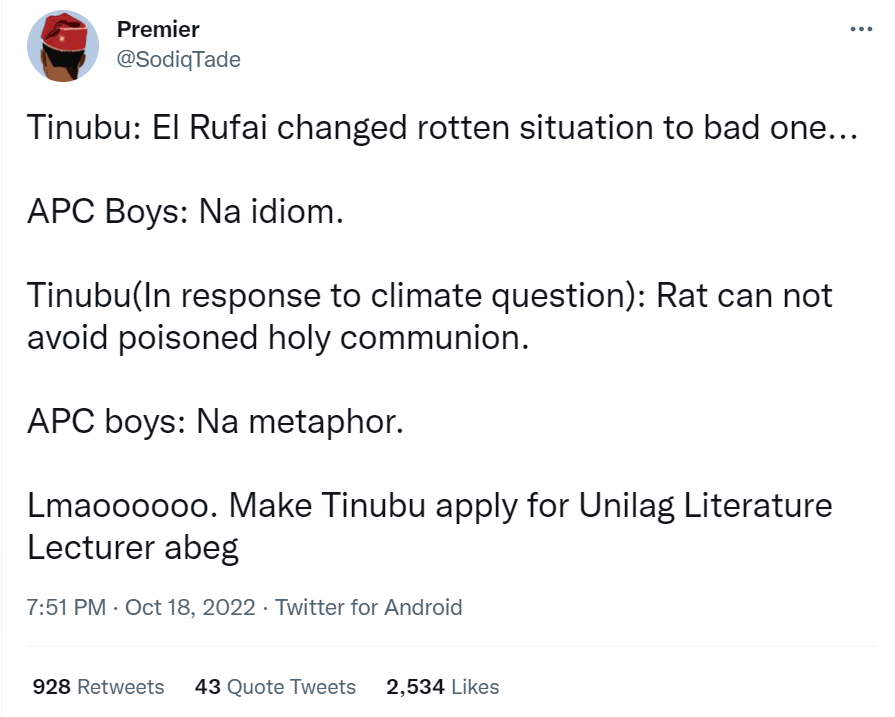
In what was supposed to be a compliment to Nasir El-Rufai, BAT still found a way to throw a jab at him. He said: “I’m begging Nasiru El-Rufai not to run away for (an) additional degree. Your vision, creativity and resiliency in turning a rotten situation into a bad one is necessary at this critical time.”
His spokesman called it a “slip of tongue”. But as you’ll find out soon, that would be one of several slips to come.
Obi and his unverifiable facts
Peter Obi (The Rock) of the Labour Party (LP) has no doubt captured a lot of supporters, building his Obidient army. And if there’s anything he is famous for, it is quoting statistics to back up his claims. However, not all rocks are solid, as Obi has shown us.
His most prominent gaffe came in an interview on Channels TV. On July 25, 2022, he claimed that of the 150 players playing in the National Basketball Association (NBA), almost 100 are Nigerians.
You know how Obi always says “Go and verify”? Well, fact-checkers did and they found his claim to be untrue. Turns out that among the 109 international players registered for the league’s 2021-2022 season, only five — and not “almost 100” — are from Nigeria.
The BAT strikes again
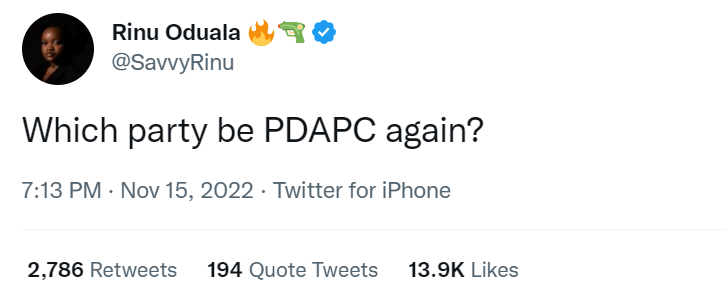
BAT’s most recent gaffe places him head and shoulders above the presidential pack. At a rally on November 15, 2022, in Plateau state, the BAT lost track of his own political party when he asked God to “bless the PDAPC”. We checked, and there’s no party by that name.
If you’re a fan of the unifier, now’s the time to look away. The last time we brought you Atiku Abubakar-related gist, we answered the question of where he was and what he’s been up to. This time, the presidential candidate of the Peoples Democratic Party (PDP) is in a new situation: inside hot soup.
What’s the gist?
Well, Atiku had a week-long trip to the United States where he continued his campaign. The public reactions were mixed, ranging from satire to applause from his supporters who said his trip neutralised any rumours that he can’t set foot in the U.S. due to a corruption indictment.
If you think H.E Atiku Abubakar's visit to the US was a total miss and not a political master-stroke then you're a political neophyte. Peter Obi toured Europe & the United States here is a breakdown of how both men fared and what it means for the 2023 elections.
But that’s just the appetiser. The real gist is that Atiku may have accumulated an unpaid debt of $5.9 million for the US visa.
According to The Nation, Legacy Logistics LLC Limited, the firm that reportedly secured Atiku’s visa, is yet to be paid. The candidate’s legal adviser, Prof. Maxwell Gidado (SAN), has said the company is lying and trying to extort Atiku..
If Atiku really needed to prove to us he could set his foot on US soil without being arrested, it appears the cost may have been way too steep.
How has Atiku responded?
For now, it appears the unifier is keeping his mouth shut on the matter. He hasn’t yet issued any statements addressing the report, and his spokespersons are unlooking.
While people online drag him for being an onigbese, he remains focused on his presidential campaign and is expected to be in Katsina on November 5, 2022. Maybe he’d have a response for us by then.
One thousand and one things are happening with a presidential election, especially one as chaotic as Nigeria’s 2023 race.
These are the highlights of the 2023 presidential election campaigns in the past week.
Obi won’t give shishi but he needs a lot of it
The Peter Obi presidential campaign uncovered a deep dark secret last week that stunned everyone across Nigeria: presidential campaigns cost money. Who saw that one coming? Before you know it, someone would tell us Abacha was a thief.
“He was only saving Nigeria’s money for future use”
The national chairman of the Labour Party (LP), Julius Abure, opened the door to a dash of public ridicule when he appealed for donations to the party’s campaign for the 2023 presidential election. Crowdfunding for presidential elections isn’t an entirely new concept, but it was a bit comical coming from a campaign that has made penny-pinching a trademark.
Nigeria’s electoral laws set a limit of ₦5 billion to run a presidential campaign. How much of that can the Peter Obi campaign raise?
Tinubu finally wins something, but there’s a twist
The presidential candidate of the All Progressives Congress (APC), Bola Tinubu, has survived a lot of things in his campaign — there was that pee thing, the constant questions about his health and his many gaffes.
But his campaign has been turning a good corner in the past couple of weeks, and he crowned that last week with an endorsement by Fitch Ratings which projected victory for him in 2023.
Peter Obi has won three major polls released in the past couple of months, but the Fitch report predicted a strong Tinubu victory — an outcome that validates his entitled campaign to succeed Buhari.
But while the report may be good news for Tinubu, it’s not such a great one for Nigerians as Fitch also projected his victory will lead to social instability in Nigeria.
Atiku’s American wonder
Atiku has to tick three things on his checklist whenever he runs for president — prove he’s not a northern extremist, beg Obasanjo to take back the stealing allegations and take a trip to the United States.
Last week, the former vice president packed his campaign team and flew to the U.S. to once again prove that he can waltz into the country where his critics say he’s wanted for corruption. He did a lot of standing around and taking fly jpegs in America and nobody saw him in handcuffs.
Roc Boys no drip pass this one
If the presidential election was a game of stunts, Atiku won last week hands down and should be crowned president as soon as he returns to Nigeria. But if he hopes to have a victorious campaign, there’s one more thing on his checklist he has to resolve and the name is Nyesom Wike.
Kwankwaso has a miracle up his sleeves
Does anyone still remember Rabiu Kwankwaso is in the presidential race? The former Kano State governor was primed as the dark horse candidate to challenge the APC and PDP in 2023. But even though he’s been dislodged from public consciousness by Obi’s rise and is now only rated fourth in a three-horse race, Kwankwaso isn’t giving up without a fight.
The former governor is still rallying his impressive crowd of Kwankwasiyya supporters with their famous red caps and posting photos of large rally crowds on his Twitter.
But does anyone trust it’ll translate into a win for the candidate of the New Nigeria People’s Party (NNPP)? A chieftain of his party, Buba Galadima, seems to think he’ll perform the miracle of the five loaves of bread and two fish by sweeping over “50-something million votes” in the north while nicking more votes in the southern region.
At 39, Christopher Imumolen of the Accord Party (AP) is the youngest presidential candidate in the race for the 2023 presidential election, and he won’t let you forget it. He’s made many claims about being the “authentic youth” option and wants young Nigerians — the most populated voting group — to elect him to make a statement.
Christopher Imumolen started his tour in Togo with plans to also touch down in Benin Republic, Ghana and Liberia. Even though he refused to be drawn into a debate on why other candidates are doing diaspora outreach in exotic places in Europe and North America, Imumolen seemed to suggest his own West African tour had more substance. We can’t begrudge a man his days of local outreach.
Sowore is pocket-watching
Remember how the law says it should cost a maximum of ₦5 billion to run a Nigerian presidential campaign? Well, it’s kind of an open secret that Nigerian politicians spend more than the limit and they get away with it because authorities don’t enforce election finance laws. The candidate of the African Action Congress (AAC), Omoyele Sowore, wants that to change for 2023 to create a level playing field.
Which is why you have laws and a referee like INEC
You can understand why this is coming from a candidate who could only raise a grand total of ₦157.9 million for his 2019 campaign. But Nigeria does need to get serious with enforcing laws to make sure everyone is playing by the books. Why have laws if you won’t enforce them? Is this a third-world country?
Atiku Abubakar, the presidential candidate of the People’s Democratic Party (PDP), officially flagged off his campaign early in October 2022. He has since hopped across the country for his unifier mission.
But what exactly has he been up to?
How has his campaign fared so far?
Well, the answer depends on who you ask. His fans have called his style of campaign unique and focused. His haters think he’s in last position in a three-horse race for the crown. But this is a former vice president of Nigeria we’re talking about and a massive crowd of supporters turned up for the flag-off of his campaign.
The biggest problem for Atiku’s campaign is he has enemies from within trying to pour sand in his garri.
On October 25, 2022, the governor of Benue State, Samuel Ortom, his fellow party member, publicly withdrew his support for Atiku for “dishonoring him” and working against the interests of his state. This withdrawal is connected to Atiku’s messy feud with Nyesom Wike, the governor of Rivers State.
Wike is yet to forgive Atiku’s transgressions since he lost the party’s ticket to him. So, it’s no surprise that every day is WW III with those two.
On his most recent campaign stop in Edo State, Atiku said his number one priority, if elected president, would be Nigeria’s unity. But it’s difficult to overlook the irony that he can’t unite his own party.
Where was Atiku last seen?
On October 25, 2022, Atiku visited residents of Bayelsa State affected by the floods that have devastated many parts of Nigeria. The candidate didn’t just show up with love and light, but also some cash — he donated ₦55 million towards the welfare of the victims.
Call him Mr Owonikoko
Atiku blamed climate change for the floods which have killed over 600 Nigerians in 2022. He called on the government to set up a relief fund to assist the victims who have lost their homes and sources of livelihood.
So where next for the unifier?
According to his campaign timetable, Atiku is expected to address the Commonwealth of Nations in the United Kingdom on October 27, 2022. He would then move his presidential campaign to Ekiti State on November 1, and neighbouring Ondo State on November 2.
The candidate’s expected to tour the remaining states in Nigeria before the presidential election holds on February 25, 2023. For his sake, we hope he manages to put his home in order or there may be some serious consequences.
This is Zikoko Citizen’s Game of Votes weekly dispatch that helps you dig into all the good, bad, and extremely bizarre stuff happening in Nigeria and why they’re important to you.
Subscribe now to get the newsletter in your email inbox at 8 am every Friday instead of three days later. Don’t be LASTMA.
If you’re feeling mischievous and throw a stone into a United Kingdom hospital, there are good odds it’ll land on a Nigerian-trained doctor who’ll scream, “Wetin be that?”
Seven years ago when Buhari became president, only 233 Nigerian-trained doctors moved to the UK. But that’s only 33 more than the 200 Nigerian doctors who moved to the UK in September 2022 alone.
If you had to guess how many Nigerian-trained doctors have relocated to the United Kingdom the entire year, what would your number be? According to the UK’s General Medical Council, the number of fleeing doctors between January and September is 1,307.
And there are more doctors waiting on the queue to get out of the country [Image source: Zikoko Memes]
For a country that already has a shortage of doctors in the health sector, losing even one doctor to other countries is a concern. To lose 1,307 professionals in just nine months is a tragedy. According to research by BMJ Global Health, low and middle-income countries lose $15.86 billion annually when locally-trained doctors migrate to high-income countries. The greatest total costs are incurred by India, Pakistan, South Africa and, of course, Nigeria ($3.1 billion).
The unchecked loss of highly-qualified doctors to new dispensations poses a threat to Nigeria’s already troubled health sector. Not only is it a loss of human capital with economic consequences, but can be a matter of life and death for Nigerians that need quality care.
[Image source: Zikoko Memes]
Nigerian doctors, like other Nigerians surfing the japa wave, are fleeing poor working and living conditions in pursuit of better opportunities abroad, and you have to wonder when the Nigerian government will tackle the exodus with ideas more sophisticated than just simply chaining them to hospital beds.
What else happened this week?
The 2023 presidential election is finally gaining life
The top three candidates for the 2023 presidential election finally breathed some life into their campaigns two weeks too late. On September 28, 2022, the Independent National Electoral Commission (INEC) officially opened the floor for candidates to start campaigning, but all three have been sluggish with kicking things off.
What changed this week?
The candidate of the Labour Party (LP), Peter Obi, announced a presidential campaign council comprising 1,234 (seriously, this number isn’t a joke) members. Former presidential spokesperson and Obi’s current ride-or-die, Doyin Okupe, is the campaign’s director-general. Okupe boasted Obi already has a minimum of 15 million votes waiting for him at the polls, as long as INEC doesn’t do anyhow.
Notably, Obi skipped the committee’s unveiling ceremony for a speaking engagement at the ICAN 52nd Annual Accountants Conference. But with how low the standards have got, you’re just thankful he wasn’t off somewhere in London secretly treating an undisclosed illness.
The candidate of the Peoples Democratic Party (PDP), Atiku Abubakar, officially flagged off his campaign and promised Nigerians would never again suffer from hunger and insecurity.
[Image source: Zikoko Memes]
But his campaign is still haunted by the ghost of Rivers State governor, Nyesom Wike, who predictably didn’t show up at the campaign launch, putting a question mark on Atiku’s high regard for himself as a unifier. In fact, days later, the party postponed two campaign outings in two states reportedly to give the candidate more time to patch things with Wike.
The candidate of the All Progressives Congress (APC), Bola Tinubu, also oversaw the launch of the party’s Women Presidential Campaign Committee. He charged his campaigners to preach his gospel and politely tell people that want his party out of government to shut their dirty mouths. It’s a great way to endear yourself to undecided voters if the goal is to lose the election.
Question of the week
What should the Nigerian government be doing about the ongoing flooding crisis that it isn’t already doing?
Click here to tweet your answer to @ZikokoCitizen on Twitter.
Ehen, one more thing…
The governor of Rivers State, Nyesom Wike, appointed over 28,000 officials for political units this week. When you get over the taxpayer cost of these appointments, you have to wonder if the governor is preparing for an imminent war the rest of us don’t know about.
On January 15th, 2022, a former governor of Anambra State, Peter Obi, praised the Super Eagles of Nigeria on his Twitter account. He got hundreds of responses but most of them weren’t talking about his original message about the national football team.
Many of the Nigerians in his comment section were begging him to run for president. One of the replies under that tweet was so threatening that Obi had to respond directly. The Twitter user threatened legal action against the former Anambra State governor if he failed to throw his hat into the ring for the 2023 presidential election. In response, Obi said, “Give me some time.”
In 2003, four years after Nigeria returned to the loving arms of democracy, billionaire businessman, Peter Obi, contested for the seat of Anambra State governor. The Independent Electoral National Commission (INEC) declared Chris Ngige the winner of that election but Obi disagreed with the result and started a legal battle that lasted three years.
In 2006, the court ruled that Obi was the winner of the election. It was the first time a court decided the winner of a governorship election in Nigeria. Obi assumed office in March 2006 but in less than a year, Anambra State lawmakers impeached him (in November 2006) over alleged corruption. Obi claimed it was a witch-hunt because he refused to inflate the state’s annual budget. He went back to court again and won; the impeachment was overturned and he made a triumphant return in February 2007.
When it was time for another governorship election in 2007, Obi wasn’t on the ballot because he believed he was entitled to four full years in office as governor. Andy Uba won the 2007 election, and Obi had to vacate the Government House in May 2007. But he ran straight to his babalawo, the Supreme Court.
The court agreed that Obi deserved his four-year term and nullified Anambra’s 2007 governorship election to return him to office to complete his first term. This victory became the precedent for other governors who would go on to win their mandates in court and is the reason why a total of eight states now have off-cycle elections. Obi won a second term in office in 2010 and remained the governor of Anambra State till 2014.
Transmission
In 2014, Obi did what all Nigerian politicians do in their lifetime: he switched parties. He had spent his eight years as Anambra State governor as a member of the All Progressives Grand Alliance (APGA). But just months after he left the Government House, he dumped the party for the Peoples Democratic Party (PDP) which was in control of the Federal Government at the time.
Five years later, Obi found himself on the PDP’s presidential ticket as the running mate to former vice president, Atiku Abubakar, for the 2019 general elections.
Even though they lost the election, Obi was one of the stand-out characters from the campaign trail. His vibrant spirit, track record as governor and obsession with statistics imported from China were some of the 2019 election campaign highlights. It was his first true introduction to the national spotlight — the moment he unwittingly sowed the seeds of the Obidient movement.
The rise of Obidience
By the beginning of 2022, the 2023 presidential election was already shaping up as the usual two-horse race between the PDP and the All Progressives Congress (APC). And in those two parties, Bola Tinubu and Atiku Abubakar were already being primed to lead their tickets. But both men, veteran politicians from all the way back in the 90s, had an image problem that made them hard to swallow, especially for young voters.
As an alternative, the Nigerian youth looked across the landscape for who had more palatable appeal. Their eyes fell on Obi. That’s why hundreds of young Nigerians hounded him to run for president in response to that January tweet where he was talking about football.
Two weeks later, Obi tweeted that he would “step into the field” if the PDP zoned the presidential ticket to the south. But when it was clear the party would renege on the gentleman zoning agreement, and Atiku remained the favourite to win the party’s ticket, Obi’s growing supporter base started prompting him to leave the party and join another one that would put him on the ballot.
This move would be tricky because only the APC and the PDP command political “structures” strong enough to win national elections. But as his chances of clinching the PDP ticket dwindled, Obi took the plunge and joined the Labour Party (LP).
Obi’s move enjoyed widespread support among the demographic of young Nigerians disillusioned with the establishment, and they vowed to carry his campaign on their heads. And as the support base swelled, they needed a name. They became Obidients.
What’s the appeal of Peter Obi?
Every Nigerian election has a candidate billed as the “messiah” to lead Nigerians out of the wilderness to the Promised Land. Even though Obidients have stopped short of using that tag, Peter Obi represents the wealth of option Nigerians don’t usually get in presidential elections. He’s distinguished himself, with his much-talked-about humility, financial prudence, and a certain kind of sophistication that’s become a rarity in Nigerian elections.
Since winning LP’s presidential ticket, Obi’s campaign has been fueled chiefly by supporters with a deep sense of commitment to his ministry and the hope that he represents. In response to criticism that he has no political structure to win a national election, Obidients have rolled up their sleeves and got down to work. They’ve moved what was once derided as a social media campaign to the grassroots to win more voters to the Obidient movement.
The result of the work is starting to show in opinion polls that have boosted confidence about Peter Obi’s chances. According to three prominent polls, including one by Bloomberg, Obi is ahead of his two main rivals and is primed to win the election next year.
One of Peter Obi’s most prominent narratives is that he’s a political “outsider” even though he’s an establishment politician who’s broken bread with the same political class Nigerian youths are desperate to retire. But the candidate has had to fight for a political career that his supporters feel makes him different.
To end up inside Aso Rock Villa, he’ll need his Obidient force to pull off the impossible and spit in the face of an unyielding status quo.
It takes a village to pull off an election. No Nigerian election is complete without the candidates pulling antics, boring campaign rallies, cringey skits and dance videos, exaggerated campaign promises, and banners like this:
But more than anything, an election needs voters. In fact, the legitimacy of an election is often defined by how many people turn out to vote. These voters are the people who fuel an election campaign after buying into the vision of their preferred candidate and spreading their gospel everywhere they go.
But just like with anything that happens where two or more are gathered in service of anything, there are bound to be… issues.
The problem with Nigeria’s 2023 elections campaign
As with any sort of competition, with elections, it’s never enough to say pounded yam is your favourite swallow. It’s equally as important to outline and, with the aid of diagrams, prove that your opponent’s semo is manufactured inside Lucifer’s latrine. The goal of putting on that pressure is to get them — and other undecided people — to ditch semo and join hands with you to crown pounded yam as the king of swallow that it is.
Your choice is elite and any other choice is a counterfeit
Over the course of the campaigns for the 2023 presidential election, this culture of putting down the other camp has oftentimes crossed six lanes into harassment. The most recent episode involved Nollywood actress, Joke Silva, who openly declared her support for the presidential candidate of the All Progressives Congress (APC), Bola Tinubu. The wave of online harassment that followed her declaration forced her to disable comments on her Instagram page. And she’s only one of many that have been targeted for online harassment over their choice of candidate.
More than once, the presidential candidate of the Labour Party (LP), Peter Obi, has cautioned his supporters to be of good conduct. His repeated calls for restraint were fueled by the sometimes problematic online attacks against other candidates and their supporters.
while you concentrate on issues to promote our cause of moving our dear Nigeria from consumption to production, create jobs, and generally evolve a better Nigeria – PO
But at the same time, other camps have also targeted Obi’s supporters and mislabeled them as terrorists using his campaign to further their supposed anti-government agenda. His supporters have also faced real-world violence while trying to boost support for him in the streets. In August 2022, thugs in Lagos State rough-handled a physically-challenged Obi supporter who proudly displayed his support on his wheelchair.
Physically challenged man, John Solam from Adamawa state allegedly attacked by thugs for campaigning for Peter Obi in Lagos state pic.twitter.com/C8vo2NkuJD
The many incidents of online harassment and offline violence currently brewing aren’t new in Nigeria. And while opposing camps keep arguing over which one is more damaging to Nigeria’s democratic process, there’s a more important question to answer.
Where’s the voter’s right to choose?
The real beauty of democracy is the right it bestows on every eligible person to choose who they want to represent their interests in government. And while this right is protected by the nation’s relevant laws, it’s not completely divorced from the freedom of speech of others to criticise it. But this freedom also has certain limits, and to go beyond them is considered harmful.
Nigeria’s 2023 presidential election is deeply personal to the more than 90 million people registered to vote. Nigerians have been dragged through too many traumatic events over the past seven years. It’d be foolish not to carefully consider the nation’s next leadership choice as critical to its survival. But it’s still important to always know where the big red line is.
An election isn’t determined by who screams the loudest obscenities online but by the people that show up to vote at the polls. If you want to make sure your pounded yam becomes the king of swallow, the best strategy is to find like-minded people like yourself who love pounded yam or are at least open-minded enough to listen to your pitch. Raining fire and brimstone on semo lovers or, even worse, fufu lovers, isn’t likely to get them to turn their back on their favourite food.
It’s important that when the 2023 presidential election is over, there’s enough of a relationship to mend for everyone to work together for the country’s future, regardless of who wins. The 2023 election is a battle for Nigeria’s soul and it’s essential that participants don’t lose their own way in the pursuit of moulding a better country.
This is Zikoko Citizen’s Game of Votes weekly dispatch that helps you dig into all the good, bad, and extremely bizarre stuff happening in Nigeria and why they’re important to you.
Subscribe now to get the newsletter in your email inbox at 8 am every Friday instead of three days later. Don’t be LASTMA.
Nigeria has a very short list of frequent natural disasters: Ponzi schemes, politicians and destructive annual floods.
Over the past week, thousands of people living in Kogi State became homeless after invasive floods visited them and decided to feel at home. Many of these victims have raised alarm about their fate, but this isn’t just a story about Kogi.
Source: Twitter/@AlejiOjay
This year, more than half a million Nigerians have suffered the same watery fate witnessed in Kogi this week. Between January and August alone, flood incidents in 33 states killed 372 people, according to statistics from the National Emergency Management Agency (NEMA). And the sad thing is there’s nothing special about what’s happening because it repeats itself every year.
Heavy rainfalls cause much of these flood incidents but there’s a man-made aspect to it too. Every year, Cameroonian officials release excess water from Lagdo Dam. The excess water knows no boundaries and travels, without a visa, through the River Niger and Benue to wreak havoc in Nigeria. This happens every year, yet the government hardly ever prepares for it other than to raise alarm.
In fact, Kogi’s Commissioner for Environment, Victor Omofaiye, was upset that the victims ignored NEMA’s warnings to move to higher ground, even though there’s little evidence the government provided them with alternatives. The state government is now scrambling to provide relief for those affected by appealing to the Federal Government and non-governmental organisations (NGOs).
Until that help comes, at least the affected residents can console themselves with these shamelessly-branded boats the Kogi State first lady, Rashida Yahaya Bello, donated before this week’s severe floods.
Source: Blueprint
What Else Happened This Week?
The Battle for Who’ll Inherit Buhari’s Mess Is Live!
Presidential candidates have been heavily flirting with Nigerians for the past couple of months but that’s just pre-marital sex in election campaign terms. It wasn’t until September 28, 2022 that the Independent National Electoral Commission (INEC) blew the whistle for the official start of campaigns.
This leaves the floor open for candidates to commence the battle for the unique honour of becoming the man or woman who inherits Buhari-shaped trials and tribulations from May 29, 2023.
The candidate of the Peoples Democratic Party (PDP), Atiku Abubakar, flagged off his campaign with the launch of a range of books that are about him. He also released a 15-minute video address promising to be Nigeria’s great unifier, never mind that he’s been struggling to unite his own party.
The candidate of the Labour Party (LP), Peter Obi, flagged off his campaign at a solidarity rally with his supporters in Jos, Plateau State. It was an auspicious day for him too because Bloomberg News released the result of a poll that showed him as the clear favourite to win next year’s election. It’s the third major poll he’s won in weeks, but February is still a long time away.
The candidate of the All Progressives Congress (APC), Bola Tinubu, launched his own campaign with a press statement after he flew to London and cancelled his scheduled campaign event. There has to be something about London that seduces Nigerian presidents and presidential hopefuls and we’d like to know so we can use it to keep them here.
On February 25, 2023, more than 90 million Nigerians will have the opportunity to pick the country’s next president from a pool of 17 men and one woman. The time to pay attention and choose your fighter starts now.
Have You Seen This Video?
Thousands of Kogi State residents have been displaced by floods, but you wouldn't know that from looking at Governor Yahaya Bello's social media activity. pic.twitter.com/9D7AVIKx5K
Nigeria’s national grid collapsed for the seventh time in 2022 this week and sent Nigerians back into familiar darkness. At what point are we taking it to Shiloh for deliverance?
This ceremony is like two lovers having a blood covenant, except there’s no blood involved here and the candidates aren’t really in love with one another. So, what’s this ritual about and why do they commit to it?
A brief backstory
It’s easy to forget these days, but Nigerian elections used to be very violent. Post-election violence used to be as inevitable as Buhari flying to London every year.
…as long as he’s not the one getting the debit alert
For example, the post-election violence of 2011 resulted in the death of more than 800 people after supporters of Muhammadu Buhari, who lost the election, protested that it was rigged. The protests degenerated into ethnoreligious riots in northern states where rioters murdered hundreds of people.
Critics partly blamed Buhari for the escalation of the violence due to his strong position that the southern Christian winner of the election, Goodluck Jonathan, rigged it. And he didn’t learn his lesson because, in 2012, Buhari went ahead to say, “The dog and the baboon would all be soaked in blood” if the 2015 election was rigged too.
Rhetorics like Buhari’s and the general climate of careless conduct by Nigerian politicians formed the building blocks of the National Sensitisaton Workshop on Non-Violence in 2015.
The first peace accord
Ahead of the 2015 general elections, the worried Goodluck Jonathan administration initiated a series of conversations with political stakeholders on peace-building. The goal was to ensure political actors embraced a more civil approach during campaigns for office.
At the National Sensitisaton Workshop on Non-Violence on January 14th 2015, presidential candidates, including Buhari, and their political parties signed a peace accord to behave themselves on the campaign trail. The main promises in the pact were to run issue-based campaigns and not engage in ethnoreligious provocations that could lead to violence. A new ritual was born.
They even got Kofi Annan to attend this thing
Section 3 of the peace accord recommended the creation of a National Peace Committee (NPC) to guarantee the constant promotion of peace. Funded by the United Nations’ Development Programme (UNDP), the NPC launched soon after, on January 25th 2015, and former military head of state, General Abdulsalami Abubakar appointed as its head.
This is what the first peace accord looked like.
2019 presidential candidates signed a similar pact, and 2023 candidates have now done the same. But we noticed a couple of notable things from this year’s ceremony.
Tinubu is missing in action
Since political parties elected their candidates in June, there have been two public events where the major candidates have crossed paths — the Nigerian Bar Association (NBA) conference in August and the latest signing of the peace accord. The candidate of the All Progressives Congress (APC), Bola Tinubu, has ghosted both events and sent his vice presidential candidate, Kashim Shettima, instead.
Nigeria is only just about to be rid of one absentee president but a frontrunner to replace him is already showing signs of following in his footsteps. At least Buhari waited to get into the office before ghosting everyone. Tinubu is already running his campaign remotely and giving fuel to the beer parlour gist that his running mate is the one actually running for president.
Sowore isn’t a man of peace
The 2023 election is Omoyele Sowore’s second attempt contesting for the seat at Aso Rock Villa, but he’s acquired a reputation for being a troublemaker. He didn’t disappoint at the signing of the accord.
Sowore already mentioned in interviews that he wouldn’t allow organisers to treat him like a second-class candidate and he almost caused a stir when he wasn’t allowed to sit in the front row with the most prominent candidates. He also got in a brief war of words with former Abacha henchman, Hamza Al-Mustapha, who’s also running for president.
At the Presidential “Peace Accord” signing in Abuja, I had to challenge Al-Mustapha Abacha henchman and Kashim Shettima who took the position of Presidential candidates because @officialABAT was no where to be found but organisers let him sit in front! pic.twitter.com/kNv4mzUG9S
Sowore went on to sign the peace accord, but we all know what he really is.
Is the peace accord good for Nigeria?
Nigerian elections used to be more violent than they currently are, and politicians were more reckless. Coincidence or not, that recklessness has become more restrained since candidates and parties started signing the NPC’s peace accord in 2015.
“I promise not to call BAT a Yoruba masquerade.”
Signing the peace accord may not completely eliminate the recklessness and violence still gripping Nigerian elections, but the NPC’s effort to establish a reasonable level of civility can’t be said to be a complete waste of time.
The 2023 presidential candidates will sign a second peace accord close to the elections. This second accord is more tailored towards candidates promising to accept the result of a free, fair and credible election.
Hopefully, Tinubu has someone to alert him so he can put it on his calendar. He can’t say it’s his turn to be president and not turn up at these things.
On the night of May 28th, 2022, delegates of the Peoples Democratic Party (PDP) gathered in Abuja to elect its 2023 presidential candidate. Moments before the voting commenced, the governor of Rivers State, Nyesom Wike, mounted the podium, grabbed the mic and made a couple of interesting promises.
As one of the aspirants contesting for the PDP’s ticket that night, he vowed strongly to support the winner and help the party win the 2023 presidential election. But everything he’s done to the PDP since then has been a betrayal of his words. What changed?
A crushing loss
Wike’s first problem was losing the ticket he desperately wanted to the perennial presidential aspirant and former vice president, Atiku Abubakar.
The defeat was a bitter pill for Wike to swallow, especially losing to Atiku who helped the opposition kick the PDP out of Aso Rock Villa in 2015.
One thing you should know about Wike is he started from the bottom — as a local government chairman in 1999, to the chief of staff of a state governor in 2007, to junior minister in 2011, senior minister in 2013 and finally governor in 2015. He’s been gathering the infinity stones of politics for the past 23 years and losing on his first crack at the biggest and final stone must have stung.
Wike, naturally, didn’t like losing, but he was even more upset about how it happened.
A friendly knife in the back
There are no permanent friends in politics and Wike got a very painful dose of that the night PDP handed Atiku the ticket. A big reason the governor lost was the last-minute withdrawal of Sokoto State governor, Aminu Tambuwal, from the race.
When he announced his withdrawal at the May convention, Tambuwal asked delegates to transfer all his votes to Atiku. The only problem was up until that moment, Tambuwal and Wike were BFFs.
It’s all love and friendly stabbings over here
In fact, Wike heavily backed Tambuwal’s 2019 run for the PDP’s presidential ticket which he also lost to Atiku. So, Tambuwal’s last-minute betrayal left Wike feeling like this:
But the series of unfortunate events didn’t end there.
When he opened it, he ushered in PDP executives led by Iyorchia Ayu, the national chairman of the party. After a very Nigerian back-and-forth hailing of each other as “My chairman”, Ayu looked lovingly into Tambuwal’s eyes and said, “You’re the hero of the convention.”
Wike saw the video of the meeting, and concluded northern forces in the party conspired to steal the ticket from him (and the south).
Despite how deeply hurt he was at this point, there was one last opportunity for the PDP to mend fences with Wike: vice-presidentship.
An offer not made
Over a week after the PDP’s primary election, a 17-member committee submitted three names to Atiku to consider for the party’s vice presidential slot. Wike was on the list and enjoyed the support of the committee’s chairman, Governor Samuel Ortom of Benue State. But on June 16th, 2022, Atiku handed his vice presidential ticket to Governor Ifeanyi Okowa of Delta State. And this was Wike’s 13th reason why.
Wike’s campaign of terror
The Wike that emerged from the ashes of that crushing night in May has become a wrecking ball crushing the PDP’s chances of returning to Aso Rock Villa in 2023.
With the help of his merry band who helps him compose his catchy impromptu diss tracks on all his opps and haters, he’s attacked Atiku many times over the past few weeks and rubbished the PDP’s current leadership.
He’s even publicly flirted with rival presidential candidates Peter Obi and Bola Tinubu just to show Atiku he’s a man of many options. But what’s Wike’s endgame?
What does Wike want?
On September 20th, 2022, high-profile PDP members in Wike’s camp pulled out of Atiku’s presidential campaign committee. They protested that Ayu must resign as the party’s chairman so that a southerner can replace him. The point of the demand is to balance the PDP’s regional composition since Atiku, the presidential candidate, is also a northerner.
Atiku has made it clear he can’t make Ayu step down, but Wike insists it’s something that needs to happen before he can even think about making more demands in exchange for his support.
How Atiku deals with his Wike problem can greatly impact who ends up in Aso Rock Villa in 2023. Wike knows this and will milk the power of his influence till he gets his way. Who blinks first?
With five months left before Nigerians elect a new president, the Independent National Electoral Commission (INEC) has released the final list of candidates for the 2023 presidential election.
So much has happened since 2023 presidential candidates got their parties’ tickets that you may be forgiven for thinking election campaigns have started. But the Independent National Electoral Commission (INEC) won’t officially declare the floor open until September 28th, 2022.
This means everything that’s happened over the past few months are just dress rehearsals for the real thing to come.
“The game hasn’t started?”
And if these dramatic moments are anything to go by, we’re in for a very eventful five months before the 2023 election.
Sowore’s water campaign
Not a lot of election candidates in Nigeria are out-of-the-box thinkers like the presidential candidate of the African Action Congress (AAC), Omoyele Sowore. And he proved this with an election rally inside a lake in May 2022.
No one should be too shocked if people from the marine kingdom participate in the 2023 elections.
Tinubu’s “emi lokan” rant
What was supposed to be a regular toasting of party delegates is now forever remembered as the day candidate of the All Progressives Congress (APC), Bola Tinubu, walked naked into the market square (not literally, thank God).
You’d hope that public office holders can surround themselves with competent special advisers and senior special assistants. But Peter Obi wasn’t shy about letting the public know that one of his most brilliant decisions as Anambra State governor goes all the way back to advice from a mentally-challenged man.
"The best advise I got in Anambra in state…to stop crime in a place called Upper Iweka, I got the advise from a mad man" – Peter Linus Obi 🙆♂️🙆♂️🙆♂️🤦♂️🤦♂️🤦♂️😭😭😭 pic.twitter.com/aqrofyQkdf
The appearance of what many critics considered to be fake priests at the unveiling of Tinubu’s controversial Muslim-Muslim ticket has also been a notable point of the pre-campaign season.
We still don’t have a clear answer on if those priests are hired fakes or just Z-list clerics no one really knows, but it’s giving shady.
Atiku’s aeroplane campaign ad
The questionable campaign ads haven’t started rolling out yet, but the candidate of the Peoples Democratic Party (PDP), Atiku Abubakar, stole the lead with this one about an aeroplane:
Where did that aeroplane take off, and why does the narrator not sound like the Atiku that’s supposed to be the narrator? Also, has he seen the state of flight ticket prices these days? It’s so bad Osuofia can’t afford to go to even Abuja.
Tinubu’s “cassava, garri, ewa” campaign
Tinubu is fast becoming the lead content creator for the 2023 campaign and this video proves it:
It’s simply impossible not to have noticed the presidential campaign of Bola Ahmed Tinubu. He’s not just the candidate of the ruling All Progressives’ Congress (APC), he’s one of those faces that have lasted in Nigerian politics as long as that stubborn piece of corn stuck in your teeth.
Tinubu’s long game
Tinubu first won an election in Nigeria in 1992, a year that millions of people voting next year had not yet been born. His tenure as a senator didn’t last long due to General Sani Abacha‘s military takeover in 1993. But like yeast, Tinubu didn’t stay down.
He contested and won the election to become the governor of Lagos in 1999 and was a thorn in the side of the Olusegun Obasanjo-led Federal Government for much of his eight-year reign.
When Tinubu finished his tenure in 2007, he might have felt he was ripe for the presidency, but he had a problem: Olusegun Obasanjo, a fellow Yoruba man, had just finished a two-term tenure at the Aso Rock Villa.
The political climate was calling for a northerner to replace him in fulfilment of an unwritten gentleman’s agreement to rotate the president’s seat between the north and the south.
Tinubu realistically couldn’t make an immediate run for the presidency, and so his plotting began.
Operation Emi Lokan
Tinubu’s 2023 campaign has been standing firm on an entitled slogan that it’s his turn to sit on Nigeria’s Iron Throne. “Emi lokan” was the soundbite of his infamous rant in June 2022 when the APC was considering choosing a consensus candidate that would likely not be him. Nigerians mocked him for his rant and the soundbite in particular, but Tinubu has turned around to make it the tagline for his presidential bid.
Where exactly did the sense of entitlement come from? Let’s go back to 2007.
2007
In 2007, Tinubu was in control of the Action Congress (AC), a party with enough clout to contest a national election. But since he couldn’t compete because of his limited chances of victory, he needed a northern ally to use his formidable platform.
For the 2007 election, he found Atiku Abubakar, a vice president and outcast who left the ruling party to fulfil his own presidential ambition.
It was a plot convenience that worked for everyone
It would appear that Tinubu’s plan in 2007 was to ride a northerner into Aso Rock Villa. The payoff for him would be the northerner’s support for his own shot at the presidency after eight years. He even tried to be appointed Atiku’s running mate, but they’re both Muslims and would have upset the typical religious balance of a presidential ticket. So Atiku said:
Even though Atiku finished in the third position at the polls, Tinubu had hacked a formula to plot his way to Aso Rock Villa through delayed gratification. It was the perfect plan.
2011
By 2011, Umaru Musa Yar’Adua, the northerner who won the 2007 election, had died and Goodluck Jonathan, his vice president, stepped up as president. Jonathan, a southerner, contested for his first term in office in 2011, spitting in the face of the PDP’s rotational arrangement because he already had a taste of presidential power and wasn’t willing to let go.
But Tinubu failed to run yet again, offering up the platform of the AC, already renamed Action Congress of Nigeria (ACN) at the time, to another outcast northerner, Nuhu Ribadu. In fact, all the four aspirants who contested for the ACN’s presidential ticket were northerners even though southerners dominated the party.
Again, the gambit failed and Ribadu finished third. But even before that election concluded, Tinubu’s ACN was already plotting with a more established northerner for a merger.
In the search for a solution to his presidency problems, Tinubu found one Muhammadu Buhari.
2015 and 2019
By 2015, Tinubu’s ACN had merged with other established opposition parties including Buhari’s Congress for Progressive Change (CPC). This merger gave birth to the APC we know today.
Buhari had been running for the president’s seat since 2003 with little success. But with Tinubu’s political “structure”, he made new inroads to southern votes and the APC rose to power on the promise of change.
Even then, Tinubu was desperate to become Buhari’s vice president. The only problem, again, was they’re both Muslims and that made the ticket politically-radioactive.
And even though Tinubu didn’t get what he wanted then, the only thing that sustained him was the thought of biding his time for what the future held for him. In 2015, he did his part and put a northerner in Aso Rock Villa. All he had to do was wait eight years for his turn.
2023: Emi lokan
According to the permutations of the unwritten rotation policy which has now been thrown inside the dustbin, 2023 is the time for another southern president after eight years of a northern one at the helm of power.
When Tinubu had his infamous “emi lokan” rant in June 2022, he didn’t just weaponise it for himself, but also for his ethnic Yoruba group. This is despite the fact Nigeria already had a Yoruba president for eight years, unlike the southeast region which has produced none.
Irrespective of his attempt to make it about the south, it’s clear that Tinubu’s ambition is solely about him and the long game he’s been playing down the length and breadth of Nigeria for years, just so he can retire in Aso Rock Villa.
Tinubu now has what he wants: his name on the presidential election ballot, his very own Muslim-Muslim ticket and a shot at Nigeria’s Iron Throne. But will he ever sit on it?
Wouldn’t you like to read a newsletter that helps you dig into all the good, bad and extremely bizarre things happening in Nigeria and why they’re important to you? Then you should sign up for Game of Votes.
The Nigerian Bar Association (NBA) invited six of Nigeria’s 17 candidates that’ll contest in the 2023 presidential election to its annual conference on August 22nd, 2022.
The candidates used the platform to toast Nigerians and sell themselves as the best things since agege bread.
We learnt some new things about them at the conference.
Tinubu is a busy man
Let’s immediately get it out of the way that the candidate of the All Progressives’ Congress (APC), Bola Tinubu, didn’t attend the conference even though it took place only a few minutes from his house.
Maybe he was too busy drawing up his strategy for the millions of youths he plans to draft into his agbado army, or maybe he’s just a late-blooming introvert too shy to show his face in public.
Tinubu sent his running mate, Ibrahim Shettima, to the conference instead and we have to talk about him…
Shettima needs a stylist
Shettima showed up to the NBA conference looking like this:
And the only plausible explanation is that he’s a victim of “What I Ordered vs What I Got.” It’s also possible that Tinubu only told him about the conference last minute, so he only got the chance to hurriedly dress himself at the car park. Either way, we (don’t) sympathise.
Dumebi Kachikwu isn’t a one-minute man
The most basic lesson even a primary school student learns is to always listen to instructions. But the candidate of the African Democratic Congress (ADC), Dumebi Kachikwu, is a man that likes to assert himself.
When the MC asked him to give his closing remarks in one minute or less, he protested that it wasn’t enough. The instruction was for him to talk about what he’d do for Nigerians as president, but he kept talking off the script so much that the MC cut him off and moved on to the next candidate.
Atiku wants to make Nigeria… great again?
In his address at the conference, the candidate of the People’s Democratic Party (PDP), Atiku Abubakar, advocated for a Nigeria where everyone has a sense of belonging and there’s unity and we’re all singing kumbaya around a fire.
And, according to him, that only ever happened when the government of Olusegun Obasanjo assumed power in 1999. Conveniently, Atiku was his vice president at the time and he thinks Nigerians need to bring back that “experience” in 2023 to rescue the country. According to him, to escape the trenches, we must go back to move forward.
Peter Obi wants to flip a switch
In his address, the candidate of the Labour Party (LP), Peter Obi, was unforgiving in his assessment of Nigeria as a failed country. And his fix is that Nigeria must make the transition from an insecure country to a secure one, from a disunited country to a united country, from a lawless country to a country of law and order and from a corrupt country to a transparent country.
Obi didn’t clearly outline how he’ll make this happen, so the only assumption is that there’s a switch somewhere waiting to be flipped.
Tinubu wants to recreate the Lagos experience for Nigeria
As Tinubu’s representative at the conference, Shettima proudly announced to everyone that the APC candidate will recreate the Lagos experience for Nigeria. But what’s the Lagos experience? The fourth-largest economy in Africa? Or the home of life-threatening annual floods and an agbero culture that’s become a trademark? Is the Lagos experience a blessing or a threat?
Shettima also promised that a Tinubu presidency will address “ecology” and we’re not sure if that’s a synonym for “unemployment” or the name of a vegetable.
The MC gave Kachikwu a second chance to sell himself after his initial stumble and his proposal is to introduce a patriot bill that makes everyone equal.
To make Nigerian leaders care about real issues, he plans to force them to use the same public amenities the average Nigerians use. For instance, his patriot bill forces public officers to travel only by road except in case of emergencies.
His theory is simple: The people who have the power to make Nigeria work would do everything possible to make it happen if it directly affects them and their families.
Adewole Adebayo knows where the money is buried
There’s an unending debate about whether Nigeria is a rich country or in the chokehold of sapa. But the candidate of the Social Democratic Party (SDP), Adewole Adebayo, believes Nigerian politicians are lying when they say there’s no money on ground. That means our money will grow like grass if he wins?
Also, Adebayo’s strategy to win the election is appealing to Nigerians to change the people they usually vote for. We wonder where we’ve heard that change thing before.
The average age in Nigeria is 18 years old, but the country’s affairs are mostly run by baby boomers born between 1946 and 1964.
Nigeria’s “leaders of tomorrow” have been waiting for eternity to take over as promised and take charge of their own future but the queue isn’t moving fast enough.
So, in honour of Baby Boomers Recognition Day, we look at the Nigerian leaders holding up the queue and keeping the leaders of tomorrow out of the room.
Muhammadu Buhari, 79
Nigeria’s current president is the oldest to ever sit in the top seat. He was a military dictator between 1983 and 1985 when he was booted out. He must have forgotten something in that office because he returned 18 years later to contest presidential elections four times before he finally won in 2015. He’s set to finally retire to his livestock farm in Daura when his second term ends in 2023.
Theodore Orji, 78
Theodore Orji served as Abia State governor for eight years and could have retired immediately as he was already 70+ when his tenure ended in 2015. But he jumped straight to the Senate and contested again in 2019. Thankfully, he says he’ll retire when his current term ends in 2023 to make way for younger people.
Senator Abdullahi Adamu, 76
Senator Abdullahi Adamu hasn’t had a moment of rest since he actively joined politics in 1977. He’s worked with many political parties and was a minister under General Sani Abacha.
He later won an election as the governor of Nasarawa State in 1999 and served two terms until 2007. He became a senator in 2011 and remained in the Senate until he was elected the national chairman of the All Progressives Congress (APC) in 2022.
Atiku Abubakar, 75
Atiku is one of the favourites to win the 2023 presidential elections, but he’s been playing that game since 1992. If the former vice president wins, Nigeria would go from one septuagenarian to another. And if he loses, history shows there’s nothing to stop him from running again in 2027.
Bola Tinubu is another favourite to win the 2023 presidential election who could continue Nigeria’s septuagenarian line of presidents. He was a senator in the 1990s and served two terms as Lagos State governor before settling into an alleged godfather role for the next three governors. He now has his sights on the Aso Rock Villa as his retirement home.
Ahmad Lawan, 63
He’s not exactly 70+ but he’s a baby boomer and one of the longest-serving lawmakers in Nigeria. He’s risen from being a House of Representatives member to becoming the Senate President and landlord head of the National Assembly which makes him the third most powerful person in Nigeria currently. And he’s already started targeting the number one position.
Nicholas Mutu, 62
He’s also not 70+ but Nicholas Mutu is another baby boomer who’s clung to power in Nigeria. At the age of 39, he was elected the representative of Bomadi/Patani federal constituency of Delta State in 1999. He’s simply never left since then and is a proper National Assembly landlord himself.
Femi Gbajabiamila, 60
He’s the youngest person on this list but as the Speaker of the House of Representatives, Femi Gbajabiamila is currently the fourth most powerful person in Nigeria. And he’s climbed all the way over there by nailing down a seat in the chamber since 2003.
The 2023 presidential election won’t happen for another eight months, but the ball’s already rolling. Parties have picked their presidential candidates and candidates have picked their running mates, even if some of them are placeholders. All those things are important, but the centrepiece that validates an electoral process is the voter: you.
There are currently two types of voters: those that have a difficult time picking their preferred presidential candidate and those that already daydream about the kind of life Nigerians will have when their preferred presidential candidate wins. If you’ve already decided, how can you turn that daydream into a reality by getting your candidate elected? Well, there are some helpful tips.
Adopt a catchy group name
A rapidly-emerging trend of Nigerian election years is group names for supporters of presidential candidates; this year hasn’t been an exception. Buharists had their time in the sun and the Atikulated and Kwankwasiyya have been around for some time. These days, there’s a rising wave of Obidients and a colony of the BATified.
Sure, it scores cool points online to have a rad group name to identify with, but that’s the least of the things you have to do to get your presidential candidate into office. So what do you do?
Donate to their campaign
Yes.
Just like cocaine addiction, election campaigns cost money. The spending limit of a presidential campaign was recently raised from ₦1 billion to ₦5 billion. And unless your candidate is secretly a drug dealer or Ponzi scheme merchant, there’s no way they can shoulder that financial burden alone. They need all the extra ₦1k and ₦2k that you can afford to support their ministry. Keep in mind, though, that it’s against the law to donate more than ₦50 million — just in case your money grows like grass.
Advertise your support
More than cash donations, you can also provide material support to contribute to your favourite candidate’s success. It can be as basic as changing your social media display pictures, sharing campaign posts created by your candidate and attending their rallies and campaign events.
There’s no better way to help your candidate’s ministry than to evangelise their selling points to everyone you can find: your neighbour, your seatmate inside the public bus, the people at your favourite salon and even the person that aired your WhatsApp message three years ago. Just like a movie you enjoy, your candidate can gain more appeal through the sheer power of word-of-mouth.
Organise
You don’t have to act alone in pushing your favourite candidate’s ministry. It’s almost impossible, even. You can always find political action groups online and offline and connect with them to push your candidate.
Volunteer
You can also volunteer to directly work for your candidate’s campaign in an official capacity. You can help the campaign to fundraise or engage in voter outreach, education and registration drive ahead of the election. Your candidate needs as many people as possible to reach out to every potential voter and secure their votes.
Have your PVC to vote, duh
The highest form of devotion to your candidate’s success is to vote for them at the polls. It’s hard to do that if you don’t have your permanent voters card (PVC). It helps that you changed your social media display picture for your candidate, but voting for them at the polls is what has the biggest impact on getting them across the finish line. That’s the only way your candidate’s journey can end in praise.
Everybody and their grandmother wanted to get on the ballot to be elected Nigeria’s next president in the 2023 presidential election. But now that the dust has settled on primary elections conducted by political parties, that list has significantly reduced to only a handful of candidates.
The pre-season competition is over, and here are the candidates that will appear on the ballot for Nigerians to vote for in 2023.
Christopher Imumolen — Accord (A)
Christopher Imumolen is the presidential candidate of Accord. He won the party’s ticket unopposed and is 39 years old.
Hamza Al-Mustapha — Action Alliance (AA)
Hamza Al-Mustapha, a former security aide to the late General Sani Abacha, is the presidential candidate of Action Alliance (AA). He was the candidate of the Peoples Party of Nigeria (PPN) in the 2019 presidential election but scored less than 5,000 votes. He’s 61 years old.
Omoyele Sowore — African Action Congress (AAC)
Omoyele Sowore was elected the African Action Congress (AAC) presidential candidate at the party’s national convention on June 9th 2022. Sowore was also the party’s candidate for the 2019 presidential election but only recorded less than 34,000 votes. He’s 51 years old.
Dumebi Kachikwu — African Democratic Congress (ADC)
Dumebi Kachikwu beat 11 other aspirants to snatch the presidential ticket of the African Democratic Congress (ADC). He’s the founder of Roots Television and the brother of a former Minister of State for Petroleum Resources, Ibe Kachikwu. He’s 48 years old.
Yabaji Sani — Action Democratic Party (ADP)
Yabaji Sani is the national chairman of the Action Democratic Party (ADP) and will also represent the party on the ballot for the 2023 presidential election. He was the party’s presidential candidate in 2019 and scored nearly 55,000 votes. He’s 64 years old.
Bola Tinubu — All Progressives Congress (APC)
Bola Tinubu beat a dozen other aspirants to the highly-coveted presidential ticket of the All Progressives Congress (APC). He’s a former senator and Lagos State governor. He’s 70 years old.
Peter Umeadi — All Progressives Grand Alliance (APGA)
Peter Umeadi is a former Chief Judge of Anambra State who’ll represent the All Progressives Grand Alliance (APGA) on the ballot for the 2023 presidential election. He won the ticket unopposed.
Yusuf Dantalle — Allied Peoples Movement (APM)
Yusuf Dantalle is the flagbearer of the Allied Peoples Movement (APM) for the 2023 presidential election. He’s also the party’s national chairman and was elected unopposed. He was a losing candidate in the 2019 Kogi State governorship election. He’s 50 years old.
Peter Obi, a former Anambra State governor, is the flagbearer for Labour Party (LP) for 2023. He was a vice presidential candidate of the Peoples Democratic Party (PDP) in the 2019 presidential election. He’s 60 years old.
Okwudili Mwa-Anyajike — National Rescue Movement (NRM)
Okwudili Mwa-Anyajike beat eight others to the presidential ticket of the National Rescue Movement (NRM).
Rabiu Kwankwaso — New Nigerian Peoples Party (NNPP)
Like Obi, Rabiu Kwankwaso also left the PDP in pursuit of his presidential ambition. He eventually won the ticket of the New Nigerian Peoples Party (NNPP). A former Kano State governor, he also served as a minister and senator in the past. While he failed to get on the presidential ballot in 2015 and 2019, he’s trying again in 2022. He’s 65 years old.
Atiku Abubakar — Peoples Democratic Party (PDP)
Atiku Abubakar is one of the favourites to win the 2023 presidential election after winning the PDP ticket. The former vice president was also the party’s candidate in the 2019 presidential election but finished second. The 2023 election is his third time on the presidential ballot and sixth attempt overall since he first contested in 1993. He’s 75 years old.
Kola Abiola beat three other aspirants to become the flagbearer of the Peoples Redemption Party (PRP). He’s the son of the late MKO Abiola (who was adjudged to have won the 1993 presidential election that was annulled by the military government of Ibrahim Babangida). He’s 59 years old.
Adewole Adebayo — Social Democratic Party (SDP)
Adewole Adebayo is the presidential candidate of the Social Democratic Party (SDP). The 54-year-old is a lawyer and founder of KAFTAN Television.
Malik Addo-Ibrahim — Young Progressives Party (YPP)
The presidential candidate of the Young Progressives Party (YPP), Malik Addo-Ibrahim, is a civil rights activist and founder of the Reset Nigeria Initiative. He’s the son of the Ohinoyi of Ebira Land in Kogi State.
Dan Nwanyanwu — Zenith Labour Party (ZLP)
Dan Nwanyanwu is another national chairman that’ll be representing his party as a candidate for the 2023 presidential election. He’s promised to unite Nigerians in three months if elected president.
Insanity is doing the same thing repeatedly and expecting different results, but Atiku Abubakar definitely doesn’t play by the rules of random online quotes. The former vice president is the candidate of the Peoples Democratic Party (PDP) for the 2023 presidential election, but it’s not his first time. In fact, it’s his sixth time trying to become Nigeria’s Number One Citizen.
How did he fare the first five times? Let’s take a trip down memory lane.
1993
The first time Atiku ran for the presidency, bootcut jeans were the pinnacle of fashion. The man’s been trying to be president longer than Fireboy DML has been alive.
Atiku contested in the primary election of the Social Democratic Party (SDP) for the 1993 presidential election and finished third behind MKO Abiola and Baba Gana Kingibe in the first round of voting. He dropped out of the run-off election after making a deal to become Abiola’s running mate, but Abiola picked Kingibe after winning the ticket. It was Atiku’s first presidential breakfast, but it wasn’t his last.
2007
After two terms as a vice president, Atiku was ready to step into the big shoes of the presidency. His only problem at the time was President Olusegun Obasanjo. The two had a power struggle for years and accused each other of stealing from Nigeria’s treasury.
The conflict between the two forced Atiku out of the PDP to the Action Congress (AC) of Bola Tinubu in 2006. The AC practically gifted him the party’s presidential ticket with no contest, and it was his first time on the ballot, but the Independent National Electoral Commission (INEC) disqualified him over corruption allegations. Atiku fought this exclusion, and the Supreme Court cleared him to participate just days before the election.
That whiff of court victory didn’t follow Atiku into the presidential election. He finished third with 2.6 million votes behind the winner, Umaru Musa Yar’Adua, who finished with 24.6 million votes and second-placed Muhammadu Buhari with 6.6 million votes.
Atiku returned to the PDP like the prodigal son in 2009 and was gearing to go after the presidency again. This time, his main stumbling block was Goodluck Jonathan who had taken over as president following Yar’Adua’s death in 2010. The third time wasn’t the charm for Atiku, as he finished second to Jonathan in the PDP’s primary election and never made it to the ballot. Many feared that it would be the end of Atiku’s run at the top job. If only they knew.
2015
Atiku was near-certain that he wouldn’t be able to beat Jonathan to the ticket a second time, so he journeyed out of the PDP again. He complained that the party couldn’t be redeemed and joined the All Progressives Congress (APC). According to him, he was putting “Nigeria’s interests” first, but you could bet that was a synonym for “my presidential ambition”.
For the 2015 presidential election, Atiku contested for the ticket of the APC where he lost again to an old foe, Buhari. Once again, Atiku didn’t make it to the ballot, and that meant only one thing:
2019
If reading this article this far has taught you anything, it’s that Atiku cannot stay in one place, and he runs for the presidency every chance he gets. In 2017, he left the APC to return, once again, to the PDP. He finally won the party’s presidential ticket for the first time and was on the ballot as the biggest challenger to his old nemesis, President Buhari. Atiku won 11.3 million votes, his highest ever, but it was 3.8 million less than he needed to beat Buhari, who won again in what was the final contest between the two.
Atiku wants the presidency, no doubt, and has been accused of being too desperate for it. But the real question is does the presidency want him? That’s an answer to look forward to in February 2023.
If history has taught us only one thing about Nigerian politics, it’s that we can always expect to be entertained. Even when the public officials are robbing the country blind or banning things for no sensible reason, there’s always something entertaining we can use as a coping mechanism.
The Peoples Democratic Party (PDP) became the first major party to elect its candidate for the 2023 presidential election. It’s a pivotal event that many Nigerians have been looking forward to for weeks because of its significance to next year’s contest. The PDP national convention has come and gone, and we learnt a few lessons.
Atiku won’t rest
Let’s start with the biggest winner. Former Vice President, Atiku Abubakar, won the PDP’s ticket at the national convention that took place between May 28th and May 29th 2022. His win makes him a motivational speaker’s wet dream because he still won’t stop aspiring for Nigeria’s highest office 30 years after his first try.
He’s been a presidential aspirant/candidate or vice-presidential candidate in elections in 1993, 1999, 2003, 2007, 2011, 2015, and 2019. We bet he mumbles, “Desire, aspire, perspire, inspire but don’t expire,” before he sleeps and when he wakes.
Breakfast goes around
Atiku defeated a dozen other aspirants, but the biggest loser is Rivers State governor, Nyesom Wike, the man who finished second behind him. The governor had by far been the loudest of the party’s aspirants and taken potshots at everyone else. He built his campaign solely on the claim that he’s the only one capable of winning the presidency back for the party.
Hard to argue against a guy who does this
When aspirants battled for the PDP’s ticket for the 2019 presidential election, Wike heavily backed Tambuwal against Atiku who eventually won the ticket. Fast-forward to 2022 when Wike could have done with some reciprocal support, Tambuwal dropped out of the race and announced his support for Atiku instead. It was a turning point of the contest, and it’s not a secret that Wike is salty about how it all went down.
Fayose is obsessed with Buhari
Look, we get it. Buhari doesn’t have many fans in the opposition party, but can someone please tell Mr Ayo Fayose that the president won’t be on the ballot next year? While giving his final address to delegates, the former Ekiti State governor kept praising himself as a man with a track record of defeating incumbents. He specifically asked delegates to make him the party’s candidate so he can defeat Buhari who it turns out won’t be contesting at all in 2023. No wonder he got zero votes by the time the convention was over.
Tari Diana Oliver was the only female aspirant in the race for the PDP ticket. And since Nigerians have never elected a female president, it was no surprise that her pitch to delegates was to make history and make her the first.
“I’m standing here as Esther in the hands of Mordecai. It’s in your hands to vote for me and make history,” she said in a passionate appeal to delegates before voting commenced. Her message got through to only one delegate that voted for her, but at least that’s one more than the zero votes that aspirants like Fayose and Dele Momodu got.
Death to zoning
Much has been made about if Nigeria’s next president should come from the north or south. The Southern Governors’ Forum (SGF) even threatened that whichever party elects a northerner will lose at the polls. It’s an issue that threatened to tear the PDP apart until the party decided to play it safe and make the contest open to whoever can spend the most money win.
Many Nigerians have kicked against the idea of a northerner, like Atiku, replacing another northerner (Buhari) after eight years, but that’s a real possibility now. Because it’s not a properly documented arrangement, it was only a matter of time before zoning met its end at the presidential level. The lesson here is to document everything.
EFCC is always watching
A lot has been made about how presidential primaries can become a money-making venture for delegates that elect the candidates. Delegates use the opportunity to cash out and take dollars from every aspirant willing to part with their money in exchange for votes. It was no surprise then that agents of the Economic and Financial Crimes Commission (EFCC) were seen sniffing around at the PDP’s convention.
No one (that we know of) was arrested, but the message is clear that the eagle is always watching, even if only for the camera.
APC boxed into a tight corner
The PDP and the All Progressives Congress (APC) have been playing a game of cat and mouse trying to see the candidate that the other one elects for the 2023 presidential election. With Atiku’s victory, the APC has one week to think long and hard about who they have in their lineup of aspirants to battle against an election veteran who clocked over 12 million votes in the 2019 election.
Contrary to Fayose’s crank theory, Buhari won’t be on the ballot, so the APC needs someone that can battle for the huge voting figures from the north. While that may automatically mean electing a northern candidate, good luck explaining that to southerners in the party who have been expecting the ticket to be zoned to the south. We can think of one southerner in particular who wants to be rewarded with a lifetime ambition. Should be fun when the convention happens between June 6th and June 8th 2022.
As a Nigerian politician, having a sweet mouth is a highly desirable skill, no doubt. You can have great plans for your voters, but you need proper storytelling skills to stimulate them. You know? Something to keep the people going.
It’s not enough to say you’ll provide free education, you have to remind your voters that you couldn’t go to school when you were young because there was no one to provide free education for you. Or that you were forced to travel to school on foot across seven seas and mountains because there were no schools in your community.
But as a voter, it’s useful to have it in the back of your mind that politicians are trying to game you. If politicians have to deceive or manipulate you to get what they want, they will — and they do. The goal is the elected office they want, and sometimes they’ll tell you sob stories to appear more relatable to you so you can vote for them.
You have to jazz up and always look at the merit of their actual plans, and not just their corny grass-to grace stories.
With the campaign season for the 2023 elections kicking into gear, we compiled Nigerian politicians’ greatest hits of sob stories. And you should expect to see more of them.
Goodluck Jonathan (2010)
“In my early days in school, I had no shoes, no school bags. I carried my books in my hands but never despaired; no car to take me to school but I never despaired. There were days I had only one meal but I never despaired. I walked miles and crossed rivers to school every day but I never despaired. I didn’t have power, didn’t have generators, studied with lanterns but I never despaired.
In spite of these, I finished secondary school, attended the University of Port Harcourt, and now hold a doctorate degree. Fellow Nigerians, if I could make it, you too can make it.”
Muhammadu Buhari (2014)
“It’s a pity I couldn’t influence the reduction of the cost of nomination forms. I felt heavily sorry for myself because I don’t want to go and ask somebody to pay for my nomination forms, because I always try to pay myself, at least for the nomination. N27 million is a big sum.
Thankfully I have a personal relationship with the manager of my bank in Kaduna and I told him that very soon the forms are coming. So, whether I am on red, or green or even black, please honour my fund request otherwise I may lose the nomination.”
Atiku Abubakar (2018)
“I started out as an orphan selling firewood on the streets of Jada in Adamawa, but God, through the Nigerian state, invested in me and here I am today. If Nigeria worked for me, I owe it as my duty to make sure that Nigeria also works for you.”
“I don’t come from a privileged background. I grew up poor. I understand how it feels to go without some meals in a day. I know the pain of lack and the agony of want. I know what it means to see your parents toil just to keep a roof over your family’s head. I know what it is to feel the weight of expectation when you are the only one in your family who enjoys the opportunity to attend university. I know what it is to scrimp and save and struggle.”
Atiku Abubakar (2022)
This guy, again.
“Who could have ever imagined, an 11-year-old village orphan, who had to rear other people’s cattle to raise money to feed his family, would have the opportunity to go to school for free, rise through the cadre of a decent profession, establish successful businesses, and become the Vice President of this country? That’s the Nigerian dream and that’s my story. That’s the possibility I want to pass to you and your children. No matter your current circumstances, that shouldn’t limit your success in life. There shouldn’t be any limit to what you want to achieve if you’re willing to work for it.”
Ordinarily, the most important quality you’d expect of someone hoping to become the president of a country of over 200 million people is that they’re smart. It helps if they also have swag or can pretend to be a hairdresser, but it’s critical that they’re a problem-solver and know what they’re doing.
On the list of priorities that have been considered by those in political circles, regional identity sits at the top. Since President Buhari is a northerner, there have been demands that the next president comes from the southern region.
This is what’s called zoning. We’ve already explained what zoning means — an unofficial arrangement to rotate power between northern and southern Nigeria. There have also been calls to micro-zone the position to a geopolitical zone like the southeast region that hasn’t produced a president or vice president since 1999, when zoning first became a thing.
The zoning debate has been causing friction within Nigeria’s two biggest parties — the Peoples Democratic Party (PDP) and the All Progressives Congress (APC).We look at what politicians — who have vested interests in where Nigeria’s next president should come from — have said about zoning.
Dele Momodu — presidential aspirant
I believe that allowing all aspirants to buy their forms at ₦40 million suggests that the race is open to all, regardless of what part of Nigeria they come from. It’s practically and legally impossible for a political party to disqualify an aspirant on account of zoning after collecting a whopping ₦40 million for services not rendered. I’m expecting a level playing ground for all aspirants.
Governor Nyesom Wike — presidential aspirant
We’ve always done zoning in the PDP. You cannot stop it. If the party says they’re zoning to the north, I have no problem. I will obey the party but what I don’t agree with is for people to say that there shouldn’t be zoning.
Hope Uzodinma — Imo State governor
Nobody will get a presidential ticket because he spoke good English on television, or abused people on television. It’s the decision of the party and many factors will be responsible. The ticket will be given to a name that can win an election.
I’ll rather see a situation where merit is allowed to drive the process of determining who occupies a public office in the country rather than where you come from. We must use our diversity to strengthen national unity, not to divide the nation.
Donald Duke — former Cross River governor
Ordinarily, I’m not a proponent of zoning, but I’m a proponent of equity and that takes precedence to zoning. Beyond that, our country is in a very desperate situation today and you need a leader that’s formidable and can make things right.
Atiku Abubakar — presidential aspirant
The PDP has the right to determine its rules on how the party should be governed. The people of Nigeria also have the right to determine who governs them. Where the president comes from has never been the problem of Nigeria, neither will it be the solution. There’s no such thing as a president from southern Nigeria or northern Nigeria. There’s only one — a president from Nigeria, for Nigeria, by Nigerians.
I’m not saying that zoning is not a criterion that must be considered when you talk about where power comes from. What I’m saying is that in 2023, zoning and other issues must be considered. We’re at a defining moment in our history where, aside from where you come from, what also really matters is how to prevent our country from becoming a failed state. As we address the issue of where you come from, we must also put that energy into who and what kind of leadership we need now.
Kingsley Moghalu — presidential aspirant
I’m running for President of Nigeria. I’m not waiting until the presidency is zoned to anywhere. I’m running on a vision, not on ethnic identity politics. I’m as good as anyone in Nigeria — north or south — to be President.
Nasir El-Rufai — Kaduna State governor
I’ll support any APC candidate if I’m satisfied that he’ll do the best for Nigeria. It doesn’t matter whether he’s from the southwest, southeast or south-south; the APC is what matters and the quality of the person. The discussion we’re having is that the Presidency is zoned to the south.
Iyorchia Ayu — PDP chairman
PDP has a history of rotating our offices. Anybody who doesn’t get it this time should wait after the tenure of whoever will be our next president.
Rotimi Akeredolu — Ondo State governor
I believe that any party that picks somebody from the north would have to face the whole southern region because they’ll not support it. We’re saying that there must be what I’ll call “rotation”. The justice of it and the fairness in it are what we’re preaching. If President Buhari has been in office for eight years, the next president can’t be from the north.
Nigeria’s Game of Thrones for the 2023 presidential election is currently at the point where everybody and their grandmother is laying claim to the Iron Throne. We recently made a list of some of the aspirants in the race, but a few more people have declared their intention since then to replace President Buhari in 2023.
Let’s see who’s shooting their shots at the most difficult job in the country.
Atiku Abubakar
You may remember Atiku Abubakar as Nigeria’s vice president between 1999 and 2007. What you may not know is that he’s been involved in every single presidential election since 1993. To clarify: he’s been either a vice presidential candidate, presidential aspirant or candidate in Nigeria’s past seven presidential elections since the 1990s. But he’s only made it to the general election ballots for the presidential position twice: in 2007 and 2019.
When he officially declared his intention to join the race for the 2023 presidential election on March 23rd 2022, the former vice president said he was obeying the “brave voices” of Nigerians who told him to try again. He wants Nigerians to remember him as the 11-year-old village orphan that reared cattle and rose through adversity to become successful.
Atiku’s big rallying cry for the 2023 election is to unify Nigerians, and we’re guessing he’s going to need more than cellotape to pull that off.
Peter Obi
Politicians lie all the time about how they joined an election race because ordinary people pressured them to run, but that’s hardly the case for Peter Obi. Since he stopped being Anambra State governor in 2014, his name has always popped up as a viable potential for the presidency.
For the 2019 presidential election, Obi settled for being a vice presidential candidate alongside Atiku. This time around, he’ll be running head-to-head against Atiku for the ticket of the Peoples Democratic Party (PDP).
For his campaign, you can expect a lot of promises about saving Nigeria by saving money, and a lot of statistics about China.
Aminu Tambuwal has been a busy politician by all standards. He won his first election to enter the House of Representatives in 2003 and won two more before he left in 2015 as Speaker. From the National Assembly, he jumped right into the governorship seat for Sokoto State in 2015 and won a second term in 2019.
He’s also jumped parties as regularly as the national grid collapses. He started from the All Nigeria Peoples Party (ANPP) before he jumped to the Democratic People’s Party (DPP) and back to the ANPP and then almost immediately to the PDP. He stayed with the PDP for seven years before he jumped to the All Progressives Congress (APC) in 2014, and then back to the PDP again four years later.
This is not the first time Tambuwal is eyeing the presidency too. He finished second behind Atiku in the PDP’s primary election four years ago, and the two will do battle once again for 2023.
Nyesom Wike
Without context, Governor Nyesom Wike of Rivers State does things like this:
Wike has been a cornerstone of the PDP for years and his retirement plan after eight years as Rivers State governor is the presidency. When he officially announced his intention to run for the top seat, he mentioned that his strategy is to take power from the APC and save Nigeria.
We’ll let him use his own words to describe his claim to the presidency, “When a mad man flogs you, don’t run. If you run, the mad man will pursue you. If he flogs you, take a stick and flog the mad man. If you do that, the mad man will start running. This APC requires people to say, ‘Enough is enough,’ and I’m that person that can tell them.”
We can be sure that the 2023 presidential election will be anything but boring with this one around.
With primary elections set to start in April 2022, more people may join the 2023 presidential race. But not to worry, we’ll keep you updated.
We all know baba Atiku as former Vice President during Olusegun Obasanjo’s tenure. But lately, he’s been showing us a different persona on social media and we’re all wondering why.
Could it be a campaign of sorts; as part of his lifelong ambition to be President of Nigeria?
So it was Nigerian music legend, King Sunny Ade’s birthday recently, and former vice president and presidential aspirant Atiku Abubakar wished him a happy one on Twitter.
From the 1960's to date, Sunny Ade's music will always be timeless. I wish the King many happy returns as he turns 70 today. pic.twitter.com/8mpTB7ZU44