Notice: Function _load_textdomain_just_in_time was called incorrectly. Translation loading for the wordpress-seo domain was triggered too early. This is usually an indicator for some code in the plugin or theme running too early. Translations should be loaded at the init action or later. Please see Debugging in WordPress for more information. (This message was added in version 6.7.0.) in /home/bcm/src/dev/www/wp-includes/functions.php on line 6121
Atiku | Zikoko!
  • What Nigerian Lawyers and Analysts Are Saying About the Election Tribunal

    Bola Ahmed Tinubu, the All Progressives Congress presidential candidate (APC), was announced the winner of the February 25, 2023, presidential elections and Nigeria’s new president-elect on March 1, 2023, by the Independent National Electoral Commission (INEC). 

    However, with 19 days left until the presidential inauguration on May 29, 2023, Tinubu still has many opps standing in the way of his dream to become Nigeria’s next president. 

    On March 21, 2023, four presidential candidates, Atiku Abubakar of the Peoples Democratic Party (PDP), Peter Obi of the Labour Party (LP), Solomon Okangbuan of Action Alliance (AA) and Chichi Ojei of Allied People’s Movement (APM) took the almighty legal steps. They filed petitions at the Presidential Elections Tribunal in Abuja, seeking to nullify INEC’s declaration of Bola Tinubu as the winner of the 2023 presidential elections.

    The petitions claim that the elections should be voided for the following reasons:

    • At the time of the elections, Tinubu wasn’t qualified to contest, which would infer that he received “wasted votes”.
    • Kasim Shettima had a double nomination, one as APC’s vice-presidential candidate and the other for a senatorial seat in the National Assembly, contrary to Section 35 of the Electoral Act.
    • Tinubu failed to get 25% of the votes in the Federal Capital Territory (FCT) and engaged in corrupt practices which are in non-compliance with the Electoral Act.

    The Presidential Election Petitions Court, led by Justice Haruna Tsamanni, began proceedings on May 7, 2023, and the Action Alliance (AA) party withdrew its petitions against Tinubu’s victory. 

    While we’ll continue to observe the tribunal, ZikokoCitizen reached out to some lawyers and political analysts to hear their thoughts on the tribunal and predict possible outcomes. Here’s what they had to say:

    “Our democracy is maturing.”

    Titilope Anifowoshe is a legal practitioner passionate about charity and good governance; she’s also the founder of the Eagles Foundation for Humanity. And she’s happy that our politics is evolving into a multidimensional one not necessarily dominated by two political parties.  

    According to Titi, “I have mixed feelings about the tribunal because some of the petitions are issues that should have been brought before the court pre-election. I hope some of the trivial and technical issues will not stall justice. But regardless, I’m confident that the Supreme Court will do the needful. Let’s not forget that Lady Justice is blindfolded and a respecter of no one but the Law. I am really optimistic that justice will be done. 

    On how likely it is for the tribunal to nullify Tinubu’s win, I can’t assertively say that this will happen because the whole situation is dicey. If you look at some of the grounds of the petition from Peter Obi and the Labour Party against Tinubu, while the 1999 constitution in Section 137 makes it clear that being charged and fined is grounds for disqualification, the Law also speaks about a 10-year gap. We should also remember the maxim that says that a man cannot be punished twice for the same offence. 

    If we also look at the grounds of the double nomination of Kasim Shettima, while it contradicts the Electoral Act, Section 35 of the Act uses the word “knowingly”, and Shettima can claim ignorance in the situation. But in the same vein, when we look at Section 60(5) of the Electoral Act, we can see that INEC violates its rules. So, considering these factors, it’s difficult to state clearly if the election will be nullified. However, we should never forget that judicial decisions must be accepted as correct, and I trust the tribunal’s decision.  

    But regardless, the tribunal and judiciary are governed by legal precedents and established rules, and justice won’t be denied. Although the Electoral Act and INEC guidelines are obviously imperfect, we’re gradually getting there. We hope the panel will reflect the yearning of the majority of Nigerians and they will be fair and honest.”

    “Electoral injustice takes away the dignity of human persons.”

    Festus Ogun, also a legal practitioner, hopes that the tribunal’s decisions reflect the people’s wishes and aspirations. 

    He said, “While it’s unprofessional to preempt or predict the outcome of the court in cases such as this, I honestly believe that a lot of our people feel cheated and violated. I also believe that electoral injustice takes away from the dignity of human persons. 

    Given this, many young Nigerians yearn for true justice at the tribunal. But unfortunately, as we’ve experienced in the past, when matters get to the court like this, lawyers and litigants tend to focus on technicalities. But I am hopeful that this time, Nigerians will pay more attention to the substance of the case.”

    “There is a political question mark on Tinubu’s mandate.”

    Demola Olarenwaju is a Public Affairs analyst, political commentator and the Special Assistant in Digital Media and Strategy to Atiku Abubakar. He thinks that regardless of the tribunal’s outcome, he doesn’t expect it to lead to an explosive situation in the country. 

    “The courts have made it clear that they don’t want to spend time on unnecessary litigation and technicalities, but instead, the case will be decided on merit. We hope this will be adhered to and the Presidential Elections Petitions Court will be concluded shortly. The petitions from the different political parties are very interesting. Peter Obi comes from the angle of legalities, which questions the legitimacy of Tinubu and Shettim as candidates in the general elections. On the other hand, Atiku Abubakar is coming from the angle of what happened on election day, which is the non-adherence of INEC to the Electoral Law. Also, in Atiku’s petition, we see the margin of lead principle, which says that where the margin of lead between the declared winner and the runner-up is less than the number of cancelled votes, then the elections should be considered inconclusive and makeup elections should be conducted. So, from all this, it’s clearly a two-pronged attack.

    On the likelihood of the court nullifying the election, given the history of Peter Obi and Atiku with electoral litigation, it could happen again in this case. Also, the advent of BVAS makes it easier to point out areas where over-voting or electoral malpractice occurred. Also, the fact that there were four major candidates in this election and Bola Tinubu could only get 30% of the votes shows that he isn’t the choice of most Nigerian voters. There’s a political question mark on his election mandate as declared by INEC that has to be resolved in court. 

    Everyone will move on if the elections are nullified, or supplementary polls are held. I don’t think it will be an explosive situation, and despite what the ruling party says, Nigeria will continue to be Nigeria, and heaven won’t fall. It’s clear that many Nigerians believe that the elections were compromised, and the tribunal should be firm in adjudicating the case. I also expect the tribunal and judiciary to open their doors to the media to show that there’s nothing to hide. 

    However, my prediction for the worst possible outcome of the presidential tribunal will be supplementary elections between Atiku and Tinubu or Atiku and Peter Obi if Tinubu is disqualified. But in any way it plays out, Atiku Abubakar will be involved in the second round of elections”. 

    Also read: Five Popular Election Tribunal Judgements in Nigeria.

    Rest assured, Zikoko Citizen will continue to keep a close watch as the drama unfolds and keep you updated on the post-election drama!

  • Election Is Here And Wike Is Still Silent

    This is Zikoko Citizen’s Game of Votes weekly dispatch that helps you dig into all the good, bad, and extremely bizarre stuff happening in Nigeria and why they’re important to you.

    Subscribe now to get the newsletter in your email inbox at 8 am every Friday instead of three days later. Don’t be LASTMA

    Doyin Okupe Resignation Sanwo-olu Meffy

    The Rivers state governor, Nyesom Wike, is one of the Nigerian politicians that should get an honorary degree in Theatre Arts. A word many would ascribe to him is “drama,” and in the days leading up to the 2023 elections, this has proved very true. 

    Wike was one of the presidential aspirant of the Peoples Democratic Party (PDP), but lost to Atiku Abubakar in the primaries. However, Wike hasn’t taken this defeat lying down. Instead, he has sabotaged PDP’s presidential campaign in every way he can. 

    Asides from leading a rebellion against the PDP leadership with his aso-ebi boys, the G-5 governors consisting of Seyi Makinde (Oyo State), Okezie Ikpeazu (Abia State), Samuel Ortom (Benue State) and Ifeanyi Ugwuanyi (Enugu State); he also cancelled Atiku’s presidential rally in Rivers state under the guise of them lacking the capacity to fill the stadium. 

    But, despite his mean-spirited attacks on his party, he hasn’t openly declared support for another candidate. However, some third-party informants say he has thrown his weight behind Bola Tinubu, the presidential candidate of the ruling party, the All Progressives Congress (APC). 

    After months of trying to let peace reign, Atiku has finally had enough. In a statement on February 22, 2023, he called out the Rivers state governor, describing him as “a con man and a chicken hiding under the costume of a lion”. He also accused him of planning to use violence in the state to hand Tinubu the win. Looking back at everything Wike has put the PDP through in this election period, you can’t help but wonder if he’s really all bark and no bite. If he’s truly displeased with the party, why not defect to a different one? In January, he said he’d be announcing his preferred presidential candidate, but it’s one day before the presidential elections, and we’ve not heard a beep from him. 

    2023 Wike Atiku PDP Chef robs

    Is he shying away from supporting his candidate with his full chest, or is he playing chess while we’re stuck on checker’s? 

    What else happened this week?

    2023 Wike Atiku PDP Chef robs

    The chef who’s a serial robber gets caught

    Like the song goes, “Crazy things are happening”. Nigerians have been trying to survive the government since we crossed into this year, and now it looks like we have to be extra watchful with other Nigerians.

    2023 Wike Atiku PDP Chef robs

    On February 23, 3023, the Lagos State Police Command arrested and detained a cook, Wilfred Amoussou, under the suspicion of drugging and robbing his employers. Allegedly, this isn’t Wilfred’s first rodeo as he has done this to many victims over the years, particularly in the Ikoyi, Parkview and Banana Island axis.

    2023 needs a restart button because, so far, it’s not giving.

    Video of the week

    Question of the week

    The Supreme court adjourned the case again against the Naira redesign to March 3. Do you still think they can help us in our fight against Meffy? 

    Ehen one more thing…

    It’s one day to the presidential and national assembly elections. You can check the results as they are being released live, here or join our WhatsApp community to get updates, fact-checks, and talk to other voters. 

  • This Nigerian Voter Believes G5 Don’t Have Impact on 2023 Elections

    The Nigerian Voter is a series that seeks to understand the motivations that drive the voting decisions of Nigerians — why they vote, how they choose their candidates, why some have never voted, and their wildest stories around elections.

    This week’s subject of The Nigerian Voter is Yusuf, a 26-year-old postgraduate student at the University of Ibadan. He tells us about his past voter experiences, why he is a big fan of Atiku Abubakar and his reasons for believing that the plans made against Atiku by the G5 don’t hold water. 

    Have you ever been voted in any election before? 

    I voted in 2015 and 2019. I also participated in the “Deliver Oyo” campaign group in 2018.

    What was the campaign all about?

    The campaign was all about the 2019 candidates and what they had to bring to the table. We were at the frontlines, granting interviews and developing goals and strategies that the candidates could possibly use to win the elections. It was around that time that the #NotTooYoungtoRun movement became very popular and soon became an Act. We had very young candidates here in Oyo state. Some of them didn’t win their elections, and others were later made appointees of the government of the day. 

    That’s dope! Who did you vote for in 2015 and 2019, and why?

    In 2015, unfortunately, I voted for Buhari. In 2019, I voted for Atiku. The funny thing with Buhari in 2015 was that I didn’t exactly support him.

    What do you mean?

    Well, I know his history well enough. People think his political career began when he planned that coup between 1984 and 1985. However, this is not true. Buhari was at the forefront of various coups. Even after he became the Head of State and Petroleum Minister, with the way we handled the government, I knew that he wasn’t the one for us.

    However, I decided to vote for him because of one person — Fashola. Most of us who were from the South-West but were not in Lagos admired how he ran Lagos and believed he would be the template for all All Progressive Congress ( APC) governors. We felt that if he is supporting Buhari, and we supported Buhari because of Fashola, then he would make Minister. Also, there would be more chances of his work being replicated in other states too, including the South-West.

    Therefore, I voted for Buhari not because of his person, but mostly because of the intelligent people he has had to work with. I felt that even if he couldn’t do his job right, his people would be there to pick up the slack. I guess I was wrong.

    Why did you vote for Atiku in 2019?

    I believed he was the better candidate. I was part of the election cycle, so I knew a lot about politicking and how these elections are run. With Buhari and Atiku as forerunners, it was a matter of settling for one of the lesser devils. This is because I strongly believed that no party asides from the two major parties can win at the level of the presidency. 

    Atiku had the qualifications. I feel his allegations of corruption are being over-exaggerated by the media. It’s not as deep as we see it. 

    Do you still have plans of voting for Atiku in 2023? If yes, why?

    I think Atiku is our only chance of booting the APC out of the presidency. People think that there can be no president worse than Buhari, but I disagree. I believe that things can be even worse with an APC candidate taking over from Buhari. Our democracy is very fragile and we cannot allow someone who doesn’t respect the tenets of democracy to get to that office in Aso Rock.

    Our presidential system of government is structured in such a way that it gives the president so much power. I think the closest system to ours is the American system, and even then, theirs has a lot of devolution or distribution of power.

    Why that statement? What makes you so?

    Because it’s in the constitution. Let’s start from 1999 till date. When Obasanjo was president, he was able to control even things that happened in the National Assembly. This is for both the House of Representatives and the Senate. 

    The only person that didn’t mix both arms of government was Yar’Adua, and that was because he passed on shortly after he became president. Even Goodluck Jonathan at one point interfered with the affairs of legislation. The constitution was even written by military personnel, so it has this ‘Decree 36’ sort of vibe with the centralisation of power that Aguiyi Ironsi did in 1966.

    That’s why Atiku is campaigning for state autonomy because states in Nigeria do not control their resources. The Federal government controls their resources and gives them derivation at the end of the month.

    The point is, we can not allow someone that doesn’t respect the tenets of democracy to be given that level of power. This is also a major reason why I am with Atiku.

    But with the decline of Atiku’s popularity over the last months, do you think he still has a chance of winning?

    The decline of his popularity is on social media oh, not physically. Let’s do a breakdown. There are 36 states in Nigeria, with 17 in the South and 19 in the North. Atiku’s running mate is someone who has been in government since 1999. He was James Ibori’s commissioner for 8 years. After Ibori left, he was also involved in 2 more tenures. The reason why I am bringing this up is to prove that Okowa is a political heavyweight.

    Even when Rivers State governor, Nyesom Wike first entered the political sphere, Okowa was already a commissioner of several tenures.

    Atiku also has the support of so many people in the South-South. There’s Delta, Okowa’s state. There is Bayelsa, which is a traditional PDP state and currently has a PDP governor. Rivers State is a traditional PDP state too but may be difficult to win because of Wike’s beef with Atiku. There is Akwa Ibom State, where Udom Emmanuel is a PDP governor. There is also Akpabio whom APC did not give his return ticket, but he still has that PDP structure.

    This means that there is solid hope of Atiku winning in the South as well as the North. It also means that Southerners, especially the South-South, have a great chance of making it to the presidency in the next couple of years. Obi is gaining ground in the South-East sure, but that doesn’t change the fact that the region is traditionally PDP too. What the PDP needs to get is at least 25% in all the southern states.

    Another point is, in all the states in Nigeria, with the way the election is, the state Obi wins, Atiku will come second. The state Tinubu wins, Atiku will come second. And yet, we say he doesn’t have a chance? Here in Oyo state, people would say that Atiku can’t win because Seyi Makinde is a G5 governor. But did they see the massive mobilisation that happened, even before Atiku announced that he was running for the presidency? Atiku has been in the PDP and has held Oyo state down before his campaign started.

    Yes, things have boiled down concerning his online campaign, but that doesn’t change the fact that this election is still between the APC and PDP.

    You mentioned the G5. Who are they, and what do they represent?

    The G5 is a group of five governors on the platform of the PDP. They are saying that they cannot support a transition of an APC Fulani man to a PDP Fulani man. In other words, they do not support a Fulani-Fulani transition for the presidency and feel a Southern president should emerge instead.

    Governor Nyesom Wike of Rivers State leads the G5. Other members include Seyi Makinde of Oyo State, Samuel Ortom of Benue State, Ifeanyi Uguwanyi of Enugu State and Okezie Ikpeazu of Abia State.

    Can you say that the G5 still has an impact on the elections and the PDP?

    They don’t. As it stands now if they proclaim the candidacy of Atiku, some of them will lose their elections. If you look at the G5 governors, only Nyesom Wike is not returning to power. Samuel Ortom is contesting for the Senate in Benue. Same with Ifeanyi Ugwuanyi of Enugu and Ikpeazu of Abia state. Seyi Makinde is seeking re-election for governor of Oyo state. So it’s only Wike in this group that has nothing to lose.

    At this stage of the election, if my governor in Oyo State starts to campaign against Atiku, he will campaign against aspirants for the Senate and House of Representatives. 

    In fact, during the Atiku campaign, the three Senate aspirants for Oyo South, Oyo North and Oyo Central and the 14 aspirants for the House of Representatives were all there to welcome Atiku. My point is that their election is tied to Atiku’s victory at the polls. The G5 can work for any candidate they like, but it has to be lowkey. I even feel like the nature of their group is unfounded.

    How so?

    I’ll keep referencing Oyo State because I am from here. So in Oyo State, we have four-axis — Ibadan (state capital), Oke-Ogun, Ibarapa and Ogbomosho. Since 1999, Ibadan has been the one producing the governors. Ibarapa has never made a governor, but they are not complaining or saying that ‘it’s their turn’. For Makinde’s campaign in 2019, he even came out to say that he is not running as an Ibadan man but rather as someone competent.

    If he has said that, why can’t he give Atiku the benefit of the doubt?

    This dispute’s genesis was that one couldn’t have a Fulani-Fulani transition. Look at Wike now. He succeeded Rotimi Amaechi, both of whom are from Ikwerre local government. Why didn’t he say he would wait for a candidate from another zone to aspire for governorship before he stepped up?

    My point is that if one wants to polarise the election along regional lines, Atiku will still win. If he doesn’t win states in the South, he will come second in those states. At this stage of our democracy, it’s not about the region.

    If it was the ‘turn of the South’ like they claim, why was Wike lobbying to be Atiku’s running mate at the primaries? These are questions that one should ask. You can’t be the beneficiary of a same-zone transition and still complain. However, the decisions of these governors can affect who citizens would vote for in their various states. For instance, Ortom’s leaning toward Peter Obi of the Labour Party could affect voter decisions on Atiku.

    What would you say of Obi, Tinubu and Kwankwaso as candidates?

    As I said earlier, the candidate of the APC (Tinubu) does not respect the tenets of democracy. He has had a hand in the affairs of Lagos State from 1999 till date. I also have a personal grudge against anyone (including APC members) that had a hand in October 2020 #EndSARS massacre. They have House of Representative aspirants that I can vote for, but I can’t vote for anyone APC at the central level. I just can’t.

    As for Peter Obi, I’m not voting for him right now because I feel his party is not a major party yet. You can’t build structures, campaigns, and everything else you’d need to survive a presidency in five months. If he keeps going this way, though, who knows? He could be our next president in 2027.

    For Kwankwaso, his New Nigeria People’s Party (NNPP) doesn’t have a fanbase outside of Kano state. I believe he is depending on Kano state being a swing state to have an edge, but that’s too much of a stretch.

    How are you mobilising people to vote in this election?

    To be honest, I don’t see why you are a Nigerian living in Nigeria with the current state of the economy and not vote.

    If people no longer believe in the Nigerian project to vote, then honestly they shouldn’t bother.

  • PDP’s Ose Anenih Believes There’d Be No Peter Obi without EndSARS

    For Navigating Nigeria this week, Citizen spoke to Ose Anenih, son of former minister and chairman of the Board of Trustees of the PDP, Anthony Anenih. He’s a member of the PDP presidential campaign council and deputy director for polling. He spoke on various issues including his party’s chances, the breakaway G5, PDP fumbling the bag, and why he thinks Peter Obi’s campaign would’ve never taken off without EndSARS.

    Editorial Note: Navigating Nigeria is a platform for Nigerians to passionately discuss policies and politics with little interference to individual opinions. While our editorial standards emphasise the truth and we endeavour to fact-check claims and allegations, we do not bear any responsibility for allegations made about other people that are founded in half-truths.

    Icebreaker. Have you ever seen any of Citizen’s work?

    I have. I feel like I’m Daniel walking into the lion’s den because of your work and because of your audience. Most of your readers might see politicians as the antithesis of everything they stand for. I’m hoping you guys will be gentle.

    Haha. Off the bat, could you answer whether you have any relations to the late Chief Tony Anenih, a legend of Nigerian politics?

    He’s my dad, yes.

    Wonderful. Your dad was a former minister under President Obasanjo yes?

    Former minister of works. My dad and Anthony Enahoro — who moved the motion for independence — come from the same community. There must be something in the water.

    Lol. Tell us, what was growing up like? 

    We always grew up around politics. My mum is a politician and a former minister of women affairs as well. One of my earliest childhood memories was during a meeting held in our living room in Benin. I peeked out the door and saw Shehu Shagari, the then president. He had come to Benin for a visit and we hosted him.

    Bragging rights

    I’m from a polygamous home and we grew up politicking. Politics is in my blood. I’m, however, more than just a politician. I’m a hotelier and businessman. My brother and I run a property development company which pays the bills while we go about trying to convince people to vote for us.

    Before your dad passed, he was chairman board of trustees (BOT) of the PDP, correct?

    He was chairman in 2015. After we lost that election, he stepped down and adopted an elder statesman role.

    Did your dad influence your journey into politics under the PDP?

    Yes and no. I say yes and no because on one hand you have to join a political party. It could have been NNPP, LP or APC. On the other hand I know a lot of these people because I interact with them across divides. I feel a sense of fellowship with them and know what they believe in. So in deciding what party to belong to I asked myself which community I’d like to work out of and I picked the PDP.

    I like the PDP’s ideology. We’re progressive and pro-business. I’m a firm advocate of free speech which is something my party also believes in so it was natural for me to work with the PDP. 

    We made some mistakes in the past but looking forward, our party’s Nigeria’s best choice for prosperity, security and growth.

    Supporters of other parties won’t agree with this assertion. Why should Nigerians give your party, not just your candidate, another chance at leadership?

    I’m a fan of Kingsley Moghalu and I read his books. He’s one of the best presidential candidates I’ve ever seen. I’ve interacted with him and interrogated his ideas and he’s solid. But, he always seems to pick parties that don’t appreciate what he brings to the table or stand no chance of winning. I say this to highlight that you can’t separate a candidate from its party.

    When we took over from the military in 1999, we had an almost negative GDP growth. We grew it to 15 per cent in 2002. I can point to that to say we’ve been in a similar situation as we are now where we’re bankrupt, there’s insecurity and skyrocketing inflation. The PDP fixed that then and did it within three years. One of the stewards of that success, Atiku, is vying for the top office today.

    We did some stuff that was great, but we also made mistakes. The beauty of Nigerian democracy is that in 2015 Nigerians clearly showed they can punish bad behaviour. However, they were only able to do that because the PDP produced a candidate that allowed free and fair elections. 

    Jonathan signed a presidential amendment to the Electoral Act a few weeks before the election and it was that same amendment that kicked him out of office.

    My worry going into the 2023 election is, on one hand we have a ruling party that doesn’t have a democratic bone in it and on the other hand a divided opposition who if they don’t band together, will find it difficult to unseat a ruling party desperate to hold on to power.

    But Buhari signed the Electoral Act into law which has benefited your party. For example, governor Adeleke’s emergence in Osun. What do you say to that?

    If Buhari had signed it in 2018, my applause for him would’ve been more enthusiastic. Right now he has no skin in the game as he’s not contesting. He did it in pursuit of a legacy. He wants to be remembered as the president that advanced our democratic process. If he was sincere he’d have signed it in 2018. All he’ll get from me is a one-handed clap.

    You spoke of mistakes your party made. One which many people have talked about is the emergence of Atiku who’s of Fulani ethnicity to replace Buhari who’s also Fulani. How do you respond to those who say it’s unfair?

    I ran for the PDP primaries to contest for the House of Representatives (HOR). Bro, if you see my manifesto ehn? I had a beautiful manifesto. I had a campaign team which was structured off of Obama’s when he ran in 2008. We were everywhere on social media including Twitter and WhatsApp. My constituency has 21 wards and we covered everywhere. Went to the markets and broke kola with everyone. 

    Omo, on the day of the primaries hahahaha. That day the conversation wasn’t about manifestoes. It was about what was in the best interest of my community. I was running for HOR and my community also had someone running for Senate. My delegates, people for whom I hired a bus to take to the venue, decided that they were better off having someone in the Senate than in the HOR.

    Chai, that must have hurt

    That’s the dark underbelly of politics. In the end these things come down to negotiations. You may not like it but as a democrat you should accept it. I wasn’t rigged out. 

    I say this to answer your question. Democracy isn’t perfect. The PDP presidential primaries had Wike, Atiku, Saraki and a host of others. There was a lot of horse-trading and in the end the delegates said Atiku was the best choice. The primaries weren’t rigged. Delegates across the nation came together to form a consensus on Atiku.

    I hear people talk about fairness a lot and it makes me cringe. When you begin to have these ethnic arguments under the guise of equity and fairness it becomes problematic. Because you’re setting a precedent that we’d put ethnicity and religion over character, competence and a track record. The threats we face today from insecurity, displaced people, out-of-school children are markers of state failure. Ethnicity or religion won’t solve this.

    So to answer the question of if it’s fair my Twitter bio reads, “It’s not fair, it’s politics.” 

    That’s interesting, because Atiku himself has slammed the APC’s Muslim-Muslim ticket and called for a “balanced” ticket. Doesn’t this contradict your previous point?

    Speaking for myself now, let’s not deceive ourselves. Tinubu is a Yoruba Muslim. How can he pick a northern Christian if he’s serious about winning an election? Elections have historically been determined by bloc votes from the northeast and northwest. When Tinubu is looking for a running mate will he aim for competence or for the person most likely to deliver him the most votes?

    So you’re saying Tinubu sacrificed competence for the sake of winning elections?

    What I’m trying to say is, Tinubu was hamstrung from the get-go. Nigeria still has these conversations about where you’re from and who you pray to and Tinubu knows this. If it was a smaller party you could get away with a Christian-Christian or Muslim-Muslim ticket and no one would bat an eye about it. I’m deputy director of polling for the PDP and what shows up in our polls is that people tend to vote along ethnic and tribal lines. So I understand Tinubu’s decision. It was a cold and calculated move although I don’t think he’ll get far with it but I wish him well.

    In 2019 you wrote that the next Nigerian president should be Igbo and you even mentioned Obi. So what changed? Why aren’t you supporting him?

    The arguments I made in that piece are still valid, which was about recognising Nigeria’s diversity. I penned it around calls for secession at the time by Nnamdi Kanu. The thrust of it was that a certain section of the country felt they were still being punished for events from the Civil War which made them feel like they didn’t belong and couldn’t aspire to the highest office.

    These issues aren’t anecdotal, they’re systemic. For instance, the North-East Development Commission (NEDC) was established because of the Boko Haram devastation as well as the Niger Delta Development Commission (NDDC) to deal with the issues in the south-south. You don’t have anything similar in the southeast. This is a region which was the theatre of the Civil War and you don’t have anything set up to fix the infrastructural and physical damage they suffered. That was the background in which that article was written.

    If you’re from the region — my mum is from the southeast — you’ll see how the state pushes back at you or doing tokenistic projects like the Second Niger Bridge. If after eight years the only thing you can give back to an entire region is a bridge, then it’s tokenistic.

    But the PDP ruled for 16 years, how come they didn’t at least deliver on what you say is a tokenistic project?

    That’s a brilliant question. We talk about bubbles of national sentiment and during Jonathan’s time the South-East didn’t feel they were being persecuted. Even though there was Nnamdi Kanu he was more like an irritant. There wasn’t a full blown agitation to leave the country. That only began to rear its head when Buhari got to office and made the “97 per cent, five per cent” remark.

    Fast forward to 2023. Nigeria’s problems have gone beyond giving a certain section of the country a sense of belonging. Yes that too is important, but there has to be a Nigeria before anyone can hope to get a sense of belonging or anything like that. I mentioned earlier that to my mind, Nigeria’s at the edge of state failure. We need to fix that before addressing subnational agitations that are ongoing.

    This brings us back to Obi

    The good thing about the Peter Obi candidacy is it addresses part of that agitation and I absolutely love it. I’m up and about in Abuja and I see people in their isi agu outfits and you can feel the general sense of pride in being Igbo because they’ve put someone who for me is a great candidate. His candidacy has also, to a large extent, doused tensions in the South-East. Agitations have shifted from ”we want to leave” to “this is our guy” which is amazing. 

    So I don’t think overall my position has changed. I just think there’s a list of priorities now brought about by the APC’s bad governance. As a result other more pressing issues have overtaken the sentiments expressed in that article.

    Given the growing support Obi has gathered in the race, do you think the PDP fumbled the bag by not fielding him?

    I think it’s a disservice to your audience to ascribe what’s happening to just Obi,  instead of being the result of a protest movement of young, energised, organised and mobilised Nigerians. 

    Even you could’ve picked up a ticket and if that movement had gotten behind you, we’d be talking about you the way we’re talking about Obi. It’s not about the LP either, which literally doesn’t exist.

    In my village, Uromi, people who contested under the PDP platform and failed to get a ticket were the ones that took up the LP ticket. 

    I don’t think it’s quite the same thing comparing me with Obi, a former governor with experience running a national campaign under the PDP

    I’m saying that between 2019 and 2023, several people have been posturing for president. Wike, Seyi Makinde and even people like Tony Elumelu, Atedo Peterside and Pat Utomi were making the right noises. So it’s not just Obi. Without EndSARS there’d be no Peter Obi.

    Please explain

    We’ve seen youth involvement in politics before. Young people were involved in Buhari’s presidential campaign. What we hadn’t seen before was organised young people working together on a large scale and with efficiency. The first time we saw young people band together to push a political agenda — even though they say it wasn’t politics — was during #EndSARS

    Young people across the nation said they were tired of police brutality and were demanding police reform to the point where the president thought there was a plot to overthrow him.

    I was out of the country on October 20, 2020 and I saw the evil this government did. My heart broke and I worried they’d crushed the spirit of Nigerian youths. So to see that spirit re-emerge now is a brilliant thing to watch even though I’m with the PDP. Although I think they’re backing the wrong horse, the engagement they’ve promoted in our political space has made it worth the while — whether Obi wins or not.

    So I’m saying that if young people hadn’t led campaigns outside of the LP structure, Obi’s movement wouldn’t have gained any traction at all because the LP is struggling to even hold rallies. I’d rather give credit to young people instead of Obi who only left us in May. Obi’s one of us, he’s an old breed politician and not new.

    He just happens to be the tip of the spear of a rebellious movement that wants to transform the country for the better. And I envy him for that. I wish we’d been able to draw that attention to our campaign, we haven’t been able to. 

    So is this you admitting the PDP fumbled the bag?

    If the PDP fumbled the bag it’s not about Obi, it’s that we didn’t appeal enough to the youth demographic. Even the young people say that this isn’t about Obi but about them and their future and I 100% agree.

    You’re part of the PDP presidential campaign council. Give us the amebo, how’s the PDP dealing with the agitations of the breakaway governors of the party, the G5?

    As e dey pain them, e go dey sweet us. Let’s talk real politics. I think they made a tactical error in showing their hand too early. Because it allowed us to ask ourselves how we’d manage if we lost any of the five PDP states. Can we chart a path to the presidency without these states? We spent the last four months developing that pathway to victory. 

    That’s why you still see confidence in our campaigns. Even if we don’t get those states back, we stand a good chance of competing and winning the election. If they’d waited a bit longer and caught us unawares then things would have been different.

    Can you speak more on the grievances of the G5?

    The G5 are saying they aren’t happy because the party appears to be top-heavy. They’re saying the presidential candidate is from the North, national chairman from the North, campaign DG from the North which lacks equity and justice.They want the chairman to step down so a southerner can take over.

    The problem with that is it’s a disingenuous argument. Governor Wike is a lawyer and he knows the PDP constitution. Because of past issues regarding replacing chairmen who step down, we inserted a clause in the constitution. If I, Ose, from Edo state, steps down, someone from my zone will have to replace me. 

    We have a national chairman, Ayu, a deputy chairman one from the North and a deputy chairman two from the South. 

    Here’s the point to understand, Ayu is a middlebelt Christian. Forget the fact that he’s called a northerner. Wike is saying Ayu should step down so that a northerner, a Muslim from the northeast would take over as chairman. How does that address Wike’s agitation?

    Or will Wike also lead another campaign for the deputy chairman one to step down so the next person becomes chairman? It doesn’t work. The proposal made to him was a simple one. We recognise your grievances and we’ll address them as soon as the candidate emerges as president. The chairman will step down.

    There are six principal offices that parties share that are mapped out to the six geopolitical zones. The president, vice president, senate president, speaker of the house, secretary general of the federation and the national chairman. Okowa is already VP and from the south-south. Any imbalances that exist will be addressed when Atiku wins the presidency.

    If…

    Like I explained, our constitution makes it impossible to give him what he wants. Unless he’s asking us to hold another national convention. The irony is, Wike was among those who conducted the last national convention and financed Ayu’s campaign. He was also  among those who moved against the former chairman, Secondus, his kinsman.

    Governor Ortom was a part of the committee that insisted the contest be thrown open without zoning. So it’s all, for want of a nicer word, somehow.

    Hmm

    I’m a politician and I’ve been blessed enough to have personal security when I travel. How many Nigerians can afford that? How many can travel without being kidnapped? I get a huge amount of DMs soliciting help. However, you can’t crowdfund governance or healthcare. So when I see my leader like Wike acting in a manner that allows the APC to continue in office, it concerns me. I also ran for office and lost. The pertinent question is why? I ran to help my people and was willing to set aside my ego and act in a manner that yields positive outcomes. Can you honestly tell me the way Wike is acting is going to help Nigeria? It’s not.

    That’s your opinion

    Well, Wike came to Lagos and endorsed Sanwo-Olu. Let’s be serious. I keep saying that you shouldn’t be involved in a democratic conversation if you’re involved in what happened at Lekki Toll Gate. So how do you come to Lagos and say someone anointed by a godfather and imposed on Lagosians deserves a second term? I don’t get it.

    How do you go and meet with Tinubu? After the last eight years how are they still an option? You asked if we made mistakes, I said yes. 2015 was a referendum on PDP’s 16 years in power. Nigerians said they wanted more and voted us out.

    As a PDP member do you consider this unforgivable?

    Forget my partisanship. I think as a Nigerian it’s a bitter pill to swallow. Beyond the theatrics a lot of us loved Governor Wike because he’s very hardworking. When you have someone you hold in such high regard acting in an emotional, scorched-earth way, it’s a dangerous game to play. It’s the politics of attrition with the lives of 200 million Nigerians.

    What’s the PDP’s plan to woo back young Nigerians disillusioned with the party’s conduct of in-house elections? Case in point, the Banky W experience

    Banky’s an example of how you should take part in politics. His candidacy was initially disputed but he fought for it. He took his case to every single member of the party leadership. Fresh primaries were conducted and he won.

    A lot of people think because they have good plans or went to Harvard they’re entitled to power. Nobody gives you power, you have to take it. That’s why this election is different. Young people are no longer sitting on the fence or waiting for the PDP or APC to cede power to them. They’re going for it.

    On our internal primaries, I think we should adopt direct primaries. Once you have delegates you’re creating a captured structure. Independent candidacy has to become a thing too. If we get into office that’s one of the reforms we’d try to push.

    Is this a promise?

    Yes it is, hold me to that. And not just independent candidacy, diaspora voting as well. We’ve committed to it in our manifesto. It makes no sense that you work abroad, send money here but can’t vote because you’re geographically displaced.

    I want to say because of the youthful audience, that I appreciate their involvement in this conversation. I’m on this platform because I recognise the importance of speaking to that demographic. This isn’t necessarily an appeal to vote for our candidate, I think by this time lots of minds have been made up. 

    This is just to encourage young people to say they’re doing an amazing job. We have lots of youths in our campaign as well. Regardless of the outcome, an Atiku-Okowa presidency will prioritise young people.

    Are you confident in INEC’s ability to conduct free and fair elections this time around?

    Real talk, there’ll be violence. I believe the ruling party will deploy violence in areas they aren’t strong. There’ll also be lots of vote-buying. But, the new Electoral Act and BVAS means this election will be the most transparent and most reflective of public opinion we’ve ever had.  On that score I’m confident that regardless of the outcome, it’ll be representative of the will of the people.

    So kudos to Buhari right?

    Kudos to the INEC chairman. Because BVAS isn’t in the Electoral Act, it’s in INEC’s guidelines. So let’s keep praying for him. As long as BVAS stays in place, I’m confident that we’ll have a free and fair election.

    Does this mean if the outcome doesn’t favour the PDP it won’t seek redress in court?

    You saw what happened in 2015. We lost the election and there were issues with it. But you always have to look at the greater good. I think it was important for us to reinforce not just confidence in INEC but confidence in the electoral process. 

    We could’ve challenged it but the president decided not to and I belong in that school of thought. But I’m speaking for myself, not my candidate. And we don’t know what might happen between now and February 25. But fingers crossed, it all comes good.

    We write the news and track the 2023 elections for citizens by citizens in our weekly newsletter, Game of Votes. Make the subscription of a lifetime here.

  • How Atiku Plans to Deal With IPOB, ASUU… and Wike

    On December 11, 2022, the presidential candidate of the People’s Democratic Party (PDP), Atiku Abubakar, and his running mate, Ifeanyi Okowa, were guests at a town hall hosted by Channels TV. The two-hour townhall focused on the PDP’s plans for Nigerians if the party is allowed to return to Aso Rock Villa.

    What did Atiku say?

    In his opening remarks, Atiku said Nigeria is going through its worst existential challenge since the civil war, describing the country as disunited due to security and economic issues. 

    The candidate believes his experience makes him uniquely qualified for the position of president more than the other candidates. Don’t forget this is his sixth attempt trying to become Nigeria’s president.

    On IPOB

    Atiku believes the central issue regarding the Indigenous People of Biafra (IPOB) is the realisation of Biafra. He noted that the options for that to happen are either another civil war or negotiations, and indicated his preference for the latter. Atiku also believes more autonomy for subregions will quell agitations.

    On ASUU

    On the recurrent strikes by members of the Academic Staff Union of Universities (ASUU), Atiku says he’ll clear all their backlogs. A very bold promise.

    “I’m going to increase the funding level (of education) as against what’s currently obtained. There’s no doubt about that because I’m a firm and committed believer in education.

    “I’ve undertaken to say, whatever backlog — we’re going to clear all the backlogs and make sure that you go back to classes and students go back to school.”

    On insecurity

    Atiku has plans to emulate the UAE to tackle insecurity in Nigeria. He’d know a lot about that seeing as Dubai is his second home.

    “The security architecture I admire is the UAE security architecture and it’s primarily based on monitoring. You don’t see policemen in uniform in UAE, you don’t see soldiers but virtually everybody is being monitored on a daily basis and particularly if you are a visitor, from the moment you step into the country or go out, anywhere you’re going, you’re being watched and that’s the deployment of technology as far as security is concerned.

    “That’s to say we’re aiming for the ultimate, but we have to deal with our current security structure. How we reform it to ensure we give our people a more secure environment to undertake their own legitimate businesses wherever they may be, whether in the rural areas, semi-urban and so on.”

    On Wike’s unending beef

    Atiku said he tried on his part to square things with Nyesom Wike who he defeated at the PDP primaries to clinch the presidential ticket. 

    “I’ve met Wike two times in Port Harcourt, two times in Abuja, one time in London, personally. It’s not on my part; it’s on the other side. I’m waiting for him.”

    Dear Wike, we’re all waiting for your reply.

    On privatisation

    Atiku has long been a champion of privatisation which has earned him equal measure of praise from his supporters and criticism from those who say he wants to sell state assets to his friends.

    He responded to a question on why he’s fixated on selling public assets.

    “I’m not fixated but I think that’s best for the country. I mean, let’s be honest with ourselves, we have four refineries and they’ve ceased functioning; I don’t know for how many years now and every year we budget money for overhauling the refineries that don’t work. Please, let’s give it to the private sector.

    “In every great nation in this world, you find out that it’s the private sector that’s driving the economy — they provide the jobs, they provide the prosperity, and they do everything. Why should we be different? So, I’m not fixated.”

    On Deborah Samuel

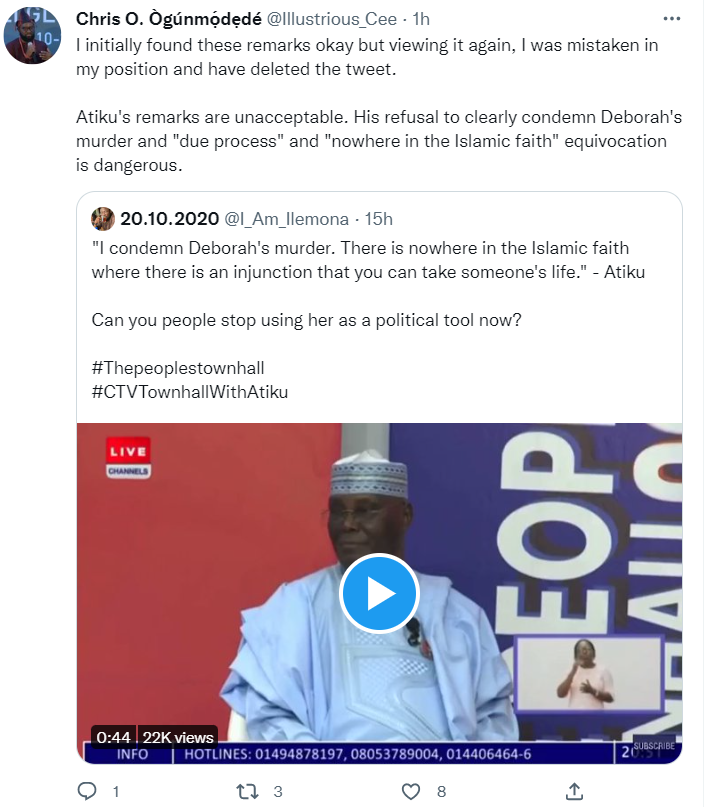
    Atiku also addressed the controversy surrounding the death of Deborah Samuel, a 19-year old Christian killed by a mob of her classmates in Sokoto over allegations of blasphemy. Atiku’s Twitter account had posted a statement condemning her death, before later deleting it.

    When asked why he deleted the tweet, the candidate said it was posted without his approval. But he made it clear that he later condemned the murder.

    Not everyone’s buying his answer though.

  • What We Learnt from the Latest Presidential Town Hall

    On December 4, 2022, Arise TV hosted a town hall with leading 2023 presidential candidates in attendance. Only the regular absentee, Bola Ahmed Tinubu of the All Progressives’ Congress (APC), was missing from the party. Those present were Atiku Abubakar of the People’s Democratic Party, (PDP), Peter Obi of the Labour Party (LP) and Rabiu Kwankwaso of the New Nigeria People’s Party (NNPP).

    What were the highlights?

    Despite the fact they’re all contesting on different mantras and platforms, the candidates seemed to agree on certain policy issues. All three believe in education being a driver of growth. They also shared, to varying degrees, sentiments that the constitution needs to be revised and an emphasis on health insurance for all.

    But they had their differences too. Obi believes strongly that an investment in human capital development is vital to pulling Nigeria out of poverty. He spoke on reviving the bank of agriculture in Kaduna to enable farmers get easier access to loans.

    Kwankwaso believes strongly in education but also in greatly expanding Nigeria’s security forces. He also said he would make strides in other sectors like in infrastructure and construction. He claimed that as Kano governor, he built three major cities in four years with ₦‎40 billion without borrowing.

    Atiku believes the private sector is the driver of prosperity and plans to incentivise it. He is also particular about agriculture being a mainstay of the economy and spoke on plans to expand the sector to employ more people. The PDP candidate also spoke on his achievements as vice president, how he was in charge of local government administration in his first nine months in office and how he plans to sustain programmes the PDP launched.

    Any touchy subjects?

    On the issue of medical tourism, Kwankwaso seemed the boldest on the matter when he said he’s in good health and that his doctor has certified he has at least 30 years of life left in him.

    The former Kano State governor said he’d keep using Nigerian health facilities if he becomes president. “We’ll introduce some policies that’ll improve healthcare service delivery through the NHIS. We’ll make healthcare accessible to every Nigerian.”

    Atiku appeared evasive on the matter by saying he would declare his health status if the need arises. On medical tourism he said, “The Nigerian health facilities that cater for my health may not be available. You know that we have limitations. We have been talking about those limitations.”

    Obi also didn’t fully commit to ending medical tourism when he said, “It’s actually required that those aspiring to lead should be able to make their medical records available to the public. And two, I have served as a governor. While serving as governor, I resuscitated some facilities and used them. I’m still using them till today. 

    “I believe if there’s any issue of referral from them, I mean if there’s a situation our healthcare can’t handle, I’ll not say everybody must be restricted here. As for my position, I use the facilities here and I believe in them. And I can tell you they’re very competent. All we need is to believe in them. I’ve shown you how we can use insurance to prove everyone can be cared for.”

    What else?

    All three candidates made pledges to Nigerians. Atiku doubled down on his mantra of unifying the country as president, Obi pledged to form a government of national unity, while Kwankwaso pledged to provide quality education and train as many Nigerians as possible. 

    But as every Nigerian knows from experience, talk is cheap. The one good thing we can take from this town hall is we can hold whoever becomes president accountable based on the promises they’ve made to us.

  • What you should know about the children of BAT, Obi and Atiku

    All eyes are set on the 2023 presidential candidates in the race to become Nigeria’s next president and move into Aso Rock Villa. We’ve already profiled the candidates and profiled the wives of the top contenders. But what do we know about their children who could also follow them to Aso Rock Villa next year?

    Bola Tinubu — All Progressives Congress (APC)

    We know Bola Ahmed Tinubu (BAT) has fathered at least six children. They are: Olajide Tinubu (late), Folashade Tinubu-Ojo, Seyi Tinubu, Zainab Tinubu, Habibat Tinubu and Olayinka Tinubu. 

    BAT with his wife and two daughters, Zainab and Habibat. [Daily Post]

    From all indications, only Folashade and Seyi are at the forefront of BAT’s campaign. Seyi, especially, has featured heavily on his father’s campaign trail, most recently in Kano where he led a one-million man march. 

    https://twitter.com/tvcnewsng/status/1594369342652964867

    Seyi describes himself as a serial entrepreneur and happens to have many powerful friends just like his dad.

    Seyi playing with the Oba of Lagos. [Twitter/@BolanleCole]

    With the way he’s moving, Seyi might get an appointment in his father’s administration if he wins. 

    Atiku Abubakar — Peoples’ Democratic Party (PDP)

    As the husband to a total of six wives over the years, Atiku Abubakar has fathered enough children to fill two football teams. As at last count, he’s fathered at least 30 children but we certainly won’t be listing all of them here

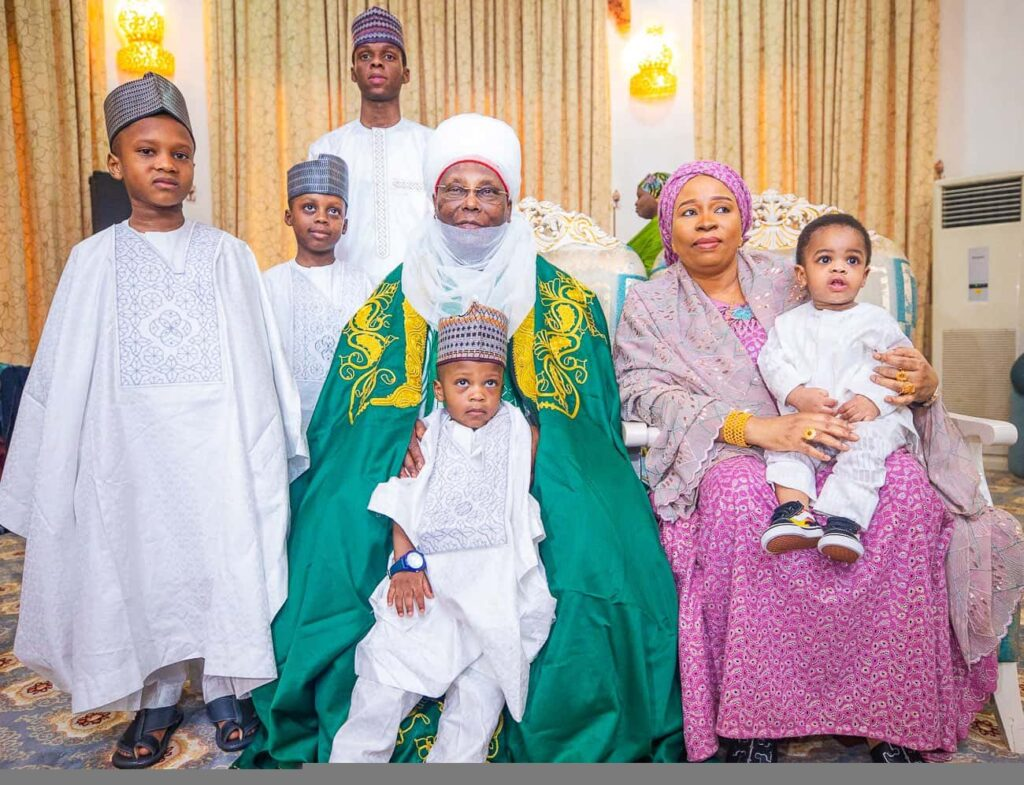
    Atiku with one of his wives and children. [DNB]

    In the book titled “Atiku – The Story of Atiku Abubakar”, he explains that his choice of polygamy was to expand his family having been born without siblings.

    We’re not aware of any of his children actively involved in his campaign though and who can blame them? The man is on his sixth run for the presidency since he started running back in 1993. If it was you, wouldn’t you be tired?

    Peter Obi — Labour Party (LP)

    Peter Obi of the Labour Party has two children: Gabriella Nwamaka Frances Obi and Gregory Oseloka Obi. As far as we know, Gabriella is a teacher based in Nigeria and Gregory is an actor based in the United Kingdom (UK). 

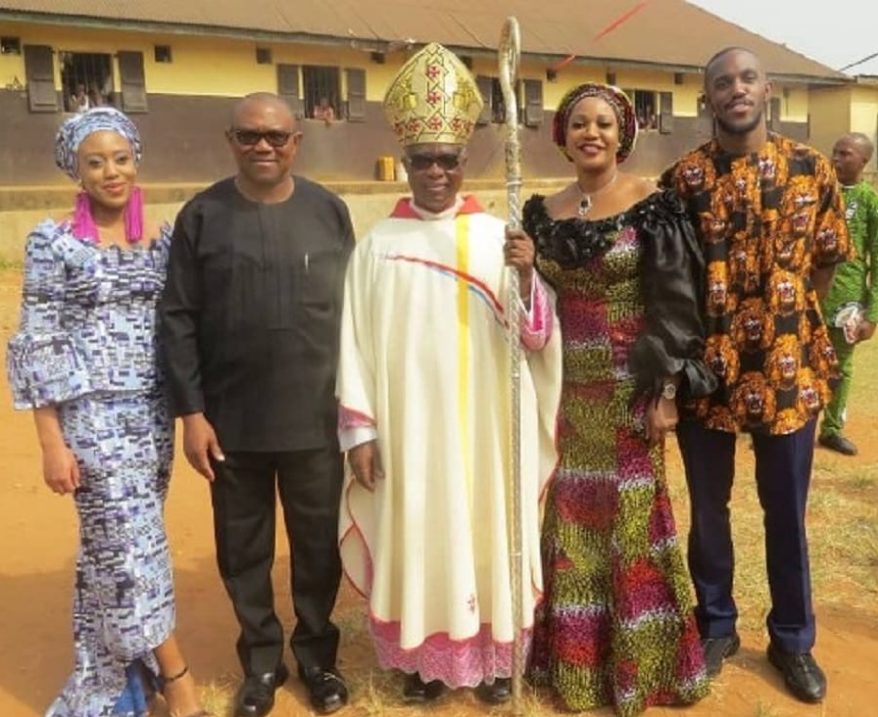
    Obi with his family and Archbishop Valerian Okeke [DNB]

    Like Atiku, we’re not aware of any of Obi’s children actively involved in his campaign. The one time he spoke of his children publicly was to say his son, who was almost 30, had no car. This caused some funny reactions online

    ALSO READ: One of These Women Is Nigeria’s Next First Lady

  • Who Are the PDP G5 Blocking Atiku’s Presidential Ambition?

    Since Atiku Abubakar won the presidential ticket of the Peoples Democratic Party (PDP) in May 2022, he’s known no peace from people within his own party. A group of PDP governors known as the G5 has been pressing his neck frustrating his sixth attempt to become Nigeria’s president.

    The G5 recently visited party chieftain, Bode George, in Lagos State in a bid to resolve the conflict within the party just three months to the 2023 presidential election. Here are the key takeaways from the meeting:

    • The G5 members had a “naming ceremony” and decided to call themselves the “Integrity Group”.
    • They’re now open to “reconciliation talks” to resolve all conflicts in the party.

    But, who exactly are these G5 members?

    [Source: Vanguard]

    Nyesom Wike — Rivers State

    [Source: Vanguard]

    If we’re talking about PDP OGs, Wike is definitely one of them, which is why it’s not a surprise he’s the G5’s ringleader.

    He began his political career as the executive chairman of Obio Akpor Local Government Area in Rivers in 1999. In 2007, he was appointed the chief of staff to the governor of Rivers State, Rotimi Amaechi. 

    In July 2011, President Goodluck Jonathan appointed him as the Minister of State for Education and promoted him to Minister of Education in September 2013. He then stepped down as a minister to contest and win the 2015 governorship election in Rivers State.

    With his second term as governor ending in 2023, he contested for the PDP’s presidential ticket but lost to Atiku. After his loss, Wike has been on a rampage and has done everything in his power to fight the man who denied him the ultimate prize

    Wike has also been pushing for the resignation of Iyiorcha Ayu, as he believes the party’s national chairman shouldn’t be from the same region as the presidential candidate. He’s also made numerous allegations against the chairman to force his resignation. It’s been an endless battle, and we can only wonder if these reconciliation talks will be for good this time.

    Seyi Makinde  —  Oyo State 

    [Source: Punch]

    Popular opinion on Twitter says that Seyi Makinde is the “best governor in Nigeria” but what makes him tick? Makinde, unlike Wike, hasn’t always been a member of the PDP. He first contested in a senatorial election as a candidate of the All Nigeria Peoples Party (ANPP) in 2007 but lost. He joined the PDP in 2010 to contest the Oyo South senatorial district a second time and lost again.

    But if there’s one thing we know for sure, it’s that Makinde never says never. He lost the PDP’s Oyo governorship ticket in 2014, and moved to the Social Democratic Party (SDP) to contest the 2015 governorship election, which he lost before he returned to the PDP to win the 2019 governorship election.

    Since then, there have been notable achievements in his career as governor, from renovating 299 primary healthcare centers to regular pension payments for civil service workers in Oyo State.

    With the 2023 elections, however, Makinde seems to be switching to the other side of the fence again, as he’s been seen to be supporting the All Progressives Congress (APC) candidate, Bola Tinubu. Even Peter Obi, the Labour Party (LP) candidate, has met Makinde for consultations, which raises many questions.


    Samuel Ortom — Benue State

    [Source: Vanguard]


    Interestingly, Ortom won his first term as Benue State governor in 2015 as a member of the APC. However, he switched camps to the PDP in 2018 due to an “internal crisis” and won re-election in 2019. Ortom’s reign hasn’t had so much of a smooth run, and has been tainted by communal crises that have claimed thousands of lives. 


    He’s one of the G5’s loudest voices against Atiku and recently clashed with the candidate over his stance on the Fulani herdsmen blamed for attacks in Benue. He also believes a southerner should be president, which is possibly why he went all the way to Labour Party to give his support to Obi instead.


    Okezie Ikpeazu — Abia State

    [Source: Vanguard]

    Ikpeazu isn’t an alien to controversy as he was accused of submitting false information to the PDP during the 2015 elections and was sacked as governor. However, he appealed the court ruling and won, and he was even successful in running for a second term.

    Since then, he has been accused of siphoning government funds to his own personal companies and has been flagged by the Nigeria Labour Congress (NLC) as the state with the highest number of unpaid salaries.


    Ifeanyi Ugwuanyi — Enugu State

    [Source: Premium Times]

    If the G5 was a secondary school classroom, Ugwuanyi would be the quiet boy sitting in front.

    Once a member of the House of Representatives in 2003, he’s serving his second term as the governor of Enugu State since his first victory in 2015. He’s known for the rehabilitation of key roads in Enugu, including internal roads in Nsukka and Achi.

  • Electoral Violence Is On the Rise and We Need To Pay Attention

    The presidential candidate for the People’s Democratic Party (PDP), Atiku Abubakar, was attacked on November 9, 2022, while on his way to a campaign engagement in Maiduguri, Borno State. Reports say the attack was carried out by some supporters of the All Progressives Congress (APC) who were identified by the party emblems they were carrying.  

    The candidate’s supporters have been attacked before. On October 17, thugs reportedly invaded its rally in Kaduna and beat people up. In the recent Borno attack, 70 people were reportedly injured in the Borno attack, with dozens of vehicles vandalized. 

    It is unclear if Atiku was harmed, but he would probably think twice before setting foot in Borno State again. 

    Also recall that in October 2022, open threats were made by a member of the House of Assembly, Mohammed Gajiram, declaring the need for APC to win all their elections if it means “people being killed and buried in holes.”

    In response to the death threats, a PDP representative in Borno state, Alhaji Zanna Gaddama, has openly appealed to both the Director-General of the Department of State Services (DSS), the National Security Adviser (NSA) and the Inspector General of Police (IG) for help. 

    What does Nigerian law say about death threats?

    In Section 323 of our nation’s Criminal Code Act, there is only a punishment for the threat to kill if the threat is written. As it states, “Any person who, knowing the contents thereof, directly or indirectly causes any person to receive any writing threatening to kill any person is guilty of a felony and is liable to imprisonment for seven years.” 

    However, Gajiram did break Subsection 2 of Section 92 of the Electoral Act of 2022 which states that “abusive, intemperate, slanderous or base language or insinuations or innuendoes designed or likely to provoke violent reaction or emotions shall not be employed or used in political campaigns.”

    Who else has been attacked this election season? 

    Even with the signing of a peace accord by all the presidential candidates, there have been signs of bad faith. This ranges from violence, intolerance, and hate speech.

    Peter Obi

    The Labour Party candidate has received his own share of violence. In September,  gunmen threatened Peter Obi’s supporters in Enugu, while they were holding a meeting in the Awga community. 

    Four unknown gunmen suddenly showed up, shot in the air, and disrupted the meeting.  A day earlier, some members of the party were also attacked in Nenwe of the same state. 

    About a week later, Obi’s supporters were again attacked in Ebonyi state. This time, some members of the Nigeria Police were identified as assailants. In a statement, the Labour Party’s National Publicity Secretary accused APC of using the police to promote violence.

    In October, Obi’s supporters, known as “flag boys” were brutalized in Lagos. The flag boys were accused of carrying Peter Obi’s flags around Oshodi in Lagos. They got beaten by thugs and attempts were made to burn them alive. 

    Senator Ifeanyi Ubah

    In September, Ubah, was ambushed and attacked at Enugwu-Ukwu in Njikoka LGA of Anambra State. Five people were killed during this attack, including some police officers and the senator’s aides. 

    Why should you care about electoral violence?

    As a citizen, electoral violence goes against your right to vote for any candidate of your choice, as stated in the INEC’s Voter Education section. 

    You should also be allowed to attend any rally for any candidate without the fear of being harassed. Start by holding your preferred candidate accountable to the peace accord all parties signed.


  • Why Ortom Would “Rather Die” Than Be Under Atiku

    On November 6, 2022, Benue State Governor, Samuel Ortom, saw his dinner party as a great opportunity to send Atiku Abubakar ‘to hell’. It came as no surprise when Ortom withdrew his support for the presidential candidate of the Peoples Democratic Party (PDP) over his allegiance with the Miyetti Allah, a Fulani cattle-rearing group in the North. 

    Ortom said: “To hell with Atiku and anyone supporting him. They should go and tell him. You want me to be a slave for a Fulani. It’s better I die. Anybody supporting Atiku is an enemy of Benue.”

    Some people have called Ortom out, saying that his outburst of rage was the ‘most embarrassing speech one has heard from a governor’ and ‘a hate speech. 

    In case you were wondering, this is actually hate speech, a commonplace during elections. 

    The Cambridge Dictionary defines hate speech as “public speech that expresses hate or encourages violence towards a person or group based on something such as race, religion, sex, or sexual orientation.” 

    Ortom’s hate speech echoed years of tribal sentiments fuelled by several events you might’ve missed. A single thread can be drawn from the age-long crisis between the Fulani people and the Tiv of Benue State. 

    Let’s catch you up. 

    The Fulani-Tiv Crisis 

    To understand the Tiv (Benue) – Fulani crisis, we need to go back to the basics. Here are a few things you need to know:

    The Tiv and Fulani were once friends during the 19th century, while the Tiv were migrating from the Central African Republic to Cameroon. But, the Tiv decided that they were not ‘feeling the friendship’ anymore due to the Fulani’s “domineering” attitude, and they parted ways.

    There are conflicting stories about how the two groups began to attack and counterattack each other. However, in the 1950s, the Tiv joined the Middle Belt Congress founded by J.S Tarka, simply because they felt the Northern People’s Congress (headed by the Hausas and Fulanis) was “cruel and wanted power all to themselves.”

    Let’s fast forward to 2022 where there is increased violence in Benue State, most of which has been attributed to herdsmen (some of Fulani origin). 

    Just this month, 18 persons were killed, including children, and the state has thousands of Internally Displaced Persons (IDPs) seeking help to feed, clothe and house themselves. 

    There have also been tussles between the state and the Miyetti Allah over anti-grazing laws.  People in the state are mostly farmers and cattle grazing has left their crops destroyed countless times, further impoverishing them.  Attempts to reach compromises on both ends have failed and even led to more violence. 

    Tensions heightened in January 2022 when Ortom insisted that the Federal Government should consider Miyetti Allah Kautal Hore, Miyetti Allah Cattle Breeders Association of Nigeria (MACBAN), and Fulani Nationality Movement (FUNAM) terrorist organizations.

    [Image Source: Peoples Gazette]

    Atiku-Ortom wahala 

    Now that you know more about the Fulani-Tiv crisis, let’s go back to the fight between Atiku and Ortom. 

    It was on October 15, 2022 that the fight really started when Atiku told the Arewa Committee during his presidential campaign that he was angry with Ortom for “profiling Fulani as bandits and terrorists because I am a Fulani.” 

    This was after the Benue Youth Forum (BYF), had awarded him the highest chieftaincy title in Benue, the ‘Zege Mule U’. After his speech, calls were made that the title should be reviewed

    Now that Ortom has consigned Atiku to hell, what is the next gbas gbos that will happen next? We’ll be here to update you. 

  • Atiku Wants OBJ’s Face on the Naira. What Could Go Wrong?

    Last week, we reported on how former president, Olusegun Obasanjo, aka OBJ, added a big feather to his cap. He led a team of mediators that brought the warring parties in the Tigray War in Ethiopia to a peace accord. 

    The signing of the agreement signaled the cessation of a two-year war that had claimed more than half a million lives. Success has many friends and sure enough, congratulatory messages started pouring in.

    Former number two to OBJ and current flag bearer of the Peoples Democratic Party, (PDP) Atiku Abubakar joined the train. 

    In a series of tweets, Atiku heaped praises on OBJ and made a host of flattering comments, including promising to nominate him for a Nobel Peace Prize.

    I mean yeah, sure. Anyone can get a Peace Prize these days, including the prime minister of Ethiopia who in a cruel twist of fate, went to war in Tigray. But that’s a story for another time. The real gist of the matter came in Atiku’s next tweet.

    Why does Atiku want OBJ’s face on the redesigned naira notes?

    Not to be outdone in his lavish praise, Atiku went ahead to say that beyond the Peace Prize, he wants OBJ’s face on the redesigned naira notes. And that set a lot of bells ringing.

    For starters, Atiku and OBJ have had a topsy-turvy relationship. Just in June 2022, Obasanjo said that he regretted picking Atiku as his vice, calling it a “mistake”. In his 2014 book  “My Watch”, OBJ called Atiku “a blatant and shameless liar”. 

    Although OBJ endorsed Atiku’s run for the presidency in 2019, it does not appear now that he is throwing his support behind him for 2023. 

    Given this background, there’s an impression that Atiku is desperate to win the support of his former boss by all means necessary.

    ALSO READ: Why Meffy and CBN Decided to Do Make-Up for Your Banknotes

    What have reactions to this suggestion been like?

    The All Progressives Congress (APC), says that Atiku is looking to humiliate OBJ. Femi Fani-Kayode, an APC spokesperson, said that Atiku’s offer was a Greek gift. His words

    “This is the same man that is now calling OBJ a statesman and is saying he deserves a Nobel Prize and that his face should be on the naira.

    “Atiku is lying. He does not mean a word of it. He’s offering a Greek gift. He is playing politics.

    “Deep down he hates OBJ with a passion and he has always done because the President outfoxed and outpunched him at every turn when he attempted his treacherous move to usurp him and take his place as President.”

    Others have lashed out at Atiku over his suggestion, noting that Obasanjo led Nigeria towards its current path of decline.

    What else should you know?

    Beyond the criticism, there are questions about how such a move would be implemented in practice. Typically, currency notes carry portraits of individuals who are no longer living. 

    You can observe this in all the naira denominations made in honour of specific individuals. The very few exceptions to this rule globally are in places where monarchs are sovereign rulers, like in the United Kingdom.

    So suggesting that OBJ should be on the naira note can only mean one thing. And it’s not nice.

    Another difficulty that presents itself is that putting OBJ on a note would almost likely mean taking someone out. I don’t suppose any of the families of the current guys on the ₦‎200, ₦500 and ₦1000 notes will be cheering that move. 

    But hey, what could go wrong?

    ALSO READ: Why Obasanjo’s Role in Ethiopian War Is Good for Nigeria

  • Five Big Moments from the Presidential Town Hall

    On November 6, 2022, Nigerians were given another opportunity to scrutinise the presidential candidates. This time, at a town hall hosted by Arise TV in Abuja. 

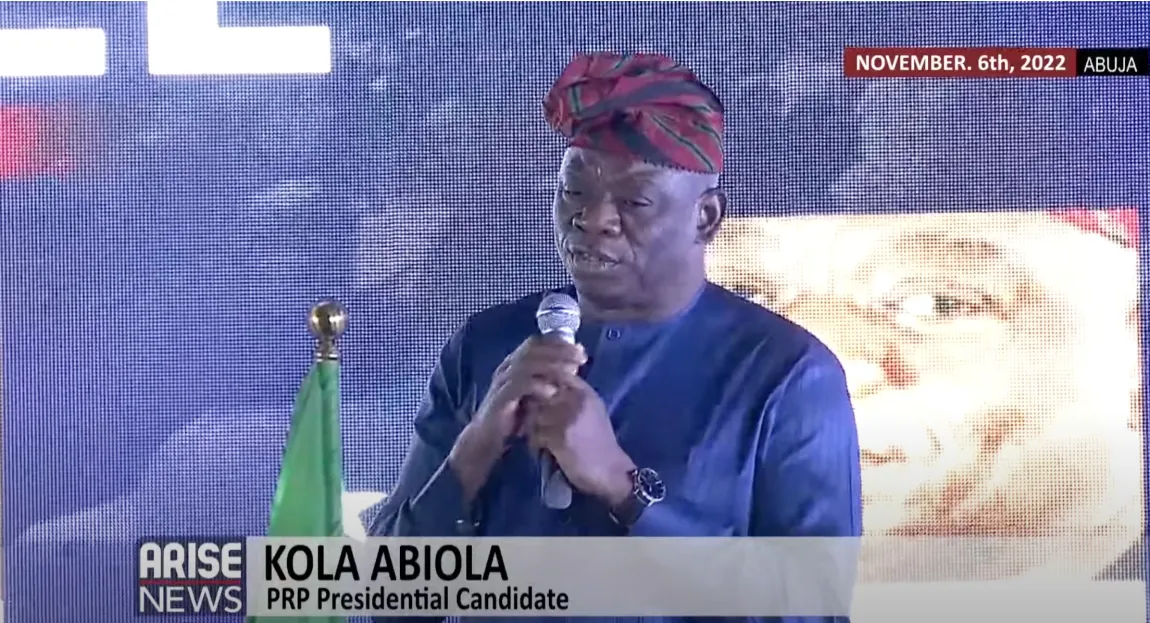
    It’s no news that your usual suspect (read: BAT) and Atiku Abubakar did not show up but four major parties were represented in varying capacities — Rabiu Kwankwaso, the presidential candidate of the New Nigeria Peoples Party (NNPP). Peter Obi, the presidential candidate of the Labour Party (LP). Kola Abiola, the presidential candidate of the Peoples’ Redemption Party (PRP), and Ifeanyi Okowa, vice presidential candidate of the Peoples Democratic Party (PDP).

    If you are looking at the trends on Twitter and wondering what you missed, we’ve got you covered. 

    The BAT ghosts again

    In a country where almost nothing is predictable, like what value the naira will trade against the dollar tomorrow, or what country Buhari will zoom to next, you can be sure of one incontestable truth — Bola Tinubu, aka BAT, will not turn up for a presidential debate.

    And so like clockwork, the BAT was absent. It would have been bearable — even if not tenable — if the BAT was far away from the debate venue, like at his favourite London abode, or in his bullion home of Bourdillon.

    However, the BAT was in Abuja — the same city where the town hall was held. And while his mates were busy talking to Nigerians about their plans for the country, the BAT had more pressing matters to deal with — like the latest owambe in town.

    Later, his campaign team released a statement explaining why he couldn’t attend. We could explain the silliness of it, but it’s better to just show you.

    BAT doesn’t send you and he wants you to know it. His campaign team has already announced he will be your president whether you like it or not. Over to you, Nigerians.

    The rock is no longer playing with you

    Depending on who you ask, Obi’s (aka The Rock) performance was either meh, or excellent. 

    But that’s by the way. While Obi touched on different matters ranging from the economy to security, the most interesting soundbite came off the cuff. At different points during the town hall meeting, Obi was posed questions from Dino Melaye, spokesperson of the PDP. 

    But it appeared Dino the skitmaker eventually took his antics too far, prompting Obi to say “enough”.

    Obi often projects a calm mien, so to see him so visibly annoyed suggests that Dino rattled him. His supporters say he handled it well. We’ll leave you to draw your own conclusions.

    Okowa got a rough reception

    The early videos that came out at the start of the town hall meeting showed Okowa getting some tough love. The crowd present was pissed that his principal, Atiku Abubakar, failed to turn up for what was billed as a “presidential debate”. 

    https://twitter.com/KnightSirdam/status/1589331486779805696

    Okowa would later explain that it had been relayed to Arise TV ahead of schedule that the PDP would be sending a representative in Atiku’s stead. He said they didn’t object to it. Well, despite the initial gra gra, the show went on.

    Okowa didn’t seem shy to take on issues, sharing ideas on how to deal with stuff like insecurity. Besides defending the PDP’s legacy in government, he took a swipe at Kwankwaso, a former member of the PDP, and Obi who until May was a member of the PDP and the former running mate of Atiku in 2019.

    And he didn’t stop there. He fired more shots at Obi for prioritising saving when the economy was dire.

    It would have been smooth sailing for Okowa except that around the same time he was throwing punches offline, another story on him was doing the rounds online. Talk about timing.

    Kwankwaso won a lot of fans

    If anyone came out ahead, it was probably Kwankwaso. Most commentaries from across political divides seemed to suggest he handled himself well. 

    And despite Okowa carpeting him for being a former PDP member, he kind of held his own.

    Kwankwaso threw his own shots. 

    While speaking in support of Okowa over the absence of his principal, he disclosed that it was at least better to have someone turn up instead of one other candidate that didn’t send anyone at all. Ouch.

    But it was not all rosy. He claimed that he left no debt when he left his office. Maybe he didn’t think the fact-checkers would go and verify. But they did, and came back with their final verdict.

    Kola Abiola was a mixed bag

    To be fair, we loved his outfit. The blue senator and that red fila probably made him the best dressed of the four candidates.

    Still, he was the least popular of the mix.

    Abiola spoke eloquently. Unlike other candidates, he noted  that Nigeria already had adequate security infrastructure but it just failed in addressing gaps in manpower training. He also spoke on the economy, making the case for a market-driven one.

    Yet, not everyone was pleased with his performance.

    And like Kwankwaso, he also got a spanking from the fact-checkers.

    ALSO READ: Peter Obi Wants Your Shishi, and Other 2023 Campaign Lessons

  • Atiku May Be in Fresh Soup. Here’s Why

    If you’re a fan of the unifier, now’s the time to look away. The last time we brought you Atiku Abubakar-related gist, we answered the question of where he was and what he’s been up to. This time, the presidential candidate of the Peoples Democratic Party (PDP) is in a new situation: inside hot soup.

    What’s the gist?

    Well, Atiku had a week-long trip to the United States where he continued his campaign. The public reactions were mixed, ranging from satire to applause from his supporters who said his trip neutralised any rumours that he can’t set foot in the U.S. due to a corruption indictment.

    But that’s just the appetiser. The real gist is that Atiku may have accumulated an unpaid debt of $5.9 million for the US visa. 

    According to The Nation, Legacy Logistics LLC Limited, the firm that reportedly secured Atiku’s visa, is yet to be paid. The candidate’s legal adviser, Prof. Maxwell Gidado (SAN), has said the company is lying and trying to extort Atiku..

    If Atiku really needed to prove to us he could set his foot on US soil without being arrested, it appears the cost may have been way too steep.

    How has Atiku responded?

    For now, it appears the unifier is keeping his mouth shut on the matter. He hasn’t yet issued any statements addressing the report, and his spokespersons are unlooking. 

    While people online drag him for being an onigbese, he remains focused on his presidential campaign and is expected to be in Katsina on November 5, 2022. Maybe he’d have a response for us by then. 

    ALSO READ: What Is Going On With Atiku’s Presidential Campaign?

  • Village People Stopped These Nigerians from Becoming President

    Nigerians just can’t catch a break — from dealing with news of possible terrorist attacks, to Meffy redesigning the naira, to the fuel scarcity and the ongoing flooding crisis

    And what makes everything worse is Nigeria has a president who can’t be bothered to deal seriously with the issues. Buhari’s poor attitude has inspired the question of what might have been if we had a different president.

    We decided to go down memory lane and reflect on what could have been if the people on this list won the president’s seat. Some of them didn’t perform in the elections as well as expected and some of them were so close, but got no cigar.

    Obafemi Awolowo — 1979

    Obafemi Awolowo [Image source: Britannica]

    Awolowo was a former minister of finance and three-time contender for Nigeria’s highest political office. His closest call was in the 1979 presidential election running on the platform of the Unity Party of Nigeria (UPN). Just like the forthcoming 2023 presidential election, the 1979 contest was also a three-horse race

    Awolowo finished second with 29.18% of the votes, just behind the winner, Shehu Shagari, with 33.77% of the votes. Although he fought hard to overturn the result, the Supreme Court ruled against him. His consolation is becoming the face on Nigeria’s ₦‎100 note.

    Moshood Abiola — 1993

    MKO Abiola [Image source: The Nation]

    MKO Abiola was a businessman and politician who contested the 1993 presidential election as the candidate of the Social Democratic Party (SDP). He was quite popular and regarded as the winner of the election having polled 58.36% of the popular vote. 

    However, one thing football has in common with politics is, the match is never over until the referee blows the final whistle. In MKO’s case, the referee — General Ibrahim Babangida — swallowed the whistle. Babangida’s military government annulled the election and Abiola died in prison for fighting for his mandate.

    ALSO READ: Buhari Needs to Do These Things Before He Leaves Office in 2023

    Olu Falae — 1999

    Olu Falae [Image source: Osun Defender]

    When Nigeria’s Fourth Republic began in 1999, Olu Falae, a former minister of finance, ran against Olusegun Obasanjo, a former military ruler. Falae ran on the joint ticket of the Alliance for Democracy and the All People’s Party against Obasanjo’s People’s Democratic Party (PDP).

    Unfortunately for Falae, two heads were simply not better than one as he only polled 37.22% of total votes compared to Obasanjo’s 62.78%. Falae had seen enough and that would be the last time he ever ran for president.

    Odumegwu Ojukwu — 2003

    Ojukwu [Image Source: Britannica]

    Ojukwu is mostly remembered for his role in the Nigerian Civil War as the president of the breakaway Republic of Biafra. But he also ran for president of Nigeria in 2003 as the candidate of the All Progressives Grand Alliance (APGA), finishing third with 3.29% of the votes cast. 

    While we may never know what might have been, it certainly would have been fascinating to have a president who had fought against Nigeria and for Nigeria. At least, everything would’ve been balanced.

    Nuhu Ribadu — 2011

    Nuhu Ribadu [Image source: Blerf]

    The first chairman of the Economic and Financial Crimes Commission (EFCC) makes this list not so much because he was close, but because he had a very audacious run. 

    As a third force candidate of the Action Congress of Nigeria (ACN) contesting in the 2011 presidential election, he managed to finish third with more than two million votes. Given the brutal history Nigerians have with the police, it’s quite impressive to see a former police officer get that kind of love. At least it’s a massive step up from collecting egunje.

    Atiku Abubakar — 2019

    Atiku Abubakar [Image source: Punch]

    If there’s one lesson Atiku Abubakar has taught us, it’s that if at first you don’t succeed, try again. And again. And again. Ad infinitum. 

    Atiku has run unsuccessfully for president five times going all the way back to 1993. His closest run was in 2019, running as the candidate of the PDP, when he polled 41.2% of votes. While that translated to over 11 million votes, it simply wasn’t enough to defeat Buhari. He’s on his sixth run in 2023 and maybe his village people will finally remove their hand from his matter.

    ALSO READ: Atiku Can’t Stop Running for President Despite His Record

  • Atiku Joins Tribal Olympics and BAT’s Lips Are Loose Again

    With Nigeria’s campaign season hitting top gear, we’re seeing the leading candidates, Atiku Abubakar of the Peoples Democratic Party (PDP) and Bola Ahmed Tinubu (BAT) of the All Progressives Congress (APC), beginning to feel the heat, providing entertainment that is unmatched in both hilarity and cringe value.

    Our story begins in Kaduna, where on Saturday, October 14, 2022, Atiku met with the Arewa Joint Committee. The meeting was billed as an interactive session ahead of the 2023 presidential election. Donning his customary full-flowing agbada and what looked like sneakers (perhaps to appeal to his youth base), Atiku took the mic to answer a question posed by the spokesman of the Northern Elders Forum, NEF, Hakeem Baba-Ahmed. The question itself was innocent enough, but Atiku’s response set off a tsunami of reactions online, revisiting old worries about tribalism and dog-whistling in Nigerian politics.

    Atiku’s “emi lokan” moment

    Baba-Ahmed asked Atiku why the North should support his candidacy. The candidate began by talking about how he had “traversed the whole of this country and built bridges”. However, in the words that followed, Atiku stepped on a landmine, or what one political commentator called his “emi lokan moment”.

    The former vice-president said, “I think what the average northerner needs is someone who is from the North, and who also understands the other parts of Nigeria, and who has been able to build bridges across the rest of the country. This is what the northerner needs. He doesn’t need a Yoruba candidate, or an Igbo candidate. This is what the northerner needs.”

    Given that Atiku is the most experienced candidate by virtue of being a serial contender, it smacks of sheer disbelief that he would make that statement in full glare of the cameras. The self-styled “unifier” for whom his supporters describe themselves as “Atikulate”, clearly didn’t win plaudits from the South with that comment, in what can at best be spinned as a “misarticulation”, and at worst, succumbing to the demands of what has been a flailing campaign.

    The audacity of the BAT

    What Atiku can do, the BAT can do better (or worse). Still in Kaduna, a place that apparently encourages loose lips, Tinubu updated his thriving catalogue of controversies with another hit.

    Tinubu was speaking at the 7th edition of the Kaduna Economic and Investment Summit. Not to be outdone by Atiku, he said, “I’m begging Nasiru El-Rufai not to run away for (an) additional degree. Your vision, creativity and resiliency in turning a rotten situation into a bad one is necessary at this critical time.”

    Following online taunts over the gaffe, Tinubu’s campaign team issued a statement describing the comment as a “slip of tongue”. That hasn’t quelled things though. Some critics are doubling down that it reveals the true sentiments that BAT has about El-Rufai. For others, it reignites fears that BAT suffers from dementia.

    Because Tinubu rarely appears publicly to discuss his plans for Nigerians, the few times he does are always subjected to scrutiny and there is almost always a soundbite that generates wild reactions online — take your pick from anywhere between “emi lokan” and cassava and agbado. If he wasn’t running for president, BAT certainly has enough material to be a skitmaker. 

    A presidential election of slips

    As we approach the elections, there will be no shortage of slips and gaffes from your faves. Today, it’s Atiku and BAT, but it could also be Peter Obi, Rabiu Kwankwaso or Omoyele Sowore tomorrow. Whatever the case, we’ll continue to bring you the latest happenings in Nigeria’s political terrain. It’s going to be a long four months before the 2023 presidential election.

  • Which Nigerian Song Accurately Describes Our Presidential Candidates?

    Can we all agree that the DJ who kept dropping bops was the best part of last night’s APC convention? While we sat and watched contestant after contestant come on stage to either step-down or drop hot lies, the DJ turned each break into a dance party. Inspired by his incredibly shady playlist, we’ve decided to give each presidential candidate a song that accurately matches their chaotic energy. 

    1. Bola Ahmed Tinubu — Buga (Lo Lo Lo) by Kizz Daniel 

    This election has given Tinubu more nicknames than your local up and coming rapper. The self-declared kingmaker who’s decided that he must be president before he turns 100, was welcomed to the APC convention stage with “Collect your money. Wake up” from Kizz Daniel’s Buga (Lo Lo Lo), playing loudly. After hearing the lyrics to that song, we’re not surprised other candidates started withdrawing from the race. It’s almost like the ₦100 million they spent in buying the presidential form was shawarma money. 

    2. Professor Yemi Osinbajo — Playboy by Fireboy DML 

    No other song describes our BDSM king like this banger from Fireboy DML. A true Yoruba demon tune, Professor Yemi Osinbajo is the biggest political playboy of the presidential race. He has the swagger, the white agbada, the sweet mouth and most importantly, the gaslighting tricks. This man promised to change Nigeria and literally give us the moon like he hasn’t been a part of the current government for seven years. We see you, Christian Grey. Ooof!

    3. Atiku Abubakar — Stand Strong by Davido 

    This has to be Atiku’s morning devotion song. After running for president five times, this man is still standing strong, even though most of us would prefer it if he just sat down. It can’t be that deep, sir. It’s almost like he forgot something in Aso Rock, because why has he been running for president way before we even had Nokia 3310? On Stand Strong, Davido sings about having more than nine lives, which might mean Atiku has three more elections if he loses the one in 2023. Wahala. 

    4. Rochas Okorocha — Levels by Flavour 

    It’s only in Nigeria that a presidential aspirant will confidently announce at the primaries that less than a week ago, he was in detention based on corruption charges. Rochas came on the stage to shade all the other aspirants and remind them that he was rich before he even went into politics, unlike the other brokies using government funds to run. With that type of energy, there’s no way Levels by Flavour isn’t this man’s theme song. Shade aside, that statement is rich, coming from someone who allegedly stole over ₦2.9 billion from public funds. Glass houses, Rochas, glass houses. 

    RECOMMENDED: These Politicians’ Kids Are Taking Over from Their Parents

    5. Peter Obi — Gentility by Melvitto and Wande Coal 

    Peter Obi definitely listens to Gentitility, and we aren’t talking about the sped-up TikTok version. The former Anambra state governor has moved from vice presidential candidate to presidential aspirant at the PDP and now, Labour Party presidential candidate. He may not have the initial ginger of all the other presidential candidates, but he has managed to become an underdog ahead of the 2023 polls. You can definitely tell that this man recites the lines “Gentitlity oshey stupidity” every time he wakes up. 

    6. Nyesom Wike — Free Madness by Terry G 

    Is there anyone Nyesom Wike hasn’t fought with? From Bubu to Edo state governor, Godwin Obaseki, this man is famous for giving you gbas gbos if you mistakenly breathe in his direction. Since he lost the PDP ticket to Vin Diesel Atiku Abubakar, we doubt we’ll be seeing that energy in Aso Rock. Either way, Free Madness is definitely his morning alarm song. 

    7. Uju Ohanenye — Sweet Mother by Prince Nico

    We should’ve known something was wrong when she started her speech by saying,” Naijas”. Where is the “s” from? Who says that? Because her motivation to run hinged on the assumption that Nigeria needs a mother, it feels apt that her official theme song be Sweet Mother by Prince Nico. Thanks for coming ma. 

    8. Rotimi Amaechi — Kilometre by Burna Boy

    Why Kilometre by Burna Boy? Amaechi was the Minister of Transport, and he also ran a lap around a stadium to prove he’s fit to run for president. We didn’t even have to dig deep for this one. He repeatedly asked delegates not to vote for him if they didn’t think he was qualified. Quick question, sir, are we voting for a president or someone to represent us at the Olympics? 

    ALSO READ: Ranked: Top 15 Burna Boy Songs of All Time, According to Album Release

  • Atiku Can’t Stop Running for President Despite His Record

    Insanity is doing the same thing repeatedly and expecting different results, but Atiku Abubakar definitely doesn’t play by the rules of random online quotes. The former vice president is the candidate of the Peoples Democratic Party (PDP) for the 2023 presidential election, but it’s not his first time. In fact, it’s his sixth time trying to become Nigeria’s Number One Citizen.

    What's Atiku looking for inside Aso Rock?

    How did he fare the first five times? Let’s take a trip down memory lane.

    1993

    The first time Atiku ran for the presidency, bootcut jeans were the pinnacle of fashion. The man’s been trying to be president longer than Fireboy DML has been alive.

    Atiku contested in the primary election of the Social Democratic Party (SDP) for the 1993 presidential election and finished third behind MKO Abiola and Baba Gana Kingibe in the first round of voting. He dropped out of the run-off election after making a deal to become Abiola’s running mate, but Abiola picked Kingibe after winning the ticket. It was Atiku’s first presidential breakfast, but it wasn’t his last.

    What's Atiku looking for inside Aso Rock?

    2007

    After two terms as a vice president, Atiku was ready to step into the big shoes of the presidency. His only problem at the time was President Olusegun Obasanjo. The two had a power struggle for years and accused each other of stealing from Nigeria’s treasury. 

    The conflict between the two forced Atiku out of the PDP to the Action Congress (AC) of Bola Tinubu in 2006. The AC practically gifted him the party’s presidential ticket with no contest, and it was his first time on the ballot, but the Independent National Electoral Commission (INEC) disqualified him over corruption allegations. Atiku fought this exclusion, and the Supreme Court cleared him to participate just days before the election.

    That whiff of court victory didn’t follow Atiku into the presidential election. He finished third with 2.6 million votes behind the winner, Umaru Musa Yar’Adua, who finished with 24.6 million votes and second-placed Muhammadu Buhari with 6.6 million votes. 

    ALSO READ: The Wildest Sob Stories Ever by Nigerian Politicians

    2011

    Atiku returned to the PDP like the prodigal son in 2009 and was gearing to go after the presidency again. This time, his main stumbling block was Goodluck Jonathan who had taken over as president following Yar’Adua’s death in 2010. The third time wasn’t the charm for Atiku, as he finished second to Jonathan in the PDP’s primary election and never made it to the ballot. Many feared that it would be the end of Atiku’s run at the top job. If only they knew. 

    2015

    Atiku was near-certain that he wouldn’t be able to beat Jonathan to the ticket a second time, so he journeyed out of the PDP again. He complained that the party couldn’t be redeemed and joined the All Progressives Congress (APC). According to him, he was putting “Nigeria’s interests” first, but you could bet that was a synonym for “my presidential ambition”. 

    What's Atiku looking for inside Aso Rock?

    For the 2015 presidential election, Atiku contested for the ticket of the APC where he lost again to an old foe, Buhari. Once again, Atiku didn’t make it to the ballot, and that meant only one thing:

    2019

    If reading this article this far has taught you anything, it’s that Atiku cannot stay in one place, and he runs for the presidency every chance he gets. In 2017, he left the APC to return, once again, to the PDP. He finally won the party’s presidential ticket for the first time and was on the ballot as the biggest challenger to his old nemesis, President Buhari. Atiku won 11.3 million votes, his highest ever, but it was 3.8 million less than he needed to beat Buhari, who won again in what was the final contest between the two.

    What's Atiku looking for inside Aso Rock?

    Atiku wants the presidency, no doubt, and has been accused of being too desperate for it. But the real question is does the presidency want him? That’s an answer to look forward to in February 2023.

    ALSO READ: Time Is Running Out for You to Register for Your PVC

  • Election season is upon us and we’ve never had a more interesting and more diverse crop of presidential aspirants.

    And because politics in Nigeria reminds us of secondary school we couldn’t help but re-imagine some of our 2019 presidential aspirants as secondary school students.

    Fela Durotoye is the smart kid who is always the first to put up his hand when the teacher asks a question, whether he knows the answer or not.

    Teacher: What’s 2 plus 2?

    Fela: If you really believe in yourself, the answer will be 22.

    Oby is the kid who will write names of noisemakers, put her best friend’s name and submit it to the teacher.

    She’ll even add x2 if she catches you talking again.

    Donald Duke is the fresh kid everyone likes and is very popular.

    He was Social prefect once and everyone loved him. The whole school thinks he can do no wrong.

    Sowore is the one all the teachers used to call useless boy and now he wants to prove them wrong by becoming head boy.

    He gets called into the principal’s office every single day.

    Moghalu is the smart kid who always comes first and everyone thinks he has two heads.

    But the day he came second he went to report to the Principal that the person who came first didn’t deserve it.

    Eunice Atuejide is the transfer student who came in SS2 and nobody knew until she said she wanted to become head girl.

    The boys like her because she refused to join the Girls’ Guide.

    Atiku is the rich kid who was Assistant Class Captain once and has now made it his life’s mission to become Class Captain.

    He has been trying since JSS1, he is in SS3 now.

    Buhari is the one who has been trying to become class captain since JSS1, when they finally gave it to him in SS3 he decided to show the whole school pepper.

    And he’ll continue to show us pepper till he graduates.

    Eighteen other Nigerians have also come out to say they want to run for president. Who else do you think we should add to this list?