Notice: Function _load_textdomain_just_in_time was called incorrectly. Translation loading for the wordpress-seo domain was triggered too early. This is usually an indicator for some code in the plugin or theme running too early. Translations should be loaded at the init action or later. Please see Debugging in WordPress for more information. (This message was added in version 6.7.0.) in /home/bcm/src/dev/www/wp-includes/functions.php on line 6121 agbero | Zikoko!
A popular saying goes, “Life be like standing fan, e go touch everybody”. During the governorship elections in Lagos on March 18, 2023, thugs violently suppressed voters to help the ruling party retain power in Lagos state.
These thugs were identified as road transport workers, known as agberos.
Many people rationalised this behaviour under the guise of protecting Lagos from ‘invaders’. But barely two weeks after successfully ‘saving’ Lagos, it seems the “protectors of Lagos” now have to protect their interests.
What happened?
On March 29, 2023, a protest by commercial bus drivers broke out along the Lagos-Abeokuta expressway, which left passengers stranded. The reason behind this protest is the latest increment of taxes by the agberos.
"We don't want agbero anymore" Lagos bus drivers and conductors protest extortion by agberos. They said they are tired of the extortion. pic.twitter.com/KBHw6l8aa7
— Arẹwà AKINKANJU💪🏽 Ọmọlúàbí (@leoleoqueen) March 29, 2023
For anyone who stays in Lagos, bus drivers paying different thugs money at almost every bus stop is as normal as traffic on a Monday morning. According to the International Centre for Investigative Journalism, these drivers pay about ₦82.13 billion annually at bus stops to agberos, which is remitted to the National Union of Road Transport Workers (NURTW).
The money is often collected forcefully, and drivers who resist have their vehicles damaged. During the protest yesterday, drivers complained that the tax increment further reduces their profit margin as they currently pay between ₦10000-15000 daily to the Union.
Has the government intervened?
There hasn’t been an official statement from the Lagos state government yet, but the police have responded to the protest the only way they know how: by shooting.
Police officers from the Alagbado police command reportedly opened fire on protesting drivers on orders from the agberos.
Police 'Open Fire' On Yoruba Drivers Protesting N13,000 Daily Agbero Levy in Lagos Policemen attached to the Alagbado police command have reportedly shot at drivers protesting illegal increments of taxes by the agberos. @jidesanwoolu@ARISEtv@UNpic.twitter.com/v0upxHcW0f
Hopefully, the bus drivers win their fight against the extortion they’re facing, but given Lagos’ history with protests, chances are this will, unfortunately, be swept under the rug.
On October 31, 2022, the Joint Drivers’ Welfare Association of Nigeria (JDWAN) commenced a seven-day strike in Lagos State due to indiscriminate harassment and extortion by managers of parks and garages in Lagos State.
For a city known for its trademark yellow buses, it’s a strange sight to wake up on a Monday morning and find them absent from the usually busy traffic routes.
The strike has left Lagosians stranded and waiting in line for the few available buses on the roads, as seen in videos posted on social media. Predictably, the scarcity of buses has led to price hikes along several routes.
Citizenspoke to some bus drivers for their thoughts on the strike.
Segun — a bus driver plying Obalende to Ajah
“The bus fare from Obalende to Ajah is ₦700. It was ₦500 earlier last week, but fuel scarcity made it ₦700 mid week. For the loading of passengers at the bus stop, we pay ₦6000 daily — ₦3000 at Obalende, ₦3000 at Ajah.
“Immediately I collect money from my passengers, I pay it to the enforcer that helps me call in passengers. They give us tickets marked with the date so we can’t even think of outsmarting them when they ask us for their money the next day.
“I support the strike because the daily extortion eats into our profits. I used to own three buses, and I leased two out to other drivers. I thought they were ripping me off with their poor weekly returns but I’ve seen things for myself. I now own just one bus that I drive myself and the agbero payment is ruining my business. If I complain and refuse to pay, they’ll damage my side mirror, windshield or something valuable in my bus.”
The strike hasn’t affected me, it’s business as usual. They said the strike will reach seven days but I don’t think they’ll complete it because these are commercial buses and anyone can come out at any time. Obviously, I still want the government to do something about the strike because the agberos extort us a lot.
“As I am now, I’ll pay for loading and booking. From junction to junction, the money we pay every day is ₦7000, I swear to God. I heard there was a meeting with the government before the strike commenced but I wasn’t a part of it.”
Akinleke — a driver in Bariga
“The strike affects me as I’m in transportation for Lagos State. I used to work with the local government until I had an accident that affected me in 2020. MC Musilliu collected our work from the local government. Before then, national transport unions were different from local ones but MC collected all of them.
“The strike is supposed to be from Monday to Monday, but look outside, you can still see vehicles going about their business.”
*Dele — a driver in Yaba
“The government needs to call LASTMA, the task force and even the police to order. They collect money from us and it’s not little. If the task force holds you they would extort anything between ₦80,000 and ₦100,000. How much do we make?
“Agbero will collect, task force will collect, LASTMA will collect, police officers will collect and they’ll do it with force because the Lagos State government gives them the avenue to do so. Can they try this in other states? We work for others to eat.
“Honestly, I don’t really mind if it’s just the agberos extorting us, we can manage that. But when you add the rest including the task force and LASTMA, those are the problems. The government should do something about that.”
*Subject’s name has been changed to protect his identity.
Agberos have become a huge part of the circle of transport life in Nigeria. They’re hard to miss — you can find them in motor parks, bus stops and highways extorting commercial drivers, tricyclists and motorcyclists.
With street names like Shadow and Poison, they’re not the kind of guys you want to engage in a shouting match because they can do one or two things to your face or your vehicle.
In a state like Lagos, they’ve even gained some legitimacy — uniforms and all — to make transport operators pay them taxes, monies no one knows where they really go. Such illegal revenue generation by agberos has been mainstreamed all over Nigeria and transport operators have been the main victims of their activities.
It’s always, “Where’s your tax?” never, “How’s the family?”
On September 22nd, 2022, some of those transport operators in Anambra State protested against the burden of taxation and exploitation by agberos. The state governor, Charles Soludo, had recently ordered operators to start paying a ₦15,000 monthly tax to the government. But they told him first to get rid of the agberos already charging them tax illegally. They refused to serve Mammon and God at the same time because the economy is hard and sapa is taking hostages.
But only two days before this protest, far away in Abuja, a federal lawmaker was cooking a legislative action against the same villains.
A federal frown
On September 20th, 2022, lawmakers of the National Assembly resumed legislative sittings after two months of what they called “summer break”.
One of the pressing businesses of the resumption day agenda in the House of Representatives was proposed by this guy:
Edun’s motion raised alarm on the unruly behaviour of agberos operating in Nigeria and persuaded the Nigerian government to make efforts to contain the scourge. Because the roads are a major mode of transportation and contribute significantly to Nigeria’s Gross Domestic Product (GDP), the lawmaker believes it must be saved from the grubby hands of agberos.
“Grubby bawo? What’s the meaning?”
Here’s a list of problems he has with them:
1. They harass and extort commercial drivers, tricyclists and motorcyclists.
2. They’re under the influence of alcohol and hard drugs and often resort to violence.
3. The presence of agberos is increasing the cost of transportation for passengers.
4. Some law enforcement officers are either in bed with them or too powerless to stop them.
A call for reform
Edun’s motion expressed worry that the agberos have simply refused to go away despite many government efforts to remove them. It may have something to do with the unemployment rate being at the worst level in Nigerian history, but we’d hate to speculate.
Edun’s motion proposed four resolutions:
1. Governments at all levels must check the lawlessness of agberos on Nigerian roads.
2. Government authorities like the Ministry of Transport must develop methods to remove agberos from highways.
3. Security agencies must arrest and prosecute offending agberos.
4. An ad-hoc House Committee must be set up to investigate the activities of agberos in some states.
Looking at you, Lagos
Will this motion change anything?
The existence of agberos in the Nigerian transport ecosystem has been a controversial subject for decades. No one knows where they fit exactly, but their existence is provocative, especially for the motorists and commuters who are often their victims. They’re generating billions of naira from people struggling to make a legitimate living, but who’s benefitting from it?
Lanre Edun’s motion is a big step in giving the issue the attention it deserves at the highest level of government. But lawmakers stepped down the motion at the plenary because Edun failed to show up on the day his motion appeared on the agenda. We don’t know why a handsomely-paid public servant would fail to show up at work after two months on holiday, but we hope it wasn’t agberos that blocked his path.
Until he shows up to attend to his motion, agberos can continue their reign of terror on the Nigerian transport ecosystem.
Citizen is a column that explains how the government’s policies fucks citizens and how we can unfuck ourselves.
So you’ve probably seen members of the Nigerian Union of Road Transport Workers (NURTW) in action. Usually sporting their white and green uniforms, they are the independent union behind the drivers of commercial buses, tricycles and motorcycles — danfos, kekes, and okadas as they are fondly known. But what you might not know is how much the NURTW makes daily, monthly, and yearly.
According to the International Center for Investigative Report, the Lagos State chapter of the NURTW made roughly ₦121.392 billion in 2020 alone. Yeah, e shock you.
In statements from 50 danfo drivers in 21 out of the 37 Local Council Development Areas (LCDAs) in Lagos State, NURTW’s ticket collectors, not so fondly referred to as Agberos, collect at least ₦3,000 from about 75,000 of these drivers in Lagos state alone, every day. This means that the union makes up to ₦225 million per day, ₦6.75 billion per month and roughly ₦81 billion from danfos per year.
You’d think they’d go easier on the kekes but nope. According to the Lagos State Maritime and Transport Agency (LAMATA), there are 50,000 kekes in Lagos State. The keke riders say that the union charges them at least ₦1,800 per day.
Some quick maths shows us that the union makes up to ₦90 million per day, ₦2.7 billion per month and roughly ₦32.4 billion from kekes per year.
Then there’s Okadas. There are about 37,000 okada riders in Lagos. They each pay an average of ₦600 every day to the NURTW, enriching the union with about ₦22.2 million per day, ₦666 million per month and ₦7.992 billion per year.
So you see how we finally arrive at ₦121.392 billion in a year of Lagos State levies alone. There are some other undocumented levies from taxis, tankers and trailers, but the main gist is these people are collecting serious money
But Is The NURTW Even Relevant?
A union is supposed to protect the interests of its members, but it seems that may not be the case with the NURTW. When asked by Al Jazeera if a union executive protected him from police harassment, Yusuf, a keke driver in Lagos replied, “Which union? The executive was only there to talk to the policemen to negotiate the bribe. His presence only helped to reduce it.”
In another interview with Al Jazeera, Afeez, a danfo driver in Lagos recalled that he once fought with a ticketing rep from the union who stabbed his conductor in the eye with a key because the conductor had refused to pay the “afternoon due”.
Professor Gbadebo Odewumi, a professor of transport at the Lagos State University concludes that “the union leaders just reap from the chaos of the system and enrich themselves”.
What Can Be Done About The NURTW?
The union was established in 1978 and is supposed to fight for the welfare of Nigerian drivers and road transport workers who constantly suffer abuse from security personnel like the police, traffic management and vehicle inspection officers.
Ideally, they should work with the Nigerian Labour Congress (NLC) to fight economic issues that seriously affect drivers like sudden fuel price hikes or bad roads. The dues the union collects should also be used to support its members.
State governments can suspend the activities of the NURTW if they violate the rights of citizens. But there are reports that politicians use NURTW ticket reps as thugs to fight opponents and manipulate elections, and this is the reason why the NURTW remains ‘untouchable’ in many states. Some states like Oyo have already banned the union because of the frequent violence and factional clashes by its members.
Clearly, there’s work to be done about some of the NURTW’s activities. Unions like these must do the work they were originally created for. But until the issues are fixed, we assume the ‘fees’ will continue being collected and bus fares will continue to rise. Sorry guys.
Image source: Unsplash
We hope you’ve learned a thing or two about how to unfuck yourself when the Nigerian government moves mad. Check back every weekday for more Zikoko Citizen explainers.
“A Week In The Life” is a weekly Zikoko series that explores the working-class struggles of Nigerians. It captures the very spirit of what it means to hustle in Nigeria and puts you in the shoes of the subject for a week
I wake up before my alarm. I set it for 5 a.m., but I’m up at 4:30 a.m. today. I freshen up. It’s almost 6 a.m. by the time I’m ready to leave the house. I do some preliminary checks on my bus — oil level, water and tyres. When I’m done I set out for my park at Ikeja. I live in Agege, and because of the hold up around that side, it takes me one hour to get to Ikeja.
There’s no parking space for all the buses at the park, so we’re loading in three’s. It’s not my turn to load so I go to a side street to call Opebi passengers for sole. As I’m calling passengers, I’m also using one eye to look out for Taskforce, LASTMA, Police, and the biggest werey of them all — Anti one way. If anti one way catch you, you don die be that. Thankfully, there’s no wahala before my bus gets filled up. I lock my door, and I do one go-come trip from Ikeja to Opebi.
As I drive back to the park, I see that it’s finally my turn to load passengers. Before I can join the queue, one faragon van has chanced me. My bus is korope, so I try to avoid wahala with anyone. I ask the faragon driver why he entered my front like that and he starts to shout “sho ya werey” and other curses.
I take a deep breath.
I don’t say a word. Mostly because I can’t be exchanging words with anyone. If I say something and he punches me, that’s a mess up for me. I just remind myself that this work is temporary, and it will end one day. I tell the other driver to load his passengers while I find somewhere to wait.
I can’t wait for this week to end. I’m already dreaming of all the sleep I’ll sleep on Sunday.
TUESDAY:
Transport business is hard, and this hardness always makes me think about my life. I’m thinking of how I started my career by doing labourer work carrying pon pon. Then I went to my daddy’s business of selling building materials. During my time there, I had one girlfriend and during our play I impregnated her. That was a wake-up call that I couldn’t raise a family on the money from selling building materials. So I carried all my savings of ₦200,000, and I asked my mummy to help me get a used Keke Maruwa. After some time of hustling with the Keke, I bought a brand new one for ₦600,000.
Not long after I started paying bills and taking care of my family, the Lagos State Governor banned Keke. The six months it took me to get a buyer for my Keke was the worst period of my life because I was just watching my savings go down. I became so broke that my mummy — who is 70 years old — started feeding me. I felt terrible in that period because I went from feeding her to being fed by her.
My mummy was so sad that she went to find someone to give me Korope on hire purchase so I could start work. After I got the bus, I went back to my old keke route. I had not worked for long before Taskforce arrested me three times in two weeks. The first time they collected ₦18,500, the second-time they collected ₦15,000, the third time ₦20,000+
I was frustrated.
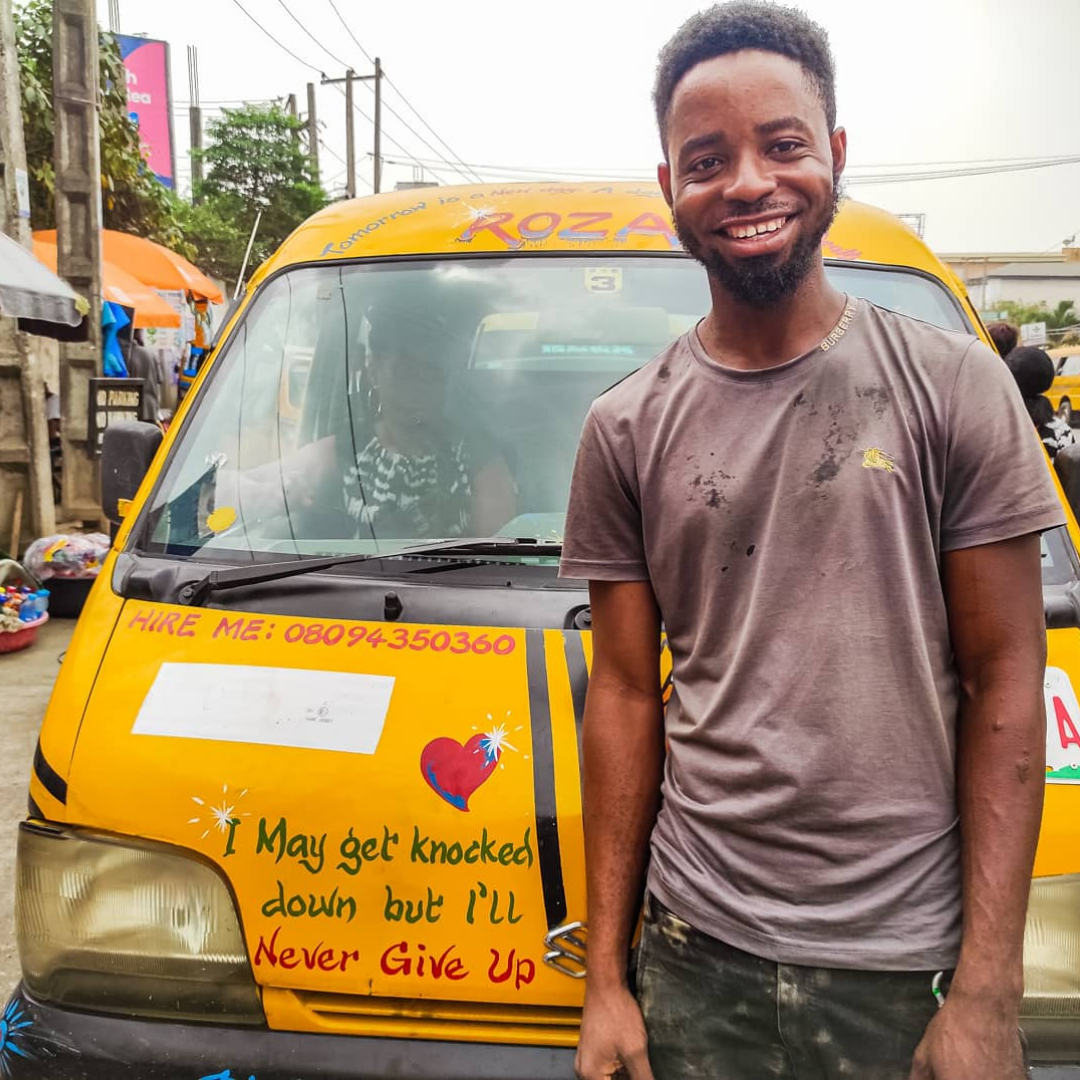
I had to take loans to pay taskforce, so I couldn’t pay the bus owner for two weeks. The owner wanted to collect his bus but my mum went to beg him and promised that it wouldn’t happen again. At that point, I was ready to return the bus but I told myself to never give up, and that was the first thing I wrote in front of the bus. My mum then told me to be careful on the road because she could no longer afford to repay loan or beg if I got arrested by the task force. She reminded me to consider that she was the one now feeding me.
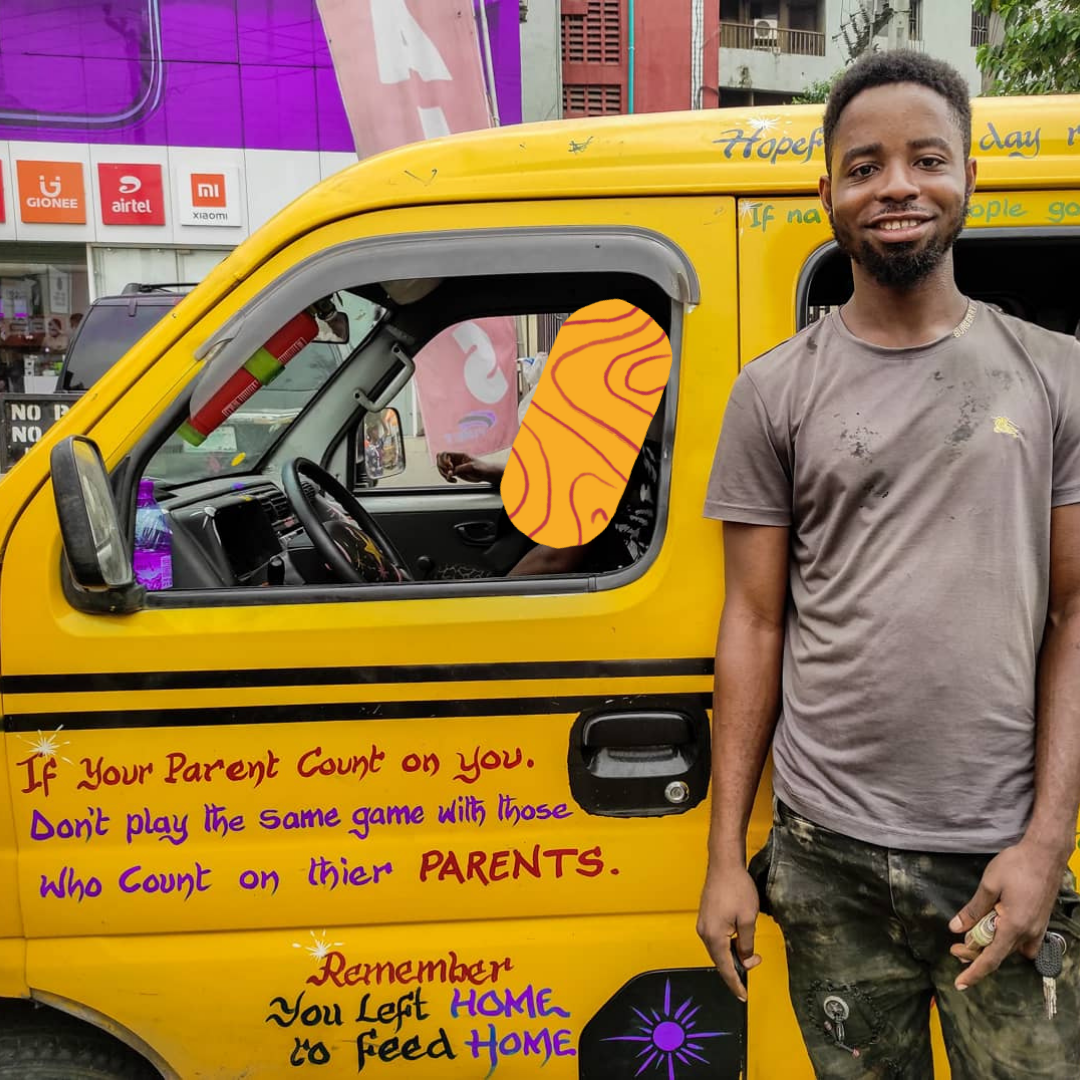
I felt bad for forgetting about her sacrifice. In that mood, I wrote “If your parents count on you, don’t play the same game as those who count on their parents. Remember you left home to feed home.” When Kekes came back on the road and ruined all my money plans with the Korope, I felt hurt. That’s when I wrote “Turn that hurt into hustle. Turn that pain into paper.”
The first time I caught myself thinking about my hustle, I wrote on my bus “Hopefully one-day real change will come because I believe everything in life is temporary.”
Reading those words on this kind of low mood day has given me some ginger. I know I will make it. I must make it.
WEDNESDAY:
I love my wife. In my head, she’s still that girl from when I was selling building materials. My wife doesn’t stress me and she’s very understanding. She understands that I’m paying ₦30,000 per week to the owner of the bus so there’s usually nothing left for flexing. She doesn’t say buy me this or buy me that because we are managing.
Our major expenses are food for the house and my son’s school fees. I still can’t believe that my son is four years old already. As soon as he grows older I know that driving a bus will no longer be able to cater for my expenses. I know because I’m currently still struggling to pay rent and raise the balance of my child’s school fees.
On the road today I’m just looking for a helper. Someone that can introduce me to anything legal that’ll be providing better money for me. A job that I know that if I hustle I can at least pay rent, send my child to school, and still give my mum money. I’m tired of working from 6 a.m to 7 p.m six days a week. I’m tired of leaving the house early, coming back home late and not spending enough time with my family. I’m tired of adult life.
But if I don’t show up, who will help me?
[ad][/ad]
THURSDAY:
Thank God it’s Thursday. Because then it’s Friday, Saturday, and then Sunday — my day of rest. On Sundays, I sleep like I’m on drugs. Once I eat breakfast like this, I’m gone for the whole day.
I don’t know how long I’ll have this amount of energy. With each passing age, I’m just praying for strength. “God please give me the power to keep driving at this pace for two years after I finish paying the owner” If I’m focused the way I am now, I should save enough money to leave this business. I’ll then take the money and use it to buy land for farming. After that, I can build one structure on the land for me and my wife. I want the location to be far away; no Police, no LASTMA, no Agbero wahala. I don’t want any disturbance.
Check back every Tuesday by 9 am for more “A Week In The Life ” goodness, and if you would like to be featured or you know anyone who fits the profile, fill this form.
We Nigerians often think we have a monopoly on ruggedness, but I think the Zimbabweans come close, especially the transport sector. I found a number of similarities between the Nigerian danfo system and the Zimbabwean system, and I knew I HAD to share ASAP.
NB: Buses in Zimbabwe are called kombis, while in Nigeria, they are largely referred to as danfos.
1. Zimbabwean bus drivers are almost always trying to evade the police.
It is the same in Nigeria. It’s like Zimbabwe and Nigeria are in the same WhatsApp group.
2. If you take a bus in Zimbabwe, you have to sit 4 on a seat, even though the seats are meant for 3 people.
My dear reader, if Nigerian bus drivers can have people sit on the roof so they can collect money for it, they will.
Personal story: Last year in Lagos, I was carrying what was left of my tired body home in a danfo when this man came from nowhere and attached his body to the bus like a leech. Turns out he knew the driver and so they let him in(to the already full bus). My man had to hunch over the passengers in the next seat.
Guess what? He still had the audacity to eat a meat-pie.
Sometimes, I’m tempted to believe Nigeria is not a real country.
3. In Zimbabwe buses, there is a little seat where the engine is.
The engine is covered with something, and normally, no one is expected to sit there, but if you are willing to pay half the fare, you can sit there and face the entire bus. It is called “Face The Nation.”
In Nigeria, you pay full fare, but you don’t have to face the whole bus sha.
4. They can decide to take another route because they’re trying to evade bills from touts.
It’s the same here in Nigeria. Sometimes, they do shortcuts because of traffic, and most of the time, the shortcuts tend to also be populated by other drivers trying to avoid traffic.
“A Week In The Life” is a weekly Zikoko series that explores the working-class struggles of Nigerians. It captures the very spirit of what it means to hustle in Nigeria and puts you in the shoes of the subject for a week.
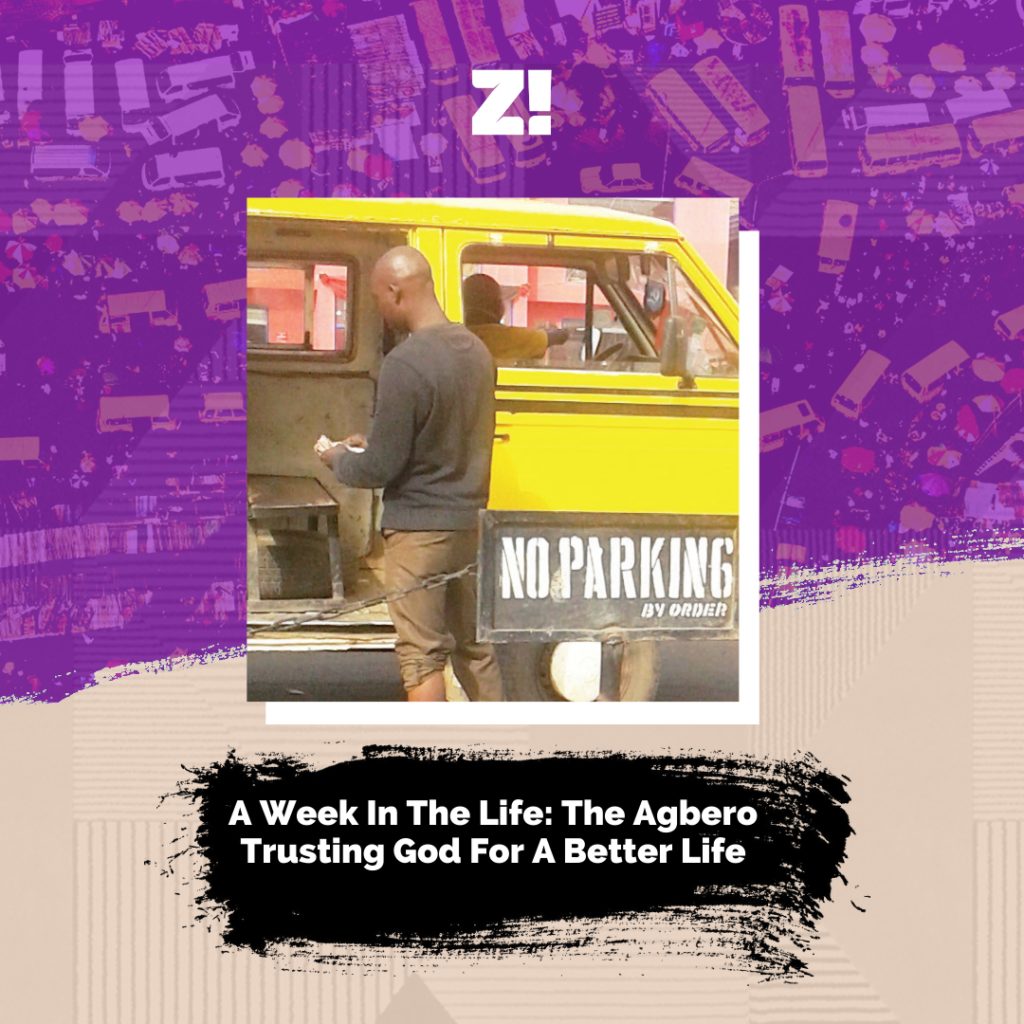
The subject for today’s “A Week In The Life” is *Tola. He collects money at the bus park, and he’s what Nigerians refer to as Agbero. He talks about wanting to quit his job, his faith in God and why he shows up every day.
MONDAY:
I’m on the road as early as 5:30 or 6:00 a.m. on most days. I have to beat traffic and get to work early because the earlier I do, the faster I can begin to make money for the day. Most people don’t know that agbero work is just like being a marketer — we have daily deliverable targets per day. I don’t earn a salary, so I depend on whatever extra money I make per day. Depending on your location and performance, your daily target can be somewhere between ₦30,000 – ₦45,000, and a failure to meet this target means you pay out of pocket. On the bright side, if you surpass your target, you get to keep the extra amount. Therefore, every single minute counts in this job.
This pressure is why some people do anything to collect money from buses; they’ll threaten to break their windscreen, remove the fuel tank cover or wipers. The union [NURTW] believes that there’s no way you’ll go out and not meet your target, so they don’t listen to excuses. Everyone has a daily target, and that’s why you’ll see agberos collecting booking fee from one bus stop to the next. We give numbers and sell tickets to show who has paid and who hasn’t. The funniest part is that the tickets are provided and printed by the state government, so a portion of our daily target also goes to them. We hand over whatever money we make to the park chairman [each park has a chairman] who then hands it over to the union’s executives. At this point, the money is shared amongst them and the state government who provides the tickets.
It is what it is.
It rained today so there were not a lot of buses on the road. I made my daily target with barely enough money for food and transportation for tomorrow. I’m praying for God’s favour because I’m tired of this job.
TUESDAY:
Things weren’t always like this for me. I wasn’t always an agbero working for a union. I learnt printing press work, but there was no money to buy a machine neither was there anyone to help me. So I set up a baba Ijebu kiosk to raise money to buy machines. Things were going well until I fell in love with one lady like this. After we started dating, nothing was coming in again. Getting money to eat even became difficult for me.
Then she fell pregnant.
Things became three times more difficult for me after that. I kept on struggling until my son was born. One year plus after his birth, she left me. Her reason was that she re-assessed her fortunes and saw that there was no future with me. After all, when she met me, I had a lotto kiosk and I was making money. Now that things were no longer the same, she went to consult her stars and they told her to remarry.
Today, I’m thinking about the fact that it’s been almost six years now, and I still don’t have money. I left the printing press to Baba Ijebu to agbero work and still, nothing tangible till now. I’m still using agidi to get money to eat. If I get a better job today, I’m gone. It’s not like I signed a life contract with these people. Even if I did, this is not the kind of job that someone should do forever.
WEDNESDAY:
Under the sun and in the rain, we’re always hustling, we’re always collecting money. It’s only God that will pity us. There’s no protection, no place to rest, nothing. If you want to urinate, you’ll find somewhere by the side to do it. When you want to toilet, you’ll look for a public toilet and pay ₦50 to use it. If you’re sick, you’ll beg someone to stand in for you so you can make your deliverables and if you’re lucky, they will make some money to give you so you can hold body.
Coronavirus time was so bad because no movement meant no work. During that time, I’d just go and do twale on the street for someone that will dash me money. Other times, we’ll group ourselves like four or five and go to a construction site and do labour assistant. Sometimes, when we see people digging borehole, we go and meet them for at all at all money. I wasn’t happy doing that, but I had to eat. To worsen matters, people will just talk to you anyhow and you’ll be tired of life. You’ll be asking yourself: what kind of person is this? Why am I here? Why is this person talking to me like this?
I had an incident like that today. I was calling passengers for a bus driver and a passenger insulted me. After calling price for this woman, she refused to pay when I asked her for money. Instead, she started blasting and rubbishing me. I wanted to reply but people around said I shouldn’t talk. So I kept on looking.
It has been almost three hours since this happened but I can’t stop thinking about it. I’m looking forward to going home at 8 p.m. With the way my day is going, I’ll make enough money to meet my daily target and still have some change. My plan is to go home and drink a chilled bottle of malt because I can’t kill myself.
THURSDAY:
Today, I’m thinking about my son. He’s just six years old and unaware. He lives with grandma, but sometimes, he comes to stay with me. We’re doing one week on and off at work, so he comes during my week off. When he’s not around, I help someone manage their lotto kiosk, and they give me money to hold body.
My son doesn’t know what I do for now because union work is not something I’m proud of. I don’t even wear the uniform. I wear the cap once in a while. When he’s around, we watch cartoon and sports as father and son because these are the memories I want him to have of me. It’s tough raising a male child and being a good role model that the child can follow. It’s lonely because I have no woman and I’m not remarried — the only thing that gives me joy is my boy.
I’ve spoken to my friends that if they have a better job they should let me know. I have my SSCE degree, so I can do factory work or office assistant. Anything that will benefit me, I’ll do it. If God is kind to me, I know the type of education I want to give my son. Part of my prayer every night is that God should spare his life because I don’t know what I’ll do if I suddenly no longer can’t hear his infectious laughter. The one he makes especially when we’re watching sports and I’m gesticulating to him.
My prayer is simple: “God, another year is about to end and I’m getting older. When it’s my time, answer my prayers. It hasn’t been easy because I haven’t gotten a better job. I need something better because I just want to start living.”
Check back every Tuesday by 9 am for more “A Week In The Life ” goodness, and if you would like to be featured or you know anyone who fits the profile, fill this form.