Notice: Function _load_textdomain_just_in_time was called incorrectly. Translation loading for the wordpress-seo domain was triggered too early. This is usually an indicator for some code in the plugin or theme running too early. Translations should be loaded at the init action or later. Please see Debugging in WordPress for more information. (This message was added in version 6.7.0.) in /home/bcm/src/dev/www/wp-includes/functions.php on line 6121
2023 presidential election | Zikoko! 2023 presidential election | Zikoko!
  • The Presidential Election Tribunal: What You Should Know

    On March 1, 2023, the Independent Nigeria Electoral Commission (INEC) announced the results of the keenly-contested February 25 presidential election, declaring Bola Ahmed Tinubu as the new Nigerian President. Subsequently, he was sworn in as President on May 29, 2023.

    But this didn’t mark the end of the election process. 

    What happened?

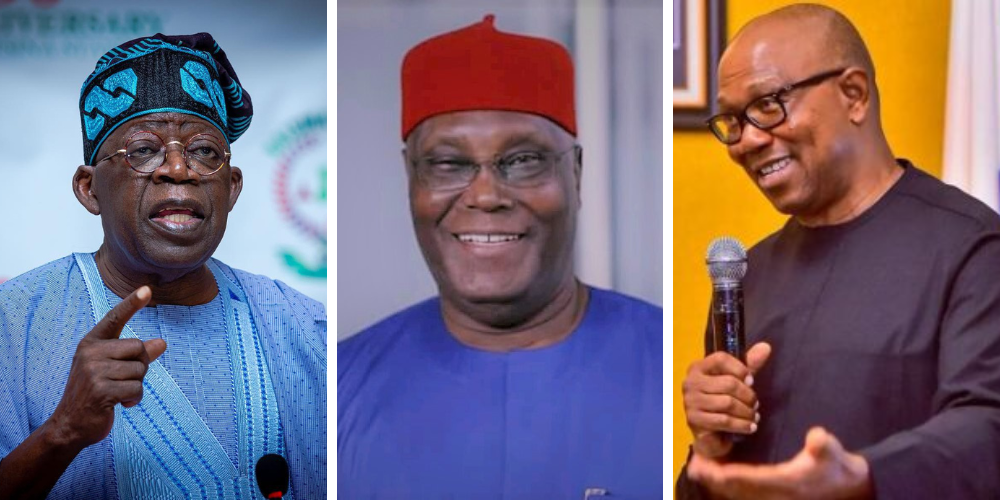
    Nigerian elections are usually fierce contests, but no election since the country’s return to democracy in 1999 was as close as the 2023 cycle. Three favourites emerged in the months leading to the polls: Peter Obi of the Labour Party, Atiku Abubakar of the People’s Democratic Party and eventual winner, Bola Ahmed Tinubu of the APC. 

    While Tinubu’s 8,794 726 votes were enough to be victorious at the polls, it was the smallest win margin by any Nigerian President since 1999. Atiku Abubakar and Peter Obi followed relatively closely at 6,984 520 and 6,101 533 votes, respectively. 

    This wasn’t the most significant bone of contention, though. The election was also allegedly marred by violence, voter intimidation, harassment and other irregularities, begging one question: Can the legitimacy of the results be trusted?

    Following INEC’s declaration, various calls emerged to invalidate the results, accusing the electoral body of multiple electoral irregularities. Since May 2023, three political parties — Labour Party (LP), People’s Democratic Party (PDP) and Allied People’s Movement (APM) — have contested the INEC results that declared Tinubu president, basically telling the tribunal to evict Tinubu from Aso Rock. 

    Here’s what to know about the petitions

    On March 21, 2023, four presidential candidates from four political parties lodged different suits with the election tribunal, seeking to nullify the results. 

    Labour Party (LP)

    The party believes the new President and vice were not qualified to contest the election, referencing Tinubu’s alleged involvement in narcotics and his running mate, Shettima’s nomination, while being the Borno Central constituency’s senatorial candidate. Also, President Tinubu didn’t get 25% of the votes in the FCT, which according to the Labour Party, should have stopped INEC from declaring him the election winner. 

    The petition prays the tribunal to order a return to the polls where Tinubu and Shetimma will not participate. 

    People’s Democratic Party (PDP)

    PDP’s petition also asked the tribunal to dismiss the results of the presidential elections. They argue the invalidity of the results based on electoral irregularities during the process. 

    Allied People’s Movement (APM)

    The petition noted that Shettima’s double nomination is against the provisions of the Nigerian constitution and electoral act.

    Action Alliance (AA)

    The party asked the tribunal to annul the election results because its candidate, Hamza Al-Mustapha, wasn’t allowed to contest by INEC.

    AA subsequently withdrew its petition. 
    What will the tribunal ruling mean?

    The tribunal announced it’ll deliver its ruling in Abuja on September 6, 2023. One of two things will happen: uphold the election results and confirm Tinubu as President, or cancel the election and order a rerun. 

    If the former happens, the petitioners can seek out the Supreme Court and appeal the judgement. According to the law, an appeal should be concluded within 60 days from the date of the tribunal judgement.

    Whatever the Supreme Court decides is the final judgement. There is no other place to go from there. 

    Highlights From the Presidential Election Petition Tribunal Judgement

    Allied Peoples Movement (APM)

    Petition: The party noted that Tinubu’s running mate, Kashim Shettima, was a senatorial candidate at the time of his nomination, which, according to the provisions of the Nigerian Constitution and Electoral Act, is a case of double nomination.

    The party asked the tribunal to void all the votes scored by the APC and announce PDP’s Atiku as the authentic winner of the election.

    Judgement: Justice Haruna Tsammani cited the petition as “incompetent” and noted that the issues raised were pre-election matters outside the tribunal’s ruling. The election petition tribunal dismissed the APM’s case, noting that the party had no legal standing to file the motion.

    Labour Party (LP)

    Petition: The party’s candidate, Mr Peter Obi, sought to have Tinubu disqualified on the basis of an alleged pre-existing drug case in the U.S., making him unqualified to contest for the election. 

    The petition challenged his vice, Kashim Shettima’s nomination while being the Borno Central constituency’s senatorial candidate.

    The petition also noted that Tinubu failed to secure 25% of votes in the FCT, so he shouldn’t have been declared the winner.

    Judgement: Justice Abba-Bello Mohammed read the court’s judgement, throwing out Peter Obi’s petition to disqualify Tinubu based on a U.S. drug case. According to the court, the U.S. court fine, which led to a civil forfeiture of $460k, did not disqualify Tinubu from running for president of Nigeria.

    The tribunal has also held that President Bola Tinubu and Vice President Kashim Shettima were qualified to have contested the last presidential election.

    Peter Obi’s motion to cancel the election result based on manual transmission has also been dismissed. According to the tribunal, INEC can transmit election results how they see fit.

     Obi’s last two motions to cancel the election results on allegations of overvoting and corrupt practices and the failure of Tinubu to secure 25% of votes in the FCT have also been dismissed by the tribunal.

    All of Peter Obi’s motions have been dismissed in favour of Tinubu.

    People’s Democratic Party (PDP)

    Petition: The party sought the tribunal to dismiss the election results based on electoral irregularities, as well as allegations of Tinubu’s dual citizenship.

    Judgement: Justice Boloukuoromo Ugo read the court’s judgement, throwing out all the motions filed in favour of Tinubu.

    The tribunal made a unanimous decision

    All five judge-members of the presidential election tribunal have unanimously affirmed Bola Tinubu as Nigeria’s validly-elected president. Justice Haruna Tsammani, in the lead judgement, held that none of the three petitioners was able to prove their allegations as contained in the petitions. They claimed the petitioners failed to provide credible evidence.

    According to Justice Mistura Bolaji-Yusuf, “It is clear from the outset that the petitioners were engaging in wild goose chase and an inquisitorial adventure.”

    Most of the exhibits and testimonies tendered by the petitioners were rejected based on “procedural blunders” and “technicalities”. The entire judgement ran for over 12 hours.

    Is this the end of the road for the petitioners?

    Far from it. The petitioners have the opportunity to file an appeal to the Supreme Court within 14 days to counter the tribunal’s judgement. It’ll likely be a long road ahead.

    [ad][/ad]

  • #NigeriaDecides: Is the Choice Really Ours or INEC’s?

    Three days after the 2023 presidential elections, Nigerians all over the world  are holding their breath and clinging to the edge of their seats as they await the long overdue results. 

    Here’s all that has happened: 

    Contrary to what we thought, election results were uploaded manually

    One of the measures put in place by the Independent Electoral Commission to ensure a smooth electoral process was the electronic transmission of results. But the spokesperson for INEC, Festus Okoye, released a report saying results from polling units would be electronically transmitted to IReV, but collations would be manual.

    Also read: Can Nigerians Trust BVAS for the 2023 Elections? 


    Disparities between figures Nigerians recorded at their PUs and INEC’s 

    A lot of heat has come upon INEC for releasing falsified results. A spokesperson for the Obi-Datti presidential campaign council claimed that the presidential result from Ekiti state had been uploaded on February 20, five days before the elections. 

    But we fact-checked this, and our checks revealed the screenshot, which was trending on social media, was in fact fake.

    Petition for the INEC’s Chairperson visa to be revoked 

    In the spirit of holding leaders accountable for their actions, Nigerians are dragging Mahmood Yakubu by his metaphorical shirt, and asking the UK, USA and Canada to revoke his visa for rigging Nigeria’s presidential election in favour of APC. The petition currently has over 285,600 signatories.

    Rumours of a runoff election to determine the president 

    For a candidate to be declared President, they must have 25% of votes in 2/3rd of all the states, including the FCT, and also the highest number of votes. From the election polls, we’ve seen the four contending parties show strength in their different regions.

    Banky W lost the Senatorial seat in Eti-Osa 

    Businessman and investor Thaddeus Attah, contesting under Labour Party, beat renowned singer and actor Bankole Wellington who contested under the People’s Democratic Party. Against speculations that he only won because of his party, some people have claimed he was absent from the TL because he was busy campaigning street-to-street. 

    Related: Who is Thaddeus Attah? The Man Who Beat Banky W in Eti-Osa 


    The European Union has dropped their two-cents

    On February 27, 2023, the EU released an official statement saying that while the Nigeria presidential elections had gone on as planned, the lack of transparency and operational failures challenged the citizen’s right to vote. So even though our electoral commission failed to address the numerous allegations of violence and vote buying, the EU acknowledges this was far from a free and fair election. 

    Lagos state alleged dinner party  

    An invitation card began circulating the media in the earlier hours of Tuesday, February 28. And the event was allegedly between the executive governor of Lagos state, Mr Babajide Sanwo-Olu and the Igbo captains of industry, such as the Executive Chairman of Chisco group of companies, Chief Dr Chidi Anyaegbu and the Chairman/CEO of Air Peace, Mr Allen Onyema. 

    But the media aides of the Governor have since come on their platform to tag the flyer as fake news. 


    Get all the latest updates on the 2023 Presidential elections in one place.

  • Civic responsibility is not cosplay. When your brand claims to be politically conscious, you should show up when it counts.

    As millions of Nigerians gathered at the polls to decide the country’s fate during the 2023 presidential elections, some singers who’ve built their identities around fixing Nigeria were nowhere to be found. It’s one thing to sing about the struggles Nigerians go through. It’s another thing to actually do something about it, especially when that thing is voting — or encouraging others to.

    Following the events of 2020 — the year we protested for our lives while some people in government hoarded Indomeeen meant for COVID-19 palliatives — I wasn’t surprised when, as early as 6 a.m., most Nigerians were already at their polling units ready to exercise their civic duty and protect their mandate. One of those early birds was Nollywood actress, Omoni Oboli. 

    Omoni Oboli at her polling unit on the morning of the elections

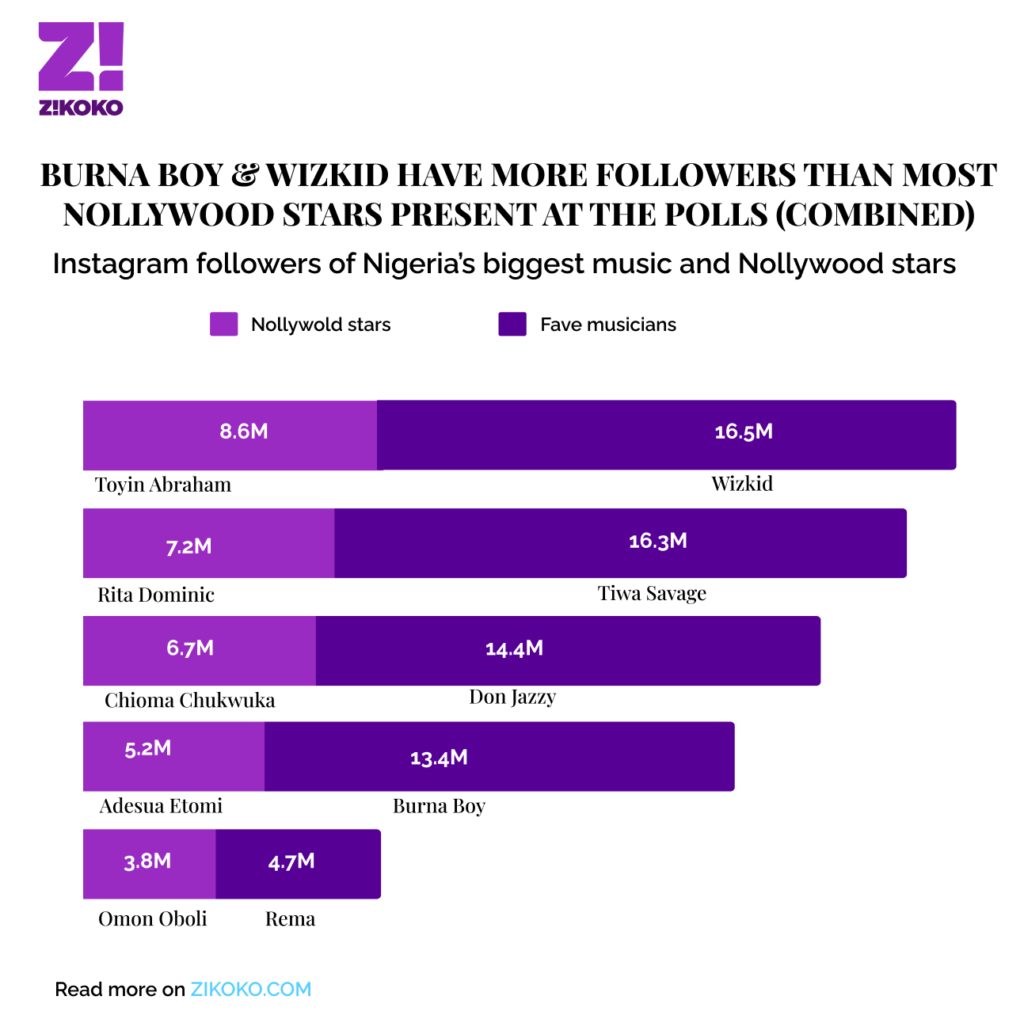
    Not too long after Omoni’s post on social media, Nollywood started showing up en masse with posts from actors like Jemima Osunde, Chioma Chukwuka-Akpotha, Kate Henshaw, Rita Dominic, Toyin Abraham, Stan Nze, Adesua Etomi and Adunni Ade. These actors didn’t just show us they were voting, they also provided situation reports on their various polling units, encouraging their over 40 million combined followers to go out and vote. 

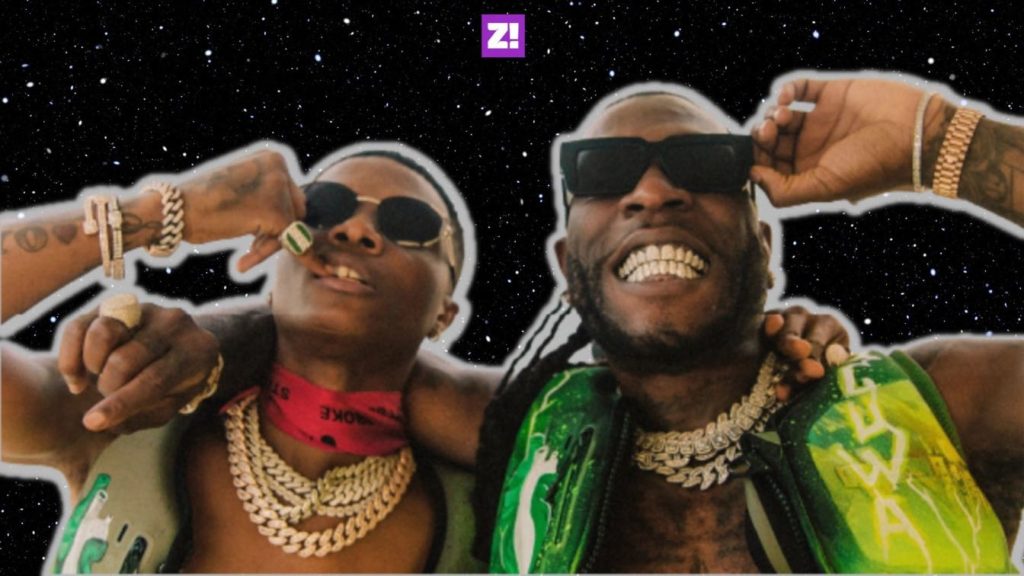
    But while Chioma Chukwuka was getting attacked by thugs trying to snatch ballot boxes and Omoni Oboli camped at her polling unit till 6 a.m. the next day, our self-proclaimed African Giant, Burna Boy, was nowhere to be found. And our best export since crude oil, Wizkid? Well, Machalla was in Ghana, attending the funeral of a music producer’s mum, which might be good enough reason to not be in the country, but to not talk about the election? 

    It’s easy to dismiss Burna Boy and Wizkid’s absence from the polls; they’re just two votes out of 93.4 million registered voters. But then there’s the question of their reach. These two men have a larger social audience than most Nollywood stars who showed up at the elections and talked about it combined.

    RECOMMENDED: Just Imagine These Nigerian Celebrities As Nigeria’s President

    Leading up to the 2023 elections, some of these actors and musicians like Falz, Davido, Ladipoe, M.I and Zlatan spoke about PVC collection, urging their fans to equip themselves with the only permissible weapon for the elections. Meanwhile, Burna and Wizkid refused to disrupt their perfectly curated social feeds with election information. 

    https://twitter.com/zikokomag/status/1629459099120279554?s=20

    Other singers like Tiwa Savage, Don Jazzy and Rema were also quiet (Tiwa put up a post after voting had officially wrapped up wishing Nigeria a peaceful election). These musicians aren’t known to be silent on social issues. After all, Burna called out Coachella, and Wizkid also attacked Reekado Banks for attempting to promote music during #EndSars, all on Blue Ivy’s internet. So why keep quiet now? 

    Imagine Wizkid not showing up after this:

    Singling out Wizkid and Burna Boy is intentional, and their selection runs deeper than surface-level social media reach. Wizkid’s first international claim to fame and one of his biggest hits to date isn’t Essence; it’s Ojuelegba. The 2014 semi-autobiographical hit narrated Wizkid’s journey from shopping demos to becoming one of the biggest stars of his generation.

    Ojuelegba wasn’t just Wizkid’s story; the song presented a certain level of hope that if this random guy could hustle his way out, then maybe it’s possible for the rest of us too. 

    Similarly, Burna Boy’s transition from “underrated” to international superstardom came in 2018  with a little song called Ye. Sampling Fela’s 1977 classic, Sorrow Tears and Blood, Ye positioned Burna as the voice of the people, a narrative he’s continued to push internationally from African Giant to Love, Damini

    These two, more Burna than Wizkid, have each benefited from posturing as messengers of the Nigerian experience — good and bad. So you can’t blame the people for expecting them to show up somehow when the going gets really tough. 

    In a very on-brand move, Wizkid has remained silent in the face of the warranted social media drag. Meanwhile, Burna has decided to be defensive and condescending — something we’ve gotten accustomed to. 

    RECOMMENDED: 9 Old Songs About Nigeria that Prove that Nothing Has Changed

    Although I don’t have hard evidence to prove that celebrities showing up at the polls can influence voter turnout in Nigeria, it’s not far-fetched to imagine many people would’ve pulled up to the Ojuelegba polling unit in Lagos if they thought there was a slight chance their fave would be there. 

    Research shows a direct relationship between celebrities encouraging people to vote and actual voter turnout in countries like America. In 2018, vote.org recorded 65,000 new registered voters after Taylor Swift endorsed a political candidate and asked her fans to vote. The same organisation recorded a 1500% increase in voter engagement after a similar Kylie Jenner post in 2020. So even though Nigeria and most other African countries don’t record data like this, celebrity culture can influence voting culture. 

    That being said, going out to vote is a civic duty, and the decision shouldn’t be forced. But we should look at the bigger picture.

    Music has held Nigerians together generation after generation, reflecting our collective struggles and hopes for the future. It was music Fela used to hold the military accountable during his time, and it was music that fueled the #EndSARS protests

    As Afrobeats dominates the “world” it’s been trying to reach for years, our faves must remember where the sound came from. There’ll be no “Afrobeats to the world” if Nigeria goes to shit. And when you claim to be about civic responsibility, you should show up when it counts.

    Check here for live updates on the ongoing presidential and legislative elections. 

    ALSO READ: Understanding the Trending Celebrity to Politician Pipeline in Nigeria

  • Nigerians Should Stop Doing These Weird Things for Politicians

    One of the greatest feelings for Nigerian politicians is knowing they have people who are in love with them enough to do anything for them. 

    Nigerian politicians enjoy a lot of public goodwill

    And love makes you do strange things, but some people on this list like to overdo things. We need them to think more before they act.

    Showing your naked bum bum to the internet

    Nothing prepares you for logging onto social media and seeing the bare asscrack of someone’s grandfather at the beach calling on God to help his candidate win. Yet, Nigerian actor, Ebun Oloyede, didn’t consider this when he subjected millions of Nigerians to a video clip of himself completely naked, with a back view no one asked for or deserved.

    We’re pretty sure Oloyede hasn’t dedicated this much to a film role before, so why do it for politics? Let this be the last time, sir.

    Drinking gutter water

    For most people, voting for a candidate who goes on to win an election is always a cause for celebration. Most normal people would put an extra piece of meat on their rice or go out for a few bottles of beer with friends. But for Aliyu Muhammad Sani of Bauchi State, Buhari’s re-election victory in 2019 was his excuse to take a full dive into a rubbish-filled gutter. 

    Nigerian politicians enjoy a lot of public goodwill

    [The Guardian]
    Sani had promised to swim inside a gutter and drink drainage water if Buhari won, but maybe this is the one time it was okay to act like a Nigerian politician and not go through with a promise. To clarify, swimming in a gutter of rubbish is bad for your health and for our eyes.

    Trekking interstate

    Nigerian voters have upheld a tradition of doing interstate treks as a declaration of love for their favourite candidates so much that it’s got weird. The most infamous of the trekkers is Suleiman Hashimu who walked 750 kilometres in 18 days from Lagos to Abuja to celebrate Buhari’s 2015 victory. Buhari rewarded him with a handshake and eight years of whatever Nigeria currently is.

    Nigerian politicians enjoy a lot of public goodwill

    Dahiru Buba, another infamous Buhari trekker, who made a trip from Gombe to Abuja with his legs in 2015 needed financial help in 2020 to treat limb pains that developed after his unnecessary walk. 

    You’d think these consequences would dissuade future trekkers, but some supporters are already trekking from state to state for 2023 presidential candidates.

    Fighting your friends for politicians

    The trend of severing ties with longtime associates over support for politicians has grown over the past eight years as online political discourse has become more toxic. 

    Nigerian politicians enjoy a lot of public goodwill

    The big attraction of democracy is it allows everyone to responsibly table their points of view without fear of bad blood, but that isn’t always the case between supporters in different camps. 

    What’s worse about this hostile trend is the politicians they’re fighting these battles for are publicly friends when elections are over and don’t care about your private relationships. Yet, there you are, cutting off your own friends.

    Nigerian politicians enjoy a lot of public goodwill

    Election violence

    Electoral violence is a feature as old as Nigerian politics itself, and it’s just sad that the pawns of the game are yet to realise they mean nothing in the grand scheme of things. People who’ll be abandoned to their fates after elections are the ones physically manipulating the process for unqualified people to march into office. 

    Nigerian politicians enjoy a lot of public goodwill

    The trend of electoral violence has tipped downward over the past few election cycles, but those who haven’t got the message must realise they’re running a fool’s errand.

    Stuff on Buhari: The President’s Weirdest Decisions We Thought Were April Fool’s Day Jokes But Weren’t

  • Will the Real Bola Tinubu Please Stand Up?

    This is Zikoko Citizen’s Game of Votes weekly dispatch that helps you dig into all the good, bad, and extremely bizarre stuff happening in Nigeria and why they’re important to you.

    Subscribe now to get the newsletter in your email inbox at 8 am every Friday instead of three days later. Don’t be LASTMA.

    It must not be easy to be Bola Ahmed Tinubu in 2022. When he won his presidential ticket in June, he signed up for a world of public scrutiny so intense it can power Nigeria’s erratic national grid. 

    Journalists, political rivals and even random 12-year-olds with an internet connection have poked and prodded into his life.

    Will the Real Bola Tinubu Please Stand Up?

    [Zikoko Memes]

    This isn’t a bad thing — the scrutiny is necessary for anyone auditioning for Nigeria’s highest political office. It’s not when you’ve already elected someone into office you want to find out they’re medically unfit, love eating semo or used to sell drugs.

    In Tinubu’s case, he’s made the job pretty easy for his haters by running a campaign so chaotic in its messaging and frightening in its prospects. Even before he won the ticket, he pissed everyone off with his infamous “emi lokan” rant and his unending stream of public slips of the tongue has made him a fertile target for online ridicule. But one of the candidate’s biggest burdens is his unresolved shady past threatening to blow up his campaign.

    Will the Real Bola Tinubu Please Stand Up?

    [Zikoko Memes]

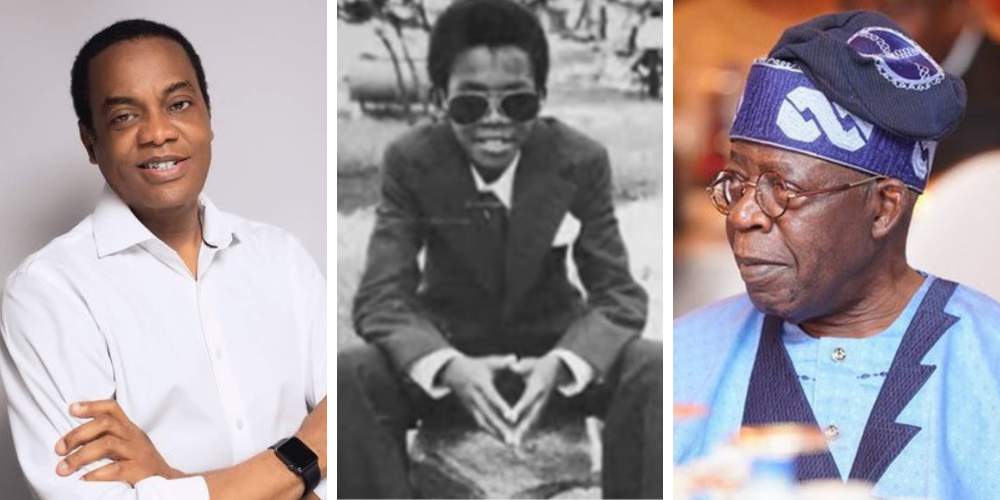
    This week, a former Cross River State governor, Donald Duke, complained that the Tinubu campaign has been using a picture of him as a young boy to represent the former Lagos State governor. The controversial documentary about the life and times of Tinubu first aired in June and implied the dashing young boy was a younger version of the candidate who says he’s now 70.

    Will the Real Bola Tinubu Please Stand Up?

    We need the wisdom of King Solomon to settle this one

    This would be considered an honest mistake for any other candidate. But for Tinubu, it’s just the latest issue to cast uncertainty over his real identity, especially with the many hazy details about his past.

    Tinubu has had many allegations thrown his way, from his dodgy academic credentials to his unclear employment records and even his political legacy. It’s an absolute miracle his campaign is still standing largely unharmed, but is there a point where his nine lives run out?

    What else happened this week?

    Make Air Travel Great Again (MATGA)

    [ThisDay]

    Using Nigerian airlines comes with some pretty heavy baggage, starting from when you arrive at the airports. If it’s not the bambiala officials, it’s the annoying queues, the announcer’s confusing accent, overpriced food, and security officials touching you anyhow in the name of inspection.

    It’s a very long list of discomforting issues, but all of these don’t even compare to the moment you find out your flight is delayed or, even worse, cancelled. It’s a vicious cycle of feeling you’re on your own and not getting your money’s worth.

    If you’re one of the Nigerians worried about not getting quality service from the aviation industry, worry not because the House of Representatives is stepping in to save everyone. House member, Simon Karu (Gombe – APC), raised a motion this week for an investigation into the violation of the rights of passengers in Nigeria.

    The goal of the investigation is to improve the system to provide quality air travel services in the country. This means airline operators will stop shortchanging their customers and provide them with due compensation when they mess up.

    [Zikoko Meme]

    Hopefully, this new energy for the industry can cause a chain reaction that’d remove the bambiala officials, the annoying queues and the customer service agents walking around with the attitude of an irritated porcupine.

    Oh, look, a flying pig.

    Have you seen this video?

    Question of the week

    On a scale of “Over my dead body” to “I’d like to sleep with them under my pillow”, what are your thoughts on the new naira banknotes?

    Click here to tweet your answer to @ZikokoCitizen on Twitter.

    Ehen, one more thing…

    The Inspector-General of Police, Usman Baba, complained this week that police officers don’t have any human rights activists to advocate for them when members of the public violate their rights. Has he met Nigerian police officers before?

  • What Does It Mean to Recharge the Lake Chad?

    In the past, Nigerian politicians used to get away with selling voters pipe dreams and empty promises. But the campaigns for the 2023 elections have shown us Nigerians are no longer gullible and are willing to ask questions. This is why Bola Tinubu, the presidential candidate of the All Progressives’ Congress (APC), is again under public fire.

    What has he done now?

    On November 22, 2022, at the inauguration of the first drilling of crude oil in Bauchi State, Tinubu made some promises. But the one that’s got everyone talking is his promise to recharge the Lake Chad. Supporters of rival candidates have ridiculed his plan on social media, but there are important things you should know about the Lake Chad before you take up arms.

    What makes the Lake Chad special? 

    The Lake Chad, once called the epitome of productivity, was one of Africa’s largest freshwater bodies and the world’s sixth-largest inland water body. In the 1960s, it used to have an area of 25,000 square kilometres with about 135 species of fish. Nigeria shares the Lake Chad with Cameroon, Chad and Niger. 

    How important is the Lake Chad to Nigeria?

    Because of how large and rich the water body was, the lake provided a means of livelihood and food for about 30 million people who lived around it. Unfortunately, the water levels began to shrink, and today, it’s reduced by over 95%. The effect of this change has been devastating. 

    Hmmm, how?

    Loss of livelihoods

    The lake provided a source of income for people who depended on farming, fishing and cattle herding. But with the water source almost gone, herders battled daily loss of livestock, and farmers and fishermen found it virtually impossible to work.

    Insecurity

    The loss of income in the areas around the lake pushed many people into a life of crime. Cattle rustling, banditry, and farmer-herdsmen clashes have become the order of the day. About two million people have been displaced from their homes, and over five million people suffer and die from malnutrition. 

    How would Tinubu’s plan help the Lake Chad?

    Recharging the Lake Chad means refilling the water body by building dams and canals to pump water from the Congo River. This proposed solution is estimated to cost around $50 billion.

    The blowback over Tinubu’s promise shouldn’t be that recharging the lake is unnecessary, it should be about if he, or whoever becomes president, can address the problem once in office.

  • Unless you’ve been living under a rock, you’d know that the 2023 presidential election is on course to be the tightest race in recent history. Forget the bluster from partisan supporters, no one knows for sure which way it’ll swing.

    At The Candidates town hall series, which we’ve been covering, the presidential candidate of the New Nigeria Peoples Party (NNPP), Rabiu Kwankwaso, on November 19, 2022, said he’s not a spoiler in the presidential race. 

    To substantiate his point, he mentioned a report by the Independent National Electoral Commission (INEC) that disclosed that it was printing 187 million ballot papers — twice the number of 93.5 million eligible voters, as it anticipated that the election might go into a runoff. 

    With this background, we’ve decided to break down what a runoff election entails, and what it could mean for voters.

    What is a runoff?

    A runoff describes a voting system that selects a winner after two rounds of voting. It happens when no candidate is able to meet the requirements needed to be president at the first round of balloting. The idea behind it is to ensure that whoever is elected president gets broad acceptance from across the country.

    What laws guide the conduct of a runoff in Nigeria?

    INEC is empowered by the Electoral Act 2022 (as amended) to conduct runoff elections in Nigeria. Section 134 of the Nigerian Constitution explains the conditions for this to occur. 

    To be elected as president, “A candidate for an election to the office of President shall be deemed to have been duly elected where, there being more than two candidates for the election –

    (a) he has the highest number of votes cast at the election;

    and

    (b) he has not less than one-quarter of the votes cast at the election of at least two-thirds of all the states in the Federation and the Federal Capital Territory (FCT), Abuja.”

    The summary of the above is that a candidate needs to get a simple majority of votes, and 25% of votes in 24 states to become president. When this doesn’t happen, we go into a runoff.

    ALSO READ: Do Opinion Polls Matter in Nigerian Presidential Elections?

    Who qualifies for a runoff?

    Section 134, subsection 3 defines who qualifies as, “(a) the candidate who scored the highest number of votes at any election held in accordance with the said subsection (2) of this section; and

    (b) one among the remaining candidates who has a majority of votes in the highest number of states, so however that where there are more than one candidate with majority of votes in the highest number of states, the candidate among them with the highest total of votes cast at the election shall be the second candidate for the election.”

    The summary here is that two candidates will go into the runoff. One is the candidate with the highest number of votes in the first round. The other candidate is the person among the rest that wins the most states. If more than one candidate in this group has won an equal number of states, then the tiebreaker is the candidate who won more votes.

    Could the 2023 election go into a runoff?

    There’s a possibility that a runoff might happen given the respective strengths of the four leading candidates. Different election polls have shown that they all possess strong support bases. INEC spokesman, Festus Okoye, said printing extra ballots has been a tradition of the commission since 1999.

    How soon after the main election can we expect a runoff?

    The Electoral Act gives INEC a maximum of 21 days to conduct a runoff. The timing is not unusual. INEC has said it’s a logistical nightmare printing another 93.5 million ballots within three weeks, hence the proactive move.

    What could it mean for voters?

    If you’re unlucky and one of your faves doesn’t make it to the next round, you may find yourself having to vote for a “lesser of two evils”. This often means that the candidates who scale through will do some serious mobilisation and have to reach out to fringe voters to gain their support. 

    Overall, this is very good for democracy. It leads to robust coalitions and helps keep candidates on their toes. For Nigeria with a history of poor leadership, a runoff, even though expensive, might be a small price to pay for good governance.

    ALSO READ: It’s 100 Days Until the 2023 Elections. What Has Happened?

  • It’s 100 Days Until the 2023 Elections. What Has Happened?

    Today, November 16, 2022, makes it exactly 100 days till the general elections scheduled for February 25, 2023. A lot has happened since campaigns officially kicked off on September 28, 2022. 

    Here are some interesting things that have happened so far, and what you can expect in the coming days.

    PDP flags off campaign with Obi chants

    Despite the many internal squabbles happening in the People’s Democratic Party (PDP), the party’s campaign took off in Uyo on October 10, 2022 and there were reports of a massive crowd. However, the standout moment came when PDP supporters were singing Obi kerenke chants at the rally. A truly forgettable moment for PDP’s Atiku Abubakar.

    Labour Party kicks off campaign with low turnout

    It was the turn of the Labour Party (LP) to kick-start its campaign which it did on October 29, 2022, in Nasarawa state. While the PDP had Obi supporters turn out in good numbers at its rally a few days earlier, they somehow managed to hide their faces where they were truly needed.

    Doyin Okupe, an LP spokesperson, said the state government employed tactics designed to frustrate its supporters, including scheduling an environmental sanitation on that day to limit movement. 

    He claimed that this was the first time in seven years that the state was doing such a thing, reducing its available supporters by 90 percent. Looks like there’s enough breakfast to go around.

    APC gets a hostile reception

    APC kicked off its campaign on November 15, 2022, in Plateau state. While other interesting things took place, there was also the unfortunate matter of boos and stones being reportedly hurled during the campaign.

    To be fair though, the APC in 2015 asked us to stone them if they fail to perform. So there’s that.

    What can we expect in the next 100 days?

    Things are bound to get very exciting. Expect funny soundbites, epic fails, more gaffes and mudslinging. 

    Meanwhile, the Independent National Electoral Commission (INEC) has said that while all that is happening in the background, it remains loyal to Nigerians. Already it has published its voter register online for Nigerians to make claims and objections. You can head over here to learn more.

     ALSO READ: Embarrassing Moments from 2023 Presidential Candidates so Far

  • MKO Abiola’s 1993 Campaign Video Is Still Valid in 2022

    MKO Abiola died 24 years ago, but he’ll always be remembered as Nigeria’s president that never was. Even though he was the winner of the 1993 presidential election, his village people — General Ibrahim Babangida and General Sani Abacha — denied him his mandate.

    Abiola’s presidential campaign is still mostly remembered for the tragedy that it was, but one of the other most memorable things from that period is his campaign ad which promised hope for Nigerians. In the video, the main character — let’s call him Polycarp — complained about the most frustrating things for him as a Nigerian in 1993.

    MKO Abiola's 1993 Campaign Video Is Still Valid in 2022

    Meet Polycarp: he believed in1993 Nigeria was one election away from becoming a paradise

    With the 2023 elections just around the corner, it’s only fitting to check in on Polycarp’s list of complaints to see how much things have changed — or not — in 30 years. 

    If Polycarp was angry about 1993 Nigeria and jumped inside a time machine to 2022 Nigeria, what would he meet?

    No work

    MKO Abiola's 1993 Campaign Video Is Still Valid in 2022

    Polycarp’s time machine may want to skip 2022 Nigeria if it’s gainful employment he’s seeking because we have some very bad news for him. Nigeria’s 2020 unemployment report pegged the unemployment rate at 33% which is the highest it’s ever been. Polycarp would still be unemployed and broke in 2022, and desperate enough to start selling affiliate marketing courses on Facebook.

    No food

    Like everything in Nigeria these days, the prices of food items aren’t obeying the laws of gravity. The National Bureau of Statistics reported that food inflation rose to 23.34% in September 2022 which is the highest it’s risen in more than 15 years. 

    Even worse, nearly 20 million Nigerians are potential victims of famine, according to the United Nations’ Food and Agriculture Organisation (FAO). What this means is that 10% of Nigerians face hunger of Biblical proportions. For context, that’s the combined population of Eritrea, Namibia, Gambia, Botswana, Gabon, Lesotho, and Guinea-Bissau at risk of hunger inside just one country.

    No house

    If Polycarp was complaining about housing issues in 1993 when you could probably rent or buy a home with money saved under your bed, then he probably wants to skip to 2072 Nigeria or something. Because in 2022, Nigeria has a housing deficit of about 28 million units and even the homeowners are being forced out of their houses by seasonal floods and terrorism.

    No light

    MKO Abiola's 1993 Campaign Video Is Still Valid in 2022

    Nigeria’s national electricity grid is more well-known than the governor of Jigawa State — and the fact you just tried and failed to remember his name proves my point. But the national grid isn’t known because it’s the eighth wonder of the world or sponsors Twitter giveaways. It’s always on everyone’s lips because of how frequently it collapses, leaving Nigerians in darkness. Whatever jungle Polycarp thought Nigeria was in in 1993, the country is still in the Dark Ages.

    Expensive transport fares

    MKO Abiola's 1993 Campaign Video Is Still Valid in 2022

    One of Polycarp’s most prominent complaints was the transport fare eating into his daily ₦2k, and we have news for him from the future. Just over the past year alone, the average bus fare within Nigerian cities rose from ₦435.36 in September 2021 to ₦615.69 in September 2022. The recurring fuel scarcities don’t help matters and the situation is likely to worsen with the proposed removal of fuel subsidies in 2023.

    Out-of-school children

    When Polycarp complained about school being a headache, the campaign ad showed a dozen shirtless little children roaming the streets. In 2022, that demographic has ballooned into a population of 20 million out-of-school children forced out of the classroom by government neglect, poverty and insecurity. The government keeps paying lip service to the problem and even 2023 presidential candidates are still talking about setting up committees to tackle it.

    Hospitals aren’t working

    MKO Abiola's 1993 Campaign Video Is Still Valid in 2022

    Nigerian doctors are some of the most prominent groups participating in the japa wave and even the president of the country travels to London every three market days to take paracetamol because the health sector isn’t where it needs to be. Not much has changed between 1993 and 2022. 

    MKO Abiola's 1993 Campaign Video Is Still Valid in 2022

    Polycarp was dealing with “so so palava” in 1993, but Nigerians are dealing with real shege in 2022. The unfortunate lesson here is 2023 presidential candidates are still using the same issues to campaign nearly 30 years after they already reached a critical point.

    Whatever choice Nigerians make in 2023 will determine whether things improve or we have to walk the wilderness for another 30 years. Polycarp may want to skip even further into the future.

    ALSO READ: This Nigerian Wants to Vote in 2023 but He Won’t Leave Germany

  • Do Opinion Polls Matter in Nigerian Presidential Elections?

    On October 27, 2022, Fitch Solutions, a subsidiary of international credit rating agency, Fitch Ratings, released a Country Risk and Industry Research report that projected 2023 presidential election victory for Bola Ahmed Tinubu (BAT) of the All Progressives Congress (APC).

    As you can be sure, supporters of the BAT received this report with uncontrolled joy. For them it was an affirmation of what they already knew, that it was his turn.

    Predictably, the Peoples Democratic Party (PDP) and Labour Party (LP) have rejected the report as unrealistic. But this isn’t the first time a report or poll has called the result of the 2023 election. In September 2022, a poll commissioned by ANAP foundation projected LP’s Peter Obi as the winner of the election.

    The trend of different polls projecting different winners has led to broader questions about if they really matter. Just as we recently looked into whether endorsements have any effect on election outcomes, we will dive into whether opinion polls matter in the context of Nigerian presidential elections. 

    Why are polls conducted?

    Despite the common trope that Nigerian politicians don’t care about the masses, they actually care about what they think when it’s time for elections. It’s only when they’re in office they can start unlooking us, just like Buhari has made abundantly clear.

    Politicians conduct opinion polls to gauge public support. This also helps them identify the leading issues that drive campaigns. They’re also a standard in robust democracies like the United States and are a hallmark of a free society.

    Opinion polls can have usefulness even outside elections, like in determining approval ratings which show how well or badly the public responds to a political figure. For example in the lead-up to the 2015 elections, Goodluck Jonathan’s approval rating dropped by 5% which ultimately affected his chances.

    We know polls are a big deal in first-world democracies like the United States, but how reliable is polling  for Nigerian elections?

    How effective was polling in Nigeria in 2011?

    In February 2011, the ANAP Foundation, a non-profit organisation, commissioned the polling agency, NOI polls, to conduct a face-to-face presidential poll nationwide. The report showed that 93% of people knew Goodluck Jonathan was running for president, 73% knew Muhammadu Buhari was running and 48% knew that Nuhu Ribadu was running. 53% of those surveyed believed Jonathan would win. 

    The result of the election followed the exact order of the poll — Jonathan won and Buhari and Ribadu finished second and third respectively. 

    How effective was polling in Nigeria in 2015?

    NOI Polls conducted another survey for the 2015 presidential election and concluded it was too close to call.  Buhari topped that poll with 32% of respondents handing him victory, slightly ahead of Jonathan with 30%. The agency had also reported that Jonathan’s approval rating fell to 55% in January 2015.

    Just like the polls results showed, Buhari won the election and became the first opposition candidate to unseat an incumbent Nigerian president. 

    How effective was polling in Nigeria in 2019?

    In February 2019, NOI polls projected a second term victory for Buhari. He won the poll with roughly 33% of votes, while Atiku ended up with 25% with the population of undecided voters as high as 38%. While Buhari was expected to win, the poll noted that the margin of undecided voters could swing results in Atiku’s favour.

    The results of the 2019 election largely aligned with the poll, with voter apathy playing a huge part in Buhari’s re-election. Only about 35% of voters took part, the lowest in Nigeria since 1999.

    How effective will polling be in 2023?

    If the history of polling in Nigeria is anything to go by, pollsters can be quite reliable. Part of their efficiency also comes from timing — all the polls were conducted very close to the elections. That should probably tell you all you need to know about all the polling reports flying about almost four months to D-Day. 

    Ultimately, while party supporters may feel relaxed about polls that predict victories for their candidates now, there’s still lots of time for the wind to change before February 2023. 

    ALSO READ: One of These 18 Candidates Is Nigeria’s Next President

  • Peter Obi Wants Your Shishi, and Other 2023 Campaign Lessons

    One thousand and one things are happening with a presidential election, especially one as chaotic as Nigeria’s 2023 race.

    Peter Obi Wants Your Shishi, and Other Campaign Lessons from Last Week

    These are the highlights of the 2023 presidential election campaigns in the past week.

    Obi won’t give shishi but he needs a lot of it

    The Peter Obi presidential campaign uncovered a deep dark secret last week that stunned everyone across Nigeria: presidential campaigns cost money. Who saw that one coming? Before you know it, someone would tell us Abacha was a thief.

    Peter Obi Wants Your Shishi, and Other Campaign Lessons from Last Week

    “He was only saving Nigeria’s money for future use”

    The national chairman of the Labour Party (LP), Julius Abure, opened the door to a dash of public ridicule when he appealed for donations to the party’s campaign for the 2023 presidential election. Crowdfunding for presidential elections isn’t an entirely new concept, but it was a bit comical coming from a campaign that has made penny-pinching a trademark.

    Nigeria’s electoral laws set a limit of ₦5 billion to run a presidential campaign. How much of that can the Peter Obi campaign raise?

    Tinubu finally wins something, but there’s a twist

    The presidential candidate of the All Progressives Congress (APC), Bola Tinubu, has survived a lot of things in his campaign — there was that pee thing, the constant questions about his health and his many gaffes.

    But his campaign has been turning a good corner in the past couple of weeks, and he crowned that last week with an endorsement by Fitch Ratings which projected victory for him in 2023.

    Peter Obi Wants Your Shishi, and Other Campaign Lessons from Last Week

    Peter Obi has won three major polls released in the past couple of months, but the Fitch report predicted a strong Tinubu victory — an outcome that validates his entitled campaign to succeed Buhari.

    But while the report may be good news for Tinubu, it’s not such a great one for Nigerians as Fitch also projected his victory will lead to social instability in Nigeria.

    Atiku’s American wonder

    Atiku has to tick three things on his checklist whenever he runs for president — prove he’s not a northern extremist, beg Obasanjo to take back the stealing allegations and take a trip to the United States.

    Last week, the former vice president packed his campaign team and flew to the U.S. to once again prove that he can waltz into the country where his critics say he’s wanted for corruption. He did a lot of standing around and taking fly jpegs in America and nobody saw him in handcuffs.

    Peter Obi Wants Your Shishi, and Other Campaign Lessons from Last Week

    Roc Boys no drip pass this one

    If the presidential election was a game of stunts, Atiku won last week hands down and should be crowned president as soon as he returns to Nigeria. But if he hopes to have a victorious campaign, there’s one more thing on his checklist he has to resolve and the name is Nyesom Wike.

    Kwankwaso has a miracle up his sleeves

    Does anyone still remember Rabiu Kwankwaso is in the presidential race? The former Kano State governor was primed as the dark horse candidate to challenge the APC and PDP in 2023. But even though he’s been dislodged from public consciousness by Obi’s rise and is now only rated fourth in a three-horse race, Kwankwaso isn’t giving up without a fight. 

    The former governor is still rallying his impressive crowd of Kwankwasiyya supporters with their famous red caps and posting photos of large rally crowds on his Twitter. 

    Peter Obi Wants Your Shishi, and Other Campaign Lessons from Last Week

    But does anyone trust it’ll translate into a win for the candidate of the New Nigeria People’s Party (NNPP)? A chieftain of his party, Buba Galadima, seems to think he’ll perform the miracle of the five loaves of bread and two fish by sweeping over “50-something million votes” in the north while nicking more votes in the southern region.

    If Galadima has seen the state of voter turnout in Nigerian elections, then he’d know he’s building castles in the air, but he’s no stranger to that.

    Imumolen is a local champion

    At 39, Christopher Imumolen of the Accord Party (AP) is the youngest presidential candidate in the race for the 2023 presidential election, and he won’t let you forget it. He’s made many claims about being the “authentic youth” option and wants young Nigerians — the most populated voting group — to elect him to make a statement

    Imumolen’s campaign got some kick last week when he commenced a tour of Nigeria’s West African neighbours to… campaign for president of Nigeria. 

    Christopher Imumolen started his tour in Togo with plans to also touch down in Benin Republic, Ghana and Liberia. Even though he refused to be drawn into a debate on why other candidates are doing diaspora outreach in exotic places in Europe and North America, Imumolen seemed to suggest his own West African tour had more substance. We can’t begrudge a man his days of local outreach.

    Sowore is pocket-watching

    Peter Obi Wants Your Shishi, and Other Campaign Lessons from Last Week

    Remember how the law says it should cost a maximum of ₦5 billion to run a Nigerian presidential campaign? Well, it’s kind of an open secret that Nigerian politicians spend more than the limit and they get away with it because authorities don’t enforce election finance laws. The candidate of the African Action Congress (AAC), Omoyele Sowore, wants that to change for 2023 to create a level playing field.

    Which is why you have laws and a referee like INEC

    You can understand why this is coming from a candidate who could only raise a grand total of ₦‎1‎57.9 million for his 2019 campaign. But Nigeria does need to get serious with enforcing laws to make sure everyone is playing by the books. Why have laws if you won’t enforce them? Is this a third-world country?

    ALSO READ: Village People Stopped These Nigerians from Becoming President

  • What Is Going On With Atiku’s Presidential Campaign?

    Atiku Abubakar, the presidential candidate of the People’s Democratic Party (PDP), officially flagged off his campaign early in October 2022. He has since hopped across the country for his unifier mission

    But what exactly has he been up to? 

    How has his campaign fared so far?

    Well, the answer depends on who you ask. His fans have called his style of campaign unique and focused. His haters think he’s in last position in a three-horse race for the crown. But this is a former vice president of Nigeria we’re talking about and a massive crowd of supporters turned up for the flag-off of his campaign.

    The biggest problem for Atiku’s campaign is he has enemies from within trying to pour sand in his garri.

    On October 25, 2022, the governor of Benue State, Samuel Ortom, his fellow party member, publicly withdrew his support for Atiku for “dishonoring him” and working against the interests of his state. This withdrawal is connected to Atiku’s messy feud with Nyesom Wike, the governor of Rivers State. 

    Wike is yet to forgive Atiku’s transgressions since he lost the party’s ticket to him. So, it’s no surprise that every day is WW III with those two.

    On his most recent campaign stop in Edo State, Atiku said his number one priority, if elected president, would be Nigeria’s unity. But it’s difficult to overlook the irony that he can’t unite his own party.

    Where was Atiku last seen?

    On October 25, 2022, Atiku visited residents of Bayelsa State affected by the floods that have devastated many parts of Nigeria. The candidate didn’t just show up with love and light, but also some cash — he donated ₦55 million towards the welfare of the victims.

    Call him Mr Owonikoko

    Atiku blamed climate change for the floods which have killed over 600 Nigerians in 2022. He called on the government to set up a relief fund to assist the victims who have lost their homes and sources of livelihood. 

    So where next for the unifier?

    According to his campaign timetable, Atiku is expected to address the Commonwealth of Nations in the United Kingdom on October 27, 2022. He would then move his presidential campaign to Ekiti State on November 1, and neighbouring Ondo State on November 2. 

    The candidate’s expected to tour the remaining states in Nigeria before the presidential election holds on February 25, 2023. For his sake, we hope he manages to put his home in order or there may be some serious consequences.

  • It’s Raining Nigerian Doctors in the UK

    This is Zikoko Citizen’s Game of Votes weekly dispatch that helps you dig into all the good, bad, and extremely bizarre stuff happening in Nigeria and why they’re important to you.

    Subscribe now to get the newsletter in your email inbox at 8 am every Friday instead of three days later. Don’t be LASTMA.

    It's Raining Nigerian Doctors in the UK

    If you’re feeling mischievous and throw a stone into a United Kingdom hospital, there are good odds it’ll land on a Nigerian-trained doctor who’ll scream, “Wetin be that?” 

    Seven years ago when Buhari became president, only 233 Nigerian-trained doctors moved to the UK. But that’s only 33 more than the 200 Nigerian doctors who moved to the UK in September 2022 alone.

    If you had to guess how many Nigerian-trained doctors have relocated to the United Kingdom the entire year, what would your number be? According to the UK’s General Medical Council, the number of fleeing doctors between January and September is 1,307.

    It's Raining Nigerian Doctors in the UK

    And there are more doctors waiting on the queue to get out of the country [Image source: Zikoko Memes]

    For a country that already has a shortage of doctors in the health sector, losing even one doctor to other countries is a concern. To lose 1,307 professionals in just nine months is a tragedy. According to research by BMJ Global Health, low and middle-income countries lose $15.86 billion annually when locally-trained doctors migrate to high-income countries. The greatest total costs are incurred by India, Pakistan, South Africa and, of course, Nigeria ($3.1 billion).

    The unchecked loss of highly-qualified doctors to new dispensations poses a threat to Nigeria’s already troubled health sector. Not only is it a loss of human capital with economic consequences, but can be a matter of life and death for Nigerians that need quality care.

    It's Raining Nigerian Doctors in the UK

    [Image source: Zikoko Memes]

    Nigerian doctors, like other Nigerians surfing the japa wave, are fleeing poor working and living conditions in pursuit of better opportunities abroad, and you have to wonder when the Nigerian government will tackle the exodus with ideas more sophisticated than just simply chaining them to hospital beds.

    What else happened this week?

    The 2023 presidential election is finally gaining life

    The top three candidates for the 2023 presidential election finally breathed some life into their campaigns two weeks too late. On September 28, 2022, the Independent National Electoral Commission (INEC) officially opened the floor for candidates to start campaigning, but all three have been sluggish with kicking things off. 

    What changed this week?

    The candidate of the Labour Party (LP), Peter Obi, announced a presidential campaign council comprising 1,234 (seriously, this number isn’t a joke) members. Former presidential spokesperson and Obi’s current ride-or-die, Doyin Okupe, is the campaign’s director-general. Okupe boasted Obi already has a minimum of 15 million votes waiting for him at the polls, as long as INEC doesn’t do anyhow. 

    Notably, Obi skipped the committee’s unveiling ceremony for a speaking engagement at the ICAN 52nd Annual Accountants Conference. But with how low the standards have got, you’re just thankful he wasn’t off somewhere in London secretly treating an undisclosed illness.

    The candidate of the Peoples Democratic Party (PDP), Atiku Abubakar, officially flagged off his campaign and promised Nigerians would never again suffer from hunger and insecurity.

    It's Raining Nigerian Doctors in the UK

    [Image source: Zikoko Memes]

    But his campaign is still haunted by the ghost of Rivers State governor, Nyesom Wike, who predictably didn’t show up at the campaign launch, putting a question mark on Atiku’s high regard for himself as a unifier. In fact, days later, the party postponed two campaign outings in two states reportedly to give the candidate more time to patch things with Wike.

    The candidate of the All Progressives Congress (APC), Bola Tinubu, also oversaw the launch of the party’s Women Presidential Campaign Committee. He charged his campaigners to preach his gospel and politely tell people that want his party out of government to shut their dirty mouths. It’s a great way to endear yourself to undecided voters if the goal is to lose the election.

    Question of the week

    What should the Nigerian government be doing about the ongoing flooding crisis that it isn’t already doing?

    Click here to tweet your answer to @ZikokoCitizen on Twitter.

    Ehen, one more thing…

    The governor of Rivers State, Nyesom Wike, appointed over 28,000 officials for political units this week. When you get over the taxpayer cost of these appointments, you have to wonder if the governor is preparing for an imminent war the rest of us don’t know about.

  • Bola Tinubu Is Too Shy to Share His Plans With Nigerians

    There are certain traits voters look out for in a potential president: a strong vision for the future, the ability to get things done, some swag, and effective communication skills. 

    On top of all that, it’s also crucial that a potential president isn’t so much of an introvert to the point of shying away from engaging the people whose votes he needs to get into office.

    Bola Tinubu Is Too Shy to Share His Plans With Nigerians

    Nigerians already have experience with shy presidents who don’t engage enough with the public —  one of them is still sitting in Aso Rock Villa communicating with press statements and pre-recorded video broadcasts. 

    To avoid history repeating itself, Nigerians must start to question the dodging pattern of the All Progressives Congress (APC) candidate, Bola Tinubu. 

    Bola Tinubu Is Too Shy to Share His Plans With Nigerians

    Here’s a quick rundown of his public engagement record since he won his party’s ticket.

    NBA conference

    The annual conference of the Nigerian Bar Association (NBA) was the first public gathering of presidential candidates after political parties concluded their primary elections in June. 

    The NBA offered its platform to six candidates, including Tinubu, to address Nigerians on their big plans. Everyone showed up, except Tinubu who sent his running mate, Kashim Shettima, to represent him. Shettima himself raised some eyebrows for showing up like this:

    Bola Tinubu Is Too Shy to Share His Plans With Nigerians

    Shettima further goofed by implying he would be in charge of the armed forces as the vice president. Tinubu’s failure to attend the conference predictably caused some backlash and possibly even made it more likely he’ll miss future public gatherings with his opponents. 

    Peace Accord

    The National Peace Committee (NPC) invited all the presidential candidates to sign a peace accord in Abuja on September 29th, 2022. As you can already guess, Tinubu failed to show up there. He sent his running mate one more time to represent him. Shettima’s fashion didn’t ruffle any feathers this time around.

    Bola Tinubu Is Too Shy to Share His Plans With Nigerians

    Tinubu missed the signing because he was away in the United Kingdom “resting”. This rest period stretched into two weeks and prompted rumours that he was sick and receiving medical treatment.

    To keep everyone’s mouth shut, he released a short video of himself riding a gym bicycle:

    Back to Nigeria

    After his gym bicycle stunt met widespread mockery online, Tinubu made what we imagine he considers a triumphant return to the country, fully energised to start his campaign. 

    Bola Tinubu Is Too Shy to Share His Plans With Nigerians

    He thinks he’s James Bond

    When he launched the APC’s Women Presidential Campaign Council in Abuja, he said whoever’s demanding a change of party at the national level should keep their dirty mouths shut. 

    Finally, the presidential candidate was well and truly ready to kick things off and engage with Nigerians, right?

    ICAN conference

    On October 12th, 2022, presidential candidates appeared at the 52nd Annual Accountants’ Conference of the Institute of Chartered Accountants of Nigeria (ICAN) in their third public gathering since August. Guess who didn’t show up again? Bola Ahmed Tinubu.

    Bola Tinubu Is Too Shy to Share His Plans With Nigerians

    He didn’t even send Shettima to represent him this time. A moderator of the event mentioned that Tinubu’s team promised he’d be at the event before it ended, but he never showed up.

    What’s Bola Tinibu hiding?

    Out of three high-profile public engagements Tinubu has been invited to share his plans with Nigerians, he’s not shown up once. He’s also the only one of the three yet to sit down for a TV interview, whether live or pre-recorded. And he also doesn’t have a campaign manifesto for a comprehensive discussion of his plans. 

    Bola Tinubu Is Too Shy to Share His Plans With Nigerians

    Tinubu’s pattern of behaviour has raised concerns that he also won’t turn up for the presidential debate when it’s time for that. We’d hate to speculate the reasons for his dodgy behaviour but it should worry voters.

    Tinubu’s claim to Nigeria’s Iron Throne is that it’s his turn to become president but every time he gets a chance to make his point, he turns up missing. It’s up to Nigerians to decide in 2023 if they want to reward that kind of behaviour.

  • How Peter Obi Accidentally Built an Obidient Force

    On January 15th, 2022, a former governor of Anambra State, Peter Obi, praised the Super Eagles of Nigeria on his Twitter account. He got hundreds of responses but most of them weren’t talking about his original message about the national football team. 

    How Peter Obi Accidentally Built an Obidient Force

    Many of the Nigerians in his comment section were begging him to run for president. One of the replies under that tweet was so threatening that Obi had to respond directly. The Twitter user threatened legal action against the former Anambra State governor if he failed to throw his hat into the ring for the 2023 presidential election. In response, Obi said, “Give me some time.”

    How Peter Obi Accidentally Built an Obidient Force

    10 months later, Obi dumped one party for another, dodged a tricky crisis that could have sunk his ambition and powered his status from underdog to frontrunner candidate fueled by the passion of Nigerian youths. But his story didn’t start 10 months ago.

    In the beginning…

    In 2003, four years after Nigeria returned to the loving arms of democracy, billionaire businessman, Peter Obi, contested for the seat of Anambra State governor. The Independent Electoral National Commission (INEC) declared Chris Ngige the winner of that election but Obi disagreed with the result and started a legal battle that lasted three years. 

    In 2006, the court ruled that Obi was the winner of the election. It was the first time a court decided the winner of a governorship election in Nigeria. Obi assumed office in March 2006 but in less than a year, Anambra State lawmakers impeached him (in November 2006) over alleged corruption. Obi claimed it was a witch-hunt because he refused to inflate the state’s annual budget. He went back to court again and won; the impeachment was overturned and he made a triumphant return in February 2007.

    When it was time for another governorship election in 2007, Obi wasn’t on the ballot because he believed he was entitled to four full years in office as governor. Andy Uba won the 2007 election, and Obi had to vacate the Government House in May 2007. But he ran straight to his babalawo, the Supreme Court. 

    How Peter Obi Accidentally Built an Obidient Force

    The court agreed that Obi deserved his four-year term and nullified Anambra’s 2007 governorship election to return him to office to complete his first term. This victory became the precedent for other governors who would go on to win their mandates in court and is the reason why a total of eight states now have off-cycle elections. Obi won a second term in office in 2010 and remained the governor of Anambra State till 2014.

    How Peter Obi Accidentally Built an Obidient Force

    Transmission

    In 2014, Obi did what all Nigerian politicians do in their lifetime: he switched parties. He had spent his eight years as Anambra State governor as a member of the All Progressives Grand Alliance (APGA). But just months after he left the Government House, he dumped the party for the Peoples Democratic Party (PDP) which was in control of the Federal Government at the time.

    Five years later, Obi found himself on the PDP’s presidential ticket as the running mate to former vice president, Atiku Abubakar, for the 2019 general elections. 

    How Peter Obi Accidentally Built an Obidient Force

    Even though they lost the election, Obi was one of the stand-out characters from the campaign trail. His vibrant spirit, track record as governor and obsession with statistics imported from China were some of the 2019 election campaign highlights. It was his first true introduction to the national spotlight — the moment he unwittingly sowed the seeds of the Obidient movement.

    The rise of Obidience

    How Peter Obi Accidentally Built an Obidient Force

    By the beginning of 2022, the 2023 presidential election was already shaping up as the usual two-horse race between the PDP and the All Progressives Congress (APC). And in those two parties, Bola Tinubu and Atiku Abubakar were already being primed to lead their tickets. But both men, veteran politicians from all the way back in the 90s, had an image problem that made them hard to swallow, especially for young voters. 

    As an alternative, the Nigerian youth looked across the landscape for who had more palatable appeal. Their eyes fell on Obi. That’s why hundreds of young Nigerians hounded him to run for president in response to that January tweet where he was talking about football.

    Two weeks later, Obi tweeted that he would “step into the field” if the PDP zoned the presidential ticket to the south. But when it was clear the party would renege on the gentleman zoning agreement, and Atiku remained the favourite to win the party’s ticket, Obi’s growing supporter base started prompting him to leave the party and join another one that would put him on the ballot. 

    This move would be tricky because only the APC and the PDP command political “structures” strong enough to win national elections. But as his chances of clinching the PDP ticket dwindled, Obi took the plunge and joined the Labour Party (LP).

    Obi’s move enjoyed widespread support among the demographic of young Nigerians disillusioned with the establishment, and they vowed to carry his campaign on their heads. And as the support base swelled, they needed a name. They became Obidients.

    What’s the appeal of Peter Obi?

    Every Nigerian election has a candidate billed as the “messiah” to lead Nigerians out of the wilderness to the Promised Land. Even though Obidients have stopped short of using that tag, Peter Obi represents the wealth of option Nigerians don’t usually get in presidential elections. He’s distinguished himself, with his much-talked-about humility, financial prudence, and a certain kind of sophistication that’s become a rarity in Nigerian elections.

    Since winning LP’s presidential ticket, Obi’s campaign has been fueled chiefly by supporters with a deep sense of commitment to his ministry and the hope that he represents. In response to criticism that he has no political structure to win a national election, Obidients have rolled up their sleeves and got down to work. They’ve moved what was once derided as a social media campaign to the grassroots to win more voters to the Obidient movement.

    The result of the work is starting to show in opinion polls that have boosted confidence about Peter Obi’s chances. According to three prominent polls, including one by Bloomberg, Obi is ahead of his two main rivals and is primed to win the election next year.

    One of Peter Obi’s most prominent narratives is that he’s a political “outsider” even though he’s an establishment politician who’s broken bread with the same political class Nigerian youths are desperate to retire. But the candidate has had to fight for a political career that his supporters feel makes him different.

    To end up inside Aso Rock Villa, he’ll need his Obidient force to pull off the impossible and spit in the face of an unyielding status quo.

    How Peter Obi Accidentally Built an Obidient Force

    ALSO READ: One of These 18 Candidates Is Nigeria’s Next President

  • These Are the 12 Types of Candidates Running for President in 2023

    Running to become the president of a country like Nigeria isn’t a joke — just ask Buhari who tried for 13 years before he won or the man who’s been contesting for 30 years without success.

    2023 elections: What to expect from candidates

    Four months from today, Nigerians will vote for a new president. But before that decision is made, voters will have to deal with seeing these types of candidates during the campaigns for the 2023 elections. 

    The motivational speaker

    2023 elections: What to expect from candidates

    An orator and a master of wordplay who can make even Martin Luther King sweat. This type of candidate claims they grew up with no shoes and sold firewood to spirits in the jungle just so they could feed their family. They’re only in the race to do spoken word poetry and not much else.

    The frontrunner

    2023 elections: What to expect from candidates

    This character is considered a real contestant for the seat. They’re typically a “former something” which is how you know they’ve been around the seat of power before and the presidency is their final infinity stone. If they’re not the candidate of one of the major parties, they have a personal political profile big enough to make them a key player in the contest. Candidates like this hog the news headlines with campaign promises voters know they won’t fulfill.

    The placeholder

    This one is only in the race so that they can drop out and endorse a frontrunner weeks before the election. Their candidacy is actually a ploy to get a political appointment.

    The youngster

    2023 elections: What to expect from candidates

    This candidate’s only selling point is they’re the youngest in the race and two plus two equals Bitcoin. There’s no campaign structure and no well-outlined plans to deserve being elected; only the audacious arrogance of youth.

    The bambiala hustler

    2023 elections: What to expect from candidates

    You can be forgiven for thinking this candidate is the CEO of an NGO because all they do during the campaign is beg the public for donations, but you never see them do any actual campaigning with it.

    The technocrat

    This one wants to play politics and win political office without being called a politician. Their entire campaign strategy rests on making voters believe they read one random unknown book that’ll help them fix all of Nigeria’s problems in six months.

    The chosen one

    2023 elections: What to expect from candidates

    This candidate tells anyone who cares to listen that they’re only contesting because God took time out of His busy schedule to appear to them in their dream to inform them they’ll be Nigeria’s next president.

    The other chosen one

    Even though one candidate already said God personally chose them to be president, this other candidate tells the exact same story. Now, you have to wonder if one or both are lying, or if Nigeria is about to have two serving presidents.

    2023 elections: What to expect from candidates

    The one who’ll win less than 1,000 votes

    2023 elections: What to expect from candidates

    This candidate is on the ballot to make up the numbers. Their party really just needed anyone to appear on the ballot to keep up appearances. At least three people in their family won’t even vote for them on election day.

    The social media candidate

    You only see this candidate’s campaign on social media or in a couple of TV and radio interviews, but you’ll never catch them on the streets or at rallies with actual voters. That’s because running for president is only a side gig and they still have to focus on their daily hustle for urgent ₦2k.

    The stat-padder

    2023 elections: What to expect from candidates

    This candidate is the backbencher of presidential candidates. They’re only in the race so they can put “former presidential candidate” on their CV and brag about it at cocktail parties. They don’t run an actual campaign, rather they remain as invisible as possible. The only reason anyone knows them is they’re on INEC’s list of candidates.

    The comedic relief 

    2023 elections: What to expect from candidates

    This candidate provides comedy content for voters to let off steam in the thick of campaigns. They can be anybody from the frontrunner, youngster or the one that’ll end up with votes less than the number of people at a regular Lagos owambe.

  • Why We Must Not Allow Bullying to Become the Norm for Elections

    It takes a village to pull off an election. No Nigerian election is complete without the candidates pulling antics, boring campaign rallies, cringey skits and dance videos, exaggerated campaign promises, and banners like this:

    Why We Must Not Allow Bullying to Become the Norm for Elections

    But more than anything, an election needs voters. In fact, the legitimacy of an election is often defined by how many people turn out to vote. These voters are the people who fuel an election campaign after buying into the vision of their preferred candidate and spreading their gospel everywhere they go. 

    But just like with anything that happens where two or more are gathered in service of anything, there are bound to be… issues.

    The problem with Nigeria’s 2023 elections campaign

    As with any sort of competition, with elections, it’s never enough to say pounded yam is your favourite swallow. It’s equally as important to outline and, with the aid of diagrams, prove that your opponent’s semo is manufactured inside Lucifer’s latrine. The goal of putting on that pressure is to get them — and other undecided people — to ditch semo and join hands with you to crown pounded yam as the king of swallow that it is.

    Why We Must Not Allow Bullying to Become the Norm for Elections

    Your choice is elite and any other choice is a counterfeit

    Over the course of the campaigns for the 2023 presidential election, this culture of putting down the other camp has oftentimes crossed six lanes into harassment. The most recent episode involved Nollywood actress, Joke Silva, who openly declared her support for the presidential candidate of the All Progressives Congress (APC), Bola Tinubu. The wave of online harassment that followed her declaration forced her to disable comments on her Instagram page. And she’s only one of many that have been targeted for online harassment over their choice of candidate.

    More than once, the presidential candidate of the Labour Party (LP), Peter Obi, has cautioned his supporters to be of good conduct. His repeated calls for restraint were fueled by the sometimes problematic online attacks against other candidates and their supporters.

    But at the same time, other camps have also targeted Obi’s supporters and mislabeled them as terrorists using his campaign to further their supposed anti-government agenda. His supporters have also faced real-world violence while trying to boost support for him in the streets. In August 2022, thugs in Lagos State rough-handled a physically-challenged Obi supporter who proudly displayed his support on his wheelchair.

    A couple of supporters flying his flag also suffered violence after a campaign rally in Lagos State on October 1, 2022.

    https://twitter.com/ObiFlagboy/status/1576597581014003713?s=20&t=ayIuLt0wlxtUiemGiKwsPw

    The many incidents of online harassment and offline violence currently brewing aren’t new in Nigeria. And while opposing camps keep arguing over which one is more damaging to Nigeria’s democratic process, there’s a more important question to answer.

    Where’s the voter’s right to choose?

    The real beauty of democracy is the right it bestows on every eligible person to choose who they want to represent their interests in government. And while this right is protected by the nation’s relevant laws, it’s not completely divorced from the freedom of speech of others to criticise it. But this freedom also has certain limits, and to go beyond them is considered harmful.

    Why We Must Not Allow Bullying to Become the Norm for Elections

    Nigeria’s 2023 presidential election is deeply personal to the more than 90 million people registered to vote. Nigerians have been dragged through too many traumatic events over the past seven years. It’d be foolish not to carefully consider the nation’s next leadership choice as critical to its survival. But it’s still important to always know where the big red line is.

    Why We Must Not Allow Bullying to Become the Norm for Elections

    An election isn’t determined by who screams the loudest obscenities online but by the people that show up to vote at the polls. If you want to make sure your pounded yam becomes the king of swallow, the best strategy is to find like-minded people like yourself who love pounded yam or are at least open-minded enough to listen to your pitch. Raining fire and brimstone on semo lovers or, even worse, fufu lovers, isn’t likely to get them to turn their back on their favourite food.

    Why We Must Not Allow Bullying to Become the Norm for Elections

    It’s important that when the 2023 presidential election is over, there’s enough of a relationship to mend for everyone to work together for the country’s future, regardless of who wins. The 2023 election is a battle for Nigeria’s soul and it’s essential that participants don’t lose their own way in the pursuit of moulding a better country.

    ALSO READ: One of These 18 Candidates Is Nigeria’s Next President

  • Why Do Nigerian Presidential Candidates Sign the Peace Accord?

    On September 29th, 2022, candidates for the 2023 presidential election gathered at a glossy ceremony in Abuja to sign a peace accord. 

    …in their Sunday best

    This ceremony is like two lovers having a blood covenant, except there’s no blood involved here and the candidates aren’t really in love with one another. So, what’s this ritual about and why do they commit to it?

    A brief backstory

    It’s easy to forget these days, but Nigerian elections used to be very violent. Post-election violence used to be as inevitable as Buhari flying to London every year.

    …as long as he’s not the one getting the debit alert

    For example, the post-election violence of 2011 resulted in the death of more than 800 people after supporters of Muhammadu Buhari, who lost the election, protested that it was rigged. The protests degenerated into ethnoreligious riots in northern states where rioters murdered hundreds of people. 

    Critics partly blamed Buhari for the escalation of the violence due to his strong position that the southern Christian winner of the election, Goodluck Jonathan, rigged it. And he didn’t learn his lesson because, in 2012, Buhari went ahead to say, “The dog and the baboon would all be soaked in blood” if the 2015 election was rigged too.

    Rhetorics like Buhari’s and the general climate of careless conduct by Nigerian politicians formed the building blocks of the National Sensitisaton Workshop on Non-Violence in 2015.

    The first peace accord

    Ahead of the 2015 general elections, the worried Goodluck Jonathan administration initiated a series of conversations with political stakeholders on peace-building. The goal was to ensure political actors embraced a more civil approach during campaigns for office.

    At the National Sensitisaton Workshop on Non-Violence on January 14th 2015, presidential candidates, including Buhari, and their political parties signed a peace accord to behave themselves on the campaign trail. The main promises in the pact were to run issue-based campaigns and not engage in ethnoreligious provocations that could lead to violence. A new ritual was born.

    They even got Kofi Annan to attend this thing

    Section 3 of the peace accord recommended the creation of a National Peace Committee (NPC) to guarantee the constant promotion of peace. Funded by the United Nations’ Development Programme (UNDP), the NPC launched soon after, on January 25th 2015, and former military head of state, General Abdulsalami Abubakar appointed as its head.

    This is what the first peace accord looked like.

    2019 presidential candidates signed a similar pact, and 2023 candidates have now done the same. But we noticed a couple of notable things from this year’s ceremony.

    Tinubu is missing in action

    Since political parties elected their candidates in June, there have been two public events where the major candidates have crossed paths — the Nigerian Bar Association (NBA) conference in August and the latest signing of the peace accord. The candidate of the All Progressives Congress (APC), Bola Tinubu, has ghosted both events and sent his vice presidential candidate, Kashim Shettima, instead.

    Nigeria is only just about to be rid of one absentee president but a frontrunner to replace him is already showing signs of following in his footsteps. At least Buhari waited to get into the office before ghosting everyone. Tinubu is already running his campaign remotely and giving fuel to the beer parlour gist that his running mate is the one actually running for president.

    Sowore isn’t a man of peace

    The 2023 election is Omoyele Sowore’s second attempt contesting for the seat at Aso Rock Villa, but he’s acquired a reputation for being a troublemaker. He didn’t disappoint at the signing of the accord. 

    Sowore already mentioned in interviews that he wouldn’t allow organisers to treat him like a second-class candidate and he almost caused a stir when he wasn’t allowed to sit in the front row with the most prominent candidates. He also got in a brief war of words with former Abacha henchman, Hamza Al-Mustapha, who’s also running for president.

    Sowore went on to sign the peace accord, but we all know what he really is.

    Is the peace accord good for Nigeria?

    Nigerian elections used to be more violent than they currently are, and politicians were more reckless. Coincidence or not, that recklessness has become more restrained since candidates and parties started signing the NPC’s peace accord in 2015.

    “I promise not to call BAT a Yoruba masquerade.”

    Signing the peace accord may not completely eliminate the recklessness and violence still gripping Nigerian elections, but the NPC’s effort to establish a reasonable level of civility can’t be said to be a complete waste of time.

    The 2023 presidential candidates will sign a second peace accord close to the elections. This second accord is more tailored towards candidates promising to accept the result of a free, fair and credible election. 

    Hopefully, Tinubu has someone to alert him so he can put it on his calendar. He can’t say it’s his turn to be president and not turn up at these things.

    ALSO READ: One of These 18 Candidates Is Nigeria’s Next President

  • One of These 18 Candidates Is Nigeria’s Next President

    With five months left before Nigerians elect a new president, the Independent National Electoral Commission (INEC) has released the final list of candidates for the 2023 presidential election.

    More than 90 million Nigerians are registered to vote

    What you should know

    1. All 18 political parties in Nigeria have candidates on the ballot.
    2. There’s only one female candidate and no female running mate.
    3. The youngest presidential candidate is 38 years old. 
    4. The oldest presidential candidate is 75 years old.

    Who are the 2023 presidential candidates?

    …and who are their running mates?

    Christopher Imumolen, 38 — Accord (A)

    Education: Bachelor of Engineering

    Vice Presidential Candidate: Bello Bala Maru, 59.

    Princess Chichi Ojei, 44 — Allied Peoples Movement (APM)

    Education: American International School, Lagos

    Vice Presidential Candidate: Ibrahim Mohammed, 47

    Sunday Adenuga, 48 — Boot Party (BP)

    Education: FSLC, SSCE, Master of Science

    Vice Presidential Candidate: Mustapha Usman Turaki, 36

    Dumebi Kachikwu, 48 — African Democratic Congress (ADC)

    Education: FSLC, WAEC

    Vice Presidential Candidate: Ahmed Buhari, 40

    Nnadi Charles Osita, 49 – Action Peoples Party (APP)

    Education: FSLC, SSCE

    Vice Presidential Candidate: Hamisu Isah, 45

    Adewole Adebayo, 50 — Social Democratic Party (SDP)

    Education: FSLC, SSCE, LLB

    Vice Presidential Candidate: Buhari Yusuf, 50

    Omoyele Sowore, 51 — African Action Congress (AAC)

    Education: FSLC, WAEC, MSc

    Vice Presidential Candidate: Magashi Haruna Garba, 45

    Osakwe Felix Johnson, 57 — National Rescue Movement (NRM)

    Education: FSLC, NABTEB, B.A, MSc

    Vice Presidential Candidate: Kyabo Yahaya Muhammad, 72

    Malik Addo-Ibrahim, 58 — Young Progressives Party (YPP)

    Education: BSc in Economics

    Vice Presidential Candidate: Enyinna Michael Kasarachi, 44

    Kola Abiola, 60 — Peoples Redemption Party (PRP)

    Education: FSLC, WAEC, BSc, MBA, MSc

    Vice Presidential Candidate: Zego Haro Haruna, 49

    Peter Obi, 61 — Labour Party (LP)

    Education: FSLC, WASC/GCE

    Vice Presidential Candidate: Yusuf Datti Baba-Ahmed, 53

    Hamza Al-Mustapha, 62 — Action Alliance (AA)

    Education: First School Leaving Certificate (FSLC), WAEC

    Vice Presidential Candidate: Johnson Emmanuel Chukwuma, 45

    Dan Nwanyanwu, 62 — Zenith Labour Party (ZLP)

    Education: WASC, LLB

    Vice Presidential Candidate: Abubakar Jibrin Ibrahim, 55

    Rabiu Kwankwaso, 66 — New Nigerian Peoples Party (NNPP)

    Education: FSLC, OND, HND, Post-graduate diploma, MSc, PhD

    Vice Presidential Candidate: Isaac Idahosa, 57

    Peter Umeadi, 67 — All Progressives Grand Alliance (APGA)

    Education: Bachelor of Law (LLB)

    Vice Presidential Candidate: Mohammed Abdullahi Koli, 65

    Yabagi Sani, 68 — Action Democratic Party (ADP)

    Education: FSLC, Secondary School Certificate, BSc

    Vice Presidential Candidate: Udo Okey Okoro, 50

    Bola Tinubu, 70 — All Progressives Congress (APC)

    Education: BSc Business and Administration

    Vice Presidential Candidate: Kashim Shettima, 55

    Atiku Abubakar, 75 — Peoples Democratic Party (PDP)

    Education: GCE, MSc

    Vice Presidential Candidate: Ifeanyi Okowa, 63

    May the best man or woman win.

    ALSO READ: The Most Dramatic Moments of the 2023 Election Campaign… So Far

  • Is Twitter Influential Enough to Swing the 2023 Presidential Election?

    Valentine is coming; where’s ya candidate?

    “About a month ago, I liked your pictures” are the lyrics to a song that’s always on the lips of Nigerians every February. But in 2023, that song won’t enjoy its usual annual fame, as Nigerians will be too busy getting ready to vote for their next president on February 25th 2023.

    It’s almost eight years since the tenure of the current administration began and the stakes have never been higher. The battle is on for who’ll become the next Nigerian president

    Twitter and 2023 Presidential Election

    …and there’s a long queue of candidates

    Every political party is trying to win the hearts of Nigerians and the action is happening everywhere, including on Twitter where political seduction is in full swing. 

    Twitter and 2023 Presidential Election

    As politicians seek to dominate Twitter for the purpose of election, there’s a question that’s become prominent: Is Twitter sentiment influential enough to determine the outcome of the 2023 election?

    But before I attempt to answer the question, an important announcement: this is a non-partisan piece. This piece doesn’t endorse or discredit any candidate. You have your choice to make. Vote wisely.

    What are the numbers saying?

    Let’s start with a statistical dive into the previous elections. After our dive, we’ll analyse and draw some sensible conclusions. I’m not your STS101 lecturer so I won’t be boring, I promise.

    I tried to get INEC’s data from the past elections and it wasn’t a very friendly process. I couldn’t find all I needed concerning the previous elections, but let’s work with the little I found.

    First, what do we know?

    Let’s start with the number of voters.

    At the end of the 2019 elections, INEC declared a total number of 84 million voters. You can verify this on INEC’s home page.

    Twitter and 2023 Presidential Election

    INEC’s homepage

    Interestingly, INEC’s post-election report in 2019 indicated that only 36% of those 84 million registered voters turned up to vote on election day. You can access INEC’s summary of 2019’s election here.

    Twitter and 2023 Presidential Election

    INEC’s 2019 election result summary

    In the above image, there is a “percentage turnout” at the bottom. This turnout represents the number of people among the registered voters who voted on election day. For example, if Country A has 100 registered voters and 50 people go out to vote on election day, it means the percentage turnout of voters is 50%. 

    The percentage turnout for the 2019 general election reflected a prevailing culture of “chilling at home” on election day among Nigerians who are registered to vote.

    I know what you’re thinking: “But there’ll be more voters for this election.” Of course, there’ll be more voters. The question is how many new voters?

    First, we’ll try to compare the average increase in registered voters every four years, then see what increase we’re working with for 2023.

    Unfortunately, I could only obtain useful data for the 2015 and 2019 elections. Every other data source for the previous election wasn’t directly attributed to INEC, so I decided to leave them out. Let’s look at the 2015 election data obtained from INEC’s report. This data is available for public viewing here.

    Twitter and 2023 Presidential Election

    INEC’s 2015 election result summary

    In 2015, 47% of the registered voters showed up for the election but the percentage turnout in 2019 was just 36%. This means that the percentage turnout rate fell by 11% between 2015 and 2019.  In four years, more people decided to abstain from voting on election day.

    What are we expecting on 2023?

    According to INEC reports, the total number of registered voters increased from 67 million in 2015 to 84 million in 2019. This means the number of registered voters grew by 17 million between 2015 and 2019, a whopping 25% growth rate.

    The voters’ registration exercise for the 2023 election ended on July 31st, 2022 and the following day, INEC reported approximately 12.2 million newly-registered voters. 

    Twitter and 2023 Presidential Election

    INEC will still verify the new accounts, which means the tally will still likely drop by one or two million, but as it stands Nigeria has 96.2 million voters registered for the 2023 elections. 

    Working with that figure, the question is will they all vote on election day?

    ALSO READ: What We Learned From the PVC Registration Drive Now That It’s Over

    We’re getting somewhere

    From the last two elections, the voter percentage turnout didn’t reach the 50% margin. If that trend is anything to go by, it probably won’t reach 50% in 2023 too.

    But let’s get optimistic and assume all the clamour for greater political participation pays off and more people are ready to exercise their franchise in 2023. If we assume a 50% voter turnout, it means we’re expecting 48.1 million voters on election day. That’s significantly more than the number of voters we’ve seen in the past two elections.

    Twitter and the power within

    The EndSARS protest in 2020 proved beyond doubt that Twitter has a significant influence in Nigeria. The movement started a Twitter trend and permeated global conscience and Nigerians took to the streets to demand change. 

    But we still have to determine if Twitter is influential enough to swing the outcome of the 2023 election.

    Nigeria’s 2023 elections mean a lot to over 200 million citizens, but only an estimated 96.2 million of them have the power to vote. The data raises a question — how many of these registered voters are on the bird app?

    How many registered voters are on Twitter?

    We need to first figure out the question of how many of our expected 48.1 million voters are on Twitter. This isn’t an easy question to answer, but we can do some guesswork.

    Is there a probability that a Twitter user who’ll vote on election day won’t engage with a tweet on a political subject?

    How many retweets and likes can we find on these political tweets? How many tweets do we find under the hottest trends? 10k, 70k, 150k, 300k?

    500k?

    I checked the tweets of all the major presidential candidates and I found that, compared to the others, one of them had an overwhelming edge in popularity on the app. He had more likes and positive comments. So, I just decided to stick with that candidate. I checked through his tweets — all of his tweets, actually, because they were less than 500 in total. His most engaging tweet posted on June 7th, 2022 has 102k likes. 

    Let’s cook further

    I checked the number of Twitter followers of the three major presidential candidates. I  have a “no-name” policy so I’ll refer to them as Candidates A, B and C. At the time of putting this together, the total number of followers these candidates have are 1.3 million, 1.9 million and 4.4 million respectively.

    The reality is that all their followers are not Nigerians. Also, not all their followers own a Permanent Voter’s Card (PVC). It’s also very common for one person to own up to four Twitter accounts and follow the same person on these four accounts. And of course, we also know that buying followers is a possibility.

    Let’s make an “unrealistic” assumption and use the candidate with the highest number of Twitter followers to drive home the point.

    If we place the candidate’s 4.4 million side-by-side with our expected 48.1 million voters, it’s not up to 10%. But are there even 4.4 million Nigerians on Twitter?

    In July 2021, The Cable concluded that the number of Nigeria’s Twitter users is around three million. That publication, heavily referencing a report from Africa Check, estimated the number of Twitter users in Nigeria to be less than 3.4 million.

    Twitter and 2023 Presidential Election

    Recent data from Statista highlighted 20 countries with the highest number of Twitter users and Nigeria didn’t make the list. Cuba is currently at the bottom of Statista’s top 20 list with 4.3 million active Twitter users. This means that countries not on that list don’t have up to 4.3 million Twitter users. 

    If Nigeria’s active Twitter users are not up to 4.3 million, then, how many of these “less than 4.3 million” users are registered voters for the 2023 presidential election?

    The plot thickens…

    Twitter can try, but if statistics and numbers mean anything, Twitter alone can’t do too much. If the previous statement is true, then Twitter can’t be described as a major influence on the 2023 elections.

    Of course, Twitter has a soft influence that can snowball into an outsized movement as we saw with EndSARS, but its population alone can’t swing a national election going by just the numbers. The perspective this offers is that the influence battle can start from Twitter but it needs to move offline where the larger populations of voters exist.

    I don’t know who will sit in Aso Rock in 2023 and I choose not to make predictions. But I’m sure of one thing: the presidential election will be filled with unexpected twists, turns and roundabouts. May Nigeria win.

    Twitter and 2023 Presidential Election

    ALSO READ: How to Help Your Presidential Candidate Win Elections in Nigeria


    ‘Leke Olushuyi is an audience-oriented writer. He’s an accountant by day and a writer by night. Leke prides himself in providing content and finance-related services for businesses. He can be found on Twitter @LekeOlushuyi.

  • What We Learnt About the 2023 Presidential Candidates at NBA Conference

    The Nigerian Bar Association (NBA) invited six of Nigeria’s 17 candidates that’ll contest in the 2023 presidential election to its annual conference on August 22nd, 2022. 

    The candidates used the platform to toast Nigerians and sell themselves as the best things since agege bread

    What We Learnt About 2023 Presidential Candidates at NBA Conference

    We learnt some new things about them at the conference.

    Tinubu is a busy man

    What We Learnt About 2023 Presidential Candidates at NBA Conference

    Let’s immediately get it out of the way that the candidate of the All Progressives’ Congress (APC), Bola Tinubu, didn’t attend the conference even though it took place only a few minutes from his house. 

    Maybe he was too busy drawing up his strategy for the millions of youths he plans to draft into his agbado army, or maybe he’s just a late-blooming introvert too shy to show his face in public.

    Tinubu sent his running mate, Ibrahim Shettima, to the conference instead and we have to talk about him…

    Shettima needs a stylist

    Shettima showed up to the NBA conference looking like this:

    What We Learnt About 2023 Presidential Candidates at NBA Conference

    And the only plausible explanation is that he’s a victim of “What I Ordered vs What I Got.” It’s also possible that Tinubu only told him about the conference last minute, so he only got the chance to hurriedly dress himself at the car park. Either way, we (don’t) sympathise.

    Dumebi Kachikwu isn’t a one-minute man

    The most basic lesson even a primary school student learns is to always listen to instructions. But the candidate of the African Democratic Congress (ADC), Dumebi Kachikwu, is a man that likes to assert himself.

    When the MC asked him to give his closing remarks in one minute or less, he protested that it wasn’t enough. The instruction was for him to talk about what he’d do for Nigerians as president, but he kept talking off the script so much that the MC cut him off and moved on to the next candidate.

    Atiku wants to make Nigeria… great again?

    In his address at the conference, the candidate of the People’s Democratic Party (PDP), Atiku Abubakar, advocated for a Nigeria where everyone has a sense of belonging and there’s unity and we’re all singing kumbaya around a fire.

    What We Learnt About 2023 Presidential Candidates at NBA Conference

    And, according to him, that only ever happened when the government of Olusegun Obasanjo assumed power in 1999. Conveniently, Atiku was his vice president at the time and he thinks Nigerians need to bring back that “experience” in 2023 to rescue the country. According to him, to escape the trenches, we must go back to move forward.

    Peter Obi wants to flip a switch

    In his address, the candidate of the Labour Party (LP), Peter Obi, was unforgiving in his assessment of Nigeria as a failed country. And his fix is that Nigeria must make the transition from an insecure country to a secure one, from a disunited country to a united country, from a lawless country to a country of law and order and from a corrupt country to a transparent country.

    Obi didn’t clearly outline how he’ll make this happen, so the only assumption is that there’s a switch somewhere waiting to be flipped.

    Tinubu wants to recreate the Lagos experience for Nigeria

    As Tinubu’s representative at the conference, Shettima proudly announced to everyone that the APC candidate will recreate the Lagos experience for Nigeria. But what’s the Lagos experience? The fourth-largest economy in Africa? Or the home of life-threatening annual floods and an agbero culture that’s become a trademark? Is the Lagos experience a blessing or a threat?

    Shettima also promised that a Tinubu presidency will address “ecology” and we’re not sure if that’s a synonym for “unemployment” or the name of a vegetable.

    What We Learnt About 2023 Presidential Candidates at NBA Conference

    ALSO READ: The 2023 Presidential Campaign Promises We Already Find Laughable

    Dumebi Kachikwu will make everyone patriots

    The MC gave Kachikwu a second chance to sell himself after his initial stumble and his proposal is to introduce a patriot bill that makes everyone equal. 

    To make Nigerian leaders care about real issues, he plans to force them to use the same public amenities the average Nigerians use. For instance, his patriot bill forces public officers to travel only by road except in case of emergencies.

    What We Learnt About 2023 Presidential Candidates at NBA Conference

    His theory is simple: The people who have the power to make Nigeria work would do everything possible to make it happen if it directly affects them and their families.

    Adewole Adebayo knows where the money is buried

    There’s an unending debate about whether Nigeria is a rich country or in the chokehold of sapa. But the candidate of the Social Democratic Party (SDP), Adewole Adebayo, believes Nigerian politicians are lying when they say there’s no money on ground. That means our money will grow like grass if he wins?

    Also, Adebayo’s strategy to win the election is appealing to Nigerians to change the people they usually vote for. We wonder where we’ve heard that change thing before.

    What We Learnt About 2023 Presidential Candidates at NBA Conference

    So original

    ALSO READ: What Nigeria Can Learn from Kenya About Cutting Politicians’ Salaries

  • After 35 Years of Service, All I Have Is a Monthly Pension of ₦80k

    With the 2023 elections drawing closer, I wonder what it was like to live in a time without democracy. In this article, a police officer who lived through the first military coup in 1966 shares the moments that led up to joining the force at 18 and the moment that reminded him there was more to life after 35 years of service.

    The life of an Igbo police officer in the ‘90s, as told to Ortega

    Life before the first military coup in 1966

    I was a restless child born in 1937. I grew up as the only son of my father, and his brothers expected me to take up his role as our village’s chief priest. But my father wanted something more for me. He wanted me to go to school and live outside the cage tradition had built for our lineage as its custodians.

    My father was convinced living together would make it easier for my uncles to persuade me. So he kept me away for as long as he could. When I was five years old, I had to live with different people in my village and depend on them to put me through school. They called me Nwali, son of the soil. It meant I belonged to everyone in my village but to no one at the same time. The villagers were in charge of taking care of me while my father kept my uncles at bay. Their generosity got me a secondary school education. But that was as far as I could go with the resources they had.

    “They called me Nwali, son of the soil”

    Everyone expected me to become a teacher, but I found the role quite stuffy and boring. I spent the two years after secondary school working odd jobs instead. I tapped palm trees and helped families build houses — I did anything I could get my hands on. I saw my father once in a while, but he expected me to figure things out on my own. 


    RELATED: We Got A Soldier In Here! Kolade’s #AbroadLife.


    At 17, I decided to leave my village in Delta for Benin. My cousin promised to teach me to drive and offered me work as one of his cab boys. The first three months were okay, but I couldn’t bear the long hours of driving just to have my cousin take most of the profit I made. I couldn’t tell him that because I had to be grateful to him for trying to help.

    After another three months of yelling for passengers under the hot sun, I decided to take a break and go back to Delta. That’s when I found a bit of luck in my life.

    On my way to the park, I met a friend who was coming in from Delta. We exchanged pleasantries and I explained why I was heading home. His response to my complaints of driving taxis for hours under the sun was an odd demand for me to follow him on an errand in Benin. He offered to cover the two pence it would cost to get a bus back to my village, so I decided to go with him. There was nothing to lose.

    The errand turned out to be recruitment at the police college for new constables in 1955. Of course, I was surprised my friend wasn’t just upfront about it, but I was more interested in how to get in as well. So while he queued up, I rode a bicycle back home to get my documents. Hundreds of people were in the queue when I got back. Every young man wanted a chance to wear fancy uniforms and work with white men. I just needed money.

    “I refused to learn Yoruba. I felt it was easier to handle thieves that pleaded for mercy if I didn’t hear anything after e jo”

    When it finally got to my turn, the constable took one look at my file and asked me to leave. Apparently, 18 was too young to serve. But then, luck was on my side. One of the senior officers asked him to consider me because I looked strong. And that’s how I got into the ranks. 

    There were only four police colleges in Nigeria at the time. Benin was just a point of recruitment, so I was moved to the one in Kaduna for a while before I was relocated with other southern officers to Lagos in 1956. I can’t remember how much I earned, but we were paid in pounds until 1973 when naira notes were introduced. What I loved about my job was the respect it gave me. No matter the rank, there was some kind of honour you felt putting on a police uniform in the ‘60s. There was also a lot more investment in the force. I attended the Police Colleges in Paris and Britain for short courses, and in a year, I rose to the rank of cadet.

    I worked in Lagos until 1959. A senior officer decided it was best to experience other parts of the west. And in 1959, the country was still at a point when a mid-western Igbo (Igbos from the Bendel region) man transferred to Lagos or Abeokuta wasn’t odd. Nobody cared where I was from or that I refused to learn Yoruba. I felt it was easier to handle thieves who pleaded for mercy if I didn’t hear anything after “E jo”. I didn’t believe Yoruba people were open to learning my dialect. But it didn’t matter. No one bothered too deeply. 

    Abeokuta was a lot calmer than Lagos. I was stationed there to monitor the railway stations. We derailed passengers coming in from the north and monitored the day-to-day running. But after two years, I got bored. I liked the rush of Lagos more, where things like welcoming renowned leaders happened. For instance, in 1956, I got to see the Israeli prime minister, David Ben-Gurion.

    “It wasn’t until the first military coup in 1966 things changed. The attack happened the day I got married in the village.”

    Working at the police station in Lagos let me meet people from different works of life. And that made my work interesting. Like the time I met a gambler who was brought in from Obalende back in 1956. He was charged as a thief, but he didn’t seem like one to me. I was in charge of the evidence desk, so I could probe a bit more when criminals came in. 

    When we spoke, he mentioned that he ran away from home and was trying to win bets to make more money. But the men who arrested him didn’t believe it. He confessed to stealing clothes the morning of his arrest, but that was it. For some reason, he seemed genuine, and I believed his story. I spoke to my colleagues and we got him off on a two-week sentence rather than a year for petty theft. Those were the moments that made me feel like my job mattered; even the bible says blessed are the peacemakers. 

    The year everything changed

    It wasn’t until the first military coup in January 1966 that things slowly began to change. The attack happened the day I got married in the village. For the most part, civilians were safe. But because the attack was by southern soldiers, Chukwuma Kaduna Nzeogwu and Emmanuel Ifeajuna, it looked like the Igbos were trying to disrupt peace. I knew better than to share my thoughts with colleagues; people were upset. 

    I was moved to Lagos to serve later that year. They began to look at me as a police officer who was Igbo rather than just a police officer. 

    As a corporal and the only breadwinner of my home, I knew better than to get involved in the messiness of politics. My main priority was keeping my family safe while my wife was expecting our first child. 

    RELATED: How to Tell a Story About Coups in Africa

    The second attempt at taking over the government took away the last shred of peace. It was in August 1966, and officers called it the revenge coup. Unlike the first coup, which was handled mainly by southern officers, this operation seemed like retaliation from northerners because it was led by Lt. Colonel Murtala Muhammed

    Unlike the first, this takeover was successful, and for the first time, we lived under military rule. It was a very difficult time depending on your tribe. For me, it suddenly meant something to be an Igbo man serving with the Lagos police force. Some superior officers checked our badges and their countenance changed when they found out I was from the south. But I wasn’t going to buckle under the sudden pressure. 

    “When we lost the war in 1970, Nigeria went into a long period of discrimination”

    Back home, people were being slaughtered. Trains were loaded with dead bodies in the east, and when Lieutenant Colonel Ojukwu decided to push back in 1967, so did the ruling officers. It was a bloodbath, and I still don’t know how Lagos maintained some sense of sanity. Still, by 1968, I had to send my family back to Delta state from Lagos. 

    I’d become a sergeant by the end of 1966, and it was business as usual at the force, which meant always being away from home. But I’d had my second daughter and wasn’t comfortable with working all the time when things were so unsafe. I also couldn’t get any of my wife’s sisters to travel from Delta to Lagos because of their safety. 

    It was better to take my wife and kids to Delta dressed in my police uniform, which was the only thing keeping me from being harassed or outrightly killed. It was a hard decision, but keeping them away was for the best. Our village didn’t experience the attacks going on in the eastern towns.

    Between 1967 and 1970, Nigeria was at war with itself. But I didn’t have the time to process what it meant at 30 years old. I had to focus on my task of training police officers, assisting to keep some level of sanity in Lagos. 


    RELATED: The Soldier Fighting For Country At ₦250k/Month


    When we lost the war in 1970, Nigeria went into a long period of discrimination. Rising to the top of the force suddenly became difficult. I should’ve officially been promoted to sergeant, but the results for the exams I took weren’t released until after a year. Most people had theirs a few weeks after the exams. That’s when I knew a lot was about to change for me. 

    By 1975, I’d made a life for myself in the Ikeja barracks. My marriage was what you’d call successful because my wife and I had five children at that point. What hadn’t been so successful was my ability to support my family on my salary. I was earning less than ₦20k as a sergeant, and a family of seven wasn’t exactly cheap. But I wasn’t the only one experiencing the economic challenge. 

    “When my friend, a fellow officer, died from high blood pressure, I realised there was more to life than chasing ranks”

    Leaving behind the police force

    With the political instability, getting goods was hard and prices went up. I could get Omo for less than ₦5 before the coup, but after, we were spending almost ₦20 per sachet. Rice was also a luxury because importing was difficult. My wife eventually had to open a store to sell drinks so she didn’t have to depend on my salary for foodstuff. But I didn’t care about the money. I wouldn’t have enjoyed any other job as much. 

    As the years went by, I began to feel like my work as an officer didn’t matter. My family joined me in Lagos again in 1971. The Civil War was over, and I missed seeing my family. I’d had my second child in 1968, and we only saw a few times a year because of the state of things. So I brought them to join me at my flat in Ikeja barracks.

    I spent years leading up to the final coup in 1975 as a sergeant. I was in the office with a few personnel who talked about setting a village close to mine on fire. I’m sure they didn’t have a clue where I was from. But that’s how ruined we were as a country after 1965. At least, the failed 1966 coup was just a power struggle, but the rest were about personal dislikes amongst ourselves. 


    RELATED: How to Stay Safe in Nigeria — Tips from the Nigerian Police


    As long as the ruling party preferred a certain ethnic group over mine, even as an Assistant Commissioner of Police (ACP) in 1983, I dealt with unwarranted questioning and didn’t get the recognition I deserved. But I was convinced I needed to rise the ranks to be a commissioner because it would make a difference. 

    Then one of my friends, a fellow officer, died from high blood pressure, and I realised there was a lot more to life than chasing ranks. I was earning around ₦80k as an ACP in 1986. I decided to start putting money aside to build a home for my family in Delta. As the only son, my father left over 500 hectares of land to me. That was enough for a farm and properties to rent out over time. 

    “I don’t regret my time on the police force”

    Major General Babangida was still in power and the force was dominated by western and northern men. I could count the officers in my rank who were from the south on one hand. But I didn’t have the time to feel bitter. I put in my notice for retirement in 1989 and was approved for pension within six months. I left in 1990 at 53 without looking back.

    It’s been 32 years since and my monthly pension hasn’t changed. Less than ₦80k per month is all I’ve gotten since 1990 while my retired colleagues from the army receive a minimum of ₦150k per month. I was one step away from the highest rank in the force, but I can’t get decent money for 35 years of work. That’s the biggest pain for me. It shows policemen aren’t as valued as we were in 1955.

    But I don’t regret my time there. I’d do it all over again if I could because being on the police force gave me some of my greatest memories. Being an officer was a time I got to see the real side of human nature because of the amount of history I saw unfold. And now that I spend most of my time alone, it’s nice to remember what life was like when I was a young man.


    Now that we know what life was like for a Nigerian police officer in the ‘60s, imagine what would’ve happened if Abacha Never Died.


  • The 2023 Presidential Campaign Promises We Already Find Laughable

    An election campaign rally isn’t any different from, say, a cocktail party where one person is trying to woo another person they’re trying to end up in bed with. 

    Campaign promises are like toasting a partner

    The seeker (politician) hopes to get lucky with quippy icebreakers and cheesy one-liners that’ll convince the target (voters) that they’re the best thing that’s happened to Nigeria since Abacha’s death.

    Campaign promises are like toasting a partner

    Since the goal of the game is to get in bed with the other party, promises are bound to be overabundant in this conversation. Some of these promises are reasonable, of course, but some promises make you cringe so hard and laugh out loud at the same time.

    Campaign promises are like toasting a partner

    Here’s a compilation of some of the 2023 presidential election campaign promises that already look sus to us:

    Al-Mustapha wants to live in Sambisa Forest

    Hamza Al-Mustapha campaign promises

    A man capable of staring Boko Haram into submission

    General Sani Abacha’s former hitman security aide, Hamza Al-Mustapha, is one of the candidates trying to move into Aso Rock in 2023. But he doesn’t plan to stay in the building much. 

    To defeat terrorists, Al-Mustapha has promised to live inside Sambisa Forest where Boko Haram fighters have waged a war against Nigerian citizens for over 13 years. He sha won’t live there 24/7, just on weekends and holidays.

    The most laughable thing about Al-Mustapha’s promise is that the year is no longer 2014. The dynamic of insecurity in Nigeria has evolved past Sambisa Forest as a nerve centre. Someone needs to catch up with the times. 

    Sowore wants to convert Aso Rock into a hospital

    Omoyele Sowore campaign promises

    At this point, Aso Rock has to observe 40 days of fasting and prayer because two candidates don’t have much love for it. Like Al-Mustapha, Omoyele Sowore of the African Action Congress (AAC) is also not too keen on staying at the presidential residence if he wins the 2023 election. 

    Sowore said at a campaign event the Aso Rock Villa is too big for any one person to live in and plans to convert it into a hospital for ordinary Nigerians.

    While we wouldn’t scoff at campaign promises that promote healthcare, Sowore’s plan just comes off as a frivolous one primarily designed to make people cheer and nothing more. So, ha ha ha.


    ALSO READ: The Class of 2015 Governors Who Want to Retire As Senators


    Kachikwu wants to cancel medical tourism

    Dumebi Kachikwu campaign promises

    Dumebi Kachikwu wants to become president so he can make every political office holder in Nigeria face the same limitations as the average Nigerian. His plan as president is to launch a National Patriot Act that levels the playing field for everyone. 

    In his own words, “It’s a bill that would ensure that public servants cannot use the privileges they cannot provide for the common man.”

    A President Kachikwu administration would block politicians from using private or foreign medical services or even generators or boreholes in their homes. He also plans to block them from sponsoring private or foreign education for their children.

    It’s the kind of campaign promise that’s bound to prompt cheers at rallies but is useless in practice as we already found out with the failure of the bill to block politicians’ children from schooling abroad.

    Adebayo wants to create 30 million jobs

    Adewale Adebayo campaign promises

    The provision of jobs is one of the most common campaign promises politicians make anywhere in the world. Jobs are kind of important and promising to provide them for people is an easy way to get the crowd going at rallies. 

    However, there’s moderation to everything, but moderation isn’t a word in the vocabulary of Adewale Adebayo, the candidate of the Social Democratic Party (SDP).

    If elected president, he’s promised to provide 30 million jobs for Nigerians, but he’s been vague on the how he’s going to do it.

    The last guy that promised to provide three million jobs annually took the unemployment rate from 8.2% to 33.3% in six years. So, forgive us for not jumping on the bandwagon of someone promising 10x more new jobs.

    Tinubu wants millions of youths in the Armed Forces

    Bola Tinubu campaign promises

    Speaking of unemployment, Bola Tinubu’s master plan to solve that is to simply recruit millions of youths into the Armed Forces. He believes he’s killing two birds with one stone as this also supposedly takes care of insecurity. And because he’s a multitasker, he can extend the bag to agriculture by feeding these young recruits cassava, corn and yam every day. Where’s the balanced diet?

    https://twitter.com/Nonso_opinion/status/1537323690462957568?s=20&t=qq4VzuLKI4ScONqrqlPfOA

    It all sounds like the sort of thing you’d hear at a secondary school debate competition but is a cornerstone of Tinubu’s campaign so far.


    ALSO READ: Who Are the Candidates for the 2023 Presidential Election?


  • How to Help Your Presidential Candidate Win Elections in Nigeria

    The 2023 presidential election won’t happen for another eight months, but the ball’s already rolling. Parties have picked their presidential candidates and candidates have picked their running mates, even if some of them are placeholders. All those things are important, but the centrepiece that validates an electoral process is the voter: you. 

    How to Help Your Presidential Candidate Win Elections in Nigeria

    There are currently two types of voters: those that have a difficult time picking their preferred presidential candidate and those that already daydream about the kind of life Nigerians will have when their preferred presidential candidate wins. If you’ve already decided, how can you turn that daydream into a reality by getting your candidate elected? Well, there are some helpful tips.

    Adopt a catchy group name

    A rapidly-emerging trend of Nigerian election years is group names for supporters of presidential candidates; this year hasn’t been an exception. Buharists had their time in the sun and the Atikulated and Kwankwasiyya have been around for some time. These days, there’s a rising wave of Obidients and a colony of the BATified. 

    Sure, it scores cool points online to have a rad group name to identify with, but that’s the least of the things you have to do to get your presidential candidate into office. So what do you do?

    Donate to their campaign

    How to Help Your Presidential Candidate Win Elections in Nigeria

     Yes.

    Just like cocaine addiction, election campaigns cost money. The spending limit of a presidential campaign was recently raised from ₦1 billion to ₦5 billion. And unless your candidate is secretly a drug dealer or Ponzi scheme merchant, there’s no way they can shoulder that financial burden alone. They need all the extra ₦1k and ₦2k that you can afford to support their ministry. Keep in mind, though, that it’s against the law to donate more than ₦50 million — just in case your money grows like grass.

    Advertise your support

    More than cash donations, you can also provide material support to contribute to your favourite candidate’s success. It can be as basic as changing your social media display pictures, sharing campaign posts created by your candidate and attending their rallies and campaign events.

    ALSO READ: Who Are the Candidates for the 2023 Presidential Election?

    Propagate their message

    How to Help Your Presidential Candidate Win Elections in Nigeria

    There’s no better way to help your candidate’s ministry than to evangelise their selling points to everyone you can find: your neighbour, your seatmate inside the public bus, the people at your favourite salon and even the person that aired your WhatsApp message three years ago. Just like a movie you enjoy, your candidate can gain more appeal through the sheer power of word-of-mouth.

    Organise

    You don’t have to act alone in pushing your favourite candidate’s ministry. It’s almost impossible, even. You can always find political action groups online and offline and connect with them to push your candidate. 

    Volunteer

    How to Help Your Presidential Candidate Win Elections in Nigeria

    You can also volunteer to directly work for your candidate’s campaign in an official capacity. You can help the campaign to fundraise or engage in voter outreach, education and registration drive ahead of the election. Your candidate needs as many people as possible to reach out to every potential voter and secure their votes.

    Have your PVC to vote, duh

    How to Help Your Presidential Candidate Win Elections in Nigeria

    The highest form of devotion to your candidate’s success is to vote for them at the polls. It’s hard to do that if you don’t have your permanent voters card (PVC). It helps that you changed your social media display picture for your candidate, but voting for them at the polls is what has the biggest impact on getting them across the finish line. That’s the only way your candidate’s journey can end in praise.

    ALSO READ: Time Is Running Out for You to Register for Your PVC

  • A Reminder That 2023 Is Not Just About Who Becomes President

    It’s still eight months to the 2023 general elections but a lot of Nigerian voters are starting to pick their corners. Young Nigerians online are already tagging themselves “Obidients,” “Atikulated” or “Batified” as hip-sounding in-group names for the candidates they want to elect as the next president of Nigeria. 

    The noise surrounding the election has been so overwhelmingly one-sided that it’s easy to forget the presidential election is only one of the elections taking place next year.

    Yes, there are other elections to keep an eye on, so let’s take a look at them.

    Presidential election 

    The president is the chief executive officer of the country and you don’t even need more than a secondary school certificate to become one.

    The 2023 general elections shouldn't be just about the presidency

    This position is the only one that every eligible Nigerian anywhere in the country can vote for. So it’s no surprise that it’s the position that gets the most attention. The next presidential election will take place on February 25th, 2023.

    ALSO READ: 5 Roles of the Nigerian Vice President You Should Know

    Governorship elections

    Governors are CEOs too, only at the state level. They have the administrative power to run their states. Governors also have the power to make appointments to the state judiciary and other regulatory bodies in the state.

    The 2023 general elections shouldn't be just about the presidency

    They can do gun poses too.

    In 2023, governorship elections won’t hold in eight of Nigeria’s 36 states. Anambra, Bayelsa, Edo, Ekiti, Imo, Kogi, Ondo and Osun all have their governorship elections out of sync with the general elections. This disruption was caused by court judgments that nullified the election of their governors at different times in the past. 

    The governorship elections of the remaining 28 states will take place on March 11th, 2023.

    National Assembly elections

    The National Assembly consists of the Senate, which is the upper chamber, and the House of Representatives, which is the lower chamber. Nigeria has a total of 109 senators and 360 members in the House of Reps. This means Nigerian voters have the chance to elect 469 federal lawmakers to represent their interests. Each representative will be elected by voters in their constituencies.

    Making laws is the most prominent power of lawmakers in the National Assembly. The laws they make, with the assent of the president, have great effects over the lives of Nigerians. The National Assembly also has approval powers over money decisions like budgeting and loans. This is why it’s important for voters to be mindful of the representatives they’re sending to the National Assembly. 

    The 2023 general elections shouldn't be just about the presidency

    The National Assembly elections will take place alongside the presidential election on February 25th, 2023.

    State House of Assembly elections

    The lawmakers in a State House of Assembly perform the same functions as the National Assembly lawmakers. The only difference is that they do it at the state level and work with state governors. They’re involved in the national lawmaking process if the National Assembly wants to do something as major as a constitutional review such as restructuring the country or granting more constitutional rights to women. Federal lawmakers need the approval of two-thirds of the 36 state houses of assembly across Nigeria to do these things. This makes them just as vital to Nigeria’s progress or stagnation.

    The 2023 general elections shouldn't be just about the presidency

    Constitutionally, a House of Assembly has at least 24 members and a maximum of 40, depending on the size of the state. Unlike the governorship elections, the election of state lawmakers takes place at the same time every four years. This means all 36 states of the federation will conduct House of Assembly elections on March 11th, 2023, even in the seven states where the governorship elections are off-cycle.

    Which election is more important?

    Every election is always regarded as the one that either makes or breaks a country. The 2023 presidential election has predictably started to carry the same heavy cross too. And while it’s important that Nigerians elect the right president for the country, it’s equally important that they pay just as much attention to all the other offices.

    The president may hold tremendous power, but decisions made at state levels tend to have a more immediate impact on the well-being of citizens. For example, state governments are responsible for issues like secondary healthcare and, by extension, primary healthcare which is the responsibility of the local governments. Services like this are pivotal for Nigerians.

    Every level of government is responsible for the progress of Nigeria. So it’s important to elect the right candidates and not get carried away with just the presidential election.

    ALSO READ: Time Is Running Out for You to Register for Your PVC

  • Who Are the Candidates for the 2023 Presidential Election?

    Everybody and their grandmother wanted to get on the ballot to be elected Nigeria’s next president in the 2023 presidential election. But now that the dust has settled on primary elections conducted by political parties, that list has significantly reduced to only a handful of candidates. 

    The pre-season competition is over, and here are the candidates that will appear on the ballot for Nigerians to vote for in 2023.

    Christopher Imumolen — Accord (A)

    Christopher Imumolen is the presidential candidate of Accord. He won the party’s ticket unopposed and is 39 years old.

    Hamza Al-Mustapha — Action Alliance (AA)

    Hamza Al-Mustapha, a former security aide to the late General Sani Abacha, is the presidential candidate of Action Alliance (AA). He was the candidate of the Peoples Party of Nigeria (PPN) in the 2019 presidential election but scored less than 5,000 votes. He’s 61 years old.

    Omoyele Sowore — African Action Congress (AAC)

    Who Are the Candidates for the 2023 Presidential Election?

    Omoyele Sowore was elected the African Action Congress (AAC) presidential candidate at the party’s national convention on June 9th 2022. Sowore was also the party’s candidate for the 2019 presidential election but only recorded less than 34,000 votes. He’s 51 years old.

    Dumebi Kachikwu — African Democratic Congress (ADC)

    Who Are the Candidates for the 2023 Presidential Election?

    Dumebi Kachikwu beat 11 other aspirants to snatch the presidential ticket of the African Democratic Congress (ADC). He’s the founder of Roots Television and the brother of a former Minister of State for Petroleum Resources, Ibe Kachikwu. He’s 48 years old.

    Yabaji Sani — Action Democratic Party (ADP)

    Yabaji Sani is the national chairman of the Action Democratic Party (ADP) and will also represent the party on the ballot for the 2023 presidential election. He was the party’s presidential candidate in 2019 and scored nearly 55,000 votes. He’s 64 years old.

    Bola Tinubu — All Progressives Congress (APC)

    Who Are the Candidates for the 2023 Presidential Election?

    Bola Tinubu beat a dozen other aspirants to the highly-coveted presidential ticket of the All Progressives Congress (APC). He’s a former senator and Lagos State governor. He’s 70 years old.

    ALSO READ: Lessons We Learnt from APC Presidential Primaries

    Peter Umeadi — All Progressives Grand Alliance (APGA)

    Peter Umeadi is a former Chief Judge of Anambra State who’ll represent the All Progressives Grand Alliance (APGA) on the ballot for the 2023 presidential election. He won the ticket unopposed. 

    Yusuf Dantalle — Allied Peoples Movement (APM)

    Yusuf Dantalle is the flagbearer of the Allied Peoples Movement (APM) for the 2023 presidential election. He’s also the party’s national chairman and was elected unopposed. He was a losing candidate in the 2019 Kogi State governorship election. He’s 50 years old.

    Sunday Adenuga — Boot Party (BP)

    Sunday Adenuga will fly the flag of the Boot Party (BP) at the 2023 presidential election.

    Peter Obi — Labour Party (LP)

    Who Are the Candidates for the 2023 Presidential Election?

    Peter Obi, a former Anambra State governor, is the flagbearer for Labour Party (LP) for 2023. He was a vice presidential candidate of the Peoples Democratic Party (PDP) in the 2019 presidential election. He’s 60 years old.

    Okwudili Mwa-Anyajike — National Rescue Movement (NRM)

    Okwudili Mwa-Anyajike beat eight others to the presidential ticket of the National Rescue Movement (NRM).

    Rabiu Kwankwaso — New Nigerian Peoples Party (NNPP)

    Who Are the Candidates for the 2023 Presidential Election?

    Like Obi, Rabiu Kwankwaso also left the PDP in pursuit of his presidential ambition. He eventually won the ticket of the New Nigerian Peoples Party (NNPP). A former Kano State governor, he also served as a minister and senator in the past. While he failed to get on the presidential ballot in 2015 and 2019, he’s trying again in 2022. He’s 65 years old. 

    Atiku Abubakar — Peoples Democratic Party (PDP)

    Who Are the Candidates for the 2023 Presidential Election?

    Atiku Abubakar is one of the favourites to win the 2023 presidential election after winning the PDP ticket. The former vice president was also the party’s candidate in the 2019 presidential election but finished second. The 2023 election is his third time on the presidential ballot and sixth attempt overall since he first contested in 1993. He’s 75 years old.

    ALSO READ: Lessons We Learnt from PDP’s National Convention

    Kola Abiola — Peoples Redemption Party (PRP)

    Who Are the Candidates for the 2023 Presidential Election?

    Kola Abiola beat three other aspirants to become the flagbearer of the Peoples Redemption Party (PRP). He’s the son of the late MKO Abiola (who was adjudged to have won the 1993 presidential election that was annulled by the military government of Ibrahim Babangida). He’s 59 years old.

    Adewole Adebayo — Social Democratic Party (SDP)

    Adewole Adebayo is the presidential candidate of the Social Democratic Party (SDP). The 54-year-old is a lawyer and founder of KAFTAN Television.

    Malik Addo-Ibrahim — Young Progressives Party (YPP)

    Who Are the Candidates for the 2023 Presidential Election?

    The presidential candidate of the Young Progressives Party (YPP), Malik Addo-Ibrahim, is a civil rights activist and founder of the Reset Nigeria Initiative. He’s the son of the Ohinoyi of Ebira Land in Kogi State.

    Dan Nwanyanwu — Zenith Labour Party (ZLP)

    Who Are the Candidates for the 2023 Presidential Election?

    Dan Nwanyanwu is another national chairman that’ll be representing his party as a candidate for the 2023 presidential election. He’s promised to unite Nigerians in three months if elected president.

    ALSO READ: Time Is Running Out for You to Register for Your PVC

  • Lessons We Learnt from APC Presidential Primaries

    We had to stay up all night to watch 22 presidential aspirants speak and then wait for over 2,000 delegates to vote using paper like it was 1980. But the All Progressives Congress’ (APC) national convention has finally ended after three days. 

    We observed a few things.

    Everybody loves kissing Buhari’s ass ring 

    If you took a shot each time an aspirant mentioned Buhari’s name during their pitch to delegates, you’d be blind drunk before the first 10 of them had spoken. Actually, you’d have liver damage if you took those shots during Ikeobasi Mokelu’s speech alone. Most of the aspirants were neck-deep in Buhari’s rectal sanctum, so it’s understandable the president’s face looked like this for most of the night. 

    Lessons We Learnt from APC Presidential Primaries

    Everybody hates bulk SMS

    When he climbed the podium for his final address to delegates, Pastor Tunde Bakare switched on his best Martin Luther King impression to toast them. But while his opponents were sending credit alerts in dollars to these delegates, he announced that he sent bulk SMS to them instead. 

    No one was surprised he got zero votes, but he got some online love for remembering the victims of the massacre in Ondo State.

    Ben Ayade is basically Shakespeare

    The bar is underground, but Senator Professor Ben Ayade, the governor of Cross River State — as he loves to be called — is easily the Shakespeare of his generation. In his speech to delegates, he talked about the “concept of Afghanistanism” and how he intends to fight insecurity with “satellite videography”. We don’t know what any of those things mean, but they were provocative and got the people going. It was giving a secondary school debate. 

    Tein Jack-Rich talks too much

    When he climbed the podium to address delegates, not a lot of people knew who Tein Jack-Rich was. By the time he was done, we discovered his mother’s natural brilliance brought all the boys to the yard, three different men promised her marriage, impregnated her and all abandoned her. Then, a man who would later become his father, who retired early from the Army because of a bullet wound, rescued her from the streets, but also left her eventually because, well, everyone leaves. Jack-Rich was also in primary school till he was 15 years old before he moved to the city and then became a rich man. 

    Lessons We Learnt from APC Presidential Primaries

    All of this could have been a Twitter thread or a smashing Asaba Nollywood hit, but Mr Jack-Rich paid ₦100 million to tell it to delegates who said, “Touching story, but you no do transfer.”

    ALSO READ: The Wildest Sob Stories Ever by Nigerian Politicians

    Ahmad Lawan thinks he’s Joe Biden

    Senate President Ahmad Lawan’s pitch for the presidency was that developed countries usually elect senators as presidents. He pointed to Joe Biden and Barack Obama as shining examples of senators who became presidents. The only thing he forgot was that he’s not Joe Biden, and no one thinks about Nigeria at the mention of “developed countries”.

    Osinbajo wants to send black people to the moon or something

    Lessons We Learnt from APC Presidential Primaries

    Vice President Yemi Osinbajo is proof that you can get away with anything as long as you have a sweet mouth. When he shared his vision with delegates at the convention, you’d be forgiven for forgetting — for a moment — that he’s been part of the current government for the past seven years. One of the highlights of his address was sharing his vision that Nigeria could become the first country to send a team of black astronauts to space by 2040. We don’t want to be accused of being small-minded so we won’t laugh at that vision. But hopefully, we can hack 24/7 power supply first so that our ship doesn’t get stuck in Mercury retrograde.

    Nigeria remains motherless

    Other than calling delegates “Naijas”, Uju Ohanenye stood out at the APC convention as the only woman in the race. “Mama don come on board. Everything go better,” she said with the air of someone addressing their starving children at the dinner table. She said she only joined the race because Nigeria needs a mother, but then stepped down for… Tinubu just moments later. The search for Nigeria’s mother continues.

    We can’t trust anything Onu says

    Remember how Buhari’s campaign team promised to make ₦1 the same as $1 only to deny it after winning the election? We didn’t think anyone would make that mistake ever again, but the former Minister of Science and Technology, Ogbonnaya Onu, took a step further: he promised to make the naira even stronger than the dollar. This is the same man who promised to localise the production of pencils and failed to deliver that after seven years. We believe him as much as we believe in the government’s poverty alleviation schemes.

    Lessons We Learnt from APC Presidential Primaries

    Tinubu wants to carry Nigeria’s problems — even though his hands can barely hold anything

    Lessons We Learnt from APC Presidential Primaries

    Tinubu’s ideal candidate for Nigeria’s next president is someone who’s willing to carry Nigeria’s many problems on their head. And, of course, he nominated himself to be that person, even though his hands were shaking like a mini Tiger generator for the herculean task of flipping the page of his written speech. He won APC’s presidential ticket at the end of the convention and we frankly don’t know what to learn from that other than when it’s your turn, it’s your turn. Good luck to everyone involved.

    Lessons We Learnt from APC Presidential Primaries

    ALSO READ: Lessons We Learnt from PDP’s National Convention

  • Atiku Can’t Stop Running for President Despite His Record

    Insanity is doing the same thing repeatedly and expecting different results, but Atiku Abubakar definitely doesn’t play by the rules of random online quotes. The former vice president is the candidate of the Peoples Democratic Party (PDP) for the 2023 presidential election, but it’s not his first time. In fact, it’s his sixth time trying to become Nigeria’s Number One Citizen.

    What's Atiku looking for inside Aso Rock?

    How did he fare the first five times? Let’s take a trip down memory lane.

    1993

    The first time Atiku ran for the presidency, bootcut jeans were the pinnacle of fashion. The man’s been trying to be president longer than Fireboy DML has been alive.

    Atiku contested in the primary election of the Social Democratic Party (SDP) for the 1993 presidential election and finished third behind MKO Abiola and Baba Gana Kingibe in the first round of voting. He dropped out of the run-off election after making a deal to become Abiola’s running mate, but Abiola picked Kingibe after winning the ticket. It was Atiku’s first presidential breakfast, but it wasn’t his last.

    What's Atiku looking for inside Aso Rock?

    2007

    After two terms as a vice president, Atiku was ready to step into the big shoes of the presidency. His only problem at the time was President Olusegun Obasanjo. The two had a power struggle for years and accused each other of stealing from Nigeria’s treasury. 

    The conflict between the two forced Atiku out of the PDP to the Action Congress (AC) of Bola Tinubu in 2006. The AC practically gifted him the party’s presidential ticket with no contest, and it was his first time on the ballot, but the Independent National Electoral Commission (INEC) disqualified him over corruption allegations. Atiku fought this exclusion, and the Supreme Court cleared him to participate just days before the election.

    That whiff of court victory didn’t follow Atiku into the presidential election. He finished third with 2.6 million votes behind the winner, Umaru Musa Yar’Adua, who finished with 24.6 million votes and second-placed Muhammadu Buhari with 6.6 million votes. 

    ALSO READ: The Wildest Sob Stories Ever by Nigerian Politicians

    2011

    Atiku returned to the PDP like the prodigal son in 2009 and was gearing to go after the presidency again. This time, his main stumbling block was Goodluck Jonathan who had taken over as president following Yar’Adua’s death in 2010. The third time wasn’t the charm for Atiku, as he finished second to Jonathan in the PDP’s primary election and never made it to the ballot. Many feared that it would be the end of Atiku’s run at the top job. If only they knew. 

    2015

    Atiku was near-certain that he wouldn’t be able to beat Jonathan to the ticket a second time, so he journeyed out of the PDP again. He complained that the party couldn’t be redeemed and joined the All Progressives Congress (APC). According to him, he was putting “Nigeria’s interests” first, but you could bet that was a synonym for “my presidential ambition”. 

    What's Atiku looking for inside Aso Rock?

    For the 2015 presidential election, Atiku contested for the ticket of the APC where he lost again to an old foe, Buhari. Once again, Atiku didn’t make it to the ballot, and that meant only one thing:

    2019

    If reading this article this far has taught you anything, it’s that Atiku cannot stay in one place, and he runs for the presidency every chance he gets. In 2017, he left the APC to return, once again, to the PDP. He finally won the party’s presidential ticket for the first time and was on the ballot as the biggest challenger to his old nemesis, President Buhari. Atiku won 11.3 million votes, his highest ever, but it was 3.8 million less than he needed to beat Buhari, who won again in what was the final contest between the two.

    What's Atiku looking for inside Aso Rock?

    Atiku wants the presidency, no doubt, and has been accused of being too desperate for it. But the real question is does the presidency want him? That’s an answer to look forward to in February 2023.

    ALSO READ: Time Is Running Out for You to Register for Your PVC

  • Lessons We Learnt from PDP’s National Convention

    If history has taught us only one thing about Nigerian politics, it’s that we can always expect to be entertained. Even when the public officials are robbing the country blind or banning things for no sensible reason, there’s always something entertaining we can use as a coping mechanism.

    The Peoples Democratic Party (PDP) became the first major party to elect its candidate for the 2023 presidential election. It’s a pivotal event that many Nigerians have been looking forward to for weeks because of its significance to next year’s contest. The PDP national convention has come and gone, and we learnt a few lessons. 

    Atiku won’t rest

    Atiku won big at PDP's national convention

    Let’s start with the biggest winner. Former Vice President, Atiku Abubakar, won the PDP’s ticket at the national convention that took place between May 28th and May 29th 2022. His win makes him a motivational speaker’s wet dream because he still won’t stop aspiring for Nigeria’s highest office 30 years after his first try.

    He’s been a presidential aspirant/candidate or vice-presidential candidate in elections in 1993, 1999, 2003, 2007, 2011, 2015, and 2019. We bet he mumbles, “Desire, aspire, perspire, inspire but don’t expire,” before he sleeps and when he wakes.

    Breakfast goes around

    Nyesom Wike lost at the PDP national convention

    Atiku defeated a dozen other aspirants, but the biggest loser is Rivers State governor, Nyesom Wike, the man who finished second behind him. The governor had by far been the loudest of the party’s aspirants and taken potshots at everyone else. He built his campaign solely on the claim that he’s the only one capable of winning the presidency back for the party. 

    Lessons We Learnt from PDP's National Convention

    Hard to argue against a guy who does this

    When aspirants battled for the PDP’s ticket for the 2019 presidential election, Wike heavily backed Tambuwal against Atiku who eventually won the ticket. Fast-forward to 2022 when Wike could have done with some reciprocal support, Tambuwal dropped out of the race and announced his support for Atiku instead. It was a turning point of the contest, and it’s not a secret that Wike is salty about how it all went down.

    Fayose is obsessed with Buhari

    Ayo Fayose lost woefully at the PDP National Convention

    Look, we get it. Buhari doesn’t have many fans in the opposition party, but can someone please tell Mr Ayo Fayose that the president won’t be on the ballot next year? While giving his final address to delegates, the former Ekiti State governor kept praising himself as a man with a track record of defeating incumbents. He specifically asked delegates to make him the party’s candidate so he can defeat Buhari who it turns out won’t be contesting at all in 2023. No wonder he got zero votes by the time the convention was over.

    ALSO READ: Delegates: The Real Cabal That’ll Determine Nigeria’s Next President

    PDP misses the chance to make history

    Tari Diana Oliver was a highlight at the PDP National Convention

    Tari Diana Oliver was the only female aspirant in the race for the PDP ticket. And since Nigerians have never elected a female president, it was no surprise that her pitch to delegates was to make history and make her the first. 

    “I’m standing here as Esther in the hands of Mordecai. It’s in your hands to vote for me and make history,” she said in a passionate appeal to delegates before voting commenced. Her message got through to only one delegate that voted for her, but at least that’s one more than the zero votes that aspirants like Fayose and Dele Momodu got.

    Death to zoning

    Lessons We Learnt from PDP's National Convention

    Much has been made about if Nigeria’s next president should come from the north or south. The Southern Governors’ Forum (SGF) even threatened that whichever party elects a northerner will lose at the polls. It’s an issue that threatened to tear the PDP apart until the party decided to play it safe and make the contest open to whoever can spend the most money win. 

    Many Nigerians have kicked against the idea of a northerner, like Atiku, replacing another northerner (Buhari) after eight years, but that’s a real possibility now. Because it’s not a properly documented arrangement, it was only a matter of time before zoning met its end at the presidential level. The lesson here is to document everything.

    EFCC is always watching

    Lessons We Learnt from PDP's National Convention

    A lot has been made about how presidential primaries can become a money-making venture for delegates that elect the candidates. Delegates use the opportunity to cash out and take dollars from every aspirant willing to part with their money in exchange for votes. It was no surprise then that agents of the Economic and Financial Crimes Commission (EFCC) were seen sniffing around at the PDP’s convention

    No one (that we know of) was arrested, but the message is clear that the eagle is always watching, even if only for the camera.

    APC boxed into a tight corner

    Lessons We Learnt from PDP's National Convention

    The PDP and the All Progressives Congress (APC) have been playing a game of cat and mouse trying to see the candidate that the other one elects for the 2023 presidential election. With Atiku’s victory, the APC has one week to think long and hard about who they have in their lineup of aspirants to battle against an election veteran who clocked over 12 million votes in the 2019 election. 

    Contrary to Fayose’s crank theory, Buhari won’t be on the ballot, so the APC needs someone that can battle for the huge voting figures from the north. While that may automatically mean electing a northern candidate, good luck explaining that to southerners in the party who have been expecting the ticket to be zoned to the south. We can think of one southerner in particular who wants to be rewarded with a lifetime ambition. Should be fun when the convention happens between June 6th and June 8th 2022.

    ALSO READ: Time Is Running Out for You to Register for Your PVC

  • Delegates: The Real Cabal That’ll Determine Nigeria’s Next President

    The 2023 general elections are starting to reach the stage where the political heavyweights will be separated from the pretenders, with political parties electing their candidates in primary elections nationwide.

    The presidential ticket is without a doubt the biggest prize, and political parties have to elect their candidates by June 3rd 2022.

    How the presidential candidates are decided

    There are three ways political parties nominate candidates: direct, indirect or by consensus. 

    Direct primaries allow all card-carrying members of a party to vote for the candidate in an election. It’s like an in-house version of the general elections. But this process is rarely used by political parties in Nigeria. 

    ALSO READ: Time Is Running Out for You to Register for Your PVC

    The consensus process involves the party adopting a candidate without an actual election. This candidate is anointed above others eyeing the ticket, but the other aspirants must sign a written consent and endorse the candidate.

    Unlike direct primaries, indirect primaries don’t allow every card-carrying member of a party to vote. Instead, that task falls to a group known as delegates. 

    Who are these delegates?

    In the Nigerian political system, there are two types of delegates: ad hoc delegates and statutory delegates.

    Statutory delegates are usually party members who are current or former occupants of elective legislative and executive positions, as well as political appointees and certain elected officials of the party. These delegates are very powerful, but they were — apparently — mistakenly left out of the drafting of the new Electoral Amendment Act signed in 2022.

    Delegates will determine Nigeria's next president

    Lawmakers have sent an amendment bill to President Buhari to correct this, but he hasn’t signed it yet. As it stands, statutory delegates won’t be involved in the 2023 process.

    And now to the main star of the show, the ad hoc delegates. 

    Ad hoc delegates are those that are elected at the local government level of a party to, for example, vote for a presidential candidate at a national convention. Think of it like if each household elected a representative to help them vote on election day. 

    These delegates are elected at congresses organised by the party. Each party is free to define the rules for the number of delegates that can vote for its candidates. For example, the All Progressives Congress (APC) elects three delegates from each of Nigeria’s 774 local government areas as well as six area councils of the Federal Capital Territory (FCT). This leaves the party with 2,340 delegates to elect its presidential candidate.

    The 2022 Electoral Act has crowned ad hoc delegates as the stars of the 2023 general elections.

    Delegates will determine Nigeria's next president

    What’s a delegate worth?

    The conversation around delegates usually revolves around how much money they can finesse out of aspirants trying to curry their favour to win tickets. They’re right in the middle of the dollar rain that descends on the political scene when it’s election time.

    Delegates will determine Nigeria's next president

    It’s not so far-fetched to see why this is so. Delegates are the kingmakers in Nigeria. Their real worth is that they’re really the ones who’ll determine Nigeria’s next president before millions of Nigerians can even vote in 2023.

    So, if you know anyone that is a delegate, hail them properly. All power belongs to them…for now.

    ALSO READ: PVCs Are Coming! And New Voters Can Start Collecting Them, But…

  • Who Are the Outsiders to Win PDP and APC Presidential Tickets?

    There are clear favourites who are expected to win the tickets of the two main parties: the All Progressives Congress (APC) and the Peoples Democratic Party (PDP). This is not an article about them.

    Thanks to 2023 presidential elections, the game of musical chairs for Nigeria’s presidential seat is reaching a fever pitch. Dozens of aspirants have been travelling all over the country promising heaven and earth if they’re elected.

    To make it to the big stage for the main election in February 2023, these aspirants first have to win the tickets of their parties. 

    This is a look at the aspirants who would need to fast 40 days and 40 nights to beat the favourites to the tickets of the APC and PDP.

    Emeka Nwajiuba, 54

    Emeka Nwajiuba believes in his presidential aspiration so much that he was eager to resign from Buhari’s cabinet as the Minister of State for Education. Despite his eagerness, he remains only a dark horse in the race for the APC’s ticket even though he has a decent track record in politics. He has previously served as a lawmaker in the Federal House of Representatives between 1999 and 2003. Nwajiuba also participated in the Imo State governorship election in 2003, 2007 and 2011. He won an election to return to the House in 2019, but he left that position to become a minister

    Mohammed Hayatu-Deen, 68

    Mohammed Hayatu-Deen was one of the first aspirants to jump into the presidential queue with his eyes on the PDP ticket. The economist commands decades of experience across multiple Nigerian industries and has worn many hats. His campaign rests on economic and social reform, insecurity, health and Nigerian youths. But he’s going to need more than a campaign website to win the ticket.

    Yahaya Bello, 46

    The governor of Kogi State, Yahaya Bello, is one of the youngest aspirants involved in the preliminary stages of the presidential election. He’s been shouting about his ambition from the rooftops long before most of the frontrunners were even in the picture. The governor is adamant that only a young president can take Nigeria into the future that many citizens want to see. His campaign hasn’t reflected much of that and it’d take a miracle to see him end up with the APC’s ticket.

    Anyim Pius Anyim, 61

    Anyim Pius Anyim is a former Senate President who’s also currently eyeing Nigeria’s top seat via the PDP. He served as the Secretary to the Government of the Federation (SGF) between 2011 and 2015. He once unsuccessfully contested to become the party’s chairman but is revered as an elder statesman in the PDP. He’s going to need more than that respect to nick the ticket from the party’s frontrunners.

    Adams Oshiomhole, 70

    Oshiomhole used to be a fearsome labour union leader and was the president of the Nigeria Labour Congress (NLC) between 1999 and 2007. He moved on to become Edo State governor in 2008 and served two terms until he left office in 2016. Oshiomhole was then elected the APC’s national chairman in 2018 until he was forced out of his position in 2020 following internal party issues. As a former party chairman, Oshiomhole would typically be considered a frontrunner for the presidential ticket, but even he’s not that confident of victory. He’s contesting for president and a seat in the Senate at the same time and filled nomination forms for both. He doesn’t just want to eat his cake and have it; he wants to throw a party with it.

    ALSO READ: The Aspirants Fighting to Become Nigeria’s First Female President

    Dele Momodu, 62

    Dele Momodu is widely known as the CEO and publisher of the Ovation International magazine. He worked with the Moshood Abiola Presidential Campaign Organisation in 1993 and invited trouble from the then military government. He fled Nigeria following political persecution from General Sani Abacha and didn’t return to the country until after the death of the dictator. Momodu was the candidate of the National Conscience Party (NCP) for the 2011 presidential election and finished with less than 27,000 votes. He’ll need better luck and a truckload of prayers to win the PDP’s ticket for the 2023 presidential election.

    Godswill Akpabio, 59

    Godswill Akpabio is another aspirant that resigned from Buhari’s cabinet in a bid to become the guy that takes over his seat in 2023. He was the Minister of Niger Delta Affairs from 2019 before his resignation in May 2022. Before that, he’d been a senator between 2015 and 2019 and governor of Akwa Ibom State between 2007 and 2015. Before he became a governor, he’d served as a commissioner in the Akwa Ibom State cabinet between 2002 and 2006. But he doesn’t have the political momentum that other favourites do.

    Bala Mohammed, 63

    Bala Mohammed was a senator between 2007 and 2010 before he was appointed the Minister of the Federal Capital Territory (FCT) and stayed in the role for five years. He’s the current governor of Bauchi State. Having served only one term as governor, you kind of get the feeling he’s only running for president to sound out his name and not necessarily to win the PDP’s ticket.

    Tunde Bakare, 67

    Tunde Bakare is one of those aspirants who’s always teasing their intention to run for the presidency every three market days. He was the running mate to Buhari in the 2011 presidential election that was won by Goodluck Jonathan. Now he believes he has divine clearance from God and is confident he’ll be the one taking over from Buhari in 2023. He just needs to grab that APC ticket first. No pressure.

    Ayo Fayose, 61

    Ayo Fayose is one of the most combative aspirants in the crowded field of presidential hopefuls. He was first elected the governor of Ekiti State in 2003 but was impeached in 2006. Fayose made a comeback and was re-elected for a second term as governor in 2014. He wasn’t impeached this time around, but he made a transition from the Government House to the custody of the Economic and Financial Crimes Commission (EFCC) the day his tenure expired in 2018. That’s how this image happened.

    No one expects that Fayose ends up with the PDP’s ticket, but nothing’s ever boring with the guy so, now we wait.

    ALSO READ: How Much Are Nigerian Parties Charging Aspirants to Run for Office?

  • The Aspirants Fighting to Become Nigeria’s First Female President

    Like most things in Nigerian politics, the presidential seat has been the exclusive plaything of one gender. Since the country’s independence from colonial rule in 1960, the top seat has been warmed only by men.

    Nigerian women haven’t even made a lot of appearances on the ballot, but this has been changing in recent elections. In 2019, a record-breaking six women made it to the ballot for the presidential election contested by 73 candidates

    For the 2023 presidential election, the women listed below fancy their chances at the polls; they just have to win their party’s primary elections first.

    Khadijah Okunnu-Lamidi

    Who will become Nigeria's first female president?

    Khadijah Okunnu-Lamidi was the first woman to declare her interest in the 2023 presidential election. The 38-year-old media personality is running on the platform of the Social Democratic Party (SDP).

    Benedicta Egbo

    Who will become Nigeria's first female president?

    Benedicta Egbo is a Professor of Education based in Canada who has also thrown her hat in the ring for the 2023 presidential election. She believes she’s capable of cleaning up the mess made by past presidents. She also thinks Nigerians deserve an apology from those leaders. We agree. 

    Uju Ohanenye

    Who will become Nigeria's first female president?

    Uju Ohanenye is running on the platform of the All Progressives Congress (APC), where nomination forms cost an arm and a leg. She’s described herself as an advocate for the commoners and occasionally attacked the male leaders that have failed the country. “I want to make a difference The men have lost it, so I’m on board because Nigerians need a mother,” the businesswoman said in an interview. 

    Ify Oforkansi

    Who will become Nigeria's first female president?

    Ify Oforkansi has a nine-point agenda for Nigeria if she becomes the country’s first female president. The agenda of the aspirant of the African Democratic Party (ADP) focuses on education, power reform, unemployment, insecurity and mechanised agriculture. 

    Caro Nwosu 

    Who will become Nigeria's first female president?

    Caro Nwosu is an aspirant running on the platform of the African Action Congress (AAC) and preaching unity as the antidote to Nigeria’s problems. The aspirant believes she can unlock Nigeria’s potential and make the country an African superpower. 

    ALSO READ: The Wildest Sob Stories Ever by Nigerian Politicians

    Ibinabo Joy Dokubo 

    Who will become Nigeria's first female president?

    Ibinabo Joy Dokubo wants to build on APC’s legacy if she wins the party’s ticket to contest at the polls in 2023. Education and security are top on the list of her priorities if she’s elected president

    Angela Johnson 

    Who will become Nigeria's first female president?

    Angela Johnson is confident she’ll become Nigeria’s first female president because, apparently, God has spoken to her and assured her of victory. The aspirant has promised to prioritise job creation for the youth and also focus on empowering women.

    Patience Ndidi Key 

    If she becomes Nigeria’s first female president, Patience Ndidi Key plans to overhaul the country. The aspirant of the People’s Redemption Party (PRP) was inspired to run due to the country’s economic and security challenges. Her three-point agenda is based on peace, equity, and wealth creation.

    Olivia Diana Teriela 

    There’s very little known about Olivia Diana Teriela but she’s bought the nomination forms of the People’s Democratic Party (PDP) to get on the ballot for the 2023 presidential election.

    Nonye Ezeanyaeche

    Who will become Nigeria's first female president?

    Nonye Ezeanyaeche raised quite a few eyebrows when she announced her intention to contest the 2023 presidential election. The widespread interest in her aspiration is down to the fact that she’s 102 years old. If she wins, she’d not only become Nigeria’s first female president but the country’s oldest leader by more than 20 years. She believes she can handle the demands of the job because, in her own words, “Energy is God-given.”

    Unlike in 2019 when there were dozens of political parties nominating candidates, only 18 parties are allowed to contest in 2023. This means it’s unlikely the number of women that will make it to the ballot will surpass the last election.

    ALSO READ: Time Is Running Out for You to Register for Your PVC

  • PVCs Are Coming! And New Voters Can Start Collecting Them, But…

    More and more politicians are going to new heights to declare their intentions to run for office. Rotimi Amaechi ran a lap around a stadium to prove his fitness for office, and Adamu Garba II climbed a rock to declare for the presidency at a spot he said is the real centre of Nigeria. 

    It’s all so entertaining, but what about the voters?

    PVC collection

    What’s up with PVC registration?

    The Independent National Electoral Commission (INEC) resumed registration for Permanent Voter Card (PVC) in June 2021. The commission set a target to register 20 million new voters to add to the existing 84 million on the register of voters. The exercise was divided into four quarters:

    First Quarter – June 28th 2021 to September 21st 2021

    Second Quarter – October 4th 2021 to December 20th 2021 

    Third Quarter – January 3rd 2022 to March 22nd 2022

    4th Quarter – April 11th 2022 to June 30th 2022.

    As of the end of the third quarter, 4.4 million new voters had completed their PVC registration — only 22% of the target set by INEC. 

    PVC registration

    Eligible Nigerians who are 18 years old or older have only three months left to register for the card. But this article isn’t about them.

    ALSO READ: Time Is Running Out for You to Register for Your PVC

    I have registered. When can I get my card?

    PVC collection

    INEC announced on April 13th 2022 that 1,390,519 PVCs have been printed for new registrants. The commission also printed 464,340 PVCs for people who applied for transfer or replacement of cards. This means a total of 1,854,859 PVCs are now ready for collection from April 19th 2022.

    Who qualifies to collect PVC now?

    The current round of collection is for applicants who completed registration in the first and second quarters of the ongoing exercise. This means people who registered for new cards or applied for transfer or replacement between June 28th 2021 and December 20th 2021.

    INEC will contact them by email and text messages on the availability of the cards and the places to collect them. You can also verify your registration status here.

    What do I need to collect PVC?

    If you qualify for collection, you need to present your Temporary Voter Card (TVC) at the INEC centre to get your PVC.

    ALSO READ: How To Register For PVC Online In 7 Easy Steps

    There’s a little problem…

    It’s possible that you registered for PVC as a new voter between June and December 2021 but you won’t be getting your card. 

    PVC collection

    While INEC has printed 1.3 million PVCs for new voters, 2.5 million people actually registered within the period. The commission said 1,126,359 of the applications were ruled to be invalid. This represents 44% of the total number of registrations.

    This was due to a lot of reasons which include illegal double registration and incomplete data. The invalid registrants won’t be included in the register of voters.

    What’s the solution?

    Nigerians who are affected by this problem can contact INEC’s Help Desk, social media handles or registration officers at the registration centres for guidance on how to proceed.

    ALSO READ: Zikoko’s Responsible Voter Starter Kit for 2023 Elections

  • We Rated the Announcements of Everyone Running for President on Twitter

    Everyone and their grandmother is declaring to contest in Nigeria’s 2023 presidential election. A certain aspirant’s announcement has inspired more Nigerians to announce their own intentions to run for president on Twitter.

    We Rated The Chances of Everyone Running for President on Twitter

    Their chances of winning are laughably impossible, but we rated their Twitter announcements anyway.

    9.5/10

    Audacious lie, check. Crisp campaign picture, check. Innovative slogan, check. Campaign promises that we all know are lies, check. It’s giving everything we expect from someone running for president. 

    5.5/10

    Too much lighting. Can’t look voters in the face. More likely to be appointed Minister of Fashion. 

    7/10

    https://twitter.com/FaruqBashar/status/1513428476728168448?s=20&t=OqvP-uTnpI2L5ezz8lK7ow

    Pro: He’ll legalise weed. 

    Con: Will spend national budget on owambe

    8/10

    Obviously in the race to stop family members from starving. We can all understand that sentiment. 

    ALSO READ: Why Nigeria (Probably) Needs a 102-Year-Old President

    8.5/10

    The fit is presidential. The speech is precise. But we’re not getting carried away. We need some campaign promises. How long before semo is banned? 

    7/10

    https://twitter.com/Lharryvee/status/1513486181274722310?s=20&t=OqvP-uTnpI2L5ezz8lK7ow

    That rolling of the sleeves sells this candidacy. This is a candidate that’ll pretend he knows how to fix a faulty car just for the campaign pictures. Real presidential material. 

    7/10

    Not a lot of poets run for president so maybe we should give this man a chance. The black and white vibe of the campaign picture gives us cause for pause, though. 

    3/10

    Obviously not a serious person. Too lazy to roll out with a campaign picture. 

    8/10

    We approve of a candidate that’s sincere even if he’s bad boy. He may do all the wrong things as president, but he’ll be entertaining as hell. 

    10/10

    This passes the vibe check. Anyone that looks at this declaration and says it’s not a 10/10 must be Lai Mohammed’s protege. 

    5/10

    Looks like Dino Melaye reincarnated. Will waste national budget on luxury cars.

    6/10

    Way too many pictures for a declaration. Interesting choice of location too. Will spend national budget on fine dining

    4/10

    It’s always best to run away from candidates that use God to run for office. They’re all detty liars. 

    8/10

    Pro: Three-day weekend that cancels Monday. 

    Con: Can’t look voters in the face. 

    4/10

    https://twitter.com/sliqbak/status/1513457654663979009?s=20&t=Vwgk15nFFnPvCdf1L-bvvw

    Can’t quite place it but it looks like he’s running for the position of course rep, not a country’s president. Too young to run.

    ALSO READ: Time Is Running Out for You to Register for Your PVC

  • Zoning: Who Do Nigerian Politicians Want as Buhari’s Successor?

    Ordinarily, the most important quality you’d expect of someone hoping to become the president of a country of over 200 million people is that they’re smart. It helps if they also have swag or can pretend to be a hairdresser, but it’s critical that they’re a problem-solver and know what they’re doing.

    Also helps if they can create memes.

    After eight years of Buhari, Nigerians will get the chance to choose a new president in 2023. With less than one year to go before that decision is made, a pattern is starting to emerge about what will be the most important quality of the person that takes over. 

    On the list of priorities that have been considered by those in political circles, regional identity sits at the top. Since President Buhari is a northerner, there have been demands that the next president comes from the southern region.

    This is what’s called zoning. We’ve already explained what zoning means — an unofficial arrangement to rotate power between northern and southern Nigeria. There have also been calls to micro-zone the position to a geopolitical zone like the southeast region that hasn’t produced a president or vice president since 1999, when zoning first became a thing.

    ALSO READ: Primary Elections Are Coming, But What Does Zoning Mean?

    The zoning debate has been causing friction within Nigeria’s two biggest parties — the Peoples Democratic Party (PDP) and the All Progressives Congress (APC). We look at what politicians — who have vested interests in where Nigeria’s next president should come from — have said about zoning.

    Dele Momodu presidential aspirant

    I believe that allowing all aspirants to buy their forms at ₦40 million suggests that the race is open to all, regardless of what part of Nigeria they come from. It’s practically and legally impossible for a political party to disqualify an aspirant on account of zoning after collecting a whopping ₦40 million for services not rendered. I’m expecting a level playing ground for all aspirants.

    Governor Nyesom Wike presidential aspirant

    We’ve always done zoning in the PDP. You cannot stop it. If the party says they’re zoning to the north, I have no problem. I will obey the party but what I don’t agree with is for people to say that there shouldn’t be zoning.

    Hope Uzodinma Imo State governor

    Nobody will get a presidential ticket because he spoke good English on television, or abused people on television. It’s the decision of the party and many factors will be responsible. The ticket will be given to a name that can win an election.

    I’ll rather see a situation where merit is allowed to drive the process of determining who occupies a public office in the country rather than where you come from. We must use our diversity to strengthen national unity, not to divide the nation.

    Donald Duke former Cross River governor

    Ordinarily, I’m not a proponent of zoning, but I’m a proponent of equity and that takes precedence to zoning. Beyond that, our country is in a very desperate situation today and you need a leader that’s formidable and can make things right.

    Atiku Abubakar presidential aspirant

    The PDP has the right to determine its rules on how the party should be governed. The people of Nigeria also have the right to determine who governs them. Where the president comes from has never been the problem of Nigeria, neither will it be the solution. There’s no such thing as a president from southern Nigeria or northern Nigeria. There’s only one — a president from Nigeria, for Nigeria, by Nigerians.

    ALSO READ: Who Wants to Be Nigeria’s President in 2023?

    Bukola Saraki presidential aspirant

    I’m not saying that zoning is not a criterion that must be considered when you talk about where power comes from. What I’m saying is that in 2023, zoning and other issues must be considered. We’re at a defining moment in our history where, aside from where you come from, what also really matters is how to prevent our country from becoming a failed state. As we address the issue of where you come from, we must also put that energy into who and what kind of leadership we need now.

    Kingsley Moghalu presidential aspirant

    I’m running for President of Nigeria. I’m not waiting until the presidency is zoned to anywhere. I’m running on a vision, not on ethnic identity politics. I’m as good as anyone in Nigeria — north or south — to be President.

    Nasir El-Rufai Kaduna State governor

    I’ll support any APC candidate if I’m satisfied that he’ll do the best for Nigeria. It doesn’t matter whether he’s from the southwest, southeast or south-south; the APC is what matters and the quality of the person. The discussion we’re having is that the Presidency is zoned to the south.

    Iyorchia Ayu PDP chairman

    PDP has a history of rotating our offices. Anybody who doesn’t get it this time should wait after the tenure of whoever will be our next president.

    Rotimi Akeredolu Ondo State governor

    I believe that any party that picks somebody from the north would have to face the whole southern region because they’ll not support it. We’re saying that there must be what I’ll call “rotation”. The justice of it and the fairness in it are what we’re preaching. If President Buhari has been in office for eight years, the next president can’t be from the north.

    ALSO READ: Buhari’s Weirdest Decisions We Thought Were April Fool’s Day Jokes But Weren’t